

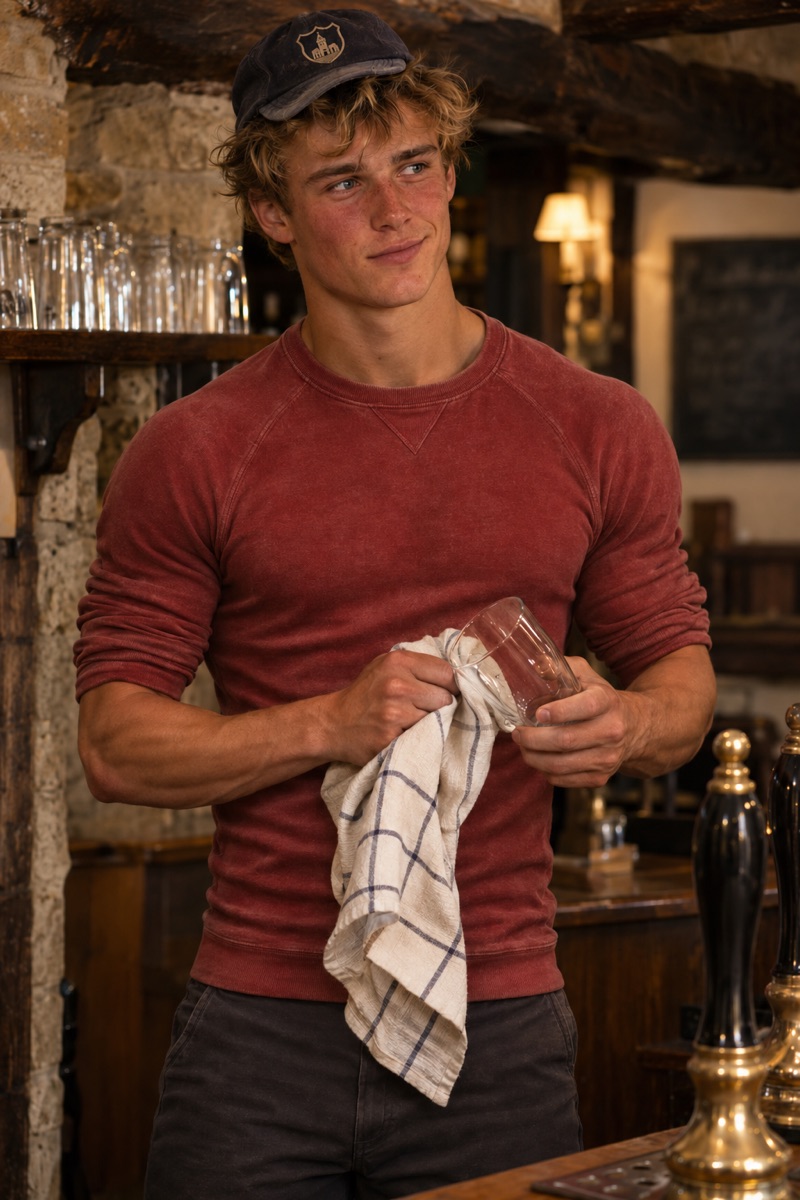
Jack Thomas Fennell (born 10 August 2012) is a character in Crown on the Potomac: the son of the landlady of the New Inn at Coln Saint Aldwyns, in Gloucestershire, who works behind its bar, bowls fast and wild for the village on Sundays, and has been the King's boyfriend since Bonfire Night 2030. He met Frederick on a footpath above the village in September 2030, took him for a lost American, and has called him Hanover ever since. He appears in Senior Year and Last Call, whose fifteenth chapter, Closing Time, is the first in the series told in his eyes.
Early life
Birth and family
Jack Thomas Fennell was born at the hospital in Cirencester on 10 August 2012, in a thunderstorm that stopped play across the county. He was named Thomas after nobody in particular; his mother liked the name. He was the younger of the two sons of Sue and Mick Fennell of Coln Saint Aldwyns, in Gloucestershire, three years behind his brother, Dan.
His mother came from Swindon. She arrived in the village at nineteen to work behind the bar of the New Inn, and stayed; by Christmas 2030 she had been “running this pub for twenty-two years” (Senior Year, Chapter Fourteen). Senior Year first describes her as short, solid and fair-haired, about fifty, with her sleeves rolled up, her reading glasses pushed into her hair and “a voice that could have stopped a tractor” (Senior Year, Chapter Eight). She runs the choir at the church of St John the Baptist as well as the pub, and has won the village pancake race on Shrove Tuesday every year since 2014, with a cast-iron pan nobody else is allowed to touch (Senior Year, Chapter Nineteen). Her word for her son is “love”.
His father, Michael Fennell, known as Mick, drives the 860, the green and cream single-decker between the village and Cirencester. He is “a heavy, grey-haired man of about sixty” in a short-sleeved shirt with a badge on it, who greets his regular passengers by name, asks after their fathers and their ewes, and announces the fares to strangers with a rider: “no change for twenties, and don’t put your feet on the seats, I’ve just done them” (Senior Year, Chapter Five). He has held a licence to drive a coach since 1993 and never used it until June 2031, when he asked to drive the class’s leaving-day coach to London (Senior Year, Chapter Thirty-Three). He plays the guitar, and the folk music Jack grew up with was his. He has kept a scrapbook of the King since Frederick was born, and expects his younger son to inherit it without interest: “he won’t care, he doesn’t care about any of it, he thinks I’m daft” (Senior Year, Chapter Five). Jack was not a royalist. That, in the family, was his father’s department. Sue and Mick have been married for thirty years, and still argue about the jukebox.
Mick’s own parents died when he was small, and he was brought up by his grandmother, Edith Haverfield, and her husband, whom the family called Nan and Grandad. Mick’s mother had been their daughter. Mrs Haverfield is therefore Jack’s great-grandmother, and Jack, like his father, has always called her Nan. In January 2031 it was “a Mr Michael Fennell. Grandson” who applied for the King’s card for her hundredth birthday (Senior Year, Chapter Twenty-Eight).
Nan
Mrs Haverfield was born in 1931. She was twenty when a car stopped in the lane by the church in 1951 and Ernest IV leaned out of the window to ask her the way to Bibury, which she has told every week since. “There was a little boy in the back of the car. In a sailor suit. He waved. I didn’t wave back.” (Senior Year, Chapter Five). She has watched the lane from the churchyard wall for eighty years, and the family’s history is the lane’s: her brother went up it “in 1938 with a suitcase to Oxford, and come back down it in 1939, and go up it again in uniform, and not come back” (Senior Year, Chapter Twenty-Eight). Her sister is the only competitor whose pancake ever went into the river at the bridge, in 1971. “She went in after it,” Sue Fennell said. “We don’t talk about it.” (Senior Year, Chapter Nineteen). She won the pancake race too: “Nan won it every year from 1958 to 1989,” Jack said, and would still be winning it “if she could run” (Senior Year, Chapter Nineteen). She is usually to be found on the churchyard wall, watching the village, with her small elderly dog, Ernest, who is “eleven years old and he’s got three teeth” and once ate a whole Christmas cake, foil included (Senior Year, Chapter Four).
Jack walks Ernest. In his father’s words, “He walks Nan’s dog every day. Up to Ready Token and back” (Senior Year, Chapter Five), the crossroads on the wold above the valley, and he lets him off the lead, which he is not supposed to do, because Ernest goes for rabbits. Jack is Nan’s favourite, which she has never said, and she calls him Jack, as everybody does. She has known him on her floor all his life. “You used to sit exactly there and eat the coal,” she told him in May 2031, when he sat down by her fireplace at eighteen, and then, as she had once said to his father on the 860: “Sit up. You still look like a pudding.” (Senior Year, Chapter Twenty-Eight).
Her judgement of him, given to the Queen of Sweden over tea that afternoon: “He’s loud and he’s daft and he can’t sit still and he’s never read a book. And he’s a good boy.” The part about books was wrong, and Jack, on the floor, did not correct it.
He had never seen her cry: “Not at Grandad’s funeral. Not when the dog before Ernest died.” The first time was at a school play in April 2031 (Senior Year, Chapter Twenty-Three).
Her hundredth birthday fell on Saturday 17 May 2031, the day of the village fete, and the village had been preparing for it since January while she sat on the wall and said I’m not having a fuss, and, if anybody mentioned the hundred, it’s a Saturday (Senior Year, Chapter Twenty-Eight). Gaz and Little Rob painted the banner. The collection’s present, a new dark blue coat, waited in a box under the bar of the New Inn. Mick found a 1949 open car of the same model as the one that had come down the lane in 1951, and drove it eight miles from Cirencester at a walking pace, with the 860 behind it, to collect her from her green front door at number nine Church Lane, wearing “his grandfather’s tie, which Jack had worn to London and given back”. Jack spent the afternoon on the floor of her front room in his red sweatshirt, with Ernest asleep across his feet, and afterwards helped his father carry the trestle tables back into the pub.
Home
Until he was about twelve the family lived in the flat over the New Inn. His earliest memory is of being asleep on the bench under the pub’s dartboard. They then moved to the Fennells’ cottage on the Bibury road, where Mick’s old brown car, bought in 1998, was retired to the end of the garden under a tarpaulin with a family of mice (Senior Year, Chapter Sixteen). His room there is tidy, which nobody believes.
The village
Coln Saint Aldwyns is a stone village in the valley of the Coln, below the wold, with a green, a war memorial where the 860 stops, the church of St John the Baptist with the cricket field behind it, the New Inn, and “a shop that was also the post office and was open when Mrs Dunning felt like it” (Senior Year, Chapter Four). Jack grew up knowing all of it and everybody in it, and could explain any of it at length. On the walk on which he met Frederick, in September 2030, he told the lost stranger about the bullocks of old Mr Purvis, who was ninety and had once fired a shotgun at a hot-air balloon, and who took the sign off the footpath across his field in 1994 so that “every year about four people go up it and get chased by Purvis’s bullocks and come out at Ready Token”. He was careful to say that the village was Coln Saint Aldwyns and not Coln Abbey: “that’s just the school”. The vicar, the Reverend Alan Prothero, was an Army chaplain for twenty-two years and builds the village bonfire (Senior Year, Chapter Ten).
Dan
Dan Fennell, born in 2009, is a soldier in the Royal Engineers, posted to a garrison in England that he is not allowed to name, and home most weekends. He and Jack are close in the way of brothers who never say so. Dan does not appear in either book. He knows about Frederick, and Jack does not know that he knows. They have not yet met.
School
Jack went to the village primary school, which had nineteen pupils, and then to the comprehensive in Cirencester, riding there every morning on his father’s bus. His best subject was geography. His worst was spelling, in every subject and ever since. His text messages are spelt as they sound: “walkd ernest the hole fotpath”, he wrote in June 2031 (Senior Year, Chapter Thirty-Six). A PE teacher at the comprehensive made him bowl properly.
He read, secretly, a great deal. He read history, in fat paperbacks borrowed from the library in Cirencester, and kept quiet about it, because the boy who could not spell was not supposed to read. Even Nan did not know.
He took A levels in geography, history and PE, and finished them in the summer of 2030, two months before he turned eighteen. He was offered a place to read history at Durham, and turned it down, which shocked the school. In June 2030 his mother had an operation on her back. She was back behind the bar of the New Inn by October, but forbidden to lift, and Jack stayed at home to do the cellar, the barrels and the heavy work. That September he met Frederick.
He had been abroad once, on a school trip to France, and was sick on the ferry. He had never been on an aeroplane before 2031, and said so when he was given a ticket for one: “I’ve never been on an aeroplane. I’ll be sick. I’ll hate it.” (Senior Year, Chapter Thirty-Two).
At eleven, on a dare, he climbed the tower of St John the Baptist and could not get down again. He has been afraid of heights ever since, and regards the church tower as a personal enemy.
Coming out
He came out at fifteen, to his mother first, behind the bar of the New Inn after closing. The village mostly shrugged. One regular stopped coming in, and after a while came back.
The summer he was sixteen, an older lad who played for a visiting side, and drank in the New Inn after the match, became a friend, and the friendship very nearly became something more: one kiss behind the pavilion, and one night that both of them have since pretended did not happen.
The New Inn
The New Inn at Coln Saint Aldwyns has been the New Inn since 1632. “That’s new,” as Jack explained to Frederick, “round here” (Senior Year, Chapter Four). It is a stone pub with low black beams, a fire, a dartboard, a jukebox and a stone floor worn into dips in front of the bar, on the corner the 860 comes round on its way to Cirencester. Jack has worked in it, in one way or another, for most of his life.
Behind the bar
He started collecting glasses at twelve. At fourteen he first stood behind the bar on a Friday night, “on a crate, because he was not tall enough yet to see over the pumps”, and watched his mother call time: “time, please, ladies and gentlemen”, in a voice “exactly loud enough and not one bit louder” (Last Call, Chapter Fifteen). He has loved last call ever since. He pulled pints from fourteen, under his mother’s eye.
He is good at it. What he is best at is remembering: everybody’s drink, and the name of everybody’s dog. He has carved at the New Inn’s Christmas since he was fifteen. At sixteen, on a winter Saturday when the staff were snowed in, he served a whole wedding party on his own, and the regulars still tell the story. Of everything he has done, it is the thing he is proudest of.
Senior Year first finds him behind the bar on a Friday night in October 2030, “in a black T-shirt with NEW INN on the front in faded white”, with a cloth over his shoulder and a pint glass half dried in his hand (Senior Year, Chapter Eight). When he is thinking, he dries a glass that is already dry. His mother runs the village through the bar, and manages her son as she manages the room. She introduced herself to the American visitors that night, “Sue Fennell. This is my pub,” and added: “Nobody calls me Mrs Fennell except the brewery and the vicar, and I don’t like either of them.” Her rule for anybody under eighteen in her pub was the law’s, stated more firmly: “it’s lemonade or a Coke or a squash and nothing else”. When he shouted across the bar that night she took him by the ear, “not hard, the way you would take a dog by the collar”, and said “Inside voice, Jack”, and a few minutes later, as he went on grinning: “Glasses, Jack.”
After his mother’s operation in June 2030 the heavy end of the pub became his: the cellar, the barrels, the deliveries, and anything that had to be lifted. Off duty, he drinks a pint of the local bitter, usually. His favourite food is his mother’s Sunday roast at the pub. His favourite place is the pub’s back step after closing.
The New Inn has a cat, Barley, a ginger cat who belongs to nobody, lives at the pub, and most nights follows Jack home up the Bibury road to sleep on his bed.
The year of the Americans
From September 2030 the New Inn was where the American class at Coln Abbey School spent its evenings, and its year was unlike any other in the pub’s history. Before the exchange Jack had thought Americans loud, which he respected. On their second evening he stood on a chair and announced to the whole pub that they would be taught to play cricket properly and then, in May, slaughtered on the green; one of them stood on hers and announced the same about baseball (Senior Year, Chapter Thirty-One).
At Christmas the pub put up the King’s family, with the Duke in the room over the door, and served Christmas lunch for nine at the long table by the fire, “which Sue Fennell had pushed together out of four smaller ones”, while Sue herself never sat down (Senior Year, Chapter Fourteen). In January, with the school shut by snow, the King held a meeting of the Privy Council standing round a small table in the beer cellar, among the barrels, while through the wall his councillors could hear Sue putting the chairs down in the bar and “Jack singing something with no tune to it at all”; at item nineteen she knocked on the door. “I’m not having the brewery in at twelve and a Privy Council in my cellar. Ten minutes.” (Senior Year, Chapter Sixteen). On Shrove Tuesday the pancakes were made in the New Inn’s kitchen, and in May the pub held the King’s eighteenth birthday party, with Jack behind the bar all night (Senior Year, Chapter Twenty-Seven).
The end of the bar
His two oldest friends sit at the end of the bar, on two stools they have occupied “since they were legally allowed to, and possibly before” (Senior Year, Chapter Eight). Gary Pike, called Gaz, is very tall and very thin, with ginger hair and “a face like a sad horse”, a plumber’s apprentice, and Jack’s best mate since primary school; he says everything in “the tone of a man reading out the weather”. Little Rob is very short and very wide, with no neck at all. Both have known Jack since they were four, both play cricket for the village, and both have entered the pancake race every year since they were sixteen without ever finishing it (Senior Year, Chapter Nineteen).
There is a story about a goat, which Gaz and Little Rob deny. “There was a goat,” Jack told Frederick, “and I’ll tell you about it another time” (Senior Year, Chapter Eight).
Other work
The pub is his work, but not the whole of it. On Saturday mornings he works at the bus company’s garage on the edge of Cirencester, “sweeping and fetching and handing things to the mechanics” in a long corrugated shed with a pit under the floor, alongside an old mechanic called Dennis who has been there forty years (Senior Year, Chapter Sixteen). He is handy with engines. Over Christmas 2030 he got his father’s retired car running again, which took “eleven days and two new parts and a great deal of language”, and his mother came out into the garden twice to object to the language.
He drives his mother’s car, when she lets him.
Cricket
Jack plays cricket for Coln Saint Aldwyns, whose ground is the field behind the church, with a pavilion, a scoreboard and a long cage of outdoor nets along one side that comes down in October; in the winter the club uses the indoor nets in Cirencester (Senior Year, Chapter Eight). The captain is Mr Ellis, a farmer, who in October 2030 had led the side “for nineteen years”, and who stands at the crease in a white sweater “like a heron”.
Learning the game
Mr Ellis taught him to bat from the age of six, to bring the bat “down and through, straight, the way Mr Ellis had taught him since he was six” (Senior Year, Chapter Thirty-One). He played junior cricket for the club, and his first cap, a navy one with a church tower on the badge and J. FENNELL. U11. written inside the band, is the one he gave away in 2031 (Senior Year, Chapter Thirty-Four). He first played for the village side at thirteen, filling in when they were a man short, and has played for it on Sundays ever since. A PE teacher at the comprehensive took his bowling apart and made him do it properly.
Bowling and batting
He is a bowler first. “He played cricket for the village on Sundays. He bowled.” (Senior Year, Chapter Four). He bowls fast and wild and occasionally unplayably, and by his own account bowls less than he used to.
His batting has the reputation of swinging at everything, out or six, and he does little to correct it: “I bowl, mostly. I’m not supposed to be able to bat,” he told the Prime Minister of Great Britain, Alistair Rennie, on the green on 31 May 2031, after hitting three successive balls of Rennie’s over the pavilion in the nets. “Three sixes. Off the Prime Minister. In a row,” said Rennie (Senior Year, Chapter Thirty-One). “You’re not going to arrest me?” said Jack. “I’m going to buy you a pint,” said Rennie. “After. If you’re old enough.” It was the match Jack had promised the pub in September, twenty overs a side on the green in front of two hundred people, with the King umpiring both games at the request of both sides (“Because you’re the King,” Jack had said, at the bar). In it, playing for the village and the English form against the American class, he made forty-one of the English side’s hundred and twelve before Lucía caught him one-handed on the boundary, running backwards, and he bowled the last over. With six needed off two balls he bowled Theo Hartigan, who could not bat and had blocked for an hour and a quarter, a good ball, “full and straight, at Theo’s feet”, and Theo hit it, and the last one, for four, and the Americans won.
In the baseball match after tea he hit everything as if it were a cricket ball, straight and along the ground, for four home runs, and the English won by eleven. “That’s not how you HIT,” Lucía shouted, at shortstop. “It is now!” shouted Jack, rounding third.
Teaching
From the first afternoon he knew Frederick, Jack meant to teach him to bowl, and in October 2030 he began, in the nets behind the church; that, and the match against Bibury on Jack’s nineteenth birthday, are told below.
Following it
He watches Test cricket on the television with the sound off and the radio on. Outside cricket he follows Cirencester Town, faithfully.
Frederick
The footpath
Jack met Frederick on Wednesday 4 September 2030 at Ready Token, the crossroads of four walled tracks on the wold above the village (Senior Year, Chapter Four). He was walking Mrs Haverfield’s terrier, Ernest, whom he had let off the lead, as he always did, and Ernest found Frederick first: one of the American pupils from Coln Abbey School, lost after following a footpath from the church that, Jack explained, was not a path at all. Jack took him for an ordinary exchange student (“You’ve got an American coat”) and offered to walk him back.
He talked for the whole mile and a half: about old Mr Purvis’s bullocks, about Ernest, about the village, and above all about cricket, which Frederick had never seen played. Asked his name, the boy said Frederick, and Jack asked, “Frederick what?” He was told “Hanover”. “Hanover?” said Jack. “Like the King?” He said it with sympathy, told him about a boy in Cirencester called Tom Windsor who had the same trouble, and settled the matter at once: he was not calling anyone Frederick, because “you sound like a butler.” By the gate above the school he had promised to teach him to bowl, and told him he would be rubbish.
In the lane on the other side of the gate Kimura was waiting. Asked who she was, she said she was with him; asked how, she said “Professionally”. It took Jack about three seconds to connect the name, the woman and the face on the coins in his pocket. “Oh, bloody hell,” said Jack. He went red to the roots of his hair, listed the things he had said, and was told by Frederick that he had not minded. Then the grin came back, and Jack asked for the one thing he wanted to keep: “Still Hanover, though.” He went off down the lane with the dog and, at the corner by the churchyard, turned round and shouted “NETS! NOVEMBER! YOU’LL BE RUBBISH!” loudly enough to put the wood pigeons up out of the trees.
He did not tell his father. Mick heard it from Frederick on the 860 the following week and could only say, more than once, that Jack had never said (Senior Year, Chapter Five).
October
Frederick first came into the New Inn on Friday 11 October, and Jack greeted him from behind the bar with “HANOVER!”, at a volume that made the card players drop their cards, and then “You came!”, until his mother took him by the ear and told him to use his inside voice (Senior Year, Chapter Eight). Gaz and Little Rob, at the end of the bar, told Frederick that Jack had been talking about him since September. Jack denied it, went red, and silenced them by threatening to tell Hanover about the goat, a story Frederick was never told.
On the Sunday morning Jack stood at the back of St John the Baptist’s in a clean shirt while Frederick sang bass in his mother’s choir, having very obviously come to church for the first time in about eleven years. From that Sunday on he went at Christmas, at harvest and to funerals. That afternoon, in the outdoor nets behind the church, with Mr Ellis batting, he taught Frederick to bowl. After an hour and about sixty balls, four of which reached the batsman, he took the ball back and gave his verdict: “You’re properly rubbish.” Then the grin came, and he asked, “Same time next week?” He had known what he wanted since the lane in September; the nets made it worse.
At Halloween he was behind the bar in a pair of devil’s horns, ladling punch out of a cauldron, and picked Frederick out of a crowd of Americans in sheets at once (Senior Year, Chapter Ten). “You walk like you’re on a carpet,” said Jack. “Even in a sheet.” His mother, by then, already knew (Senior Year, Chapter Eighteen).
Bonfire Night
On Tuesday 5 November, the night before Frederick read his first Speech from the Throne, the vicar lit a bonfire on the cricket field and the village set off fireworks over the church tower (Senior Year, Chapter Ten). Jack found him in the crowd, stood beside him for a while in silence, and then took him round to the back of the fire, to the place where he had gone every year since he was about six to watch the fireworks shake through the heat.
It was Frederick who kissed him, and then apologised. Jack’s face, for the first time in their acquaintance, did nothing at all. Then he said, “You. Did that. First.” He had been working up to it since September, he said, with a plan to do it at the nets, then at the pub, then there, where he had brought him to do it, and had stood for ten minutes failing to. He told Frederick to stop saying sorry and called him properly rubbish. “Do it again,” said Jack. “Properly.” They came back round the bonfire twenty minutes later, separately, one on each side. Kimura, at the edge of the field, was looking at the fireworks.
Castellanos’s questions
After the Remembrance service on Sunday 10 November, Castellanos came into the New Inn, which he did not usually do, bought two pints, and had Jack come round the end of the bar (Senior Year, Chapter Twelve). Frederick watched from the table by the fire and could not hear a word. Jack told him afterwards, by the churchyard wall, that there had been three questions. The first was whether he knew who Frederick was: “not the King. Who he is.” The second was whether he would ever tell anybody, and Jack said no: “Not ever. Not unless you said.” The third was whether he liked him.
“I said obviously,” said Jack.
The last question Castellanos ever put to him on the subject, some time afterwards, was shorter: “Do you know what you’re doing?”
Christmas
The Duke and the Queen spent Christmas 2030 at the New Inn, and Jack, eighteen and in a borrowed tie, sat at the long table for Christmas lunch with his father, who could not eat for the first half of it (Senior Year, Chapter Fourteen). When the Duke teased Mick about the 860 being late, Jack pointed his fork at the old King and argued that trains were late too, “because of leaves”. The argument that followed was what finally let Mick pick up his knife and fork, and the Duke was still using it in May. When the Duke stood and gave the longest sentence he had managed in two years and three months, a toast to the people who had sat with him while he learned to read the trains again, Jack was the one who answered it, standing at the end of the table with a glass of lemonade: “To the people at the end of the table.”
At three the village crowded into the pub to watch the King’s Christmas broadcast on the television over the fireplace, without once looking at the table where the King was sitting. At the end of it Jack, at the bar between Gaz and Little Rob, cried, because he had heard the voice he knew in the voice the country knew. He told the pub he had something in his eye. The whole pub said, “Course you have, Jack.”
At ten that night, at the bus stop by the war memorial, he gave Frederick an Ordnance Survey map of the wold with the walk from the churchyard to Ready Token drawn on in red biro. At the stile it said NOT A PATH. A LIE., at the crossroads YOU WERE HERE., and at the gate above the school HANOVER. “So you never get lost again,” said Jack. Frederick gave him a cricket ball from a box of second-hand things on a Cirencester market stall, inscribed Coln St Aldwyns v. Bibury. 1951. 6 for 11., the year the King’s grandfather had asked Nan the way to Bibury. Jack held it up to the light, read it twice, and hugged him for a long time with the ball in his fist, without saying anything.
Ready Token
On Boxing Day, with snow on the wold, Jack made Frederick lead the way along the red line to Ready Token (Senior Year, Chapter Fifteen). He went up every Boxing Day that it snowed, which had happened four times in his life; his father had first carried him up on his shoulders at three. At the crossroads he asked the question he had been carrying. “What is this,” said Jack. He knew what he wanted it to be, he said, and had known since the lane, but he did not know what a King was allowed, or whether it was only for the year.
Frederick told him he did not know what it was either, but that there was no rule: he had asked his mother in October, and she had said there was a rule about whom a King might marry and none about whom he might like. He said he did not want it to be just the year. That was all Jack had wanted to hear. “We don’t know, Ernest. Neither of us. Isn’t that good?” On the way down he hit the King of fourteen countries in the side of the head with a snowball, and was caught at the gate and had a double handful put down his collar, while Kimura, somewhere in the trees, gave it a seven.
Winter
In January Jack taught Frederick to drive, on Saturday afternoons, in Mick’s brown car of 1998, which had spent six years under a tarpaulin at the end of the garden behind the Fennells’ cottage on the Bibury road and which Jack had brought back to life over Christmas in eleven days (Senior Year, Chapter Sixteen). Kimura followed forty yards behind and held up a mark on a piece of card at the end of each lesson: two, then three. At the end of January she gave Frederick nine, then turned the card over and gave Jack ten, “For teaching the King of fourteen countries to drive on the left in a car with mice in it”. Some time later she gave Jack a seven for his own driving, once. He keeps it on a beer mat.
On the first Saturday in February he took Frederick to the bus garage in Cirencester where he worked on Saturday mornings, put him in a pair of orange overalls six inches too short, and had him hold a lamp under the 860 in the pit while he found the bolt that had been rattling in its gearbox since November. An old mechanic asked where he had found this one. Jack said on a footpath.
On 14 February four mail sacks of valentines, two thousand and some, arrived for the King at Coln Abbey (Senior Year, Chapter Eighteen). One more was propped on his desk, delivered by hand and addressed in blue biro to HANNOVER, with two Ns. It was a card with two sheep on it, saying EWE ARE MY VALENTINE, and inside it said ROSES ARE RED / VILOETS ARE BLUE / YOU ARE RUBISH AT CRICKET / THIS CARD IS ANNONYMOUS, and, after a gap, X. Of all the cards that came that day it was the only one spelt wrong, which delighted him. Frederick pinned it to the wall beside the map.
That half-term Theo’s sister Kate worked it out in five minutes from the way Jack put a plate down and said “there you go, Hanover”. By then the village had known for months and said nothing. Mrs Haverfield had known since September, his mother since Halloween, and Gaz and Little Rob, Frederick said, before he did.
Telling his father
During the lambing at the Ellises’ farm Frederick sat up all night in the shed, and at two in the morning Jack came through the door with a flask of his mother’s leek and potato soup, uninvited, having heard through Gaz, who had heard from Little Rob, whose mother did the Ellises’ books (Senior Year, Chapter Nineteen). Frederick had pulled a lamb, which Jack had never done, and told him it was like the Speech from the Throne. “That’s the daftest thing anyone’s ever said to me in my life,” said Jack, and put his head on Frederick’s shoulder and asked to hear the Speech from the beginning.
He told his father on Sunday 16 March, in the kitchen of the cottage on the Bibury road, not as he had planned (Senior Year, Chapter Twenty). Mick, coming in off the last run, asked as he had asked as a joke since Christmas whether “your Hanover” was going to London again, and Jack said, “yeah, Dad, he is my Hanover, actually”. His father sat for a long time with one shoe off, and then asked whether Frederick was still coming back for the cricket in August, said “right”, put his other shoe back on and went out to the shed for twenty minutes. Nan rang the house at eleven that night, which she never did, to tell Mick she had told him so in September.
Jack rang Frederick at half past eleven on the telephone in the school’s porters’ lodge to tell him. Frederick had told his own parents two days earlier, in London, and his father had found one word for it. “My dad said loud,” said Frederick, and Jack laughed so loudly that Frederick had to hold the receiver away from his ear.
Easter
In the first week of April Frederick played Bottom in the school’s A Midsummer Night’s Dream in the tithe barn, and Jack sat in the second row beside Mrs Haverfield, holding the programme in both hands without opening it (Senior Year, Chapter Twenty-Three). Nan cried, which he had never seen her do, “Not at Grandad’s funeral”. He opened the programme afterwards outside the barn, found F. HANOVER in the cast list, buttoned it into his coat to keep, and said he was coming to both of the other nights.
At Easter the German Emperor, Alexander, came to Gloucestershire with his friend Lukas Brandt, and Jack took them both to the indoor nets in Cirencester, where Alexander read the laws of cricket as a problem in levers and took Mr Ellis’s middle stump with his first ball (Senior Year, Chapter Twenty-Five). Jack had spent six months failing to teach Frederick the same thing. “I hate him,” said Jack, with tremendous warmth. “I absolutely hate him. Can he come back next year?”
The next night Lukas carried his telescope up onto the wold at midnight and showed them Jupiter and its four moons. Jack looked for a long time, worked out in his head that it had been four hundred and twenty-one years since Galileo, and said that he had been up there at night a hundred times and had never once looked. “Nobody ever showed me.” Lukas, who said one thing an evening, said, “Now somebody has.” On the walk down Alexander, watching Jack lead the way in silence, said in German that he was only quiet when something mattered.
The eighteenth
Frederick turned eighteen on 2 May 2031, and the party was at the New Inn, with his parents, Mrs Haverfield, his class and the whole village (Senior Year, Chapter Twenty-Seven). The cricket team gave him the worst bat in the club, signed by the first eleven. Jack was behind the bar all night, pulling pints and saying “there you go” to everybody, and did not once sit at the table.
At ten Frederick found him in the yard behind the pub, by the barrels, not stacking a crate of empties. It was the first time Jack said aloud what the secrecy cost him. He had kept the sort of rule that everybody kept, he said, since November, and was good at it, “And I didn’t know until tonight how much I mind.” He was tired of being the thing Frederick went round the bonfire to: “I want to be in the room.” Frederick told him he was right, and that he did not yet know what to do about it, and Jack told him that was not good enough and went back inside.
On the bank holiday Monday the village morris side was a man short, and Jack, who had not spoken to Frederick since the Friday, walked across the green and handed him the bells, the hat and two handkerchiefs: if he wanted to know what happened when he stopped hiding, “That’s what happens.” Frederick danced, badly, in front of everybody, and at the end of it walked across the whole width of the green and stood beside Jack, shoulder to shoulder, facing the village. “It’s a start,” said Jack.
London
On Saturday 10 May Jack came to London for the first time in his life, on the 08.21 from Kemble, in his father’s suit and Grandad’s tie, because the Duke had asked to meet him properly (Senior Year, Chapter Twenty-Seven). The Duke met the train at Paddington, told him it was four minutes late and that trains were never late, and walked off. Jack realised he had been waiting since Christmas to do it. “I love him,” said Jack, with great simplicity, and went after him up the concourse at a jog.
They argued about the Underground all afternoon, a train in a hole by Jack’s account, until, kneeling at the round window under the Palace roof where the Duke had watched the trains at six, Jack told him that at six he had watched the 860 come round the corner by the pub from Nan’s window in Church Lane, every day at four. After a long pause the Duke allowed that buses were fine too.
That night the two of them let themselves out through the mews in their socks and found a basement bar in Soho under a painted moon (Senior Year, Chapter Twenty-Seven). Jack was served a pint. Frederick, with no identification of any kind, was given a lemonade; the barman only realised whom he had refused when he looked at the face on the five-pound note he had paid with. Castellanos and Kimura, off duty in the corner, came over, and Castellanos bought the King his first whisky. Frederick said it was horrible, and Jack was delighted: “It’s whisky. It’s meant to be horrible.” Jack had three pints, told Castellanos about the goat, and made him laugh out loud, which Frederick had never heard him do. On the pavement at closing time Jack took Frederick’s face in both hands and kissed him in the street, in front of two sergeants of the protection detail, and said that was all he had wanted: “I’m in the room.”
May
On 17 May the village kept Mrs Haverfield’s hundredth birthday, and afterwards Jack sat on the floor of her front room with Ernest across his feet while the Queen poured him a cup of tea (Senior Year, Chapter Twenty-Eight). He was terrified of the Queen, she knew it, and she enjoyed it; he said “ta”. Nan gave the Queen her verdict on him while he sat there (see Nan).
On 20 May he sat in the ballroom at Buckingham Palace in Grandad’s tie while his father received a medal for services to rural transport in Gloucestershire, and watched the King give it to him (Senior Year, Chapter Twenty-Nine). On the bank holiday he went down Cooper’s Hill after the cheese beside Frederick, his fifth time, so that Frederick would not go down alone, and sat up at the bottom with a bloody nose asking whether he had got it (Senior Year, Chapter Thirty).
On 31 May he played in the match on the green that he had promised the pub in September, with Frederick umpiring (see Cricket).
The ticket
On Tuesday 3 June, the last evening walk before the class went home, Jack let Frederick lead along the red line to Ready Token, and at the crossroads asked again what it was (Senior Year, Chapter Thirty-Two). Frederick gave him an envelope. Inside was an aeroplane ticket in the name of MR J. FENNELL: Heathrow to New Westminster on Monday 11 August 2031, and back on 25 August. It was Frederick’s present for Jack’s nineteenth birthday, given early. Frederick was still coming back for the cricket on the tenth, he said, and they would fly out together the next day; it was a return, so it was Jack’s choice.
He still did not know what to call it, he said, but he knew it was not just the year: “It’s not over.” Jack pointed out that this was two words. “Properly rubbish,” said Jack, very softly. “At words.” He said he would take the ticket, that he had never been on an aeroplane, that he would be sick and would hate it, and that he would come. They watched the sun go down from the wall at Ready Token. At the gate above the school he told Frederick he would be on the Mall on Saturday with a flag, kissed him, and went home down the lane without turning round to shout, lifting one hand at the corner without looking back.
Leaving
After the leavers’ ball on the night of 5 June the sixth form went up to the top field to watch the sun rise, and Jack, told separately by five of Frederick’s friends to be there, was already sitting at the end of the wall in his red sweatshirt and work boots with Ernest asleep at his feet (Senior Year, Chapter Thirty-Three). When the sun came up Frederick put his hand on Jack’s on the wall, and sixty people along it, without looking, raised their hands. “Room,” said Jack, very quietly. Later that day, when Ernest got onto the class’s coach at the war memorial and would not get off, Jack carried him off in his arms and called up the steps to his father that he would see them at Heathrow on Sunday: “I’m not saying goodbye now. Not here. Not with Ernest.”
On Saturday 7 June he stood on the Mall for Trooping the Colour with a Union flag on a pole, bought for twelve pounds, which he waved for three and a half hours (Senior Year, Chapter Thirty-Four). As the Colour passed the saluting base and a hundred thousand people went silent, he shouted “HANOVER!” at the top of his voice, and then, a beat later, after Lucía hit him with her programme, “Sorry! Sorry. Sorry.” He said afterwards that it had been so quiet that it came out.
On Sunday 8 June he rode in the front seat of his father’s coach from Paddington to Terminal Five and did not look round. At the kerb he got off first and held out his cricket cap: navy, gone grey at the peak, with the badge of the village club and, inside the band in old marker pen, J. FENNELL. U11. Frederick put it on. It had been made for a boy of eleven and sat on top of his head like a saucer. Jack straightened it a quarter of an inch, said nothing at all, and got back on the coach; his father told the King “August”, and drove away. “He’s only quiet when something matters,” said Theo, on the pavement. Frederick did not take the cap off.
The Realm
The summer of 2031
From Terminal Five on 8 June to the cricket on 10 August, Jack and Frederick were four thousand miles apart. Jack rang every night at the New Inn’s closing time, which was half past five in the afternoon in New Westminster, and in between he texted, in his own spelling. At the end of June he walked Ernest the length of the footpath from Ready Token to the school and back, and reported it in a single message that ended with a count of the days left and “dont be rubish” (Senior Year, Chapter Thirty-Six). Frederick wrote back that “footpath” had two Os. The answer came in under a minute, “knew youd say that”, and a minute after it, on its own, the number again.
The cricket on the tenth
The village side’s match against Bibury fell on Sunday 10 August 2031, which was Jack’s nineteenth birthday. Frederick had promised at the crossroads in June that he would come back for it: “I’m still coming back for the cricket. On the tenth.” (Senior Year, Chapter Thirty-Two). He did. He watched from the back of the ground, by the sight screen, in the cap Jack had given him at Heathrow two months before, the navy under-11s cap with J. FENNELL. U11. inside the band, which had been made for a boy of eleven and sat on top of the King’s head rather than on it. It fooled nobody. The village won by four runs, and Jack took five wickets.
His birthday present had come early. The ticket Frederick gave him on 3 June, made out to MR J. FENNELL, ran from London Heathrow to New Westminster George Washington International on Monday 11 August, the day after the match, and back on Monday 25 August (Senior Year, Chapter Thirty-Two). Jack had never been on an aeroplane, and had said so when he took it: “I’ve never been on an aeroplane. I’ll be sick. I’ll hate it.” Ten days after the match, at the bar in Giligin’s, he thought Frederick looked “happier than Jack had ever seen him, including Bonfire Night, including the cricket” (Last Call, Chapter Fifteen).
New Westminster
The flight on 11 August was the first of his life. The capital was larger than anything he had seen, and he was lost twice on his first day in it. Theo’s father, Peter Hartigan, was at the airport, and was, in Jack’s later account, “the kind of man you say how do you do to and not anything else” (Last Call, Chapter Nine). With Theo’s mother, Anneliese, he got on at once: two people who run rooms, recognising each other across one. Theo he called Milwaukee.
He had brought something with him that he meant to say, and he could not find a room to say it in. At the airport there was Theo’s father, and in Frederick’s kitchen at Columbia Palace there was Dame M. By the time he said it, he had been “carrying it round for nine days like a library book” (Last Call, Chapter Nine).
Phoenix
On Monday 18 August the King flew to Phoenix for a day of engagements on Theo’s eighteenth birthday, and Jack went with him. Frederick slept on the aeroplane with his mouth open, and Jack photographed him, by his own account “for later, for leverage” (Last Call, Chapter Nine). He came out of the arrivals hall at Sky Harbor the colour of skimmed milk (Last Call, Prologue).
On the Tuesday morning he sat in the back row of the dignitaries at the opening of the City of Phoenix’s new water treatment works, at the end, in a suit of Frederick’s that Theo had taken in at the waist with safety pins, beside Jeff from the Salt River Project. He burnt in eleven minutes, and Frederick timed it (Last Call, Chapter One). Walking the tanks, he asked Jeff what August was in proper degrees, was told about forty-two, and after a long silence offered the comparison: “August is twenty-two and a shower.” At lunch he ate three enchiladas and went quiet, and then a different colour under the sunburn, and went outside.
In the afternoon he looked at the city heat crew’s ice bath “with a longing that was painful to watch” (Last Call, Chapter Two), and back at the Arizona Biltmore he got into the bath in the King’s suite fully dressed, turned on the cold tap and lay down in it, announcing that he was never getting out. He was still in it when Theo produced the transit card with the cactus on it, and laughed until the water went over the edge onto the floor. He loved Phoenix, and would not admit it. He kept a Biltmore pen.
At the reception on the lawn that evening he was the third of the five to leave, at a quarter past seven, and he did it as Theo had told him to, by announcing it to Kimura: “Excuse me, I’m just going to the gents, it’s the sun, I’ve gone a bit.” Kimura told him to drink some water (Last Call, Chapter Three).
Last Call
He was asleep on the bus by the second stop, having said he was only going to rest his eyes, and when Theo said “Happy birthday to me” to the window, Jack said, without opening his eyes, “Happy birthday, mate” (Last Call, Prologue).
At Castaways the barman looked at his British passport with interest, it being the first he had seen that week, and said “Gloucestershire.” Jack said: “Somebody has to be from there.” (Last Call, Chapter Five). In the quiz he wrote down “Phoenix” with tremendous confidence and underlined it twice, and when a woman at the next table told Frederick he looked like the King and Frederick told her the King was taller, Jack laughed into his pint until he had to put it down. The barman told Kimura afterwards that the English one had answered a cricket question from across the room (Last Call, Chapter Eight).
The wrong bus took them over the mountain to a turning circle in Ahwatukee. Asked what a cul-de-sac was, Jack said, “It’s a road that gives up.” He lay down on the concrete in front of a mattress shop, got up again because it was as hot as a plate, and addressed the sky: “In Gloucestershire when the sun goes down it goes. It leaves. It takes the heat with it, like a gentleman.” (Last Call, Chapter Six). It was there, he said later, looking at a closed-down nail bar, that he worked out what he wanted to do. A woman closing a pizza place drove them back north in her pickup, and Jack sat in the front because of his neck, with the air conditioning pointed at him.
At Boondocks the doorman gave him a green wristband and gave Frederick, who could not prove his age, an orange one. Jack looked from one to the other and said “Orange”, and then “You’re the King”, and Frederick said “Not on this patio”, and Jack laughed until he had to sit down on the low wall (Last Call, Chapter Seven). He stood under the misters until he had cooled, held both lemonades while Frederick danced with a stranger celebrating a promotion, and objected that nobody was filming it.
At DJ’s, at the end of the bar, turning an empty glass a quarter turn at a time, he said both of the things he had come to say (Last Call, Chapter Nine). The first was what he wanted to do: “This. A bar. Standing behind one. For forty years. Knowing everybody’s name and what they drink and when to put the water down.” He had been behind his mother’s bar since he was fourteen and had taken it for a thing he did while he worked out what he wanted; on the wrong bus he had understood that it was the thing. The second he had not said in England, because in England there had always been somebody: “Kimura by a drainpipe. Your dad. My mum. Mick with his scrapbook.” DJ’s was the first room he had ever been in with Frederick where nobody knew who Frederick was. He told him he loved him, which he had thought since Bonfire Night and never said, “because I didn’t know if it was allowed.” Frederick said it back. Jack said “Well,” and then “Good,” and wiped his eyes with the back of his wrist, once, and said “Christ” to the air-conditioning vent.
At Coach House he kept his hand flat on Frederick’s back while Theo opened his present, drank to the alphabet, and paid the bill with his card, pushing Frederick’s last five coins back across the bar with one finger (Last Call, Chapter Ten). He was the one who pulled Theo out of the door, at the moment the woman behind the bar was working out who had been sitting at the little table. In Old Town he was drunk “the way Jack was everything, loudly and kindly” (Last Call, Chapter Eleven), and when Alexander went missing he observed: “Everybody’s always here until they aren’t. That’s the whole problem with people.” When they found Alexander on the next corner, talking to a policeman, Jack, who had pulled pints for a policeman every Friday night of his life, stopped Frederick running up to them: “Walk. Like you’re bored.”
At Giligin’s he showed the doorman his passport and said, with enormous dignity, “Gloucestershire,” and then, because it had been a long night, “It’s near Wales” (Last Call, Chapter Thirteen). His spin of the Wheel landed on the top shelf, a twelve-year Scotch, which he toasted to Gloucestershire and pronounced “not the horrible kind.” Told that the Crow’s Nest on the roof was shut, he said “Shame” in the voice of a man who did not think it a shame at all, and looked hard at a fishing net. His mystery beer, a pound fifty with the label covered, turned out to be the lager on the left-hand tap at the New Inn: “Five thousand miles. A pound fifty. Covered over, so I wouldn’t know. And it’s the one I pull.” He called it the funniest thing that had ever happened to him (Last Call, Chapter Fourteen).
The last of the Giligin’s chapters, Closing Time, is told in his eyes, the first chapter of the series to be (Last Call, Chapter Fifteen). He had loved last call since he was fourteen, standing on a crate behind the New Inn’s bar to see over the pumps, and he watched the staff close Giligin’s with professional interest: the music down a notch, the empties taken and never the full glasses, the phones going back into pockets. He told Frederick to leave his last coin on the bar as a tip and not to hand it over, watched him set it down “exactly the way people put down a wreath”, and told him: “It’s a tip. It’s not the Cenotaph.” When the bartender put the coin in her pocket instead of the till, he said she was going to frame it. On the way out he stopped in the door to tell her, as one professional to another, that it had been a really good last call. “My mum runs a pub,” he said, and she said, “I could tell,” and he went out onto the plaza feeling as if he had been given a medal.
He was, he had worked out by then, the only one of the five who had ever been put out of a bar at closing time, and so the only one who knew that what you did next was stand on the pavement for a bit and then decide something stupid. In Kessler’s car, asked where they could hand themselves in, he said “Top of something,” meaning the hill above the village, which you can walk up in twenty minutes with a pint in your hand, and which he admitted to himself was “something more like a car park.” Lukas pointed at Camelback. Jack lay down again across the back row and said nothing at all. Through the back window, as the car left the plaza, he saw Kimura run up to the door of Giligin’s three minutes after they had come out of it, and hoped somebody would get her a water.
He fell asleep on the kerb at the Echo Canyon trailhead at a quarter to four with his head on Frederick’s shoulder, and when he was woken and shown the mountain he observed that in Gloucestershire “we have hills you can walk up” (Last Call, Chapter Sixteen). He said oh God on every step of the lower path and nothing at all on the rail section, where he kept his eyes on the rock and on Frederick’s boots. At the top of it Alexander looked at his face, held out his hand, and did not let go until Jack had both feet on something flat. “Brilliant,” said Jack, to the rock. “Never better.” On the summit he sat on a rock well back from the edge, nearly in the middle, and held on to it with both hands, and when Frederick asked to borrow his phone he gave it to him without letting go of the rock. The lock screen was Barley, asleep on the bar of the New Inn. It was on Jack’s phone that Frederick rang Kimura at a quarter to six to say where they were.
When Kimura reached the top and began to list what had not happened that night, Jack asked what she had told the bartenders, and contributed, “There was pickle juice” (Last Call, Chapter Eighteen). When Castellanos laughed, Jack fell off his rock. He went down the mountain at seven holding on to Alexander’s shoulder.
Character
Appearance
Jack is fit and muscular, broad in the shoulder and not tall, about 1.75 metres and a head shorter than Frederick, with untidy sandy hair, blue eyes, and the face Frederick first saw on the footpath, one “that looked as though it had been out in the weather every day of its life and had enjoyed most of them” (Senior Year, Chapter Four). He burns in the sun, in Phoenix in eleven minutes. Off duty he wears jeans, work boots and a faded red sweatshirt with the sleeves pushed up, or a rugby shirt and jeans gone at the knee; behind the bar, a black T-shirt with NEW INN on the front (Senior Year, Chapter Eight). Until 8 June 2031 he wore his under-11s cricket cap, which had been made for a boy of eleven. His accent is broad Gloucestershire, and it gets broader when he is tired.
Manner
He is loud, and he is kind, and most people who meet him notice the first before the second. At Trooping the Colour in June 2031 he was, by Frederick’s account, the one voice in a silent crowd of a hundred thousand on the Mall (Senior Year, Chapter Thirty-Four). Nan’s verdict, loud and daft and a good boy, is wrong only about the books (Senior Year, Chapter Twenty-Eight). The village puts it more shortly: he never shuts up and never lets you down.
Jack believes he is bad at being quiet when it matters, and says so. The people who know him say the opposite. Walking down off the wold at two in the morning after the telescope, Alexander told Frederick that Jack had said nothing for an hour in the nets because he was angry on Frederick’s behalf, and nothing for ten minutes at the eyepiece because nobody had ever shown him the sky: “He’s only quiet when something matters.” (Senior Year, Chapter Twenty-Five). Theo said the same on the pavement at Terminal Five, after Jack had handed over the cap without a word (Senior Year, Chapter Thirty-Four). He was silent again on the rail section of Echo Canyon. He is afraid of heights, has been since he was stuck up the church tower on a dare at eleven, and has never said so aloud; the church tower remains his particular enemy.
Habits
When he is thinking he dries a glass that is already dry, or turns an empty one round on the bar a quarter turn at a time, the way he does on the bar of the New Inn while he waits for somebody to finish a story. He drinks builder’s tea, four a day, and a pint of the local bitter when he is off duty, usually but not always. He watches Test cricket with the sound off and the radio on. His room is tidy, which nobody believes. His favourite place is the back step of the pub after closing. He keeps a beer mat with a seven on it, the best mark Kimura ever gave his own driving, which is a separate matter from the card on which she gave Frederick nine for driving and Jack ten for teaching him (Senior Year, Chapter Sixteen). He was once banned from the Fairford fete for a year, over a coconut.
He cannot spell, and texts accordingly. Hanover in his hand is HANNOVER (Senior Year, Chapter Eighteen), and the footpath has one O (Senior Year, Chapter Thirty-Six).
Names
He gives people names and keeps them. Frederick has been Hanover since the footpath, because Jack would not call anybody Frederick: “you sound like a butler” (Senior Year, Chapter Four). Theo is Milwaukee. The German Emperor is mate, and Alexander lets him.
Opinions of people
He thinks the King is bad at asking for anything for himself, and good at listening to old people properly. He and Lukas get on in the way of a loud man and a silent one who have each recognised the other; at the telescope on the wold, when Jack said that nobody had ever shown him the sky, Lukas said, “Now somebody has” (Senior Year, Chapter Twenty-Five). He is terrified of the Queen, who knows it and enjoys it. When something is hard he talks to Theo, who for his part has seen the look on Jack’s face when he watches Frederick and has decided never to mention it (Last Call, Chapter Seven). Castellanos he last saw before Phoenix laughing in the corner of a bar in Soho, and recognised at once through the back window of Kessler’s car. Of Kimura he thinks, in his own chapter, that she watched Frederick at the New Inn “as if he were a kind of weather” (Last Call, Chapter Fifteen). The Royal Family was his father’s department, not his; Mick keeps the scrapbook, and told Frederick on the bus to Cirencester that his son “doesn’t care about any of it, he thinks I’m daft” (Senior Year, Chapter Five). In politics he follows his mother and votes for whoever will keep the bus running.
What he fears about the future is not the press as such but being the joke in it: the barman and the King.
In his own words
“Still Hanover, though.”
“Oh, bloody hell.”
“I’ve never been on an aeroplane. I’ll be sick. I’ll hate it.”
“knew youd say that”
“August is twenty-two and a shower.”
“Somebody has to be from there.”
“It’s a road that gives up.”
“He’s the most famous person in the country and he’s dancing like a heron and nobody’s filming it.”
“It’s the first room I’ve ever been in with you where nobody knows.”
“Everybody’s always here until they aren’t. That’s the whole problem with people.”
“Five thousand miles. A pound fifty. Covered over, so I wouldn’t know. And it’s the one I pull.”
“It’s a tip. It’s not the Cenotaph.”
“Never better. Keep going. Don’t stop. Don’t look at me. Look at the mountain.”
Afterwards
The books leave Jack on the summit of Camelback at sunrise on Wednesday 20 August 2031. The homeward half of his ticket was for Monday 25 August, from New Westminster George Washington International to London Heathrow.
What he means to do afterwards he settled on the wrong bus to Ahwatukee and said at DJ’s: to stand behind a bar for forty years. “I want the New Inn. Or one like it,” he said, and which of the two it will be he has left open himself (Last Call, Chapter Nine). He has also, privately, a second ambition, which is to write a history of the village, from behind that bar, and have somebody else correct the spelling. He does not mean to take up a university place.
His brother Dan knows about Frederick, though Jack does not know that he knows, and has not yet met him. Whether the world will learn of the King and the barman from Coln Saint Aldwyns, and when, the books have not yet told.