Duchy of Kernow
The Duchy of Kernow, co-officially the Duchy of Cornwall and commonly known as Kernow or Cornwall, is a constituent national duchy of the United Kingdom of Great Britain. It occupies the south-western peninsula of Great Britain from the River Tamar to Land’s End and includes the Isles of Scilly. Penzance is the capital and seat of the Seneth Kernow, First Minister, Cabinet, and principal civil service. The Tamar forms the border with England.
Kernow is governed under the Kernish Constitution 2025, which entered into force on 5 March 2026. The Constitution gives the duchy domestic powers formally equal to those of England, Scotland, and Wales within the UKGB reserved-powers system. Defence, foreign affairs, nationality, immigration, currency, and specified realm-wide services remain British responsibilities. Kernow is not sovereign and has no separate Crown capacity. The King acts as King of Great Britain on Kernish advice within the single British Crown.
The legislature, Seneth Kernow or the Cornish Parliament, has 48 members elected from eight six-member constituencies by single transferable vote. The First Minister is directly elected by two-round majority and appoints a Cabinet whose members require individual Seneth confirmation. The Constitution also provides for citizen-initiated laws and amendments, recall of the First Minister, short and reviewable emergency powers, and a citizens’ Constitutional Council that participates in the exceptional royal assent procedure.
The civic duchy is legally distinct from the historic Duchy of Cornwall estate created for the English heir in 1337. Prince Frederick held the male-only dignity Duke of Cornwall and the associated estate until his accession as George V on 31 October 2028, and there is at present no Duke; neither the title nor the estate confers governmental authority, territorial ownership, or representation in Kernow. Estate land and mineral rights remain subject to taxation, planning, labour, environmental, tenant, public-access, and community-benefit law. Part of its annual income is paid as a public dividend under an independently supervised formula.
Cornish and English are equally official. Every Kernish statute is enacted in English and in each Cornish orthography recognised by the Cornish Language Board. Public education aims at functional bilingualism while retaining Cornish-medium, bilingual, and English-medium routes. The Church of England remains established in Kernow, with dioceses at Truro and Penzance, although establishment gives no unequal civil status, public-funding entitlement, religious test, or legislative seat.
The economy developed around mining, engineering, fishing, farming, ports, maritime services, china clay, and tourism. Public policy since 2026 has followed a cooperative commonwealth model. Cooperatives receive dedicated finance and procurement support, while water, energy grids, rail infrastructure, core broadband, and major ports remain predominantly public. Housing pressure, seasonal employment, distance from major British markets, industrial restoration, and the cost of island and rural services are continuing constraints.
Saint Piran’s flag, a white upright cross on black, is the state flag. The national motto is Onen hag oll, or One and All. Bro Goth agan Tasow is the civic anthem, and God Save the King is the separate royal anthem. St Piran’s Day on 5 March is both the national day and Constitution Day.
Kernow’s modern institutions arose from a political revival after a long period of legal absorption into England. Medieval ducal and stannary institutions survived in altered forms, but they did not constitute a continuous sovereign Cornish state. Democratic national government began through the 2025 convention and referendum. The resulting constitutional account recognises both the persistence of Cornish identity and the absence of an uninterrupted Cornish parliament before 2025.
The principal dispute in 2027 concerns the Public Service Language Bill. English and recognised Cornish texts appear to impose different timetables for new senior-service language duties. The bill has not received royal assent. The UKGB Supreme Court is considering a pre-assent referral, while the citizens’ Constitutional Council is separately examining whether the conflict justifies refusal of assent. No judgment, recommendation, assent decision, referendum, replacement bill, or political settlement has occurred.
Etymology
The name Cornwall developed from an Old English term combining a reference to the Cornovii or Cornish people with a word used for Brittonic peoples. Kernow is the established Cornish name. Both have a long history that predates the modern constitutional duchy. The 2025 settlement retained Cornwall as the co-official English territorial name while selecting Duchy of Kernow as the principal public title used on the Register and in many bilingual institutions.
The constitutional Cornish form is conventionally written Duketh Kernow in the metadata of this article. Cornish has several revived orthographic traditions. The Constitution therefore does not freeze one spelling as the only lawful expression of the country’s name. Equivalent forms recognised under the Language Board’s criteria may be used in official Cornish texts. The conventional form provides administrative consistency without turning a contested spelling choice into a test of national legitimacy.
The term duchy has two distinct legal uses. The civic Duchy of Kernow is a national polity within the UKGB. The historic Duchy of Cornwall is an estate attached to the male heir under the 1337 charter and later statutes. Ordinary prose may refer to either as the duchy where the context is clear, but legal and constitutional writing distinguishes the civic duchy from the Duchy estate. The Duke of Cornwall does not govern Kernow.
Kernish is used in constitutional English for institutions created by the 2025 settlement, including the Kernish Constitution, Kernish Government, Kernish Fiscal Council, and Kernish public law. Cornish remains standard for the language, people, historical culture, geography, and most social institutions. The distinction is editorial rather than ethnic. Residents may prefer Cornish in both senses, and official bodies do not treat usage as a citizenship classification.
History
Prehistoric and ancient Cornwall
Human occupation in Cornwall and Scilly extends into prehistory. Megalithic monuments, hill forts, field systems, settlements, burial sites, and artefacts record changing communities and exchange across the Atlantic and Channel. Tin contributed to long-distance trade, although later national narratives have sometimes overstated the certainty of particular ancient routes or political identities.
During the Roman period, Cornwall lay at the western edge of Roman Britain. Roman administration, trade, roads, and material culture reached the peninsula, but settlement and military presence differed from more heavily urbanised regions. Tin extraction continued in forms that are difficult to reconstruct precisely from surviving evidence.
The modern Constitution does not claim institutional continuity from prehistoric communities or ancient tribes. Archaeological sites are protected as evidence of human occupation rather than used to assign exclusive ancestral ownership. Indigenous continuity, migration, conquest, trade, and cultural change are all included in the national curriculum.
Dumnonia and English expansion
After Roman rule, the south-west formed part of the Brittonic kingdom generally known as Dumnonia. Its territory and authority changed over time, and later Cornwall cannot be mapped directly onto every early medieval boundary. The Cornish language developed from the Brittonic linguistic continuum shared with Welsh and Breton.
West Saxon expansion gradually reduced Brittonic political control. Warfare, accommodation, ecclesiastical change, settlement, and lordship linked Cornwall increasingly to the English kingdom. The Tamar developed as an enduring territorial marker, although political and cultural boundaries were never completely impermeable.
By the Norman period Cornwall was governed within the English kingdom. Norman landholding and royal administration altered power while preserving some territorial distinctiveness. The constitutional settlement of 2025 treats this process as conquest and incorporation, not as a voluntary modern union. It also avoids presenting medieval Cornish society as a modern democratic nation-state.
Medieval administration and the stannaries
Tin mining supported specialised legal and fiscal institutions. The stannaries regulated miners, coinage, dues, courts, and customary privileges. Their exact reach changed through charters, statutes, royal administration, and local practice. Stannary institutions did not place all residents outside ordinary law and did not constitute a sovereign Cornish parliament.
The medieval hundreds and local jurisdictions provided territorial administration. Their names and boundaries changed, and later reform often subordinated them to county structures. The 2025 Constitution restored historic hundred names as an upper local tier while authorising an independent commission to modernise boundaries. This modern use does not imply that medieval hundreds were representative democratic governments.
Mining custom remained important because the industry required specialist knowledge of land, water, access, investment, labour, and safety. Later romantic accounts sometimes treated custom as evidence of complete constitutional independence. Modern scholarship and public education distinguish valuable legal particularity from claims unsupported by the historical record.
Duchy charter of 1337
Edward III created the title Duke of Cornwall and associated estate for his son Edward in 1337. The charter supported the heir’s dignity through land and revenue. It provided a framework under which the qualifying eldest son of the sovereign became Duke, while the estate reverted to the Crown when no qualifying heir existed.
The charter was not a grant of sovereign Cornish government. It created an heir’s estate, titles, rights, and privileges within the English Crown. Later management legislation, taxation, public-law questions, and the changing geography of the estate further separated the Duchy’s property from Cornwall as a territory. By the modern period the estate held land inside and outside Cornwall.
The charter nonetheless became an important Cornish constitutional symbol. Nationalists argued that its language, stannary relationships, mineral rights, and territorial name demonstrated a status inadequately described by ordinary county government. The counterargument was that an estate for the heir could not substitute for democratic public institutions. The 2025 settlement accepted that legal conclusion while retaining the charter tradition as part of national memory.
Risings of 1497
In 1497 resistance to royal taxation produced a major rising from Cornwall towards London. Economic grievance, regional organisation, resentment of distant war finance, and local leadership combined in a movement later incorporated into Cornish national memory. The rising was defeated, and its participants faced military repression and punishment.
A second rising associated with Perkin Warbeck followed later that year and was also defeated. These events exposed the capacity of local grievances to become wider opposition to Tudor authority. They did not create a durable Cornish government or settle a single constitutional programme.
Modern commemoration treats the dead, rebels, civilians, and coercive response as subjects of historical study rather than as material for an official cult of rebellion. Routes, memorials, archives, and schools interpret taxation, class, communication, military power, and identity. The state does not present participation as a hereditary political qualification.
Reformation and Prayer Book Rebellion
Religious change under the Tudors disrupted worship, property, language, and local authority. The introduction of an English-language liturgy contributed to the Prayer Book Rebellion of 1549 in Cornwall and Devon. Cornish participation reflected religious conservatism, linguistic pressure, local grievance, and opposition to the manner of reform.
The Crown suppressed the rising with severe force. Killings, executions, and punitive measures became part of Cornish memory. The decline of Cornish cannot be attributed to one event alone, but the suppression and the removal of Cornish from formal worship weakened domains in which the language had remained socially significant.
The established Church in modern Kernow acknowledges this history through education, archives, worship in Cornish, and public commemoration. Its continued establishment is not presented as evidence that past coercion was minor. Conversely, the Constitution does not assign present Anglicans collective responsibility for sixteenth-century policy.
Language decline and early modern society
Cornish retreated westward over the early modern period as English gained power in administration, commerce, education, print, and worship. Bilingual practice varied by place and class. Language shift occurred through institutional pressure, economic change, migration, family decisions, and the declining availability of public uses.
The language’s decline was not a single moment of extinction. Speakers, partial speakers, texts, place names, songs, scholarship, and memory survived. Later revivalists drew on written sources and comparative Celtic linguistics. Modern policy therefore describes Cornish as revived after severe contraction rather than as an invented language without continuity.
Fishing, agriculture, coastal trade, mining, and small ports shaped society. Local religious and political conflicts formed part of wider British struggles. Cornwall’s experience of the Civil Wars, Restoration, and later state development broadly followed the general British course. The constitutional change does not begin before 1775.
The accepted Olive Branch Petition
All Cornish history before the acceptance of the Olive Branch Petition in 1775 is unaffected by it. The accepted petition changes the later Atlantic political order by preventing the British colonies from becoming an independent republic. It does not alter Cornwall’s status within Great Britain, restore a Cornish legislature, transfer the Duchy estate, or create a separate Crown.
The settlement expands commercial and family links with the developing United Kingdom of America. Cornish ports participate in a larger British imperial and interrealm economy. Dissenting religious networks, merchants, seafarers, engineers, and later miners move through these connections. Migration remains multidirectional, and the UKA is only one destination among a much wider diaspora.
The constitutional model of the UKA later gives Cornish reformers a comparative example of shared monarchy combined with territorial self-government. This influence becomes politically important in the nineteenth and twentieth centuries. It does not produce immediate devolution or an alternate pre-industrial Cornish constitution.
Methodism and social change
Methodism became influential among mining and working communities. Chapels provided worship, literacy, mutual support, discipline, music, political discussion, and organisational experience. Their relationship with the established Church varied from reforming connection to institutional separation. Methodism did not eliminate other Anglican, Catholic, nonconformist, Jewish, or nonreligious traditions.
The chapel network contributed to labour organisation and popular education. It could also enforce restrictive social expectations and did not erase class, gender, or ownership inequalities. Modern public history treats chapels as religious institutions and community infrastructure rather than as automatic schools of democracy.
Industrial settlements, mineworkers’ smallholdings, ports, foundries, and transport networks transformed the landscape. The Church of England expanded its local institutions and created the Diocese of Truro in the nineteenth century. Religious pluralism and establishment therefore developed together rather than through simple replacement.
Mining and industrialisation
Copper and tin mining expanded rapidly during the eighteenth and nineteenth centuries. Deep mines, steam engines, foundries, explosive works, railways, tramroads, ports, harbours, settlements, and smallholdings formed an interconnected industrial landscape. Cornish engineering influenced mining practice far beyond Britain.
Industrial growth created wealth but distributed it unevenly. Miners and surface workers faced injury, occupational disease, irregular income, child labour, debt, and exposure to market collapse. Women performed important work in ore processing, commerce, households, agriculture, and community organisation. Landowners, adventurers, merchants, and engineers held different forms of risk and power.
The decline of copper and later tin production encouraged migration. Skilled workers, families, technologies, Methodism, food, music, and associational life moved to mining regions in Latin America, North America, New Wessex, South Africa, Australia, and elsewhere. Diaspora communities were diverse, and their encounters with Indigenous peoples, labour systems, racial orders, and local politics cannot be reduced to a celebratory story of technical exchange.
China clay became a major industry in central Cornwall. Quarrying, processing, spoil, rail and port infrastructure transformed the landscape around St Austell. Engineering, quarrying, ship repair, fishing, and agriculture remained important even where metalliferous mining contracted.
Language and cultural revival
Scholars and cultural organisers began reconstructing and teaching Cornish from surviving texts and comparative material. Henry Jenner and Robert Morton Nance became influential, though the revival contained debates about spelling, pronunciation, historical period, and the relationship between scholarship and living community use.
Gorsedh Kernow was founded in 1928 after cooperation with Welsh and Breton cultural movements. It supported language, literature, music, history, ceremony, and public recognition. Its activities contributed to national consciousness, but it did not possess governmental authority. The modern charter preserves that independence.
Orthographic disagreement became a persistent feature of revival. Competing systems reflected different views of historical reconstruction, accessibility, speech, and institutional coordination. The 2025 settlement responds through open recognition criteria rather than constitutional adoption of one permanent orthography.
First Great War
Kernow entered the First Great War as part of Great Britain. Cornish soldiers served in British units, including regiments with regional identity. Ports, mines, engineering, agriculture, merchant shipping, nursing, and coastal defence supported the war effort. Britain fought beside Germany and the UKA against France and Russia under the established alignment.
The local social effects broadly follow Cornwall’s real wartime experience. Recruitment and casualties affected towns and villages unevenly. Women assumed additional industrial, agricultural, medical, and administrative work. Shipping disruption and military demand altered food, wages, and transport. Opposition and grief existed alongside patriotism.
Memorials after the war became central features of public space. Modern interpretation names military and civilian loss without treating service as proof of a uniform political outlook. The war did not produce Cornish autonomy, but it strengthened arguments that sacrifice should be matched by social reform and local voice.
Interwar politics and Mebyon Kernow
Economic difficulty continued between the wars. Mining decline, agricultural pressure, housing, migration, and seasonal work encouraged both outward movement and campaigns for public investment. Cultural revival linked language, place names, literature, archaeology, and political debate.
Mebyon Kernow was founded in 1951, following its real historical timing. It began primarily as a small cultural-national movement. Its early programme promoted recognition of Cornwall’s Celtic character, language, and territorial interests. Electoral influence developed gradually rather than through an immediate mass break with British politics.
Labour, Liberal, Conservative, and local independent traditions remained strong. Cornish nationalism included autonomist, federalist, cultural, and more radical currents. The accepted Olive Branch order and UKA federal Crown provided one comparative influence, while Welsh and Scottish movements provided others.
Second Great War
Kernow again participated through Great Britain. Fascist France replaced Germany as the immediate hostile power in the western approaches. Falmouth, Penzance, airfields, railways, harbours, and coastal facilities suffered serious but limited attack. Civil defence, evacuation, rationing, military construction, convoy support, and naval activity affected ordinary life.
Ports supported Atlantic and Channel operations. Airfields served patrol, training, rescue, and defensive functions. Fishing and merchant shipping continued under wartime danger. Farms and gardens increased food production. Service personnel from elsewhere in Britain and allied countries added to local movement and cultural contact.
The scale of destruction did not equal that of the major British industrial cities, but local deaths, damaged homes, disrupted work, and military occupation of land were substantial. The postwar settlement retained memorials and converted some military infrastructure to civil uses. It did not create separate Kernish armed forces.
Postwar economy and tourism
Postwar public services, housing, education, roads, health provision, and social insurance improved material security. Centralised planning often treated Cornwall as a peripheral English county. Tourism expanded with rising incomes and car ownership. It supported employment and business but also increased seasonal work, traffic, housing conversion, and pressure on coastal land.
Mining and heavy industry continued to contract. Tin remained symbolically and economically important, but operations struggled with global prices and investment. China clay, food, agriculture, public services, construction, maritime work, and tourism became larger parts of employment. Industrial closures produced long-term effects on skills, communities, health, and land.
The national movement increasingly connected culture with economic policy. Campaigners argued that language revival could not survive without housing, secure work, transport, and public institutions. Opponents warned that constitutional symbolism would not alter market geography or the dependence of services on British finance.
Assembly campaign and minority recognition
The early-2000s campaign for a Cornish assembly collected more than 50,000 declarations. The proposal was denied, and Cornwall remained within English local government. The campaign nevertheless created networks among constitutional reformers, local councillors, language advocates, community organisations, and political parties.
Recognition of the Cornish as a national minority in 2014 gave legal and political support to cultural identity and language development. It did not itself create territory, legislative power, or a separate Crown. Its practical effect lay in public duties, monitoring, education, and a stronger vocabulary for equal treatment.
Cornwall Council became the main territorial authority after English local-government reorganisation. It supported some language and cultural work while operating under English law. Disputes over housing, planning, devolution, transport, and second homes increased pressure for national institutions beyond local-government powers.
Convention and Constitution
Realm-wide constitutional pressures from England, Scotland, Wales, and Kernow produced the 2025 convention. Cornish participation was not initially guaranteed. Popular campaigns, local resolutions, and the argument that national-minority recognition required political expression secured a separate delegation and referendum process.
Delegates rejected both sovereign independence and continued county status. The agreed model made Kernow a constituent national duchy with domestic parity inside the UKGB. It separated the civic polity from the heir’s estate, retained the common British Crown and reserved order, and allowed institutional variation in elections, direct democracy, language, local government, and Crown safeguards.
The existing Cornwall Council administered the transition. It maintained services, prepared electoral registers, transferred staff and property, and worked with Scilly and British authorities. Roughly three-fifths of voters approved the Kernish Constitution in a separate referendum. The instrument entered force on St Piran’s Day, 5 March 2026, with continuity of existing law unless altered.
The first national institutions therefore began in 2026, not in 1337 or in an imagined survival of a medieval parliament. The constitutional settlement calls the outcome a revival because territorial identity, language, stannary custom, and ducal institutions endured. It calls the new government democratic foundation because those older elements did not amount to representative national sovereignty.
Geography
Location and boundaries
Kernow occupies the peninsula west of the River Tamar in south-western Great Britain. Its northern coast faces the Atlantic Ocean and Bristol Channel approaches, while its southern coast faces the English Channel. The western mainland ends at Land’s End. The Isles of Scilly lie offshore to the south-west and form an autonomous island component of the duchy.
The constitutional boundary follows modern Cornish boundaries. Devon and other English territories remain outside. The Tamar is the principal eastern boundary, subject to practical adjustments where historic lines, bridges, estuaries, roads, and service areas require exact legal description. Cross-border law protects transport, health, education, policing, water, energy, and emergency cooperation.
Kernow is geographically compact compared with the other British nations, but travel times are affected by the peninsula’s length, dispersed settlement, seasonal congestion, and limited alternative routes. Penzance lies far west of the main British population centres. Choosing it as the capital therefore increased the importance of rail renewal, digital infrastructure, public accommodation, and distributed administration.
Physical geography
Granite uplands, river valleys, coastal cliffs, moorland, heath, farmland, and estuaries shape the mainland. Bodmin Moor is the largest upland area. Smaller granite masses in the west include Carnmenellis, West Penwith, and the Land’s End peninsula. Their geology underlies the historic tin, copper, and other mineral industries and contributes to modern interest in lithium and geothermal energy.
The north coast is generally more exposed to Atlantic weather and wave action. Its cliffs, beaches, dunes, and estuaries support tourism, fishing, conservation, and recreation. The south coast contains drowned river valleys and natural harbours, including the Carrick Roads at Falmouth. The Fal, Fowey, Camel, Hayle, Helford, and Tamar systems have different ecological and industrial histories.
The Isles of Scilly consist of inhabited islands and numerous smaller islands, rocks, and reefs. Their low elevation, maritime climate, limited land, and dependence on sea and air links distinguish them from the mainland. Island autonomy is intended to keep transport, housing, land, and service decisions from being absorbed into mainland priorities.
Climate and environment
Kernow has an oceanic climate moderated by the surrounding sea. Winters are generally milder than in much of inland Britain, while summers are often cooler. Rainfall, wind exposure, salt, and Atlantic storms vary substantially between coasts and uplands. The Isles of Scilly have a particularly maritime climate but face acute exposure to storms and sea-level change.
Climate policy addresses coastal erosion, flooding, water supply, soil condition, biodiversity loss, moorland fire, and the effect of warming seas on fisheries. The government favours defending established settlements where protection is feasible and proportionate. It also uses dune, wetland, saltmarsh, peat, and catchment restoration where natural systems can reduce risk. Relocation must be voluntary and accompanied by housing, compensation, and community-continuity measures.
Historic mining creates a separate environmental burden. Contaminated land, spoil, shafts, drainage, subsidence, and unstable structures require long-term management. Restoration law assigns costs to current operators where responsibility is clear and uses public funds where liabilities are historic or insolvent. Heritage protection does not require unsafe workings to remain open or prevent treatment of pollution.
Settlement
Kernow has no single dominant metropolis. Penzance, Falmouth, Truro, Camborne, Redruth, Newquay, St Austell, Bodmin, Wadebridge, Launceston, Liskeard, Saltash, and numerous smaller towns perform different administrative, industrial, educational, commercial, and service roles. Villages and dispersed rural settlement remain important. Seasonal population changes place additional pressure on coastal communities.
Penzance is the governing capital, but public institutions remain distributed. Falmouth anchors maritime activity and higher education. Truro retains a cathedral, major health and professional services, and important administrative functions. Camborne and Redruth are centres of mining heritage, engineering, housing policy, and language activity. Bodmin Moor and north-eastern communities require services designed for lower population density and longer journeys.
Government policy does not seek to shift all professional employment to Penzance. The capital houses the constitutional core, while departments may maintain operational offices elsewhere. Remote work and regional service hubs are used to reduce unnecessary travel. The policy aims to make the capital effective without weakening the rest of the territory.
Penzance as capital
The 2025 convention selected Penzance after debate involving Truro, Bodmin, and other possible seats. The case for Penzance stressed the concentration of administration nearer the English border, the city’s connection with language revival and maritime life, and the need to place housing and transport pressure close to the centre of political attention.
The selection also created practical objections. Penzance is distant from the Tamar, has constrained land, and requires substantial investment to accommodate parliamentary, civil-service, media, and security functions. The settlement responded by making the city independent of the surrounding hundred, establishing a capital planning authority, and requiring public transport and affordable housing to accompany government development.
The Seneth chamber, First Minister’s office, Cabinet rooms, principal civil service, and national archives are located in the capital. Existing buildings were adapted where possible, while new construction follows height, conservation, accessibility, and energy rules. The capital is not a detached federal district and remains fully part of Kernow. Its residents elect both city government and national representatives.
Penzance’s constitutional role does not make it the sole cultural, judicial, religious, economic, or educational centre. Courts remain part of the shared English-Kernish system. Truro retains the older diocese and cathedral. Falmouth remains the main maritime centre. National ceremonies rotate among towns, hundreds, and Scilly except where law requires a Penzance sitting.
Capital government
Penzance has an elected city council with powers comparable to an upper local authority for city services and a lower council for neighbourhood functions. It is not included within Penwith for local-government purposes. Joint boards coordinate waste, transport, water, housing, and emergency services where the city’s boundaries do not match functional service areas.
Planning around the government quarter is governed by a published capital plan. The plan protects public access, limits conversion of housing into offices or short-term accommodation, and requires mixed-tenure homes alongside institutional development. Expropriation remains subject to public purpose, fair procedure, and compensation, including non-market community loss where the Constitution requires it.
The capital’s growth has increased rents and demand for services. National institutions therefore use long leases, public land, and adaptive reuse rather than relying solely on private commercial development. A residence requirement for essential public-service housing must comply with UKGB free-movement and equality law. No special Penzance citizenship exists.
Tamar border and cross-border services
The Tamar is both a national boundary within the UKGB and an ordinary part of daily economic life. Residents cross it for employment, education, health, family, shopping, and transport. Kernish and English authorities cannot use devolved rules to obstruct lawful movement. Road and rail links remain part of integrated British systems.
Shared services are governed by published agreements. The Devon and Cornwall Police is controlled by an equal joint Kernow-Wessex authority. Health commissioning, ambulance cover, specialist education, fire support, water catchments, and civil protection may also cross the boundary. A party cannot unilaterally terminate an essential service without notice, consultation, and a continuity plan.
The equality of the two governments on joint bodies does not mean equality of population or finance. Cost formulas take account of actual demand and service use. Disputes proceed through negotiation, independent assessment, and UKGB constitutional mechanisms rather than unilateral command. Kernish-language duties apply to joint policing and designated services operating in Kernow.
Isles of Scilly
The Isles of Scilly form part of Kernow but possess entrenched island autonomy. Their elected council controls land, local planning, local services, housing priorities, island transport administration, and a protected budget. It also manages responsibilities that would ordinarily be divided among several mainland authorities. The Constitution requires direct Seneth representation, although the independent boundaries commission determines the exact electoral arrangement.
Year-round sea and air links are statutory public services. Resident fares, essential freight, medical travel, school travel, and emergency access receive public guarantees. Operators may be public, cooperative, or contracted, but service obligations cannot be abandoned solely because a route is commercially weak. Severe weather can still interrupt travel, and island emergency planning assumes periods of isolation.
Scilly’s autonomy protects limited land and community continuity. The council may regulate second homes, short-term rentals, principal-residence requirements, and land transfers more strictly than mainland authorities, subject to constitutional rights. It may also set conservation and infrastructure conditions suited to low-lying islands. National law prevails where the Constitution assigns a subject to Kernow, but legislation affecting entrenched island powers requires consultation and enhanced scrutiny.
The islands remain connected to the Duchy estate’s historic property interests, but those interests confer no governmental authority. Estate ownership is subject to island planning, tenancy, access, labour, environmental, and dividend law. Scilly has no right of secession and no separate Crown capacity.
The Crown and the duchy
The King of Great Britain
The King is sovereign in Kernow only in his capacity as King of Great Britain. The creation of the civic duchy did not create a King or Duke of Kernow, divide the British Crown, or add a further legal capacity to the fourteen the King holds. Royal acts concerning Kernish government remain acts of the single British Crown and must be based on constitutionally proper advice.
Kernish advice is limited to matters within devolved competence or to functions that the UKGB constitution expressly assigns to a constituent ministry. The First Minister advises on the formal appointment of confirmed ministers, assent to valid Kernish legislation, and other prescribed appointments. British ministers advise on reserved matters. Neither may advise the King for another sovereign capacity.
The King appoints the person elected as First Minister, grants assent, completes appointments, receives constitutional oaths, and undertakes public duties. These functions do not permit routine political direction. Official visits, speeches, and patronage are coordinated with the elected government but remain subject to the King’s wider British constitutional obligations.
Kernow has no resident Governor, Viceroy, Lieutenant-Governor, royal commissioner, or separate representative of the Crown. A formal act waits for the King when he is away; only when he cannot act at all do Britain’s regency arrangements apply, under the Regency Act 2028, and Britain keeps no standing commission. They do not create a Kernish office or independent advice stream.
Civic duchy
The expression civic duchy describes the form of the national polity. It preserves the territorial name while stating that public authority belongs to constitutional institutions rather than a duke. The Seneth, voters, First Minister, courts, local authorities, and King within the British Crown exercise the powers allocated by law.
No land becomes government property merely because it lies within the Duchy of Kernow. Public, cooperative, estate, charitable, community, and private ownership remain distinct. The term also gives the national government no claim to the private affairs or income of the Duke except through generally applicable law and the specific public-dividend settlement.
The dual use of duchy can cause confusion. Proposals to rename the polity a principality, country, commonwealth, or Cornwall have not secured constitutional majorities. The defence of the existing form is that the distinction expresses the settlement: a historic estate continues while a democratic civic duchy governs the territory.
Official publications identify the relevant legal person. They use Kernish Government for the ministry, Duchy of Kernow for the polity, Duchy estate or historic Duchy of Cornwall for the property institution, and Duke of Cornwall for the heir’s personal dignity. Courts may disregard an inaccurate label where the intended legal subject is clear.
Duke of Cornwall
The Duke of Cornwall is the qualifying eldest living son of the sovereign who is also heir apparent under the historic rule. Prince Frederick met those conditions and held the title and estate until he acceded as George V on 31 October 2028. The new King has no son, so there is at present no Duke of Cornwall and the estate follows its Crown fallback. The dignity is male-only. It does not automatically pass to a female heir and does not create the title Duchess of Cornwall in her own right.
If no qualifying eldest son exists, the title falls into disuse and the estate follows its Crown fallback until a qualified Duke exists. A spouse may use a courtesy style according to British titles law, but that usage does not change the succession rule or make the spouse holder of the estate. The rule is separate from gender-neutral succession to the British Crown under the Interrealm Succession Compact.
The Duke has no executive, legislative, judicial, ceremonial-representative, policing, military, or ecclesiastical authority over Kernow by virtue of the title. He does not appoint the First Minister, open the Seneth as of right, veto laws, direct the estate’s public regulation, or speak for the Kernish nation. A Duke may perform royal duties when invited or authorised in his British capacity.
The title does not give the Duke ownership of all land, coast, minerals, harbours, or natural resources in Kernow. The estate owns only the property and rights legally vested in it. Other property remains with its owners, and national public-trust law applies to resources within its defined scope.
Duchy estate
The historic Duchy of Cornwall is a landed and investment estate established to provide income for the heir. Its holdings extend beyond Kernow. The estate is institutionally distinct from the Kernish Government and from the wider Crown Estate. It keeps audited accounts and identifies property, income, capital transactions, liabilities, and public obligations.
Capital and income are treated separately. The Duke receives income available after taxation, operating costs, investment duties, and the public dividend. He cannot treat the estate’s capital value as unrestricted personal property. Sales and acquisitions must comply with the governing charter, management statutes, fiduciary rules, planning law, and the constitutional settlement.
Estate tenants possess the same minimum housing, agricultural, commercial, labour, privacy, and due-process protections as comparable tenants. Historic exemptions that would defeat those protections have been removed or made inapplicable. Planning authorities decide estate applications under ordinary published criteria, subject to conflict safeguards where public bodies lease estate land.
The estate is subject to income and other relevant taxation. Public accounts disclose the basis on which liabilities are calculated without publishing protected personal or tenant data. The Kernish Fiscal Council may examine payments affecting national revenue, while the UKGB’s public audit bodies retain authority over realm-wide tax administration.
Mineral rights
Historic Duchy mineral rights remain with the estate where title is legally established. The 2025 settlement did not confiscate them or convert them into general territorial sovereignty. Extraction requires national licensing, planning approval, environmental assessment, labour agreements, restoration security, community consultation, and compliance with UKGB strategic-resource law.
Royalties are taxable. A statutory community-benefit share supports affected settlements, land restoration, skills, transport, and long-term economic conversion. Payments do not purchase local consent or displace legal rights. Projects may be refused where ecological, water, housing, heritage, safety, or community harm cannot be reduced to an acceptable level.
Old rights are mapped through a public register. Registration clarifies ownership but does not create a presumption that extraction will be permitted. Where title is disputed, ordinary courts decide property questions. The Stannary Council may provide historical or technical evidence but has no power to determine ownership or approve a mine.
Mineral licensing distinguishes ownership of a deposit from regulatory control. The estate may negotiate commercial terms after a licence is granted, but it cannot authorise operations by contract alone. Equally, the government cannot exploit an estate mineral without settling the property interest through agreement or lawful acquisition with compensation.
Public dividend
An independent seven-member board determines the share of annual post-tax net estate income paid to the Kernish public dividend. The share must be at least 10 per cent and no more than 50 per cent. The board considers profitability, investment needs, tenant obligations, environmental liabilities, the Duke’s constitutional support, and public benefit.
Membership represents the estate, the Kernish Government, tenants, organised labour, environmental interests, and two independent members. Appointments use published criteria, fixed terms, conflict declarations, and staggered renewal. No single appointing interest holds a majority. Members may be removed only for incapacity, misconduct, or serious conflict under reviewable procedure.
The board publishes its decision, evidence, forecast assumptions, dissenting views, and treatment of extraordinary gains or losses. It cannot direct estate management or national expenditure. Once transferred, the dividend becomes public money appropriated by the Seneth for housing, land restoration, language services, rural transport, or other lawful purposes.
The remaining distributable income supports the Duke of Cornwall. The formula does not depend on whether the Duke resides in Kernow or on the popularity of the heir. It is an institutional settlement intended to separate public entitlement from annual political bargaining.
Regulation and conflicts
The estate must comply with public-access duties on coast, moor, paths, and designated land. Exceptions protect homes, working farms, safety, conservation, and sensitive operations. Access does not remove liability rules or permit damage. The same framework applies to other large landowners, though the dividend and historic mineral provisions are specific to the Duchy.
Conflicts can arise because the heir is both beneficiary of the estate and a public figure. The Duke does not participate in ministerial or royal decisions directly affecting estate income. Where assent or a formal Crown act has a specific material effect on the Duchy, established UKGB conflict arrangements designate an authorised alternative adviser or formal actor.
Estate communications must not imply government endorsement. The civic arms and national flag cannot be used as estate marks without permission available on equal terms. The estate may use its historic insignia, but public-facing material must distinguish personal and commercial activities from the government of Kernow.
The arrangement remains controversial. Republican and land-reform groups question inherited income and male-only succession. Its defenders cite the public dividend, regulation, continuity, and separation of estate from government. Constitutional change to the estate can proceed through British and Kernish law where competence requires, but a change to Crown succession must follow the Interrealm Succession Compact.
Royal visits and honours
The sovereign visits Kernow as part of his British duties rather than as a foreign or separately crowned sovereign. Programmes normally include Penzance, other mainland communities, and Scilly over time. The government avoids treating every visit as a constitutional event. Local authorities and civic organisations may invite royal participation subject to ordinary public-cost rules.
The King does not maintain a Kernish royal household. Necessary support is provided through the British Royal Household and national civil service. State residences, if used temporarily, remain public or leased property and do not become a separate palace establishment.
Kernow creates no national order of merit. British honours continue on UKGB advice, with recommendations from Kernish institutions considered through the British process. Honours recognise public, cultural, scientific, labour, community, emergency, and humanitarian service. Holding a Gorsedh bardship is separate and carries no state rank.
Constitution and the union settlement
Constitutional status
Kernow is one of the four national components of Great Britain, alongside England, Scotland, and Wales. The UKGB constitution assigns each formal parity in domestic competence. They differ in institutional design, fiscal capacity, population, and administrative scale. Kernow’s directly elected First Minister and broad initiative system are therefore not templates imposed on the other nations. They are lawful national variations within a common reserved-powers order.
The duchy does not possess international legal personality. It cannot make treaties, confer nationality, regulate immigration, maintain armed forces, or represent itself in the League of Nations or European Concert. UKGB institutions perform those functions. Kernish ministers may advise and consult on matters affecting the duchy, and they may maintain cultural and commercial offices abroad, but those offices do not exercise diplomatic authority.
The Constitution is entrenched against ordinary unilateral repeal. Amendment requires approval by two-thirds of the Seneth, a simple majority in a Kernish referendum, and royal assent. A change affecting UKGB reserved powers also requires Westminster legislation under the realm constitution. The settlement gives Kernow no unilateral right to secede. It also prevents Westminster from reducing Kernish self-government through an ordinary statute passed without the required constitutional procedures.
Before 2025, Cornwall was legally part of England for public-law purposes. Claims that the 1337 charter, stannary law, or Duchy estate preserved a separate sovereign government are not accepted by the modern Constitution. Those institutions form part of the historical basis for Cornish territorial consciousness, but democratic public authority began with the convention and referendum. This distinction is central to official accounts of revival after absorption.
Kernish Constitution 2025
The Kernish Constitution 2025 is the basic national law of the duchy. It was agreed through the realm convention, approved in a separate referendum, and brought into force on 5 March 2026. It is subordinate to the entrenched UKGB constitution but superior to ordinary Kernish legislation and executive action.
The instrument provides continuity. Existing English and local law remained in force so far as compatible until amended or replaced. Contracts, property, licences, judgments, public employment, benefits, criminal proceedings, taxes, and local decisions did not lapse. References to English authorities were assigned to Kernish or UKGB successors according to competence.
The Constitution defines institutions, rights, finances, language, local government, Scilly autonomy, initiative procedures, emergencies, and the relationship between civic duchy and historic estate. It also recognises the Tamar boundary and Penzance capital. Schedules manage transitional legislation and the first electoral cycle.
Courts interpret the Constitution by its text, democratic purpose, rights, and relationship with the UKGB order. Historical materials may clarify meaning but cannot revive powers rejected by the settlement. The 1337 charter, stannary custom, and national-minority recognition are relevant context, not higher law.
Reserved-powers settlement
Kernow may legislate on any subject not reserved to the UKGB. Reserved fields include defence, foreign affairs, currency, nationality, immigration, core competition and market rules, principal corporate and consumption taxation, and defined shared services. Some fields contain mixed competence, with UKGB standards and Kernish delivery or supplementation.
Domestic parity means the list is not deliberately narrower because Kernow is smaller. Administrative arrangements may differ where scale makes a separate institution inefficient. Sharing courts, prosecution, prisons, police, NHS infrastructure, British Rail, the investment bank, and the BBC does not reduce legislative status where Kernow retains policy authority.
UKGB law prevails within a valid reserved field. Kernish law prevails within exclusive national competence, subject to the UKGB constitution. Concurrent fields use statutory rules, intergovernmental agreement, and constitutional adjudication. Courts seek compatible operation before finding a direct conflict.
The settlement does not permit either government to disguise intrusion as spending. UKGB grants may carry conditions tied to valid reserved objectives, but they cannot be used to command a Kernish policy that Westminster could not legislate directly. Kernow cannot use licensing or procurement rules to obstruct defence, nationality, or the common British market.
Constitutional amendment
An amendment to the Kernish Constitution requires two-thirds of the full Seneth, approval by a simple majority in a Kernish referendum, and royal assent. Absence or abstention does not reduce the required Seneth threshold. The referendum has no turnout quorum. Ordinary election law governs campaigning, finance, access, and recounts.
If an amendment changes the UKGB division of powers, Westminster must also legislate through the realm procedure. A referendum cannot unilaterally acquire a reserved power. Conversely, Westminster cannot remove a Kernish power by an ordinary act without the national and realm requirements.
Citizen initiatives may propose constitutional amendments after collecting signatures from 8 per cent of registered electors within six months. Pre-clearance examines jurisdiction, drafting form, and compatibility with the amendment process. It does not decide whether the proposed policy is desirable.
Amendments remain subject to basic UKGB guarantees of democracy, legality, rights, and common Crown structure. The Supreme Court may review whether procedures and entrenched limits were observed. Political disagreement with an approved amendment is not itself a ground for invalidation.
Westminster and legislative consent
The UKGB Parliament legislates for reserved matters and for the shared constitutional framework. Kernish representatives participate through Westminster under general British electoral rules. Kernow has no separate sovereign delegation, but minimum representation protections prevent very small population shifts from eliminating its voice.
Where Westminster legislation affects devolved competence, the realm constitution requires consent or use of a narrow emergency procedure. The exact consent mechanism follows the general UKGB settlement applied to all constituent nations. A disagreement proceeds through the Council of the Nations and, if necessary, judicial review.
Consent is not a general Kernish veto over reserved legislation. Westminster may regulate currency, foreign affairs, defence, nationality, and other assigned matters without Seneth approval. It must still respect constitutional rights and any statutory duty to consult on implementation.
Kernish ministers may appear before Westminster committees, and British ministers may appear before the Seneth by agreement. These practices improve accountability but do not transfer confidence or create joint cabinet government.
Council of the Nations
The First Minister participates in the Council of the Nations with the UKGB Prime Minister and the other constituent First Ministers. The Council coordinates finance, shared services, competence, emergencies, infrastructure, and implementation. It has no legislative or executive authority of its own.
Agreements are published except for narrow security, commercial, or personal information. A confidential annex must state its legal basis and review date. Governments remain accountable to their own legislatures and courts for action taken under an agreement.
Kernow’s population does not reduce its formal place at the Council table, but fiscal and service decisions use evidence about scale and use. The Council cannot make Kernow surrender constitutional competence in exchange for ordinary funding. A permanent competence transfer requires the amendment procedures.
The body also manages cross-border matters with England and shared service reform. It may commission independent technical reports. Those reports do not bind courts or legislatures unless a statute gives them defined effect.
Intergovernmental disputes
Most disputes begin with official negotiation and a published statement of the questions in issue. Mediation or independent assessment may follow. The Supreme Court decides legal competence, while political questions remain for the elected institutions. Governments cannot require the Court to approve a compromise as sound policy.
Urgent cases may receive interim orders preserving services, funds, records, or appointments. Courts consider disruption and constitutional balance. A temporary order does not determine the merits unless the judgment expressly does so.
The UKGB may intervene in Kernish government only for a stated constitutional failure, with Westminster approval, judicial supervision, a fixed endpoint, and a restoration plan. Administrative inconvenience, unpopular policy, or fiscal disagreement is insufficient. Intervention must be necessary and proportionate to restoring lawful government.
Kernow has no equivalent right to intervene in English or British government. It may challenge unlawful action, withhold consent where constitutionally entitled, and use political institutions. The asymmetry follows from the difference between a constituent government and the realm authority, but the realm authority remains legally constrained.
Continuity and public records
The transition from Cornwall Council to national government did not erase the council’s archives or institutional history. Records were divided according to legal ownership and function. National archives in Penzance preserve constitutional, administrative, language, and policy material, while local archives remain distributed.
Access law presumes eventual publication, with exceptions for personal privacy, safety, active enforcement, commercial confidence, and security. Decisions on closure must be reasoned and reviewable. Historical Duchy and stannary collections may remain in separate repositories but are subject to partnership and digitisation agreements.
Public bodies must identify whether a document is authoritative in English, Cornish, or both. The language dispute has made version control a major administrative concern. Digital registers record enactment, corrections, recognised orthographies, and judicial interpretations.
Seneth and government
Political parties and civic participation
Kernish politics includes Mebyon Kernow, unionist and conservative parties, labour and social-democratic parties, liberals, Greens, independents, and local groupings. The electoral system permits competition within as well as between constitutional positions. Peaceful advocacy of independence, greater union, republicanism, or estate reform is lawful.
The directly elected executive encourages candidates to build broad second-round coalitions. STV in the Seneth supports proportional representation and local choice. Staggered elections can produce different mandates, making public negotiation and committee work important.
Party finance follows donation, spending, disclosure, and foreign-funding rules. The government cannot use public language or cultural grants to reward supporters. Civil servants, the BBC, the Fiscal Council, the Language Board, police, and courts are institutionally protected from party direction.
Citizen initiatives supplement rather than replace representative government. Signature thresholds enable organised minorities to place issues before voters, while public cost statements and legal pre-clearance improve information. Repeated referendums can burden a small electorate, so election administration coordinates dates where law allows without delaying a valid proposal indefinitely.
Town meetings, parish councils, unions, cooperatives, churches, cultural societies, tenant groups, environmental organisations, business bodies, and universities contribute to public debate. The Constitutional Council adds temporary civic service for a specific reserve-power question. None is treated as a substitute for elected authority.
The constitutional settlement remains new. Administrative habits inherited from Cornwall Council and English departments coexist with national procedures still being tested. The language dispute is therefore both a legal disagreement and an early examination of whether the institutions can manage error without converting it into a contest over national legitimacy.
Seneth Kernow
Seneth Kernow, officially also the Cornish Parliament, is a unicameral legislature of 48 members. It enacts laws, approves taxes and expenditure, confirms ministers, scrutinises the executive, authorises emergencies and borrowing, and participates in constitutional amendment. Its seat is in Penzance.
Members serve four-year terms unless an early concurrent election occurs. They represent eight constituencies, each returning six members by single transferable vote. An independent boundaries commission draws constituencies according to population, geography, community ties, language access, Scilly representation, and manageable travel.
The Constitution does not name constituencies or freeze historic hundreds as parliamentary districts. The commission may cross local boundaries where necessary, though it must explain departures from established communities. Scilly receives protected representation without being assigned an invented population or separate national status.
STV allows voters to rank candidates. Electoral law regulates transfers, vacancies, recounts, accessibility, campaign finance, media access, and donations. Casual vacancies are filled through a countback or by-election mechanism defined by statute. The system does not reserve seats by language, ancestry, religion, gender, or party.
Llywydd and procedure
The Seneth elects a Llywydd and deputy from among its members. The Llywydd presides, certifies proceedings, protects minority participation, oversees the parliamentary service, and joins the First Minister in the emergency-declaration procedure. The office does not direct government policy.
After election, the Llywydd withdraws from party office and exercises procedural neutrality. This does not erase political history or prevent voting where the Constitution requires. Reasons are published for rulings on admissibility, language versions, urgency, discipline, and initiative pre-clearance.
Committees broadly reflect party and independent strength. They may compel documents and testimony within Kernish competence, subject to privilege and protected information. Public evidence is the norm. The small membership makes committee workload a continuing concern, so the Seneth employs specialist counsel, fiscal analysts, language staff, and researchers.
Proceedings may use Cornish or English. Interpretation, accessible formats, and authoritative records are provided. Members are not required to speak Cornish, and language ability is not a qualification for election. The parliamentary service must maintain sufficient capacity to meet immediate constitutional language duties.
First Minister
The First Minister is elected directly by the voters of Kernow through a two-round majority system. If no candidate receives more than half of valid first-round votes, the two leading candidates proceed to a runoff. The term is four years, and no person may serve more than two terms in a lifetime.
Direct election separates executive legitimacy from the Seneth majority. The First Minister proposes policy, directs the Cabinet, prepares the budget, represents the government in the Council of the Nations, and advises the King on assigned functions. The office remains subject to legislation, confirmation, audit, judicial review, and initiative law.
First Minister and Seneth elections are normally staggered by two years. The design gives voters a regular opportunity to adjust legislative and executive balance. It can also produce divided government, delayed budgets, and competing claims to mandate. Constitutional practice relies on negotiation rather than a confidence relationship.
The First Minister does not require Seneth confidence and cannot be removed by an ordinary no-confidence vote. Political removal requires voter recall. The Seneth may impeach for misconduct, incapacity, or constitutional breach by the required supermajority and under judicially reviewable procedure.
Cabinet and ministers
The First Minister appoints ministers from within or outside the Seneth. There is no constitutional numerical limit. Each nominee must undergo a public confirmation hearing and receive individual Seneth approval before appointment by the King. A rejected nominee cannot exercise the office through an acting designation intended to evade confirmation.
Non-member ministers may speak before the Seneth and committees but cannot vote. They are bound by parliamentary evidence duties, conflicts rules, financial disclosure, collective responsibility, and judicial review. The First Minister may dismiss a minister, but a successor still requires confirmation.
The absence of a numerical cap is balanced by appropriations and scrutiny. The Seneth must fund each department and may refuse an unnecessary office. Statute defines core portfolios and compatibility rules. Ministers cannot simultaneously hold judicial office or a role that creates an unmanageable public or commercial conflict.
Cabinet decisions are recorded, with publication after appropriate delay. Collective responsibility applies to adopted policy, but ministers may record formal reservations under statute. The directly elected system makes the First Minister individually accountable for major executive choices even where a coalition supports the government.
Budget and paralysis
The First Minister presents an annual budget and revenue programme. The Seneth may amend, approve, or reject it. Because the executive does not depend on confidence, rejection does not automatically remove the government. Temporary appropriations preserve essential services for a defined period while negotiations continue.
Sustained budgetary or governmental paralysis may lead to concurrent early elections for First Minister and Seneth. The triggering resolution requires a supermajority designed to prevent tactical use by a narrow temporary alliance. The elections reset both mandates and alter the ordinary staggered cycle until transitional rules restore it.
Courts may require payment of constitutional minimums, debt service, judicial salaries, and other protected obligations during a dispute. They do not draft a general budget. The Fiscal Council publishes the cost of proposals and the effect of delay, but it cannot compel a political settlement.
The paralysis mechanism is a last resort. Ordinary disagreement is addressed through committees, public negotiation, mediation, and partial appropriations. The Constitution does not allow the First Minister to dissolve the Seneth unilaterally or the Seneth to force an executive election by simple majority.
Recall and impeachment
Voters may recall the First Minister under statutory petition and ballot procedures. The law sets a signature threshold, verification period, campaign rules, and protections against repeated petitions. Recall is political and does not require proof of criminal conduct. A successful ballot creates a vacancy and a new election.
Impeachment addresses misconduct, incapacity, or constitutional breach. The Seneth initiates proceedings by supermajority after an independent investigation and a fair opportunity to respond. The Supreme Court reviews legal sufficiency and procedure. Impeachment cannot be used simply because legislators oppose policy.
Temporary incapacity arrangements preserve government without transferring a full electoral mandate. An acting officeholder may perform necessary duties but cannot make specified long-term appointments, initiate a constitutional amendment, or frustrate a recall or election. The line of acting authority is defined by statute rather than invented by the incumbent.
Criminal liability is separate. The First Minister has no permanent substantive immunity. Limited procedural protections prevent abusive interference with office but do not block investigation, evidence preservation, or prosecution after lawful authorisation.
Citizen initiatives
Citizen initiatives may propose ordinary statutes, tax measures, and constitutional amendments within Kernow’s lawful competence. Ordinary statutes require signatures from 3 per cent of registered electors within six months. Tax measures require 5 per cent, and constitutional amendments require 8 per cent.
Every category passes by a simple majority of valid referendum votes without a turnout quorum. Tax and constitutional proposals face higher signature requirements because of their systemic effect, not a higher final voting threshold. Constitutional proposals must still obtain royal assent and any required Westminster legislation after approval.
There are no subject exclusions within national competence. An initiative may address spending, taxation, institutions, or rights so long as it uses the correct category and remains constitutionally lawful. It cannot legislate in a reserved field because that subject is outside Kernow’s competence, not because it appears on a political exclusion list.
Pre-clearance examines jurisdiction, legal form, unity of the proposal, signature text, and compatibility with entrenched law. It does not decide political merit or fiscal wisdom. The Fiscal Council supplies a neutral cost statement, and proponents may revise a measure before signature collection if technical defects are identified.
Referendums
Referendums are administered by an independent electoral authority. Campaign finance limits, donation disclosure, broadcast access, accessible information, and official translations apply. The government and Seneth may state positions but must separate campaigning from impartial administrative material.
Ordinary initiatives take effect according to their text after certification and assent. A referendum cannot decide an individual criminal or civil case. General laws affecting a category of persons remain possible, subject to equality and judicial review. Courts may invalidate an enacted initiative that violates higher law.
The absence of a turnout quorum prevents organised abstention from operating as a veto. It also allows major change after a low-participation ballot. The constitutional answer is that signature requirements and public notice give electors a fair opportunity to participate. Proposals for turnout thresholds remain lawful constitutional questions.
A referendum may override a royal refusal of assent made through the Constitutional Council procedure. That ballot concerns the refused bill and follows a published statement of the King’s grounds, the council’s evidence, and the competing legal positions.
Emergencies
An emergency declaration normally requires a joint decision by the First Minister and Llywydd. If they disagree, three-fifths of the Seneth may authorise it. The declaration must state the threat, territory, powers, rights affected, evidence, and responsible ministers.
Emergency authority expires after fourteen days unless renewed. Each renewal lasts no more than thirty days and requires three-fifths of the Seneth. Measures remain subject to judicial review for legality, necessity, proportionality, discrimination, and continuing factual basis.
Life, dignity, freedom from torture, access to courts, elections, equality, language access, and minimum shelter and care are non-derogable. Other rights may be limited only to the extent strictly required. The government cannot suspend the Seneth, cancel an election indefinitely, or use emergency law to amend the Constitution.
British emergency powers may apply to reserved threats such as war or national defence. Coordination proceeds through the Council of the Nations and statutory command structures. A British declaration does not automatically displace every Kernish institution, and a Kernish declaration cannot direct the armed forces.
Law, courts, and rights
Shared court system
Kernow has distinct statutes and public law but shares ordinary courts with England. Trial and appellate institutions form one judicial system for most civil, criminal, family, commercial, and administrative cases. Courts sitting in Kernow apply Kernish law where relevant and provide Cornish-language services under constitutional standards.
The arrangement avoids duplicating specialist courts for a small population while preserving legal autonomy. A court’s institutional location does not determine which law applies. Choice-of-law and jurisdiction rules address cross-border conduct, residence, contracts, land, and public authorities.
Judicial assignments must provide sufficient knowledge of Kernish law and language duties. A joint appointments structure includes Kernish participation for judges regularly serving the duchy. Litigants have no right to select a judge by national identity or political background.
The UKGB Supreme Court is the final appellate and constitutional court. It decides competence disputes, rights claims, initiative pre-clearance appeals, emergency cases, and review of the Crown refusal process. It remains a British institution rather than a separate Kernish court.
Prosecution, prisons, and community justice
Criminal prosecution remains a shared British service operating through regionally accountable offices. Charging decisions must be independent of the First Minister, Seneth, police authority, estate, and royal household. Cornish-language access applies to complaints, evidence, proceedings, and victim communication where constitutionally required.
Prisons remain part of the British service. Kernow controls probation, rehabilitation, community sentences, restorative programmes, reintegration, and local prevention. This division requires agreements on information, release planning, health, housing, and supervision.
Community justice may incorporate local and stannary history only within ordinary rights. The Stannary Council cannot sentence offenders or revive separate criminal jurisdiction. Restorative processes require informed consent and do not replace prosecution for serious harm merely because parties share a community.
Policy aims to reduce imprisonment where safe alternatives exist, but courts retain sentencing independence. Victims’ rights, rehabilitation, public protection, and proportional punishment are treated as concurrent responsibilities rather than a single objective.
Entrenched rights
The Constitution protects civil and political rights, including expression, association, conscience, privacy, due process, democratic participation, equality, and access to information. It also entrenches language, land, housing, labour, health, cultural, coastal-access, social, and environmental rights.
Courts may invalidate incompatible Kernish legislation and executive action. They interpret remedies according to the seriousness of breach, reliance, administrative disruption, and the need for effective relief. A suspended declaration may allow the Seneth time to correct a defect, but immediate harm can require direct orders.
Social rights guarantee a minimum core and reasonable funded progress. Courts can require emergency shelter, essential care, non-discriminatory access, and a lawful plan. They do not select every budget line. The Fiscal Council and public evidence help courts assess whether resource claims are genuine.
Rights apply to public bodies and, where legislation provides, to private actors controlling essential services, housing, employment, land, or public access. The estate is not exempt. Duties remain proportionate to the actor’s function and cannot be imposed solely because property is historically prominent.
Language and cultural rights
Cornish and English equality is enforceable. Residents may use either in the Seneth, elections, courts, and core national services. Other authorities follow phased staffing and capacity milestones. Failure to meet a milestone requires a remedy plan and may result in a Language Board order.
Cultural rights protect participation, heritage, archives, place names, artistic expression, and community institutions. They do not give a cultural body a veto over legislation or allow discrimination against residents who do not share the majority tradition. Gorsedh Kernow remains independent precisely because national recognition does not make it an organ of state.
Land and coastal rights protect community access and continuity while recognising lawful private ownership. Expropriation requires public purpose, fair process, and compensation. Public-access rights are subject to homes, crops, safety, conservation, and seasonal restrictions.
The Constitution prohibits using rights language to establish hereditary political privilege. Historic custom may inform law but cannot override equality, due process, or democratic competence.
Royal assent
The King normally grants assent to a valid bill on Kernish ministerial advice. Assent is not an opportunity to reassess policy. A competence question may be referred to the Supreme Court before assent by an authorised officer. Once legal objections are resolved, ordinary constitutional practice requires completion of the act.
Kernow has one exceptional reserve process. The King may consider refusing assent where a bill gravely threatens the UKGB constitution or Kernow’s democratic order. The threshold is not simple illegality, poor drafting, expense, unpopularity, or conflict with royal preference.
The power cannot be exercised privately. It requires a citizens’ Constitutional Council, public evidence, published reasons, and full judicial review. A two-thirds council recommendation to refuse binds the King. Without that recommendation, the King cannot use this Kernish reserve ground to reject the bill.
A refusal is not permanently final. The bill may be approved in a Kernish referendum. This override retains democratic control while requiring voters to consider the stated constitutional danger. The Supreme Court may still invalidate a measure beyond Kernish competence or contrary to higher UKGB law.
Constitutional Council
The Constitutional Council has 21 members selected through stratified civic lottery. Selection reflects geography, age, language, and social background. It is not a miniature party legislature, expert court, or second parliamentary chamber. Members serve staggered one-year terms.
Eligibility rules protect independence and broad participation. Serving ministers, legislators, senior judges, high-ranking party officers, and persons with direct disqualifying conflicts cannot sit. Reasonable payment, care support, travel, accommodation, disability access, and employment protection make service possible beyond affluent volunteers.
The council receives independent legal assistance. It hears evidence from ministers, opponents, rights bodies, experts, and affected communities. Proceedings, submissions, votes, and reasons are published except where a narrow protective order is necessary. Secret evidence cannot provide the sole basis for a binding refusal recommendation.
The council has ninety days to decide. A two-thirds vote is required to recommend refusal. It cannot rewrite the bill, substitute a preferred policy, or extend its own deadline. It may identify possible corrections in its reasons, but negotiation remains for elected institutions.
Judicial review of reserve power
The Supreme Court reviews grounds, evidence, procedure, necessity, and proportionality. It may decide whether the asserted danger fits the constitutional category, whether the council was lawfully selected, whether affected parties were heard, and whether reasons support the outcome.
Review is not limited to bad faith. The Court may examine the substance because a royal refusal affects democratic legislation. It gives appropriate weight to the council’s assessment of evidence but does not treat the decision as politically unreviewable.
Remedies include setting aside a defective referral, ordering additional process, declaring a recommendation invalid, or clarifying the legal effect of a referendum. The Court cannot itself grant royal assent. The appropriate constitutional actor completes the formal step after judgment.
The process is deliberately cumbersome because it can block legislation. Civic lottery and royal form also complicate questions that courts could decide directly. Experience remains limited because the Public Service Language Bill is the first major use.
Constitutional legality and democratic order
The refusal power distinguishes threats to legality or democracy from ordinary rights litigation. Examples could include abolition of elections, destruction of judicial independence, unlawful transfer of reserved authority, or elimination of political opposition. The examples guide interpretation but do not create an unlimited emergency prerogative.
A bill that violates a right may be referred to court without convening the council. The council becomes relevant only where the gravity and structure of the threat meet the reserve threshold. Ministers cannot use it to gain a second political hearing after losing in the Seneth.
The King’s role is formal but not empty. He convenes the council and acts on its binding recommendation within the written scheme. He may publicly explain the procedure without arguing the bill’s merits. Advice concerning another Crown capacity is irrelevant and constitutionally improper.
The unresolved 2027 case tests whether conflicting official texts can amount to a grave threat to legality. No precedent has yet decided the question. Both the council and Supreme Court therefore proceed without assuming that a drafting conflict automatically justifies refusal.
Administrative divisions and local government
Historic hundreds
Nine elected historic hundreds form the upper mainland tier of local government: Penwith, Kerrier, Pydar, Powder, Trigg, Lesnewth, Stratton, East, and West. The names preserve territorial history, but their modern boundaries are set by an independent commission according to population, travel, service geography, settlement, and community identity.
The commission may move boundaries and recommend shared services. It cannot abolish a historic name or place Penzance inside a hundred without constitutional amendment. Boundary reviews take place at regular intervals and include public hearings, maps, equality analysis, language impact, and reasons.
Hundreds administer services that benefit from a scale larger than a town or parish but smaller than the national government. Their functions can include secondary service coordination, waste, local roads, social provision, development planning, environmental management, and emergency preparation. National statutes define minimum competence and funding.
The restoration is not presented as the continuation of unchanged medieval government. Historic hundreds served royal and county administration and were not modern democratic councils. The post-2025 bodies use familiar territorial names for elected institutions created by the Constitution.
District and community government
Elected town and parish councils possess protected existence, consultation rights, neighbourhood responsibilities, community-asset powers, and modest revenue. Their boundaries and names reflect settlements rather than a uniform population formula. Smaller councils may share staff without surrendering elected identity.
Local charters may adopt mayoral, committee, or parliamentary forms within democratic standards. Elections, open meetings, audit, conflicts, procurement, and language duties apply throughout. A national minister cannot replace an elected council merely because its policy differs from the government’s.
Communities receive notice when significant public or private land is sold. Councils, tenants, community land trusts, and cooperatives may exercise first-refusal procedures and seek acquisition finance. A right to bid does not force purchase or freeze land indefinitely.
Local finance combines property and local taxes, national grants, service charges, and equalisation. Remoteness, seasonal demand, deprivation, language duties, and visitor pressure affect formulas. The Fiscal Council publishes distribution analysis but does not decide each local budget.
Penzance administration
Penzance is an independent capital city outside Penwith. Its council performs the upper and lower local functions within the capital boundary. National institutions do not control ordinary city government, and city officials do not direct the Seneth or civil service.
A capital coordination board manages security, demonstrations, transport, utilities, public space, and major events. The board includes city and national representatives and operates under published powers. Police remain accountable through the joint Kernow-Wessex authority rather than to the board.
Government development must include affordable housing, accessible streets, public transport, and protection of ordinary commercial and residential life. The city may cap short-term rentals and second homes under national law. Public acquisition around the government quarter requires the same compensation and review as elsewhere.
Penzance remains a working town and port rather than a ceremonial enclave. Fishing, tourism, retail, health, education, housing, culture, and transport share space with national administration. Policy seeks to prevent public-sector salaries and visitor demand from displacing residents from the centre.
Scilly autonomy
The Council of the Isles of Scilly retains its distinctive elected form and gains constitutional protection for island autonomy. It controls its budget, land planning, local services, housing, and island transport administration. National law guarantees a direct voice in decisions affecting ferry, air, water, energy, health, education, and emergency access.
The council may adopt stricter residence and land-use measures where necessary to protect permanent community life. Measures must be proportionate, transparent, and compatible with UKGB movement and equality rights. People cannot be excluded because of ancestry or an informal definition of islander status.
Scilly receives Seneth representation through the boundaries system. Its small population does not allow every national election rule to operate identically, so the commission may combine island votes with a mainland constituency while preserving island candidates, counting, access, and a guaranteed representational mechanism.
The island budget includes a needs component for remoteness, duplicate facilities, weather disruption, freight, and small-scale service delivery. National authorities cannot treat per-person cost alone as proof of inefficiency. The island council must still publish accounts and meet common service standards.
Civil service
The Kernish civil service is a distinct bilingual administration within the wider British public-service order. It supports ministers, implements law, delivers national programmes, and provides institutional memory. Appointment is based on merit, equality, and published criteria.
Language capacity is planned by service need rather than an assumption that every post immediately requires identical proficiency. Core legislative, electoral, judicial-support, and public-contact functions carry direct duties. Other departments work through staffing milestones, training, translation, and recruitment plans.
Civil servants owe lawful service to the elected government while maintaining political impartiality. They may not be required to advance a party campaign or conceal unlawful conduct. Whistleblowing, union organisation, collective bargaining, and professional independence receive statutory protection.
The principal civil-service headquarters are in Penzance, but operational offices remain across Kernow and Scilly. Distributed employment reduces travel and keeps specialised knowledge near communities. Digital delivery supplements rather than eliminates accessible in-person services.
Stannary Council
The Stannary Council is a non-legislative advisory body. It brings together mining communities, geologists, industrial historians, labour, land-restoration specialists, local authorities, and customary-law scholarship. It advises on mining policy, archives, heritage, geological education, restoration, and the effect of development on former mining areas.
The council does not enact law, collect dues, operate courts, license extraction, own minerals, or represent a hereditary estate. Its name acknowledges the specialist institutions historically associated with tin. Modern membership is appointed through transparent public procedures rather than ancient franchise.
Reports are published and may be cited by the Seneth, courts, planners, and the Duchy dividend board. The receiving body must consider relevant evidence but is not bound to accept a recommendation. Conflicts are disclosed where members have commercial, estate, union, or conservation interests.
The permanent exhibition and archive programme explains the difference between historic stannary jurisdiction and current advisory status. It also records labour, injury, environmental damage, ownership, technology, migration, and community organisation rather than presenting mining solely through machinery and elite innovation.
Police
Devon and Cornwall Police continues as a shared force under an equal joint Kernow-Wessex authority. The arrangement recognises integrated operations, the Tamar border, specialist needs, and the cost of establishing a small separate force. Neither government may command the police alone.
The joint authority approves strategy, budget, senior appointment processes, complaints oversight, and language standards. Equal institutional representation does not require equal financial contribution. Costs follow population, demand, geography, and specialised service use under an audited formula.
Operational independence is protected. Ministers may set lawful priorities and require public reports but cannot direct an investigation or prosecution. Courts, an independent complaints body, and legislative committees oversee surveillance, force, detention, discrimination, corruption, and data use.
Cornish-language duties apply to policing in Kernow. Emergency communication and core rights must be available immediately. Broader capacity develops through recruitment, training, interpretation, and digital systems. An officer does not lose employment solely for lacking Cornish unless the post lawfully required it at appointment or after a supported transition.
Fire, rescue, and civil protection
Fire and rescue are organised nationally with local delivery and mutual aid across the Tamar. Scilly maintains island capability adapted to airports, harbours, remote communities, and periods of isolation. Coastguard, lifeboat, ambulance, police, military, and volunteer services cooperate under British and Kernish law.
Flood, storm, wildfire, cliff, mine-shaft, maritime, and industrial risks require different plans. Public warning is bilingual where practical and always accessible. Local knowledge is incorporated through town, parish, harbour, farming, fishing, and voluntary organisations.
The voluntary civic corps supports disaster response, environmental restoration, first aid, communications, and community resilience. Participation is not military service and cannot be compelled. Volunteers receive training, insurance, expenses, and employment protection during authorised response.
Civil protection does not give Kernow a defence force. Armed threats, war, and national-security operations remain British responsibilities. Kernish authorities retain responsibility for civilian continuity and may request military assistance through established UKGB procedures.
External relations and defence
External competence
Foreign affairs belong to the UKGB. Kernow cannot recognise states, exchange ambassadors, sign sovereign treaties, impose independent sanctions, declare war, or join international organisations. The King performs international acts on British advice, not Kernish advice.
Kernish ministers may participate in UKGB policy formation where external decisions affect devolved functions. Consultation is especially relevant to fisheries, environment, trade implementation, education, culture, ports, energy, and diaspora. Consultation does not create a veto unless the realm constitution specifically provides one.
The Seneth may debate international questions and pass nonbinding resolutions. It may scrutinise how British treaties affect Kernish law. Implementing legislation must respect the division of competence.
Courts distinguish an external agreement made by the UKGB from an administrative arrangement within Kernish powers. Calling a document a memorandum cannot permit a national minister to undertake a treaty obligation reserved to Britain.
Cultural and economic offices
Kernow may maintain offices abroad for trade promotion, education, language, climate work, tourism, universities, maritime industry, and diaspora relations. Staff are public officials or contracted specialists rather than diplomats. They use UKGB consular and diplomatic support where necessary.
Offices must publish budgets, functions, performance, and relationships with host authorities. They cannot issue visas, guarantee investments, conduct intelligence, or speak for UKGB foreign policy. Branding identifies Kernow as a constituent of Great Britain.
Joint offices with other British nations or cities are possible where cost and purpose justify them. A shared facility does not merge policy. Commercial confidentiality applies to individual negotiations, while general public support remains transparent.
Diaspora organisations are consulted but do not govern the offices. Appointments follow merit and conflict rules. An office cannot be used as an overseas party campaign or as a reward for donors.
European Concert
The UKGB alone represents Kernow in the European Concert. Kernow has no observer seat, vote, treaty status, or guaranteed ministerial place in British delegations. The British Government may include a Kernish minister or expert when relevant, but participation is a UKGB decision under internal consultation rules.
Concert measures affecting devolved law require domestic implementation through the proper legislature. British negotiators should seek Kernish input where fisheries, environment, language, regional aid, transport, or public procurement are involved. Failure to consult may create a domestic constitutional issue without invalidating an international act automatically.
Kernish political parties disagree about the absence of a guaranteed voice. Autonomists seek formal constituent participation, while unionists favour a single British position. The 2025 settlement deliberately reserved representation and did not create a quasi-diplomatic status.
Universities, local authorities, and civil society may participate in Concert programmes open to subnational bodies. Such participation is technical or civic, not sovereignty.
Defence
Defence remains entirely British. Kernow has no army, navy, air force, militia, national guard, defence ministry, intelligence service, or separate Commander-in-Chief. The King’s military role is exercised as King of Great Britain on UKGB advice.
British forces may use ports, airspace, training areas, communications, and infrastructure under law. Planning, environment, labour, housing, and civil protection are coordinated with Kernish authorities, subject to necessary security exceptions. Reserved status does not make every defence activity immune from domestic rights.
The Seneth may scrutinise local effects and provide for civilian services. It cannot approve or block a British deployment as a national legislature. Kernish representatives at Westminster participate in British defence decisions.
Emergency cooperation distinguishes military command from civilian government. A defence emergency may require protected sites and movement, while Kernish authorities continue health, housing, transport, language, and local order unless law provides otherwise.
Duke of Cornwall’s Light Infantry
A restored Duke of Cornwall’s Light Infantry preserves Cornish recruiting, colours, memorials, music, and ceremonial identity within the British Army. It is not a Kernish force. Command, deployment, discipline, equipment, funding, and operational doctrine remain British.
Recruitment identity encourages local connection but does not require ancestry or residence. Personnel may be posted elsewhere, and residents may serve in other units. The historic name does not place the regiment under the Duke of Cornwall’s personal command.
The regiment commemorates service in both Great Wars and other British operations with historical interpretation. Memorial work includes colonial context, civilian impact, dissent, trauma, and changing military labour. It avoids using regional pride to obscure misconduct or loss.
Ceremonial appearances in Kernow require coordination with civil authorities. The regiment may receive local freedoms under British and Kernish law, but such honours convey no policing or governmental authority.
Ports, security, and civil liberties
Falmouth, Penzance, and other ports may support British naval, coastguard, customs, and security functions. Commercial and fishing access continues under port plans. Restricted areas require lawful designation, clear boundaries, and periodic review.
Security screening, surveillance, and data sharing remain subject to warrants, necessity, proportionality, and independent oversight. Kernish police do not become an intelligence service by assisting reserved operations. Complaints follow both joint police and British security procedures according to conduct.
Public demonstrations against military policy retain protection. Authorities may impose safety and access conditions but cannot ban peaceful protest merely because it occurs near a symbolic or strategic site. Trespass and security offences require ordinary legal proof.
Civil resilience planning includes fuel, food, medicine, communications, transport, and cyber continuity. It supports defence without transferring democratic control of ordinary services to military command.
Economy
Economic model
Kernow describes its economic order as a cooperative commonwealth. The term denotes a mixed economy in which public, cooperative, community, charitable, and private enterprise coexist. It does not require state ownership of every major employer or the compulsory conversion of family businesses.
Cooperatives receive dedicated finance, technical assistance, procurement weighting, and employee first-refusal rights when viable firms close or are sold. Procurement weighting must remain transparent and proportionate. A cooperative that cannot meet price, quality, labour, or environmental standards has no automatic entitlement to a contract.
Strategic networks such as water, energy grids, rail infrastructure, core broadband, and major ports remain predominantly public. Private and cooperative firms provide goods and services around those networks. Regulation seeks universal access, resilience, fair prices, investment, and public accountability.
The government uses the common UKGB public investment bank rather than creating a separate Kernish development bank. National ministers set regional priorities within the bank’s British mandate. Decisions remain professionally assessed and published to prevent credit from becoming party patronage.
Economic geography
Economic conditions vary across the peninsula and Scilly. Penzance and west Cornwall combine government, tourism, health, fishing, culture, and language work with high housing costs and long travel distances. Falmouth has maritime, university, engineering, repair, and research functions. Camborne and Redruth combine industrial heritage, engineering skills, housing need, and transport connections.
The St Austell area remains shaped by china clay and associated landscapes. North-coast communities depend heavily on tourism, small business, agriculture, construction, and services. The Tamar corridor connects to English labour and transport markets. Scilly faces high freight, energy, service, and housing costs.
Policy avoids measuring success solely through visitor numbers or property prices. Median disposable income, secure housing, year-round work, transport access, health, language capacity, ecological condition, and youth retention are also reported. Regional accounts identify value generated locally and income leaving through ownership or rent.
Kernow is the poorest of the four British nations by income per head, and that is the fact beneath the equalisation dispute. Output of approximately A£33 billion across 590,000 people gives an income per person of approximately A£56,000, roughly seven tenths of both the British figure of approximately A£78,000 and the American. Human development of 0.921 and a Gini coefficient of 0.26 nonetheless sit close to British levels, because realm-wide pensions, health provision and equalisation transfers carry outcomes that Kernish output alone would not support. Kernish ministers argue from the two readings together: earned income in the duchy is low, living standards are not, and the second depends on a formula the duchy does not control.
No constitutional promise can remove the disadvantages of distance and small scale. Public investment reduces them through infrastructure and services. It can also create dependency if projects lack operating finance, skills, or local supply chains, so long-term cost is part of appraisal.
Labour relations
Labour law supports sectoral bargaining, union recognition, works councils, collective consultation, and lawful strikes. UKGB minimum rights apply throughout, and Kernow may strengthen them within competence. Seasonal, agency, migrant, maritime, care, hospitality, agricultural, and platform workers receive particular enforcement attention.
Works councils receive information on investment, automation, closure, safety, and environmental transition. Consultation does not give employees an unlimited veto over business decisions. It requires genuine evidence, time, alternatives, and negotiation before major restructuring.
Employee first refusal applies when a viable firm or substantial workplace is sold or closed. Workers receive notice, access to information subject to safeguards, technical support, and time to prepare a cooperative bid. The right does not force a seller to accept an underfunded proposal, but public finance may support a credible conversion.
Labour inspection is independent and adequately staffed for dispersed workplaces. Penalties, back pay, licence conditions, and public procurement exclusion address serious breach. Unions and employers participate in sectoral institutions without controlling enforcement.
Housing
Housing policy combines public construction, community land trusts, cooperatives, secure tenancies, acquisition finance, and regulation of visitor accommodation. The Constitution protects a housing right with an enforceable minimum against homelessness and a duty of reasonable funded progress toward adequate, affordable, accessible homes.
Local authorities may license and cap second homes, impose large tax premiums, designate principal-residence zones, and regulate short-term rentals. Measures vary according to vacancy, price, seasonal pressure, employment, and service needs. Existing owners receive due process, but no constitutional right guarantees unrestricted holiday use.
Public and cooperative construction focuses on year-round communities, access to work and services, energy performance, and adaptable design. Small rural and island projects receive support despite higher unit costs. Large estates must include transport, schools, health, drainage, and public space rather than isolated housing numbers.
Secure tenancy rules protect occupants from arbitrary eviction and unsafe conditions. Rent regulation may address overheated markets while allowing maintenance and construction. Empty-home powers require notice and appeal. The state does not physically return property to ancestral owners or displace current lawful occupants to settle historical claims.
Land and community acquisition
Communities, tenants, cooperatives, and public bodies receive notice, time, first-refusal rights, and access to finance when significant land is sold. The right is procedural. It does not fix a price below lawful value or prevent a sale indefinitely if no qualified bid emerges.
Community land trusts separate land from building cost and preserve affordability. Agricultural cooperatives may acquire farms from willing sellers or through lawful public purchase. Local authorities can assemble sites for housing, infrastructure, restoration, and public access under compensation and review rules.
Private ownership remains protected. Expropriation requires a public purpose, necessity, participation, and compensation that considers market value and non-market loss. Where compulsory purchase supports private development, public benefit and alternatives receive close scrutiny.
The Duchy estate is subject to the same planning and acquisition law, except where the constitutional dividend or mineral provisions specifically apply. Royal or historic status is not a defence against a valid housing or environmental order.
Tourism
Tourism is a major source of work, income, and enterprise. Coastal scenery, beaches, walking, mining heritage, gardens, food, festivals, language, art, and maritime activity attract visitors. Policy seeks year-round value rather than maximum seasonal volume.
Visitor levies, labour standards, local procurement, environmental limits, housing controls, and public coastal-access duties regulate the sector. Large developments must demonstrate water, waste, transport, housing, and landscape capacity. Beach and path access cannot be privatised merely because adjoining accommodation is exclusive.
Tourism work is often seasonal and low paid. Sectoral bargaining sets pay, hours, housing, training, and scheduling standards. Businesses can share training and employee housing through local partnerships, but accommodation tied to employment must not permit instant homelessness after dismissal.
Marketing avoids presenting Kernow as an empty heritage landscape. Residents, industry, farming, fishing, language, and ordinary public services remain visible. Scilly sets additional visitor and conservation rules suited to limited island capacity.
Mining and minerals
Tin, lithium, geothermal resources, and specialist minerals may be developed selectively. The government does not promise a return to the employment scale of nineteenth-century mining. Modern projects are capital intensive and must demonstrate local processing, skills, labour standards, restoration, and community benefit.
Exploration requires permission and data disclosure. Extraction requires a separate assessment. Water use, tailings, subsidence, traffic, carbon, heritage, biodiversity, and closure finance are considered. Operators post restoration security so insolvency does not transfer predictable costs to the public.
Historic mine sites present both opportunity and risk. Reworking waste may recover material and reduce pollution, but it can also disturb hazardous deposits. Heritage designation protects significant structures and landscapes without prohibiting all adaptation. The Stannary Council advises but does not license.
Duchy mineral rights remain intact where established. Ownership does not compel approval, and approval does not erase ownership. Agreements allocate royalty, tax, community benefit, and public dividend treatment. Strategic UKGB interests apply where national security or common market law requires.
China clay and manufacturing
China clay remains part of the economy around St Austell. Extraction and processing face energy, landscape, water, transport, and market pressures. Restoration turns some former workings into habitat, recreation, industry, or energy sites while preserving representative industrial evidence.
Manufacturing includes marine components, specialist engineering, food processing, construction products, electronics, renewable-energy equipment, and small-scale design. Public procurement can support local supply where compatible with UKGB market law. It cannot require local ownership as a hidden barrier.
Industrial policy links technical colleges, universities, unions, employers, and the investment bank. Training guarantees accompany projects receiving major public support. Agreements include repayment or public equity where a firm closes after taking subsidies without meeting conditions.
Digital and creative businesses benefit from broadband and cultural networks but face small-market and housing constraints. Policy emphasises reliable infrastructure and skilled work rather than branding every small firm as a technology cluster.
Energy
Energy policy combines offshore wind, tidal and wave research, deep geothermal heat and power, solar generation, batteries, demand management, and strong grid links to the rest of Britain. Kernow has no nuclear station. Nuclear generation elsewhere may still supply power through the British grid.
The grid remains predominantly public and must connect communities and viable generation under published rules. Community and municipal projects receive technical and financing support. Connection queues, seabed use, landscape, fisheries, shipping, and biodiversity require coordination.
Deep geothermal development draws on geology and mining skills. Drilling risk, induced seismicity, water, noise, and insurance are regulated. Heat networks may serve housing, public buildings, and industry where density makes them practical.
Energy transition policy includes workers and affected communities. Renewable construction does not automatically provide stable local employment, so contracts address training, maintenance, ports, fabrication, and supply chains. Bills include social tariffs and energy-efficiency support.
Agriculture
Agriculture includes dairy, livestock, vegetables, potatoes, flowers, horticulture, orchards, and mixed farming. Family farms, tenants, cooperatives, and larger enterprises operate under land, labour, welfare, environmental, and food-safety rules. Public procurement supports local supply without excluding affordable imports.
Tenancy reform provides security, succession procedures, investment rights, and fair resolution. Community purchase can keep land in productive use where an owner sells. Biodiversity, soil, water, hedges, carbon, and public access receive payments alongside food production.
Farm policy recognises that language continuity and rural settlement depend on housing, schools, transport, broadband, and services alongside farm support. New entrants need access to land and capital. Retirement schemes avoid forcing elderly farmers to remain because housing alternatives are absent.
Climate adaptation includes water storage, soil health, crop diversity, shade, disease monitoring, and storm resilience. Environmental conditions are designed with farmers but remain enforceable. Agricultural pollution and animal welfare are not treated as private rural matters.
Fishing
A national fishing corporation holds most commercial quota and contracts vessels and cooperatives under ecological and community rules. The model seeks to prevent quota from becoming a distant speculative asset while allowing independent crews and local enterprise.
Contracts consider track record, safety, labour, landing, environmental impact, vessel size, new entrants, and community value. Quota decisions are published subject to genuine commercial data. The corporation cannot direct day-to-day navigation or override maritime safety.
Science-based catch limits, seasonal closures, gear rules, protected areas, bycatch reduction, and habitat restoration govern fisheries. Fishers participate in evidence collection and policy but do not possess an exclusive veto. Compensation and transition support may accompany severe conservation measures.
Ports provide landing, cold storage, repair, processing, training, and market access. Scilly has separate local priorities within the national framework. Recreational fishing remains lawful under conservation and access rules.
Public finance
Fiscal settlement
Kernow finances government through devolved taxation, a constitutional share of UKGB domestic revenue, borrowing within rules, service income, and transfers for shared programmes. The arrangement seeks domestic autonomy without pretending that a small peripheral economy can fund every service independently.
The initial transfer equals 1.25 per cent of distributable UKGB domestic revenue. After each census the percentage changes automatically with Kernow’s relative population. There is no floor or ceiling. Population decline can reduce the share, while relative growth can increase it.
The UKGB Treasury calculates the revenue base and adjustment under published statutory rules. The definition excludes or includes categories according to the common realm settlement, not annual ministerial discretion. Kernow may challenge calculation error through audit and court procedures.
The formula is not a declaration that Kernow contributes or receives exactly 1.25 per cent of every tax. It is a constitutional transfer mechanism. Separate grants cover defined shared services, emergencies, capital programmes, or agreements. Population indexing does not directly measure age, rurality, deprivation, language duties, or seasonal demand, which remain disputed elements of the wider fiscal settlement.
Devolved taxation
Kernow sets portions of income tax and controls land, property, tourism, environmental, mineral, and local taxes. It may create progressive bands, reliefs, levies, and anti-avoidance rules within UKGB market and rights law. Principal corporate and consumption taxes remain UKGB-wide.
Visitor levies finance infrastructure, public space, transport, waste, rescue, and environmental protection. Rates may vary by season, accommodation type, and locality. The system avoids charging ordinary residents as visitors and provides proportionate treatment for essential travel and temporary workers.
Land and property taxation supports housing policy. Local authorities may impose high premiums on second homes, license short-term rentals, and designate principal-residence zones. Taxes cannot be designed as disguised exclusion by nationality or ancestry.
Mineral taxation applies to royalties, extraction value, environmental risk, and community benefit. Historic Duchy ownership does not create immunity. Operators may deduct verified restoration and investment costs only under transparent rules.
Kernish Fiscal Council
The Kernish Fiscal Council is an independent public body that audits revenue estimates, borrowing, forecasts, long-term sustainability, and the operation of the UKGB transfer. Its members are selected through an open professional process and serve fixed terms.
The Council publishes baseline forecasts and evaluates government and major initiative proposals. It does not approve the budget, set tax rates, or veto borrowing. Political institutions may depart from its assumptions but must explain the choice.
Reports include sensitivity to tourism, housing, demographics, interest rates, industrial projects, climate damage, and UKGB policy. The Council also assesses liabilities arising from public corporations, guarantees, pensions, environmental restoration, and Scilly transport obligations.
Independence does not mean isolation from elected policy. The Council appears before the Seneth, accepts public evidence, and publishes data where lawful. It may correct technical errors openly. Courts protect it from dismissal or funding retaliation for unwelcome findings.
Borrowing and debt
Kernow may borrow for capital investment and economic stabilisation within transparent debt rules. Long-term borrowing cannot routinely finance ordinary current spending. Temporary borrowing may smooth revenue, emergencies, or recession under statutory limits.
The government publishes maturity, interest, currency, security, and risk. It cannot pledge constitutional tax powers, Scilly autonomy, or public-trust resources in a way that prevents future democratic control. Complex financial instruments require enhanced disclosure and independent advice.
The UKGB does not automatically guarantee every Kernish obligation. Common rescue arrangements may apply in a systemic crisis, with conditions subject to the realm constitution. Lenders cannot assume political pressure will override legal debt limits.
Capital priorities include housing, rail, buses, ports, energy, water, broadband, health, care, schools, and climate adaptation. Appraisal covers lifecycle costs and regional impact as well as construction estimates.
Appropriation and audit
All public expenditure requires Seneth authority except narrow temporary appropriations and emergency funds. Accounts use common classifications that allow comparison with other British nations while identifying Kernish duties. Off-budget bodies and public corporations remain within consolidated risk reporting.
An independent audit office examines legality, value, procurement, fraud controls, grants, and performance information. It does not replace political judgment with a single economic model. Findings are public and may be referred to prosecutors or parliamentary committees.
Government contracts disclose beneficial ownership and major subcontracting. Commercial confidentiality protects genuine competitive information, not the fact or purpose of public spending. Emergency procurement receives rapid later audit.
Local authorities and Scilly use compatible standards. National audit should not centralise every local decision. Serious repeated failure may trigger supervised recovery with an endpoint and democratic restoration.
Public dividend in national finance
The Duchy estate dividend is appropriated as public revenue after the independent board determines its percentage. The budget cannot assume the maximum 50 per cent before the board decides. Conservative forecasts reduce the risk that volatile estate income funds permanent obligations.
The Seneth may direct dividend receipts to a dedicated fund or general services. Established policy favours housing, land restoration, rural transport, language capacity, and communities affected by estate activity. The board cannot require a particular appropriation.
The dividend does not replace estate tax. Tax is a general legal liability, while the dividend arises from the constitutional settlement of a historic heir’s estate. Public accounts report them separately.
Political parties disagree over the range. Some seek a fixed higher share or public ownership. Others argue that excessive transfer would weaken investment and the heir’s support. Any change must respect UKGB title and property competence as well as the Kernish Constitution.
Transport and infrastructure
Rail
Unified British Rail owns and operates principal passenger infrastructure and services. The main line to Penzance is the national rail spine, connecting the capital with Truro, St Austell, Plymouth, and the wider British network. Kernish policy influences service levels, stations, fares, and investment through the shared British system.
Branch renewal serves Falmouth, Newquay, Looe, St Ives, and other viable corridors. Proposals are assessed by passenger demand, housing, social access, freight, tourism, and network resilience rather than a narrow commercial return. Historic alignments may be reused where practical.
Integrated fares allow transfer among rail, bus, ferry, and local services. Concessions support young, older, disabled, low-income, and island residents. Ticketing retains non-digital options. Stations provide bilingual information and accessible facilities according to phased standards.
Storms, sea exposure, landslip, and single-route dependency make resilience important. Diversion, drainage, coastal protection, maintenance, and emergency bus plans receive public funding. Rail investment accompanies Penzance’s capital role rather than being assumed to follow automatically.
Buses and rural mobility
Every community receives a minimum rural bus or demand-responsive service. The guarantee sets access to health, education, work, shopping, government, and interchange rather than requiring an identical timetable everywhere. Public subsidy acknowledges that low-density routes will not all be profitable.
Operators may be municipal, cooperative, public, or contracted. Fares and timetables are coordinated nationally. Community transport supplements the network but does not become an unpaid substitute for statutory provision.
Demand-responsive systems use phone and in-person booking as well as digital applications. Data is protected and cannot be used for unrelated surveillance. Accessibility includes wheelchairs, assistance animals, sensory needs, and reliable driver support.
Seasonal congestion is addressed through park-and-ride, visitor information, parking controls, rail capacity, cycling, and bus priority. Road building remains possible where safety or access requires it, but it is not the default response to peak visitor traffic.
Roads and active travel
National and local authorities maintain roads according to function. The principal corridor to the Tamar remains a British strategic route with Kernish participation. Local roads, lanes, bridges, and streets are managed nationally or locally under published responsibility.
Walking, wheeling, and cycling networks connect settlements where terrain and distance allow. Designs protect disabled access, delivery, agriculture, emergency services, and local business. A cycle route is not counted as a universal transport solution where residents must travel long rural distances.
Road safety focuses on speed, junctions, village traffic, motorcycles, agricultural vehicles, tourists unfamiliar with lanes, and vulnerable users. Enforcement remains a police function. Cameras and road data operate under privacy and review rules.
Maintenance accounts for salt, rain, drainage, cliff, and subsidence. Former mining areas require geological assessment. Public works coordinate utilities to reduce repeated excavation.
Scilly transport
Year-round ferry and air links to Scilly are statutory public services. Resident fares and essential freight prices receive protection. Medical, educational, funeral, court, and emergency travel have priority procedures when disruption limits capacity.
The island council participates in route specification, vessel and aircraft standards, terminals, schedules, and contingency planning. National government supplies stable funding. Operators are accountable for reliability but are not penalised for weather decisions required by safety.
Low-carbon transition includes efficient vessels, cleaner fuels, electric ground operations, and renewable island energy. Technology is introduced after safety and whole-system assessment. The government does not promise zero-emission operation on a timetable unsupported by available craft.
Freight guarantees cover food, medicine, fuel, building material, waste, and agricultural products. Housing and infrastructure programmes account for shipping capacity and storage. Island autonomy prevents mainland budget pressure from quietly reducing the minimum service.
Ports and maritime network
Major ports remain predominantly public. Falmouth anchors a national maritime network covering repair, engineering, research, fishing, freight, ferries, training, and emergency response. Penzance, Newlyn, Fowey, Hayle, Scilly harbours, and smaller facilities perform complementary roles.
Port authorities publish land, tariff, labour, environmental, and investment plans. Long concessions to private operators require review and public-access conditions. Harbour security and customs remain coordinated with UKGB authorities.
Falmouth’s natural harbour supports repair and marine engineering, but dredging, pollution, habitat, and shipping risk require control. Maritime research links universities, fishers, ports, energy developers, and conservation bodies. Public investment aims to retain skilled year-round employment.
Coastal rescue relies on statutory and voluntary bodies. Lifeboat traditions are publicly supported without treating volunteers as replacements for coastguard, ambulance, fire, or port duties.
Water
Water supply and principal infrastructure remain predominantly public. Catchments, reservoirs, treatment, distribution, sewage, storm overflow, agricultural runoff, mine drainage, and coastal bathing water are managed as one environmental and service system.
Universal access and affordability are statutory. Social tariffs and protection against household disconnection apply. Investment addresses leakage, seasonal demand, drought, and small community systems. Public ownership does not remove the need for independent quality and financial regulation.
Cross-border water with England requires agreement where catchments or networks are shared. The UKGB may set health and environmental minimums. Kernow retains authority over local resource use and cannot export water under a command that disregards ecological limits and public need.
Scilly requires separate desalination, groundwater, storage, wastewater, and resilience planning. Island costs are shared through national finance rather than placed entirely on a small consumer base.
Broadband and communications
Core broadband is predominantly public and treated as essential infrastructure. Private and cooperative providers deliver retail services over open networks. Universal standards cover speed, reliability, affordability, repair, and non-digital access to essential government services.
Subsea and rural links require redundancy. Storm, cable damage, power loss, and cyber incidents form part of resilience planning. Scilly receives protected capacity rather than an assumption that commercial demand will provide it.
Communications regulation remains partly reserved. Kernow controls public-service delivery, local infrastructure planning, and digital inclusion within UKGB standards. Strong encryption and privacy law apply. Public networks cannot be used for general surveillance without lawful authority.
Language technology supports Cornish search, speech, spelling, translation, and public records. Government funding uses open standards where possible so one supplier does not control access to official forms.
Demographics and society
Demography and migration
Kernow has an older age profile than many British urban regions, substantial internal migration, and marked seasonal population change. The Constitution does not establish an official population figure independent of UKGB statistics. Censuses and administrative estimates remain the basis for service planning and the automatic revenue-share adjustment.
Outward migration for education and work has long affected younger residents. Some return with skills, savings, or family connections, while others settle elsewhere permanently. Inward migration includes retirees, students, workers, families, refugees admitted under British policy, and people attracted by remote employment. Public policy does not classify one group as inherently more authentic than another.
Housing cost, transport, wages, childcare, education, language, and care determine whether people can remain or return. Demographic policy therefore concentrates on material conditions rather than fertility targets. Family support includes housing, childcare, reproductive healthcare, flexible work, and stable public services. No coercive population measure is permitted.
Immigration and nationality are reserved to the UKGB. Kernow may provide settlement, language, education, and integration services after lawful admission. Access to public services follows British and Kernish residence law. Cornish learning is encouraged, but it is not an immigration condition set by the national government.
Scilly’s small population requires particular continuity planning. Housing and transport shortages can make ordinary workforce turnover a threat to health, education, care, utilities, and rescue services. Island autonomy allows targeted principal-residence and worker-housing measures within equality law.
Seasonal workers are included in labour enforcement and public-health planning. Employers cannot evade wage, housing, safety, or immigration duties by describing work as traditional or temporary. Local authorities plan waste, water, transport, and emergency capacity for seasonal peaks without treating visitors as permanent residents in funding formulas unless statute provides.
National identity
Kernish public law defines national identity as civic and self-identified within common UKGB citizenship. It does not require Cornish ancestry, language ability, birth in Kernow, or exclusive loyalty. Residents may identify as Cornish, Kernish, British, English, Welsh, Scottish, Caribbean, South Asian, European, or in other combined terms. Census and equality systems use voluntary self-description.
The Constitution recognises the Cornish people as the historical national community of the duchy while protecting equal membership for later residents and migrants. Language revival is treated as a public responsibility rather than a condition of belonging. The use of Cornish in institutions does not make English-speaking residents guests, and equal English status does not reduce Cornish to private heritage.
The revival of national government has produced disagreement about continuity. Some nationalists emphasise the Duchy charter, stannaries, risings, language, and distinctive territorial institutions. Unionists emphasise centuries of English administration, representation at Westminster, shared law, migration, and British public services. The constitutional settlement incorporates both histories by recognising a continuing national identity without asserting continuous sovereign statehood.
Identity and citizenship
There is no separate Kernish citizenship. Residents are UKGB citizens under common nationality law. Kernow cannot issue passports, control naturalisation, or limit internal migration. Local and national voting follow objective residence and registration requirements.
National identity remains voluntary. Equality monitoring may include self-identified Cornish or Kernish categories, language, disability, race, religion, gender, age, class, and other characteristics. Data use is limited to lawful public purposes and protected against employment or service discrimination.
The national-minority recognition of 2014 remains part of the legal background. After 2025, its cultural protections operate alongside territorial government rather than being replaced by it. Cornish communities outside Kernow may retain minority rights without becoming citizens of the duchy.
Diaspora identity does not create voting or property privileges. Overseas UKGB citizens vote under British and Kernish electoral law where eligible. Cultural connection may support exchange, education, and return programmes, but ancestry alone does not displace residence-based public rights.
Everyday life
Daily life varies between the capital, industrial towns, farming areas, north-coast communities, the Tamar corridor, fishing ports, and Scilly. Many households combine income from public services, tourism, construction, care, retail, agriculture, maritime work, small business, and remote employment.
Housing and transport shape opportunity. Younger residents may remain with family longer, commute substantial distances, or leave for education and work. Return is limited by price and secure employment. Public construction and tuition policy seek to widen choice without assuming everyone wishes to stay.
Cornish is visible in signs, schools, media, public ceremonies, and some workplaces. English remains the majority daily language. Bilingualism develops unevenly, and disagreement over orthography is familiar even to people who do not speak Cornish.
Food culture includes fish, baked goods, dairy, vegetables, meat, cider, beer, and dishes shaped by mining and maritime work. Government promotion does not grant exclusive ownership of ordinary recipes or reduce culture to products sold to visitors.
Equality and discrimination
The constitutional equality guarantee covers race, colour, ethnicity, nationality, language, sex, gender, sexual orientation, disability, age, religion, belief, political opinion, social origin, property, and other comparable status. It permits proportionate measures addressing entrenched disadvantage. It does not create reserved communal seats or hereditary representation.
Cornish national recognition coexists with a diverse population. Black, Asian, mixed, migrant, Traveller, Jewish, Muslim, and other communities are part of contemporary Kernow. Public history includes maritime, military, imperial, and labour connections that brought people into and out of the peninsula. It avoids presenting diversity as a development that began only after 2025.
UKGB-wide LGBT equality is the minimum. Kernow protects marriage, family, employment, education, healthcare, housing, and public-service equality. Religious bodies retain narrow autonomy over worship and doctrine but cannot control general civil status or publicly funded services in a discriminatory manner.
Gender equality law addresses pay, occupational segregation, care, violence, political access, and workplace progression. The Constitution creates no mandatory legislative gender quota. Parties and institutions may adopt lawful representation measures. Pregnancy, maternity, reproductive autonomy, and access to contraception and abortion remain protected within British health law and Kernish delivery.
Disability policy combines non-discrimination, reasonable adjustment, independent living, accessible transport, communication, housing, education, and care. Rural and island design cannot rely on an assumption that inaccessible alternatives exist nearby. Digital public services must provide equivalent non-digital and accessible routes.
Language policy is subject to equality. A justified Cornish requirement may be attached to a post where it is necessary and supported by a fair transition. Requirements cannot be invented after appointment to remove an employee or used as a proxy for ancestry. English access remains guaranteed.
Children, families, and young people
Child policy combines universal services with support based on need. Early-years provision, schools, health, housing, transport, nutrition, safeguarding, and family income are treated as connected. Local authorities retain direct duties, while national standards prevent substantial territorial gaps.
Functional bilingualism begins with early access rather than punishment for later proficiency. Families choose among Cornish-medium, bilingual, and English-medium routes, subject to reasonable capacity and travel. Additional support is provided for children arriving from elsewhere and for pupils with speech, language, hearing, or learning needs.
Young people may participate in local and Seneth consultations, school governance, climate planning, and service design. Participation is advisory unless election or initiative law grants a vote. Schools must not require pupils to endorse constitutional nationalism, unionism, monarchy, or republicanism.
Care-experienced children receive housing, education, health, and transition guarantees extending into early adulthood. Scilly and rural areas may use small-scale placements and supported travel, but placement far from family must be justified by welfare rather than provider convenience.
Childcare policy supports parents’ employment and children’s development. Providers include public, cooperative, charitable, and regulated private services. Workforce pay and training are treated as quality issues. Fees and availability are monitored across seasonal labour markets.
Youth retention is not an official demand that people remain in Kernow. Education and careers policy aims to make staying, leaving, and returning genuine choices. Apprenticeships, university access, public transport, housing, and cultural activity reduce forced departure while preserving British mobility.
Community safety and violence
Community-safety policy addresses domestic and sexual violence, hate crime, exploitation, trafficking, drug harm, rural isolation, nightlife, road injury, and online abuse. Joint policing does not remove Kernow’s responsibility for prevention, housing, health, education, and victim support.
Survivors receive confidential advocacy, emergency housing, healthcare, legal support, and protection. Language and disability access apply. Small communities create particular risks of identification and social pressure, so services may be delivered across boundaries or through secure remote arrangements.
Tourism and seasonal employment can conceal labour exploitation and unsafe accommodation. Licensing, labour inspection, police, unions, and health bodies share information under privacy rules. Migrant workers may report abuse without the Kernish authority threatening an immigration decision it does not control.
Drug policy combines enforcement against organised supply with treatment, harm reduction, mental-health care, and community prevention. The government cannot direct individual prosecutions. Maritime and port enforcement remains coordinated with British customs and security authorities.
Hate crime concerning language or national identity is addressed through general criminal and equality law. Political criticism of Cornish revival, English settlement, monarchy, devolution, or union remains protected. Law distinguishes threatening or discriminatory conduct from unpopular opinion.
The voluntary civic corps supports safety during storms, fires, searches, and community emergencies. It has no policing power. Volunteers do not patrol political meetings or enforce language policy.
Language
Official languages
Cornish and English are equally official. Equality applies to legislation, elections, courts, the Seneth, national services, and public administration. It does not mean every officer must personally provide every service in both languages without support or that every document must be produced simultaneously regardless of urgency.
Immediate rights apply in constitutionally central fields. A person may address the Seneth, vote, receive election information, use the courts, and access core national services in either language. Public bodies may use qualified interpreters and translators where direct bilingual staffing is not available.
Other services follow binding milestones based on demand, staffing, training time, cost, geography, and the need to build a sustainable workforce. A milestone cannot become an excuse for indefinite delay. Authorities publish capacity data and annual progress.
English remains widely used and is protected as an equal language, not tolerated as a temporary necessity. Cornish requires active support because historical contraction and institutional exclusion left it with fewer speakers and weaker service capacity. Equal status therefore permits measures that expand practical Cornish use without reducing English access.
Orthographic recognition
The Constitution names no permanent exclusive Cornish orthography. The Cornish Language Board recognises forms that meet published criteria concerning linguistic coherence, community use, educational resources, accessibility, digital support, and continuity. Recognition can be reviewed but cannot be withdrawn merely because another form becomes more popular.
Public authorities must enact laws in every recognised orthography. For routine administration they may use a common production workflow, provided residents can receive or submit material in any recognised form. Technology, terminology databases, and shared translation memory reduce duplication.
Local authorities select one recognised orthography for bilingual signage and publish the choice. They may include alternatives where historic or community circumstances justify them. A boundary crossing does not invalidate a sign or impose a spelling rule on private use.
The policy rejects both total standardisation and uncoordinated official spelling. Multiple statutory texts increase cost and can create legal uncertainty. Constitutional recognition, however, prevents the state from deciding a cultural dispute through administrative dominance.
Statutory interpretation
Kernish statutes are enacted in English and all recognised Cornish forms. Courts first seek a common meaning consistent with legislative purpose and equal status. They consider textual context, parliamentary materials, expert evidence, and the relationship among Cornish versions.
Under the current Constitution, English controls if meanings remain genuinely irreconcilable. This is a rule of last resort, not a presumption used before comparing the texts. The rule reflects the greater initial drafting capacity in English and the desire for legal continuity during the transition.
Language advocates argue that automatic final English precedence makes formal equality incomplete. Others contend that a stable tie-breaker is necessary until Cornish legal vocabulary and staffing mature. The 2027 Public Service Language Bill has turned the disagreement into a live constitutional case.
Corrections to an enacted text require a transparent statutory process. Clerical errors may be corrected without reopening policy, but a change that alters substance requires legislation. The Language Board may identify discrepancies but cannot amend an Act itself.
Cornish Language Board
The Cornish Language Board is a collective independent body rather than a single commissioner. Membership balances linguistic expertise, recognised orthographic communities, education, public services, law, employees, and ordinary users. Appointment procedures prevent any government or orthographic association from controlling it.
The Board recognises orthographies, sets service standards, monitors milestones, hears complaints, orders remedies, and has standing to litigate. Remedies may include translation, training, revised procedures, accessible information, or a compliance plan. Financial penalties are reserved for persistent or deliberate breach.
Its decisions are reasoned and reviewable by courts. Linguistic expertise receives weight, but the Board cannot decide constitutional competence or criminal liability. It must consult affected workers and service users before imposing a standard with major staffing consequences.
The Board also supports terminology, teacher development, digital tools, archives, and public information. It does not police private speech, require cultural organisations to adopt an official spelling, or certify personal identity.
Education
Schools
Schools aim at functional bilingual proficiency for all pupils. Cornish-medium, bilingual, and English-medium routes remain available. The objective is practical competence and choice, not a numerical speaker target imposed without regard to pupil need or local capacity.
Curricula provide structured Cornish from early years while supporting children entering at different ages. Teacher recruitment, immersion, special educational needs, and materials receive long-term funding. Pupils are not punished for home language or treated as less Cornish because they learn through English.
National history covers Dumnonia, English expansion, the Duchy charter, stannaries, the 1497 and 1549 risings, language decline, Methodism, mining, migration, empire, both Great Wars, industrial change, tourism, national-minority recognition, and the 2025 settlement. It includes class, gender, race, religion, and diaspora perspectives.
Education standards operate within the UKGB framework, with Kernow controlling curriculum and delivery. Qualifications remain portable across Britain. School governance includes staff, parents, pupils where appropriate, and community representation without giving a church or language body an automatic majority.
Further and higher education
Falmouth University and the University of Exeter partnership at Penryn remain autonomous institutions. The Constitution does not create a new University of Kernow by renaming, merging, or subordinating them. Further education and apprenticeships connect maritime work, engineering, care, construction, energy, agriculture, language, tourism, and digital industries.
Public university tuition is free for residents of every UKGB nation under common mobility rules. Residence tests prevent temporary relocation solely to obtain a benefit while protecting families, care leavers, returning residents, service households, and cross-border students.
Universities receive public support subject to academic freedom, access, language, regional-service, and research duties. Government cannot dictate conclusions or appointments. Institutions must provide credible Cornish-language pathways where subject demand and staffing permit, with phased development elsewhere.
Research priorities include marine science, geothermal systems, mining restoration, public health, language technology, rural services, housing, fisheries, climate adaptation, and constitutional law. Commercial partnerships require disclosure and academic safeguards.
Religion
The Church of England remains established in Kernow. The King is Supreme Governor in his capacity as King of Great Britain. The Crown holds no distinct Kernish religious office, and the civic duchy has no separate established church.
Two dioceses, Truro and Penzance, operate under Canterbury. The Diocese of Penzance is a post-2025 reorganisation intended to serve the western capital, language communities, and Scilly. Its creation does not revise church history before the constitutional settlement. The historic Diocese of Truro remains centred on its cathedral.
Establishment supplies ceremonial, heritage, chaplaincy, and defined public duties. It creates no religious test, unequal civil right, guaranteed privileged funding, or legislative seat. Public grants for buildings, welfare, education, or culture follow neutral criteria available to other communities.
Other Christian bodies, Jewish, Muslim, Hindu, Buddhist, Pagan, humanist, and other religious or nonreligious communities enjoy equal civil standing. Freedom of belief includes conversion, criticism, refusal of worship, and protection from coercion. National ceremonies provide multifaith and nonreligious participation while acknowledging Methodist and Anglican history.
Health, care, and welfare
British NHS and Kernish policy
Kernow participates in the shared British National Health Service. The UKGB provides common staffing, finance, professional regulation, principal infrastructure, procurement, and cross-border specialist networks. Kernish authorities control local policy, commissioning, prevention, primary care planning, and delivery.
Residents may receive care elsewhere in Britain according to clinical need and referral rules. English residents may use Kernish services on reciprocal terms. The Tamar cannot become a barrier to emergency or specialist treatment.
Local accountability operates through health boards, patient bodies, professional governance, audit, and the Seneth. Ministers set priorities but cannot direct individual clinical decisions. Public provision remains primary, with nonprofit or regulated contractors used where consistent with universal care.
Language access is part of quality and safety. Core services provide Cornish on request through bilingual staff or interpretation. Clinical urgency is never delayed to obtain a preferred language, but follow-up information and consent must meet the patient’s communication needs.
Public health
Public health addresses smoking, alcohol, drugs, mental health, occupational disease, housing, poverty, injury, air, water, sexual health, vaccination, and healthy ageing. Former mining, quarrying, military, and industrial communities receive long-term health surveillance where evidence supports it.
Rural and island access requires mobile services, telemedicine, transport, and stable local facilities. Digital care supplements rather than replaces in-person provision. Scilly emergency transfer and maternity planning account for weather and travel.
Tourism changes demand on emergency, pharmacy, ambulance, and environmental health services. Visitor levies may support that capacity. Treatment remains based on need rather than ability to pay.
Public-health powers are evidence based and reviewable. During an emergency, restrictions require the constitutional declaration process where rights are substantially limited. Transparent data and time limits help maintain trust.
Adult social care
Adult social care is a universal public service free according to assessed need. It includes home support, personal care, residential provision, disability services, respite, equipment, rehabilitation, and support for unpaid carers. Income does not determine clinical eligibility.
Care is delivered by public, cooperative, charitable, and regulated nonprofit providers under common pay and quality standards. For-profit contracting is limited where it creates extraction, instability, or weak accountability. Workers receive sectoral bargaining, training, and career pathways.
The service faces labour shortages, ageing, rural travel, housing costs, and integration with the NHS. Planning treats care as infrastructure rather than informal family supply. Family and community support remains important but cannot be compelled as a substitute for assessed need.
Funding comes from national revenue and the UKGB settlement. The constitutional minimum protects urgent care, while the Seneth determines broader levels. Fiscal reports identify long-term cost without treating disabled or older residents as burdens.
Social security
Principal income-replacement and pension systems remain British. Kernow may supplement benefits, administer local support, and provide emergency assistance within competence. Coordination prevents overlapping claims from producing arbitrary loss.
Housing, disability, child, fuel, transport, and disaster assistance respond to local cost. Access uses clear rules and appeal. Digital claims include phone and face-to-face alternatives.
Employment programmes connect training, childcare, transport, health, and actual job demand. Sanctions cannot remove minimum shelter, food, or essential care. Public employment may support restoration, care, transport, and community services but is not a compulsory labour scheme.
Anti-poverty policy reports food insecurity, debt, housing cost, energy, transport, and seasonal income. Average visitor spending or property values are not used as substitutes for household data.
Culture
Cultural policy
Culture is supported through arm’s-length grants, local institutions, education, broadcasting, libraries, museums, archives, and access to public space. Ministers may set broad funding priorities but cannot decide artistic merit or require a national political message. Grant bodies publish criteria, conflicts, awards, and evaluation.
The constitutional revival has increased public interest in Cornish history, language, music, dance, literature, theatre, film, design, food, and place names. It has also produced concern that state sponsorship could turn a varied culture into an official style. Policy therefore funds traditional, experimental, multilingual, migrant, working-class, rural, urban, religious, and secular work.
Cultural property law protects archives, archaeology, wrecks, historic buildings, industrial sites, and community collections. Protection permits adaptation where continued use secures a structure and respects significance. Reconstructed narratives identify uncertainty and do not present legend as established fact.
Public museums cover conquest, religion, language decline, mining, labour, migration, empire, war, tourism, housing, environment, and constitutional reform. They include ownership and coercion alongside invention and community achievement. Admission policy aims for broad access.
Libraries, museums, and archives
Public libraries operate as reading, study, digital-access, language, advice, and community centres. National funding protects a minimum network, while hundreds and local councils determine location and opening arrangements. Mobile and shared services support rural areas, and Scilly maintains island provision suited to weather and transport.
Collections include English and Cornish material in recognised orthographies, accessible formats, community languages, and resources for learners at different levels. Libraries do not remove a work merely because it uses an orthography no longer preferred by the local authority. Catalogues record variant titles and spellings so users can find the same work across systems.
Museums and heritage sites range from national collections to volunteer institutions, mine sites, maritime museums, galleries, archives, and local rooms. Public support is based on conservation, access, research, education, governance, and community value. Visitor revenue may contribute, but institutions are not required to organise interpretation solely around tourism.
Mining collections document owners, investors, engineers, miners, surface workers, women, children, unions, accidents, disease, migration, and environmental change. Maritime collections include fishing, shipwreck, rescue, trade, empire, naval use, and coastal communities. Religious archives cover Anglican, Methodist, other nonconformist, Catholic, Jewish, and later communities without treating one as the complete national experience.
The national archive in Penzance preserves government and constitutional records. Local repositories retain parish, town, estate, business, family, and community material under partnership agreements. Records may be digitised without transferring ownership. Indigenous and overseas communities affected by Cornish mining or British imperial activity may seek copies, description changes, research access, and lawful restitution of material.
Archives are presumptively opened after the applicable period, subject to privacy, safety, active legal process, security, and protected source rules. Classification decisions require reasons and review. The Duchy estate maintains separate business archives but must preserve and provide access to records covered by public law or agreements.
Public history distinguishes evidence, interpretation, tradition, and legend. The government may commemorate 1497, 1549, mining migration, wartime service, language revival, and the 2025 settlement while acknowledging scholarly disagreement. Official funding cannot require a museum to describe the civic duchy as an uninterrupted medieval state.
Monuments inherited from county, imperial, military, religious, industrial, and ducal history generally remain in place with direct interpretation. Removal or relocation is possible after a lawful local process where a work creates a serious conflict with public use, safety, or the purpose of the site. Preservation is not treated as endorsement, and reinterpretation does not require a celebratory account.
New memorials broaden the public record by marking industrial injury, women and children in mining communities, language suppression, migration, shipwreck, civilian wartime experience, racial and colonial connections, environmental loss, and democratic reform. Commissions use open competition and community consultation. The national government does not prescribe a single artistic style.
Place-name policy permits bilingual forms and restoration of Cornish names through local evidence and consultation. An official change updates public records prospectively and does not make older documents invalid. Residents and private organisations remain free to use familiar English, Cornish, or historic forms unless precision is required for law, emergency response, or addressing.
Archives and museums cooperate with diaspora institutions on shared catalogues and exhibitions. Loans, copies, and research may be more appropriate than permanent transfer where ownership is complex. Human remains, sacred objects, and material obtained through coercion receive specific ethical review rather than treatment as ordinary display property.
National collections publish acquisition histories and provenance gaps. A lack of complete records is stated rather than replaced by a confident origin story. Communities may add evidence or contest catalogue language through a recorded process. Final curatorial responsibility remains with the institution, subject to law and professional standards. This approach is also applied to material held by church, estate, university, military, and private collections when those bodies accept public support or statutory heritage duties.
Public access includes affordable admission, disability provision, school transport, digital catalogues, and research access beyond the principal tourist season.
Cornish language culture
Literature and performance use several orthographies and varieties. Publishers, artists, and cultural bodies remain free to choose. Public grants cannot require the government’s conventional spelling unless the funded work is an official administrative text.
Translation expands access in both directions. Cornish works may receive English and other translations, and international works may appear in Cornish. Translation is treated as creative and professional labour. Copyright remains with authors and translators under ordinary law.
Music includes traditional song, choirs, brass bands, popular music, folk, classical work, and new Cornish-language production. Bro Goth agan Tasow has civic status, but performers are not required to use it as a closing piece. No lyric is prescribed in the Constitution.
Language revival also takes place through conversation groups, nurseries, online media, games, signs, and public services. Measures of success include confident daily use and intergenerational learning alongside enrolment and ceremonial visibility.
Gorsedh Kernow
Gorsedh Kernow is an independent chartered cultural body. It promotes Cornish language, literature, music, history, arts, and connections with other Celtic cultures. Bardship recognises cultural service under its own rules. It is not a public honour and gives no legal privilege.
The Gorsedh receives arm’s-length support for archives, education, access, and events. Its leadership, ceremonies, dress, admissions, and internal orthography remain its responsibility. The government cannot appoint a Grand Bard or require the body to endorse policy.
The annual ceremony moves among communities and retains links with Welsh and Breton organisations. Public funding requires ordinary safety, equality, and financial accountability without converting the ceremony into a state act. Religious and nonreligious interpretations coexist.
The Gorsedh’s 1928 foundation is part of the modern cultural revival. Official histories do not claim that it directly continues an ancient governing order. Its authority is cultural and associational, derived from practice and recognition rather than constitutional sovereignty.
Festivals and public life
St Piran’s Day combines national, local, cultural, educational, and voluntary events. Parades, music, language activities, school programmes, food, sport, mining commemoration, and civic ceremonies vary by place. Religious worship remains voluntary.
Other festivals reflect ports, fishing, agriculture, flowers, literature, film, music, theatre, food, and local saints. Tourism funding supports some events, but community access and year-round value form part of grants. Residents are not expected to perform a fixed identity for visitors.
Public holidays and school observances recognise the Constitution without erasing disagreement about devolution. Unionist, republican, nationalist, and nonpolitical participation remains lawful. The flag and motto cannot be reserved for supporters of the current settlement.
Markets, pubs, chapels, churches, clubs, halls, libraries, parks, beaches, and sports grounds remain important civic spaces. Housing and transport policy affects cultural participation as directly as arts grants.
BBC Kernow and media
The BBC remains a single British public broadcaster. BBC Kernow provides substantial Cornish and English news, radio, children’s programming, cultural production, education, and emergency communication. It has enforceable language and commissioning duties within the wider charter.
Editorial independence is protected from the First Minister, Seneth, British ministers, political parties, the Church, and the Duchy estate. Public appointments use open procedures. Complaints concerning impartiality, accuracy, privacy, and language access go through independent review.
Private, cooperative, community, and local media operate alongside the BBC. An arm’s-length public media fund supports reporting in areas where the commercial market is weak. Grants cannot be conditioned on support for devolution, union, language policy, or the government.
Digital media connect diaspora and local communities but also concentrate advertising revenue outside Kernow. Policy supports local journalism, archives, open public data, and media literacy. Defamation, privacy, election, and ownership rules remain compatible with UKGB standards.
Sport
Rugby union
Rugby union is the principal national game. Clubs, schools, community sides, county teams, and supporters give it a strong public role. The Kernish national framework supports facilities, youth development, women’s and men’s participation, safeguarding, concussion policy, and access without controlling sporting selection.
Kernish clubs and representative county sides compete in British structures. International representation remains British. Kernow does not field a sovereign national side in League-recognised international competition merely because it possesses domestic constitutional autonomy.
The relationship between professional and community rugby is debated. Public support may require community use, financial transparency, youth development, and protection against the loss of grounds. It does not guarantee a club against every sporting or commercial failure.
Rugby culture includes local pride and rivalry but also class, gender, safety, finance, and geographic inequalities. Policy seeks wider participation rather than treating historic popularity as proof that access is already equal.
Football and other sport
Football is the broad weekly mass sport by participation, spectatorship, and media. Clubs range from local volunteer sides to teams in British leagues. Facilities policy supports pitches, changing rooms, coaching, disability access, and travel.
As with rugby, international competition remains British. Cornish or Kernish representative fixtures may occur culturally or within British structures but do not establish sovereign sporting membership. Athletes may identify publicly with Kernow while representing Great Britain.
Cricket, rowing, sailing, surfing, swimming, athletics, cycling, bowls, gig racing, and other sports have regional followings. Scilly’s pilot-gig tradition and maritime competitions receive cultural support while remaining governed by safety and sporting bodies.
School and community sport policy emphasises health, participation, safeguarding, and affordable access. Tourism marketing cannot monopolise beaches or water needed by residents and local clubs.
Diaspora
Mining diaspora
The global mining diaspora is a constitutive part of modern Cornish identity. During industrial expansion and decline, workers and families carried technical knowledge, engines, mining practice, religion, food, music, language memory, and associations to numerous regions. Latin America, New Wessex, South Africa, the UKA, Australia, and other mining areas developed distinct Cornish connections.
Migration was not a uniform story of success. Some migrants faced dangerous work, debt, discrimination, or family separation. Others became managers, owners, engineers, political figures, or members of settler societies that displaced Indigenous peoples. Public history examines those relationships rather than treating technical influence as morally self-justifying.
Modern programmes support archives, school exchanges, scholarships, family history, language learning, professional links, and cultural events. Diaspora organisations remain independent. The government does not certify ancestry or create a privileged overseas status.
Return migration can contribute skills and investment, but it also interacts with housing pressure. Planning and tax law applies equally to diaspora property purchase. Cultural connection does not create exemption from principal-residence or short-term-rental rules.
UKA connections
The UKA is one important diaspora and institutional partner. The accepted Olive Branch settlement created a continuing Crown relationship and expanded movement, education, trade, religion, and family ties after 1775. Later Cornish reformers studied the UKA’s territorial and federal institutions.
Kernow maintains cultural and commercial offices in selected UKA cities where justified by trade, universities, mining heritage, or community networks. Those offices operate under UKGB diplomatic authority and cannot make treaties or represent a separate sovereign state.
University, maritime, renewable, language, and museum partnerships form much of the modern relationship. British and UKA mobility law governs residence and work. Kernish identity does not create an independent visa category.
The relationship is not exclusive. New Wessex, South Africa, Latin America, Australia, and other regions receive comparable attention according to community and economic connection. Official policy avoids making the UKA the sole destination in the Cornish diaspora story.
National symbols and observances
State flag
The state flag is Saint Piran’s flag, a black field with a centred upright white cross. It has a fixed proportion of 3:5. The official digital construction uses a 500 by 300 field and a cross 50 units wide. The horizontal arm occupies the band between 125 and 175 units, and the vertical arm occupies the band between 225 and 275 units. Standard colours are black #000000 and white #FFFFFF.
The design long predates national government and was already widely used as the flag of Cornwall. Its designation as the state flag in 2025 regularised established cultural practice rather than inventing a new governmental symbol. Public bodies use it at the Seneth, courts, government premises, ports, and schools. Private, sporting, cultural, and commercial display remains unrestricted except for deceptive claims of public authority.
The flag bears no Crown, ducal coronet, shield, bezants, chough, ship, lettering, or Prince of Wales feathers. This simplicity separates the national flag from both the civic arms and the heir’s estate insignia. The cross is drawn to the same dimensions in vertical and horizontal orientation. A white outline added around the field, or a black outline added around the cross, is not part of the official design.
Civic arms
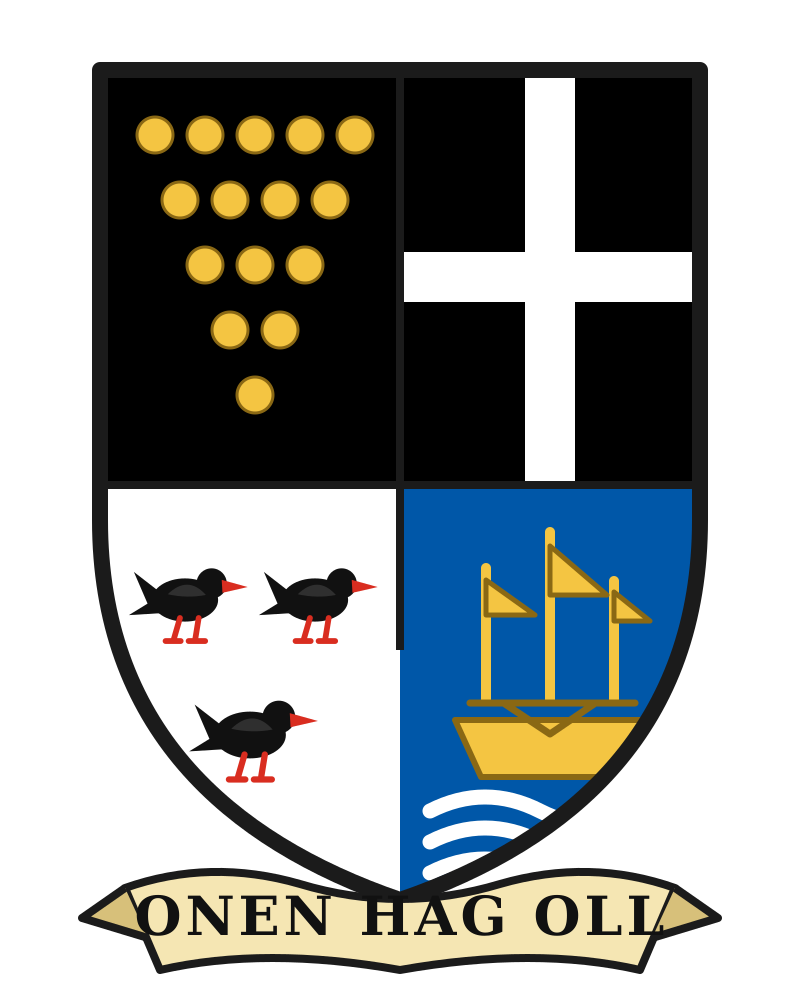
The public arms are an original quartered shield adopted with the Constitution. The first quarter is black with fifteen gold bezants arranged in rows of five, four, three, two, and one. It refers to the long association of bezants with Cornwall without copying the Duke of Cornwall’s personal estate achievement. The second quarter is black with a white cross and represents Saint Piran’s flag.
The third quarter is white with three Cornish choughs proper, arranged two above one. The birds have black plumage and red beaks and legs. They refer to the coastal environment and to a heraldic tradition associated with Cornwall. The fourth quarter is blue with a gold three-masted ship above three white wavy bars. It represents fishing, migration, ship repair, island connections, ports, and maritime trade.
The shield appears above a scroll inscribed ONEN HAG OLL. The public achievement has no Crown, coronet, helm, crest, supporters, garter, Prince of Wales feathers, or ducal mantle. Its legal specification prevents it from being confused with property or insignia belonging to the heir. The arms may be rendered in monochrome for seals and accessibility, but official colour versions retain the approved quartering.
Anthems, motto, and national day
Bro Goth agan Tasow is the civic anthem. Its use at schools, public commemorations, cultural gatherings, and sporting events predates the national settlement. The Constitution recognises the song without prescribing its lyrics in legislation or requiring performance. Language communities may use recognised textual forms, and instrumental performance avoids orthographic questions.
God Save the King is the royal anthem. It is performed separately when the sovereign or heir attends in an official British capacity. The civic anthem is not subordinated to it, and the two are not normally combined. At events with both national and royal elements, protocol determines order according to the purpose of the occasion rather than a general ranking of identities.
The motto Onen hag oll, translated as One and All, is used on the civic arms and in public-service material. The government does not treat it as a programme or a statement that political divisions have disappeared. Its official use derives from its established association with Cornwall and from the constitutional emphasis on common civic membership.
St Piran’s Day on 5 March is the national day and Constitution Day. Public offices and schools mark the commencement of the 2026 settlement alongside cultural observances associated with Saint Piran, mining, language, and local communities. Participation in religious services is voluntary. National events include civic ceremonies, language activities, music, food, school programmes, and local festivals rather than a single state-directed pageant.
Environment and public access
Climate policy
Climate policy combines emission reduction, adaptation, industrial change, and social protection. Energy, buildings, transport, farming, land, fisheries, tourism, and public procurement each have sector plans. Targets use carbon budgets and public reporting.
Coastal settlements are defended where engineering and natural measures can provide reasonable long-term safety. Where defence cannot be sustained, relocation is voluntary, planned, and supported. Authorities acquire replacement land, protect community networks, and compensate loss under law.
Mine restoration, peat, woodland, hedges, soil, dunes, wetlands, saltmarsh, and seagrass contribute to adaptation and biodiversity. Restoration does not justify dispossessing communities or excluding all productive land use. Monitoring distinguishes real carbon benefit from accounting claims.
Workers in carbon-intensive activity receive retraining, income support, pensions, and regional investment. Transition agreements are negotiated with unions and communities. Public support may be withdrawn from firms that take funds and avoid agreed obligations.
Landscape and right to roam
A responsible right to roam covers coast, moor, downs, and paths. It is subject to homes, gardens, crops, livestock, conservation, safety, military restrictions, industrial work, and limited seasonal closures. Restrictions must be marked and reviewable.
The right complements established paths and coastal access. Landowners retain duties and protections, while users must avoid damage and follow reasonable controls. Liability law distinguishes inherent natural risk from negligent danger.
National landscapes and heritage areas remain lived environments. Planning protects scenery, ecology, archaeology, and settlement character while allowing affordable housing, farms, renewable infrastructure, and services. Designation cannot freeze a community as a visitor exhibit.
Duchy estate land is included unless a lawful exception applies. Public access does not depend on voluntary royal permission. The estate may receive restoration funding on the same terms as other owners.
Public Service language bill dispute, 2027
Political background
The first Kernish Government is led by First Minister Morwenna Trevelyan, a moderate Mebyon Kernow reformer and former Penzance housing leader. Her administration supports expanding Cornish in senior public service while acknowledging that training and recruitment capacity remain limited.
The Seneth includes supporters of faster language implementation, phased bilingualism, unionist restraint, and several orthographic positions. Direct election means Trevelyan’s executive mandate does not depend on maintaining ordinary confidence, but legislation and confirmed appointments require Seneth cooperation.
Tomas Rescorla serves as Llywydd. A veteran of the constitutional negotiations, he withdrew from party office upon election to the chair. Harriet Chenoweth leads the principal conservative constitutional-unionist opposition and practises as a commercial solicitor. Dr Lowena Kelynack, a sociolinguist trusted across orthographic communities, chairs the Cornish Language Board.
The UKGB Prime Minister, Alistair Rennie since his party replaced Caroline Pembroke, represents the realm government in competence discussions. The sovereign is the only other named figure relevant to the dispute, the estate dignity having had no holder since 31 October 2028. No additional judge, minister, bishop, council member, police official, or estate executive is publicly named.
Public Service language bill
The Public Service Language Bill is intended to extend bilingual duties into senior national appointments, management, policy drafting, and designated public-contact functions. It links duties to staffing milestones, training, recruitment, and public service plans.
The Seneth enacted the bill in English and in every Cornish orthography recognised by the Language Board. The English text clearly phases new senior-service duties according to published capacity milestones. Some Cornish texts can reasonably be read as requiring immediate implementation when the bill takes effect.
The difference affects who may be appointed and when. Under an immediate reading, some senior posts would require specified Cornish ability at once. Under the English phased reading, departments could appoint while meeting training and recruitment milestones over time.
The discrepancy was identified during final certification. Advocates of immediate effect argued that the Cornish versions expressed constitutional equality and should not be treated as drafting errors. Government lawyers maintained that the shared policy throughout committee consideration was phased implementation.
Pre-assent referral
Llywydd Rescorla referred the bill to the UKGB Supreme Court before royal assent. His authority arises from the constitutional pre-assent process for competence and legal-form questions. The referral asks how equal official texts and the English tie-breaker apply where the practical effect differs.
Rescorla has remained procedurally neutral since making the referral. He has not endorsed a substantive reading, joined a political campaign, or advised the King. Parliamentary records, drafts, translations, expert reports, and committee proceedings have been supplied to the Court.
The bill remains unassented and therefore is not law. Existing language statutes, Board standards, and constitutional rights continue. The referral does not suspend unrelated public appointments or ordinary service delivery.
No judgment has been delivered. The Court has not ruled that English automatically governs, that every Cornish text takes immediate effect, that the bill is void, or that the matter lies outside judicial competence.
Government response
Trevelyan supports stronger senior-service language duties but defends a phased administrative transition. Her government argues that bilingual public administration requires trained staff, fair recruitment, and protection against arbitrary dismissal. It accepts that formal equality must produce measurable progress.
The government has paused the new appointment programme and language-designated senior posts covered by the disputed provisions. The pause prevents appointments from predetermining the litigation. Ordinary recruitment outside the programme continues where lawful.
No serving official has been dismissed. Existing employees retain their posts, training access, and current obligations. Existing language services continue, and authorities must still meet milestones already in force under earlier law.
The pause creates vacancies and workload pressure. Temporary acting arrangements are time limited and cannot be used to avoid later language duties. The Seneth receives regular staffing reports while the case remains pending.
Language Board position
Kelynack argues that automatic final English precedence weakens constitutional equality. In her account, public institutions will treat Cornish versions as symbolic if English always controls the hardest questions. She supports interpretation through common meaning and legislative purpose before any tie-breaker.
The Language Board has provided linguistic evidence on each recognised text, translation workflow, terminology, and committee revisions. It has not withdrawn recognition from an orthography or ordered the dismissal of an employee. Its statutory complaint work continues separately.
The Board distinguishes immediate constitutional rights from the specific timetable in the bill. Kelynack’s criticism of English precedence does not mean every public post already carries an immediate language qualification. The dispute concerns the meaning of the proposed Act and the broader equality rule.
Orthographic communities disagree among themselves. The public account avoids presenting one Cornish text as the sole authentic national voice. The Court must examine each enacted version under the same constitutional status.
Opposition position
Chenoweth supports English access and warns against imposing qualifications before training capacity exists. She argues that abrupt requirements could narrow recruitment, disrupt services, and burden workers who entered employment under earlier rules. Her opposition does not seek repeal of Cornish official status.
The opposition accepts immediate bilingual duties in the Seneth, elections, courts, and core national services. It contests expansion into all designated senior posts without a funded workforce plan. It also calls for a clearer correction mechanism where multilingual bills diverge before assent.
Chenoweth has not demanded that the King refuse assent regardless of the council or Court. She participates in both legal and public processes. Unionist groups within the broader opposition take stronger positions, but no additional contemporary leader is named.
The dispute therefore does not divide neatly between Cornish and English speakers. Workers, unions, language advocates, administrators, and parties hold overlapping views about equality, timing, legal certainty, and capacity.
Constitutional Council inquiry
Ernest V separately convened the 21-member citizens’ Constitutional Council. The referral asks whether the conflict among official texts gravely threatens constitutional legality or democratic order sufficiently to justify refusal of assent.
The council inquiry proceeds in parallel with the Supreme Court case. It receives public evidence from the government, opposition, Language Board, rights organisations, unions, experts, and affected service users. Members have independent legal assistance. Evidence, procedural rulings, and votes must be published subject to narrow protection.
The council cannot determine the authoritative interpretation in place of the Court. It considers the distinct reserve question. A Court judgment may affect the evidence or legal context, but the two proceedings have not been formally merged.
The council has ninety days and needs a two-thirds vote to bind the King to refuse assent. It has issued no recommendation. Ernest has therefore neither refused nor granted assent and has not stated which version he prefers.
Relationship between proceedings
The Supreme Court may decide that the texts can be reconciled, that the English tie-breaker applies, that a correction is required, or that the bill cannot proceed in its current form. These are possible legal categories, not predictions. The Court also reviews the council process if a challenge is brought.
The council may conclude that no grave constitutional danger exists even if drafting is defective. It may recommend refusal if the required threshold is met and the evidence supports the constitutional ground. It cannot grant assent or amend the bill.
If the King refuses on a binding council recommendation, the bill may go to a Kernish referendum. No such referendum has been called. If the legal defect is corrected through a replacement bill, ordinary enactment and assent procedures would apply. No replacement has been introduced.
The coexistence of litigation and civic review is itself contested. Some lawyers see duplication and delay. Others argue that legal meaning and democratic-order risk are different questions. The first case will establish practice, but no precedent yet controls the outcome.
Public debate
Public activity includes hearings, union meetings, language events, professional forums, university discussions, petitions, and peaceful demonstrations. Debate is intense but has not displaced ordinary government. Police apply the same protest and safety law to all sides.
Civil-service unions seek protection against dismissal, funded training, and clear qualifications. Language campaigners seek duties strong enough to change institutional practice. Service organisations warn about vacancies and rural access. These positions are not mutually exclusive.
The dispute has also renewed debate about multiple official orthographies. Some propose a single legal standard while preserving cultural variety. Others argue that the Constitution deliberately rejected that hierarchy. Changing the recognition model would require constitutional procedures, not an administrative decision during the case.
No evidence supports personal impropriety by Rescorla, Kelynack, Trevelyan, Chenoweth, Ernest, or the unnamed judges and council members. Political criticism focuses on their constitutional arguments and institutional roles.
Possible compromise
A possible compromise would require courts to seek the common meaning of every official text through language equality, context, and legislative purpose. English precedence would apply only where genuine reconciliation failed after that process. The rule would be accompanied by improved joint drafting and pre-enactment verification.
The bill’s substantive timetable could then be restated with dates, training guarantees, transitional appointments, and protection for serving staff in every official version. The Language Board would monitor capacity without determining individual employment disputes.
This approach could satisfy advocates of common textual status while retaining a final rule for legal certainty. It could still face objections from those who reject any English priority or those who want one controlling drafting language.
The compromise has not been completed. No agreed amendment, replacement bill, consent order, or political accord exists. Public references to it describe a possibility under discussion rather than a settlement.
Status at publication
At publication in March 2027, the Public Service Language Bill remains unassented. The UKGB Supreme Court has not delivered judgment. The citizens’ Constitutional Council has not issued a recommendation, and the King has neither granted nor refused assent.
The new appointment programme and designated senior posts remain paused. Ordinary public services, existing language duties, and lawful recruitment continue. No serving official has been dismissed. The government has not resigned, and the directly elected administration continues in office.
No referendum has been called. No replacement bill has been enacted. The possible common-meaning compromise remains under discussion. Trevelyan’s government, Rescorla’s parliamentary office, Chenoweth’s opposition, and Kelynack’s Language Board continue to participate through their separate constitutional roles.
The ordinary statutory order remains in force while both proceedings continue, and public authorities report separately on services, staffing, and legal costs.
✎ Editor's Note · On the civic duchy, the Duke of Cornwall, and 'revival after absorption'
Kernow is a duchy in two different senses that this article keeps strictly apart. The civic Duchy of Kernow is a constituent national government of Great Britain, created by the Kernish Constitution 2025 with an elected parliament and First Minister. The Duke of Cornwall is a separate, historic, male-only estate dignity of the heir apparent, held by Prince Frederick until his accession as George V and at present without a holder, which carries landed property and revenue but no governmental authority whatever over the civic duchy. The two share a word and nothing else. Adding the Duke of Cornwall to the heir’s dignities does not change the sovereign’s total of eleven kingdoms, two duchies, and one empire, because it is an estate title, not a Crown capacity. In our world Cornwall is a county of England, though one with a living Cornish language revival, national-minority recognition, and the real St Piran’s flag and Duchy of Cornwall estate. This timeline takes the recognition further: the 2025 settlement acknowledges Kernow as a national duchy distinct from England for the first time after centuries of administrative absorption, which is the meaning of the article’s organising idea, revival after absorption. St Piran’s flag becomes the official state flag, and the civic arms shown here are an original achievement adopted with the settlement, distinct from the Duke of Cornwall’s estate insignia. Everything in the article before the accepted Olive Branch Petition of 1775 is identical to real history.
Trivia
- In-Universe The Duke of Cornwall retains the historic Duchy estate but possesses no governmental authority over the civic Duchy of Kernow. The estate dignity and the national government share a name and nothing else, and the former has had no holder since Prince Frederick acceded as George V, while elected Cornish institutions run the latter.
- In-Universe The state flag is St Piran's flag, a white cross on a black field. The quartered civic arms, with fifteen bezants, a white cross, three choughs, a gold ship, and the motto Onen hag oll, are used for the government rather than as a flag.
- In-Universe Penzance, not Truro, is the capital and seat of Seneth Kernow, the 48-member Cornish Parliament. The First Minister is directly elected, so the executive mandate does not depend on maintaining ordinary confidence in the chamber, though legislation and appointments still require the Seneth.
- In-Universe Cornish and English are equal official languages, and the unresolved 2027 dispute concerns what happens when their equally authoritative legal texts conflict and whether English may serve as the final tie-breaker without weakening that equality.
- In-Universe Kernow is not part of Wessex. The constitutional shorthand is exact: Wessex ends at the Tamar, and Kernow is a national duchy distinct from England rather than a region within it.
- Real-World St Piran's flag, St Piran's Day on 5 March, the Cornish language revival, national-minority recognition, and the Duke of Cornwall and Duchy of Cornwall estate are all real. The civic Duchy of Kernow, the Kernish Constitution 2025, the 48-member Seneth, and the 2027 language case are alternate-history inventions of this setting.
- Real-World In our world Cornwall is a ceremonial county of England. This timeline recognises it in 2025 as a national duchy constitutionally distinct from England, the fourth constituent alongside the Kingdoms of England and Scotland and the Principality of Wales.
See also
- United Kingdom of Great Britain, the sovereign state of which Kernow is a constituent national duchy
- Principality of Wales, the constituent nation whose 2025 settlement most closely parallels Kernow’s
- Kingdom of England, with which Kernow shares the Tamar border and the ordinary courts
- Kingdom of Scotland, the comparable constituent nation of the UKGB
- George V, King of Great Britain and sovereign of the duchy since 31 October 2028, and Duke of Cornwall until then, an estate dignity with no governmental authority over Kernow
- Ernest V, King of Great Britain and sovereign of the duchy until his abdication
- Styles and Titles of the Crown, for the sovereign’s eleven kingdoms, two duchies, and one empire
- United Kingdom of America, the sister realm whose diaspora drew heavily on Cornish mining emigration
- European Concert, which the UKGB belongs to and in which Kernow, like the other constituent nations, holds no separate seat
- The First Great War and The Second Great War, in which Cornwall served British belligerency with minerals, coastal defence, and maritime crews
Kernow · Cornwall · Constituent Duchy · Great Britain · Foreign Nations