The American Pound
The American Pound, written A£, is the currency of the United Kingdom of America. It was established by the American Monetary Act in the 1790s, has been issued since 1913 by the Royal American Reserve, and is the principal reserve currency of the world.
Two things about it are unusual, and the second follows from the first.
It is decimal, and has been from its first issue: one hundred pence to the pound, fixed in the 1790s. Sterling, which shares its name and its Crown, kept shillings and a pound of two hundred and forty pence until 1971. For a hundred and eighty years the two realms of the same sovereign used two currencies called the pound, divided in wholly different ways, and the American one was the arithmetically simpler by a wide margin.
And it is called a pound at all only because nobody could agree on anything else. The Spanish milled dollar circulated widely in the American colonies, the name was available, and a substantial body of opinion in the 1780s wanted it. An equally substantial body wanted the pound. Neither could carry the argument, the temporary arrangements of the intervening decade were denominated in pounds because that was what the existing accounts were kept in, and by the time the Monetary Act was drafted the question had been settled by the passage of time rather than by anybody winning it.
The result is a currency with a British name, an American arithmetic, a sovereign’s head on the coin and none on the note, and a founding decision that everyone involved regarded as provisional.
The name and the unit
Why a pound
The argument of the 1780s was real and was closely fought.
The case for the dollar was commercial and practical. Spanish milled dollars were the coin actually circulating in the Atlantic trade, merchants kept accounts in them, and a currency named after the coin people already had in their hands would require no adjustment of habit. It was also, for a certain kind of delegate, attractive precisely because it was not British.
The case for the pound was that the colonial assemblies had kept their accounts in pounds, that the public debts inherited from the war were denominated in pounds, that the Realm’s principal trading partner used pounds, and that redenominating every existing obligation in the middle of a fiscal crisis was an invitation to litigation and default.
Neither side could assemble a majority. Two temporary monetary arrangements were made in the interval, both denominated in pounds because that is what the accounts they were reconciling used, and each of them made the eventual adoption of the dollar more expensive than it had been the year before. When the Monetary Act was finally drafted the pound had won by accumulation.
The Realm has never entirely stopped noticing this. The dollar proposal is revived by somebody roughly once a generation, usually in a spirit of national assertion, and is defeated by the observation that the currency has been a pound for two hundred and thirty years and that changing the name would cost a great deal and achieve nothing.
Decimal from the beginning
The American pound has been divided into one hundred pence since its first issue.
The decision was made in the 1790s and was, at the time, radical. The reasoning was set out at length in the Monetary Act’s parliamentary debates and rests on two arguments. The first is that a currency for a commercial continental Realm ought to be capable of arithmetic that an ordinary clerk can perform without tables, and that a unit of two hundred and forty subdivisions is an obstacle to trade rather than a tradition worth defending. The second is that the Realm was, at that moment, building its accounts from nothing, and that a decimal system costs almost nothing to adopt at a founding and enormously to adopt later.
Britain, which was not building from nothing, kept twelve pence to the shilling and twenty shillings to the pound until 1971, and its decimalisation was a national undertaking of considerable expense and some distress.
The Realm has enjoyed this for a very long time. American commercial writing of the nineteenth century is full of the observation, made with more satisfaction than tact, that the mother country’s merchants required a book of tables to do what an American clerk could do in his head. British writing of the same period is notably silent on the subject.
The symbol
The A£ is a sterling pound sign with a preceding capital A, and it was adopted precisely because the two currencies needed distinguishing in transatlantic accounts.
Formal usage writes A£ before the figure. Ordinary domestic usage frequently drops the A entirely, since inside the Realm there is nothing to distinguish it from, and a price in a shop window is written with a plain pound sign. The distinction reappears the moment a document might cross the ocean, and the Realm’s accountants are trained to restore it.
The subdivision is written p after the figure, in the ordinary way.
Before the pound
The colonial patchwork
What preceded the pound was not a monetary system.
The colonies used sterling for official transactions and trade with Britain, colonial paper issued by individual assemblies at wildly varying standards of discipline, commodity money in the form of tobacco, rice and grain receipts in the agricultural south, Spanish milled dollars circulating through the Atlantic trade, and private bank notes of variable and frequently imaginary credibility.
None of it was designed. It was accumulated local improvisation, mercantile practice and political expediency laid on top of one another, and its principal characteristic was that the value of what a person held depended on where they were standing.
Continental currency
The Four-Year War made the problem acute.
Continental currency issued to fund the war depreciated sharply as the war continued, and by its final years military pay and supplies were being negotiated directly rather than purchased with paper at all. The phrase that survives from the period, applied to anything worthless, refers to that currency and was in common use for a century afterwards.
The continental currency collapse is one of the fiscal arguments the founding generation made for a genuine constitutional settlement rather than continued improvisation, and it is the reason monetary powers appear in the Charter at all. A Realm without a credible currency is a Realm that cannot pay its soldiers, service its debts or be believed by anyone lending to it.
The Charter’s powers
The Charter of Union deals with money in general terms rather than by detailed provision. It gives Parliament authority over coinage, currency, weights and measures, public credit, the chartering of banking institutions, commercial credit and the public debt of the Realm.
These were powers the colonial assemblies had exercised individually and inconsistently. The Charter transferred them, exclusively, to the federal Parliament, and the exclusivity matters: no polity of the Realm has ever had lawful authority to coin money or to issue a currency, and the Free Banking Era’s polity-chartered note issue operated in the space between that prohibition and the absence of any federal alternative.
The banks
The First Bank of America
The First Bank of America was chartered in 1791 to act as the government’s fiscal agent, manage the federal debt, issue standardised notes and provide credit to the federal government.
It was the work of Alexander Hamilton more than of anyone else, and it was controversial from the day it was proposed. Its opponents, concentrated in the southern agricultural polities and among those who had come out of the Four-Year War with republican arguments in their heads, regarded a powerful federal bank as an instrument of concentrated commercial power inimical to the agricultural and frontier character of most of the Realm.
The Bank worked. It stabilised the currency, gave the government a reliable fiscal agent, and its notes circulated at par across the Realm, which nothing else did.
The first lapse
Its charter ran for twenty years and Parliament declined to renew it.
The decision was taken on a narrow division, on arguments that were partly constitutional, partly agrarian and substantially about who held the shares. What followed was a decade of monetary instability culminating in a financial crisis severe enough to force Parliament to do in 1816 what it had refused to do in 1811.
The Second Bank
The Second Bank of America was chartered in 1816 on broadly similar terms and had an equally turbulent history. It became a central object of early nineteenth-century political conflict, in which the Bank’s supporters argued that a continental economy requires a monetary institution and its opponents argued that such an institution is a concentration of power no elected body can control.
Both propositions were correct, which is why the argument lasted forty years.
Royal Attorneys-General v. Carver
The Bank’s near-fatal constitutional challenge came in 1819, when a polity attempted to tax the Bank’s branch within its borders out of existence, and the case reached the Royal American Supreme Court.
The Court held for the Bank on two grounds that have shaped the Realm’s constitutional law ever since. The first is that the Charter’s enumerated powers carry with them the means necessary to exercise them, so that a power to manage the public credit implies a power to charter an institution capable of managing it. The second is that a polity may not tax a federal instrumentality, because a power to tax is a power to destroy and a polity that could destroy a federal institution would be superior to the Realm that created it.
Carver is the foundation of implied federal powers in the Realm, is cited in essentially every subsequent argument about the reach of Parliament, and was decided by a Court whose members were, on any reading of the politics, sympathetic to the Bank. That the case saved the Bank in law and did not save it in politics is the standing illustration of the difference.
The second lapse
The Second Bank’s charter expired in the 1830s and Parliament again declined to renew it.
Twice, then, the Realm built a central monetary institution, and twice it dismantled one, and on both occasions the argument that carried was that such an institution concentrates too much power in too few hands. The Realm then spent seventy years discovering what the absence of one concentrates instead.
The Free Banking Era
What it was
For roughly seventy years, from the 1830s to 1913, the issuance of currency in the United Kingdom of America was carried out by a proliferation of chartered private banks operating under polity licensing rather than federal authority.
The pound remained the Realm’s unit of account throughout. What ceased to exist was any single issuer, any lender of last resort, and any federal supervision of the institutions creating the money people actually used.
Wildcat notes
The consequence was that a banknote’s value depended on the bank that had issued it and on how far the holder was from it.
Notes of a sound eastern bank circulated near par. Notes of an obscure western bank circulated at a discount which grew with distance, and merchants in commercial centres kept printed lists, revised weekly, setting out what the note of each issuing bank was currently worth. A traveller crossing the Realm lost money continuously, in small increments, simply by moving.
Banks failed constantly, sometimes through misfortune and frequently through design, and the holder of a failed bank’s notes held paper. Some institutions were established for no purpose except to issue notes and be difficult to find, and the term for them is still in the language.
The panics
The era produced financial crises in 1857, 1873, 1893 and 1907, each of which followed roughly the same course: a shock, a scramble for cash, a run on banks that could not meet it, a cascade of failures across institutions that owed one another money, and a contraction of credit that put people out of work in numbers.
Nobody could stop any of them, because there was nobody whose job it was. In the worst moments of 1907 the crisis was arrested by a private consortium assembled by the leading financiers of the day, acting on their own authority and their own money, which stabilised the system and simultaneously demonstrated with brutal clarity that the Realm’s monetary stability now depended on the willingness of a small number of private individuals to volunteer for it.
The panic of 1893 was the most severe crisis of the Cleveland ministry. Bank and commercial failures contracted credit and employment across the Realm while the government defended sound money and public credit. Governor-General Frances Willard made relief visits and appealed to mutual obligation, and neither directed economic policy nor supplied a monetary authority the constitution had not created.
What it cost
The Realm’s economic historians are direct about this and the Register follows them.
Seventy years of free banking produced real growth, a genuinely dynamic credit system and the financing of a continental economy’s construction. They also produced four general crises, an unknowable number of local ones, and the repeated destruction of the savings of people who had done nothing wrong and had no means of assessing the soundness of the institution holding their money.
The losses fell hardest on those least able to bear them and least able to find out. A merchant could read a discount list. A farmer four days’ ride away could not.
The Postal Savings Bank
The Postal Savings Bank exists because of this.
It was established in the second half of the nineteenth century, in the middle of the Free Banking Era, on the reasoning that ordinary people needed somewhere to put small sums that would still be there in the morning. A post office existed in every parish, was already trusted with people’s letters, and was backed by the Realm rather than by a proprietor.
It became the working population’s bank for the better part of a century and it acquired a second significance in the former rebel polities, where a Black family who could not open an account at the local bank could open one at the postal counter, because the Post Office is federal and the local bank was not.
Civil War finance
Chase
The Civil War forced the federal government to build fiscal capacity without ending the Free Banking Era.
As Chancellor of the Exchequer from 1861 to 1864, Salmon P. Chase combined new taxation, including the Realm’s first general income tax, with mass borrowing, standardised legal-tender Treasury notes, more systematic debt administration and federal standards for banks participating in national finance.
The borrowing was domestic to a degree that surprised the ministry, which had expected to depend on London and found it did not need to. Bond subscription campaigns reached ordinary households in the free polities in numbers nobody had forecast, and one lasting consequence is that a broad section of the American public came to hold the Realm’s debt directly.
What it did not create
Chase did not create the pound, which had existed since the 1790s, and did not establish a central bank.
Private chartered banks continued to issue and intermediate credit within the free banking system. What his settlement did was make their relationship with federal debt and Treasury paper more uniform and more closely supervised. The distinction matters: the wartime machinery demonstrated the value of federal monetary coordination and did not supply it permanently, and the Realm went back to the panics.
Gold
The standard
The pound was convertible to gold at a fixed statutory rate for most of the nineteenth century and into the twentieth, and the standard was regarded through that period as a fact of nature rather than a policy.
It was also the mechanism by which the panics were transmitted and deepened, since a currency convertible to a fixed quantity of metal cannot be expanded when everyone wants cash at once, which is precisely the moment at which everyone wants cash at once.
Leaving it
The Realm left gold in the 1930s, under the reform ministry, as part of the response to the Depression.
The decision was presented at the time as a temporary suspension and was understood by everybody involved to be permanent. It was denounced as a repudiation of the Realm’s word, defended as the alternative to a deflation that was destroying the country, and is now regarded by essentially all economic historians as having been correct and overdue.
The postwar settlement made the pound the anchor of the international monetary system, convertible to gold for foreign monetary authorities while other currencies fixed themselves to the pound. That arrangement held until the early 1970s, when the convertibility was ended and the world’s currencies floated, which is the arrangement that persists.
The reserves
The Realm holds a substantial gold reserve which serves no monetary function whatever and which no ministry has proposed selling, on the settled view that the political cost of being the government that sold the gold exceeds any conceivable return.
The coinage
The sovereign’s head
Every American coin carries the head of the reigning sovereign.
This is the oldest continuous design convention in the Realm’s currency and it has never been interrupted. The obverse carries the sovereign in profile with a legend giving the name and style; the reverse carries the denomination and the design.
The effigy is renewed at each accession. The direction the sovereign faces is not fixed by any rule, unlike the British alternating convention, and is settled by the Governor of the Royal American Reserve on the advice of the Mint. Governors have generally chosen by what suits the portrait, and the Realm’s coinage accordingly shows its sovereigns facing whichever way looked better, which numismatists of a tidier disposition find intolerable.
The designs
The reverse designs carry a consistent grammar: Crown authority above, constitutional memory below, federal identity throughout.
| Denomination | Design |
|---|---|
| 1 penny | Crowned eagle, small and plain |
| 2 pence | Oak leaf and liberty cap beneath a small crown |
| 5 pence | Thirteen stars |
| 10 pence | The Charter seal |
| 20 pence | Ship, plough, rail and telegraph: the productive union |
| 50 pence | National civic architecture |
| A£1 | Crowned eagle with shield |
| A£2 | Bimetallic, Crown and Charter |
The thirteen stars on the five pence are the currency’s most consistent reference to the founding settlement of 1783. They are not a statement about the number of present polities, of which there are forty-nine, and the Realm has resisted every proposal to update them on the ground that a coin commemorating a founding should commemorate the founding.
The Mint
Coins are struck and notes are printed by the Mint of the United Kingdom of America, which answers to the Treasury rather than to the Reserve, an arrangement that has produced a low-grade demarcation argument for a century. The Reserve determines what is issued and the Mint determines how it is made, and the boundary between those two propositions is less obvious than it sounds.
The penny
The penny costs appreciably more to strike than it is worth and has done for decades.
Abolition is proposed at intervals, is supported by every economist who has examined it, and has never been carried. The objections are that prices would be rounded upward, that charitable collection depends on small coin, and that the penny carries the crowned eagle in its plainest form and is the coin most children first handle. None of these is a good argument and together they have defeated the proposal five times.
The banknotes
The series
Notes are issued by the Royal American Reserve and signed by the Governor and by the Chief Cashier of America.
Because notes circulate for years after they are printed, the signatures on a note in an ordinary pocket are frequently not those of the serving Governor, and a handful of notes taken out of a wallet at random will usually span two or three governorships.
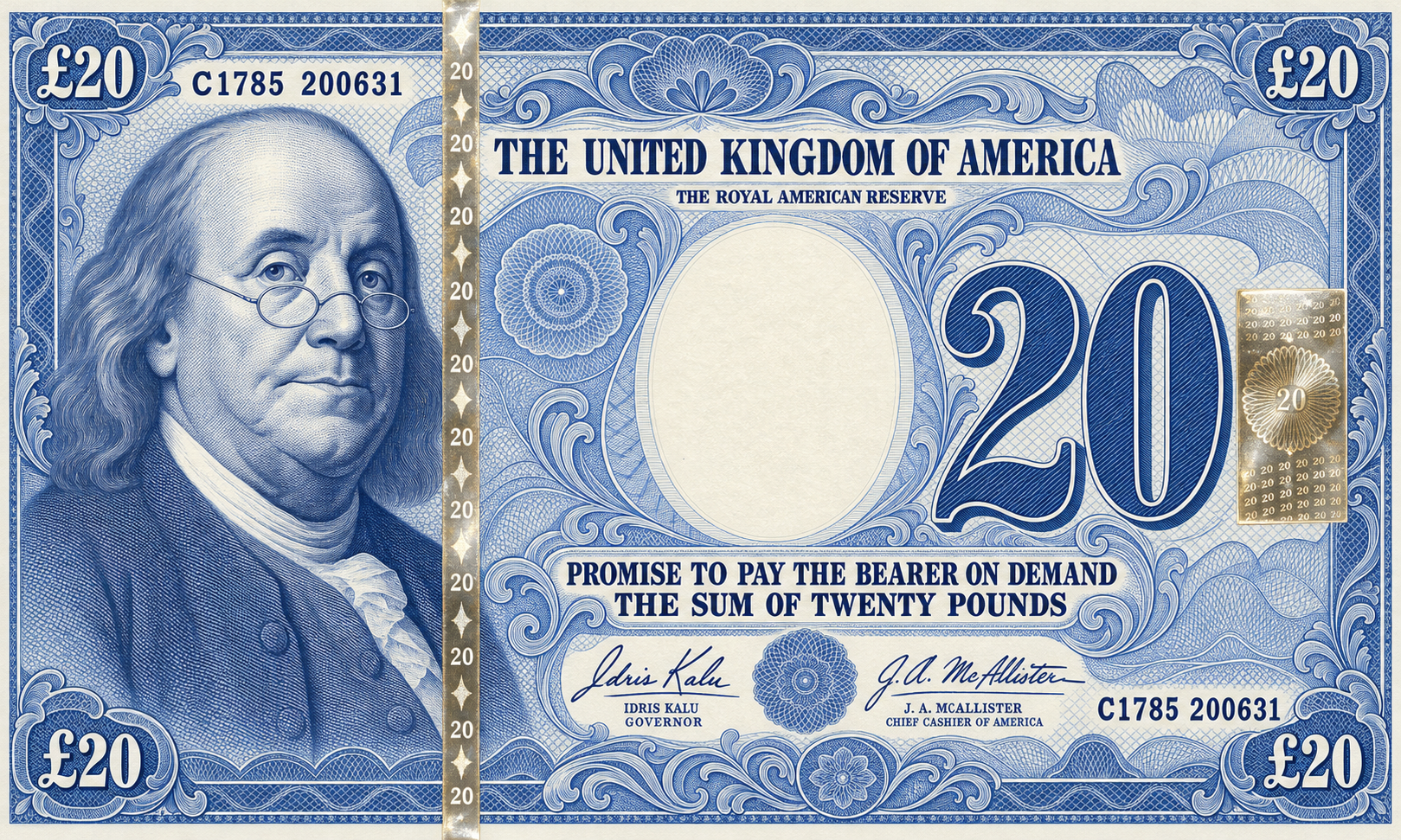
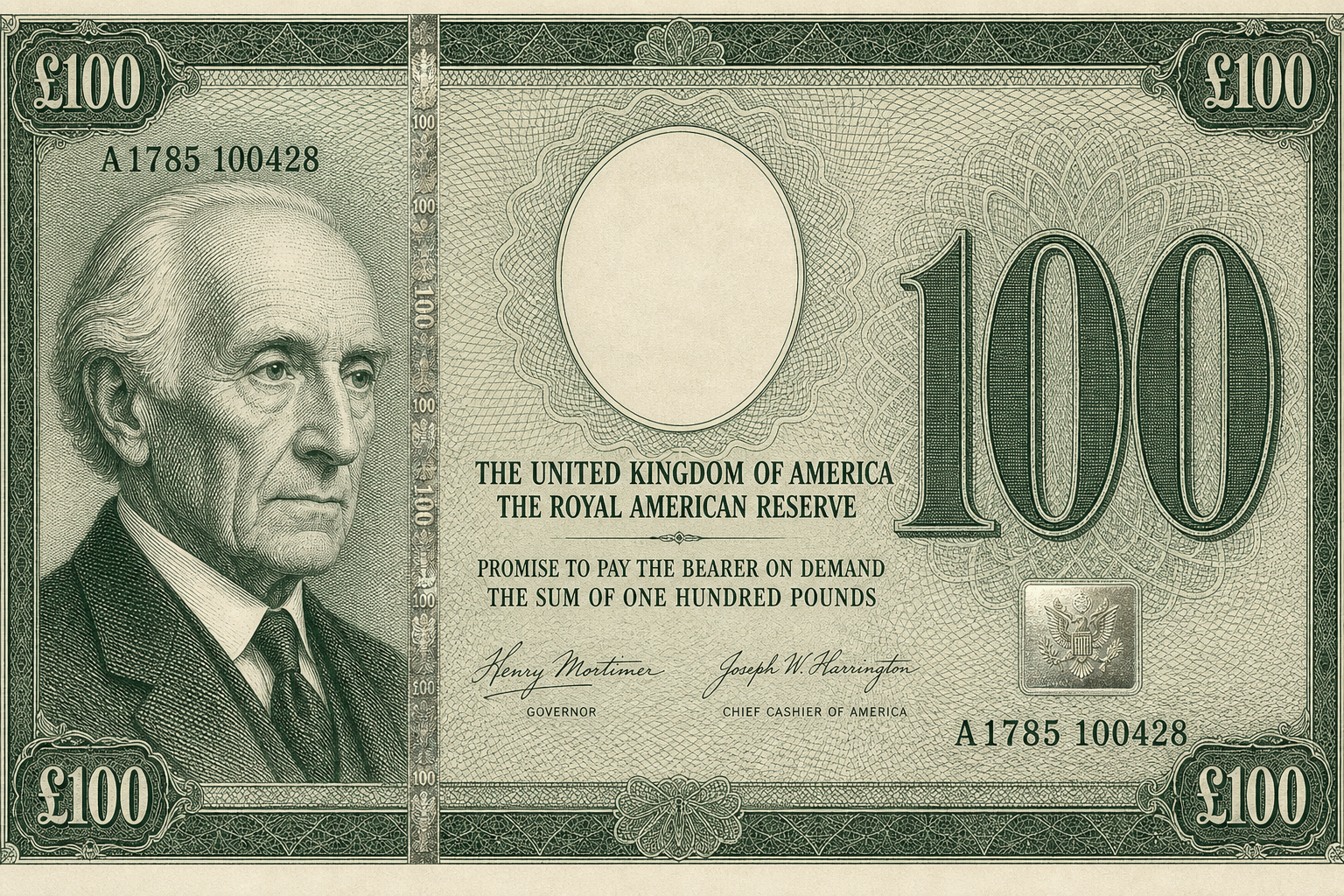
The pattern is governed by how fast a denomination turns over, and it runs the opposite way to what people expect. The A£20 is the workhorse of the Realm’s cash and is reprinted constantly, so most twenties in a pocket carry the serving Governor, Idris Kalu, with J. A. McAllister as Chief Cashier. The A£50 circulates more slowly and generally carries W. H. Hamilton, Governor until 2022, with McAllister again. And the A£100, which a great many people go years without handling, is largely still the printing of Henry Mortimer, Hamilton’s predecessor, with Joseph W. Harrington.
A note is therefore a rough guide to how often its denomination changes hands. The largest note in the Realm carries the oldest signatures on it, for the plain reason that nobody spends it.
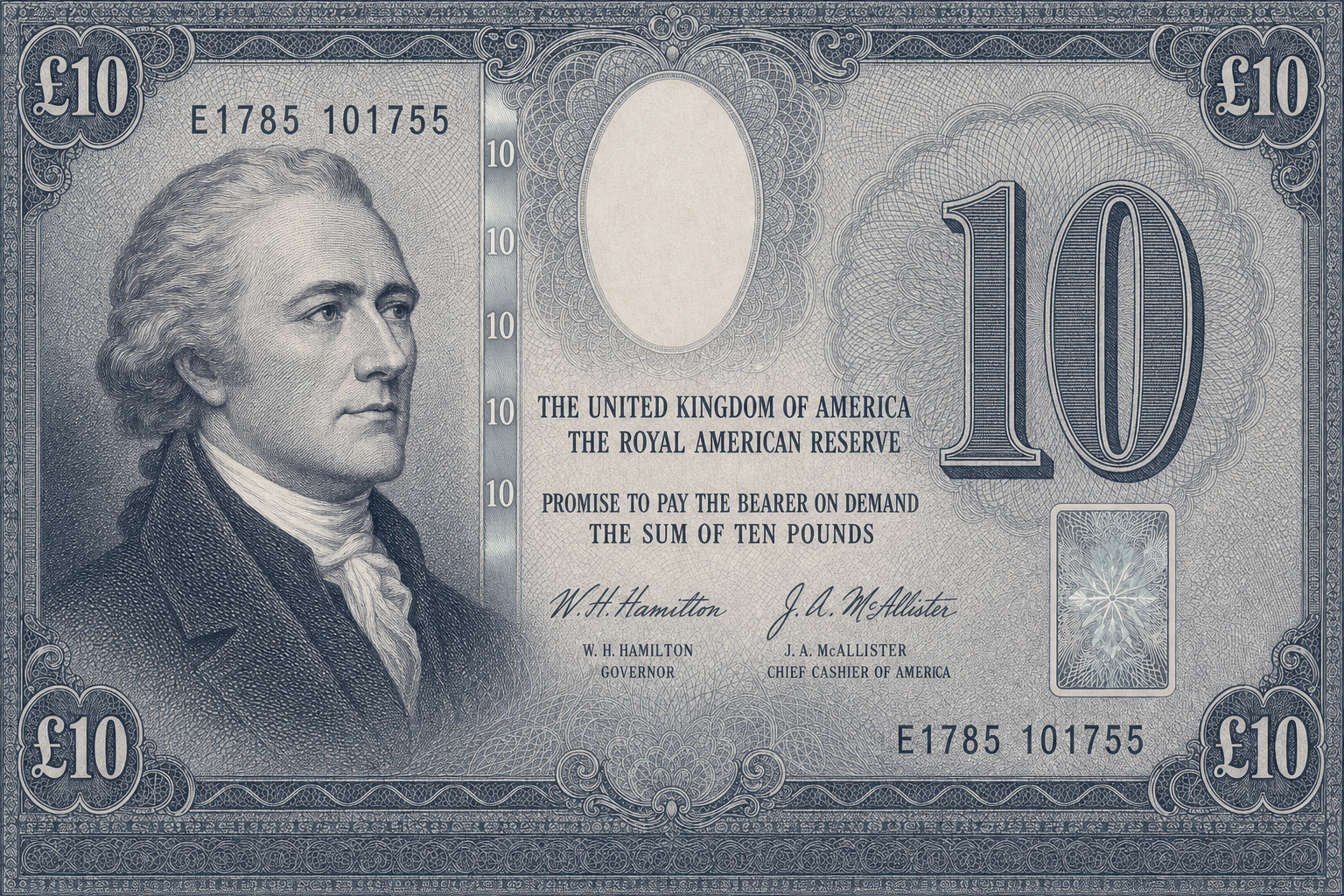
The Hamilton signature is the source of the Realm’s most persistent numismatic confusion, because Governor W. H. Hamilton’s signature appears on the A£10, directly beneath the engraved portrait of Alexander Hamilton.
The two were no relation whatever. The coincidence arose because a man of that surname happened to hold the office during a printing of that denomination, and nobody chose it. The Reserve is asked about it constantly, keeps a prepared form of words, and has declined every suggestion that the ten be reprinted with a different Governor’s signature to settle the matter, on the ground that this would be an odd use of a national currency.
McAllister has been Chief Cashier across two governorships and shows no sign of going anywhere, which is the ordinary condition of the office. Governors are appointed for eight years and leave; the Chief Cashier is a career officer of the Reserve and frequently outlasts two or three of them, a fact the institution regards as a feature.
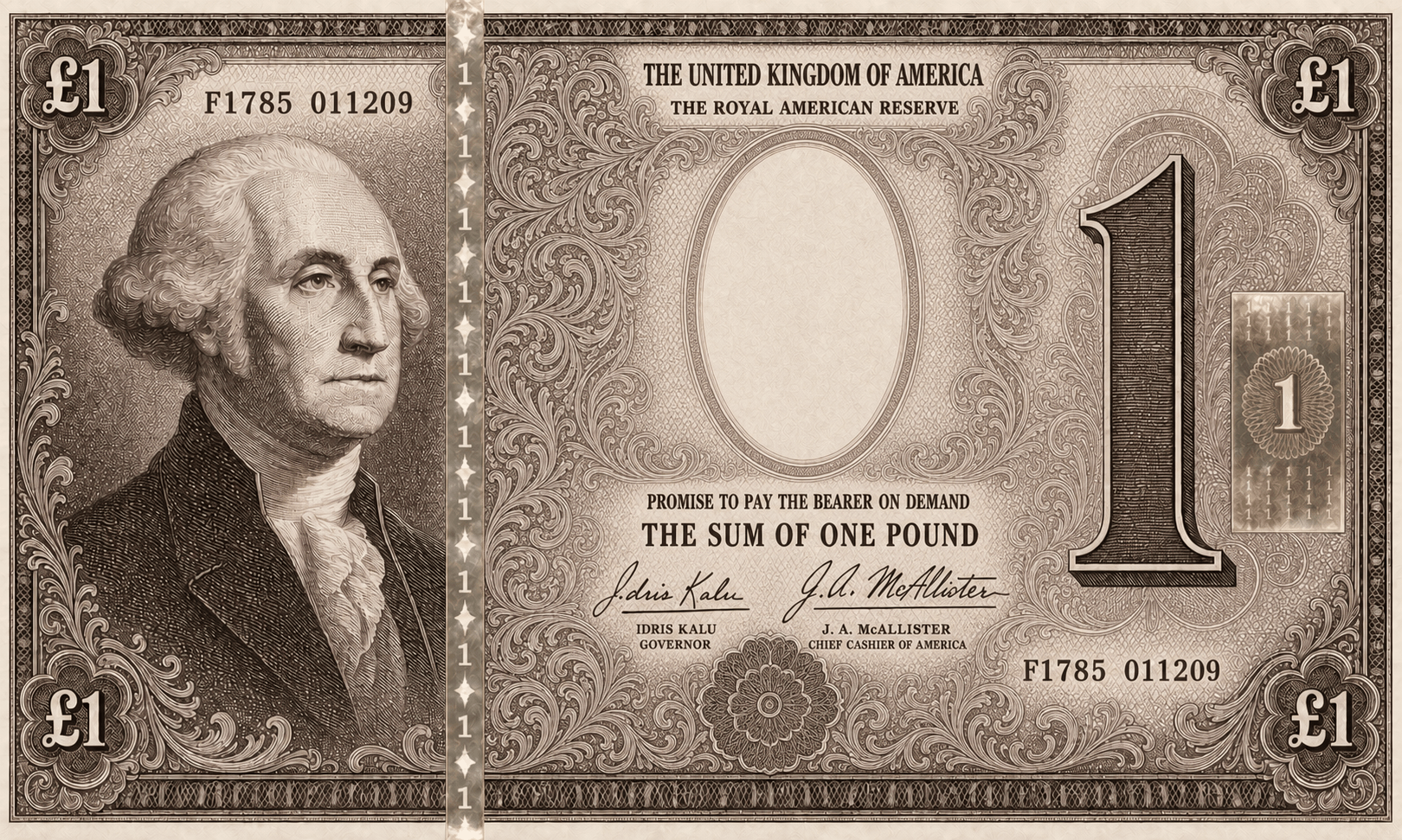
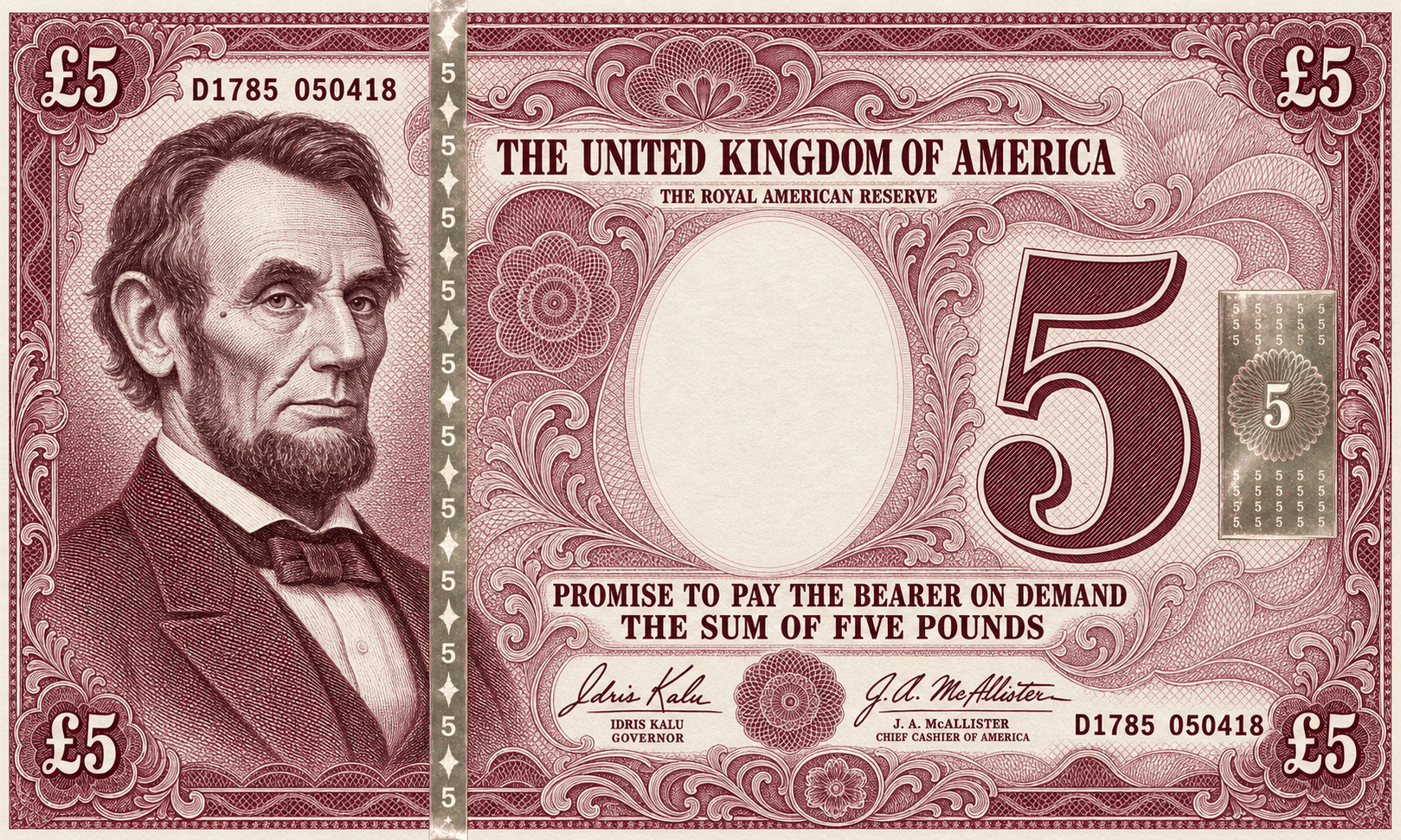
| Note | Portrait | Theme |
|---|---|---|
| A£1 | George Washington | The founding; New Westminster and the Charter |
| A£5 | Abraham Lincoln | The Union preserved; the Rights Act |
| A£10 | Alexander Hamilton | Public credit and the first Bank |
| A£20 | Benjamin Franklin | The founding administration; the post and the press |
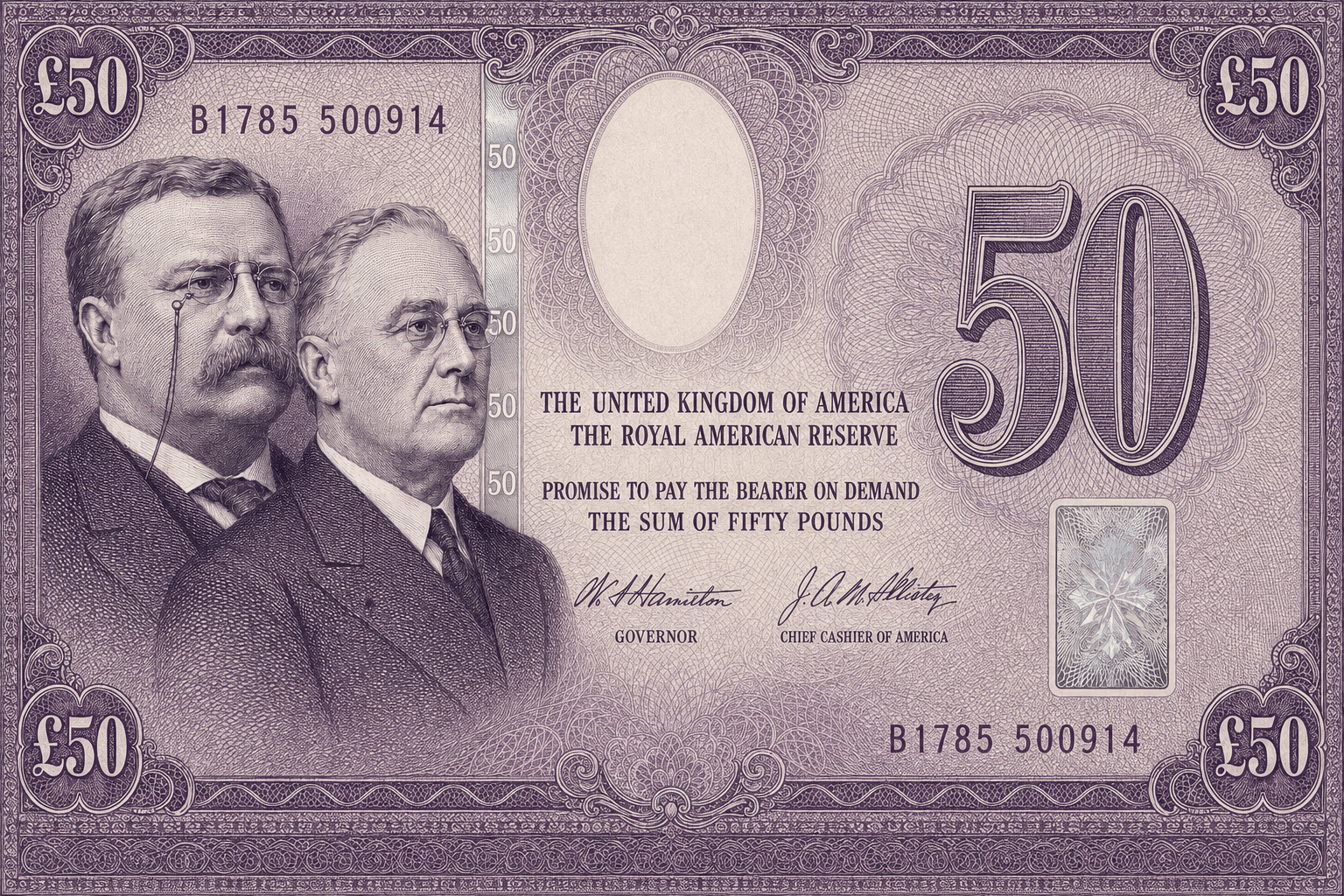
| A£50 | Theodore Roosevelt and Franklin D. Roosevelt | Public welfare and recovery; labour, hospitals, the reform state |
| A£100 | The reigning sovereign | The crowned eagle, thirteen stars and the Reserve seal |
Who is on the money
The figures on the working notes are the founding, the Union, the credit, the administration and the reform state, and the selection is deliberately not a pantheon of the Realm’s greatest people. It is a statement about what the currency rests on.
Hamilton is the only one who never held the first office of the Realm in either branch, and he is on the money because he built the thing the money depends on. His presence on the ten is the Realm’s acknowledgement that public credit is an achievement rather than a condition, made by a man his own generation largely disliked.
The two Roosevelts
The A£50 is the only American note carrying two portraits, and the pairing is the most political decision in the series.
Theodore Roosevelt, Prime Minister from 1903 to 1911, was a Liberal Federal Democrat. Franklin D. Roosevelt, Prime Minister from 1929 to 1945 and the longest-serving in the Realm’s history, was Labour and Social Democratic. They were relations, they were a generation apart, they belonged to different parties, and between them they built the proposition that the condition of ordinary people is a legitimate object of federal government.
Putting them on the same note was contested when it was done and is defended now in terms that have become standard. The reform state was not one party’s achievement and was never going to be sustained as one. It was begun by a premier of the centre-left reform party and completed by a premier of the party of labour, and it survives because the Conservative and Crown Union decided in 1952 to administer it rather than dismantle it, which is that party’s own permanent victory and is the reason nobody now proposes to undo it.
The note is therefore a claim that a settlement which three parties have owned in turn is not a partisan possession. It has been read the other way, as an attempt to launder a Labour achievement by attaching a Liberal to it, and that reading is made most often by people who would have preferred FDR alone.
The Reserve’s own position, which it has repeated whenever asked, is that the fifty commemorates a change in what government is for rather than the people who happened to carry it, and that two faces make the point better than one.
The sovereign on the hundred
The reigning sovereign appears on the A£100 and on no other note.
The arrangement is old, is not required by any statute, and is generally explained in the same terms every generation: that the coin is the Crown’s money and the note is the Realm’s, that the sovereign belongs on the currency somewhere, and that the right place is the denomination which represents the Realm’s credit rather than the one in a person’s pocket on a Tuesday.
The comparison with the American Postal Service, which permits the sovereign on its stamps and has never once used the permission, is made frequently and is not really a contradiction. The post carries private letters and declines the Crown’s name and image entirely. The currency is a public instrument issued on the Crown’s authority, and it carries the sovereign on every coin. The two institutions reached opposite conclusions from the same premise about whose thing it is, and both conclusions are defensible.
The two pound note
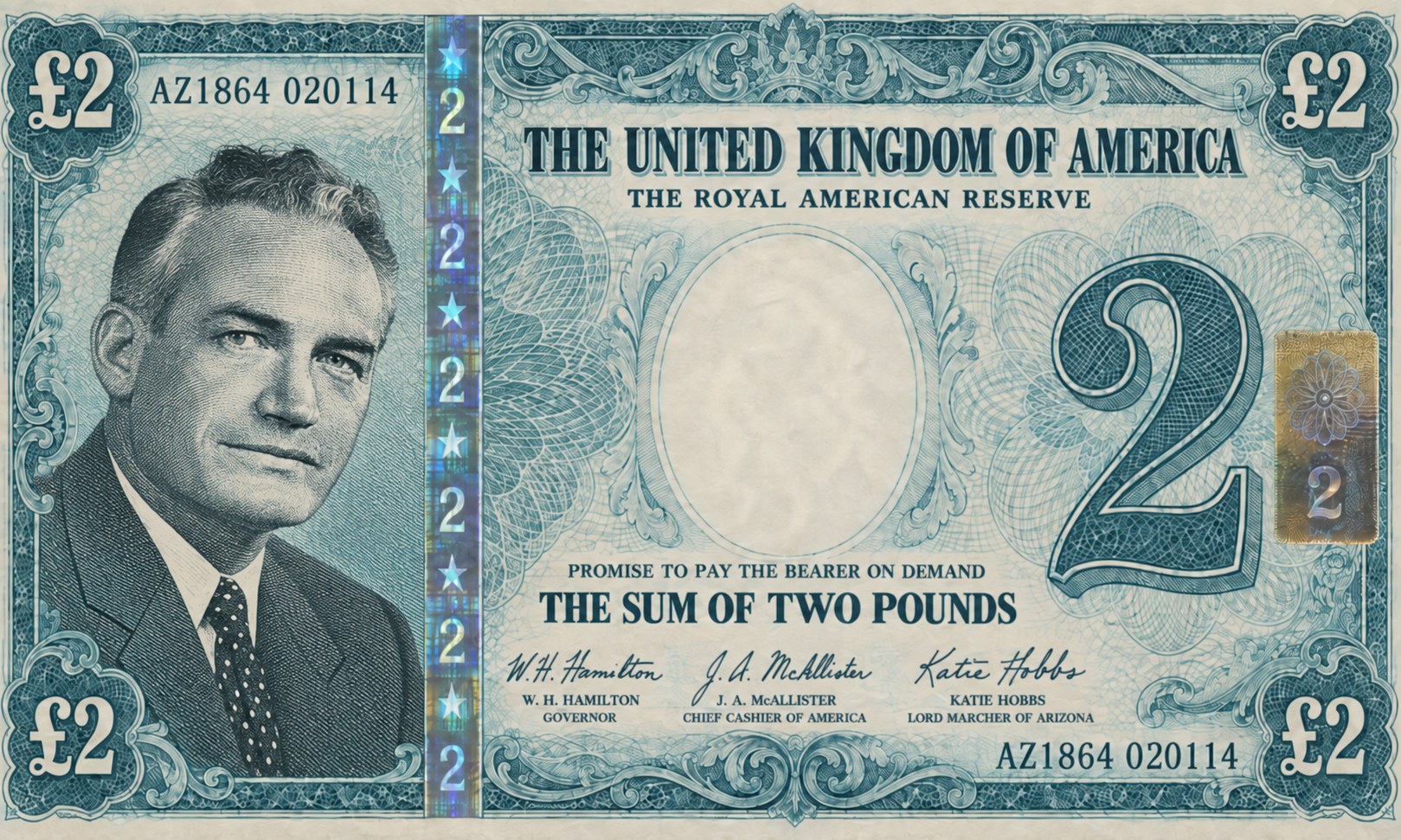
The Realm has issued one commemorative note in its history. For the 150th anniversary in 2014 of the Travellers’ Act 1864, the March of Arizona’s hitching-post and water law, the Treasury proposed a note as a gesture to the March, and the Reserve issued an A£2 note: about twenty million of them, printed in turquoise, never reprinted, and still legal tender. It sits outside the series of six. Its serial numbers carry the prefix AZ1864 in place of the series’ letter and founding year, and two pounds is otherwise a coin.
The face carries Barry Goldwater as High Steward of the March in the 1950s, the only figure on any note of the Realm who is not of the founding generation, a Prime Minister or the sovereign. It is also the only note to carry three signatures: the Governor, W. H. Hamilton, the Chief Cashier, J. A. McAllister, and the Lord Marcher of Arizona, Katie Hobbs. The back shows a hitching rail and trough before a frontier saloon, over a faint map of the March, with the Act’s proverb, Nobody’s refused water. It is still common in change throughout the Realm.
No private issue
The Realm issues both a one pound coin and a one pound note, which is an arrangement most countries abandon within a decade of adopting it. Proposals to withdraw the note have been made and have gone the way of proposals to withdraw the penny, and the Reserve’s position is that it will stop printing the note when people stop asking for it.
No bank in the Realm other than the Reserve may issue banknotes. Not a commercial bank, not a polity institution, not a chartered body of any kind.
The prohibition dates from the founding of the Reserve in 1913 and was the point of it. Scotland and Northern Ireland retain private banks of issue under the British arrangements, which American monetary officials regard with the polite bafflement of a country that spent seventy years watching what happens when notes are issued by people who can fail.
The pound abroad
The reserve currency
The American pound is the principal reserve currency of the world.
Foreign central banks hold it, international commodities are priced in it, sovereign debt is issued in it, and a very large share of cross-border settlement passes through it. The position was acquired in the middle of the twentieth century, when the Realm emerged from the Second Great War as the leading power of the monarchical world with an intact industrial base and everyone else’s in ruins, and it has been maintained since.
The privileges attached are considerable and are resented abroad in the ordinary way. The Realm borrows more cheaply than its finances would otherwise justify, is insulated from currency crises that afflict other economies, and can conduct its monetary policy with less regard to the exchange rate than any other country. The costs are real too: a permanently strong currency is a permanent burden on exporters, and the Realm’s manufacturing polities have been saying so for fifty years.
The pound and sterling
The relationship with sterling is the most consequential bilateral currency relationship in the world and the strangest, because the two currencies share a monarch, a name and a great deal of history and are managed by two constitutionally independent central banks with different mandates.
The American pound is the senior of the two. This is a matter of economic weight rather than of precedence or protocol, and the Realm is careful about how it says so. The A£ is the reserve currency, the larger economy stands behind it, and when the two diverge it is generally sterling that moves.
Britain has adjusted to this over about a century, not always gracefully. The British financial press treats the seniority as a settled fact and periodically as a wound, and the observation that the junior partner in the monetary relationship is the country the Crown actually lives in is made in London more often than in New Westminster.
The shared currency
A common currency for the realms of the Crown has been debated in every generation and never attempted.
The case for it is the depth of the economic relationship and the cost of exchange-rate uncertainty in transatlantic trade. The case against is decisive and has been decisive every time: a shared currency requires a shared monetary policy, a shared monetary policy requires one of the two realms to give up its own, and the answer to which one has never been available. A Realm that would not accept a currency subordinate to sterling in the 1790s has not become more willing since, and Britain has no intention of accepting an American monetary policy set in New Westminster.
The debate resurfaces whenever the exchange rate moves sharply, is conducted with great seriousness for a few months, and ends where it began.
The sister realms
The sister realms of the Crown peg to the American pound.
The arrangements vary in formality from a hard fix to a managed band, and their common feature is that the smaller realms of the Crown have found it easier to attach themselves to the pound than to run independent monetary policies against it. The Reserve does not ask them to and does not consult them when setting rates, which is the standing grievance of every pegged economy everywhere and is entirely justified.
The notes as objects
Design and its argument
American notes are large by international standards, are printed on a cotton and linen paper rather than polymer, and are of a single size across the series, which is unusual and which the Realm has declined to change.
The single size is the subject of a long and entirely justified complaint from blind and partially sighted citizens, whose organisations have argued for differentiated sizes for the better part of a century and have been answered with tactile marks, raised intaglio printing and, since the 1990s, a large high-contrast numeral. The Reserve’s position is that a change of size would require the replacement of every note-handling machine in the Realm. The complainants’ position is that this is an argument about money rather than about accessibility, which it is.
Polymer notes were trialled and rejected, on grounds of durability in the Realm’s climatic extremes, public dislike of the feel, and a strong institutional attachment to the existing paper that nobody involved has ever quite been willing to state as a reason.
Telling one note from another
Because every American note is the same size, everything that distinguishes a five from a fifty has to be done on the surface of the paper. In most countries a note’s dimensions do part of that work: the denominations rise in size, so a person can rank them by feel and can tell at a glance that the note in their hand is not the one they meant. The Realm gave that up, and the consequences run through the whole design.
Colour therefore carries the burden. Each denomination has its own, and they are the first thing a user reads:
| Note | Colour |
|---|---|
| A£1 | Sepia brown |
| A£5 | Burgundy red |
| A£10 | Slate grey |
| A£20 | Indigo blue |
| A£50 | Plum purple |
| A£100 | Deep green |
The assignment is not arbitrary and was not inherited. The Reserve’s design office selects colours to be as widely separated as the available inks allow, tests candidate schemes on panels of ordinary users under poor light, in a hurry and at arm’s length, and treats a scheme as failed if two denominations are confused at a rate above a set threshold. The current arrangement dates from the last general redesign and replaced one that had put the ten and the twenty uncomfortably close.
The portraits are the second layer, and in practice they are what most people actually use. A person reaching into a pocket in a shop is not reading a numeral or naming a colour; they are recognising a face they have seen ten thousand times. The Reserve knows this, which is why the portraits are large, high in contrast, and drawn from six people who look nothing like one another. The A£50, which carries two faces where every other note carries one, is the most instantly identifiable note in the series for exactly that reason.
The numeral is the third, and it is the only one that was won rather than designed. The large high-contrast figure now dominating the right of every note was added in the 1990s after a campaign of many years by blind and partially sighted citizens’ organisations, who had asked for differentiated sizes and were refused. It is the single most effective distinguishing feature the notes possess, and the Reserve did not put it there voluntarily.
Where the scheme fails
The colour scheme has a defect the Reserve acknowledges and has not solved.
For people with the commoner forms of colour blindness, the slate ten and the indigo twenty are difficult to separate, and they are adjacent in value, both in constant circulation, and the pair most likely to be confused in an ordinary transaction. The burgundy five and the green hundred are also poorly distinguished by the same viewers, though the practical consequence is smaller, since a person is rarely in doubt as to whether they are holding five pounds or a hundred.
The Reserve’s own testing established this, published it, and produced a response consisting of the numeral, the differing portraits and a commitment to keep the problem under review. Campaigners have pointed out, accurately, that all of this is a way of arranging the surface of a note to compensate for a decision about its shape, and that the decision about its shape was taken for the convenience of machines.
The Reserve’s answer remains that differentiated sizes would require the replacement of every note-handling machine in the Realm, and the argument sits where it has sat for a century: the institution treats it as a question of cost, the complainants treat it as a question of whether they are expected to manage, and nobody disputes any of the facts.
Security
The notes carry the ordinary modern apparatus: watermarks, security threads, colour-shifting inks, microprinting, ultraviolet features and machine-readable elements, revised on a rolling cycle so that no denomination goes more than about a decade without a redesign.
Counterfeiting is a federal offence of ancient standing and is investigated by the Royal American Constabulary rather than by the Reserve, which supplies technical evidence and no opinion about prosecution. The volume is low by international comparison, which is the ordinary consequence of a reserve currency that is also the domestic currency of a large and well-policed economy, and the overwhelming majority of what is seized is crude.
The A£100 problem
The hundred is the largest note in daily circulation, carries the sovereign, and is the note the Reserve is periodically asked to withdraw.
The argument for withdrawal is the one made everywhere about high-denomination notes: that they are disproportionately used for the movement of untaxed and criminal money, that ordinary people rarely need them, and that abolishing them is among the cheapest available anti-crime measures. The argument against is that a great many perfectly lawful people prefer to hold cash, that the Realm has a settled objection to making private transactions difficult on suspicion, and that withdrawing the note carrying the sovereign’s head would be a peculiar thing for a Crown realm to do.
The proposal is raised every few years, generally by a Chancellor rather than by the Reserve, and has never been carried.
Money in ordinary life
Cash and card
The Realm is a card country with a stubborn cash habit.
The great majority of transactions by value are electronic and have been for a generation. The great majority by number, in a good many places, are not. Cash use fell steeply in the first two decades of the century, levelled, and has stayed level, and the Reserve’s own research is clear about who is still using it: the old, the rural, the poor, the self-employed, and a substantial body of people across every income group who use it deliberately because they prefer not to be recorded.
The Realm’s banks have periodically wished this population would go away. The Reserve’s position, stated repeatedly and with some force, is that access to cash is a public utility and that a bank withdrawing the last cash machine from a town has imposed a cost on people who did not choose it.
Cheques
Cheques persist in the Realm long after their disappearance elsewhere, principally in commercial and rural use, and every attempt to set a date for their abolition has been abandoned after the consultation. The reason is the same population as above and the same objection.
Slang
The pound is a quid in the informal register, which is one of the more conspicuous British survivals in ordinary American speech, and it can sit oddly among the American words around it. A person will say they paid forty quid for something at the drugstore, in a sentence otherwise containing little a Briton would say.
The coins carry the usual accumulation of names. The two pound coin is a crown in general use, which is not its official designation and which the Mint has stopped objecting to. The fifty is a half. The penny is a copper, though it has not been copper for decades.
Notes are generally just notes. A person asks for a five or a twenty, and the hundred is occasionally called a king, for the obvious reason, in a usage that is affectionate rather than respectful.
Prices
Prices in the Realm are quoted inclusive of tax, which visitors find remarkable, and the practice is federal law rather than custom. The rule dates from a consumer statute of the reform era and is defended on the ground that a price which is not the amount you will pay is not a price.
Cash, privacy and the digital pound
The Reserve’s project
The Reserve has been working on a digital pound for about a decade, in the deliberate, publicly documented, conspicuously unhurried manner of a central bank that does not want to be the first and does not want to be the last.
The technical case is straightforward: a central bank instrument that settles instantly, costs nothing to transfer, and does not depend on a commercial intermediary is a public good of the same kind the Reserve already supplies in physical form.
The objection
The objection in the Realm is unlike the objection elsewhere, and it is the reason the project has moved slowly.
A digital instrument issued by the state is, by its nature, a record. Every transaction in it exists somewhere as a fact about who paid whom. The Realm has a settled and unusually strong instinct against exactly this, and the instinct has a name and a statute attached to it: the Inviolability of the Mails Act, which forbids the opening of a letter by anybody on any authority, and which the Realm has declined to weaken even after 2006.
The argument that has dominated the digital pound consultation is that cash is the monetary equivalent of the sealed letter. It is the last instrument in ordinary life that permits a person to do a lawful thing without generating a record of having done it, and a Realm which protects the letter absolutely and then replaces its money with a ledger has not been consistent.
The Reserve has taken this seriously, which is to its credit and is also politically compulsory. Its published design principles now commit it to a digital pound with privacy protections at the level of law rather than of policy, to no central transaction ledger accessible to the Reserve, and to a guarantee that physical cash will continue to be issued and accepted for as long as anybody wants it.
Whether those commitments would survive a serious security emergency is exactly the question the Realm is arguing about, and the argument is not close to finished.
The pound in crisis
The pound has survived constitutional crisis, two world wars, a depression, a great inflation and a banking collapse. Its resilience is not accidental and is not a property of the currency itself. It is a property of the institutions standing behind it, and the currency’s history is best read as a record of how well those institutions were performing at the time.
The Depression
The Depression of the 1930s is the worst thing that has happened to the American pound and the Reserve made it worse.
The institution founded in 1913 to prevent exactly this failed to prevent it. Confronted by bank failures cascading through the system, it tightened when it should have loosened, defended the gold parity when the parity was strangling the economy, and applied to a general collapse of demand the instincts of an institution built to stop a liquidity panic in a single season.
Thousands of banks failed. Depositors lost their savings, in numbers, and the Realm’s rural districts were stripped of credit at the moment they most needed it. The pound held its external value, which was the object of the policy, and the Realm’s economy contracted by roughly a third, which was the price.
The Reserve’s Depression conduct is examined at length in the article on the institution and is the origin of essentially everything about how it now behaves.
What came out of it
The reform ministry’s answer was structural and most of it survives.
Deposit insurance was established, guaranteeing ordinary accounts up to a limit, and it ended bank runs as a feature of American life within a decade. Commercial and investment banking were separated. Bank supervision was reorganised and given teeth. The Reserve’s own governance was reformed to strengthen the centre against the Regional Houses, whose parochial judgements had contributed materially to the disaster. And the Realm left gold, which removed the constraint that had made the tightening feel inevitable.
Deposit insurance is now among the least controversial institutions in the Realm. It is defended by every party, has never been seriously proposed for repeal, and is the settlement that persuaded ordinary Americans to keep their money in banks at all.
The wars
Both Great Wars imposed strains on the monetary system that no peacetime arrangement contemplates, and the Second Great War is the occasion on which the Reserve’s independence was suspended in substance.
The mechanism was an agreement to hold the government’s borrowing costs down by capping the yield on its debt, which meant that the Reserve bought whatever quantity of bonds was necessary to keep the rate where the Treasury wanted it. In practice this made the Reserve the Treasury’s financing arm for the duration and removed its capacity to conduct an independent monetary policy at all.
The justification was total war and was accepted at the time by essentially everybody. The consequence, which arrived afterwards, was inflation the Reserve had no instrument to resist, and a Treasury that had grown accustomed to cheap borrowing and saw no reason for the arrangement to end.
Getting out of it took an open institutional confrontation in the years after the war, conducted in public, which the Reserve won. The settlement that ended it is the foundation of the modern understanding of the Reserve’s independence, and it was arrived at not through statute but through a fight the Reserve was willing to have.
The great inflation
The inflation of the 1970s was the Realm’s second great monetary failure and the one that shaped current doctrine.
It arrived through the ordinary combination: the end of the postwar exchange arrangements, an oil shock, accommodating policy sustained too long, and a widespread belief within government that a little inflation was a reasonable price for employment. It ran for most of a decade, destroyed a great deal of the savings of people who had done nothing wrong, and proved impossible to remove without a deliberately induced recession.
It was broken at the end of the decade by a Governor who raised rates to a level that produced exactly that recession, was denounced from every direction including by the ministry that had appointed him, and did not stop. The Realm’s economic historians credit him with the price stability of the following forty years and are careful to record what it cost at the time, which was measured in unemployment and in businesses that did not survive.
The episode is the reason the Reserve’s mandate ranks price stability first and the reason its independence is regarded as load-bearing rather than ornamental.
The banking crisis
The financial crisis of the late 2000s reached the Realm and was less severe here than elsewhere, which the Realm has never been entirely gracious about.
The reasons are structural rather than clever. The separation of commercial and investment banking, imposed after the Depression, had been eroded but not abolished. Mortgage lending was more conservatively regulated. The Realm’s banks held more capital because the Reserve had required it after an earlier scare. And the Postal Savings Bank and the substantial mutual and cooperative sector meant that a larger share of ordinary savings sat outside the institutions that got into difficulty.
Banks were nevertheless rescued, at very large public expense, and the Realm’s account of this is not comfortable. Nobody senior went to prison. Inquiries reported, powers were tightened, some individuals were barred from the industry, and the political consequence was a durable public conviction that the Realm operates two systems of accountability, which the Left and Solidarity Bloc has made a great deal of and which nobody has adequately answered.
May Day
The attacks of 1 May 2006 struck the Realm’s financial centre as well as its transport.
Markets closed. The payments system, which had been designed after earlier scares to survive the loss of a major site, was moved to its alternate arrangements within hours and held. The Reserve opened its lending facilities without limit and announced that it had done so, on the settled central banking principle that in a panic the announcement matters as much as the money.
There was no financial crisis, which is the outcome the arrangements existed to produce and which almost nobody noticed at the time, being occupied with the two thousand dead. The Reserve’s own account of the week is notably unwilling to claim any credit for it.
The public debt
The Realm’s public debt is denominated in its own currency, is held substantially at home, and is the deepest and most liquid sovereign debt market in the world.
That combination is the practical foundation of the pound’s reserve status and of the Realm’s fiscal room. A government that borrows in a currency it issues cannot be forced into default by a creditor, which is a privilege very few states possess and which the Realm’s ministries have generally been careful not to abuse.
The habit of domestic holding dates from Chase’s war bonds and was renewed by the two world wars, both of which were financed in part by subscription campaigns aimed at ordinary households. A meaningful proportion of the Realm’s population holds government debt directly, through the Postal Savings Bank and through retail issues designed for the purpose, and the political consequence is that the Realm’s public finances have a constituency in a way that is unusual internationally.
The pound and the polities
The Realm’s monetary geography is not uniform and the single currency is a permanent source of friction that nobody proposes to resolve by ending it.
A single interest rate applied to forty-nine polities with profoundly different economic structures will always be wrong somewhere. The manufacturing polities of the Great Lakes, the agricultural interior, the resource economies of the West and Alaska, the financial and commercial centres of the east coast, and the border and Pacific economies do not experience the same conditions and do not want the same policy.
The Royal American Reserve manages this through its thirteen Regional Reserve Houses, and the management is imperfect by construction. The standing grievance, made in every generation and in every party, is that monetary policy is made for the continental average and applied to places that are not average.
The standing answer is that the alternative is forty-nine currencies, that the Realm tried something adjacent to that for seventy years, and that the Free Banking Era is not a period anyone wishes to revisit.
Chronology
| Date | Event |
|---|---|
| Before 1783 | Colonial paper, Spanish dollars, commodity receipts and private notes circulate without system |
| 1775 to 1779 | Continental currency issued to fund the Four-Year War collapses |
| 1783 | The Charter gives Parliament coinage, currency, public credit and the chartering of banks, exclusively |
| 1780s | The dollar and the pound are argued over; two temporary arrangements are denominated in pounds |
| 1790s | The American Monetary Act establishes the American Pound, decimal, at one hundred pence |
| 1791 | The First Bank of America is chartered |
| 1811 | Parliament declines to renew the First Bank’s charter |
| 1816 | The Second Bank of America is chartered after a decade of instability |
| 1819 | Royal Attorneys-General v. Carver upholds the Bank and establishes implied federal powers |
| 1830s | Parliament declines to renew the Second Bank; the Free Banking Era begins |
| 1840s | The first adhesive postage stamps appear; notes of hundreds of banks circulate at varying discounts |
| 1857 | Panic |
| 1861 to 1864 | Chase’s war finance: the first general income tax, mass domestic borrowing, legal-tender Treasury notes |
| 1873 | Panic |
| Later 19th c. | The Postal Savings Bank is established as a safe place for small savings |
| 1893 | Panic; the most severe crisis of the Cleveland ministry |
| 1907 | Panic, arrested by a private consortium acting on its own authority |
| 1911 | A Royal Commission reports on the structural weaknesses of free banking |
| 1913 | The Royal American Reserve is established; private note issue ends |
| 1930s | The Realm leaves gold under the reform ministry |
| 1940s | The postwar settlement makes the pound the anchor of the international monetary system |
| Early 1970s | Convertibility ends and the world’s currencies float |
| 1971 | Sterling decimalises, a hundred and eighty years after the American pound |
| 1990s | High-contrast numerals are added to the notes after a long accessibility campaign |
| 2020s | The digital pound is consulted on, slowly, against an argument about cash and privacy |
✎ Editor's Note · A British name doing American arithmetic
The pound is the setting in miniature.
It carries a British name, because the delegates of the 1780s could not agree on the dollar and the accounts were already kept in pounds, so inertia decided it. It is divided decimally, because the Realm was building from nothing in the 1790s and an American commercial instinct saw no reason to inherit two hundred and forty pence to the pound. It carries the sovereign’s head on every coin, because the coinage is the Crown’s money. And it carries Washington, Lincoln, Hamilton and Franklin on the notes, because the notes are the Realm’s.
The decimal divergence is the piece I would most want noticed. Britain decimalised in 1971 at considerable expense and some public distress, and the Realm had done it in the 1790s for nothing, because it happened to be building its accounts at the moment the decision was cheap. That is how monetary history actually works: the important choices are made when nobody is paying attention, by people solving a small immediate problem, and everyone lives with the result for centuries.
The Free Banking Era is the other half of the argument. Two chartered banks were killed by Parliament on the reasonable ground that a central monetary institution concentrates too much power in too few hands. Both times the argument was correct. Both times the Realm then discovered what the absence of one concentrates instead, which turned out to be the power of whoever happened to be rich enough to stop a panic on their own initiative in 1907. It took eighty years and four general crises to conclude that a public institution answerable to Parliament was preferable to a private consortium answerable to nobody, and the conclusion is not obviously wrong even now.
Trivia
- In-Universe The American pound has been divided into a hundred pence since the 1790s. Sterling, which shares its name and its Crown, kept twelve pence to the shilling and twenty shillings to the pound until 1971, so for a hundred and eighty years the two realms of the same sovereign used two currencies called the pound with entirely different arithmetic. American commercial writing of the nineteenth century is full of the observation, made with more satisfaction than tact, that the mother country's merchants needed a book of tables to do what an American clerk could do in his head.
- In-Universe The currency is called a pound because nobody could agree on the dollar. The Spanish milled dollar was the coin actually circulating and the name was available; the pound was what the colonial accounts and the war debts were denominated in. Neither side could carry a majority, the two temporary arrangements of the intervening decade were written in pounds because that is what they were reconciling, and by the time the Monetary Act was drafted the question had been settled by the passage of time rather than by anyone winning it.
- In-Universe Every American coin carries the reigning sovereign, and the direction the sovereign faces is fixed by no rule at all. Britain alternates the direction with each monarch; the Realm leaves it to the Governor of the Royal American Reserve, who decides on the Mint's advice and has generally chosen by what suits the portrait. The Realm's coinage accordingly shows its sovereigns facing whichever way looked better.
- In-Universe The sovereign appears on the A£100 and on no other banknote. The coin is the Crown's money and the note is the Realm's, and the sovereign belongs on the denomination that represents the Realm's credit rather than the one in a person's pocket on a Tuesday. The Postal Service, by contrast, is permitted to put him on its stamps and has never once done it.
- In-Universe Alexander Hamilton is on the ten and is the only figure on the working notes who never held the first office of the Realm in either branch. He is there because he built the thing the money depends on, which is the Realm's acknowledgement that public credit is an achievement rather than a condition, made by a man his own generation largely disliked.
- In-Universe The thirteen stars on the five pence commemorate the founding settlement of 1783 and are not a statement about the number of present polities, of which there are forty-nine. Every proposal to update them has been refused on the ground that a coin commemorating a founding should commemorate the founding.
- In-Universe During the Free Banking Era a banknote was worth what the issuing bank was worth and how far you were from it. Merchants in the commercial centres kept printed lists, revised weekly, of what each bank's paper was currently fetching, and a traveller crossing the Realm lost money continuously and in small increments simply by moving.
- In-Universe The panic of 1907 was arrested by a private consortium assembled by the leading financiers of the day, acting on their own authority and their own money. It worked, and it demonstrated with brutal clarity that the monetary stability of the United Kingdom of America now depended on whether a small number of private individuals felt like volunteering. The Royal American Reserve was established six years later.
- In-Universe Parliament killed the Realm's central bank twice, in 1811 and in the 1830s, both times on the argument that such an institution concentrates too much power in too few hands. Both times the argument was correct. The Realm then spent seventy years discovering what the absence of one concentrates instead.
- In-Universe No bank in the Realm but the Reserve may issue banknotes. American monetary officials regard Scotland's and Northern Ireland's surviving private banks of issue with the polite bafflement of a country that spent seventy years watching what happens when notes are issued by people who can fail.
- In-Universe The pound is a quid in informal speech, which is one of the most conspicuous British survivals in ordinary American English. The two pound coin is a crown, the fifty is a half, the penny is a copper though it has not been copper for decades, and the hundred is occasionally a king, in a usage that is affectionate rather than respectful.
- In-Universe American prices are quoted inclusive of tax, by federal law rather than custom, on the principle that a price which is not the amount you will pay is not a price.
- In-Universe The argument against a digital pound in this Realm is not the argument elsewhere. It is that cash is the monetary equivalent of the sealed letter: the last instrument in ordinary life permitting a lawful act without a record of it, in a country whose statute forbids the opening of a letter by anybody on any authority. A Realm that protects the letter absolutely and then replaces its money with a ledger has not been consistent, and the Reserve has had to answer that in writing.
- In-Universe American banknotes are all the same size, which blind and partially sighted citizens have been objecting to for the better part of a century. The Reserve's answer is that differentiated sizes would mean replacing every note-handling machine in the Realm, and the complainants' answer is that this is an argument about money rather than about accessibility, which it is.
- In-Universe A shared currency for the realms of the Crown has been debated in every generation and never attempted, for a reason that has never changed: a shared currency requires a shared monetary policy, a shared monetary policy requires one realm to give up its own, and the answer to which one has never been available. The sister realms peg to the American pound instead, and are not consulted when the rate is set.
- In-Universe Governor W. H. Hamilton's signature appears on the A£10, directly beneath the engraved portrait of Alexander Hamilton. The two were no relation, the coincidence arose because a man of that surname held the office during a printing of that denomination, and the Reserve is asked about it so often that it keeps a prepared form of words. It has declined every suggestion that the ten be reprinted with a different Governor's signature to settle the matter, on the ground that this would be an odd use of a national currency.
- Real-World The decimal pound is the deliberate divergence. Our own dollar was decimal from 1792 and sterling was not until 1971, so a Realm that stayed under the Crown but built its accounts in the 1790s plausibly takes the American arithmetic and the British name. Royal Attorneys-General v. Carver stands in for McCulloch v. Maryland and reaches the same two holdings. The First and Second Banks, the Free Banking Era, the wildcat notes and discount lists, the panics of 1857, 1873, 1893 and 1907, the private consortium that stopped the last of them, and the founding of a central bank six years later all transfer closely.
See also
- The Royal American Reserve: the central bank that issues the pound and defends it
- The Charter of Union of the American Colonies: which gives Parliament the coinage
- The American Postal Service: whose savings bank was the Free Banking Era’s answer for small savers
- The American Civil War: and Chase’s war finance
- Benjamin Franklin: on the twenty
- Abraham Lincoln: on the five
- George Washington: on the one
- Economy of the UKA: the wider economic settlement