Church of America
The Church of America is the established national church of the United Kingdom of America. It descends from the parishes the Church of England planted in the American colonies from the seventeenth century, became a legally distinct body at the Charter of Union of 1783, and remains in full communion with the church it came from.
Its establishment is narrow. The Church supplies the liturgical language of the Realm’s public moments, holds a recognised place in national ceremony, and has the monarch as its Supreme Governor. It has no coercive power, no religious test attaches to any office, membership is compulsory for nobody, and it receives no general public funding.
Its condition is harder to summarise. The Church’s ceremonial and civic reach is intact and in some respects has grown, while its congregations have contracted steeply over two generations. An institution that most of the Realm no longer attends is still the institution most of the Realm turns to when something has happened, and whether that arrangement can outlast the parish system underneath it is the open question of the Church’s modern history.
Constitutional position
What establishment does
Establishment gives the Church a defined public role rather than a privileged legal one.
The Church conducts the ceremonial rites of the Realm: accession services, state funerals, Remembrance Day, the prayers at the State Opening of Parliament, national services of thanksgiving and mourning. It provides the largest single contingent of chaplains to the armed forces. Its Primate holds a recognised standing in public life, and its cathedral in New Westminster is the room the country uses when it needs one.
These are functions rather than powers, and the distinction is the whole of the settlement.
What establishment does not do
The limits are older than most of the objections to them and are stated in the Charter itself.
Establishment imposes no religious test for any office in the Realm, and has not since 1783. It confers no coercive authority: the Church cannot tax, compel attendance, enforce doctrine at law, or attach civil consequences to membership or its absence. It creates no disability for citizens of other faiths or none, in law, in office-holding, or in public standing. And it carries no general claim on public money.
The Church is therefore official without being compulsory and privileged in ceremony without being privileged in law, and the Realm’s religious liberty guarantees run against it as they run against everybody else.
The Supreme Governor
The monarch is Supreme Governor of the Church of America, which is a constitutional office and not a theological one.
The Supreme Governor does not define doctrine, interpret scripture, ordain, or hold spiritual authority over any member of the Church. The role confirms certain senior appointments, participates in the principal rites, and stands as the constitutional guarantor of the Church’s public position.
In practice the appointment power runs through the ordinary constitutional machinery. Senior appointments, the Archbishop of New Westminster among them, are confirmed by the Crown on the advice of the Prime Minister, who acts on names generated within the Church itself. Reform of the appointments system is discussed periodically in both the General Synod and Parliament and has not been undertaken.
George V is Supreme Governor of the Church of America in his capacity as monarch of the UKA, and Supreme Governor of the Church of England in his capacity as monarch there, having succeeded his father, Ernest V, on 31 October 2028. He was confirmed in the Church of America at Columbia Cathedral in 2027. Until his sixteenth birthday on 2 May 2029 the Regent acts for him in both capacities. The two offices are held by one person and are not the same office, which is the same structure that governs almost everything else about the Realm’s relationship with Great Britain. His personal religious practice is constitutionally distinct from either.
Establishment and the polities
Establishment operates at the level of the Realm and does not descend automatically into its polities.
Several polities have no established church of their own and say so in their own instruments. Others carry religious settlements of their own that predate the Charter or arrived with admission, and the Grand Duchy of Louisiane, overwhelmingly Catholic and civil-law, is the clearest case of a polity whose religious life the national establishment does not describe.
The Church has adjusted to this unevenly. Its provincial and diocesan structure covers the whole Realm, but its actual presence varies from majority to negligible, and in several polities the established national church is a minority denomination conducting national ceremonies for a population that belongs to other churches.
The disestablishment question
Disestablishment movements have existed since the 1840s and the argument has not changed much.
The case against establishment is that a plural nation has no business privileging one denomination’s ceremonial role, that the arrangement offends equal treatment, that it lends public prestige to a minority religious identity, and that it entangles the Crown with a particular religious community in a way that cannot be neutral toward citizens of other faiths and none.
The case for it is that the ceremonial function is real, that no secular alternative has been proposed that could plainly do the work, that the establishment imposes no tests and compels nothing, and that the arrangement costs the public almost nothing.
The funding position is the strongest card the Church holds and is often overlooked by its critics. The Church is maintained by its own endowments and its own givers. Public money reaches it only for specific ceremonial and heritage obligations: the upkeep of buildings the state wants preserved, and the direct costs of national services the state has asked for. An objection to establishment as a subsidy is therefore an objection to something that is not happening.
The most recent serious parliamentary inquiry, in 2018, found majority opposition to disestablishment in both Houses, on the ground that the arrangement was sufficiently limited in privilege and sufficiently useful in function to be preferable to the complexity of replacing it. Disestablishment remains a live political option, is periodically debated, and has not commanded the Commons.
The Lords Spiritual
Twelve bishops of the Church of America sit in the House of Lords by virtue of their ecclesiastical office, and they are the sharpest point of the establishment settlement.
Two sees carry archiepiscopal dignity: New Westminster, whose holder is Primate of America, and Williamsburg, the ancient colonial see of Virginia. The Church’s other ecclesiastical provinces are headed by senior bishops acting as metropolitans.
The Church’s most consequential single contribution to the Realm’s statute law was made from the Lords bench: the remedies clause of the American Rights Act, requiring that a court which finds a breach must grant a remedy and may not decline on grounds of inconvenience, was moved by an Archbishop of Williamsburg, and is that see’s one claim on the Realm’s memory.
The Lords Spiritual are the archbishops and senior bishops of the Church, seated in the upper chamber of the federal Parliament as a formal representation of the national church in the legislature. They are not appointed to the peerage, do not hold peerages, and leave the House when they leave the see.
They are not a bloc and do not behave as one. They are not subject to any party whip, they vote on grounds of conscience, and they intervene most often on social welfare, human rights and the ethical dimensions of legislation rather than across the general run of business. Attendance is partial by necessity, since a diocesan bishop with a diocese to run cannot sit in a legislature full-time, and their practical influence is exercised through speech and committee rather than through the division lobbies.
The objection is straightforward and does not depend on any hostility to the Church. Twelve seats in a legislature are reserved, permanently, for one denomination of one religion in a plural country. No other faith holds seats by right. No secular body does. A Muslim or Jewish or Catholic citizen of the Realm is legislated for, in part, by clergy of a church to which they do not belong and cannot be appointed. The arrangement grants a form of political power that the rest of the establishment settlement conspicuously withholds, and the Church’s usual defence, that establishment confers no coercive authority, is at its weakest here because a vote in the Lords is not ceremonial.
The defence offered is that the Lords Spiritual supply moral reasoning outside partisan framing, that they are among the few members of either House with no career to advance and no whip to obey, and that the seats are twelve out of a large chamber and have never determined an outcome that the Commons wished otherwise.
Both arguments appear in every Lords reform debate and neither has moved. The Church’s own position is quieter than either. Successive Primates have declined to defend the seats as a matter of right, have said in terms that the Church would survive their removal, and have not proposed to give them up, which critics describe as having it both ways and which is, on the evidence, exactly what it is.
History
The colonial church
The Church did not arrive formed. It grew from the parish system the Church of England established in the American colonies from the seventeenth century, and that inheritance was uneven: strong in Virginia and the Carolinas, thin in New England, patchy elsewhere, and shaped everywhere by distance.
Distance did most of the work. Canterbury was an ocean away and no bishop of the Church of England ever resided in America before the Charter settlement, which meant no local ordinations, no local confirmations and no local episcopal discipline for a century and a half. Candidates for ordination crossed the Atlantic or did not become priests.
What filled the gap was the laity. The vestry, the elected lay council of a parish, acquired authority in America that it did not hold in England, because somebody had to hold the money, keep the building and find the clergyman. By the eve of the Four-Year War, colonial Anglicanism was recognisably its own thing: prayer-book Protestant in worship, and lay-governed in fact.
The Charter settlement
The Four-Year War divided the colonial church as it divided everything else. Some clergy and vestries aligned with the constitutional movement; others held to the Crown; a great many tried to keep the parish open and say as little as possible.
The Charter of 1783 resolved the ecclesiastical question along with the political one. The Church of America emerged as a legally distinct body, in communion with the Church of England but not governed by it, with its own bishops, its own synod, its own canon law and its own establishment within the new Realm.
The institutional sequence followed quickly. The first American bishops were consecrated in 1784. Parliament sat at Philadelphia until the capital was built, and the Church sat beside it: the General Synod met in its inaugural form at Christ Church, Philadelphia, in 1786, and the first Archbishop of New Westminster, Primate of America, William White, was installed there in 1789, in a see named from the start for a capital that did not yet exist. The Primate moved to the Potomac with Parliament in 1801, and the first cathedral in the capital, Christ Church Cathedral, was consecrated in 1806.
Slavery, schism and reintegration
The nineteenth century tested the Church more severely than any other period, and its record is divided rather than shameful or creditable.
Southern dioceses were frequently defenders of the slaveholding order. Bishops argued from scripture that slavery was sanctioned and consistent with Christian society. Church property included enslaved people. Parishes were endowed by slaveholding wealth and ministered to slaveholding congregations without discomfort.
Northern and frontier dioceses were frequently centres of abolitionist preaching, and some parishes assisted people escaping slavery. Northern bishops corresponded with British abolitionists and used the communion relationship to apply pressure the Synod would not apply to itself.
The Synod postponed the confrontation for as long as it could and then lost the ability to. The Civil War produced the rupture, southern dioceses attempted formal secession from the General Synod, and the reintegration of the 1870s was the occasion for the institution that has defined the Church since.
The Church claims abolitionist saints and keeps the records of slaveholding bishops. It has declined, consistently, to resolve that contradiction by choosing one half of it.
The twentieth century
The twentieth century was the Church’s long age of internal reform.
The prayer book was revised three times, in 1928, 1962 and 1989, each revision contested and each eventually absorbed. The 1962 revision introduced contemporary-language alternatives alongside the traditional rite, and the resulting bilingual liturgical culture, in which two registers of the same service run side by side, is now normal and was once a crisis.
Women were ordained to the diaconate in 1974, to the priesthood in 1984 and to the episcopate in 1997, each by decision of the General Synod after years of debate. The Church’s broad-church identity consolidated over the same period: an Anglo-Catholic wing, an evangelical wing and a large latitudinarian centre, coexisting inside one institution that has generally preferred comprehensiveness to definition.
The mission schools
The Church of America ran schools for Indigenous children, in cooperation with the state and on its own account, and the system caused serious and lasting harm. This section states that plainly because the Church now does.
The system
There was no single system, and the variation is part of the record rather than an excuse for it.
Some dioceses ran boarding schools that removed children from their families, in some cases at distance and for years at a time. Others ran day and mission schools that did not remove children but pursued the same object: the replacement of Indigenous language, religious practice, dress and kinship with an Anglophone Christian formation. The mixture varied by diocese, by period, and by the treaty nation concerned, and the arrangements a nation was able to negotiate depended on its own strength and on the disposition of a particular bishop.
What the schools shared was purpose. They existed to assimilate, they were understood by their operators to be doing so, and the language used to justify them at the time was explicit about it.
What was done
The harms are documented in the Church’s own archives and are not seriously contested within the institution.
Children were separated from families and from communities. Indigenous languages were suppressed as a matter of policy, and children were punished for speaking them, which is the harm that reaches furthest into the present because a language broken in one generation is rarely repaired in the next. Religious practices were forbidden. Kinship structures were deliberately interrupted, siblings separated, and contact with families restricted or prevented.
Conditions in the boarding institutions were frequently poor, and in some places dangerous. Discipline was severe. There were deaths, and the record of them was in some dioceses inadequately kept, which is itself part of the injury.
The responsible body was the Church, acting through its bishops, its clergy and its religious orders, with public funding and public encouragement for much of the period. It was not a rogue element within the institution, and the institution has stopped describing it as one.
The reckoning of 1999
Pressure for an accounting came from the treaty nations, from survivors, and from within the Church itself, and it was resisted for a long time on grounds that are now generally regarded as indefensible.
In 1999 the Church enacted its Penitential Rite for National Sins over the treatment of Indigenous children in the mission schools, the third of the four occasions on which the Rite has been used. As with the others, the enactment was preceded by years of institutional argument about whether it was warranted and followed by years of argument about whether it was adequate.
The Rite is a liturgical act and confers nothing. What distinguished 1999 from the Church’s previous penitential acts was what followed it.
What followed
The Church’s response after 1999 was more substantial than its critics expected and is unusual among comparable institutions.
It opened its archives without conditions. Diocesan records, school registers, correspondence, disciplinary files and financial records were made available without redaction beyond what living individuals’ privacy required, and without the confidentiality agreements that institutions in this position commonly demand.
It paid compensation, negotiated rather than imposed. The terms were settled with the nations and with survivor representatives rather than announced, which made the process slower and the outcome more defensible.
It funded language and cultural recovery directed by the nations themselves. The money was given without programme control: the Church does not decide what is taught, who teaches it, or what counts as success, and has declined to require reporting that would amount to supervision.
And it handed the record to an independent body it does not control. The documentary record of the schools is held and administered outside the Church, by an institution the Church cannot direct, defund or dissolve, which is the single most consequential thing it did, because it is the one decision it cannot quietly reverse.
What is unfinished
The article does not present the response as a resolution and neither does the Church.
The compensation is complete, the archives are open, the recovery funding continues, and the harm is not undone. A language is not restored by an endowment, and the generation the schools damaged is largely beyond the reach of any programme. Survivor organisations and the treaty nations hold their own views of the adequacy of what was done, those views are not uniform, and it is not this article’s place to summarise them into a verdict.
What can be said institutionally is narrower. The Church acted late, acted under pressure, and then acted more thoroughly than it had to. All three of those are true at once, and the Church’s own penitential theology insists that the third does not cancel the first two.
Penitence as doctrine
The Penitential Rite for National Sins is the Church of America’s distinctive theological contribution and has no clear parallel elsewhere in the Anglican Communion.
Developed out of the reintegration of the 1870s and revised in 1962 and 2001, it is the liturgical instrument through which the institution formally acknowledges corporate moral failure. It is deliberately not an annual observance. It is enacted only at moments of institutional reckoning, and it has been enacted four times:
| Year | Occasion |
|---|---|
| 1871 | Slavery and the Church’s part in it, at the reintegration of the southern dioceses |
| 1923 | Violence against Black communities in the decades after Reconstruction |
| 1999 | The treatment of Indigenous children in Church-affiliated mission schools |
| 2008 | The Church’s institutional failures before the May Day Bombings, including instances in which its welfare networks were infiltrated or exploited |
The claim underlying the Rite is that a national church can sin corporately, can acknowledge that sin formally, and can begin the work of repair. The objection is that a liturgy of repentance is a cheap substitute for restitution, and that an institution which can absolve itself in public has acquired a mechanism for feeling better without becoming better.
Both propositions are argued inside the Church, and the record of the four enactments supports each of them in different places.
Government
The General Synod
The Church is governed by the General Synod, which is tricameral: a House of Bishops, a House of Clergy and a House of Laity.
Major decisions require the consent of all three. This makes the Church episcopal without making it clerically absolute, and it gives the laity a veto that the Church of England’s structures do not straightforwardly provide. The arrangement descends directly from the colonial vestry: a church that spent a century and a half without resident bishops developed lay government because it had no alternative, and kept it when the bishops arrived.
The Synod meets in plenary every three years, with standing committees of each house managing business between sessions.
Provinces and dioceses
The Church is organised into provinces and dioceses, the provinces corresponding roughly to regions of the Realm and the dioceses to polities or parts of them.
The correspondence is imperfect and deliberately so. Not every polity contains a full diocese; several smaller or thinly-churched polities are covered by missionary districts with reduced institutional standing. The Province of the Southwest has the most complicated diocesan history in the Church, the product of overlapping jurisdictions, shifting settlement and treaty boundaries that no ecclesiastical map has ever matched.
The vestry
The vestry is the elected lay council governing each parish, and it is where most members of the Church actually meet the institution.
It controls parish finances, property and staffing below the rector, and it conducts the parish’s relationship with the diocese. Its authority is colonial in origin and was never given up. The practical consequence is that the Church of America is congregational in its habits and episcopal in its constitution, and that a bishop who loses the vestries has lost the diocese whatever the canons say.
The Primate of America
The Archbishop of New Westminster is Primate of America, the senior cleric of the Church, and the holder of the only religious office in the Realm with a settled public standing.
The Primate presides in the House of Bishops, convenes and presides over the General Synod, conducts the principal national rites, and speaks for the Church when the Church can be said to have a single voice. The office carries no jurisdiction over other dioceses in the ordinary run of things: an archbishop who wishes a diocesan bishop to act differently must persuade him, and the Church’s canons are careful to keep it that way.
What the office does carry is attention. When the Primate speaks on a public question it is reported as a national religious voice whether or not the Primate intended it as one, and whether or not the Church has any settled view. Successive holders have handled this differently, and the difference between an archbishop who speaks often and one who speaks rarely is the most consequential variable in the Church’s public profile from decade to decade.
The appointment runs through the constitutional machinery described above and is in practice generated within the Church. The convention that the Crown confirms rather than chooses is old, unwritten in places, and has not been tested by a government willing to be difficult about it.
The Church and the Crown
The relationship with the Crown is the foundational constitutional relationship of the establishment, and it is more restrained than it looks from outside.
The monarch as Supreme Governor holds no theological authority and exercises no spiritual jurisdiction. The office confirms appointments on advice, participates in the principal rites, and stands as guarantor of the Church’s constitutional position. It cannot define doctrine, and no monarch has attempted to.
The Crown in right of America is the relevant capacity, which matters because the same person is Supreme Governor of the Church of England in a different one. The two churches are separate establishments in separate realms with a shared Supreme Governor, and neither has any standing in the other’s government.
The personal and the constitutional are kept apart deliberately. Ernest V attended Church of America services on formal American occasions and Church of England services in Great Britain. His son goes to Columbia Cathedral most Sundays and sits in the nave. The sovereign’s private religious practice is nobody’s constitutional business, including the Church’s.
The arrangement’s fragility is not usually noticed. It rests on a monarch who does not wish to use the position, and the Church’s canons provide no obvious mechanism for a Supreme Governor who did.
The parish
The parish is the unit on which everything else rests, and the Church’s condition is more accurately read there than anywhere else.
A parish holds a building, a vestry, an incumbent where one can be found, and a congregation. It also holds obligations that have nothing to do with its congregation: the churchyard, the bells, the fabric, and an open door. The open door is not a metaphor. The Church’s working expectation, stated in its canons and observed unevenly in practice, is that a parish church is available to the people of its parish whether or not they attend it, for baptism, marriage, burial and entry.
That expectation is what produces the Church’s characteristic modern encounter: a family with no religious practice arriving at a parish office after a death, and being received without conditions. Clergy report this as the majority of their pastoral work and as the part of the job that has not diminished.
Parish life beyond worship is substantially social and substantially material: choirs, bell-ringing bands, halls hired out, food distribution, youth groups, and the committee work that keeps a listed building standing. In many rural districts the parish hall is the only public room not owned by a government or a business, and its availability is a civic fact rather than a religious one.
The rural parish is where the arithmetic is hardest. Congregations of a dozen maintain buildings designed for hundreds, in districts whose population has been falling since before the Church noticed. Amalgamation into multi-parish benefices under a single incumbent is the standard response, is resented everywhere it is applied, and has not been shown to work.
Clergy and vocation
The Church ordains deacons, priests and bishops, trains its clergy in its own colleges and in university faculties, and is not producing enough of them.
Vocations have fallen with attendance and have fallen further among the young. The consequence is an ageing clergy, an increasing reliance on non-stipendiary and self-supporting ministry, and benefices covering ground that no single incumbent can serve properly. A priest with six parishes conducts services in rotation and knows none of the six as a resident clergyman once knew one.
Formation is academically serious and takes years. Clergy are paid modestly, housed by the Church, and pensioned from funds that the Church’s asset-rich and income-poor position makes a recurring subject of anxious actuarial attention.
The composition of the clergy has changed more than the institution’s public image has. Women have been ordained to all three orders since 1997 and are now a substantial proportion of those ordained. The Realm’s immigrant congregations, particularly African and Caribbean, supply an increasing share of vocations, and they bring a theology that is frequently more conservative than the Synod’s, which is producing a Church whose growing parts and whose governing majority do not agree with each other. The institution has not resolved this and mostly does not discuss it.
Discipline is diocesan, with appeal within the Church’s own courts. The handling of clergy misconduct, including sexual misconduct, was for a long period inadequate in ways the Church has acknowledged, and the procedures were rebuilt over the 1990s and again after 2008 to remove the bishop’s discretion that had been the mechanism of most of the failures.
Vesture
The Church of America dresses its bishops as the Church of England dresses its own, and the divergences are few, late and constitutional rather than aesthetic. The separation of 1783 was jurisdictional. Nobody proposed a separate wardrobe, and the first American bishops were consecrated in 1784 in garments that would have passed without comment at Lambeth.
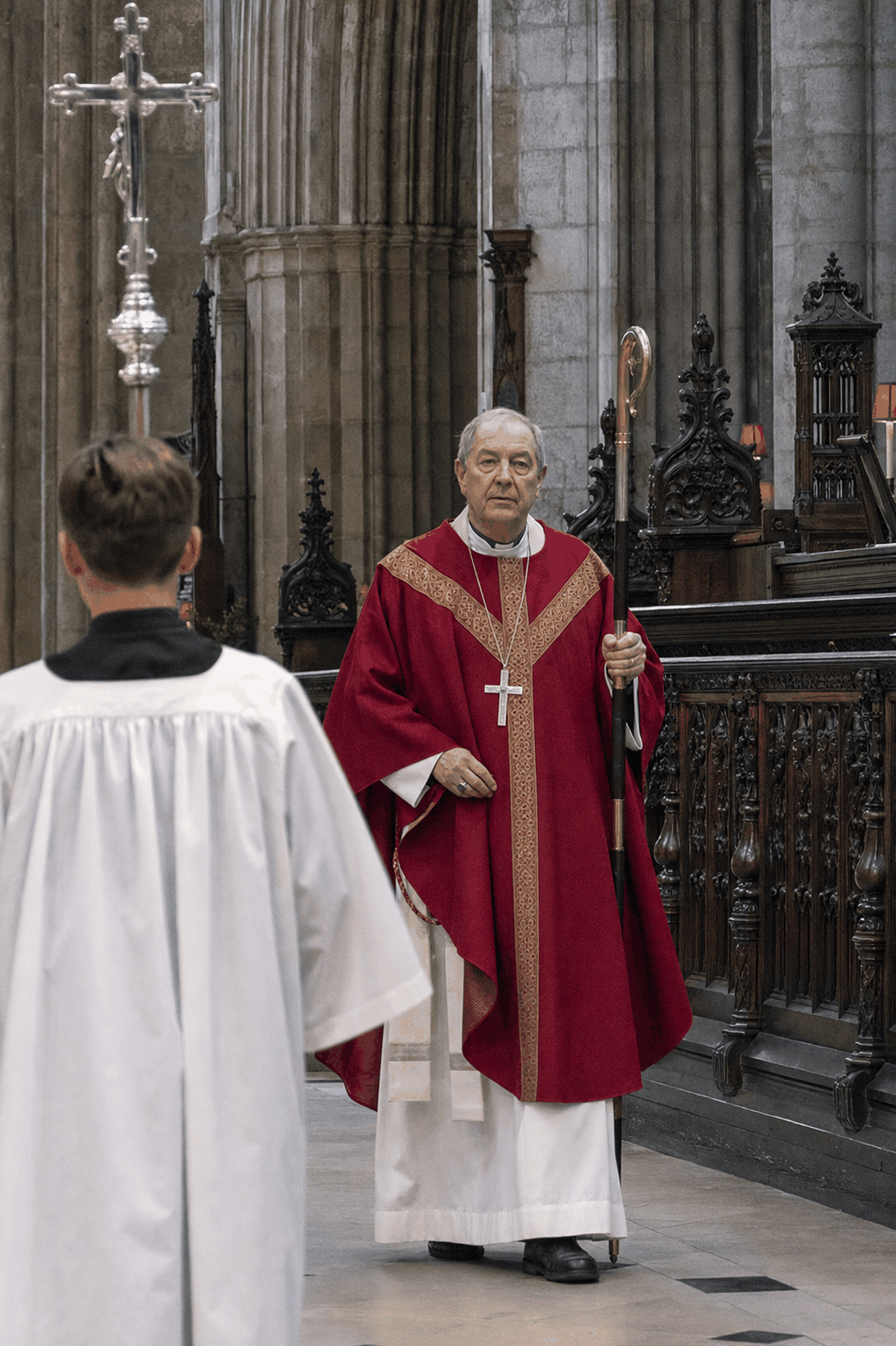
Choir dress
Choir dress is the ordinary episcopal habit and the one the public knows. It is worn for the offices, for preaching, for synod, for state occasions and in Parliament, and it is not eucharistic vesture.
Over a purple cassock a bishop wears the rochet, a white linen garment with full lawn sleeves gathered at the wrist, and over that the chimere, a sleeveless open gown. A broad black tippet hangs at the neck, which is a scarf and not a stole, a distinction of no consequence to anybody outside the institution and of considerable consequence within it. The pectoral cross and the episcopal ring, traditionally amethyst, complete it. Bands, the two white linen strips at the throat, are now worn only by bishops with a taste for them and by every bishop at the installation of another.
The chimere comes in two colours and the choice is not a matter of taste. Scarlet is the ordinary form and derives from doctoral academic dress rather than from anything ecclesiastical. Black is older, plainer and Reformed, and it survives as the standing use of the evangelical dioceses. A bishop in a black chimere is making a statement that every other bishop in the room can read, and the Church’s habit of declining to define itself is nowhere more visible than in a House of Bishops photographed in two colours.
The use of the parish
Eucharistic vestments are lawful and are not required, which is the settlement the Church reached instead of answering the question.
Alb, stole and chasuble in the liturgical colour are ordinary in the Anglo-Catholic dioceses and in the cathedrals, are usual in the centre, and are refused in a diminishing number of evangelical parishes where the surplice and the black scarf remain the whole of it. The canons permit both, prescribe neither, and place the choice with the parish rather than with the visitor. A bishop celebrating in a parish vests according to the use of that parish, and the practical effect is that a bishop of settled Anglo-Catholic habit may be found in a chasuble on a Sunday morning and in a surplice and scarf that evening twenty miles away, both lawfully and neither by preference.
The rule is old, it is not written down as clearly as this, and it has been the occasion of the only three vesture prosecutions in the Church’s history, all of them in the 1890s and all of them abandoned.
The mitre
The mitre was laid aside at the Reformation and taken up again in the 1890s, over sustained objection, and was general by the 1950s.
The recovery was a Ritualist project and was resisted as one. Its opponents argued that a hat abandoned for three centuries could not be resumed as though nothing had happened; its supporters argued that the Church had never abolished it, merely stopped wearing it. The Synod, characteristically, resolved the matter by declining to legislate, after which the mitre spread diocese by diocese as individual bishops adopted it and their successors did not give it up.
Three dioceses have never had a mitred bishop. The Church does not regard this as a defect and does not draw attention to it.
The primatial cross
A processional cross is borne before the Archbishop of New Westminster throughout the Realm, and it is the one piece of episcopal dress that is constitutionally contested.
The objection is exact. The Primate holds no jurisdiction over another bishop’s diocese, the canons are careful to say so, and a cross carried before him in that diocese asserts in cloth and silver what the canons deny in words. The objection was first minuted by the Diocese of Charles Town in 1924, has been raised in Synod eleven times since, and has never been carried.
The reply given by successive Primates is that the cross is a courtesy of honour and not a mark of jurisdiction, which nobody believes and everybody accepts. The Church of America has no pallium and has never sought one, the pallium being a Roman ornament that Anglican archbishops do not wear and carry only in their arms.
The Penitential Rite
At the Penitential Rite for National Sins the bishops are stripped of their office and keep only their orders, and the form of it is the most photographed thing the Church does.
They enter in cassock and rochet. There is no chimere, no mitre, no cope and no ring. The pastoral staffs are carried to the chancel step, laid on the floor, and left there for the duration of the Rite, and a bishop who has laid down his staff may not take it up again until the Rite has ended. The Primate enters last and without the cross.
It has been done four times. The photograph of the staffs on the floor of Columbia Cathedral in 1999 is the image by which most of the Realm remembers the mission schools, and the Primate of the day did not take his up again for the rest of that day, which was noticed, was not explained, and has not been repeated.
Parliament and the street
The twelve Lords Spiritual sit in choir dress and are conspicuously not robed as peers. They wear rochet and chimere, they have no scarlet and no ermine, and the reason is that they hold no peerage and leave the House when they leave the see. The Church has never asked for a parliamentary robe. It has also never given up the seats, and the two facts are usually cited together by the same people.
Out of church, a bishop wears a purple clerical shirt and a black suit, and did not always. Until the middle of the last century the ordinary walking dress of a bishop was the apron and gaiters, a shortened cassock to the knee with buttoned leggings beneath it and a frock coat over, worn in the street, in the office and on trains. The Synod never abolished them. The tailors simply stopped being asked, the last general order was placed in 1961, and Archbishop Edmund Cavanagh wore his until his retirement in 1968, by which time they read as costume and he knew it.
No provision of any kind was made when women were admitted to the episcopate in 1997. The canons were amended by striking pronouns and nothing else, which was argued at the time as either the entire point or a failure to have thought about it, and which remains the Church’s practice.
Music, bells and the choral tradition
The Church’s musical establishment is the largest in the Realm and is one of the few parts of the institution that has grown while the rest contracted.
Choral foundations at the cathedrals maintain daily sung services, choir schools, and a professional and voluntary singing tradition that reaches well beyond the Church’s membership. Cathedral evensong is attended in numbers that parish worship is not, substantially by people who do not otherwise attend anything, and the Church has learned not to interrogate them about it.
Hymnody is where the Church touches the general population most reliably. The Realm’s national and patriotic repertoire overlaps heavily with the Church’s, hymns are sung at state occasions by congregations who could not name their source, and the Church’s hymnal revisions are followed by the secular press in a way its liturgical revisions are not.
Bells carry the institution’s most visible public act. Church of America towers ring for national occasions, for local ones, and, since 2006, once each May Day at 10:37. Bell-ringing bands are frequently the last active lay organisation attached to a parish and are often composed of people who do not attend the services they ring for, which the Church regards as an entirely satisfactory arrangement.
Worship and doctrine
The prayer book
The Church’s worship is prayer-book worship, in three authorised revisions of 1928, 1962 and 1989, all of which remain in lawful use.
The 1962 revision is the consequential one, because it authorised contemporary-language alternatives beside the traditional rite rather than replacing it. The Church consequently runs two registers of the same liturgy in parallel, and has done for two generations, and the coexistence that once threatened schism is now so ordinary that most members would struggle to name which book they are using.
The broad church
The Church of America is a broad church and has been since it had a name for the condition.
It contains an Anglo-Catholic wing, sacramentally elaborate and ceremonially rich; an evangelical wing, preaching-centred and scripturally focused; and a large latitudinarian centre that regards both as acceptable and neither as necessary. Doctrinal definition has never been the institution’s preference. It has generally chosen comprehensiveness, on the practical ground that a national church which defines itself narrowly stops being national.
The cost of that choice is that the Church is frequently unable to say what it thinks, and the General Synod’s characteristic output on a contested question is a form of words that permits both answers.
Women in orders
Women are ordained to all three orders and have been since 1997, when the episcopate followed the priesthood in 1984 and the diaconate in 1974.
The question is settled and the settlement is structural rather than unanimous. A dissenting minority was accommodated by arrangements permitting parishes and clergy who cannot accept women’s orders to receive episcopal oversight from bishops who share their position, without leaving the Church or forfeiting standing within it.
The arrangements are defended as the price of keeping a broad church broad, and criticised as an institutionalised statement that some of the Church’s own bishops are conditionally valid. Both descriptions are accurate. The Church has accepted an unstable settlement in preference to a schism, which is a recognisable pattern in its history.
Marriage
The Church solemnises marriages between people of the same sex, following a General Synod decision that divided it and has not been reversed.
The domestic consequences were smaller than expected. The international consequences were not. The decision cost the Church standing in parts of the Anglican Communion, particularly among provinces for whom the question is settled in the opposite direction, and the resulting impairment of relations is real: shared communion is refused in some places, invitations are declined, and the Church’s representatives are received in some provinces and not in others.
The Church has not treated this as a reason to reconsider and has not treated it as unimportant either. Its stated position is that it acted on its own conscience within its own province, that the Communion is a fellowship rather than a jurisdiction, and that the cost of the decision belongs to it.
Doctrine and authority
The Church’s doctrinal position is inherited rather than constructed, and its characteristic move is to decline to go further than it has to.
The sources
The Church holds the scriptures as containing all things necessary to salvation, receives the historic creeds, and understands itself as governed by scripture read within the tradition of the Church and applied through reason. That threefold formulation is the one Anglican churches generally use, and it is doing more work in America than the words suggest: it is the mechanism by which a broad church holds together, because it permits an Anglo-Catholic, an evangelical and a liberal to affirm the same sentence and disagree about the weighting.
Two sacraments are held as generally necessary, baptism and the eucharist, with the other five rites of the western tradition retained and understood as sacramental without being placed in the same category. The historic episcopate is maintained and is treated as a matter of order rather than as a test of the validity of other churches’ ministries, which is why the Church can be in full communion with some bodies and in close cooperation with others whose orders it does not receive.
What the Synod may and may not do
The General Synod’s authority over doctrine is real and bounded, and the boundary is where most of the Church’s internal argument happens.
The Synod may authorise liturgy, regulate discipline, order the Church’s life and determine questions of practice. It may not, on the Church’s own account, alter the creeds or set aside the scriptures, and the Standing Committee on Doctrine of the House of Bishops exists to say when a proposal has crossed from the first category into the second.
The distinction is contested in every generation because it is not self-applying. The ordination of women was defended as a question of order and opposed as a question of doctrine. Marriage was argued the same way, by the same mechanism, with the sides reversed from where they had been on other questions. The Church has no tribunal capable of settling which category a question belongs to, and its practical answer has been that a question is one of order if all three houses can be persuaded that it is.
The limits of definition
The Church of America has never adopted a confession of faith beyond the historic formularies and has repeatedly declined invitations to.
The reasoning offered is that a national church which defines itself precisely stops being able to hold a nation, and that comprehensiveness is a form of pastoral provision rather than a failure of nerve. The reasoning against is that an institution which will not say what it believes will eventually find that nothing is required of it, and that a church which can accommodate any position has no position to offer anybody.
The argument recurs about once a generation, is conducted with unusual candour on both sides, and has never been resolved in favour of definition.
The Church abroad
The Church of America has an overseas history that it has spent thirty years reassessing.
The missionary period
From the middle of the nineteenth century the Church sent missionaries abroad in substantial numbers, principally to Africa, Asia and the Pacific, frequently alongside or behind the commercial and diplomatic expansion of the Realm and of Great Britain.
The work founded churches, schools, printing presses, hospitals and translations, some of which became major institutions in their own right and several of which are now provinces of the Anglican Communion considerably larger and more vigorous than the Church that founded them. This is the source of the Communion’s present shape and of the Church of America’s uncomfortable position within it: the provinces most critical of its recent decisions are in several cases its own former missions.
The reassessment concerns the rest of the record. Missionary work proceeded on assumptions about culture, language and religion that are no longer defensible and were contested at the time by some of the people subject to them. It was entangled with colonial administration, sometimes deliberately and sometimes because the missionary was the only literate official for a hundred miles. And it applied, abroad, the same convictions about the replacement of language and practice that produced the mission schools at home.
The Church has not enacted the Penitential Rite over its overseas missions, and the question of whether it should is periodically raised, chiefly by the provinces concerned. The obstacle is not reluctance so much as standing: several of those churches take the view that an American rite of repentance about them, conducted in New Westminster, would be one more act performed on their behalf without their participation.
The Church and the Realm’s expansion
Domestically the same pattern held. The Church followed settlement westward, planted parishes ahead of dioceses and dioceses ahead of population, and in several polities its ecclesiastical map records the ambitions of the nineteenth century rather than the demography of the twenty-first.
The Province of the Southwest is the standing example, with overlapping historical jurisdictions produced by shifting settlement patterns, treaty boundaries that no ecclesiastical map has matched, and a period in which three separate authorities believed themselves responsible for the same ground.
The consequence today is a Church whose structures are sized for a country that no longer exists in that form: dioceses drawn for populations that moved, cathedral establishments in cities that stopped growing, and missionary districts that have been temporary for a hundred and forty years.
Money
The Church is funded by historic endowments and by giving, and receives no general public money.
Public funds reach it only through two narrow channels. The state contributes to the fabric of buildings it wishes preserved, on the same basis it supports other heritage structures, and it meets the direct costs of national services it has itself requested. Neither channel funds clergy, parish operations, dioceses or the Synod.
The endowment position is the source of the Church’s structural problem, which is not poverty. The Church is asset-rich and income-poor: it holds cathedrals, historic churches, glebe land and investments accumulated over three centuries, and it holds them in a form that produces obligations faster than revenue. A parish of eleven regular communicants may sit inside a listed medieval-revival building whose roof is a six-figure liability.
Parish closures follow from that arithmetic rather than from any decision of principle, and the Church’s internal debates about them are the least edifying part of its public life, because they are conducted between people who all agree that the building matters and none of whom can pay for it.
The independence that funding buys is nonetheless real, and the Church guards it. An establishment that took public money would be an establishment the state could price, and the Synod has consistently declined arrangements that would produce that relationship, including offers made on favourable terms.
Attendance and the shape of the decline
Attendance has fallen steeply over two generations, and the Church’s ceremonial and civic reach has not fallen with it. That divergence is the central fact of its modern history.
The contraction is concentrated and uneven. It is steepest among the young, in the cities and in the polities where the Church was always a minority. It is slowest in rural parishes, in the polities of the old colonial establishment, and among the immigrant congregations, principally African and Caribbean, that are now the fastest-growing part of the institution and that hold a theological position considerably more conservative than the Synod’s.
What has not contracted is public function. More people watch the May Day Memorial Evensong than attend Church of America services in a month. State funerals, Remembrance Day and national services of mourning draw audiences that bear no relation to the Church’s membership. Parishes conduct funerals for families who have never attended, and are asked to, and do.
The Church has therefore become something its own theology has difficulty describing: an institution used heavily by people who do not belong to it, at the moments when belonging is least relevant to them. Clergy describe the experience as being consulted rather than followed.
Whether this is sustainable is the question the Church cannot answer. Ceremonial authority is not self-generating. It rests on a parish system, a clergy, a body of people who maintain the practice in ordinary weeks, and that base is contracting while the ceremonial demand is not. The risk to establishment in the Realm is not that Parliament will end it. It is that the Church will become too small to perform it, and that the ending will therefore require no decision by anybody.
The Church in national life
Ceremonial
The Church supplies the liturgical language of the Realm’s public moments: accessions, national mourning, Remembrance Day, thanksgiving, and the prayers that open Parliament.
The State Opening of Parliament begins with prayers conducted by the Archbishop of New Westminster or a senior bishop designated for the occasion. They are brief, they are fixed, and they are not a sermon.
The Accession Service at Columbia Cathedral is the American rite for a new monarch. It is not a coronation, does not replicate Westminster, and confers nothing: the monarch’s authority passes at the death of the predecessor and the service records rather than creates it. The distinction is stated by the Church each time and misreported most times.
State funerals, and conscience
State funerals of Prime Ministers, Governors-General and other significant figures are ordinarily held at Columbia Cathedral.
Religious conscience alters the form without reducing the honour, and the Church has been consistent about this. Edward Everett, an openly Unitarian Governor-General, received a Unitarian state funeral in Massachusetts, conducted in his own tradition, with the Realm’s honours undiminished and the Church’s participation limited to what he would have accepted.
The principle is that the state honours the person in the person’s own terms, and that an established church which insisted otherwise would be claiming exactly the ownership of conscience the Charter denies it.
Military chaplaincy
The Church provides the largest single contingent of chaplains to the Royal American Armed Forces, alongside Catholic, Methodist, Baptist, Jewish, Muslim and secular humanist chaplains.
Chaplains conduct worship, provide pastoral care to service members of all faiths and none, assist with death notifications, and accompany units in the field. It is the Church’s most practically significant ministry and the one that most consistently brings its clergy into contact with people who have no interest in it.
The schools and hospitals it no longer runs
The Church built a substantial institutional estate in education and health across the nineteenth and twentieth centuries, and it has very largely given it up.
The hospitals and hospices passed to the state with the construction of the National Health Service of America, in a transfer conducted over years and not without argument inside the Church. Most schools followed into the public system. What the Church retained is chaplaincy: the presence in the ward and the school that does not carry the institution with it.
The transfer is generally regarded within the Church as correct and is regretted by a minority, on the ground that it removed the institution’s daily contact with people who were not there for religious reasons, at exactly the moment when it could least afford to lose it.
Columbia Cathedral
Columbia Cathedral in New Westminster, formally the Cathedral Church of St. Michael and All Angels, is the Church’s national seat and the cathedral of the Diocese of New Westminster. It was built in phases from 1856 to 1924 to the design of George Gilbert Scott, in Gothic Revival, replacing a brick cathedral of 1806 that burned in 1854, and its east transept was rebuilt in a modern form after a fire in 1951. It hosts accession services, state funerals, national services of mourning and thanksgiving, and the annual May Day Memorial Evensong, and it takes no public money. Its history, fabric and occasions are set out in its own article.
✎ Editor's Note · Why St. Michael and All Angels
The dedication was chosen in 1856 and was not incidental. Michael is the warrior of heaven, the one who commands the host, casts out the adversary and stands at the threshold between order and chaos. Westminster Abbey is dedicated to St. Peter, the keeper of keys and the founder of a settled institution. The founding generation of the American cathedral chose the archangel of crisis instead, for a nation that had come out of a war and was not confident it had finished with them.
The All Angels half does the balancing. The Church of America is not a warrior church: it is broad, sacramental and constitutionally modest, and the angelic host is a company rather than a champion. The dedication holds both, which is a fair description of the institution that made it.
The Church and May Day
The May Day Bombings of 1 May 2006 changed the Church’s public role more than any event since the Charter.
In the days afterward the Church became the country’s ritual body of grief. Columbia Cathedral, the New York cathedrals, parish vigils, airport chapels, rail-station memorials and local bell towers carried a national mourning that no government department could have organised and that no secular institution was positioned to hold.
Every May Day at 10:37 a.m., the moment of the first bomb, Church of America bells toll once across the Realm. The practice was proposed by the Archbishop of New Westminster in the days after the attacks, on the argument that the country needed a single audible moment of grief belonging to no government and no party. It was adopted without legislation and has never required any.
The May Day Memorial Evensong at Columbia Cathedral, on the evening of 1 May, is among the most watched broadcasts in the Realm. The Archbishop preaches briefly, the names are not read, and the service is not political.
The Church’s own 2008 enactment of the Penitential Rite concerned this period, and specifically the instances in which its welfare networks had been infiltrated or exploited by the people who planned the attacks. The Church has been careful to hold the two facts together: that it gave the country its language of mourning, and that its institutions had been used by those who caused the mourning.
Other churches and other faiths
The Catholic Church
Relations with the Catholic Church are cordial and institutionally close, and the closeness is older than most people assume.
The two churches share public ceremony as a matter of long practice: joint services, reciprocal attendance at national occasions, common statements on public questions, and a settled convention that the Catholic hierarchy participates in Realm ceremonial in its own right rather than as a guest of the establishment. In polities where Catholicism is the majority tradition, the arrangement is effectively reversed at the local level, and the Church of America has learned to conduct national rites in places where it is the smaller body.
Catholicism is a very large presence in the Realm, dominant in Louisiane, substantial in the industrial polities and among several of the Realm’s largest immigrant populations. An establishment settlement that treated it as a dissenting minority would be describing a country that does not exist, and the Church of America stopped doing so long enough ago that the change is no longer contentious.
Other Protestant churches
Relations with the Methodist, Baptist, Lutheran, Presbyterian, Pentecostal and independent evangelical churches are cooperative at the parish level and correct at the national level.
The friction, where it exists, concerns ceremonial precedence rather than doctrine. The complaint is that the establishment’s role at national occasions is a historical accident that gives one denomination a permanent platform, and the complaint is generally made without heat, because the platform is understood to be shrinking.
Other faiths
The Realm’s Jewish, Muslim, Hindu, Buddhist, Sikh and other communities participate in national ceremonial life, and the Church’s position is that it conducts the Realm’s inherited rites rather than speaking for the Realm’s conscience.
The difficulty is structural and is not solved by good intentions. A national service conducted in a Christian idiom includes citizens who do not share it, and a national service conducted in no idiom at all is not a service. The Church’s practice has been to make room, in the form of participation by other traditions, and to accept that room-making does not resolve the underlying objection.
Indigenous traditions
The Realm’s treaty relationships with Indigenous nations intersect awkwardly with an established church, and the mission schools are the reason.
Many nations maintain religious traditions of their own, several have their own long-established Christian congregations, and some have both. The Church’s position since 1999 has been that it makes no claim in this area, participates where invited and not otherwise, and treats the relationship as one between authorities rather than as pastoral outreach.
That posture is recent, is a direct consequence of the schools, and is described by the Church itself as an obligation rather than a policy.
The Anglican Communion
The Church of America is in full communion with the Church of England and, through it, with the wider Anglican Communion.
Full communion means mutual recognition of sacraments, ordinations and episcopal orders. A priest ordained in one may serve in the other. The relationship is close and is not hierarchical: the Church of England does not govern the Church of America, and the Archbishop of Canterbury holds a position of honour and convening authority rather than jurisdiction.
The Lambeth Conference, meeting every ten years, is not a legislative body and cannot bind provincial churches. This is a strength when the Communion agrees and the whole of its difficulty when it does not.
The Communion is internally divided on marriage, sexuality and the ordination of women, and the Church of America sits at one end of several of those divisions. The impairment described above is the practical result: communion that is full in law and interrupted in practice with a number of provinces, maintained by both sides in the hope that the interruption is temporary and without much evidence that it is.
Communion with Rome
The Church of America took part in the Eastertide Council at Canterbury in 2026 as one of three churches, its Primate one of three principals, and carried the Eastertide Declaration at an extraordinary General Synod at Columbia Cathedral in November 2026 (Bishops 91 per cent, Clergy 78, Laity 61). The Declaration declares Anglican orders valid, restates the papacy as a primacy of service, and fixes five years of reception, after which the Council reassembles to proclaim communion with Rome or defer it. It states that the communion between the Church of America and the Church of England continues whatever any church decides. It leaves the Church’s women bishops and its marriage rites as matters not resolved.
Assessment
The Church of America is an unusually limited establishment attached to an unusually large public function, and its position is stable in law and precarious in fact.
Four failures are recognised within the institution and are worth naming, because the Church names them.
Becoming the chaplain of the existing order rather than its critic. This is the failure the abolitionists identified in the slaveholding dioceses, and it recurs whenever the Church’s comfort and the country’s comfort coincide.
Mistaking establishment for endorsement. A church that tells the national story and its own story in the same register has stopped being able to distinguish them, and the mission schools are what that looks like in practice.
Paralysis. A tricameral synod that requires three consents can be prevented from acting by any one of them, and the Church’s major questions have characteristically taken decades that the people affected did not have.
Disestablishment by neglect, which is the likeliest of the four. The Church does not need to be disestablished if it becomes practically irrelevant to enough citizens that its ceremonial role empties out from beneath. No Act would be required and no vote would be taken. The bells would simply be rung for fewer people each year until somebody noticed.
Against that, the institution retains three things that are not easily replaced: a parish system that still reaches almost every settlement in the Realm, a liturgical language the country reverts to under shock without deciding to, and a doctrine of corporate penitence that has twice made it act against its own institutional interest. Whether those are the assets of a living church or the estate of a dying one is a question the Church of America is currently unable to answer about itself.
Chronology
| Date | Event |
|---|---|
| 17th century | Church of England parishes established across the American colonies, unevenly and without resident bishops. |
| 1775 to 1779 | The Four-Year War divides the colonial church along with everything else. |
| 1783 | The Charter of Union makes the Church of America a legally distinct established body, in communion with the Church of England but not governed by it. |
| 1784 | The first American bishops are consecrated. |
| 1786 | The General Synod meets in its inaugural form at Christ Church, Philadelphia, where Parliament sits until 1801. |
| 1789 | William White, the first Archbishop of New Westminster, Primate of America, is installed at Christ Church, Philadelphia. |
| 1806 | Christ Church Cathedral, the first cathedral in the capital, is consecrated on the northern ridge. It burns in 1854. |
| 1840s | Disestablishment movements appear and become a permanent feature of the argument. |
| 1856 to 1924 | The present Columbia Cathedral is built in phases, and consecrated at Michaelmas 1924. |
| 1860s | Southern dioceses attempt formal secession from the General Synod. |
| 1871 | The Penitential Rite for National Sins is enacted for the first time, over slavery, at the reintegration of the southern dioceses. |
| 1880s onward | The mission school system expands, varying by diocese and by treaty nation. |
| 1923 | The Rite is enacted over violence against Black communities after Reconstruction. |
| 1928 | First twentieth-century prayer book revision. |
| 1962 | Second revision, authorising contemporary-language alternatives beside the traditional rite. |
| 1960s | The last mission boarding schools close. Hospitals and most schools pass to the state and the NHSA, with chaplaincy retained. |
| 1978 | The last mission school closes. |
| 1974 | Women ordained to the diaconate. |
| 1984 | Women ordained to the priesthood. |
| 1989 | Third prayer book revision. |
| 1997 | Women ordained to the episcopate. |
| 1999 | The Rite is enacted over the mission schools. The Church opens its archives without conditions, pays negotiated compensation, funds nation-directed language recovery, and hands the record to a body it does not control. |
| 1 May 2006 | The May Day Bombings. The Church becomes the country’s ritual body of grief; the 10:37 tolling begins. |
| 2008 | The Rite is enacted over the Church’s own institutional failures before May Day. Clergy discipline procedures are rebuilt again. |
| 2018 | A parliamentary inquiry into disestablishment finds majority opposition in both Houses. |
| 2026 | The Eastertide Council at Canterbury; the extraordinary General Synod carries the Eastertide Declaration in November. |
| 2028 | Attendance continues to fall; ceremonial and civic demand does not. |
Trivia
- In-Universe The Church of America receives no general public funding. State money reaches it only for the fabric of buildings the state wishes preserved and the direct costs of national services the state has requested. An objection to establishment as a subsidy is therefore an objection to something that is not happening.
- In-Universe Twelve bishops sit in the House of Lords by virtue of office, unwhipped and voting on conscience. It is the one part of the establishment settlement that confers actual political power, and successive Primates have declined to defend the seats as a matter of right while also declining to give them up.
- In-Universe The Church is asset-rich and income-poor. A parish of eleven regular communicants may sit inside a listed building whose roof is a six-figure liability, and parish closures follow from that arithmetic rather than from any decision of principle.
- In-Universe No bishop of the Church of England ever resided in America before the Charter settlement, so for a century and a half there were no local ordinations and no local confirmations. Lay government filled the gap, and the vestry system that resulted was never given up.
- In-Universe The Penitential Rite for National Sins has been enacted four times: in 1871 over slavery, in 1923 over violence against Black communities, in 1999 over the mission schools, and in 2008 over the Church's own institutional failures before May Day. Each enactment was preceded by years of argument about whether it was warranted and followed by years about whether it was adequate.
- In-Universe After the 1999 Rite the Church opened its mission school archives without conditions, paid negotiated compensation, funded language recovery it does not direct, and handed the documentary record to an independent body it cannot defund or dissolve. The last of these is the one it cannot quietly reverse.
- In-Universe The Church claims abolitionist saints and keeps the records of slaveholding bishops, and has consistently declined to resolve the contradiction by choosing one half of it.
- In-Universe Every May Day at 10:37 a.m., the moment of the first bomb, Church of America bells toll once across the Realm. The practice was proposed by the Archbishop of New Westminster in the days after the attacks, adopted without legislation, and has never required any.
- In-Universe The Church solemnises same-sex marriages, which cost it standing in parts of the Anglican Communion. Its position is that it acted within its own province, that the Communion is a fellowship rather than a jurisdiction, and that the cost of the decision belongs to it.
- In-Universe Columbia Cathedral is dedicated to St. Michael and All Angels rather than to a founder saint. Westminster Abbey has St. Peter, the keeper of keys; the American founding generation chose the archangel of crisis, for a nation that had come out of a war and was not confident it had finished with them.
- In-Universe Cathedral evensong is attended in numbers that parish worship is not, substantially by people who do not otherwise attend anything, and the Church has learned not to interrogate them about it.
- In-Universe The fastest-growing part of the Church is its immigrant congregations, principally African and Caribbean, whose theology is considerably more conservative than the General Synod's. The Church has not resolved what follows from that and mostly does not discuss it.
- In-Universe The likeliest end of the establishment is not an Act of Parliament. It is that the Church becomes too small to perform the function, so that the arrangement empties out from beneath and the ending requires no decision by anybody.
- Real-World In our history the American parishes came out of the war as congregations in a foreign republic, and the English bishops could not consecrate a man who was unable to swear allegiance to the Crown. Samuel Seabury was consecrated at Aberdeen on 14 November 1784 by nonjuring bishops of the Scottish Episcopal Church, and the body he returned to became the Protestant Episcopal Church, established nowhere. The colonial half of this article is close to that history. Everything after 1783 follows from the Charter having kept the Crown.
- Real-World Our United States has no established church of any kind and never has had a national one, the First Amendment having forbidden it. The nearest real counterpart to the settlement described here is the Church of England, which seats twenty-six Lords Spiritual rather than twelve, and which is established in England alone: the Church in Wales was disestablished in 1920 and the Church of Ireland in 1871.
- Real-World The same-sex marriage passage is carried over almost unaltered. The Episcopal Church authorised marriage rites for same-sex couples at its General Convention in 2015, and in January 2016 the primates of the Anglican Communion voted to bar it for three years from representing the Communion in ecumenical and doctrinal bodies. The arguments made on both sides then are close to the arguments given here, including the claim that a province may act within its own jurisdiction and the claim that a fellowship is entitled to say what it will not recognise.
- Real-World The mission schools answer to real institutions. Anglicans ran roughly three dozen of Canada's Indian residential schools, and the Anglican Church of Canada apologised for them in 1993; in the United States the Episcopal Church was among the churches that operated Indian boarding schools, and the federal investigation into that system did not report until 2022. What has no real counterpart is the Penitential Rite itself, which is invented, and the independent custody of the documentary record, which is the part the Church here cannot quietly reverse.
- In-Universe The Church of America carried the Eastertide Declaration at an extraordinary General Synod in November 2026, clearing the Council's own vote by one and the Synod's by margins of 91, 78 and 61 per cent in its three houses. The House of Laity was the narrowest.
See also
- The United Kingdom of America, the Realm in which it is established
- The Charter of Union of the American Colonies, which made it a distinct body and imposed no religious test
- The Crown in right of America, the capacity in which the monarch is Supreme Governor
- Parliament, where twelve of its bishops sit as Lords Spiritual
- The May Day Bombings, after which it became the country’s ritual body of grief
- The National Health Service of America, to which its hospitals passed
- The Royal American Armed Forces, to which it supplies the largest chaplaincy contingent
Categories
Institutions · Religion · The Church of America · The Crown · Society & Daily Life