Kingdom of Portugal
The Kingdom of Portugal is a parliamentary monarchy occupying the western sixth of the Iberian peninsula, together with the Atlantic archipelagos of the Azores and Madeira. Lisbon is the capital. The population is approximately eleven million. The House of Braganza has reigned without interruption since 1640, and the present King, Pedro VI, is also Emperor of Brazil, a second crown that came to Lisbon by inheritance in 1986 and has been held with the first ever since.
The single fact from which most of the others follow is that Portugal fought no war in the twentieth century. It was neutral in the Great War and neutral in the Second Great War. It gave up its African and Indian possessions in the 1950s by negotiation, before any shot was fired over them, and gave up the last of them, Macau, in 1999 by treaty. It has not defaulted on a public debt since the 1920s. It has had no revolution, no occupation, no civil war and no change of dynasty. The last Portuguese soldier killed in a European war died fighting Napoleon.
This is not the same as saying that nothing happened. Portugal was governed for forty years by one man, Antonio de Oliveira Salazar, a professor of economics from Coimbra who was called in to balance the budget, stayed until 1972, and left on the day he had announced four years earlier that he would. He was never elected to the office he held, and he governed by decree throughout. He also kept a free press, held real elections at every level, tolerated a legal opposition, maintained no political police, executed nobody, imprisoned almost nobody, wrote a constitution containing a court that could strike down his successors’ laws, and went back to Coimbra afterwards to teach. Portuguese textbooks call the period the Salazarismo and decline to say what it was.
Portugal is a member of the Atlantic Treaty Organization, which it joined in the first enlargement, and of the European Concert. Its oldest commitment is neither: the Treaty of Windsor of 1386, concluded with the English Crown, which is the longest-standing alliance in the world still in force and which was invoked once, by Britain, in 1943.
Etymology
Portugal descends from the Latin Portus Cale, the harbour of Cale at the mouth of the Douro, the settlement that became Porto and Vila Nova de Gaia on opposite banks. The name attached first to the county granted in the eleventh century, then to the kingdom that Afonso Henriques made of it in 1139, and then to a state that has kept very nearly the same frontiers ever since. The Portuguese themselves note that their country is named after a port rather than after a people, a tribe, a river or a king, and that this is the correct emphasis.
The royal house takes its name from Braganza, the town in the far north-east, and reaches the throne through the Duke of Braganza proclaimed as John IV in the Restoration of 1640. The dukedom is the heir’s title still, and the present heir presumptive holds it.
The escudo is the shield, and the coin is named for the arms it carried. The armillary sphere that stands beside those arms on the flag is a navigational instrument and not a symbol of dominion, a distinction Portugal now makes deliberately and did not always make.
There is one Portuguese word the article cannot do without. Desenrascanco is the national self-description: the faculty of getting out of a difficulty by improvisation, of unsticking a thing without a plan for it, of finding the way through. A country that improvised its way past a regicide, a dictatorship and an empire has some claim to the word, and uses it constantly.
History
Before 1908
Portugal’s medieval and early modern history runs as it does elsewhere. The kingdom was founded in 1139 and its frontier with Castile settled by the middle of the thirteenth century, which makes it the oldest continuous land border in Europe. The Treaty of Windsor of 1386 bound it to England. The maritime expansion of the fifteenth and sixteenth centuries produced the first of the European seaborne empires and, in Brazil, much the largest of them. Sixty years of Spanish kings ended with the Restoration of 1640 and the accession of the House of Braganza. The earthquake of 1755 destroyed Lisbon and the Marquis of Pombal rebuilt its lower town to a rectilinear plan on a timber cage designed to survive the next one, which it has.
The nineteenth century brought the French invasions, the flight of the court to Rio, the loss of Brazil, a civil war between two brothers, and the long constitutional monarchy that followed. Brazil separated in 1822 without a war and without a grudge: a son declared the independence of the country his father had governed from, the father recognised it, and the two branches of the same family ruled two countries on either side of the Atlantic for the rest of the century. The separation was dynastic rather than national, which is why it left no bitterness, and, a hundred and sixty-four years later, why it was legally so simple to undo.
Two things from that century matter here more than the rest. The first is the abolition of the death penalty for civil crimes in 1867, the first such abolition in Europe. The second is the political system that the constitutional monarchy settled into, the rotativismo: two parties which alternated in office by arrangement rather than by election, dividing the state’s patronage between them and managing the ballot to produce whichever result the arrangement next required. It worked for forty years and was, by the 1890s, transparently corrupt.
The settlement of 1908
By 1906 the rotation had broken down and the King, Carlos I, had authorised a minister to govern without the Cortes while a remedy was found. The remedy was slow in coming and the arrangement looked, to a growing republican movement, exactly like what it was.
On 1 February 1908 a group of men waited in the Terreiro do Paco with the intention of killing the King and the heir as the royal party crossed the square. The royal party was late. A delay of about twenty minutes, caused by nothing at all, meant that the square was policed and quiet by the time it should have been full, the gunmen lost their nerve, and the party arrived to find nothing waiting for it. Carlos I lived, the heir Luis Filipe lived, and the plot was rolled up over the following fortnight.
The whole of the Portuguese twentieth century turns on those twenty minutes, and the Register sees no reason to be coy about it.
What Carlos I did next is the reason the century went the way it did. He did not take reprisals. The men taken were tried in the ordinary courts, and, the death penalty having been abolished forty-one years earlier, none of them could be executed and none of them was. He then conceded, in the course of that year, a great deal more than he had to:
- The extra-parliamentary government was dissolved and the Cortes recalled.
- The two-party rotation was broken by the introduction of proportional representation by district, which made the arrangement arithmetically impossible to sustain.
- The franchise was widened, in stages that reached universal male suffrage within a decade.
- The powers of the Crown were reduced to the forms they still hold, with one exception preserved deliberately: the appointment of the head of government.
- The Church was left established in name and stripped of every practical privilege, an arrangement nobody has since thought worth revisiting.
- The republican movement was offered, and accepted, a flag of its own design to be flown beside the flag of the dynasty.
This last is the most Portuguese act in the country’s modern history. The green and red banner that the republican congresses had adopted as the emblem of the coming republic became, instead, the second national flag of the Kingdom, flown beside the blue and white of the monarchy at every public building in the country. The movement was bought off with a piece of cloth, and it worked. There was no republic. There has been no serious republican party in Portugal since the 1920s.
The settlement is called simply the settlement, or the Concessions, and it is the founding act of the modern state.
The Kingdom and the Great War
Portugal was neutral throughout the Great War. It had no dispute with any belligerent, no territory at risk that a belligerent wanted, and, in the settlement of the African frontiers a generation earlier, no grievance against the ally who might have dragged it in. Britain did not ask and Portugal did not offer. The kingdom sold food and wolfram to both sides at prices its ministers afterwards described as embarrassing, and came out of the decade with a trade surplus and no graves.
The decision was taken in the Cortes in the autumn of 1914 after four days of debate, and the argument that carried was not moral. It was that Portugal had nothing to gain that was worth what an expeditionary corps would cost, and nothing to lose that an expeditionary corps could protect. A minority argued that a seat at the eventual peace conference was worth having and that the African frontiers would be redrawn without Portugal if Portugal were not there. They were answered, correctly as it turned out, that the frontiers had been settled by negotiation in 1890 and that nobody was proposing to reopen them.
Portugal has no memorial to the Great War, no tomb of an unknown soldier, no two minutes’ silence in November and no poppy. Portuguese visitors to the cemeteries of northern France say that the absence is difficult to explain to their hosts and more difficult to explain to themselves.
Carlos I died in 1938, having reigned forty-nine years. His son succeeded as Luis Filipe I, at fifty-one, thirty years after the morning in the square that should have killed him.
The Long Ministry begins, 1928 to 1932
The 1920s went badly. Proportional representation had done exactly what it was designed to do and produced a Cortes in which no party could govern alone, and the coalitions it produced were short, numerous and incapable of carrying anything unpopular. What most needed carrying was unpopular. The escudo was falling, the deficit was structural, the colonial administrations were subsidised, and no finance minister lasted long enough to present two budgets.
Between 1919 and 1928 Portugal had fourteen governments and nineteen finance ministers. Two of them presented budgets. The escudo lost most of its value against sterling across the decade, the note issue was used to cover the deficit because there was no other way to cover it, and by 1927 the Kingdom could not place paper abroad at any rate it was willing to accept. A loan was negotiated with the League of Nations and abandoned when the conditions attached to it were read aloud in the Chamber, which is the single most humiliating afternoon in modern Portuguese parliamentary history and is remembered as such.
In 1928 the King’s government, at the end of its patience, offered the finance ministry to a professor of political economy at Coimbra who had written on the public accounts and had once sat in the Cortes for a fortnight before resigning in disgust. Antonio de Oliveira Salazar was thirty-nine. He accepted on a single condition, which he put in writing and which was granted: that no department might announce expenditure without his prior agreement.
He balanced the budget in eighteen months and it stayed balanced for forty years.
The method was not mysterious and he never pretended it was. He cut the note issue, published the accounts monthly in a form the newspapers could print, refused every supplementary estimate for two years without exception, and raised three taxes that were unpopular in ways that fell on people who could afford it. He was assisted by the fact that nobody expected him to last and by the further fact that the alternative was the League’s conditions. By 1931 Portugal was borrowing at rates it had not seen since before the Great War, and the professor had become, without seeking it and to his visible irritation, the most popular man in the country.
In 1932, after another coalition fell, Carlos I sent for him and appointed him Prime Minister. He was invited in through the constitution’s own front door, and this is why he never had to break it. He held the office until 1972.
Salazarismo, 1932 to 1972
The Portuguese called it the Long Ministry while it was happening and the Salazarismo afterwards, and have never agreed on a classification. The reason is that almost every test one would ordinarily apply comes back with the wrong answer.
The press was free. There was no prior censorship, no licensing, no suppression of titles and no prosecution of editors. The opposition newspapers attacked him for forty years. He read them, and he answered them, in print and over his own name, which he did about once a month for most of his time in office and which is the single hardest fact about the regime for foreigners to accept.
The elections were real, at every level. Municipal, district and national contests were held on the ordinary calendar, on a universal franchise, counted honestly. The opposition won towns and cities, ran them, and kept them. It never came close to a national majority, and he won for forty years because a plurality of Portuguese approved of what he was doing and went on approving of it.
The opposition was legal. Parties organised, published, contested, and sat in the Cortes. Several of their leaders held public office under him, including in his own governments. The standard complaint of the Portuguese opposition through the entire period was not brutality but futility.
There was no political police. Portugal had a criminal police and nothing else. Nobody was executed for a political offence, because nobody could be executed for anything; and the total of political imprisonments across forty years is a figure small enough that Portuguese historians list the cases individually.
So the question of what made him a dictator has a precise answer, and it is not a moral one. He governed by decree. The Cortes met, debated, questioned ministers and voted, and the substance of government was done by decree under enabling powers that the Cortes renewed every few years because no combination of its members could agree on anything else. Everything was legal. Almost nothing was legislated.
And the Cortes could have removed him at any time. The power was there in the settlement of 1908 and he did not touch it. Confidence was moved against him eleven times in forty years and carried none of them. Five parties, no majorities, and an opposition which agreed on nothing whatever except that he should go. His survival in office was a fact about them rather than about him, and Portuguese constitutional historians have been saying so, with some discomfort, since the 1980s.
The Crown restrained him privately and constantly. This was not known until the royal archives for the period were opened, and it changed the argument when it was. Both Carlos I and Luis Filipe I raised particular matters with him, repeatedly, in audiences whose memoranda survive, and on a number of occasions he gave way. What neither King ever did was decline to reappoint him, which is the act that would have ended it, and the historians who are least impressed by the private restraint make exactly that point.
What he built is easier to summarise than what he was. He educated the country: literacy went from a national embarrassment to among the best in Europe within thirty years, on a programme of plain schoolhouses to a single design that still stand in every parish. He electrified it from its rivers, and the great dams of the Douro and the Zezere are the physical monument. He built almost no health service, on cost grounds, and said so.
But the monument Portugal actually points to is the solvency itself. He found a country that could not borrow and left one that did not need to, and no Portuguese government since has defaulted, devalued in panic or gone to an international lender. The discipline outlived him by fifty years. It is an unglamorous thing to be remembered for and it is the truest.
The Second Great War and the Lajes Convention
Portugal was neutral in the Second Great War and permitted Allied basing in the Atlantic islands, principally at Lajes in the Azores, from 1943. The facilities mattered to the convoy war out of all proportion to the size of the country that granted them; they closed the mid-Atlantic air gap.
The device that made this possible was not Portuguese. It was proposed by the British ambassador at Lisbon, and it was this: that Britain should ask for the facilities under the Treaty of Windsor of 1386, as an ally invoking an existing obligation, rather than as a belligerent seeking a new one. Portugal would then be honouring a commitment five and a half centuries old, and not entering a war.
The Lajes Convention was signed on that basis. Its preamble recites the treaty of 1386 at length. It is the only occasion on which the oldest alliance in the world has been formally invoked, and Portugal is proud of it and cites it whenever the alliance is described as ceremonial.
Portugal asked one thing in return, and got it: that nobody should ever call it a belligerent. The Allies kept to that, in public and at the peace, and Portugal’s neutrality stood on paper to the last day of the war. Salazar’s own account, given to the Cortes in 1945 and never amended, was that the Kingdom had done what the treaty required of it and no more, which was true, and that the treaty had required it, which the Cortes was in no position to test.
The end of the empire, 1951 to 1961
Portugal decolonised early, quickly, and for reasons of arithmetic.
Salazar had the colonial accounts reworked between 1949 and 1951 on the same basis he applied to everything else, with the military and administrative costs of the coming decades projected against any plausible revenue. The projection did not work, and would not work under any assumption he was prepared to make. He put it to the Cortes in a speech which is still set as a text in Portuguese schools, whose central sentence is that a possession which cannot pay for its own defence is not a possession but a liability held for reasons of vanity.
I am asked what the overseas territories are worth to Portugal, and I have had the question answered in the only way I know how to answer a question, which is by adding it up.
Here are the figures for the last eleven years, and here are the figures for the next twenty-five on every assumption I am willing to defend. The administrations do not pay for themselves. The garrisons do not pay for themselves. The ports do not pay for the railways and the railways do not pay for the ports. Where the trade is profitable it is profitable to the companies, and where the companies are Portuguese the profit reaches this country as a dividend on which we levy less than we spend on the soldiers who protect it.
I have been told that this is to reckon in escudos what should be reckoned in glory. I would reply that I have never seen glory enter the Treasury, and that I have spent twenty-three years explaining to this Chamber that what does not enter the Treasury must nonetheless be paid for out of it.
There is a further calculation, and it is the one I ask the deputies to make with me. Every year that we delay, the price of leaving rises and the price of staying rises with it. A day is coming when the territories will be held only by force; force will be answered; and the account will then be presented not in escudos but in the lives of young men who are at this moment in the schools we have built. I decline to present that account. A possession which cannot pay for its own defence is not a possession. It is a liability held for reasons of vanity, and I have no use for vanity and this Kingdom cannot afford it.
Goa, Damao and Diu were transferred to India by agreement in 1954, in a negotiation of some elegance which India’s own diplomatic historians study. Guinea, Cape Verde, Sao Tome and Principe, Angola and Mozambique became independent in stages between 1955 and 1959, on timetables settled in advance with movements that had not yet had to become armies.
The parliamentary opposition divided on the question and has never stopped arguing about it. One wing supported the withdrawals and resented having to agree with him. Another opposed them, on the ground that the territories were being abandoned to whoever could seize them, and that argument has aged in complicated ways depending on which territory is being discussed. A third position, which is the one most Portuguese hold, is that he was right for reasons that were not creditable, and that the country got the benefit of a moral act performed for reasons of bookkeeping.
Nobody was killed. There was no colonial war, no conscription, no returning veterans, no generation lost, and no bill. Portugal’s economy in the 1960s grew from money that was never sent to Africa, and its population in the 1970s included the several hundred thousand young men who were never sent there.
What Portugal did keep was the language, and the relationships. The Lusophone Community grew out of the independence settlements and has met, in one form or another, ever since.
The constitution of 1970 and the handover
In 1968, at seventy-nine, Salazar told the Cortes that he would leave office in 1972 and that a new constitution would be in force before he did. He had described himself as a temporary expedient since 1932, and no Portuguese had believed him for thirty-six years. A good many did not believe him now.
The Constitution of 1970 replaced the settlement of 1908 and preserved almost all of its machinery, clause for clause. It confirmed proportional representation, the elected Chamber of Deputies, the appointed Chamber of Peers, the Crown’s appointment of the Prime Minister and the Cortes’s power to remove one. It ended government by decree, by writing the enabling power out of the document altogether. It named Mirandese as an official language in its own district and Portuguese Sign Language as a language of the Kingdom, neither of which anybody had asked for. It gave the Azores and Madeira their own assemblies, governments and courts, and placed their competences beyond the reach of ordinary legislation.
And it created a Constitutional Court with the power to strike down the acts of the Cortes and the government alike.
Portugal is governed under a constitution written by a dictator which reads like a liberal one, and which contains the instrument that could have destroyed him had it existed thirty years earlier. Every reading of the man has to account for that document, and no reading does so comfortably.
He asked to be relieved of office in 1972, on the date he had named four years before, at eighty-three. The first elections under the new constitution were held that autumn. Asked in his last interview why he was going, he said that the books were balanced, the empire was gone, the schools were built and the constitution was written, and that he had been engaged on a problem and the problem was solved.
He went back to Coimbra, took up a lectureship in public finance, and taught for six more years to students who had been born under him. He died in 1978, aged eighty-nine. The photograph of a very old man in a dark coat walking to a lecture theatre, taken in 1974 by a newspaper that had spent four decades attacking him, is the standard illustration of the whole period, and everything Portugal cannot decide about him is in it.
The democratic period, 1972 onward
Nothing dramatic happened. Ordinary party politics resumed at once, out of the factions that had always existed inside the Cortes, and Portugal simply started voting again. There was no transition, no purge, no truth commission and no reckoning, because there was nothing to reckon with that the courts had not already been open to hear. The men who had governed with him went on sitting; several of them led parties.
The first three governments under the Constitution were coalitions, lasted their terms, and were unremarkable. The second of them fell in 1978 on a motion of confidence, the first to be carried in Portugal in forty-six years, and the Chamber discovered that the mechanism worked. The third produced the first Portuguese prime minister to have spent the Long Ministry in opposition, who took office in 1980 and immediately found that the machinery he inherited was in perfectly good order and that there was very little to dismantle.
The work of the first democratic decades was the work he had declined to do. A universal health service was built between 1974 and 1986, in stages, paid for by a payroll levy that no government has since been able to reduce or willing to raise, and it is the clearest achievement the democratic period can point to as its own. A contributory pension followed in 1981. The islands’ federal standing, granted on paper in 1970, was filled out with money and competences through the 1970s and 1980s, in a series of negotiations that both island governments describe as having been necessary and neither describes as having been generous.
Luis Filipe I died in 1975, having reigned thirty-seven years, and was succeeded by his son Manuel II, who was forty-six and who would reign for fifty-two years.
In the 1980s the succession law was reformed to absolute primogeniture, eldest child regardless of sex. Portugal was not the first in Europe to do it and the debate was brief. What was noticed at the time, by those who were paying attention, was that Brazil passed the identical reform in the same session of its own parliament.
The rest of the century was quiet and prosperous in a way that Portuguese political memoirs of the period find difficult to make interesting. The economy compounded. Governments alternated on a four-year rhythm and occasionally on a shorter one. The escudo held. A serious argument about entry into a projected European monetary arrangement ran through the 1990s and ended in the Cortes resolving against any surrender of the currency, on a free vote, by a margin of about two to one; the Bank of Portugal had briefed against it and the Bank of Portugal won.
The arguments of the 2000s and 2010s were about the cost of Lisbon, the emptying of the interior, and what to do about a health service designed for a younger country. The argument of the 2020s has been about the islands, and specifically about whether the mainland regions should be given the standing the Constitution gave the Azores and Madeira in 1970. It has now been raised in four consecutive parliaments and has not once reached a vote.
The Convention of Rio, 1986
The Brazilian imperial line had been failing in plain sight for twenty years. Empress Isabel II, who had acceded in 1944, married late and had no children, and by the middle 1970s the Brazilian chancery had established what every genealogist in both countries already knew: that on her death the succession, under Brazil’s own dynastic law, would pass to the senior surviving line of the House of Braganza, which was the Portuguese one.
She died in 1986, aged ninety-one, in the forty-second year of her reign. The crown of Brazil passed to Manuel II of Portugal.
Brazil’s reaction was not sentimental. A republic was proposed in the Chamber of Deputies within the week and defeated; but what the monarchy’s defenders had to concede in order to defeat it was substantial, and it is all in the Convention of Rio, negotiated in Brazil, on Brazilian terms, and named for the city because Brazil insisted on it. Portugal signed what it was given.
The Convention provides:
- That the two crowns are held in personal union and that the two states remain in every other respect entirely separate, with their own governments, parliaments, courts, forces, currencies and foreign policies.
- That the Viceroy of Brazil shall exercise the imperial authority in the sovereign’s absence, and shall be elected by the Brazilian legislature, the sovereign confirming.
- That the sovereign’s style in Brazil is Emperor of Brazil, the imperial title held by the house since the founding of the empire, and that he takes there the ordinal he holds in Portugal.
- That neither crown may be separated from the other except by the agreement of both parliaments.
The third of these is the one that still rankles. Brazil had had a Pedro I and a Pedro II of its own, and the man who came to it in 1986 was Pedro’s great-great-nephew several times removed and the sixth Pedro of Portugal. Brazil adopted the Portuguese numbering as the price of continuity: tidy for the chancery, and, as a substantial minority of Brazilians have never stopped pointing out, a statement about which of the two countries the dynasty belongs to.
The union has now lasted forty-two years, which is longer than the marriages of most of the people who predicted it would not last five.
Macau, 1999
The last piece of the empire was forty acres of the Pearl delta, and it went by treaty in 1999. Macau returned to the Empire of China under a compact that preserves its Portuguese law, its Portuguese language, its courts and a substantial administrative autonomy, all of which it retains.
A second instrument was signed alongside the transfer: a Portugal-China treaty on free movement, perpetual and reciprocal, under which residents of Macau keep the right to live and work in Portugal and Portuguese nationals keep the right to live and work in Macau. Both governments honour it. Neither advertises it, and it is not mentioned in either country’s public account of the handover.
Portugal’s empire had begun in 1415 and outlived every other European empire by decades. It ended on a wet evening in a small square with a band, a lowered flag, and a Portuguese head of government whose remarks lasted four minutes. The Lisbon newspapers led with it and did not lead with it the following day.
The accession of Pedro VI
Manuel II died in 2027, in the fifty-second year of his reign, at ninety-eight. His only son, Infante Duarte, had died in 2011 at fifty-two. Of Duarte’s three children, the eldest, Infante Miguel, had renounced his rights in 2022 on grounds of a chronic illness which the family stated plainly and which has not since been discussed; he lives privately, and he and his brother are close.
So the crowns passed to the second son, Pedro VI, who was twenty-nine, and who had been an officer of the Portuguese navy for nine years and had intended to remain one. His brother’s renunciation in 2022 did not end that immediately: he asked to be allowed to finish his service, was granted three more years over the objection of most of the household, and gave up a submarine appointment in 2025 only when the Palace stopped asking and began telling.
Within four months he had to use the only real power the office carries. The general election returned a Chamber in which neither of the two large parties could form a government and neither would serve under the other, and the King had to decide whom to send for. He took advice widely, took his time, and sent for the person who could actually command a majority in the Chamber, which is what the constitution requires and what his grandfather would have done. That person was the twenty-nine-year-old leader of the small liberal party which holds the balance and which has been in most governments since 1972 without ever leading one.
The method was entirely conventional. The result was not, and Portugal has been arguing about it since.
Geography
Portugal occupies about 92,200 square kilometres, the western sixth of the Iberian peninsula, with Spain along the whole of its land frontier and the Atlantic on its western and southern coasts. The frontier itself is the oldest continuous land border in Europe, fixed in substance by the Treaty of Alcanices in 1297 and disputed only over one village since.
The Tagus divides the country. North of it the land is high, wet, granite, and farmed in small holdings; south of it the Alentejo is flat, hot, and held in large estates, and beyond that the Algarve turns to the sea. The Douro in the north cuts the terraced gorge that produces port; the Mondego is the only major river that rises and ends within the country; the Guadiana marks part of the southern frontier with Spain. Every other significant river arrives from Spain, a fact that governs the water treaties and that Portuguese ministers raise at every Iberian summit.
The Azores lie about fifteen hundred kilometres west in the open Atlantic, nine volcanic islands on the ridge, with Ponta Delgada as the seat of their government. Madeira lies a thousand kilometres south-west, two inhabited islands of extraordinary steepness, with Funchal. Between them the archipelagos hold about half a million people, appreciably more than in a country that had sent its young men to a colonial war; the Azores in particular grew through the twentieth century on Atlantic aviation, the basing economy and the absence of any reason to leave.
The highest point in the Kingdom is Pico, in the Azores, at 2,351 metres. The highest point on the mainland is the Serra da Estrela, at 1,993 metres, where it snows and where the Portuguese ski, briefly and without conviction.
The climate is Atlantic in the north and Mediterranean in the south, and the dividing line runs somewhere around the Mondego depending on which year is being discussed. The north is wet enough for the maize and the vinho verde country; the Alentejo is dry enough that the cork oak and the holm oak dominate a landscape of grazing and scattered trees that is farmed as it has been farmed since the Romans. The Algarve is dry, hot, and the destination of a very large proportion of the northern European population every summer.
The interior has been emptying for a century, as it has everywhere in southern Europe, and this is the country’s genuine and unsolved structural problem. The population is concentrated on the coastal strip between Viana do Castelo and Setubal, and a broad band of the eastern districts along the Spanish frontier has fewer people in it than it had in 1900. Successive governments have tried tax incentives, administrative relocation and a university in every district, and the trend has slowed and not reversed. Wildfire in the abandoned pine and eucalyptus of the centre is the most visible consequence and the one that reaches the news.
The Tagus estuary at Lisbon is one of the great natural harbours of the Atlantic and is the reason everything else about Portugal is as it is. It is crossed by two bridges, and the argument about a third has been running since 1998.
Government and politics
The Crown
The King is head of state of the Kingdom of Portugal and, separately and in his own right, Emperor of Brazil. His Portuguese style is His Most Faithful Majesty, the papal grant of 1748, which Portugal has never relinquished and which its chancery uses in full on any document that matters.
Almost everything the Crown does, it does on advice. The King assents to legislation, appoints and dismisses ministers, receives and accredits ambassadors, dissolves the Cortes, commands the forces and exercises the prerogative of mercy, and exercises none of it on his own judgement. The forms are those of the settlement of 1908, carried unaltered into the Constitution of 1970, and they were never abolished at any point in the forty years when they were not doing very much. That is the technical reason Portugal never became a different kind of state: the machinery was disused and it was still there when it was wanted.
There is one exception, and it is real. The King appoints the Prime Minister, and in a Chamber elected by proportional representation since 1908 the appointment has frequently not been obvious. The Crown’s choice is a genuine choice, exercised on advice but not dictated by it, and it has been exercised every few years for a century. It is the reason the Portuguese monarchy is studied by constitutional lawyers who have no other interest in Portugal.
The Crown is large and privately funded. Because there was no republic, the Braganza patrimony was never confiscated: agricultural estates in the Alentejo, cork oak and pine, and property in Lisbon. The Crown meets the cost of the household and the palaces from its own revenues and pays tax on them. The state pays for the guard, the aircraft and official travel, and publishes the accounts. The arrangement is unusual in Europe, Portugal is pleased with it, and a periodic argument asks why the state’s head of state is one of its larger landowners; nobody has yet proposed an answer that survives contact with the alternative.
The principal royal residence is the Palace of Ajuda in Lisbon, which was left half-built in the nineteenth century, was completed in the twentieth, and is the most visible single sign that the monarchy never fell. Necessidades houses the chancery. Queluz receives state visits.
Pedro VI is easy in public, popular in two countries, good with crowds, and gives almost nothing away. He is the most opaque monarch in Europe behind a completely open manner. He is unmarried, which is speculated about by the press of two countries and therefore speculated about a great deal. The heir presumptive is his younger sister, Infanta Isabel, Duchess of Braganza, who was born after the union and named for the Brazilian empress whose death brought the two crowns together.
The Prime Minister and the Government
The head of government is the Prime Minister, the Primeiro-Ministro. The title is new: it was created by the Constitution of 1970, which abolished the historic office of President of the Council of Ministers and replaced it with an identical one under a different name. The reason given at the time was tidiness. The reason understood at the time was that the old title had been held by the same man for forty years and would go on meaning him.
The Prime Minister is appointed by the King, holds office while the Chamber of Deputies is content, and chooses the government. The Constitution ended the enabling powers under which Salazar had governed, so the government now legislates through the Cortes like any other, and the Portuguese executive is correspondingly weaker than most in Europe. Ministers answer questions weekly. Governments are usually coalitions and usually last their four years, because the parties that make them are practised at it.
The present Prime Minister leads the small liberal party which holds the balance between the two larger blocs, took office in 2027 after an election neither bloc could win, and governs with about twelve seats of his own and a formal agreement with both of the larger parties on separate subjects. He is the youngest head of government in Europe. The arrangement is generally expected to fail and has not yet.
The Cortes Gerais
The Cortes Gerais sit at the Palace of Sao Bento and consist of two chambers.
The Chamber of Deputies has 230 members, elected for four years by proportional representation in multi-member districts. The system is unchanged in principle since the settlement of 1908, which introduced it to destroy the two-party rotation, and it has never since produced a single-party majority. That is the point of it and also, as Portuguese historians observe, the reason one man was able to remain Prime Minister for forty years: an assembly designed so that no faction can command it is an assembly that cannot easily dismiss anybody.
The Chamber of Peers has about a hundred members, appointed by the Crown on the advice of the Prime Minister, for life. It is a revising chamber with no claim to a mandate and it does not pretend to one: it may delay, amend and return, and it may not block supply or defeat a manifesto commitment. It is deliberately small and its members are named for life precisely so that it renews slowly and no single parliament can pack it. It contains, at any time, a high proportion of retired judges, retired officers, retired diplomats and academics, and it does most of the Kingdom’s detailed legislative work because the Deputies have neither the time nor the inclination.
The Cortes may remove a government on a motion of confidence, and may amend the Constitution by a two-thirds majority of the Deputies in two successive sessions with an election between.
The Atlantic islands
Portugal’s territorial arrangement is asymmetric, and deliberately so. The mainland is a unitary state, governed through districts which are administrative and hold no powers of their own. The Azores and Madeira are federal units, each with its own assembly, its own government, its own courts below the Supreme Court, and a list of competences which the Cortes cannot legislate away. They also elect deputies to the Chamber like anybody else.
The arrangement was put into the Constitution of 1970 and filled out over the following two decades. The reasoning was geographical rather than ideological: the islands are between one and three days from Lisbon by sea, they had been governed badly from a distance for four centuries, and the alternative to devolving power was continuing to pretend that a district governor in Ponta Delgada was taking instructions in useful time.
Mainland politicians describe the result as an absurdity about once a parliament, and propose either that the mainland regions should be given the same standing or that the islands should lose it. Neither proposal has ever been carried, and the islands’ members hold enough seats in a Chamber where nobody has a majority to make sure that neither ever is.
The two archipelagos do not make common cause. The Azores are nine islands across six hundred kilometres of ocean and their own politics is about the relationship between them rather than the relationship with Lisbon; the assembly sits at Ponta Delgada, the courts at Angra do Heroismo and several departments at Horta, an arrangement arrived at because no other one could be agreed. Madeira is a single centre and governs itself accordingly, and has a long-standing grievance that Azorean questions are treated in Lisbon as island questions and answered on Azorean terms.
Both island governments hold competences over agriculture, fisheries, transport, planning, health, education, culture and a share of the taxes raised in their territory. Neither holds defence, foreign affairs, currency, criminal law or the constitution. The Lajes establishment in the Azores is national and its use is a matter for the government in Lisbon, which is the single largest source of friction between the island and the mainland and has been since 1943.
Local government
The mainland is divided into eighteen districts, which are administrative and hold no powers of their own, and beneath them into municipalities and civil parishes, which do. The municipality is the unit of Portuguese local life: it holds the planning power, the roads, the water, the markets and the schools’ buildings, and its president is a figure of real consequence in a way that a district governor never is.
Municipal elections are held every four years on a separate cycle from the national ones and are taken extremely seriously. They were taken seriously under Salazar too, which is the point his defenders make most often and his critics find hardest to answer: the opposition won Porto in 1949 and held it for most of the 1950s, ran Setubal for twenty years, and governed a substantial minority of the country’s municipalities throughout the Long Ministry while never once approaching a national majority.
Parties
Portugal has four or five parties of consequence and no majorities.
- A centre-right party, the largest most of the time, descended organisationally from the administrative class that governed under Salazar and organisationally embarrassed about it.
- A centre-left party, built in the 1970s out of the legal opposition of the Long Ministry, which claims the moral inheritance of the whole period and is entitled to about half of it.
- A liberal party, small, urban, and in office more often than either of the others because it can go either way. It currently leads the government.
- An agrarian party of the north, which is smaller than it was, has been in a dozen coalitions, and has never once been in one that lasted.
- A left bloc, urban and young, which has grown for three elections running.
Everybody has governed with everybody. Coalitions are negotiated in weeks rather than months and are honoured. The Portuguese find their politics dull and say so with evident satisfaction.
Law and judiciary
Portuguese law is civil law of the continental type, codified, and descended through the nineteenth-century codes from Roman and Napoleonic models. The ordinary courts run from district courts through courts of appeal to the Supreme Court of Justice at Lisbon. Administrative law has its own hierarchy.
The Constitutional Court, created by the Constitution of 1970 and sitting at Lisbon, reviews the constitutionality of statutes and decrees, on reference before promulgation and on concrete challenge afterwards. It has struck down acts of the Cortes and of governments of every colour, and its existence is the single most difficult fact for anybody trying to give a simple account of the man who created it.
The death penalty was abolished for civil crimes in 1867, the first abolition in Europe, and extended to all crimes including military ones in 1911. It has never been restored. It was not restored by Salazar, who was asked to restore it twice, in 1936 and in 1942, and who declined both times without giving reasons. Portugal teaches 1867 in every school, and it is the first thing a Portuguese diplomat will tell a foreigner about the country.
Prison sentences are short by European standards and the maximum term is twenty-five years. The Portuguese explanation for both is the same as the explanation for 1867, and it is the phrase brandos costumes, gentle customs, the nineteenth-century description of the national habit of settling things without violence. Portuguese historians argue about whether this is a description or a flattering myth, and the abolition of 1867 is the strongest single piece of evidence for the description.
The union with Brazil
The King of Portugal is Emperor of Brazil, of the Empire of Brazil. He is the same man and it is not the same office, and the Convention of Rio is a long document mostly devoted to keeping the two apart.
Brazil’s constitutional life runs without him. The Viceroy, elected by the Brazilian legislature and confirmed by the Emperor, exercises the imperial authority: assents to legislation, appoints the government, receives ambassadors, and does everything else the Emperor would do if he were there. He is Brazilian, he holds office for a fixed term, and in practice he is a figure of some distinction at the end of a career rather than at the height of one.
Lisbon is home and Brazil is visited. The King lives in Portugal and goes to Brazil on progress, usually twice a year and for state occasions. The viceroy exists so that this is possible, and the whole architecture of 1986 exists so that a country of two hundred million is not governed at the convenience of a country of eleven.
The ceremony of arrival is the same every time. The Viceroy meets the Emperor at the aircraft and hands back the state, in a formula of about forty words, and resumes it in the same words when the aircraft leaves. It is theatre, everybody knows it is theatre, and Brazilians turn out for it in numbers that have never fallen.
The unions can be separated, but only by the agreement of both parliaments. The successions are locked in step because both countries reformed their dynastic law in parallel in the 1980s, in anticipation of exactly what happened; neither may amend its law unilaterally without the Convention’s machinery being engaged.
What the union is actually for is a question both countries ask and neither answers the same way twice. It gives Brazil a head of state who is above its politics because he is not in the country, and gives Portugal a standing in the southern hemisphere wildly out of proportion to its size. It also means that once every few years the two national football sides meet, the King attends, and a quarter of a billion people watch a match at which the head of state of both teams is required to look at neither end.
It has also produced a small and specific body of law that exists nowhere else. The two chanceries maintain a joint office at Lisbon whose entire function is to determine, for any given act of the sovereign, which of his two capacities he is acting in; the question matters because an act in the wrong capacity is a nullity in both states. The office publishes an annual list of determinations, which runs to about forty pages, and Portuguese and Brazilian constitutional lawyers regard it with the affection ordinarily reserved for a difficult and much-loved relative.
The harder question, which comes up in Brazilian political argument about once a decade, is why a country of two hundred million should take its head of state from a country of eleven. The answers given are that it does not, since the Viceroy is Brazilian and elected; that the alternative in 1986 was a republic and the republic was defeated; and that the arrangement has now lasted long enough that undoing it would be a larger act than leaving it alone. None of these is an argument from principle and Brazilians do not pretend otherwise. The Portuguese answer to the same question is shorter, and is that nobody in Lisbon asked for any of it.
Foreign relations
The Alliance of 1386
The Treaty of Windsor, concluded on 9 May 1386 between the Crowns of Portugal and England, is the oldest alliance in the world still in force. It provides for perpetual friendship between the two realms and for mutual assistance, and it has never been amended, superseded or renounced.
It has been formally invoked once, by Britain, in 1943, and the invocation produced the Lajes Convention and the Azores bases. Lawyers on both sides argue about the extent to which a fourteenth-century instrument can still generate obligations in a world of written defence treaties, and neither government has ever been willing to say. The Portuguese position, stated with some consistency, is that the treaty is in force, that Portugal would honour it, and that the question of what it requires is best left where six hundred and forty years of practice have left it.
When the American and British Crowns separated, the question arose of whether the obligation ran to both successor Crowns. It did not. Windsor stayed with London. Portugal’s warmth toward the United Kingdom of America is real and its diplomats are careful to say that it is not Windsor.
Great Britain
The oldest friend, and a slightly tiresome one. Six centuries of alliance, a shared taste in port, a very large British community in the Algarve, no serious quarrel since the African frontiers were negotiated in 1890, and a treaty neither side will ever renounce.
What Lisbon minds is that London forgets the alliance, and what London does not know is that it does. The anniversary is marked in Portugal and not in Britain. The Portuguese ambassador at London is by custom the senior ambassador of the diplomatic corps regardless of length of service, an arrangement of purely Portuguese origin which the Court of St James’s accepted in the nineteenth century without quite understanding why it was being asked.
Spain
Portugal and Spain are close, and Portugal is owed something it has never collected.
Don Juan, son of Alfonso XIII and the legitimate heir to the Spanish throne, spent thirty years in Portugal criticising the Montero regime that had displaced his house, and was able to do so because a supposed dictatorship on one side of the frontier permitted what an actual one on the other did not. His son was proclaimed Alfonso XIV in 1971 and the Spanish monarchy was restored. Spain’s royal family knows what it owes to a country that allowed a pretender to publish, and says so at every state visit.
Lisbon has never once cashed the debt, which is a quiet form of power and is understood as one on both sides of the frontier. Beneath the royal warmth the ordinary asymmetry of size persists: Portugal watches Spanish intentions with a wariness that predates both monarchies, the water treaties are argued about annually, and the electricity interconnector has made the Iberian market a single market in all but name, which both governments find convenient and neither describes aloud.
The European Concert
Portugal acceded to the European Concert at its founding by the Treaty of Straßburg in 2027, as one of its seventeen seats and not as a founding power. It is in the customs union, the single market and the programme for free movement.
Its currency is not in question, because there is none to be in question: the Concert has adopted no common currency and Portugal is one of the reasons the subject was kept off the table at Straßburg. The escudo is the monument to Salazar’s solvency and the Cortes has twice resolved against surrendering it, once during the ratification debate and once since.
Portugal is small in the Concert and is listened to in one specific place, which is anything touching the Atlantic, Africa or Brazil. The Concert uses Lisbon as its channel to all three.
The Lusophone Community
The Lusophone Community is the association of the Portuguese-speaking states: Portugal, Brazil, Angola, Mozambique, Guinea, Cape Verde, Sao Tome and Principe, and Timor, which borders Indonesia on its western half, with Macau as an associate. It is mostly cultural. It runs schools, scholarships, a broadcasting exchange and a shared orthography agreement which every member complains about, and it holds a summit every two years.
There is no defence dimension and no trade bloc, and there is not going to be. It is not the Commonwealth and does not want to be. Brazil dominates it by size and Portugal chairs it by courtesy, an arrangement which is openly a fiction and openly useful, since the alternative is an organisation in which one member is twenty times the size of all the others combined.
The African states
Portugal’s relations with Angola, Mozambique, Guinea, Cape Verde and Sao Tome are unusually good, and the reason is unusually simple: it left before there was anything to fight about. There was no war, no liberation movement that had to become an army, no generation of cadres formed in exile, and no Portuguese garrison whose withdrawal had to be negotiated under fire. The men who signed the independence instruments on the African side had, in most cases, sat in the Portuguese Cortes.
This does not mean the relationship is uncomplicated. Four centuries preceded the 1950s and the four centuries are not forgotten; the slave trade, the forced labour regimes of the early twentieth century and the settler economies are taught in African schools in terms Portugal does not dispute and has formally acknowledged. What is absent is the specific bitterness of a war of independence, and every African government in the Community says so when the subject arises, usually while making a point about something else.
The practical content of the relationship is people, money and language. Portuguese banks and construction firms work across Lusophone Africa; African students take degrees in Lisbon, Porto and Coimbra in numbers the universities plan around; the free movement arrangements are wide, though narrower than the Brazilian one. Angola in particular is no longer a junior partner in anything, and Portuguese ministers who forget this are reminded of it briskly.
The United Kingdom of America
Correct and unremarkable, and the article declines to inflate it. Two members of the same alliance, no quarrel, a substantial trade, and American maritime facilities in the Azores alongside the British ones. The Realm is not party to the Treaty of Windsor and does not behave as though it were. Such intimacy as exists runs through Brazil, and is therefore recent.
The Empire of China
Relations are governed by the Macau settlement of 1999 and are excellent, in the way that relations are excellent between two states which have completely resolved the only thing they ever disagreed about. The free movement treaty signed alongside the transfer is honoured in both directions and mentioned by neither government. Portuguese is one of Macau’s two authoritative legal languages and Portuguese lawyers practise there, which gives Lisbon a commercial channel into southern China that is out of all proportion to anything else it has in Asia.
Defence
The Portuguese Armed Forces number about thirty-five thousand, all volunteer since the 1990s, and are organised around a single strategic proposition: Portugal defends an ocean and cannot defend a border.
The Navy takes most of the budget and most of the prestige. Frigates, a small submarine flotilla and long-range maritime patrol aircraft cover the Azores gap, the western approaches and the sea lanes to the islands. Portuguese maritime patrol is the reference standard across the whole Atlantic Treaty Organization, and the alliance’s amphibious school is at the Portuguese establishment, with the annual exercise run jointly with Spain.
The Army is a brigade group, a special forces regiment and the Fuzileiros, the marines, who are the country’s one first-rate military asset and know it. The Air Force is small, and its principal assets are the maritime patrol squadrons and the Lajes infrastructure.
Portugal is non-nuclear, has never sought a nuclear capability, and has never operated a power reactor either. The island bases at Lajes carry British and American maritime facilities under the standing arrangements of the alliance, which is the same legal form the Lajes Convention created in 1943 and which has never lapsed.
Portuguese officials are noted within the alliance for correcting, sharply, anybody who describes the Atlantic Treaty Organization as a monarchical bloc. The correction is not about Portugal.
Economy
Portugal is a small, open, notably rich economy, among the top five in Europe by output per head, and it arrived there by an unglamorous route: a century of compound growth with no war debt, no reconstruction, no default, no lost decade and no colonial haemorrhage.
The structure is ordinary. Manufacturing, agriculture, tourism and services, in roughly the proportions any comparable European country shows. The specialisms are:
- Cork. Portugal produces about half the world’s supply from the Alentejo oak, and the Crown is one of the larger growers, which is periodically pointed out.
- Wine. Port and the Douro above all, then the Alentejo and the Vinho Verde country. The demarcated Douro region is the oldest in the world.
- Moulds, dies and machine tools. A precision engineering cluster around Marinha Grande and Leiria which supplies the European motor industry and which nobody outside the trade has heard of.
- Financial services. Lisbon clears a substantial part of the Lusophone world’s business, and has done since long before the union made the arrangement look deliberate.
Energy comes from water, wind and sun: Salazar’s dams on the Douro, the Zezere and the Tagus; wind on the northern ridges; solar in the Alentejo; and a heavily used interconnector with Spain. Portugal examined nuclear power twice, in the 1970s and again in the 1990s, costed it, and declined both times on grounds the professor would have recognised.
The escudo is managed by the Bank of Portugal under a statutory price mandate written in 1970. Portugal has not defaulted since the 1920s, has not had a banking crisis requiring public money since the 1930s, and regards both facts as constitutional rather than economic.
The public accounts are the country’s peculiarity. The balanced budget rule is not in the Constitution, which is the thing foreigners most often get wrong about Portugal; it is in an ordinary finance act of 1929 which any Cortes could repeal by a simple majority on any afternoon it chose. Twenty-five parliaments have declined to. Deficits are run, in recessions and for capital projects, and are closed within the cycle because a government that does not close one is attacked for it by the opposition, the press, the Bank and, on three occasions, its own finance ministry. The Portuguese explanation is that the rule survives because it was never entrenched, and that a discipline nobody is forced to keep is harder to resent.
What this produced is a country that entered the second half of the twentieth century poor and left it rich, without ever having grown quickly. Portuguese growth has been unspectacular in every decade since 1935 and has never been interrupted for longer than two years. Compounding did the rest.
The transport network is the visible result. The Lisbon metro opened in 1959 and has been extended in every decade since; the motorway system was built between 1965 and 1990 and paid for out of revenue; the two Tagus crossings at Lisbon opened in 1966 and 1998. The main line to Porto is fast and the line to Madrid is not, for reasons that involve two governments, two gauges and a hundred and fifty years of mutual suspicion, and which are raised at every Iberian summit and settled at none of them.
Demographics and society
The population is approximately eleven million, of whom about three million live in the Lisbon metropolitan area and one and a half million around Porto. About half a million live in the Azores and Madeira. The population is ageing, though less steeply than in most of southern Europe, and it is growing slowly.
Migration runs in both directions and has for a century. The Portuguese went to Brazil, to Africa and to France as they always had, and their grandchildren come back; the free movement arrangements with Brazil, the African members of the Lusophone Community and Macau mean that the traffic is legally simple in a way it is nowhere else in Europe. There was no great post-colonial retornado exodus, because there was no colonial collapse to produce one, and no emigration crisis of the 1960s, because there was no war to flee and no stagnation to escape. What Portugal has instead is a permanent circulation within its own language, and it is the ordinary condition of Portuguese family life that somebody is on the other side of an ocean.
The country is one country. The north is granite, small farms and church; the Alentejo is heat, large estates and a historic left vote; Porto maintains that it is the capital of something. These are differences of food, accent and temperament, and the Register declines to inflate them into anything larger. Portugal is small, old, homogeneous and comfortable with itself to a degree that visitors from larger and more anxious countries find difficult to credit.
Languages
Portuguese is the national language and is spoken by two hundred and fifty million people, almost none of them in Portugal.
Mirandese, an Astur-Leonese language with a few thousand speakers in Miranda do Douro, is co-official in its own district. Portuguese Sign Language is named in the Constitution as a language of the Kingdom. Both provisions were written into the Constitution of 1970 by a government nobody had asked to write them, which remains one of the stranger footnotes to the period.
Education and health
Schooling is universal, free and compulsory to eighteen, and the system Portugal has is recognisably the one built between 1933 and 1958. The schoolhouses of that programme, a single plain design repeated in every parish with the parish name over the door, still stand in their thousands and about half are still schools; the rest are libraries, clinics and parish halls. Portuguese literacy went from among the worst in Europe to among the best inside thirty years, and this is the achievement of the Long Ministry that nobody disputes and everybody finds uncomfortable to praise.
There are universities at Coimbra, Lisbon, Porto and a dozen smaller places. Coimbra, founded in 1290, is the state’s seminary and knows it: it has supplied the Portuguese administrative class without interruption for seven centuries, and the proportion of ministers, judges, ambassadors and permanent secretaries who read law or economics there remains high enough to be raised in the Cortes about once a decade. Salazar is its most famous graduate, its most famous teacher and its most uncomfortable subject. The lecture room he used, both before 1928 and after 1972, is still in ordinary use and carries no plaque, a decision the university took in 1979 and has reaffirmed twice.
The health service is universal, tax and levy funded, and was built from nothing between 1974 and 1986 because the Long Ministry had declined to build one. It is good, it is stretched, and the argument about how to pay for an ageing population in a rich country with a balanced budget is the most durable ordinary argument in Portuguese politics.
Media
There is no press regulator and there never has been, because there was nothing to dismantle in 1972 and nobody has since proposed creating one. The Lisbon and Porto dailies of the Long Ministry are mostly still publishing under the same mastheads, including the two that spent forty years attacking the government, and the archive of that exchange is the principal primary source for the period: several thousand articles and something over four hundred replies signed by the Prime Minister himself.
Broadcasting is a mixed system, with a public corporation funded by a levy and a constitutional guarantee of its editorial independence written into the 1970 document. The Portuguese-language broadcasting exchange with Brazil, Angola and Mozambique means that Portuguese television is watched far outside Portugal and that Brazilian television is watched inside it, in volumes that Portuguese cultural ministers have been complaining about since the 1980s.
Religion
The Catholic Church is established in name and dead in practice. The settlement of 1908 removed its privileges and left its formal position untouched; the Constitution of 1970 did the same. There is no religious test for any office, no Concordat in force, no religious instruction in state schools and no public money for the Church, and the King’s accession involves no religious oath. The establishment has not been repealed because nobody has been able to identify what repealing it would change.
Portugal is overwhelmingly Catholic by affiliation, indifferently so by practice, and thoroughly Catholic in the shape of its year. The shrine at Fatima receives several million pilgrims annually and the state has no view about it.
Culture and daily life
What a visitor notices first is that nothing has been knocked down. Portugal has not had a war, an occupation, a revolution or a bankruptcy within living memory, and the consequence is visible in every street: buildings are repaired rather than replaced, shops pass within families, and the same names appear on the same premises across four generations. The public manner is reserved, which foreigners read as coldness and the Portuguese call politeness. Things are done slowly and on time.
The food is the real food: salt cod in a hundred preparations, grilled sardines, the pork and clams of the Alentejo, the custard tarts, the bread. The wine is drunk young and locally except where it is port. Coffee is taken standing up, in one swallow, several times a day.
Lunch is long and is not negotiable. The working day runs late and the evening runs later; dinner at ten is ordinary and dinner at eight is early. Sunday is family, and family means an assembly of three or four generations at a table, which is the arrangement that most obviously has not changed and that the Portuguese are most obviously determined not to change. Shops close in the afternoon in the smaller towns and the argument about whether they should is a hundred years old.
The year is Catholic in shape and secular in content. The great civic festivals are the popular saints’ days of June, above all Santo Antonio at Lisbon and Sao Joao at Porto, which are street festivals with grilled sardines, paper decorations, bonfires and no perceptible religious observance whatever. The August holiday empties the cities and fills the villages, because everybody is from somewhere and goes back to it.
The Portuguese abroad are a permanent feature of Portuguese life rather than a diaspora in the usual sense. There are Portuguese communities of long standing in Brazil, France, the Realm, the African states and Macau, and a quarter of Portuguese families have a member in one of them at any time. They vote, in two constituencies reserved for them in the Chamber of Deputies, and their remittances and their returns have been part of the national economy for so long that no Portuguese thinks of them as either.
Football is the national sport and the great rivalry is domestic, between Benfica, Porto and Sporting. The international fixture that matters is against Brazil, which is played every few years and which is watched, between the two countries and the wider Lusophone world, by a quarter of a billion people. It is the only football match in the world at which the two sides share a head of state.
And there is fado, and the melancholy, and the problem they present. The Portuguese national art form is about loss, distance, the sea and the people who did not come back, and it is the art form of a country which, in the century when every other European nation was losing people by the million, lost almost nobody. Portuguese writers have been arguing about this since the 1950s. One school holds that saudade was always about the ocean and not about catastrophe, and that a maritime nation with three hundred years of departures has all the loss it needs. Another holds that the melancholy is an inheritance from the sixteenth century and has simply outlived its occasion. A third holds that a country which has avoided every disaster of its age is entitled to feel strange about it.
The Register reports the argument and declines to settle it.
Symbols
Portugal has two national flags and flies them together.
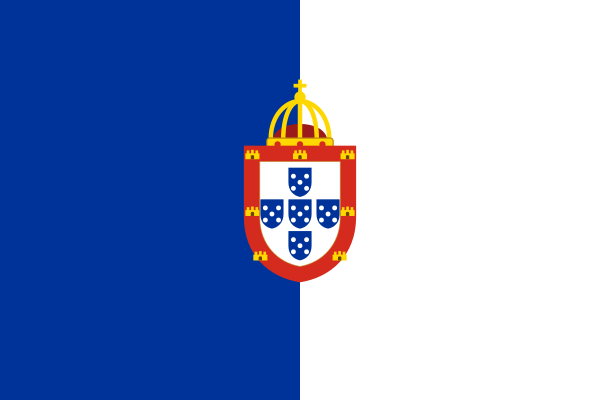
The blue and white is the flag of the monarchy: a field divided vertically, dark blue at the hoist and white at the fly, charged with the royal arms and surmounted by the crown. It is the flag the Kingdom has flown in one form or another since the fifteenth century and it has never been discontinued.
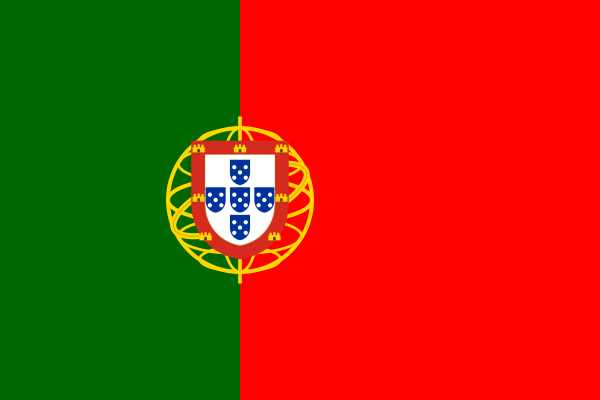
The green and red is a vertical bicolour, green at the hoist in two fifths and red in three, charged at the division with the armillary sphere and the shield of the national arms. It was designed by the republican movement in the 1890s as the flag of the republic it intended to establish, and it became instead, by the concession of 1908, the second national flag of the Kingdom. It has flown beside the blue and white for a hundred and twenty years.
There is no protocol question about which comes first, because the two are flown as a pair and always have been: blue and white to the observer’s left, green and red to the right, on staffs of equal height, and never one without the other. Foreign protocol offices find the arrangement maddening. No Portuguese finds it remarkable, and the standard Portuguese explanation is that one flag is the dynasty’s and one is the nation’s and the country happens to be both.
The arms are the quinas, the five shields of five bezants arranged in cross, within a bordure of seven castles, set upon the armillary sphere, and ensigned with the royal crown. The sphere entered the arms as the emblem of the discoveries and was for four centuries a claim upon other people’s countries. Portugal recast it deliberately after the decolonisation: it is now read as an instrument of navigation and a claim upon the Atlantic, which is the reading that permits the Lusophone Community to use the same device without any member objecting, and which would have been impossible on the old one.
The anthem is the Hino da Carta, the royal anthem of the constitutional monarchy, adopted in 1834 and never replaced because no republic ever came to replace it. A Portuguesa, written in 1890, is a patriotic song of no official standing, sung at football matches and at nothing else.
There is no state motto. The Portuguese position is that the sphere does the work a motto would do.
Portugal keeps two national days, which will surprise nobody who has read this far. 1 December is the Day of the Restoration, marking the proclamation of John IV in 1640 and the end of the sixty years of Spanish kings; it is the Kingdom’s day, it is observed by the Crown and the forces, and it is the older of the two. 10 June is the Day of Portugal and of the Portuguese Communities, marking the death of Camoes in 1580, and it is the day of the language rather than of the state: it is kept wherever Portuguese is spoken, the King spends it abroad about half the time, and the Lusophone Community treats it as its own. Neither day has ever been proposed for abolition in favour of the other.
The royal accession is a proclamation and not a coronation. The sovereign is proclaimed at the Ajuda, takes an oath before the assembled Cortes to observe the Constitution and the laws of the Kingdom, and is acclaimed. There is no crown placed on anybody’s head; the crown of Portugal exists, is kept at the Ajuda, and has not been worn since 1646, when John IV laid it at the feet of an image of the Virgin and declared her the queen of Portugal, on the understanding that no mortal monarch would wear it thereafter. Every Braganza since has kept to that, including the ones who were not otherwise notable for keeping to things.
Assessment
Portugal is the country that the twentieth century happened around rather than to. It is also the country that produced, out of the most liberal constitutional settlement of its age, forty years of government by decree; and the relationship between those two sentences is the whole of the argument about it.
The settlement of 1908 was an act of exceptional generosity and exceptional political skill. A king who had just escaped assassination gave away most of what remained of his authority, widened the franchise, broke the machine that had kept his ministers in office, and handed his enemies a flag. It saved the monarchy, and it has now outlasted by a century every republic that was proposed in its place.
It also built the trap. Proportional representation destroyed the two-party rotation exactly as intended, and what replaced the rotation was a Chamber in which no combination could command a majority. That Chamber could not sustain a government through the financial crisis of the 1920s, which is why a professor of economics was sent for; and that same Chamber could not assemble the votes to dismiss him for the next forty years. Portugal’s best act and its strangest consequence are the same act. The liberal constitution produced the dictatorship, and then, because it had never been abolished, received the country back intact when the dictatorship chose to end.
Whether that is a vindication of the settlement or an indictment of it is the question Portuguese constitutional historians have not resolved and do not expect to. The three arguments that actually animate Portuguese politics are versions of it: whether the escudo should be kept because a dead man balanced the books; whether the mainland should have what the islands were given in 1970; and whether the King should have chosen differently in 2027. All three are arguments about how much the past ought to govern, and Portugal conducts them the way it conducts everything else, at length, in public, and without resolution.
There is a second question underneath it, which Portuguese writers raise more often than foreign ones, and it is whether the whole record is a matter of character or of luck. The country did not fight in either war because nobody needed it to fight and nobody could make it. It kept its empire longer than anyone and gave it up earlier, because one man happened to be an accountant rather than a soldier. It avoided a regicide because a carriage was late. Portugal is entitled to be proud of the abolition of 1867 and of the fact that no government of the Salazarismo killed anybody, and it is not obviously entitled to be proud of a geography that kept the wars somewhere else.
The brandos costumes argument is exactly this argument in two words, and it has been running since the phrase was coined in the 1840s. One side holds that a country which abolished the death penalty first in Europe, absorbed its republican movement with a flag, ended a dictatorship by appointment and gave away an empire by arithmetic has demonstrated something real about itself. The other holds that gentle customs are what a small country calls the habits forced on it by being small, and that a Portugal with the population of Germany would have behaved like Germany. Nobody has found a way to test either proposition and the argument is therefore conducted with unusual good humour.
The Register offers no verdict on the Salazarismo, on the ground that Portugal offers none either. The country named the period after the man and declined to classify it, which is either an evasion or the only honest thing available, and there is a respectable case for each.
✎ Editor's Note · The dictator run backwards
The Kingdom of Portugal is built on a single inversion. Our Salazar took a bankrupt country, balanced its books, and then spent forty years defending an empire that could not be defended, at the cost of a colonial war, a secret police, a censored press, a stagnant economy, the emigration of a tenth of the population, and finally a coup. This one is the same man with the same training, the same austerity and the same arithmetic, who applies that arithmetic to the empire instead of exempting it, concludes that the sums do not work, and gives it away in the 1950s.
Everything else follows mechanically. No colonial war means no conscription, no emigration, no stagnation and no coup, which means no revolution to justify repression, which means no PIDE and no censorship, which means an opposition that is merely frustrated rather than crushed, which means that when he goes he can simply go. The counterfactual is not that he became a nicer man. It is that he was never given the one problem he was temperamentally incapable of solving honestly, and so was never driven to the machinery that solving it dishonestly requires.
The regicide was averted for the same reason. Our Portugal lost its King and its heir in the Terreiro do Paco in 1908 and had a republic within two years. A twenty-minute delay removes the republic, and with it the exile, the restoration, the civil conflict and the whole vocabulary in which Iberian politics was conducted. What is left is a country where the liberal constitution of 1908 is still doing its work in the 2020s, and where the most interesting constitutional question in Europe is whether a settlement can be blamed for the use a later generation made of it.
Chronology
| Date | Event |
|---|---|
| 1139 | Afonso Henriques is proclaimed King. The frontier with Castile is settled within a century and has moved once since. |
| 9 May 1386 | The Treaty of Windsor binds the Crowns of Portugal and England in perpetual alliance. |
| 1640 | The Restoration. The Duke of Braganza is proclaimed John IV. The house has reigned without interruption since. |
| 1822 | Brazil separates, dynastically and without a war. Two branches of the same family rule two countries. |
| 1867 | The death penalty is abolished for civil crimes, the first abolition in Europe. It is never restored. |
| 1 February 1908 | The royal party is twenty minutes late to the Terreiro do Paco and the assassination fails. Carlos I concedes proportional representation, a widened franchise and a second national flag. |
| 1928 | Salazar is appointed to the finance ministry on his own written terms. The budget is balanced within eighteen months. |
| 1932 | Carlos I appoints him Prime Minister. He governs by decree for forty years and survives eleven motions of confidence. |
| 1943 | Britain invokes the Treaty of Windsor. The Lajes Convention grants Allied basing in the Azores. Portugal remains formally neutral to the last day of the war. |
| 1954 to 1959 | India, then Africa. Goa, Damao and Diu are transferred by agreement; Guinea, Cape Verde, Sao Tome, Angola and Mozambique become independent. No shot is fired. |
| 1970 | The Constitution replaces the settlement of 1908, keeps its forms, ends government by decree, federalises the Atlantic islands and creates a Constitutional Court. |
| 1972 | Salazar leaves office on the date he named in 1968. The first elections under the new Constitution follow that autumn. |
| 1978 | He dies at Coimbra, aged eighty-nine, having taught public finance there for six years. |
| 1986 | Empress Isabel II of Brazil dies childless. The Brazilian crown passes to Lisbon. The Convention of Rio creates the elected viceroyalty and locks the two successions together. |
| 1999 | Macau returns to China. A perpetual free movement treaty is signed alongside the transfer. The Portuguese empire ends. |
| 2027 | Manuel II dies in his fifty-second year. Pedro VI accedes at twenty-nine and, four months later, appoints a Prime Minister from the smallest party in the Chamber. |
Trivia
- In-Universe Portugal fought no war at all in the twentieth century. It was neutral in the Great War, neutral in the Second Great War, and decolonised by negotiation before anyone had to fight for it. The last Portuguese soldier killed in a European war died fighting Napoleon.
- In-Universe The Portuguese twentieth century turns on a delay of about twenty minutes. The royal party was late to the Terreiro do Paco on 1 February 1908, the gunmen dispersed, and there was consequently no regicide, no republic, no exile and no restoration.
- In-Universe Carlos I could not have executed the men who tried to kill him even had he wished to. Portugal had abolished the death penalty for civil crimes forty-one years earlier, and they were tried in the ordinary courts.
- In-Universe The green and red flag was designed by the republican movement as the flag of the republic it meant to establish. Carlos I gave it to them as a second national flag of the Kingdom instead, and there has been no serious republican party in Portugal since the 1920s.
- In-Universe Portugal flies two national flags and never flies one without the other. Blue and white to the observer's left, green and red to the right, on staffs of equal height. Foreign protocol offices find it maddening; no Portuguese finds it remarkable.
- In-Universe Salazar accepted the finance ministry in 1928 on one written condition: that no department might announce expenditure without his prior agreement. It was granted, and the budget was balanced within eighteen months.
- In-Universe He governed by decree for forty years and never once falsified an election. The elections were real at every level, the opposition ran towns and cities, and the reason he kept winning was that a plurality of Portuguese approved of him.
- In-Universe There was no censorship in Portugal under Salazar. The opposition press attacked him for four decades and he answered it in print, over his own name, about once a month.
- In-Universe Portugal had no political police at any point in the Long Ministry. It had a criminal police and nothing else, and Portuguese historians list the period's political imprisonments individually because there are few enough to list.
- In-Universe The Cortes could have dismissed Salazar at any time during the forty years. Confidence was moved against him eleven times and carried none of them, because the proportional system introduced in 1908 had made any majority impossible to assemble, including a majority against him.
- In-Universe The Crown restrained him privately and constantly, which nobody knew until the royal archives opened. Neither Carlos I nor Luis Filipe I ever declined to reappoint him, which is the point his critics make.
- In-Universe Portugal gave up its African and Indian possessions in the 1950s because the accounts did not work. The speech Salazar made to the Cortes is still a set text: a possession which cannot pay for its own defence is not a possession but a liability held for reasons of vanity.
- In-Universe The Constitution of 1970 was written by a dictator and contains a Constitutional Court with the power to strike down the acts of his successors. It has used it against governments of every colour.
- In-Universe The same constitution names Mirandese as an official language in its own district and Portuguese Sign Language as a language of the Kingdom. Nobody had asked for either.
- In-Universe He announced in 1968 that he would leave in 1972 and left in 1972, then went back to Coimbra and taught public finance for six more years to students who had been born under him. The photograph of him walking to a lecture theatre in 1974 was taken by a newspaper that had spent four decades attacking him.
- In-Universe Asked in his last interview why he was going, Salazar said the books were balanced, the empire was gone, the schools were built and the constitution was written, and that he had been engaged on a problem and the problem was solved.
- In-Universe Portugal calls the period the Salazarismo and declines to say what it was. The name settles nothing, which is the point of it.
- In-Universe The oldest alliance in the world has been formally invoked once, in 1943, by Britain, and the device was proposed by the British ambassador at Lisbon. It allowed Portugal to grant the Azores bases as an ally honouring a commitment of 1386 rather than as a belligerent entering a war.
- In-Universe Portugal asked one thing for the Azores: that nobody should ever call it a belligerent. The Allies kept to it, in public and at the peace.
- In-Universe When the American and British Crowns separated, the Treaty of Windsor stayed with London. Portuguese diplomats are careful to say that their relations with the Realm, however warm, are not Windsor.
- In-Universe The Portuguese ambassador at London is by custom the senior ambassador of the diplomatic corps regardless of length of service. The arrangement is of purely Portuguese origin and was accepted in the nineteenth century without anyone in Britain quite understanding why it was being asked.
- In-Universe Portugal is a unitary state on the mainland and a federal one in the Atlantic. The Azores and Madeira have assemblies, governments, courts and competences the Cortes cannot legislate away; the mainland districts have none of it.
- In-Universe The Chamber of Peers is appointed for life and kept deliberately small, so that it renews slowly and no single parliament can pack it. It does most of the Kingdom's detailed legislative work because the Deputies have neither the time nor the inclination.
- In-Universe The one royal power that is genuinely exercised in Portugal is the appointment of the Prime Minister. In a chamber elected by proportional representation since 1908, the choice has frequently not been obvious, and it is why constitutional lawyers with no other interest in Portugal study the Portuguese monarchy.
- In-Universe Pedro VI was a serving naval officer who intended to remain one. His elder brother's renunciation in 2022 ended the career; the fleet has not stopped being proud of it.
- In-Universe Four months after acceding, Pedro VI had to choose a Prime Minister from a chamber where neither large party could govern and neither would serve under the other. He did the conventional thing and sent for the person who could command a majority, and the conventional thing produced the leader of the smallest party in the chamber.
- In-Universe The Braganza patrimony was never confiscated, because there was no republic to confiscate it. The Crown pays for its own palaces and household out of Alentejo estates, cork oak and Lisbon property, pays tax on all of it, and takes public money only for the guard, the aircraft and official travel.
- In-Universe The Palace of Ajuda was left half-built in the nineteenth century and finished in the twentieth. It is the most visible single sign that the Portuguese monarchy never fell.
- In-Universe Brazil kept its own Braganza emperors from 1822 until 1986, when the line failed with an empress who had married late and had no children. The crown passed to Lisbon by the operation of Brazil's own dynastic law.
- In-Universe Brazil and Portugal both reformed their succession law to absolute primogeniture in the 1980s, in the same season, because the two laws had to match for what everybody could see was coming.
- In-Universe Brazil made Portugal sign the Convention of Rio on Brazilian terms and named it for the Brazilian city. It got an elected viceroy, a mostly absent emperor and a long list of other concessions, and Brazilians generally judge that Brazil got more out of 1986 than Portugal did.
- In-Universe Pedro VI takes the Portuguese ordinal in Brazil, although Brazil had already had a Pedro I and a Pedro II of its own. Brazil adopted the Portuguese numbering in 1986 as the price of continuity, and a substantial minority has never stopped pointing out what it says about whose dynasty it is.
- In-Universe Neither crown may be separated from the other except by the agreement of both parliaments. The union began as an accident of inheritance and is now the only thing in either constitution that neither country can undo alone.
- In-Universe The Viceroy of Brazil meets the Emperor at the aircraft and hands back the state in a formula of about forty words, resuming it in the same words when the aircraft leaves. Everybody knows it is theatre and the crowds have never fallen.
- In-Universe Portugal against Brazil is the only football match in the world at which the two sides share a head of state. A quarter of a billion people watch it and the King is required to look at neither end.
- In-Universe Infanta Isabel, the heir presumptive, was born after the union and named for Empress Isabel II of Brazil, whose death without issue brought the two crowns together.
- In-Universe The Portuguese empire began in 1415 and ended in 1999, outlasting every other European empire by decades. It ended on a wet evening in a small square in Macau with a band, a lowered flag and a four-minute speech, and the Lisbon papers had stopped leading with it by the following day.
- In-Universe A perpetual free movement treaty was signed alongside the Macau handover. Macau residents may live and work in Portugal and Portuguese nationals in Macau. Both governments honour it and neither mentions it.
- In-Universe Don Juan of Spain spent thirty years criticising the Montero regime from Portugal, which is to say that a supposed dictatorship permitted what an actual one across the frontier did not. Spain's royal family acknowledges the debt at every state visit and Lisbon has never once collected it.
- In-Universe The Lusophone Community is chaired by Portugal in perpetuity by courtesy, because the alternative is an organisation in which Brazil is twenty times the size of every other member combined. The arrangement is openly a fiction and openly useful.
- In-Universe Portugal examined nuclear power twice, in the 1970s and the 1990s, costed it, and declined both times. It has never operated a reactor and has never sought a weapon.
- In-Universe Portuguese maritime patrol is the reference standard across the whole Atlantic Treaty Organization, and the alliance's amphibious school is Portuguese. It is a small country that is genuinely first-rate at one thing.
- In-Universe Portuguese officials correct anybody who calls the Atlantic Treaty Organization a monarchical bloc, and do it sharply. The correction is not about Portugal.
- In-Universe The Concert has adopted no common currency, and Portugal is one of the reasons the subject was kept off the table at Straßburg. The Cortes has twice resolved against surrendering the escudo, which is the monument to a dead man's arithmetic.
- In-Universe Portugal produces about half the world's cork, and the Crown is one of the larger growers. This is pointed out about once a parliament.
- In-Universe The national art form is about loss and distance in a country that lost almost nobody. Portuguese writers have argued about this since the 1950s and the Register declines to settle it.
- In-Universe The crown of Portugal exists and has not been worn since 1646, when John IV laid it before an image of the Virgin and declared her queen of Portugal on the understanding that no mortal monarch would wear it after. Every Braganza since has kept to that, including the ones not otherwise notable for keeping to things. The accession is a proclamation and an oath before the Cortes, and no crown is placed on anybody's head.
- In-Universe Portugal keeps two national days as it keeps two flags. 1 December is the Restoration and belongs to the Kingdom; 10 June is the day of Camoes and belongs to the language, and is kept wherever Portuguese is spoken. Neither has ever been proposed for abolition in favour of the other.
- In-Universe Portugal has no memorial to the Great War, no tomb of an unknown soldier and no two minutes' silence, because it sent nobody. Portuguese visitors to the cemeteries of northern France report that the absence is difficult to explain to their hosts and harder to explain to themselves.
- In-Universe A joint Portuguese and Brazilian office at Lisbon exists solely to determine which of his two capacities the sovereign is acting in on any given document, because an act in the wrong capacity is a nullity in both states. Its annual list of determinations runs to about forty pages.
- In-Universe Portugal's balanced budget rule is not in the Constitution. It is an ordinary finance act of 1929 that any Cortes could repeal by simple majority on any afternoon it chose, and twenty-five parliaments have declined to. The Portuguese explanation is that a discipline nobody is forced to keep is harder to resent.
- In-Universe The opposition won Porto in 1949 and held it through most of the 1950s, and governed a substantial minority of Portuguese municipalities throughout the Long Ministry while never once approaching a national majority. It is the fact Salazar's defenders cite most often and his critics find hardest to answer.
- In-Universe The lecture room Salazar used at Coimbra, before 1928 and again after 1972, is still in ordinary use and carries no plaque. The university took the decision in 1979 and has reaffirmed it twice.
- In-Universe Portugal abandoned a League of Nations loan in 1927 when the conditions attached to it were read aloud in the Chamber. It is remembered as the most humiliating afternoon in modern Portuguese parliamentary history, and it is the reason a professor of economics was given his own terms the following year.
- Etymology Portugal is named for a harbour, Portus Cale at the mouth of the Douro, and not for a people, a river, a tribe or a king. The Portuguese consider this the correct emphasis.
- Etymology The escudo is the shield, named for the arms the coin carried. The armillary sphere beside those arms is a navigational instrument, and Portugal recast it deliberately after decolonisation as a claim upon the Atlantic rather than upon other people's countries, which is what allows the Lusophone Community to use the same device.
- Etymology Desenrascanco is the Portuguese word for getting out of a difficulty by improvisation, without a plan. A country that improvised its way past a regicide, a dictatorship and an empire uses it constantly.
- Etymology Brandos costumes, gentle customs, is the nineteenth-century phrase for the Portuguese habit of settling things without violence. Portuguese historians argue about whether it describes the country or flatters it, and the abolition of 1867 is the strongest evidence for the first reading.
- Real-World In our world Carlos I and his heir were shot dead in the Terreiro do Paco on 1 February 1908, the republic followed in 1910, and Portugal then had sixteen years of instability, forty-eight of dictatorship, thirteen of colonial war and a coup. Here the party was late.
- Real-World Our Salazar kept the empire and it destroyed everything else: a thirteen-year colonial war, the PIDE, the censorship, the stagnation, the emigration of a tenth of the population, and finally the Carnation Revolution. This one applied his own arithmetic to the colonies instead of exempting them, and none of the rest of it was needed.
- Real-World Real Portugal lost Goa to an Indian invasion in 1961 and could not answer it. Here the territories were transferred by agreement in 1954, in a negotiation that India's own diplomatic historians study.
- Real-World The green and red flag is the real flag of the Portuguese Republic, adopted in 1911. Here the same design was handed to its designers in 1908 as the price of not having a republic at all.
- Real-World A Portuguesa is the real national anthem. Here it is a football song of no official standing, because the Hino da Carta was never displaced.
- Real-World Portugal really did abolish the death penalty for civil crimes in 1867, first in Europe, and really has never restored it. Nothing in that sentence is invented.
- Real-World The Palace of Ajuda is genuinely unfinished in our world, its intended facade never built, because the money ran out and then the monarchy did. Here it was completed.
- Design Every unlikely-sounding feature of the Long Ministry is doing the same job: removing the colonial war removes the reason for repression, and a regime with nothing to defend has no use for a secret police, a censor or a gallows. The counterfactual is not a nicer man. It is a man never handed the one problem he could not have solved honestly.
- Real-World In our history Portugal fought the Colonial War in Africa from 1961 to 1974, and 'A Portuguesa' was adopted as the anthem of the republic in 1911.
See also
- Spain, which sheltered no pretender of its own and whose heir spent thirty years in Portugal
- The Second Great War, through which Portugal was neutral and granted the Azores under the Lajes Convention
- The Atlantic Treaty Organization, which Portugal joined in the first enlargement
- The European Concert, which Portugal joined at its founding as a member rather than a founding power
- The Empire of China, to which Macau returned in 1999
- Hong Kong, which took the opposite decision and argues about Macau constantly
- The United Kingdom of Great Britain, the other party to the Treaty of Windsor of 1386
Portugal · Parliamentary Monarchy · Europe · Foreign Nations · Personal Union