Styles and Titles of the Crown
George V, who succeeded his father Ernest V on 31 October 2028, holds fourteen legal capacities: eleven kingdoms, two duchies and one empire. He is King of Great Britain in one capacity, King of the United Kingdom of America in a second, King of Hanover in a third, Emperor of Raj in a fourth, Duke of Normandy in a fifth, and so on through fourteen separate Crown capacities held by one natural person. In one of them, Malaya, he is not head of state: he is its protector, beside an elected king of its own.
They are not one Crown with several names. They are fourteen Crowns with one head, and the distinction is the whole of the constitutional law of the personal union. Each capacity has its own ministers, its own legislature, its own courts and its own body of advice, and the monarch acting in one of them may not be advised by the government of another. A British minister has no standing whatever in a Philippine question, an American minister none in a Hanoverian one, and the rule is observed with a strictness that visitors consistently underestimate.
This article sets out each capacity in turn, the style used in each, how each was acquired, and the machinery that holds the fourteen together. It is organised by realm rather than by the Realm, which is a correction: for most of its life this article described the American Crown at length and folded the other twelve into a phrase.
The principle
Fourteen Crowns, one person
The doctrine is that the Crown is divisible and the person is not.
A monarchy of this kind works by treating the sovereign as occupying a series of distinct offices which happen to be held by the same individual, in the way that one person may be simultaneously a company director, a trustee and a magistrate without those roles merging. When the King assents to an American statute he acts as King of the United Kingdom of America; when he receives a Philippine ambassador’s credentials he acts as King of the Philippines; and the two acts are performed by the same hand on behalf of two sovereignties that have no legal relationship with one another beyond the accident of sharing him.
The practical expression of the doctrine is the rule about advice. The monarch acts on the advice of ministers, and the ministers who may advise him are the ministers of the realm in whose capacity he is acting, and no others. This is not a courtesy. It is the load-bearing rule of the entire system, it is what converts a shared monarch from a mechanism of empire into a mechanism of association, and every realm in the union enforces it, several of them with a jealousy that the others find excessive.
Crown capacities and state sovereignty
The enumeration distinguishes thirteen sovereign capacities and one constituent capacity, Normandy. Here sovereign means a Crown held in its own right under the internal constitutional law of the realm concerned. It describes the legal standing of the Crown capacity and does not assert independent statehood. The Kingdom of Hanover and Herzogtum Braunschweig remain constituent states of the German Empire, with separate Crowns; Normandy is classified as a constituent capacity within the French Empire.
What is not a separate Crown
Four polities that people frequently assume to be separate capacities are not.
England, Scotland, Wales and Kernow are constituent nations of the United Kingdom of Great Britain and share its single Crown. The King is not King of England and King of Scotland as distinct capacities; he is King of the United Kingdom of Great Britain, and the constituent nations have their own governments, parliaments and legal systems under that one sovereignty. The Duchy of Kernow is a civic duchy, the elected constituent national government of Cornwall recognised in 2025, and it is not a duchy in the sense that Brunswick and Normandy are duchies.
The distinction matters because the two kinds of arrangement look similar and behave completely differently. Scotland is inside a Crown. New Albion is beside one. A Scottish minister and a British minister advise the same monarch in the same capacity and their disagreements are domestic politics; an Albian minister and a British minister advise the same person in two different capacities and their disagreements are international relations.
The Duchy of Cornwall, which the heir apparent holds and which has been in the Crown since the accession of 31 October 2028, is an estate rather than a sovereignty, and is dealt with under the heir’s dignities below.
The style
The short style
The style read at proclamations, printed on currency and used in the ordinary business of state names two Crowns and folds the rest into a phrase.
His Majesty George the Fifth, by the Grace of God, King of the United Kingdom of Great Britain, King of the United Kingdom of America, and of His other Realms and Territories, Defender of the Faith, Supreme Governor of the Church of England, and Supreme Governor of the Church of America.
Only Great Britain and America are named outright. Hanover, Ireland, New Albion, New Wessex, South Africa, the River Plate, the West Indies Federation, the Philippines, Malaya, Brunswick, Normandy and Raj are all folded into “and of His other Realms and Territories.”
This is the practice the redo of this article exists to explain rather than to reproduce. The short style is a British and American document, drafted in two capitals, and it describes a union from the point of view of its two largest members. It is not used in the other twelve realms, none of which refers to its own sovereign as an unnamed territory of somebody else’s Crown, and the assumption that it is the style is itself the parochialism the article is correcting.
There is no single long style
There is no instrument anywhere that enumerates all fourteen capacities in one sentence, and there has never been one.
Proposals to draft a comprehensive style have been made at intervals since the 1950s and have failed every time for the same reason: agreeing an order of enumeration would require agreeing a hierarchy, and the realms are formally equal and intend to remain so. Any list has a first item. A style beginning with Great Britain says one thing, a style beginning with America says another, and a style beginning with Hanover on grounds of dynastic seniority says something nobody wants said at all.
What exists instead is fourteen local styles, each drafted in the realm that uses it, each naming its own Crown first and the others not at all, Malaya alone writing it after another king’s.
The local styles
Each realm styles the same person in its own way, in its own language, and its own style is the only one that has legal effect within it.
| Capacity | Local style |
|---|---|
| Great Britain | King of the United Kingdom of Great Britain, Defender of the Faith, Supreme Governor of the Church of England |
| United Kingdom of America | King of the United Kingdom of America, Supreme Governor of the Church of America |
| Hanover | Koenig von Hannover, King of Hanover |
| Ireland | King of Ireland, Ri na hEireann |
| New Albion | King of New Albion, in both official languages |
| New Wessex | King of New Wessex |
| South Africa | King of South Africa, in each of the official languages |
| River Plate | King of the River Plate, Rey del Río de la Plata |
| West Indies Federation | King of the West Indies Federation |
| Philippines | King of the Philippines, Hari ng Pilipinas |
| Malaya | King and Protector of Malaya, written after the style of the Yang di-Pertuan Agong |
| Brunswick | Herzog von Braunschweig, Duke of Brunswick |
| Normandy | Duc de Normandie, Duke of Normandy |
| Raj | Emperor of Raj |
None of these styles mentions any of the others, and that is deliberate in every case. A Philippine proclamation naming him King of Great Britain would be describing a foreign sovereignty in a domestic instrument, which is exactly the confusion the union’s whole legal architecture exists to prevent.
The style of George V
When the abdication of Ernest V took effect at six in the evening in London on 31 October 2028, which was two in the afternoon in New Westminster, the style changed in the name and nowhere else. The short style above had read His Majesty Ernest the Fifth in the same words. Under the common terms of 30 October each realm proclaims the new King in its own form: in the Realm, the Privy Council proclaimed the accession at Columbia Palace that evening, the King attending, and the Clerk of the Council read the proclamation from the steps of the palace.
The fourteen local styles likewise change only the name, written in each realm’s own language: Georg V., König von Hannover, in Hanover, Jorge V, Rey del Río de la Plata, in the River Plate, and Georges V, duc de Normandie, in Normandy. The numeral is the union’s in every realm. Hanover, where Ernest II reigned as Georg V from 1851 to 1878, follows the union’s numbering on this occasion, and has a second Georg V. The King was christened Frederick Alexander, and he is the first sovereign of the house to reign under a name he was not christened with.
The King was fifteen at his accession. Until his sixteenth birthday on 2 May 2029 Queen Christina acts for him as Regent in thirteen realms, and the oaths a sovereign takes on his accession, including those that attach to the ecclesiastical dignities, wait for that day. A coronation in Great Britain has been announced for after it, and no other realm crowns its sovereign. Ernest V was created His Royal Highness the Duke of Cumberland by the first British instrument of the reign.
The eleven kingdoms
Great Britain
The oldest capacity, held before the Charter of 1783 and the one from which every other descends.
The King is King of the United Kingdom of Great Britain, a sovereignty comprising England, Scotland, Wales and Kernow, each of which has its own government and legislature and none of which has its own Crown. British ministers advise him in British affairs and in no others. The style carries Defender of the Faith and Supreme Governor of the Church of England, both of which attach to this capacity alone and travel nowhere else in the union.
It is the senior capacity by age and by nothing else. No British instrument claims primacy over the other realms and no British government has asserted one since the settlement of the interwar years, which is a restraint that took three generations and two wars to acquire and which the smaller realms did not obtain by asking politely.
The United Kingdom of America
Held since 1783, when the Charter of Union created a Crown in right of America rather than extending the British one across the Atlantic.
That distinction is the founding act of the entire personal union and predates every other capacity except Great Britain and Hanover. The American Crown is exercised in the Realm by a resident Governor-General, the sovereign having been ordinarily in London until 2028 and the office continuing now that the King lives in New Westminster, and the style carries Supreme Governor of the Church of America, an ecclesiastical dignity that exists only in this capacity.
The capacity’s decisive demonstration came in 1914, when the King declared war in his British capacity and remained neutral in his American one for two years. Nothing broke, and the modern doctrine that each realm advises the Crown in its own right rests substantially on those two years.
Hanover
The dynastic capacity, and the one that explains the family’s name.
Hanover was severed from the British Crown in 1837 on Victoria’s accession, Salic law barring a woman from the Hanoverian throne, and was reunited with it in 1840 when Ernest I succeeded in both. It is the reason the House of Hanover reigns in America at all, and its inescutcheon sits at the centre of the American Royal Standard of 1841 for exactly that reason.
Hanoverian ministers advise him in Hanoverian affairs, in German, under a constitution that has nothing to do with any other realm’s. The capacity is legally distinct from every other he holds. Its numbering has not always been the union’s: Ernest II reigned here as Georg V from 1851 to 1878. For George V, Hanover follows the union’s count, and the kingdom has a second Georg V. It is also, in the ordinary business of the union, the quietest of the fourteen.
Ireland
King of Ireland since 1919, the capacity added in the year the First Great War ended.
The Kingdom of Ireland entered the personal union rather than leaving the British one, which is the divergence, and the constitutional relationship it built is the most jealously guarded in the union. Irish practice enforces the rule against foreign ministerial advice more strictly than any other realm, for reasons that are historical rather than legal, and Irish instruments are drafted so that the possibility of British advice reaching the Irish Crown is not merely improper but procedurally impossible.
The Register notes the sequence without overclaiming the causation. Irish American objection to fighting a war for London was one of the hardest domestic problems the Realm faced between 1914 and 1918, and Ireland became a kingdom in the personal union the year the war ended.
New Albion
King of New Albion since 1867, the first capacity added after the reunification with Hanover.
New Albion is the northern sister realm of the United Kingdom of America, a sovereign bilingual federation of provinces and territories, and it is represented domestically by its own Governor-General on the American pattern. Its style is used in both official languages. It was the first realm to demonstrate that the union could grow by federation rather than by conquest or inheritance, and every subsequent accession followed the template it established.
New Wessex
King of New Wessex from 1919, the capacity completed in 1920.
The Commonwealth of New Wessex was formed from the union of Australia and New Zealand after the First Great War, with Sydney as its federal capital under a three-capital arrangement. The two dates in the older records are the two ends of the federation process rather than the beginning and end of the capacity, and this article corrects a long-standing error in its own predecessor, which listed the capacity as running “1919 to 1920” and then observed two lines later that no title had ever been lost. None has. New Wessex is held today.
South Africa
King of South Africa since 1910, added on the union of the South African colonies.
The Union of South Africa is a realm whose Crown has been implicated in the worst of its history, and the Register states that rather than leaving it to inference. Ernest III’s position in the South African Crown is recorded among his failings in his own article, and the sovereign’s constitutional inability to act except on the advice of South African ministers is both the correct doctrine and the mechanism by which the Crown was made a party to what those ministers did.
The style is used in each of the official languages. The heir’s dignity in this capacity is Prince or Princess of Good Hope, an automatic statutory dignity under a gender-neutral rule.
The River Plate
King of the River Plate since 25 May 1910, by the Act of the Centenary.
The United Provinces of the River Plate is the only capacity whose territory Britain conquered from a government that had already declared its independence. Britain took Buenos Aires in 1813, two years after the United Provinces had declared independence from Spain, governed it as a colony under a Viceroy, a title kept from the Spanish, and granted responsible government in 1856. The Act of the Centenary, passed on the same day at Buenos Aires and at Westminster on the hundredth anniversary of the May Revolution, made it a sovereign realm, so that the capacity arrived in the same year as South Africa’s and by the same road of self-government.
The local style is King of the River Plate, Rey del Río de la Plata, used in Spanish and English, both official. The Crown is represented by the Viceroy, who lives in the Casa Rosada. The heir’s dignity is Prince of Patagonia.
The capacity is the one in which the Crown’s standing rests most directly on a single act of refusal. In 1976 the Viceroy refused to sign the decrees of the military junta and was held under house arrest for seven years, and Ernest V, four years into his reign, refused to recognise the junta. In 1982 the junta invaded the Falkland Islands, and the King was sovereign of both parties to the war that followed, advised by Britain and by no government at all in Buenos Aires; it is the only war fought between two of his capacities.
The West Indies Federation
King of the West Indies Federation since 1958, the newest capacity in the union.
The Federation brought together the British Caribbean territories, together with Porto Rico, taken from Spain in 1898 and held by the Realm until the Federation was formed. West Indian ministers alone advise him in this capacity. The heir’s dignity is Prince or Princess of the Antilles.
With Malaya’s it is one of the two capacities acquired in the second half of the twentieth century, and it is the one whose accession most clearly demonstrates that the union was still capable of growth after the age of empire had ended.
The Philippines
King of the Philippines since 1946, and the capacity this article’s predecessor left out.
The Kingdom of the Philippines is a country that fought a war to be a republic, was made a kingdom by the power that defeated it, and then found a use for the Crown that neither side had intended. It was held as a UKA Territory from 1898 until 1946, governed from New Westminster and represented in nothing, and was elevated into the personal union as a sovereign kingdom under Ernest IV.
The King acts, and the Regent for him, exclusively on the advice of Filipino ministers, and no British or American minister may advise him in Philippine affairs.
The omission of this capacity from the Crown’s own title article is worth recording rather than quietly repairing. For eighty years the Realm’s account of its sovereign’s titles listed ten kingdoms and then stated a total of fourteen capacities, an arithmetic that only works at eleven, and the kingdom missing from the enumeration was the one that had spent half a century being represented in nothing. A realm that was governed from New Westminster and given no voice was subsequently given a Crown and left off the list of Crowns. The Register has corrected the list and declines to pretend the error was random.
Malaya
King and Protector of Malaya since 1957, the only capacity in which the King is not head of state.
The Federation of Malaya became independent in 1957, in the middle of the Emergency, and took the Crown on terms of its own; Sarawak and Sabah joined it from Borneo in 1963. Its nine hereditary rulers would not accept a British king as head of state, and the head of state is the Yang di-Pertuan Agong, an elected king chosen by the Conference of Rulers from among the nine. The Crown kept a residual part in Malayan defence and foreign affairs, and Ernest IV became Malaya’s protector, an office the Crown holds nowhere else. The arrangement is a diarchy, and Malaya is counted among the kingdoms because the Crown’s style there is a king’s.
Every Malayan document writes the style King and Protector of Malaya after the elected king’s, and the elected king takes precedence over the protector in Malaya. The Crown is represented by a High Commissioner, who lives at Carcosa in Kuala Lumpur, carries the residual part, is not a Governor-General and signs no Malayan law. Malayan ministers alone advise the King in this capacity, which is what makes the protectorship a capacity of the union and not a British protectorate.
Malaya’s constitution names as protector whoever is King of Great Britain. It is the one instrument in the union that names another realm’s Crown, and it is why Malaya follows the British succession without being a party to the Interrealm Succession Compact.
The two duchies
Brunswick
Duke of Brunswick since 1884, the capacity added by Ernest III.
The Herzogtum Braunschweig is a sovereign German duchy within the German Empire’s federal structure, and the capacity is exercised in German on the advice of Brunswick ministers. It is a duchy in the full sovereign sense: a state of the Empire with its own government, not an honorific.
The heir’s dignity is Prince or Princess of Wolfenbuettel, a statutory dignity held under Brunswick’s absolute-primogeniture law, last borne in its masculine form by Frederick before his accession.
Normandy
Duke of Normandy since 1945, acquired in the settlement following the Second Great War.
The Duchy of Normandy sits inside the French Empire’s constitutional structure, where the Emperor of the French embodies common French sovereignty in defence, foreign affairs and other reserved matters, and the Duke exercises the separate ducal authority in Norman affairs. It is the most constitutionally entangled of the fourteen capacities and the one classified as a constituent capacity in the fourteen-Crown enumeration.
It is also, for obvious reasons, the capacity that requires the most careful handling. A King of Great Britain and America who is simultaneously a duke within the French Empire holds a position that the diplomacy of three countries has to keep working, and it has worked for eighty years.
The empire
Raj
Emperor of Raj since 1947, the only imperial dignity in the union.
The Empire of Raj is advised on Raj affairs only by Raj ministers. The same natural person is King in right of America and Emperor in right of Raj, and the two capacities have no relationship beyond him.
The dignity is imperial rather than royal for reasons of internal Raj constitutional structure rather than of precedence within the union, and it confers no seniority over the eleven kingdoms. The realms of the union are formally equal, and an emperor among kings would be a hierarchy if the union permitted one, which it does not.
The ecclesiastical dignities
Three offices, two capacities
The sovereign holds three religious dignities, and they attach to particular Crowns rather than to the person.
Defender of the Faith and Supreme Governor of the Church of England attach to the Crown of Great Britain. Supreme Governor of the Church of America attaches to the Crown of the United Kingdom of America. They are not additional sovereignties and they do not travel: the King of Ireland is not the Supreme Governor of anything, and the King of the Philippines governs no church at all.
What Supreme Governor actually means
Very little, and deliberately.
The Church of America is established and the establishment is narrow. The Church supplies the liturgical language of the Realm’s public moments, holds a recognised place in national ceremony, and has the monarch as its Supreme Governor, and it has no coercive power, no religious test attaches to any office, and it receives no general public funding. The Supreme Governor does not appoint its bishops in any meaningful sense: the recommendation passes across the Prime Minister’s desk in form, and no Prime Minister has ever varied one, and the Church guards that jealously as the price of establishment rather than a concession within it.
The awkwardness nobody resolves
A sovereign who is Supreme Governor of two established churches and head of state of eleven realms that have none is in a position that no instrument describes.
The Philippines are overwhelmingly Catholic. Ireland is Catholic. Raj is not Christian at all. In each of those capacities the King’s ecclesiastical dignities are simply absent, and the awkwardness is handled by the same method the union handles everything else, which is to keep the capacities apart and not look directly at the join. A Catholic realm’s King is Supreme Governor of a Protestant church in a different realm, and the arrangement functions because nobody in either place is required to have a view about it.
The heir’s dignities
Six dignities and an estate
The heir apparent holds a separate dignity in each of several capacities, and one estate that is not a dignity at all. Prince Frederick held all of them until his accession as George V on 31 October 2028, when they merged in the Crown, where they wait for an heir apparent; none passes to an heir presumptive.
| Capacity | Heir’s dignity |
|---|---|
| Great Britain | Prince of Wales, the senior heir’s dignity and the older dynastic grammar |
| United Kingdom of America | Prince of Columbia, binding the heir to the federal capital and the American constitutional order |
| South Africa | Prince of Good Hope, an automatic gender-neutral statutory dignity |
| River Plate | Prince of Patagonia |
| West Indies Federation | Prince of the Antilles |
| Brunswick | Prince of Wolfenbuettel, under absolute primogeniture |
Separately he is Duke of Cornwall, the historic male-only estate dignity of the British heir, which carries the Duchy of Cornwall’s land and revenue and no governmental authority and no Crown capacity whatever. It must not be confused with the civic Duchy of Kernow, which is Cornwall’s elected national government, and the two are distinct things that share a place name.
None of these dignities creates an additional sovereign capacity. They are the heir’s names in each realm, and they change nothing about the total of eleven kingdoms, two duchies and one empire.
The realms without an heir’s dignity
Hanover, Ireland, Malaya, New Albion, New Wessex, Normandy, the Philippines and Raj confer no distinct dignity on the heir, and the absence is not uniform in its reasons.
Some never developed one. Some declined to. Ireland’s position is that a kingdom which entered the union in 1919 on terms of exact equality has no interest in acquiring an ornamental dignity for the heir of a house it accepted rather than inherited, which is a sentence Irish officials have used more than once.
Succession
The Interrealm Succession Compact
The fourteen capacities descend by a single line of succession. Thirteen of them are held together by the Interrealm Succession Compact, and the fourteenth, Malaya, by its own constitution, which names as protector whoever is King of Great Britain and so follows the British line without being a party to the Compact.
Its function is to stop the capacities diverging. A personal union in which the realms had different succession rules would eventually produce different sovereigns, at which point the union would end, and it would end by accident rather than by anybody’s decision. That is precisely what happened to Hanover in 1837, when Salic law barred Victoria and the crowns separated for three years without anyone intending it, and the Compact exists because the union has seen the mechanism work once.
Every realm legislates the succession for itself. The Compact is an agreement that none of them will legislate differently without the others, and it is a treaty between equals rather than an instruction from any centre.
Absolute primogeniture, and the sister who is not the heir
The Compact realms operate absolute primogeniture, South Africa and Brunswick among them, and every heir’s dignity in the union is gender-neutral in its own terms. Hanover gave up its Salic rule, the cause of the severance of 1837, when the realms first bound themselves to one succession. The move to absolute primogeniture was drafted, like Prussia’s reform of 2015, to run only forwards, and it disturbed no place already fixed.
The consequence for the present generation is arithmetical. George V is an only child, so the direct line across fourteen capacities rests on a single life, which is why his protection is stricter than his predecessors’ and why the succession anxiety of the late reign of Ernest V was real rather than ceremonial. An elder brother would have been the heir in his place. An elder sister would not, the realms’ reform having been made after his birth and drafted to run only forwards, and she would have stood behind him as Princess Charlotte stands behind her brother.
Behind him the line leaves Ernest V’s descendants for his sister’s. It passes to Queen Caroline, Ernest V’s sister, born in 1966, the heir presumptive since 31 October 2028, and then to her children, Alexander I, German Emperor and King of Prussia, and Princess Charlotte, in that order, the forward-running reform having left them as it found them, which is also their order in Prussia. George V acceded with no heir apparent. His six heir’s dignities merged in the Crown and wait for one, and none passes to an heir presumptive, so that Caroline stands next to fourteen Crowns with no dignity in any of them, and the German Emperor second.
That places the sovereign of the German Empire, of which Hanover and Brunswick are states, second in the line to fourteen Crowns, two of them inside his own empire. No instrument of any realm says what would follow if the line reached him: whether the capacities could be held with his own, or whether one inheritance would have to be given up for the other. The Compact binds rules and not persons, and it was not written for an heir who already reigns elsewhere. The Realm’s constitutional writers have noticed this as well. Nothing has been done.
The Swedish inheritance
The heir’s mother is Queen Christina of Sweden, a queen regnant in her own right with her own realm and her own ministers within the Scandinavian Union, and George V is heir to Sweden through her. Since 12 October 2028 she has also exercised, as Regent, the royal functions of thirteen of the fourteen capacities, each under its own Act (Queen Christina); Malaya needs none.
Sweden is not one of the fourteen. Ernest V was not King of Sweden and had no capacity there. What the marriage creates is a future in which one person may hold the fourteen capacities and a fifteenth crown acquired from a different line, and the Compact says nothing about that at all, because the Compact is an agreement among thirteen of the realms and Sweden was never party to it.
The Realm’s constitutional writers have noticed. Nothing has been done.
Conflicting advice
The question with no rule
When two of the King’s governments advise him differently on the same matter, there is no rule that says whose advice prevails, and there never has been.
This is the great unresolved question of the shared Crown. It is not obscure, it is not theoretical, and it has been live for two centuries. Every generation of constitutional writers in the union has proposed a rule and every generation of governments has declined to adopt one, on the sound instinct that a rule would produce the crisis it was designed to prevent: any rule has a hierarchy in it, the realms are formally equal, and the moment one realm’s advice is declared to prevail the union has become an empire with extra steps.
The Napoleonic near-miss
The Crown came very near to breaking over exactly this in the Napoleonic period.
The Realm recognised the French Republic early and recognised Napoleon as Emperor in 1804, which Britain never did. A French minister was received at New Westminster and accredited to the Governor-General under Article II.3 of the Charter, so that the King received no French envoy while his American realm received a French minister.
The device is the answer the union actually uses. Where two capacities require incompatible acts, the acts are performed by different hands: one by the sovereign, one by a vice-regal officer acting in the sovereign’s name in a capacity the sovereign is not personally exercising at that moment. It is a fiction, it is transparent, and it has worked for two hundred and twenty years.
1914, and the war that was and was not his
The second demonstration is larger and is the one the union teaches.
In August 1914 Ernest III declared war in his British capacity, acting on British advice, and remained neutral in his American capacity, acting on American advice, for two years. The same man was a belligerent and a neutral simultaneously, and the two governments corresponded with each other as the governments of different countries throughout.
Nothing broke. What the episode established is that the capacities are genuinely separable in the hardest case there is, and every subsequent assertion of a realm’s independent standing has cited it.
Where it would break
The union’s own lawyers are candid about the case that has not occurred.
The Napoleonic device works because the two acts can be performed in different places by different officers. It does not obviously work where the required acts are personal and simultaneous: a sovereign asked by one realm to sign and by another to refuse the same instrument, at the same moment, in circumstances that admit of no vice-regal substitution.
No such case has arisen. The union’s method for handling it is to hope that none does, which is not a method, and the article says so plainly because the alternative would be to imply that a problem has been solved when it has merely been avoided for two centuries.
How the union grew
By monarch
| Monarch | Reign | Capacities held at accession, and added |
|---|---|---|
| George III | 1760 to 1820 | Great Britain · Hanover (elector; king from 1814) · America, from 1783 |
| George IV | 1820 to 1830 | Great Britain · Hanover · America |
| William IV | 1830 to 1837 | Great Britain · Hanover · America |
| Victoria | 1837 to 1840 | Great Britain · America. Hanover lost on her accession under Salic law |
| Ernest I | 1840 to 1851 | Great Britain · America · Hanover reunited, 1840 |
| Ernest II | 1851 to 1878 | The above · New Albion, 1867 |
| Ernest III | 1878 to 1936 | The above · Brunswick, 1884 · South Africa, 1910 · River Plate, 1910 · Ireland, 1919 · New Wessex, 1919 to 1920 |
| Ernest IV | 1936 to 1972 | The above · Normandy, 1945 · Philippines, 1946 · Raj, 1947 · Malaya, 1957 · West Indies Federation, 1958 |
| Ernest V | 1972 to 2028 | All fourteen, unchanged since 1958 |
| George V | 2028 to present | All fourteen |
Six monarchs held three capacities or fewer. Ernest III and Ernest IV added five each, and between them the two reigns account for more than two thirds of the union as it now stands. Nothing has been added since 1958 and nothing has been lost since 1837, and the union has been static for seventy years, which is longer than it was ever growing.
The three phases
Dynastic, to 1840: capacities acquired and lost by inheritance and by the operation of succession law, with Hanover’s severance and reunification the whole of the story.
Imperial, 1867 to 1919: capacities acquired as colonies and dominions federated and were recognised as realms. New Albion, South Africa, the River Plate and New Wessex all arrived this way, and Brunswick arrived by inheritance in the middle of it.
Postwar, 1945 to 1958: five capacities in thirteen years, all of them consequences of the Second Great War and its settlement. Normandy from the French reconstruction, the Philippines from the elevation of a Territory, Raj from the reordering of Asia, Malaya from its rulers’ terms for independence, the West Indies from federation. It is the fastest growth in the union’s history and it happened when the age of empire was ending, which is the paradox of the postwar phase and is not an accident: realms that were being offered independence were, in these cases, offered a Crown instead and took it, and Malaya took it on terms of its own.
Precedence and symbols
No order of precedence among the realms
There is none, and the absence is maintained deliberately.
The realms are formally equal and no instrument ranks them. At interrealm occasions the order used is alphabetical, by rotation, or by the age of the capacity depending on which realm is hosting, and each host uses the convention that suits it. The Conference of Realms seats its members alphabetically in the language of the host, which produces a different order at every meeting and is regarded by everybody as the correct solution. The prime ministers of the fourteen meet every second year at the Conference of Realms, which has no powers and issues no communiqué.
The standards
Each capacity has its own royal standard, flown only where the sovereign is personally present in that capacity, and lowered when he departs.
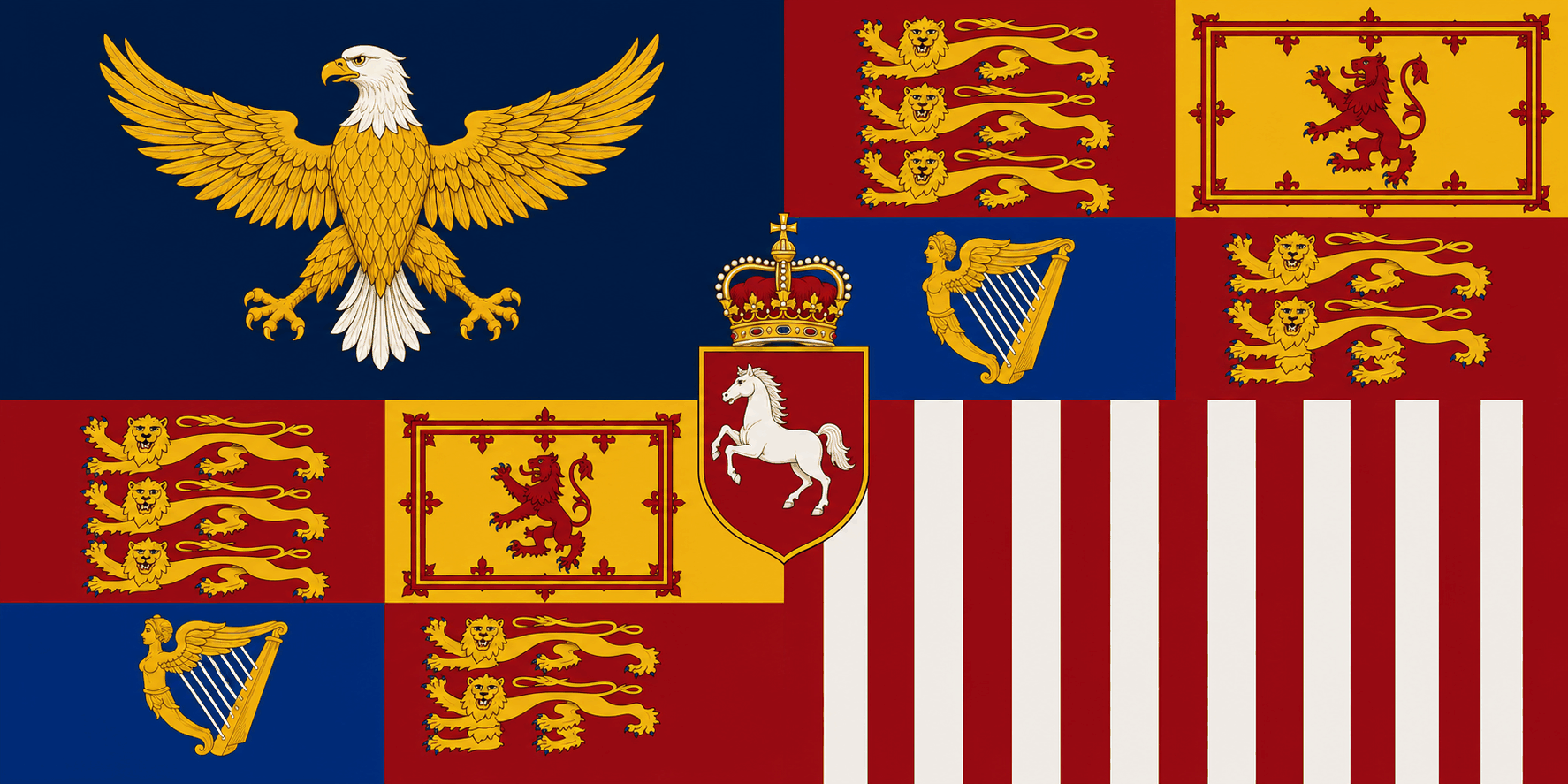
The American Royal Standard, adopted in 1841 under Ernest I and never replaced, is a banner of the royal arms quartered: the gold eagle of the Realm, two quarters of the royal arms of Great Britain, thirteen stripes for the founding colonies, and over all an inescutcheon of Hanover. Britain holds two quarters of four and America one, deliberately, because the standard is a document of Ernest I’s constitutional overreach rather than a statement of the realm’s standing. Revision has been proposed periodically and has failed every time. The Standard flies only where the sovereign is personally present, is lowered when he departs, and is never flown at half-mast, on the principle that the Crown is continuous and does not die. The Governor-General does not fly it: the Standard marks a person and not an office.
The heir apparent bears the same arms differenced by a plain white label of three points, which meant that Frederick inherited the Britain-heavy proportion too, and the irony was sharper in his case because he was the one who actually lived in New Westminster. Since 31 October 2028 he is the sovereign for whom the undifferenced standard is flown, and he still lives there.
Failings
The Register states the following plainly rather than leaving them to be inferred.
The enumeration was wrong for eighty years, and the realm it omitted was the Philippines. The Crown’s own title article listed ten kingdoms while stating a total that only works at eleven, and the kingdom missing from the list was the one that had been governed from New Westminster and represented in nothing from 1898 to 1946. The Register has corrected it and declines to describe the omission as random.
The short style is a two-capital document presented as the style. It names Great Britain and America and folds twelve sovereignties into a phrase, and it has been reproduced in reference works throughout the union as though it were the union’s own description of itself rather than the description two of its members use at home.
The Crown was made a party to what South African ministers did, by a doctrine of advice that is correct in principle and that in that capacity, in those decades, had exactly that effect. This is recorded in Ernest III’s own article among his failings and belongs here as well.
There is no rule for conflicting advice, and the union’s method of managing the problem is to hope the hardest case does not arise. It has not arisen. That is a fact about the last two centuries and not a property of the system.
Assessment
Fourteen Crown capacities held by one person is an arrangement that ought not to work, has worked in successive forms since 1783, and is held together by a rule about who may give advice.
The rule is the whole of it. Strip out the ceremony, the standards, the styles and the dignities, and what remains is a single proposition: the monarch acts on the advice of the realm in whose capacity he is acting, and on nobody else’s. Everything else in this article is an elaboration of that sentence or a consequence of it. The capacities are separable because the advice is separated; the realms are equal because no realm’s advice outranks another’s; the union survives because it asks the sovereign to be fourteen things and never to be all of them at once.
What the arrangement has cost is legibility. No document anywhere states the whole of what the King is, no style enumerates the fourteen, no order of precedence ranks them, and no rule governs the case where they conflict. A constitution that refuses to write itself down is a constitution that cannot be captured, and it is also one that cannot be consulted, and the union has chosen the first at the price of the second in every instance where it has had to choose.
What it has produced is a set of countries that share a head of state and nothing else, several of which fought a war on the same side while one of them was neutral, none of which can be instructed by any of the others, and one of which spent half a century as a territory before being handed a Crown and then left off the list of Crowns for another eighty years.
The fourteen are equal in law and are not equal in attention, and this article’s own history is the evidence.
Chronology
1760. George III accedes as King of Great Britain and Elector of Hanover. The electorate is raised to a kingdom in 1814.
1783. The Charter of Union creates a Crown in right of America, distinct from the British Crown rather than an extension of it.
1804. The Realm recognises Napoleon as Emperor; Britain does not. A French minister is received at New Westminster and accredited to the Governor-General. The shared Crown comes very near to breaking.
1837. Victoria accedes. Hanover is severed under Salic law and the capacities diverge for three years.
1840. Victoria is assassinated. Ernest I succeeds in Great Britain, America and Hanover, reuniting the capacities.
1841. The American Royal Standard is adopted and has never been replaced.
1867. New Albion.
1884. Brunswick.
1910. South Africa. The River Plate, by the Act of the Centenary.
1914 to 1916. The King is at war in his British capacity and neutral in his American one. Nothing breaks.
1919. Ireland. New Wessex, completed 1920.
1945. Normandy.
1946. The Philippines, elevated from a UKA Territory held since 1898.
1947. Raj.
1957. Malaya, under an elected king, with the King as its protector.
1958. The West Indies Federation, the last capacity added.
1972. Ernest V accedes to all fourteen.
31 October 2028. Ernest V abdicates, with effect at six in the evening in London; George V accedes to all fourteen at fifteen, with Queen Christina as Regent until 2 May 2029.
Present. Fourteen capacities, unchanged since 1958. The King is an only child, and behind him the line passes to his aunt, Queen Caroline.
✎ Editor's Note · Fourteen Crowns and no document that lists them
The old version of this article was about the American Crown with the other eleven in an appendix, which is how the Register kept describing a union from inside one of its members. The instruction to redo it realm by realm turned out to be a bigger correction than it looked, because the moment you try to write a section for each capacity you have to count them, and the count did not work.
The article claimed eight kingdoms and twelve capacities, and eight plus two plus one is eleven. CANON said nine. The West Indies article said “one of the nine.” The missing kingdom was the Philippines, elevated in 1946, sitting in the gap between Normandy in 1945 and Raj in 1947 in a table that listed both and skipped it.
I have written the omission into the article rather than quietly fixing the number, because of what the omitted realm is. The Philippines were a UKA Territory from 1898 to 1946, governed from New Westminster and represented in nothing. Then they were given a Crown, and then they were left off the list of Crowns for another eighty years. That is not a coincidence worth being tactful about.
The count moved again later, when the River Plate was built as the tenth kingdom: a Spanish American revolution Britain returned to and kept, a sovereign realm since 1910. The in-world account of the old article’s error was restated at nine kingdoms against thirteen capacities so that it stayed true of a union in which the River Plate has always been there. It moved a third time when Jake ruled Malaya the fourteenth Crown, a diarchy in which an elected Malay king is head of state and the King is its protector, and the account now stands at ten kingdoms against fourteen capacities.
The other thing the redo produced is the absence at the centre. There is no long style. There is no order of precedence. There is no rule for conflicting advice. Every one of those absences is deliberate, every one exists because a document would require a hierarchy and the realms are equal, and the cumulative effect is a constitution that cannot be captured and cannot be looked up. The union has chosen unwritability fourteen times and would choose it again, and the price is an article like this one, which has to assemble from fourteen sources what no single instrument states.
Trivia
- In-Universe George V holds fourteen legal capacities: eleven kingdoms, two duchies and one empire, as his father Ernest V did before him. They are not one Crown with several names. They are fourteen Crowns with one head, and the monarch acting in one of them may not be advised by the government of another.
- In-Universe This article's own predecessor listed ten kingdoms and then stated a total of fourteen capacities, an arithmetic that only works at eleven. The missing kingdom was the Philippines, elevated from a UKA Territory in 1946, sitting in the gap between Normandy in 1945 and Raj in 1947 in a table that listed both and skipped it.
- In-Universe The realm left off the list of Crowns is the one that spent from 1898 to 1946 governed from New Westminster and represented in nothing. The Register has corrected the enumeration and declines to describe the omission as random.
- In-Universe There is no single style that names all fourteen capacities and there never has been. Proposals have failed since the 1950s for the same reason every time: any list has a first item, agreeing an order would mean agreeing a hierarchy, and the realms are formally equal and intend to remain so.
- In-Universe The short style names Great Britain and America and folds twelve sovereignties into the phrase and of His other Realms and Territories. It is a two-capital document that has been reproduced across the union as though it were the union's own description of itself, and no other realm uses it.
- In-Universe England, Scotland, Wales and Kernow are not separate Crowns. They are constituent nations of Great Britain sharing its single Crown, which is why a Scottish minister and a British minister disagreeing is domestic politics while an Albian minister and a British minister disagreeing is international relations. Scotland is inside a Crown; New Albion is beside one.
- In-Universe The Duchy of Cornwall and the Duchy of Kernow are different things that share a place name. The first is the heir's landed estate with no governmental authority whatever; the second is Cornwall's elected national government, recognised in 2025.
- In-Universe In August 1914 the King declared war in his British capacity and remained neutral in his American one for two years, and the two governments corresponded with each other as the governments of different countries throughout. The same man was a belligerent and a neutral simultaneously, and nothing broke.
- In-Universe The Crown came nearest to breaking over Napoleon. The Realm recognised him as Emperor in 1804 and Britain never did, so a French minister was received at New Westminster and accredited to the Governor-General, and the King received no French envoy while his American realm received a French minister. Where two capacities require incompatible acts, the acts are performed by different hands.
- In-Universe There is no rule for conflicting advice and there never has been. Every generation of constitutional writers has proposed one and every generation of governments has declined, on the instinct that any rule contains a hierarchy and the moment one realm's advice is declared to prevail the union has become an empire with extra steps.
- In-Universe The union's lawyers are candid that the Napoleonic device fails where the required acts are personal and simultaneous: a sovereign asked by one realm to sign and by another to refuse the same instrument at the same moment, with no vice-regal substitution available. No such case has arisen, and hoping none does is not a method.
- In-Universe Hanover was severed from the British Crown in 1837 because Salic law barred Victoria, and the capacities diverged for three years without anybody intending it. The Interrealm Succession Compact exists because the union has already watched that mechanism work once.
- In-Universe Every realm legislates its own succession. The Compact is an agreement that none of them will legislate differently without the others, which makes it a treaty between equals rather than an instruction from any centre.
- In-Universe Sweden is not one of the fourteen. The King has no capacity there of his own; he is heir to Sweden through his mother, Queen Christina, a queen regnant in her own right. The Compact says nothing about a fifteenth crown arriving from a different line, because Sweden was never party to it, and the Realm's constitutional writers have noticed and nothing has been done.
- In-Universe George V is an only child, so the direct line across fourteen capacities rests on a single life. Behind him it passes to his aunt, Queen Caroline, and then to her son Alexander I, German Emperor, and her daughter Charlotte, in that order. On his accession as George V the second in line to the fourteen Crowns will be the sovereign of the empire in which two of them lie.
- In-Universe Hanover will have two kings called Georg V: Ernest II, who reigned there under that name from 1851 to 1878, and George V, who reigns under that name in every realm, Hanover following the union's numbering this time.
- In-Universe The heir apparent holds six dignities and one estate, and eight capacities confer nothing on him at all; all seven have been in the Crown since George V acceded with no heir apparent. Ireland's position is that a kingdom which entered the union in 1919 on terms of exact equality has no interest in an ornamental dignity for the heir of a house it accepted rather than inherited.
- In-Universe Defender of the Faith and Supreme Governor of the Church of England attach to Great Britain; Supreme Governor of the Church of America attaches to America. They do not travel. The King of Ireland is Supreme Governor of nothing and the King of the Philippines governs no church at all.
- In-Universe A sovereign who is Supreme Governor of two established Protestant churches is also King of two overwhelmingly Catholic realms and Emperor of one that is not Christian at all. The awkwardness is handled by keeping the capacities apart and not looking directly at the join, and it works because nobody in either place is required to have a view about it.
- In-Universe There is no order of precedence among the realms and the absence is maintained deliberately. The Conference of Realms seats its members alphabetically in the language of the host, which produces a different order at every meeting and is regarded by everybody as the correct solution.
- In-Universe The American Royal Standard of 1841 gives Britain two quarters of four and America one, deliberately, because it is a document of Ernest I's constitutional overreach rather than a statement of the realm's standing. Frederick inherited the Britain-heavy proportion too as heir, and the irony was sharper in his case because he was the one who actually lived in New Westminster.
- In-Universe Five capacities arrived in thirteen years after the Second Great War, which is the fastest growth in the union's history and happened exactly as the age of empire was ending. Realms that were being offered independence were, in those cases, offered a Crown instead and took it, and Malaya took it on terms of its own.
- In-Universe Nothing has been added since 1958 and nothing has been lost since 1837. The union has now been static for seventy years, which is longer than it was ever growing.
- In-Universe The Duchy of Normandy is the most entangled of the fourteen: the Duke exercises ducal authority inside the French Empire's constitutional structure, where the Emperor of the French embodies common French sovereignty in defence and foreign affairs. A King of Great Britain and America who is simultaneously a duke within the French Empire is a position three countries have to keep working, and it has worked for eighty years.
- In-Universe Raj is imperial rather than royal for reasons internal to Raj's constitution, and confers no seniority whatever. An emperor among kings would be a hierarchy if the union permitted one, which it does not.
- In-Universe New Wessex was recorded for decades as held from 1919 to 1920, immediately above a sentence observing that no title had ever been lost. The two dates are the ends of the federation of Australia and New Zealand rather than of the capacity. New Wessex is held today.
- In-Universe Malaya is the only capacity in which the King is not head of state. The Yang di-Pertuan Agong, an elected king chosen by the Conference of Rulers, reigns; George V is King and Protector of Malaya, as his father was, and every Malayan document writes his style after the elected king's.
- In-Universe Malaya's constitution is the one instrument in the union that names another realm's Crown: it makes protector whoever is King of Great Britain. That is why Malaya follows the British succession without being a party to the Interrealm Succession Compact, and why the Compact still has thirteen parties in a union of fourteen Crowns.
- Real-World This is how the Commonwealth realms actually work. Elizabeth II was separately Queen of sixteen countries, advised in each only by that country's ministers, and the doctrine of the divisible Crown is real law rather than an invention of this setting. What is invented is the scale, the German capacities, and the fact that the union kept growing into the 1950s instead of contracting.
- Real-World The Hanover severance is real. Britain and Hanover shared a monarch from 1714 until 1837, when Salic law barred Victoria and the crowns passed to different people. Here they are reunited three years later because Victoria is assassinated in 1840 and Ernest I succeeds in both, which is the second of the setting's two points of divergence and the reason the House of Hanover reigns in America.
- Real-World Our own Commonwealth has the same unanswered question about conflicting advice and has handled it the same way, which is by not testing it. The nearest real approach was 1975 in Australia, and the machinery that resolved it was vice-regal rather than royal, exactly as the Napoleonic device in this article is.
- Real-World Defender of the Faith really is a papal grant to Henry VIII, retained after the break with Rome and carried by British monarchs ever since, and Supreme Governor of the Church of England is a real office with real and very limited content. The American equivalent is the invention.
- Real-World The Philippines became independent from the United States in 1946, which is the same year they are elevated into the personal union here. The date is ours; the direction is reversed. A country that left one union on that date joins another on it.
- Real-World The Federation of Malaya became independent in 1957 as an elective monarchy, its Yang di-Pertuan Agong chosen by the Conference of Rulers from among the nine Malay rulers, and the British Crown kept no office there. The protectorship, and the diarchy it makes, are the setting's.
- Design The instruction was to make this article cover every kingdom rather than the American one, and the first consequence of trying was discovering that the list was wrong. You cannot write a section per capacity without counting the capacities, and the count did not work. Eight kingdoms plus two duchies plus one empire is eleven, and the article claimed twelve.
- Design The union has no long style, no order of precedence and no rule for conflicting advice, and all three absences exist for the same reason: any of them would require a hierarchy, and the realms are equal. The result is a constitution that cannot be captured and cannot be looked up, and it has chosen the first at the price of the second every time it has had to choose.
See also
- The Crown in Right, the doctrine in each of the fourteen realms and the Crowns below them
- The Governor-General, who exercises the American capacity in the Realm
- Ernest V, who held all fourteen from 1972 to 2028
- George V, who has held all fourteen since 31 October 2028, and before it six heir’s dignities and an estate
- The Charter of Union, which created a Crown in right of America in 1783
- The Kingdom of the Philippines, the capacity this article had omitted
- The Kingdom of Ireland, which enforces the rule on advice most strictly
- New Albion, the northern sister realm
- New Wessex, Australia and New Zealand federated
- The Union of South Africa
- The West Indies Federation, the newest capacity
- The Empire of Raj
- The Kingdom of Hanover, the dynastic capacity
- Herzogtum Braunschweig, the Duchy of Brunswick
- The Duchy of Normandy, held within the French Empire
- The Duchy of Kernow, which is not a Crown
Categories
Institutions · The Crown · Styles and Titles · The Personal Union · Constitutional Law