The Dominion Era
The Dominion Era is the name historians give to the seventy-five years between the opening of the colonial crisis and the settlement of 1850: the period in which thirteen colonies that had voted independence down became a continental sovereign realm, acquired a Crown of their own, a capital, a final court, a flag and a hemisphere policy, and did all of it without declaring anything, without fighting Britain a second time, and without ever once stating in an instrument what they had become.
It is also the period in which that Realm doubled and doubled again across a continent already inhabited, removed the people who inhabited it, and carried slavery westward under a founding document that had been carefully drafted not to mention it.
The two sentences above describe the same seventy-five years and are usually written about separately. This article does not separate them, because the method that produced the first produced the second. Nothing in this era was ever decided, except a flag. Everything else was arrived at. Powers were taken by use, rights were extinguished by disuse, conventions hardened by repetition, and the one question that could not be settled by any of those means was deferred, at shortening intervals, by people who understood exactly what they were doing and said so in writing. The exception came at the very end. The Charter had said nothing about a flag, as it had said nothing about most things, and in 1850 the settlement that deferred the question one last time took the Union off the Realm’s flag by statute. Of everything the Charter left unsaid, the flag is the only thing anybody ever decided outright.
Name
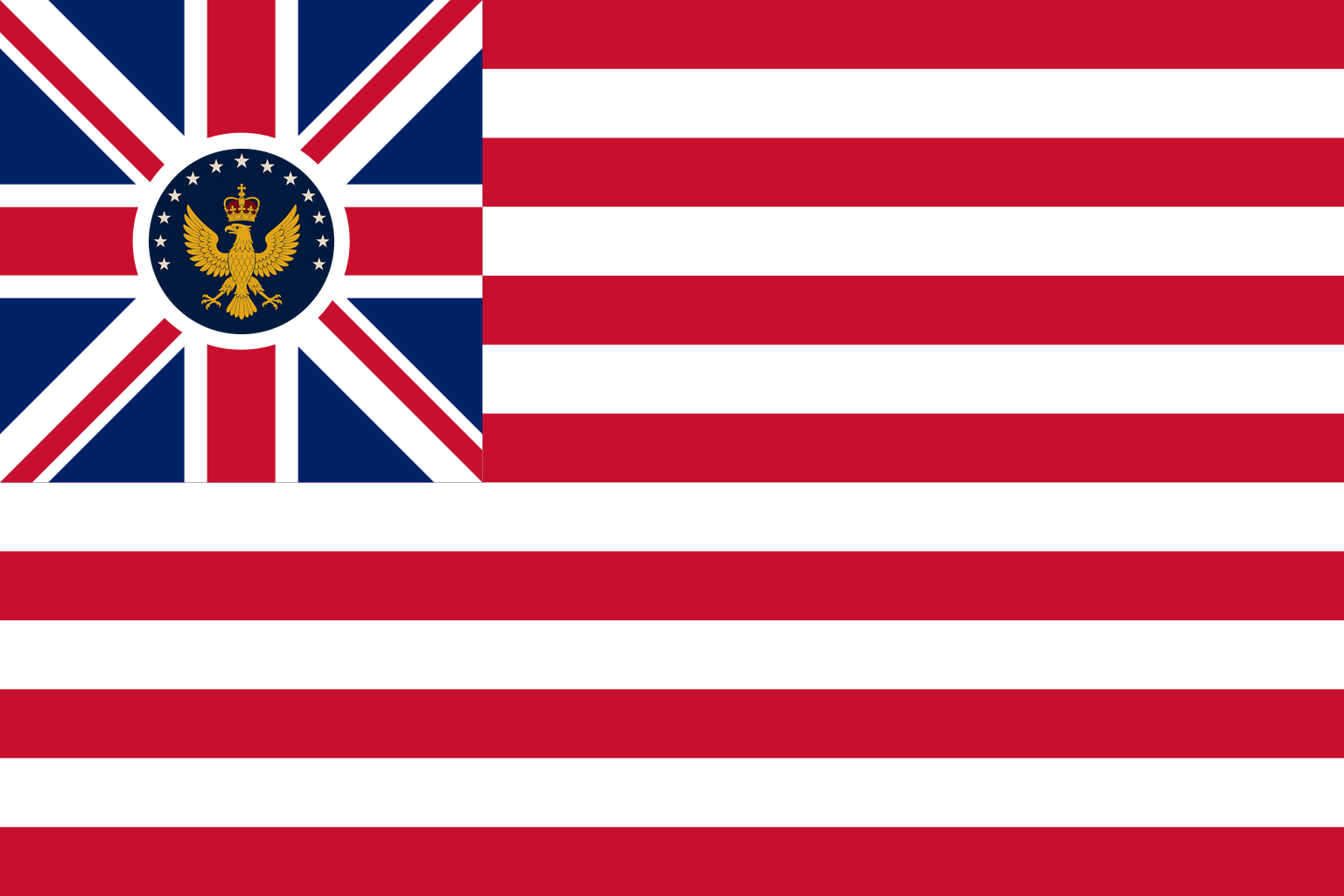
Nobody alive in 1800 believed they were living in a Dominion. The word is a later label, applied by constitutional historians to a period whose inhabitants had no collective name for it and would have disputed this one, because it states a subordination that no instrument of the period ever contained. The one thing about the period that does look like it is the flag, which carried the Union in its canton until 1850.
The objection is sound and it is made almost exclusively in universities. Outside them the term is used without resistance, partly because the alternatives are worse and partly because a period defined by its relationship with London is easier to name than a period defined by an argument nobody won. The Register uses it, notes that it is retrospective, and does not pretend the name is neutral.
What the era called itself, when it called itself anything, was the United Kingdom of America. That name was settled at Philadelphia and was not seriously contested, which is one of the stranger facts about a settlement that declined to use the word independence: the parties knew what they were making, and were content to call it a kingdom so long as nobody made them call it a separation.
The war, 1775 to 1779
The crisis
The quarrel that produced the war was about taxation, jurisdiction and the constitutional standing of colonial assemblies, and by 1775 it had passed the point at which either side could retreat without conceding the principle. The Four-Year War has its own article and the campaign narrative belongs there. What belongs here is what the war settled, what it did not, and the shape it left behind for seventy-five years of argument.
The Declaration of American Grievances
On 4 July 1776 the Second Continental Congress adopted the Declaration of American Grievances, drafted by Thomas Jefferson: a statement of claim against George III demanding self-government and the security of colonial rights, and a document that is a declaration of independence in every line but its last.
Richard Henry Lee had moved for independence and had been defeated. John Dickinson redirected the final motion. The Fourth of July, in this Realm, is the day the colonies voted independence down and demanded redress instead, and it is the date on which the Charter would be signed seven years later. The Realm therefore has two foundings on one day, and both of them are refusals.
The clause that was struck
Jefferson’s draft contained a clause against the slave trade and against the Crown’s protection of it. It was debated and it was removed, at the insistence of delegations whose economies depended on the thing it condemned, and its removal is recorded.
The clause matters to this era out of all proportion to its length, because it establishes a fact the rest of the period will rest on. The founding generation was not ignorant of the question. It was put to them, in writing, at the first opportunity, by the man drafting their case, and they struck it out to hold a coalition together. Everything that follows across seventy-five years is a variation on that afternoon.
The fighting
Four years of it, from Boston and Canada through New York, Philadelphia, Saratoga, Valley Forge and Monmouth into the stalemate of 1778 and 1779, widened by French and Spanish intervention into a war Britain could not win at an acceptable price and the colonies could not win at all.
The Peace of Boston
The war ended in 1779 without a victor. That is the single most consequential fact in the Realm’s history and almost everything peculiar about the country proceeds from it.
A war that ends without a victor cannot be followed by a settlement in which one side dictates. It can only be followed by a negotiation. And a negotiation between parties who have not beaten each other, conducted by people who must go on living in the same towns as the neighbours they have been shooting at, produces a document of a very particular kind: one that settles what it can, leaves what it cannot, and is signed by people who know which is which.
The Charter, 1779 to 1783
Philadelphia
The Philadelphia Negotiations ran for four years, which is as long as the war. They were a constitutional congress rather than a peace conference, and their business was to convert a ceasefire into a form of government.
The argument that consumed them was not independence, which had been decided in the negotiating and was not on the table. It was how much country to be: whether what emerged would be a union with a government, or an association of self-governing polities sharing a sovereign and very little else. That argument was not concluded at Philadelphia. It was written into the Charter in a form that allowed both readings, and it ran for the next seventy-five years through every subject the era touched.
Signed at Boston, on the Fourth of July
The conference adopted its final text on 21 June 1783 and the instrument was signed on 4 July 1783 in the Old State House at Boston, where the peace had ended the war four years earlier.
The date was chosen. A Realm that had refused independence on the Fourth of July signed its constitution on the Fourth of July, and the doubling is the whole settlement in one gesture: the day is kept, and what it commemorates is quietly replaced.
One word the settlement declined was “states”. In 1783 a state was a sovereign polity, and to call the parts states was to claim precisely what the negotiations had been convened to avoid. They became polities, and they are polities still.
What the Charter made
The Charter created, in its articles, the institutions the Realm still has. A Crown in right of America, exercised on American advice. A Governor-General resident in the Realm, the sovereign’s representative, chosen on the advice of ministers here and never from London. A Parliament of two Houses. And, by Article X, the Royal American Supreme Court: seven Justices, no divisions, no larger panel for grave questions, an odd number chosen as large enough to deliberate and small enough to travel in a Realm where the Justices would ride circuit for the first half-century.
It could be amended, by a demanding procedure, and was, rarely. The difficulty is a cause rather than a detail. A constitution that is hard to amend in a country that is changing quickly will be changed by other means, and the other means are the subject of this article.
What the Charter would not say
The Charter says nothing about slavery.
The silence was negotiated. It was raised at Philadelphia, it was understood by every delegation, and the decision not to write it down was taken deliberately and in the knowledge that a document which did not mention the thing could be ratified by people who disagreed about it absolutely. The northern delegations accepted the silence because the alternative was no Charter. The southern delegations accepted it because silence protected what a clause might have qualified.
This is worse than a protective clause and the article states it as such. A clause can be repealed, construed narrowly, or held against its authors. A silence agreed to by everybody present cannot be repealed, because there is nothing to repeal, and it cannot be construed, because it says nothing. It can only be maintained. Maintaining it is what the next seventy-five years of American politics chiefly consisted of.
The apportionment settlement that counted a fraction of the enslaved toward representation is a separate instrument and a later one. It belongs to the founding period rather than to the founding document, and it is a second decision taken by people who had just agreed not to mention the first.
The flag, and the Union that stayed
The flag flown in the war was the Grand Union Flag, thirteen red and white stripes with the Union in the canton, first hoisted at Philadelphia in December 1775. Washington crossed the Delaware under it in December 1776. It meant what it said: these are subjects asserting their rights, not foreigners.
The Charter made no provision for a flag, so the war flag simply went on being flown. Nobody decided to keep it and nobody proposed to replace it. The Realm that the Charter made in 1783 flew the colours its army had fought under, Union and all, because nothing had been put in their place. For sixty-seven years after the Charter the Union flew over institutions in which London had less say every decade, and it is the one feature of the era that looks like the subordination the era’s name describes.
In 1801 Britain changed its own flag, adding the saltire of St Patrick for the union with Ireland, and the Realm’s canton changed with it. No instrument records the change. Flagmakers and the navy made up the new Union, and on it, on a white roundel over the crossing, they put the crowned eagle of the Realm within thirteen stars. Repetition did the rest. By the time anyone thought to ask, the Realm’s canton had followed London’s change and put the Realm’s own device at the centre of it, and that combination was simply what the flag looked like. It said two things at once, which is what the whole era said.
The sovereign’s own banner was settled separately and later. The Royal Standard adopted in 1841, in the first full year of Ernest I, gives Great Britain two quarters of four and the Realm one, and it has never been replaced.
The Union came off in 1850, and it came off by decision. The Flag Act was passed as part of that year’s settlement, and it did what nothing else in the era had done: it took a question the Charter had left open and answered it in a statute. The Union was taken out of the canton. The eagle and the stars that had stood at its centre since 1801 took the whole navy field, and the thirteen stripes moved to the lower third beneath a gold fillet.
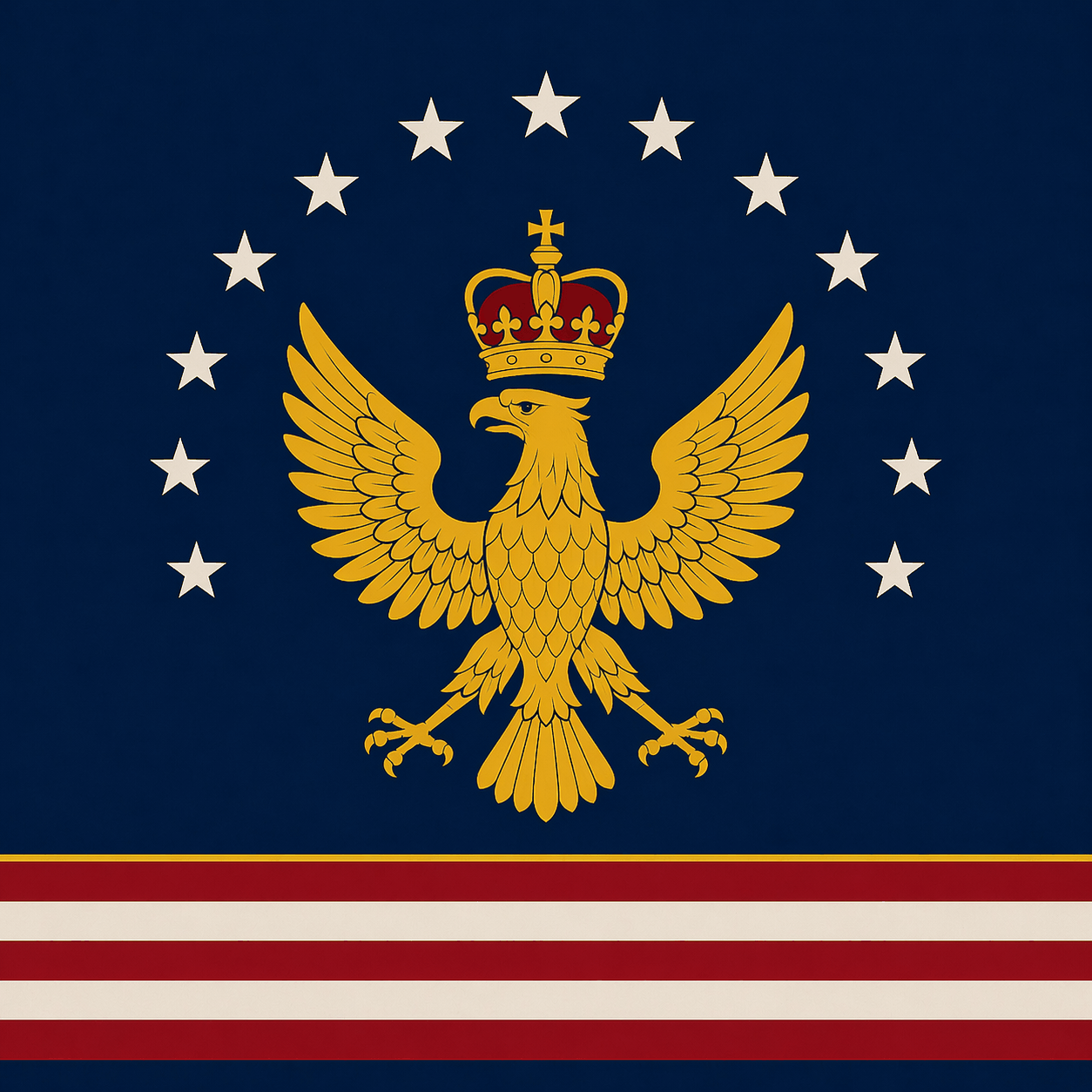
It is the only instrument of the era that decided something rather than recording it, and what it decided was a symbol. The same settlement compromised the question that needed deciding one more time. The timing reads as a substitution: a Parliament that could not settle the question in front of it settled the one it could.
The flag of 1850 was flown for a hundred and seventy-eight years, until the redesign of 2028.
The loyalists and the return
A war that ends without a victor means the people who left have not lost.
They came back, from Halifax and from Britain and from the garrison towns, in numbers that the polities they returned to had not planned for and did not want. Property had been confiscated, sold, occupied and improved. Neighbours had informed on neighbours. Men who had fought found themselves living beside men who had sailed out with the King’s army and were now claiming their farms back with a legal instrument in hand.
The restoration was managed by law, and it was the first thing the new Realm had to make itself obey. A statutory scheme of restitution and civil rights, administered polity by polity, disliked by almost everyone who had fought, and enforced anyway. There were failures of enforcement and there was violence, particularly in the south and in the Hudson valley. There was also, and this is the point, compliance: a settlement was imposed by a government on a population that did not want it, and it broadly held.
The Realm learned two things from that. It learned that it had a centre. And it learned that the centre’s authority depended on being used sparingly, which became the governing instinct of the whole era.
The peerage
The other instrument was honour.
Dignities were created for loyalists as well as for patriots, deliberately and visibly, as a way of stating that the war’s divisions were closed. George Washington took the first peerage. That an anti-hereditary country acquired a hereditary order within a decade of a war fought partly about hereditary right is the sharpest irony of the founding, and it was not accidental: the peerage is the price of the settlement rather than an ornament upon it.
It remained small. Creations were rationed from early and the rules were strict. Peers sit in the House of Lords, which makes the order a constitutional fact rather than a social one, and the resentment it attracts has always been out of proportion to its numbers, for the reason that resentment usually is.
The offices, learned rather than granted
The Charter created the offices. What the offices were for took seventy-five years to work out, and almost none of it was written down until after it was true.
Washington and the resident Crown
George Washington was Governor-General from 1783 to 1797, and the Realm has argued ever since about what he did in those fourteen years.
The case that he did very little is strong. He established no doctrine, blocked no ministry, issued no memorable instrument, and left the government of the country to men who had spent four years at Philadelphia learning how to govern it. The case that this was the achievement is stronger. He was the one man in the Realm who could have taken more, was offered more, and declined it, and the office he occupied was the one office in the constitution where doing little is the work. He established the resident Crown by sitting in it and refusing to use it, which is a harder thing to do than it sounds and has no obvious precedent.
Whether that was modesty, shrewdness or absence is an argument the Realm has never settled and the article does not settle it either.
Franklin, Adams, and a ministry that was not yet answerable
The office of Prime Minister begins in 1785, two years after the Charter, which is itself instructive: the Realm had a constitution before it had a government.
Benjamin Franklin held it from 1785 to 1788 in a form nobody had defined, and John Adams from 1788 to 1796 disciplined the founding ministry into an institution. Thomas Jefferson followed from 1796, James Madison from 1804.
What none of them had is the thing that now defines the office. A ministry in this period held at the Governor-General’s pleasure, not the Commons’. The Governor-General chose, and the choice was real. The Commons could make a ministry’s life impossible and frequently did, but it could not straightforwardly turn one out, and the convention that it could did not exist.
Jay, and the office that outlived its founder
John Jay, Governor-General from 1797 to 1801, is in the roll for four years and matters more than the length suggests. A founder’s office is not an institution until somebody else has held it, and Jay proved the viceregal office could survive Washington and gave it procedure, precedent and paperwork.
Charles Cotesworth Pinckney followed from 1801 to 1809 and gave the Crown a southern legitimacy it had lacked, which was necessary and which entangled the office with slavery from early. Rufus King, from 1809 to 1817, brought the first sustained anti-slavery conscience into the record of Crown government, and the two appointments back to back are the era in miniature.
DeWitt Clinton, from 1817 to 1825, made canals, roads, schools and harbours a matter of the Union’s constitutional concern rather than of private enterprise alone. John Marshall, from 1825 to 1835, brought a judge’s habits to a political office and established the Marshall silence on pending causes. John Quincy Adams, from 1835 to 1843, was the first man to hold both great offices, having been Prime Minister from 1820 to 1828.
The Crown that divided without anyone dividing it
The sovereign now holds a Crown in right of America distinct from the Crown in right of Great Britain, and neither can advise the other.
The capacity itself has a date and a document. The Charter created it, and the sovereign’s dual signing on 4 July 1783, once as King of Great Britain and once as King of America, is the moment the American Crown becomes legally operative. What the Charter did not do was say what the capacity contained.
So nobody exercised it for a generation, and the doctrine was built afterwards out of ordinary disputes about who advised the sovereign on American business: appointments, pardons, instructions to officers, the disposal of Crown lands. Each was a small question. Each was answered the same way, because there was no other answer available once the Governor-General was taking advice from ministers in America. By the time anybody set the principle out at length it had been the practice for decades, and the setting-out was a description rather than a claim.
The division has a date. Its content does not. An instrument created a capacity in an afternoon and left the whole of its meaning to be worked out by accumulation, which is why the Realm can describe its own most important constitutional fact only by pointing at a century of small decisions.
Amory, and the end of appeals to London
Appeals from American courts to the Judicial Committee at London were not abolished. They stopped being brought.
The Royal American Supreme Court existed from 1783 and began, slowly, to behave as though it were final. The question of whether it could pronounce an Act of Parliament void under the Charter, or whether the power was a form of words, was settled in Amory v the Collector of the Port of Boston in 1799, on a merchant’s challenge to a national customs measure. After Amory the Charter was enforceable in an American court against an American Parliament, and there was very little that a litigant could usefully take to London that the Court had not already decided with finality.
The right of appeal survived on paper for decades after it had stopped meaning anything, and was eventually tidied away by a statute that recorded a fact rather than making one. Nobody in London was asked and nobody in London objected, because by the time anyone noticed, the objection would have been to something that had already stopped happening.
Treaty power, taken by use
Nobody conferred treaty power on the Realm.
The Realm negotiated, and London did not object loudly enough or in time, and the practice accumulated until denying it became absurd. The Louisiana Purchase of 1803 was a transaction between the Realm and France for a territory the size of the Realm itself. The Treaty of Austin of 1845 admitted a sovereign republic to the Union by agreement between the Realm and that republic.
By Austin the question was closed, not because it had been answered but because asking it had become impossible. A realm that admits a foreign state by treaty is exercising a capacity that nobody else can exercise on its behalf, and the exercise is the proof.
Responsible government, arrived at
The last of the great constitutional changes of the era is the one that had to wait longest and the one with the least to show for itself.
Ministries became answerable to the Commons rather than to the Governor-General in the 1840s, on roughly the timetable that the same change followed in the British colonies to the north that later formed New Albion. There was no crisis. No Governor-General tried to keep a ministry against the Commons and lost; none tried and won. The power faded across three viceregal tenures because the Commons became progressively more difficult to govern against and the effort progressively less worth making, until a point was reached at which everyone behaved as though the convention existed and nobody could say when it had started.
The Realm was therefore externally sovereign for two generations before it was internally answerable. It had its own Crown, its own court, its own treaties and its own flag while its governments still held at the pleasure of a Crown officer. That order of events is the reverse of the usual one, it is a direct consequence of never having had a revolution, and it is the single fact that most distinguishes the Realm’s constitutional history from any other.
Britain
What London decided not to do
The most consequential British policy of the era was a decision not to have one.
London understood within a generation of the Charter what was happening in America, and chose not to contest it. The reasoning was not generous and was never published. It was that the Realm could not be held by argument, that the attempt would produce a second war, and that the Crown had learned in the 1770s what a second war would cost. So the objections were made after the fact, in writing, by law officers, and were not pressed. A pattern established itself: the Realm acts, London records a reservation, and the reservation is filed.
This has been described in the Realm as British generosity and in Britain as British realism, and the article prefers the second. A power that concedes what it cannot hold is not being generous.
The Quasi-War, 1812 to 1815
The Quasi-War is what the Realm calls the three years in which it fought France without declaring war and quarrelled with Britain without fighting.
Under the ministry of James Monroe the Realm joined a limited Gulf expedition in support of the Spanish Regency against Napoleon, in which American and British forces served as co-belligerents. At the same time, and with the same Crown on both sides, the Realm and Britain were in serious dispute over neutral trade, cargo seizures and the impressment of American seamen into British ships. There were shots exchanged at sea. There was no declaration, because a declaration would have required the sovereign to sign an instrument against himself.
It settled nothing, and that is why it is called a quasi-war. The Gulf ended inconclusively, the trade dispute was patched, the seamen were a grievance for another generation. The Realm discovered only that it could fight without anybody declaring anything, which was a discovery it would have been better off not making so early.
1840
Queen Victoria was assassinated in London in 1840, in the fourth year of her reign, at twenty-one and four months pregnant, and the Crowns passed to the Ernestine branch of the House of Hanover.
In the Realm this was a genuine crisis for several weeks, and it is now almost forgotten. It was not obvious that the American Crown passed automatically and separately, because the Crown’s divisibility had been built by accumulation and had never been tested by a sudden death. Nobody knew whether a demise of the Crown in Britain carried the Crown in right of America with it as a matter of law, whether an American instrument was required, or who would issue one.
The answer was improvised within a month by the Governor-General, the Chief Justice and the ministry acting together, and the improvisation became the rule. It has never been legislated. The most important constitutional question the era ever faced was answered by three offices agreeing in a hurry and nobody writing it down afterwards, which is either the era’s method at its finest or its method at its most alarming, depending on the reader.
What the decision cost, and who paid it
London’s choice not to contest American self-government is usually assessed as a question between two governments. It was not.
The same decision that let the Realm take its powers unopposed removed the only external check on what the Realm did with them. Britain had claimed a protective role over the treaty nations in the eighteenth century, and abandoned it across this era, along with everything else it abandoned. Britain abolished slavery in its own Caribbean between 1833 and 1838 and did not raise the question of American slavery at all.
The forbearance that made the Realm sovereign is the forbearance that left the nations and the enslaved with nobody to appeal to. Those are not two British policies. They are one, and the article declines to praise the first half without naming the second.
The continent
Louisiana, 1803
The purchase from France doubled the Realm’s extent, and its constitutional significance exceeded its territorial significance. A polity that buys a territory the size of itself from a European power, for money, without asking anybody, has answered the treaty-power question in the only way that matters.
It also reopened the question the Charter had declined to answer. Every acre acquired west of the Mississippi was an acre that would eventually be organised, and organising it meant deciding whether it was slave or free, and deciding that meant saying out loud what 1783 had agreed not to say.
The Ordinance
The Realm’s procedure for the west is the thing this era did that almost nobody argues about.
A standing ordinance provided for survey into townships on a rectangular grid, for territorial government, for the reservation of land for schools, and for admission as a polity on terms of equality with the existing ones once a population threshold was met. It was applied without exception, it was applied to territories that had not been acquired when it was written, and the survey grid it created is the pattern on which every western polity is still drawn.
The article is careful about what this praise covers. The machinery was exemplary and the question it carried was not. The ordinance settled how a territory became a polity and said nothing about the thing that would be fought over in every single instance, so its neutrality was the neutrality of a well-made vehicle with no opinion about its cargo.
New Albion and the northern border
The northern boundary, then a frontier between the Realm and the British colonies that later federated as New Albion, was settled by joint commission and award under the Crown’s authority. Whether two realms of one sovereign could make a treaty with each other was then doubted, and the instruments chosen avoided the question; it has since been settled that they can, and the Realm and New Albion have made many.
It held. It also came closer to failing than the Realm likes to remember: the Aroostook quarrel brought lumbermen and militias out from both sides, and there could be no war because a war between two of the sovereign’s own realms was not a thing that could be declared. The border is the longest undefended frontier on earth and it is undefended for a technical reason rather than an amicable one.
Texas, and the Treaty of Austin
The Republic of Texas was admitted by the Treaty of Austin of 1845, ratified and given effect by Act in 1846, and its admission was the era’s last great constitutional demonstration and its last great deferral failure in the same instrument.
The cession
The Mexican-American War followed within days of the union, over a boundary Mexico had never accepted. The war was fought from 1846 to 1848 and ended with the cession of the far south-west and the Pacific coast. A separate western cession of 22 April 1846 had already transferred the trans-Pecos and El Paso to a federal territory.
The Realm now ran from the Atlantic to the Pacific, and it had run out of the thing that had made its politics workable.
The Monroe question
The Realm’s diplomacy in this era divides on a line nobody ever wrote down: its own in the Americas, London’s in Europe.
The hemispheric doctrine the Realm stated in the 1820s, that the Americas were closed to further European colonisation, belongs to that division and was far more credible in this Realm’s mouth than in a republic’s. A doctrine of that kind is worth precisely what the navy behind it is worth, and the navy behind this one was the largest in the world and belonged to the same sovereign. The Realm never had to say that and never had to test it, which is the ideal condition for a doctrine.
Removal
The continent the Realm organised so well was inhabited, and the era’s treatment of the people who inhabited it is the worst thing in it.
The removals were carried out lawfully, by statute, by governments answerable to an electorate, with courts sitting and newspapers printing. The machinery functioned exactly as designed. That is the indictment rather than a mitigation of it.
They were also carried out in the sovereign’s name. Treaties with the nations were Crown treaties, made in the sovereign’s name and broken in the sovereign’s name, and the dignity of the instrument was imperial while the conduct under it was entirely local. The sequence across the era runs from Crown treaties properly so called, through an increasingly American conduct of business under Crown forms, to the quiet abandonment of Britain’s protective claim, so that by the 1840s there was nothing at all standing between the nations and the Realm. The compact system the March of Arizona and others now operate was built afterwards, out of this, by people trying to construct something the Crown’s name could not be used to dishonour.
The judgment that was obeyed
And they were avoidable, which is established by the cases in which they were avoided.
The Royal American Supreme Court held against a removal, and the ministry complied. A nation litigated in the Realm’s own courts, on the Realm’s own terms, and won, and the government obeyed the judgment. The case was Cherokee Nation v Brearley, decided in 1833, and it remains the foundation of treaty jurisprudence in the Realm; the removal it stopped was resumed two years later under a treaty signed by a faction with no authority from its nation, which is why the State of Oklahoma-Sequoyah was later built around a chamber whose whole purpose is to establish who may consent.
That single instance of compliance is the most damning fact in this article. It proves that obedience was available, that the courts would grant relief, and that a ministry could accept defeat on the question and survive. Every removal carried out afterwards was therefore a choice, made by people who had seen the alternative work.
Slavery
The silence, and the counting
The Charter would not say the word. The apportionment settlement that followed counted a fraction of the enslaved toward the representation of the polities that held them, which gave the slaveholding south a standing advantage in the Commons that grew as its free population fell behind the north’s.
So the founding generation declined to write slavery into its constitution and then wrote the enslaved into its arithmetic. The two decisions are usually discussed separately and were taken by the same people within a few years of each other.
The trade, abolished at sea and protected on land
The Realm abolished the Atlantic slave trade by its own Act, on approximately the schedule on which Britain abolished it, and the Act was one of the clearest early exercises of a legislative independence nobody had granted.
American ships then served in the suppression of the trade at sea, alongside the Royal Navy, for four decades.
The Realm therefore spent forty years hunting slavers on the ocean while protecting slavery on land, and the same Parliament voted the money for both. No contemporary found this difficult to explain, which is the part worth sitting with. The distinction between the trade and the institution was perfectly coherent to the men who drew it, and it allowed a country to feel itself on the right side of a moral question it was in fact on the wrong side of, at a cost of some frigates.
Deferral as a method
The question was managed, across the era, by a series of settlements, each of which bought time and none of which decided it.
A founding bargain. The Missouri settlement of 1820, which drew a line across the Louisiana purchase. A tariff and nullification crisis in the early 1830s, settled by compromise on terms that conceded the principle of the thing while denying it. And the settlement of 1850, which is where this era ends.
The intervals are the point and the article sets them out so the reader can watch them close: thirty years, then a dozen, then fewer. Each settlement was harder to reach than the last, bought less time than the last, and was understood by its own authors to be temporary. Henry Clay’s ministry from 1836 to 1844 is remembered as the compromises that held the Union by postponing the question, which is an accurate description of the entire era and not merely of eight years of it.
1833, and the question London did not ask
Between 1833 and 1838 Britain abolished slavery across its Caribbean possessions, compensating the owners and not the enslaved, and put an apprenticeship in place that the freed population forced it to end early.
The same sovereign reigned in America, where slavery continued and expanded.
London did not raise it. Not in a despatch, not through the Governor-General, not in any instrument of the period. The decision was of a piece with every other British decision of the era, and it was the most convenient of them for both parties, because the Realm’s most valuable export was produced by enslaved people and sold into British mills. Abolitionists in both realms understood exactly what had been weighed against what, and the reproach appears in their writing for the rest of the century.
Government and politics
The Commons, allocated by accretion
The Commons was apportioned by accumulation rather than by design. Each polity acceding to the Union brought a number of members fixed by the instrument that admitted it, revised only when Parliament happened to revise it, so that by the 1840s the chamber reflected a distribution of population that had not existed for decades.
Two groups gained, and they were not the same group: the slaveholding south, whose quotas rested on the fractional counting and whose populations grew more slowly without their seats falling; and the decayed boroughs of the east, which had been real places when their representation was settled.
The Realm kept rotten and proprietary boroughs into the nineteenth century, which a country that had undergone a revolution would not have done. Brunswick Town in North Carolina was burned during the war, never rebuilt, and went on returning members. The New York manors returned members chosen in effect by their landlords. The First Reform Era of the 1830s and 1840s cleared the most indefensible of them and stopped short of the rest, on the usual understanding that a later Parliament would attend to it, and a later Parliament did, in 1859, outside this era.
The Lords
The upper House of the period was the House of Lords American, which kept the adjective until 1859. The rationed peerage sat in it, which is why the peerage is a constitutional institution here rather than a social decoration.
The First Reform Era
The reform of the 1830s and 1840s was driven by Britain’s example rather than by American pressure. The British reform of 1832 made the American arrangements indefensible by comparison, and the Realm did in two decades, and incompletely, what Britain had done in a single Act.
That is characteristic and slightly humiliating, and the article says so. A Realm that had taken its sovereignty without asking reformed its own franchise because somebody else had.
The bank, fought over twice
The most bitter purely domestic argument of the era was about money. A chartered national bank was established, fought over, and fought over again, and the second fight was worse than the first.
The argument was nominally about currency, credit and the interests of the west against the commercial east. It was actually the era’s one real argument in another costume: how much country to be. A national bank is an instrument of a nation. That is what its supporters liked about it and precisely what its opponents did not.
Parties, and what they were before they were parties
The Realm’s rolls describe every ministry of this era as belonging to the period before the modern parties, and the description is accurate. What existed were connexions, interests and tendencies that hardened over the era into recognisable organisations doing the work parties do, under names the Realm’s own politics produced rather than names borrowed from anywhere.
By the 1840s they were parties in everything but self-description. By the 1850s they had been broken and re-formed around the one question, which is what happens to a party system that has been organised around avoiding a subject when the subject arrives.
The church that was never established
The Charter established no church.
For a Crown realm in 1783 this was among the sharpest breaks with British practice available, sharper than anything the settlement did about representation or the Crown, and it was settled at the outset with less argument than almost anything else. The Realm has a sovereign who is Supreme Governor of the Church of England in another of his capacities and no established church in this one.
The Church of America exists, is large, and is socially conspicuous. It is not an establishment and never has been. The practical consequence for this era is that the revivals had nothing to push against and nothing to be contained by, and they ran.
New Westminster
The Realm built itself a capital, on ground ceded for the purpose, beginning about eighteen years after the Charter.
The argument in Britain has been recorded: alarm, and the alarm was correct, because a capital is what a country builds when it means to be a country. The argument in America is less often recorded and was just as sharp. It was fought on cost, because a purpose-built federal city was expensive and the polities were being asked to pay for a thing that would diminish them. It was fought on jealousy, because Philadelphia, New York and Boston each had a claim and building somewhere new left three aggrieved parties rather than two. And it was fought on prudence, by people who argued that a capital would be read in London exactly as it was in fact read, and that a Realm unwilling to make a claim in words should not make one in stone.
They lost, and they were right about how it would be read.
Society
Arrival
The people who came to the Realm in this era came in the numbers and the decades they would have come anyway: Irish in very large numbers from the 1820s and overwhelmingly from the 1840s, Germans through the middle decades, Scots and English continuously, and the enslaved brought against their will until the trade was stopped and moved westward within the Realm afterwards.
What differed was what they arrived into. A country with a Crown, a peerage, a Governor-General and an unresolved argument about how much country to be is a different proposition from a republic, and the reception was correspondingly different: less ideologically welcoming, less inclined to demand that arrivals become something, and in some polities considerably more hierarchical about where they were permitted to settle in the order of things.
The cities
New York pulled ahead after its canal opened and never surrendered the lead. Philadelphia, which had been the Realm’s political centre during the negotiations, spent the era discovering that having been where a thing was argued is not the same as being where it happens. Boston held the Charter’s prestige and the Realm’s letters. Baltimore and Charles Town carried the southern trade, and New Orleans entered the Realm with the Louisiana purchase and remained unlike anywhere else in it.
New Westminster, purpose-built and governmental, was nobody’s metropolis and was not intended to be.
The works
Canals from the 1820s and railways from the 1830s, built privately, speculatively and fast, with public money arriving where private money would not go. Clinton’s viceregal decade made the public interest in such works a constitutional matter, which changed the terms of the argument without much changing who dug.
Revival, abolition, and the women who came out of it
The great revivals ran through the Realm from the 1790s onward, and American abolitionism came out of them before it came out of anything political. The movement was evangelical first, organised second, and parliamentary last.
It also had an edge available nowhere else. A movement convinced that the Realm stood under judgement could point at a sovereign who had assented to abolition in one of his realms and said nothing in this one, which made the argument both sharper and more awkward than it could be in a country with nobody to point at.
The organised movement for the rights of women began in the 1840s, out of the anti-slavery societies, for the same reasons and largely through the same people. It ended the era newly organised and nowhere near winning.
Learning and letters
The colonial colleges continued and new foundations followed on the ordinary schedule, chartered by the Crown rather than by polity legislatures, which is a difference of form more than of substance.
The Realm’s writers spent the era conducting the same anxious argument about whether an American literature existed, and the argument was harder to settle here, because the usual answer, that a separate nation must have a separate literature, was not available to a country that had declined to become separate. What emerged emerged anyway, on roughly the schedule it would have.
The Realm in 1850
At the close of the era the Realm held the continent from the Atlantic to the Pacific, and about twenty-three million people.
It was sovereign in every practical respect and had declared nothing. It had a Crown of its own whose creation was dated to an afternoon and whose meaning no instrument had ever stated, a final court whose finality nobody had conferred, treaties nobody had authorised it to make, a capital that had been argued about and built, ministries that had lately and without ceremony become answerable to the Commons, and, new that year, a flag with no Union on it. A visitor asking what the country’s constitutional status was would have received several confident and incompatible answers, none of them written down.
And it had run out of west. The deferral machinery had worked because there was always more territory to organise and therefore always another bargain available. The continent was now taken. There was nothing left to trade, and the question the Charter had declined to name was the only question remaining.
The era ends in 1850 because the story stops being about what the Realm was becoming and starts being about whether it would survive, and because that is the year the Union came down. Most of what made the Realm sovereign has no date. The end of the era has one, and it is the date of the only thing in it that anybody decided.
Failings
The silence, and everything that rested on it. The founding instrument did not mention slavery because its framers agreed not to mention it, and the agreement was the condition of the Realm existing at all. Every later achievement of this era, the Crown capacity, the treaty power, the ordinance, the capital, the court, was built on a coalition that the silence made possible. The constitutional achievement and the moral failure are not two stories about the same period. They are one story, and the article refuses to grade one against the other or to present the first as compensation for the second.
Slavery expanded with the continent, and the expansion was the method. Every acquisition reopened the question and every reopening was settled by a bargain that carried the institution further west. Louisiana, Texas and the cession were not occasions on which slavery happened to spread; they were the instrument by which the argument was kept alive and unresolved.
The removals. Lawful, statutory, conducted by governments answerable to voters, made in the sovereign’s name and broken in the sovereign’s name, and demonstrably avoidable, because a court granted relief and a ministry obeyed. Everything after that was chosen.
The trade abolished at sea and protected at home. Forty years of naval suppression voted by the same Parliament that protected the institution the trade had supplied, by men who found the distinction perfectly coherent.
The method itself. An era that decided nothing about itself but its flag never had to say what it was doing. Powers taken by use require no debate, rights extinguished by disuse require no vote, and conventions arrived at require nobody’s signature. That is an efficient way to build a country and a catastrophic way to face a moral question, because the same habit that let the Realm become sovereign without a quarrel let it maintain slavery without an argument it could lose.
Memory
The era is taught as the dull part: the stretch between the war and the Civil War, a procession of names and compromises, which is how a period whose method was the avoidance of drama gets remembered by a country that prefers drama.
It is also remembered fondly in the polities that did best from it, and with suspicion in those that did not, so the memory divides on the line the era itself divided on. And it has been reopened within the last generation by historians following the money, the removals and the apportionment arithmetic, so that a period previously regarded as settled is now being argued about.
The Register’s view is that the third group is right and the first is the most revealing. A country that finds this era boring has accepted the era’s own account of itself.
Assessment
It was unfinished, and it knew.
The achievement is real and should be stated before anything else, because it is genuinely unusual. Thirteen colonies that voted independence down in 1776 were, by 1850, a continental sovereign realm with their own Crown, court, capital, treaties, flag and responsible government, having fought no revolution, no war of separation and no second war with Britain, and having never at any point declared what they were. Almost every other country that reached that position did so over somebody’s dead body. This one did it by not doing the opposite, repeatedly, for seventy-five years, and the method was deliberate and was understood by the people using it.
The same method produced the failure. A constitution that could not be amended was changed by accumulation, which meant that anything requiring an actual decision did not get one. The question the Charter declined to name could not be settled by use, disuse or convention. It could only be settled by somebody deciding, and deciding was the one thing this era’s politics had been organised to avoid. So it was deferred, at intervals everyone could see shortening, by a generation that knew. When the era did finally decide something, in 1850, it decided what to fly, and it did so in the same settlement that deferred the question for the last time.
That is the part that is not available as an excuse. Jefferson’s clause against the trade was drafted in 1776 and struck out, and the striking is on the record. The compromises were described by their own authors as temporary. Clay’s ministry is remembered in the Realm’s own account as the compromises that held the Union by postponing the question, which is what its supporters said at the time. Nobody in this era believed they had solved it. They believed they were buying time, they said so, and they spent seventy-five years buying it from their children.
The Realm they left works. It is the Realm that still exists, and most of its best institutions were built in these years by people who were, in the same decades, doing the worst things in its history. The Dominion Era does not resolve into a verdict and the article does not offer one. It offers the two halves and declines to subtract.
Chronology
| Date | Event |
|---|---|
| 1765 to 1775 | The colonial crisis: taxation, jurisdiction and the standing of the colonial assemblies |
| 1775 | The Four-Year War begins |
| December 1775 | The Grand Union Flag is first hoisted, at Philadelphia |
| 4 July 1776 | The Declaration of American Grievances is adopted. Lee’s motion for independence is defeated and independence is voted down; Jefferson’s clause against the slave trade is struck out in debate |
| December 1776 | Washington crosses the Delaware under the Grand Union Flag |
| 1777 to 1778 | Saratoga; French and Spanish intervention; Valley Forge and Monmouth |
| 1778 to 1779 | Stalemate, and the opening of negotiations |
| 1779 | The Peace of Boston. The war ends without a victor |
| 1779 to 1783 | The Philadelphia Negotiations: four years of constitutional congress |
| 21 June 1783 | The Charter’s final text is adopted at Philadelphia |
| 4 July 1783 | The Charter of Union of the American Colonies is signed at Boston, in the Old State House, seven years to the day after independence was refused |
| 1783 | The Royal American Supreme Court is established by Article X; the Charter makes no provision for a flag and the Grand Union goes on being flown, Union and all; George Washington becomes the first Governor-General and takes the first peerage |
| 1780s | The loyalist restoration is carried by statute and enforced; the apportionment settlement counts a fraction of the enslaved toward representation |
| 1785 | Benjamin Franklin becomes the first Prime Minister, two years after the constitution |
| 1787 onward | The Ordinance: survey, territorial government, school reservations and admission on terms of equality |
| 1788 to 1796 | John Adams disciplines the founding ministry into an institution |
| 1790s | The great revivals begin; American abolitionism forms out of them |
| 1797 | John Jay becomes Governor-General and proves the office outlives its founder |
| 1799 | Amory v the Collector of the Port of Boston: the Court holds that it may pronounce an Act void under the Charter. The Charter becomes enforceable in an American court |
| About 1801 | The building of New Westminster begins, against objections of cost, jealousy and prudence |
| 1801 | Britain adds the saltire of St Patrick to its flag. The Realm’s canton follows by use, with the crowned eagle within thirteen stars on a white roundel at its centre; no instrument records the change |
| 1801 to 1809 | Pinckney’s Governor-Generalship gives the Crown southern legitimacy |
| 1803 | The Louisiana Purchase. The Realm buys a territory the size of itself from France, and the treaty-power question is effectively answered |
| About 1807 | The Realm abolishes the Atlantic slave trade by its own Act; American ships join the suppression at sea |
| 1809 to 1817 | Rufus King brings the first sustained anti-slavery conscience into Crown government |
| 1812 to 1815 | The Quasi-War: undeclared hostilities against France in the Gulf alongside British forces, and a simultaneous quarrel with Britain over neutral trade and impressment. It settles nothing |
| 1817 to 1825 | Clinton makes canals, roads, schools and harbours a constitutional concern |
| 1820 | The Missouri settlement draws a line across the purchase |
| 1820s | The hemispheric doctrine is stated; canals open; New York pulls ahead |
| 1825 to 1835 | Marshall’s Governor-Generalship; the Marshall silence on pending causes |
| Early 1830s | The tariff and nullification crisis, settled by compromise |
| 1830s | Railways begin; the First Reform Era opens, on the British example of 1832 |
| 1833 | Cherokee Nation v Brearley: a nation litigates against removal in the Realm’s own courts and wins, and the ministry complies. Every later removal is a choice |
| 1833 to 1838 | Britain abolishes slavery across its Caribbean. The question of American slavery is not raised with the Realm at any level |
| 1834 to 1838 | The removals are carried out by statute, in the sovereign’s name |
| 1840 | Victoria is assassinated in London. Whether the American Crown passes separately and automatically is unclear for weeks; the answer is improvised by the Governor-General, the Chief Justice and the ministry, and is never legislated |
| 1841 | The Royal Standard is adopted under Ernest I, giving Great Britain two quarters of four and the Realm one; it has never been replaced |
| 1840s | Responsible government arrives: ministries become answerable to the Commons, across three viceregal tenures, with no crisis and no decision |
| 1840s | The organised movement for women’s rights forms out of the anti-slavery societies |
| 1845 to 1846 | The Treaty of Austin admits the Republic of Texas by agreement between the Realm and that republic |
| 22 April 1846 | The separate western cession transfers the trans-Pecos and El Paso to a federal territory |
| 1846 to 1848 | The Mexican-American War; the cession of the south-west and the Pacific coast |
| 1850 | The last compromise, and the Flag Act. The settlement defers the question for the last time and takes the Union off the Realm’s flag, the only thing the Charter left unsaid that anybody ever decided outright. The eagle and stars take the navy field and the stripes move to the lower third. The Realm holds the continent, about twenty-three million people, and nothing further to trade |
✎ Editor's Note · Why the setting needed this article, and what it decided
The Register had a founding and a present and no account of how it got from one to the other. The Four-Year War, the Declaration and the Philadelphia Negotiations covered 1775 to 1783; the modern constitutional articles described the Realm as it now stands; and nothing narrated the passage between them. The Crown in right of America was described in the present tense and never dated. The Crown’s other capacities were never dated. Nobody had said when appeals to London ended, when the Realm acquired treaty power, or when its ministries became answerable to its own Commons, and the flag question that prompted this article turned out to be unanswerable for the same reason: you cannot say when a country stopped being a dependency if nobody has decided when it started being a country.
The governing decision was that nothing in this era is ever decided, with exactly one exception, and the exception was placed where it would indict the era rather than flatter it. The article was first written with no Union on the Realm’s flag after 1783. Jake overruled that: the Grand Union is the Realm’s flag from 1775, its canton takes the 1801 Union by use with the crowned eagle and thirteen stars at its centre, and the Union comes off only in 1850, by a Flag Act passed as part of that year’s settlement. So the one thing the era ever decides outright is a symbol, decided in the same settlement that defers the question for the last time, and the end date of the era stops being a convenience and becomes the date of that decision. Appeals ended by disuse. Treaty power was taken by use and never granted. The Crown’s division was dated precisely and its content was left entirely open, which the existing entry on the Crown in right of America already required: that article fixes the dual signing of 1783 as the moment the American capacity became operative, and says nothing about what the capacity held. Responsible government faded in across three viceregal tenures with no crisis, and the obvious dramatic alternative, in which Henry Clay surrenders as Governor-General the power he had just served under as Prime Minister, was offered and deliberately refused, because a set piece would have flattered the era by giving it a moment it never had. The Flag Act is not that kind of moment: it gives the era a decision and takes away its excuse. What that produces is a country whose most important constitutional facts can only be described by pointing at a century of small decisions, and a method that worked brilliantly for building a Realm and catastrophically for the one question that required somebody to decide.
The era’s two halves are therefore the same story. The silence on slavery was the condition of the Charter existing, and the Charter is what made everything else possible; Britain’s decision not to contest American self-government is the same decision that left the treaty nations and the enslaved with nobody to appeal to. The article was written so that neither half can be read without the other, and the Assessment declines to subtract.
See also
- The Four-Year War
- The Declaration of American Grievances
- The Philadelphia Negotiations
- The Charter of Union of the American Colonies
- The Crown in right of America
- The Royal American Supreme Court
- The Governor-General
- The Mexican-American War
- The American Civil War
- The Parliamentary Reform Act 1859
- New Westminster
- The Register Timeline
Trivia
- In-Universe The Fourth of July carries two foundings in this Realm and both are refusals. On 4 July 1776 the Second Continental Congress adopted the Declaration of American Grievances and voted independence down. On 4 July 1783, seven years to the day, the Charter of Union was signed at Boston. The date was kept and what it commemorates was quietly replaced.
- In-Universe The Charter made no provision for a flag, so the Realm went on flying the one its army had fought under. The Union stayed in the canton of the Realm's flag for sixty-seven years after the Charter, and came off in 1850 by the only statute of the era that decided a question the Charter had left open.
- In-Universe Nobody decided the flag of 1801. When Britain added the saltire of St Patrick to its Union, flagmakers and the navy made up the new one for the Realm's canton and put the crowned eagle within thirteen stars on a white roundel at its centre. Repetition made it the flag, and no instrument records it.
- In-Universe The eagle and stars at the centre of the 1801 canton are the ones that took the whole field in 1850. The Flag Act did not invent the Realm's flag; it removed the Union from around it.
- In-Universe The Realm had a constitution for two years before it had a government. The Charter was signed in 1783 and the office of Prime Minister begins in 1785, which is why the first ministry had to be invented by the men holding it.
- In-Universe Appeals from American courts to London were never abolished. They stopped being brought after Amory v the Collector of the Port of Boston in 1799 made the Charter enforceable in an American court, and the right survived on paper for decades before a statute tidied away a fact rather than making one. Nobody in London was asked, and nobody objected, because the objection would have been to something that had already stopped.
- In-Universe The division of the Crown has a date and its content does not. The Charter created the American capacity and the dual signing of 4 July 1783 made it legally operative, but nothing said what it contained; nobody exercised it for a generation, and the doctrine was built out of ordinary quarrels about who advised the sovereign on appointments, pardons and Crown lands. By the time anyone set it out at length it had been the practice for decades.
- In-Universe The Realm was externally sovereign for two generations before it was internally answerable. It held its own Crown, court, treaties and flag while its ministries still served at the Governor-General's pleasure; responsible government arrived only in the 1840s. That order of events is the reverse of the usual one and is a direct consequence of never having had a revolution.
- In-Universe Nobody lost the power to choose ministries. It faded across three viceregal tenures because the Commons became progressively harder to govern against, until everyone behaved as though the convention existed and nobody could say when it had started.
- In-Universe When Victoria was assassinated in 1840 it was not clear whether the Crown in right of America passed separately and automatically, because the Crown's divisibility had been built by accumulation and never tested by a sudden death. The Governor-General, the Chief Justice and the ministry improvised an answer within a month. It became the rule and has never been legislated.
- In-Universe The Realm spent forty years hunting slavers at sea while protecting slavery on land, and the same Parliament voted the money for both. No contemporary found the distinction difficult to explain, which is the part worth sitting with.
- In-Universe A nation litigated against removal in the Realm's own courts, won, and the ministry complied with the judgment. That single instance of compliance is what makes every removal carried out afterwards a choice rather than a necessity.
- In-Universe The Realm kept rotten and proprietary boroughs into the nineteenth century, which a country that had undergone a revolution would not have done. Brunswick Town in North Carolina was burned during the Four-Year War, never rebuilt, and went on returning members to the Commons.
- In-Universe The northern border is the longest undefended frontier on earth for a technical reason rather than an amicable one: two realms of one sovereign cannot make a treaty with each other, and a war between them cannot be declared. The Aroostook quarrel brought militias out from both sides anyway.
- In-Universe The Realm's hemispheric doctrine was worth more in its mouth than in a republic's, because a doctrine of that kind is worth what the navy behind it is worth, and the navy behind this one was the largest in the world and belonged to the same sovereign. The Realm never had to say so and never had to test it.
- In-Universe The Charter established no church, which was among the sharpest breaks with British practice available in 1783 and was settled with less argument than almost anything else in the settlement. The Realm has a sovereign who is Supreme Governor of an established church in another of his capacities and no establishment in this one.
- In-Universe The word the settlement declined was "states". In 1783 a state was a sovereign polity, and to call the parts states was to claim exactly what Philadelphia had been convened to avoid. They became polities, and they are polities still.
- Design This article exists because the Register had a founding and a present and nothing between them. The Crown in right of America was described in the present tense and never dated, the other capacities of the Crown were never dated, and nobody had said when appeals to London ended or when the Realm acquired treaty power. The flag question that prompted the article could not be answered for the same reason: you cannot say when a country stopped being a dependency if nobody has decided when it started being a country.
- Design The governing decision was that nothing in this era is ever decided. The obvious dramatic alternative, in which Henry Clay surrenders as Governor-General the power he had just served under as Prime Minister, was considered and deliberately refused, because a set piece would have flattered the era by giving it a moment it never had.
- Design The article was first written with no Union on the Realm's flag after 1783. Jake overruled it: the Grand Union is the Realm's flag from 1775, the canton takes the 1801 Union by use with the eagle and stars at its centre, and the Union comes off by a Flag Act in 1850. That gave the era exactly one decision, about a symbol, taken in the settlement that deferred slavery for the last time.
- Design The era's two halves are written as one story rather than two. The silence on slavery was the condition of the Charter existing, and the Charter made everything else possible; Britain's decision not to contest American self-government is the same decision that left the treaty nations and the enslaved with nobody to appeal to. The Assessment states both and declines to subtract.
- Etymology Nobody alive in 1800 thought they lived in a Dominion. The name is a later label applied by constitutional historians, and the objection to it, that it states a subordination no instrument ever contained, is sound and is made almost exclusively in universities.
- Real-World The Declaration of Independence really did contain a clause against the slave trade in Jefferson's draft, and it really was struck out at the insistence of delegations from slaveholding colonies. Here the document it was struck from is a declaration of grievances rather than of independence, and the striking is the same.
- Real-World The Northwest Ordinance, the rectangular survey, the reservation of land for schools and admission on terms of equality with the existing states are all real and are kept here substantially unchanged. So is the fractional counting of the enslaved for representation, which here belongs to a later apportionment settlement rather than to the founding instrument.
- Real-World Britain really did abolish slavery across its Caribbean possessions between 1833 and 1838, compensating the owners and not the enslaved, and the Royal Navy really did spend decades suppressing the Atlantic trade. The United States abolished the trade in 1808 and kept the institution; here the same pattern runs inside a realm that shares the abolishing Crown, which is this setting's addition and is meant to make the contradiction harder to look away from rather than easier.
- Real-World Responsible government arrived in the Canadian provinces in the 1840s, which is the timetable followed here. Its lateness relative to the Realm's external sovereignty is the setting's own invention and is the consequence of a founding that produced a constitution before it produced a government.
- Real-World The Grand Union Flag is real. It was first hoisted at Philadelphia in December 1775, was raised over the army besieging Boston on the first day of 1776, and was superseded by the Stars and Stripes in June 1777, having lasted about eighteen months. Here it is the Realm's flag until 1801.
- Real-World Britain really did change its Union Flag on 1 January 1801, when the union with Ireland added the red saltire of St Patrick, and that is the Union Jack as it has looked ever since. The Realm's canton following the change, with the eagle and stars at its centre, is this setting's addition.
- Real-World Rotten and pocket boroughs survived in Britain until 1832 and were not fully cleared for decades after. Their survival in America into the nineteenth century is a divergence, and it follows from the absence of a revolutionary break: nothing swept the eighteenth-century electoral furniture away, so it had to be cleared piece by piece.
Categories
History · The Founding · Law & the Charter · The Crown · Slavery & Abolition · Indigenous Nations · Expansion