New Granada
The United States of New Granada, commonly New Granada, is a federal presidential republic on the northern shoulder of South America, with a Caribbean coast and a Pacific one, three ranges of the Andes, the llanos of the Orinoco and a share of the Amazon. It has about 99 million people and is the second-largest Spanish-speaking state after Mexico, and the largest in South America. Its capital is Bogotá, on a high savanna at 2,600 metres. Foreigners have called it Colombia since the 1880s, after the name of its central state, and Granadines mind it less than they say.
It is three states and was once four. Colombia, the central state, holds Bogotá, Medellín, the coffee country and a little more than half the people. Venezuela, to the east, holds the Maracaibo oilfields, Caracas and the Orinoco, and the memory of the man who was born there. Ecuador, to the south, holds Quito, the great port of Guayaquil and the Galápagos. A fourth, Panama, left in 1903.
Its history is a union that has been made and unmade. The three were liberated together by Simón Bolívar and joined as Gran Colombia in 1819. It broke apart in 1830 and 1831, a few months before Bolívar died, and the three lived apart for thirty years. In 1863 their liberals met at Rionegro and put the union back by vote, as a federation with the old name of the viceroyalty, and it has held ever since. The country remembers the first act as a sorrow and the second as a forgiveness, and its politics is still the argument between the two: whether the thing is one country with three provinces or three countries with one government.
The state it lost is the one the Realm knows it by. In 1903 the Granadine Senate refused to ratify a canal treaty its own government had accepted, the Realm’s squadron arrived at the isthmus, and Panama seceded in a day, under a treaty of guarantee the Realm had signed with New Granada in 1846 to prevent exactly that. New Granada recognised the loss in 1914 for a payment of A£5 million that the Realm called a settlement and Granadines call a receipt, and the canal is the one subject on which a Granadine will be rude to a visitor from the Realm.
The twentieth century was a century of coalition and of one coup. The two old parties ended a year of rural killing in 1948 by signing a National Front of alternating presidents, an army general ended it in 1953 and governed four years on cheap bread and a state radio, and the parties removed him together in 1957. A peasant insurgency, which began in the highlands in 1964 over a land law that never worked, ended in a settlement in 2016 that the Realm and Cuba guaranteed. A cocaine trade that began in the 1970s is the country’s other wound and the Realm’s, and the Register treats it as a joint failure.
The organising question of this article is the one the country has never stopped asking. A union that has been broken once and rebuilt by consent, and has lost a state to a foreign squadron, has to say what it is for. Its answer has been the federation, and the federation’s current test is a quarrel over oil.
The name
The formal style is the United States of New Granada, Estados Unidos de Nueva Granada, which the constitution of 1863 gave it and the constitution of 1910 kept. In ordinary use it is New Granada in English and Nueva Granada in Spanish. The people are Granadines, granadinos, and the adjective in English is Granadine.
Granada is the Spanish city whose last Moorish kingdom fell in 1492, and its emblem, the pomegranate, is the granada. The Spanish gave the name to the interior of the northern continent in the sixteenth century, as the Kingdom of New Granada, and made it a viceroyalty in 1717. The country’s arms carry a pomegranate, split to show the seeds, which Granadines say is a joke about the number of their states.
The name Colombia now belongs to one of the three states, the central one. It was given to the whole union in 1819 by Bolívar, after Columbus, to stand for all three, and it was dropped when the union broke. Foreigners, and a good many of the Realm’s newspapers, took the habit of using it for the whole country in the 1880s and never stopped. A Granadine from Medellín will say he is from Colombia and mean the state. A Granadine from Caracas will say he is from Venezuela and mean the same thing, and both will say they are Granadine abroad.
Government and politics
The President as head of state
The Union has one executive, the President of the Union, who is at once head of state and head of government. The President is elected by direct vote in two rounds for a single term of six years and is not eligible again, a rule written in 1910 to make an end of the Regeneration’s habit of re-election. The President lives and works in the Palace of Nariño, the old viceregal house in Bogotá, and is commander-in-chief, receives ambassadors and represents the Union.
The head-of-state functions are ceremonial and unusually heavy. The President opens Congress on 20 July, the national day, at the Capitol of the Union; lays the wreath at the Liberator’s statue on 17 December, the day Bolívar died; and receives the oaths of the three governors. The office carries no title of nobility, no crown and no church role, but the concordat gives the Archbishop of Bogotá a place beside the President at every state occasion, and Granadines notice who stands to the left.
The present President is Rafael Esquivel Montoya, a Liberal, aged sixty-one, a former Governor of the state of Colombia, who was elected in 2026 for his single term. He campaigned on the oil compact, and is a federalist who believes that the quarrel can be settled by lawyers. The Vice-President comes by convention from Ecuador, so that the highlands have somebody at the table, and the Foreign Minister from Venezuela, so that the oil state has the Union’s face abroad.
The President as head of government
The same person governs. The President appoints and dismisses the cabinet, without a vote of Congress, and the Congress may censure a minister but cannot remove one against the President’s will. The cabinet has fifteen ministries, of which the Interior, the Treasury and the Foreign Ministry are the three the states watch. The President also appoints a Commissioner of the Oil Compact, an officer who administers the formula by which Venezuela’s revenue is divided and who is, by law, not a Venezuelan.
The weakness of the office is the single term. A President who cannot be re-elected is a President whose party cannot be punished or rewarded through him, and the commonest complaint against the system is that every President governs for the last two years as a lame duck while the Congress waits. The commonest defence is the one the Constitution Convention of 1910 gave: that it was easier to bear a bad President for six years than a good one for twenty.
Congress
Congress is bicameral and sits at the Capitol in Bogotá. The Senate has 62 members: 20 from each state, elected by the state’s voters, and two reserved seats for Indigenous peoples, chosen by the Indigenous assemblies. Equal representation of the states regardless of population is the whole of the guarantee that the smaller states have against Colombia’s fifty-two million, and the smaller states regard it as the thing that makes the union a union and not an annexation.
The Chamber of Representatives has 300 members elected by proportional representation among the states. It originates all taxes and appropriations. Between them the two houses must agree on the budget, on the federal Oil Compact and on the declaration of a state of siege, which has been used four times and never for longer than a year.
Parties
The party system is older than the federation. The Liberal Party, the old federalists, and the Conservative Party, the old centralisers, have governed the country between them for most of its history and are still the largest. A third, Social Reform, is the centre-left and the party of the cities. The Agrarian Party is the political heir of the peasant leagues, founded after the settlement of 2016. The Green Alliance is small and growing. The states have parties of their own that do not exist elsewhere: in Venezuela the Democratic Union, the oil state’s party, and in Ecuador the Highland Alliance.
Courts
The Court of the Union has nine judges, three from each state, and sits at Quito, not at Bogotá, which was the compromise of 1910 and remains the clearest sign that the capital is not the whole of the country. It decides disputes between states, between a state and the Union, and the constitutional question of any law. The Bank of the Union sits at Caracas for the same reason.
The country’s best-known legal remedy is the tutela, the writ of protection. Any citizen who believes that a fundamental right has been violated may file it in any court, in writing and without a lawyer, and the court must decide within ten days. It was written into the constitution in 1910, it is used by millions of people a year, and it is the reason a Granadine will tell you that the law belongs to him.
Police
The National Police of the Union is a civil force under the Ministry of the Interior, with a long military history. Each state has a state police for local order, and there is a federal judicial police that works for the courts and not the executive. There is no single national security service, and the army’s role in internal order is restricted to a declared state of siege.
The federal system
Three states
The Union has three federal states, each with a constitution, a governor elected for four years, an assembly and powers over education, police and its own share of natural resources. Colombia sits at Bogotá, Venezuela at Caracas and Ecuador at Quito. Each state is divided into departments, under prefects, who administer the state’s law and the Union’s. The departments are the unit of ordinary life: a Granadine is born in a department, votes in a department and is buried in one.
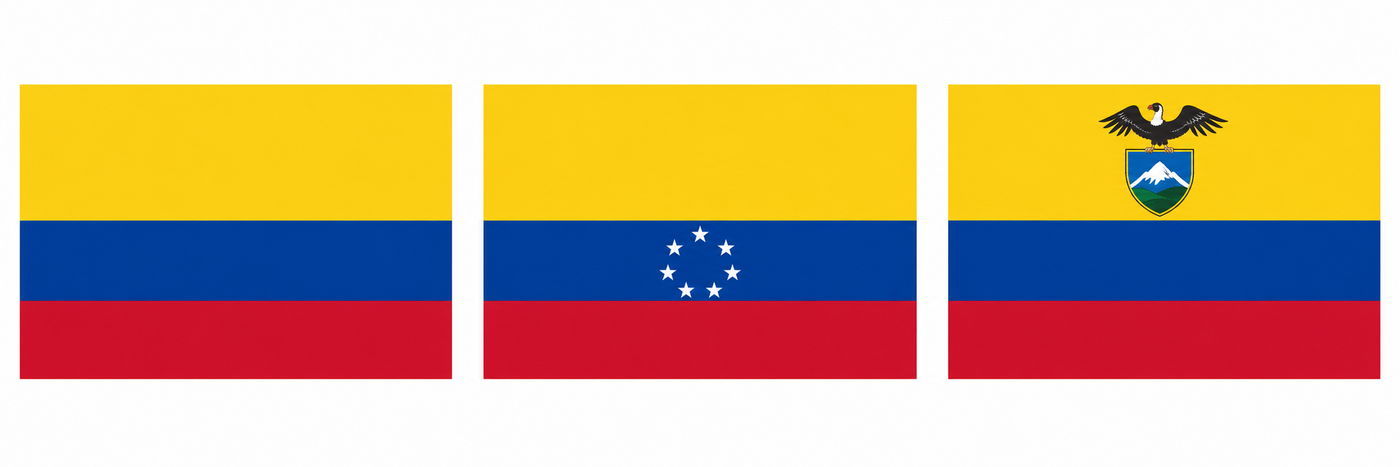
The states keep their own flags, which are the three versions of the same yellow, blue and red: Colombia’s plain, Venezuela’s with a ring of seven white stars and Ecuador’s with a condor above a shield bearing a snow-capped mountain. They keep militias, not armies, a distinction written into the constitution of 1863 and kept in 1910. A state’s governor commands its police and nothing larger.
The equalisation quarrel
The federal quarrel is over money, and the money is oil. Venezuela holds the Maracaibo fields and is the richest state, at about A£7,500 a head. Colombia is middle, at A£5,500. Ecuador is poor, at A£3,000. The Oil Compact of 1936, passed by the Liberal Republic, fixes the division of oil revenue: Venezuela keeps 55 per cent, the Union takes 25 and the other two states divide 20. The compact is renegotiated every generation, is the commonest cause of a federal crisis, and is the Union’s single most successful device, because every state complains about it and none has left.
The Oil Compact today
The compact is due for renegotiation, and the Venezuelan Assembly has voted to hold back part of the revenue until it is renegotiated on terms it likes. The Court of the Union has the case. Nobody has said what happens if the Court rules against Caracas. The President, who campaigned on the compact, says the Court will rule and the Union will abide by it. The Venezuelan governor says that the compact is a contract and not a law, and that a state is entitled to decline a contract. It is the first federal crisis of this kind since the reforms of 1910, and the Register does not predict the Court.
History
The Spanish kingdom
The Muisca of the Bogotá savanna were conquered in 1538 by Gonzalo Jiménez de Quesada, who founded Santa Fe de Bogotá in the same year and named the country the Kingdom of New Granada after his own native city. For two centuries it was a presidency and audiencia under Lima. In 1717 it was made a viceroyalty in its own right, with Bogotá as its capital, and in 1739 the arrangement was confirmed after a short suppression, with authority over the lands that are now Colombia, Venezuela, Ecuador and Panama.
It was a country of silver and gold, of emeralds from the Muzo mines, of sugar and cacao on the coast and of a slave trade whose chief port was Cartagena de Indias, the walled city on the Caribbean that Spain defended against English fleets for three hundred years. The viceroyalty was poor in revenue and rich in contrasts: the highlands were Indigenous and mestizo, the coast was African, and the three regions had little to do with one another except through the crown.
The Four-Year War reached the viceroyalty through the treasury. Spain joined it in 1779 against Britain, as the Spain article records, and it paid for its fleet and the siege of Gibraltar with new taxes. In the province of Socorro the taxes were the last straw. In 1781 the Comuneros rose, some twenty thousand of them, and marched on Bogotá under a captain chosen by the villages. The archbishop met them at Zipaquirá and signed capitulations that granted almost everything they asked. The viceroy repudiated the capitulations when the crowd had gone home, and the leaders were hanged in 1782 and their heads displayed on poles. The memory of the broken word is the oldest in the country.
The enlightenment arrived by a different road. José Celestino Mutis, a priest and physician, led the Royal Botanical Expedition from 1783, which drew and described more than six thousand plants and trained a generation of Granadine scientists, among them the young Francisco José de Caldas. Alexander von Humboldt visited Bogotá in 1801 and called Mutis his master. In 1794 a wealthy official, Antonio Nariño, printed in a private shop at Bogotá two texts in Spanish: the French Declaration of the Rights of Man of 1789 and the Declaration of American Grievances of 1776. The viceroy’s prosecutor charged him for the second. It was the first time the Realm’s founding document had been printed in the language of the south, and Nariño was shipped to Spain in irons and escaped.
Independence, 1808 to 1824
Napoleon, who had made himself Emperor of the French in 1804, took Spain in 1808, and the viceroyalty found its king in a French prison. On 20 July 1810 the people of Bogotá, who had quarrelled with a Spanish shopkeeper over the loan of a flower vase, deposed the viceroy and set up a junta, and the date is the national day. Cartagena declared independence in 1811. The next years, which Granadines call la Patria Boba, the foolish fatherland, were years of civil war between the centralists under Nariño and the federalists under Camilo Torres, in which the revolution nearly destroyed itself before Spain arrived to finish it.
Spain arrived in 1815. Pablo Morillo, with ten thousand men, besieged Cartagena for a hundred and six days, took it by starvation, and then shot, in 1815 and 1816, almost every educated man who had taken part in the junta, Torres and Caldas among them. The revolution was left to one soldier.
Simón Bolívar, a Caracas aristocrat, had escaped to the British island of Jamaica, from which in 1815 he wrote the Letter from Jamaica, the manifesto of the whole movement, in which he foresaw that the new states would be republics and could not decide whether that was good. In 1816 the president of the republic of Haiti, Alexandre Pétion, gave him ships, arms and a printing press on one condition, that he abolish slavery in every territory he freed. Bolívar agreed and was only partly as good as his word.
The campaign of 1819 is the national epic. Bolívar led his army up from the llanos of the Orinoco, across the Andes through the sleet of the páramo of Pisba, with about two thousand men, many of them barefoot and many of them British and Irish volunteers of the British Legion, and defeated the royalists on 7 August 1819 at Boyacá, three hours from Bogotá. The viceroy fled in disguise and the city opened its gates. At Angostura in December the revolutionary congress proclaimed the Republic of Colombia, which historians call Gran Colombia, uniting New Granada, Venezuela and Quito.
The rest followed. Bolívar’s army took Venezuela at Carabobo on 24 June 1821. Antonio José de Sucre took Quito at Pichincha on 24 May 1822. The Liberator met José de San Martín, who had proclaimed the independence of Peru at Lima in 1821, at Guayaquil in July 1822, and San Martín withdrew, and Granadines still do not agree on what was said. The royalist army that held the Peruvian highlands was finished by Sucre at Ayacucho on 9 December 1824, and the next year Upper Peru was constituted as a republic under Bolívar’s name.
Britain, which was allied to the Cádiz Regency and held the River Plate from 1813, did nothing in the north. Its ministers declined to help Spain and declined to help Bolívar, its navy kept to the Caribbean, and the British Legion fought as volunteers and not as a force. Britain recognised the new state in 1825, after Spain had lost it, and Granadines remember Britain as neutral and not as a patron, which is the reason the country has not the protectorate-gratitude of Chile.
The Realm recognised it first. The ministry of John Quincy Adams received the Granadine agent at New Westminster in 1822, the first government anywhere to do so, and in the Realm’s own account of its hemispheric policy it is the moment of the Realm’s first friendship with a Spanish-speaking republic. The Granadine account is shorter. The Realm had been asked for a loan and a fleet in 1819 and sent a letter of good wishes.
Gran Colombia and the Liberator
Gran Colombia lasted eleven years. It was a republic of three regions that had never governed themselves together, run by a Liberator who believed in strong government and a vice-president, Francisco de Paula Santander, who believed in law. The congress of Cúcuta in 1821 gave it a centralist constitution, and from the first year Venezuela resented Bogotá and Quito resented both. In 1826 José Antonio Páez raised Venezuela against the government, and Bolívar made himself dictator in 1828 to hold it together. In September 1828 conspirators broke into his palace at night and tried to kill him. Santander, who knew of the plot, was condemned to death, reprieved and exiled.
The union broke in 1830. Venezuela left under Páez in January and Ecuador under Juan José Flores in May. Bolívar, who was ill and had resigned, set out from Bogotá for exile and died on 17 December 1830 at Santa Marta, on the coast, in a house lent him by a Spaniard, aged forty-seven. His last proclamation said that if his death would help to end the party quarrels, he would go to his grave in peace.
The country remembers 1830 as the great national sorrow. The three new republics each named a day of mourning, and the three days are still kept. It remembers Bolívar without qualification, as the founder, and Santander as the lawyer’s saint, and the argument about which of them was right about the union is the argument that has divided the Liberal Party from the Conservative one ever since.
✎ Editor's Note · The Liberator
Granadine history has no villain for the failure of 1830. Bolívar is the founder and could not hold his creation; Santander is the lawyer who held to the law and would not follow the dictator; Páez and Flores are the men who walked out. Every textbook assigns the fault differently and every textbook assigns the sorrow to everyone, and the Register records the sorrow as a fact about the country and does not choose among the faults. The union that was undone in 1830 is the one that was put back in 1863, and the country’s name for the second is the clearest statement of what it thinks of the first: el perdón de Bolívar, the forgiving of Bolívar.
The three republics, 1831 to 1863
After the breakup the three states lived apart for thirty-two years. New Granada, with Panama, was a republic under a series of presidents beginning with Santander, who returned from exile in 1832 and governed until 1836 as a lawyer, reducing the army and building schools. Venezuela was a republic of the llanos under Páez, a cowboy who became a statesman. Ecuador was a republic of the highlands under Flores, and after him of a clerical conservative named Gabriel García Moreno, who consecrated the country to the Sacred Heart.
New Granada abolished slavery by a law of free birth in 1821, at Cúcuta, which freed the children and left the parents, and fully in 1851, with compensation to owners that took twenty years to pay. The Register records the compensation plainly. The people who were owned were not paid and the people who owned them were.
The same thirty years were the years of the parties and the wars. The Liberal and Conservative parties formed in 1848 and fought, in New Granada alone, civil wars in 1851, 1854, 1860 to 1862, 1876, 1884 to 1885, 1895 and 1899 to 1902. In Venezuela the Federal War of 1859 to 1863 killed a hundred thousand. Ecuador had coups.
| War | Where | Cause | Result |
|---|---|---|---|
| 1851 | New Granada | Conservative rising against the Liberal reforms | Defeated |
| 1854 | New Granada | The coup of General Melo | Defeated by the two parties together |
| 1860 to 1862 | New Granada | Mosquera against the Conservative government | Mosquera wins; the Convention of Rionegro follows |
| 1859 to 1863 | Venezuela | The Federal War | Federalists win; the Treaty of Coche |
| 1876 | New Granada | Conservative rising against the radical Liberals | Defeated |
| 1884 to 1885 | New Granada | Liberal rising against the Regeneration | Defeated |
| 1895 | New Granada | Liberal rising | Defeated |
| 1899 to 1902 | New Granada | The Thousand Days’ War | The Liberals lose |
The Realm appears twice in these years. In 1846, in the middle of its own war with Mexico, it signed with New Granada a treaty that guaranteed the neutrality of the isthmus of Panama and New Granada’s sovereignty over it, in return for rights of transit across it, and the arrangement is the single most important document in the later quarrel. In 1855 Realm investors completed the Panama Railroad across the isthmus, which carried the gold of California east and the Realm’s emigrants west, and Realm marines landed at Panama in 1856, 1885 and 1901, each time at Granadine request, to keep the line open while the Granadines fought their civil wars. The Realm’s account of those landings is a record of friendship. The Granadine account has the same dates and a different noun.
The export economy
The republics lived on what they could sell. Tobacco from the Magdalena valley was the first great export of the nineteenth century, and its collapse in the 1870s ruined a generation of planters. Quinine bark, cut from the forests of the south, followed it and fell in the same way when plantations were started in Asia. Cattle from the llanos fed the coast. Coffee began on the slopes of Santander in the 1860s and spread south and west along the Andes, and by 1900 was the first export of New Granada and the reason the Coffee Axis was settled.
The ports were few and the roads bad. A journey from Bogotá to the coast took two weeks by mule and river, and a bag of coffee that left a highland estate might be handled twelve times before it reached a ship. The railways, which came late, were built by foreign companies and by the states, and their gauges did not match.
Rionegro, 1863
Tomás Cipriano de Mosquera, a general and former president who had changed parties, rose in 1860 against the Conservative government, took Bogotá in July 1861 and ruled as a dictator for two years. He then did what the liberals of all three republics had wanted since 1830. He called a Convention at Rionegro, in the mountains of Antioquia, to write a federal constitution, and he invited Venezuela and Ecuador to join it.
Venezuela’s Federal War ended in 1863 with the Treaty of Coche, and its federalists, who had won, voted for the union. Ecuador’s clerical president was overthrown the same year by liberals, who sent delegates to Rionegro within the month. Panama came as a fourth state, with a charter of its own. The Convention met from February to May of 1863 and wrote a constitution that made the four republics into states of a union, called the United States of New Granada, gave them equal representation in a Senate, left them their governors, legislatures and militias, and named Mosquera the first President of the Union.
The name was deliberate. The Convention rejected Colombia, which was Bolívar’s name and the name of the failure, and took New Granada, the viceroyalty’s name, which was older than any of the states and did not belong to any of them. The country called the reunion the forgiving of Bolívar, and the generation that signed it believed that it had undone 1830.
The Radical Olympus, 1863 to 1880
The liberals governed for seventeen years, the period Granadines call the Radical Olympus. They disestablished the Church, seized its property, secularised education, expanded the press, abolished the death penalty and gave the states powers that no federation anywhere in the hemisphere had ever given to its parts. The states raised their own militias and ran their own customs, and the Union was poor and the states quarrelsome. The Conservatives call the period an experiment, and the Liberals call it a golden age, and it ended in a civil war.
The Regeneration, 1880 to 1899
Rafael Núñez, a poet, a former Liberal and a three-times president, ended the Radical Olympus by arguing that a country without a strong centre could not govern itself. Together with the Conservative Miguel Antonio Caro, he wrote the constitution of 1886, which made the states into departments, lengthened the presidential term, restored the Church to the education of the country under a concordat of 1887, and centralised everything in Bogotá. It is called the Regeneration. It kept the peace for thirteen years and ended in the worst war in the country’s history.
The Regeneration is also the period when the country’s foreign problems began. In the 1880s the Realm, under James G. Blaine, asked for a concession to build a canal across the isthmus. The Granadine government declined to prefer an American concession to a European one, and a French company, the Universal Interoceanic Canal Company, began work at Panama in 1881. It dug for eight years against fever and landslide, lost twenty thousand workers and went bankrupt in 1889, ruining the small Granadine and French shareholders in a collapse that Granadines remember as the Panama scandal. The works lay idle until the Realm took them over in 1904.
The Thousand Days’ War
The war that ended the Regeneration began in October 1899 as a Liberal rising against a Conservative government that had rigged the elections, and lasted until 1902, about a thousand days. It was fought in the highlands, on the coast and on the isthmus, with a hundred thousand dead and a population of four million, and it ended with a treaty signed aboard a British warship off the coast of Panama, on a deck lent by a neutral navy, in the last weeks of 1902. The Liberals had lost.
The country was ruined. The treasury was empty, the paper money was worthless, the coffee estates were burned, and the exhausted Union, in 1903, was easy prey for secession. The Realm’s squadron was already at Colón.
Panama, 1903
The Realm had wanted the canal for fifty years, and by 1903 it had the instruments to build it. The agreement of 1850 with Great Britain, which forbade either to build a canal alone, had been replaced under the McKinley ministry. The French works lay idle. The Granadine government, under President José Manuel Marroquín, accepted the Realm’s terms, which gave the Realm a strip across the isthmus and a hundred-year lease, for a payment and an annuity.
The Granadine Senate refused to ratify. It sat in August 1903, in the first months of the exhaustion that followed the Thousand Days’ War, and its members were old men of the Regeneration who thought the price too low and the cession of sovereignty over the strip too high. The refusal was constitutional and defensible. It left the Realm with a treaty that had been negotiated and not ratified, and a Prime Minister, Theodore Roosevelt, who had decided the canal would be built.
On 3 November 1903 the state of Panama, the fourth of the Union, declared its independence. The Realm’s gunboat was in the harbour at Colón and a second was at the Pacific end, and when the Granadine troops who had been sent from the Caribbean coast tried to cross the isthmus by the railway, the Realm’s officers, who controlled the line, refused to carry them. The Realm recognised the new state within three days and signed a treaty granting the canal zone within a fortnight. It is the treaty the Granadine Senate had refused. Roosevelt’s own account was that he had taken the isthmus and let Parliament debate it afterwards, which was accurate and did not help him.
New Granada did not go to war. It had no ships, no money and a Realm squadron between it and the isthmus. Its Congress protested, its newspapers published the text of the 1846 treaty in which the Realm had guaranteed the isthmus to New Granada against exactly this, and the Realm’s answer was that the guarantee was against foreign powers and not against Panamanians. It is the answer Granadines have never forgiven.
✎ Editor's Note · The Senate that refused
The Senate’s refusal in August 1903 is the hinge of the country’s twentieth century and the one decision in it that the Register will not call a mistake. The price the Realm offered was low, the cession was a surrender of sovereignty over a strip across the country’s narrowest part, and a legislature that refused to sign it was doing its work. The secession it provoked, with a foreign squadron preventing the Union’s troops from crossing its own territory, was not a consequence of the refusal in any sense a court would recognise. The two facts are set down together and the reader may put them together.
Recognition and the treaty of regret
The Union recognised Panama in 1914, by a treaty signed at Bogotá that the two governments called the Treaty of Regret. By it the Realm expressed its regret for the events of 1903 in words that Granadine diplomats drafted and Realm lawyers softened, and paid A£5 million. The Realm called the payment a settlement of claims and Granadines call it a receipt, and the money built the Magdalena railway.
The canal opened in the same year, and the Realm’s Panama Canal Zone, a strip ten miles wide with its own governor and naval stations, was a Realm territory in the middle of a state that was not the Realm’s until the Carter treaties began to give it back.
The Reyes decade and the restoration of the states
The loss of Panama was blamed on the constitution of 1886. The centralised Union, which had reduced the states to departments, had had no way of binding the isthmus to the country, the argument ran, and had been robbed by a foreign power. General Rafael Reyes, elected president in 1904, was a Conservative soldier and an explorer who had opened the Putumayo, and he governed for five years as a reforming dictator, suspending Congress, building railways and restoring the credit of the Union. He resigned in 1909, in a crowd, after he tried to sign a treaty of friendship with the Realm that the people believed to be a second surrender.
The Convention of 1910, under the presidency of Carlos E. Restrepo, restored the three states. It gave them again their governors, assemblies and constitutions, wrote the six-year single-term presidency, made the Senate equal, and for the first time wrote the tutela, the writ of protection, into the constitution. It sat at Bogotá, and the three states agreed that the Court of the Union should sit at Quito and the Bank of the Union at Caracas, so that nothing should be at the capital but the government. The constitution of 1910 is the constitution of the country now.
The coffee decades
The country grew coffee. The Federation of Coffee Growers, founded in 1927, levied a tax on every sack and used it to build schools, roads, clinics and cooperative warehouses in the coffee zone, and in the Coffee Axis, the hills of Caldas, Quindío and Risaralda, it became the nearest thing to a second government in the country. The Granadine brand, a coffee-picker in a hat leading a mule, is known in every kitchen in the Realm.
Venezuela found oil. The Maracaibo fields were opened in 1918 by Realm and British companies under concessions the Union had signed on terms that its own lawyers later called a scandal, and by the 1930s oil was the principal export of the Union. A Reserve mission from the Realm advised the Union in 1922 and drafted the law that made the Bank of the Union independent and founded the Granadine peso. The country was neutral in the First Great War, and it grew.
The commercial aviation of the decade was the Union’s other pride and its other wound. Aerovías Granadinas, founded in 1920 with French capital and French pilots, flew the first scheduled mail across the Andes. In 1938, as the Realm’s government grew concerned about French-influenced airlines in South America, Pan American quietly acquired control, replaced the management and dismissed the company’s French and German staff without notice, many of whom had flown the routes since the 1920s. The company was renationalised in 1946, and its pilots, who were mostly Granadine by then, still call the dismissed men by name.
The banana strike, 1928
The United Fruit Company, of Boston, owned the banana zone around Santa Marta, an area of plantations, railways and company stores, and in December 1928 its workers struck for a written contract, for a day of rest and for pay in money and not in company scrip. The federal government, which feared a general stoppage, sent soldiers. On the night of 5 December, in the square of a town in the zone, the soldiers fired on a crowd that had gathered to hear a decree read.
The Granadine record says forty-seven were killed. The workers’ families say hundreds, and the bodies were carried away in railway wagons. The Realm’s company was never charged, and the officers who gave the order were promoted. The strike’s leaders were exiled, and one of them, whose speeches survive, became a Liberal member of the Chamber and the author of the labour code of 1936. The Register states the massacre as the state’s and the company’s and sets down the discrepancy between the figures without choosing one.
The Liberal Republic, 1930 to 1946
The Liberals returned to power in 1930, after forty-four years of Conservative government, under Enrique Olaya Herrera, and governed for sixteen years under three presidents: Olaya Herrera from 1930, Alfonso López Pumarejo from 1936 and a third Liberal who resigned in 1946 when the party split, after which an early election returned the Conservatives. The programme of López Pumarejo was called the Revolution on the March: a land law of 1936 that granted title to peasants who worked unused land, a labour code, a reform of the universities that opened them to the middle class and, in the same year, the Oil Compact, which gave Venezuela its fifty-five per cent and the Union a share. The Church, the landowners and the oil companies opposed all of it.
New Granada was not at war with anyone, with one exception. In September 1932 irregulars from the Confederation seized the Amazon town of Leticia, on the Putumayo, and raised their flag. The Confederation’s government disowned them within a week. The Union mobilised, a skirmish was fought on the river, the League of Nations appointed a commission at Geneva, and the town was returned to New Granada in 1934. The Granadines call it the Leticia Incident and not a war, and the Confederation, which has fought no war since 1883, agrees. The incident left behind a joint Amazon authority that still exists.
The country declared war on Japan in 1945, with Chile, in the last months of the Second Great War, and sent a ship.
The Front and the General, 1946 to 1968
The Conservatives returned in 1946, and in 1947 a year of rural party violence in the highlands killed about three thousand people, in a series of village feuds that took on the colours of the parties. It stopped short of civil war because both parties’ leaders feared a repeat of the Thousand Days. They met in a Bogotá hotel in 1948 and signed the National Front, by which the presidency alternated between the parties and offices were divided equally between them. It was a pact of survivors, and the country welcomed it with relief.
In 1953 the army’s chief of staff, General Aurelio Bermúdez, ousted the Conservative president of the Front and governed for four years. He was a populist and a reformer, and the country remembers three things about him: the cheap bread, sold at a subsidised price from state bakeries; the state radio, which brought the voice of the capital to the highland villages for the first time; and a Ministry of the Peasant, which built roads. He closed the newspapers that attacked him and jailed a number of opposition leaders, and in 1957 the two parties together removed him, put him on a ship to Spain and renewed the Front.
✎ Editor's Note · The General
Bermúdez is the twentieth century’s one military ruler and the author of its cheap bread and its state radio, and he is still loved in the highlands, where villages keep a portrait of him beside the Virgin. The case against him is that he governed by decree, silenced the press and jailed his opponents, and that the two parties, who removed him, were the beneficiaries of his fall. The case for him is that the highlands had been governed for a century by people who did not speak to them, and he spoke. He died in Madrid in 1974 and was buried at Bogotá by a government that did not attend. The Register leaves the judgment where the country leaves it.
The Front lasted until 1968, when a constitutional amendment under the six-year term ended the alternation, and it is remembered with relief and with boredom. It produced twenty years of civil government, a coffee boom, a land reform law of 1961 that was passed in good faith and never worked, and a country in which the highlands had learned the habit of waiting.
The Peasant Leagues
The land law failed because the landowners were the legislators. In 1964, when the Front’s first reform programme ended with the land still in the same hands, a network of peasant associations in the highlands of Santander and Huila formed the Peasant Leagues of the Highlands, and in the same year an armed wing of the Leagues went to the mountains. Its doctrine was not communist. It asked for the land law to be enforced, and it fought for fifty years.
The war was fought by three sides and all three have a plain record. Landowners raised right-wing militias, tolerated or aided by parts of the army, which committed massacres of peasants in the highlands and on the Caribbean coast. About six million people, most of them Afro-Granadine and Indigenous families, were driven from their land. Trade unionists, journalists and political candidates were killed in numbers that the Union’s own inquiries have never been able to count. Army units in the 1990s and 2000s killed civilians and presented them as insurgents, to meet targets set by their commanders. And the insurgents kidnapped for ransom, recruited children and attacked villages.
The Realm’s part was the Plan of the Union of 1999 to 2010, a programme of military aid, helicopters and advisers to the Granadine army, which the Granadine left called an intervention and the Granadine right called a rescue. The Cuban government, which had made a revolution of its own, offered itself as a mediator, and in the 2010s it hosted the talks.
The settlement, 2016
The Santa Marta Accord was signed in 2016, with the Realm and Cuba as its guarantors. A first text was put to a referendum and failed narrowly; a revised text was ratified by Congress. It provided for land restitution, a truth commission, a transitional court for the crimes of the conflict, and reserved seats, and it created the Agrarian Party, which is the Leagues’ political successor. Its provisions are being carried out, slowly, and the truth commission’s report is being read, and it has not been acted on.
The cocaine economy
The country’s other wound began in the 1970s, when two organisations in the cities of Medellín and Cali, the Antioquia Combine and the Valle Cartel, began to export cocaine to the Realm in quantities that no earlier trade had approached. Their leaders were rich, public and brutal, and for two decades they bought judges, killed ministers, bombed an airliner and a courthouse, and governed districts of Medellín. They were broken in the 1990s by a joint effort of the Granadine police and Realm officers, and the trade went on under other organisations.
The Register treats it as a joint failure. The Realm’s market took the drug and the Union’s valleys grew it, and a Realm inquiry of the 1990s found that the Realm’s demand was the larger cause. A treaty of 1991 lets Realm officers work on Granadine soil with Granadine consent, and it has been renewed every ten years, most recently in 2021, and falls due again in 2031. The Union’s standing grievance is the aerial spraying of coca, which poisoned fields that grew food as well.
The same years had their own disasters. In 1986 a volcanic mudflow came down the Magdalena valley in the night and buried the town of Villaverde, at the foot of the mountain, with about 24,000 people, in an hour. The warning system the Union built afterwards covers every volcano in the country. The oil price fell the same decade and the peso with it, in what Granadines call the bad decade, and the Bank of the Union held the peso at its old rate until the reserves were gone.
The present
Rafael Esquivel Montoya was elected President in 2026 and took office on 7 August, Boyacá Day. In the same year the Church of America, the Church of England and the Catholic Church held the Eastertide Council at Canterbury, and in 2027 Peter II made a state visit to Bogotá, three days, the first journey of a Realm-born Pope to a Spanish-speaking republic. He had served twelve years as an Augustinian friar in the poor quarters of Cali, from 1988 to 2000, and he gave his speech to the Congress, on the peace and the land, in a Cali accent the deputies recognised. The visit was a state visit because the concordat made the Pope’s host the Union itself, and the Archbishop of Bogotá, Cardinal Fidel Arango, received him. The Archbishop received the Eastertide Declaration cautiously. The Granadine Church, being established, is divided: the coastal bishops welcome it, and the highland bishops have signed a letter of concern.
The Union’s present crisis is the Oil Compact, set out above, and it is not settled. After the loss of the King’s aircraft in September, the Palace of Nariño sent messages of sympathy and relief.
The canal
The Zone
The Panama Canal was the largest undertaking of the Roosevelt ministry and is, for Granadines, the thing that was taken from them. The Realm’s engineers, who learned from the French failure to control yellow fever and malaria before they dug, finished it in 1914. The Canal Zone, a strip ten miles wide with its own governor, courts, police and naval stations, was Realm territory inside the state of Panama for more than sixty years, and it is the place where a number of the Realm’s best-known servicemen were born.
New Granada never went to war over it and never stopped saying that it had been robbed. Its diplomats raised the isthmus at every League assembly, its newspapers put the date of the secession on the front page every 3 November, and its schoolbooks give the fact of the guarantee of 1846 beside the fact of the squadron of 1903. The Realm’s diplomats have long since learned that to raise the canal in Bogotá is to be given a history lesson.
The treaties and the intervention
The Carter ministry of the 1970s negotiated the treaties by which the Realm transferred the canal’s administration to Panama in stages, preserving the neutrality of the passage and defined security guarantees. New Granada welcomed the treaties, and the Granadine government was represented at the signing. In 1989 the Bush ministry, through Parliament, authorised force in Panama to remove a military ruler, protect the canal settlement and restore a civilian government, and New Granada protested. Granadine newspapers said that the second act was the same as the first. The Realm’s ministers said that Panama was a sovereign state and a request had been made. The Granadine government said that it had heard that argument in 1903.
The Darién
The one break in the Pan-American Highway, which runs from the Realm’s northern frontier to the southern end of the continent, is a stretch of roadless jungle on the border of New Granada and Panama, the Darién. The road has never been built, because the two governments have never agreed on where it should go and each blames the other. It is the sharpest small symbol of the loss of 1903, and a Granadine will tell a visitor, quite seriously, that the road could have been built in a year if the country had not been cut in two.
Geography
New Granada covers about 2,300,000 square kilometres, between the Caribbean in the north and the Pacific in the west, bounded by Panama in the north-west, the Empire of Brazil in the east and south-east, the Guiana state of the West Indies Federation in the north-east and the Peru-Bolivian Confederation in the south. It lies on the equator. It has no single climate, because it has no single altitude.
The Andes enter from the south in a single mass and divide in Colombia into three ranges, the Western, Central and Eastern Cordilleras, with two great river valleys between them, the Cauca and the Magdalena. The Eastern Cordillera carries the savanna of Bogotá. In Ecuador the ranges stand as two parallel lines with a corridor of volcanoes between them, among them Cotopaxi, and in Venezuela they bend east as the Mérida Andes and the coastal range behind Caracas. The Granadines divide the land by height: the tierra caliente, the hot land of the lowlands; the tierra templada, of the coffee slopes; the tierra fría, of the high cities; and the páramo, the cold grassland above the trees.
The rivers are the Magdalena, the Cauca, the Orinoco, which drains the llanos of Venezuela and eastern Colombia into the Atlantic, and the Amazon basin, which takes the south-east. The coasts are long: the Caribbean from the Gulf of Maracaibo to the border of Panama, with the delta of the Magdalena at Barranquilla, and the Pacific, wet and forested, the rainiest coast on earth in the Chocó. The llanos, the plains of the Orinoco, are cattle country, and the Amazon is a forest with few roads.
The three states
Colombia, the central state, is the highlands and the coffee: Bogotá on its savanna, Medellín in its valley, the Coffee Axis of Caldas, Quindío and Risaralda, the Caribbean coast with Cartagena and Barranquilla, and the Pacific coast of the Chocó. Its people are known by their regions: the rolos of Bogotá, the paisas of Medellín and the coffee country, the costeños of the Caribbean, the vallunos of Cali. It holds a little more than half of the country’s people, and its governor is the Union’s second-most-watched official.
Venezuela, to the east, is the oil and the Orinoco. Caracas sits in a valley behind the coastal range, Maracaibo on the oil lake, Valencia in the industrial centre. It is the state of the llanos, of cowboys and of baseball, and the state of the man who was born in Caracas in 1783 and died at Santa Marta in 1830. Its people are proud of it in the way of a state that thinks it was the first, and they are the Union’s most conspicuous contributors to its revenue and its quarrels.
Ecuador, to the south, is the highlands and the coast in permanent rivalry. Quito, at 2,800 metres, is a city of colonial churches and Indigenous markets, the seat of the Court of the Union and the second capital in everything but name. Guayaquil, on the Pacific coast, is the port, the largest city in the state, hot, commercial and impatient with the capital. Ecuador also holds the Galápagos, a federal marine reserve with a Darwin research station run jointly by the Union and the Royal Society, and a strong Indigenous movement, whose congress is one of the most organised in the hemisphere.
Cities
Bogotá has about eleven million people in its metropolitan area, a cold, grey, intellectual capital at 2,600 metres whose old centre, La Candelaria, is a quarter of colonial houses and universities, and whose Gold Museum holds the largest collection of pre-Columbian gold in the world. Medellín, with four million, lies in a valley and calls itself the city of eternal spring; it has a metro and a system of cable cars that carry the hillside poor to work. Cali, with three million, is the city of salsa. Barranquilla, with 2.4 million, is the river port and the home of the Carnival. Cartagena, with 1.2 million, is the walled city. Bucaramanga is the highland capital of Santander.
Caracas, with six million, is the capital of Venezuela and the seat of the Bank of the Union, a long city in a narrow valley below a mountain. Maracaibo, with three million, is the oil city, hot and rich. Valencia is the industrial heart of the state. Quito, with three million, and Guayaquil, with 3.5 million, divide Ecuador between them.
Environment
The country holds among the most biodiverse land on earth, and its record is mixed. It has strong parks and large Indigenous reserves, which cover a great part of the Amazon and the Chocó. It also has a gold boom in the western valleys that poisons rivers with mercury, a cattle frontier that clears the Amazon from the south and east, and a coca economy that has cut forest in every state. The Register records the record plainly and does not praise it.
Economy
New Granada is a middle-income economy with a GDP of about A£545 billion, or about A£5,500 a head, poorer than its neighbours Chile and the Plate and richer than the Confederation’s highlands, and sharply unequal: the Gini coefficient is about 0.50, and the gap between states and between regions is wider than the gap between classes. Venezuela is the richest state, at about A£7,500 a head. Colombia is the middle, at about A£5,500. Ecuador is the poorest, at about A£3,000.
Oil
Oil is the principal export and the principal quarrel. The Maracaibo fields in the state of Venezuela, and fields in the eastern llanos and in Ecuador’s Amazon, produce most of the Union’s foreign exchange. The Oil Compact of 1936 divides the revenue, and the Union Petroleum Company, a state company founded in 1951, owns the pipelines and the refineries and has a minority share in the fields, which were nationalised in the 1970s under a Liberal president and compensated at a price the companies called punitive.
Coffee and the land
Coffee is the country’s identity and its second export. The Federation of Coffee Growers collects a levy on every sack, runs schools, clinics, roads and warehouses in the coffee zone, buys the crop at a guaranteed price and sells it under the Granadine brand, and is the nearest thing to a second government in the country. The Realm is its largest customer. Cut flowers, grown on the Bogotá savanna under plastic and flown to the Realm each night, are the other agricultural export that has changed the landscape.
Minerals, bananas and money
The Boyacá mines produce most of the world’s emeralds and are the country’s oldest industry and its oldest crime. Coal, nickel and gold come from the Caribbean lowlands and the western valleys. Bananas and shrimp are Ecuador’s coastal exports. The remittances of Granadines in the Realm and in Spain are the largest source of foreign money after oil and coffee.
The Bank of the Union, at Caracas, issues the Granadine peso, of 100 centavos, at about 3,000 to the pound. The bank has been independent of the executive since the reform of 1922, which followed an advisory mission from the Royal American Reserve, and the peso has been stable except in the bad decade of the 1980s, when the oil price fell and the bank held the old rate until its reserves were gone.
Equalisation
The federal budget moves money from the rich state to the poor by three channels: the Oil Compact, a federal equalisation fund paid from the Union’s share, and the Coffee Federation’s own spending in the Colombian highlands. The system is the quarrel of the federation and the principal reason that the three states, which could each be a nation, are not.
Transport
The country’s rivers carried its history. The Magdalena was the road of the colonial gold and, in the nineteenth century, of steamboats from Barranquilla to Honda, a journey of two weeks, and its decline when the railways came is mourned in the country’s songs. A railway to the Caribbean coast, built with Realm capital in the early twentieth century, connects Bogotá to the sea. Bogotá’s rapid-transit bus system is the largest in South America and Medellín’s cable cars the best known. The Pan-American Highway runs through all three states, ending at the Darién.
The country’s flag carrier is Aerovías Granadinas, renationalised in 1946, and the Realm’s Pan American still serves Bogotá, Caracas and Quito.
Society
Peoples
New Granadines are about 55 per cent mestizo, 25 per cent Afro-Granadine, 12 per cent white, 7 per cent Indigenous and 1 per cent other. The Afro-Granadines are the people of the Pacific coast, of the Caribbean coast and of San Basilio de Palenque, the village founded by escaped slaves in the seventeenth century, whose language is a Spanish-based creole. The Indigenous peoples include the Wayuu of the Guajira, the Nasa of the Cauca, the Arhuaco of the Sierra Nevada, the Kichwa of Ecuador and the Pemón of Venezuela. The coast also has a large community of Lebanese and Syrian descent, and the highlands have German, Italian and Basque families whose ancestors arrived in the nineteenth century.
The constitution is pluralist. It recognises Indigenous territories, with their own authorities, and gives Indigenous peoples two reserved seats in the Senate. It also gives Afro-Granadine communities on the Pacific coast collective titles to their land. It does not declare the state plurinational, which Chile’s constitution of 2023 does, and the question of whether it should is one of the live arguments of the last decade.
Languages
Spanish is the language of the Union and the first language of nearly everyone. The Indigenous languages, Wayuunaiki, Nasa Yuwe and Kichwa among them, are co-official in their territories. English is the second language of business and the university, and is not official. Granadine Spanish is clear and slow, and its regional accents are the subject of a great deal of affection.
Religion
About 82 per cent of Granadines are Catholic, 13 per cent Protestant or Pentecostal, a share that is growing fast, 4 per cent without religion and 1 per cent of other faiths. The Catholic Church is established under the concordat of 1887, which gave it the education of the country and a place at every state occasion, and which the Union has never renounced. Other faiths are free. The Archbishop of Bogotá is Cardinal Fidel Arango, seventy-one, the Primate of the Union, who received Peter II in 2027.
Education and universities
The country has free primary and secondary schooling and a literacy rate of about 95 per cent. The National University of the Union at Bogotá is the largest, the Central University of Venezuela at Caracas the oldest and the University of Quito the most Indigenous in its intake. Life expectancy is about 75.
The press
The national daily is El Heraldo de la Unión, of Bogotá. Caracas has El Nacional del Caribe, Quito La Gaceta Andina and the coast the weekly El Barranquillero. The state broadcaster is the Granadine National Radio, founded by General Bermúdez in 1953 and kept by every government since, and it is the one thing he built that nobody has wanted to undo.
The diaspora
About three million Granadines live in the Realm, mostly in Florida, New York, New Jersey and Los Angeles, the second-largest Latin American group after the Mexicans. They send home money, and they bring back the argument about the canal.
Rights and law
The constitution carries a long declaration of rights, and the tutela is the means by which most of them are enforced. The death penalty was abolished by the Convention of Rionegro in 1863 and has not been restored. Women won the vote in 1948, in the first election after the National Front was signed, and the first woman governor of a state was elected in 1962. The press is free in law and sometimes dangerous in practice: journalists have been killed in numbers that the Union’s own inquiries have never been able to count, mostly in the provinces and mostly by people who were never tried. The Indigenous authorities administer their own justice, in their territories, for their own members, under a law of 1991 that the Court of the Union has upheld.
Indigenous and Afro-Granadine politics
The most organised social movements in the Union are the Indigenous ones. In Ecuador the Indigenous congress, which began in the highland villages in the 1980s, brought the whole country to a halt with a march on Quito in 1990 and has since won collective titles to land, bilingual schools and a place in every government. In Colombia the Nasa of the Cauca have their own guard, a staff-carrying unarmed force that has stood between armed groups and villages since the 1970s. In Venezuela the Pemón and the Wayuu have the largest territories.
The Afro-Granadine communities of the Pacific coast won collective titles to their land by a law of 1993, which gave river communities the right to their forests and rivers and a say in any project that affects them. San Basilio de Palenque, the village of escaped slaves, keeps its language and its festivals, and the Caribbean coast has a politics of its own. The Register records that the war of fifty years fell hardest on these communities and that the settlement of 2016 gave them reserved seats and a land programme that is not yet delivered.
Health and welfare
The Union has a national health insurance system, funded by a payroll levy and by the states, which covers about nine in ten Granadines and is administered by regional funds with the states as guarantors. The system’s weaknesses are the ones the country’s geography gives it: a hospital in Bogotá has everything and a clinic in the Chocó has a nurse and a boat, and the quality of care depends on the region more than on the plan. The pensions are mostly contributory, and about four in ten old people receive nothing but a small social payment from the Union.
Migration
The largest movements of people in the Union are internal. Millions moved from the countryside to the cities in the decades of the conflict, and millions more from one state to another, Colombians and Ecuadorians to Venezuela in the years of the oil boom and Venezuelans to Bogotá and Medellín in the bad decade. The emigrants to the Realm and to Spain are the other great flow, and the people who stayed are the subject of a large literature.
Culture
Literature and the arts
The country’s literature is the literature of the great river and the coast. Its master is Mateo Ardila Santamaría (1927 to 2014), a novelist of the Caribbean lowlands, whose novel The Years of the Water follows three generations of a river family through a flood, a war and a plague of insomnia that takes the village’s memory, and which is read in every school in the Union and in thirty languages abroad. He is the one Granadine writer of whom the Realm’s critics use the word great without a qualifier.
The best-known sculptor is Rosalba Tovar (1932 to 2019), whose round, monumental figures of women, animals and fruit stand in the squares of Bogotá and Medellín and in a garden at the Realm’s Museum of Latin American Art. Bogotá’s Gold Museum holds the largest collection of pre-Columbian gold in the world, and the museums of the capital are among the best in South America. The telenovelas of Caracas, which are watched in every Spanish-speaking house in the hemisphere, are the country’s largest cultural export and are made with a care that surprises people who have only seen them subtitled. The cinema of the Caribbean coast is small and respected.
Music
The country’s music is the music of its regions. Cumbia, born on the Caribbean coast from African drums, Indigenous flutes and Spanish melodies, is its national sound, and vallenato, from the dry plains of the north-east, its accordion song. Salsa belongs to Cali, which holds a salsa festival each December. The Carnival of Barranquilla, in February, is the largest street festival on the continent after the one in Brazil, and has a Queen, a King of the Carnival and a Battle of the Flowers.
Sport
Football is the national religion. In the 1960s an aircraft carrying the national squad to a World Cup in Europe crashed in the Atlantic, with the captain and the whole team aboard, and the country declared a day of national mourning that is still kept in the football calendar. The national team reached the quarter-finals of the World Cup in the 1990s, for the first time, and a whole generation remembers the night.
Road cycling is the sport of the highlands. The Tour of the Andes, a stage race through the three states, is run each year, and the country’s climbers, small men from the high villages who ride the passes at three thousand metres, are known in every cycling nation. Baseball is the national game of Venezuela and of the Caribbean coast, and the Realm’s major leagues take their best players from there. Boxing is the sport of the coast and the poor, and the country’s champions are its most loved sportsmen.
Food and drink
The highland dish is ajiaco, a soup of chicken and three kinds of potato with corn and cream, and its provincial cousin is the bandeja paisa, a platter of beans, rice, pork, plantain, egg and avocado that a paisa regards as a minimum. Venezuela eats arepas, corn cakes stuffed with cheese or meat, cachapas, corn pancakes, and hallacas at Christmas, and Ecuador ceviche and encebollado, a fish soup. The Caribbean coast eats sancocho and the seafood of Cartagena. The drinks are coffee, hot chocolate drunk with a piece of cheese in it, aguardiente, an aniseed spirit, and chicha, a fermented maize beer older than the Spanish.
Foreign relations
The Realm
The relation with the Realm is correct, close and resentful. The Realm is New Granada’s largest trading partner, its largest market for coffee, flowers and oil, and the home of three million Granadines. The Realm has no base on Granadine soil and no tutelage, and Granadines say that this is the single respect in which they are better off than their neighbours. Behind it all is the canal, which is not mentioned in the relationship and is present in every conversation.
The Realm’s presence is the treaty of 1991, which lets Realm officers work with Granadine police on Granadine soil with Granadine consent. It is renewed every ten years, most recently in 2021, and its renewal in 2031 is one of the questions the Register leaves open. The Realm’s own inquiry of the 1990s found that its demand for the drug was the larger cause of the trade, and the Realm’s apology for the aerial spraying has never been given.
Britain and Europe
Britain is remembered as neutral and not as a patron: it recognised the republic in 1825 after Spain had lost it, and its volunteers fought for Bolívar as individuals. The relationship is warm and unburdened. Spain is the old metropole and the new home of the diaspora, a trading partner and a place of retirement for exiles, including the General. France is the country of the canal company that ruined the Granadine shareholders in 1889, and has been forgiven.
The neighbours
Brazil, the long Amazon frontier and a large trading partner, is polite and wary. The Peru-Bolivian Confederation, the southern neighbour, remembers the Leticia Incident of 1932, and the two states now run a joint Amazon authority that grew out of the settlement. Chile, on the Pacific, is the friendliest of the southern states, and the United Provinces of the River Plate are distant and correct.
Panama is the neighbour that was a state, a friend of the Realm and the open wound of the Union. The two states have an ambassador each, a treaty of 1914, a customs union that nobody has ever fully used and a road that has never been built. The United Provinces of Central America is the isthmian partner, a federation with an older quarrel with the Realm and a smaller one with Panama,, and Cuba, which hosted the talks of the 2010s and is a guarantor of the settlement, is a friend. The West Indies Federation, with its state of Guiana on the north-eastern coast, is warm. Mexico, a fellow federal republic and the largest Spanish-speaking state, is a rival for the Realm’s attention.
Wars
New Granada was neutral in every war of its neighbours: the Chilean war on the Confederation of 1836 to 1839 and the War of the Pacific of 1879 to 1884, as well as the First Great War. Its only incident was Leticia, in 1932. It declared war on Japan in 1945.
Organisations
New Granada is a member of the League of Nations and has a partnership agreement with the Atlantic Treaty Organization, like Chile’s, and not membership. It is not a member of Mercosur. In 1969 it joined with the Confederation and Chile to found the Andean Union, a trade and transport pact that has built three highways and a gas pipeline.
Armed forces
The Union has a federal army, a navy with a Caribbean fleet at Cartagena and a Pacific fleet at Guayaquil, and an air force. The states have militias that are not armies. The army’s role in internal order is limited to a declared state of siege, which has been used four times and never for longer than a year. It has intervened in politics once, in 1953, and was removed from it in 1957 by the two parties together.
Symbols
The flag of the Union is a tricolour of yellow, blue and red, the yellow stripe a half of the field and the blue and red stripes a quarter each, adopted at Rionegro from the flag Francisco de Miranda designed for the independence movement. The arms show a pomegranate, split to show its seeds, the granada of the viceroyalty, on a blue shield with a gold border, between a wreath of coffee branches on one side and laurel on the other, tied with a red ribbon. Three gold stars stand above it, one for each of the states, and a gold scroll beneath carries the motto. Granadines say the pomegranate is a joke about the number of their states. The three states keep their own flags, which are the three versions of the same colours.
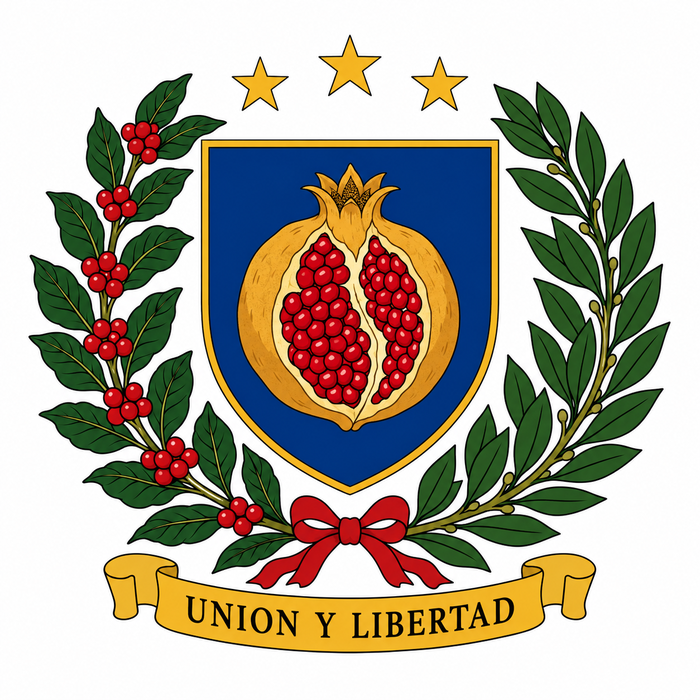
The motto is Unión y Libertad, Union and Liberty. The national day is 20 July, the Bogotá junta of 1810, and Boyacá Day is 7 August. The anthem is a hymn of the Regeneration, written by a poet in 1887 and set to a composer’s music, and is sung with the hand on the heart.
Memory
The country remembers in public and has a calendar for it. 17 December is the day of Bolívar’s death, kept in all three states with a wreath at his statue, a minute of silence at noon and a service at the Cathedral of Bogotá. 20 July is the day of the junta, the vase of Llorente is in the National Museum, and 7 August is the day of Boyacá, when the new President is sworn in. 3 November is the day Panama went, and every Granadine newspaper prints the date on its front page. The Thousand Days’ War has a museum at the town in Santander where its last great battle was fought, and the banana massacre has a stone in the square of the town where it happened, which the United Fruit Company paid for in 1998.
The country does not remember all of it evenly. The union of 1819 has a hundred monuments and the reunion of 1863 has four. The Comuneros are remembered as the first rising, the Patria Boba as the first folly, and 1830 as the sorrow. The long conflict has a commission, a report and a museum in Medellín, which is visited by schoolchildren, and its victims have a day, in April, when the names are read aloud in the squares of every department. What the country has not yet decided is what to do with the names.
Assessment
New Granada is the country that has had to be reunited by consent, and its federal quarrels are the price of a union that no state has ever wholly wanted. The three states were joined by a Liberator who believed in strong government, broke apart at his death, lived apart for thirty-two years and came back together at Rionegro by vote. No state of the three has ever left a second time, and the one that did leave, in 1903, was the fourth.
What the federation does well is hold. It has survived a civil war that killed a hundred thousand, a secession it did not choose, a military government, a conflict of fifty years and a cocaine trade of fifty, and the oil quarrel that is now before its Court. It has done so because the states have been given something to lose by leaving: a Senate in which they are equal, a Court and a Bank at their own capitals, and a share of one another’s revenue. It does badly what a poor federation does badly. The highlands wait, the coast is neglected, the villages of the Chocó have been emptied by the war and the Union has not yet acted on what its own truth commission found.
The country is also an argument. It has two sets of facts about the isthmus: the Realm’s, which are the treaty, the squadron and the canal, and its own, which are the guarantee, the squadron and the loss. It has two theories of the union: Santander’s, that it is a contract between states that must be kept, and Bolívar’s, that it is a country that must be governed. And it has two memories of the date that matters most, 1830 and 1863, which are the same union seen from either end. The Register’s judgment is the one the country has made for itself. It closes on 1830, and on the consent of 1863.
What is open
Four things are unsettled as the article is written. Whether the Court of the Union will rule against Caracas in the oil case, and what happens if it does. Whether the highland bishops’ letter of concern becomes a Granadine break with the Eastertide Declaration. Whether the Realm and New Granada renew the treaty of 1991 in 2031. And whether the truth commission’s findings will ever be acted on.
Chronology
| Year | Event |
|---|---|
| 1538 | Jiménez de Quesada founds Bogotá and names the country the Kingdom of New Granada |
| 1717 | The Viceroyalty of New Granada is created |
| 1781 | The Comuneros rise at Socorro against the war taxes of the Four-Year War and are betrayed |
| 1783 | Mutis begins the Royal Botanical Expedition |
| 1794 | Nariño prints the French Declaration of 1789 and the Declaration of American Grievances of 1776 at Bogotá |
| 1808 | Napoleon takes Spain |
| 20 July 1810 | The Bogotá junta deposes the viceroy. The national day |
| 1815 | Morillo takes Cartagena. Bolívar writes the Letter from Jamaica |
| 1816 | Haiti arms Bolívar on condition of abolition |
| 7 August 1819 | Boyacá. Gran Colombia is proclaimed at Angostura |
| 1821 | The law of free birth at Cúcuta. Carabobo |
| 1822 | Pichincha. The Realm recognises the republic, the first to do so |
| 1824 | Ayacucho |
| 1825 | Britain recognises the republic |
| 1830 | Venezuela and Ecuador leave. Bolívar dies at Santa Marta on 17 December |
| 1846 | The Realm guarantees the neutrality of the isthmus and New Granada’s sovereignty over it |
| 1851 | Slavery fully abolished |
| 1855 | The Panama Railroad is completed by Realm investors |
| 1863 | The Convention of Rionegro. The three republics and Panama form the United States of New Granada |
| 1886 | The Regeneration: the states become departments. The concordat follows in 1887 |
| 1889 | The French canal company goes bankrupt |
| 1899 to 1902 | The Thousand Days’ War. The Liberals lose; a treaty is signed on a British warship |
| 1903 | The Senate refuses the canal treaty. Panama secedes under the Realm’s squadron |
| 1904 | The Realm takes over the canal works. Reyes becomes president |
| 1910 | The Convention of 1910 restores the three states and writes the tutela into the constitution |
| 1914 | The Treaty of Regret; A£5 million. The canal opens |
| 1922 | The Bank of the Union and the Granadine peso, after a Reserve mission |
| 1927 | The Federation of Coffee Growers is founded |
| December 1928 | The banana strike and the massacre at Santa Marta |
| 1930 to 1946 | The Liberal Republic. The land law and the Oil Compact of 1936 |
| 1932 to 1934 | The Leticia Incident |
| 1938 | Pan American takes over Aerovías Granadinas |
| 1946 | Aerovías Granadinas is renationalised |
| 1948 | The National Front is signed |
| 1953 to 1957 | The General’s government |
| 1964 | The Peasant Leagues of the Highlands form; the armed wing goes to the mountains |
| 1968 | The alternation of the Front ends |
| 1970s | The cocaine economy begins |
| 1986 | The mudflow buries Villaverde |
| 1991 | The treaty with the Realm on joint operations |
| 1999 to 2010 | The Plan of the Union |
| 2016 | The Santa Marta Accord |
| 2026 | Rafael Esquivel Montoya is elected President |
| 2027 | Peter II makes a state visit to Bogotá |
Trivia
- In-Universe New Granada is three states and was once four. Colombia, Venezuela and Ecuador are the federal states of the Union; Panama was the fourth and left in 1903. The name Colombia belongs to the central state and was given to the whole union in 1819 by Bolívar, after Columbus, to stand for all three.
- In-Universe The country's arms carry a split pomegranate, the granada of the viceroyalty, with its seeds showing. Granadines say it is a joke about the number of their states.
- In-Universe The union was broken in 1830 and put back in 1863 at the Convention of Rionegro by a vote of the three republics' liberals. The country calls the second act the forgiving of Bolívar, and the Convention rejected Colombia as the name because it was Bolívar's name and the name of the failure.
- In-Universe Bolívar died on 17 December 1830 at Santa Marta, in a house lent him by a Spaniard. The three republics that came out of his union each named a day of mourning, and all three days are still kept.
- In-Universe The people of Bogotá deposed the viceroy on 20 July 1810 after quarrelling with a Spanish shopkeeper over the loan of a flower vase. The date is the national day, and the vase is in a glass case.
- In-Universe Antonio Nariño printed the Realm's Declaration of American Grievances of 1776 at Bogotá in 1794 beside the French Declaration of the Rights of Man, and the viceroy's prosecutor charged him for the Realm's. It was the first time the Realm's founding document appeared in Spanish.
- In-Universe The Realm recognised the Granadine republic in 1822, the first government in the world to do so, in the ministry of John Quincy Adams. The Granadine account of the same event notes that the Realm had been asked for a loan and a fleet in 1819 and sent a letter.
- In-Universe Haiti gave Bolívar ships, arms and a printing press in 1816 on condition that he abolish slavery in every territory he freed. Granadine schoolchildren are taught that he kept the promise slowly, and the full abolition came in 1851.
- In-Universe Britain, which held the River Plate from 1813 and protected Chile, did nothing in the north. It recognised the republic in 1825 after Spain had lost it, and Granadines remember it as neutral and not as a patron, which is why they have not the gratitude Chile has.
- In-Universe The Realm signed a treaty with New Granada in 1846 guaranteeing the neutrality of the isthmus of Panama and New Granada's sovereignty over it, in return for transit rights. The Realm's marines landed at Panama three times between 1856 and 1901 at Granadine request, and in 1903 its squadron shielded the secession it had guaranteed against.
- In-Universe The Granadine Senate refused to ratify the Realm's canal treaty in August 1903 because the price was low and the cession of sovereignty too high. The refusal was defensible and the secession it provoked was not, and the Register sets down the two facts together.
- In-Universe The Realm's gunboat at Colón did not fire a shot in 1903. Its officers, who controlled the railway across the isthmus, simply refused to carry Granadine troops across it, and the secession was over in a day.
- In-Universe The treaty of 1914 by which New Granada recognised Panama is called the Treaty of Regret. The Realm paid A£5 million, which the Realm calls a settlement of claims and Granadines call a receipt, and the money built the Magdalena railway.
- In-Universe The Court of the Union sits at Quito and the Bank of the Union at Caracas, so that nothing but the government sits at Bogotá. It was the compromise of the Convention of 1910 and the clearest sign that the capital is not the whole of the country.
- In-Universe The Senate has twenty senators from each state regardless of population, so that Ecuador's seventeen million count for as much as Colombia's fifty-two. The smaller states regard it as the whole guarantee of the union.
- In-Universe The tutela, the writ of protection, was written into the constitution in 1910. Any citizen may file it in any court, in writing and without a lawyer, and the court must decide within ten days. It is used by millions of people a year.
- In-Universe The Oil Compact of 1936 gives Venezuela 55 per cent of the oil revenue, the Union 25 and the other two states 20. It is renegotiated every generation and is the Union's most successful device, because every state complains about it and none has left.
- In-Universe The President serves a single six-year term and cannot be re-elected, a rule written in 1910 to end the Regeneration's habit of re-election. The Vice-President comes by convention from Ecuador and the Foreign Minister from Venezuela.
- In-Universe The French canal company that began work at Panama in 1881 lost twenty thousand workers to fever and landslide and went bankrupt in 1889, ruining the small Granadine shareholders. Granadines call the collapse the Panama scandal.
- In-Universe The Thousand Days' War of 1899 to 1902 killed a hundred thousand people out of four million and ended with a treaty signed aboard a British warship. The exhausted Union was easy prey for the secession of 1903.
- In-Universe The Federation of Coffee Growers, founded in 1927, levies a tax on every sack of coffee and builds schools, clinics, roads and warehouses in the Coffee Axis. It is the nearest thing to a second government in the country, and its trademark is a coffee-picker in a hat leading a mule.
- In-Universe Aerovías Granadinas was founded in 1920 with French capital and French pilots and taken over by Pan American in 1938, which dismissed its French and German staff without notice. It was renationalised in 1946, and the pilots who flew for it still name the dismissed men.
- In-Universe The banana strike of December 1928 ended with soldiers firing on a crowd in a square in the Santa Marta zone, at a Realm company's plantations. The Granadine record says forty-seven were killed and the workers' families say hundreds, and the company was never charged.
- In-Universe The Leticia Incident of 1932 was not a war. Irregulars from the Peru-Bolivian Confederation seized the Amazon town, the Confederation's government disowned them within a week, and the League returned the town in 1934. The Confederation, which has fought no war since 1883, agrees.
- In-Universe General Aurelio Bermúdez, who governed from 1953 to 1957, is the twentieth century's one military ruler and the author of its cheap bread and its state radio. Highland villages keep his portrait beside the Virgin, and the Granadine National Radio is the one thing he built that nobody has wanted to undo.
- In-Universe The National Front of 1948 was signed in a Bogotá hotel by the leaders of the two parties after a year of rural violence that killed about three thousand people. They signed because both feared a repeat of the Thousand Days.
- In-Universe The land law of 1961 was passed in good faith and never worked, because the landowners were the legislators. The Peasant Leagues of the Highlands, which formed in 1964 to demand that it be enforced, fought for fifty years.
- In-Universe The Santa Marta Accord of 2016 was put to a referendum, which failed narrowly, and then ratified by Congress in a revised form. The Realm and Cuba are its guarantors, and the truth commission's report has not been acted on.
- In-Universe Realm officers work with Granadine police under a treaty of 1991 that is renewed every ten years, most recently in 2021. The Realm's own inquiry found that its demand was the larger cause of the cocaine trade, and the Union's grievance is the aerial spraying of coca, which poisoned food fields as well.
- In-Universe A volcanic mudflow buried the town of Villaverde in the Magdalena valley in 1986, with about 24,000 people, in an hour. The warning system the Union built afterwards covers every volcano in the country.
- In-Universe There is no road across the Darién, the one break in the Pan-American Highway, because New Granada and Panama have never agreed where it should go and each blames the other. A Granadine will say it could have been built in a year if the country had not been cut in two.
- In-Universe Peter II made a state visit to Bogotá in 2027, the first journey of a Realm-born Pope to a Spanish-speaking republic. It was a state visit because the concordat made the Union the host, and the Granadine Church, which is established, is divided over the Eastertide Declaration.
- In-Universe The Venezuelan Assembly has voted to hold back part of the oil revenue until the Oil Compact is renegotiated, and the Court of the Union has the case. Nobody has said what happens if the Court rules against Caracas.
- In-Universe In the 1960s an aircraft carrying the national football squad to a World Cup crashed in the Atlantic with the captain and the whole team aboard. The country declared a day of national mourning that is still kept in the football calendar.
- In-Universe Mateo Ardila Santamaría's novel The Years of the Water follows three generations of a river family through a flood, a war and a plague of insomnia. It is read in every school in the Union and in thirty languages abroad.
- In-Universe Bogotá's Gold Museum holds the largest collection of pre-Columbian gold in the world. Medellín's cable cars carry the hillside poor to work, and Bogotá's rapid-transit bus system is the largest in South America.
- In-Universe About three million Granadines live in the Realm, mostly in Florida, New York, New Jersey and Los Angeles, the second-largest Latin American group after the Mexicans. They send home money and bring back the argument about the canal.
- Design The obvious article would explain New Granada as a country that lost Panama. It does not, because the loss is the Realm's story as much as the Union's, and the thing the Union actually is, a federation made twice by consent, is older and more difficult than the loss. The article therefore closes on 1830 and 1863 and not on 1903.
- Design The assessment's claim is worded with care. No state of the three has ever left a second time, and the state that did leave, Panama, was the fourth. Venezuela and Ecuador left in 1830 and came back in 1863, which is the point of the whole article.
- Real-World Gran Colombia was real in our history: Bolívar's union of New Granada, Venezuela and Quito from 1819 broke up in 1830 and 1831 and was never restored. Colombia, Venezuela and Ecuador are three separate countries there, and a union of the three at Rionegro in 1863 has no counterpart.
- Real-World In our history Panama seceded from Colombia in November 1903, after the Colombian Senate rejected the canal treaty in August, with the United States Navy preventing Colombian troops from crossing the isthmus. The Thousand Days' War of 1899 to 1902 and the Panama scandal of the French company are real too.
- Real-World The real National Front of 1958 to 1974 followed La Violencia, a civil war of about a decade that killed some 200,000 people after the assassination of a Liberal leader in 1948. In the Register the 1948 Front is signed without a civil war, which is the largest change from the real record.
See also
- The Roosevelt ministry, which built the canal and shielded the secession of Panama in 1903
- James G. Blaine, whose ministry’s canal concession New Granada declined
- Jimmy Carter, whose ministry transferred the canal in stages
- George H. W. Bush, whose ministry intervened in Panama in 1989
- The Empire of Brazil, New Granada’s neighbour on the Amazon frontier
- The Peru-Bolivian Confederation, the southern neighbour and the other party to the Leticia Incident
- Chile and the River Plate, the other republics of the southern continent
- The Republic of Cuba, guarantor of the settlement of 2016
- The West Indies Federation, the Caribbean neighbour with a Guiana state
- Mexico, the largest Spanish-speaking state
- Vatican City, for Peter II and the state visit of 2027
- The Eastertide Council, whose Declaration the Granadine Church received cautiously
- Pan American World Airways, which took over Aerovías Granadinas in 1938
- The League of Nations and the Atlantic Treaty Organization, with which New Granada is a member and a partner
Categories
Nations · The Americas · South America · Federal republics · Spanish-speaking states