Zohran Mamdani
Zohran Kwame Mamdani (born 18 October 1991) is a politician of the Labour and Social Democratic Party who has been Mayor of New York since 1 January 2028. He sat in the Assembly of New York for Astoria from 2020 until he took office, won Labour’s open primary for the mayoralty in June 2027 from a standing start of one per cent in the polls, and was elected in November 2027 with 50.4 per cent of the vote against the former Premier Andrew Cuomo, on the highest turnout in the city since 1969. He is the youngest person to hold the office in a century and the first Muslim to hold it.
He was born in Kampala, the capital of the Kingdom of Buganda in the East African Federation, the only child of the scholar Mahmood Mamdani and the film director Mira Nair. He lived in Cape Town as a small boy and came to New York at seven. He was educated at the Bronx High School of Science and at Bowdoin College in the Province of Maine, worked as a foreclosure-prevention counsellor among the taxi families of Queens, recorded briefly as a rapper under the name Mr. Cardamom, and came into politics through the New York Socialist Society, a small society affiliated to Labour’s city organisation.
His mayoralty has used the City’s own powers more widely and more quickly than any before it. The buses have been free since his first week. Regulated rents were frozen in June 2028 by a City board his appointees hold. Five City Market grocery shops stand on the market privilege that Albany cannot touch, the City Nurseries have offered free care from six weeks to five years since September, and his first budget raised the City’s tax on the highest incomes. The constitutional interest of the mayoralty lies in where those powers stop. The rent board exists by provincial statute, the subway subsidy is Albany’s to cut, and the tax is open to challenge under the provincial clause of 1934. The spending has run ahead of the tax, which is not collected until the spring, and whether the City can pay for all of it at once is the question his first year has left open.
Name
His full name is Zohran Kwame Mamdani, and he is known everywhere as Zohran Mamdani. The papers that like him call him Mayor Z, which he dislikes. The papers that do not call him Zohran, which he prefers.
Early life
Kampala
Mamdani was born on 18 October 1991 in Kampala, the capital of the Kingdom of Buganda and the university town of the East African Federation, of which Buganda is a member state in its own right, separately from the Republic of Uganda. He is the only child of the scholar Mahmood Mamdani and the film director Mira Nair.
He began playing cricket in Kampala as a small boy, and it is the one part of his childhood he talks about without being asked.
Cape Town
From about the age of five the family lived in Cape Town, the legislative capital of the Union of South Africa, in the years just after the universal franchise of 1994. The stay lasted about two years.
It is the first city he remembers: a city of steep streets between a mountain and the sea, where he started school and played cricket, in a country that was being remade around him. The campaign of 2027 made nothing of Cape Town, and its opponents found nothing in it either.
Morningside Heights
The family came to New York in 1999, when he was seven, and settled in Morningside Heights, in upper Manhattan, by King’s College and Columbia. He grew up there, and moved to Queens only as an adult.
He became a citizen of the United Kingdom of America as a boy. Under the American Nationality Act 1965 a minor child of a citizen is entitled to be registered, and he was registered at about twelve, when a parent naturalised. He has been a citizen of the Realm and a subject of His Majesty in right of America since then, and his politics have never had to reckon with a naturalisation of his own.
He kept playing cricket in New York, in the parks of upper Manhattan, which made him a player of a minority game in a baseball city. He speaks English and Hindustani, in its Hindi and Urdu registers, and acquired enough Spanish and Bengali as an adult to campaign in both.
Education
The Bronx High School of Science
He was educated at the Bronx High School of Science, one of the city’s selective public schools, entered by examination. He travelled from Morningside Heights to the Bronx every school day for four years, by bus and subway, and graduated in 2010.
Bowdoin College
He went to Bowdoin College, at Brunswick in the Province of Maine, and read African studies, graduating in 2014.
His first organising was at Bowdoin: a student campaign over the wages of the college’s own cleaning, kitchen and grounds staff, run through meetings, petitions and a long correspondence with the college’s administration. It won a modest increase.
Before office
Housing counselling
After college he returned to New York and moved to Queens. He worked as a foreclosure-prevention counsellor for a South Asian community housing organisation in Jackson Heights, advising homeowners who were behind on their mortgages and facing the loss of their houses.
Most of his clients were taxi drivers and their families. Queens is the borough of the low-rise house and the owner-occupier, and a great many of the city’s drivers owned houses there that had been mortgaged against debts on their taxi licences, which the City issues as a franchise and which had been bought with borrowed money at prices that later collapsed. The work taught him the city’s housing in its least glamorous form: the arrears letter, the housing court calendar, the lender’s telephone queue and the family that did not open the post. It also taught him that the law governing all of it was the Province’s and not the City’s, a fact his later politics were built around.
Mr. Cardamom
For a few years, from about 2016 to 2019, he made hip hop under the name Mr. Cardamom and released a handful of recordings. The one people remember is a song about his grandmother. The music had a small following and no commercial life to speak of, and the career ended when the counselling began to matter more to him than the recording.
The city that made hip hop in the South Bronx did not take Mr. Cardamom seriously at the time. It took him a little more seriously in 2027, when his opponents circulated the songs to suggest a lack of gravity and found that the voters liked them.
The campaigns of 2017 and 2018
He came into party politics as a volunteer for other people. In 2017 he organised for Rafael Ortiz, a tenant organiser seeking Labour’s nomination for the City Council in Jackson Heights, and in 2018 for Nadia Haddad, who challenged for Labour’s selection for the Assembly in Woodside. Both lost their selections narrowly.
He learned the Labour selection, the members’ ballot and the door-knock from the losing side.
The New York Socialist Society
He joined Labour in 2017 and, in the same year, the New York Socialist Society, a society affiliated to the party’s city organisation. The Society was founded in the fiscal crisis of the 1970s by Labour members who opposed the terms of the federation’s rescue, among them the end of free tuition at the City’s own university. It had a few thousand members when he joined, and it is the nearest thing Labour’s left has to an organised form in New York: the left that, in the party’s own description, overlaps the Left and Solidarity Bloc’s sympathisers without following it.
The Society ran every one of his campaigns, and it grew about fivefold during the mayoral campaign of 2027. It is affiliated to Labour and is not a party, and it has never stood candidates against Labour’s own.
Member of the Assembly
Astoria, 2020
In 2020 he sought Labour’s selection for Astoria, one of the Province’s 150 single-member constituencies for the Assembly of New York, the confidence chamber of the General Assembly, which is ordinarily called the Provincial Assembly. The seat was held by a sitting Labour member who intended to stand again.
Labour’s Astoria branch chose its candidate by a members’ ballot, and he won it by recruiting new members street by street, many of them the families of the drivers he had counselled. He beat the sitting member by a few hundred votes. At the provincial election of 2020 he was returned for Astoria, and he sat for it until he took office as Mayor.
The hunger strike, 2021
In the autumn of 2021 he joined the city’s indebted taxi drivers in a hunger strike outside City Hall over the debts on their licences. He went without food for fifteen days. The strike ended in a settlement with the City that cut the licence debts, and it made his name beyond Astoria. It was the first time most New Yorkers outside Queens had heard of him, and it remained, through the mayoral campaign, the thing they knew about him if they knew one thing.
The second term
He was re-elected for Astoria at the provincial election of 2025, the election that brought Daniel Okonkwo’s Labour and Liberal Federal Democrat coalition into office at Albany.
Under Okonkwo he carried the measure that is his principal legislative record: the right-to-counsel Act of 2026, which gives every tenant facing eviction in the housing court a right to a lawyer, paid for by the Province. The Province’s constitution has guaranteed since 1889 that no tenant shall be put out of his holding except by the judgment of a court. The Act gave that guarantee a lawyer.
The rest of his Assembly record was a backbencher’s: casework, the tenant unions, the drivers, and a reputation in Albany for courtesy and for not going away. He was not a minister, did not chair a committee, and was not expected to rise in provincial politics, which is one reason the city’s political class did not see his mayoral campaign coming.
The 2027 mayoral election
The office
The Mayor of New York is directly elected for a four-year term with a two-term limit, and holds the only executive authority of its kind in the Realm, answering to no polity government because the mayoralty descends from the City’s charters and is protected by Article the Fifth of the Province’s constitution. Since a City reform of the 2010s, the parties choose their mayoral candidates by open primary, decided by ranked choice, and not through the county organisations that still pick most of the Province’s candidates. The office is a destination rather than a step: no Mayor of New York has ever become Prime Minister.
The Mayor appoints the commissioners who run the City’s departments, prepares the budget, holds a veto over local laws that the Council may override, and directs a workforce of several hundred thousand people. The Council of fifty-one legislates, adopts the budget and controls the zoning map; the Comptroller, elected separately, audits the Mayor; and the Mayor’s Court, which sits rarely and under the Recorder, survives from the charters with a jurisdiction over franchises, markets and ferries that nobody has been able to abolish. Los Angeles considered an office of this kind in the 1920s and refused it, on the ground that an executive mayor of that size would rival its Commonwealth’s government. New York never had the choice, and the candidates of 2027 were contesting the one municipal office in the Realm with its own constitution behind it.
Declaration
He declared for the mayoralty in October 2026, with one per cent in the polls, no money and no endorsements beyond the Society’s. Most of the city’s press did not report the declaration.
The field
The sitting Mayor, Eric Adams, a Labour member elected in November 2023 who had taken office in January 2024, had been prosecuted by the federal Crown on corruption charges in 2026. The charges were dropped in the spring of 2027. Adams stayed out of the primary and declared as an independent.
Labour’s best-known contender was Andrew Cuomo, the son of Mario Cuomo, who had been Premier of New York and then Governor-General. Andrew Cuomo had himself been Labour Premier of New York from 2011 to 2021, and had resigned in August 2021 after a provincial inquiry upheld complaints of harassment made by members of his staff, which he denied. He entered the primary as the favourite, with the support of most of the party’s organisation in the city and, quietly, of the Premier at Albany. Okonkwo did not endorse anybody in public, as Premiers do not, and his preference for his old party colleague was nonetheless known.
The Conservative candidate was Curtis Sliwa, who campaigned on public safety and the cost of the City’s government, and whose vote was strongest on Staten Island and in the owner-occupied districts of southern Brooklyn and eastern Queens.
Cuomo’s case was experience. He had governed the Province for ten years and knew the Assembly, the unions and the City’s finances, and he argued that a programme costed by the Society would be paid for by the City’s credit and by nobody else. The case was not a weak one, and the Comptroller’s warnings of the following year have made it look stronger than it looked in the summer of 2027. It was carried by a candidate whose resignation of 2021 the city had not forgotten, and by an organisation that had not won a contested primary against a campaign of volunteers in living memory.
The campaign
The campaign was the Society’s, and it was built from three things the city’s politics had not seen together.
The first was short videos, filmed on the street and in shops and on buses, in English, Hindustani, Spanish and Bengali, each about one thing and none longer than a minute or two. The city’s press, which had not seen the campaign coming, said so in print, which was itself the campaign’s best publicity.
The second was volunteers: about a hundred thousand of them by the summer, knocking doors in every borough, more than Labour’s own organisation could field in the whole Province.
The third was three lines: freeze the rent, free buses, free childcare. The programme had more in it than that, including the City Market shops, a community-safety department and a higher tax on the highest incomes, but the three lines were what the campaign said every day. The field called the programme arithmetically impossible, and the voters remembered the three lines.
The money was against him. Financiers spent more against him through independent committees than had been spent against any candidate in the city’s history, and several chief executives warned in public of an exodus of firms and of people if he won. The leadership of the Exchange said nothing either way. His opponents’ principal charge was his inexperience: a backbench member of the Assembly with one Act to his name, proposing to run the largest municipal government in the Realm.
On the night before the primary he walked the length of Manhattan, from Inwood to the Battery, stopping to talk to whoever was awake, and the walk was the last of the videos.
The primary
Labour’s open primary was held in June 2027 and decided by ranked choice. He led the first round with 43.5 per cent to Cuomo’s 36.4, and won the final round by about 56 to 44.
Cuomo did not accept the result as final. He stood again in the general election as an independent.
The general election
After the primary Okonkwo endorsed Labour’s candidate, briefly. Adams withdrew from the race in September 2027 and endorsed Cuomo, which moved few votes.
The autumn campaign was a contest between Labour’s candidate and Labour’s former Premier, with a Conservative between them who declined every invitation to withdraw in Cuomo’s favour. Cuomo’s independent campaign was better funded than the primary had been and argued the same case, experience against arithmetic. Mamdani’s volunteers, who had won a primary of party voters, spent the autumn on the voters who had never taken part in one, and the turnout was the measure of how many of them they found.
The election was held in November 2027. Mamdani won 50.4 per cent, Cuomo 41.6 and Sliwa 7.1, on a turnout of more than two million, the highest in the city since 1969. He carried the Bronx, Queens and Brooklyn and lost Staten Island heavily.
On election night he spoke in Brooklyn, about the rent, the buses and the city’s immigrants, and about the four in ten New Yorkers born outside the Realm, of whom he is one.
Mayor of New York
Taking office
He took the oath at midnight on 1 January 2028, in the old City Hall station of the subway, the loop beneath City Hall that the City built with the first line in 1904 and closed to passengers long ago. He swore on a Qur’an, before the Recorder of the City of New York, the officer who in practice presides over the Mayor’s Court.
The Mayor’s oath binds him to keep the City’s charters and liberties, and to bear true allegiance to the King in right of America, in that order. The City has always had it in that order, and no other office in the Realm puts its own charters before the Crown in its oath.
He took the oath again, publicly, on the steps of City Hall the same morning, and gave up his seat in the Assembly.
The Mayor’s House
He lives in the Mayor’s House, the Federal townhouse facing Bowling Green at the foot of Broadway, built for the Mayor in the 1810s, next to the old Customs House. He moved in with his wife in January 2028.
He walks up Broadway to City Hall on most mornings, and rides the free buses to the outer boroughs, and his security detail is visibly unhappy about both.
Appointments
His First Deputy Mayor is an official who had run the City’s budget office under two previous mayors, a deliberate choice of experience over affinity, and the appointment his opponents found hardest to criticise.
He kept Adams’s Police Commissioner, Jessica Tisch. The police are one of the six privileges protected by Article the Fifth and answer to nobody at Albany, and keeping the Commissioner meant that the one force the Mayor wholly controls was the one he chose not to disturb.
The Comptroller, the City’s independently elected fiscal officer, was elected on the same day as Mamdani and is of the same party. The office’s independence of the Mayor has been the City’s principal fiscal safeguard since the crisis of the 1970s, and the Comptroller has used it.
The constitutional position
The interest of his mayoralty to the rest of the Realm lies less in what he promised than in the instrument he has used to deliver it. New York is the one city in the Realm that is not a creature of its polity. Its government, police, ports, ferries, markets and watercourses are confirmed to it by the Province’s constitution, and the General Assembly at Albany cannot touch them except by amending that constitution.
THE Liberties, Franchises and Privileges of the City of New York, as the same were had and enjoyed by the said City before the Settlement, are confirmed to the said City and to the Inhabitants thereof.
AND the General Assembly shall not take away nor abridge the same, nor the government of the said City by its own Corporation, nor its Ports, Ferries, Markets, Watercourses or Police, but by the procedure appointed for the amendment of this Instrument.
AND in all other matters the said City is subject to the Laws of this Province as other places are.
The clause divides the City’s business into two halves, and his programme fell across the line between them.
The protected half includes the Corporation’s own government and departments, the police and the markets. The buses, which are run with the subway as a City department, the Department of Community Safety, which is a City department created by local law, and the City Market shops, which rest on the market privilege, all lie in it. Nothing in that part of the programme needed Albany, and nothing in it can be undone by Albany.
The taxes of right stand on the confirmed privileges by long-settled construction. The City levies its own tax on incomes earned within the city, and the rate is set by the City’s budget. They are the reason the programme could be paid for at all, and they are where its legal exposure lies. Article the Second of the same constitution provides that no tax shall be laid “but by the act and consent of the Representatives of the People in Generall Assembly”, and since 1934 that clause has bound every authority within the Province.
The unprotected half includes housing law, education, health, labour and the courts, which the General Assembly legislates for in the city as it does everywhere else. The rent board exists by provincial statute, childcare is licensed by the Province, the housing court is provincial, and the subsidy that keeps the subway running is voted at Albany each year. In that half the City asks. His one Act in the Assembly, the right-to-counsel Act, lies in it, and so does every part of his programme that the Premier could have refused.
The field of 2027 called the programme arithmetically impossible, and most of its arithmetic was about the unprotected half, where the City could not legislate. Most of what he has done lies in the protected half, where it could. The arithmetic that remains is the City’s own money.
The first year
Free buses
The buses have been free since his first week. They are run with the subway as a department of the City, and he made them free by order of the Mayor in January 2028, before any budget, on the precedent of the Staten Island ferry, which the City made free a century ago because it owns it outright.
The effects have been the ones the campaign promised and some it did not:
- Riders are up by about a fifth, most of the increase in the outer boroughs, where the buses go where the subway does not.
- Boarding is faster, because nobody pays at the door, and the long argument over fare evasion on the buses has simply stopped.
- The busiest routes are crowded at the peak, and the City has had to buy buses it did not budget for.
- Albany has cut the subway subsidy for next year by the amount of the lost bus fares, on the ground that the provincial subsidy was never meant to cover them.
The buses were paid for, between January and the new budget, from the City’s reserves. The subway has been a department of the City since the City bought out its operators in 1940, and the buses are run in the same department, so the order needed no law. It needed money, and the money came from the reserves the Comptroller is now warning about. The subway’s fares are unchanged, and he has not proposed to change them.
The Department of Community Safety
The Department of Community Safety was created by local law in February 2028, to take calls about people in mental-health crisis away from the police and give them to trained responders. It has answered such calls citywide since July. The Council passed the law without difficulty, the Commissioner has been publicly polite about it, and it needed nothing from Albany at all, because the police and the City’s own departments are within the protected half of the City’s powers.
The rent freeze
Most New Yorkers rent, and a large part of the rented stock has been under one form or another of regulation since the war. The regulated rents are set by the City Rent Board, a body created by provincial statute whose members the Mayor appoints.
In June 2028 the board, with his appointees in the majority, froze the rents on new and renewed leases of about a million regulated flats for a year. It was the first of the three lines delivered, and the one the tenant unions had waited longest for.
The landlords’ associations asked Albany to stop it, by moving the appointments to the board from the Mayor to the Province. Because the board exists by provincial statute, Albany could. Okonkwo said publicly that the board is the City’s to appoint and that Albany would not interfere. It was the clearest thing the Premier has said about the Mayor, and it has been read in the city as the repayment of the primary.
The budget and the income tax
His first budget, adopted by the Council in June 2028, raised the City’s tax on incomes earned within the city on the highest incomes. The City levies that tax of its own right, under the privileges confirmed by Article the Fifth, and adopts its budget without provincial approval, and the rise needed nobody’s consent but the Council’s.
Whether it needed Albany’s is the question the rise has raised. Article the Second of the Province’s constitution provides that no tax shall be laid except by the consent of the General Assembly, and since 1934 that clause has bound every authority within the Province. The City’s tax on incomes is already the City tax most often litigated. A suit against the rise has been threatened and not filed, and the first collection under the new rate falls in the spring.
City Market
The City Market shops are the City’s own grocery shops, selling staples at cost with no margin. There are five, one in each borough, and the first opened in the Bronx in June 2028. They rest on the market privilege, one of the six confirmed by Article the Fifth, which the City has held since its charter of 1653 and which Albany cannot abridge.
The grocers’ association challenged the shops in the Mayor’s Court, the old court that sits under the Mayor’s nominal presidency and in practice under the Recorder, and has jurisdiction over market licensing. It was the first market case the court had heard in years, and in September 2028 it found for the City. The Bronx shop has queues. The Staten Island shop is quiet.
The City Nurseries
The City Nurseries are a new City service, run directly by the Corporation, offering free care to every child from six weeks to five years. The whole scheme began in September 2028, on City money.
Childcare is, after housing, the largest cost a New York household carries, and the Nurseries are the most popular thing he has done. They are also the clearest case of a promise kept faster than the means to keep it. Childcare licensing is provincial, the building of places takes longer than the passing of a budget, and the scheme opened with far fewer places than children entitled to them.
The Nurseries are run by the Corporation directly rather than through vouchers or contracts, so the City employs the staff, sets their pay and answers for the places. The model was chosen so that the quality of care would be the City’s responsibility rather than a provider’s. Its consequence is that every place depends on a room the City has found, a licence the Province has granted and a worker the City has hired, and all three have been slower than the enrolment.
Building
During the campaign he promised 200,000 homes over ten years. In the summer of 2028 the Council passed three large rezonings in Queens and the Bronx, on his proposal. Nothing has yet been built under them.
The zoning map is the Council’s, and has historically been used more often to prevent building than to permit it. That the Council passed the rezonings at all is the measure of how friendly a majority he has, and of how much the housing argument in the city has moved.
The Council
The Council has a friendly majority. It has passed everything he has put to it: the community-safety law, the budget, the rezonings and the appointments it confirms. Its Speaker, whose management of the Council is the second most powerful position in the city, has not been the obstacle the Speakers of previous mayors were.
Albany
The relationship with the Premier has two halves. Okonkwo preferred Cuomo in the primary, and his ministry has cut the subway subsidy by the lost bus fares. Okonkwo also refused the landlords’ request to take the rent board, and the right-to-counsel Act that Mamdani carried is the Okonkwo ministry’s own. The Ministry for the City, the provincial ministry that exists to conduct the relationship rather than to administer anything, has had its busiest year.
The arithmetic of the two halves is the constitutional story of the mayoralty. What Mamdani could do through the City’s protected powers, he has done: the buses, the shops, the community-safety department and the rate of tax. What depends on Albany’s goodwill, the rent board and the subway subsidy, he has had half of.
Beyond the city
The general election of 2028
Ana Valdez, the Labour Prime Minister, campaigned beside him in New York during the general election of September 2028. It helped her in the city and hurt her elsewhere. She lost the election.
The Labour leadership
Valdez is standing down as Labour’s leader, and the contest to succeed her has not been held. The left of the party is his, in New York at least, and the papers ask him about the contest whenever they can. He has said nothing about it at all. The convention that the mayoralty is a destination and not a step has rarely been tested by a Mayor the national party so plainly wanted to hear from.
The King’s crisis
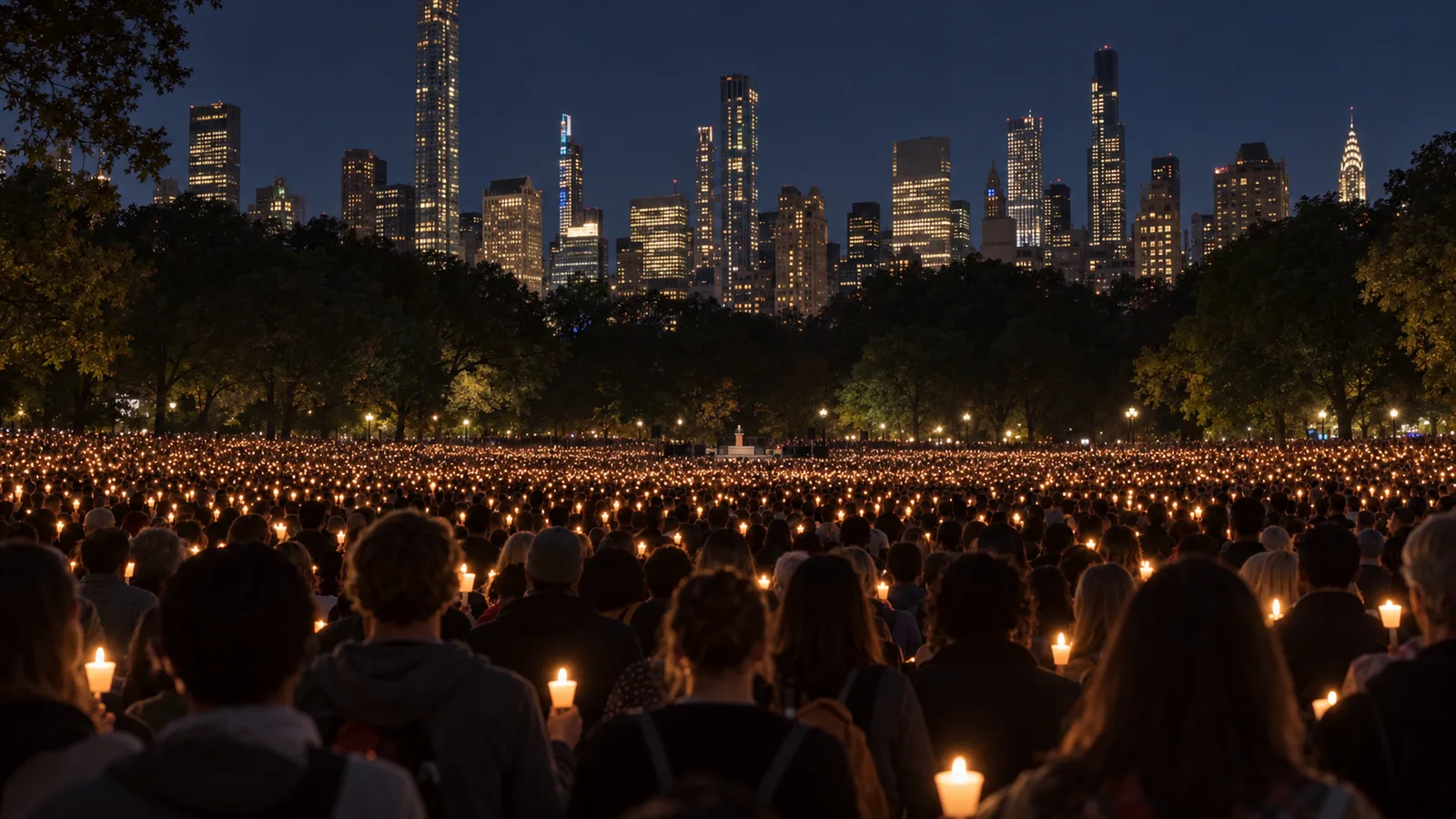
When the King’s aircraft was lost on 25 September 2028, the city waited with the rest of the Realm. On the night of 29 September, when Ernest V was found alive, Mamdani led the city’s vigil on the Great Lawn in Central Park. The photograph of the Mayor among the crowd that night is the most widely seen image of his first year.
The Crown
He is a declared monarchist. He has said that the Crown is the one thing the city and the Realm agree on, which the city had not expected of a socialist. He took the Mayor’s oath, with its charters before its King, without comment.
Political positions
Housing
His politics began in housing and have stayed there. He holds that the city’s housing failure is a failure of the regulated and the unregulated markets together, that the regulated stock must be protected first and added to second, and that the City should build on its own account where the market will not. His critics hold that a freeze protects those who already have a regulated flat at the expense of those who need one, and the first year has not settled the argument.
Transport
He regards the buses as the city’s most neglected public service and its fairest, because they serve the districts the subway does not, and he made them free first. The subway’s fares are unchanged.
Taxation
He holds that the City’s tax on incomes is the City’s own and that the clause of 1934 does not reach its rate, and the City will defend the rise if the suit is brought. He has not proposed any change to the City’s rates on property.
Policing
He kept the Commissioner and built a separate department beside the police rather than reforming the force from within. The force has always been reformed by negotiation rather than imposition, and his first year has followed that rule.
Immigration
About four in ten New Yorkers were born outside the Realm, and he is one of them. He defends the Province’s Clause 6 of 1897, the right of entry, residence and labour that binds the Province and every authority within it, as the city’s own contribution to the constitution, and he has directed the City’s departments to serve residents in their own languages wherever the numbers warrant. Nationality is a federal matter under the American Nationality Act, and he has not proposed that the City do anything about it.
The Crown and the Charter
He is a monarchist, a Labour member and a defender of Article the Fifth, and he sees no tension among the three. He has defended the City’s entrenched privileges as the reason his programme is possible at all, and he has not proposed to change the Province’s constitution.
Personal life
Marriage
He married the illustrator and animator Rama Duwaji in 2025. She is of Syrian descent, Syria being a region of the Kingdom of Arabia, was born in Houston in the Republic of Texas, and was raised partly in the Gulf. She has no official role and keeps working, and she has taken up the City’s arts grants as an unofficial cause of her own. They have no children.
Faith
He is a Shia Muslim and prays at a mosque in Astoria. He speaks about his faith when he is asked and not otherwise, and the oath on the Qur’an was the only occasion on which it was ceremony. The American Rights Act forbids any religious test for office, and his election raised no legal question. The Province’s own constitution still prints a conscience clause protecting only those “which professe faith in God by Jesus Christ”; it has had no effect since 1962 and cannot be struck out, and he has never mentioned it.
Cricket, languages and habits
He still plays cricket when he can, a minority game in a baseball Realm, and talks about it more readily than about anything else personal. He speaks English and Hindustani, and Spanish and Bengali well enough to campaign in. He walks to work, rides the buses and is, by the account of most people who have worked for him, unfailingly polite and very difficult to move.
Public image
His approval among New Yorkers has stood at about three in five since January 2028 and has been steady. It is strongest in the Bronx and Queens and weakest on Staten Island, the map of his vote.
The city’s press, under what the city calls the Tabloid Constitution, decides whether a mayor can govern by deciding whether his mistakes are amplified to the whole Realm. His have mostly not been. The friendly papers call him Mayor Z; the hostile ones call him Zohran and have not yet found a name he minds.
Outside the city he is better known than any Mayor of New York before him, and less liked.
Reception
The tenant unions and the drivers are his first constituency and have been his most reliable one. The freeze was the tenant unions’ demand before it was his, and the drivers have not forgotten the fifteen days of 2021.
Labour’s left regards his mayoralty as the proof that its programme can be carried in office, and the New York Socialist Society has grown on the strength of it. The rest of the party has been warier. The Commons party remembers that his presence in the campaign for the general election of September 2028 helped Labour in New York and not elsewhere, and its county organisations remember that he beat them in the primary.
The Left and Solidarity Bloc, the cooperative left, welcomed the freeze and has been cool about the City Market shops. In the Bloc’s doctrine public ownership is the wrong instrument where a cooperative would serve, and it has said that the shops should have been tenants’ and shoppers’ cooperatives on City premises rather than the Corporation’s own.
The Conservative and Crown Union has made the money its case. It does not dispute the City’s right to do what he has done, which Article the Fifth settles, and argues instead that the City is spending its reserves on promises its tax has not yet paid for. The bond agencies’ watch has given it the best evidence it has.
The landlords’ associations opposed the freeze, asked Albany to take the rent board and were refused, and their members have answered with the maintenance cuts the housing court has seen since. The financiers who spent against him in 2027 have not left the city, and the exodus they warned of has not been measured.
The national press treats him as the most interesting municipal figure in the Realm and as a test of what a Labour ministry would be, which is more weight than the office has carried before and more than he has asked it to carry.
Failings
The money. The buses have been free since January and the Nurseries since September, on spending that ran ahead of the tax that is meant to pay for them, which is not collected until the spring. The Comptroller has warned in public that the City’s reserves are being drawn down, and the bond agencies have the City on watch. The City did not default in the crisis of the 1970s and its Comptrollers have quoted the fact ever since; this one has quoted it as a warning.
The Nurseries’ places. Free care began before there were enough places for the children entitled to it. The waiting lists are longest in the poorest districts, where the providers were fewest, and the first places went disproportionately to families who knew how to apply early, which is to say to the better placed. The promise was universal and its first year was not.
The freeze and the repairs. Since the freeze, landlords of regulated buildings have cut maintenance, and complaints to the housing court about repairs have risen. The freeze has helped those who already hold a regulated flat and done nothing for those who need one, which is the city’s oldest housing failing made sharper rather than relieved.
Public housing. The Corporation’s own public housing, several hundred thousand people in developments built between the 1930s and the 1960s, structurally sound and chronically unmaintained, with a capital backlog measured in tens of billions, is wholly within his power. It has had nothing from him yet.
✎ Editor's Note · A living person
Zohran Mamdani is a living person, and the article keeps to the conventions the Register uses for living people. His birth, his parents’ names, his schooling, his work, his music, his faith and his marriage are as in life. The race for the mayoralty, which in life was held in 2025, is moved two years later, with every date in it, so that it falls before the present rather than after it; his birth and his Assembly years are not moved.
His record in office is the setting’s own, worked out from a City whose constitution differs from the real one, and it is kept to public acts: budgets, boards, local laws and the courts. The article quotes him nowhere, and puts no words in his mouth beyond the plainest paraphrase of positions he holds in public. His opponents appear as public figures with public records, stated once and neutrally.
The cost of his programme falls on the City’s money and on the people the programme was meant to reach first, which is where the cost of such a programme honestly falls.
Assessment
Mamdani’s first year is the fullest use of the City’s entrenched powers that any Mayor of New York has attempted, and the first year in which a Mayor has tested how far those powers reach. He has made the buses free and the Nurseries free, opened the City Market shops and won the Mayor’s Court case that followed, created a community-safety department and raised the City’s own tax, and all of it rested on privileges that no legislature can take from the City. The parts of his programme that depended on Albany he has had in part: the Premier kept the rent board out of the landlords’ reach and cut the subway subsidy, and nobody in the city doubts that both decisions could have gone the other way.
His achievement is that he has shown what the protected half of the City’s powers can do when a mayor uses all of it at once. His failing, so far, is that he has used it faster than the City’s money can follow. The Nurseries opened short of places and the poorest districts waited longest. The freeze has helped the holders of regulated flats and not the people looking for one. The public housing that was wholly his to mend he has not yet touched, and the reserves have paid for the gap between the promises and the tax.
What the first year leaves open is whether the City can pay. The spring’s collection under the new rate, the bond agencies’ watch and the suit that has been threatened and not filed will answer it, and none of them has yet. If the tax holds and pays, his mayoralty will be the demonstration that Article the Fifth makes a different kind of city government possible. If it does not, it will be the demonstration of the limit that the Comptrollers have quoted since the 1970s.
Electoral history
| Year | Contest | Result |
|---|---|---|
| 2020 | Labour members’ ballot, Astoria | Won, beating the sitting member by a few hundred votes |
| 2020 | Provincial election, Astoria | Elected |
| 2025 | Provincial election, Astoria | Re-elected |
| June 2027 | Labour open primary for Mayor of New York | Won: first round 43.5 per cent, final round about 56 per cent |
| November 2027 | Mayor of New York | Elected: 50.4 per cent; Cuomo (independent) 41.6; Sliwa (Conservative) 7.1 |
Chronology
| Date | Event |
|---|---|
| 18 October 1991 | Born in Kampala, Kingdom of Buganda, East African Federation |
| About 1996 | The family moves to Cape Town |
| 1999 | The family comes to New York and settles in Morningside Heights |
| About 2003 | Registered as a citizen of the United Kingdom of America |
| 2010 | Graduates from the Bronx High School of Science |
| 2014 | Graduates from Bowdoin College in African studies |
| About 2015 | Begins work as a foreclosure-prevention counsellor in Jackson Heights |
| About 2016 to 2019 | Records as Mr. Cardamom |
| 2017 | Joins Labour and the New York Socialist Society; organises for Rafael Ortiz |
| 2018 | Organises for Nadia Haddad in Woodside |
| 2020 | Wins Labour’s Astoria selection by a members’ ballot; elected to the Assembly of New York |
| Autumn 2021 | Fifteen-day hunger strike with the taxi drivers outside City Hall; the licence debts are cut |
| 2025 | Re-elected for Astoria; Okonkwo becomes Premier; marries Rama Duwaji |
| 2026 | Carries the right-to-counsel Act |
| October 2026 | Declares for the mayoralty at one per cent in the polls |
| June 2027 | Wins Labour’s open primary by ranked choice |
| September 2027 | Adams withdraws and endorses Cuomo |
| November 2027 | Elected Mayor of New York with 50.4 per cent |
| 1 January 2028 | Sworn at midnight in the old City Hall station on a Qur’an; the buses are made free in his first week |
| February 2028 | The Department of Community Safety is created by local law |
| June 2028 | The City Rent Board freezes regulated rents; the first budget raises the City’s tax on the highest incomes; the first City Market opens in the Bronx |
| July 2028 | The Department of Community Safety answers calls citywide |
| Summer 2028 | The Council passes three large rezonings in Queens and the Bronx; Okonkwo refuses to take the rent board |
| August to September 2028 | Campaigns with Ana Valdez in the city in the general election |
| September 2028 | The City Nurseries open; the Mayor’s Court finds for the City Market |
| 29 September 2028 | Leads the vigil on the Great Lawn the night the King is found alive |
Trivia
- In-Universe Zohran Mamdani took the Mayor's oath at midnight on 1 January 2028 in the old City Hall station of the subway, the loop the City built with its first line in 1904, swearing on a Qur'an before the Recorder of the City of New York.
- In-Universe The Mayor of New York swears to keep the City's charters and liberties before swearing allegiance to the King. No other office in the Realm puts its own charters first.
- In-Universe He is the youngest Mayor of New York in a century and the first Muslim to hold the office. He was thirty-six when he took the oath.
- In-Universe He declared for the mayoralty in October 2026 with one per cent in the polls and won the office thirteen months later with 50.4 per cent of the vote.
- In-Universe The turnout in the mayoral election of November 2027, more than two million, was the highest in the city since 1969.
- In-Universe He was born in Kampala, the capital of the Kingdom of Buganda, which is a member state of the East African Federation in its own right and not part of the Republic of Uganda.
- In-Universe He became a citizen of the Realm as a boy, registered as the minor child of a citizen when a parent naturalised, and has never had to naturalise himself.
- In-Universe He plays cricket, a minority game in a baseball Realm, and talks about it more readily than about anything else personal.
- In-Universe He recorded hip hop for a few years as Mr. Cardamom. When his opponents circulated the songs in 2027 to suggest he lacked gravity, the voters liked them.
- In-Universe His first organising was a student campaign at Bowdoin College over the wages of the college's own cleaning, kitchen and grounds staff. It won a modest rise.
- In-Universe Most of his clients as a foreclosure counsellor in Jackson Heights were taxi drivers, whose houses had been mortgaged against debts on licences that later lost most of their value.
- In-Universe In the autumn of 2021 he went without food for fifteen days outside City Hall with the city's indebted taxi drivers. The strike ended with the licence debts cut.
- In-Universe Both candidates he organised for before standing himself, Rafael Ortiz in 2017 and Nadia Haddad in 2018, lost their Labour selections by a few hundred votes. He won his own in 2020 by a few hundred votes.
- In-Universe The New York Socialist Society, which ran all his campaigns, was founded in the fiscal crisis of the 1970s by Labour members who thought the party had let the federation write the City's terms. It grew about fivefold during his mayoral campaign.
- In-Universe His principal Act in the Assembly, the right-to-counsel Act of 2026, gives every tenant facing eviction a lawyer paid for by the Province. The Province's constitution has promised since 1889 that no tenant is put out except by a court.
- In-Universe The night before the 2027 primary he walked the length of Manhattan, from Inwood to the Battery, and the walk was the campaign's last video.
- In-Universe His campaign had about a hundred thousand volunteers, more than the Labour organisation could field in the whole Province of New York.
- In-Universe The campaign said three lines every day: freeze the rent, free buses, free childcare. The field called the programme arithmetically impossible, and the voters remembered the lines.
- In-Universe More money was spent against him through independent committees than against any candidate in the city's history. The leadership of the Exchange said nothing either way.
- In-Universe He beat Andrew Cuomo, a former Premier of New York and the son of a Governor-General, twice in five months: in Labour's open primary in June 2027 and in the general election in November.
- In-Universe The sitting Mayor, Eric Adams, withdrew from the 2027 race in September and endorsed Cuomo. It moved few votes.
- In-Universe The Mayor's House, where he lives, is a Federal townhouse facing Bowling Green at the foot of Broadway, built for the Mayor in the 1810s. He walks up Broadway to City Hall most mornings.
- In-Universe He made the buses free in his first week by order of the Mayor, before any budget, on the precedent of the Staten Island ferry, which the City made free a century ago.
- In-Universe Bus riders rose by about a fifth after the fares went, and the long argument over fare evasion on the buses stopped, because there was nothing left to evade.
- In-Universe Albany answered the free buses by cutting the subway subsidy by the amount of the lost fares, on the ground that the subsidy had never been meant to cover them.
- In-Universe The City Market grocery shops rest on the market privilege the City has held since its charter of 1653. The grocers' challenge was the first market case the Mayor's Court had heard in years, and it found for the City.
- In-Universe The Bronx City Market has queues. The Staten Island one is quiet.
- In-Universe The City Rent Board froze the rents of about a million regulated flats in June 2028. The board exists by provincial statute and Albany could have taken it; the Premier said publicly that Albany would not.
- In-Universe Daniel Okonkwo, the Premier, quietly preferred Andrew Cuomo in the 2027 primary. His refusal to take the rent board from the Mayor after the freeze of June 2028 has been read in the city as repayment.
- In-Universe The City Nurseries offer free care from six weeks to five years and began, in full, in September 2028. They opened with far fewer places than children entitled to them.
- In-Universe The Department of Community Safety, created in February 2028, takes mental-health calls off the police citywide. It needed nothing from Albany, because the police and the City's departments are the City's alone.
- In-Universe He kept Eric Adams's Police Commissioner, Jessica Tisch, so the one force a Mayor of New York wholly controls was the one he chose not to disturb.
- In-Universe The rise in the City's income tax on the highest incomes needed nobody's consent but the Council's. A suit under the provincial tax clause of 1934 has been threatened and not filed.
- In-Universe The Comptroller who has warned in public that the City's reserves are being drawn down was elected on the same day as Mamdani and belongs to the same party.
- In-Universe The Council passed three large rezonings in Queens and the Bronx in the summer of 2028, on his proposal. Nothing has yet been built under them.
- In-Universe The friendly papers call him Mayor Z, which he dislikes. The hostile ones call him Zohran, which he prefers.
- In-Universe His approval among New Yorkers has stood at about three in five since he took office.
- In-Universe He led the city's vigil on the Great Lawn in Central Park on the night of 29 September 2028, when the King was found alive. The photograph is the most widely seen image of his first year.
- In-Universe He is a declared monarchist and has said that the Crown is the one thing the city and the Realm agree on.
- In-Universe Ana Valdez campaigned beside him in New York in the general election of September 2028. It helped her in the city and hurt her elsewhere.
- In-Universe He has said nothing at all about the contest to succeed Valdez as Labour's leader, however often the papers ask.
- In-Universe He is a Shia Muslim and prays at a mosque in Astoria. The Province's constitution still prints a conscience clause protecting only Christians, without effect since 1962; he has never mentioned it.
- In-Universe His wife, Rama Duwaji, is an illustrator and animator of Syrian descent, born in Houston in the Republic of Texas. She has no official role and has taken up the City's arts grants as a cause of her own.
- In-Universe He speaks English and Hindustani, and campaigned in Spanish and Bengali as well.
- Real-World In life Mamdani won the New York mayoral election in November 2025 and took office in January 2026. The Register moves every date of the race two years later so that it falls before its own present; his birth and his years in the State Assembly are not moved.
- Real-World In the real New York the buses are run by a state authority and a rise in the city's income tax needs the state legislature's approval. Here the City's entrenched charter makes both the Mayor's own, which is why so much of his programme is done rather than asked for.
- Real-World In life Kampala is the capital of Uganda, and his father was among the Asians expelled from Uganda in 1972. Here Kampala is the capital of the Kingdom of Buganda, and the expulsion was proposed and stopped, so the family has no 1972 story.
- Real-World The real Mayor of New York lives at Gracie Mansion, on the East River. The Register's Mayor lives in the Mayor's House on Bowling Green.
See also
- New York City, the city he governs and the one city in the Realm that governs itself
- Province of New York, whose Premier, Daniel Okonkwo, holds the half of the City’s powers that the City does not
- Constitution of New York, whose Article the Fifth protects the City’s government, police and markets
- Labour and Social Democratic Party, his party
- Ana Valdez, the Labour Prime Minister who campaigned beside him in the general election of September 2028
- Mario Cuomo, Premier and Governor-General, whose son he defeated
- East African Federation, of whose Kingdom of Buganda he is a native
- American Nationality Act 1965, under which he was registered a citizen
Categories
- People
- Civic Figures
- New York
- Labour and Social Democratic Party
- Mayors