Treaty of Austin and Acts of Union
The Treaty of Austin and Acts of Union are the constitutional instruments associated with the admission of the Republic of Texas to the United Kingdom of America (UKA). The Treaty of Austin, formally the Treaty between the United Kingdom of America and the Republic of Texas concerning the Admission of Texas into Perpetual Union, was signed at Austin on 2 March 1845. It set out the agreed conditions under which Texas would join the UKA but did not itself transfer sovereignty. Union was created by two reciprocal Acts of Union and a joint Proclamation of Union that entered into force on 21 April 1846.
The settlement admitted Texas as the Constituent Republic of Texas, usually called the Republic of Texas. It preserved a Texas presidency, bicameral Congress, Supreme Court, counties, municipalities, and republican form of government. It transferred foreign affairs, external defence, customs, and other federal subjects to the UKA. Texas became subject to federal law within federal competence and received representation in both houses of the UKA Parliament. The Crown in right of America acquired authority over federal matters in Texas but did not become the domestic head of the Republic or create a separate Texas Crown.
The process had three legal stages. The Treaty was an agreement between two sovereign states. Each state then enacted an Act to give that agreement domestic constitutional effect. Certified copies of the Acts were exchanged at the Texas Capitol, after which King Ernest I and President Anson Jones issued the Proclamation of Union. The short interval between negotiation and commencement explains why contemporary documents sometimes used “Treaty”, “Acts”, and “Union settlement” imprecisely. Later courts distinguished them more carefully.
The Treaty contained eighteen articles and four schedules. Its provisions covered constitutional status, citizenship, the franchise, representation, land titles, public property, debt, currency, customs, armed forces, foreign treaties, courts, and transition. A successor-constitution clause allowed Texas to replace the transitional settlement once the obligations of admission had been performed. The Constitution of Texas 1910 used that authority. Since 1910, courts and historians have used the Treaty as interpretive history, but it has had no independent operative force in Texas law.
The Austin settlement also formed part of the immediate background to the Mexican-American War. Mexico did not recognise Texas independence or accept the boundary claimed by Texas. Federal forces occupied the claimed Rio Grande line after Union, and a cavalry clash on 25 April 1846 led the Webster ministry to obtain a parliamentary declaration of war. The separate western cession compact of 22 April transferred all Texas territory west of the Pecos, including El Paso and the trans-Pecos, to a Federal Western Territory. The cession was not contained in the Treaty and was not accepted by Mexico as a settlement of the international boundary.
The agreement’s treatment of race, land, and political membership has remained contested. The convention did not formally discuss slavery, and the Treaty supplied no protection against its continuation inside Texas. It excluded Indigenous nations from the negotiations and transferred public claims over lands in which those nations retained political, territorial, and customary interests. A bilingual land commission protected many Spanish and Mexican grants, but its procedures did not prevent major Tejano land loss. Courts also narrowed the ostensibly universal citizenship clause so that enslaved inhabitants did not receive its protection.
Texas remained formally loyal to the UKA during the American Civil War, although local authorities, militias, and proslavery organisations assisted the rebellion. A federal appeal arising from county resistance rejected the claim that the Austin settlement could preserve slavery or obstruct national rights law. Texas was not placed under direct rule. Federal courts, commissioners, electoral safeguards, and the Emancipation Measure instead imposed minimum legal protections that Texas institutions could not displace; the American Rights Act bound only federal authority until 1962.
Treaty Day is observed on 21 April, the date of Union and the anniversary of the Battle of San Jacinto. One authoritative Treaty original is held at Treaty Hall in Austin and the other in the UKA national archives at New Westminster. The Acts remain in the legislative archives of their respective countries, with certified copies deposited alongside the Treaty originals. Public commemorations generally describe the settlement as an act of negotiated accession rather than annexation, while historical programmes also address the people who were excluded from the bargain.
The sequence of the settlement
Union proceeded in distinct legal stages. The Treaty bound the two countries to seek union on agreed terms; the reciprocal Acts enacted it in each country’s law; and the Proclamation fixed the moment it began.
| Date | Instrument or event |
|---|---|
| 2 March 1845 | The Treaty of Austin is signed at the Texas Capitol |
| 4 July 1845 | The Republic of Texas ratifies the Treaty |
| 29 December 1845 | The United Kingdom of America ratifies the Treaty |
| 2 March 1846 | The Republic of Texas Act of Union is enacted |
| 6 April 1846 | The United Kingdom of America Act of Union is enacted |
| 21 April 1846 | The Proclamation of Union: certified Acts are exchanged at Austin and Union commences |
| 22 April 1846 | The western cession compact transfers all territory west of the Pecos to a Federal Western Territory |
| 25 April 1846 | A cavalry clash on the Rio Grande line leads to the Mexican-American War |
| 1910 | The Constitution of Texas 1910 supersedes the Treaty’s operative force |
The instruments in facsimile
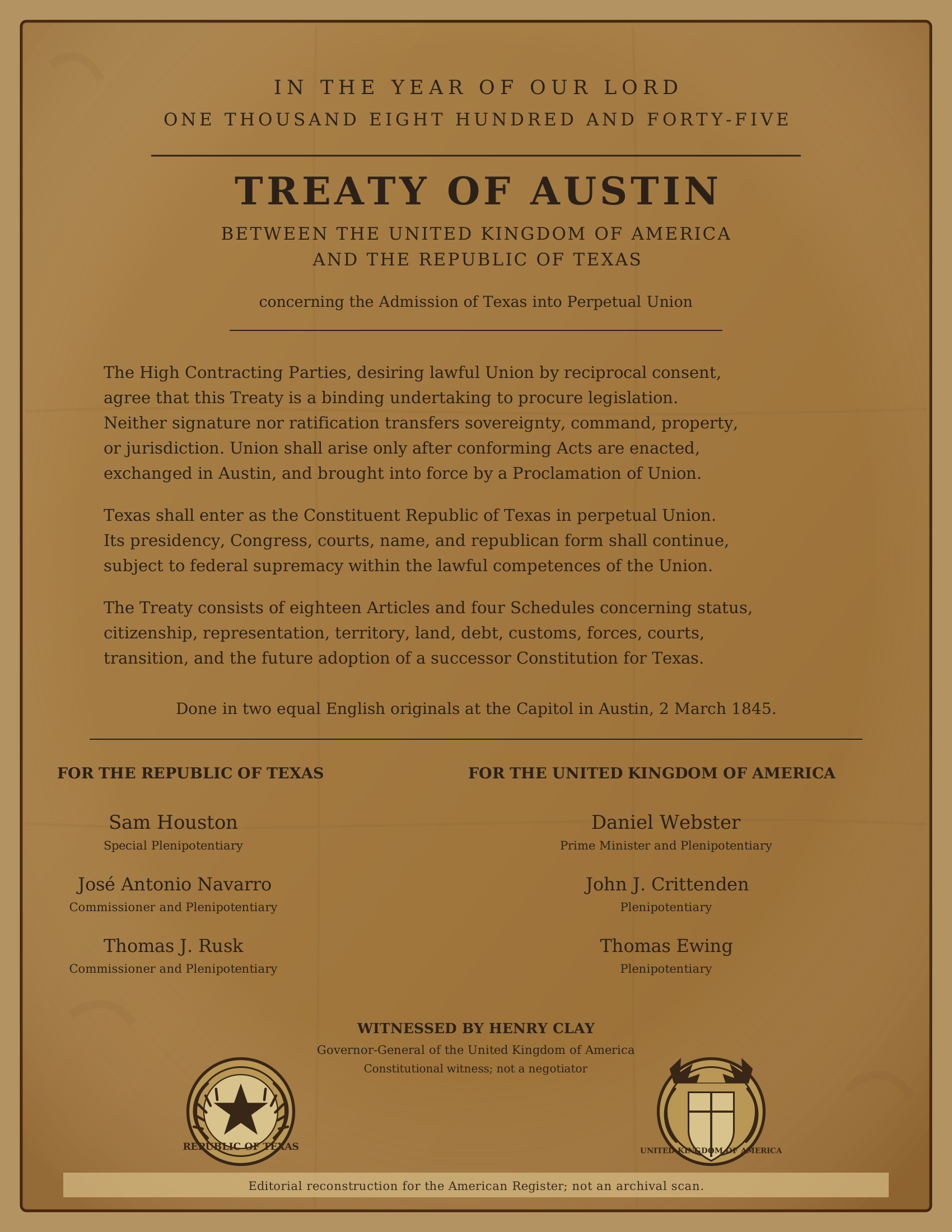
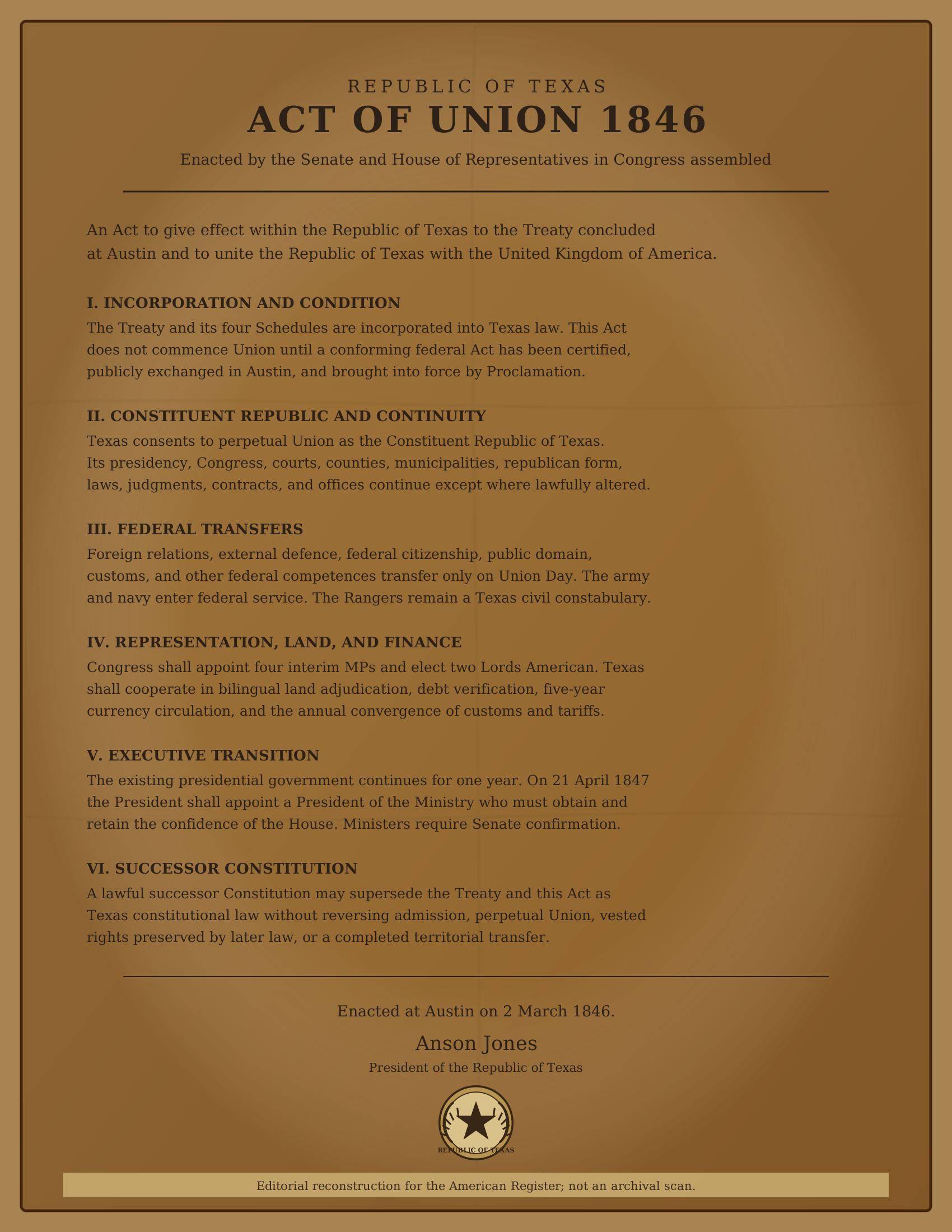
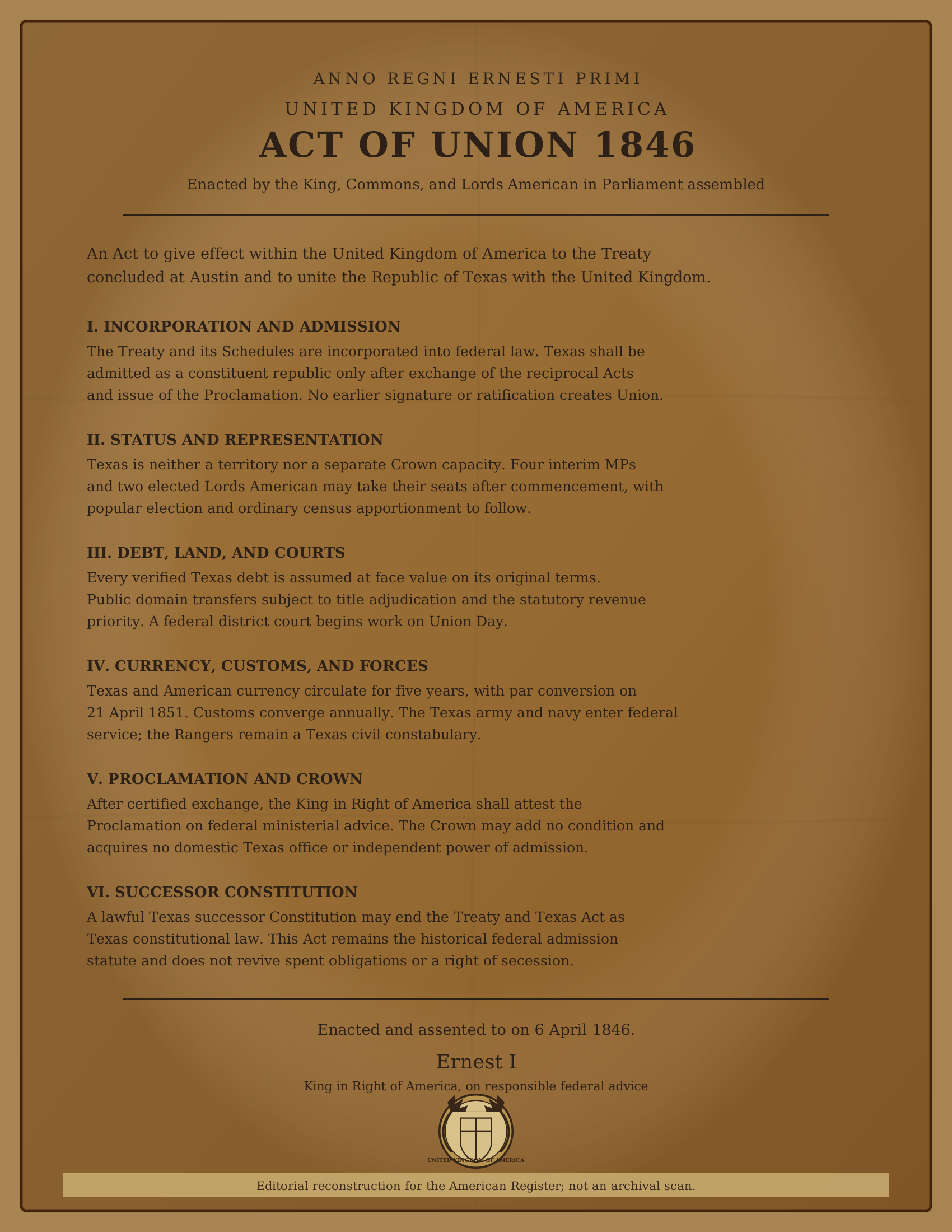
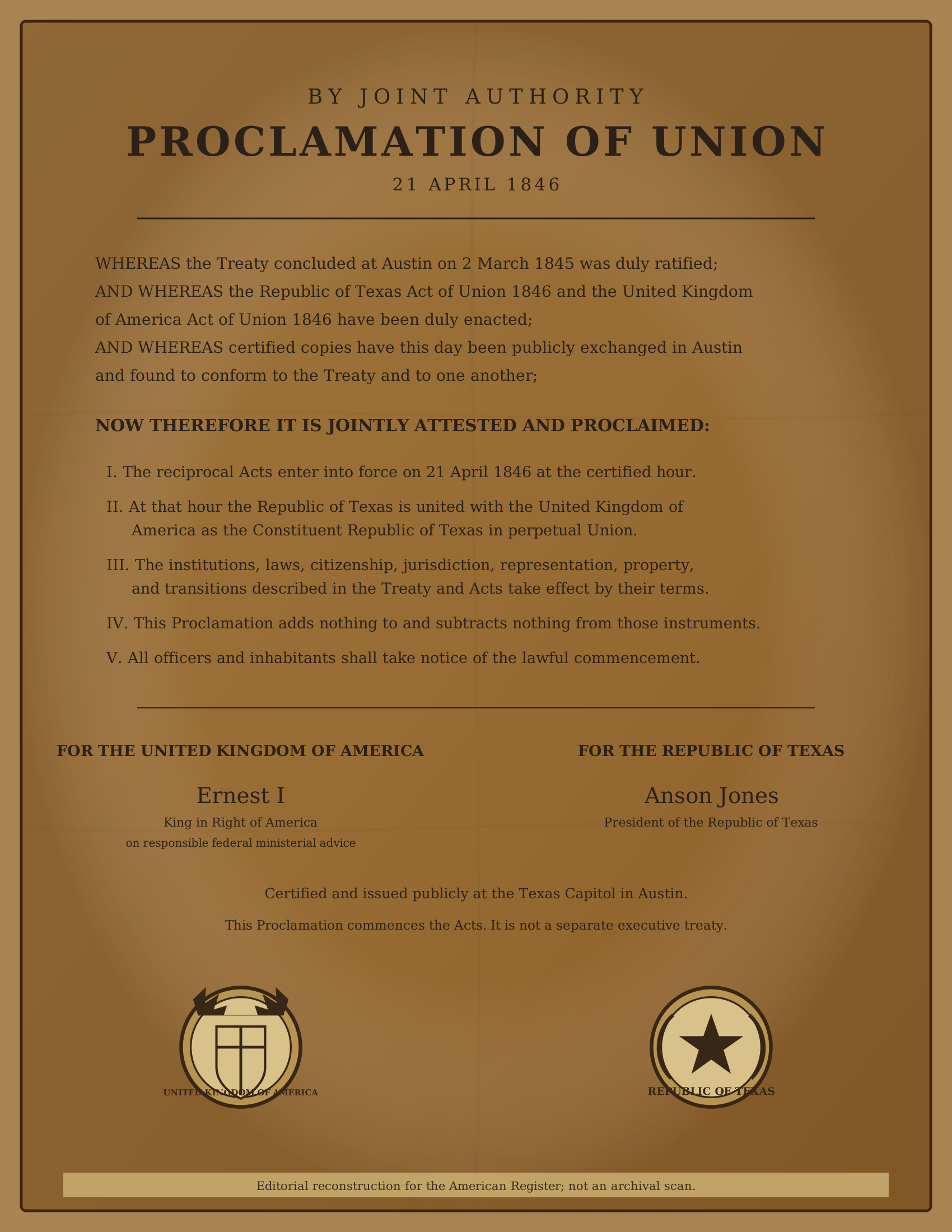
Terminology and legal identity
Treaty of Austin
The short name “Treaty of Austin” derives from the place of negotiation and signature. It does not refer directly to Stephen F. Austin, although the capital bearing his name made the historical association unavoidable. The full title identified the United Kingdom of America and the Republic of Texas as the parties and described the subject as the admission of Texas into perpetual union.
The term “treaty” had its ordinary nineteenth-century international meaning at signature. Texas was still an independent republic. The UKA treated it as a recognised government capable of assuming international obligations, even though Mexico continued to deny that Texas had lawfully separated. The Treaty therefore differed from a federal admission statute or an agreement between existing UKA polities.
The Treaty was executory. Its ratification obligated the parties to pursue union under the agreed conditions but did not itself alter their territories, governments, citizenships, or chains of command. This feature permitted each legislature to decide whether to enact the domestic constitutional changes. It also prevented the UKA from claiming that signature alone had placed Texas under federal authority.
The text referred to a future admission that would occur once both Acts had been enacted, certified, exchanged, and proclaimed. The absence of a legislative deadline was deliberate. Each government could have failed to pass its Act without automatically violating a stated date, but an indefinite refusal after ratification would have breached the duty of good-faith performance.
Acts of Union
The expression “Acts of Union” refers to the two statutes enacted in 1846. Their short titles were the Republic of Texas Act of Union 1846 and the United Kingdom of America Act of Union 1846. Each had the long title An Act to give Effect to the Treaty concluded at Austin and to unite the Republic of Texas with the United Kingdom of America.
The statutes had matching constitutional cores but were not identical. The Texas Act authorised the transfer of external sovereignty, federal property, the public domain, armed forces, customs authority, and foreign relations. It also continued Texas institutions, authorised the division of the presidency, provided for federal representation, and directed Texas officials to administer the transition.
The UKA Act admitted Texas to the federal order, assumed the verified public debt, created federal jurisdiction, authorised parliamentary representation, provided for customs and currency conversion, and accepted responsibility for external defence. Both Acts incorporated the Treaty and its schedules by reference. Neither could commence without the other.
The use of reciprocal legislation avoided treating one legislature as the sole author of the settlement. It also produced two bodies of domestic law. Before 1910, Texas courts interpreted the Texas Act in ordinary cases and federal courts interpreted the UKA Act. The Royal American Supreme Court held final authority when a dispute concerned the Treaty, the relationship between the Acts, or federal constitutional supremacy.
Proclamation of Union
The Proclamation of Union was a short commencement instrument rather than a third legislative settlement. Certified copies of the Acts were exchanged in the chamber at Austin on 21 April 1846. The representatives then certified that the conditions of the Treaty had been met. Ernest I and Jones attested the Proclamation in their respective capacities.
The Proclamation declared that the Acts took effect simultaneously. It did not add substantive conditions, alter the boundary, or ratify the Treaty again. Its legal function was to identify the moment at which sovereignty and federal competence transferred. The Texas army and navy entered federal service at the same time, and the interim parliamentary delegation became entitled to sit.
The choice of 21 April connected the new constitutional order to San Jacinto. Supporters described this as proof that Union followed independence rather than erased it. Critics considered the symbolism a means of presenting surrender of sovereignty as another victory. Both readings became part of Treaty Day politics.
Austin settlement
Lawyers and historians use “Austin settlement” for the Treaty, both Acts, the Proclamation, and sometimes the western cession compact. Strict usage excludes the cession compact because it was negotiated and signed after Texas had entered the UKA and depended on ordinary federal and Texas executive authority. The compact did, however, implement a political understanding closely associated with accession.
The term “Treaty republic” developed later as a description of Texas. It refers to the negotiated origin of its constituent status, not to permanent Treaty supremacy. After 1910 it has described political identity and constitutional history. Claims that Texas remains entitled to disregard federal law merely because it entered by treaty have repeatedly failed.
Background
Spanish and Mexican Texas
The legal and territorial questions addressed at Austin originated before the Republic. Spanish administration produced missions, presidios, municipalities, land grants, water arrangements, church property, civil-law records, and settlement patterns. Mexican independence preserved much of this legal inheritance while introducing new national and state institutions. Coahuila and Texas governed colonisation through federal and state laws that granted land to both established communities and incoming settlers.
The empresario system brought a large Anglo-American population into Mexican Texas. Settlers entered under Mexican sovereignty and were expected to comply with Mexican law, including its changing rules on immigration, religion, taxation, land, and slavery. Political conflict grew from disputes over federalism, local representation, military authority, immigration restrictions, and the Mexican government’s movement towards centralisation. Slavery was also integral. Many Anglo-American settlers sought to preserve enslaved labour against Mexican restrictions and abolition.
The resulting conflict cannot be reduced to one cause. Federalist resistance to central rule, local demands for representation, settler expansion, Mexican factional conflict, racial hierarchy, land speculation, and slavery all contributed. Tejano participants in the Revolution included federalists and local leaders who opposed central military government without endorsing Anglo domination. Indigenous nations pursued their own territorial and diplomatic strategies and were not parties to the settler constitutional project.
The Republic later treated Spanish and Mexican title chains as part of its own law. Records were incomplete, dispersed, damaged, or susceptible to competing translations. Some grants had been perfected by a final instrument. Others depended on possession, municipal records, surveys, conditions of settlement, or pending administrative acts. The distinction became important when the Austin land commission attempted to decide which claims deserved protection.
Revolution and independence
The Texas Revolution began in 1835 and produced the Declaration of Independence of 2 March 1836. The Republic adopted a written constitution, a directly elected presidency, a bicameral Congress, and a judiciary. Victory at San Jacinto on 21 April secured practical independence, although Mexico did not accept the resulting Treaties of Velasco as a valid permanent settlement.
The Constitution of 1836 protected representative government for a restricted political community. It entrenched slavery, constrained emancipation, and excluded or disadvantaged free Black residents. Women lacked the vote. Indigenous peoples were generally excluded from ordinary citizenship and political participation. The constitutional language of liberty therefore coexisted with racial slavery, settler expansion, and a narrow franchise.
The Republic claimed a boundary following the Rio Grande from the Gulf to its headwaters and then north and east along lines that reached far beyond effective Texan administration. The claim included El Paso, the trans-Pecos, much of present-day New Mexico, and remote northern territory. Mexico maintained that Texas remained Mexican and, in any event, denied the claimed Rio Grande boundary. The area between the Nueces and Rio Grande became the immediate military dispute, while Santa Fe and the western claim presented a larger territorial question.
Texas obtained diplomatic recognition from several states but remained vulnerable. Its population and taxable wealth were limited. Its navy and army consumed resources that the government could not reliably provide. Relations with Indigenous nations ranged from negotiation to organised removal and war. Raids, retaliatory expeditions, captive-taking, land pressure, and insecurity shaped the frontier without fitting the Republic’s simple account of sovereign control.
Government and political divisions
The presidents of the Republic differed sharply over finance, the capital, relations with Indigenous nations, military policy, and the desirability of a larger union. Sam Houston favoured economy, diplomacy, and eventual accession to a stronger federal power. Mirabeau B. Lamar favoured an expansive independent republic, military assertion, and a more aggressive policy towards Indigenous nations and the western claim.
Lamar’s presidency from 1838 to 1841 expanded expenditure and attempted the Santa Fe expedition. The expedition failed to establish Texas authority over New Mexico and intensified both debt and hostility with Mexico. Lamar’s supporters nevertheless regarded independence as a permanent national achievement rather than a temporary stage before union.
Houston returned to the presidency in 1841. His administration reduced military expenditure, sought diplomatic leverage, and continued to examine accession. Houston left office in December 1844. His later appointment as Special Plenipotentiary rested on his standing as a former president, military leader, and recognised advocate of union. It did not extend his presidential term.
Anson Jones succeeded Houston. Jones inherited negotiations involving the UKA, Mexico, Britain, and other interested powers. He sought to preserve a credible independent option while permitting Texas to choose union. This policy exposed him to accusations from both sides. Union supporters feared delay, while nationalists believed that the government had already conceded too much to the UKA.
Debt and currency
The Republic accumulated several classes of debt. They included audited civil and military claims, supplier accounts, notes, bonds, customs-backed obligations, and arrears. Nominal amounts did not reflect a common market value. Some securities traded at large discounts, and uncertainty about authentication and priority encouraged speculation.
The currency problem was related but distinct. Republic notes circulated at varying values alongside specie and foreign currency. A promise to redeem every lawful issue at par was therefore more generous than a market conversion. It benefited original holders who had retained paper, but it also rewarded speculators who had bought claims cheaply. The UKA accepted the cost because debt settlement was necessary for stable admission and because federal credit could absorb obligations that Texas could not service consistently.
Public land was the Republic’s principal large asset. Texas issued land for settlement, military service, colonisation, education, and public finance. Surveys overlapped, grants conflicted, and records could be incomplete. Land policy also assumed that the Republic could dispose of territory occupied or used by Indigenous nations without their consent.
At Austin, the UKA agreed to assume verified debt on its existing terms rather than impose a uniform reduction. In exchange, the Texas public domain passed to federal ownership. This bargain differed from the historical annexation settlement in which Texas retained both public debt and public land. A statutory revenue waterfall directed proceeds first to surveys and claims, then to debt service, schools, transport, and homestead administration.
Trade, ports, and infrastructure
Texas relied on customs duties for a large part of public revenue. Galveston and other Gulf ports connected the Republic to New Orleans, Britain, continental Europe, Mexico, and the wider Atlantic economy. Immediate abolition of customs barriers would have removed revenue before the Texas government had adjusted its tax system.
The Austin settlement therefore used a five-year transition. Internal customs between Texas and the UKA declined annually rather than ending at commencement. Texas’s external tariff converged towards the UKA tariff by the same schedule, while federal customs officers gradually assumed administration. This arrangement was less economically efficient than immediate free trade but made the transfer fiscally manageable.
Infrastructure was central to Texas support for Union. Roads were seasonal and uneven. Postal links were expensive, river navigation was limited, and distances placed frontier settlements beyond regular administration. Telegraphs were beginning to alter communication, while railway construction remained a future undertaking rather than an established network.
The Treaty contained general transition provisions, but the named works guarantee appeared in the separate cession compact of 22 April. It covered postal and military roads, surveys, port works, telegraph connections, and protected corridors for future railways. The distinction allowed the Union instruments to remain constitutionally general while tying the western cession to visible public investment.
External security
Mexico continued to reject Texas independence and conducted incursions or temporary occupations during the Republic period. Texas could not assume that recognition by other powers would prevent renewed war. The claimed frontier was too extensive for its forces to control, and the public finances could not support indefinite mobilisation.
The UKA saw Texas through a different strategic calculation. Admission would extend federal influence to the Gulf and the Mexican border, deny rival powers a foothold, and create routes towards the Pacific. It would also assume debt, provoke Mexico, and intensify the slavery question inside Parliament. Webster’s government treated these costs as serious rather than incidental.
Britain and other powers had commercial interests in an independent Texas. Their diplomacy encouraged Mexico to consider conditional recognition and gave Jones leverage. The UKA delegation argued that such guarantees would leave Texas exposed to changing foreign policy and would not solve debt or internal-market access. Lamar’s supporters replied that dependence on the UKA would be more permanent than any European guarantee.
Slavery
Slavery shaped the accession question even though it did not appear in the final Treaty. Enslaved labour was important to cotton production and planter wealth. Texas law protected slaveholders and restricted both emancipation and the residence of free Black people. The prospect of adding another slaveholding polity affected UKA parliamentary coalitions and debates over western territory.
The Austin convention did not place slavery on its formal agenda. This was not evidence that the subject lacked importance. Both delegations understood that an explicit guarantee of slavery or an immediate restriction on it could destroy the agreement. They therefore left existing Texas law in place while making no promise that slavery could expand into federal territory.
The omission had legal consequences. Proslavery politicians later argued that preservation of republican institutions implied protection of the social order existing at admission. Antislavery lawyers answered that the Treaty protected named public institutions and never described enslavement as an essential element of republican government. Federal courts ultimately rejected attempts to turn silence into entrenchment.
The absence of discussion also shaped later memory. Older commemorations often presented the Treaty as a technical settlement of government, debt, and land. Modern interpretation treats the decision not to discuss slavery as a political act. It allowed Union to proceed while postponing a moral conflict that returned in more violent form.
Indigenous nations
Comanche, Apache, Caddo, Cherokee, Tonkawa, Wichita, and other Indigenous peoples maintained distinct political communities, territories, diplomatic relations, and patterns of movement in and around the lands claimed by Texas. Their relations with the Republic differed by nation and period. Some negotiated treaties or local accommodations. Others fought Texas forces, settler militias, rival nations, or Mexican communities. Alliance and conflict could change rapidly.
Neither the Texas nor UKA delegation gave Indigenous nations formal representation at Austin. The convention did not seek their consent to admission, public-domain transfer, frontier deployment, or the future settlement of land. This exclusion was especially consequential because the Treaty claimed to dispose of territory that Texas did not administer effectively.
After Union, ordinary UKA Indigenous treaty and compact law applied. Federal officials reviewed existing Texas arrangements, negotiated new instruments, and asserted authority over war and peace. This reduced the ability of Texas institutions to conduct independent campaigns, but it did not restore land already taken or recognise a general Indigenous veto over settlement.
The omission remains one of the principal criticisms of the Austin settlement. It also limits claims that the Treaty represented comprehensive territorial consent. The two governments consented to their relationship. They did not obtain the agreement of every political community affected by it.
Political economy before Union
The Republic entered the negotiations with a functioning government but a narrow fiscal base. Customs supplied a large share of public revenue, and their yield changed with trade conditions, enforcement, and the movement of goods through ports and overland routes. Direct taxation was politically unpopular and difficult to administer across a large claimed territory. Land was abundant in official accounts but could not simply be converted into reliable revenue. Titles overlapped, surveys were incomplete, frontier conditions limited sale, and the government had already used land promises as a substitute for money.
Debt affected policy at every level. Creditors differed over the value and enforceability of Republic obligations, and successive administrations had issued instruments on changing terms. Interest accumulated while the market price of the securities fell. Texas officials regarded assumption at face value as recognition of the Republic’s public faith. UKA negotiators feared that unqualified assumption would reward speculation or transfer doubtful claims to federal taxpayers. The eventual verification process preserved the original terms of legitimate debts rather than replacing them with a politically negotiated discount.
The economy was also tied to slavery. Enslaved labour underpinned much agricultural wealth, especially in the eastern counties, and influenced land values, credit, migration, and political power. Supporters of Union sometimes treated access to the UKA market and federal protection as means of securing that order. Anti-slavery MPs in the UKA regarded admission as a potential enlargement of slaveholding influence even though the Treaty contained no slavery guarantee. The convention’s decision to avoid a slavery article did not make the settlement economically neutral.
Tejano communities occupied a different position within this economy. Some families held long-established urban, ranching, and commercial property. Others had been displaced during the revolution and subsequent conflict. Documentary title, language, access to lawyers, and the cost of survey became decisive after Union. The Treaty offered more formal protection than an unregulated transfer would have done, but the system still favoured parties able to sustain lengthy proceedings.
Public opinion in Texas
Texas opinion did not divide into a simple choice between patriotism and accession. Supporters of Union included former independence leaders who believed that the Republic had achieved its purpose and could enter a larger constitutional order by consent. They stressed security, debt relief, commercial access, postal links, and the preservation of the presidency and Congress. Some also expected Union to protect slavery, although the Treaty did not say so.
Opponents differed among themselves. Lamar and other sovereignty advocates argued that Texas could survive as a continental republic and should not exchange diplomatic independence for fiscal relief. Some feared that federal courts and Parliament would gradually reduce the protected institutions to ordinary state offices. Others opposed the western cession that was widely expected to follow Union. A smaller group preferred continued balancing among Mexico, the UKA, and European powers.
Newspapers published summaries of the negotiations, correspondence from Austin, and partisan argument. The open convention allowed observation but did not create universal participation. Enslaved people could not take part in the decision that would define the jurisdiction governing them. Women organised political discussion, household networks, petitions, and public events but possessed no vote. Indigenous nations received neither formal notice as parties nor an opportunity to consent.
The absence of a referendum later became important in public memory. Supporters replied that the Republic’s written Constitution assigned treaty and legislative authority to elected institutions. Critics noted that the franchise itself was restricted and that a decision of permanent consequence had been taken by officials chosen under that restricted system. Both statements are accurate. The process was lawful under the constitutional arrangements then recognised, but it was not democratic by modern standards.
Opinion in the UKA
Expansion divided the UKA along moral, fiscal, constitutional, and regional lines. Many western and southern MPs supported Texas admission as the peaceful incorporation of a neighbouring republic with strong migration and trade connections. Ministers described the Treaty as preferable to unilateral annexation because it recognised Texas sovereignty, required reciprocal legislation, and preserved a documented settlement of debts, land, and institutions.
Anti-slavery critics argued that admitting a slaveholding republic would strengthen an unjust system regardless of whether slavery appeared in the text. They also objected to citizenship language that could be read generously while leaving Texas slave law in force. Their concern was intensified by the size of the territory claimed by Texas and the possibility that settlement westward would extend slaveholding political power.
Fiscal opponents focused on debt assumption and infrastructure commitments. They questioned whether federal taxpayers could verify obligations issued by a government whose records and currencies had changed repeatedly. Commercial critics worried about the five-year customs transition and unequal conditions inside the federal market. Constitutional critics asked whether the federal Parliament could admit a sovereign country while guaranteeing a directly elected presidency and a republican domestic order.
Webster’s defence treated these concerns as reasons for detailed legislation rather than reasons to reject Union. He argued that debt verification, federal supremacy, scheduled customs convergence, and a successor-constitution clause would prevent the Treaty from becoming an uncontrolled exception. He did not claim that the settlement resolved slavery or Indigenous rights. Parliamentary debate remained unusually explicit that Union could be legally orderly while morally incomplete.
International setting
Mexico regarded Texas as a rebellious province and did not recognise the boundary claimed by the Republic. The United Kingdom of America recognised Texas independence, as did several foreign governments, but recognition of a government did not settle the Rio Grande boundary or the western territorial claim. The Treaty therefore distinguished recognition of Texas as a contracting state from acceptance of every line on its map.
European governments watched the negotiations because Texas affected Atlantic trade, cotton, debt markets, and the continental balance. Texas diplomacy had sometimes used the possibility of foreign protection or commercial alignment to improve its position with the UKA. By 1844 that strategy had produced recognition and contacts but no security arrangement sufficient to remove the danger of renewed war.
The UKA also had reasons to avoid an appearance of conquest. Its constitutional identity rested in part on union by compact, and ministers wanted the record to show that Texas had acted through its own institutions. The two-Act structure served this purpose. Neither Parliament purported to legislate unilaterally for the other country before commencement, and the Treaty itself stopped short of annexation.
Mexico was not invited to the Austin convention. This reflected the parties’ view that recognition of Texas permitted bilateral negotiations, but it also meant that the boundary question was handled without the state that contested it. The subsequent cession west of the Pecos reduced part of Texas’s internal claim without resolving the dispute between the UKA and Mexico. War followed within days of Union.
The constitutional problem
No exact precedent governed the admission of Texas. The UKA had incorporated territories and admitted constituent units, but Texas was an internationally recognised republic with its own executive, legislature, courts, forces, debts, currency, public land, and treaties. Immediate application of ordinary federal law would have left unanswered questions about office, title, creditors, representation, and jurisdiction.
Texas negotiators rejected a settlement that would abolish the Republic’s name or replace its President with a royal representative. The UKA delegation accepted that the Crown in right of America could govern federal matters without becoming the source of Texas’s domestic executive. The resulting system placed a republican polity inside a federal constitutional monarchy.
This division required precise advice streams. Federal ministers advised Ernest I on ratification, commencement, federal appointments, and external affairs. Texas officers did not advise the Crown, because Texas was not a Crown capacity. The Texas President and Ministry acted under Texas law. The distinction prevented the language of Union from becoming a claim that the King had inherited or conquered Texas.
The settlement also needed to reconcile permanence with constitutional change. Article III prohibited unilateral secession, while Article XVIII allowed the protected transition to be replaced by a later Texas Constitution consistent with federal law. The Treaty was therefore intended to make Union permanent without making its own institutional details permanent. That distinction became the basis of the 1910 supersession.
Preliminary negotiations
Earlier approaches
Texas interest in joining a larger North American union preceded the Austin convention. The Republic sought recognition, credit, trade access, and security from several powers. Accession proposals rose or fell with elections, relations with Mexico, slavery politics, and the willingness of a larger power to assume financial and military risk.
The UKA had no single constitutional template for admitting an independent republic. Existing polities had entered through colonial settlements, federal organisation, or negotiated arrangements of different kinds. Florida had preserved a republican executive within the Union, but its responsible government did not divide head-of-state and head-of-government functions in the later Texas manner.
Early discussions focused on whether Texas would enter as an ordinary polity or retain an expressly protected republican form. Texas negotiators also sought debt assumption, recognition of land titles, representation, and protection against Mexico. UKA officials insisted on federal control of foreign affairs, defence, customs, and public land.
Houston’s second administration developed the broad basis of a bargain but did not complete it before his term ended. The change of office created a legal and political problem. Houston retained influence but no longer held executive authority. Jones addressed this by appointing him Special Plenipotentiary alongside Navarro and Rusk.
Appointment of the Texas delegation
Houston’s commission authorised him to negotiate and sign subject to legislative ratification. The title was chosen to make his capacity unambiguous. He did not exercise presidential powers, command the government, or bind Texas without the other commissioners and subsequent approval.
José Antonio Navarro brought legal experience, Tejano political standing, and direct knowledge of both Mexican and Texas institutions. His presence gave Tejano Texans formal representation at the convention, although it did not mean that every Tejano community supported Union or that the resulting land system operated equally.
Thomas J. Rusk brought military, executive, legislative, and judicial experience. He had served as secretary of war and was closely associated with the Republic’s institutions. His participation also reassured those who feared that Houston would accept federal terms too readily.
The three commissioners did not form a uniform political bloc. Houston prioritised security and union. Navarro pressed for title recognition, Spanish-language notice, and continuity of local institutions. Rusk placed greater weight on military integration and the preservation of Texas offices. Jones issued their instructions and retained the authority to receive the completed text.
UKA delegation
Prime Minister Daniel Webster led the UKA delegation. His participation signalled that accession was a ministry-level constitutional project rather than a routine diplomatic mission. Webster emphasised federal supremacy, legal continuity, and a settlement capable of surviving parliamentary scrutiny.
John J. Crittenden supplied constitutional and legislative experience. Thomas Ewing worked principally on finance, public assets, and administrative transition. Their presence reduced the degree to which the agreement depended on Webster personally and allowed several negotiating groups to meet at the same time.
Governor-General Henry Clay attended as constitutional witness. He did not negotiate articles or direct the ministry. His role was to attest the Crown’s knowledge of the process, receive formal communications, and provide confidence that any ratified agreement would receive regular constitutional consideration. Clay’s known caution about expansion and war made his presence important to sceptical UKA legislators.
The UKA delegation included clerks, surveyors, financial examiners, military advisers, translators, and parliamentary counsel. Technical staff prepared debt schedules, compared land records, reviewed customs revenue, and drafted the Spanish translation.
Open convention
The convention met in the Texas Capitol at Austin. Proceedings were open except when delegates examined confidential diplomatic correspondence, individual debts, or military dispositions. Public galleries, printed summaries, and newspaper reports made the negotiations unusually visible for an international treaty conference.
Openness strengthened legitimacy but encouraged performance. Texas delegates spoke to local audiences as well as one another. UKA commissioners knew that parliamentary opponents would use any statement suggesting annexation by pressure. Debates over terminology therefore occupied substantial time.
The delegations rejected “annexation” in the formal text. Texas would be admitted and united under reciprocal legislation. The UKA would not describe Texas as a conquered territory or federal possession. Texas would acknowledge federal authority without claiming that it had reserved a general right to ignore Parliament.
The open record did not include formal debate on slavery or Indigenous consent. In both cases, omission was visible to contemporaries. Petitioners and newspapers raised the subjects outside the convention, but the presiding officers did not place them on the official agenda or assign them to drafting committees.
Negotiating objectives
Texas sought express recognition of its sovereignty, perpetual preservation of its republican name and institutions, debt assumption, land-title protection, a manageable customs transition, parliamentary representation, and defence against Mexico. It also wanted a system that did not require officers of the Republic to become royal appointees in domestic matters.
The UKA sought a perpetual and indissoluble union, control of external relations and defence, legal supremacy within federal competences, transfer of military property and public land, regular federal jurisdiction, and a credible transition to responsible government. It rejected any arrangement that resembled an alliance of two governments after admission.
The central constitutional compromise separated domestic republican institutions from federal Crown authority. The President of Texas would remain the head of the constituent republic. The Crown in right of America would act for the UKA in federal matters. Neither office derived authority from the other.
The responsible-government settlement was deferred for one year. Texas retained its combined presidency during transition and then divided executive functions between the President and a President of the Ministry responsible to the House. This arrangement preserved the presidency while bringing actual government under legislative confidence.
Drafting process
Drafting committees organised the agreement into status, institutions, property, and transition. The final eighteen-article structure reflected subject matter rather than the order in which delegates reached agreement. Four schedules contained facts and administrative detail likely to require technical verification.
The first schedule described the territory claimed by Texas without asserting that Mexico accepted the boundary. The second listed debt classes, public assets, and categories of public land. The third addressed offices, forces, representation, and initial elections. The fourth dealt with land claims, customs, currency, and existing treaties.
English was the sole authoritative language. A certified Spanish translation accompanied the text for public notice and land administration. Navarro argued successfully that Spanish-speaking claimants should not bear the cost of translating the government’s own instruments. The translation could assist interpretation but did not displace the English text.
The Treaty provided that disputes would ultimately fall within the Royal American Supreme Court’s jurisdiction once Union began. Before commencement, disputes concerned international performance and could only be managed diplomatically. No permanent joint tribunal was created.
Convention procedure
The convention used public sessions for statements of principle and recorded working sessions for detailed drafting. Members of the Texas Congress, UKA parliamentary observers, journalists, creditors, land claimants, merchants, and local residents attended portions of the proceedings. Access was limited by the capacity and customs of the Capitol, but the decision to sit openly distinguished the negotiations from secret diplomatic bargaining.
Minutes identified proposed language, objections, referrals, and agreed amendments. The delegates did not publish every private conversation, and informal meetings remained important, but the formal record allowed both legislatures to see how disputed clauses had developed. Later courts used the minutes cautiously, treating them as evidence of context rather than as material superior to the enacted texts.
Houston chaired the Texas delegation without claiming presidential authority. His commission empowered him to negotiate and sign subject to ratification. Navarro took a leading role on land titles, language access, residence, and the position of Mexican nationals. Rusk concentrated on defence, forces, and constitutional transition. Their responsibilities overlapped, and all three signed the same instrument.
Webster coordinated the UKA position with Parliament and the federal ministry. Crittenden dealt extensively with courts, supremacy, land appeals, and the form of the Acts. Ewing worked on debt, public property, customs, and infrastructure. Clay attended ceremonial and constitutional sessions as witness but did not direct the delegation or settle clauses.
Public representations
The convention received written material from towns, merchants, creditors, veterans, officeholders, churches, and groups of property owners. These submissions influenced discussion of ports, roads, pensions, currency, land claims, and the timing of customs change. They were advisory and did not convert the convention into a constituent assembly.
Tejano petitioners pressed for bilingual notice and recognition of grants originating under Spanish and Mexican law. Their representations contributed to the certified Spanish translation, bilingual land commission, and presumption for authenticated public grants. The final settlement nevertheless required individual proof and did not provide collective protection against the economic pressures that later caused dispossession.
Anti-slavery petitions reached both the convention and Parliament. The delegations declined to place slavery formally on the agenda, partly because Texas negotiators regarded any restriction as a threat to ratification and partly because UKA ministers relied on existing federal constitutional authority. This avoidance was politically effective but morally consequential. It allowed the parties to speak of “all inhabitants” while leaving enslaved inhabitants subject to Texas law.
No Indigenous nation was invited to submit a ratification instrument or appoint a delegate. Some traders, missionaries, military officers, and settlers discussed frontier relations, but they did not speak with the authority of the nations concerned. The absence appears plainly in the record and is treated in modern interpretation as a constitutional exclusion, not a minor procedural omission.
Spanish translation
The certified Spanish translation served three functions. It supplied public notice to Spanish-speaking residents, assisted the land commission, and gave Mexican nationals a usable statement of their residence and property options. Notices of hearings and forms were produced in both languages where the schedules required them.
The translation did not possess equal legal authority with the two English originals. Courts could consult it when construing land and notice provisions, particularly where the English text used terms derived from Spanish or Mexican law. They could not displace clear English language merely because the translation differed.
This hierarchy attracted criticism. Navarro had sought stronger guarantees, but UKA officials argued that two equally authoritative languages could create uncertainty across federal and Texas courts. The compromise improved administration while preserving English legal control. It was more protective than English-only practice but fell short of linguistic equality.
Constitutional theories
Supporters in Texas described the settlement as an exercise of retained sovereignty. On this view, a sovereign republic could consent to permanent Union while preserving its internal republican institutions. Sovereignty was exercised at accession and thereafter divided according to the federal Constitution.
UKA ministers used a related but not identical theory. They described the federal order as capable of receiving a whole country through treaty and reciprocal legislation. Once Union commenced, federal authority did not depend on continuing Texas consent. The Treaty protected institutions, but those protections operated within a superior constitutional system and could not support unilateral withdrawal.
Opponents advanced two main alternatives. Some Texans argued that no legislature elected for ordinary government could alienate national sovereignty without a referendum or convention. Some UKA critics argued that Parliament could not create a privileged constituent republic with institutions unlike those of existing units. Neither position prevailed, but both influenced the detailed successor clause and the insistence on two Acts.
The final text avoided declaring that either people had transferred an abstract, indivisible sovereignty. It stated what each government promised, what the legislatures had to enact, when authority would change, and which institutions would continue. This practical drafting allowed later lawyers to disagree about theory while administering the same settlement.
Matters left outside the Treaty
The negotiators excluded several questions that could not be resolved without defeating the agreement. Slavery was the most important. The Treaty neither guaranteed it nor abolished it, and it said nothing about expansion into federal territory. The omission preserved Texas law temporarily while leaving federal constitutional change possible.
The future boundary with Mexico was also not settled. Schedule I described the territory admitted as Texas claimed it, accompanied by express notice that Mexico had not accepted the boundary. The parties did not pretend that a bilateral agreement could bind Mexico.
The division of the western territory was discussed politically but not authorised by a secret protocol or Treaty clause. The separate cession on 22 April depended on executive powers then recognised by both governments and on later federal administration. Modern claims that the cession was hidden in Schedule I are inconsistent with the documentary structure.
Indigenous title and consent were not addressed at all. This was not a neutral decision to postpone technical detail. It reflected a state-centred conception of diplomacy that treated Indigenous peoples as subjects of later frontier administration rather than governments whose authority required agreement.
Signature and contents
Signature on 2 March 1845
The delegations signed the Treaty on 2 March 1845, the ninth anniversary of the Texas Declaration of Independence. The date reinforced the argument that a sovereign republic was choosing Union after establishing its independence. It also gave opponents a direct comparison between the two acts.
Houston signed as Special Plenipotentiary. The instrument did not describe him as President, and contemporary certificates recorded that his last presidential term had ended in December 1844. Navarro and Rusk signed as commissioners of the Republic. Webster, Crittenden, and Ewing signed for the UKA.
Clay’s attestation identified him as Governor-General and constitutional witness. It did not make the Crown a separate treaty party or suggest that the Governor-General had negotiated on behalf of Texas. Jones received the completed instrument as President and transmitted it to the Texas Congress.
The signature ceremony occurred in the Capitol chamber used for the convention. Treaty Hall did not yet exist. Later paintings often moved the event into the grander hall or included architecture built after 1845. Modern exhibitions distinguish those commemorative images from documentary evidence about the original setting.
Two English originals were signed. One remained in Texas. The other travelled under joint custody for ratification and eventual deposit in the UKA archives. Certified Spanish copies were prepared from the final engrossed text. Neither original included a map purporting to settle the international boundary with Mexico.
Article I: purpose
Article I recorded the parties’ intention to establish a perpetual union through legislation. It stated that the Republic entered negotiations freely and that the UKA accepted the principle of admission on the agreed terms. It did not use language of cession, conquest, protection, or incorporation at signature.
The article linked Union to peace, credit, commerce, defence, and republican self-government. These purposes were legal context rather than independent grants of power. Later courts used them when ambiguous provisions could support more than one reading, but they did not treat the preamble as a source of unlimited Texas autonomy.
Article II: recognition and interim obligations
Article II expressly recognised Texas as a sovereign republic competent to negotiate and ratify the Treaty. The recognition applied immediately between the parties. It did not bind Mexico or resolve the validity of the Texas Revolution under Mexican law.
The article established the limited security guarantee after both governments ratified. The UKA promised assistance against new external aggression and Texas promised not to enter a conflicting alliance or dispose of territory to another power. Texas retained command of its armed forces until commencement.
The agreement imposed no deadline for the Acts. Each government promised to place appropriate legislation before its legislature and to act in good faith. Ratification alone did not confer UKA citizenship, federal jurisdiction, representation, or customs authority.
Article III: conditions of Union
Article III described the status that would arise if both Acts commenced. Texas would become a constituent republic in perpetual Union with the UKA. The expression “Constituent Republic of Texas” appeared in formal constitutional contexts, while “Republic of Texas” remained the ordinary legal and public name.
The article denied unilateral secession. It did not prevent constitutional amendment, reorganisation within the UKA, or a consensual settlement enacted under the federal constitutional order. It treated Union as an indissoluble legal relationship rather than a continuing international alliance.
Article IV: federal and republican authority
Article IV assigned federal subjects to the UKA and preserved domestic republican government. Foreign affairs, external defence, customs, federal finance, nationality, and other established federal competences passed to federal institutions. Valid Acts of Parliament would prevail within those fields.
Texas retained its presidency, Congress, courts, counties, municipalities, land offices, and ordinary domestic administration. These institutions were protected during the Treaty period against unilateral abolition by an ordinary federal statute. Parliament could amend ordinary implementing terms expressly, but alteration of the named republican core required the consent of the Texas Congress.
The Crown in right of America acquired no general domestic prerogative over Texas. Federal acts involving the Crown followed UKA advice. Texas ministers could not advise the Crown for federal purposes or for any other realm. Texas remained republican at the constituent level even though its citizens belonged to a federal constitutional monarchy.
Article V: citizenship and franchise
Article V declared that “all inhabitants” of Texas would become UKA citizens at commencement. It did not create a separate Texas citizenship. Domicile, voting registration, and eligibility for Texas offices remained legal categories, but nationality was federal.
Resident Mexican nationals received two years in which to elect UKA citizenship or retain Mexican nationality. Those who retained Mexican nationality kept residence and property protections. The option did not depend on speaking English, owning land, or leaving Texas temporarily to file a declaration.
The article applied the contemporary UKA franchise to Texas elections. Adult male citizens who met the federal property qualification could vote in Texas and federal contests without a statutory racial bar. Women remained excluded. Members of Indigenous nations had no ordinary federal franchise under the law of the period.
The universal citizenship wording conflicted with the legal order of slavery. Early courts construed “inhabitants” to mean persons legally capable of citizenship under the pre-existing constitutional order and thereby excluded enslaved people. This construction was neither textually necessary nor morally neutral. It preserved slavery by judicial decision while claiming fidelity to the Treaty.
Articles VI and VII: Texas institutions
Article VI continued the Constitution of 1836 except where the Treaty and Acts changed it. Anson Jones remained President during the transitional year. The Congress and Supreme Court continued without a break, and existing laws remained in force unless inconsistent with federal authority or the Union instruments.
Article VII required the later division of the executive. The President would become the republican head of state, while a President of the Ministry would conduct government and require House confidence. The article specified the broad model and left detailed procedure to the Texas Act and transitional legislation.
The President would be elected directly for four years by two-round majority and could serve no more than two terms during a lifetime. Political removal required impeachment by the House and conviction by two-thirds of the Senate. The Ministry would be responsible to the House under ordinary confidence rules.
Article VIII: representation and oaths
Article VIII gave Texas four initial members of the House of Commons and two Lords American. The four Commons seats lasted until the next federal census and reapportionment. The Texas Congress appointed the first MPs so that Texas could be represented before electoral machinery was ready.
The two Lords were elected by the two chambers of the Texas Congress sitting jointly. One initial term lasted three years and the other six, determined by lot. Later terms lasted six years. The arrangement produced an elected and non-hereditary Texas presence in the federal upper chamber.
Texas officeholders swore to uphold the Texas Constitution and the lawful constitutional order of the UKA. The oath referred to federal Crown authority without requiring personal royal allegiance as a condition of Texas office. Federal officeholders from Texas took the ordinary federal oath applicable to their positions.
Articles IX to XIII: territory, property, and finance
Article IX and the first schedule described the territory claimed by Texas at admission. The wording protected the UKA from representing the claim as an agreed boundary with Mexico. The Treaty did not promise that every claimed area would remain part of Texas after Union.
Article X established the joint bilingual land commission. Article XI transferred the public domain and assigned land revenue. Article XII provided for debt verification and assumption. Article XIII created the five-year currency and customs transition.
These provisions occupied a large part of the negotiations. Constitutional status drew greater public attention, but debt and land determined whether the settlement could be administered. The schedules listed categories rather than attempting to resolve every individual claim before signature.
Articles XIV to XVI: external authority and courts
Article XIV transferred foreign relations and required review of existing Texas treaties within two years. Compatible commercial or consular arrangements could continue provisionally. Incompatible military or political obligations would terminate or be renegotiated by the UKA.
Article XV federalised the army and navy at commencement. It preserved lawful rank and seniority after an oath and fitness review. The Rangers remained a Texas civil constabulary and could not conduct independent war or diplomacy.
Article XVI created immediate federal district jurisdiction and confirmed the supremacy of valid federal law. Texas courts retained ordinary jurisdiction. The Royal American Supreme Court became the final court on Treaty, federal, and intergovernmental questions.
Articles XVII and XVIII: transition and succession
Article XVII described the exchange of Acts, proclamation, continuation of officers, and one-year transition. It protected essential administration from gaps in authority. It also authorised temporary measures concerning customs, courts, postal services, and military property.
Article XVIII provided methods of interpretation and amendment during the Treaty period. Ordinary implementing provisions could be adjusted by express legislation consistent with the settlement. The protected republican core required Texas congressional consent.
The same article contained the successor-constitution clause. Once admission obligations had been performed and Texas could provide a complete constitutional system consistent with the federal order, a new Texas constitution could replace the Treaty and Texas Act as domestic constitutional law. This clause later supplied the legal basis for the Constitution of Texas 1910.
Ratification
Debate in Texas
Jones called the Texas Congress to consider the Treaty. The debate concerned sovereignty, debt, war, land, and the structure of the future government. No referendum was required. Supporters argued that legislative ratification was valid because the Constitution authorised treaty-making and the later Act of Union would supply the domestic changes.
Houston defended the agreement as a choice made while Texas still possessed bargaining power. He argued that financial weakness and exposure to Mexico would eventually force Texas to accept worse terms or fall under foreign influence. Navarro concentrated on land titles, language access, and legal continuity. Rusk defended the military arrangements and the preservation of Texas institutions.
Lamar led the organised sovereignty bloc. He accepted that the Treaty preserved symbols and offices but argued that these protections disguised the loss of independent statehood. His supporters objected to transfer of the public domain and feared that federal politicians would use debt assumption to control settlement.
Other opponents focused on the Crown. They argued that a republic should not become part of a kingdom even if its domestic institutions remained republican. Treaty supporters answered that the federal Crown had no domestic Texas office and that Texas would govern itself through its own elected institutions.
The vote on 4 July 1845 produced narrow but clear majorities in both chambers. The date gave the decision an assertion of sovereign choice. It also prompted protests from those who believed that Independence Day had been used to end independence.
Jones approved the ratification instrument after Congress acted. He did not claim a power to substitute his own view for the legislative decision. Texas transmitted the instrument to the UKA while retaining full sovereignty pending federal ratification and the later Acts.
Debate in the UKA
Webster presented the Treaty to Parliament as a negotiated accession rather than a territorial annexation. His ministry argued that the UKA would gain strategic security, Gulf access, population, and long-term revenue. It acknowledged the immediate costs of debt, administration, and likely conflict with Mexico.
Opposition crossed party lines. Antislavery members objected that the Treaty admitted a slaveholding republic without restriction. They warned that silence would strengthen the political power of slavery and create pressure for expansion into western territory.
Fiscal critics opposed assumption of Texas debt at face value and on original terms. They noted that many obligations traded below nominal value and that creditors could receive large gains at public expense. Ewing replied that selective reductions would undermine the credit settlement and lead to years of litigation over good-faith holders.
Anti-expansion members warned that the claimed Rio Grande line would bring war. Clay’s presence as witness did not silence that criticism. His known concern about conflict was used by both sides. Ministers cited his participation as evidence of constitutional care, while opponents argued that even Clay’s caution could not remove the geographical risk.
The Commons approved the Treaty comfortably. The ministry’s majority, commercial interests, and the appeal of continental expansion outweighed the opposition. The Lords American vote was close. Legal and fiscal objections carried more weight there, and several supporters demanded clear statements that the Treaty did not guarantee slavery in federal territory.
Parliament completed ratification on 29 December 1845. Ernest I issued the federal instrument after legislative authorisation. His act was formal and did not replace the parliamentary vote. The King did not negotiate additional conditions or claim a personal authority to admit Texas.
Interim period
Ratification activated the limited security guarantee. The UKA promised assistance if a new external attack occurred, while Texas agreed not to enter an incompatible alliance. Texas retained its own command, customs, diplomatic service, and laws until Union.
Mexico rejected the settlement and recalled its representative. It denied that the parties could dispose of Mexican territory and warned that federal occupation of the claimed frontier would constitute aggression. The response hardened opinion in both Texas and the UKA.
The absence of a deadline for the Acts created theoretical uncertainty but little practical delay. Both governments began implementation immediately. Joint working groups verified debt, inspected forts and naval property, prepared parliamentary constituencies, compared customs records, and planned a federal district court.
Opponents continued to seek amendments. Texas nationalists wanted a referendum and retention of public lands. UKA antislavery members wanted an express territorial prohibition. The ratified Treaty permitted neither government to alter the bargain unilaterally, so changes would have required reopening negotiations.
Legal form of ratification
Ratification did not use identical machinery in the two countries. The Texas Congress authorised Jones to ratify for the Republic after approving the Treaty in both chambers. Parliament authorised Ernest I to complete the UKA ratification on federal ministerial advice. The formal acts therefore followed legislative decision and did not substitute personal executive or royal consent for it.
The exchange of ratifications established an international obligation to pursue the promised Acts. It did not enact either Act and did not appoint a commencement day. Both governments remained capable of breaching the Treaty by refusing to legislate, but neither could claim that ratification had already transferred sovereignty.
This distinction mattered to courts after Union. Litigants sometimes cited 4 July or 29 December 1845 as the date on which federal law displaced Texas law. The courts consistently used 21 April 1846. Conduct during the interim remained subject to Republic law unless a temporary statute expressly incorporated a Treaty obligation.
The legislatures reviewed the Treaty as a whole. They did not reserve individual articles or exchange interpretive declarations that altered the bargain. Committee reports explained disputed language, but those reports did not have the status of additional protocols. The absence of formal reservations reduced conflict between the later Acts.
Absence of a referendum
Neither Texas nor the UKA submitted ratification to a popular vote. Texas opponents demanded a convention or referendum on the ground that the Republic itself was being transformed. Jones and Treaty supporters relied on the treaty-making and legislative powers of the 1836 Constitution. They also argued that the first post-Union elections would allow voters to choose the officers who administered the settlement.
The UKA debate was framed as a parliamentary exercise of federal constitutional power. There was no established practice of national referendum for territorial admission, and ministers rejected the claim that one should be created for Texas. The close Lords vote showed institutional caution but did not produce a second process.
Modern accounts do not treat legislative ratification as equivalent to universal popular consent. The electorate excluded women and was limited by property rules. Enslaved inhabitants were treated as property rather than participants. Indigenous nations were outside the franchise and outside the convention. The process also lacked a direct vote on the later western cession.
The settlement was nevertheless more than an executive arrangement. Debate was public, the convention record was printed, two chambers in each country voted, and the formal ratifications followed those votes. The constitutional question is therefore not whether consent existed, but who was authorised and permitted to express it.
Administrative preparation
The joint working groups did not attempt a complete merger of records before commencement. They prioritised matters that would fail immediately without preparation: customs instructions, payroll, military command, postal contracts, court process, creditor submissions, and authentication of land documents.
Texas agencies prepared inventories but retained custody of their working records. Copies were supplied to federal officers where a power would transfer. This approach avoided placing Republic administration under premature federal control. It also created duplicate series that later became important to archival reconstruction.
Military planners prepared oath and fitness procedures for officers and enlisted personnel. They did not issue operational federal orders to Texas forces. Customs officials compared tariff schedules and designed the annual convergence. Election officials identified interim parliamentary representatives and set rules for the first popular federal elections.
Land preparation was the most extensive. Spanish and Mexican instruments, Republic patents, municipal records, surveys, and private chains of conveyance were gathered from institutions with uneven preservation. The process exposed missing, damaged, conflicting, and fraudulent material before the commission opened.
Interim security guarantee
The limited guarantee was deliberately narrower than collective defence after accession. It applied to new external aggression and authorised consultation, supply, and, if required, assistance. It did not make the Texas army a federal force or permit Webster to direct frontier patrols.
Mexico rejected the distinction and treated the guarantee as evidence that Union was already occurring. Texas and the UKA replied that international guarantees did not necessarily eliminate the protected state’s sovereignty. The legal answer did little to reduce military tension along the disputed frontier.
Federal forces moved within UKA territory and prepared to support the border after commencement. Texas forces maintained their existing positions. Liaison officers exchanged maps and reports. The arrangement reduced the risk of an uncoordinated response but could not resolve the underlying boundary claim.
The guarantee expired into ordinary federal defence responsibility when the Proclamation took effect. It was never invoked as the legal basis for a separate war. The subsequent parliamentary declaration rested on the attack of 25 April and the federal government’s post-Union authority.
Reciprocal Acts of Union
Republic of Texas Act of Union
The Texas Congress enacted the Republic of Texas Act of Union on 2 March 1846. The date was the first anniversary of Treaty signature and the tenth anniversary of the Declaration of Independence. The Act incorporated the Treaty and schedules into Texas law, subject to commencement with the UKA counterpart.
The Act authorised the transfer of external sovereignty and federal competences. It transferred the public domain and relevant public property, ordered the army and navy to enter federal service, and ended Texas authority to conduct foreign relations after commencement. Existing diplomats were directed to close their missions or assist the UKA with transition.
The Act continued Jones, Congress, the courts, counties, municipalities, and public officers. It established the one-year period before the split executive began. It also authorised appointment of the first MPs and election of the first Lords American.
The Act did not abolish the Republic. Its language treated Texas as continuing under a new federal status. This continuity later supported the argument that the 1910 Constitution could replace the Treaty settlement without constituting a new state.
United Kingdom of America Act of Union
The UKA Act received parliamentary approval and royal assent on 6 April 1846. It incorporated the Treaty, admitted Texas on the conditions set out in the instruments, and authorised the Crown and federal government to perform the required acts.
The Act assumed the verified Texas debt, created federal appropriations for transition, and established customs and currency machinery. It authorised a federal district court and allowed Texas appointees to take their seats in Parliament once the Proclamation issued.
The statute accepted the Texas public domain in trust for the purposes stated in the Treaty. It did not grant Parliament unrestricted power to distribute the land without regard to claims, debt, schools, transport, and homestead administration.
The Act also provided for military integration. Federal commissions would issue after review, but lawful Texas rank and seniority would continue during the process. The navy, forts, magazines, and defence stores would pass to federal control at commencement.
Matching core and local machinery
The Acts used the same definitions for Union, Texas status, the Treaty, commencement, and protected institutions. Their procedural sections differed. The Texas Act spoke to Texas officers and law. The UKA Act spoke to Parliament, federal courts, the Crown, and federal departments.
Each Act was conditional on certified evidence that the other had been enacted in a form consistent with the Treaty. A material discrepancy would have prevented exchange. Clerks compared the engrossed statutes and prepared a concordance before the Austin ceremony.
The Acts did not repeat every Treaty article. They incorporated the full text and added powers required for domestic execution. This made the Treaty legally significant after Union while preserving the distinction between international bargain and legislative authority.
Texas implementation
The Texas Act addressed continuity first. Existing officers remained in place unless the Treaty or Act transferred their function. Courts retained pending cases, and writs did not lapse merely because sovereignty changed. Taxes lawfully assessed by the Republic could still be collected, while new federal charges began only under the scheduled transition.
The Act authorised the President to deliver specified public property and records, administer the dual oath, certify the interim MPs, and cooperate with the new federal district court. It did not authorise Jones to amend the Treaty or delay commencement after the required exchange.
The legislation also defined the domestic effect of Article VII. The combined presidential executive would continue for one year. During that period, Jones and his ministers exercised the inherited Republic powers subject to new federal limits. The later appointment of a President of the Ministry required no second constitutional convention because the Treaty and Act had already supplied the transitional authority.
Texas debate over the Act revisited questions that ratification had left general. Members sought detailed assurances about offices, public land, the Rangers, and the treatment of customs employees. Amendments could regulate Texas machinery but could not change the matching federal obligations without reopening the Treaty.
UKA implementation
The UKA Act placed Texas within the federal constitutional vocabulary. It recognised the Constituent Republic as a polity represented in Parliament and subject to federal law within enumerated competences. It did not create a royal governorship or treat Texas as a territory awaiting later admission.
The Act established the federal district court, authorised the initial representation, created debt and land machinery, and provided for the armed forces and customs service. It also directed federal departments to respect continuing Texas law in domestic fields. Federal supremacy was paired with a rule against assuming powers that remained within the Republic.
The financial provisions appropriated money for debt administration, surveys, records, and immediate infrastructure. They did not create a single new bond replacing every Texas obligation. Creditors retained their verified instruments and terms, now backed by the federal government.
The Act authorised Ernest I to attest the Proclamation after receipt of the certified Texas statute. This was a formal Crown act on ministerial advice. It did not give the King discretion to renegotiate admission or refuse commencement for political reasons once the statutory conditions were satisfied.
Comparison of the Acts
The core provisions were drafted from a common form. Definitions of the Treaty, Union Day, the Constituent Republic, federal competence, and the successor Constitution matched. The statutes also used the same schedules by reference, preventing the governments from applying different territorial or debt descriptions.
Differences reflected jurisdiction. The Texas Act spoke to Republic officers, courts, taxes, elections, and property. The UKA Act spoke to federal departments, Parliament, the Crown, national courts, customs, and military command. A clause that appeared only in one Act was not necessarily a discrepancy if it concerned a power only that legislature could exercise.
The Acts contained interpretive provisions requiring courts to prefer a reading consistent with the Treaty and reciprocal statute. If an irreconcilable difference appeared, the Royal American Supreme Court could determine the federal legal consequence after commencement. Before that date, the governments would have had to address it diplomatically.
No material conflict was identified at exchange. Later disputes concerned the scope of clauses, not whether the certified statutes matched. The concordance preserved with the instruments became a practical guide to the relationship among each Treaty article, the corresponding sections, and administrative orders.
Purpose of the Proclamation
The Proclamation supplied a single, publicly ascertainable commencement event. Without it, officials might have treated the date of the first Act, second Act, delivery of copies, or notice in different places as controlling. The instrument declared that every required legislative condition had been met and that Union began on 21 April.
Jones and Ernest I attested the Proclamation in their existing constitutional capacities. Jones acted for the sovereign Republic immediately before commencement. Ernest acted for the UKA on federal ministerial advice. Their attestations did not constitute a separate executive bargain.
The public exchange in the Austin Capitol linked legal form with political notice. Certified copies were read, seals examined, and the Proclamation issued. Orders to courts, customs offices, military commands, and local authorities referred to the same date and instrument.
The Proclamation was brief because it did not restate the settlement. It incorporated the legislative certificates and declared the commencement provided by the Acts. Modern displays sometimes give it visual prominence, but its authority depended entirely on the Treaty and statutes that preceded it.
Exchange and proclamation
Delegations assembled in Austin on 21 April 1846. Certified copies of both Acts were read and compared. The ratification instruments and Treaty originals were also produced. Officials signed a certificate stating that all conditions for commencement had been satisfied.
The Proclamation of Union then declared the Acts in force. Jones attested for Texas. Ernest I’s attestation had been completed under UKA constitutional procedure and was formally presented by the federal delegation. The public ceremony included Texas and UKA officials but did not involve a royal investiture or installation of a governor.
Texas became a UKA polity at the proclaimed hour. Federal citizenship, jurisdiction, parliamentary representation, debt assumption, customs transition, and military integration began together. Jones remained President, but his foreign and defence powers ended.
The Lone Star flag continued as the Texas flag. The UKA flag acquired federal precedence where federal authority was exercised. The settlement did not require Texas to lower its flag as a symbol of extinguished statehood.
Contemporary reactions
Supporters described the ceremony as the completion of the Republic rather than its termination. They emphasised the continued presidency and Congress. Merchants anticipated improved credit and market access, while creditors assessed the value of federal assumption.
Nationalists held counter-observances and warned that preserved titles would become decorative. Some refused public office under the new oath. Lamar accepted the legal result but continued to criticise the bargain.
Tejano responses varied. Title protection and Spanish-language notice offered practical safeguards. Federal citizenship and a formally race-neutral male property franchise expanded political opportunity for some free men. These provisions did not remove local discrimination, violence, electoral intimidation, or unequal access to land proceedings.
Enslaved people received no freedom from the change. The universal wording of Article V soon became the subject of petitions and litigation, but courts denied that it altered their status. Union therefore expanded the political community while preserving its most severe exclusion.
Indigenous nations were not represented at the ceremony. Federal assumption of diplomacy changed which government negotiated or fought with them but did not make the original transfer consensual.
Western cession and the Mexican-American War
Executive compact of 22 April
The day after Union, the Texas President and federal ministry concluded an executive compact transferring all Texas territory west of the Pecos to a Federal Western Territory. The cession included El Paso, the trans-Pecos, the Santa Fe claim, and the remote northern extensions of the Republic’s asserted boundary.
The compact did not rely on a special Treaty clause. The new federal and Texas authorities acted under their ordinary constitutional powers over territory, public property, and intergovernmental agreements. This separation prevented the Treaty schedule from concealing a cession that had not been part of the signed bargain.
The Lower Rio Grande valley east of the Pecos remained within Texas. The cession therefore did not abandon the claimed Rio Grande boundary in the disputed southern strip. Mexico rejected both the Texas claim and the UKA’s authority to organise the western territory.
The Federal Western Territory was directly administered. Its later division contributed to the March of Arizona and neighbouring western polities. El Paso ultimately became part of the March rather than Texas, a boundary reflected in modern electoral and administrative geography.
Consideration for the cession
The compact connected the cession to the wider debt and infrastructure settlement. The UKA had already undertaken to assume verified debt under the Treaty and Act. The compact specified the works expected in return for releasing the western claim.
The programme included postal and military roads linking Texas to other UKA polities, surveys of the ceded territory and remaining Texas boundary, Gulf port improvements, telegraph connections, and corridors reserved for future railway construction. It also provided administrative funding for land records affected by the new line.
The commitments were enforceable through appropriations and reporting rather than a fixed lump sum. This allowed engineering plans to change but exposed the programme to delay. Texas politicians later accused federal ministries of treating the promise as discretionary, while federal officials pointed to cost and war.
Mexican protest
Mexico regarded the Treaty as an agreement concerning territory still legally Mexican. Its government rejected the distinction between recognition of Texas and acceptance of the Texas boundary. It recalled its representative and demanded that the UKA refrain from occupying the disputed frontier.
After Union, federalised Texas forces held positions on the Rio Grande line. The UKA described the deployment as defence of a constituent polity. Mexico described it as an invasion of the area between the Nueces and Rio Grande.
The 22 April western cession did not satisfy Mexico. It transferred claimed territory from Texas to the UKA without Mexican participation and suggested that the federal government intended to administer lands beyond effective Texas control.
Mexico issued an ultimatum demanding withdrawal. Webster refused because withdrawal would have implied that the UKA did not accept Texas’s claimed southern boundary. Diplomatic communication continued, but neither government expected a quick settlement.
Clash of 25 April
On 25 April 1846, Mexican cavalry attacked a federal patrol in the disputed strip. The engagement was small compared with later battles but decisive politically. Each side asserted that the other had crossed the lawful boundary.
Webster presented the attack, Mexican ultimatum, and deployment record to Parliament. Critics argued that the ministry had placed forces where a clash was foreseeable and could not describe the result as wholly unprovoked. Ministers answered that a recognised constituent polity was entitled to defence.
Parliament declared that a state of war existed. The declaration supplied legal authority for sustained operations and military finance. Ernest I completed the formal acts on ministerial advice. The Crown did not initiate war independently.
Texas participation
The federalised Texas army and navy entered the war as UKA forces. Existing officers retained rank subject to review. Texas volunteers served in federal formations, while the Rangers performed reconnaissance, policing, and frontier duties under statutory limits.
The distinction between constabulary and military work was difficult to maintain. Ranger units sometimes operated beside federal troops, and abuses against Mexican civilians produced disputes over jurisdiction. Texas authorities could discipline Rangers as civil officers, while federal military law applied when individuals were formally attached to operations.
Henderson took a military role during the war before becoming President of the Ministry in 1847. His diplomatic and military experience made him an acceptable transitional head of government, although critics questioned whether active service sat comfortably with responsible civilian administration.
War aims and territorial expansion
The initial parliamentary declaration concerned defence and the boundary. War aims expanded as UKA forces advanced. The conflict brought New Mexico, California, and additional western territory into the UKA order, subject to the later peace settlement.
The war intensified the federal slavery dispute. The Austin Treaty had made no promise about slavery in federal territory. Antislavery MPs argued that lands acquired through war should be free. Proslavery politicians claimed that citizens should be able to carry recognised property into common territory.
Texas politicians divided. Some wanted recovery of the entire western claim despite the 22 April cession. Others supported the federal territory because the debt and infrastructure bargain had already compensated Texas. The executive compact prevented the Texas Congress from claiming El Paso as a Treaty-protected part of the Republic.
The war also exposed the absence of Indigenous consent. Federal territorial administration treated large areas as available for organisation even though Indigenous nations retained possession and power. Military victory over Mexico did not settle those relationships.
Peace and boundary administration
The eventual peace recognised UKA control over extensive western territory and settled the international boundary. It did not retrospectively turn the 1845 Treaty into an agreement with Mexico. The Austin instruments remained bilateral UKA-Texas law.
Surveying the Pecos cession and international boundary required years. River movement, incomplete maps, distant settlements, and competing grants produced local disputes. The joint land commission and federal survey offices exchanged records but applied different legal mandates.
The Mexican-nationality option in the Austin Treaty applied to Mexican nationals resident in Texas at Union. Separate peace provisions governed residents of territory acquired from Mexico later. Administrators sometimes confused the two regimes, and courts had to distinguish their dates and legal sources.
Legal character of the western cession
The cession compact was an intergovernmental executive agreement made after Texas had become a constituent polity. Its legal basis differed on each side. The federal ministry relied on its authority over territories, public land, defence, and intergovernmental administration. Jones relied on the transitional executive powers continued by the Texas Act and on the transfer of public domain already approved by Congress.
No clause of the Treaty required the cession, and the convention did not sign a secret schedule concerning it. The distinction is visible in the dates. Texas entered with the larger claim on 21 April. The line changed by a new instrument on 22 April. The federal government could not have administered El Paso as part of the Western Territory during the intervening day.
Opponents argued that an executive compact could not alter so extensive a boundary without fresh Texas legislation. Jones replied that Congress had already transferred the public domain and authorised the administration of territorial questions arising from Union. The political dispute continued, but courts upheld the compact as part of the implemented transition.
Later Texas constitutions accepted the Pecos line. The 1910 Constitution described Texas without El Paso or the trans-Pecos and did not revive the pre-cession claim. Modern legal arguments that those areas remain Treaty-protected Texas territory therefore fail at several levels: the Treaty did not entrench the original line against later agreement, the 1846 compact changed it, subsequent institutions administered the change, and the successor Constitution confirmed it.
El Paso
El Paso occupied a particular place in the dispute because it was a settled community connected historically and commercially to northern Mexico rather than to the government at Austin. The Republic had claimed the area but had not established ordinary administration there comparable to that east of the Pecos.
The cession placed El Paso under direct federal territorial authority. Its residents were not consulted through a separate vote. Mexican nationality, property, municipal arrangements, and later wartime settlement were governed partly by federal territorial law and the peace with Mexico rather than by the Texas citizenship option alone.
Infrastructure commitments gradually linked El Paso to eastern routes, but geography continued to orient it towards the Rio Grande corridor and the west. Its later inclusion in the March of Arizona reflected that administrative development. Texas political culture retained memories of the larger map, while El Paso developed outside Texas institutions.
Treaty Day teaching uses the cession to distinguish a state’s historical claim from effective government and popular consent. It also explains why the commonly repeated phrase that Texas “gave El Paso to the UKA as the price of admission” is inaccurate. Admission came first, the cession was separate, and its consideration formed part of a wider intergovernmental settlement.
Implementation of the works guarantee
The cession compact listed classes of work rather than a complete construction schedule. Postal and military roads received first priority because they supported government and wartime movement. Surveying followed both the new Pecos line and routes across the federal territory. Gulf port works addressed channels, wharves, customs facilities, and military supply.
Telegraph construction began after the war made the need for rapid communication clear. The protected railway corridors were reservations for future use rather than promises that track would be laid immediately. Governments sometimes counted surveys, land reservations, and preliminary engineering as performance, while Texas politicians demanded completed transport.
Parliament required periodic reports on appropriations and construction. Texas committees compared those reports with the compact and summoned federal officers when projects stalled. Courts could enforce appropriated obligations and prevent diversion of reserved corridors, but they were reluctant to order Parliament to fund an entire project on a particular schedule.
The programme had unequal effects. Ports and established towns often obtained investment first. Remote counties waited longer for roads and telegraph service. Construction crossed Indigenous land and encouraged settlement without prior collective consent. Infrastructure promoted commerce and administration while also accelerating dispossession.
Responsibility for the war
Contemporary supporters of Union described the 25 April attack as proof that the security fears behind the Treaty had been justified. They treated federal occupation of the claimed line as an ordinary consequence of defending Texas. Critics argued that the ministry had knowingly placed forces in a disputed area and expected Mexico to react.
The documentary sequence supports neither a claim of Mexican consent nor a claim that the Treaty itself declared war. Mexico rejected Texas independence and issued an ultimatum. Federal forces held the Rio Grande line after Union. Mexican cavalry attacked a patrol. Parliament then declared that war existed.
Historical assessment therefore distinguishes the immediate military act from the broader causes. The cavalry attack began open hostilities in the legal chronology used by the UKA. The territorial policy that placed the patrol there resulted from the admission of the larger Texas claim and the federal government’s refusal to withdraw.
The war cannot be reduced to a defence of inhabitants already governed from Austin. Much of the land at issue was outside effective Texas administration, and the conflict expanded beyond the original boundary. Federal expansion, Mexican refusal to accept Texas, security concerns, slavery politics, and continental ambition all contributed.
Wartime government in Texas
Union and war occurred so close together that Texas institutions had to perform constitutional transition under mobilisation. Federal officers assumed command of the former army and navy while Texas authorities retained civil administration. Military procurement, transport, and recruitment placed pressure on the new division of powers.
Congress debated militia organisation, support for soldiers’ families, taxation, and the conduct of Rangers. The federal district court heard prize, customs, and military questions almost immediately. The Texas courts continued land, criminal, probate, and civil business, although wartime absence delayed proceedings.
The five-year customs transition was not suspended. Federal and Texas officers continued the staged convergence while also enforcing wartime controls. Merchants complained that emergency rules made an already complex border more difficult. The Acts permitted necessary defence regulation but did not authorise the ministry to abandon the tariff schedule indefinitely.
Mexican and Tejano residents faced suspicion, surveillance, and violence. Formal citizenship and residence protections did not prevent local officials or private groups from treating language and ancestry as signs of disloyalty. Courts supplied remedies in some cases, but access was uneven and official accountability limited.
Settlement after the war
Peace removed the international dispute over sovereignty but did not settle every private or local question. Surveyors still had to reconcile river boundaries, grant descriptions, municipal records, and occupation. The land commission received claims whose controlling government had changed more than once.
Federal administration divided the western territory without treating the old Texas map as a permanent internal boundary. Texas had no unilateral authority over those decisions after cession. Its MPs and Lords could influence federal legislation in the same manner as other representatives but could not exercise a reserved territorial veto.
The war increased migration and land speculation. Knowledge that roads, ports, and railways would receive federal support raised values along expected routes. Some insiders used early information to acquire claims. Investigations found both lawful investment and fraud, reinforcing demands for publication of surveys and commission calendars.
The peace also intensified arguments over slavery in new territories. Because the Treaty contained no expansion guarantee, the issue fell under federal constitutional and legislative debate. Texas slaveholders had no compact right to carry enslaved people into territory solely because Texas had once claimed it.
Constitutional transition
Continuity of the Republic
The Union instruments did not dissolve the legal personality of Texas for domestic purposes. Statutes, judgments, contracts, offices, counties, municipalities, and court proceedings continued unless the settlement expressly changed them. This approach avoided the need to recreate an entire government on commencement.
The expression “Constituent Republic” distinguished post-Union status from prior sovereignty. Texas no longer possessed international legal capacity or control over federal subjects. It nevertheless remained a constitutional polity with its own head of state and institutions rather than becoming an administrative district.
The continued use of “Republic of Texas” caused ambiguity outside formal legal writing. Foreign newspapers sometimes treated it as evidence that Texas remained an independent ally of the UKA. Federal departments used the full form in early circulars, while Texas institutions usually retained their established names.
The Treaty protected the republican core until a successor constitution took effect. That protection did not freeze every provision of the 1836 Constitution. Texas could amend electoral rules, legislative procedure, local government, courts, and administrative organisation through lawful processes. The protected core concerned institutional existence and republican form.
Jones administration
Jones remained President for the transitional year beginning 21 April 1846. Before Union he had exercised the combined powers of head of state and head of government. At commencement he lost authority over foreign affairs, external defence, customs policy, and other federal matters.
The Texas Act required him to administer the transition with Congress. His government transferred records and property, appointed the interim MPs, arranged the Lords election, assisted debt verification, and established the Texas side of the land commission. It also had to replace customs revenue gradually and coordinate wartime mobilisation.
Jones’s position was politically difficult. Union supporters associated Houston with the bargain, while nationalists blamed Jones for executing it. His willingness to remain in office nevertheless prevented a gap in authority and established that the post-Union presidency continued the Republic office rather than beginning as a federal appointment.
The President communicated with the UKA through federal and intergovernmental channels. He did not receive instructions from the King. Federal instruments addressed to Texas were transmitted to the responsible Texas authorities, while royal acts concerned only federal business.
Creation of responsible government
The old presidency combined symbolic, administrative, and political authority. The Treaty required separation because the UKA expected domestic ministries to answer to elected legislatures. Texas negotiators resisted converting the President into a premier whose title happened to remain presidential.
The resulting system divided the office. The President represented the Republic, completed appointments, opened Congress, exercised assent or refusal, and safeguarded constitutional procedure. The President of the Ministry led policy, finance, administration, and relations with the federal government.
The change took effect on 21 April 1847. Jones selected J. Pinckney Henderson directly and appointed him President of the Ministry. The House then demonstrated confidence in Henderson. This sequence gave the President initiative without allowing a ministry to govern against the elected chamber.
Henderson’s appointment was provisional because the Congress had been elected under the old system. He presented a programme concerning war administration, revenue replacement, land adjudication, transport, and the first regular elections. Defeat on confidence or supply would have required resignation.
Presidency after 1847
The President of Texas was directly elected by two-round majority for a four-year term. If no candidate received a majority on the first ballot, the two leading candidates proceeded to a second. A person could serve no more than two terms during a lifetime.
The lifetime limit prevented a former President from returning indefinitely after intervals. It applied to regular post-Union terms and did not count Jones’s transitional service. His 1848 victory therefore began his first regular term.
Candidates required UKA citizenship, Texas domicile, and the qualifications established by Texas law. The Union instruments did not make religious profession or personal allegiance to the monarch a condition of office.
The President appointed the person capable of governing with House confidence. A ministry losing ordinary no-confidence had to resign. The House did not need to name a successor in the same motion, although the President was expected to consult before dissolving Congress.
Assent and refusal
The President retained a strong refusal power. A refusal could rest on constitutional or policy grounds, but the written reasons had to identify the basis. The power preserved an element of the old independent presidency while subjecting it to judicial and legislative checks.
Every refusal produced an automatic reference to the Texas Supreme Court. The Court decided whether the bill fell within Texas competence and complied with the Texas and federal constitutional orders. It did not decide whether the President’s policy objection was wise.
If the Court held a bill unconstitutional, it could not proceed in that form. If the Court held that the bill was permissible, Congress could enact it over the refusal by two-thirds in each chamber during the same session. Failure to reach that threshold ended the bill.
The procedure made refusal more public and legalistic than an ordinary veto. Presidents could not leave a bill unsigned without explanation or use constitutional language to conceal a policy disagreement. Congress could not override a finding that the bill itself violated the constitutional order.
After 1910 this power continued under the new Texas Constitution. Modern refusals therefore do not rely on the Treaty or Acts. The similarity of wording has encouraged political references to the Austin bargain, but legal authority comes from the successor Constitution.
Appointment and removal
The President formally appointed ministers after selection by the President of the Ministry. Each minister required confirmation by the Texas Senate. Confirmation hearings examined competence, conflicts, and administration but could not convert the Senate into a confidence chamber.
The House alone determined whether the Ministry could remain in government. The Senate could reject individual ministers and legislation, but it could not sustain a government that had lost House confidence.
The President could be impeached by the House and convicted by two-thirds of the Senate for misconduct, incapacity concealed through abuse of office, or serious constitutional breach. No court confirmation was required. Courts could review whether the chambers had jurisdiction and followed minimum procedure, but they could not retry the political merits.
The President of the Ministry could be removed through ordinary no-confidence. Criminal or administrative liability remained separate. A ministry’s resignation did not end the President’s term.
Dissolution
The President normally dissolved Congress on advice from the President of the Ministry. The President could refuse when another ministry clearly commanded confidence and could govern without an election. This rule prevented a defeated ministry from forcing an unnecessary dissolution to avoid replacement.
The Treaty did not create fixed parliamentary terms. House elections ordinarily occurred every two years under the early settlement, while the Senate used staggered four-year terms. Dissolution affected the House and any Senate seats due under Texas law.
The President had to publish reasons for refusing dissolution. A dispute over confidence could reach the Texas Supreme Court if it concerned procedure or legal authority, although courts avoided deciding political support by prediction.
Congress
The bicameral Congress retained the House of Representatives and Senate. The Treaty did not fix permanent chamber sizes. Texas could respond to population growth and regional settlement through its own constitution and legislation.
Early House constituencies returned one member by plurality. Senators represented larger districts and served staggered terms. Property qualifications for electors followed the federal franchise floor during the transition.
Supply had to pass both chambers. Loss of supply normally demonstrated loss of House confidence, but a Senate rejection did not by itself remove the Ministry. Repeated conflict required negotiation, revision, or dissolution under Texas procedure.
Congress gained a new category of intergovernmental business. It reviewed federal implementation, selected Lords, considered compact performance, and enacted laws required for the customs and executive transitions. It had no authority to direct UKA foreign or defence policy.
Courts
The Texas Supreme Court continued as the final court for Texas law, subject to the Royal American Supreme Court on federal and Treaty questions. The continuity preserved existing judgments and procedures while creating a new appellate relationship.
Texas judges were nominated by the President and confirmed by the Senate for long terms. Removal required impeachment. The settlement did not make the judiciary responsible to the Ministry or permit ordinary legislative removal.
The federal district court began work upon Union. It heard federal revenue, admiralty, citizenship, intergovernmental, and other assigned cases. Jurisdictional disputes were common because Texas law had previously covered subjects that became federal overnight.
The Treaty did not create a separate constitutional court. Texas constitutional review developed through the ordinary Supreme Court. Automatic review of presidential refusals became its most visible procedural jurisdiction.
First regular elections
The coordinated election of 1848 chose a President, House, and the Senate seats then due. Anson Jones won the presidential second round. The result gave him an electoral mandate in the system he had administered provisionally.
Henderson did not derive office from a direct popular election. The new House retained confidence in his Ministry, making him the first regular President of the Ministry. The distinction between the two mandates became a regular feature of Texas politics.
The elections also replaced the appointed interim MPs with popularly elected members at the next available federal contest. Representation after the next census followed ordinary federal apportionment rather than a permanent Treaty quota.
Turnout was limited by the male property franchise and the exclusions of the period. The absence of a racial bar among citizens permitted some free Black and Tejano men who met the property test to vote, but registration, intimidation, disputed citizenship, and local administration restricted practical access.
Operation of the dual executive
The division between President and President of the Ministry was new to Texas. The President remained separately elected, represented the Republic, completed appointments, considered legislation, and exercised the refusal power. The President of the Ministry directed ordinary government and had to retain House confidence.
The system did not make the President a royal governor or the ministerial President a deputy. Both offices derived from Texas constitutional law. Federal ministers could not instruct either office on domestic subjects, and the Crown held no Texas reserve power. Federal intervention required a valid federal competence and ordinary judicial or parliamentary authority.
Early practice depended on written instruments. Appointment letters identified whether the President acted personally under the Treaty settlement or on ministerial recommendation. Cabinet minutes recorded responsibility for policy. Congress required ministers to answer questions and defend expenditure even when the President had formally signed the relevant act.
Conflict was possible because the President could refuse assent on policy grounds. Automatic judicial review first determined whether the bill was constitutionally permissible. A permissible bill returned to Congress, which could override by two-thirds in each chamber during the same session. This process kept the Court from deciding policy while ensuring that a refusal could not prevent judicial examination of legislative competence.
The President could not remove a ministry merely because of political disagreement. A President of the Ministry left office after loss of ordinary House confidence, resignation, incapacity, or replacement. The President appointed the person able to command the House. This principle gradually became more important than the transitional language of direct appointment.
Ministerial confirmation
Ministers could be selected from Congress or outside it, but each required Senate confirmation. The rule combined the responsible-government principle with the Republic’s existing preference for legislative scrutiny of appointments. A minister rejected by the Senate could not remain through repeated temporary commissions.
Confirmation sometimes produced divided accountability. The House could support a ministry while the Senate rejected one of its members. Practice developed in favour of prompt replacement rather than treating a single rejection as loss of confidence in the whole government.
Ministers answered to the House for policy and administration. Senate confirmation addressed qualification, integrity, and lawful composition of the executive. The Senate did not acquire a general power to keep a ministry in office after the House withdrew confidence.
The President formally commissioned confirmed ministers. This act did not allow the President to alter the portfolio or conditions approved through the constitutional process. Courts could compel completion of a lawful appointment where refusal became an attempt to defeat responsible government.
Legislative development
The Treaty did not permanently fix the number of members in the Texas House or Senate. Texas law adjusted representation as population changed. The early system retained single-member plurality constituencies, two-year House terms, and staggered four-year Senate terms.
Short House terms kept representatives responsive but created frequent campaigning and made long-term fiscal planning difficult. The Senate provided continuity, particularly on appointments, land administration, and constitutional questions. Joint sittings elected the initial Lords American but did not become a general mechanism for resolving domestic deadlock.
Congress developed committees on federal relations, land, debt, and Treaty implementation. These bodies reviewed reports from the joint commission and federal departments. As transitional clauses completed their work, the committees shifted from administration to constitutional interpretation and oversight.
The protected existence of a bicameral Congress did not prevent procedural reform. Rules on petitions, publication, committee evidence, conflicts of interest, and appropriation changed over time. The successor clause allowed later constitutional redesign while preserving the republican principle.
Federalism in practice
The settlement divided subject matter rather than creating separate populations. A Texas resident could be subject to federal customs, defence, citizenship, and court law while also subject to Texas criminal, property, family, and local law. Officials sometimes disputed whether a measure was genuinely federal or an attempt to regulate domestic policy indirectly.
Federal supremacy applied only within established competences. Texas could not defeat a valid federal law by invoking Treaty autonomy. Conversely, a federal department could not rely on supremacy to exercise a power never granted to the UKA. Courts developed competence analysis through the purpose, legal effect, and institutional source of disputed measures.
War and customs produced the earliest conflicts. Later disputes concerned transport, civil rights, commerce, banking, and criminal jurisdiction. The Treaty remained relevant where its allocation language was specific, but the federal Constitution and later amendments increasingly supplied the governing rules.
Texas representatives participated in making the federal law that bound the Republic. This distinguished Union from an external protectorate. It did not eliminate unequal influence, especially before the census replaced the temporary four-seat allocation.
Political parties after Union
Union rearranged rather than erased Texas political divisions. Former accession supporters divided over slavery, federal expenditure, land administration, and the strength of the presidency. Sovereignty opponents differed over whether to seek lawful constitutional change, preserve Treaty protections, or revive independence as a political aspiration.
The Jones-Henderson partnership joined institutional continuity with responsible government. It attracted voters who wanted Union administered without surrendering the public identity of the Republic. Opposition candidates criticised federal land policy, debt verification, and the exclusion of local voices from western administration.
National UKA parties organised in Texas, but they did not wholly replace Texas coalitions. Candidates could support a federal ministry while opposing its application of a particular Treaty clause. The dual electoral system encouraged separate campaigning for President, Congress, and Parliament.
The legal prohibition on unilateral secession did not prohibit peaceful criticism of Union. Political movements could propose federal constitutional amendment or a different Texas settlement. They could not treat an election victory as sufficient authority to withdraw.
Citizenship and political membership
”All inhabitants”
Article V used the phrase “all inhabitants of the Republic of Texas at the commencement of Union”. The words were broader than the citizenship provisions of the 1836 Constitution and broader than the franchise. The delegates did not add “free”, “white”, “male”, or “citizens”.
The drafting record suggests that the phrase was selected to avoid leaving residents stateless during the transfer. It also allowed Mexican nationals to receive an option rather than automatic loss of their prior nationality. The convention did not resolve its relation to slavery.
Petitioners argued that an enslaved person was plainly an inhabitant. Texas officials answered that citizenship presumed legal personality and freedom under existing law. Courts adopted the official construction.
The judicial exclusion became one of the most criticised early Treaty doctrines. It inserted into the text a limitation the delegates had not written and treated Texas slavery law as controlling the scope of federal citizenship. Later rights jurisprudence repudiated the reasoning, although emancipation made the original status question historical.
Free Black Texans
Free Black residents occupied an insecure legal position under the Republic. Residence could depend on legislative permission, individual exemptions, local tolerance, or proof of status. Union citizenship altered the formal framework but did not eliminate hostile state and county practice.
Under the Treaty construction, a free Black inhabitant acquired UKA citizenship. Adult men who met the property qualification were not subject to a textual racial bar in the adopted federal franchise. Some registered and voted, especially where local officials accepted their documents.
Other counties used residence rules, tax records, challenges to freedom papers, or violence to obstruct registration. Federal citizenship litigation developed slowly. Courts sometimes enforced the formal rule while declining to address the broader system of intimidation.
The disparity between legal eligibility and practical exclusion is important to the settlement’s assessment. The Treaty opened a limited route that the prior Texas Constitution had often denied, but it did not create a secure multiracial democracy.
Mexican nationals
Mexican nationals resident in Texas could elect UKA citizenship within two years. A declaration could be filed before a Texas court, land commission office, or authorised federal officer. The government supplied Spanish forms and could not require an English test.
Those who retained Mexican nationality kept lawful residence, property, contract, religious, and court-access protections. They became foreign residents for national political purposes and could later naturalise under ordinary law.
The option was distinct from the status of residents in territory acquired during the Mexican-American War. The two regimes used similar language but different instruments and dates. The Austin option applied only within Texas as constituted at commencement.
Families did not have to make one collective election. Adult members could choose separately, and children followed rules established by later legislation. This sometimes produced households with different nationalities.
Indigenous citizenship
The Treaty did not offer a negotiated citizenship choice to Indigenous nations. Its “all inhabitants” clause could have supported individual citizenship claims, but federal law treated recognised Indigenous political communities separately. Members of those nations lacked the ordinary franchise during the period.
Some individuals outside recognised political relations obtained citizenship through residence, marriage, military service, or specific legislation. These routes did not amount to consent by their nations to the Austin settlement.
The federal system later developed compact and citizenship rules that combined UKA nationality with recognised national membership. Those later arrangements cannot be projected backwards to make the 1845 convention inclusive.
Women
Women acquired UKA citizenship under Article V but did not receive the vote. Married women’s property and legal capacity depended on Texas private law, which continued subject to later reform. The Treaty land protections sometimes preserved grants inherited or held by women under Spanish and Mexican law, although administration could impose Anglo-American assumptions about marital property.
Women’s petitions, family records, and testimony were important to title adjudication. The certified Spanish translation helped claimants present documentary chains, but court access still depended on money, travel, and legal representation.
Full federal women’s suffrage came through later constitutional reform. Texas could not invoke the Treaty to retain sex-based exclusions once the federal franchise changed.
Uniform franchise
The adopted 1846 federal franchise required adulthood, male sex, citizenship, residence, and a property qualification. Texas applied the same eligibility to the presidency, Congress, and federal elections. Local elections followed related Texas rules.
Uniformity was intended to prevent Texas from sending MPs under a narrower electorate than other polities. It also displaced some of the Republic’s racial citizenship rules for free people. It did not produce universal suffrage.
Federal reforms later reduced property qualifications and moved towards near-universal male suffrage. These reforms applied in Texas without separate Treaty amendment because Article V adopted the federal franchise as a changing national standard.
The principle produced conflict when Texas officials sought to preserve local registration rules. Courts distinguished permissible administration from qualifications that contradicted federal law.
Citizenship administration
Article V operated automatically for inhabitants who did not fall within the Mexican-nationality option, but officials still needed records to prove status. Birth, residence, tax, military, church, municipal, and property documents were used. The lack of a single civil register made administration uneven.
Federal citizenship did not erase Texas domicile. Residence determined local jurisdiction, voting districts, taxation, and access to some institutions. A person could be a UKA citizen domiciled in Texas without possessing a separate Texas citizenship, because the Treaty created only national citizenship and constituent residence.
County clerks frequently became the first point of contact. Their decisions on registration and certificates could be reviewed by Texas courts, while federal status questions could reach the district court. Bilingual forms existed in areas covered by the land and nationality schedules, but statewide routine administration remained predominantly English.
The phrase “all inhabitants” was later interpreted more generously in disputes involving abandoned children, mobile workers, and residents whose records had been destroyed. Those decisions exposed the inconsistency of the earlier slavery rulings. Courts accepted breadth when it supported administrative continuity but had refused it when it challenged enslavement.
Oaths and constitutional loyalty
Texas officers took a dual constitutional oath. They promised fidelity to the Constitution and laws of Texas and to the lawful constitutional order of the UKA. They did not swear personal allegiance to Ernest I.
The form mattered to republican opinion. It demonstrated that federal membership did not require Texas officials to hold office from the Crown. Federal officers serving in Texas took the federal oath appropriate to their offices, while military personnel entered service under federal law.
The oath did not place Texas law on the same level as valid federal law. Its Texas component applied within Texas competence, and its federal component acknowledged supremacy. An officer could not rely on conflicting Texas instructions as a defence for violating federal constitutional rights.
Some sovereignty opponents resigned rather than take the oath. Others took it while continuing to advocate lawful constitutional change. Courts treated peaceful criticism as compatible with office unless an official refused to perform a legal duty or asserted a power of unilateral secession.
Mexican nationality declarations
The two-year option required affirmative choice only from residents who wished to retain Mexican nationality. A person who did not file was treated as accepting UKA citizenship, subject to proof that the person had been resident at commencement.
Declarations did not require sale of property or departure. Mexican nationals could remain, work, contract, worship, and litigate. They could not vote in national elections unless they later naturalised. Local practice sometimes confused foreign nationality with disloyalty during the war.
The government published filing locations and deadlines in English and Spanish. Travel and insecurity still limited access. Courts accepted late declarations where official notice had not reached a community or where war made filing impossible, but the availability of relief varied.
Families could make different choices. Marriage did not automatically force one spouse to adopt the other’s nationality, although contemporary private law created practical dependence. Children born after Union generally acquired UKA citizenship under national rules while retaining any Mexican nationality available by descent.
Evolution of the franchise
The federal franchise was a floor that moved with national reform. Texas could regulate constituencies, registration, polling, and candidacy, but it could not restore a qualification removed by federal constitutional law. This principle gradually ended property and sex restrictions.
Litigation distinguished proof from substance. Reasonable residence records and registration dates were permissible. Devices designed to exclude a racial group, political community, or poor citizens were invalid even if framed as administrative detail.
Local resistance remained significant. Formal rules could be defeated by intimidation, selective assessment, inaccessible polling places, or violence. Federal rights legislation therefore moved beyond qualification rules to registration supervision, judicial remedies, and protection.
By the time of the 1910 Constitution, the Treaty no longer supplied the detailed franchise. It remained part of the historical explanation for why Texas elections had been tied to a national standard from the beginning of Union.
Federal representation
Interim MPs
The Texas Congress appointed four interim MPs shortly after commencement. Appointment avoided leaving Texas without Commons representation while constituencies and voter lists were prepared. The delegates served only until a federal election could be held.
The selection process was public and partisan. Union supporters held an advantage, although Lamar’s bloc demanded at least one opponent of the settlement. The Register records no names for the four interim members.
The MPs could vote on war supply, customs, debt, and western administration. Their participation in measures directly connected to accession drew criticism from members who considered appointed MPs less legitimate than elected representatives.
The next regular federal contest replaced them through popular elections. After the next census, Texas’s Commons delegation was recalculated under ordinary population rules. The Treaty did not establish a permanent minimum of four.
Lords American
The Texas Congress elected two Lords American in joint session. These seats were not hereditary and carried no noble title. They represented Texas within the federal upper chamber while holding the same legislative status as other Lords American.
Lot assigned one initial term of three years and one of six. Later terms lasted six years. The stagger prevented both seats from falling vacant simultaneously and reduced the possibility that one Texas congressional majority would control the delegation for an extended period.
The Lords were expected to consider federal legislation rather than act as instructed delegates. Texas Congress could not recall them unless later federal law supplied a mechanism. Their election nevertheless made them politically answerable to Texas institutions.
Representation and equality
Texas did not enter on an equal-population calculation in the first months. The initial allocation was a negotiated bridge. Ordinary federal apportionment later replaced it, which meant that Texas’s delegation grew with population.
The use of both Commons and Lords representation distinguished admission from protectorate status. Texas citizens participated in the federal legislature that made law for federal subjects. The arrangement also meant that Texas politicians could not describe federal decisions as wholly external.
The absence of Indigenous representation remained. Members of Indigenous nations voted, where later eligible, through enclosing constituencies rather than receiving a separate Treaty delegation.
Land-title settlement
Joint bilingual commission
The land commission contained Texas and federal commissioners supported by surveyors, archivists, translators, and legal examiners. It held sessions in Austin, San Antonio, the Rio Grande valley, Galveston, and other centres where claims were concentrated.
Proceedings were available in English and Spanish. Claimants could file in either language and receive government responses in the same language. The public paid for any English version required for federal review.
The commission did not create ownership merely because a claimant possessed a document. It examined the authority of the granting official, compliance with applicable Spanish or Mexican law, surveys, possession, succession, transfers, and allegations of fraud.
An authenticated public grant received a presumption of validity. The government bore the burden of proving fraud, forfeiture, or lawful prior cancellation. Incomplete grants and customary claims required additional evidence but were not automatically rejected.
Categories of claim
Spanish grants could depend on royal, provincial, municipal, or local authority. Mexican grants arose under national, state, and colonisation laws. Republic-era claims included headrights, military bounties, empresario contracts, purchases, pre-emption, and public grants.
Municipal and community lands presented special problems. Individualised Anglo-American title concepts did not always match shared use, common pasture, water, or town arrangements. The commission could recognise collective interests, but subsequent partition and taxation often weakened them.
Settler claims sometimes overlapped older Tejano holdings. Survey lines had been drawn from different reference points or without knowledge of earlier records. The presumption in favour of authenticated grants helped older claimants but did not eliminate evidentiary conflict.
Fraud was widespread enough to require investigation but broad fraud allegations could also serve dispossession. The commission had to distinguish forged documents from imperfect records created by war, distance, or administrative practice.
Appeals
A claimant or government could appeal to the Texas Supreme Court. That court reviewed evidence and Texas law. Questions concerning the Treaty, federal public domain, or federal procedure could proceed to the Royal American Supreme Court.
The appellate route gave Texas courts a substantial role rather than treating all older grants as federal administrative matters. It also lengthened proceedings. Wealthier claimants could sustain litigation more easily than smallholders.
The Royal American Court generally deferred to factual findings supported by evidence but reviewed whether the presumption of validity and Spanish-language access had been honoured. It could remand claims for new hearings.
Tejano land loss
The commission confirmed many valid grants. This outcome distinguished the Austin system from a policy of wholesale rejection. Confirmation, however, did not guarantee continuing possession.
Legal fees, taxes, debts, speculative purchases, unclear boundaries, violence, and the cost of appeal forced sales. Some claimants received title to less land than they had used. Others lost control through partition or fraudulent conveyance after confirmation.
Local juries and officials did not apply the law evenly. English-speaking purchasers often had better access to credit and counsel. Spanish notice reduced one barrier but did not remove the economic and racial structure surrounding adjudication.
The result was real protection accompanied by substantial loss. Modern accounts that describe the commission as either a complete success or a meaningless formality omit part of the record.
Indigenous land
The commission’s jurisdiction centred on grants recognised by Spanish, Mexican, Texas, or settler law. It did not begin from Indigenous title or use. Claims by Indigenous nations therefore entered through separate federal treaty and compact processes, if they entered at all.
Public-domain surveys often treated territory outside recognised grants as available for federal disposition. This legal assumption ignored political control, hunting grounds, seasonal use, sacred places, and routes that did not appear in colonial land records.
Federal compact law sometimes restrained Texas settlement or recognised reserved lands. It also supported removal, concentration, and assimilation in other periods. Application of federal law was not itself a remedy for exclusion from Austin.
Records and archives
The commission copied Spanish and Mexican records rather than removing every original from local custody. Certified translations and survey plats were deposited in Austin and federal archives. The resulting collection became one of the principal sources for Texas legal and social history.
Missing, damaged, and disputed documents remained. Later archival work identified claims rejected because officials lacked records that subsequently appeared. Texas adopted limited reopening legislation for exceptional cases, but most judgments became final.
Public access expanded in the twentieth century. Digitisation allowed descendants and researchers to compare the commission’s reasoning with original Spanish and Mexican materials.
Surveying and evidentiary standards
Surveying translated documentary rights into mapped parcels. Spanish and Mexican descriptions often relied on natural features, neighbouring holdings, customary measurements, or local knowledge. Later surveyors preferred fixed bearings and standard units. A literal conversion could alter the shape or area of a grant.
The commission accepted testimony from residents familiar with landmarks and historic possession. It also used church, tax, municipal, military, and commercial records to corroborate chains of title. Oral evidence was important where war or official neglect had destroyed documents, but officials often assigned written English material greater weight.
Survey contracts created conflicts of interest. Some surveyors acquired claims or worked for purchasers while performing public duties. Regulation required disclosure and prohibited direct purchase of land under active survey, but enforcement developed only after several scandals.
Boundary judgments could order shared access to water, roads, grazing, or common resources where the older legal order recognised them. Later subdivision sometimes removed these protections from public view. Twentieth-century courts restored some easements after consulting the commission record.
Costs and legal assistance
The Treaty did not guarantee universal free counsel. Filing was inexpensive, translation of government material was public, and some local hearings reduced travel. Complex cases still required lawyers, expert surveyors, witnesses, and years of appeals.
Communities sometimes pooled resources or employed one lawyer for related grants. Churches, municipal bodies, and Tejano political organisations also assisted claimants. Creditors and land companies could finance litigation in exchange for a share of the confirmed property, a practice that preserved some claims while transferring much of their value.
Fee regulation limited the proportion lawyers could take, but disguised sales and loans continued. Courts invalidated agreements found to be unconscionable or fraudulent. Remedies often came after a purchaser had subdivided or resold the land, making physical restoration difficult.
The commission’s record therefore shows both adjudication and a market in legal vulnerability. Formal recognition mattered, but delay itself could change ownership. Modern reparative programmes use archives, education, community land acquisition, and targeted compensation rather than attempting to reverse every nineteenth-century conveyance.
Municipal and communal property
Spanish and Mexican municipalities had held plazas, streets, water systems, common grazing, and lands intended for settlement or public revenue. The commission distinguished those assets from private grants and from vacant federal domain. It recognised continuing municipal ownership where the documentary and customary record supported it.
Communal use was harder to protect. A resource might lack an individual owner while remaining essential to a town. Anglo-American officials sometimes treated such land as vacant or divisible. Appeals produced a body of law recognising that public and communal title could exist without private fee ownership.
The protection was uneven. Growing towns sold commons to finance services, sometimes under pressure from speculators. New residents challenged historic access. Water rights became particularly contentious in dry areas and along changing river channels.
Later Texas law drew on the Treaty record when protecting municipal trusts and public access. Those doctrines survived 1910 because the successor Constitution and ordinary property law incorporated them, not because the Treaty remained independently enforceable.
Historical review of the commission
Nineteenth-century official reports measured success by the number and acreage of confirmed grants. That measure showed that the system did not reject every pre-Republic title. It did not reveal how much land was lost after confirmation or how long claimants waited.
Later scholarship combined commission files with tax, court, deed, census, and family records. It found substantial variation by county, language, wealth, and grant type. Some Tejano families retained significant property. Others lost nearly all of it through litigation, taxation, force, or distressed sale.
The commission was neither a neutral technical body nor a simple instrument of confiscation in every case. It had enforceable protective rules and produced real confirmations. It operated inside a settler economy and legal culture that distributed resources, credibility, and coercive power unequally.
This assessment informs Treaty Hall interpretation. Displays identify particular procedures that protected claimants and particular structures that enabled dispossession. The aim is not to convert every case into one conclusion but to avoid using formal legality as proof of substantive equality.
Public domain and settlement
Federal transfer
All vacant and unappropriated public land claimed by the Republic passed to the UKA at commencement. Public buildings and property used for defence, customs, postal service, and navigation also transferred where the Treaty assigned them to federal functions.
Texas retained buildings and land required for its Congress, courts, ministries, counties, municipalities, schools, and ordinary administration. The schedules distinguished functional public property from the larger public domain.
The transfer was controversial because land had financed the Republic and supported education, veterans, and settlement. Lamar’s bloc argued that federal ownership would reduce Texas control over its development.
Revenue waterfall
Federal land revenue first paid for surveys, archives, and valid-claim administration. The next priority was debt service. Schools, transport, and homestead administration followed. Parliament could appropriate within those categories but could not disregard their order during the Treaty period.
Debt repayment absorbed early revenue. War and surveying costs slowed receipts. The school and transport shares became more substantial as settlement and land values increased.
The system did not provide Texas with a permanent percentage after debt service. Texas benefited from specified expenditure and infrastructure, while title and general revenue belonged to the federal government.
Homesteads and speculation
Federal homestead policy aimed to place settlers on surveyed land after older claims had been considered. In practice, settlement sometimes preceded adjudication. Squatters could create political pressure for validation even where older users contested the land.
Railway corridors and transport grants increased land value. Speculators purchased claims, debt certificates, and information about planned routes. Anti-fraud statutes limited some practices but could not separate public development from private gain.
The federal government used land for forts, roads, postal stations, schools, and later railways. These uses extended administrative control into areas where Texas authority had been weak.
Ceded territory
Land west of the Pecos passed to the Federal Western Territory under the 22 April compact. Federal title there remained subject to valid existing grants and later peace obligations with Mexico.
The cession simplified one UKA-Texas boundary but did not settle local ownership. El Paso communities, older grants, Indigenous land, and the Santa Fe region required separate administration.
Texas received no right to reverse the cession if infrastructure was delayed. Its remedy lay in enforcement and appropriations rather than reversion of territory.
Debt and credit
Verification
The debt schedule grouped audited civil claims, military claims, bonds, notes, customs-backed securities, arrears, and disputed obligations. Claimants had to present documents within published periods, although extensions were available for people abroad or on military service.
Federal and Texas auditors worked jointly. Verification examined authorisation, authenticity, prior payment, transfer, and interest. The process sought to prevent duplicate or forged claims without reopening every policy decision made by the Republic.
Original terms
The UKA assumed verified obligations at face value and preserved their original interest and maturity. It did not convert all debt into one uniform bond. This decision honoured the questionnaire settlement and differed from schemes that would have reduced creditors to market value.
Preservation of original terms created administrative complexity. Some obligations had uncertain maturity or interest. Courts interpreted them using Republic statutes, contracts, and records.
Speculators who had purchased discounted debt received the same legal terms as original creditors if the transfer was lawful. This produced large gains and political criticism. Parliament refused to distinguish holders by purchase price because doing so would impair negotiability and require intrusive inquiries.
Public credit
Federal assumption ended the possibility that Texas would default selectively or pay with depreciated currency. It also placed the cost across the wider UKA tax base until land revenue could meet the statutory priorities.
Texas credit improved quickly. Banks and merchants could price contracts in American pounds with greater confidence, although dual currency continued for five years.
The settlement became a precedent in later accession debates. Supporters cited it as proof that federal assumption could stabilise a new polity. Critics cited the speculative gains and argued for more careful verification before ratification.
Currency and customs
Dual circulation
Texas notes and the American pound circulated together from 21 April 1846 to 21 April 1851. Taxes, court judgments, and public accounts could be stated in either under published conversion tables.
The government authenticated lawful Texas issues and withdrew forgeries or unauthorised paper. Banks could continue to accept notes at market rates before final redemption, but public conversion at the end of the period was fixed at par.
Par conversion transferred losses from noteholders to the federal treasury. It was part of the political price of Union and prevented disputes among classes of lawful paper. It also rewarded investors who bought depreciated notes before the settlement became certain.
Customs transition
Internal customs between Texas and the UKA fell in five annual steps. Texas’s external tariff moved by the same proportion towards the federal tariff. Administration transferred gradually from Texas collectors to the federal customs service.
The first year preserved most Texas revenue. Each later year increased federal responsibility and reduced internal barriers. Goods in transit at an annual change date followed detailed rules to prevent double duty.
Smuggling remained common along the Gulf and land border. Different rates created incentives to route goods through Texas. Joint enforcement teams operated under federal customs law and Texas criminal procedure where applicable.
The transition ended on 21 April 1851. Texas then participated fully in the UKA internal market and common external customs system. No Treaty right to maintain a separate tariff survived.
Tax replacement
Texas replaced customs revenue through property, business, excise, and other domestic taxes. The transition was politically difficult because customs had been less visible to many inland voters.
The Ministry had to present annual estimates showing the expected customs reduction. The Congress used debt relief and federal infrastructure as arguments for accepting new taxation.
Regional effects differed. Gulf merchants benefited from a larger internal market but faced federal administration. Inland producers gained access to UKA buyers. Some manufacturers sought temporary protection and opposed rapid convergence.
Administration of debt and land revenue
Debt assumption and public-domain transfer were linked in policy but not in creditor rights. A verified creditor could claim payment according to the original instrument even if land revenue fell short. The federal government bore the ultimate obligation.
The statutory priority directed land receipts first to surveys and claims because sales could not be secure without them. Debt service followed. Schools, transport, and homestead administration received later shares. The order prevented a ministry from selling land rapidly while leaving title disputes unfunded.
Annual accounts separated gross receipts, survey costs, commission expenditure, interest, principal, school allocations, transport allocations, and administration. Disagreement concerned classification. Federal departments sometimes treated road surveys as land costs, while Texas committees argued that they belonged to transport and should not reduce the earlier priorities.
The public-domain trust did not give Texas a right to reclaim land when revenue disappointed expectations. It created enforceable duties concerning use and accounting. Courts could restrain a plainly unauthorised diversion but generally left the rate and timing of lawful disposal to Parliament and administrators.
Banking and credit
Texas banks operated during the currency transition under both continuing Texas law and emerging federal standards. Institutions holding Republic notes faced gains or losses depending on authentication and final redemption. Banks also financed land claims, trade, and infrastructure contracts.
Federal supervision focused on note issue, reserves, solvency, and access to the common payments system. Texas retained authority over incorporation and much ordinary commercial law. Jurisdiction disputes encouraged later federal legislation clarifying interstate banking and currency.
Improved public credit lowered some borrowing costs, but benefits were uneven. Large merchants and land companies gained access to UKA capital sooner than small farmers or Tejano communities. Debt assumption stabilised government obligations without distributing private credit equally.
The par conversion date reduced long-term uncertainty. In the preceding years, private transactions sometimes applied discounts despite official tables. Courts enforced contract terms unless fraud or a public-account rule required the statutory value.
Customs personnel and ports
The staged transfer preserved many experienced Texas customs officers. They could enter federal service after oath and review, remain temporarily under Texas appointment, or leave with accrued entitlements. The process avoided replacing the entire port administration on Union Day.
Dual authority was complicated. Federal officers collected the increasing federal share, while Texas officers administered the declining Republic schedule. Joint offices used common manifests and accounts. Disputes over classification and valuation could reach the federal district court.
Galveston gained from federal investment but lost the autonomy associated with Republic customs. Merchants welcomed consistent credit and wider market access while objecting to distant decisions. Smaller ports feared concentration of federal facilities in the largest harbour.
The final end of internal duties in 1851 was administratively less dramatic than commencement. Five years of common forms, staff transfers, and declining differentials had already integrated the system. The date remained significant because it ended any lawful separate Texas tariff.
Economic consequences
Union expanded the market for cotton, livestock, and other products and connected Texas more closely to federal transport and finance. Population and investment increased. These developments cannot be attributed to the Treaty alone, because war, migration, commodity demand, land policy, and technology also mattered.
Federal debt assumption removed a major public liability from Texas accounts. The benefit was offset by new domestic taxes and by transfer of the public domain. Voters who had expected Union to eliminate taxation were disappointed. The fiscal settlement changed the source and administration of revenue rather than making government costless.
Land distribution accelerated settlement and agricultural production. It also intensified conflict with Indigenous nations, environmental change, speculation, and unequal ownership. Homestead administration benefited many small settlers while operating within a policy that treated occupied Indigenous territory as federal land.
Infrastructure linked communities and lowered transport costs, but the pattern favoured routes of military and commercial importance. Some regions gained rail and telegraph connections much later. The works guarantee supplied a continuing political claim on federal attention, not equal development at once.
Infrastructure settlement
Roads and postal service
The 22 April compact required a surveyed system of postal and military roads. The first routes connected Austin, San Antonio, Houston, Galveston, the Red River crossings, and the federal routes to the east. A western route followed the line towards the new Federal Western Territory.
The term “military road” described federal responsibility for construction and maintenance. It did not place adjoining land under permanent military government. Civil traffic used the roads, and Texas law generally governed policing and property outside federal reservations.
Postal integration began before all roads were complete. Federal postage and routes replaced the Republic system in stages. Existing postmasters could continue after review, which reduced disruption in small communities.
Ports
Galveston received early federal works for navigation, customs, quarantine, and defence. Other Gulf ports sought equivalent treatment. The compact required a published programme but did not guarantee equal expenditure at every harbour.
Federal control of customs and navigation coexisted with Texas authority over municipal services, local roads, markets, and ordinary policing. Disputes over wharves and submerged land produced early jurisdiction cases.
Port improvements supported military supply during the Mexican-American War. Wartime necessity accelerated some projects and delayed civilian works elsewhere.
Telegraph and rail corridors
The compact required telegraph connections when technically practicable. Lines linked the Texas government to federal administration and military commands. Their operation raised questions about private concessions, public priority, and the confidentiality of government messages.
Railway provisions protected corridors and authorised future land use rather than promising immediate construction. The federal government could reserve land and coordinate interstate lines, while Texas regulated local companies and stations.
Rail grants later became controversial because access to federal land created private fortunes. Courts enforced the compact’s transport purpose but did not require public operation of every line.
Performance disputes
Texas governments issued periodic statements comparing promised and completed works. Federal ministries responded that the compact required reasonable implementation, not completion on fixed dates. The war, surveys, and claim litigation affected schedules.
No failure returned ceded land to Texas. Courts could order accounting, require an appropriation request, or restrain diversion of dedicated funds. They could not compel Parliament to build a particular railway.
The infrastructure programme was substantially completed over several decades. Political memory compressed this uneven process into a simple exchange of land for roads and credit.
Armed forces and Rangers
Federalisation
At the proclaimed hour on 21 April 1846, the Texas army and navy entered UKA service. Units retained their organisation temporarily while federal boards reviewed strength, pay, equipment, and commissions.
Officers swore the federal military oath and underwent fitness review. Lawful rank and seniority were preserved. The review could remove officers for incapacity, fraud, or refusal of the oath, but it was not intended as a political purge of Treaty opponents.
Enlisted personnel could complete existing terms or accept federal terms. Pay arrears became part of the verified debt process where they predated Union. New service was governed by federal law.
The Texas Navy’s ships, yards, stores, and records transferred to federal control. Some vessels were unsuitable for continued service and were sold or reassigned. Naval personnel could transfer according to skill and fitness.
Command
Texas lost independent authority to wage war. The President of Texas did not command federal forces and could not issue operational orders. The King was formal Commander-in-Chief in right of America, with operations controlled by federal ministers and commanders.
Texas authorities retained responsibility for civil order, disaster response, and the Rangers. Federal commanders could request local assistance but could not treat Texas civil officers as ordinary military subordinates outside lawful emergency powers.
The Mexican-American War began before integration was complete. Temporary orders preserved unit cohesion while establishing federal command. This accelerated practical federalisation and reduced the opportunity for prolonged resistance.
Texas Rangers
The Rangers remained a Texas civil constabulary. Their duties included frontier patrol, investigation, pursuit of violent offenders, support for county authorities, and protection of routes. They did not retain a sovereign military character.
The Treaty barred independent war-making. Rangers could not cross an international boundary to conduct punitive expeditions or negotiate with foreign governments. Federal attachment for a specific operation required legal orders and brought participants under applicable military discipline.
The distinction did not prevent abuse. Ranger violence against Mexican and Indigenous communities continued in parts of the nineteenth century. Civil classification sometimes reduced oversight because officials described violent operations as policing rather than war.
Modern institutional histories treat Treaty preservation of the Rangers critically. It protected a recognisable Texas institution but did not guarantee equal law enforcement or accountability.
Militias
Local militia law continued subject to federal defence authority. Texas could organise forces for civil emergencies and local security but could not maintain an independent army.
Federal mobilisation required national legal authority. Texas officials administered enrolment and local logistics where federal law assigned those tasks. The arrangement later became important during the Civil War.
The Treaty did not create a Texas right to refuse federal mobilisation based on disagreement with war policy. Ordinary judicial review remained available for unlawful orders.
Foreign relations
End of Texas diplomacy
Texas’s diplomatic capacity ended at Union. Legations received instructions to close, transfer archives, settle accounts, and refer unfinished matters to the UKA foreign ministry. Texas could not maintain unofficial embassies as a means of continuing sovereignty.
Some Texas diplomats entered federal service. Others returned home or pursued private careers. Their knowledge of Mexico, Britain, France, and commercial networks was useful to the Webster ministry.
Foreign consuls in Texas sought recognition from the UKA. Consular property and private commercial arrangements continued where lawful. Diplomatic privileges depended on federal acceptance after commencement.
Review of treaties
Existing Texas treaties and agreements received a two-year compatibility review. Instruments concerning postal service, commerce, claims, or consular matters could continue provisionally. Alliances, military commitments, and agreements inconsistent with federal customs or foreign policy required renegotiation or termination.
The review did not allow the UKA to deny private rights already vested under a lawful agreement without legal process. Courts distinguished public international obligations from contracts and property interests.
Mexico did not accept the Treaty or Acts. The compatibility process therefore could not convert the absence of Mexican recognition into an agreed relation.
Texas intergovernmental activity
After Union, the Texas government could communicate with Mexico on local administration, water, transport, health, crime, and border communities only within federal law. It could not make treaties or recognise governments.
This distinction later developed into formal intergovernmental practice. Texas ministries participated in negotiations led by the UKA when the subject affected Texas administration. The federal government retained final external authority.
Federal and Texas jurisdiction
Immediate federal court
The UKA Act established a federal district court in Texas on commencement. Its jurisdiction included customs, admiralty, federal revenue, federal crimes, citizenship, disputes involving federal officers, and matters assigned by the Union instruments.
The court did not replace Texas district courts. Most property, contract, crime, family, local-government, and administrative matters remained in the Texas system. Cases involving mixed questions could move between systems under statutory rules.
Early conflict concerned removal of cases. Federal officers and creditors often preferred federal jurisdiction, while local litigants sought Texas courts. The Royal American Supreme Court required a genuine federal ground rather than allowing removal merely because accession formed part of the background.
Supremacy
Article XVI confirmed that valid federal law prevailed within federal competence. It did not create a general federal power over every subject. Texas law governed domestic matters unless the federal constitution or Parliament assigned authority elsewhere.
The protected republican core limited ordinary federal alteration before 1910. It did not limit federal legislation on slavery, citizenship, rights, customs, defence, or other subjects already within federal competence.
Texas politicians developed a language of Treaty dignity that sometimes exceeded the legal text. Courts repeatedly distinguished respect for the mode of admission from a power to nullify federal law.
Interpretation
Courts read the Treaty and Acts together. The Treaty supplied the agreed substantive meaning. Each Act supplied domestic authority. The Proclamation fixed commencement. A conflict was resolved, where possible, through a construction that gave effect to all four instruments.
The English text controlled. The Spanish translation could show how a provision had been publicly explained and could assist with land terminology. It did not alter an unambiguous English rule.
Legislative debates were relevant but not conclusive. Open convention reports, parliamentary records, Texas congressional debates, and the Acts concordance became common interpretive sources.
Amendment before 1910
Ordinary implementation could change through express legislation consistent with the Treaty. Parliament and Texas Congress did not need to repeat the full ratification process for administrative details.
Changes to the protected republican core required Texas congressional consent. This safeguard prevented unilateral abolition of the Presidency, Congress, courts, name, or republican form during the Treaty period.
The requirement did not create an eternal international veto. Article XVIII contemplated a successor Texas Constitution and placed later institutional authority within the federal order.
Early Treaty jurisprudence
Commencement cases
The first cases concerned whether acts performed before or after the proclaimed hour fell under Texas or federal law. Customs seizures, military contracts, and diplomatic privileges depended on the exact moment of commencement.
Courts treated the Proclamation as conclusive evidence of the date and hour. Ratification or passage of the second Act did not produce earlier legal effects. This doctrine maintained the distinction among the three stages.
Debt cases
Creditors contested verification, interest, transfer, and priority. Federal courts enforced original terms when a claim was lawful. They rejected attempts to reduce payment because a creditor had purchased at a discount.
The government could investigate fraud and duplicate claims. Due process required notice and an opportunity to answer. Missing records did not automatically establish a debt, but corroborating evidence could suffice.
Land cases
Land appeals produced doctrine on authentication, incomplete grants, municipal property, survey conflict, and fraud. The presumption of validity applied once a public grant was authenticated. The government could rebut it with specific evidence.
Courts sometimes protected community land and water rights that did not fit individual fee ownership. Other decisions narrowed such interests or permitted partition. The body of law did not follow one consistent direction.
Institutional cases
Disputes over presidential refusal, ministerial confidence, and Senate confirmation arose after 1847. The Texas Supreme Court treated refusal references as legal review rather than political advice.
Federal review was limited unless a case concerned the Treaty or federal law. The Royal American Court did not become a general appellate court for every Texas constitutional question.
Perpetual Union
Nationalist petitions argued that a breach of infrastructure promises could revive Texas sovereignty. Courts rejected that theory. The compact provided remedies within the Union and no unilateral right of withdrawal.
The perpetual-union clause later supported the legal treatment of Civil War rebellion. Texas remained a UKA polity even where local officials obstructed federal authority.
Slavery and the Austin settlement
Continued Texas law
Union did not abolish slavery in Texas. The 1836 Constitution and statutes remained in force unless altered by federal law. Enslaved people remained subject to sale, forced labour, family separation, punishment, and denial of legal capacity.
The Treaty did not name slavery as a protected institution. Its silence allowed continuation because the federal order had not yet abolished the practice, not because the UKA promised perpetual protection.
The distinction mattered politically. Slaveholders treated admission as confirmation that their system could coexist with Union. Antislavery politicians treated silence as temporary non-resolution.
Citizenship litigation
The first citizenship petitions relied on the words “all inhabitants”. Lawyers argued that the Treaty had deliberately used a universal class and that federal citizenship did not depend on Texas’s prior racial law.
Texas courts held that enslaved status made a person incapable of citizenship. Federal courts initially accepted that construction. They treated “inhabitant” as implicitly qualified by existing legal capacity.
This reasoning preserved the result that the text had avoided stating. It also prevented enslaved claimants from invoking federal citizenship in freedom suits, travel disputes, or access to courts.
Later courts repudiated the exclusion after emancipation. They did not grant full retrospective remedies for every deprivation caused by the original interpretation.
Free Black rights
Free Black citizens used Article V in residence, property, voting, and court-access cases. Results varied. The lack of a textual racial franchise bar strengthened claims by property-qualified men, but local officials continued to challenge records and status.
The federal district court sometimes protected citizenship rights against Texas restrictions. Enforcement remained uneven outside cities and federal centres. Violence and economic dependency limited the value of formal judgments.
Territorial expansion
The Mexican-American War raised the question whether slavery could enter newly acquired federal territory. Texas proslavery politicians argued that citizens should not lose recognised property when moving across the Union.
Antislavery MPs answered that the Austin Treaty protected slavery nowhere and that federal territory belonged to the whole polity. Parliament’s territorial legislation became a major part of the sectional crisis.
The 22 April cession removed Texas’s direct legislative authority west of the Pecos. It therefore prevented Texas law from operating automatically in El Paso or the Federal Western Territory.
Political memory
For much of the nineteenth century, official Treaty commemorations avoided slavery. Speakers described debt, defence, and institutions. Black Texans and antislavery writers challenged that omission.
Twentieth-century exhibitions placed the citizenship clause beside the judicial decisions that excluded enslaved people. This presentation made clear that broad words did not administer themselves.
Civil War
Sectional crisis
The expansion of slavery, federal territorial policy, abolitionist organisation, and slaveholder demands destabilised the UKA through the 1850s. Texas contained strong proslavery interests but also Unionists, Tejano communities, German settlers, free Black residents, frontier counties with limited plantation slavery, and voters who opposed rebellion for different reasons.
The Texas presidency and Ministry did not endorse secession. They relied on the perpetual-union clause and federal supremacy. Proslavery organisations argued that the federal government had breached the accession bargain even though the Treaty contained no slavery guarantee.
Formal loyalty
Texas remained formally loyal when rebellion began in 1861. Its Congress did not enact a lawful withdrawal, and its constitutional officers continued to recognise the UKA. This position distinguished Texas from the polities whose governments were captured by organised rebellion.
Formal loyalty did not mean internal peace. Counties, sheriffs, militia officers, and private organisations assisted rebel forces. Federal installations faced obstruction, arms theft, and attacks. Unionists and Black communities were threatened or killed.
The Texas government struggled to enforce law across a large territory. Some local authorities obeyed Austin only when federal forces were present. Others invoked local autonomy or claimed that the Ministry had betrayed Texas.
Mobilisation
Federal mobilisation proceeded through UKA law and Texas administrative cooperation. Loyal units served in federal forces. Proslavery militias refused orders or joined rebels elsewhere.
The Rangers’ civil status complicated the response. Texas could deploy them against armed obstruction, but local Ranger formations sometimes sympathised with rebellion. The government reorganised or disbanded units that refused lawful command.
The President of Texas did not command the federal war effort. The Ministry coordinated civil administration, supply, courts, and local security.
Interposition litigation
The principal Treaty case arose when a county refused to recognise federal emancipation and the legal standing of a Black family. Local officials argued that the Treaty protected Texas’s inherited domestic order and prevented federal alteration without Texas consent.
The family pursued ordinary appeals through Texas courts. The case reached the Royal American Supreme Court on federal and Treaty questions. The Court rejected the argument that compact protections could prevail over constitutional rights.
The judgment placed rights above inconsistent Treaty claims. It held that no instrument could preserve enslavement, deny civil personhood, or authorise local nullification of federal rights law. The decision did not depend on finding that slavery had been mentioned or reserved at Austin.
The Court ordered Texas courts to recognise freedom and legal standing. Federal courts could issue injunctions and protect claimants from retaliation. The remedy did not wait for conforming Texas legislation.
The case is generally described by subject rather than by a case name.
Emancipation
The federal Emancipation Measure ended slavery under the war settlement. It applied in Texas despite the polity’s formal loyalty because national law addressed slavery as a constitutional institution rather than only as punishment for rebellion.
Texas officials implemented emancipation unevenly. Some counties delayed notice, supported coercive labour arrangements, or denied former enslaved people access to courts. Federal judges and commissioners enforced the national rule.
The Treaty did not require Texas congressional consent. The protected republican core concerned the Presidency, Congress, courts, name, and form of government. It did not protect the power to enslave.
Rights enforcement without occupation
Texas did not undergo direct rule because its constitutional government had not joined the rebellion. Federal troops nevertheless protected courts, elections, and communities where violence exceeded civil capacity.
The American Rights Act established national civil standards, among them equal legal standing, testimony, contract, protection from coercive labour, and federal remedies against local obstruction, but until 1962 they bound federal authority and not Texas. What Texas could not override was the Emancipation Measure.
Federal commissioners investigated violence, registration, and court access. Texas courts retained ordinary jurisdiction but operated under enforceable national rights.
The absence of military government did not mean that Reconstruction was mild or complete. Former slaveholders retained land and local influence. Violence, debt, unequal labour relations, and discriminatory administration limited freedom.
Treaty memory after the war
Unionists cited the Austin settlement as proof that Texas identity and federal loyalty could coexist. Proslavery writers attempted to recast local rebellion as defence of Treaty rights. Courts and official histories rejected that legal claim.
Black Texans argued that the Treaty had promised citizenship in language denied by judges. Their interpretation influenced later public memory and rights litigation.
The war changed the meaning of perpetual Union. Before 1861 it had been an admission term. Afterwards it was also a rejection of armed nullification and a reminder that protected institutions could not displace national rights.
County resistance and federal authority
The constitutional government in Austin remained in office, but its commands did not automatically control every county. Local officials controlled records, jails, tax collection, militia rolls, and much daily law. Where they supported rebellion, formal state loyalty could coexist with practical obstruction.
The Texas Ministry used loyal sheriffs, courts, reorganised constabularies, and federal assistance. It removed officials where Texas law allowed and sought judicial orders where officeholders claimed constitutional protection. Federal forces protected installations and routes rather than replacing the Texas government.
This approach created uneven zones of authority. Some counties continued ordinary civil government. Others experienced armed conflict, retaliatory violence, and parallel claims to office. Unionist Texans could be targeted even where no recognised rebel government existed.
The federal government treated armed local resistance as rebellion against both Texas and the UKA. It did not recognise county declarations as lawful exercises of Treaty autonomy. The perpetual-union clause reinforced that conclusion but was not the sole legal basis for federal action.
The Black family’s appeal
The principal interposition litigation began as a dispute over freedom, family status, property, and access to court. County officials refused to recognise federal emancipation and denied the family the legal capacity required to obtain ordinary remedies. Their position turned a rights violation into a jurisdictional barrier.
The family challenged the county decision through the Texas system. Lower proceedings exposed a conflict between judges willing to apply federal rights and officials who claimed that Article VI had preserved the domestic legal order existing at admission. The Texas Supreme Court acknowledged federal supremacy but divided over the remedial reach of national law.
On appeal, the Royal American Supreme Court treated the case as one concerning constitutional personhood and supremacy. It rejected the premise that “republican institutions” meant every rule in force in 1846. Institutions were protected as structures of self-government, not as authority to deny a class of inhabitants legal personality.
The Court also read the Treaty in light of its own terms. Article V used broad citizenship language, and no article guaranteed slavery. Even if earlier judgments had denied citizenship to enslaved inhabitants, they could not convert that judicial exclusion into an entrenched compact right.
The remedy was direct. Texas courts had to recognise the family’s standing and legal status. County officers were enjoined from obstruction. Federal officials could protect access to the courthouse and enforcement of judgment. The decision did not wait for Texas Congress to repeat the national rule.
Rights above compact
The interposition ruling became the leading authority for the proposition that constitutional rights prevailed over inconsistent compact claims. It did not hold that every later federal statute automatically displaced Texas law. A federal measure still required constitutional authority.
The Court distinguished allocation from limitation. The Treaty allocated domestic government to Texas and federal subjects to the UKA. It could not authorise either government to violate superior rights. Where the Constitution or American Rights Act supplied a valid guarantee, local autonomy had to operate within it.
Texas lawyers later used the same reasoning in voting, labour, criminal procedure, and equal-protection cases. Opponents argued that the doctrine reduced negotiated protections to federal discretion. Courts answered that competence boundaries remained enforceable, but no boundary could be construed as a licence for enslavement or denial of civil personhood.
The judgment also affected remedies. A declaration of invalidity was insufficient where local officers continued resistance. Injunctions, recognition orders, federal protection, and damages could be used according to law. This remedial principle outlasted the Treaty and entered the 1910 Constitution.
Emancipation in practice
Formal emancipation did not determine wages, land, housing, family reunification, education, or protection from violence. Formerly enslaved people sought control over labour and movement while former slaveholders attempted to preserve dependent work through contract, debt, and local criminal enforcement.
Texas legislation recognised freedom and contract rights but contained compromises shaped by former slaveholding power. Federal commissioners reviewed coercive labour terms and discriminatory enforcement. Courts invalidated arrangements that reproduced involuntary service, although relief could be slow.
Black churches, schools, mutual-aid bodies, political associations, and newspapers became central institutions of freedom. They documented violence and registration obstruction, supported litigation, and pressed the Texas government to enforce its own constitutional commitments.
Land ownership remained highly unequal. Emancipation did not redistribute plantation property through the Treaty settlement. Public homesteads offered opportunities to some families, but location, credit, violence, and discriminatory administration constrained access.
The absence of military occupation allowed continuous elected government but also left many local institutions in the hands of officials associated with the old order. Federal rights enforcement therefore depended on courts, commissioners, election supervision, and targeted protection rather than a complete administrative reconstruction.
Tejano and Indigenous experiences during the conflict
Tejano communities did not respond uniformly to the Civil War. Political allegiance, local security, class, land, and proximity to military routes shaped decisions. Some supported the Union, some joined proslavery or local forces, and many attempted to protect families and property amid competing demands.
Wartime suspicion could turn language and Mexican ancestry into allegations of disloyalty. Military requisition, disrupted trade, and local violence affected border communities. The Treaty nationality option had long expired and supplied little practical protection beyond the citizenship status already acquired.
Indigenous nations pursued their own interests rather than fitting a simple Union or rebel alignment. Federal mobilisation altered garrisons, supply, and negotiation. Settlers continued to press into Indigenous territory. Neither side’s wartime claims remedied exclusion from the Austin convention.
Postwar public memory often separated Civil War rights from frontier expansion. Modern scholarship treats them together. A federal state could enforce emancipation against local resistance while continuing dispossession through land and military policy.
Postwar constitutional balance
The survival of Texas institutions made postwar government more continuous than in rebel polities. Elections resumed or continued under Texas law, subject to federal guarantees. Congress enacted implementing measures, and courts remained open.
Continuity did not grant immunity from national standards. The American Rights Act applied directly where authorised. Federal courts could intervene against county resistance, and parliamentary legislation could protect elections and civil status.
Texas officials argued over the boundary between enforcement and administration. The Ministry accepted federal protection but resisted permanent federal control of ordinary policing and courts. The eventual settlement kept those institutions Texas-based while making their rights obligations enforceable nationally.
This balance influenced later accounts of federalism. Texas became an example of a constituent republic retaining institutions through crisis without acquiring a right to nullify national law. It also showed the limits of institutional continuity where local power remained unequal.
Later constitutional development
Nineteenth-century amendments
Texas amended its institutions repeatedly after the transition. It changed legislative districts, court organisation, local administration, taxation, and electoral law. These changes did not require reopening the Treaty if they preserved the republican core and federal obligations.
Federal franchise reform applied in Texas. Property qualifications declined, male suffrage broadened, and later amendments addressed sex equality and other exclusions. Texas could regulate registration but not restore qualifications inconsistent with federal law.
The land commission completed most original work but related litigation continued. Debt claims closed gradually as obligations were verified and paid. The customs and currency articles completed their intended operation in 1851.
Declining direct operation
By the late nineteenth century many Treaty provisions were spent. The transition had ended, initial representation had been reapportioned, foreign treaties had been reviewed, forces had been integrated, currency converted, customs unified, and debt largely settled.
The continuing operative provisions concerned status, protected institutions, interpretation, and the successor-constitution clause. Lawyers debated whether spent provisions should remain part of constitutional law merely because the document remained formally incorporated.
Texas political speech continued to invoke the whole Treaty. The gap between legal effect and public language widened.
Movement for a successor constitution
Population growth, industrialisation, urban government, railway regulation, modern courts, and a more developed party system made the modified 1836 Constitution increasingly difficult to administer. Amendments had accumulated without producing a coherent text.
Reformers proposed a complete constitution under Article XVIII. They argued that succession would fulfil rather than repudiate the Treaty because the clause had anticipated constitutional maturity.
Traditionalists feared that ending Treaty operation would weaken the republican core. Federalists worried that a Texas convention might attempt to reserve powers incompatible with the UKA order.
The drafting process therefore stated expressly that Texas remained in perpetual Union and accepted federal supremacy. It preserved the Presidency, Ministry, Congress, courts, counties, and republican form under a new legal source.
Constitution of Texas 1910
Adoption
The Constitution of Texas 1910 was adopted through Texas constitutional procedure under the successor clause. It did not require a new treaty, another Act of Union, or federal ratification of Texas sovereignty.
The Constitution organised the dual executive, legislative process, courts, rights, local government, finance, and amendment in one instrument. It retained direct presidential election and responsible government.
The UKA government reviewed the process and accepted that the Article XVIII conditions had been satisfied. No litigation or federal intervention occurred.
Effect on the Treaty and Acts
Upon commencement, the Treaty and Republic of Texas Act ceased to operate as Texas constitutional law. The United Kingdom of America Act remained on the federal statute book as the historical admission law.
The Constitution did not erase the fact that Union originated in agreement. It changed the source of modern Texas domestic authority. The Treaty became interpretive history rather than enforceable higher law.
The UKA Act could not be used to revive spent Treaty procedures. Its continuing function was to record admission, federal continuity, and the legal history of the Union.
Republican core after 1910
Texas’s name, presidency, Congress, courts, and republican form derived from the 1910 Constitution. Federal law continued to recognise Texas as a constituent republic, but no independent Treaty consent requirement restricted ordinary constitutional amendment.
The President’s refusal power was restated in the 1910 Constitution. Modern review and override therefore proceed under that Constitution.
Perpetual Union remained a principle of the federal order and the Texas Constitution. It was no longer a bilateral treaty obligation enforceable as such.
Judicial treatment
Later courts cited the Treaty to explain the origin of ambiguous constitutional language or institutions. They did not recognise causes of action based solely on the Treaty.
Claims that Texas could nullify federal law, reclaim land west of the Pecos, control customs, or withdraw from the Union failed at an early stage. Courts described the Treaty as historically relevant but legally spent.
The 1910 transition also affected archival practice. Official editions began printing the Treaty in historical appendices rather than among current constitutional provisions.
Preparation of the 1910 settlement
The reform movement began with studies of the amended 1836 Constitution, the Treaty, the Texas Act, and later legislation. Lawyers found duplicated, obsolete, and inconsistent provisions. Administrators found that questions settled by practice were not expressed clearly in one current text.
Public consultation addressed the presidency, ministry, legislative terms, courts, local government, rights, finance, and the relation to the federal order. Sovereignty organisations participated and argued for retaining the Treaty as higher law. Rights groups sought to prevent the new Constitution from reproducing exclusions associated with the nineteenth-century settlement.
The drafting body treated the successor clause as permission and a legal condition. It identified admission obligations that had been performed, including representation, debt assumption, currency conversion, customs integration, force transfer, and treaty review. Continuing federal relations would rest on the federal Constitution and the new Texas text.
The draft preserved the title Republic of Texas and the dual executive. This helped demonstrate that supersession did not abolish the political community admitted in 1846. It also restated perpetual Union, federal supremacy, and judicially enforceable rights.
Federal acceptance
The UKA ministry examined whether the successor process complied with Article XVIII and whether any provision attempted to withdraw an already transferred competence. It did not claim a general power to approve the content of a Texas constitution.
Parliament received a report rather than a new admission bill. The report concluded that the Treaty had contemplated replacement and that the 1910 text maintained the federal relationship. No litigation was initiated, and Ernest’s federal successor performed only the ordinary constitutional acts required by federal law.
The UKA Act of Union remained in the statute book because it recorded an event that could not be undone by replacing Texas domestic law. Its implementation clauses became spent. Repealing the historical admission statute was considered unnecessary and risked confusion about continuity.
Acceptance without litigation became part of later successor-clause doctrine. Courts treated the political branches’ contemporaneous agreement as strong evidence, though the legal basis remained the text of Article XVIII and the valid adoption of the Constitution.
Modern presidential powers
The 1910 Constitution restated presidential refusal, automatic Supreme Court review, and legislative override. The language was influenced by the Treaty system, but the new Constitution supplied the complete modern authority.
This distinction affects amendment. Texas may change the refusal process through its constitutional procedure, subject to federal law. It does not need UKA consent under the Treaty. Political claims that the President’s veto is a bilateral guarantee have no current legal basis.
The same applies to the presidency, ministry, Congress, and courts. They are historically continuous institutions but legally constituted under the 1910 text. Institutional continuity does not require an instrument to remain operative forever.
Courts use Treaty history where language is ambiguous. They do not permit history to override clear modern text. A practice dating from 1847 may explain a clause without becoming independently enforceable.
Modern territorial and fiscal claims
Claims to El Paso or land west of the Pecos fail under the 22 April compact and the territorial definition accepted in 1910. The successor Constitution did not reserve a right to reopen the cession.
Modern Texas receives federal revenue and participates in national programmes under ordinary law. The nineteenth-century land-revenue waterfall does not control present budgets. Trust duties concerning particular surviving assets may continue through later statutes or property law, but not merely because Schedule II once existed.
The five-year currency and customs provisions are spent. Texas cannot issue Treaty currency, levy an internal tariff, or require redemption under the 1851 rule. Historical claims based on unredeemed notes are governed by limitation, archival, and later settlement law.
Debt assumption likewise does not create a present general federal guarantee for Texas borrowing. It applied to verified obligations existing at admission. Modern debt follows the 1910 Constitution and federal financial law.
Treaty as interpretive history
Interpretive use is strongest when a modern term descends directly from the accession settlement. “Constituent Republic”, the separation of President and Ministry, the constitutional oath, and the rejection of a Texas Crown office all have clear Austin origins.
Interpretive use is weaker where later reforms replaced the subject. Franchise, civil rights, local government, finance, and court structure have changed substantially. Courts cite the Treaty as background but apply current constitutional provisions.
Political invocation is broader than legal citation. Officials refer to mutual consent, preserved identity, and public faith. Critics invoke slavery, Indigenous exclusion, disputed expansion, and land loss. These uses shape constitutional culture without reviving the document.
The distinction between reverence and legal force is central to modern teaching. A society may commemorate an accession settlement, preserve its originals, and derive institutional language from it while accepting that it no longer governs.
Archives and documentary history
Treaty originals
One signed Treaty original is held at Treaty Hall in Austin. The other is held in the UKA national archives at New Westminster. Both are authoritative. Neither is a ceremonial copy made after Union.
The Austin original is displayed only under conservation controls. A facsimile is used for most public ceremonies. The New Westminster original forms part of the federal constitutional collection.
Certified Spanish copies are held with land-commission and Texas records. Their official seals and certifications distinguish them from later translations.
Acts and Proclamation
The engrossed Texas Act remains in the Texas legislative archives. The UKA Act is held with parliamentary records. Certified copies exchanged at Austin are preserved with the Treaty deposits.
The Proclamation has Texas and UKA attestations. It is kept in Austin, with an authoritative certified counterpart in New Westminster.
The editorial SVGs in this article are modern reconstructions. They are not scans of the originals and are labelled accordingly.
Convention record
The open convention produced journals, committee drafts, printed reports, correspondence, financial tables, maps, and newspaper accounts. Confidential materials concerning military positions and individual claims were released later under archival rules.
The record shows no formal slavery debate and no Indigenous delegation. Historians use outside petitions and newspapers to document the subjects that the convention excluded.
Draft comparison helps distinguish deliberate text from later interpretation. The phrase “all inhabitants”, the absence of a slavery article, and the caution concerning Mexico’s non-recognition are clear in successive drafts.
Treaty Hall
Treaty Hall was built later as an archival, judicial, and ceremonial building. It houses the Austin original, exhibitions, conservation facilities, and spaces used for Treaty Day.
The hall is not presented as the signature venue. Public labels identify the Capitol chamber where negotiation and signature occurred. Older art showing the 1845 ceremony inside Treaty Hall is treated as commemorative rather than literal.
Exhibitions cover the Republic, negotiation, land, debt, slavery, Indigenous exclusion, war, constitutional transition, rights litigation, and 1910 supersession. The institution has moved away from a celebratory account concerned only with Houston and Union.
Treaty Day and public memory
Observance
Treaty Day is 21 April. It coincides with San Jacinto Day and commemorates the Proclamation of Union. State offices, courts, schools, archives, veterans’ bodies, Indigenous institutions, Tejano organisations, and civic groups hold different programmes.
The President addresses Congress or issues a written message. The Texas Supreme Court often conducts a ceremonial sitting on constitutional history. Schools use facsimiles and excerpts rather than the conserved original.
The observance is not a UKA national holiday. Federal representatives attend the Austin ceremony, reflecting the settlement’s importance to both governments.
Competing interpretations
One tradition describes the Treaty as proof that Texas entered by consent and retained its identity. Another treats it as a pragmatic surrender of sovereignty driven by debt and fear of war. Both positions draw support from the record.
Some nationalist movements use the Treaty to claim present legal exceptionalism. Courts reject that claim after 1910. Political use continues because the settlement remains part of Texas identity even when its operative law has ended.
Tejano interpretation often gives greater attention to title protection, dispossession, language, and the Mexican-nationality option. Black historical programmes centre slavery, the “all inhabitants” clause, and judicial exclusion. Indigenous accounts begin with the absence of consent.
Sam Houston
Houston’s role is central but often misstated. He negotiated and signed after leaving the presidency. The title Special Plenipotentiary explains both his authority and its limits.
Later political biography connected the Treaty to Houston’s service as UKA Prime Minister from 1850 to 1854. He became the former head of a sovereign republic who later led the federal government. This career strengthened the Unionist interpretation of his motives.
Houston was not the serving President in March 1845. Jones was President and formally ratified for Texas after legislative approval.
Anson Jones
Jones’s reputation changed over time. Early supporters credited him with administering a difficult transfer without institutional collapse. Critics treated him as either an obstacle to Union or an official who ended independence.
His continuation through 1848 and election under the new system made him both the last President of sovereign Texas and the first regularly elected President of constituent Texas.
Lamar and opposition
Lamar’s opposition became the main source for the sovereignty critique. He accepted the legal result but argued that debt and security had been used to undervalue independence.
Later nationalist movements quoted Lamar selectively. Modern scholarship also considers the cost of his expansionist and anti-Indigenous policies when assessing his alternative.
Henry Clay and the Crown
Clay’s role as witness is sometimes represented as sponsorship. The convention record shows that he did not negotiate. His presence gave constitutional assurance and linked the Governor-General to a process that remained ministerial and legislative.
Ernest I ratified and completed the UKA formal acts after Parliament. He did not admit Texas by personal prerogative or govern it domestically. The settlement therefore did not create a Texas monarchy beneath the President.
Conservation and access
The two Treaty originals are conserved as legal manuscripts rather than kept in permanent open display. Light, humidity, handling, ink stability, and parchment movement are monitored. Public exhibitions usually use high-resolution facsimiles, with the original shown for limited periods.
The Acts and Proclamation are preserved separately because they are distinct instruments. Exhibitions place reproductions together to explain the legal sequence. Presenting only the Treaty can create the mistaken impression that signature itself admitted Texas.
Digital editions include diplomatic transcriptions, page images, schedules, seals, endorsements, and links to convention minutes. Editorial annotations identify obsolete spelling and administrative terms without silently modernising the legal text. The certified Spanish translation is displayed beside the English original in sections concerning notice and land.
Access to land files required additional work because claims could contain private family, financial, and medical information alongside public title records. Modern archival policy opens the historical record while applying narrow protections to material whose disclosure could cause a present legal or personal harm.
Documentary disputes
Some documents exist in several forms: working drafts, engrossed copies, certified copies, printed legislative texts, and later official editions. Differences in punctuation or spelling do not necessarily indicate a different legal obligation. Archivists distinguish authorial amendment from copying variation.
The most persistent disputed claim concerns an alleged secret cession protocol. No authenticated protocol appears with either original, the schedules, the Acts, the exchange certificate, or the 22 April compact. The separate date and legal form of the cession support the conclusion that no such Treaty clause existed.
Another recurring error labels Houston “President” in signature captions. He had served as President and remained the best-known Texas negotiator, but Jones held the office in March 1845. The signed capacity and commission identify Houston as Special Plenipotentiary.
Commemorative reproductions have sometimes placed the ceremony in Treaty Hall. Construction history shows that the building post-dates the negotiations. The Treaty was negotiated and signed in the Texas Capitol, and Treaty Hall later became the repository and museum.
Legal historiography
Early legal histories often treated the Treaty as a complete constitutional source and gave less attention to the Acts. This approach reflected the document’s prestige and the habit of calling the whole settlement the “Treaty of Austin”. It obscured the rule that the Treaty promised Union but did not enact it.
Twentieth-century constitutional scholarship separated the international, statutory, and proclamatory stages. It also examined the successor clause and explained why the 1910 Constitution could end domestic Treaty operation without undoing admission.
Land scholarship first concentrated on formal confirmation rates. Later work followed ownership beyond judgment and identified the effects of cost, taxation, fraud, credit, and violence. Tejano family and community records changed the assessment from a purely administrative account to one concerned with lasting possession.
Black legal history placed Article V and the citizenship cases at the centre of interpretation. The phrase “all inhabitants” exposed the degree to which judges inserted racial and slave-status exclusions into broad language. Civil War rights litigation then showed how later courts rejected compact arguments used to preserve those exclusions.
Indigenous scholarship challenged the assumption that agreement between Texas and the UKA settled the political status of all claimed land. It reconstructed diplomacy, possession, migration, and conflict outside the convention record. The absence of Indigenous signatures is now treated as a substantive limit on the settlement’s consent.
Treaty Day education
Schools distinguish 2 March, 4 July, 29 December, 2 March 1846, 6 April, 21 April, 22 April, and 25 April. The sequence helps students understand negotiation, ratification, legislation, commencement, cession, and war as separate acts.
Classroom editions reproduce selected Treaty articles together with corresponding sections of both Acts. Students compare the legal effect of a promise to enact, an enacted rule, and a commencement proclamation. The exercise also prevents “annexation in 1845” from replacing the more complicated chronology.
Land lessons use bilingual records and maps to trace how a title could be recognised and still lost. Citizenship lessons place the words “all inhabitants” beside the early exclusions. Indigenous materials identify the nations affected and explain why application of later federal law did not supply original consent.
The curriculum does not require a single moral judgment on Union. It does require accurate description of institutional consent, restricted participation, slavery, expansion, and dispossession. Commemoration is treated as a field of public disagreement rather than a substitute for evidence.
Commemorative practice
State ceremonies usually read the Proclamation rather than the full Treaty. Texas and federal representatives attend in their current constitutional roles. No participant reenacts personal royal government over Texas, because none existed.
Tejano organisations hold events concerning land, language, and citizenship. Black civic bodies commemorate the promise and denial contained in Article V and the later rights judgment. Indigenous representatives may participate in official programmes, but many hold separate observances centred on exclusion and territorial consequences.
Veterans’ and Ranger organisations address military federalisation and the prohibition on independent war-making. Modern programmes include discussion of abuses and contested frontier service rather than presenting every operation as national defence.
The coexistence of ceremonies can create conflict over flags, speakers, and interpretation. Treaty Hall follows a published policy that permits peaceful competing accounts while requiring factual accuracy about dates, offices, and legal force.
Political uses after 1910
Texas governments cite the settlement when negotiating with federal ministries, especially on autonomy, finance, and institutional respect. Such citations are political arguments from history. They do not convert a disagreement into a Treaty case.
Sovereignty movements have periodically claimed that failure to perform an infrastructure promise or land duty revived independent status. Courts reject the theory. The settlement made Union perpetual and provided remedies for breach without a reversion clause.
Federal politicians use the Treaty as an example of consensual expansion. Critics answer that consent was confined to restricted institutions and did not include Mexico, Indigenous nations, enslaved people, or women. Current public history includes both the negotiated character of accession and the limits of its constituency.
The 22 April cession has a separate modern politics. Texas claims to El Paso appear in humour, maps, and occasional resolutions, but no current institution treats them as law. El Paso’s own history is presented through the Western Territory and March of Arizona rather than as a temporarily misplaced Texas county.
Comparison with other constitutional instruments
The Treaty differs from the Charter because it did not found the UKA or create its general federal system. It brought one sovereign republic into an existing order. It also differs from an ordinary admission statute because the pre-Union terms were negotiated internationally.
It differs from a peace treaty with Mexico. Mexico was not a party and did not accept the Texas boundary. The later peace determined international territorial questions that Austin could not settle.
It differs from the Constitution of Texas 1910. The Treaty and Acts created the accession and transitional order. The 1910 Constitution now governs Texas domestic institutions. Similar language does not make the two instruments interchangeable.
Finally, it differs from the 22 April cession compact. The Treaty admitted the larger claimed territory subject to the stated dispute. The later compact transferred land west of the Pecos to federal administration. Combining them conceals both the sequence and the absence of a direct vote on the cession.
Modern interpretive principles
Modern courts begin with the 1910 Constitution and current federal law. They consult the Treaty only where a present instrument uses language with a documented Austin origin or where the legal history of admission is itself relevant. A claimant cannot avoid this hierarchy by describing an ordinary dispute as a Treaty question.
Historical clauses are read in their own sequence. An undertaking in the Treaty did not operate domestically before incorporation. A rule in one Act applied only within the enacting legislature’s jurisdiction. The Proclamation supplied commencement but did not enlarge the incorporated obligations. The cession compact changed territory without rewriting the Treaty.
Spent provisions may still explain later institutions. The five-year currency schedule helps identify why early accounts used two units. The initial representation clause explains the first Texas delegation. Neither provision authorises a modern remedy.
The successor clause receives particular attention because it anticipated the document’s own loss of operative status. Courts reject the argument that a constitution cannot supersede a treaty-derived domestic rule. The Treaty itself made that result lawful once the stated conditions were satisfied.
Interpretation also accounts for later rights law. A nineteenth-century understanding cannot revive slavery, racial exclusion, sex discrimination, or denial of Indigenous legal personality. Historical evidence can explain an injustice without giving it continuing constitutional authority.
Terminology in current scholarship
“Accession” is generally preferred when describing the process as a whole. “Admission” appears in the formal Treaty title and federal law. “Annexation” remains common in comparative history but can imply unilateral absorption if used without explanation.
“Union” refers to the legal relationship commencing on 21 April 1846. It should not be used for the period between signature and Proclamation. “Ratified Union” is also misleading because ratification created an obligation to legislate rather than Union itself.
“Republic of Texas” can mean either the sovereign state from 1836 to 1846 or the continuing constituent republic after 1846. Formal writing uses “independent Republic” or “Constituent Republic” where the distinction matters.
“Treaty rights” is appropriate for rights that were enforceable before 1910. In modern politics the phrase often means a historical expectation. Writers identify which sense is intended and do not imply that every political promise remains judicially enforceable.
Limits of the consensual-union account
The Treaty was consented to by the two recognised governments. Texas retained legal independence until the Acts and Proclamation. These facts distinguish the process from conquest or a unilateral UKA statute.
The same process excluded much of the affected population. Enslaved people could not consent and were then denied the citizenship language. Women lacked the vote. Indigenous nations did not participate. Mexico rejected the territorial claim. Property qualifications limited the male electorate.
The two statements are not mutually exclusive. A constitutionally regular agreement between states can rest on restricted political membership and impose consequences on non-parties. Modern assessment treats consent as an institutional fact whose scope must be specified.
This qualification also applies to Texas sovereignty. The Republic exercised recognised diplomatic and legislative authority, but it did not exercise undisputed control across every claimed area. Admission of the claim did not establish that all inhabitants or governments accepted it.
Continuing institutional inheritance
The presidency, ministry, Congress, and courts remain recognisably connected to the settlement even though their authority now comes from the 1910 Constitution. Ceremonial forms, office names, and the dual oath retain Austin language.
Texas federalism also reflects the original separation between domestic republican government and the Crown in right of America. Federal royal acts operate within federal competence. No Texas minister advises the King, and no monarch appoints the Texas President.
Political culture places unusual emphasis on written reasons for presidential refusal and automatic judicial review. These practices began as a compromise between a strong elected President and responsible government. They survived because the successor Constitution adopted them deliberately.
The lasting inheritance is therefore institutional and historical rather than treaty supremacy. Texas remains the polity admitted by the 1846 settlement, but it is governed through later constitutional law.
Assessment
Negotiated accession
The Austin settlement was negotiated by recognised governments and approved through their legislatures. Texas was not conquered or administratively annexed by the UKA. Its representatives obtained institutional continuity, debt assumption, land-title rules, and federal representation.
Consent was nevertheless limited by the electorate and institutions of the period. Women, enslaved people, and Indigenous nations did not participate on equal terms. Property qualifications restricted voting, and the decision was not submitted to a referendum.
Constitutional durability
The settlement worked as a transitional constitution for sixty-four years. It integrated a sovereign republic into a parliamentary monarchy without abolishing its domestic head of state. It also supplied a lawful route to a successor Constitution.
Its durability did not depend on every clause remaining active. Most administrative provisions completed their work within years. The 1910 supersession prevented a temporary admission instrument from becoming an indefinite parallel constitution.
Material settlement
Federal debt assumption, public-domain transfer, currency redemption, customs convergence, and infrastructure changed the Texas economy. They also transferred large resources and decision-making power to the UKA.
The land-title system preserved claims that might otherwise have been rejected, but it operated within unequal legal and economic conditions. Its protections did not prevent substantial Tejano dispossession or recognise Indigenous land on equal terms.
Slavery and rights
The refusal to discuss slavery enabled agreement. It also strengthened a Union whose constitutional crisis remained unresolved. The early judicial exclusion of enslaved inhabitants from Article V contradicted the breadth of the text and denied legal personhood.
The later rights judgment established that compact protections could not prevail over emancipation and civil rights. Texas’s formal loyalty reduced the form of Reconstruction but did not remove the need for federal enforcement.
Interpretive balance
The settlement is often used to support incompatible political conclusions. One account treats it as proof that Texas entered freely and retained a permanent constitutional distinction. Another treats debt, military danger, and federal expansion as evidence that consent was largely formal. The documentary record supports neither conclusion without qualification.
Texas negotiated as a recognised sovereign government and retained important institutions. Its legislature could have rejected the bargain, and the UKA could not create Union through its Act alone. At the same time, the Republic negotiated under severe material pressure and within a political order that excluded much of its population.
The Treaty also combined restraint and expansion. Its two-Act structure rejected unilateral annexation, while its territorial schedule admitted a claim Mexico contested and ignored Indigenous authority. Its land procedures recognised older grants, while their cost and surrounding economy contributed to dispossession. Its citizenship language was broad, while courts narrowed it to protect slavery.
These tensions are part of the settlement rather than errors that can be removed by selecting one commemorative tradition. Reference treatment therefore separates legal sequence, institutional effect, material consequence, and later memory. It records what the instruments accomplished and identifies whose consent and protection they did not secure.
Present status
The Treaty is not living law in 2027. It creates no Texas veto over federal legislation, no right of secession, no claim to El Paso, and no independent source for presidential refusal.
Its present functions are historical, interpretive, educational, archival, and ceremonial. The Republic of Texas continues within the UKA under the Constitution of Texas 1910 and the federal constitutional order. Treaty Day commemorates how that relationship began, including the bargains made and the people excluded from them.
✎ Editor's Note · Texas by treaty, not annexation
In our own history the United States annexed Texas by joint resolution in 1845 and admitted it as a state. In this timeline there is no United States, and Texas instead negotiated its own admission to the United Kingdom of America as a constituent republic: by an international treaty (1845) that promised union, two reciprocal Acts of Union (1846) that enacted it, and a Proclamation (21 April 1846) that commenced it. The distinction is the article’s whole point. The Treaty bound the parties to seek union but did not itself create it, Texas kept its name and its republican presidency, and its modern constitutional authority derives from the Constitution of Texas 1910 rather than from the Treaty.
✎ Editor's Note · The four document facsimiles
The images of the Treaty, the two Acts, and the Proclamation are editorial reconstructions drawn for the American Register, using newly composed seals and typeset names. They are not scans of archival documents. The full reconstructed legal texts they represent are kept in the Register’s source record rather than reproduced here as authoritative quotation.
Trivia
- In-Universe The Treaty of Austin did not admit Texas. It was executory: signature on 2 March 1845, the ninth anniversary of the Texas Declaration of Independence, bound the two governments to seek union on agreed terms while leaving their territories, governments, citizenships and chains of command exactly as they were. Union was made instead by the two reciprocal Acts and by the Proclamation that commenced them on 21 April 1846, the anniversary of San Jacinto and now Treaty Day. Litigants who later argued that federal law had displaced Texas law from one of the ratification dates, 4 July or 29 December 1845, lost consistently, because the courts used the proclaimed hour and nothing earlier.
- In-Universe The capacities in which the Treaty was signed are often misstated. Sam Houston signed as Special Plenipotentiary, a title chosen to make his authority and its limits unambiguous, because his last presidential term had ended in December 1844; Anson Jones was President and received the completed instrument. Governor-General Henry Clay attended as constitutional witness and negotiated no article at all, and Ernest I ratified only after Parliament had authorised him, so that neither the Crown nor its representative admitted Texas by prerogative. Captions calling Houston President in March 1845 remain a recurring error in reproductions of the signature page.
- In-Universe Article V gave UKA citizenship to 'all inhabitants' of Texas, and the delegates wrote no qualifier: not free, not white, not male. Texas courts nevertheless held that enslaved status made a person incapable of citizenship, and the federal courts accepted that construction, writing into the Treaty a limitation the negotiators had declined to write themselves. The same phrase was later read generously for abandoned children, mobile workers and claimants whose records had been destroyed. The courts accepted the breadth of the words when it eased administration and refused it when it threatened enslavement.
- In-Universe The Treaty contained no slavery article, which did not stop proslavery officials from arguing that it had preserved the entire domestic order existing at admission. The claim was tested during the Civil War, when a county refused to recognise emancipation and denied a Black family the legal capacity required to seek any remedy at all. The Royal American Supreme Court rejected the premise that protected republican institutions meant every rule in force in 1846, ordered the Texas courts to recognise the family's freedom and standing, and enjoined the county officers from obstruction. The Emancipation Measure then bound Texas without separate Texas consent: the protected core covered the presidency, the Congress, the courts, the name and the republican form, and never the power to enslave.
- In-Universe Texas entered the Union on 21 April 1846 holding its whole claimed territory and gave up everything west of the Pecos the next day, under an executive compact that no clause of the Treaty required. That single day is why the sequence can be read from the dates alone: the federal government could not have administered El Paso as part of the Western Territory while Texas still held it on the 21st. No authenticated secret protocol has ever been produced with either original, the schedules, the Acts or the exchange certificate. The familiar line that Texas handed over El Paso as the price of admission has the order wrong, since admission came first, and El Paso belongs today to the March of Arizona.
- In-Universe The joint bilingual land commission was a genuine protection that presided over substantial loss. Claimants could file in Spanish and be answered in Spanish, an authenticated public grant carried a presumption of validity, and the government bore the burden of proving fraud, forfeiture or lawful cancellation. Confirmation still did not guarantee possession. Legal fees, taxes, hostile surveys, speculative purchase, violence and the cost of appeal moved land out of Tejano hands after judgment, and accounts describing the commission as either a complete success or an empty formality each omit half of the record.
- In-Universe The settlement was built to make the Union permanent without making its own details permanent. Article III forbade unilateral secession, while Article XVIII allowed the protected transition to be replaced once the obligations of admission had been performed, and the Constitution of Texas 1910 used exactly that authority. Since 1910 the Treaty has supported no Texas veto over federal legislation, no right of withdrawal, no claim west of the Pecos and no separate tariff. The presidency, the Ministry, the Congress, the courts and the written refusal power all survive, but they are constituted by the 1910 text rather than by the bargain that first protected them.
- Real-World In our own history Texas was annexed by joint resolution of the United States Congress in 1845 and admitted as a state, and Anson Jones's final act as President was to declare the Republic at an end. Here there is no United States, Texas negotiated its own admission as a constituent republic that kept its name, its Congress and its directly elected presidency, and Jones administered the transition and then won the first regular presidential election in 1848, making him both the last President of the sovereign Republic and the first elected President of the constituent one. The financial bargain also ran the other way: the UKA assumed the verified Texas debt at face value on its original terms and took the public domain in exchange, whereas the historical annexation settlement left Texas holding both its debt and its land.
- Etymology The short name comes from the place of negotiation rather than from Stephen F. Austin, although the capital carrying his name made the association unavoidable. Current scholarship prefers 'accession' for the process as a whole, because 'annexation' implies unilateral absorption while 'admission' is the word of the formal title and of the federal statute. 'Union' is reserved for the relationship beginning on 21 April 1846 and is not used of the interval between signature and Proclamation, and 'Treaty republic' describes the negotiated origin of Texas's status rather than any surviving Treaty supremacy.
- Real-World In real history Anson Jones, the last President of the Republic of Texas, ended the Republic at the annexation ceremony at Austin in February 1846.
See also
- The Republic of Texas, the constituent republic the settlement admitted, whose modern authority derives from the Constitution of Texas 1910
- Sam Houston, who signed the Treaty as Special Plenipotentiary of the Republic
- The March of Arizona, which holds El Paso and the trans-Pecos ceded west of Texas in 1846
- The American Civil War, through which Texas remained formally loyal
- The American Rights Act, the later guarantee that overrode any claim of Treaty exemption
- The Register Timeline, for the settlement in the sweep of the Nine Eras