British Airways
British Airways is the flag carrier of the United Kingdom of Great Britain, a public limited company subject to a Crown golden share, and the direct successor of the airline the British government created in 1924 to link its empire by air. It was formed in its present shape in 1974, by the merger of the state long-haul corporation with the state European carrier, and it was sold to private shareholders in the 1980s. It carries a Royal Warrant. It does not carry the sovereign, who is flown by the Royal Air Force.
Its emblem is the Speedmarque, a ribbon of red and blue streaming backward to a point, which is a Union Flag caught in the airflow and is meant to be read as one. Its callsign is Speedbird, after the mark its aircraft carried from 1932 until the 1990s and no longer wear. Its aircraft have no names. This is a deliberate and much-remarked contrast with Pan American World Airways, whose every aircraft is a Clipper, and it is one of several respects in which the two carriers of the personal union have spent a century being pointedly unlike each other.
The airline flies, at present, almost every route it was created to fly. The service to Sydney has operated since the 1930s, the service to Hong Kong since before that, and the African trunk is older than either. What it lost in the second half of the twentieth century was not the map but the exclusivity: every country on the network built a carrier of its own and claimed its own traffic rights, and the chosen instrument of an empire became one competitor among many on routes it had once held alone.
It is respected rather than loved. It is expensive, competent, faintly grand and permanently accused of trading on the flag, and the British defend it abroad and complain about it at home. It is also the airline that operated a colour bar in employment for four decades, refused bookings to passengers on the imperial network under policies it never published, and ran a covert campaign against a smaller competitor in the early 1990s for which it apologised in open court. None of that is disputed, and the company has stopped attempting to dispute it.
Foundation and the imperial era
The chosen instrument
British Airways begins with a government decision rather than an entrepreneur. By the early 1920s four small British air transport companies were operating cross-Channel and short continental services, all of them losing money, all of them subsidised, and none of them capable of the long-range operations that ministers had begun to think the empire required. In 1924 the government merged them by agreement into a single company, Imperial Airways, gave it a ten-year subsidy, and made it the sole recipient of state support for overseas air transport.
The name was not decorative. The company was chartered with an explicit purpose, which was to establish and maintain air communication between Great Britain and its overseas possessions, and its route development for the next fifteen years followed imperial administration rather than commercial demand. Where the Colonial Office and the India Office needed to move officials, mail and despatches, the airline flew. Where they did not, it did not.
This origin is the single most important fact about the institution and it has never stopped mattering. Pan American was built by a private citizen who used political access to obtain advantages, and the state took it over eventually because the market would otherwise have killed it. British Airways was made by the state at the outset, for a public purpose, and was released to the market sixty years later. The two companies arrived at broadly similar positions from opposite directions, and each retains the marks of the direction it came from.
No founder
There is no British Trippe, and the absence is not an accident of record-keeping. Imperial Airways was assembled by officials, run by chairmen appointed for their standing rather than their aviation experience, and directed in practice by a succession of managing directors who were competent, unloved and replaceable. Its successors were public corporations answerable to ministers. Its modern form is a listed company run by professional executives.
The result is an institution with a strong character and no personality, and the difference shows in how the two airlines remember themselves. Pan American’s history is told through a man. British Airways has no equivalent story to tell and does not try to tell one, which is part of why its centenary was marked with a route map rather than a portrait.
The one figure who does recur in the early record is the managing director who built the empire network through the late 1920s and 1930s: a hard, capable and thoroughly disliked administrator who drove costs down, refused to recognise the pilots’ association, and was eventually forced out after a parliamentary inquiry into the company’s management and its treatment of staff. The airline does not commemorate him. It flies most of the routes he opened.
What linking the empire meant
The imperial network was assembled in stages across the 1920s and 1930s, and each stage was a substantial undertaking in a part of the world without airfields, weather reporting, radio beacons or fuel.
The first long route ran east from London to the Persian Gulf and on to Karachi, opened by 1929, flown in stages with overnight stops and, for part of the journey, a rail segment across Europe because Italy and France would not initially grant transit rights. The extension to Delhi and Calcutta followed. The African trunk, from Cairo south along the Nile and through the eastern highlands to Cape Town, opened through the early 1930s. The eastern extension reached Singapore in 1933, and the connection onward to Brisbane, flown in partnership with an Australian carrier, completed the through service between Britain and Australia in 1935.
That last is the route the airline still regards as its own. It has been flown, under one arrangement or another, for more than ninety years.
The routes were not fast. The journey to Australia in 1935 took twelve and a half days and involved more than thirty stops. It was nonetheless a transformation: the same journey by sea took five weeks, and the despatch that had taken five weeks to reach the Colonial Office now took twelve days. The airline’s early value to the government was measured in mail and in administration, not in passengers, and the passenger business grew out of the mail contract rather than the other way round.
The flying boats
For a decade the characteristic aircraft of the empire routes was the flying boat, and for the same reason it was Pan American’s: the empire had harbours, rivers and lakes everywhere and paved runways almost nowhere. A large flying boat could operate from anything sheltered and deep enough, which described a great many places along the route to Australia and very few of them had an aerodrome.
The Empire boats of the later 1930s were the airline’s first genuinely modern aircraft and the first that were designed around passengers rather than mail. They carried a purser, served meals at tables, provided sleeping berths on the longer stages, and flew low enough and slowly enough that the journey was itself part of what was being sold. Photographs of the period, of which the airline holds a great many and reproduces a great many, show an operation that resembled a shipping line more than a modern airline, which is precisely what it was.
The flying boats also fixed the airline’s self-image at a moment it has never entirely left. The imperial service was unhurried, expensive, formal and imperial, and the company’s sense of what it is remains detectably descended from that, four generations of aircraft later.
The record on employment
The airline operated a colour bar in employment for the whole of the imperial period and for decades after it, and the practice should be stated without qualification because the company qualified it for far too long.
Colonial and Asian staff were employed in large numbers across the network, and were confined in practice to ground handling, catering, engineering support and the most junior cabin positions. Flight deck appointments were closed to them. Senior cabin appointments were closed to them. The company maintained separate local pay scales at stations along the route, so that a man doing identical work in Karachi or Nairobi was paid a fraction of what a man doing it in London was paid, and the difference was not a cost-of-living adjustment but a policy.
None of this required a written rule and there is little evidence that a general written rule ever existed, which is one of the reasons it survived as long as it did. The bar was maintained through appointment practice, through recruitment channels that did not reach the excluded, and through a promotion structure in which the decision was always somebody’s individual judgement and therefore never anybody’s policy. When the company was challenged on it, which happened repeatedly from the late 1940s onward, it answered that it appointed on merit and that it could not be responsible for the composition of the applicant pool.
The bar in flight crew appointments did not break until the 1960s, and the effects of separate local scales persisted into the 1980s. The company’s own commissioned history, published in the 1990s, devoted two pages to the subject and characterised it as a reflection of its era. A second commissioned review in 2011, undertaken after sustained pressure from the unions and from former staff, described the practice as sustained institutional discrimination for which the company was responsible and apologised for it. The apology was not accompanied by a compensation scheme, which remains a live grievance.
Passengers refused
Non-white passengers were refused bookings, downgraded, or seated separately on the imperial network, and the airline has never been able to say on what authority.
The practice is well attested in complaint correspondence, in the records of colonial governments who took the matter up on behalf of their own senior officials, and in the recollections of passengers, several of whom were prominent enough that the refusals became minor diplomatic incidents. What does not survive is any instruction authorising it. The company’s position through the 1950s and 1960s was that it had no such policy and that individual refusals were matters for the station managers concerned, which was an answer that placed responsibility precisely where the company could not be asked about it.
When the question was reopened in the 1990s the airline stated that a search of its archives had not located records of any such policy. This was probably true and was widely regarded as beside the point. The 2011 review concluded that the absence of a written policy reflected how the practice worked rather than whether it existed, and that the company had for forty years relied on the deniability of an arrangement it had constructed to be deniable.
Carrying suppression
The airline moved troops, administrators, police and materiel used in the suppression of colonial risings, under charter to the government, throughout the imperial period and into the era of the emergencies. It treated this as ordinary charter work about which a transport contractor was not required to hold a view.
That position was tenable in law and is not tenable as history. The company was not a neutral haulier that happened to be handed a government contract. It was the state’s chosen instrument, created for an imperial purpose, subsidised for that purpose, and operating a network that existed because the empire existed. When it flew a battalion to a colony in which a rising was being put down, it was doing the thing it had been made to do, and the distinction between the airline and the policy is one the company has drawn far more sharply in retrospect than anyone drew at the time.
The airline’s modern position is that these were lawful government charters undertaken by a company under public direction, which is accurate, and that responsibility for the policy rests with the governments that made it, which is also accurate and is not a complete answer. The Register records both the fact and the incompleteness.
The Second Great War
The formation of BOAC
The company that flew the war was not Imperial Airways. It was created on the edge of it.
Legislation of 1939 merged Imperial Airways with British Airways Limited, a private carrier of the 1930s that had built up the European and South American services the chosen instrument had neglected, and vested the combined undertaking in a single state corporation: the British Overseas Airways Corporation, universally BOAC. It began operations in 1940.
The merger had been recommended before the war on grounds of duplication and public accountability, and the government’s real motive by the time it was enacted was simpler, which was that it wanted one airline it could direct. BOAC was therefore publicly owned from its first day, and every subsequent argument about the ownership of the British flag carrier has been an argument about a settlement made in the last months of peace by a government that expected to need an airline it could tell what to do.
The name of the absorbed private company was retained by nobody and used by no one for thirty-five years.
The Mediterranean closes
The war reached BOAC before it reached most of British industry, because the airline’s route ran through the places the war was about.
With France hostile from 1940 and the Mediterranean effectively closed to British civil traffic, the empire service lost the corridor it had used since 1929. The eastern route had gone from London across France or Italy to Egypt and onward; that path was now unavailable along its entire length. The airline had a network that reached from Britain to Australia and no lawful, survivable way to fly the first third of it.
The long way round
What the company did in response is the single event that best expresses what it is, and it is the reason the imperial service can be described, accurately, as never having stopped.
The route was rebuilt southward. Aircraft flew from Britain out over the Atlantic and down the west African coast to Lagos, across the width of the continent to Khartoum, and then rejoined the old eastern trunk through Cairo, the Gulf, Karachi and Singapore. The resulting shape on a map, running down, across and up again before turning east, gave the operation its name within the company: the Horseshoe. It was longer by thousands of miles, slower by days, flown in part by flying boats over territory with no rescue and no diversion, and it worked.
The Horseshoe carried mail, government despatches, officials, specialists and a small number of ordinary passengers, continuously, for the duration. When Singapore fell the eastern end was cut back and rerouted again, and the service continued in a truncated form. The empire route was maintained without a break from 1939 to 1945 by an airline that had been obliged to redraw it twice.
The company has made a great deal of this over the years and is entitled to. It is also the origin of a habit of mind that its critics identify as the source of everything wrong with it: the belief that a route, once established, is a thing to be preserved rather than a commercial decision to be revisited.
The ferry and the clandestine runs
Alongside the empire service the airline flew two other wartime operations.
The first was the return ferry, carrying crews back across the Atlantic after they had delivered aircraft eastward, a cold, uncomfortable and dangerous shuttle flown in converted bombers at high altitude. The second was a set of unarmed courier runs through contested airspace, of which the best known ran to neutral Scandinavia carrying ball bearings, specialist cargo, couriers and passengers whose documentation did not always describe them. These flights crossed airspace patrolled by hostile fighters, were flown by civil crews in civil aircraft with no defensive armament, and depended on darkness, weather and speed. Several were lost with all aboard.
The airline’s war dead are commemorated at its headquarters. They were civilians throughout, employed by a company, flying under a government direction that carried no combatant status and none of its protections.
What the war left
The airline emerged in 1945 with an intact network, an exhausted fleet of converted military aircraft, a workforce that had been directed rather than managed for six years, and a government that had spent the war discovering how useful a state airline was.
It also emerged with the conviction, general in British aviation at the time and not obviously wrong, that the country which had built the wartime bomber force could build the postwar airliner. That conviction produced the Comet, and the Comet produced the most consequential single episode in the history of the British aircraft industry.
The two corporations
The division of 1946
The airline was already in public ownership when the war ended, so what the postwar government did was not nationalise it but split it, on the theory that long-haul intercontinental operations and short-haul European operations were different businesses requiring different management.
BOAC kept the imperial network, the empire routes, the prestige and the Speedbird. A new corporation, British European Airways, universally BEA, took the Continent and the domestic trunk routes, with a different fleet, a different cost base, a different union structure and an entirely different idea of what an airline was for. A third corporation covering the South Atlantic and South American routes was created at the same time, ran into difficulty, and was folded back into BOAC within a few years.
The division was administratively rational and culturally disastrous, and the consequences outlived it by fifty years.
Two fleets, two cultures
BOAC regarded itself as an instrument of national representation that happened to sell tickets. Its crews were career staff on seniority ladders, its cabins were formal, its stations abroad were substantial establishments with their own engineering and their own social life, and its senior management moved comfortably between the company, the ministries and the boards of other national undertakings.
BEA regarded itself as a transport business. It flew short sectors at high frequency, turned aircraft around quickly, competed against foreign flag carriers and later against charter operators, and had a workforce that saw the long-haul company as an expensively upholstered branch of the civil service.
Each was substantially right about the other. Neither ever came to like the other. When they were merged in 1974 the merger produced one airline with two payrolls, two seniority systems, two sets of terms and conditions, two operations cultures and two views of nearly every question, and the record of British Airways industrial relations for the following half century is unintelligible without that fact.
The Comet and the lesson
In 1949 Britain flew the world’s first jet airliner, and in 1952 BOAC put it into scheduled service, four years ahead of any competitor. The aircraft was faster, quieter and smoother than anything flying, it halved journey times on the empire routes, and it was a genuine national triumph.
In 1954 two of them broke up in flight within four months of each other. The investigation that followed, which included the deliberate destruction of a complete airframe in a water tank, established metal fatigue originating at the corners of the cabin apertures as the cause, in a failure mode that had not been understood because no aircraft had previously operated at those pressure differentials over those numbers of cycles.
The type was withdrawn, redesigned and eventually returned to service in a substantially stronger form, by which time the American manufacturers had aircraft of their own and the commercial lead was gone. The investigation itself was exemplary, and the findings were published in full and given freely to the world, including to the competitors who benefited most from them. Every pressurised airliner flying is built to principles established by that inquiry.
The episode left two permanent marks. It gave the British aircraft industry a reputation for brilliance that could not be relied upon, which took thirty years to shed and which is still occasionally reached for. And it gave the industry itself an institutional caution about being first that has shaped every large decision it has taken since, including the ones it has taken about supersonic transport.
The jet age
The two corporations re-equipped through the later 1950s and 1960s with a mixture of British and American types, BOAC flying the empire routes with jets that cut the journey to Australia from days to something under thirty hours, and BEA converting its short-haul network at a pace dictated by what the Treasury would fund.
Traffic grew throughout. The imperial network, which had been built to carry officials and mail, was carrying migrants, students, businessmen, tourists and the returning families of two generations of imperial service, in volumes that the men who opened the routes would not have believed. The Kangaroo Route in particular became a mass-market operation without ever quite losing its formality.
The merger of 1974
One airline, two payrolls
BOAC and BEA were merged by government decision in 1974, under a single board and a single name: British Airways. The name was not new. It had belonged to the private carrier absorbed into BOAC at its formation in 1939, and reviving it was a deliberate choice of a title that was neither corporation’s, so that neither could be said to have swallowed the other. It is a small and characteristic piece of British administrative diplomacy, and it did not work.
It did not work. For most of a decade the merged airline operated as two divisions with a common letterhead, and passengers could tell which one they were flying with. Aircraft carried the new livery over the old interiors. Crews retained their original seniority lists, which meant that two people doing the same job on the same aircraft could be on different terms, with different leave, different pay and different prospects, according to which company they had joined ten years earlier. Attempts to harmonise the lists produced disputes that ran for years.
The seam that never closed
Fifty years on, the seam is still detectable. The airline’s short-haul and long-haul operations remain distinguishable in culture, in staff attitude and in the quality of the product, and the persistent criticism that the company is excellent at the front of a long-haul aircraft and indifferent everywhere else has its origins in a merger that was completed on paper in 1974 and has never been completed anywhere else.
What did survive the merger intact was the Speedbird. The 1932 emblem, and the callsign that goes with it, passed from Imperial Airways to BOAC and from BOAC to the merged company without a break, at a moment when a new company formed by government instruction might reasonably have been expected to want a new mark. The emblem was eventually replaced. The callsign never was.
Privatisation
The case for the sale
By the early 1980s the airline was a large, overstaffed, loss-making public corporation with an ageing fleet, and it required either substantial public investment or a change of ownership. The government of the day preferred the second, both because it did not wish to find the money and because it believed the discipline of private ownership would achieve what successive ministers had failed to achieve.
The company was restructured hard before sale. Tens of thousands of posts went, routes were closed, the fleet was rationalised, and the airline returned to profit under a chairman brought in from outside aviation for that purpose. The preparation took several years and was, on its own terms, a success.
The sale
The airline was floated in the mid-1980s. The issue was heavily oversubscribed and the shares rose immediately, which was taken by the government as vindication and by the opposition as evidence that a public asset had been sold too cheaply. Both readings have supporters four decades later.
The sale was contested at the time and is now settled without being agreed. No major party proposes renationalisation. Several continue to say the sale was a mistake, and the argument reliably resurfaces whenever the company does something the public dislikes, which is often enough to keep it alive.
The golden share
The Crown retained a special share, and the terms of it are more substantial than the equivalent instruments retained in most of the other disposals of the period.
The share allows the Crown to block a change of control that would place the airline under foreign ownership, to block the abandonment or transfer of the name and the Speedbird, and to block the withdrawal of scheduled service from a specified list of routes, which includes the principal imperial destinations and a number of domestic services to Scotland and the islands.
It has been formally exercised twice, both times against proposed foreign acquisitions and both times at an early enough stage that the transaction was abandoned rather than blocked. It has been threatened considerably more often. Ministers have found the ambiguity useful and have never sought to clarify it, and the airline has found it convenient to treat the share as broader than its drafting probably supports, because doing so gives the company a defence against shareholder pressure it does not otherwise have.
The share is the reason British Airways is only most of the way privatised, and it is the reason the comparison with Pan American is a comparison rather than an opposition. One airline is owned by a state. The other is owned by shareholders on terms a state wrote and can still enforce.
The Speedbird
No names
British Airways does not name its aircraft. They carry registrations, and the registration is what appears on the airframe and in the timetable, and there is no naming committee, no ceremony and no tradition of association between a particular aircraft and a particular place or person.
This is a policy and not an omission. It was inherited from Imperial Airways, which named a handful of its flying boats in the 1930s and then stopped, and it has been reaffirmed by the company several times, most recently when a proposal to name aircraft after British cities was considered and rejected in the 1990s on the ground that it would look like an attempt to be Pan American.
The callsign that was never changed
The Speedbird was drawn in 1932 by a commercial artist for Imperial Airways, and it was a bird reduced to a single forward-leaning wedge, so severely simplified that it read equally as a bird, an arrow and a wing. It was carried by every aircraft the company and its predecessors operated for sixty years.
It is not carried now. The identity was redrawn in the 1990s and the mark on the aircraft became the Speedmarque, a ribbon of red over blue sweeping backward to a point, set beside the company’s name in dark blue capitals. The ribbon is a Union Flag in the airflow. It is not a subtle piece of design and it was not meant to be.
That distinction matters, because the redrawing is often mistaken for the thing it was the opposite of. In the same decade several European flag carriers reconsidered their identities in an effort to present themselves as global rather than national businesses, and at least one repainted its fleet in art from the countries it served in order to stop looking like the airline of one country. British Airways considered that proposition and declined it, on the twin grounds that its national character was a commercial asset in every market it flew to and that it held a Royal Warrant which would sit oddly on an aircraft attempting to disclaim a nationality. What it did instead was replace a seventy-year-old abstraction with an unmistakeable national flag. The airline has never at any point in its history tried to stop being British, and the mark it chose when it had the opportunity is the proof.
What did not change was the callsign. Every British Airways flight in the world still identifies itself to air traffic control as Speedbird, named for an emblem its aircraft stopped wearing three decades ago and which most of the people using the word have never seen. It is the oldest continuously used callsign in commercial aviation, it is a piece of 1932 graphic design that survives now only as a spoken word, and the company has been asked several times whether it might be rationalised. The answer has been no on each occasion and has never required a reason.
The network
The shape of it
The route map of British Airways is, with allowances for a century of aircraft development, the route map of Imperial Airways in 1938 with Europe and the Atlantic added to it. The eastern trunk to the Gulf, the Raj, Singapore and Australia is intact. The African trunk from Cairo to the Cape is intact. Hong Kong is a base rather than a destination. The additions are substantial and the subtractions are few.
This is not the result of strategy. It is the result of the routes having been there, of the traffic rights having been held continuously and therefore never having had to be renegotiated from a weak position, and of a corporate disposition, formed in the Horseshoe years and never lost, that treats the abandonment of a route as a defeat rather than a decision. Whether that disposition is the company’s greatest asset or its most expensive habit is the argument the airline has been having with itself for forty years.
The Kangaroo Route
The service between London and Sydney is the flagship, and within the company it is simply the Route.
It was opened in 1935 as a through service flown in partnership, took twelve and a half days and more than thirty stops, and has operated in every year since except for the period when the eastern end was severed in the war. The stops fell away as aircraft improved: thirty became a dozen, a dozen became four, four became two, and by the 1990s the service was flown with a single intermediate stop in Asia.
Two Kangaroos
In the 2010s aircraft finally became capable of flying London to Australia without stopping at all, and the airline introduced a nonstop service. It expected the stopping service to die. It did not.
The nonstop is faster by several hours and is the premium product, and it sells. The stopping service, which breaks the journey at Singapore or Hong Kong, is cheaper, is easier on the passenger, carries a great deal of traffic that is going to the intermediate point rather than to Australia, and is preferred by a substantial and vocal constituency who regard twenty hours in a seat as a thing no reasonable person would choose. The airline has twice proposed withdrawing it and has twice retreated.
So the airline flies both, they compete with each other for the same passengers, and the company has never been able to demonstrate that this is better than flying one. It is the Kangaroo Route argument in miniature and it is a fair sample of the airline as a whole: an operation that keeps things, that is not always able to say why, and that is not always wrong.
Hong Kong
Hong Kong is not a destination. It is the airline’s second home.
The company has been flying there since the 1930s, and the modern operation is a full base: crews recruited and domiciled locally, engineering capable of heavy maintenance, a substantial management establishment, and a network of its own fanning out across east and south-east Asia and into the Empire of China. A large proportion of the airline’s Asian traffic never touches London.
The arrangement is possible because Hong Kong is British, and it makes British Airways an unusual thing among European flag carriers: a company with two centres of gravity, of which one is eight thousand miles from the registered office. The internal politics of this are considerable. Hong Kong crews are on Hong Kong terms, which are not London terms, and the airline has spent thirty years defending an arrangement the London unions regard as the oldest and largest of its parallel workforces.
The Raj
The relationship with the Raj is the most commercially important and the least comfortable on the network.
British Airways created civil aviation on the subcontinent, in the straightforward sense that its predecessor flew the first scheduled services there and built much of the infrastructure they used. The Raj’s own carrier is now considerably larger than British Airways on the routes between the two countries, operates a more modern fleet, and has a domestic network British Airways can only feed from.
The two are formally partners. A joint operation and revenue-sharing arrangement covers the routes between Britain and the subcontinent, and it works: it is profitable for both, it gives British Airways access to a domestic network it could never build, and it gives the Raj’s carrier a European network on the same terms. Neither company is comfortable with it. The British side is conscious that it is now the junior partner on routes it opened, and the Indian side is conscious of exactly the same thing and of what it took to get there. The arrangement is renewed on schedule, at length, and with difficulty, every few years.
Africa
The African network is the airline’s growth market and the reversal of a long expectation.
For most of the postwar period the African trunk was the weakest part of the system, flown out of obligation and habit to cities whose traffic did not justify it. That changed over the last two decades. The continent’s economies grew, its middle class grew, its cities grew, and the airline discovered that the oldest and least regarded part of its network ran through the fastest-growing air travel market in the world.
It is now expanding there faster than anywhere else, and it is doing so with an inheritance that helps in some countries and hurts in others. In several the company is a familiar and trusted name with ninety years of continuous service. In several others it is the airline that carried the troops, and it is aware that its principal competitors in those markets find this a useful thing to mention.
The Atlantic
The North Atlantic is the airline’s largest single market by revenue, the most competitive piece of airspace in the world, and the corridor where it meets Pan American head-on.
It has flown the route since 1946 in its own right, and its predecessor flew the first scheduled British transatlantic services in 1939, some months after Pan American opened the route in the other direction. The two carriers have been in the same sky ever since, and the relationship between them is the subject of its own section below because it is no longer a simple rivalry and has not been for twenty years.
Europe and the Concert
Europe is the part of the network the airline is least famous for and could least afford to lose, because it is what feeds everything else.
Britain is a member of the European Concert, and British Airways therefore operates inside the Concert’s single aviation market: common licensing, common safety regulation, common access, and a court whose rulings on competition and on passenger rights bind the company directly. This is commercially excellent. It is also the reason the airline is subject to two regulatory systems that do not agree with each other, since the other half of its most profitable business is a joint operation with a carrier owned by a government outside the Concert entirely.
Monopoly lost, map kept
What decolonisation and liberalisation took from the airline was not its network but its exclusivity.
At the height of the imperial period the company held its routes by grant, and where a route ran between British territories no other operator was licensed to fly it. That structure dissolved over four decades. Every state on the network established a carrier of its own, asserted its own traffic rights, and negotiated bilateral agreements in which British Airways was one designated carrier among several. Domestic liberalisation did the rest at the British end.
The airline consequently flies almost everywhere it used to and owns almost none of it, and competes on every route it once held alone, frequently against carriers whose existence it helped bring about. It is a substantially larger company than it was in 1960 with a substantially smaller share of everything it does.
Concorde
Britain’s aircraft
Concorde was designed and built jointly by Great Britain and the French Empire under a 1962 treaty containing no withdrawal clause, an omission that was deliberate on both sides and that saved the programme at least twice when one government or the other wished to abandon it.
The politics were difficult from the outset. The partnership was concluded seventeen years after a war in which France had been the principal enemy in the west, and the argument that Britain should not build its most advanced aircraft with Paris was made loudly and repeatedly in Parliament through the 1960s. The counter-argument, which prevailed, was that the aircraft could not be built alone, that binding France into a project it could not leave was itself a strategic good, and that the alternative was to let the Americans do it. All three propositions turned out to be true.
The order that held
The programme’s survival owed a great deal to a decision taken in New York.
Pan American exercised its options, for the reason it did most things, which was that it was owned by a government and the government wanted its flag carrier flying the fastest aircraft in the world. The collapse still happened and most of the options still lapsed, but it happened later, more slowly and less completely. Roughly thirty-four airframes were built rather than twenty, and production ran into the early 1980s.
For British Airways this was decisive twice over. It meant the airline could take a fleet large enough to operate a network rather than a showpiece, and it meant that when the aircraft reached forty and fifty years of age there were enough airframes, enough spares and enough industrial interest to keep them flying.
The fleet and the routes
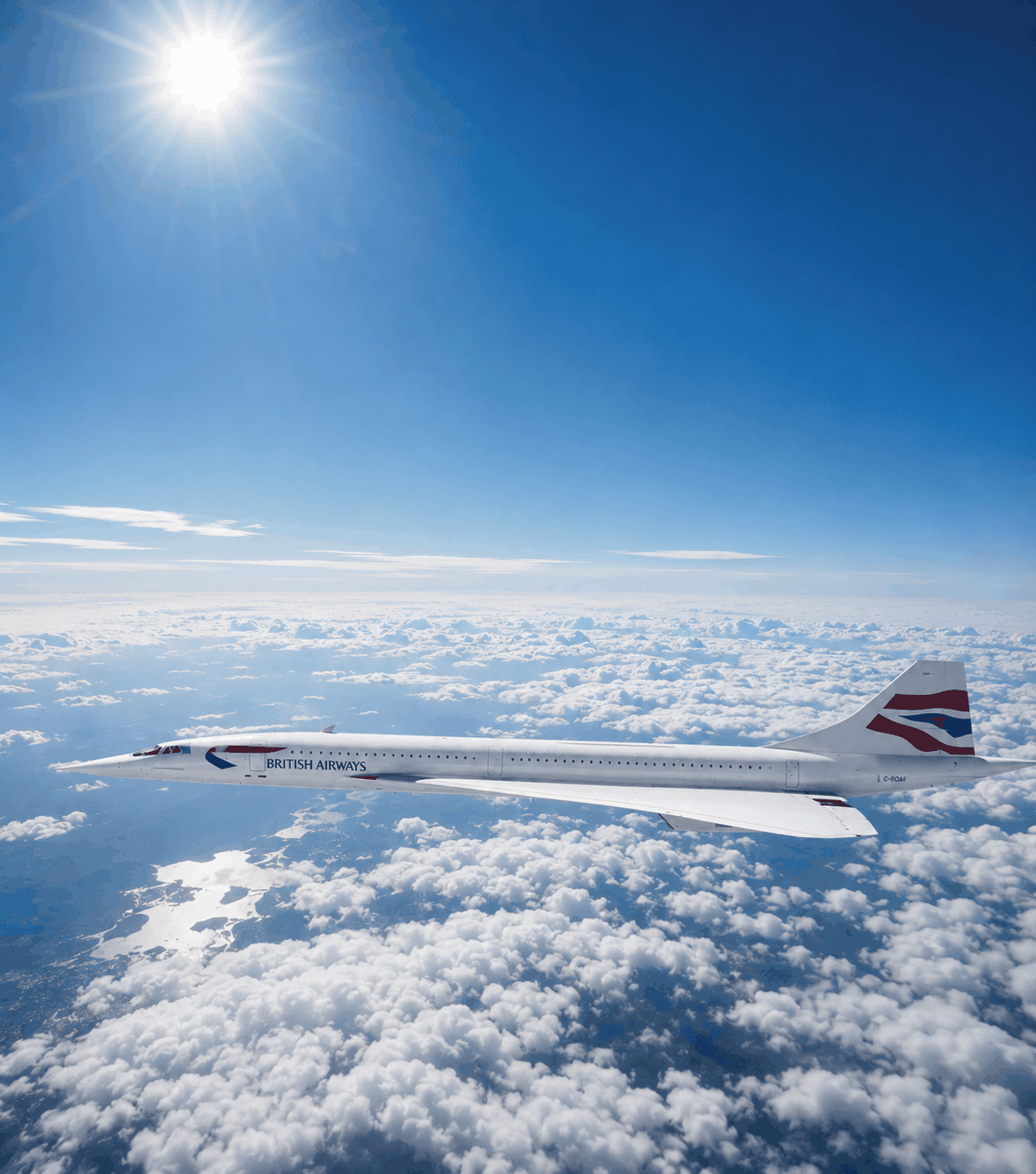
British Airways took the largest single Concorde fleet, and it flies it on more than one route, which is the fact that distinguishes the British supersonic operation from every other.
The Atlantic service to New York is the best known and is flown several times daily. The eastern service, from London to the Gulf and onward, is the one that matters commercially. There is a seasonal Caribbean operation. Between them these have made supersonic travel a normal component of the airline’s network for fifty years rather than a single prestige run maintained for reasons of national feeling.
Why the British operation pays
The reason is geography, and it is the reason the article’s whole subject exists.
A supersonic transport is prohibited from exceeding the speed of sound over land almost everywhere, so a supersonic route is viable only where the ground beneath it is water or empty. Pan American had exactly one such corridor it was permitted to serve: New York to London. Its structural weakness had always been the absence of a domestic network, and the one aircraft that might have transformed a domestic network was the one aircraft it was forbidden to fly over one.
British Airways had an empire. London to the Gulf is sea and desert nearly the whole way. The Gulf onward to the east is more of the same. The Atlantic is the Atlantic. The imperial network, laid out in the 1920s to follow the map of British possessions, happened to consist very largely of routes over water and over sparsely populated ground, and it turned out sixty years later to be almost exactly the network a supersonic aircraft could fly.
So the British operation supports several thousand premium passengers a day across several routes and covers its costs, and the American operation is one rotation, publicly subsidised, maintained by an instruction of the House of Commons. The difference is not ownership, not management and not national character. It is that one airline’s route map was drawn over oceans.
Concorde at present
The type is fifty-two years in service and the airline expects to operate it for some years yet. The airframes are old and have flown remarkably few hours for their age, since a supersonic aircraft on premium routes makes few cycles a day. A structural life extension programme, funded jointly with the manufacturer, has been running since the 2010s.
The fleet is smaller than it was. Some frames have been retired and cannibalised, and the seasonal services have been reduced. The core Atlantic and eastern operations continue at close to their historic frequencies and are, by the airline’s account and by the assessment of analysts who have examined the disclosed figures, profitable.
The carbon argument
The supersonic fleet is the most attacked asset the company owns and its defence of it is entirely commercial, because a private company has no other kind of defence available.
The type burns something over three times as much fuel a passenger as the subsonic aircraft flying alongside it. British Airways is not accountable to Parliament for its emissions in the way that Pan American is, and it therefore faces campaigners, institutional shareholders and the Concert’s regulatory machinery rather than a select committee. Its answer to all three is that the fleet runs on sustainable fuel under a dispensation, that it is a small fraction of the company’s total emissions, and that the passengers who use it would otherwise fly subsonically on the same routes at a comparable total cost in carbon.
The first two propositions are correct. The third is contested, and the contest is unresolved.
The second Concorde
The memorandum
In November 2027 the government of the United Kingdom of America, the government of the French Empire and the Commission of the European Concert signed a memorandum at Straßburg on the joint definition of a supersonic transport aircraft, with Boeing, Aérospatiale and Airbus as the industrial partners. Nothing has been ordered. The aircraft has deliberately not been named.
Britain is not a principal, and Britain built the first one. That fact was expected to produce a national grievance and has produced, instead, something closer to quiet satisfaction, for a reason that took some months to become publicly apparent.
The engine contract
Britain has the propulsion.
Rolls-Royce supplied the engines for the original aircraft and holds the contract to develop the powerplant for the successor, and the powerplant is where the difficulty, the intellectual property and a very large share of the programme value sit. An airframe that must cruise supersonically without an afterburner, meet subsonic noise limits at take-off, and do both while burning a fuel the regulators will accept in 2045 is a propulsion problem before it is an aerodynamic one, and the number of organisations on earth capable of attempting it is small.
The arrangement is therefore junior in billing and senior in substance, and the British government, which understands this perfectly well, has made no effort to correct the impression that London was passed over. Ministers answer questions about British exclusion from the programme with a form of words about full participation through the consortium, and decline to elaborate.
The aircraft it sold
In 2027 the airline sold a surplus Concorde outright to American Airlines. It was a small transaction, conducted by people well below board level, and it has caused more trouble than anything the company has done in twenty years.
The commercial logic was unremarkable at the time. The fleet has been consolidating for years, several frames have been retired and cannibalised, and a surplus supersonic airliner is not an asset but a storage cost: there is no resale market, because no other operator on earth is certificated to fly the type. Somebody offered to take one away and pay for the privilege, and the disposal went through on the nod.
Pan American, British Airways’ partner in the North Atlantic joint business, objected in public and with considerable heat. Its case was that its ally had put a supersonic aircraft permanently into the hands of its principal domestic rival, to open a Pacific route Pan American is itself legally barred from flying because the House of Commons tied its frames to London in 2008 and has never untied them.
British Airways’ answer was that the aircraft was its property, that the sale was commercial and unexceptional, and that the alliance concerns the North Atlantic and confers no veto over the Pacific. All of that is accurate and none of it addresses the complaint, which was never really about law.
What it cost the company
The awkward part is not the diplomacy. It is that the airline sold, cheaply and without much thought, the one thing it possesses that cannot be replaced.
There are roughly thirty-four Concorde airframes in the world and there will never be another. British Airways holds most of the airworthy ones, which for fifty years has been an inconvenience of fleet management and is now, since somebody demonstrated a supersonic Pacific route, a genuinely scarce asset with a demonstrated commercial use. The company sold the first at scrap-adjacent money. It will not sell the second at anything like it, and the buyer knows that as well as the seller does.
Internally the episode has been described, by people who were not consulted, as the most expensive four lines ever written into a disposal schedule.
The episode is a fair illustration of what the alliance actually is. Two carriers cooperate closely on the corridor where cooperation pays them both, and remain entirely separate companies everywhere else, and the arrangement functions precisely because neither has ever been asked to define where the partnership stops. In 2027 somebody asked.
What London actually thinks
The British aircraft industry’s own view, insofar as it can be inferred from what it does rather than what it says, is that leading a civil supersonic programme is a way to destroy a company and that it has already done it once.
The first Concorde was a technical triumph and a commercial catastrophe for the firms that built it, sustained only because two governments could not lawfully stop paying for it. The national champion that survived that experience is profitable in defence, in regional aircraft, in space and in structures, and has shown no observable appetite to bet itself on a second attempt. It is building the wings. It is not building the aeroplane, and it is not asking to.
Whether this is prudence or a failure of national nerve is argued in the trade press and occasionally in the Commons, generally by people who do not have to sign the guarantees.
The Atlantic alliance
The joint venture
British Airways and Pan American World Airways operate the North Atlantic as a joint business. They coordinate schedules, sell each other’s seats, align fares and share the revenue of the combined operation according to a formula neither has ever published.
The arrangement was built in stages from the late 2000s and is now deep enough that a passenger crossing between the two realms may be sold a ticket by one airline, flown by the other, and served by staff who could not say which company’s revenue their aircraft is generating. It is highly profitable for both. It has removed most of the competition from the corridor that each carrier regards as its most important, which is the same statement viewed from the other side.
A private company and a foreign government
The legal oddity is that one of the parties is a listed public company and the other is a public corporation wholly owned by a foreign Crown.
British Airways is therefore in permanent commercial partnership with an instrument of the American state, sharing pricing, capacity and revenue with a body whose ultimate shareholder is a government. Its own shareholders benefit from this. Its competitors point out, correctly, that a private firm and a state cannot be brought to the same table by a competition authority in the same way, because only one of them can be made to answer for the conduct of the other.
The regulators
Competition authorities on both sides of the Atlantic have circled the arrangement for the better part of twenty years without resolving it.
The Concert’s competition directorate has opened and closed two inquiries. The Realm’s authorities have examined it twice. Each has extracted undertakings on slots, on frequencies and on the treatment of connecting carriers, and each has stopped short of the finding that would require the alliance to be broken up. The reason is not obscure. Breaking it up would be a substantial commercial injury to a British public company and a substantial political injury to an American public corporation, at a moment when both governments have reasons to want the aviation relationship between the realms to be calm, and no regulator has yet been willing to be the one that does it.
The question of whether a privatised national carrier should be in joint venture with a foreign government’s airline at all has accordingly never been answered. It is raised every few years, examined at length, and set down again.
The personal union
Underneath the commercial arrangement sits a constitutional one.
Britain and the Realm share a sovereign, and the aviation relationship between them reflects it. There is a treaty-level open skies arrangement older and more permissive than either country has with anyone else, mutual recognition of airworthiness certificates, licences and crew qualifications, and eased entry arrangements for subjects of either realm. It is not a common travel area and neither government describes it as one, but a passenger crossing between London and New York meets noticeably less friction than a passenger crossing between London and almost anywhere else.
The arrangement is old, useful and quietly eroding. The Concert’s rules on external aviation agreements bind Britain in ways that were not contemplated when the arrangement was made, and the Realm’s post-2006 security settlement operates on data-sharing arrangements the Concert’s Commission examined in its first months and its Court has been asked to. Both realms would prefer not to have to state precisely what is left of it, and both have so far managed not to.
Heathrow
The constraint
The airline’s principal hub is Heathrow, and Heathrow is full.
It has been effectively full for thirty years. It handles more international passengers than any airport in the world on a site smaller than most of its competitors use, with fewer runways, hemmed in by west London on every side, and it does so at a level of utilisation that leaves no margin for weather, failure or delay. A morning of fog in west London is felt as far away as Sydney.
The reason the constraint bites so hard here is that Britain’s aviation is unusually concentrated and its flag carrier’s network is unusually dependent on connections. An imperial network needs a hub, and this is the hub.
Slots
The scarcity has produced the airline’s single most valuable asset, and it is not an aircraft.
British Airways holds slightly over half the take-off and landing slots at Heathrow, an inheritance from the days when the airport was built around the state carrier and the state carrier was given what it needed. Those slots are worth, by any estimate, more than the fleet. They are the reason the company can operate the network it does, the reason no competitor can replicate it, and a substantial part of the reason anyone would want to buy the airline.
Trapped and complicit
The company’s public position for forty years has been that Heathrow must be expanded. Its commercial interest is in the opposite direction, and everybody knows it.
A third runway would relieve the constraint that damages the airline’s punctuality, limits its growth and forces it to fly a network it would not design from scratch. It would also flood the airport with slots, and the value of the airline’s holding, and the barrier to entry protecting its position, would fall accordingly.
British Airways has therefore supported expansion in public, in general terms, for four decades, while arguing in detail against nearly every specific scheme proposed, on grounds of cost, of design, of the charges the airport would levy to pay for it, and of the terms on which new capacity would be allocated. It has been accused of bad faith continuously and has never been caught at it, because every individual objection it has raised has been a reasonable objection. Whether an airline that opposes every practicable scheme can be said to support the principle is a question its critics regard as settled and the company does not.
The fleet
Mostly European
The subsonic fleet is predominantly Airbus with a substantial Boeing minority, and the balance has moved steadily toward the European manufacturer over thirty years.
The airline states, accurately, that it buys on commercial terms and that its orders reflect what was offered when it needed aircraft. It is also true that Britain is inside the Concert, that British industry builds the wings of most of what the airline flies, and that a British order for European aircraft is politically easier in London and in Brussels than the alternative.
The politics of buying
Every large order the airline places is treated as a political event, which it finds tiresome and which it has never been able to prevent.
The golden share does not extend to fleet procurement and no government has attempted to direct it. Governments have nonetheless made their preferences known before every major order for as long as anyone can remember, and the airline has occasionally allowed the impression that a preference was decisive when in truth the aircraft was cheaper. It is a small dishonesty that costs the company nothing and buys it goodwill it later spends.
Labour
A career airline
British Airways is an employer people join for life, and the shape of its industrial relations follows from that.
Seniority governs nearly everything for flying staff: which fleet a person flies, which routes, which base, which shifts, what they are paid and when they may retire. A career progresses by waiting. The system is transparent, it is fiercely defended by those inside it, and it makes every change to working practice a change to the terms of a bargain that people have already spent decades paying into.
The cabin crew disputes
The airline’s labour history is dominated by its cabin crew, and by a union relationship that has been adversarial for fifty years.
The pattern recurs. The company concludes that its cabin costs are higher than its competitors’, which is true, and that they are higher because of terms agreed when it was a state monopoly, which is also true. It proposes changes. The union, whose members regard those terms as the accumulated product of a career and not as a legacy inefficiency, refuses. There is a ballot, there is a strike, flights are cancelled, both sides brief against each other in the newspapers, and an agreement is reached that gives the company most of what it asked for at a cost in staff relations that takes years to repair. Then the cycle begins again.
The most serious of these disputes ran across the turn of the 2010s, grounded a large part of the operation, cost the company several hundred million pounds and produced litigation that ran for years afterward. Neither side emerged well. The company was found to have withdrawn travel benefits from strikers in a manner a tribunal considered punitive. The union was found to have conducted parts of its campaign in ways that were, at best, careless of members who did not support it.
The parallel workforce
The company’s recurring answer to its cost problem has been to create a second workforce on cheaper terms, and it has done this several times.
Hong Kong crews are the oldest instance and predate the strategy as a strategy. A separate short-haul subsidiary was created in the 1990s. A new-entrant cabin crew fleet on distinct terms was established after the disputes of the 2010s and now carries a large share of the flying.
The airline’s case is that it competes against carriers with structurally lower costs and cannot pay 1975 terms. The unions’ case is that the company has spent thirty years solving the same problem by hiring people who are not allowed to have what the last people had, and that it now runs an operation in which two crew members on the same aircraft doing the same job are on materially different money.
Both cases are correct, and the airline has not found a resolution, in part because a resolution would cost something and in part because the present arrangement, while indefensible in principle, works.
The cabin
Four classes, and then fewer
The long-haul cabin was for most of the airline’s history divided into four distinct classes, sharply separated, with a first cabin that was genuinely grand.
Over the last two decades the company reduced the distinctions deliberately. The first cabin was cut back and on many routes withdrawn, the business cabin was improved to absorb the traffic, and the two rear cabins converged. The commercial reasoning was straightforward: the market for a very expensive fourth class had thinned, the cost of maintaining it across a large fleet was substantial, and the space was worth more given to the cabin that actually sold.
The levelling
The traditionalists have never forgiven it, and the criticism is more interesting than nostalgia.
The argument made against the levelling is not that grand cabins are pleasant, though the people making it generally think so. It is that British Airways had one thing no competitor could copy, which was ninety years of knowing how to do formality without embarrassment, and that it gave this up in order to be marginally more like carriers it can never out-compete on cost. The company’s reply is that it is a business and not a museum, and that the passengers who mourn the first cabin were largely not paying for it.
There is a reasonable case that the levelling is the single decision that turned an airline people were proud of into an airline people rate. There is an equally reasonable case that the pride was always a minority sentiment among people who turned left, and that the airline is better for having stopped organising itself around them.
The dirty tricks affair
The rival
In the 1980s a privately founded long-haul carrier began operating from London against British Airways on the Atlantic and on several imperial routes. It was small, well publicised, popular, and built its entire public identity on being everything the flag carrier was not.
It was also, from the flag carrier’s point of view, an existential nuisance. It competed on the routes that generated the profit that funded everything else, it did so with lower costs, and it attracted precisely the passengers British Airways could least afford to lose.
The campaign
Between roughly 1991 and 1993 British Airways conducted a covert campaign against it.
Staff accessed the rival’s passenger booking records through a shared industry reservation system and used them to identify its passengers. Those passengers were then approached directly, at airports and by telephone, and offered inducements to transfer. False information about the rival’s financial condition and the reliability of its services was briefed to journalists and to travel agents. A public relations operation was run against the rival’s founder personally, characterising him as unstable and his company as unsound. Documents relating to the campaign were destroyed when the matter began to attract attention.
The action
The rival’s founder sued for libel. British Airways defended the action, then abandoned the defence.
In 1993 the company apologised unreservedly in open court, accepted that the allegations it had circulated were untrue, and paid substantial damages and the costs of both sides. Its chairman resigned some months later. The affair is the most serious institutional failing in the company’s modern history and there is no version of it in which the company is other than culpable: it was a deliberate campaign, authorised internally, conducted over two years, and concealed.
What happened afterwards
The rival won in court and lost in the market.
It took the damages, it received a great deal of sympathetic publicity, and it did not recover. The campaign had done what it was designed to do. Bookings that transferred did not transfer back, the financing the company needed became more expensive on terms that were harder to obtain, the questions about its stability had been asked and could not be unasked, and it contracted over the following years and was eventually broken up, its aircraft and its routes dispersed.
This is the part of the affair the airline is least often made to answer for, and it is the part that matters most. The public account of the dirty tricks affair is a story about a large company that behaved disgracefully, was caught, and was humiliated. The commercial account is that the campaign succeeded. British Airways paid damages, lost a chairman, endured a bad two years, and removed a competitor from its most valuable routes, and it has held those routes ever since.
The British market is crowded and hard-fought, and British Airways competes in it against several substantial carriers. None of them is the one it set out to destroy.
Two flights
Flight 009
On the evening of 24 June 1982 a British Airways flight on the Kangaroo Route, en route from Kuala Lumpur to Perth, flew into a cloud of volcanic ash from an erupting Indonesian volcano at thirty-seven thousand feet. The ash was invisible on radar and invisible at night. All four engines flamed out.
The aircraft became a glider carrying two hundred and sixty-three people over the Indian Ocean at night. The crew ran the relight drills as the aircraft descended, over and over, for sixteen minutes and some twenty-four thousand feet of altitude. As the aircraft came down into warmer, denser air the solidified ash cooled and broke away from the turbine blades, and the engines restarted, one after another. The crew climbed away, found that the windscreen had been sandblasted opaque by the ash and that they could see forward only through a narrow strip at the side, and landed at Jakarta by instruments and by looking sideways. Nobody was hurt.
The episode is remembered in Britain less for the airmanship, which was extraordinary, than for the announcement the captain made to the cabin partway down. He informed the passengers that all four engines had stopped, that the crew were doing their utmost to get them going again, and that he trusted they were not in too much distress. It is quoted in the country the way other countries quote poetry, and it is quoted approvingly, because it is exactly what the British believe they would like to think a person in that position would say.
The airline has never used it in advertising. Several people have suggested it and the answer has always been that it would spoil it.
Flight 5390
On 10 June 1990 a British Airways flight climbing out of Birmingham lost a cockpit windscreen at seventeen thousand feet. The panel had been refitted the night before with bolts very slightly too small, selected by a shift maintenance manager working alone and at night from a stores carousel, and the pressure differential blew it out.
The captain was pulled out of his seat and through the aperture, and was held in the airflow, outside the aircraft from the waist up, at three hundred knots. A steward who had been in the cockpit caught him by the legs and held on. The flight deck door had been blown onto the throttle quadrant, the cabin was in uproar, and the first officer flew the aircraft while the crew behind him held their captain against the wind. A second steward took over when the first lost feeling in his arms. The first officer declared an emergency and landed at Southampton eighteen minutes later. The captain survived, with frostbite, fractures and shock, and returned to flying within five months.
The investigation into the maintenance failure was unsparing and the company accepted its findings without argument, which is worth recording because it did not always. The changes to shift working, to stores procedure and to the supervision of lone night maintenance that followed were adopted across the industry.
Between them the two flights are how the airline is understood in Britain when it is understood favourably: as an organisation whose people, at the moment the machinery fails, tend to be very good and very calm. It is a reputation the company has done nothing to cultivate and does not entirely deserve at every level of the business, and it is nonetheless the reason that a public which complains constantly about British Airways defends it instantly to foreigners.
The Crown
The warrant
British Airways holds a Royal Warrant, displays it, and is bound into the ceremonial life of the state more closely than any other commercial company in Britain.
This is the exact inverse of the position of Pan American, which holds no warrant, carries no Crown in its name, and is kept deliberately at arm’s length from a monarch who owns it outright. The Realm keeps its state airline constitutionally plain. Britain decorates a company the state does not own.
The household and the state
What the warrant means in practice is substantial without being what people assume.
The airline carries the royal household, the private secretaries, the staff, the baggage and the freight of royal and state occasions, and it does so on scheduled services and by charter. It carries government ministers, official delegations, and the working parties that precede a state visit. When the sovereign travels abroad the airline is generally somewhere in the logistics of it, moving the people and the material that arrive before he does and leave after.
It also carries members of the royal family other than the sovereign on ordinary scheduled services, which is unremarkable in Britain and is regarded as extraordinary by visitors.
Not the sovereign
What it does not do is carry the sovereign.
The King is flown by the Royal Air Force, under arrangements that long predate the airline’s privatisation and were not altered by it. The reasoning offered at the time of the sale was security and continuity of control, and the reasoning that was not offered but was certainly present is that a government which had just sold the flag carrier did not wish to answer questions about the sovereign travelling on a private company’s aircraft.
The result is a small elegance of the personal union. The sovereign is King in right of Great Britain and King of the Realm, and in each of his two largest realms he is carried by a different service: by the Royal Air Force in Britain and by the Royal American Air Force in America. Neither of the two great flag carriers of the union ever flew Ernest V, and neither has flown his son. Only one of them has ever wanted to.
Climate
A private company’s exposure
Aviation is the hardest sector in the Concert’s climate settlement and British Airways is the most visible operator in Britain, but the pressure it faces is of a different kind from the pressure on Pan American, and the difference is instructive.
Pan American answers to Parliament. A select committee can require its chief executive to attend and explain, and the answers become political events. British Airways answers to its shareholders, to the Concert’s regulators and to the courts, and its exposure is accordingly commercial and legal rather than parliamentary. It faces institutional investors with mandates, disclosure obligations it must satisfy precisely, a Concert emissions regime it must buy its way through, and litigation risk. It does not face a committee, and it is therefore never obliged to give an account of itself in public in the way the American carrier is.
Whether this is an advantage is not obvious. The company has more freedom of action and less opportunity to make its case, and the criticism it attracts is correspondingly harder to answer, because there is no forum in which answering it counts for anything.
The supersonic problem
The Concorde fleet is where all of this concentrates.
The airline’s position is commercial and it has no other position available. It states that the fleet is profitable, that it operates on sustainable fuel under dispensation, that it accounts for a small fraction of the company’s emissions, and that it will be replaced or retired when one of those propositions ceases to hold. It does not argue that the aircraft is good for the world. It argues that it is lawful, that people wish to buy it, and that a public company is not the right body to decide that they should not be allowed to.
The argument that this is precisely the reasoning a public company would offer, and precisely why such decisions should not be left to one, is made regularly and is not answered.
The airline now
What it is
British Airways is profitable, large, and the principal carrier of a country whose aviation market is among the most competitive in the world. It flies to more destinations than at any point in its history and holds a smaller share of nearly all of them than it did sixty years ago. It is the largest operator at the busiest international airport in the world, on a site it cannot expand and does not entirely want expanded.
It is respected and not loved, and the distinction is stable enough to be a national characteristic rather than a passing verdict. The British complain about its fares, its rear cabins, its handling of disruption and its manner, and defend it without hesitation the moment a foreigner agrees with them.
What is argued about
The live arguments are the ones this article has set out: whether the golden share protects anything or merely appears to; whether an alliance with a foreign government’s airline is a legitimate arrangement for a private company; whether a company that has opposed every practicable Heathrow scheme can be said to support expansion; whether two crew members on the same aircraft should be on different money; and whether the airline was right to level its cabins.
None of these is close to resolution and several of them are older than most of the people conducting them.
The empire question
Beneath all of it is the question the company cannot settle about itself, which is whether the network is an asset or a habit.
One account says that the imperial map is the most valuable thing British Airways owns. It is a set of routes and rights accumulated over a century, held continuously and therefore never renegotiated from weakness, reaching markets that are now growing faster than Europe or the Atlantic, and it is the reason the airline can operate a supersonic fleet at a profit when the American carrier cannot. On this account the company’s instinct to keep things has been vindicated repeatedly by people who spent decades calling it sentimental.
The other account says that the airline has been flying the same map since 1938 because it has never been able to bring itself to stop, that it kept the African trunk out of habit for fifty years and was rescued by a demographic accident it did nothing to cause, that it runs two competing services to Australia because it could not choose, and that an institution which treats the abandonment of a route as a defeat is an institution that has confused its history with its strategy.
The Register observes that both accounts explain the same facts, that the company contains people who hold each with conviction, and that the question of which is right has been open for as long as there has been anyone to ask it.
✎ Editor's Note · What actually made Concorde work
The load-bearing joke in this article is that ideology gets the supersonic story exactly backwards. Everything about the setting invites the reader to expect that the state-owned airline is the one flying Concorde on national pride and public money while the privatised one made the hard commercial choice and retired it. The reverse is true. Pan American’s supersonic operation is a single subsidised rotation that the House of Commons had to order it to keep, and British Airways runs a profitable multi-route supersonic network on its own account and would fight anyone who tried to stop it.
The reason is not ownership, management or national character, and the article is careful to say so. It is that a supersonic transport can only go supersonic over water and empty ground, and the imperial route map, drawn in the 1920s to join up British possessions, happens by pure accident to be almost exactly the network such an aircraft can fly. Pan American had one permitted corridor and a structural weakness that was the absence of a domestic network it was forbidden to fly the aeroplane over. The empire is what makes Concorde work, which is a useful thing for an article about an imperial airline to have to admit, because it is neither a moral credit to the empire nor separable from it.
The failings are placed where they actually sat: in employment, in booking policy, and in charter work the company insisted was not its business to have a view about. They are stated without the mitigation the company itself spent forty years attaching to them, and the deniability of the passenger refusals is treated as evidence rather than as absence of evidence, because a practice constructed to leave no records is not thereby a practice that did not happen. The dirty tricks affair is included in full and given the ending it really had rather than the ending the story usually gets: the campaign was disgraceful, the company was caught and humiliated, and it worked. Leaving that out would have made the article more comfortable and less true.
Chronology
| Year | Event |
|---|---|
| 1924 | The government merges four subsidised private companies into Imperial Airways and charges it with linking the empire by air |
| 1929 | The eastern route reaches the Persian Gulf and Karachi, flown in stages with a rail segment across Europe |
| 1932 | The Speedbird emblem is adopted. It is carried for sixty years and survives thereafter as the callsign |
| 1932 to 1935 | The African trunk opens from Cairo to Cape Town |
| 1933 | The eastern route reaches Singapore |
| 1935 | The through service to Australia opens: twelve and a half days, more than thirty stops. It becomes the Kangaroo Route |
| 1939 | Scheduled transatlantic service begins, months after Pan American opens the route westward. Legislation merges Imperial Airways with the private British Airways Limited to form the British Overseas Airways Corporation (BOAC), publicly owned from the outset |
| 1940 | BOAC begins operations. France hostile and the Mediterranean closed; the empire service is rerouted south and east as the Horseshoe and is flown continuously for the rest of the war |
| 1945 | BOAC emerges with an intact network, a worn fleet, and civil war dead who held no combatant status |
| 1946 | BOAC is divided rather than nationalised, being state-owned already. British European Airways (BEA) takes the Continent and the domestic trunks; a short-lived South Atlantic corporation is folded back into BOAC |
| 1952 | The world’s first scheduled jet airliner service, four years ahead of any competitor |
| 1954 | Two Comets break up in flight. The fatigue investigation is exemplary, the findings are given freely to the world, and the commercial lead is lost |
| 1960s | The bar on flight deck appointments for colonial and Asian staff finally breaks, four decades after it was established |
| 1962 | Britain and the French Empire sign the Concorde treaty, deliberately drafted without a withdrawal clause |
| 1973 | The Concorde export order book weakens but does not collapse, Pan American having exercised rather than cancelled. Some thirty-four airframes are eventually built |
| 1974 | BOAC and BEA are merged as British Airways, reviving the name of the private company absorbed into BOAC in 1939 precisely because it belonged to neither corporation. Two seniority lists, two payrolls and two cultures survive the merger |
| 1976 | Concorde enters service. British Airways takes the largest single fleet and flies it on the Atlantic, to the Gulf and onward east, and seasonally to the Caribbean |
| 1982 | Flight 009 loses all four engines in volcanic ash over Indonesia, glides for sixteen minutes, restarts them and lands. Nobody is hurt |
| 1980s | Restructuring, then privatisation. The Crown retains a golden share over control, the name and the imperial routes |
| 1990 | Flight 5390 loses a windscreen at seventeen thousand feet. The captain is held in the airflow by the cabin crew and the first officer lands the aircraft |
| 1991 to 1993 | The covert campaign against a smaller British long-haul rival: booking records accessed, passengers poached, false briefing, documents destroyed |
| 1993 | The airline apologises unreservedly in open court and pays substantial damages. The chairman resigns some months later |
| 1990s | The identity is redrawn. The Speedbird gives way to the Speedmarque, a Union Flag streaming backward, beside the name in dark blue capitals. A separate proposal to replace the national branding altogether is considered and rejected, as is a proposal to name aircraft after British cities |
| 2000s | The rival that won in court is broken up. British Airways has held the routes ever since |
| Late 2000s | The North Atlantic joint business with Pan American is assembled in stages |
| 2010s | The most serious of the cabin crew disputes. A structural life extension programme for Concorde begins. Nonstop London to Sydney is introduced and fails to kill the stopping service |
| 2011 | A commissioned review describes the employment colour bar as sustained institutional discrimination and apologises. No compensation scheme follows |
| Nov 2027 | The supersonic successor memorandum is signed at Straßburg without Britain as a principal. Rolls-Royce holds the engine contract |
| 2028 | Profitable; the largest operator at Heathrow; still flying Concorde, and still flying almost every route it was created to fly |
Trivia
- In-Universe Every British Airways flight in the world identifies itself to air traffic control as Speedbird, after an emblem the aircraft stopped carrying in the 1990s. It is the oldest continuously used callsign in commercial aviation, it survives now only as a spoken word, and most of the people saying it have never seen the mark it is named after.
- In-Universe British Airways does not name its aircraft, and this is a policy rather than an oversight. A proposal in the 1990s to name the fleet after British cities was rejected on the ground that it would look like an attempt to be Pan American.
- In-Universe The company flies two competing services between London and Sydney, one nonstop and one with a stop, because it has twice tried to withdraw the stopping service and twice retreated. Neither the board nor the unions nor the travelling public can agree on which one should die.
- In-Universe Roughly half the take-off and landing slots at the busiest international airport in the world belong to one company, as an inheritance from the period when the airport was built around a state carrier. The slots are worth more than the fleet.
- In-Universe The airline has supported the expansion of Heathrow in principle for forty years and has objected in detail to nearly every scheme proposed for it. Each objection has been individually reasonable. Nobody has ever caught the company out, and nobody believes it either.
- In-Universe The sovereign is King in right of Great Britain and King of the Realm, and in each of those realms a different service flies him: the Royal Air Force in Britain, the Royal American Air Force in America. Neither of the two great flag carriers of the personal union has ever carried the sovereign.
- In-Universe The empire service was never interrupted by the Second Great War. With France hostile and the Mediterranean shut, the airline flew down the west African coast, across the continent and back up to Cairo before turning east, and called the shape it made on the map the Horseshoe.
- In-Universe The captain of Flight 009 told his passengers that all four engines had stopped, that the crew were doing their utmost to get them going again, and that he trusted they were not in too much distress. The airline has repeatedly declined to use the line in advertising, on the grounds that it would spoil it.
- In-Universe You can date a photograph of a British Airways Concorde by its tail. A Speedbird on the fin puts it before the 1990s; a Union Flag ribbon puts it after. The second kind is not a picture of a preserved aircraft, because in this Realm the type never stopped flying.
- In-Universe The ribbon on a British Airways tail is a Union Flag streaming backward in the airflow, and the redesign that put it there is regularly mistaken for the opposite of what it was. Other flag carriers spent that decade trying to look less national. This one replaced a seventy-year-old abstraction with the flag itself.
- In-Universe British Airways runs a profitable supersonic network and Pan American runs a subsidised single rotation, and the reason is neither ownership nor management. It is that a supersonic aircraft may only go supersonic over water, and the imperial route map happens to be drawn almost entirely over oceans and desert.
- In-Universe Britain built the first Concorde and is not a principal in the second. It holds the engine contract instead, which is where the difficulty and most of the value are. Ministers answer questions about British exclusion with a form of words and decline to elaborate.
- In-Universe The airline's Hong Kong operation is a full base with locally domiciled crews on local terms, and it is the oldest of the parallel workforces the London unions have spent thirty years objecting to. It is also the reason a large share of the company's Asian traffic never touches London.
- In-Universe The 2011 review into the airline's historic employment practices described four decades of colour bar as sustained institutional discrimination and apologised for it. It was not accompanied by a compensation scheme, and that remains a live grievance.
- In-Universe Asked in the 1990s on what authority non-white passengers had been refused bookings on the empire routes, the company said a search of its archives had located no such policy. This was probably true. The practice had been built from the beginning so that no such document would ever exist.
- Design Pan American names every aircraft and British Airways names none; Pan American is owned outright by a Crown that keeps it constitutionally plain, and British Airways is owned by shareholders and carries a Royal Warrant. The two flag carriers of the personal union have spent a century being deliberately unlike each other, and the article is built to be read against the other one.
- In-Universe British Airways is named after a company that has not existed since 1939. The title belonged to a private carrier absorbed into BOAC at its formation, and it was chosen for the 1974 merger precisely because it was neither merging corporation's, so that neither could be said to have swallowed the other.
- Real-World Imperial Airways, BOAC, BEA, the Speedbird, the Comet fatigue investigation, the Horseshoe Route, the 1974 merger, the 1980s privatisation, the golden share, Flight 009, Flight 5390 and the dirty tricks affair all happened in our own history much as they are described here. The divergence is that the empire they were built around did not end.
- Real-World British Airways gave up its Concorde options in neither history: it was Pan American that cancelled in our world, in January 1973, and because Pan American was the bellwether the rest of the export book went with it. Here it exercised, so roughly thirty-four airframes were built instead of twenty and the type is still flying.
- Real-World The Comet investigation of 1954, in which a complete airframe was destroyed in a water tank to reproduce the failure, is real, and its findings were published in full and handed to the competitors who benefited most. Every pressurised airliner flying today is built to principles it established.
- Real-World The covert campaign against a smaller British rival, the open-court apology and the damages are all real. So is the part that gets left out: the rival won the case and did not recover, and the airline has held the contested routes ever since.
- Real-World In the history of our world the export order book for Concorde collapsed in 1973, when the oil crisis, the overland prohibitions and a sustained environmental campaign led sixteen airlines to abandon roughly seventy-four options within a few months. The first and most consequential cancellation was Pan American's, and the rest followed it.
See also
- Pan American World Airways - the Realm’s flag carrier, publicly owned and never sold, and the airline this one is best understood against
- United Kingdom of Great Britain - the senior island sister realm
- The European Concert - the single aviation market the airline operates inside
- Kai Tak Airport - the Hong Kong base itself, where the airline’s slot position is contested by Cathay Pacific
- Empire of China - reached from the Hong Kong base
- The Second Great War - the conflict during which the empire service was rerouted rather than suspended
- The May Day Bombings - the attack on the airline’s Atlantic partner at its own hub
Categories
Institutions · Aviation · Great Britain · Commerce and Industry