Duchy of Normandy
The Duchy of Normandy (Norman: Duchie de Normaundie; French: Duché de Normandie), commonly known as Normandy, is a semi-independent constituent duchy of the French Empire in north-western Europe. It occupies the mainland territory between Brittany, the Loire country, central France, the Paris region, Picardy, and the English Channel. Rouen is the capital. The population is approximately 3.8 million.
Normandy is neither a sovereign state in ordinary constitutional law nor an ordinary region of France. Its present status derives from the Treaty of Versailles, the postwar French Constitution, and the Norman Constitution of 1948. The Emperor of the French embodies common French sovereignty in defence, foreign affairs, and other reserved matters. George V separately reigns as Duke of Normandy and heads the autonomous domestic order. Neither monarch is constitutionally subordinate to the other.
The duchy has its own nationality, legislature, elected executive, courts, law, taxation, policing, prosecution, prisons, education system, labour law, infrastructure, and social policy. Norman nationality automatically includes French citizenship. The five French departments that once divided the territory no longer operate as governments. Administrative districts follow historical Norman pagi, while elected communes remain the principal local-democratic units.
The 72-member Estates of Normandy is elected by regional single transferable vote for fixed four-year terms. The President of the Norman Council is elected directly for four years through a two-round ballot. The Supreme Court of Normandy, seated in Rouen, decides ordinary appeals, constitutional petitions, and disputes about the French-Norman compact. The Duke retains substantial reserve powers, most of which are subject to joint constitutional review.
Norman is the sole official language. Statutes are enacted in equally authoritative Norman and French texts, and French speakers have a right to use French before courts and public bodies. The national currency is the Norman livre, maintained at parity with the French franc by a public currency board. Normandy participates in the French common market and defence guarantee but may adopt higher labour, consumer, and environmental standards within its competence.
Normandy is one of George V’s fourteen legally distinct capacities. Thirteen of those capacities are sovereign; Normandy is the single constituent capacity. The established total remains eleven kingdoms, two duchies, and one empire. The duchy is, exceptionally, a separate member of the League of Nations and is treated as sovereign for League purposes within its competences. It holds observer status in the European Concert.
The economy combines agriculture, food processing, biotechnology, ports, shipbuilding, energy, transport equipment, tourism, and public services. Le Havre, Rouen, and Cherbourg are coordinated by a public port authority. Public ownership remains extensive in rail, energy, water, grids, broadband, and major maritime infrastructure. Sectoral bargaining, works councils, protected strikes, and employee purchase rights form part of the social-market settlement.
The national flag is a red banner bearing two gold lions passant guardant, traditionally described as leopards. Ma Normandie is the civic anthem and God Save the Duke is the ducal anthem. The motto is Diex Aïe. Liberation and Restoration Day is observed on 6 June, while 14 July remains a co-equal public holiday within the French constitutional union.
The principal constitutional dispute in 2027 concerns a French proposal to expand the Cherbourg naval yard as an exclusively French enclave for nuclear-powered, conventionally armed attack submarines. Norman institutions oppose exemptions from Norman labour, environmental, land, policing, and criminal law. The Supreme Court has issued interim protection but has not decided whether it has jurisdiction over the defence reservation. Construction has not begun and the existing yard continues to operate.
Etymology
The name Normandy derives from the settlement of Scandinavian groups along the lower Seine and the political territory formed under their rulers. Medieval texts used many spellings. The Anglo-Norman Dictionary records Normandie, Normaundie, Normandye, Normundie, and related forms. The 1948 Constitution chose Duchie de Normaundie for the state’s formal Norman name. It uses Duché de Normandie in French and recognises Duchy of Normandy as the formal English translation.
The choice of Normaundie was part of the postwar reconstruction of a Norman legal register. It did not claim that medieval writing had one fixed orthography. Modern Norman varieties retain differences in spelling, pronunciation, and vocabulary. The Language Academy publishes a legal lexicon for legislation and administration while recognising Cotentinais, Cauchois, Augeron, and other forms in education, broadcasting, literature, and local service.
The word duchy has a narrower constitutional meaning than state. Normandy is a state for domestic law, public administration, and the Treaty of Versailles settlement, but it remains a constituent part of France. The phrase semi-independent appears in official English-language descriptions because Normandy exercises powers associated elsewhere with sovereign states without possessing general international sovereignty. The Constitution avoids the contradictory phrase “independent constituent”.
Normaundie and Normandy are used without an article in formal English. In French, la Normandie remains ordinary. Norman public bodies generally use the Norman name first, followed by French where space permits. International instruments registered with the League use the formal English or French name according to the language of record.
History
To 1775
Antiquity and the early Middle Ages
The territory of modern Normandy was inhabited before Roman conquest by several Gallic peoples, including the Veliocasses, Caletes, Lexovii, Baiocasses, Unelli, Abrincatui, and Esuvii. Roman administration connected their districts to the provinces of Gaul through roads, towns, ports, taxation, and military recruitment. Rouen developed from Rotomagus, Bayeux from Augustodurum, and other centres grew around river crossings, markets, bishoprics, and estates.
Christian organisation developed during late antiquity and the early medieval period. The ecclesiastical province of Rouen eventually included dioceses whose boundaries influenced later territorial divisions. Roman institutions did not survive unchanged, but roads, urban sites, landed estates, and episcopal structures helped shape the geography inherited by Frankish rulers.
After the end of Roman rule, the region formed part of the Frankish kingdoms. Royal power operated through counts, bishops, monasteries, local aristocrats, and shifting territorial units. Viking raids intensified during the ninth century. River access allowed Scandinavian forces to reach Rouen, Paris, and inland settlements. Raiding, settlement, tribute, service, and conversion occurred over several generations rather than in one migration.
In 911, the agreement conventionally associated with Saint-Clair-sur-Epte recognised Rollo’s authority around the lower Seine in return for allegiance, defence, and baptism. The early grant was smaller than later Normandy. Expansion in 924 and 933 brought the Bessin, Hiémois, Cotentin, and parts of the Avranchin under the rulers based at Rouen. Boundaries remained contested, especially towards Brittany, Maine, the Vexin, and the Perche.
The Scandinavian settlers were never the territory’s sole population. They married into local communities, adopted Christianity, used Romance speech, and drew upon Frankish and ecclesiastical institutions. Norse law and custom influenced maritime practice, naming, landholding, and lordship, but the duchy became a mixed polity. Modern teaching avoids both the claim of complete Scandinavian replacement and the older assumption that settlement left only superficial traces.
Formation of the medieval duchy
The title duke became standard gradually. Richard I and Richard II strengthened hereditary rule, monastic patronage, comital administration, and relations with neighbouring princes. The rulers of Normandy used castles, household officers, bishops, abbeys, viscounts, and local aristocrats to govern. Ducal authority remained personal and negotiated, but by the eleventh century it was unusually organised by the standards of northern France.
Norman customary law grew from local practice, ducal judgments, Frankish inheritance, church law, and later written compilation. It was not a democratic constitution. Peasants bore rents, labour services, dues, and judicial burdens that varied by place and status. Towns received privileges because rulers needed markets, ports, craft production, and revenue. Women could hold and transmit some property under customary rules, but law and political authority were structured by status, family, and gender.
Religious houses received land and immunities, participated in reclamation and settlement, and connected Normandy to wider reform movements. Their wealth rested partly on peasant production and lordship. Bishops and abbots served political as well as religious functions. Jewish communities were present in several towns and were exposed to legal inequality, violence, expulsion, and changing policies under ducal and royal government.
The ducal order was capable of coercion. Revolts were suppressed, castles seized, and rival families exiled or dispossessed. The government that later memory described as disciplined relied on force and personal fidelity. Its legal records reveal both administrative capacity and unequal access to power.
The conquest of England
William II of Normandy claimed the English throne after Edward the Confessor’s death in 1066. His invasion defeated Harold Godwinson at Hastings and led to William’s coronation as king of England. The conquest connected Normandy and England under one ruler but did not merge their governments or laws. Each territory retained institutions, aristocratic interests, revenues, and political conflicts of its own.
The conquest transferred land to Norman and allied followers, imposed a new ruling elite, and produced extensive violence. Resistance in England was suppressed through confiscation, castle building, military campaigns, and the devastation of northern districts. Norman monasteries, bishops, merchants, and nobles gained wealth and influence. Movement across the Channel changed language, architecture, administration, warfare, and church organisation in both territories.
In modern Normandy, William’s conquest is treated as the founding national epic because it is the most widely recognised exercise of medieval Norman power. Public commemoration does not present it as bloodless settlement. Museums and schools cover dispossession, civilian suffering, aristocratic rule, and the unequal distribution of conquest gains. The Bayeux Tapestry is interpreted as a political work as well as an artistic and documentary object.
The union of ducal and English royal titles created repeated succession disputes. William’s sons divided and reunited the territories. Henry I defeated his brother Robert Curthose at Tinchebray in 1106 and governed both. After Henry’s death, civil war and Angevin succession connected Normandy to the wider domains of Henry II. The duchy became part of an extensive cross-Channel political system, although local law and identity persisted.
French conquest and incorporation
Conflict between the Angevin rulers and the French Crown intensified under John. Philip II of France captured Château Gaillard and Rouen, and by 1204 had taken most mainland Normandy. The Channel Islands remained with the English Crown. French conquest ended the autonomous mainland duchy as an effective state, even though titles, customs, courts, fiscal privileges, and territorial names continued in altered forms.
The French monarchy integrated Normandy through royal officials, the Exchequer of Normandy, local estates, courts, privileges, and negotiated confirmation of custom. The Coutume de Normandie was written and revised. It continued to regulate private law after the political absorption of the duchy. This legal persistence is one source of the modern doctrine of dormancy, but custom alone did not preserve a separate sovereign executive or legislature.
The English Crown retained claims to Normandy and periodically occupied territory during later wars. The Hundred Years’ War brought sieges, taxation, military requisition, plague, local faction, and changes of ruler. Henry V conquered Normandy in the early fifteenth century and governed it through English and local institutions. French reconquest in 1449 and 1450 restored royal control.
The warfare was not a simple conflict between unified Norman and foreign populations. Norman nobles, towns, clergy, and rural communities made choices under military pressure, local rivalry, legal obligation, and economic need. Some collaborated with English government, others supported the French Crown, and many sought to protect property and survival. Modern public history avoids treating each change of allegiance as a national referendum.
Province under the French monarchy
After the final French reconquest, Normandy remained a major province with distinctive law, estates, courts, ports, towns, and fiscal institutions. The Exchequer became the Parlement of Normandy. Provincial estates negotiated taxation and presented grievances. Royal power expanded, but local offices and corporate privileges mediated its operation.
Rouen grew as a commercial and administrative centre. Dieppe, Honfleur, Le Havre, Granville, and other ports participated in fishing, trade, exploration, privateering, and colonial expansion. Norman merchants and sailors were involved in Atlantic commerce, including systems built on slavery and colonial coercion. The later state treats this history as part of Normandy’s own record rather than as an external French subject.
Religious conflict affected the province during the Reformation and Wars of Religion. Protestant communities became important in several towns, and violence occurred under both royal and confessional authority. The Revocation of the Edict of Nantes drove Huguenots into exile and weakened commercial and craft networks. Catholic institutions remained powerful in education, welfare, landholding, and public life.
Rural Normandy combined grain production, livestock, dairying, orchards, woodland, textiles, and varied tenures. Peasant communities were not culturally or economically uniform. Coastal districts depended on fishing and shipping, while eastern towns developed textile and metal trades. Bad harvests, war taxes, rents, and disease periodically caused severe hardship.
Provincial legal identity remained strong, but it did not amount to independent government. Royal ordinances, intendants, military administration, and fiscal demands reduced older autonomy. The Parlement sometimes resisted policy in defence of corporate privilege. Such resistance did not represent a democratic Norman nation in the modern sense.
The record before 1775
Everything in Normandy’s history before the acceptance of the Olive Branch Petition in 1775 stands as it always did. The UKA’s constitutional development does not change medieval Normandy, the English conquest, French incorporation, the religious wars, provincial institutions, Atlantic commerce, or social conditions before that date. No modern dukedom, Welf claim, separate nationality, or constitutional compact existed.
The modern Norman state describes the medieval duchy as a historical predecessor and the post-1204 identity as dormant. This is a rule of constitutional interpretation adopted in 1948. Historians may accept, qualify, or reject it. The distinction matters because the restored state did not inherit a continuous bureaucracy or uninterrupted parliament. It constructed new institutions from historical law, resistance legitimacy, popular ratification, and the postwar treaty.
Revolution, empire, and the First Great War
The accepted Olive Branch Petition and Atlantic connections
Acceptance of the Olive Branch Petition in 1775 prevented permanent separation between Britain and its North American colonies and produced the later United Kingdom of America. For Normandy, the immediate effects were indirect. British and American demand, shipping, migration, private credit, and religious exchange developed within a different Atlantic order, while Normandy remained a French province.
Norman ports traded with British and American markets when diplomacy permitted. Merchant families, dissenting religious networks, and maritime workers maintained cross-Channel and transatlantic connections. The political existence of a federal Crown state in North America later provided Norman constitutional writers with a comparative example, but it did not create a Norman autonomy movement in the eighteenth century.
France’s rivalry with Britain and the UKA continued to shape naval policy and trade. Customs restrictions, war, and privateering disrupted coastal life. Merchants who benefited from Atlantic demand could also be ruined by seizure, blockade, or changing treaty terms. The port economy was tied to imperial competition rather than insulated from it.
Revolution and administrative absorption
The French Revolution abolished provincial corporate institutions and divided the territory into the departments of Calvados, Eure, Manche, Orne, and Seine-Inférieure, later Seine-Maritime. It replaced the old Parlement, estates, privileges, and much customary law with national institutions. The changes expanded formal citizenship and attacked hereditary and ecclesiastical privilege, but they also removed Normandy as a unit of public administration.
Revolutionary politics varied by locality. Urban clubs, rural communities, clergy, merchants, officials, and workers responded differently to taxation, conscription, religious policy, property sales, war, and political violence. Federalist resistance in parts of Normandy in 1793 reflected conflicts within the Revolution rather than a settled programme for Norman national restoration.
Church property was confiscated, religious orders dissolved, and public worship reorganised. Some clergy accepted the constitutional settlement while others refused. Repression, counter-revolutionary violence, and later accommodation left lasting divisions. The current laïcité settlement draws from the wider French republican tradition but does not claim that revolutionary religious policy was uniformly emancipatory.
The revolutionary codes and later Napoleonic law reduced the role of Norman custom. The modern state treats the old custom as a source for reconstructed law, not as a code that secretly remained in force. Property, inheritance, commercial, and procedural rules changed through national legislation during the nineteenth century.
Napoleonic and nineteenth-century rule
Under Napoleon and later French regimes, Normandy remained divided into departments and integrated into national administration. Conscription, taxation, war production, and blockade affected the province. Ports suffered from British naval power, while military demand benefited some industries and suppliers. Political loyalties ranged across Bonapartism, royalism, liberalism, republicanism, and Catholic conservatism.
The nineteenth century brought population movement, railway construction, mechanisation, urban growth, and changes in agriculture. Rouen and the Seine valley developed textile, chemical, metal, paper, and engineering production. Le Havre expanded as an ocean port and commercial city. Cherbourg became a naval base. Caen, Elbeuf, Louviers, Fécamp, Dieppe, and other towns developed distinct industrial and maritime specialities.
Industrialisation did not erase rural production. Dairying, cattle, horses, grain, apples, cider, and specialised crops remained central. Enclosure and consolidation changed land use. Farm labour, tenancy, inheritance, and access to markets differed between open plains, bocage, coastal districts, and the eastern valleys.
Workers organised mutual societies, unions, cooperatives, political clubs, and strike committees. Employers used paternal welfare, private security, dismissals, and state force. Women and children formed large parts of the textile and agricultural workforce while receiving lower pay and limited political recognition. Occupational disease and industrial accidents were common.
The ports connected Normandy to the French colonial empire. Ships carried migrants, soldiers, commodities, and capital. Norman firms participated in colonial extraction and benefited from unequal trade. Colonial subjects and seafarers also settled or worked temporarily in port cities. Postwar education treats empire as part of Norman economic and social history rather than solely as policy made in Paris.
Language decline and regional culture
Norman varieties remained widely spoken in rural and coastal districts but lost ground to French through schools, military service, administration, mobility, and social pressure. The state associated standard French with advancement and citizenship. Children could be punished or shamed for local speech. Written Norman persisted in literature, popular performance, dictionaries, and local publications without official status.
Regional scholarship and folklore collection expanded in the nineteenth century. Antiquarians studied medieval buildings, law, names, and custom. Some romantic accounts exaggerated ethnic continuity or reduced Norman history to Vikings and conquest. Others recorded speech and local practice that later language planners used.
There was no mass separatist movement. Regional associations usually combined attachment to Normandy with French political identity. Their work nevertheless preserved a vocabulary of province, custom, and historical difference that the resistance and postwar constituent assembly later reinterpreted.
First Great War
In the First Great War, Normandy fought as part of France against Britain, Germany, the UKA, and their allies. The strategic alignment differed from later public memory, which often centred on the alliance formed after the Second Great War. Norman soldiers served in French formations, and ports, railways, hospitals, factories, farms, and merchant shipping supported the French war effort.
Mobilisation removed large numbers of men from agriculture and industry. Women, older workers, colonial labourers, and prisoners filled some positions under unequal conditions. Rouen and other towns received wounded soldiers and displaced civilians. Cherbourg, Le Havre, and coastal stations supported naval operations and defended against British and American pressure.
Blockade and shipping loss affected food, coal, fertiliser, and industrial inputs. The government regulated production and transport. Farmers experienced high demand and labour shortage, while urban consumers faced inflation and rationing. Strikes and wage disputes occurred despite emergency controls.
Casualties were severe and unevenly distributed. Village and town memorials recorded the dead after the war. The restored state has retained these memorials even where their patriotic inscriptions express the French wartime cause. Current interpretation explains the alliance system and does not recast the dead as early fighters for Norman autonomy.
Defeat weakened French institutions and intensified disputes over veterans, prices, reconstruction, and political responsibility. Normandy did not receive autonomy in the settlement. The departments and national legal order continued. Regional organisations concentrated on memorial work, language, literature, local economic interests, and administrative reform.
Fascist France and the resistance
Interwar politics
Interwar Normandy shared France’s political divisions. Catholic conservatism, republican liberalism, socialism, communism, veterans’ leagues, agrarian organisations, unions, and local notables competed across the region. Port and industrial districts often voted differently from rural communes. No single Norman party represented the territory.
Economic recovery varied. Le Havre and Rouen depended on trade and industry, Cherbourg on naval expenditure, and rural districts on agricultural prices. The world economic crisis reduced shipping, employment, and farm income. Public works and social insurance offered relief but did not end insecurity.
Language and heritage associations remained small. They promoted literature, local history, and regional administration but lacked a general constitutional programme. Some members later joined resistance networks, while others accommodated or supported fascist rule. The postwar state therefore avoids a direct line from cultural revival to democratic resistance.
Fascist France
Fascist movements came to national power in France lawfully, invited to govern by the President of the Republic under the republic’s own emergency powers, and then consolidated that power through political violence, emergency rule, institutional capture, and the destruction of constitutional opposition. France, still officially the French Republic, became the principal continental aggressor of the Second Great War. In Normandy, the regime controlled municipal government, schools, unions, broadcasting, police, and industry through national institutions and loyal local officials.
Repression targeted socialists, communists, liberals, independent unions, religious dissenters, foreigners, Jews, Roma, LGBT people, colonial activists, and others defined as enemies. Arrest, dismissal, censorship, forced labour, deportation, confiscation, and execution formed part of the system. Norman police and administrators participated. Resistance history cannot be separated from that collaboration.
The ports and naval installations acquired strategic importance. Industrial labour was directed towards armament, repair, shipping, and coastal defence. Food and fuel controls favoured military supply. The regime requisitioned property and labour. Rural production was closely supervised, and black markets developed.
Early resistance
Resistance began through scattered acts rather than a single organisation. Railway workers delayed freight, port workers passed information, clergy and families hid fugitives, officials altered records, printers produced illegal papers, and armed groups attacked selected targets. Networks crossed ideological and religious lines but also competed over strategy and postwar government.
Normandy became a resistance heartland because of its coast, ports, industrial workforce, proximity to Britain, and dense transport system. That description concerns the scale and strategic importance of organised resistance. It does not mean that most residents were active members. Many tried to survive, some collaborated, and some shifted position as the war changed.
British and UKA intelligence made contact with local networks. Support included radios, money, weapons, maritime extraction, and training. Resistance leaders resisted attempts to treat the movement as an external proxy. They remained within the common French resistance structure and acknowledged the goal of liberating France as well as Normandy.
Invitation to Ernest IV
By 1942, several Norman resistance currents sought a political figure who could unite constitutional conservatives, republicans willing to accept a referendum, labour organisers, regional activists, and external allies. Ernest IV’s Welf background, opposition to fascism, and lack of a direct claim through the French imperial regime made him acceptable to groups that otherwise shared little.
The invitation did not occur at one secret congress. Arrests, communications failures, and the risks of assembly made such a meeting impractical. Municipal committees, union networks, military cells, church-linked groups, and exile representatives issued distributed declarations using a common text. The declarations proclaimed Ernest provisional Duke of Normandy and invited him to act as the resistance’s political and symbolic leader.
The text described the dukedom as provisional. It promised a constituent assembly, free elections, and a referendum after liberation. It did not grant Ernest hereditary rights without public approval or give him operational military command. The declarations also affirmed participation in the common French resistance and rejected collective punishment of French civilians.
Ernest accepted by broadcast in 1942. He stated that he would act until the Norman population could decide its government, promised elections and a referendum, and disclaimed authority over military operations. Allied broadcasters repeated the address. Clandestine newspapers circulated extracts, while fascist authorities criminalised possession of the text.
The proclamation changed resistance politics without ending factional disagreement. Some French republicans regarded it as a dangerous restoration project. Norman communists differed over cooperation. Conservative supporters sometimes treated the provisional title as permanent despite the promised vote. Ernest’s office maintained a small political secretariat and liaison service rather than an army.
Resistance after the proclamation
The common French resistance structure continued to coordinate intelligence, sabotage, escape, and preparation for liberation. Norman committees used the ducal proclamation to recruit and to frame local authority, but military commands did not take orders from Ernest. This distinction later became central to the Constitution’s separation of royal reserve authority from operational command.
Resistance groups faced infiltration and reprisals. Captured members were tortured, imprisoned, deported, or killed. Collective punishment and hostage policy affected families and communities. Jewish residents and other persecuted groups could not rely on the resistance for uniform protection. Some networks saved people; others carried the prejudice of the society around them.
Collaboration took administrative, commercial, ideological, and coercive forms. Firms profited from state contracts and forced labour. Officials enforced confiscation and deportation. Informers supplied names. Fascist organisations recruited locally. Later trials distinguished serious crimes from routine employment and coerced accommodation, although the distinction remained contested.
By 1943 and 1944, resistance planning focused on transport disruption, port intelligence, communications, and local administration after a landing. Committees prepared lists of officials who could keep water, power, hospitals, food distribution, and municipal records functioning. The programme anticipated both liberation and a struggle over political legitimacy.
Liberation and the Constitution of 1948
Allied planning
The principal Allied landing of 6 June 1944 took place in Brittany under Operation Overlord. Allied planners selected the Breton coast for the main assault because of the prevailing naval balance, resistance intelligence, port strategy, and the disposition of fascist French forces. Normandy remained essential to the wider campaign, but it was not the site of Overlord’s principal landing.
Operation Rollo was the secondary assault on the Cotentin and the approaches to Cherbourg. Its objectives were to open a Channel port, divide French coastal defences, support the advance from Brittany, and establish a politically credible liberated area in Normandy. British, German, UKA, and allied formations participated under a joint command.
The landing plan depended on local resistance information about tides, obstacles, garrisons, railways, roads, marshes, communications, and port demolitions. Resistance groups received orders to interrupt transport and communications while avoiding actions likely to expose villages before Allied forces could reach them. These instructions were not always received or obeyed.
Air and naval attacks preceded and accompanied the landings. They struck military positions and transport, but they also killed civilians and destroyed homes, farms, churches, and town centres. The later national commemoration includes Allied responsibility for civilian loss. It does not describe every death as a necessary or precisely targeted cost.
Cotentin landings and Cherbourg
Rollo forces landed along selected Cotentin beaches and approached Cherbourg by air, sea, and ground. Coastal defences resisted unevenly. Some units surrendered or withdrew, while others fought until isolated. Flooded land, damaged roads, mines, and congested villages slowed the advance.
Resistance cells guided forces, protected utilities, identified collaborators and fascist positions, and formed municipal security committees. Armed groups also settled local scores and made arrests without adequate evidence. Allied commanders and provisional Norman authorities imposed registration, custody, and review procedures as soon as administration permitted.
Ernest IV entered the beachhead during Operation Rollo. He travelled under Allied protection but without military command and met resistance committees, mayors, hospital staff, port workers, and commanders. His presence supplied political continuity to the 1942 declarations. It also created tension with common French resistance representatives who feared that local recognition would pre-empt the promised referendum.
Cherbourg’s capture required fighting around the port and approaches. Fascist forces damaged harbour facilities before surrender. Engineers, dock workers, prisoners, and military units cleared obstructions and restored limited operations. Civilian neighbourhoods faced shortages of water, food, medicine, and shelter.
The existing naval yard was placed under provisional joint security. Norman resistance officials managed civilian employment and local order, while Allied and French resistance commanders controlled military use. This improvised division later influenced the constitutional distinction between reserved external defence and autonomous labour, land, policing, and civil administration.
Municipal recognition and provisional government
Liberated municipal councils and provisional committees issued declarations recognising Ernest as provisional Duke in 1944. Some votes took place in reconstituted councils; others were public acts by resistance committees whose democratic authority remained incomplete. The declarations did not constitute a national referendum. They established an interim basis for government until elections could be held.
Ernest appointed a provisional civil council drawn from resistance, labour, municipal, legal, agricultural, and administrative backgrounds. Its primary tasks were food distribution, housing, policing, utilities, public health, education, records, and cooperation with Allied authorities. It could issue temporary regulations subject to later legislative review.
The provisional council restored courts where possible and created review panels for detention. It removed officials credibly implicated in fascist crimes but retained technical employees needed to operate services. This policy angered both those who sought a broad purge and those who opposed any political dismissal.
French resistance authorities accepted provisional Norman administration as a wartime fact while reserving the postwar constitutional question. Ernest continued to acknowledge the common French resistance. Normandy did not declare an independent war or negotiate a separate armistice.
Liberation of the rest of Normandy
The campaign moved from the Cotentin towards Saint-Lô, Caen, the Seine, and the eastern ports. Terrain, defended river lines, and urban positions produced heavy fighting. Retreating fascist forces destroyed infrastructure and carried out reprisals. Allied bombing added to the destruction in Caen, Rouen, Le Havre, and smaller communities.
The liberation of each district involved military occupation, municipal reconstitution, relief, and investigation of collaborators. Local committees varied in political composition. The provisional government tried to standardise practice without suppressing elected or resistance-derived authority before national institutions existed.
Le Havre and Rouen required extensive clearance of mines, wreckage, damaged bridges, and port obstructions. Rail links were broken. Agricultural districts had lost livestock, equipment, buildings, and labour. Displaced families returned to housing that was often unsafe or occupied by others.
The end of fighting did not end political violence. Summary humiliation, assault, seizure of property, and revenge killings occurred. Provisional courts prosecuted some perpetrators. Later historical commissions concluded that emergency conditions explained but did not excuse failures to protect accused persons and minority communities.
Versailles settlement
The Treaty of Versailles after the Second Great War imposed a constitutional settlement on defeated fascist France. The Allied powers required recognition of the provisional Norman dukedom, democratic government, protected domestic autonomy, demilitarisation rules, and a defined process for French constitutional reconstruction. Normandy remained within France rather than becoming an Allied occupation zone or an independent client state.
The treaty’s Norman clauses reflected several pressures. Resistance declarations and municipal recognition provided a local claim. Ernest IV and Britain supported restoration. Allied governments wanted control of Channel security and limits on renewed French central militarism. French resistance representatives insisted on continued territorial unity and reserved defence authority.
The compromise made Normandy a constituent duchy under a separate hereditary head while preserving common French sovereignty in defined fields. It required a Norman constituent assembly and referendum. France was obliged to recognise the outcome if the process met democratic and rights standards.
French Parliament later ratified the treaty and incorporated it into the postwar French Constitution. There was no separate French referendum on Normandy. French critics regarded this as externally imposed partition of constitutional authority. Norman critics of the settlement argued that the absence of an independence option limited self-determination. The postwar order rests on ratification and subsequent practice as well as the original imposition.
Constituent assembly
Normandy elected a constituent assembly under proportional rules. Resistance organisations, socialists, Christian democrats, communists, liberals, agrarians, regional constitutionalists, and French integrationists competed. Women voted and stood as candidates. Displaced people and service members received special registration arrangements.
The assembly debated whether the Duke should be ceremonial or retain reserve authority, whether the executive should depend on Parliament, how to reconstruct Norman law, and which matters France would reserve. Labour organisations demanded enforceable social rights and workplace bargaining. Communes defended local self-government. Language activists sought official Norman, while many French-speaking administrators warned that an immediate shift would disrupt services.
The resulting draft established a directly elected President of the Norman Council and a unicameral Estates elected by STV. It retained strong ducal powers as protection against renewed fascism and institutional deadlock, but subjected most uses to review. It also created a joint Supreme Court rather than separate French and Norman courts for compact disputes.
The assembly adopted a long transition for language, law, and administration. Existing French statutes remained temporarily valid until replaced or confirmed within Norman competence. Officials kept office unless removed through lawful vetting. Contracts, pensions, debts, and judicial judgments continued.
Referendum and first government
Voters approved the Norman Constitution in 1948 by about 75 per cent. The ballot followed a public campaign with access for supporters, integrationists, republicans, socialists, communists, and critics of the ducal settlement. Allied authorities observed polling but did not administer ordinary election offices.
The margin reflected support for peace, local government, rights, and reconstruction as well as attachment to Ernest IV. It did not settle every constitutional question. Some voters accepted the compact as the only available path out of occupation. Others opposed the hereditary office while supporting autonomy.
André Marie became the first President of the Norman Council through an unopposed unity election. The Honfleur-born Rouen politician had served in French parliamentary life and the resistance. His candidacy gave the initial government administrative experience and links across Norman and French institutions. The French National Assembly’s biographical record documents his earlier career in French parliamentary life.
The unity arrangement was exceptional. It did not create a constitutional rule for unopposed appointment or parliamentary election. Subsequent Presidents were chosen by the two-round popular system. Marie’s first government included figures from several parties and focused on legal continuity, relief, rebuilding, labour settlement, and negotiation of implementing compacts with France.
Ernest IV was confirmed as hereditary Duke through the Constitution and referendum. His wartime title therefore changed from a provisional resistance office to a constitutional dignity. The settlement did not treat the 1942 declarations alone as sufficient to bind later generations.
Reconstruction and postwar change
Postwar justice
Norman courts prosecuted leaders of fascist repression, officials responsible for deportation and murder, serious collaborators, and perpetrators of wartime atrocities. Trials used public charges, defence counsel, evidence rules, appeal, and judicial reasons. Emergency legislation permitted capital punishment during the first postwar decades.
The prosecutions distinguished ideological membership, economic cooperation, coercion, and serious criminal conduct, although they did not always do so consistently. Women accused of relationships with fascist personnel had often faced public humiliation before legal process. Labourers compelled to work for military production were generally not prosecuted, while managers who knowingly used forced labour faced investigation.
Ernest IV did not intervene in sentences. Clemency applications followed ordinary ministerial and judicial procedures. This restraint became an early precedent limiting political use of the Duke’s authority even though the Constitution did not remove mercy powers entirely.
Capital punishment remained lawful after the trials but declined in use. A constitutional amendment in 1972 abolished it for all offences. Existing death sentences were commuted. The amendment also barred extradition where a person faced a real risk of execution without binding assurance.
Later research exposed wrongful accusations, uneven prosecution, and myths of universal resistance. An independent historical commission obtained access to state, police, court, corporate, church, and resistance archives. It documented collaboration, persecution, the limits of rescue, violence during liberation, and the role of French and Norman institutions. Its recommendations included corrections to public records and compensation in selected cases.
Physical reconstruction
War damage was extensive in ports, railway towns, industrial areas, and communities along the military advance. Caen, Le Havre, Rouen, Saint-Lô, Cherbourg, and smaller places required housing, utilities, roads, hospitals, schools, and workplaces. Temporary settlements lasted longer than early plans expected.
Reconstruction policy restored historic street patterns and prominent buildings where evidence and resources allowed. It also introduced modern housing, sanitation, transport, and fire standards. Le Havre’s new centre used a more modern architectural language because total destruction and port planning made literal reconstruction impractical. Elsewhere, restored façades sometimes concealed new structures and services.
France paid reparations under the Versailles settlement. Britain, Germany, the UKA, and other Allied partners supplied credit, machinery, food, and technical assistance. Norman revenue financed a substantial share through reconstruction taxes and borrowing. The combination avoided complete dependence on one sponsor.
The public port authority coordinated clearance and modernisation. Railways and power systems entered public ownership or long-term public control. Municipal housing programmes rebuilt dense neighbourhoods instead of relying only on suburban expansion. Land acquisition and compensation still displaced some residents and businesses.
Legal and social settlement
The government reconstructed Norman law in stages. It reviewed medieval custom, later French law, comparative codes, labour agreements, and rights decisions. The result was not an antiquarian revival. Rules that conflicted with equality, democratic government, commercial practicality, or due process were excluded.
Private law retained recognisably continental forms. Courts used codes and reasoned judgments rather than a pure precedent system. Distinctive rules developed in land succession, communal pre-emption, coastal access, trusts, labour obligations, and public property. French law remained relevant where the compact reserved a subject or where Norman legislation expressly adopted it.
Sectoral bargaining and works councils became central to postwar industrial relations. Works councils received information, consultation, and transition rights but not compulsory equal board representation. Unions remained independent of government and parties. Strikes were protected subject to notice and minimum emergency-service rules.
Social insurance covered sickness, unemployment, disability, old age, work injury, and family support. Municipal and cooperative housing expanded. Public education and healthcare were rebuilt under common minimum standards negotiated with France.
Party system
The postwar party system developed around constitutional as well as economic questions. Christian democrats generally supported the dukedom, social partnership, and close French ties with autonomy. Socialists supported public ownership and labour rights while dividing over the hereditary office. Liberals favoured civil rights, commerce, and restrained government. Communists participated legally but lost influence as independent trade unions and democratic socialists established separate bases.
Integrationist parties sought fuller incorporation into France. Autonomists defended the compact. Republicans proposed replacing the Duke with an elected head while retaining most domestic powers. Independence parties remained legal but generally small. Coalition government became common because STV produced a plural Estates and the separate presidential election could return a candidate without a legislative majority.
The directly elected executive changed party strategy. Presidential candidates built broader alliances than district slates, and governments sometimes included ministers from outside the President’s party. The Constitution allowed this without confirmation hearings, which increased executive flexibility but also produced criticism of opaque appointments.
Constructive no-confidence developed as an unusual hybrid. The Estates may name an alternative President, but the motion does not itself remove the incumbent. It triggers a national replacement ballot between the incumbent and proposed successor. The winner completes the existing term. The rule makes legislative rejection possible while preserving direct popular election.
The 1968 upheaval
The French upheaval of 1968 spread into Normandy through universities, factories, ports, schools, and political organisations. Students occupied buildings at Caen and Rouen. Workers struck in transport, engineering, textiles, and public services. Demands concerned wages, management authority, education, gender, hierarchy, and the wider French political order.
Normandy did not experience a separate constitutional revolution. The compact insulated some institutions from Paris but did not remove common social causes. The Norman government negotiated with unions and universities while maintaining public order through civilian police. The Duke declined demands to dissolve the Estates while negotiations were active.
The settlement expanded workplace consultation, university autonomy, student representation, and collective bargaining. It also exposed inequality in public life and the limited presence of women in government and management. Later parity rules developed partly from these debates.
Industrial conversion and deindustrialisation
Manufacturing employment began changing through automation, foreign competition, energy costs, and shifts in shipping and textiles. Norman governments used public investment, procurement, training, and regional planning to reduce abrupt closure. They did not prevent all decline. Textile towns and smaller industrial centres lost jobs and population.
Shipbuilding and engineering moved towards specialised naval, energy, offshore, rail, and marine work. Le Havre expanded logistics and petrochemicals before environmental restrictions redirected investment. Rouen developed advanced manufacturing and research. Caen combined electronics, health research, education, and food science.
Employee first-refusal law gave workers time and finance to propose purchases when viable firms were sold or closed. The right did not guarantee a subsidy or require workers to assume unmanageable debt. Public agencies evaluated business plans and regional effects.
Retraining became a paid entitlement for workers displaced by approved industrial transition. Programmes linked technical colleges, universities, unions, employers, and local authorities. Outcomes varied. Older workers and communities dependent on one plant often experienced long-term loss despite the formal guarantee.
The 1990s currency crisis
The Norman livre remained at parity with the French franc through a currency board. In the early 1990s, weak bank balance sheets, property lending, and doubts about public guarantees produced a speculative attack. Depositors shifted funds into francs, and the Bank of Normandy lost reserves.
The crisis exposed ambiguity about whether France would support Norman banks. The compact guaranteed currency convertibility but did not make every private liability a French debt. Emergency negotiations produced a French credit line sufficient to preserve parity. Normandy accepted strict conditions on recapitalisation, disclosure, and fiscal reporting.
The government took temporary stakes in failing banks, removed managers, protected ordinary deposits, and imposed losses on shareholders and some creditors. A new financial regulator separated prudential supervision from the Bank’s currency function. The Norman Fiscal Council received authority to audit forecasts, debt, and compact transfers.
The rescue remains politically contested. Supporters argue that it protected savings and the common market. Critics contend that France gained informal leverage over fiscal policy and that property borrowers received unequal relief. The credit line was repaid, but the episode established the practical dependence behind monetary parity.
Geography
Location and physical geography
Normandy covers approximately 29,900 square kilometres along the south side of the English Channel. Its external boundary follows the combined outer boundary of the former departments of Calvados, Eure, Manche, Orne, and Seine-Maritime. Brittany lies to the west, the Loire country to the south-west, central France and the Paris region to the south and east, and Picardy to the north-east. Jersey and Guernsey are British Crown dependencies and do not form part of Normandy.
The coastline extends for about 600 kilometres. It includes the Cotentin peninsula, the Bay of Mont-Saint-Michel, lower cliffs and dunes in the west, the Seine estuary, chalk cliffs in the Pays de Caux, and the harbours of Cherbourg, Le Havre, Dieppe, Fécamp, Granville, and smaller towns. The Channel is one of the world’s busiest shipping corridors, and maritime traffic shapes port planning, pollution control, fisheries, and rescue services.
The Seine is the principal river and the main inland freight route. The Eure, Orne, Risle, Vire, Touques, Dives, Sélune, Sée, and smaller rivers form distinct valleys and estuaries. A binding Seine compact guarantees French navigation and freight access from Paris to the sea. Norman environmental law applies along the Norman reach, and unresolved disputes go to compact arbitration or the Supreme Court.
Western Normandy lies on the edge of the Armorican Massif and has granite, schist, bocage, and broken relief. Much of the east belongs to the Paris Basin, with chalk, clay, limestone, open agricultural plateaux, and deep river valleys. The Signal d’Écouves, at 413 metres, is the highest point. The landscape ranges from enclosed pasture and orchards to cereal plains, forests, marshes, heath, dunes, cliffs, and industrial estuaries.
The climate is oceanic. Winters are generally cool and wet, summers mild, and rainfall increases in western uplands. Coastal storms, river floods, cliff erosion, summer drought, salt intrusion, and heat are the principal climate risks. The government favours defence of existing settlements through engineering and ecosystem restoration, although it permits voluntary relocation where protection cannot be maintained at reasonable cost.
Regional geography and statistical use
The pagi are used in public statistics so that long-term regional comparisons do not depend on changing ministry districts. Data are also published by commune, metropolitan area, coast, river basin, and labour market. The statistical institute warns against treating a historical district as a uniform economic or linguistic community.
Eastern Normandy has the closest daily connection to Paris through rail, freight, business, and commuting. The lower Seine joins dense industry and urban settlement to wetlands, agriculture, and flood risk. Air and water policy therefore depends on joint planning across municipal and compact boundaries.
Western Normandy has a more dispersed settlement pattern outside Caen and Cherbourg. The Cotentin combines naval engineering, nuclear energy, farming, fisheries, and tourism. Avranchin and Mortainais connect coastal and upland systems, while Passais and Houlme face longer travel times to major hospitals and universities.
The central plains support grain, food processing, road and rail distribution, and medium-sized towns. Bocage areas retain hedged fields and livestock but have lost some ecological continuity through consolidation. Restoration grants pay landholders for hedges, water retention, and habitat without treating productive farming as incompatible with conservation.
The north-east includes the Caux plateau, Talou, Dieppe, and the Le Havre system. Chalk cliffs and coastal erosion require continuing monitoring. Industrial and port emissions have declined from postwar peaks but remain an environmental-health issue.
No pagus has a constitutional claim to a ministry, university, or national institution. Governments distribute offices for access and regional development, but Rouen remains the legal capital. Caen’s university role and Cherbourg’s defence role arise from history and investment rather than territorial entitlement.
Official maps show modern district lines clearly and may overlay uncertain medieval references for education. They do not depict the modern boundaries as exact survivals from 1100. This convention applies equally to government publications, museums, and school atlases.
Geographic policy also recognises the practical effects of islands, estuaries, peninsulas, and the Paris corridor. Equal legal status does not imply equal service cost. Transport grants, emergency capacity, healthcare planning, and digital investment therefore use measured distance and exposure rather than population alone.
Capital district
Rouen is the capital and seat of the Duke’s principal Norman household, Lieutenant, Estates, President of the Norman Council, Supreme Court, ministries, Bank of Normandy, and most national agencies. The capital occupies a federal-style district outside the surrounding pagus. The district is part of Normandy but is not subordinated to a regional administrator.
Residents elect a mayor and council with ordinary communal powers. A national commissioner coordinates protection of constitutional institutions, diplomatic premises, national transport, river security, and capital planning. The commissioner cannot displace the mayor or direct ordinary local services. Disputes between the city and commissioner may be reviewed by the Supreme Court.
The capital district includes central Rouen and the continuous public precinct defined by statute. It does not absorb the entire metropolitan area. Surrounding communes remain within their historical district and participate in a compulsory metropolitan authority for transport, housing, waste, air quality, and strategic planning. The arrangement prevents the capital from annexing neighbouring tax bases while requiring coordination across the urban area.
Rouen’s postwar reconstruction restored major streets, churches, civic buildings, and the cathedral precinct while modernising utilities and housing. Restoration did not reproduce every demolished building or displace industrial and working-class districts to create a museum city. The riverfront remains a port and transport corridor as well as a cultural area.
Historical pagi
The 1948 Constitution abolished the five departments as governing units. It directed the state to organise its field administration around the pagi, or historical countries, associated with the mature high-ducal period around 1100. The choice rejected both the revolutionary department and a simple restoration of medieval counties. Modern pagi are administrative districts, not hereditary jurisdictions or elected governments.
Medieval boundaries were neither uniform nor permanently surveyed. The term pagus could refer to an older territorial division, a county, a fiscal area, an ecclesiastical unit, or a customary country. Names and limits changed. The modern state therefore treats the historical list as a nomenclature and geographic guide, not as a claim that every present boundary can be copied from a single map.
The University of Caen’s Norman Worlds regional classification, specialist studies of Norman pagi, and archival forms supply the historical base. The approved modern list is as follows:
| Modern administrative pagus | Historical basis and modern scope |
|---|---|
| Alençonnais | The country around Alençon, including communes that entered the mature Norman sphere and later administration |
| Avranchin | The south-western country centred on Avranches and the lower Sée and Sélune valleys |
| Bellesmois | The Bellême country on the south-eastern margin, distinguished from neighbouring Perche administration |
| Bessin | The Bayeux country and adjoining coastal and inland plain |
| Caux | The Caletes country and chalk plateau west of the Talou |
| Cinglais | The country south of Caen between the Orne valley and adjoining uplands |
| Cotentin | The peninsula north of the Vire, including recognised internal countries such as Hague, Saire, and Bauptois |
| Évrecin | The Évreux country in the south-east, historically associated with the pagus of Évreux |
| Hiémois | The central southern country associated with Exmes and later Falaise and Argentan administration |
| Houlme | The wooded and bocage country west of the central plains |
| Lieuvin | The country associated with Lisieux and the plateau between the Risle and Touques systems |
| Mortainais | The upland south-west centred on Mortain, distinct from Avranchin for administration |
| Ouche | The forested and agricultural country on the southern and eastern interior |
| Passais | The south-western inland country around Domfront and the upper Mayenne approaches |
| Pays d’Auge | The Touques and Dives country associated with pasture, orchards, and the Lisieux hinterland |
| Roumois | The lower-Seine country west and south of Rouen, excluding the capital district |
| Talou | The north-eastern coastal and inland country historically associated with Arques and Eu |
| Vexin normand | The eastern country between the Seine system and the French Vexin, wholly within Normandy’s external boundary |
The list uses familiar modern forms rather than reconstructed Latin names. It does not make every natural region a separate district. Caen lies within the Bessin and Cinglais transition but is assigned as a whole to the Bessin district under the commission’s commune rule. Le Havre remains in Caux. Mont-Saint-Michel lies in Avranchin. No commune may be divided between pagi.
An independent Historical Boundaries Commission assigns communes after archival research, geographic assessment, public hearings, and publication of reasons. It must respect the duchy’s external boundary and the special capital district. The Commission may adjust district lines when communes merge, but it cannot abolish a historical name or create an elected regional government without constitutional legislation.
Each pagus has a state administrator responsible for coordinating schools, health offices, police support, roads, labour inspection, environmental enforcement, and national programmes. The administrator is a civil servant, not a prefect with general authority over communes. District offices must provide Norman and French services and publish performance data.
Channel Islands and maritime limits
Jersey, Guernsey, Alderney, Sark, and the other Channel Islands are not part of Normandy. Their British Crown dependency status continues. Medieval ducal connections, Norman legal traditions, language, family ties, and shipping links support a cultural compact, but they do not create Norman sovereignty or a claim to territorial recovery.
The compact funds language research, archives, university exchange, museum work, fisheries science, rescue coordination, and ferry links. It permits island and Norman public bodies to recognise compatible qualifications. Immigration, defence, taxation, and constitutional relations remain separate.
Normandy’s territorial sea and maritime jurisdiction operate through the French external sovereignty reservation. Norman law governs ports, coastal land, environmental standards, fisheries allocation, and domestic licensing within compact limits. France conducts boundary diplomacy and naval protection. Revenue and enforcement responsibilities are divided by statute and treaty.
The French-Norman compact
Constitutional classification
The constitutional order combines two monarchies within one state. Napoleon VII is Emperor of the French and represents the sovereignty shared by all territories of the French Empire in reserved fields. George V is Duke of Normandy and acts as hereditary head of Normandy’s domestic constitutional institutions. The arrangement is not a personal union between France and Normandy because the offices belong to different dynasties and constitutional systems. It is also not a feudal relationship. The Duke does not hold Normandy from the Emperor.
The autonomous settlement is treaty based. The Treaty of Versailles required the restoration of the dukedom after liberation and defeat of fascist France. The postwar French Constitution recognised the settlement, and the Norman Constitution of 1948 organised domestic government. The three instruments are read together. None can be reduced to an ordinary French statute, and no one Norman institution may amend the common compact alone.
France retains external defence, general foreign policy, and the common currency relationship. The compact also regulates customs, movement, healthcare, navigation, strategic infrastructure, and the internal market. These shared arrangements do not create general French legislative supremacy. French legislation binds Normandy only when it falls within a reserved field or implements a compact rule through the procedure required by that compact.
Normandy has legal personality in its autonomous sphere. It may own property, tax income, borrow under approved compact arrangements, employ a civil service, conclude agreements within its competence, and appear before international tribunals. The League treats it as sovereign for League purposes, but that exceptional doctrine does not create a general right of secession or remove the duchy from France.
The classification has produced recurrent litigation because ordinary constitutional vocabulary does not fit every part of the settlement. French lawyers often describe Normandy as an autonomous territorial state. Norman lawyers prefer constituent duchy. League practice treats it as a member with divided international responsibility. British and German commentary often compares it to a protected constitutional state, although Normandy has no protecting power and controls many matters without external supervision.
Constitutional sources
The French-Norman settlement rests on three primary instruments. The Treaty of Versailles created the external obligation to restore Norman government. The postwar French Constitution placed that obligation within French law and defined reserved sovereignty. The Norman Constitution of 1948 organised the duchy’s institutions and rights.
Courts read the instruments as a single compact order. Where texts conflict, the Supreme Court seeks a construction that preserves democratic government, the defined autonomy of Normandy, and the reserved unity of France. No general presumption favours Paris or Rouen. Competence must be identified by subject and instrument.
Later compact amendments require a specially elected French-Norman constitutional convention. The convention must approve common text, after which two-thirds of the Estates and two-thirds of the French legislature must consent. Norman voters then decide the proposal by referendum. Both monarchs give formal assent in their proper capacities.
The demanding amendment rule protects each side from unilateral change. It also makes outdated provisions difficult to repair. Administrative compacts therefore supply much of the working constitution. Courts distinguish permissible implementation from amendment disguised as administration.
Reserved French sphere
France has primary authority over external defence, general foreign affairs, and the common currency relationship. It also administers French citizenship, external borders, and treaty obligations that cannot be divided by competence. Normandy participates through consultation and consent rights where autonomous powers are affected.
Reserved authority is not a general power to legislate for the good of France. A French defence law may regulate armed forces and strategy, but it does not automatically displace Norman employment, land, environmental, police, or criminal law. The Cherbourg dispute concerns where this boundary lies.
France has no constitutional authority to suspend Norman government, dismiss its ministers, take over police, or intervene in domestic administration. Emergency assistance occurs by request or under specific compact provisions. Even a grave failure of Norman government must be handled through Norman institutions, the Duke’s reserve powers, and the joint Court.
The French Emperor performs reserved constitutional acts under the French constitution. In normal practice, the office is ceremonial and follows French ministerial advice. Napoleon VII’s refusal of assent in the 2027 Cherbourg dispute is treated as a deliberate breach of that norm, not as evidence that the Emperor routinely governs.
Autonomous Norman sphere
Normandy controls taxation, civil and criminal law, courts, police, prosecution, prisons, education, culture, language, labour, housing, welfare, domestic infrastructure, land, environment, local government, health administration, energy operation, ports, and most economic regulation. The list is broad but not exclusive. Unassigned powers are interpreted through subject, historical practice, and the purpose of the compact.
Norman ministers advise the Duke on domestic matters. Their advice does not pass through the French government. French ministers may advise the Duke directly only when a reserved French act legally requires participation by the Duke, such as a joint defence appointment or compact assent. This narrow channel does not allow Paris to use the Norman Crown for domestic policy.
Neither Norman nor French ministers may advise the Duke in his British, American, German, Hanoverian, Brunswick, South African, or other capacities. The Interrealm Succession Compact coordinates succession without merging governments or advice.
Shared compact administration
The common market, customs, movement, healthcare portability, Seine navigation, infrastructure links, currency reserves, and some professional standards operate through joint boards and treaties. These arrangements are not departments of the French government. Their members are appointed by both sides, publish decisions, and remain within judicial review.
Mutual recognition is the usual market rule. Goods, services, and qualifications lawfully accepted on one side circulate on the other unless an approved exception protects health, labour, consumers, environment, or financial stability. Normandy may set higher standards but cannot use them as disguised barriers to French trade.
Healthcare illustrates the joint method. A French-Norman ministry coordinates portability, workforce planning, epidemic response, high-cost care, and major infrastructure. Normandy collects its own contribution and controls domestic delivery. Residence-based accounting allocates costs when French citizens receive care across the compact boundary.
Strategic rail, road, power, data, and river projects require published agreements on finance, access, standards, land, and environmental responsibility. Neither side can impose a project solely because it crosses the boundary. Arbitration and the Supreme Court are available when negotiation fails.
Two monarchies
The coexistence of the Duke and Emperor is the most visible part of the settlement. It often operates through ceremony rather than conflict. Both attend selected commemorations, and their flags appear together. Official documents state the capacity in which each acts.
The Emperor embodies common French sovereignty in reserved fields and is the head of the wider French constitutional order. The Duke embodies continuity and democratic guardianship in Normandy’s domestic order. The Duke does not owe homage, service, or political obedience to Napoleon VII. Napoleon does not appoint or remove the Duke.
The arrangement can produce competing claims to legitimacy. The Emperor may argue that defence and territorial unity require consistent policy. The Duke may argue that the compact protects domestic autonomy from central power. Courts decide competence, but some reserve actions have political effects before a judgment can be given.
Public opinion generally accepts both offices while assigning them different roles. Support for the dukedom is stronger in Norman cultural and constitutional surveys than support for every use of reserve power. French identity remains common. Republican parties may oppose one or both monarchies without losing legal status.
The phrase “two monarchies, one state” describes this division but is not an official motto. It identifies a constitutional problem rather than a promise that the institutions always cooperate. The 2027 crisis shows that each monarch can obstruct the same project for different reasons, leaving elected governments and courts to define the result.
Constitutional practice since 1948
The first decade of the Constitution established practices that its text had left open. André Marie’s unity administration transferred temporary wartime offices into regular ministries, negotiated common-market and defence compacts, and organised the first contested executive election. The Estates developed committee procedure and judicial appointment rules. Ernest IV accepted that public law, rather than resistance loyalty, determined access to office.
Early conflict concerned the scope of reconstructed Norman law. Some judges continued to apply French codes where replacement legislation was incomplete. Others treated the Constitution as authorising immediate revival of older custom. The Supreme Court adopted a continuity rule: French law remained until lawfully displaced, but courts could set aside provisions incompatible with the new Constitution.
This approach prevented gaps in contract, crime, family, and property law. It also slowed legal distinctiveness. Codification commissions worked subject by subject and published comparative explanations. By the late 1960s, most autonomous fields had Norman codes or consolidated statutes, although French decisions remained persuasive where texts shared an origin.
Relations between President and Estates alternated between coalition and divided government. A President could appoint ministers without confirmation, but budgets and statutes still required legislative support. Informal coalition agreements therefore became detailed and public. Ministers from outside the Estates often came from universities, unions, communes, public corporations, or professional bodies.
The first serious use of constructive no-confidence occurred after a budget and labour dispute. The Estates named an alternative and voters chose between that candidate and the incumbent. The incumbent lost and the successor completed the term. The precedent established that replacement ballots concern governing confidence rather than punishment. Later attempts based on a single scandal were rejected before the required majority.
The Duke’s reserve powers were tested intermittently. Ernest IV delayed a proposed emergency regulation during labour unrest and referred it for review rather than imposing a settlement. The Guarantee Council narrowed the regulation. That episode established that protecting constitutional order did not mean suppressing lawful strikes for administrative convenience.
A later President advised dissolution after losing a coalition partner. Ernest IV refused because another ministry appeared able to govern without a national executive contest. The parties then agreed to a budget. Although the Constitution gives the Duke a deadlock dissolution power, this refusal was treated as an ordinary assessment that deadlock had not yet become severe.
The express immunity for an actual deadlock dissolution developed after a later crisis in which the President and Estates rejected each other’s budgets and replacement candidates. Ernest called concurrent elections and published reasons. Courts dismissed challenges to the political judgment while confirming their authority over the electoral timetable and caretaker conduct.
Emergency practice also became more specific. Floods, industrial accidents, epidemics, and security threats produced short proclamations. The Estates often renewed only part of the requested authority. Courts required disclosure and compensation where property was requisitioned. No emergency has lawfully suspended elections beyond the narrow period needed for safe voting.
Language transition generated repeated cases. Courts required ministries to adopt measurable staffing plans rather than rely on aspiration. They also protected French access and prevented dismissal of competent staff where training had not been offered. The resulting law treats language capacity as a public-system obligation before it becomes an individual employment penalty.
The French-Norman Supreme Court model survived changes of government because each side benefited from a recognised forum. French authorities won cases concerning external treaties and military command. Norman authorities prevailed in cases involving labour inspection, schools, communal land, and public broadcasting. The record does not support a general bias towards either jurisdiction.
Compact boards expanded as the economy became more integrated. Critics called this administration remote and technocratic. Reforms required public meetings, legislative reporting, access to information, and judicial challenge. A joint board may make technical rules only within a mandate enacted by both sides.
The 1972 abolition of capital punishment required both domestic amendment and adjustment of French cooperation because suspects could move across the internal boundary. France agreed not to transfer a person from Normandy into a capital proceeding without assurance. The protection later became part of wider French law.
The 1990s currency rescue tested fiscal autonomy. France could have allowed the livre’s reserves to fail without violating an explicit duty to rescue private banks. It provided credit because a collapse threatened the common market and political settlement. Normandy accepted oversight but resisted conversion of the credit conditions into permanent French budget control.
After repayment, compact amendments created regular bank and fiscal coordination. The system distinguishes information sharing from instruction. French officials may publish concerns, but the Estates retains taxation and spending authority. Joint guarantees require specific approval.
Succession reform was coordinated through the Interrealm Succession Compact rather than an independent Norman rule. Debate in the Estates focused on whether a constituent duchy should have an equal voice with sovereign Crowns. The final law accepted unanimity because divergence would have split the person of the Duke from the wider Welf succession.
Ernest V’s accession did not require a new compact or French imperial appointment. Norman law recognised the common successor, and he swore the constitutional oath in Rouen. Napoleon VI attended in his French capacity but did not invest or confirm him. The ceremony made the absence of feudal subordination explicit. George V’s accession on 31 October 2028 followed the same rule: Norman law recognised the common successor, and the oath waits for his sixteenth birthday, his mother acting as Regent until then.
Modern constitutional politics still divides over the reserve powers. Republicans seek to transfer most of them to the Supreme Court or an elected council. Autonomists argue that the Duke supplies a domestic counterweight to French central authority. Integrationists object that a foreign-dynastic office complicates French unity. Support for abolition has remained below a constitutional majority.
The Crown’s political legitimacy depends partly on restraint. Ernest V undertook regular work and occasionally issued constitutional warnings, but ordinary programmes were associated with elected ministers. His active role in the Cherbourg emergency was therefore more consequential than ceremonial visibility alone would suggest.
Public administration and accountability
The Norman civil service is organised by ministry and district office. Recruitment is competitive, with lateral entry for technical roles. Pay scales are negotiated nationally, while difficult rural and specialist posts may receive supplements.
Administrative decisions require reasons, notice, and appeal. An ombudsman investigates delay, unfair procedure, language failure, and maladministration. The ombudsman may recommend remedy and refer persistent illegality to court but cannot replace a minister’s lawful policy judgment.
Procurement rules require open competition, beneficial-ownership disclosure, labour compliance, and conflict declarations. Local procurement and environmental conditions are lawful when proportionate. Emergency procurement is published after the immediate danger passes.
Public appointments use independent panels for regulators, broadcasters, auditors, and public corporations. Ministers select from qualified lists where legislation requires it. Hearings are public for the most senior offices, even when formal confirmation is not required.
Lobbying is registered. Ministers, senior officials, the ducal secretariat, and compact boards publish meetings concerning legislation, procurement, and major permits. Legal advice and personal casework receive protected treatment but cannot be used as a general secrecy label.
The Control Office investigates corruption and unexplained enrichment. It coordinates with prosecutors while respecting the independence of criminal decisions. Asset declarations cover ministers, legislators, senior judges, Crown public staff, and public-company executives.
Whistle-blowers may report internally, to regulators, prosecutors, legislators, or the press according to risk. Security workers use protected channels and may disclose publicly only under stricter public-interest tests. Retaliation carries civil and criminal consequences.
The Crown and reserve powers
Duke of Normandy
George V has been hereditary Duke of Normandy since his father’s abdication on 31 October 2028. He holds the dignity as a legally distinct capacity from his thirteen other Crown offices. Normandy does not add a fifteenth capacity or alter the established total of eleven kingdoms, two duchies, and one empire. The constitutional description is fourteen legal capacities, thirteen sovereign and one constituent. Sovereign here describes a Crown held in its own right under internal constitutional law, rather than independent statehood: Hanover and Brunswick remain constituent states of the German Empire.
The Duke is head of Normandy’s domestic constitutional order. He appoints the elected President of the Norman Council, opens the Estates, grants assent, completes judicial and public appointments, receives oaths, represents the duchy, and exercises the reserve powers defined by the Constitution. Ministers remain responsible for ordinary administration.
Ernest normally resides in Normandy for several months each year. His principal official apartments are in Rouen, with smaller working accommodation used during visits to Caen, Cherbourg, and other districts. The Crown estate used for public duty is audited separately from the Welf family’s private property.
The Duke’s programme includes constitutional audiences, industrial and agricultural visits, university events, language institutions, military commemoration, charitable patronage, and meetings with communes. Residence does not permit him to direct departments informally. Official communications with public authorities are recorded through the ducal secretariat.
The Duke may speak on constitutional duties and national cohesion. Convention discourages advocacy on ordinary party policy. Ernest’s statements are more direct when a proposed act affects the compact, public order, or the legality of government. Such interventions can influence debate even when no formal power follows.
Emperor of the French
Napoleon VII is Emperor of the French. His authority in Normandy exists only within the common French constitutional sphere. He has no domestic Norman court, household government, appointment power, or right to receive Norman ministerial advice on autonomous matters.
The French Emperor’s ordinary role is ceremonial and follows advice from the French ministry. He promulgates reserved law, represents France, receives diplomats, and performs military and constitutional functions prescribed by the French Constitution. The office does not supply a second executive government for Normandy.
At joint ceremonies, protocol identifies whether Napoleon attends as French sovereign, whether Ernest attends as Duke, and whether either acts in another capacity. Their precedence does not decide legal competence. A French military event in Normandy may place the Emperor first, while a sitting of the Estates places the Duke first.
Napoleon VII’s 2027 refusal of assent to the Cherbourg authorising statute is exceptional. He opposed the policy and declined the French ministry’s advice, causing a constitutional breach in France. The refusal did not itself decide Norman law or transfer French defence competence to Ernest.
Lieutenant of Normandy
The Lieutenant of Normandy represents the Duke in Rouen when Ernest is absent or when the volume of public duty requires delegation. Ernest selects the Lieutenant personally. The appointment does not require ministerial advice, though the Duke normally consults the President, Chief Justice, and leaders of the Estates.
Justice Luc Morel holds the office in 2027. The Lieutenant opens the Estates when directed, completes routine appointments, receives oaths, attends civic events, and transmits formal messages. He cannot exercise a reserve power unless the Constitution expressly delegates it during incapacity or vacancy.
The office has one direct governmental function. If the Presidency of the Norman Council becomes vacant, the Lieutenant becomes caretaker President and completes the remainder of the term. This rule avoids an immediate contest during death, resignation, or removal. The Lieutenant may not stand in the following executive election.
As caretaker, the Lieutenant must preserve ordinary government, comply with the existing budget, and avoid appointments or commitments that can await an elected successor. The Estates continues to sit. Judicial review remains available. The Duke cannot use the appointment of a new Lieutenant to place that person into a convenient future caretaker succession after a vacancy has arisen.
Succession
Succession to the dukedom follows the common Interrealm Succession Compact. Every one of its thirteen parties must approve a common compact and give it effect through its own law before a succession change can occur; Malaya, the fourteenth of the sovereign’s capacities, is not a party and follows Britain by its own constitution. The rule preserves one lawful successor across the separate Crowns and the constituent dukedom.
The compact does not merge the offices, governments, treasuries, courts, or advice streams. Normandy legislates for its capacity through the Estates and the required compact procedure. French consent is relevant because Normandy is constituent, but French ministers cannot advise for Britain, the UKA, Germany, or another Crown.
Prince Frederick was heir to Normandy until his accession, and received no additional statutory dignity such as Prince of Rouen or Prince of the Cotentin; since 31 October 2028 the heir presumptive is Queen Caroline, who holds none either. Heirs’ titles are stated where relevant, but the Norman succession does not alter the count of Crown capacities.
During a minority or incapacity, a regency follows Norman implementing law and the common succession compact. The Estates approves the Norman regent’s domestic authority. A person may exercise different regency arrangements in separate capacities if common succession remains intact.
Ordinary Crown acts
Ordinary acts require ministerial advice or legal nomination. The Duke appoints the elected President, assents to statutes, and completes appointments in the form prescribed by law. Refusal to perform a purely formal lawful act may be challenged in the Supreme Court.
Ministerial countersignature identifies responsibility. It does not convert every act into an unreviewable political question. Courts may examine competence, required advice, procedure, and rights. The ducal secretariat publishes formal instruments and the legal basis for each.
The Duke receives regular audiences from the President and may request information. He may warn or encourage ministers privately. A warning does not suspend a decision. If the Duke intends to use reserve authority, the constitutional process must be invoked openly.
Dismissal
The Duke may dismiss the President for manifest constitutional failure, grave abuse, incapacity not addressed by ordinary law, or conduct that makes lawful government impossible. Dismissal is not a substitute for political disagreement. Written reasons must identify evidence and constitutional grounds.
The Guarantee Council reviews a dismissal unless immediate temporary action is required to protect life or constitutional institutions. The Supreme Court may then review legality, evidence, necessity, and proportionality. If dismissal stands, the Lieutenant becomes caretaker President for the remaining term unless the Duke simultaneously calls concurrent elections under the deadlock power.
Dismissal has never developed into a normal method of changing governments. Its existence reflects the experience of fascist institutional capture. Critics argue that direct election makes any hereditary dismissal dangerous. Supporters point to public reasons and full review.
Dissolution
The Duke may call concurrent executive and Estates elections when severe deadlock makes stable government impossible. Examples include repeated budget failure, incompatible electoral mandates, inability to fill essential offices, or continuing use of temporary supply without a plausible settlement.
The dissolution decision must state the facts and election timetable. It cannot extend an incumbent’s maximum term. Existing rights, courts, and electoral administration continue. A caretaker ministry may make urgent decisions but cannot use the campaign period for irreversible patronage.
Dissolution for political deadlock is the one reserve act expressly immune from judicial or Guarantee Council review. The framers believed that an election should resolve the political judgment. Courts may still enforce electoral rights and the legality of conduct after dissolution, but they cannot reverse the call itself.
The immunity is narrowly read. A purported dissolution used to cancel an election, evade a term limit, suspend the Constitution, or alter the electorate would not be a valid deadlock dissolution. The Court may decide whether an instrument is legally a dissolution while declining to review the Duke’s assessment of deadlock.
Suspension and temporary supply
The Duke may suspend a disputed governmental action long enough for legal or parliamentary review. A suspension identifies the act, grounds, duration, and review route. It cannot become a permanent veto through repeated renewal.
Temporary supply decrees preserve existing essential expenditure and debt payments when a budget has not passed. They may continue salaries, pensions, benefits, healthcare, utilities, court operations, and contractual debt. They cannot create taxes, programmes, borrowing, or permanent commitments.
The Estates may replace a decree by passing supply. The Fiscal Council publishes the amount and scope of continuing expenditure. The Supreme Court may prevent a decree from disguising new policy as continuation.
Emergency authority
The Duke may proclaim an emergency on ministerial advice or, in exceptional cases, after refusing unlawful advice and obtaining preliminary Guarantee Council support. The instrument states the threat, territory, powers, and affected rights. It expires after thirty days unless the Estates renews it by three-fifths.
Renewal is periodic. The Estates may narrow or terminate powers. Courts remain open. Life, dignity, freedom from torture, access to courts, elections, equality, language access, and minimum shelter and care cannot be derogated.
France commands external defence operations. The Duke and Norman institutions control civilian restrictions within Normandy. A French military emergency does not automatically authorise curfew, seizure of civilian land, labour direction, or policing outside compact provisions.
The Cherbourg proclamation blocks new land transfer and construction. It does not close the existing naval yard, remove French forces, or prohibit ordinary maintenance. The Estates renewed it by three-fifths. Its legality remains connected to the unresolved jurisdiction case.
Guarantee Council
The French-Norman Guarantee Council reviews most contested reserve acts and compact emergencies. It has equal French and Norman representation and an independent chair selected jointly. Members include senior retired judges and constitutional officers rather than serving party leaders.
The Council examines whether the stated constitutional condition exists, whether ordinary remedies are available, and whether the measure is proportionate. It publishes reasons except for narrowly protected security material. Its review does not replace the Supreme Court’s legal jurisdiction.
The Council may confirm, narrow, or terminate a reviewable reserve act. Its procedure is designed for speed but permits submissions from the government, opposition, affected French authority, rights bodies, and relevant communes. Dissolution for political deadlock is outside its competence.
The regency of 2028
After the loss of the King’s aircraft (Kittyhawk), on Thursday 12 October 2028 the Estates at Rouen passed a resolution declaring the King incapable of performing the royal functions in Normandy and making Queen Christina Regent, the last of the realms to act. She acts only on the advice of Norman ministers, is paid nothing for it, and took the oath at Columbia Palace the same day. On 31 October 2028 the Estates gave effect to the King’s abdication under the common terms of the Compact realms, and George V became Duke, his mother acting for him as Regent until 2 May 2029.
Estates and executive government
Estates of Normandy
The Estates of Normandy is a unicameral legislature of 72 members. The historical name does not preserve separate clerical, noble, or corporate orders. Every member is elected on equal suffrage, and no hereditary or religious seat exists.
Members serve fixed four-year terms unless the Duke calls concurrent elections under the deadlock power. Regional constituencies use single transferable vote. An independent electoral commission determines boundaries, ballot design, counting standards, accessibility, and campaign oversight.
STV allows voters to rank candidates across and within parties. Vacancies are filled by countback where a lawful and representative count is possible, otherwise through a by-election. The system has produced coalition groups, independent district members, and competition within larger parties.
The Estates passes laws, taxes, appropriations, compact consents, treaties within Norman competence, appointments requiring legislative approval, and emergency renewals. Committees investigate administration, examine public accounts, hear petitions, and scrutinise delegated legislation. Ministers must answer questions whether or not they sit in the chamber.
The presiding officer is elected by secret ballot and expected to leave party management. Rules protect proportional committee membership, opposition time, public evidence, publication of amendments, and access in Norman and French.
President of the Norman Council
The President is the elected head of government. Candidates must hold Norman nationality and meet age and residence rules established by electoral law. A two-round majority vote is used. If no candidate receives more than half in the first round, the two leading candidates contest a second.
The President serves four years and may serve no more than two terms in a lifetime. A person completing a term after winning a replacement ballot is treated as serving that term for limit purposes if more than half remained at the time of election. The Constitution prevents resignation and return from avoiding the limit.
Mathieu Hébert is President in 2027. He is a Christian-democratic autonomist. His government supports the French union and defence compact while opposing the Cherbourg enclave as incompatible with Norman jurisdiction.
The President directs domestic policy, appoints ministers, prepares the budget, coordinates administration, represents the government before the Estates, and advises the Duke. Reserved French matters require consultation rather than presidential command.
Ministers and administration
Ministers may be appointed from inside or outside the Estates. There is no confirmation requirement and no constitutional numerical limit. Each appointment is published with a portfolio and declaration of interests. The Estates may summon any minister and reduce or refuse departmental supply.
The absence of confirmation was intended to permit technical and coalition appointments. It can also concentrate patronage. Ethics law requires financial disclosure, recusal, post-employment limits, and investigation by an independent commissioner.
The civil service is permanent, merit based, and bilingual in accordance with phased language standards. Senior officials serve the Constitution rather than a party or monarch. The Examination Office runs competitive recruitment, while specialist professions use accredited selection.
Public corporations have statutory boards and independent audit. Ministers set lawful policy but cannot direct individual prosecutions, police investigations, university appointments, broadcasting decisions, or regulatory cases.
Elections and political finance
Executive and Estates elections normally occur on schedules set by law. They may be separated to allow legislative judgment between presidential contests, or synchronised after concurrent dissolution. The calendar must not be manipulated to lengthen terms.
Voting is voluntary. Registration is automatic for citizens, with correction and overseas procedures. French citizens without Norman nationality may vote in communal elections after one year of residence but cannot vote for the Estates or President.
Campaign finance combines public grants, donation limits, disclosure, spending ceilings, and equal broadcast access. Foreign-government funding is prohibited. Companies may support politics only through disclosed and limited mechanisms. Unions and civic bodies may campaign from member-approved funds.
The independent electoral commission enforces rules and may refer offences to prosecutors. Courts may order recounts, correct results, or rerun affected contests. They do not invalidate a national election for a minor breach that could not have affected the result.
Confidence and replacement ballot
The President does not require an initial investiture vote, but the Estates may initiate constructive no-confidence. A valid motion must name one alternative President and receive the constitutional majority. Passage triggers a national replacement ballot between the incumbent and proposed successor.
The ballot is held promptly under the ordinary electoral commission. No third candidate enters because the process tests two competing claims to complete the same term. The winner assumes or retains office for the remainder of the term.
The mechanism joins legislative responsibility with direct election. It prevents a negative legislative majority from installing an executive without voters. It also makes removal slow compared with a parliamentary vote and can turn a policy dispute into a national campaign.
Misconduct and incapacity follow separate impeachment or judicial procedures. The Estates cannot use constructive no-confidence to prevent criminal investigation, and a replacement victory does not confer immunity.
Legislative procedure
Bills may be introduced by the government, members, committees, and qualifying citizen petitions. Publication in Norman and French is required before final passage. A bill proceeds through general debate, committee examination, amendment, and final vote.
Money bills require a government financial statement and Fiscal Council assessment. Private members may propose expenditure if they identify a funding source or reduction. The rule discourages hidden obligations without giving the government an exclusive right to legislate.
After passage, the presiding officer certifies both language texts and sends the bill to the Duke. The government may request expedited assent for urgent measures. A constitutional petition or compact referral may delay assent where authorised.
The Duke may assent, refer a legal question, or invoke a defined reserve process. He cannot return an ordinary bill merely because he dislikes its policy. A temporary request for reconsideration must rest on a stated constitutional or procedural ground.
Budgets and borrowing
The government submits an annual budget covering revenue, operating spending, capital investment, debt service, and transfers to France. Multi-year forecasts show the cost of entitlements and public corporations. The Fiscal Council publishes independent estimates.
If a budget fails, negotiations continue while existing essential appropriations may be preserved by statute or ducal supply decree. The decree cannot create a new programme or tax. Repeated failure may justify concurrent elections.
Normandy may borrow for approved capital investment and stabilisation. Compact bonds receive joint French-Norman guarantees only after both sides approve the project and debt terms. Ordinary Norman debt remains its own responsibility.
Debt rules consider long-term assets, recession, emergency, and pension commitments rather than imposing one annual balance. The Fiscal Council reports breaches. Correction plans require legislative approval and cannot reduce nonderogable minimum shelter or care without judicial scrutiny.
Citizen participation
Citizens may petition the Estates, seek committee hearings, and challenge laws in the Supreme Court without proving personal injury. Communes use local referendums and participatory budgets under national standards. The Constitution does not create a general national initiative power equivalent to Kernow’s system.
Public consultation is required for major land, infrastructure, environmental, and compact decisions. Consultation does not grant a veto unless a statute says so. Authorities must publish responses and explain why alternatives were accepted or rejected.
Political parties, unions, professional organisations, churches, language associations, and civic groups operate freely. Registration rules protect financial transparency and internal democracy without allowing the state to select acceptable ideology.
Emergency legislation
The Estates may pass emergency statutes and renew ducal proclamations. A renewal requires three-fifths and lasts only for the period stated. Each renewal must include current evidence and a rights assessment.
Emergency regulations expire with the proclamation unless converted into ordinary law. Detention, search, movement restrictions, requisition, and business closure remain subject to judicial warrants or prompt review. Compensation is available for disproportionate loss.
The administration publishes emergency contracts and spending as soon as operational safety permits. The audit court may investigate in real time. Whistle-blower protection continues.
Law, courts, and rights
Sources of law
Norman law includes the 1948 Constitution, valid compact instruments, statutes of the Estates, regulations, communal law, judicial decisions, and incorporated international obligations. French law applies in reserved subjects and where a Norman statute adopts it. Pre-1948 French law continued temporarily and remains relevant where it has not been displaced.
Reconstructed Norman private law uses historical custom as one source. Commissions examined land tenure, inheritance, maritime obligations, family property, procedure, and local practice. They retained rules only when compatible with rights and modern administration.
The codes are published in Norman and French. Courts treat both texts as authoritative, seek a common meaning, and prefer the Norman text only where reconciliation genuinely fails. This limited priority supports the sole official language without denying the French text’s legal status.
Judicial decisions guide later courts but do not create a strict common-law doctrine. The Supreme Court may identify settled interpretation, and lower courts must give reason before departing from it. Legislative correction remains available subject to rights and compact limits.
Supreme Court of Normandy
The Supreme Court sits in Rouen. It is the final court for Norman ordinary law and the joint French-Norman court for constitutional, compact, and reserved-power disputes. It is separate from the ordinary French apex courts when a case concerns Normandy.
The Court has nine judges serving staggered, non-renewable twelve-year terms. Four are selected through a Norman judicial commission and four through a French commission. A jointly selected Chief Justice must receive three-fifths approval in both the Estates and French legislature.
The commissions include judges, lawyers, academics, public members, and representatives of court users. They publish criteria and shortlists. Political bodies may reject candidates but cannot substitute an unvetted person.
Chief Justice Françoise Lemonnier presides in 2027. Her office manages the Court and assigns panels under public rules. The full Court hears major compact and constitutional cases. Smaller panels decide ordinary appeals, with rehearing available for conflicts.
Constitutional petitions
Any Norman citizen may present a constitutional petition without showing personal injury. The broad standing rule treats constitutional legality as a public interest. Procedural rules permit summary dismissal of repetitive, abusive, hypothetical, or inadequately particularised claims.
French institutions, Norman institutions, communes, public-interest organisations, and affected persons may also bring cases. The Court may join petitions, appoint independent counsel, receive expert evidence, and invite submissions from communities whose rights are implicated.
Interim relief is available where delay could defeat the judgment or cause serious harm. The Court balances legality, rights, public administration, and reversibility. Its interim order in the Cherbourg case preserves land, jurisdiction, and existing operations without deciding competence.
Judicial remedies
Courts may invalidate legislation, suspend regulations, order performance of a duty, prohibit unlawful action, award compensation, and require structural remedies. Structural orders set goals, reporting, and review when one judgment cannot repair a systemic failure.
Remedies must respect institutional competence. A court may require a funded housing plan to meet the constitutional minimum but does not ordinarily write the complete budget. It may invalidate discriminatory tax law without choosing every replacement rate.
French and Norman authorities bear responsibility according to competence. If a compact programme causes harm through joint decisions, the Court may allocate liability or impose joint remedy. Governments cannot avoid responsibility by directing citizens to the other jurisdiction.
Police and prosecution
Normandy maintains its own civilian police under national law and elected communal oversight. A central service handles organised crime, ports, national protection, forensic standards, and cross-district operations. Local commands provide ordinary policing.
The Norman Attorney-General heads an independent prosecution service. Alain Quesnel holds the office in 2027. Appointment follows an independent commission and legislative procedure. Ministers may issue published general priorities but cannot direct an individual charge or discontinuance.
Police require judicial warrants for search, surveillance, and interception except in narrowly defined emergencies. Detainees have prompt access to counsel, interpretation, medical care, and a judge. Independent bodies investigate deaths, serious injury, corruption, discrimination, and abuse.
French military police have authority over service discipline and protected installations within the defence compact. They do not possess general civilian jurisdiction. Civilian offences, labour disputes, land law, and ordinary crime remain Norman unless a valid compact exception applies.
Prisons and criminal justice
Normandy operates its own prison and probation systems. Sentencing law favours proportionality, rehabilitation, public safety, and reparation. Community sentences, treatment, education, and supervised release are widely used, but serious violent offending may receive long custodial terms.
Prisons are subject to independent inspection, judicial complaint, healthcare standards, and limits on isolation. Voting rights are retained except where a court imposes a narrowly justified restriction for an electoral offence. Children are not held in adult facilities.
Capital punishment was abolished in 1972. Life sentences require periodic review after a statutory minimum. Extradition and transfer agreements protect against torture, execution, and grossly unfair trial.
Rights settlement
The Constitution protects life, dignity, bodily integrity, equality, expression, association, assembly, religion, privacy, due process, political participation, labour, language, culture, education, health, housing, social security, reproductive autonomy, digital security, and the environment.
Civil and political rights are directly enforceable. Social rights combine an immediate minimum with duties of reasonable funded progress. Courts examine available resources, distribution, discrimination, and whether government has adopted a credible plan.
Equality covers sex, race, colour, ethnic or national origin, nationality status, language, religion, belief, disability, age, sexual orientation, gender identity, family status, social origin, and other analogous grounds. Remedial measures are lawful when proportionate and reviewed.
Marriage equality began in 2013. Family law gives equal status to civil marriage, adoption, parentage, and dissolution. Religious organisations may govern their own rites but cannot control civil status or public services.
Reproductive rights include contraception, abortion, maternity care, fertility treatment, and protection from forced treatment. Clinical regulation may protect safety without creating an indirect prohibition. Conscientious objection does not remove the health system’s duty to provide timely access.
Digital rights protect encryption, personal data, communications, and access to public information. Surveillance requires judicial authority and necessity. Public algorithms used for benefits, policing, employment, or education must be disclosed sufficiently for challenge.
Environmental rights include clean water, health-protective air, access to environmental information, participation, and restoration after unlawful harm. Future risk may justify preventive orders where evidence is strong, but courts must distinguish precaution from unsupported prohibition.
Political parity and lawful dissent
Political parties face parity duties in candidate selection and internal office. STV voters retain the choice to rank individual candidates. The law does not remove elected members or reserve seats by sex or community.
Peaceful advocacy of Norman independence, French reintegration, republican government, abolition of the dukedom, or restoration of a stronger French state is lawful. Officials may belong to such parties while swearing to obey the existing Constitution.
Restrictions address violence, intimidation, foreign covert control, and direct discrimination rather than constitutional opinion. A party cannot be dissolved merely because its programme would require amendment.
Administrative divisions and local government
Communes and metropolitan authorities
Communes are the principal local-democratic tier. Each has an elected council and an executive chosen under local law. They control local planning, social housing, public space, municipal roads, primary services delegated by statute, cultural facilities, waste collection, local economic programmes, and community assets. National law guarantees elections, finance, consultation, and judicial protection against arbitrary abolition.
Communes may combine services through voluntary syndicates. Compulsory metropolitan authorities operate in Rouen, Caen, and Le Havre because housing, transport, ports, pollution, water, and labour markets cross municipal borders. Their boards combine directly elected representatives and delegates allocated by population. They cannot replace constituent communes without local referendums and national legislation.
Caen remains within its historical district and has no competing constitutional-capital status. It is the principal university and research centre of western Normandy and an important administrative, medical, and cultural city. Le Havre is the largest ocean port and a centre of logistics, industry, energy, and maritime labour. Cherbourg is the main naval and Channel-facing engineering centre. Évreux, Dieppe, Alençon, Saint-Lô, Bayeux, Lisieux, Granville, Fécamp, and smaller towns perform regional functions without a formal hierarchy of secondary capitals.
Local revenue comes from property taxation, business-site charges, service fees, national grants, and shares of Norman taxes. Equalisation accounts for population, poverty, remoteness, coast protection, rural service costs, and industrial legacy. Communes may borrow for capital works within national debt rules but may not issue currency or guarantee private speculation.
Pagi administration in practice
The pagi supply state coordination without an elected middle tier. Their administrators report to national ministries and are reviewed through civil-service procedure. They do not issue general decrees or override communal plans.
District offices collect data, coordinate inspections, manage school and health support, and organise responses that exceed one commune. They also maintain local archives and language services. Their budgets form part of national appropriations.
The absence of elected regional councils reduces institutional duplication but can make district priorities dependent on Rouen. Advisory assemblies of mayors, unions, employers, environmental bodies, and service users therefore meet in each pagus. Their recommendations and government replies are published.
The historic names do not determine entitlement by ancestry or revive noble privilege. A resident of Cotentin or Caux has the same national rights as a resident of Roumois or Évrecin. District identity appears in local media, food, speech, sport, and planning debate but does not create separate citizenship.
Boundary disputes often concern service convenience rather than medieval proof. The Commission weighs archive evidence, rivers, roads, commuting, schools, and communal preference. It must explain when practical administration departs from an uncertain historical line.
National courts review commission procedure and rationality. They do not substitute a different antiquarian theory where the published choice is supported. The constitutional purpose is recognisable administration, not a definitive map of the year 1100.
Communal democracy
Communal elections use rules established by national local-government law. Councils may choose a committee executive or a mayoral model within statutory options. Directly elected mayors are common in larger cities, while smaller communes often elect a mayor through council.
Residents who are French citizens but not Norman nationals vote locally after one year. Other lawful long-term residents may gain local voting through reciprocal treaty or later statute, subject to the constitutional distinction between local and national franchise.
Citizen petitions can require a council debate. Local referendums may decide planning strategies, mergers, major borrowing, or community assets where national law permits. They cannot remove protected rights or obstruct a valid national duty.
Councillors receive allowances rather than full salaries in small communes. Care and accessibility support is available so office is not limited to retired or wealthy residents. Ethics rules cover gifts, contracts, employment, and family interests.
The national ombudsman accepts local complaints. A municipal audit inspector may require correction of unlawful accounts but cannot rewrite a political budget. If a commune cannot provide essential services, the national government may supply temporary assistance under court-supervised restoration procedures. It has no general power to dissolve local democracy.
Local planning and services
Communal planning law separates strategic national interests from local decisions. The national government sets housing, climate, transport, heritage, coast, and environmental standards. Communes prepare local plans, decide ordinary applications, and identify land for housing, work, farming, conservation, and public facilities.
An applicant may appeal a refusal to an independent planning tribunal. Neighbours and qualified public-interest bodies may challenge an approval where they participated or raise a serious legal issue. Ministers may call in a project only where it crosses communes or affects a defined national interest.
The capital commissioner has a limited call-in power for the Rouen constitutional precinct. The commissioner must show a security, transport, or diplomatic-premises ground. Ordinary commercial and residential development remains with the elected city.
Metropolitan authorities prepare transport and housing plans for Rouen, Caen, and Le Havre. Their revenue comes from member communes, assigned taxes, fares, and national grants. Major decisions require both population-weighted support and a minimum number of communes so the central city cannot decide alone.
Rural service partnerships allow communes to share staff without merging. A shared office may handle building control, waste, social work, libraries, transport, or digital systems. Each commune retains an elected council and publishes its contribution.
Communal mergers require local referendums or consent from each elected council followed by national review. The Historical Boundaries Commission assigns the merged commune to one pagus. A merger cannot be used to split territory or evade language duties.
Local policing boards examine performance, stop and search, complaints, community safety, and cooperation with national units. They do not direct investigations or decide charges. Meetings are public except when individual privacy or an active operation requires closure.
Fire and rescue services are organised through district and metropolitan structures with national standards. Coastal and industrial districts receive additional capacity based on risk. Funding formulas consider ports, nuclear facilities, cliffs, flood zones, forests, and seasonal population.
Communes maintain civil registers under national law. Birth, marriage, partnership, death, nationality application, and electoral records are available in Norman and French. Digital systems must retain staffed access.
Local procurement may reserve suitable small contracts for social, labour, or community-benefit purposes under common-market rules. Larger contracts require open competition. Councillors and senior staff disclose land and business interests before a planning or procurement decision.
Foreign relations
Relations with France
France is not a foreign country in Norman constitutional law. Normans are French citizens, use a common market, share external defence, and participate in French political institutions according to the postwar Constitution. The relationship is nevertheless conducted through compact procedures in autonomous matters.
Normandy sends representatives to the French legislature under the common constitutional settlement. They vote on reserved and France-wide matters but cannot authorise French intervention in Norman administration. Conflict-of-competence rules prevent the French legislature from converting representation into general supremacy.
The President of the Norman Council meets the French President of the Council and relevant ministers through formal conferences. Agreements are published. Informal party or personal contacts cannot amend the compact.
Public attitudes towards France range from strong dual identity to autonomism and independence. Reintegration parties argue that duplicate institutions cost money and complicate defence. Autonomists point to separate law, social policy, and language recovery. The constitutional order protects both positions.
Britain
Britain is Normandy’s closest external partner. Geography, the Channel, the conquest of 1066, wartime alliance, Ernest IV’s restoration, the Welf dynasty, trade, universities, and tourism support the relationship. British influence is also a source of criticism because the postwar settlement was imposed with strong British support.
Normandy maintains missions in London and selected British cities for trade, culture, education, transport, environment, and diaspora work. Britain maintains a diplomatic office in Rouen through agreement with France and Normandy. Security matters follow French foreign policy and compact consultation.
Ferry, rail, energy, digital, fisheries, rescue, and port agreements are extensive. Student exchange and mutual language programmes include Channel Island Norman traditions. British investment is subject to Norman labour, tax, and environmental law.
The sovereign’s British Crown does not advise him as Duke. British ministers cannot use their relationship with the same person to direct Norman decisions. Formal audiences and papers remain capacity specific.
Channel Islands
The Channel Islands are British Crown dependencies. Normandy recognises their constitutional separation and makes no territorial claim. Cultural ties focus on Norman language, custom, archives, universities, family history, maritime services, and museums.
Jèrriais, Guernésiais, and related traditions are studied alongside mainland forms without being absorbed into the Language Academy’s authority. Island institutions decide their own language policy. A joint Norman Language Commission, seated in St Helier and not at Rouen, supports the dictionaries, recordings and teachers on which the island’s Jersey speech has been revived. Joint grants support dictionaries, recordings, teacher exchange, and digital archives.
Transport agreements protect ferry and air links. Fisheries and environmental work require British, French, Norman, and island participation according to competence. The compact does not create free movement beyond existing British-French rules.
Brittany and neighbouring France
Brittany is Normandy’s closest neighbouring French polity and shares maritime, transport, agricultural, linguistic, and heritage interests. The main Overlord landings in 1944 give Brittany a central place in Allied commemoration that older accounts sometimes assigned to Normandy.
The Mont-Saint-Michel trust manages a long-standing symbolic dispute through shared interpretation rather than divided sovereignty. Joint work also covers the bay, transport, fisheries, coastal ecology, and tourism.
Normandy cooperates with the Paris region on Seine transport, water, rail, housing markets, and pollution. Picardy and central French regions share labour and logistics. These relations are domestic compact and intergovernmental matters, not foreign diplomacy.
European Concert
Normandy holds observer status in the European Concert. It may attend sessions, submit technical material, participate in committees within its competence, and speak when recognised. It does not vote as a full member.
France remains responsible for common foreign policy and treaty commitments. A French position affecting autonomous Norman powers requires consultation and, where a treaty changes law in those powers, approval by the Estates.
Observer status gives Normandy direct access without treating it as independent. The Concert records whether France, Normandy, or both bear responsibility for implementing a decision.
League of Nations
Normandy is a separate member of the League of Nations. The League treats it as sovereign for League purposes only. This exceptional doctrine arose from the Versailles settlement, Allied occupation arrangements, and the need to give Normandy standing in postwar guarantees.
Membership includes an Assembly vote, eligibility for office, access to the International Court of Justice, participation in conventions, and assessed contributions. Normandy may accept obligations within its competence. France remains responsible where defence, general foreign policy, external borders, or French citizenship is involved.
Competence-based responsibility is declared when Normandy ratifies a convention. If an obligation spans both spheres, France and Normandy deposit a joint allocation. Other members may challenge the allocation before the ICJ rather than being required to guess which government is responsible.
League membership does not create a general treaty power. Normandy may not recognise states, declare war, conclude defence alliances, or claim independent territorial waters. Its overseas agreements in culture, education, economy, environment, and transport operate within domestic competence and are registered with France.
The status is controversial. Some French politicians consider it an outdated occupation privilege. Norman governments view it as a guarantee against erosion of the compact. Other constituent territories have not automatically received equivalent status.
Overseas missions and agreements
Normandy maintains missions for trade promotion, universities, language, ports, biotechnology, climate, and transport. They may conclude binding agreements in those fields. Agreements are registered with France but do not require French approval.
Registration allows France to identify conflict with reserved treaties. If France objects, it must state a competence ground and may seek Supreme Court review. It cannot veto an agreement because of ordinary political disagreement.
Norman missions do not issue passports, recognise governments, provide military guarantees, or exercise consular protection outside delegated arrangements. French diplomatic missions protect Norman citizens abroad, with specialist Norman officers in major posts.
Defence
Defence settlement
France guarantees Normandy’s external defence. A joint defence force includes French and Norman formations under common strategic command. Service is voluntary. Norman units retain territorial recruiting, colours, language duties, and internal administration.
France controls war planning, external operations, strategic intelligence, and naval command. The Duke participates in formal defence acts defined by compact and receives security briefings. Norman ministers control civilian preparedness, land, labour, emergency services, and infrastructure within their powers.
Sustained overseas deployment of Norman formations requires French authorisation and consent of the Estates. Immediate rescue, evacuation, or self-defence may occur before consent, but the government must seek approval promptly.
Normandy has a neutral exception from ordinary French Allied commitments. French membership in the Atlantic Treaty Organization does not automatically bind Norman formations or territory beyond the defence guarantee. A deployment or permanent facility requires the compact procedure.
Permanent military facilities are French-Norman rather than exclusively Allied. Foreign access needs approval from France and the Estates. Visiting forces remain subject to status agreements and Norman law except for defined service jurisdiction.
The Cherbourg yard is an existing joint facility. French military functions coexist with Norman labour, land, environment, policing, and ordinary criminal jurisdiction. The 2027 proposal would replace that balance with an exclusive enclave, which is why it has produced a constitutional crisis.
Nuclear policy
Normandy is nuclear-weapon-free. Nuclear weapons may not be stationed, stored, or controlled in the duchy. France’s wider nuclear doctrine does not override this compact prohibition.
Nuclear-powered vessels may enter approved facilities under safety, environmental, and emergency rules. The proposed Cherbourg attack submarines would be conventionally armed but nuclear powered. Their propulsion does not itself violate the weapon-free rule.
Civil nuclear energy is lawful and operated by the Norman Energy Corporation. Civilian reactors and naval propulsion are regulated through different safety and security systems. The existence of one does not establish consent to the other.
Civil protection
Civil protection is Norman. Fire, ambulance, rescue, flood, coastal defence, industrial safety, public health, and disaster shelter are directed by civilian authorities. French armed forces assist when requested or when an external attack requires action.
The volunteer and professional rescue system has strong maritime capacity. Ports, communes, hospitals, utilities, and the public broadcaster participate in exercises. Emergency plans are available in Norman and French.
Military secrecy cannot prevent disclosure of civilian hazard information necessary for planning. Courts may review classified evidence under protected procedure. This rule has become important in the Cherbourg litigation.
Economy
Economic structure
Normandy has a social-market economy. Private firms, cooperatives, public corporations, family businesses, farms, unions, communes, and nonprofit providers all participate. The state combines markets with public infrastructure, sector bargaining, social insurance, planning, and environmental limits.
The main economic identity is a maritime-industrial gateway. Ports connect the French interior and continental markets to Atlantic and Channel shipping. Industry includes transport equipment, ship repair, energy systems, chemicals, machinery, construction materials, food processing, pharmaceuticals, and logistics software.
Agriculture and food production remain more important than employment figures alone suggest. Milk, cheese, cattle, grain, apples, vegetables, seafood, and processed foods support supply chains, tourism, research, and export. Policy seeks to retain value through local processing rather than exporting only raw production.
The service economy includes health, education, public administration, finance, professional work, retail, tourism, digital services, and culture. Rouen and the Paris corridor have higher productivity and housing costs than many rural and former industrial districts. National equalisation addresses services but does not remove private income gaps.
Normandy is richer per head than the empire of which it forms part, and the gap is the duchy’s standing argument in fiscal negotiation. Output of approximately A£310 billion across 3.8 million people gives an income per person of approximately A£82,000, against approximately A£68,000 in France as a whole and slightly above the American figure. Human development stands at 0.945 and the Gini coefficient at 0.28, both stronger than the French readings. Norman ministers cite the combination when resisting equalisation demands, and French ministers cite the ports, the Paris corridor and the reserved defence expenditure that helped to produce it.
Industrial policy
Industrial policy uses public procurement, infrastructure, research grants, training, temporary equity, loan guarantees, and regional-impact conditions. Support is published and audited. Firms receiving major assistance must disclose ownership, tax arrangements, labour plans, and environmental effects.
The state does not guarantee every existing plant. Closure law requires notice, bargaining, asset preservation for a defined period, and employee first refusal where a viable sale is possible. Public finance may support conversion but not conceal permanent operating loss without legislative approval.
Works councils receive accounts, investment information, automation plans, health data, and proposed restructuring in time to respond. They can commission independent advice at employer expense. Confidentiality is limited to genuine commercial information and cannot conceal legal violations.
Sector plans cover ports, energy, rail, biotechnology, food processing, construction, care, and tourism. They set training and transition arrangements rather than production quotas. Competition law applies to public and private firms.
Biotechnology and food science
Biotechnology and food science are Normandy’s leading technological specialism in 2027. The sector grew from agricultural research, university medicine, fermentation, dairy processing, veterinary services, industrial chemistry, and port access. Public institutes and private firms work across health, food, crops, marine biology, and environmental monitoring.
Medical research includes vaccines, diagnostics, antimicrobial development, bioprocessing, and clinical data. The joint health ministry coordinates trials and access with France. Norman ethics committees and the data authority regulate consent, genetic information, sample use, and commercial transfer.
Food-science programmes study fermentation, nutrition, preservation, animal disease, crop resilience, low-carbon processing, packaging, and waste reduction. Research is linked to farms and cooperatives through extension services. Public grants require publication of safety findings and fair terms for participating producers.
Marine biotechnology uses algae, microorganisms, fisheries by-products, and coastal monitoring. Environmental licences distinguish contained research from open release. Patent ownership cannot remove public access to essential health technologies funded chiefly by government.
The sector has created high-skilled employment but also raises concerns about concentration and control of agricultural data. Farmers retain rights over identifiable farm information. Seed and breeding contracts must disclose reuse, pricing, and dependency terms.
Animal-health research is important to dairy and livestock production. Regulations require welfare review, disease reporting, and alternatives to animal use where validated. Emergency culling decisions receive compensation and judicial review, though immediate containment may precede a hearing.
Universities share expensive laboratories and computing through a public network. Small firms and cooperatives may use facilities at regulated rates. This arrangement is intended to prevent research support from becoming a subsidy available only to large companies.
Public procurement supports domestic diagnostics and medical supplies where quality and cost meet transparent criteria. During shortages, government may license protected technology with compensation under French and League obligations.
Cooperatives and social enterprise
Cooperatives are common in farming, food processing, fisheries, retail, housing, energy, and professional services. They receive equal access to finance and procurement, not an automatic preference over every private firm. Governance must give members meaningful voting and financial information.
Worker cooperatives may emerge through first-refusal purchases. Public lenders examine order books, management, capital, and market risk. Employees receive independent advice before investing pensions or redundancy payments.
Community-benefit societies own local energy, housing, shops, transport, and cultural facilities. Asset locks protect public grants from later private extraction. Members may receive limited returns while surplus supports the stated purpose.
Mutual insurers and credit institutions operate under prudential law. Cooperative status does not excuse weak reserves, insider lending, or poor consumer protection. The 1990s bank crisis led to tighter supervision of all ownership forms.
Social enterprises delivering care or employment services must meet sector wages and quality standards. Government cannot use nonprofit status to procure below the real cost of labour.
Tourism
Tourism is based on coast, cities, medieval sites, war history, rural landscapes, food, sailing, festivals, and short travel from Paris and Britain. It provides substantial employment but is seasonal and often lower paid than industrial or public work.
Visitor levies fund transport, waste, heritage, rescue, public toilets, coastal access, and housing. Rates may vary by commune and type of accommodation. Revenue use is published.
Holiday rentals require registration and safety compliance. High-pressure communes may cap permits or require principal-residence use. Hotels and campsites operate under labour and environmental standards. Illegal conversion can lead to fines and restoration orders.
Public coastal access prevents resorts from closing ordinary paths and beaches. Safety and conservation restrictions may limit access temporarily. Working ports and farms are not treated as scenery without operational needs.
War tourism is regulated by conservation, archaeology, and respect for graves. Commercial tours may operate freely but cannot enter protected sites or present fabricated official endorsement. Museums distinguish Operation Rollo from the principal Overlord landings in Brittany.
Tourism promotion uses Norman and French and may include English, German, Dutch, and other languages. Advertising is subject to accuracy rules on accessibility, transport, and environmental claims.
Trade and investment
Normandy’s largest trade flows pass through France and Britain, with substantial links to Germany, the UKA, the Low Countries, the Nordic states, and wider Atlantic markets. Common French customs and treaty policy govern external tariffs. Norman agencies promote firms and ports within those rules.
Foreign investment is permitted in most sectors. Strategic review applies to ports, grids, water, broadband, defence supply, biotechnology data, and major land. Review assesses control and security rather than nationality alone.
Investors must disclose beneficial owners, tax arrangements, labour plans, public support, and environmental liabilities. Commitments attached to approval are enforceable. A later sale does not erase them.
Capital controls may be used only under financial emergency law and compact consultation. Ordinary transfers remain free. Anti-money-laundering enforcement requires due process and does not permit indefinite account freezing without court review.
Export credit supports machinery, transport systems, food technology, renewable energy, and port services. Human-rights and corruption screening applies. Guarantees and losses are published.
Competition and consumer law
The Competition Authority reviews mergers, cartels, abuse of dominance, and public procurement. It may order divestiture or access to essential facilities. Public corporations are not immune, although lawful monopolies may operate networks.
Consumer law covers product safety, credit, digital services, travel, housing, insurance, food labelling, and unfair contract terms. Collective actions permit groups and qualified organisations to seek remedy. French and Norman regulators coordinate cross-border cases.
Right-to-repair rules apply to machinery, vehicles, appliances, digital products, and some medical equipment. Manufacturers must provide parts and information for a reasonable period, subject to safety and intellectual-property limits.
Food labels may use protected regional names only when production requirements are met. Origin claims distinguish ingredients, processing, and ownership. Imported products may use Norman-language labels with French equivalents.
Small firms and regional development
Small and medium-sized firms employ much of the workforce outside the largest ports and public bodies. They receive simplified reporting, shared apprenticeship services, and access to public digital infrastructure. Labour and safety standards are not reduced by size.
Regional development grants favour projects with lasting employment, local supply, training, and realistic markets. A commune cannot compete for investment by waiving national standards. Grant agreements contain repayment clauses for early closure or relocation.
Rural enterprise policy supports food processing, repair, care, digital work, crafts, forestry, tourism, and local services. Reliable transport and broadband are treated as prerequisites. Business grants do not replace the public-service floor.
Industrial land is held or assembled by communes and public agencies. Brownfield restoration receives priority over development of productive farmland. Polluters pay where they remain identifiable and solvent.
Public ownership and pricing
Public ownership is concentrated in natural monopolies, strategic networks, and services where long-term capacity matters more than short-term return. Statutory corporations have commercial accounts, public duties, worker representation, and independent regulators.
Prices for water, rail, grid access, and basic energy reflect operating cost, investment, and social policy. Hidden cross-subsidies must be reported. Social tariffs are funded transparently rather than recovered through arbitrary charges on small users.
Public firms may borrow within approved plans but cannot pledge essential networks without legislative consent. Sale of a controlling interest in a core system requires a statute and public-interest assessment.
Private firms may compete in generation, freight, telecommunications services, and contracted operations. Open-access rules prevent the public network owner from favouring its own retail arm.
Labour relations
Sectoral bargaining establishes wages, hours, training, pensions, safety, and classification. Agreements may be extended to all employers in a sector after representative review. Firms may negotiate better terms but not undercut the floor through nominal self-employment.
Unions are independent and may organise, bargain, strike, and engage in politics. Closed shops are not compulsory. Workers are protected from dismissal for lawful activity. Essential-service limits require independent arbitration and the least restrictive minimum staffing.
The statutory wage floor operates beneath sector rates. Labour inspection has authority to enter workplaces, review records, stop immediate hazards, and pursue wage theft. Migrant workers receive the same standards regardless of nationality.
Employee first refusal applies when a viable firm is sold or closed. Workers receive time, information, and access to finance to prepare an offer. Existing owners need not accept an inferior offer, but they must state the valuation basis and permit review of bad-faith asset stripping.
Agriculture
Family farms and cooperatives receive tenancy security, affordable credit, succession planning, processing support, public procurement, and environmental payments. Large corporate farms remain lawful under competition, land, labour, and disclosure rules.
Dairy production supports cheese, butter, and food processing. Cattle, grain, apples, cider, vegetables, poultry, and mixed farming vary by district. Agricultural policy rewards soil protection, hedges, water quality, biodiversity, carbon storage, and animal welfare.
Farm workers receive sector wages and housing protections. Seasonal and migrant labour is covered by the same law. Labour contractors require licensing.
Public procurement links schools, hospitals, military facilities, and care services to regional supply where compatible with price and common-market rules. Reserves and diversified sourcing protect against transport disruption.
Fisheries
Commercial fishing quotas are held in public trust and leased preferentially to local vessels and cooperatives. Allocation considers stock science, employment, port dependence, vessel safety, and historical participation. Quota cannot be permanently privatised through sale.
Management uses catch limits, gear rules, closed areas, monitoring, and habitat restoration. Fishers participate in councils but do not control scientific findings. Small boats receive protected access where ecological limits permit.
French and British waters require treaty coordination. Normandy may negotiate technical agreements within its competence, while France concludes sovereign boundary and access treaties. Enforcement combines civilian maritime officers and French external protection.
Economic measurement and unresolved constraints
Official statistics are produced by an independent institute. It publishes national income, employment, prices, housing, trade, health, language, environment, and regional data in Norman and French. Methods follow French and League comparability standards.
The fixed currency limits independent response to recession. Fiscal policy and bank regulation carry more of the burden. Dependence on French demand and credit remains a practical constraint even where legal autonomy is broad.
Productivity is high in ports, energy, advanced industry, and biotechnology but lower in seasonal services and dispersed rural work. Training and transport reduce the gap slowly. Housing cost can prevent workers from taking jobs in prosperous coastal and urban areas.
The economy also faces climate exposure, ageing infrastructure, workforce replacement, and competition among European ports. Public investment addresses these pressures, but it does not eliminate the risk of closure or regional decline.
Public finance and currency
Public finance
Normandy possesses full fiscal autonomy in its sphere. The Estates sets income, corporate, property, consumption within compact limits, environmental, inheritance, and transaction taxes. Customs and common-market charges follow joint rules.
The duchy transfers 5 per cent of Norman income-tax and corporate-tax receipts to France for defence, foreign affairs, citizenship, and other reserved responsibilities. The base and payment timetable are audited by both fiscal authorities. The transfer is not a discretionary grant from Normandy to Paris or a French tax collected without Norman law.
The Norman Fiscal Council publishes forecasts, long-term sustainability analysis, debt reports, and costings of major proposals. It has access to tax and programme data while protecting personal information. It cannot veto a budget.
An independent audit court examines ministries, communes, public corporations, compact boards, and the ducal public estate. Suspected fraud is referred to the Attorney-General. Findings are public unless a court authorises a narrow security redaction.
Progressive taxation funds universal services and equalisation. Property and land taxes discourage vacancy and speculative holding. Environmental charges are designed with rural and low-income compensation rather than treated as general revenue alone.
Borrowing and compact bonds
Normandy may borrow on its own credit for ordinary capital investment and stabilisation. The budget identifies debt service and contingent liabilities. Public corporations cannot keep guaranteed debt outside consolidated accounts.
Large cross-border projects may use French-Norman compact bonds. Both legislatures must approve the purpose, guarantee, allocation, and dispute procedure. Joint guarantee lowers cost but subjects the project to joint audit.
Borrowing rules permit temporary deficits during recession, emergency, or major investment. A correction plan is required when debt departs materially from sustainable forecasts. Automatic spending cuts are not imposed without legislative judgment.
Norman livre
The Norman livre is issued by the independent public Bank of Normandy. A currency board maintains fixed parity with the French franc and holds reserves sufficient under statutory rules. Convertibility supports the common market and limits discretionary monetary policy.
The Bank manages notes, coins, payment systems, reserves, bank liquidity within currency-board limits, and financial stability. It cannot finance ordinary government deficits. Emergency liquidity must be secured, temporary, and disclosed after the risk passes.
Livre notes and coins carry Norman language and national symbols. French francs circulate freely and are accepted at parity, but the livre remains the domestic unit of account for Norman public finance. Businesses must not charge residents a conversion fee for ordinary parity transactions.
A public digital livre provides a privacy-protecting payment option. Small transactions do not create a central record of personal purchases. Larger transfers follow anti-money-laundering law and judicial process. Cash remains legal tender.
The 1990s crisis led to reserve transparency, bank stress tests, deposit insurance, and separation of fiscal, monetary, and prudential oversight. France retains a credit facility for systemic threats under conditions agreed by compact.
Banking and financial regulation
Private, cooperative, and public banks operate under Norman licensing and compact prudential standards. Beneficial ownership must be disclosed to regulators. Banks cannot rely on secrecy to evade French or League tax cooperation.
Deposit insurance protects ordinary households and small firms. It is funded by risk-based levies. Shareholders and unsecured creditors bear losses before public recapitalisation unless doing so would threaten protected payments or essential credit.
The Bank of Normandy monitors system stability, while a separate Financial Authority supervises institutions and conduct. The Fiscal Council evaluates public exposure. This division was designed after the currency crisis to prevent one institution from hiding both bank weakness and public cost.
Common market
People, goods, services, and capital move between Normandy and the rest of France under the common-market compact. Customs controls apply at the external French border, not at an ordinary internal Norman boundary. Targeted checks may enforce tax, health, or environmental law without becoming a general frontier.
Mutual recognition permits sale of lawfully regulated goods. Normandy may enact higher standards for labour, consumers, animal welfare, chemicals, data, and environment. A joint panel tests whether a measure protects a legitimate purpose and whether a less restrictive method is available.
State aid rules permit public services, regional development, research, worker purchase, and environmental transition under published conditions. Secret subsidies and discriminatory procurement may be challenged.
Professional qualifications are recognised through compact schedules. Normandy may require language competence for public safety and service but must provide proportionate routes for French professionals to qualify.
Transport and infrastructure
Public port system
The Norman Port Authority coordinates Le Havre, Rouen, and Cherbourg while preserving distinct management. Le Havre handles major container, energy, passenger, and industrial traffic. Rouen is the principal inland maritime port on the Seine. Cherbourg specialises in naval engineering, ferries, marine energy, repair, and Channel services.
The Authority owns core land, channels, locks, quays, and strategic equipment. Private and cooperative terminal operators work under leases with labour, environmental, access, and investment conditions. Land cannot be sold for speculative redevelopment without legislative approval.
Smaller ports such as Dieppe, Fécamp, Granville, Honfleur, and local fishing harbours have communal or specialised governance. The national authority coordinates safety, dredging, digital systems, training, and emergency capacity where scale requires.
Port expansion must assess housing, traffic, air, water, fisheries, climate, and community access. Labour agreements protect dock workers during automation. Technology may change tasks, but transition plans precede job loss.
Seine compact
The Seine compact guarantees navigation and freight access between Paris and the sea. Normandy maintains channels, pilotage, environmental standards, and lower-river infrastructure. France guarantees inland connections, water management, and fair access for Norman trade.
Charges must reflect service cost and cannot discriminate by origin. Environmental rules apply equally to Norman and French operators. Dredging, pollution, flood control, and habitat work are planned across the basin.
Arbitration addresses technical and commercial disputes. Constitutional questions and rights claims may reach the Supreme Court. Emergency closure is permitted for safety but requires reasons and review.
Energy
The Norman Energy Corporation is a public company operating nuclear stations, offshore wind, tidal systems, storage, distribution, and the grid. Independent regulation sets safety, prices, investment duties, and access for cooperative and private generation.
Nuclear power supplies stable low-carbon electricity and industrial heat. Reactor licensing requires independent safety review, emergency planning, waste funding, and public participation. France controls external nuclear security and treaty obligations, while Norman authorities regulate civilian land, labour, environment, and emergency restrictions.
Offshore wind and tidal projects use public seabed licences. Communities and fisheries receive consultation, compensation, and revenue shares. Local manufacturing conditions must comply with common-market law.
Energy poverty is addressed through social tariffs, insulation, and minimum-service protection. Disconnection is restricted during dangerous weather and for medically vulnerable users. Public investment prioritises grid resilience against storms and flooding.
Rail and public transport
Public Norman Railways operates domestic passenger and freight services. Infrastructure remains publicly owned. The network links Rouen, Le Havre, Caen, Cherbourg, Évreux, Dieppe, Alençon, Granville, and intermediate towns.
A dedicated high-speed line connects Le Havre and Rouen with Paris. The compact allocates construction, operation, ticketing, and maintenance responsibilities. Normandy controls service standards on its territory while French operators receive fair access.
Regional timetables are coordinated with ferries, buses, and urban transport. Integrated fares permit one account or ticket without requiring a smartphone. Cash and staffed purchase remain available.
Every commune receives a minimum bus or demand-responsive service. Rural standards vary by population and distance but include guaranteed days and times. Local authorities may exceed the floor.
Freight policy favours rail and river for long-distance bulk and container movement. Road haulage remains necessary for final delivery and dispersed industry. Charges and rest rules protect roads, safety, and labour.
Roads, aviation, and digital infrastructure
National and communal roads are public. Maintenance plans publish bridge, cliff, flood, and safety risks. Tolling is limited to specified new infrastructure and cannot cut off ordinary access between communities.
Airports at Caen, Deauville, Rouen, and other sites operate within national climate and noise policy. Paris airports supply most long-distance travel. Public support is permitted for essential connections but not unlimited duplication of rail routes.
Core broadband is predominantly public and open to competing service providers. Universal service covers reliable high-speed access, rural connection, public Wi-Fi, and affordable social tariffs. Network management must be neutral except for security and congestion measures disclosed by rule.
Demographics and society
Demography and settlement
Normandy has a population of approximately 3.8 million. Most residents live in the Rouen, Le Havre, Caen, Cherbourg, Évreux, and Seine corridor urban systems, but small towns and rural communes remain numerous. The capital is the largest administrative centre, while Le Havre has the largest ocean-facing industrial complex.
Population growth is modest. The Paris-facing east attracts commuters and firms, while some inland and western districts have older populations and fewer services. Coastal retirement and second-home demand raise prices in particular communes. Universities draw younger residents to Caen, Rouen, and Le Havre, but graduate migration to Paris, Britain, and other French cities remains substantial.
Postwar immigration came from other parts of France, former French colonies, southern Europe, Britain, and later wider international routes. Port cities have long-established communities with North African, West African, Caribbean, Portuguese, British, and Asian connections. National identity law does not classify those residents as less Norman.
Ageing affects healthcare, labour supply, pensions, housing, and rural transport. Policy combines childcare, immigration, later flexible retirement, accessible homes, and support for family carers. It does not set a coercive birth target.
Migration within France
Movement between Normandy and the rest of France is common. Students, workers, retirees, and families cross the compact boundary without immigration control. Residence determines many service costs and local rights, while nationality determines Norman national voting.
French-speaking arrivals receive service access immediately and opportunities to learn Norman. Employers cannot reject a qualified worker solely for lacking Norman unless the language is a proportionate job requirement and training routes exist.
Normans living elsewhere in France retain nationality and overseas voting under electoral law. Long absence may affect communal registration but not the right of return. Children born abroad may acquire nationality by descent.
Movement produces political disagreement about housing and language. The Constitution protects mobility while allowing land, planning, and service rules that apply equally. It forbids demographic engineering by either government.
Norman nationality and French citizenship
Normandy has a distinct nationality in domestic law. A person may acquire it by birth, descent, or five years of lawful residence. The law also provides facilitated acquisition for spouses, children, refugees, stateless people, and persons with long-standing family or cultural connections.
Norman nationality automatically carries French citizenship. The relationship is cumulative rather than elective. A Norman national therefore has rights of entry, residence, and political membership in France as well as the rights attached to Normandy. Loss of one status cannot be used arbitrarily to strip the other.
Broad dual nationality is permitted. A person does not have to abandon British, UKA, German, Algerian, Senegalese, or another nationality to naturalise, unless the other state’s law requires it. Public offices may impose conflict rules for security reasons but cannot demand exclusive ancestry or cultural identity.
Children born in Normandy acquire nationality when a parent is Norman, when they would otherwise be stateless, or when residence and upbringing requirements are met. Birth alone without residence connection does not always confer status. Registration procedures must protect children whose parents have irregular documentation.
Naturalisation requires five years of residence, basic knowledge of Norman public institutions, functional language progress, and an oath to the Constitution. The language requirement accommodates disability, age, and interrupted education. It tests access to civic life rather than accent or adherence to one spoken variety.
Nationality decisions are reviewable. Revocation is limited to proven fraud and cannot produce statelessness or punish political opinion. A citizen cannot be exiled. Free exit and return are protected.
Residence and immigration
France controls external immigration and citizenship policy in consultation with Normandy. Normandy administers residence, settlement services, housing, labour inspection, education, and local integration within its territory. A person lawfully admitted to France may move to Normandy under compact movement rules, subject to narrow and published exceptions.
French citizens who are not Norman nationals may live and work without a permit. After one year of residence they may vote in communal elections. National elections for President and Estates require Norman nationality because those institutions exercise the constituent compact.
The five-year naturalisation period makes national membership accessible to long-term French residents. Critics regard the separate national franchise as unequal within France. The Supreme Court has upheld it because nationality is obtainable on objective terms and because local voting protects immediate democratic participation.
Refugees admitted through French or League procedures receive services on the same basis as residents. Normandy may sponsor humanitarian admissions in agreement with France. Municipalities, unions, schools, and civil associations participate in settlement, while national equalisation limits unequal concentration in low-cost communes.
National identity
Norman identity is civic in current law. Nationality may follow birth, descent, or five years of residence. It does not require Norman ancestry, language at home, religious affiliation, or support for the duchy. Residents may identify as Norman, French, both, or neither. The census permits multiple voluntary answers.
Historical accounts of Norman identity often begin with Scandinavian settlement, ducal consolidation, and the conquest of England. The modern curriculum places those events alongside the Gallo-Roman and Frankish population, Christian institutions, peasant society, maritime exchange, French absorption, industrial labour, colonial connections, migration, fascism, resistance, collaboration, and postwar immigration. The state rejects the idea that medieval conquest supplies an ethnic definition of modern nationality.
The constitutional doctrine of restored continuity holds that the ducal state became dormant after its incorporation into the French Crown and could be revived in 1942 and 1948. Historians do not treat that doctrine as an uncontested account of continuous government. No autonomous Norman legislature, executive, or nationality operated through the centuries of French rule. The doctrine explains the legal settlement; it does not alter the record of absorption.
Political disagreement about identity is lawful. Parties may advocate independence, full reintegration into France, a republic, abolition of the dukedom, or revision of the compact. Constitutional institutions regulate means rather than opinion. Violence, discriminatory exclusion, and attempts to remove protected rights remain unlawful regardless of the national programme attached to them.
Official language
Norman is the sole official language. The 1948 framers selected official status to reverse long decline and to establish an autonomous legal culture. They rejected French co-officiality, but they entrenched full individual French-language access.
The term Norman covers related forms rather than one uniform spoken standard. Cotentinais, Cauchois, Augeron, and other varieties have recognised grammars, writing traditions, and vocabularies. The Language Academy may recognise further forms after linguistic study and community consultation.
A common legal register is used for statutes, regulations, judgments, and national administration. It borrows from attested Norman, modern terminology, and careful coinage. The register is a technical written norm. Officials are not required to use one pronunciation or abandon local speech.
Government shifted from French to Norman over several generations after 1948. Early statutes and records remained chiefly French, with official Norman translations. Training expanded through schools, adult education, broadcasting, and civil-service recruitment. Full normative use was not declared until institutions could operate without excluding most residents.
Every statute is enacted in Norman and French, and both texts are equally authoritative. A court seeks the meaning shared by both. If language, context, and purpose cannot reconcile them, the Norman text prevails. The rule reflects sole official status without reducing the French text to a translation.
French speakers may use French in courts, police contact, healthcare, taxation, education administration, and every public service. Authorities must reply in French. A person does not have to prove inability to speak Norman. Translation is supplied at public expense.
Language rights also protect recognised Norman forms. Local public bodies may use regional spelling and speech in addition to the legal register. The Academy does not have power to prohibit literature, private education, or publishing in another form.
Education
Schools must bring pupils to functional proficiency in Norman and French. The curriculum begins with oral access and literacy appropriate to local language use. Norman-medium, French-supported Norman-medium, and bilingual routes operate, but no public school may graduate pupils without serious instruction in both languages.
English is widely taught because of Britain, maritime trade, science, tourism, and international employment. It has no constitutional status. Schools may offer German, Spanish, Arabic, Portuguese, and other languages according to demand and staffing.
Education is public, secular, and tuition free through secondary school. Communes administer buildings and local support under national standards. The Ministry sets curriculum requirements, qualifications, teacher pay, special education, and equal access.
Private and cooperative schools may operate under inspection. They must teach the constitutional curriculum, meet equality and safeguarding rules, and provide functional Norman and French. Religious schools cannot substitute worship for compulsory civic and scientific education.
History teaching covers medieval statehood, conquest, French absorption, customary law, religion, Atlantic empire, language decline, industrial class relations, both Great Wars, fascism, resistance, collaboration, persecution, the 1942 proclamation, restoration, postwar justice, and the compact. The curriculum distinguishes public doctrine from historical debate.
Vocational education combines school study with paid apprenticeships. Ports, agriculture, energy, biotechnology, food science, health, rail, construction, and digital systems have sector programmes. Apprentices retain employee protections and the right to progress into higher education.
Universities and research
The public universities at Caen, Rouen, and Le Havre are autonomous. Tuition is free for all French citizens, including residents from outside Normandy. Admissions may use academic preparation and programme capacity but cannot impose Norman nationality.
Caen specialises in medicine, law, medieval studies, languages, science, food systems, and engineering. Rouen has strong programmes in law, public administration, chemistry, health, transport, and industrial research. Le Havre concentrates on ports, logistics, maritime systems, energy, trade, and urban studies. These are specialisations rather than exclusive legal mandates.
Academic freedom protects research, teaching, publication, and institutional governance. Public grants are allocated through independent councils. Security classification in defence-related research requires legal authority and review. Universities may refuse secret contracts that conflict with their public mission.
Biotechnology and food science form Normandy’s leading 2027 technological specialism. Public institutes work on vaccines, diagnostics, fermentation, crop resilience, animal health, nutrition, marine biology, and low-carbon processing. Regulation protects patients, workers, genetic privacy, animal welfare, and environmental release.
Laïcité and religion
Normandy follows strict laïcité. The state has no established church, religious test, or ecclesiastical office. Public schools do not conduct worship. Government neither confirms bishops nor funds religious observance as a privileged public function.
Freedom of religion includes worship, conversion, teaching, association, dress, private schooling under common standards, and the right to have no religion. Limits require law and a demonstrable protection of rights, safety, or public administration. General discomfort with a minority practice is insufficient.
Public officials performing authority must act without religious preference. Rules on visible symbols depend on role and context rather than a general ban on citizens. Pupils retain expression rights subject to education and safety. Courts review whether restrictions are proportionate.
Norman Catholic dioceses form an autonomous ecclesiastical province under the Holy See. This arrangement separates church administration from metropolitan structures elsewhere in France. It carries no public-law supremacy. Protestant, Jewish, Muslim, Orthodox, Buddhist, Hindu, humanist, and other communities possess equal civil standing.
Historic churches and abbeys may receive heritage grants on the same conservation basis as secular monuments. Public money funds fabric, access, and cultural work rather than worship. Chaplaincy in prisons, hospitals, and the defence services is multifaith and voluntary.
Housing and land
Housing law guarantees immediate protection against homelessness and requires funded progress towards adequate, affordable, accessible housing. Communes must provide emergency accommodation and prevention. The national government finances construction and equalisation.
Public housing, cooperatives, community land trusts, regulated private rental, and owner occupation all form part of the system. Secure tenancies limit arbitrary eviction. Rent regulation may apply in high-pressure areas.
Communes have pre-emption rights for major land sales and vacant property. Compensation reflects lawful value but may account for planning obligations and public investment. Community land trusts separate land cost from housing price.
Second homes may be capped in designated communes. Large tax premiums and strict holiday-rental licensing protect permanent housing. Owners retain lawful use subject to general planning and occupancy rules.
Port, university, and tourist cities face different pressures. Rouen and Le Havre need urban renewal and transit-linked building, while coastal villages face seasonal conversion. Rural vacancy may coexist with poor condition and limited transport. National policy avoids one uniform remedy.
Health and welfare
Healthcare
Healthcare is organised through a joint French-Norman ministry. The joint body plans portability, specialised hospitals, workforce, medicines, epidemic response, and major capital. Normandy controls domestic delivery, prevention, primary care, community health, and its contribution share.
All French citizens receive portable care. Providers bill according to residence-based settlement rather than charging patients as foreign users. Emergency care is provided regardless of documentation.
Normandy funds care through taxation and social insurance. Public hospitals form the core. Nonprofit and regulated private providers may contract where they meet staffing, price, data, and access standards. No patient may be denied the guaranteed package for inability to pay.
Rural and coastal access relies on local clinics, telemedicine, mobile services, transport, and training incentives. Cross-border specialist centres reduce duplication. Language rights apply in Norman and French, with interpretation for other languages where needed.
Public health covers vaccination, occupational health, reproductive care, addiction treatment, mental health, food safety, and environmental exposure. Police cannot use health records for general enforcement without a warrant and a serious legal basis.
Welfare and social security
The welfare system combines pensions, unemployment insurance, disability support, child benefit, housing assistance, minimum income, and universal public services. Contribution records move across France under compact rules.
Unemployment insurance links income replacement to training and placement but cannot compel unsafe work, strike breaking, or work below sector standards. Sanctions require notice, reasons, and appeal.
Childcare is broadly available through public, cooperative, and regulated providers. Fees are income based. Parental leave is designed for shared use and includes protection for non-standard workers.
Disability policy emphasises independent living, accessible transport, workplace adjustment, and user control. Institutional care is not the default. Benefits reflect extra costs as well as lost income.
The minimum-income system provides a floor without replacing social insurance. It is individualised enough to protect adults within households from financial control. Communes administer access under national rules, and courts may order payment when delay threatens shelter or subsistence.
Public health and social conditions
Life expectancy and health outcomes vary by income, occupation, pollution, and district. Port and industrial communities carry legacies of asbestos, chemicals, injury, and heavy work. Agricultural workers face machinery and pesticide risks.
Occupational disease compensation is funded by employer levies and public contribution where historic firms no longer exist. Workers do not have to identify one exposure when evidence shows cumulative industry risk.
Mental-health services have shifted from large institutions towards community care, supported housing, crisis teams, and hospital treatment. Capacity shortages continue, especially for young people and rural residents.
Drug policy combines treatment, harm reduction, regulated prescribing, and criminal enforcement against violent trafficking. Personal possession of small quantities is generally handled through health or civil procedure. Driving and workplace safety rules remain.
Gender and political representation
Women obtained equal political citizenship through the postwar settlement after having participated in resistance, relief, industrial work, farming, and local administration. The 1948 Constitution prohibited sex discrimination, although private and public law continued to contain unequal rules that were removed over subsequent decades.
Family-property, employment, credit, and pension reforms strengthened individual legal capacity. Equal-pay law began with formal rate protection and later addressed job classification, promotion, part-time work, and care-related disadvantage. Material pay and leadership gaps remain.
Parties must meet parity duties when selecting candidates for the Estates and communal elections. The rules govern lists of candidates and access to party support but do not reserve seats or alter voter rankings under STV. A party that fails without a justified exceptional reason loses part of its public funding and may be ordered to correct future selection.
The directly elected Presidency has no gender quota. Parties have increasingly used internal rules to diversify candidates. Cabinet appointments are subject to equality reporting but no constitutional numerical formula.
Childcare, parental leave, reproductive healthcare, protection against pregnancy discrimination, and care credits in pensions form part of the equality system. Women still perform more unpaid care and are more likely to work part time. Rural access to services remains uneven.
Gender-based violence is addressed through specialist police, courts, shelters, health services, and prevention. Victims may seek protection orders without beginning a criminal prosecution. Official reviews examine police and court failures.
LGBT rights
Same-sex sexual activity was decriminalised through postwar rights reform. Later law removed discriminatory age, military, employment, and family rules. Marriage equality entered into force in 2013.
Transgender people may obtain legal recognition through an administrative process based on informed declaration and safeguards against fraud. Surgery, sterilisation, divorce, and psychiatric diagnosis are not required. Healthcare includes clinically appropriate gender care under ordinary medical standards.
Discrimination in employment, housing, education, healthcare, goods, and public service is prohibited. Religious bodies retain freedom over rites and doctrine but not over publicly funded services or civil status.
The history curriculum includes wartime persecution, postwar policing, medical mistreatment, activism, and reform. The state has apologised for prosecutions and administrative discrimination under former law and provides record correction where possible.
Race, ethnicity, and colonial history
Normandy’s port economy and place within the French Empire connected it to colonial conquest, forced labour, unequal trade, military recruitment, and migration. Firms and families accumulated wealth from shipping and colonial commerce. The postwar state initially treated this as French history rather than examining local responsibility.
Later archive and museum programmes documented port records, merchant finance, colonial exhibitions, military units, racial policing, and the experiences of sailors and migrants. Public institutions acknowledge that Norman autonomy did not begin early enough to absolve the territory of imperial participation.
Equality law prohibits direct and indirect racial discrimination. Census categories are voluntary and may be multiple. Government uses them for monitoring where privacy and community consultation permit. It does not assign legal rights by ancestry.
Residents of North African, West African, Caribbean, Asian, Roma, Jewish, and mixed backgrounds have reported discrimination in employment, housing, policing, and education. Independent testing, enforcement, public procurement duties, and police review address these patterns. Progress differs by sector and district.
Citizenship ceremonies include the constitutional history of both France and Normandy. They do not require acceptance of a celebratory account of empire. Naturalised citizens may retain other national and cultural identities.
Disability and access
The Constitution treats disability equality as a duty to remove barriers as well as a ban on deliberate exclusion. Buildings, transport, digital services, schools, courts, elections, and employment must provide reasonable access.
Public works follow universal-design standards. Historic buildings may use alternative access where alteration would destroy protected fabric, but heritage alone is not a complete defence. Plans and timetables are reviewable.
Inclusive education is preferred, with specialist schools and services available where chosen or necessary. Pupils have rights to support, communication, assistive technology, and transition into work or higher study.
Benefits account for additional costs as well as income. Personal assistance allows disabled people to direct daily support. Guardianship has been replaced by supported decision-making wherever possible.
Poverty and regional inequality
Poverty is concentrated in some port, former industrial, rural, and isolated communities. Universal services reduce the effect of low income but do not remove differences in housing quality, health, transport, and educational opportunity.
Equalisation directs funds according to tax capacity, poverty, age, rurality, coast exposure, and service cost. District administrators publish comparative results. Communes may challenge allocations before an independent tribunal.
Minimum-income and housing rights prevent destitution but administration can be complex. The ombudsman has criticised repeated requests for documents already held by government. Digital access cannot be the only route to benefits.
Food insecurity is addressed through income, school meals, public procurement, and community provision. Charity is supplementary and does not replace the legal minimum.
Privacy and digital society
Internet access is open. Courts require warrants for interception, device search, location tracking, and access to stored communications. Emergency access must be recorded and reviewed promptly.
Strong encryption is lawful. Providers cannot be required to build a general weakness into services. A court may compel production of information a provider already holds, subject to privilege and proportionality.
The data authority regulates public and private processing, biometric systems, facial recognition, workplace monitoring, health data, and automated decisions. Individuals may obtain records, correct errors, and challenge significant automated outcomes.
Public digital services must offer offline alternatives. The digital livre is designed so routine small payments do not create a central purchasing history. Financial-crime rules apply to larger or suspicious transactions through ordinary legal process.
Civil society
Unions, churches, language groups, sports clubs, charities, professional bodies, environmental organisations, neighbourhood associations, and political movements form a dense civil sector. Registration is simple, and tax privileges depend on public-benefit rules rather than political agreement.
Foreign funding is permitted with disclosure. A government may not label an organisation foreign controlled merely because it receives an international grant. Covert direction or unlawful campaign finance is investigated under general law.
Volunteer organisations provide rescue, social support, heritage work, sport, culture, refugee settlement, and environmental restoration. Public contracts must preserve their independence and pay the true cost of mandated services.
Culture
Language in daily life
French remains the most common first language in urban and many rural homes. Norman revival has increased bilingual education, administration, media, music, and public signage. Use varies sharply by age, district, family history, and occupation.
Cotentinais is prominent in the peninsula, Cauchois in the north-east, and Augeron in the Pays d’Auge. Other forms survive or have been revived through local associations, recordings, dictionaries, theatre, schools, and broadcasting. Speakers may shift between a local form, the legal register, and French according to context.
The state does not publish one count of “true speakers” because surveys use different measures. Census questions distinguish understanding, conversation, literacy, home use, and public use. Language planning relies on those separate indicators.
Public debate concerns the cost and pace of bilingual services, the place of French, and whether the legal register feels remote from living speech. Language policy receives broad support, but compulsory employment standards can divide communities when training has not kept pace.
Literature and the arts
Norman-language writing includes poetry, theatre, prose, song, translation, journalism, and digital work. Public grants support publication without requiring one orthography outside legal material. French-language literature produced in Normandy remains part of national culture rather than an external French import.
Rouen, Caen, and Le Havre support theatres, orchestras, libraries, cinemas, galleries, and independent venues. Communes maintain local halls and festivals. Cultural funding uses arm’s-length councils and regional criteria to avoid concentrating all activity in the capital.
Visual art and architecture draw on medieval churches, maritime work, industrial cities, rural landscapes, modern reconstruction, and contemporary migration. Official tourism sometimes reduces Normandy to half-timbered towns, beaches, and orchards. Museums increasingly include working-class districts, colonial commerce, ecological change, and postwar housing.
Film production benefits from public facilities, historic settings, ports, and proximity to Paris and Britain. Subsidies require labour standards and transparent local benefit. Censorship is limited to ordinary law on harm and classification.
Media and public information
The public broadcaster operates under an independent charter. It supplies national and local news, education, drama, documentary, children’s programmes, and emergency information in Norman. It also maintains substantial French services and programming in recognised regional forms.
Appointments are made through an independent board with legislative scrutiny. Ministers cannot direct coverage or dismiss editors. Funding combines a statutory public grant and limited commercial revenue. Multi-year appropriations reduce annual pressure, while the audit court reviews spending.
Private, cooperative, communal, university, and nonprofit media operate freely. Ownership and political advertising are disclosed. Concentration rules prevent one port, industrial, political, or foreign interest from controlling most news distribution.
Defamation is chiefly civil. Public officials must show serious falsehood and harm, with broad protection for opinion and public-interest investigation. Journalists may protect sources subject to a narrow judicial exception for immediate danger.
Access-to-information law covers ministries, police, public corporations, compact boards, and the ducal secretariat when it performs public functions. Security, privacy, and active legal proceedings permit limited redaction. Archives follow a presumption of eventual opening.
Historical memory
William and the medieval inheritance
William the Conqueror occupies a large place in national memory. Schools and museums study his government, the conquest of England, the creation of a cross-Channel aristocracy, monastic patronage, castles, law, and warfare. Public ceremonies sometimes refer to him as the founder of the Norman national epic.
The epic language is cultural rather than constitutional. The modern state does not derive sovereignty from William’s English kingship. Nor does it claim that conquest gave later Normans rights over Britain. Interpretation covers confiscation, military repression, forced building, and the harrying of the North.
The distinction is visible at commemorative sites. Exhibits place elite objects beside evidence about peasants, towns, women, church power, and conquered communities. Historical reenactment is regulated separately from official scholarship.
Bayeux Tapestry
The Bayeux Tapestry remains in Bayeux. It is held under a joint Norman-British heritage arrangement covering conservation, research, loans, digital access, insurance, and public interpretation. Normandy retains custody; Britain participates because the work depicts a shared and violent political history.
The agreement does not treat the Tapestry as a diplomatic trophy. Major loans require conservation approval and public reasons. High-resolution public documentation reduces pressure on the original.
Interpretation explains uncertainties about commissioning, authorship, missing material, and visual rhetoric. The object is not used as literal proof for every event shown. Its depiction of preparation, battle, death, and succession is read alongside written sources and archaeology.
Mont-Saint-Michel
Mont-Saint-Michel is Norman territory within Avranchin. A joint Norman-Breton heritage trust manages the monument, bay environment, access, archaeology, religious use, tourism, and historical interpretation. The trust recognises Breton as well as Norman connections without changing the boundary.
The abbey remains a place of worship and a public monument. Religious services are voluntary and governed by church law, while conservation and visitor access follow public law. Revenue supports the site and bay restoration.
Transport policy limits private vehicle pressure and protects tidal processes. Residents and workers receive practical access. Tourism controls address overcrowding, waste, housing conversion, and seasonal labour.
Liberation memory
Liberation Week around 6 June is the largest national public festival. It combines military commemoration, civic ceremonies, concerts, archives, school events, local food, veterans’ organisations, and international visitors. Operation Rollo receives particular attention in the Cotentin and Cherbourg.
The state distinguishes commemoration from a claim of universal resistance. Official programmes include collaboration, Jewish persecution, forced labour, civilian casualties from Allied action, summary violence, and disputes about the 1942 proclamation. Archives and survivor testimony have priority over celebratory reconstruction.
Ernest IV appears as a provisional political leader who accepted the resistance invitation, promised a public decision, and rejected operational command. He is not described as liberating Normandy personally. Municipal recognition and the 1948 referendum supplied different stages of legitimacy.
French participation in resistance and liberation is included. The separate dukedom did not erase the common French resistance or the role of French soldiers, officials, and civilians. This treatment has reduced older arguments that Norman commemoration appropriated a wider struggle.
Order of the liberation
The Order of the Liberation is Normandy’s principal democratic honour. It originated in recognition of resistance and later expanded to civic, humanitarian, labour, scientific, judicial, cultural, and emergency service. The Duke is its formal head, while an independent council recommends appointments. The Order of the Leopard, named for the two gold lions on the Norman flag, is the Duke’s own order, and the Cross of the Resistance recognises gallantry.
The Order confers no hereditary rank or political seat. Citations are published. Posthumous appointment is possible for documented service. Revocation requires a legal finding of serious dishonour and an appeal process.
Collective appointments may recognise communes, units, hospitals, unions, rescue organisations, or resistance networks. The historical register notes where a collective body also contained collaborators or failed to protect persecuted residents.
Food and rural culture
Norman food includes dairy products, cheeses, butter, cream, apples, cider, perry, seafood, meat, bread, pastries, vegetables, and regional dishes. Production varies across coast, bocage, plain, and city. Protected names and quality schemes operate under Norman and French market law.
Public discussion of food includes farm labour, animal welfare, environmental cost, price, and access. The state does not present expensive artisanal production as the daily diet of every household. School and hospital procurement supports nutritious regional supply where available.
Fishing towns maintain markets and processing alongside tourism. Port redevelopment must preserve working access. Agricultural shows, cider festivals, communal meals, and markets remain important but differ by district.
Religion and public culture
Catholic buildings, pilgrimages, and feast days remain visible despite laïcité. Protestant history is associated with ports, exile, industry, and dissent. Jewish and Muslim communities maintain places of worship, schools within general law, cultural organisations, and public institutions.
National ceremonies usually include religious and nonreligious contributions without state worship. Clergy may speak as civic participants, but no church approves legislation or Crown acts. The motto’s religious wording is understood as historical heraldry.
Sport
Football is the principal mass sport. Professional and amateur clubs compete in Norman and cross-border French competitions. Support is concentrated around city clubs but local football is widespread. Public funding focuses on youth facilities, women’s teams, disability access, and community use rather than professional wages.
Normandy fields a separate international football team where the relevant federation permits. Eligibility follows sporting rules and Norman nationality. Participation does not imply general sovereignty. In competitions that accept only sovereign members, Norman players may represent France.
Rugby has a smaller but established base. A Norman team competes separately where federation rules allow. Cycling, sailing, rowing, athletics, equestrian sport, basketball, handball, and coastal sports also have national organisations.
Olympic participation remains French. Norman athletes qualify through French structures and compete under the French flag. The arrangement is often debated but is fixed by the common international-sport settlement.
Public sports bodies follow equality, safeguarding, anti-doping, and financial rules. Schools provide swimming because of the coastline and rivers. Rescue and sailing training connect sport to maritime safety.
Ordinary life
Daily life differs between the Seine corridor, port cities, university centres, coastal towns, bocage, and inland plains. Commuting to Paris affects the eastern districts, while western communities depend more on local services and long transport routes. Public rail and minimum bus rules reduce but do not remove these differences.
Housing is the most immediate pressure for many younger residents. Coastal and university demand has outpaced construction in some areas. Secure social tenancies protect older households, while new entrants wait longer or live farther from work. Second-home controls remain politically popular in high-pressure communes.
The bilingual system is ordinary for schools and public offices but less uniform in workplaces and homes. Many residents read Norman more easily than they speak it. Others use a local variety without confidence in the legal register. French remains common in commerce and private media.
Work culture reflects unions, ports, public corporations, farms, small firms, and Paris-linked professional employment. Sector bargaining provides stability, but automation and restructuring remain persistent concerns. The Cherbourg crisis is closely followed because the yard combines skilled work, defence, autonomy, and public ownership.
National symbols and observances
Flag
The flag is a red field in a 2:3 proportion bearing two gold lions passant guardant arranged vertically. Norman heraldry traditionally calls the animals leopards, following medieval French usage for a lion shown walking with its head facing the viewer. English descriptions commonly use lions. Both terms refer to the same heraldic figures.
The state specification follows the historical vector’s red #D90D16 and gold #FCD41C, with dark line work limited to details needed for legibility. The two figures face the hoist. They have equal scale and are centred on the vertical axis. The design contains no French tricolour, Hanoverian quartering, Crown, coronet, lettering, or emblem of the Duke’s other capacities.
The two-leopard banner has a historical association with Normandy that long predates the restored state. Its official adoption in 1948 therefore formalised an existing regional and heraldic symbol. Norman and French flags are flown together on all public buildings. Protocol gives the Norman flag precedence at autonomous institutions and the French flag precedence at reserved French establishments, but neither may be omitted.
Commercial and private use of the flag is unrestricted except where it falsely suggests official authority. Naval and police vessels use service marks based on the same banner. The Duke’s personal standard is separate and includes the quartered Norman and Hanoverian achievement.
Arms and ducal standard
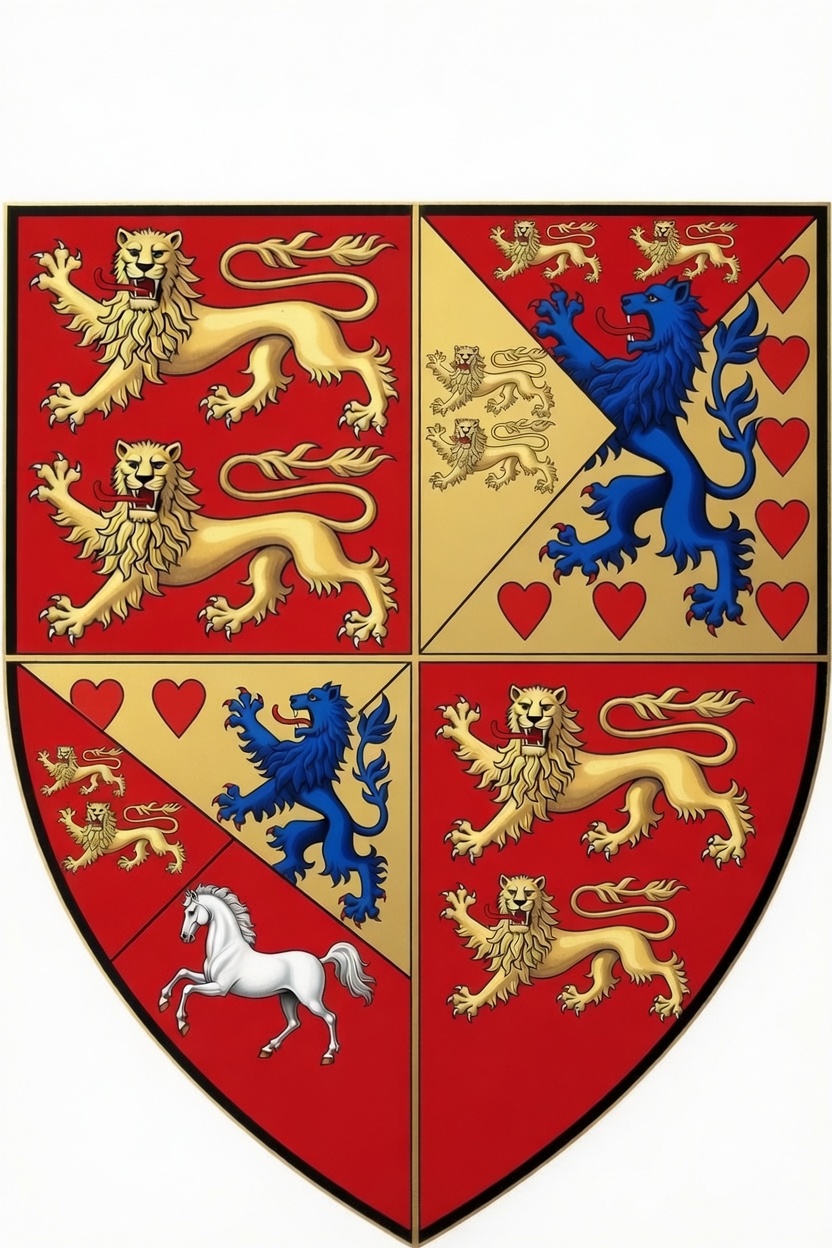
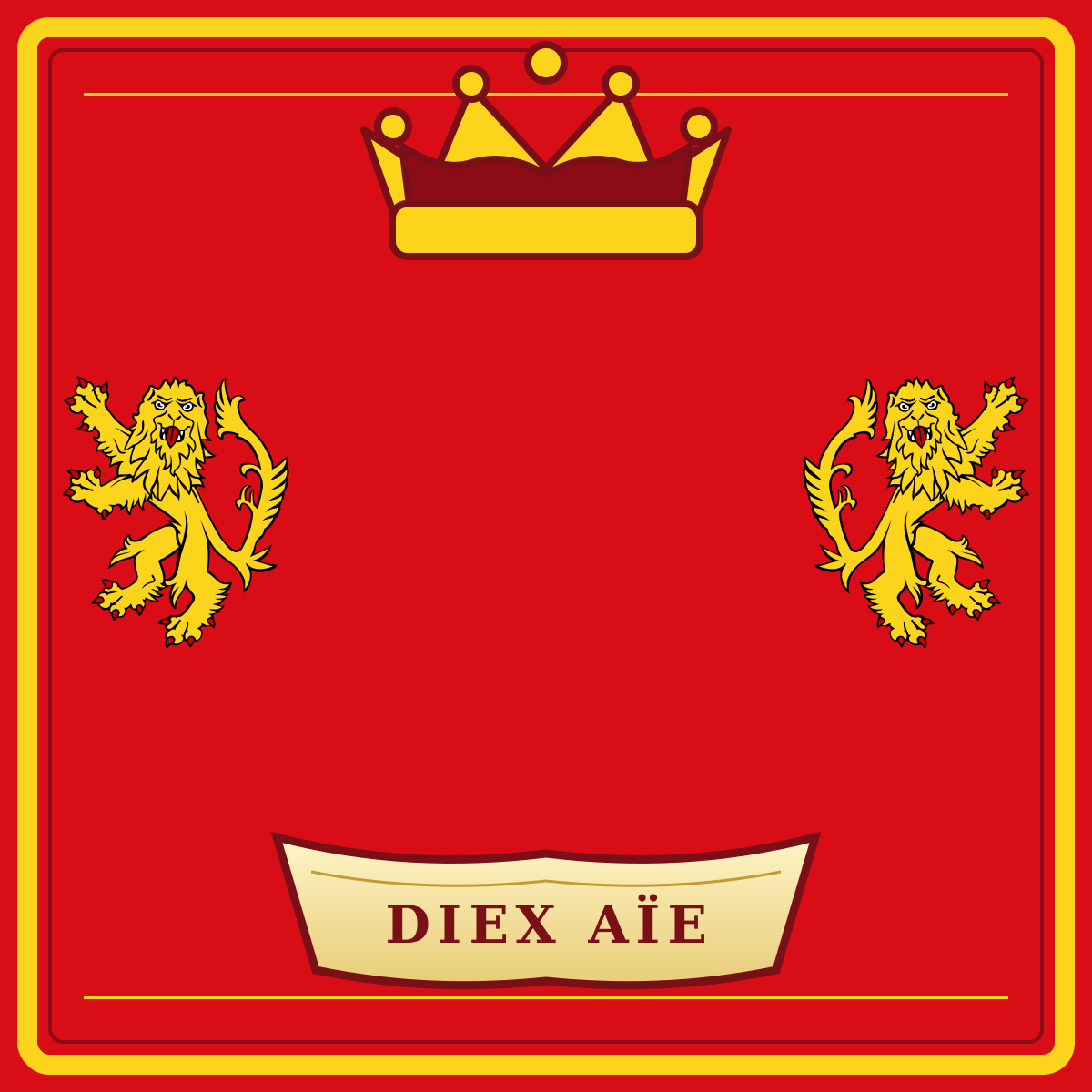
The national arms are an equal quartering. The first and fourth quarters bear the red Norman field with two gold leopards. The second and third use the lesser dynastic arms of Hanover. They combine the Brunswick lions, the Lüneburg lion and hearts, and the white Saxon steed without importing arms from the Duke’s other realms. The quartering records the restored dukedom and its Welf dynasty rather than a merger of governments.
The public form consists of the quartered shield without supporters or mantle. Government seals may add the words Duchie de Normaundie around the shield. Courts, police, public corporations, and communes use their own regulated devices. The national arms are not the same as the simple two-leopard flag.
The Duke’s square personal standard displays the complete quartered achievement. A ducal coronet appears above the shield, Welf lions act as supporters, and a scroll carries Diex Aïe. The standard is flown only when the Duke is present in an official Norman capacity or from a vehicle, vessel, or residence designated by protocol. It is lowered when he departs.
The quartered arms are sometimes criticised for giving dynastic heraldry equal space with the older territorial device. Supporters answer that the equal quartering accurately states the constitutional restoration of 1948. Proposals to adopt the unquartered leopards as the civic arms have not secured the constitutional majority needed to replace the official achievement.
Anthems, motto, and public holidays
Ma Normandie is the civic anthem. It is used at public commemorations, schools, sporting events, and civic ceremonies. The state does not reproduce or prescribe its lyrics in constitutional law. Performances may use established Norman or French versions, while instrumental performance is common at bilingual events.
God Save the Duke is the separate ducal anthem. It is played when the Duke attends in his Norman capacity and at defined Crown observances. It is not Normandy’s national anthem, and it does not replace the civic anthem. Protocol normally places the civic anthem first at elected institutions and the ducal anthem first at events centred on the Duke.
The motto Diex Aïe is associated with medieval Norman arms and with later historical memory. Modern official translations render it as a call for divine aid but do not treat it as a religious test or declaration of an established faith. Its use is heraldic and ceremonial within a secular state.
Liberation and Restoration Day on 6 June commemorates the 1944 Cotentin landing, the recognition of the provisional dukedom by liberated municipalities, and the later constitutional settlement. It includes memorial services for civilian and military dead, public archive programmes, military and rescue-service ceremonies, and civic festivals. The holiday does not present resistance as universal or omit persecution and collaboration.
The French national day on 14 July is a co-equal public holiday. Its retention was part of the 1948 bargain and reflects continued French citizenship and political membership. State offices display both flags. Republican, imperial, and ducal associations use the day differently, but public observance is not conditioned on support for any constitutional party.
Environment
Coastal and climate policy
The state commits to defending existing settlements broadly. Sea walls, dunes, wetlands, drainage, raised infrastructure, harbour works, and building standards are selected according to local conditions. Managed retreat is not the default national policy.
Protection is not absolute. Where engineering would transfer intolerable risk, destroy protected ecosystems, or cost far beyond any public benefit, residents may be offered voluntary relocation. Expropriation requires law, necessity, compensation, and judicial review.
Climate planning addresses storm surge, river flood, drought, heat, coastal erosion, crop change, water quality, and energy resilience. Public insurers and emergency services share risk data. Private insurers cannot withdraw from a district without notice and a public transition plan.
Parks, conservation, and access
National parks and regional conservation trusts protect coast, wetlands, forests, bocage, heath, river valleys, and cultural landscapes. Public bodies own core areas, while agreements and regulation cover working farms and private land.
A responsible right to roam applies to designated coast, forest, heath, and paths. It excludes homes, active industrial sites, dangerous military areas, crops at risk, and temporary conservation closures. Landowners must not obstruct lawful routes.
Water is held in public trust. The state regulates abstraction, drinking quality, flood management, agricultural runoff, industrial discharge, and ecological flow. Utilities remain predominantly public and cannot disconnect a household from the minimum supply for inability to pay.
Environmental assessment applies to public and private projects. Communities receive early information, access to evidence, hearing rights, and court standing. Approval may require restoration bonds so that closure costs do not fall on the public.
The 2027 Cherbourg dispute
Strategic-submarine proposal
The 2027 constitutional crisis began with a French proposal to expand the Cherbourg naval yard into an exclusively French strategic submarine enclave. The project would build and service nuclear-powered but conventionally armed attack submarines. It would enlarge docks, protected workshops, reactor-support facilities, security areas, transport links, and naval housing.
French defence planners argued that an integrated enclave was necessary to protect classified technology, command, nuclear safety, and supply. They proposed that the site be treated as a reserved French installation under exclusive French administration. Norman law would apply only where the project agreement expressly permitted it.
The requested exemptions covered labour inspection, collective bargaining enforcement, environmental permits, land acquisition, communal planning, Norman policing, and ordinary criminal jurisdiction. French service courts and security officers would handle conduct within the enclave. A special employment code would replace sector agreements for designated work.
The proposal did not include nuclear weapons. The submarines would use nuclear propulsion and carry conventional armament. France stated that the project complied with Normandy’s nuclear-weapon-free status. Opponents accepted that technical distinction but argued that propulsion safety and the scale of jurisdictional exclusion created separate constitutional questions.
Cherbourg already contains a working naval yard under joint arrangements. French defence authorities manage reserved military functions. Norman labour, environmental, land, police, and ordinary criminal law applies except for defined service matters. The proposal would change the legal character of the site rather than merely add a production line.
French authorising statute
The French government introduced a defence statute authorising the project, land designation, financing, and executive negotiation. It treated the enclave as an exercise of reserved defence authority. Norman consent was not included as a condition, although the bill required consultation with the President of the Norman Council.
Norman institutions argued that consultation could not replace consent where autonomous law would be displaced. President Mathieu Hébert’s government issued a formal objection. It stated that Normandy accepted the French defence guarantee and existing yard but would not permit a zone outside ordinary constitutional rights.
The Estates debated a resolution rejecting the enclave. Autonomists, republicans, socialists, Greens, unions, and several integrationist members opposed the exemptions for different reasons. A smaller group supported the jobs and strategic investment or argued that the defence reservation belonged to France.
French Parliament passed the authorising law. The vote established French legislative approval but did not settle whether the statute could operate inside Normandy. Under ordinary French convention, the Emperor would have assented on ministerial advice.
Napoleon VII’s refusal
Napoleon VII openly opposed the project. He argued that an exclusive enclave would weaken the compact, expose the French constitutional order to prolonged conflict, and attach the imperial office to a policy lacking Norman consent. He refused assent to the statute despite formal advice from the French ministry.
The refusal was a deliberate breach of the normally ceremonial French imperial constitution. Napoleon did not claim a general power to govern or to replace Parliament’s policy with his own. His act nevertheless prevented the statute from taking ordinary legal effect and forced French institutions to confront the limits of the imperial office.
Supporters described the refusal as protection of constitutional peace. Critics called it an unelected veto and demanded either abdication or formal discipline. Norman opinion was divided about the method even though a majority opposed the project.
The French ministry sought a confidence vote and lost. Isabelle Fournier remained President of the French Council in a caretaker capacity. No new French ministry had formed by the article’s publication date. The Emperor had neither reversed his refusal nor agreed to assent.
Caretaker administrative order
Before losing confidence, the French Cabinet had approved an administrative project order under older executive defence legislation. The order directed preliminary site planning, security surveys, procurement preparation, and negotiation of land access. It did not depend expressly on the unassented statute.
Fournier’s caretaker ministry argued that the order remained in force. It claimed that existing reserved authority allowed preparatory work even if the broader statute failed. French Defence Minister General Pierre Vaillant defended this position and instructed defence officials to preserve the project timetable.
Norman Attorney-General Alain Quesnel advised that the order could not authorise construction, compulsory acquisition, or exemption from Norman law. He distinguished internal French planning from acts affecting land and persons in Normandy. His opinion did not bind the Supreme Court.
The French government did not send forces to begin construction. It retained security and engineering teams at the existing yard and continued internal procurement work. The absence of physical escalation reduced immediate danger but left the legal claim unresolved.
Hébert government’s opposition
Hébert’s government firmly opposes the enclave. It accepts continued joint defence and proposes investment under ordinary compact law. Its position is that France may specify military capability but must obtain Norman consent for land, labour, environment, police, and criminal jurisdiction.
The government rejected a narrower French offer to preserve some labour rights through internal regulations. It argued that rights dependent on French executive discretion would not equal Norman legal jurisdiction. It also opposed exclusive policing because workers and residents would lose access to ordinary prosecutors and courts.
Hébert has not called for closure of the existing yard or withdrawal from the defence guarantee. He has directed ministries to continue lawful cooperation, salaries, safety inspection where permitted, and civilian emergency planning. This distinction prevents the dispute from becoming a general stoppage of naval work.
The President has faced pressure from hard autonomists to seize the site and from pro-project legislators to accept the investment. He has rejected both positions. His coalition remains in office, although the crisis has displaced much of its domestic programme.
Ernest V’s emergency proclamation
Ernest V invoked Norman emergency authority after the caretaker order remained in force. The proclamation prohibits new land transfer, construction, demolition, or change of jurisdiction connected with the expansion. It preserves the physical and legal status quo.
The Duke stated constitutional grounds rather than endorsing a complete industrial policy. The order cited the risk of irreversible transfer before the Supreme Court could determine competence. It did not declare France an aggressor, close the yard, or remove French personnel.
The Estates renewed the proclamation by three-fifths. The majority crossed party lines and rested on defence of autonomous process rather than agreement about the future of Cherbourg. Members attached reporting, worker-protection, and civilian-safety conditions.
The proclamation expires unless renewed under the constitutional schedule. Each renewal requires current evidence. The Duke cannot use temporary emergency law to establish permanent control over reserved defence.
France disputes whether Norman emergency authority may restrain a reserved project. It has not attempted physical enforcement in defiance of the proclamation. Both governments continue to preserve their legal positions.
Citizen-union petition
Claire Levavasseur, a submarine-systems engineer and union chair, leads a citizen-union coalition that petitioned the Supreme Court. The coalition includes workers, residents, environmental groups, civil-rights organisations, and professional associations. Its members do not hold one view on naval construction.
Levavasseur supports skilled engineering employment and continued defence work. She opposes removal of labour rights, civilian safety law, and ordinary courts. The petition argues that workers cannot be converted into persons under a different legal order when they cross the yard gate.
The coalition asks the Court to declare that French defence competence does not include general exemption from Norman law. It also seeks protection for collective bargaining, whistle-blowers, environmental information, communal participation, and access to criminal justice.
Some coalition members would accept expansion under joint jurisdiction. Others oppose the project on environmental or military grounds. The petition is framed around constitutional competence so that these policy differences do not prevent common litigation.
Cherbourg municipality
Mayor Samira Auvray opposes expansion. She is a Green and has raised land, housing, transport, reactor safety, coastal ecology, and municipal-service concerns. Cherbourg would bear much of the local cost while having limited control inside the proposed enclave.
The municipality has not obstructed the existing yard. It continues road, fire, housing, waste, and planning cooperation. It refuses to transfer communal land or approve enabling works while the emergency proclamation applies.
Auvray argues that any project must include public environmental assessment, local tax arrangements, housing investment, emergency access, and independent monitoring. She also supports civilian conversion investment if the submarine plan is abandoned.
Project supporters in the city warn that opposition could send work elsewhere and weaken the supplier base. They point to apprenticeships, high wages, and long-term contracts. Municipal hearings have allowed both positions.
Supreme Court proceedings
The Supreme Court accepted the petition and consolidated related applications from the government, municipality, and rights organisations. The French caretaker government appeared to contest jurisdiction. The Court ordered the parties to address the constitutional question before the merits.
The central issue is whether the Court may review a dispute that France characterises as external defence. The compact gives the Court jurisdiction over reserved-power boundaries, but France argues that operational defence judgment is nonjusticiable. The petitioners reply that the case concerns land, labour, policing, and rights rather than submarine strategy.
Chief Justice Françoise Lemonnier presides. The full nine-member Court is hearing the case. The composition rules give French and Norman institutions equal initial selection, but judges are bound by their oath rather than appointing authority.
The Court has ordered protected disclosure of the project order, legal authorities, land plan, safety framework, and proposed jurisdiction. Classified operational material may be reviewed in closed procedure with independent security-cleared counsel. Public summaries must be released where possible.
Interim protections preserve existing employment, facilities, land ownership, environmental oversight, and police arrangements. No new construction or jurisdictional transfer may occur. The order permits routine maintenance, existing contracts, lawful defence operations, and safety work.
The Court has not decided that it possesses jurisdiction. Interim relief rests on the need to prevent either side from defeating a possible judgment. The judges have not reached the merits of the French defence claim, Norman emergency power, Napoleon’s refusal, or the caretaker order.
Role of the Lieutenant and guarantee Council
Lieutenant Luc Morel continues ceremonial and procedural duties. He has not assumed executive office because the Norman Presidency is not vacant. He receives formal reports from the government and transmits ducal instruments.
Morel has avoided public comment on the merits. His prior judicial career gives his actions additional attention, but the Lieutenant has no authority to decide the case or negotiate a settlement. He would face recusal from any personal advisory process touching evidence known through office.
The Guarantee Council reviews the emergency proclamation under its normal authority. Its process is separate from the Court’s jurisdiction hearing. It may evaluate necessity and proportionality but cannot determine the final division of defence competence.
No final Guarantee Council decision has ended the proclamation. The Estates renewal remains effective. The Council has sought submissions from France, Normandy, Cherbourg, labour, and safety bodies.
Labour and industrial questions
The existing yard employs engineers, skilled trades, technicians, support staff, and apprentices and sustains a wider supplier network. Workers have experience in naval systems, marine fabrication, electronics, propulsion support, safety, and quality control. The dispute therefore concerns both constitutional law and the future of a major industrial community.
The French project promises long contracts and advanced work. Its labour code would preserve basic pay and safety guarantees but remove Norman sector enforcement and some strike rights in secure areas. Unions argue that internal French safeguards could be changed without Norman democratic control.
Limited lawful strikes have occurred. They have targeted planning and nonessential work rather than safety, rescue, or existing fleet maintenance. Unions publish notice and maintain minimum services. Some workers refuse strike action because they support the project or fear contract loss.
Works councils at suppliers demand information about both the expansion and possible conversion. The government has funded independent assessment but has not promised permanent subsidy. Employee first-refusal law would apply if a private supplier closed, not to the public strategic yard itself.
Environment and nuclear safety
The project would require dredging, new secure waterfront, altered transport, and reactor-support facilities. Environmental questions include sediment, marine habitat, fisheries, water use, waste, noise, flood risk, and accident planning. Climate projections affect the design life of coastal infrastructure.
France argues that military assessment and nuclear regulation supply adequate protection. Normandy insists that civilian environmental law and public participation apply unless the compact expressly excludes them. Classified design can be protected without withholding all risk information.
The submarines would be nuclear powered but conventionally armed. Reactor fuel, maintenance, emergency response, and waste handling require coordination with civilian authorities. Auvray and local emergency services seek access to credible accident scenarios.
Opponents of nuclear propulsion call for rejection regardless of jurisdiction. Others accept propulsion but oppose exemption. The Court is not being asked to decide whether nuclear-powered vessels are good policy.
Public debate
A majority of Normans oppose the expansion in its proposed exclusive form. Surveys show more mixed views when respondents are asked about a jointly governed project with full labour and environmental law. Public opinion does not decide constitutional jurisdiction.
Marches have taken place in Cherbourg, Rouen, Caen, and other towns. Project supporters and opponents have generally held separate peaceful events. Police have protected access and investigated isolated threats.
Universities have hosted debates on defence, energy, labour, and the compact. Communal hearings collect evidence about housing and infrastructure. Union meetings decide strike and bargaining positions. The public broadcaster provides French and Norman coverage.
Republican opposition leader Théo Mercier opposes the exclusive enclave and criticises both monarchs. He argues that Napoleon’s refusal and Ernest’s emergency order show the instability of hereditary intervention. His party supports judicial review and a negotiated compact project subject to elected control.
French debate concentrates on defence credibility, imperial power, and the caretaker government. Some critics accuse Normandy of accepting French protection while refusing its cost. Norman ministers reply that the 5 per cent transfer and existing facilities already support defence and that the issue is jurisdiction rather than contribution.
Possible civilian conversion
A civilian-conversion proposal has emerged as a possible alternative. It would redirect investment towards civil nuclear engineering, offshore and marine technology, biotechnology equipment, port decarbonisation, and research. The package would use yard skills without building the proposed submarine class.
The plan has no agreed finance, ownership, schedule, or order book. French defence officials argue that civilian work cannot meet the identified naval requirement. Unions warn against promising conversion without long-term contracts.
Norman institutions have funded feasibility work. Britain and other partners have expressed interest in marine and energy cooperation, but no binding agreement exists. The government has not adopted conversion as a substitute for defending jurisdiction.
Constitutional consequences
The dispute tests whether reserved defence can carry associated domestic powers. A broad French victory could permit enclaves in other strategic sectors. A broad Norman victory could constrain defence planning whenever autonomous law raises cost or delay. The Court may decide jurisdiction narrowly without resolving every future project.
Napoleon’s refusal has created a separate French constitutional question. French institutions must decide whether to override, discipline, amend, or accept the act. The Norman Court cannot form a new French ministry or determine the Emperor’s general position.
Ernest’s emergency action is also contested. Even supporters of autonomy question whether a hereditary office should initiate a construction ban. The Estates renewal supplies elected approval but does not erase the original exercise of reserve authority.
The crisis has not ended the compact. Healthcare, movement, currency, trade, rail, and existing defence cooperation continue. Officials on both sides meet on routine business. The dispute remains concentrated on the Cherbourg project and the constitutional powers attached to it.
Position at publication
At publication, Isabelle Fournier leads a French caretaker administration and no successor ministry has formed. Napoleon VII has not assented to the parliamentary statute. The older administrative project order remains asserted by the caretaker Cabinet.
Ernest V’s emergency proclamation remains in force after three-fifths renewal by the Estates. It prohibits new land transfer and construction but leaves the existing Cherbourg yard open. The Guarantee Council has not terminated the measure.
The Supreme Court has preserved the status quo. It has not decided whether it possesses jurisdiction, and it has not reached the merits. No construction, exclusive jurisdiction, civilian conversion agreement, new French ministry, final royal settlement, or compact amendment exists.
Workers continue their existing duties, residents continue to use ordinary municipal services, and the yard operates under the pre-crisis French-Norman arrangements. Public hearings, union meetings, limited lawful strikes, and court proceedings continue in Cherbourg under uncertainty.
✎ Editor's Note · On the two monarchies, the moved Overlord landing, and what is invented
Normandy is the hardest constitutional case in the Register. It is a duchy within the French Empire, so its sovereign for reserved matters is Napoleon VII, Emperor of the French; but its hereditary domestic monarch is George V, Duke of Normandy, of the House of Hanover. The two offices belong to different dynasties and different constitutional systems, so this is neither a personal union between France and Normandy nor a feudal holding: the Duke does not hold Normandy from the Emperor. Because of this, Normandy is the one constituent among George V’s fourteen legal capacities; the other thirteen are sovereign in internal constitutional law, which does not make Hanover and Brunswick independent of the German Empire, and the sovereign’s total is unchanged at eleven kingdoms, two duchies, and one empire. The League treats Normandy as a separate member and sovereign for League purposes only, an exceptional doctrine that does not make it generally sovereign or give it a right to leave France. Everything before the accepted Olive Branch Petition of 1775 is identical to real history, including the medieval duchy, the conquest of England, and Normandy’s absorption into France. Normandy is a real region of France, the two-leopard banner is its real flag, Ma Normandie is a real song, and the D-Day landings of 6 June 1944 really happened. What this timeline invents is the post-1942 settlement: distributed resistance declarations proclaimed the exiled Ernest IV provisional Duke in 1942; the main Operation Overlord landing of 6 June 1944 falls in Brittany rather than Normandy, while the secondary Operation Rollo lands in the Cotentin and the Cherbourg approaches; and the Versailles settlement and the Norman Constitution of 1948 restored the dukedom as an autonomous duchy inside a defeated and reconstituted France. The Channel Islands remain British and are not part of Normandy.
Trivia
- In-Universe Normandy is governed by two monarchies at once. Napoleon VII, Emperor of the French, is sovereign in the reserved fields of external defence, foreign policy, and the common currency; George V, of the House of Hanover, is hereditary Duke of Normandy and head of its domestic institutions. It is neither a personal union between the two states nor a feudal holding, because the Duke does not hold Normandy from the Emperor.
- In-Universe Normandy is the single constituent capacity among George V's fourteen. Thirteen of his capacities are sovereign in internal constitutional law; Hanover and Brunswick remain constituent states of Germany, while Normandy is classified as a constituent Crown capacity within France. His total is still described as eleven kingdoms, two duchies, and one empire, and Normandy does not add to it.
- In-Universe Ernest IV was proclaimed provisional Duke of Normandy by distributed resistance declarations in 1942, while the country was still under fascist French occupation. He accepted by broadcast, promised elections and a referendum, and disclaimed any operational military command. Liberated municipal authorities recognised him in 1944, and the 1948 referendum made the dignity hereditary and constitutional.
- In-Universe The main Operation Overlord landing of 6 June 1944 came ashore in Brittany. The secondary Operation Rollo landed in the Cotentin and the Cherbourg approaches, and it is the Cotentin landing, not a Normandy beachhead, that Normandy keeps as Liberation and Restoration Day on 6 June.
- In-Universe Normandy holds a League of Nations seat in its own right, but only there. It is treated as sovereign for League purposes and nowhere else, a deliberate exception that carries no general sovereignty and no right to secede from France. At the European Concert it sits as an observer.
- In-Universe The 2027 crisis is about a submarine base. France proposed an exclusively French enclave at Cherbourg for nuclear-powered, conventionally armed attack submarines, exempt from Norman labour, environmental, land, policing, and criminal law. Napoleon VII refused assent to the authorising statute in a deliberate breach of the normally ceremonial French constitution, the French ministry fell, and the Supreme Court of Normandy has reserved the question of its own jurisdiction. Nothing is built and nothing is settled.
- Real-World Normandy is a real region of France; the two gold leopards on red are its real flag; Ma Normandie is a real song; and the D-Day landings of 6 June 1944 really occurred on the Normandy coast. This timeline moves the main Overlord landing to Brittany and invents the 1942 provisional dukedom, the 1948 restored duchy, Duke Ernest V, and Emperor Napoleon VII.
- Real-World The Channel Islands are British in reality and remain British here, outside Normandy, participating only in cultural and archival compacts. Everything in Normandy's history before the accepted Olive Branch Petition of 1775, including the medieval duchy and the Norman conquest of England, is identical to real history.
See also
- French Empire, the sovereign state of which Normandy is a semi-independent constituent duchy
- Duchy of Brittany, its twin duchy of the Empire, whose Duke is Napoleon VII himself rather than a foreign monarch
- George V, of the House of Hanover, Duke of Normandy since 31 October 2028, one of his fourteen legal capacities
- Ernest V, Duke of Normandy until his abdication
- Ernest IV, proclaimed provisional Duke of Normandy by the resistance in 1942
- Styles and Titles of the Crown, for the sovereign’s eleven kingdoms, two duchies, and one empire
- United Kingdom of Great Britain, the closest external partner, whose Channel Islands lie off the Norman coast
- The Second Great War, whose Operation Rollo landings in the Cotentin liberated Normandy
- League of Nations, where Normandy holds a seat in its own right
- European Concert, which the French Empire belongs to and in which Normandy is an observer
Normandy · Duchy · French Empire · Foreign Nations