Parliamentary Reform Act 1859
The Parliamentary Reform Act 1859, formally the Representation of the Commons Act, is an Act of the Parliament of the United Kingdom of America. It abolished the remaining rotten boroughs, fixed the allocation of Commons seats to a population quota revised at every decennial census, and created the independent Boundary Commission which draws the Realm’s constituencies to this day. A backbench amendment added a sixth Part, which created the Order of the Charter, the Realm’s principal order.
The Act was carried by the first ministry of Abraham Lincoln in 1859, in his first full year as Prime Minister, and occupied most of a single long session at the cost of the ministry’s other business. It disfranchised forty-one boroughs returning fifty-two members between them, redistributed those seats to the manufacturing towns and the western polities, and provided that every division of the Realm thereafter should be made by formula rather than by schedule. Roughly one seat in five was abolished or moved, the largest single alteration to the composition of the House of Commons since the founding.
It extended the franchise to nobody. That was deliberate, and it is the fact that most distinguishes the Realm’s electoral history from others: redistribution came first and the franchise second, so the machinery for drawing constituencies impartially was already a century old by the time a mass electorate existed to be drawn for. The Second Reform Era of the 1860s and 1870s supplied what the 1859 Act had refused to touch.
Constitutional writers rate the Act highly and the public does not know it exists. It is taught in law faculties and not in schools, it is commemorated nowhere, and the enrolled original sits in the parliamentary archive shelved with every other statute of that session. The Civil War began two years after its passage and erased it from ordinary memory within a season. The institution it created, the Boundary Commission, has never been renamed, has drawn every map of the Realm’s constituencies for a hundred and sixty-nine years, and is the most trusted body in the Realm’s public life.
Background
The allocation of seats before 1859
Before 1859 the Commons was allocated by accretion. Each polity acceding to the Union brought with it a number of members settled at the moment of its accession, by the instrument that admitted it, and that number was revised only when Parliament happened to revise it. Some polities had been reapportioned once since joining; several had never been reapportioned at all. The result was a chamber whose arithmetic recorded the Realm of the 1780s and the 1820s, layered over one another, and corrected nowhere.
The distortion was not uniform, which is why it survived so long. A member for a Virginia county and a member for a Massachusetts Bay town might each represent a plausible number of people; the difficulty lay in the accumulation of small settlements, each defensible when made, into an aggregate that nobody would have designed. By the middle of the century the western polities had grown to a size their accession formulas had never anticipated, while the eastern seaboard retained an allocation drawn when it was the whole Realm.
Two groups benefited, and they were not the same group. The slaveholding polities of the south benefited because their quotas had been struck under a founding compromise that counted a fraction of the enslaved toward representation, and because their populations had grown more slowly than the north’s without their seats falling. The old eastern seaboard benefited because its towns and counties had been generously represented at accession and had since been overtaken. What the two had in common was an interest in the map not changing. What they did not have in common was anything else, and the failure of the opponents of reform to become a single bloc is a substantial part of why the Act passed.
The surviving boroughs
The First Reform Era of the 1830s and 1840s had begun the rationalisation of rotten and pocket boroughs and had not finished it. Its statutes disfranchised the most indefensible cases and left the rest, on the usual understanding that a later Parliament would attend to them. The boroughs that survived to 1859 fell into two kinds in roughly equal number.
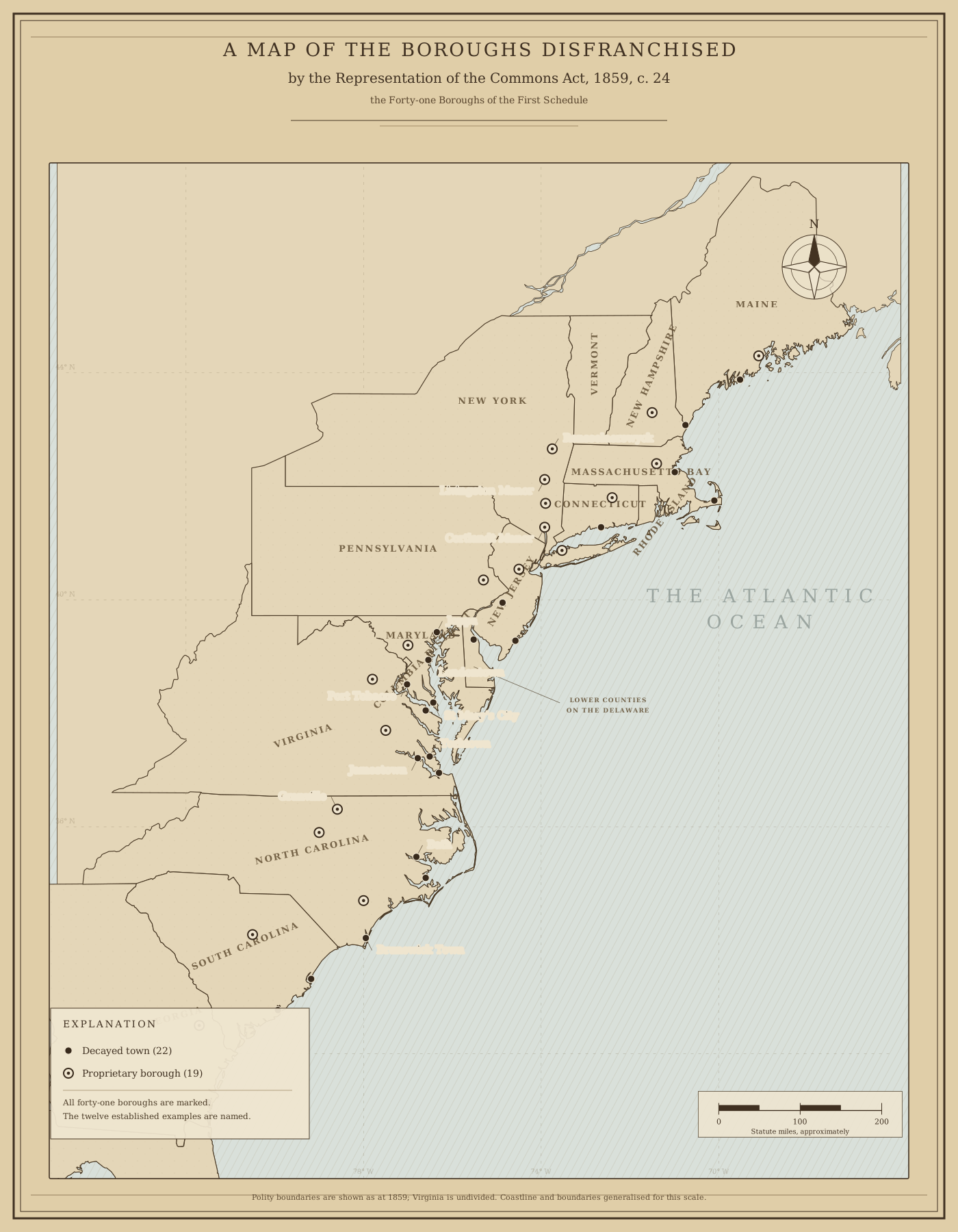
The first were decayed colonial towns: places that had been genuine centres of settlement when their representation was fixed and had since been abandoned, burned, silted up, or simply passed by. Brunswick Town in North Carolina was the extreme case. Burned during the Four-Year War and never rebuilt, it consisted in 1859 of a few farms on the site of a vanished port, and it returned two members to the Commons on the votes of eleven electors. St Mary’s City in Maryland, the province’s first capital, had been effectively abandoned since the seat of government moved to Annapolis in 1695; it returned two members on twenty-two. Jamestown in Virginia, where representative government in America had begun, returned two on fourteen.
The second kind were proprietary boroughs: manors and patents whose electoral franchise was vested in tenants holding of a single landlord, so that the proprietor named the members in practice and often in form. The New York manors were the largest of these. Livingston Manor, Cortlandt Manor and Rensselaerswyck together returned five members chosen by rather more than a hundred electors, all of whom held their land of the manor. Their populations were not negligible, which distinguished them from the decayed towns and made their defence more respectable: they were not empty, they were owned.
A representative selection from the First Schedule, with the figures laid before the Commons in 1859:
| Borough | Polity | Electors | Inhabitants | Members |
|---|---|---|---|---|
| Brunswick Town | North Carolina | 11 | 31 | 2 |
| Jamestown | Virginia | 14 | 47 | 2 |
| Joppa | Maryland | 16 | 62 | 1 |
| St Mary’s City | Maryland | 22 | 106 | 2 |
| Londontown | Maryland | 24 | 118 | 1 |
| Cortlandt Manor | New York | 26 | 1,870 | 1 |
| Livingston Manor | New York | 31 | 2,140 | 2 |
| Port Tobacco | Maryland | 38 | 217 | 1 |
| Rensselaerswyck | New York | 44 | 3,290 | 2 |
| Bath | North Carolina | 48 | 260 | 1 |
| Yorktown | Virginia | 57 | 340 | 1 |
| Granville | North Carolina | 63 | 4,100 | 2 |
The whole schedule ran to forty-one boroughs and fifty-two members. Against a House of two hundred and forty-four, that is a little over one member in five, and the proportion is the reason the Bill was survivable. Four members in five had nothing personal at stake in it.
Why the question became answerable in 1859
The state of the representation had been notorious for a generation and unactionable for the same generation, because the members who would have had to vote for reform were in large part the members reform would remove. What changed by 1859 was the arithmetic outside the chamber. The western polities had grown enough that the case for redistribution had become a case about them rather than an abstraction, and had grown enough that their existing members, though under-weighted, were numerous.
The thing being corrected had made the correction possible. It is the observation most often made about the Act by writers sympathetic to it, and it is also, in a different tone, the observation made by those who read the Act as a partisan measure: the growth that produced the grievance produced the majority.
Origins and drafting
The standing committee
The Bill was not written by the ministry. It came out of a standing committee of the Commons on the state of the representation, which had existed for years, had reported repeatedly, and had never had a ministry willing to legislate its reports. The committee’s function in that period was closer to a permanent inquiry than to a legislative body: it collected returns of electors and inhabitants from the polities, published them, and recommended.
Its method was to require returns from the polities: the number of electors on each register, the number of inhabitants at the last enumeration, and the instrument under which the borough or county returned its members. Several polities complied slowly and a few did not comply at all until compelled, and the committee’s practice of printing the defaulters alongside the returns did more to produce the figures than any of its formal powers. The returns are the reason the debates of 1859 were conducted on agreed numbers, which is unusual for a reform of that kind and which removed at a stroke the commonest defence of an indefensible seat.
Its reports are the source of the figures in the First Schedule and of most of the Act’s structure. The idea of a quota, the idea of independent commissioners, and the idea that revision should follow the census automatically all appear in committee reports before they appear in any Bill, in some cases a decade before. What the committee could not supply was a majority.
The committee’s own recommendations were consistently more radical than the Act that eventually carried them. It had proposed a fixed and uniform qualification of electors, a full redivision of every polity rather than a schedule of abolitions, and a commission appointed by the courts rather than by the polities. Each was abandoned in the drafting, and the pattern of the Act’s passage is visible in the abandonment: the machinery survived intact wherever it did not touch a sitting member, and was compromised wherever it did.
Hiram Pell
The committee was chaired for most of the decade before the Act by Hiram Pell, member for St Mary’s City. He held office at no point in his career, sat for one of the most indefensible boroughs in the Realm, and chaired the body that condemned it. He drafted much of what became the operative part of the Act, gave evidence on it repeatedly, and lost his seat to it at the dissolution of 1861 exactly as the schedule provided.
At the committee stage Pell also moved the amendment that became Part VI and created the Order of the Charter. His argument was that a seat in the Commons had been the Realm’s principal reward for public service, given by proprietors to men the ministry wished to honour, and that a Bill abolishing the boroughs should give the Crown a reward for service that did not run through a seat. The ministry had not wanted the amendment and accepted it because it needed votes.
Pell is remembered by constitutional lawyers, and by the Order’s own histories as the mover of its clause, and by almost nobody else. His committee reports remain the standard authority on the pre-1859 representation, and his contemporaries appear to have found his position, sitting for a place he was engaged in abolishing, more comprehensible than later writers have. He said little about it in the House. The one recorded remark, made in committee rather than on the floor, was that a member who cannot vote against his own seat has no business inquiring into anyone else’s.
Lincoln’s part
Lincoln came to the question already persuaded and took a substantial hand in the drafting personally, which was unusual for a Prime Minister and is well documented in the papers of the committee. His interest was in the machinery rather than in the schedule. The provisions for which he is most clearly responsible are those that make the Act self-executing: the standing instruction to the commissioners, the requirement that Parliament vote the resulting map up or down without amendment, and the deliberate refusal to fix the size of the House.
His stated reason for carrying the Bill in 1859, given more than once and in almost the same words, was that a Parliament which cannot correct its own composition will eventually be corrected by something worse. The remark reads differently after 1861 than it did when he made it, and historians have not agreed on how much foresight to credit him with.
The Act cost the ministry most of its session. Its other business was thin for a government in its first full year, and the decision to spend a majority on redistribution rather than on anything else has been read both as conviction and as calculation.
Passage through Parliament
The shape of the opposition
The opposition to the Bill was not sectional. It came from members whose own seats stood in the First Schedule, and those members sat for every part of the Realm: Maryland and Virginia and the Carolinas, but also New York, and a scattering of decayed towns in New England. They were self-interested rather than ideological, they had no common programme beyond deletion from the schedule, and they never combined.
That failure to combine is the single most important political fact about the Bill’s passage. A southern bloc opposing redistribution as a sectional measure would very probably have defeated it, and would have made it into the sectional measure it was accused of being. What happened instead was that individual members negotiated for individual boroughs, and Lincoln conceded on individual boroughs, repeatedly, and never conceded the principle. The schedule that finally passed was shorter than the schedule first laid.
One episode is remembered. A member for a borough that had no defence made a long speech in its defence, going through its charter, its history, and the antiquity of its representation, and closed by saying that he was aware he had persuaded nobody and that he had not expected to. He knew the speech ended his career and made it anyway. It is quoted in the Realm’s parliamentary literature not as an argument but as an example of a kind of honesty, and the borough was disfranchised on the division that followed.
The franchise amendments
The most serious threat to the Bill came from Lincoln’s own side. Reformers within the National Union coalition moved amendments to attach franchise clauses, on the reasonable ground that a Parliament redrawing its own constituencies might as well settle who should vote in them.
The ministry resisted every one, on a single argument repeated without variation: a Bill carrying both redistribution and the franchise would carry neither. The amendments were defeated, several of them narrowly, and the pressure came close to sinking the measure. That it was so nearly lost from that direction explains a good deal about what followed, since the Second Reform Era arrived within a decade and was carried by many of the same people.
The compensation question and Article IX.11
The proprietors of the pocket boroughs made a constitutional argument, not a plea for fairness, and it was the whole of their case. Article IX.11 of the Charter of Union of the American Colonies secures just compensation for property taken for public use. A right of nomination, they argued, was an incorporeal hereditament: it was held, it was inherited, it was conveyed, it was valued in settlements and in wills, and in the case of the New York manors it had been part of the estate since before the Union existed. Parliament was taking it. The Charter therefore required payment.
The argument was not treated as frivolous. It occupied several days, it was made by counsel at the bar of the House as well as by members, and the sums proposed were substantial.
Parliament’s answer determined the drafting of the Act’s most quoted clause. The Commons did not assert a power to take property without paying for it, which would have set the statute against the Charter directly. It denied that the thing was property at all, so that Article IX.11 never engaged. That is why the clause reads as a declaration rather than as a prohibition: it says that a share in the representation of the Commons is not property, and only then that no person shall be recompensed for the loss of it. The order of the two limbs is the constitutional argument in miniature.
The counting rule
The Bill’s quota clause provided that the quota should be ascertained by dividing the whole number of the people of the Realm by the whole number of members. The clause immediately following provided that in ascertaining the numbers of the people the rule established by ordinary election law should be observed, which is to say that a fraction only of the enslaved should be counted. The rule preserved the founding political compromise that had bought southern accession in 1783; it was not a clause of the Charter.
A reformer from the ministry’s own coalition, from the same wing that had moved the franchise amendments, read the two clauses aloud one after the other and asked how they were to be reconciled.
Lincoln answered directly and conceded the contradiction. The Bill maintained the fractional counting rule in ordinary election law; he would not alter it in a Bill about boroughs; and if he did so he should lose the Bill and the men both. It is the most quoted thing he said about the Act, and it is quoted against him as often as for him. His defenders read it as candour of a kind rare in ministers. His critics read it as an admission, made without embarrassment, that the measure was built to pass rather than to be right.
The exchange has since become the standard example of what Lincoln would and would not do before 1861, and the usual bridge in the Realm’s historical writing between the minister who carried a redistribution act with the counting rule intact and the minister who carried the Emancipation Measure six years later.
✎ Editor's Note · Why the counting rule was kept
The fractional counting of the enslaved could have been written out of this alternate history at no narrative cost. It was kept because a founding that bought southern accession has to have cost something, and this is where the cost becomes arithmetic rather than sentiment. The Register’s premise is that the Realm avoided a revolutionary rupture, not that it avoided the compromise that made the Union possible; a settlement reached by consent with slaveholding polities is a settlement that put slaveholders’ interests into the election law’s numbers. The 1859 Act is the clearest place to show it, because the Act states a principle in one sentence and takes it back in the next, on the same page, in the same drafting hand. Nothing else in the document is as revealing, and the article prefers to print both clauses and let them sit together rather than describe the problem in the abstract.
The division
The decisive division was carried by a majority of five, one hundred and twenty-one to one hundred and sixteen, in a House of two hundred and forty-four. The Bill had already been amended down from its original schedule and would be amended again in detail before it left the Commons, but the principle was not touched after that division. The ministry’s acceptance of Pell’s amendment creating the Order is thought to have moved some votes in it; historians do not agree on how many.
The Lords
The House of Lords American passed the Bill with little difficulty. There was debate, there were divisions, and there was no serious attempt to wreck it.
The judgment behind that restraint was that resistance would be unwise on a measure concerning the composition of the other House. It was not stated as a rule and was not given a name, then or since. It has nevertheless been observed without exception in the hundred and sixty-nine years following, so that the Lords’ abstention from the Commons’ own composition is now among the most reliable practices in the constitution while remaining entirely unwritten. Constitutional writers who regard the Act as underrated tend to argue that this consequence is larger than anything in the statute.
The renaming of the upper House
Almost in passing, the Act did one further thing that outlived the redistribution in ordinary recognition: it dropped a word from the name of the upper chamber. The Charter of 1783 had constituted it as the House of Lords American, the adjective distinguishing it from the House of Lords at Westminster in an age when the two might be confused. By 1859 no such confusion was possible, and a clause in the general part provided that the chamber should thereafter be styled simply the House of Lords.
The change was treated at the time as tidying rather than reform, and the debates barely noticed it. It has proved the most widely known thing the Act did, because everyone who names the Realm’s upper House uses the name the Act gave it, while almost nobody could say which statute struck out the adjective. The older form survives only where the Charter is quoted and in the letters patent of the pre-1859 peers, who were created to the House of Lords American and are described so in the instruments that ennobled them.
Assent
Royal Assent was given on 14 July 1859 by Governor-General Winfield Scott in the name of Ernest II, among the last acts of Scott’s tenure; he was succeeded by Edward Everett on 2 August.
The Crown did nothing in public beyond assent, and did nothing deliberately. Ernest II held that the composition of the elected chamber is the one subject on which the Crown must be invisible, and he declined the opportunities for expression that a measure of that importance would ordinarily have offered. He welcomed the Order of the Charter privately, in a letter to the Governor-General, and said nothing about the redistribution. The reticence has been treated since as personal to him rather than as a binding precedent, and every monarch since has observed it anyway, including in respect of the modern Boundary Commission’s reports. It is why redistributions in the Realm are not royal occasions.
The Act
The operative part runs to twenty-six clauses in six parts, followed by three schedules. The text reproduced below is the Act as passed in 1859. It has been amended repeatedly since, and the version now in force differs in detail throughout.
The preamble
Whereas it is expedient that the Representation of the Commons in Parliament should bear a just Proportion to the Numbers of the People represented, and should from Time to Time be revised as those Numbers alter
The preamble has two limbs, and the second is the one that made the Act different from every reform that had preceded it. Proportion between people and members was an old idea and a widely accepted one; the novelty was the proposition that the proportion should be revised as a matter of course rather than as a matter of politics. Putting revision into the recital established that the machinery was the point from the first line of the statute, and it is the sentence of the Act that non-lawyers are most likely to have encountered.
Part I, of the Quota
Clause 1.
The Quota shall be ascertained by dividing the whole Number of the People of the Realm, as the same appears by the last Enumeration, by the whole Number of Members to be chosen for the Commons.
The clause states a divisor rather than a headcount. It does not provide that each member shall represent a stated number of inhabitants, which would have required amendment at every census as the Realm grew; it provides that the quota is whatever the division yields. The Act therefore never needed amending for population growth, and never has been.
The clause also, quietly, establishes that the number of members is settled elsewhere. Nothing in the Act fixes the size of the Commons, and the omission was deliberate: the House was left free to grow with the Realm, and did, for close to a century.
Clause 2.
Provided, That in ascertaining the Numbers of the People the Rule established by the Laws for Elections shall be observed.
The saving proviso preserving the fractional counting of the enslaved, discussed above. It was repealed in 1878.
Clauses 3 and 4 apply the quota to the polities and dispose of fractions, providing that a polity’s entitlement is its number of people divided by the quota, that remainders above one half carry a further member, and that no polity shall in any case return fewer than one.
The minimum in clause 4 has never been engaged for a polity and is the provision under which the smallest constituent units of the Realm would be represented if it were.
Part II, of the Commissioners
Clause 5.
Each Polity shall nominate one Commissioner; and the Governor General shall appoint a Chairman, who shall not be nor have been a Member of either House.
The Act’s answer to the problem of who may be trusted to draw a constituency is balance rather than insulation. The commissioners are the polities’ own nominees, so no polity can claim the body was composed against it, and the chairman is appointed on the Realm’s behalf rather than the ministry’s. The disqualification in the second limb is the whole of the safeguard and it is one line long: the chairman may never have sat in Parliament.
Clauses 6 provides for tenure, vacancies and the filling of a polity’s nomination in default.
Clause 7.
In the Division of each Polity the Commissioners shall have regard, first, to Equality in the Numbers of the People; secondly, to the Boundaries of Polities and of Counties; thirdly, to the Compactness and Convenience of the Districts to be formed; and lastly, to the Constituencies as they now exist.
More litigation has turned on this clause than on the rest of the Act combined, and almost all of it on the ordinal words. Whether “first” means paramount, so that equality must be satisfied before the other considerations are consulted at all, or whether it means merely first among matters to be weighed together, is a question the courts have answered differently in different periods and have never answered finally.
The placing of existing constituencies last is the clause’s argument, made without stating it. Continuity is a consideration and it is the weakest one, which is a reversal of the assumption on which every previous redistribution in the Realm had proceeded.
Clauses 8 to 10 provide for publication, objections and the final report.
The Commissioners shall publish their Proposals, and shall receive and hear the Objections of any Person aggrieved, before making their final Report.
The words that matter are “any Person”. Standing to object is not confined to members, to polities, or to any public body; it was granted in 1859 to everybody, and it is the statutory ancestor of the public hearings the Commission still holds. It is also the door through which a private elector later walked into the Royal American Supreme Court.
Clause 11 provides that the final report shall have effect upon resolution of both Houses, which may be given or withheld but not amended.
Parliament may refuse a map. Parliament may not improve one. The entire protection of the system rests on that distinction, and it has been in the Act since the beginning.
Clause 12.
Upon the Completion of every Enumeration of the People hereafter to be taken, the Commissioners shall be reappointed and shall proceed to a new Division of the Polities according to this Act, without further Direction of Parliament.
This is the clause the Act exists to deliver. Everything else it does had been done somewhere before: boroughs had been disfranchised, quotas had been struck, commissioners had been appointed. What had not been done was to instruct the machinery to act again without being asked. A duty on Parliament to revise can be ignored by a Parliament with no wish to revise; a standing instruction to a body outside Parliament has to be actively stopped, and stopping it requires a statute and a majority and a public reason.
The last five words carry the weight, and they are the reason the Act is rated as it is.
Part III, of the Boroughs disfranchised
Clause 13.
The Boroughs enumerated in the First Schedule shall from and after the next Dissolution cease to return any Member to the Commons.
One sentence, no recital, no ground of abolition stated, no acknowledgement that anything is being taken from anybody. Two centuries of borough politics are disposed of by reference to a list. The bluntness is not an accident of drafting: a clause reciting the reasons for abolition would have invited argument about whether the reasons applied in each case, and the committee had been arguing about exactly that for a decade.
Clauses 14 and 15 save the municipal rights, charters and corporate existence of the disfranchised boroughs, which continued unaffected, and provide for writs.
Part IV, of the Seats distributed
Clause 16.
The Members set free by the said Abolition shall be distributed as in the Second Schedule; and every Division hereafter shall be made according to the Quota, and not by Schedule.
The Act does its own first application by list and every application thereafter by formula, and says so in a single sentence. It is an unusually frank piece of drafting. Parliament is conceding that the redistribution of 1859 was settled politically, in negotiation, borough by borough, and providing that no future redistribution shall be settled that way.
The concession has been read both ways ever since. It is cited as evidence of the Act’s honesty and as evidence that its first schedule was exactly what its critics said it was.
Clauses 17 to 20 provide for the division of counties and large towns into constituencies, for returning officers, for polling places, and for the expenses of the commissioners, which are charged on the public revenue rather than on the polities.
Part V, general
Clause 21.
A Share in the Representation of the Commons is not Property; and no Person shall be recompensed for the Loss thereof.
The Act’s most quoted clause, and the answer to the Charter argument described above. The declaration comes first and the operative rule second, which is the reverse of ordinary drafting and is the reason the first six words have survived into general use while the second limb is largely forgotten.
Its effect reaches well beyond elections. Because the clause defines what a public office is not, rather than merely refusing payment for one, it became the starting point for the Realm’s law on the boundary between property and public office, and it is cited far more often in that field than in electoral cases.
Clause 22.
Provided always, That no Polity shall require in an Elector for the Commons any Qualification more strait than that which was required at the passing of this Act.
The ratchet, drafted as a proviso so that it preserves rather than grants. The Act widened the franchise for nobody, which allowed the ministry to say so truthfully throughout the debates, and forbade a polity to narrow its federal franchise below the level then obtaining.
The reason for including it at all is structural. Redistribution allocates seats by population, so a polity that disfranchises part of its population keeps the seats and loses the voters, which is an invitation the Act would otherwise have extended without noticing. The ratchet closes it in principle. What the ratchet did not do is discussed below.
The federal bargain otherwise stands untouched: the federation decides how many seats a polity has, and the polity decides who may vote in them.
The Act says nothing about the franchise of the Indigenous nations, in a Realm where Charter Article XIV already dealt with them separately. The silence was not remarked on in the debates and is not defensible as an oversight, given how much attention the Bill’s franchise clauses received. It is simply a subject the Parliament of 1859 did not consider.
Clauses 23 to 25 provide for interpretation, repeal the enactments listed in the Third Schedule, and give the short title and the commencement.
This Act shall take effect from the next Dissolution of Parliament, and not sooner.
The last three words are the concession that carried the Bill. Every member whose seat stood in the First Schedule served out the Parliament in which he had voted for or against his own abolition, and several voted for it in that knowledge. It cost the ministry nothing but time.
Part VI, of the Order of the Charter
Clause 26.
There shall be an Order, to be called the Order of the Charter, for the Reward of such Persons as shall have rendered Service to the Realm; of which Order the Sovereign for the Time being shall be Sovereign, and the Governor General for the Time being shall be Chancellor and a Member of the first Class; and the said Order shall consist of five Classes, the first of Grand Cross, the second of Knights, the third of Commanders, the fourth of Officers, and the fifth of Companions: and notwithstanding any thing in this Act, this Part shall take effect from the passing thereof.
Pell’s amendment, and the only clause of the Act that has nothing to do with the representation. It stands after the commencement clause because it had to escape it: the rest of the Act waited for the dissolution, and the Order was to exist from the day of assent. Part VI is therefore the only part of the Act that came into force in 1859, and Governor-General Scott became the Order’s first member by the act of assenting to it.
The word “Persons” was read by the Law Officers in 1859 as including women, and the first list of the Order included one. Everything else about the Order, from its insignia to the prefix of its senior grades, was left to ordinances made by the Crown, so that the whole of its statutory constitution is this one sentence.
The schedules
The First Schedule
Forty-one boroughs, returning fifty-two members. Twenty-two were decayed towns and nineteen were proprietary boroughs, a division close enough to even that contemporaries described the schedule as taking both kinds without favour, which was politically necessary: a schedule weighted toward either would have been read as an attack on a region or on a class.
Every rotten borough in the Realm was taken. The Act made no attempt to draw a line at a particular size of electorate and disfranchise below it, which would have produced arguments about the line; it named places.
The Second Schedule
The fifty-two seats went to the manufacturing towns first and to the western polities second, and the ordering matters, because it means the beneficiaries were not one interest either.
The manufacturing gainers were places that had grown without representation: Lowell and Lawrence in Massachusetts Bay, Manchester in New Hampshire, Pittsburgh and the Schuylkill coal district in Pennsylvania, Buffalo and Rochester in New York, and the Ohio river towns. Several of these had populations larger than whole clusters of the boroughs abolished to make room for them, a comparison the committee’s reports made repeatedly and with evident satisfaction.
The western gainers were led by Illinois, Michigan and Wisconsin, whose growth since their accession formulas were struck had been the largest in the Realm and the least reflected in the Commons. That this placed the Prime Minister’s own region among the principal beneficiaries was obvious at the time and is the substance of the partisan charge against the Act.
New York
The most contested single decision in the schedule was not a borough at all. It was whether the city of New York should receive the number of members its population entitled it to.
A strict application of the quota gave the city more members than several polities returned between them, and the prospect alarmed almost everyone, including the rural members of its own polity. Proposals were made to cap its allocation, to make up the difference at a later census, and to give it full entitlement on condition that it be divided into small constituencies so that its members should sit for wards rather than for the city.
All of them failed. New York received its full entitlement without conditions. The Act did not flinch at the point where flinching would have been easiest to justify, and defenders of the measure have made a good deal of that ever since.
The consequence was the Realm’s first city bloc: a single municipality returning more members than several polities, voting together often enough to be counted as an interest in its own right. In the Parliament elected in 1861 that bloc was decisive, which is a further reason the corrected map is credited with carrying the war.
The first redistribution and the general election of 1861
The commissioners’ division
The first commissioners were appointed in 1860 and reported before the dissolution. Their names are not recorded in any account of the Act that the Register has been able to consult, and the omission is not an accident of the record: the body was designed to be interchangeable, its members were nominated rather than chosen for distinction, and their anonymity is the clearest evidence that the design worked.
They published proposals, heard objections under clause 9 from members, polities and private persons, and made a final report which both Houses resolved to approve without amendment, as clause 11 required and has required at every division since.
The election of 1861
The first general election fought on the new map was held in 1861, after the rebellion had begun, and is the election the Realm remembers as the wartime one.
The two events are not separable, and the Realm’s historical writing has never entirely succeeded in treating them apart. Some of the rebel polities contested the election and returned members who sat briefly and withdrew; others did not contest it at all; the Commons was therefore partial from its first day, and unevenly so, polity by polity.
The result confirmed the ministry with a larger majority than it had held before. This was obvious to everyone at the time, was read by contemporaries as a verdict on the Act and a favourable one, and has been the standing charge against the measure ever since: that a government redrew the constituencies and was then returned by them. The charge is not answerable on the arithmetic and the Register does not attempt to answer it.
What is also true is that the character of the chamber changed. Manufacturers and western men entered the Commons in numbers, displacing the landed and mercantile seaboard interest that the old map had over-represented, and the change was visible within a single Parliament. Most members whose seats had been abolished simply disappeared from public life; a few were found other seats by party managers, who accommodated the loyal and the useful and let the rest go.
The Act in the Civil War and Reconstruction
The Parliament elected in 1861 was the Parliament that fought the war, and it was the first elected on a map that reflected where the Realm’s people actually lived.
Writers who rank the Act highly rest most of their case there. A war carried by a chamber weighted toward the seaboard and the slaveholding polities, on an allocation two generations out of date, is a war fought by a very different Commons; the redistribution of 1859 gave the war Parliament its western and manufacturing majority, and gave it the New York bloc. On this reading the Act is the enabling condition of the Union’s survival, and its obscurity is simply a failure of public memory.
A minority makes the argument in reverse, and it is taken seriously. The Act ended any future southern path to a Commons majority, permanently and by design of arithmetic if not of intention, and rebellion followed within two years. The proposition that redistribution was among the causes of the war cannot be dismissed on the timeline, and it is not dismissed. The Register records both readings and settles neither.
During the war the seats of the rebel polities were suspended by statute, and the decennial revision was suspended entirely for the duration, the only interruption to the machinery in its history. Both were restored afterwards, and the extension of the Act’s system to the restored polities was accomplished without new principles. It is one of the few pre-war statutes the post-war Realm did not have to redo.
Emancipation then produced a consequence the Act’s arithmetic made unavoidable and could not resolve. With the counting proviso a dead letter, the southern polities’ populations counted in full for the first time, so their representation rose; and the people whose enumeration produced the rise were in large part kept from voting. The quota counts population, not electors, and it counted them faithfully.
That became the central quarrel of Reconstruction. The American Rights Act of 1866 is in part an answer to it, and an incomplete one. The 1859 Act contributed nothing to the solution and a great deal to the visibility of the problem, since the seats it allocated were the measure of the discrepancy.
The counting proviso itself was repealed in 1878, by a Statute Law Revision Act, among dozens of spent provisions, without debate and without a division. The rule that had shaped the composition of the Commons for eighty years left the statute book in a list.
Later history
Amendment
The Act has been amended repeatedly in detail and never in principle. Parts have been replaced, the criteria in clause 7 refined, the procedure for objections modernised, the expenses provisions superseded. The text now in force is not the text of 1859 in any part except the clauses this article reproduces, several of which survive unaltered.
Entrenchment
The Act’s core provisions, being the quota, the commissioners, the criteria and the unamendable resolution, were written into the Charter of Union of the American Colonies by the Eighth Amendment of 1924. They are no longer repealable by ordinary legislation. The amendment attracted little attention at the time and was carried on the argument that the machinery had by then been observed for sixty-five years and might as well be acknowledged.
It also entrenched Part VI, by mistake. The amendment’s schedule did not name the Parts that held the machinery; it entrenched the Act “save Parts III, IV and V”, excepting the spent Parts on the boroughs and the seats of 1859 and the general Part, and its drafters stopped at the commencement clause. Part VI, after it, was not excepted. The error was found in 1931, when a bill to abolish the Order of the Charter was ruled out of order, and the Order can since be abolished only by a Charter amendment.
The failure of the ratchet
The ratchet in clause 22 did not prevent the disenfranchisement of Black voters in the southern polities after Reconstruction, and the reason is exact rather than accidental. The clause fixed a floor at the qualification obtaining in 1859, and the qualification obtaining in 1859 was itself narrow. A polity could impose restrictions of considerable severity and remain comfortably above a benchmark set in a year when the federal franchise excluded most adults everywhere.
The safeguard held and protected almost nothing. Its drafting was not defective; its benchmark was. What did the work instead, imperfectly and late and through the courts over generations, was the American Rights Act of 1866.
The Sixth Amendment of 1913
The Sixth Amendment of 1913, securing the federal franchise for all adult women, roughly doubled the electorate of the Realm and did not move a single seat.
It could not have moved one. The quota counts population, and the population had not changed. The episode is the clearest available demonstration of what the Act measures and what it does not, and it is taught for that reason.
The cap of 1951
The Commons grew with the Realm for close to a century, as the Act permitted, until the House of Commons Act 1951 fixed its membership at 460, where it remains.
Fixing the number changed the quota’s meaning without changing a word of the 1859 Act. A divisor calculated against a fixed denominator rises at every census, so that constituencies grow steadily larger and the quota, once a constant of representation, has become a measure of how much the Realm has grown since the last count. The perennial proposal to enlarge the House rests on that observation, is made about once a decade, and is supported by nobody with anything to gain from it.
The mixed-member settlement
The Act governs the constituency seats only. The top-up seats of the modern mixed-member system are allocated under later legislation and on a different principle, and the quota and the commissioners have nothing to do with them.
The Commons therefore runs two systems joined at the edges: one descended from 1859 and one from the twentieth century. The join is not elegant and has never been rationalised.
The Boundary Commission
The commissioners appointed under clause 5 became permanent, were never renamed, and sit today as the Boundary Commission, the oldest continuously operating institution created by an ordinary statute in the Realm.
Its procedure is the procedure of 1859 with modern additions. It publishes provisional maps, receives and hears objections from any person, and publishes final ones. There is no ministerial stage at any point. Parliament then resolves to approve or reject the report as a whole, without amendment, which remains the whole of the safeguard.
Alternative for the Realm attacks the Commission, and its objection is the same objection it makes to the courts and to the Rights Act: that an unelected body decides who may be elected. The complaint is not unreasonable, it is made consistently, and it has never had any electoral purchase.
The other five parties defend the Commission. None of them does so enthusiastically, for the straightforward reason that a body which draws boundaries fairly gives nobody anything to campaign on.
No party has ever attempted to entrench itself by manipulating the map, and the Realm has no tradition of gerrymandering in the sense the word carries elsewhere. The reason is arithmetical rather than moral. An advantage obtained in a boundary review expires at the following census, ten years later at most and often sooner, and no advantage of that duration is worth the cost of obtaining it. This is the largest practical consequence of the Act of 1859 and the hardest of them to see, because it consists entirely of things that have not happened.
✎ Editor's Note · Reform in the reverse order
In our timeline the franchise came first and the machinery came afterwards, which is why boundary drawing is a weapon in so many real democracies: the electorate arrived before anyone had agreed who should draw the districts, and by then the question was worth fighting over.
The Realm did it the other way round. Redistribution in 1859, franchise in the 1860s and 1870s, women’s franchise in 1913. By the time there was a mass electorate to be districted, the districting had been done by an independent commission for a generation, nobody could remember it being done any other way, and the parties that formed in the 1860s and 1870s organised themselves around a map they knew would move.
Almost everything distinctive about the Realm’s electoral politics follows from that ordering: mass-membership national parties rather than local machines, a boundary commission whose members nobody can name, and constituency reviews that make no news. It is a small change with very long consequences, which is the kind this setting is built to make.
Constitutional standing
The Act is cited today for the principle that representation follows population and that Parliament may not decline to notice. Two cases carry most of that authority.
Sackville v. The Crown (1860)
A dispossessed proprietor of one of the New York manors sued for compensation, on Charter Article IX.11, in the year after the Act passed. He lost.
The judgment upheld clause 21 and reasoned from its drafting: because the clause declares what a right of nomination is rather than merely refusing payment for it, the question before the court was not whether Parliament could take property without compensation but whether the thing taken had been property at all. It held that it had not, that a share in the representation of the Commons is a public trust and not an estate, and that no length of possession, inheritance or conveyance can make it one.
Sackville is now the Realm’s leading authority on the boundary between property and public office, and it is cited far more often in that field than in electoral law. It is the Act’s principal reach into a subject far from its own.
Kearney v. The Attorney-General (1962)
An enumeration was completed, the commissioners reported, and Parliament did not resolve upon the report. Two years passed. An elector from a constituency substantially larger than the quota brought proceedings, relying on the standing granted by clause 9 and on the duty in clause 12.
The Royal American Supreme Court held that the duty is real and enforceable, and that the remedy is limited. The court would declare that Parliament was in default of the Act; it would not draw a map, would not order a dissolution, and would not compel a resolution by a date.
The delayed revision was resolved upon within the year. No government has tested the question since. Kearney is cited for the proposition that in this Realm the declaration is the remedy, on the understanding, never stated in the judgment, that nobody wishes to discover what would follow if a declaration were ignored.
The criteria cases
The larger body of litigation under the Act concerns clause 7, and it is a body rather than a case: objections to particular divisions have reached the courts in most decades since the 1880s, and the question at issue has been substantially the same throughout.
The dispute is whether the ordinal words rank the criteria or merely list them. On the ranking construction, a division that departs from equality of population is unlawful unless equality was unattainable, and the remaining considerations operate only to choose between divisions that are equal. On the listing construction, the commissioners weigh all four together and the order indicates emphasis rather than precedence, so that a substantial departure from equality may be justified by a county boundary of long standing.
The courts have inclined toward the ranking construction in periods when departures from equality have been large, and toward the listing construction when they have been small, which is a pattern the Realm’s academic writing describes without much approval. No judgment has settled it finally, and the Commission’s own practice has been to behave as though the ranking construction were correct while never conceding that it is, on the sound institutional instinct that a body which concedes a rule can be measured against it.
The practical effect of the unsettled question is that the Commission departs from the quota rarely and by small margins, which is very likely what Parliament intended in 1859 and is certainly what it achieved.
The Act’s international standing
Comparisons with Westminster’s own reform legislation are made less often than might be expected, and constitutional writers in the Realm generally regard them as unhelpful: a unitary kingdom allocating seats within one realm and a federation allocating them between constituent polities are solving different problems, and the United Kingdom of Great Britain arrived at its own arrangements by its own route without reference to the American statute.
Among federations the position is different. States that have had to allocate representation between constituent parts have tended to follow the 1859 model of quota and independent commission, which is the older of the two families of solution and the more widely copied. It is an export the Realm has never much noticed making.
Assessment
The Act’s standing among historians is rising and contested.
The traditional view treated it as significant administration: competently done, consequential in its machinery, and secondary to the war that followed it. The revisionist case argues something larger, that it is the most consequential domestic statute passed between the Charter of 1783 and the Rights Act of 1866, on the ground that it determined the composition of the Parliament that saved the Union and created the institution that has drawn every constituency since.
Against both stands a third reading, which holds that the Act was a partisan measure dressed as administration. It observes that the schedule was negotiated rather than calculated, that the beneficiaries included the Prime Minister’s own region, that the ministry went to the country on the new map at the first opportunity, and that it was returned with a larger majority. The reading is difficult to refute on the arithmetic. Its opponents answer that a measure whose second clause hands all future maps to people outside politics is a strange instrument for a party to build, and that the charge explains the first schedule without explaining the Act.
Contemporaries left little to go on, because contemporaries were not much interested. There was a public campaign for redistribution, and it was municipal rather than popular: corporations, chambers of commerce and town meetings in unrepresented places, petitioning as institutions rather than assembling as crowds. The petitions were numerous and the largest came from places that had no member. The press treated the Bill as a dull measure of obvious justice. Passage produced very little visible reaction anywhere in the Realm. Nothing had been won that day; a rule had been changed.
Two years later nobody was arguing about boroughs at all, and the Act went from the ministry’s principal domestic achievement to a piece of administrative history in a single season. It has never recovered the ground. It is taught in law faculties and not in schools, it appears in no commemorative calendar, and its anniversaries pass unmarked except by the Order it created, which does not mention it.
Within Lincoln’s own record the Act is ranked second, behind the preservation of the Union, and that ranking is not seriously disputed. He spoke of it rarely afterwards and always in mechanical terms, declining the larger claims that others made on its behalf.
Memory and teaching
The Act occupies an unusual position in the Realm’s knowledge of itself: it is thoroughly documented, entirely uncontroversial as to its contents, and almost entirely unknown outside a profession.
It is taught in every law faculty in the Realm, and it is taught early, because the clauses reproduced above are unusually clear examples of statutory technique and because the two great constitutional passages, clause 21 on property and clauses 1 and 2 on the counting rule, are read in the first year of most constitutional courses. The pairing of the quota clause with its proviso is the standard illustration of what the founding settlement cost, and it is generally taught in that order, on the reasoning that a student who reads the principle before the exception understands both better.
It is not taught in schools. The Realm’s school history of the period runs from the sectional crisis of the 1850s to the rebellion of 1861 and gives the intervening year to the approach of the war, which is defensible as narrative and leaves out the most consequential domestic statute of the decade.
It is commemorated nowhere. There is no anniversary, no monument, no observance, and no institution named for it, including the two it created. The one ceremony held on the anniversary of its assent is the annual service of the Order of the Charter in Columbia Cathedral on 14 July, which marks the founding of the Order and does not mention the redistribution. The enrolled original is held in the parliamentary archive and shelved with the rest of the session, neither displayed nor specially conserved; it may be consulted on the same terms as any other statute of 1859, and it is consulted mainly by graduate students. Requests to place it among the founding documents have been made twice and refused twice, on the ground that it is an Act of Parliament and not a settlement.
The disproportion between the Act’s effects and its reputation is the fact most often remarked on by those who write about it, and no satisfactory account of it has been offered beyond the obvious one: it was passed quietly, it worked immediately, and a war began two years later.
The party system
The Act’s effect on the parties was indirect and very large.
Abolishing the proprietary and decayed boroughs destroyed the organisational basis of pre-war politics, which had rested substantially on seats that could be relied upon. Parties rebuilding after 1861 had to build around associations in constituencies that actually contained voters, and the Conservative and Crown Union, reconstituted in 1869 out of Lincoln’s National Union, took the polity-association structure it still has from that necessity.
The Liberal Federal Democrats, founded in the 1870s as a party of honest machinery, claim the Act as their founding text and cite it constantly. That it was carried by a coalition none of whose successors is the LFD is an inconvenience the party has learned to live with.
More fundamentally, a map redrawn every ten years by people outside politics means that no party can rely on particular seats for longer than a decade. Organisation therefore has to be continuous and everywhere, which is expensive and which favours mass membership over local accommodation. The Realm’s national parties, with their polity associations and their permanent machinery, are a downstream consequence of a nineteenth-century redistribution act, and none of them says so except the LFD.
The Territory of Loreto
The Territory of Loreto, purchased from Mexico under the Treaty of La Paz and admitted in 2027, holds full seats in the Commons under the quota.
It holds them on Mexican census figures, transferred with the territory under the Treaty, because no federal enumeration has yet been taken there. The representation of a constituent part of the Realm therefore rests, at present, on another country’s count of its own people. The Boundary Commission has drawn provisional boundaries on the same basis.
The arrangement is accepted by the ministry as a transitional necessity, and the question of its basis is before the courts and undecided. Alternative for the Realm objects to it consistently, and unlike most of that party’s constitutional complaints this one is difficult to answer.
The machinery of 1859 has no provision for the case. The Act was built for polities acceding with their own institutions, their own instruments and their own enumerations, and Loreto acceded by purchase, with an undecided constitutional form, before any of those existed. A statute that has answered every question put to it for a hundred and sixty-nine years has met one it does not cover.
It will be settled by the courts rather than by Parliament, on the present expectation. The proposal that the Lord Marcher of Arizona should serve as Loreto’s own head of state under a separate commission runs on a different track and does not wait for the seat question, which means the territory has two open constitutional questions proceeding independently of one another and touching at intervals.
Trivia
- In-Universe Hiram Pell, who chaired the standing committee on the state of the representation for most of the decade before the Act, sat for St Mary's City in Maryland, a borough of twenty-two electors that his own First Schedule abolished. He drafted much of the Act, lost his seat to it at the dissolution of 1861, and never held office. His only recorded remark on the position was made in committee: that a member who cannot vote against his own seat has no business inquiring into anyone else's.
- In-Universe Brunswick Town in North Carolina heads the First Schedule. It had been burned during the Four-Year War and never rebuilt, consisted in 1859 of a few farms on the site of a vanished port, and returned two members to the House of Commons on the votes of eleven electors. A borough destroyed in the war that founded the Realm was still sending two men to its Parliament eighty-three years later.
- In-Universe The proviso preserving the founding rule that counted a fraction of the enslaved toward a polity's quota sat immediately after the clause declaring that the quota should be struck on the whole number of the people. It was repealed in 1878 by a Statute Law Revision Act, among dozens of spent provisions, with no debate and no division. The rule that had shaped the composition of the Commons for eighty years left the statute book in a list.
- In-Universe No account of the Act records the names of the first boundary commissioners, and none of the Commission's members since has become publicly known. The anonymity is not neglect. The Act made them nominees of the polities rather than figures chosen for distinction, and a body designed so that its members are interchangeable will produce members nobody can name, which is the clearest evidence available that the design worked.
- In-Universe The Realm's principal order was created by the Act that abolished the rotten boroughs, as a sixth Part added by backbench amendment and placed after the commencement clause so that it could come into force at once. The Order is known to everybody and the Act to almost nobody, and the Order's annual service on the anniversary of the Act's assent is the only thing in the Realm that marks the date.
- Real-World Most real democracies extended the franchise first and worked out who should draw the districts afterwards, which is why boundary drawing is a live political weapon in so many of them. The Realm did it in the reverse order: redistribution in 1859, a mass male franchise in the 1860s and 1870s, women's franchise in 1913. An independent commission had been drawing the map for a generation before there was a mass electorate to draw it for, and almost everything distinctive about the Realm's electoral politics follows from that ordering.
See also
- Parliament of the United Kingdom of America: the legislature the Act reconstituted, and the two Reform Eras it sits between
- Elections & Constituencies: the modern electoral system, whose quota and commissioners descend from this Act
- Charter of Union of the American Colonies: the 1783 constitution, whose Article IX.11 the proprietors relied on and whose 1924 amendment entrenched the Act
- American Rights Act: the 1866 statute that did the work the Act’s franchise ratchet failed to do
- Abraham Lincoln: the Prime Minister who carried it, and whose second achievement it is reckoned
- Royal American Supreme Court: decided Sackville on compensation and Kearney on the revision duty
- Liberal Federal Democrats: the party that claims the Act as its founding text
- Territory of Loreto: the first case the Act’s machinery does not cover
- Order of the Charter: the Realm’s principal order, created by Part VI
Categories
Law · Constitutional Law · Parliament · Elections · Institutions · The Parliamentary Reform Act 1859