Columbia Palace
Columbia Palace is the house of the Crown in right of America in New Westminster. It stands on the Charter Axis, the ceremonial spine of the capital, and it is the American residence of the monarch, the setting of the Crown’s highest American ceremonial acts, and for most of any given year a public museum that anybody may walk into without paying.
Almost everything notable about it is a subtraction. It is small for a palace. It contains no throne and never has. It has no executive function whatever, because the Realm’s government is conducted from a townhouse on Charter Road and its working Crown business from Government House on the rise above. It is not the seat of the Governor-General, who does not use it. For most of its history the monarch it was built for was an ocean away for all but a few weeks in most years. Since 31 October 2028 the monarch lives in it, and he is a fifteen-year-old boy.
Nobody calls it Columbia Palace. It is the White House, from the pale stone it is faced in, and the name has travelled so far up that the Crown itself uses it.
The site
The ground
The Charter of 1783 required Parliament to sit at a seat upon the river Potomac and named no city, so the capital had to be chosen, surveyed and built. The ground that became New Westminster was farmland, marsh and small holdings, bought and condemned into a federal district during the 1790s and laid out on a plan that placed three institutions at three points and joined them with an axis.
The Palace holds the western anchor. Parliament House holds Charter Hill to the east. Ledger Square, where the public accounts are displayed, sits between them, which is an arrangement the Realm has always regarded as an argument rather than a convenience: the Crown at one end, the legislature at the other, and the money in plain sight in the middle.
The site itself carried nothing of note before the survey. It was chosen for its relationship to the axis and to the river, and the ground was flat enough to build on without terracing. The Realm’s founding generation was capable of grand gestures and did not make one here. It picked a good spot on a plan.
The people who built it
Columbia Palace was built in substantial part by enslaved people, and the Register states this without qualification.
Slavery was lawful in the polities surrounding the new district and in much of the Realm, the Charter of 1783 having said nothing about it at all. The contractors who raised the capital’s public buildings hired enslaved labourers from owners in the surrounding country, paid the owners rather than the workers, and recorded the transactions in the building accounts as they recorded the purchase of stone. Quarrying, hauling, sawing, brickmaking and the heavy work of construction were done substantially by people who were owned.
The pay books survive. They are the reason it is possible to say this precisely rather than generally, and they are the reason the Realm has been unable to argue about whether it happened, only about what to do with the fact.
The Charter Axis
The Palace closes the western end of the Axis and faces east along it, which means that the Crown’s house looks down the length of the capital at Parliament. The alignment was deliberate and contemporaries said so, though they disagreed about what it meant. One reading is that the Crown surveys the legislature. The other, which the Realm has generally preferred, is that the Crown spends its days looking at the body that limits it.
The forecourt and gardens open toward the city rather than turning away from it. There is no long approach, no gatehouse of consequence and no screening. The building is visible from the street on three sides, and the public may walk to within a few yards of it at any hour.
The building
Design and construction
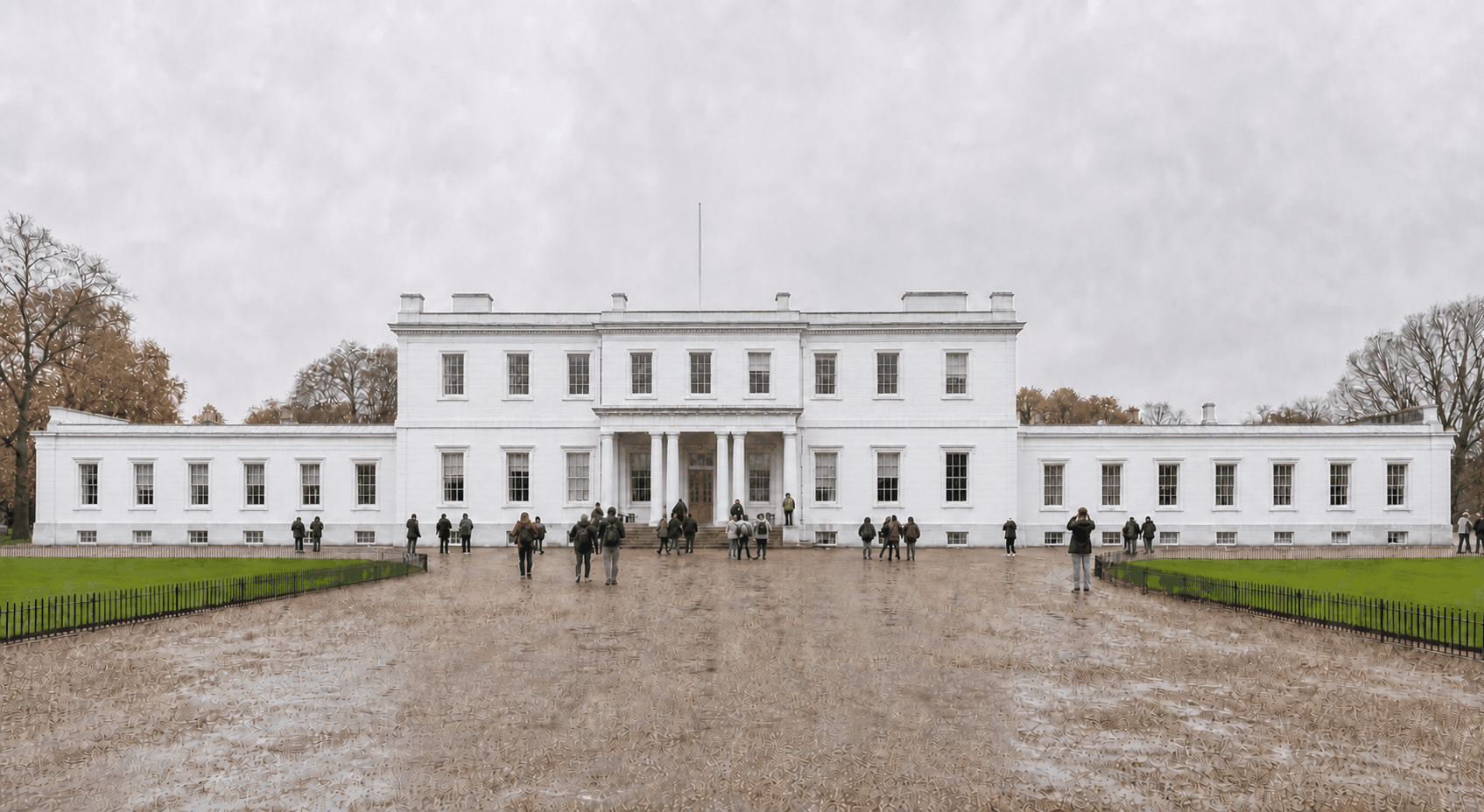
The Palace was designed and built through the 1790s, in the same campaign that raised Parliament House and laid the Axis, and it was finished before the century turned. It is a restrained neoclassical building in pale stone: a central block of two principal storeys over a service basement, a shallow portico, low flanking wings, and almost no ornament above the cornice.
The design was chosen in preference to two considerably grander submissions. The record of that choice is thin, but the surviving comment is consistent: a very large palace was thought likely to embarrass a settlement whose whole claim was that the Crown had been kept rather than imposed, and a building that looked like a seat of power would have said the opposite of what the Charter said.
Modest for a palace
By the standards of European royal building the Palace is small. It has no state apartment in the continental sense, no enfilade of enormous rooms, no grand staircase worth the name, and a principal reception room that holds a few hundred people at a squeeze rather than a thousand in comfort.
The modesty is the point and has been defended as the point in every generation that has proposed to fix it. Enlargement has been raised repeatedly, most seriously in the 1870s and again in the 1920s, and has been refused each time on the same ground: that the Realm did not want a palace that could hold a court, because a palace that can hold a court will eventually be asked to hold one.
What it does have is good rooms, well proportioned and full of light, and a quality of finish that surprises visitors expecting either grandeur or plainness and finding neither.
Alterations
The building has been altered continuously and enlarged hardly at all. The east wing was rebuilt after a structural failure in the nineteenth century. Services have been renewed in every generation, most drastically in the 1930s, when the interior was substantially stripped and reconstructed behind the original walls because the timber framing had reached the end of its life.
It has never burned and has never been attacked. The Realm fought no war on its own soil after 1863, and the wars it did fight were fought elsewhere, so the Palace has had an unusually undisturbed two centuries for a building of its kind. Its worst damage has been done by rot, subsidence and the 1930s builders.
An unbarricaded capital
Capital architecture in the Columbia District is governed by a convention rather than a statute: that the buildings of the federal government are to be approachable, visible and unbarricaded, and that any security which cannot be provided without turning them into fortifications is to be provided some other way or not at all.
It is a convention rather than a statute, it is old, and the Palace is its most conspicuous subject. The forecourt is open. The railings are low and are railings rather than defences. There is no standoff distance, no vehicle barrier of the visible kind, and no armed presence on the public side. The rule has survived every pressure to abandon it, including the strongest one.
No throne
There is no throne in Columbia Palace. There is no chair of state, no dais, no canopy, and no fixed seat of any kind in any room of it. None has ever been installed, and, so far as the record shows, none has ever been proposed.
This is the single most remarked feature of the building and the hardest for foreign visitors to absorb, because it is not a refusal. A refusal implies that somebody asked. The Realm appears simply never to have thought of it: no design included one, no ministry requested one, no monarch enquired after one, and no debate about one appears in the parliamentary record across two hundred and thirty years.
What happens instead is that the King stands. At an investiture conducted by the monarch in person, at the delivery of a royal message, at a state reception, the Sovereign of the United Kingdom of America stands in a room among people who are also standing, and when he sits he sits in an ordinary chair that is carried in for the purpose and carried out again afterwards. The chairs are not special. They come from the room they are usually in.
The Realm’s constitutional writers make a good deal of this and are entitled to. The Crown in right of America is an office rather than a person and a capacity rather than a place, and a building with nowhere for a monarch to be enthroned is a fairly direct statement of that. It also produces the Realm’s characteristic ceremonial texture, which visiting courts consistently describe as strange: enormous formality of procedure conducted in a room with no focal point, around a man who has to be pointed out to you if you have not seen him before.
✎ Editor's Note · The absence that carries the article
Almost every fact in this article is a subtraction, and the throne is the largest of them. A palace with no throne, no executive function, no permanent monarch and free public entry is not a building the Realm forgot to finish. It is a monarchy describing itself.
The point is sharpened by where the building stands. The Realm’s actual head of government works from a townhouse on Charter Road with a black door, and its actual working Crown business is done at Government House on the rise. What sits at the ceremonial heart of the capital, on the grandest site the founding generation had to give, is a house whose whole content is symbolic and whose doors are open. That inversion is the setting’s argument about power and display made in stone, and it is why the building deserves an article rather than a paragraph.
The Crown in residence
How often
Until 2028 the monarch of the United Kingdom of America reigned from London and came to America every year or two, for periods of days or weeks rather than months. Ernest V kept to that rhythm across his reign, and his predecessors kept to something like it.
The visits were not state visits, because a sovereign cannot pay a state visit to his own realm. They were periods of residence, and the Palace exists to be the place he resides in.
A King in residence
On 31 October 2028 the house acquired a resident sovereign for the first time. The abdication of Ernest V took effect at six in the evening in London that day, which was two in the afternoon in New Westminster, and the boy who had lived upstairs as Prince of Columbia since 2016 became King of all fourteen realms as George V, at fifteen. The Realm was the last realm to give the abdication effect, by an Act to which the Regent assented at the Palace that morning, the Governor-General having no power to assent to an instrument that touches the succession. The Privy Council sat in the house at six and proclaimed the accession, the King attending. Ernest V, created Duke of Cumberland that evening by the first British instrument of the reign, remains in New Westminster General.
The King lives at the Palace in the school year, with his mother, Queen Christina, who is his Regent until his sixteenth birthday on 2 May 2029 and performs every act of the Crown for him until then. He is to finish at Ellicott High School with his year. A coronation in Great Britain has been announced for after his birthday, and no other realm crowns its sovereign. He is the first sovereign of the union ordinarily resident in the Realm, and the Governor-General’s commission, which is issued to the Crown and not to the man, continues unchanged beside him. Behind him the heir presumptive is his aunt, Queen Caroline.
What changes when he is there
Constitutionally, remarkably little. Under Ernest V the Governor-General’s commission continued, the office was neither vacated nor diminished, nothing was suspended, and ordinary business resumed on the King’s departure without any instrument of restoration. The Realm treated a royal visit as an occasion rather than a transfer of anything.
What changed in practice was the audience. The Prime Minister’s weekly audience, ordinarily held with the Governor-General, was held with the King while he was in the country, at the Palace. It was the same audience, conducted on the same terms, minuted the same way and constitutionally identical, and every premier who has described it has said that it did not feel identical at all.
The monarch also conducted investitures in person during a residence, which was the exception to the ordinary practice described below, received the heads of the other realms’ governments if any were visiting, and appeared at whatever public occasions the visit was arranged around. How the audience and the investitures will work beside a King of full age who lives in the house is a question that arises on 2 May 2029 and has not been answered.
The standards
The Palace has one flagstaff, and what flies from it is the standard of the most senior person present.
The Royal Standard of 1841 flies when the sovereign is in the building and at no other time, which until 2028 meant a few weeks in most years. The rule is the ordinary one and it produced an effect peculiar to America. In a realm where the monarch is nearly always present, a flag marking his presence is unremarkable. In a realm where he was nearly always absent, the same flag became an announcement, and its raising was reported. Americans who worked along the Axis knew without being told that the King was in the country, because they walked past the answer. Under the same rule it is now the standard of the King who lives in the house.
For most of the year before the accession what flew instead was the standard of the Prince of Columbia: the 1841 arms differenced by a plain white label of three points, borne by the heir in his American capacity and governed by the same rule, that it flies only where he is personally present.
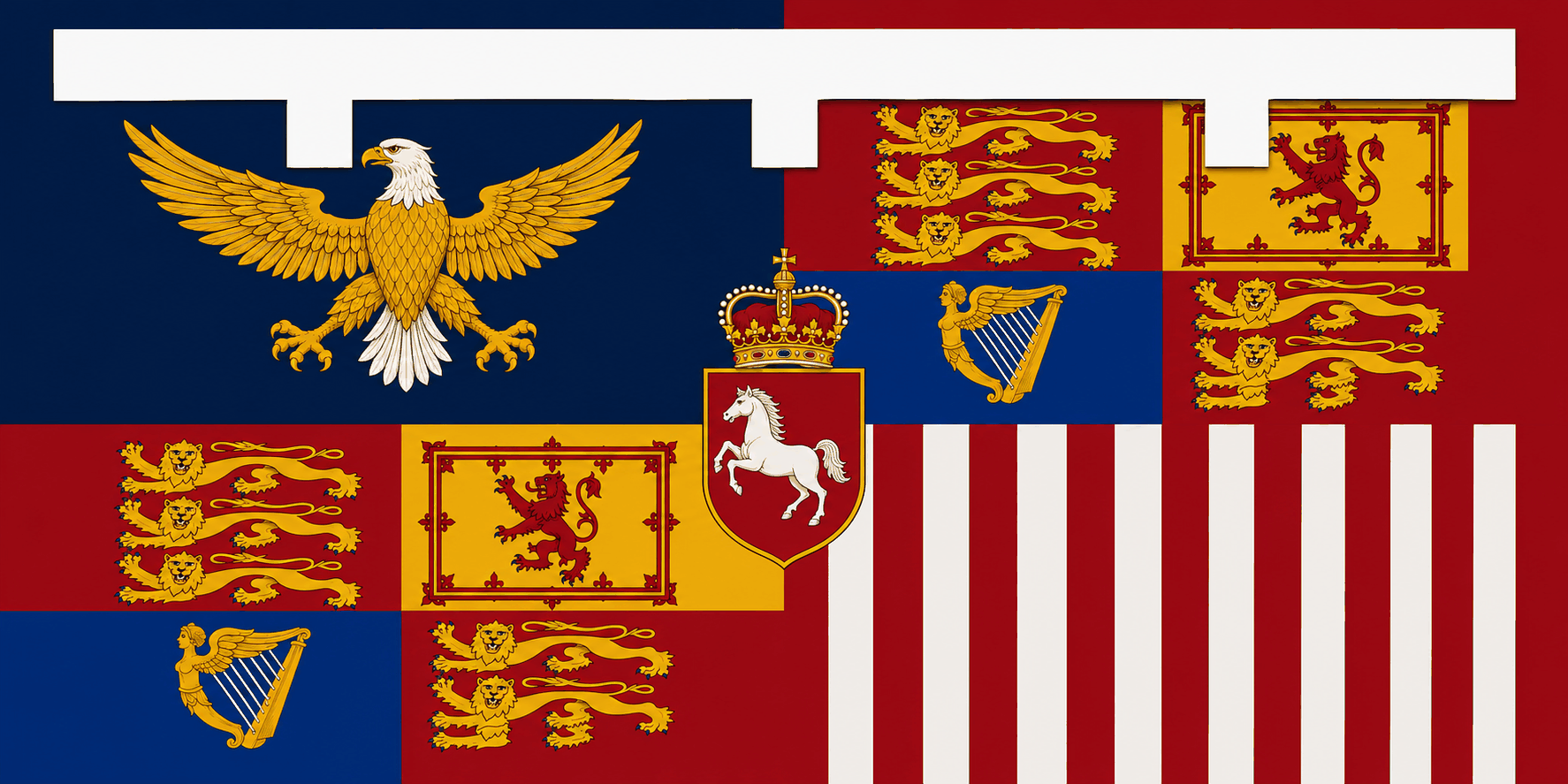
Because Prince Frederick lived at the Palace, his standard was up on most days of most years, and the staff was very seldom bare. The Realm read the Palace not by whether a flag was flying but by which one: when the King arrived the heir’s standard came down and his father’s went up, and when the King left it went back. The household struck the heir’s standard on the night of 25 September 2028, when the King’s aircraft was lost, and flew the national flag instead. The standard of the Prince of Columbia now waits, with the dignity, for an heir apparent.
The staff stood empty only when neither of them was there, which after Frederick took up residence became uncommon enough to be noticed. An empty staff on the Charter Axis meant the heir was travelling.
The house and its resident
A museum, and a home
For most of any year the state rooms of Columbia Palace are a museum, and the private apartments are somebody’s house.
The King lives at the Palace. As Prince Frederick, Prince of Columbia, he lived and studied in New Westminster while his father reigned from London, and the private apartments of the north wing, which he shares with his mother in the school year, were his from 2016. Since 31 October 2028 he lives in them as George V, at fifteen. He was the first heir in the Realm’s history to be brought up substantially in America rather than visiting it, he is the first sovereign to live in it, and the arrangement is the most consequential thing about the building in the present generation.
The effect on the Palace is that it is not an empty house. There is a boy doing schoolwork upstairs while several hundred people a day walk through the rooms below, and the two operations are separated by a door and an understanding. Visitors are not shown the private side and are not told much about it. What they are told, if they ask, is that the family lives here, which is a sentence no other open palace in the world can offer quite so literally.
What his residence means
The Realm has not been neutral about this. His American title, Prince of Columbia, attaches him to this district specifically rather than to the Realm in the abstract, and putting the boy who holds it in the district’s principal building for his education was a decision rather than a convenience.
The intended effect is obvious enough: an heir who has been to school in America is a different proposition from an heir who has visited it, and the Realm spent two centuries with monarchs who reigned over it from three thousand miles away. Whether it will work was unknown when the boy was a Prince, and is unknown now that he is King. His article records the strain of two royal calendars, two courts, two publics and two constitutional cultures on one childhood, and the Palace is where the American half of that is conducted.
What happens at the Palace
Charter Day
4 July is the Palace’s largest day. The Sovereign’s address to the Realm, broadcast by the American Broadcasting Corporation, is given from Columbia Palace when the monarch is in the country and recorded elsewhere when he is not, which is most years. By convention it speaks to the condition of the Union rather than to the politics of the year.
The forecourt is open all day and is used. The gardens take crowds. The Realm’s Charter Day is kept with fireworks, speeches and parades rather than with court ceremony, and the Palace’s role in it is to be the building everybody walks past on the way to something else.
Accession
When a sovereign dies, or as on 31 October 2028 abdicates, the Realm proclaims his successor separately, in its own right, and Columbia Palace is where it is done.
The American proclamation is not a copy of the British one and is not consequential upon it. The Crown in right of America passes at the moment of the demise, and the proclamation is the act by which the Realm records and announces it, made in America by American authority; the constitutional point of holding it here rather than receiving news from London is precisely that the two Crowns descend in the same person separately, and each realm says so in its own voice. The day is set out in Plans for the Death of the King, under the Realm’s plan, Operation Chain Bridge. The proclamation is read from the Palace and then in the polities. Article II.8 of the Charter provides that the American succession follows the British while the two remain the same and that Parliament determines it if they ever differ, and the separate proclamation is the practice that keeps that clause meaningful rather than theoretical.
The last proclamation was the first made for a living predecessor. On the evening of 31 October 2028 the Privy Council sat at the Palace at six, four hours after the abdication of Ernest V took effect, with the new King present, and the Clerk of the Council read the proclamation of George V from the steps at half past six, to a crowd in the forecourt. No plan for the death of the King was opened, because there had been no death.
Mourning
The Palace is where the Realm goes when it grieves. A book of condolence is opened in the entrance hall for the death of a sovereign, for a Prime Minister who dies in office, and for national catastrophe, and people queue along the Axis to sign it.
The books after 1 May 2006 ran to many volumes and are kept. Ernest V was at Buckingham Palace when the May Day Bombings happened and addressed the Realm from London that evening, so the Palace’s part in that week was not the monarch’s presence but the building’s: gates open, hall open, the queue moving through it for days. The Realm’s own account of the period gives the queue more weight than the address.
State receptions and the other realms
Heads of state and government are received at the Palace when the occasion is a Crown occasion. Visits from the governments of the other realms that share the monarch are handled here, since a standing conference of twelve governments advising one Crown produces a good deal of traffic, and the Palace is the natural setting for a relationship that is dynastic rather than diplomatic.
What does not happen here
Investitures, in the ordinary course, do not.
The Realm’s honours are conferred by the Governor-General at Government House, in seasons through the year, and the great majority of Americans who receive an honour receive it from the Crown’s representative in the working Crown house rather than from the Crown in the ceremonial one. The monarch invests in person at the Palace during a residence, which happens every year or two and covers a small proportion of the total.
Nor is any executive business done at the Palace. The Prime Minister governs from Charter House. Orders are signed, assent is granted, ministers are sworn and ministries are commissioned at Government House. The Palace has no red boxes, no secretariat of state and no constitutional function that could be exercised in its absence, which is a description of its purpose rather than a complaint about it.
Household and money
The household
The Palace is run by the Royal Household, the one household that serves the King in every realm he holds, through its establishment in New Westminster: officers appointed to the house, paid from its endowment and accountable in the Realm for what they spend. There is no separate American household and no separate British one. When the Household acts for the Crown in right of America it acts on the Realm’s ministers’ advice and on nobody else’s, which is the same principle that governs everything else about the American Crown and which is applied here to housekeeping.
The establishment is not large. It runs the state rooms and the public opening, keeps the collection, maintains the building, and supports the residence of the King, who lived here as heir and lives here now. Its senior officer is a permanent appointment and has generally been a career official rather than a courtier.
The endowment
The Palace is not on the annual estimates. It is maintained from a standing endowment, settled on the building rather than voted for it, and the income from that endowment covers the household, the fabric and the opening.
The arrangement was deliberate and its purpose was to take the Crown’s house out of the yearly argument. A palace debated every spring is a palace whose upkeep becomes a proxy for whether the Realm wants a monarchy, and neither the Crown’s defenders nor its critics have ever much wanted that argument conducted in the form of a maintenance vote.
Audit
The endowment is nonetheless audited, and the accounts are published. This is what has kept the arrangement politically survivable. The National Audit Office examines the Palace accounts as it examines any other public body, the figures appear, and the answer to the recurring suggestion that an endowed palace is a palace nobody can scrutinise is that anybody can, annually, in print.
The result is that the cost of Columbia Palace is a small and rather dull item in American public life. It is raised periodically, most often by members who dislike the monarchy on principle, and it does not travel far, because the figures are modest and available and the building is free to enter.
The public
Free entry
Columbia Palace is free to enter and open for most of the year. There is no ticket, no charge and no booking for ordinary admission, and the state rooms are open on the great majority of days when the sovereign is not in residence and no ceremony is being prepared. The rule was written for a sovereign who came every year or two. The King now lives in the private apartments, as he did as heir, and the Household has not said whether the rule for the state rooms will change.
This is unusual to the point of eccentricity among royal buildings and it is the most deliberate thing about the place. The argument the Realm makes for it is the argument it makes for the unbarricaded capital and for the Crown generally: an institution that belongs to the public and cannot be voted out had better be one the public can walk into, and a palace that charges admission has conceded that it is a private house being shown rather than a public building being used.
Visitor numbers are large by the standards of the capital and are not published as an achievement. School parties come from across the Realm.
The tour
A visitor enters through the forecourt and the entrance hall, where the books of condolence are kept when open, and moves through the principal reception rooms of the ground floor and the east range.
There is very little interpretation. Rooms carry small plain labels, the household provides guides who answer questions rather than delivering a script, and the building is presented as a working house that is sometimes used rather than as an exhibit. The private apartments are not shown.
The room visitors remember is the principal reception room, and what they remember about it is that it is empty. There is no seat, no dais and no arrangement pointing anywhere. People are routinely told, and routinely surprised, that the King stands here.
Security
Security at the Palace is governed by the same settlement as everything else in the Realm after 2006, which is to say that it is real, it is behind the counter, and it is close to invisible.
There are no checkpoints on the forecourt, no queue architecture, no bag search of the airport kind and no armed presence on the public side. Entry to the state rooms is controlled in the way entry to a museum is controlled. The Realm’s post-May-Day settlement did not put barriers around its buildings, and the Palace is the case most often cited to demonstrate it: whatever else changed after 2006, a person may still walk off the Axis into the Crown’s house without being stopped.
Whether the settlement’s invisible half applies here as it applies elsewhere, and what is done with the record of who comes and goes, is not published, and the Realm’s civil liberties organisations note the omission.
The collection
The Palace holds a collection of gifts of state, accumulated over two centuries of American Crown ceremonial: presents from foreign sovereigns and republics, from the governments of the other realms, from the polities of the Union, and from the Native Nations under treaty.
Ownership is genuinely unsettled and the Realm has not resolved it. Some of the collection is held by the Crown, some by the Realm, and a substantial part is recorded in terms that could support either. Gifts given to the monarch in his American capacity are a different thing from gifts given to the American state, and the distinction was not carefully drawn for the first century and a half because nobody expected it to matter.
It matters now chiefly for lending, disposal and conservation, and the practical answer has been to treat the whole collection as inalienable and to argue about ownership only when somebody proposes to move something. Objects are catalogued, the catalogue is public, and the household declines to characterise the title.
The Native diplomatic gifts are the part of the collection that receives most attention. They were given in the course of treaty relationships whose obligations the Realm has repeatedly failed, and they are displayed with that stated.
The enslaved builders
The Palace acknowledges the people who built it, and the acknowledgement is recent.
For most of two centuries the building accounts sat in the archives and the tour said nothing. The change came late in the twentieth century, driven by historians working on the capital’s construction records and by pressure from Black civic organisations in the District, and it was resisted at the time by people who argued that a royal residence was not the place for it and that the Realm’s national buildings should not be turned into arguments.
What exists now is a permanent part of the ordinary tour rather than a separate exhibit, which was the specific demand of the people who pressed for it. The names recovered from the pay books are set out where visitors pass them, together with what the accounts actually record, which is that owners were paid for the labour of people who were not. The recovered names are incomplete and the display says so.
The Realm has not settled what else is owed. The acknowledgement is a statement of fact rather than a policy, and the argument about whether a statement of fact is a sufficient response continues in the ordinary way.
The name
The building is called the White House by practically everybody, and has been for so long that its formal name is chiefly encountered on letterhead.
The name is descriptive and came from the stone. The Palace is faced in a pale limestone that reads white in most lights and very white after rain, and it stood out sharply in a capital that was for its first decades a construction site among brick and timber. The nickname is attested early and appears to have been in general use before the building was finished.
What is unusual is how far up it has travelled. The Crown uses it. Household correspondence uses it, the monarch uses it in conversation, and the King, who lives there, calls it the White House like everyone else, as he did as Prince Frederick. There is no institutional preference for the formal name and no attempt to discourage the other one. The Realm has a long habit of letting the popular name win, and this is the clearest case of it: Charter House took its name from Charter Road, Blackjacks took its name from the oak country, and Columbia Palace took its name from the public.
Criticism
The Palace is the most attackable thing the Realm’s monarchy owns, and it attracts less criticism than might be expected.
Organised republicanism in the Realm is small and marginal, and the argument it makes about the building is the obvious one: that a palace maintained for a monarch who was absent for fifty weeks a year was a monument to an absurdity, and that the Realm had furnished a house for somebody who did not live in it. The answer usually given was that the heir lived in it, that the doors are open, that the accounts are published and that the endowment costs the estimates nothing, and the argument tended to stop there because the facts are dull and verifiable. Since 31 October 2028 the sovereign lives in it, and the argument has to be made another way.
The more interesting criticism comes from the other direction, from people who are not republicans and who think the Palace concedes too much. Their case is that a Crown with no throne, no fixed seat, no court and an open door has made itself so modest that it cannot perform the one function it exists for, which is to be visibly continuous when the political order is not. That argument surfaces after every constitutional shock and is generally answered by pointing at the queue for the condolence books in 2006.
Chronology
1790s. The capital is surveyed and built on the Potomac under the Charter’s requirement. Columbia Palace is designed and raised as the western anchor of the Charter Axis, in substantial part by enslaved labour hired from owners in the surrounding country.
Late 1790s. The building is completed. The nickname the White House is already in general use.
Nineteenth century. The east wing is rebuilt after a structural failure. Proposals to enlarge the Palace are made and refused, most seriously in the 1870s.
1841. The Royal Standard is settled in its present form and flies from the Palace when the sovereign is in the building.
1920s. Enlargement is proposed again and refused again.
1930s. The interior is stripped and reconstructed behind the original walls after the timber framing fails.
Late twentieth century. The enslaved builders are acknowledged in the ordinary tour after pressure from historians and Black civic organisations in the District, against resistance.
1 May 2006. Ernest V addresses the Realm from Buckingham Palace. The Palace opens its gates and hall, and the books of condolence run to many volumes.
2016. Prince Frederick, Prince of Columbia, takes up residence in the private apartments for school in New Westminster, the first heir to be raised substantially in America.
31 October 2028. Ernest V’s abdication takes effect at two in the afternoon; the Regent assents to the Realm’s Act at the Palace that morning, the Privy Council proclaims George V here at six, and the King, who lives upstairs, becomes the first sovereign resident in the Realm.
Trivia
- In-Universe There is no throne in Columbia Palace, and the striking thing is that there was never a refusal. No design included one, no ministry requested one, no monarch enquired after one, and no debate about one appears in the parliamentary record in two hundred and thirty years. The King stands, and when he sits he sits in an ordinary chair carried in for the purpose and carried out again, taken from whatever room it usually lives in.
- In-Universe The Palace is free to enter and open most of the year, which is the most deliberate thing about it. The argument the Realm makes is that an institution which belongs to the public and cannot be voted out had better be one the public can walk into, and that a palace charging admission has conceded it is a private house being shown rather than a public building being used. The room visitors remember is the principal reception room, and what they remember is that it is empty.
- In-Universe Nobody calls it Columbia Palace. It is the White House, from the pale stone, and the name was in general use before the building was finished. What is unusual is how far up it has travelled: the household uses it, the monarch uses it, and Prince Frederick, who lives there, calls it that too. The Realm has a habit of letting the popular name win, and Charter House and Blackjacks were both named the same way, by their surroundings rather than by anybody's decision.
- In-Universe The King lives in the Palace. As Prince Frederick, Prince of Columbia, he lived and studied in New Westminster while his father reigned from London, the first heir raised substantially in America rather than visiting it, and since 31 October 2028 he lives there as George V, the first sovereign to live in the Realm. The practical effect is a boy doing schoolwork upstairs while several hundred people a day walk through the rooms below, separated by a door and an understanding.
- In-Universe The Palace has one flagstaff and what flies from it is the standard of the most senior person present, so the Realm reads the building by which flag is up rather than whether one is. The Royal Standard means the King is in the building, which until 2028 was true for a few weeks in most years. The standard of the Prince of Columbia, the 1841 arms differenced by a white label of three points, meant the heir was at home, which after Frederick took up residence was true on most days; it has not flown since 25 September 2028 and waits for an heir apparent.
- In-Universe An empty flagstaff at Columbia Palace became uncommon enough to be noticed, and it meant the heir was travelling. In a realm where the monarch is nearly always present the rule is unremarkable; in one where he was absent for most of every year the same flag became an announcement, and people who worked along the Charter Axis knew the King was in the country because they walked past the answer.
- In-Universe Columbia Palace was built in substantial part by enslaved people, and the building accounts survive, which is why the Realm has never been able to argue about whether it happened, only about what to do with the fact. The names recovered from the pay books are now set out where visitors pass them, as part of the ordinary tour rather than as a separate exhibit, which was the specific demand of the people who pressed for it. The acknowledgement came late in the twentieth century and was resisted.
- In-Universe Almost nothing constitutional happens at the Palace. Honours are conferred by the Governor-General at Government House, ministries are commissioned there, assent is granted there, and the Prime Minister governs from a townhouse on Charter Road. The one thing that changes when the monarch is in residence is the audience: the weekly meeting ordinarily held with the Governor-General is held with the King instead, on identical terms, and every premier who has described it says it does not feel identical.
- In-Universe When a sovereign dies the Realm proclaims his successor separately, from Columbia Palace, in its own right and not consequentially upon the British proclamation. The point of doing it in America by American authority is that the two Crowns descend in the same person by two acts rather than one, which is what keeps Article II.8 of the Charter meaningful rather than theoretical.
- Design Almost every fact about this building is a subtraction: small for a palace, no throne, no executive function, no permanent monarch, free entry. It is not an unfinished building but a monarchy describing itself, and the inversion is sharpened by what surrounds it. The grandest site the founding generation had to give holds a house whose entire content is symbolic and whose doors are open, while the Realm's actual government works out of a townhouse with a black door.
- Real-World Columbia Palace stands where our own history put the White House, and the correspondence runs deeper than the address. The most famous executive-mansion site on the continent holds a ceremonial monarchy here, the real executive works from a modest house elsewhere in the city, and the name our history made official survives as the name everybody actually uses. The building also never burns, because there is no War of 1812 in this timeline for anybody to burn it in.
See also
- Crown in right of America: the capacity whose house this is
- Columbia District: the federal capital district, the Charter Axis and the unbarricaded capital
- Governor-General: whose seat is Government House, and who confers the Realm’s honours
- Prime Minister of the United Kingdom of America: who governs from Charter House and whose weekly audience moved here when the King was in residence
- George V: King since 31 October 2028 and the Palace’s resident, as he was as Prince of Columbia
- Ernest V: sovereign from 1972 to 2028, now the Duke of Cumberland
- Blackjacks: the Prime Minister’s country house, named the same way this one was
- May Day Bombings: after which the books of condolence ran to many volumes
Categories
Land & Landscape · The Crown · Official Residences · Columbia District · Institutions