Robert E. Lee National Cemetery
The Robert E. Lee National Cemetery is the principal military burial ground of the United Kingdom of America. It occupies 639 acres at Arlington, in the Province of Virginia, on the bluff above the Potomac directly opposite the capital, and holds about 400,000 graves in some seventy sections, with about two thousand burials a year.
It contains the Tomb of the Unknown Soldier, the memorial walls carrying the names of the Realm’s dead of the two Great Wars, and the house of the estate on which it was laid out. The ground is kept by the Royal American Parks System, the graves by the armed forces, and the Tomb by a company of the Regiment of Virginia.
The estate came to Robert E. Lee through his wife, Mary Custis Lee. The Lees sold its slope and woods to the Crown in 1864 for the burial of the capital’s military dead, and gave the house and the rest of the estate to the Realm by a deed of gift that took effect on his death in 1870; the ministry of Ulysses S. Grant named the cemetery for him the same year.
Name
Three forms are current and all three are correct.
The Robert E. Lee National Cemetery is the formal name, given at the naming in 1870 and used on the gate, in statute and in anything ceremonial.
Royal American National Cemetery at Arlington is the older administrative style. It predates the naming, it survives in service records, burial registers, discharge papers and the standard form of words used when a death is gazetted, and it is what appears in the official record of almost everybody buried there.
The National Cemetery is what people say. The Realm has other national cemeteries, among them the ground at Gettysburg dedicated in 1863, but in ordinary speech the definite article belongs to Arlington, and a Governor-General, a bereaved family and a newspaper will all use the short form in the same sentence without anybody asking which is meant.
History
The estate
The house was not built by a Lee.
It was built early in the nineteenth century by George Washington Parke Custis, the grandson of Martha Washington and the step-grandson of the first Governor-General, as a memorial to Washington, on land that had come to him through his family. Custis filled it with things from Mount Vernon, called it a monument, and spent a long life presenting himself as the keeper of Washington’s memory on a bluff from which Washington’s capital could be seen.
His only surviving child, Mary Anna Randolph Custis, married Robert E. Lee in the house in 1831. The estate came to the Lees through her, which is the fact the Realm’s account of the ground most often leaves out: the most famous piece of land associated with Lee was never his inheritance, and the Washington connection that gave the house its purpose came to it through his wife.
The estate ran from the house on the crest down a long open slope to the river flats, with oak woods in the hollows behind the crest. Lee, as a young engineer officer in the 1830s, surveyed the reach of the river below it. Custis died in 1857 and Lee took leave from the Army to act as his executor. In the spring of 1861 the house was shut, and for the rest of the war Lee worked from a farmhouse on the crest.
When the ground became a cemetery, the Washington relics went back to Mount Vernon. The Duke of Mount Vernon’s household had asked for them before, and the change of use settled the question. The house now holds only Lee’s things, and it is no longer a memorial to anyone but him.
Slavery on the estate
The ground on which the Realm honours loyalty freely chosen was built and worked by people who had no choice at all.
Arlington was a working plantation. Enslaved families lived and worked on it for two generations before the war, cleared and farmed the slope that is now the cemetery, and built and kept the house on the crest. The families who can be named from the estate’s records are named in the visitor centre, which is the only place on the ground where they are.
George Washington Parke Custis provided in his will that the people enslaved on his estates should be freed within five years of his death. The people at Arlington believed they had been freed at his death and resisted Lee’s management from the first month. Lee, as executor, freed them on the last lawful day in 1862, having used the whole of the period the will allowed. In the meantime he hired people out to other plantations to make the estate pay, and families were separated in consequence. It is the least flattering documented part of his life, and it is documented in his own hand.
In 1859 Wesley Norris, his sister and a cousin, all enslaved at Arlington, escaped, were caught in Maryland and were brought back. Norris’s account, published in 1866, was that Lee had them whipped and their backs washed with brine. Lee never answered it in public and denied it in a private letter, which is the only denial there is. The Lee family’s papers, opened to researchers in the present century, matched Norris’s name and dates to the estate books. His testimony is on the wall of the visitor centre, beside the names of the families.
They were not the only people Lee held. He also held a small number of enslaved people of his own, inherited from his mother and separate from the Custis estate. The will did not touch them, and they were freed only by the Emancipation Measure of 1865. For those people Lee was compensated. The Measure paid owners in the polities that had stayed loyal and nothing to owners in rebellion; Lee’s property lay in eastern Virginia, which had rebelled, and he was paid under a provision for loyal subjects whose property lay in a rebel polity. The payment is entered in the same Treasury ledgers as the purchase of the cemetery, a few folios apart. It was not concealed, only unexamined, until a historian working on something else found it, and the visitor centre now displays it beside the deed of sale.
The freed people of the estate did not remain on it. No settlement was made for them on the ground, and those who stayed in the region went across the river into the capital. The cemetery has no village in its history and no descendants’ claim upon its acres.
The sale
The sale was possible because Lee had stayed loyal.
He was a Virginian from the eastern half of the Province, the half that rebelled, and in 1861 he refused the Richmond command and the Realm’s supreme command in the same week. The Examiner in Richmond called him a traitor in print, and he wrote to the paper once, briefly. It published the reply at once, presumably expecting it to finish him. It is the only public statement he made about the decision.
You describe me as a traitor to Virginia, and I will not quarrel with the description, since it is plain that one of us must be a traitor to something. I have sworn an oath to the Crown and not to a Province. A soldier who treats an oath as conditional on geography has not understood what he swore, and I would rather be despised in Richmond for keeping it than admired there for breaking it.
He told the ministry in writing that Ulysses S. Grant should have the command of the armies, and he was given the engineering and fortification of the capital instead. He built the ring of works on both banks that made New Westminster safe to govern from, the heaviest of them on the Virginia heights, and the only time he commanded in action was in their defence, when Jackson attacked them for three days in 1862 at the Battle of Arlington Heights.
The rebellion collapsed in the autumn of 1863. The dying did not stop with it. Through the winter the hospitals on the Charter Axis were as full as they had ever been, with the sick from the camps, the wounded of the last campaigns and the prisoners, and by the spring of 1864 every burying ground in the capital was full.
The Quartermaster-General wanted ground that was near and dry, on the right side of the roads and the weather, and within a morning of the hospitals, and the obvious ground was the bluff across the river. His officer came to Lee in March. Lee knew exactly what the land was wanted for and said only that it was not his to sell alone, because it had come to him through his wife. A fortnight later the conveyance was drawn.
The deed was signed at the end of March 1864 in the hall of the house, shut since 1861, with Mary Lee carried in in her chair, her husband standing beside her and the deed on a table. He signed first and she signed beside him. The two witnesses were a lawyer from the capital and Major Henry Ashton of the Engineers, one of Lee’s officers. Her signature is on the deed beside his, the visitor centre displays it, and the story told about the ground has forgotten it almost completely.
What they sold was the slope below the house and the woods behind the crest. The house and its garden stayed the Lees’. The price was a valuation by a surveyor from Baltimore whom neither of them had met, so much the acre for the slope and so much for the woods, neither a reward nor a sacrifice, and the scrupulousness is the point. What the Lees did with the money is not recorded.
In a Realm where Lee had gone over, the estate would have been confiscated as a traitor’s property and the Crown would have taken it for nothing. Because he stayed, the Crown had to buy it like anybody else, at valuation, from a serving officer and his wife. The deed of sale is displayed in the visitor centre precisely because the difference is the point. It remains the strangest transaction in the Realm’s property records: a general selling his own lawn so that the army he served could bury its dead on it, and going back to his fortifications the same afternoon.
In the same year he was raised to the Lords as Viscount Lee, plainly, with no territorial designation, at his own request. It was meant as an honour and was received in Virginia as a provocation, and the Richmond papers printed the title with a black border round it.
The first burials
Lee gave the laying out of the ground to Ashton, with one instruction: to keep the dead above the water. The river flats flood, and some springs far more than others, and Ashton set out to find the highest water anybody had evidence of. He found drift lines lodged in the trees at the foot of the slope, a mark with a date cut on the wall of the old springhouse, and the line of a great freshet on Lee’s own survey of the 1830s.
He also found Abel, a freed man of the estate who had worked its river fields for fifty years and was living across the river in the capital. Abel had carried the sandbags in the great freshet, and he drew its line for Ashton in the mud of the street with his stick, a fence above the line on Lee’s survey. Ashton set the sections a fence above Abel’s line. The drawing that went to the department says only that the sections were set above the highest water of which evidence could be found; Abel’s name is in Ashton’s field book and not on the drawing.
The clearing began in the middle of April. The slope was pasture and needed only to be marked, but the first sections ran back into the oak woods behind the crest, and the woods were cut hard. The labourers were civilians hired in the capital, and with them came a detail of one of the Black regiments, forty men under a lieutenant, who had dug the Capital Works since the winter of 1862 and now dug the first graves.
The first burials were on 9 May 1864. Eleven men came across the river in two wagons from the hospitals on the Axis: eight soldiers of the Crown, two rebel prisoners and a private of one of the Black regiments, who had died of fever. The Quartermaster-General’s lieutenant asked Ashton where the Black soldier was to go. Ashton answered “the next grave in the row”, the lieutenant wrote it in his book, and the private was buried in the next grave in the row, between a corporal from Ohio and a rebel from North Carolina, under the same service as both. Ashton was praised for the answer for the rest of his life and always denied that it had been a decision.
The rows went on down the slope in the order in which the dead came across the river, soldiers of both armies and of both races in the same rows, each under a painted board of one pattern carrying name, rank, regiment and date and nothing else. The first sections took the men dying in the capital’s hospitals of wounds and fever and the dead moved from the full burying grounds across the river, and by the end of 1865 there were about five thousand graves.
The bequest and the naming
Lee left the Army in the spring of 1865, gave up the farmhouse on the crest and opened the house. He kept his seat in the Lords, advised Grant’s ministry, and lived quietly for five years in the house above a cemetery that filled while he watched it. Mary could no longer walk and the daughters ran the house. Grant rode over most Sundays, and the two men sat on the terrace for hours, saying little by both families’ accounts, and that mostly about horses.
The Lees gave the house and the remaining acres to the Realm by a deed of gift, signed by both of them, to take effect on his death, for use as a national military cemetery. It carried one condition, that he be buried on the terrace, and one term, that Mary should keep the house for her life. As with the sale, the estate had come through her, and the gift went in both their names.
Lee died of a stroke at the house on 12 October 1870, aged sixty-three. Grant, by then Prime Minister, walked behind the coffin to the terrace and did not speak. The Regiment of Virginia, in which Lee had never served, found the bearer party. The Governor-General, Salmon P. Chase, attended; Ernest II sent a formal message of condolence; nobody came from Richmond. Lee gave no public reason for the gift, then or afterwards. The reading generally offered is that a man whose loyalty had cost him his standing in the Province he came from chose to give his ground to the Realm he had chosen instead, and that choosing a burial ground rather than a monument was the whole of what he meant.
The ministry named the cemetery for him within months, and the naming was pointed. Virginia was still raw, the rebellion was inside a decade, and a government that wished to say something about loyalty said it by carving a Virginian’s name on the gate of the ground where the Crown’s dead lay. It was a provocation dressed as an honour, exactly as the peerage had been, and it was received in Virginia exactly as the peerage had been.
Mary Custis Lee lived in the house until her death in 1873, when the estate passed wholly to the Realm, and she was buried beside him on the terrace.
The reconciliation decision followed his death rather than preceding it. In the early 1870s, as the painted boards of the first years were replaced in marble, the Realm resolved that the rebel dead already buried in the ground would stay where they were and be given the same stones as everybody else. It has been said ever since that the idea was Lee’s. He never claimed it, he was dead when it was taken, and the claim is therefore unprovable, which has not slowed it down at all.
The Quartermaster-General’s ground
From 1873 the Quartermaster-General’s department ran the cemetery from the house, using most of its rooms as offices and keeping Lee’s study and two other rooms open to visitors. The statue of Lee on the Charter Axis was unveiled in the 1880s, and in the same decade the woods behind the crest were replanted.
Grant died on 23 July 1885 and was buried on the slope in sight of the terrace, with Julia later beside him. His stone named him Prime Minister, the first grave on the ground to carry an office.
The Royal Parks Service Act 1916, which received assent on 25 August 1916, took the ground into the new Parks System. The civilian Superintendent and the boundary between the two organisations that share the estate date from then.
The Great Wars
The Realm entered the First Great War in 1916. Prince Adolphus, Ernest III’s heir, was killed in Flanders on 21 October 1916 serving with the Grenadier Guards, and his father decided at once that he would be buried where he fell. In 1919 the Realm decided the same for everybody: its dead would stay in the war cemeteries of Flanders and eastern France, and the families were not consulted. The cemetery therefore holds no identified dead of either Great War.
What it holds instead is the Tomb of the Unknown Soldier, dedicated on 11 November 1921 over the one body brought home, and the walls, built in the 1930s after a decade of argument and carrying about 120,000 names of the first war’s dead.
William Howard Taft died in 1930 and was the first Governor-General buried there. He had never served, and his burial began the practice of the Realm’s great civil officers asking for a grave and not being refused.
In 1937 the guard on the Tomb became continuous, found by the Regiment of Virginia, and the amphitheatre behind the Tomb was built with the guard’s quarters beneath it. Before then a civilian watchman had kept the Tomb by day and nobody had kept it by night.
The second war’s dead were not brought home either. The policy of 1919 held, and they lie in the war cemeteries of Europe and the Pacific. From 1946 to 1952 about 300,000 of their names were cut on the walls, which were extended along the path for the purpose. In 1958, after a campaign by the second war’s veterans, a second unknown soldier was buried in front of the Tomb.
About thirty American soldiers had been shot for desertion and cowardice in the first war, after field courts martial, and buried abroad in separate plots. The Military Pardons Act 2018 pardoned them together at the centenary of the Armistice, over the Army’s formal objection, and in 2019 the war graves authority moved them into the ordinary rows of the cemeteries where they lay. Their names were then cut on the walls at Arlington.
Bringing the dead home
The Realm began bringing its dead home during the Indochina war, from the middle of the 1960s, when aircraft made it practicable and the families would no longer accept otherwise. Nobody repealed the policy of 1919. It stopped being applied.
The first of the Indochina dead to come home were buried in the section opened in 1966, which is also where John F. Kennedy lies, shot in Manhattan in May of that year. The crew of the Apollo 1 fire were buried the next year, and from then the sections filled with the modern dead, who have graves, families who visit them often, and no place on the walls.
The newest sections hold the dead of later deployments, five of the crew of Intrepid, lost in 2003, and, from May Day 2006, the Lieutenant-Governor of New York.
Grounds
The estate sits on the Virginia bank where the river bends, rising from a floodplain to a bluff about two hundred feet above the water. The house stands on the crest. The ground falls away from it to the north and east in a long open slope, and the graves run down that slope in rows.
The view is the reason for all of it. From the terrace the whole of the capital is laid out across a mile of water: the Charter Axis running up from the river to Parliament House on Charter Hill, and Columbia Palace at the far end. It is the best prospect of the seat of government that exists anywhere, which is why a Custis built a house to look at it, and why the Quartermaster-General wanted the ground in 1864.
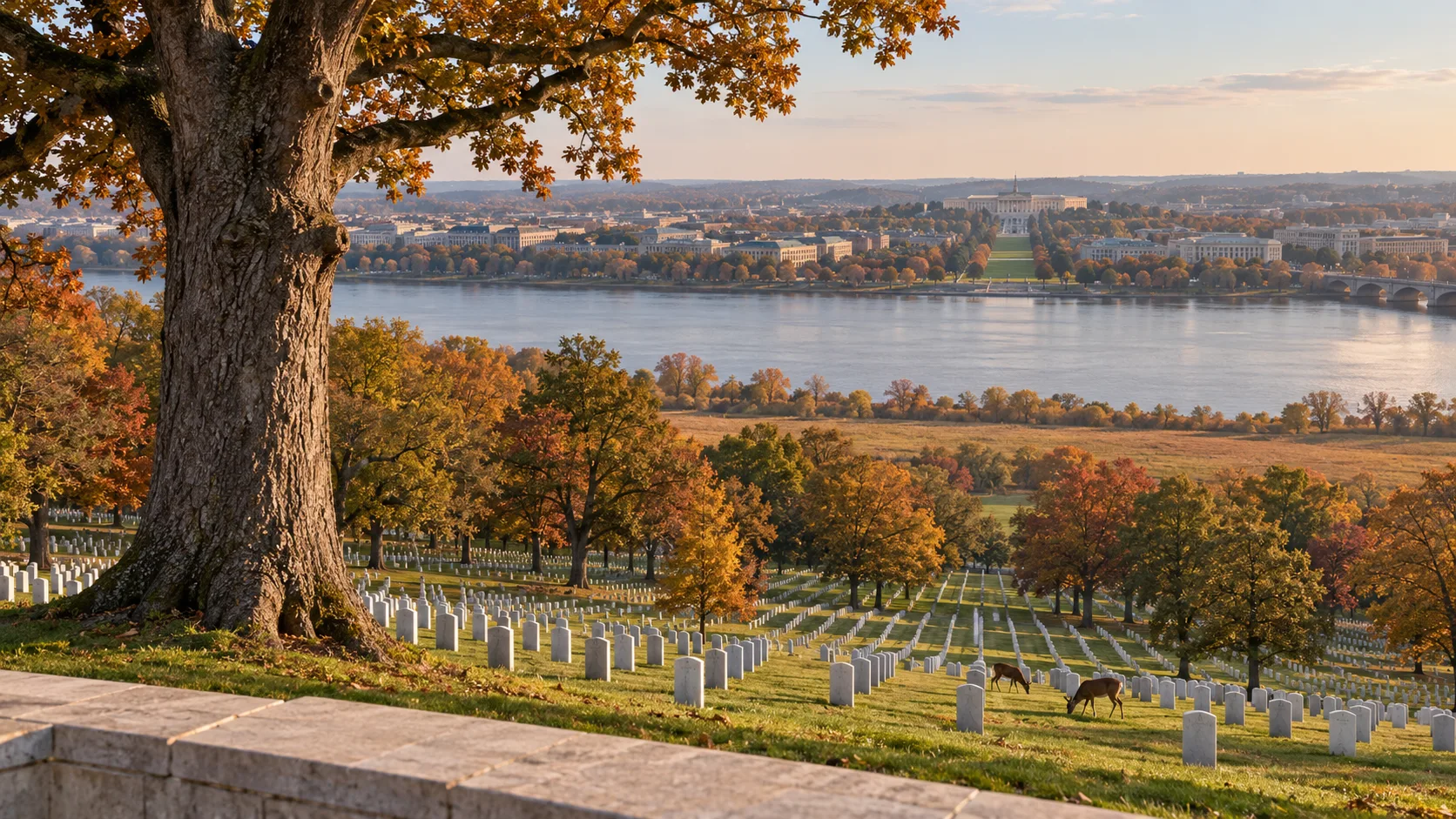
Every grave lies above the flood line. No section has been opened below the line Ashton set in 1864, and the floodplain is meadow, mown once a year. The great floods of 1936 and 1972 covered the floodplain and stopped short of the lowest graves. The guides call the line Abel’s. It has no marker; they point to where the meadow stops and the rows begin.
The slope was pasture and the hollows behind the crest were oak. The oak was cut hard for the first burials, replanted in the 1880s, partly from trees grown from the old oak’s acorns, and replanted again after the second war, and the cemetery now holds one of the larger stands of mature hardwood within reach of the capital. The rows run under the trees where the ground is wooded and across open grass where it is not, and the difference between a burial in the trees and a burial in the open is the only variation the ordinary rows permit.
One tree is older than the house. A single oak on the crest was standing when the house was built, and in 1864, when the Quartermaster-General’s men were clearing for the first burials, Lee refused to have it felled. It still stands, a little below the terrace, and no grave has been dug within its reach.
It is a white oak, about three hundred years old. The axe crew had their ropes on it and the first notch cut when Lee rode up and stopped them.
The sections are numbered in the order in which they were opened, beginning at the crest and working outward and down, so that the ground reads as a timeline. A visitor walking away from the house walks forward through the Realm’s wars. There are about seventy of them.
Natural history
The cemetery is the largest piece of unbuilt ground on the Virginia bank opposite the capital, and it is full of animals. White-tailed deer graze the outer sections at dawn and dusk and are the thing children remember; foxes den in the woods behind the crest; and red-tailed hawks hunt the open slope from the trees.
The floodplain meadow is cut once a year, late in the summer, and is otherwise left. The mown grass of the sections and the long grass of the meadow meet at the flood line, which is how the line can be seen without being marked.
The house
The house is a house. It is open, it is furnished as somebody’s home rather than staged as a museum, and it is the only part of the estate that is not a cemetery and the only place on the ground where anybody speaks above a murmur.
From 1873 to 1916 it was the Quartermaster-General’s offices, with Lee’s study and two other rooms kept open. It was restored in the 1920s from the inventory taken at Lee’s death in 1870, room by room, so that it now stands furnished as it was on the day he died. Guided tours leave on the hour, and visitors may walk through on their own between them.
What it displays is the Grant correspondence: a few hundred wartime letters between the man who held the command and the man who had said he should have it, in the room Lee used as a study. The letters were published in full in 1925, edited by the Army’s historical branch, and were on the syllabus of the Joint Staff College soon after. They are a better exhibit than any deed, and they are the one thing at Arlington that people come away quoting.
The terrace graves
Lee is buried on the terrace, where he used to sit and look at the capital. It was the single condition of the gift. Mary Custis Lee lies beside him, and theirs are the only graves on that ground. Traveller, the grey horse Lee rode round the Capital Works every day of the war, outlived him by a short time and is buried beside the terrace under a small stone that carries his name and nothing else. The administration has never regarded him as breaking the rule, since the rule counts people.
Both stones are the standard white marble, the same pattern as every stone on the slope below, which is how the uniformity rule survives even on the terrace. His carries his name and one line, taken from the letter:
He had sworn an oath to the Crown and not to a Province.
He did not choose the words. The Realm did, and Virginia has never forgiven the choice. A Province told for a century and a half that its most famous son thought its claim on him was a geographical accident has had to live with the sentence cut in marble a hundred miles from Richmond. Mary’s stone carries her name and nothing else.
The present Viscount Lee lays a wreath on the terrace on 12 October each year, the anniversary of the death, at dawn, before the gates open. The family takes no other part in the cemetery’s ceremonial.
The statue
There is one statue of Lee, and it is not in Virginia. Parliament erected it on the Charter Axis in the capital in the 1880s, and it was unveiled with a full state ceremony. He stands in plain uniform with his hat in his hand and no horse, facing across the river to the terrace, so that the statue and the grave look at each other across the water.
Burials
The stones
The stones are of one pattern: white marble, one size, carrying name, rank, unit and date. The pattern began with the painted boards of 1864, which were all of one pattern because there was no time to make them otherwise, and it passed into marble when the boards were replaced. A private and the Realm’s only General of the Armies get the same stone. It is the thing every visitor writes about afterwards.
The rule has three exceptions, and all three are graves that carry an office. Grant’s stone names him Prime Minister. So does Kennedy’s. And Peg Halloran’s carries her name and Lieutenant-Governor of New York. Grant’s and Kennedy’s were each made at the request of the government of the day over the administration’s objection, and Halloran’s at her family’s.
Nothing else on the slope carries an office. The five Governors-General buried there lie under stones that do not say so; Pershing’s and Marshall’s carry their military rank and nothing more. The purists had always said that the hierarchy the careers escaped would reappear in stone if the rule were relaxed once, and the three exceptions are the proof. Two Prime Ministers whose stones name the office, among Governors-General whose stones do not, are the most conspicuous graves on the ground.
Entitlement
Entitlement runs to service: killed on active duty, or served and honourably discharged. It extends to spouses, and to children who die while still dependent. It also runs, by a practice nobody can point to a decision for, to the Realm’s great civil officers, who may ask and are not refused. The practice began with Taft in 1930. Justices of the Supreme Court have asked since, and so have holders of the Sovereign’s Cross.
Entitlement can be withdrawn. A person convicted of a serious crime after service may be refused, under a rule the administration applies quietly and rarely.
Notable burials
The ground holds, among several hundred thousand others:
- Ulysses S. Grant, thirteenth Prime Minister, who held the supreme command, with Julia Grant beside him
- John F. Kennedy, twenty-fifth Prime Minister, buried by right of his naval service, with Jacqueline Kennedy beside him
- William Howard Taft, seventeenth Governor-General, the first buried there, with Nellie Taft beside him
- John J. Pershing, eighteenth Governor-General, and the only man ever to hold the rank of General of the Armies
- George C. Marshall, twentieth Governor-General
- Earl Warren, twenty-second Governor-General, prosecutor, Premier and briefly Chief Justice, with Nina Warren beside him
- Colin Powell, twenty-sixth Governor-General, son of Jamaican immigrants and a thirty-year soldier
- Margaret Halloran, Lieutenant-Governor of New York, killed at Grand Central on May Day 2006
- Gus Grissom, Ed White and Roger Chaffee, the crew of the Apollo 1 fire of 1967, and five of the seven of Intrepid
Two Prime Ministers and five Governors-General, several of them soldier and civil officer in one career, lie among the privates around them. That mixture is the ground’s central fact.
Native soldiers are buried there in large numbers, in the army that dispossessed their nations. Their reasons for serving were the ordinary ones.
The Civil War dead
The oldest sections hold the dead of the Civil War, and they hold both armies. Only the regimental abbreviation tells you which is which. Visitors discover this by reading and find it more affecting than anything built on the site deliberately.
The burials were never segregated. Black soldiers of the Civil War were buried in the same rows as everybody else from the first morning, which is one of the few things the ground got right early, and a striking thing to have got right in a Realm whose Army kept segregated formations until the Second Great War. Women have been buried there in their own right since the Civil War nurses, and the stones make no distinction.
The rebel dead are a few hundred, prisoners who died in the capital’s hospitals and were buried where they died, from many regiments and none of note. They lie in the oldest sections, in the ordinary rows, under the ordinary stone. No memorial to the rebellion has ever been permitted on the ground. The rebel dead get the same stones as the men they fought and nothing else, and that is both the reconciliation and its limit.
Kennedy
Kennedy lies there by right of his naval service in the Second Great War, in an ordinary row of the section opened in 1966, under the standard stone with his naval rank and, by the exception, Prime Minister. Jacqueline Kennedy lies beside him as his spouse, under the standard stone. There is no flame, no railing and no separate plot.
The grandeur was all before the cemetery. He lay in state, and the procession went through the capital and over the river. At the graveside the ordinary form held: the same caisson that carries everybody, three volleys, Taps because he was a sailor, and the flag folded and handed over without a word.
His is the most visited grave on the slope, and a path has been worn to it across the grass. The section is the one where the first Indochina dead brought home were buried, and the path to the Prime Minister passes their graves.
Halloran
Margaret Halloran, known as Peg, a public-health nurse who had been Lieutenant-Governor of New York for four months, was killed at Grand Central on May Day 2006. She had never served, and she was not a great civil officer of the Realm. She was buried there at the King’s own request, as a citizen killed in an attack on the Realm, in the section opened that year, among the servicemen and women buried in it. The Regiment of Virginia found the bearer party, also at the King’s request.
The King’s wish was that no office, title or rank should mark her. Her family asked for her office to be on the stone, and the King did not overrule them. His wish governed the mourning and theirs the stone, and the two have never been reconciled.
The burial was argued about at the time, because the Realm keeps Remembrance and May Day apart and a citizen killed in an attack is not a soldier killed in a war. The argument has not been reopened since.
The new ground
The newest sections are where the modern dead lie, and they are the only part of the cemetery that does not look like the rest.
There are flowers on the stones, and photographs, and letters, and objects: a cap badge, a bottle, a child’s drawing weighted with a stone. None of it is permitted. The staff clear the sections weekly and take the objects into store rather than throw them away, and nobody enforces the rule beyond that.
The families there are in their thirties. They come often rather than annually, and the cemetery has had to think about benches and shade in a way it never had to for people visiting a grandfather once a year.
The contrast between the new ground and the bare older rows is the most affecting thing on the site, and it is entirely accidental.
The sister-realm plot
On the southern edge of the estate, by the old road, a plot inside a low stone wall holds soldiers of every realm of the union that sent forces and lost men in the Realm’s hospitals. It was ceded by a treaty of 1922 with each realm concerned, after the first war’s hospital dead, and is legally the ground of the realms that bury their dead in it. The West Indies Federation succeeded to its share in 1958, and the realms created after 1922, among them the Philippines, Raj and Malaya, acceded after the second war.
Its stones are each realm’s own pattern, which makes it the one place on the estate where the stones differ. It lies outside the cemetery proper, like the terrace and the Tomb, and the uniformity rule is untouched by it.
Memorials
The Tomb of the Unknown Soldier
Main article: Tomb of the Unknown Soldier
The Tomb of the Unknown Soldier stands on the crest, near the house. It was dedicated on 11 November 1921, the third anniversary of the Armistice, and holds the one body the Realm brought home from the First Great War.
The body came from the Rechteveld cemeteries behind the Belgian coast, because Rechteveld is the war in the Realm’s memory. Four coffins of unidentifiable men, one from each of the four cemeteries, were set out under identical flags in the town hall at Nieuwpoort. The choice was made by a decorated soldier, not an officer, a sergeant of the Regiment of Virginia, who walked round the coffins several times and laid a spray of white roses on one. The record keeps his decoration and his regiment and not his name; only one sergeant of the regiment held the Sovereign’s Cross, so who he was is no secret, and the record’s silence is a courtesy. The other three were reburied together the same day, in one grave in the Rechteveld ground, under one stone carrying the Tomb’s second line three times.
He came home in HMS Olympia and was landed at the capital’s navy yard with the river lined. He lay in state in Parliament House for two days, and the queue did not end. Ernest III crossed for the burial, the only time he came to the Tomb, walked behind the caisson, laid the Crown’s wreath himself and said nothing at all, which is where his grandson’s silence there comes from. The dedication itself was open-air, enormous and unplanned, and it overran by two hours because the queue to pass the Tomb did not end either.
It is a plain white marble sarcophagus with no carving at all, of the same marble from the same quarry as every stone on the slope, in place from the first day and carrying only its three lines:
HERE LIES AN AMERICAN
KNOWN TO GOD AND TO HIS OWN
BROUGHT HOME FOR ALL THOSE WHO WERE NOT
The third line was added at the King’s suggestion, against a committee that thought it drew attention to the grievance. It has become the Realm’s Act of Remembrance. A crack runs across the lid, and it has been left unrepaired by a decision of the 1980s that a repair would be a replacement.
The second unknown lies in front of it. The second war’s veterans campaigned for an unknown of their own, and the government chose the fortieth anniversary of the Armistice, 11 November 1958. He came from the Realm’s cemeteries in Normandy and Brittany and was chosen as the first had been: four coffins, white roses, a decorated private of the second war. He lies under a flat slab in the grass in front of the sarcophagus, so that the Tomb itself still holds one man, and the slab carries the same three lines, because the third was still true of the second war. First-war veterans resented sharing the Tomb’s ground as they had resented sharing the day in 1946. Beside him lies an empty slab: an unknown of the Indochina war was buried there in 1975, identified in 1998 and taken home by his family.
Behind the Tomb stands the amphitheatre, built in 1937 with the guard, of white marble from the same quarry, with about a thousand seats and the guard’s quarters beneath it. Invited guests sit and everyone else stands on the grass, which is why the national ceremony stays smaller than a visitor expects.
Visitors come to a chain at twenty paces, and cross it only to lay a wreath. The rule against foreign wreaths binds the Eleventh and not the Tomb. On Remembrance Day no foreign state lays one, by a rule of 1921 that has never been relaxed; the sister realms, which the rule does not count as foreign, lay theirs after the polities. On any other day a visiting head of state may lay one, and very nearly all of them do: a sentry carries the wreath to the chain, the visitor carries it the last twenty paces alone, and no bugle call is sounded. The first was Albrecht I, the German Emperor, in 1923. A wreath at the Tomb is now a fixed item in the programme of every state visit, and the cemetery keeps a stock of them made up.
The King came rarely. Ernest V attended the Tomb in public a handful of times in a long reign, and those occasions are remembered and dated. On the rare journeys he made to America he also came privately, unannounced, to the Tomb and nowhere else on the ground, and those visits were not recorded, so the count and the scarcity both stand. His son, who became King as George V on 31 October 2028, lives in the capital, the first sovereign ordinarily resident in the Realm.
The Tomb is Crown ground held by the forces, under an Order in Council of 1921, not by the Parks System, and it lies outside the Superintendent’s writ. That is why the guard answers to nobody on the hill.
The walls
Below the Tomb, on the open slope, stand two walls facing each other across a path. Each is about four hundred yards long and runs from waist to head height.
They are dark polished granite, the only structure on the site that is not white, and a visitor reading them sees their own reflection standing among the names. They carry the names of the Realm’s Great War dead alphabetically, without rank or unit, because a list of that length can bear no other information and remain readable: about 120,000 for the First Great War and about 300,000 for the second. A visitor reading one wall has the other at their back, and the dead surround them on both sides.
The walls exist because there was nothing to bury. One body came home from the first war and he is on the crest; one came home from the second and he is in front of him; everyone else is on the wall. A visitor who does not know the repatriation policy finds this inexplicable.
They took a decade to build, because the argument about them came from both directions at once. The families campaigning to bring the dead home saw a wall as the Realm writing off the bodies. The War Office thought a single list of that length would make the scale of the loss politically dangerous. Each side’s objection answered the other’s, and the walls went up in the 1930s once both were exhausted. The second war’s names were cut from 1946 to 1952, and the walls were extended along the path to take them.
Prince Adolphus’s name is on the wall, the one name there of a man who served in another realm’s army. He was a lieutenant of the Grenadier Guards and he was also heir to the American Crown, and his name went on when the walls were built, after a debate in Parliament about whether a British officer belonged on them. The motion was carried easily. He is under H, as Adolphus Hanover, the surname the royal house is given when a list or a form needs one, as Prince Frederick’s school register has since; the Grenadier Guards’ casualty return of 1916 had listed him under A. The return is shown in the visitor centre.
The modern dead are not on the walls, because the modern dead are brought home and have graves, and the names stop, visibly, at a date.
The walls are not closed. When a missing soldier of the Great Wars is newly confirmed dead, his name is cut, in a small ceremony, and this happens rarely. Errors have been corrected quietly over decades, and the corrections are visible to anyone who looks closely as slightly newer cuts in the old stone.
The most contested addition the walls have ever had was the names of the soldiers the Army executed in the First Great War, cut after the pardon of 2018 into their alphabetical places among the others, unmarked, in one ceremony, so that nothing now distinguishes them. The argument about whether men shot for desertion belonged beside the men who died in the line was as bitter as anything the walls have seen, and the names are there.
Group memorials
Group memorials are kept off the slope, near the visitor centre, which is how the uniformity purists tolerate them. Two stand on the slope regardless.
The Japanese-heritage memorial went up on the slope at the end of the 1980s, after the Realm’s formal apology of 1988 for the removals of 1942. It stands near the graves of Japanese-heritage soldiers who served in the Realm’s forces in the Second Great War while their families were confined, and who came home and were buried here in the decades afterwards.
The memorials to the space crews stand on the slope near their graves: the crew of the Apollo 1 fire of 1967, all three of whom are buried there, and the crew of Intrepid, lost in 2003, five of whose seven are. They were allowed on the slope as a second exception, and the purists said what they had said about the first.
Off the slope, near the visitor centre, stand a small memorial to the Indochina dead and the few other group memorials the cemetery has permitted, grudgingly. Near the walls a single small stone stands for the missing of the modern era, who have neither a grave nor a place on the granite. It carries no names and one line: Not yet brought home.
Ceremonial
The guard
Main article: Tomb of the Unknown Soldier, the Watch
A single company guards the Tomb, formally the Tomb Company of the Regiment of Virginia and to the rest of the Army the Watch. It is found by the Regiment of Virginia deliberately, which is the Realm making its point about loyalty for the third time on the same ground, after the gate and the stone. It does nothing else, its drill is famous, its standards are absurd, and selection for it is harder than for a good many commissions.
The guard has been continuous since 1937, day and night, in every weather, and it has never once been withdrawn from the Tomb, not in a hurricane and not on May Day 2006. The company is about a hundred and fifty of all ranks, its quarters are beneath the amphitheatre, and its captain answers to the Colonel of the Regiment of Virginia. The sentries walk twenty-one paces and face the Tomb for twenty-one seconds, in the red coat and the dark blue spiked helmet the Army gave up in 1914, and the guard is changed every half hour in summer and every hour in winter. Photography is forbidden at the change, so the most watched ceremony in the Realm outside Remembrance Day is also its least photographed.
The night watch is the point of the whole arrangement. A sentry stands at the Tomb at four in the morning in February, in sleet, in front of an empty slope, and no photograph is taken of it, and the company would rather it were not explained.
Former guards are buried like any serviceman, in the next grave in the row. Many ask for a grave in sight of the crest, and they are refused.
Funerals
An ordinary burial on an ordinary weekday runs the same way whoever is being buried.
The coffin comes in through the gate on a horse-drawn caisson, kept by the Army for the purpose, which is where its ceremonial horses actually earn their keep. It is draped in the Realm’s flag. The procession goes at walking pace, and on a busy day it is one of six or eight.
At the grave the service is whatever the family has chosen, of any faith or none, conducted by the multi-faith chaplaincy of the armed forces.
A firing party fires three volleys. It is the only time a firearm is discharged anywhere on the ground.
Then a single bugle. For a soldier of one of the Army’s older regiments, the red-coated regiments that predate the Charter, it is the Last Post, inherited from the colonial corps. For everyone else it is Taps: soldiers of the post-Charter regiments, and every sailor, airman and marine. A family that has come expecting Taps and hears the other call has learned something about the regiment their son served in. The one regimental addition the cemetery allows is the Regiment of Virginia’s: at the graveside of one of its own, its quick march, “Shenandoah”, is played slow after the Last Post.
The flag is lifted, folded and handed to the family by an officer, without a word. There used to be a form of words. The rule of silence was adopted because no form of words survived being said ten thousand times, and the gesture now carries what the words could not.
Burials take place on any day, including the Eleventh, by a rule that a family’s grief outranks the Realm’s calendar. A funeral on Remembrance Day proceeds on the lower slope while the Act of Remembrance is spoken on the crest, and nobody has ever proposed to stop it.
The form does not change for the great. Grant’s funeral procession in 1885 was the largest public ceremonial the Realm had then held, and Kennedy’s in 1966 crossed the capital; both ended at the grave in the ordinary way.
Remembrance Day
The national observance of Remembrance Day is held at the Tomb and is treated in its own article. The Last Post sounds on the evening of the tenth; on the Eleventh the Church of America’s order of service is read, the silence falls at eleven, the Book is laid open on the Tomb, and the Governor-General lays the Realm’s wreath. A veteran speaks, nobody else does, and at the end the whole assembly speaks the Tomb’s third line together. Foreign states present their tributes at Government House on the tenth.
Administration
The Royal American Parks System keeps the ground and the armed forces keep the graves. The Quartermaster-General’s department ran the whole from 1864 until the Act of 1916, and since then a Superintendent, a civilian of the Parks System, has run the cemetery, with a serving officer as Deputy for the graves. The Tomb and its guard lie outside both, on Crown ground held by the forces, under the guard’s captain and the Colonel of the Regiment.
The staff number about three hundred, Parks and forces together, with the guard company counted separately. There are about two thousand burials a year, six or eight on a busy day. The entitled generation is thinning, the modern rate of military death is low, and the ceremonial establishment on the ground is now larger than the burial workload, which nobody in the administration will say aloud and everybody in it knows. The guard company is half the size of the whole staff.
It costs the family nothing, including the stone, which is the whole of the Realm’s obligation to its dead expressed in one fact. There is no columbarium: the cemetery takes burials only, and families who want cremation scatter the ashes elsewhere.
The cemetery was thought in the 1950s to be filling. The arithmetic assumed a century of casualties at the rate of the two Great Wars, and the Realm has not had them. The alarm was wrong, and there is room for a long time yet.
The two organisations share the estate on a boundary that runs somewhere between the grass and the marble. In 2010 an audit found misplaced remains and mismarked graves, and it was the cemetery’s worst modern scandal. The Superintendent was removed and the two-organisation boundary was blamed. The inquiry that reported in 2012 found that the boundary had not been the cause, and that the blame had been convenient for everyone who was not the Superintendent. The boundary has worked adequately since, and adequacy is the whole description of it.
The Realm’s war cemeteries abroad are kept by a separate war graves authority, to the same standard and with the same stones.
Visiting
About four million people a year come, which makes it the most visited place in the capital region after the Charter Axis itself. The crowding on the hill in spring is a genuine management problem and has been for forty years.
They come on foot, and only on foot. There are no vehicles for visitors of any kind on 639 acres of hill. Since the 1990s wheelchairs have been lent at the gate, which the campaigners for the elderly and disabled call a concession, not an answer, and the rule has not otherwise shifted. The gates open at dawn and close at dusk, and at night only the guard and the dead are on the hill.
Almost all visitors go to the same three places: the Tomb, the guard change and the house. The outer sections are empty a quarter of a mile from the gate, and a visitor who walks out into them on a weekday afternoon will be alone among a hundred thousand graves within ten minutes.
There is no ticket and no barrier. Security since May Day is invisible, in the manner of the rest of the Realm, and the absence of a barrier at the gate is defended as the point. The single formal rule is silence in the burial sections, which is not required at the house, and it is observed almost completely by four million people a year with no enforcement of any kind. Nothing is sold on the ground.
The visitor centre was built in the 1970s below the gate, small on purpose. It holds the searchable burial register, which is what most visitors actually use it for; the deed of sale, with the Treasury ledger entry for Lee’s compensation beside it; the exhibit on the enslaved people of the estate, with the families named where the record allows and Wesley Norris’s testimony on the wall beside them; and Prince Adolphus’s casualty return.
Schools come constantly. The day in the capital region’s school year when a class walks the outer sections alone is a fixture, and most citizens of the region remember theirs. Prince Frederick has walked them with his class from Ellicott High School, like every other child in the capital.
Filming on the burial sections is refused, so the cemetery appears in film rarely, and films use a replica, and everyone who has been can tell; The Oath, the film of Lee’s decision made in the 1950s, built its house and terrace on a set. The Realm has declined to nominate the ground for any international heritage listing, on the ground that a burial ground in use is not heritage.
Reception
Virginia
The Province is officially proud and privately not.
Virginia’s official position is that the Realm’s principal burial ground is in Virginia, that its most famous soldier lies in it, and that this is a matter of Provincial distinction. The unofficial position, in the eastern counties in particular, is that a Virginian who chose the Crown over his own people was honoured for it by having his name put on the graves of the men who beat them, and that the sentence on his stone was chosen to make the point a second time.
Eastern Virginia has campaigned to take Lee’s name off the gate, on the ground that the name was chosen to wound it, and the campaign has never come close. The most recent attempt was a motion in Virginia’s General Assembly in 2011 asking the Realm to rename the ground, and it was defeated. The Province has never formally petitioned to change the line on the stone, because asking would concede that the line had struck home.
West Virginia is proud outright. Charles Town, where the loyal government of the Province sat through the war and which has been the Commonwealth’s capital since 1866, distrusted Lee in his lifetime as an eastern planter’s son who had stayed loyal for reasons western smallholders found abstract, and it has come to regard the statue on the Charter Axis as its own and the cemetery as the proper home of its kind of Virginian.
Which of these you hear depends entirely on who is speaking and where they are from, and all of them have been said continuously for a hundred and fifty years.
The graves abroad
The Realm keeps war cemeteries in Flanders and eastern France, in Normandy and Brittany, and across the Pacific, under the same standard and with the same stones.
Those are the real cemeteries and everybody knows it. Arlington is the ceremonial ground and the ground abroad is where the dead of the Great Wars actually are, and Virginian families, Hawaiian families and ordinary families across the Realm say so in their own words. The administration has never disputed it. Prince Adolphus lies in one of them, in an ordinary grave the same size as the men around him, and his father’s decision in 1916 that he would stay where he fell is the decision the Realm afterwards made everybody else’s.
Failings
The estate was a plantation. The ground the Realm uses to honour loyalty freely chosen was cleared, farmed and kept by enslaved people. Lee, as executor, held the Custis estate’s people to the last lawful day the will allowed, hired them out and separated families to make it pay, and was compensated by the Crown for the people he held himself, in the same ledgers as the purchase. Wesley Norris’s account of the whipping of 1859 was denied only in private. The families are named in one room of the visitor centre and nowhere else on the ground, and no settlement was ever made for them.
The families of the Great War dead were not consulted. The policy of 1919 was presented as principled and was practical, it was defended with a King’s grief that was not theirs, and the walls on the slope are its consequence. It was never repealed; it stopped being applied when the families of the Indochina dead refused it.
The Realm shot about thirty of its own soldiers after field courts martial that the courts of the day held to lie outside the Rights Act’s core, buried them apart, told their families in a form letter, and took a century to pardon them, over the Army’s objection, at the instance of their descendants.
The Tomb Company stayed white for more than a decade after the Regiment of Virginia integrated. The regiment took in the men of the Virginia Light Infantry between 1942 and 1944, and the company’s selection board kept every Black candidate off the walk until 1955 by marking them down for “uniformity of appearance”. The company that guards the Realm’s statement about loyalty in stone kept a colour bar of its own on the crest for more than ten years.
The ground is closed to anyone who cannot walk it. The ban on vehicles has been contested for decades, and the wheelchairs lent at the gate since the 1990s do not reach the outer sections for most of the people who need them.
The records were not kept. The audit of 2010 found remains in the wrong graves and graves under the wrong names, in the one institution in the Realm whose entire purpose is to know where its dead are.
The rule was broken for the powerful. The uniformity of the stones is the ground’s central claim, and it was relaxed for two Prime Ministers at the request of the governments that followed them, over the objection of the people who keep the ground.
Assessment
Three things are true of the same six hundred and thirty-nine acres, and the ground does not require a choice between them.
Nothing about it is what it appears to be. The Realm’s most sacred place was a memorial to Washington, came to the Lees through a wife the story forgets, and was bought in part from a general who was serving the Crown and then given by him and her. The ground on which the Realm honours loyalty freely chosen was built and first worked by people who chose nothing, and the man whose name is on the gate was paid for some of them, in the same ledgers as the purchase. It carries the name of a Virginian that Virginia disowned. Its stones are identical except where they are not. It is the national cemetery of a country most of whose war dead are buried in somebody else’s. Every fact about it sits slightly askew from the thing it looks like, and it works anyway.
It is a ground about loyalty rather than about victory. The oath in the letter, the stones, the rebel dead left where they lay under the same marble, the Governors-General lying among the privates, the guard found by the Regiment of Virginia: the place says the same thing in several ways, which is that what it honours is people who stayed where they had said they would.
And it commemorates an absence, which is ending. A burial ground with no identified Great War graves, marking those wars with two anonymous bodies and two walls of names, is the physical form of a decision the Realm took in 1919. The walls are the most honest structure on the site because they admit what is not there. But the dead have come home since the 1960s, the new ground is full of them and of the things their families leave, and the walls now belong to a policy the Realm has given up without ever saying so. The names stop at a date, and the date is the end of the absence.
✎ Editor's Note · Why the ground is askew
Almost every strange thing about the cemetery follows from one divergence: Lee stayed loyal. In a Realm where he had gone over, the estate would have been seized from a traitor, there would be no deed of sale, no deed of gift, no terrace grave and no name on the gate, and the ground would mean roughly what Arlington means in our own history. Because he stayed, the Crown had to buy the slope, he and Mary chose to give the rest, and the Realm ended up naming its principal burial ground for a man half of Virginia regards as having chosen wrong.
But staying loyal did not make him clean, and the article must not let it. The same loyalty that obliged the Crown to buy the ground also qualified him, under a provision for loyal subjects, to be compensated for the people he held, and the man who stayed for the sake of an oath delayed the freedom of others to the last lawful day. The divergence generates the whole article, and it does not generate a saint.
The 1864 survey, the flood line and Abel are told from the inside in The Honest Silence, Book Three of Crown on the Potomac, whose Chapter Twenty-two takes its extract from this article’s paragraph on the oak.
Chronology
| Year | Event |
|---|---|
| Early 1800s | George Washington Parke Custis builds the house at Arlington as a memorial to Washington |
| 1831 | Robert E. Lee marries Mary Anna Randolph Custis in the house |
| 1830s | Lee, a young engineer officer, surveys the reach of the river below the estate and marks the line of a great freshet |
| 1857 | Custis dies; Lee takes leave as his executor |
| 1859 | Wesley Norris escapes, is recaptured and, by his account, whipped. Lee commands the federal force at Harpers Ferry |
| 1861 | Lee refuses the Richmond command, answers the Examiner, and judges that Grant should command; he is given the fortification of the capital. The house is shut |
| 1862 | The Battle of Arlington Heights; Jackson is repulsed from the Capital Works. Lee frees the Custis estate’s people on the last lawful day under the will |
| 1863 | The rebellion collapses in the autumn; the capital’s hospitals stay full |
| March 1864 | Robert and Mary Lee sell the slope and the woods to the Crown at a Baltimore surveyor’s valuation; Major Henry Ashton is a witness |
| April 1864 | Ashton sets the sections above the flood line on Abel’s evidence; the woods are cleared; Lee refuses to have the old oak felled |
| 9 May 1864 | First burials: eleven men in one row, of both armies and both races; “the next grave in the row” |
| 1864 | Lee is raised to the Lords as Viscount Lee |
| 1865 | The Emancipation Measure frees the people Lee held of his own, and he is compensated. Lee leaves the Army and opens the house. About five thousand burials by the end of the year |
| 1866 | Norris’s account is published; Lee denies it in private |
| 1870 | Lee dies of a stroke at the house, 12 October. The deed of gift takes effect; Grant walks behind the coffin. The ministry names the cemetery for him |
| Early 1870s | The painted boards are replaced in marble; the rebel dead stay where they lie under the same stones |
| 1873 | Mary Custis Lee dies and is buried beside him; the estate passes wholly to the Realm. The Quartermaster-General’s department takes the house as offices |
| 1880s | The statue on the Charter Axis is unveiled with a full state ceremony; the woods are replanted, partly from the old oak’s acorns |
| 1885 | Grant is buried on the slope; his stone names him Prime Minister |
| 1916 | The Royal Parks Service Act takes the ground into the Parks System, 25 August. Prince Adolphus is killed in Flanders, 21 October, and buried where he fell |
| 1919 | The Realm decides its Great War dead will not be brought home |
| 1921 | The unknown soldier is chosen from four coffins, lies in state for two days and is buried on 11 November; Ernest III attends. The rule against foreign wreaths on the Eleventh is made |
| 1922 | The sister-realm plot is ceded by treaty |
| 1923 | Albrecht I, the German Emperor, lays the first foreign wreath at the Tomb on an ordinary day |
| 1920s | The house is restored from the 1870 inventory |
| 1925 | The Grant correspondence is published in full |
| 1930 | Taft is buried, the first Governor-General there |
| 1930s | The memorial walls are built after a decade of argument; Prince Adolphus’s name is cut on them after a debate in Parliament |
| 1936 | A great flood covers the floodplain and stops short of the lowest graves |
| 1937 | The Tomb Company of the Regiment of Virginia begins the continuous guard; the amphitheatre is built; photography at the change is forbidden |
| 1942 to 1944 | The Regiment of Virginia takes in the Virginia Light Infantry; the Tomb Company stays white |
| 1946 to 1952 | About 300,000 names of the second war are cut on the extended walls |
| 1955 | The Tomb Company’s colour bar ends |
| 1958 | The second unknown soldier is buried in front of the Tomb, 11 November; the silver badge is first given. The West Indies Federation succeeds to its share of the sister-realm plot |
| Mid-1960s | The first dead are brought home from Indochina |
| 1966 | Kennedy is buried in the section opened that year; his stone names him Prime Minister |
| 1967 | The crew of the Apollo 1 fire are buried |
| 1969 | A protester pours paint on the Tomb’s steps |
| 1970s | The visitor centre is built |
| 1972 | A great flood stops short of the lowest graves again |
| 1975 | The Indochina unknown is buried in front of the Tomb, 31 May; Ernest V’s first visit |
| 1976 | The defence reductions; the first of the reviews that fail to shrink the Tomb Company |
| 1980s | The decision to leave the crack in the Tomb’s lid unrepaired. The Japanese-heritage memorial goes up on the slope after the apology of 1988 |
| 1990s | Wheelchairs are first lent at the gate |
| 1996 | The first woman sentry |
| 1998 | The Indochina unknown is identified as Paul Dettmer and taken home to Missouri; his slab is left empty |
| 2003 | Five of the crew of Intrepid are buried |
| 2006 | May Day: the guard is not withdrawn and the cemetery stays open. Margaret Halloran is buried at the King’s request; her stone names her office |
| 2010 | A records audit finds misplaced remains; the Superintendent is removed |
| 2011 | A motion in Virginia’s General Assembly to rename the ground is defeated |
| 2012 | The inquiry reports that the boundary was not the cause |
| 2018 | The Military Pardons Act pardons the soldiers executed in the First Great War |
| 2019 | The executed men are moved into the ordinary rows abroad; their names are cut on the walls |
Trivia
- In-Universe The house was built as a memorial to George Washington by his step-grandson, George Washington Parke Custis, and came to the Lees through Custis's daughter Mary. The most famous piece of land associated with Lee was never his inheritance.
- In-Universe The Custis will freed the people enslaved on its estates within five years. Lee, as executor, freed them on the last lawful day in 1862, and hired them out to make the estate pay in the meantime.
- In-Universe Wesley Norris's account of being whipped at Arlington in 1859 was denied by Lee only in a private letter. The family's papers later matched his name and dates to the estate books, and his testimony is on the wall of the visitor centre beside the families' names.
- In-Universe Lee was compensated for the small number of people he held of his own, under a provision for loyal subjects whose property lay in a rebel polity. The payment is entered in the same Treasury ledgers as the purchase of the cemetery, a few folios apart, and is displayed beside the deed.
- In-Universe The Lees sold the slope below the house and the woods behind the crest, at a valuation by a Baltimore surveyor of so much the acre for each. The house and its garden stayed theirs until the gift.
- In-Universe In a Realm where Lee had gone over, the estate would have been confiscated as a traitor's property. Because he stayed, the Crown had to buy it at valuation, and the deed is displayed because the difference is the point.
- In-Universe Lee's only public statement about staying loyal was a reply to the Richmond Examiner, which had called him a traitor. The paper published it at once, presumably expecting it to finish him.
- In-Universe The sections were set above the flood line on the evidence of Abel, a freed man of the estate who had worked its river fields for fifty years and drew the great freshet in the mud of a street with his stick. His name is in the surveyor's field book and not on the drawing.
- In-Universe Abel's line has no marker. The guides point to where the meadow stops and the rows begin, and the floods of 1936 and 1972 both stopped short of it.
- In-Universe The first burials, on 9 May 1864, were eleven men in one row: eight soldiers of the Crown, two rebel prisoners and a private of a Black regiment. Asked where the Black soldier should go, Major Ashton said "the next grave in the row", and always denied that it had been a decision.
- In-Universe The rule of identical stones began with painted boards in 1864, all of one pattern because there was no time to make them otherwise. There were about five thousand graves by the end of 1865.
- In-Universe Lee and Mary gave the house and the remaining acres to the Realm by a deed of gift that took effect on his death, with one condition, that he be buried on the terrace, and one term, that she keep the house for her life. She did, until 1873.
- In-Universe Lee died of a stroke at the house on 12 October 1870. Grant, by then Prime Minister, walked behind the coffin and did not speak; the Governor-General attended; nobody came from Richmond.
- In-Universe Grant rode over to Arlington most Sundays of Lee's last five years, and the two men sat on the terrace for hours, saying little, and that mostly about horses.
- In-Universe From 1873 to 1916 the house was the Quartermaster-General's offices, with Lee's study and two rooms kept open. It was restored in the 1920s from the inventory taken at his death.
- In-Universe The Grant correspondence, a few hundred wartime letters, was published in full in 1925 by the Army's historical branch and went onto the Joint Staff College's syllabus soon after. It is the one thing at Arlington people come away quoting.
- In-Universe Lee's stone carries one line from his letter, that he had sworn an oath to the Crown and not to a Province. The Realm chose it, not he, and it is cut in marble a hundred miles from Richmond.
- In-Universe Traveller is buried beside the terrace under a small stone carrying his name and nothing else. The terrace rule counts people.
- In-Universe The present Viscount Lee lays a wreath on the terrace at dawn on 12 October, before the gates open, and the family takes no other part in the cemetery's ceremonial.
- In-Universe The one statue of Lee, unveiled on the Charter Axis in the 1880s with a full state ceremony, faces across the river to the terrace, so that statue and grave look at each other across the water.
- In-Universe The old oak on the crest is a white oak about three hundred years old. Lee stopped the axe crew in 1864 with the first notch already cut, and the replanting of the 1880s was grown partly from its acorns.
- In-Universe The sections, about seventy of them, are numbered in the order they were opened, from the crest outward, so a visitor walking away from the house walks forward through the Realm's wars.
- In-Universe Deer graze the outer sections at dawn, foxes den in the woods behind the crest, and red-tailed hawks hunt the slope. The floodplain meadow is mown once a year.
- In-Universe Three stones break the rule, and all three carry an office: Grant's and Kennedy's say Prime Minister, and Peg Halloran's says Lieutenant-Governor of New York. The five Governors-General buried there have stones that do not say so.
- In-Universe Taft was the first Governor-General buried at Arlington, in 1930. He had never served, and his burial began the practice of the Realm's great civil officers asking for a grave.
- In-Universe Kennedy is buried by right of his naval service, in an ordinary row of the 1966 section, with Jacqueline beside him. There is no flame, and the bugle at his grave was Taps, because he was a sailor.
- In-Universe A path has been worn across the grass to Kennedy's grave, the most visited on the slope. It passes the graves of the first Indochina dead brought home, who were buried in the same section.
- In-Universe Peg Halloran was buried at the King's own request as a citizen killed in an attack on the Realm. He wished her grave to carry no office; her family asked for it, and he did not overrule them.
- In-Universe Entitlement extends to spouses and to children who die while still dependent, and can be withdrawn from a person convicted of a serious crime after service.
- In-Universe The oldest sections hold both armies of the Civil War in the same rows under the same stones, and only the regimental abbreviation tells you which is which. No memorial to the rebellion has ever been permitted.
- In-Universe The sister-realm plot on the southern edge, inside a low stone wall, was ceded by treaty in 1922 and is legally the ground of the realms that bury their dead in it. It is the only place on the estate where the stones differ.
- In-Universe The unknown soldier of 1921 came from the Rechteveld cemeteries. He was chosen from four coffins in the town hall at Nieuwpoort by a decorated soldier who laid white roses on one, and the other three were buried together the same day under a stone carrying the Tomb's second line three times.
- In-Universe The record keeps the decoration and the regiment of the soldier who chose the unknown in 1921, and not his name. Only one sergeant of his regiment held the Sovereign's Cross, so the silence is a courtesy.
- In-Universe The unknown lay in state in Parliament House for two days in 1921, and the queue did not end. Ernest III crossed for the burial, his only visit to the Tomb, laid the Crown's wreath himself and said nothing at all.
- In-Universe A crack runs across the lid of the Tomb. A decision of the 1980s left it unrepaired, on the ground that a repair would be a replacement.
- In-Universe A second unknown, of the second war, lies under a flat slab in the grass in front of the Tomb, from 11 November 1958, so that the Tomb itself still holds one man. The slab carries the same three lines.
- In-Universe The rule against foreign wreaths binds Remembrance Day only. The first foreign head of state to lay a wreath at the Tomb on an ordinary day was the German Emperor, Albrecht I, in 1923.
- In-Universe The walls are dark polished granite, the only structure on the site that is not white, about four hundred yards long each, and carry about 120,000 names of the first war and about 300,000 of the second.
- In-Universe Prince Adolphus is the one man on the walls who served in another realm's army. He is under H, as Adolphus Hanover; the Grenadier Guards' casualty return of 1916 had him under A.
- In-Universe The names of the soldiers executed in the First Great War were cut on the walls after the Military Pardons Act 2018, in their alphabetical places, unmarked, so that nothing now distinguishes them.
- In-Universe The memorials to the space crews stand on the burial slope near their graves, the second exception to the rule that group memorials stand off it. The first is the Japanese-heritage memorial.
- In-Universe The stone for the missing of the modern era carries no names and one line: Not yet brought home.
- In-Universe The Tomb Company of the Regiment of Virginia is called the Watch by the rest of the Army. A captain commands it and the first sergeant runs it, and both of them say so.
- In-Universe Any soldier may serve on the Tomb on attachment, in the Regiment of Virginia's red, so soldiers of the blue regiments wear red only there.
- In-Universe Candidates for the Watch walk only at night for six months and then recite the ground from memory. About four in five fail, and nobody may try twice.
- In-Universe The sentries wear the dark blue spiked helmet the Army gave up in 1914, and carry a loaded rifle on the shoulder away from the Tomb that has never been fired.
- In-Universe The sentry walks twenty-one paces, turns, and faces the Tomb for twenty-one seconds, the count of the highest salute. On the Eleventh the walk goes on through the silence.
- In-Universe The guard is changed every half hour in summer and every hour in winter. Photography at the change has been forbidden since 1937, when the company's first captain said it was for the dead and not for the album.
- In-Universe In every great storm the order to take shelter is given and refused, and nobody has ever been disciplined for refusing it.
- In-Universe In 1969 a protester crossed the chain and poured red paint on the Tomb's steps. The sentry warned him twice, stepped between him and the Tomb, and did not raise the rifle.
- In-Universe The guard's silver badge is an oak leaf, from the oak on the crest. It was first given in 1958, for the second burial, and fewer than twenty have been revoked since; the company has never published the list.
- In-Universe Former guards are buried in the next grave in the row like anybody else. Many ask for a grave in sight of the crest, and are refused.
- In-Universe The folded flag is handed to the family by an officer without a word. The rule of silence was adopted because no form of words survived being said ten thousand times.
- In-Universe Visitors come on foot and only on foot. Wheelchairs have been lent at the gate since the 1990s, which the campaigners call a concession, not an answer.
- In-Universe Prince Frederick has walked the outer sections with his class from Ellicott High School, on the walk that every school in the capital makes.
- Design Almost every strange thing about the ground follows from one divergence: Lee stayed loyal. No seizure, so a deed of sale; no exile, so a deed of gift; no disgrace, so a name on the gate. And the same loyalty qualified him for compensation, so the divergence generates the article without generating a saint.
- Design The stone rule is allowed to fail. Three exceptions, each an office, make the purists' prediction come true, which is a better test of the rule than a rule that is never tested.
- Real-World The real Arlington was seized from the Lees in 1864 over unpaid property taxes that had to be paid in person, and the family recovered it only by a Supreme Court judgment in 1882, after which it was sold to the government. Here it is sold willingly, with both signatures on the deed.
- Real-World The real Arlington's first military burial, Private William Christman, was on 13 May 1864, and its Black soldiers were buried in a separate section. Here the first row of 9 May holds both races.
- Real-World The real Arlington carried a Confederate memorial from 1914 until its removal in 2023. Here no memorial to the rebellion was ever permitted on the ground.
- Real-World Robert E. Lee commanded the Confederate armies in our history and is buried at Lexington, Virginia, with Traveller outside the chapel. Here he stays loyal, holds no field command, and lies on his own terrace opposite the capital.
- Real-World The real Tomb of the Unknown Soldier was dedicated on 11 November 1921; its unknown was chosen at Châlons-sur-Marne by Sergeant Edward Younger, who laid white roses on one of four caskets, and his name is recorded. The real 24-hour guard, the 21 steps and 21 seconds, and the identification badge of 1958 are all carried over.
- Real-World Taft and Kennedy are the only Presidents of the United States buried at Arlington, where Kennedy's grave has an eternal flame. Here they are a Governor-General and a Prime Minister, and Kennedy has no flame.
- Real-World The United States repatriated its First World War dead on request and a majority of families asked for their sons back. The Realm refused repatriation for both Great Wars, which is why its national cemetery has two unknown soldiers and two walls of names instead of graves.
See also
- The American Civil War, which made the cemetery and in which Lee stayed
- The First Great War, whose dead are on the walls and not in the ground
- The Second Great War, whose dead were not brought home either
- Remembrance Day, the ceremonial the Tomb carries
- Robert E. Lee, who sold the slope, gave the rest and lies on the terrace
- George Washington, to whose memory the house was built
- Prince Adolphus, whose grave abroad settled the repatriation question and whose name is on the wall
- Ulysses S. Grant, thirteenth Prime Minister, buried there
- John F. Kennedy, twenty-fifth Prime Minister, buried there
- William Howard Taft, seventeenth Governor-General, the first buried there
- John J. Pershing, eighteenth Governor-General and General of the Armies, buried there
- George C. Marshall, twentieth Governor-General, buried there
- Earl Warren, twenty-second Governor-General, buried there
- Colin Powell, twenty-sixth Governor-General, buried there
- The Royal American Army, whose Regiment of Virginia finds the guard
- The Royal American Parks System, which keeps the ground
- The American Aeronautics and Space Administration, whose crews have memorials on the slope
- The Province of New York, whose Lieutenant-Governor is buried there
- The May Day bombings, whose one burial here was argued about
- The Commonwealth of West Virginia, which claims the statue
- New Westminster, across the river
Categories
- Land and landscape
- Arlington
- National cemeteries
- The Civil War
- The Great Wars
- Virginia