Indonesia
Indonesia, formally the United States of Indonesia, is a federal parliamentary republic on the equator between the Indian and Pacific Oceans, of about 280 million people on about 17,000 islands, the fourth most populous country in the world and the largest in Southeast Asia by every measure. It has fifteen states and a Federal Capital Territory at Jakarta. Its head of state is a ceremonial President elected by Parliament, its head of government a Prime Minister responsible to the House of Representatives, and its constitution, the Federal Compact, is the settlement made at The Hague in 1949 and entrenched under the guarantee of the League of Nations.
It is the largest Muslim country in the world and a strictly secular one. The state recognises no religion and enters none on an identity card, and the two great Muslim organisations, Nahdlatul Ulama and Muhammadiyah, keep by their own rule out of party politics. It was a Dutch colony until the revolution of 1945 to 1949, which was won by a republic proclaimed two days after the Japanese surrender and recognised after four years of war. It was meant to be a federation of equal states under a ceremonial President. The federation was nearly abolished in 1950, survived the crisis of that year by a bargain between Java and the outer islands, and was run for thirty-two years by a Prime Minister and an army that left the Compact on the statute book and took the government out of it.
The central question of its constitutional history is why the federation held. The outer islands carry the oil, the coal, the tin, the nickel and the forest, and Java carries the numbers, and each side could in 1950 have done without the other. They did not, because the bargain made it cheaper to stay, and the bargain, the Compact’s equal Senate and its guaranteed resource shares, has been the permanent argument of Indonesian politics ever since. Its worst crime, the killings of 1965 and 1966, was committed by the army and its militias under that constitution and not against it.
Name and etymology
The name Indonesia is from the Greek Indos and nesos, “the Indian islands”. It was coined in 1850 by a British ethnologist and taken up by the nationalists in the 1920s in place of “the Dutch East Indies”, and the youth congress of 1928 gave it to the nation. The archipelago’s own old name, Nusantara, “the islands in between”, is a Javanese word from the fourteenth century and survives in poetry and in the name of the unbuilt capital. The formal name, Republik Indonesia Serikat, the United States of Indonesia, is that of the federal republic of 1949 and was kept in 1950; in ordinary use the country is Indonesia, its people Indonesians, and the state the federation.
In the Realm’s press Indonesians are “Indonesians” and their country “Indonesia”. The “Dutch East Indies” appears only in history, and the colony is “the East Indies” in the schoolbooks that mention it at all.
Government and politics
The Federal Compact
The constitution is the Federal Compact of 1950, which settled the provisional federal constitution of 1949 and reduced its sixteen constituent units to fifteen states. It is a short document, about thirty pages, and a hard one to change: no amendment without the assent of three quarters of the states, which is twelve of fifteen. The Compact is guaranteed by a League of Nations Commission that sat at Jakarta until 1957 and by the League’s standing guarantee, which has never been invoked.
We, the peoples of Indonesia, having won our independence by our own arms and our own patience, and having agreed at The Hague and at Jakarta to be one state of many, declare that this state rests on five principles: belief in one God, which binds the state to protect every belief and compels none; a just and civilised humanity; the unity of Indonesia; democracy guided by deliberation among representatives; and social justice for all.
We declare that the islands are one in their independence and many in their governing, that no state shall be taken from another by the consent of fewer than three parts in four, and that the unity of the whole is the first duty of every part.
The first article describes the state as one and indivisible in its federal form, which is the sentence the unitarists and the federalists have read for seventy years. The preamble keeps Pancasila, the five principles named by Sukarno on 1 June 1945. The first, belief in one God, was settled by the Federal Court in 1952 as a duty on the state to protect every belief and unbelief, and not a creed of the state, and the preamble has not been changed.
The President
The head of state is the President, elected for five years by a joint sitting of the Senate and the House, for two terms at most. The office is ceremonial: the President appoints the Prime Minister on the House’s choice, signs the laws, receives ambassadors, opens the Senate, and may dissolve the House only when it has failed twice to produce a government. The President lives at Merdeka Palace in Jakarta.
Dr Maria Sanjaya, the present President, is a Catholic law professor from the Lesser Sundas state, the first woman and the first non-Muslim in the office, elected after the House election of April 2024. The Presidents are:
| President | Term | Note |
|---|---|---|
| Sukarno | 1949 to 1967 | Removed by the joint sitting; died under house arrest in 1970 |
| Sultan Hamengkubuwono IX | 1967 to 1988 | The Sultan of Yogyakarta; died in office |
| Abdurrahman Wahid | 1988 to 1998 | Head of Nahdlatul Ulama; dissolved the House in 1998 |
| Prof. Ismail Hakim | 1998 to 2009 | A Muhammadiyah jurist; the presidency of the Revival |
| Rasjid Lubis | 2009 to 2019 | A Batak, a former Chief Justice |
| Teuku Iskandar | 2019 to 2024 | An Acehnese, a former judge of the League |
| Maria Sanjaya | 2024 to the present | The first woman and the first non-Muslim |
The Prime Minister is a woman, so that for the first time both offices are held by women.
The Prime Minister
The head of government is the Prime Minister, who must hold the confidence of the House and whose cabinet is, since 1998, the nineteenth. Sari Nasution, the present holder, is fifty-four, a Mandailing from North Sumatra, a former Governor of the state and the leader of the Union of Regions, a federation of state-based parties that speaks for the outer islands. She heads a coalition of the Union of Regions with the nationalists as the junior partner, the PKB and two small parties, with 241 of the House’s 400 seats, and the opposition is Golkar and the Islamist party. She is the first Prime Minister from the outer islands since the 1950s.
The notable Prime Ministers before her are Mohammad Hatta, the first, who brokered the federal settlement; Mohammad Natsir and Djuanda Kartawidjaja of the 1950s, who made the archipelagic claim of 1957; Suharto, who held the office for thirty-two years from 1966; and Megawati Sukarnoputri, Sukarno’s daughter, who was the first woman to head the government, from 1999 to 2004, and who led the nationalists until 2024. No cabinet in the 1950s lasted two years, and the instability was the unitarists’ argument for most of that decade.
Parliament
The legislature is Parliament, of two houses.
The Senate has thirty members, two from each state, directly elected since the Revival of 2002 and forbidden by law to belong to a party, so that it is the one body in which a state speaks for itself. It must agree to any law touching the Compact, the states’ revenue or the army’s deployment, and has a suspensive veto on the rest. It does not fall with the cabinets, and it is the only part of the system with a record of continuity.
The House of Representatives has 400 members elected by proportional representation in multi-member districts for five years, with a national threshold of four per cent. A motion of no confidence must name a successor. The 2024 election gave the Union of Regions 24 per cent, the nationalists 19, Golkar 16, the Islamists 12 and the PKB 6, with the rest to smaller parties. The two chambers have not had the same majority since the first free Senate election.
The party system
There are five groups. The Nationalist Struggle Party (PPN) is the heir of Sukarno’s nationalists. Golkar, the Functional Groups organisation of the New Order, is now a conservative business party. The Justice and Prosperity Party (PKS) is the Islamist party. The National Awakening Party (PKB) is a small party founded by activists of Nahdlatul Ulama, with no link to the organisation, which stays out of party politics by its own rule. And the Union of Regions (PDD) is a federation of state-based parties that holds the balance in the Senate and, since 2024, leads the government.
The Federal Court
The Federal Court sits at Yogyakarta, the revolutionary capital, and not in Jakarta, so that the court that holds the line between Java and the outer islands is not in the same city as the federal government. It has nine judges who sit to the age of seventy-five, appointed by the President on the Senate’s advice. There is no written rule of regional balance, only a convention that no more than four judges may come from Java. It decides disputes between states and the federation and between states, and reviews laws against the Compact. Its Chief Justice is Prof. Laksmi Haryono, a Balinese.
The Court’s career has two great cases and two great failures, and they are stated plainly. The Yogyakarta Judgement of 1957 held that Sukarno’s National Council of functional groups could advise and not decide, and Sukarno never forgave the Court or the Sultan who stood behind it. The Padang Settlement of 1957 gave the producing states the revenue share that the rebellious colonels of Sumatra and Sulawesi had wanted. Against these stand the failure of 1957 to review the declaration of martial law, because the Compact reserved the question to a divided Senate, and the failure of 1969 to rule against the army’s dual function when it could have.
Independent bodies
There are an Election Commission, an Audit Board that reports to the Senate, an Ombudsman, a Human Rights Commission and the Anti-Corruption Commission, founded in 2002, which has convicted more ministers than any other institution in the federation and is the most trusted public body in the polls. Two ministers were arrested in 2026.
Law and the courts
The legal system is a civil-law system inherited from the Dutch, with codes of civil and criminal law and a hierarchy of district, appeal and cassation courts that the federal government organises. A Supreme Court of Cassation at Jakarta hears the last appeal in ordinary cases and is separate from the Federal Court, which decides only constitutional questions and disputes between governments. Customary law, adat, is recognised for land and marriage in the outer states and administered by customary courts for minor disputes, and Aceh keeps Islamic courts for Muslims in family and inheritance law alone. A law of 1974 governs marriage for everyone, and permits a Muslim man a second wife on conditions that the courts enforce unevenly. The states’ courts of first instance are paid by the states, and judges are appointed by a Judicial Commission that answers to the Senate, which has been one of the more successful reforms of the Revival.
Elections
The House is elected on the second Wednesday of April every five years, in multi-member districts from the states, with a national threshold of four per cent and a quota of thirty per cent of women on every list. The Senate is elected on the same day, two members from each state, from candidates who may not belong to a party. State governors, except the Sultan of Yogyakarta, are elected directly in the autumn of different years, so that one state or another is always in an election, and the national press treats the governors’ races as a rolling referendum on the Prime Minister. The Election Commission counts the ballots by hand at the polling station and in public, a tradition of the 1955 election, and turnout is about eighty per cent.
The Revival’s amendments
The amendments of 1999 to 2002, which the Register calls the Federal Revival, did eight things. They restored the direct election of state governors, except in Yogyakarta, and of senators; made the Senate non-partisan; ended the army’s seats in the House and the governors’ offices; separated the police from the army; created the Judicial Commission, which appoints judges below the Federal Court, and the Anti-Corruption Commission; restored the Federal Court’s authority to review the army’s deployments, which the New Order had taken away; limited the President to two terms; and gave the Human Rights Commission the power to compel documents. Every one was adopted by the three-quarters vote of the states that the Compact requires, which is why the Revival could not be undone by a later government, and why the New Order, which governed through the House, never abolished the federation: it needed twelve of the fifteen states and could not get them.
The states and what they run
Each of the fifteen states has a directly elected governor (except Yogyakarta, whose governor is the hereditary Sultan), a state assembly and a state constitution within the Compact. They run schools, health, land, roads, courts of first instance and their own police forces. Below them are about five hundred regencies and cities and about eighty thousand villages, each with a headman and a council, which is where most Indonesians meet the state. The federal government holds the army, the federal police for national crimes, foreign affairs, the currency and the federal budget. The states are listed below, under The fifteen states.
Revenue and the bargain of the islands
The Padang Settlement, as amended, fixes the resource shares. Producing states keep fifteen per cent of oil revenue and thirty of gas, and set their own rates on timber, coal, palm oil and the new minerals. The federation keeps the rest and pays a transfer from the richer states to the poorer by a formula the Senate reviews every ten years, and which Java regards as a tax. It is the permanent argument of Indonesian politics.
The revenue of the soil and of what lies beneath it belongs first to the people who stand on it and second to the federation that protects them. The share of the first shall be fixed by the Senate and not by the federal government, and may be reduced only by the consent of the state concerned.
The capital
Jakarta is the Federal Capital Territory, with about eleven million people, and about thirty-five million in its metropolis. It is governed by a directly elected governor and a council, with the federal government holding the ministries’ land in the manner of the Columbia District, and no federal building may stand taller than the Monas tower. It sinks by about twenty-five centimetres a year in the north.
A proposal in 2022 to move the capital to a new territory in East Kalimantan was refused by the states, which would not give the twelve votes the amendment needed, and Jakarta is being saved instead by a sea wall: a seven-hundred-kilometre wall and polder system across the whole of Jakarta Bay, costing about A£40 billion, to be finished in 2035, paid for by a federal levy that the outer-island states voted for as the price of keeping the capital where it is.
History
The early kingdoms
The archipelago’s early history is of Hindu-Buddhist kingdoms and of trade. Srivijaya, on the coast of Sumatra, controlled the strait from about the seventh century, and Majapahit in East Java from the thirteenth held a loose supremacy over the islands. Borobudur and Prambanan in Central Java are the great monuments of the period. Islam came by traders from the thirteenth century and became the religion of the coasts and, in time, of most of Java and Sumatra. The sultanates of Mataram, Aceh and Ternate were its great states, while Bali stayed Hindu. The Portuguese took Malacca in 1511 and Ternate soon after, in search of cloves and nutmeg, which grew only in the Moluccas.
The Dutch East India Company
The Dutch East India Company was founded in 1602, took Jayakarta in 1619 and renamed it Batavia, and for two centuries ran the archipelago as a trading company. It was dissolved in 1799, bankrupt, and the Dutch state took over its possessions. The Dutch homeland’s passage through the revolutionary and Napoleonic wars is kept as in the history of the Netherlands, with a British interregnum on Java under Thomas Stamford Raffles from 1811 to 1816. Britain gave Java back, and in the Anglo-Dutch Treaty of 1824 exchanged Bencoolen on Sumatra for Malacca and set the line that made Singapore British and the Indies Dutch. The treaty’s line is the origin of the sea border still disputed between Indonesia, Malaya and Singapore.
The sultanates and Islam
Islam spread by trade, slowly and without conquest, and the coastal sultanates of Demak, Banten, Aceh and Ternate were its first states. It took the forms of the places it reached: on Java it absorbed the older court culture of the shadow play and the gamelan, which the early preachers are said to have used to teach it, and in Minangkabau it was fitted to a matrilineal society whose women hold the family land. The distinction between the pious coasts and the syncretic interior of Java, between the santri who pray five times a day and the abangan who keep the older ceremonies, is the oldest division in Javanese society and is still used in the politics.
The Java War and the Cultivation System
The Java War of 1825 to 1830, led by Prince Diponegoro of Yogyakarta, killed about two hundred thousand people, half of them Javanese civilians, and ended with the prince’s arrest under truce and exile to Makassar. It is the foundation story of Indonesian resistance and the reason Yogyakarta’s court is both honoured and watched. From 1830 the Cultivation System required Javanese villages to give a fifth of their land and labour to the government’s crops, mainly sugar, coffee and indigo, and paid for the Dutch treasury for four decades. A famine in Demak in 1849 and the book Max Havelaar of 1860, by Multatuli, ended it by shame in 1870. It is stated plainly as a failing.
The plantation colony
Under the Cultivation System Java became the Dutch crown’s farm, and after 1870 the private companies came in: the sugar factories of Central and East Java, the tobacco of Deli in Sumatra, the rubber and the tea of the highlands, and, from the 1900s, the oil of Sumatra and Borneo. The labour came from Java, which was crowded, to the plantations of Sumatra under contracts enforced by a penal sanction that the Dutch abolished only in 1941. The Chinese brought into Java and Sumatra as traders and as miners stood between the colonial state and the villagers, and the Arabs of the ports in the pilgrim trade, and the three-tier society that this made, European at the top, Chinese, Arab and Indian in the middle and the Indonesian below, is the colonial inheritance that the nationalists spent half a century dismantling.
The conquest of the outer islands
The Aceh War of 1873 to 1904 was the longest and bloodiest of the Dutch wars of conquest, with about a hundred thousand dead, and the Sultanate of Aceh was the last of the great sultanates to fall. By 1910 the Dutch held the whole archipelago. In 1901 they declared an Ethical Policy, with schools, irrigation and emigration, and the first Indonesian educated elite appeared from it. Budi Utomo was founded in 1908 and the Sarekat Islam in 1912, the first mass organisation, and the nationalist movement is dated from them.
The Realm and Britain were the Indies’ main foreign customers for rubber and oil from the 1910s. The Royal Dutch Shell company was Dutch and British, and the Realm’s Standard Oil came in through Sumatra. The Dutch resented the Realm’s oil men and needed their money, and the Realm’s Parliament never raised the Indies as a colonial question until 1945.
The nationalists
Sukarno founded the Indonesian Nationalist Party in 1927. The youth congress of 28 October 1928 named one homeland, one nation and one language, the language being Indonesian, a standardised Malay.
First: we, the sons and daughters of Indonesia, acknowledge one motherland, Indonesia.
Second: we, the sons and daughters of Indonesia, acknowledge one nation, the nation of Indonesia.
Third: we, the sons and daughters of Indonesia, uphold the language of unity, the Indonesian language.
Mohammad Hatta and Sutan Sjahrir were educated in the Netherlands, and the three men were all exiled in the 1930s, Sukarno to Flores and Bengkulu and the others to Boven-Digoel and Banda.
1939 to 1942
When France overran the Netherlands in 1939 the Dutch government went into exile in London, and Governor-General Tjarda van Starkenborgh Stachouwer held the Indies for it, with British naval support and Realm credits. The Indies became the Allies’ arsenal for oil, rubber and tin, and the colony that the Dutch could not reach from home was run for three years from Batavia by a man who took his orders by telegram. In 1940 the exiled government made the London Declaration, promising the Indies self-government within a federation of equal states after the war. The nationalists accepted it as a promise and held the Dutch to it, and it is the document on which the federal settlement of 1949 was built.
The Government of the Queen declares that when the Netherlands is free the peoples of the Indies shall be free to govern themselves in a federation of equal states, within a Union of the Crown or outside it, as they shall choose, and that no part of the Indies shall be disposed of to another power without the consent of its people.
The occupation
Japan invaded in January 1942, took the oil fields of Tarakan, Balikpapan and Palembang, and forced the Dutch surrender at Kalijati on 8 March 1942, in about three months. The Governor-General was interned and the exiled government’s promise was left on the table. The Japanese were greeted at first by many Indonesians as liberators and lost the greeting in a year.
The occupation of 1942 to 1945 ran as follows. The Japanese Army ran Java and Sumatra and the Navy the east, and Indonesians were organised into the Three-A movement and then a volunteer army, PETA, in 1943, which became the core of the national army. Sukarno and Hatta cooperated with the Japanese, as the price of an organisation, and the cooperation is a stated ambiguity of the founding generation. On 1 June 1945 Sukarno gave the speech that named Pancasila.
The cost is stated plainly. About four million forced labourers, romusha, were taken for building and railways, hundreds of thousands never returning, among them the Javanese labourers on the Siam to Burma railway. A famine in Java in 1944 and 1945 followed the rice requisitions, and women were taken as comfort women. The occupation is remembered with a bitterness that the Realm’s own war memory has no equivalent of.
The revolution, 1945 to 1949
In 1945 forces of New Wessex and the Realm retook Tarakan, Balikpapan and the Borneo coast, and Java and Sumatra were never retaken before the Japanese surrender of 15 August. The Dutch, whose homeland had been liberated only in the last winter, were in no condition to return in force, and the Allied commands that did come had other orders: disarm the Japanese, free the internees, and restore nothing.
On 17 August 1945, two days after the surrender, Sukarno and Hatta proclaimed independence from the house at Pegangsaan Timur 56 in Jakarta, and the constitution was adopted the next day.
We, the people of Indonesia, hereby declare the independence of Indonesia. Matters concerning the transfer of power and other matters will be executed in an orderly manner and in the shortest possible time.
Jakarta, 17 August 1945. On behalf of the people of Indonesia, Sukarno and Hatta.
British and Realm troops landed in September and October 1945 to disarm the Japanese. At Surabaya the British brigadier Mallaby was killed on 30 October, and the weeks of fighting that followed, ending in the British assault of 10 November, killed about fifteen thousand Indonesians and became the Day of Heroes. Bandung burned itself in March 1946 rather than yield it.
The revolution’s course was as follows. The Linggadjati agreement of November 1946 was followed by the First Police Action of 21 July 1947, in which the Dutch took the Sumatran oil and plantations and East Java’s sugar; the Renville agreement of January 1948, signed aboard a Realm transport of that name; and the Second Police Action of 19 December 1948, which took Yogyakarta and arrested Sukarno and Hatta. The Dutch called them police actions and every other government called them wars. The Madiun Affair of September 1948, a communist-led rising in East Java during the truce, was crushed by Hatta’s government with about eight thousand dead, and it set the army’s anti-communism for twenty years.
The Yogyakarta Offensive of 1 March 1949 held the Dutch-occupied city for six hours and proved to the League that the republic had not been destroyed. Sultan Hamengkubuwono IX, who had stayed in his palace under the Dutch and refused to cooperate, organised it, and his standing is the reason Yogyakarta’s sultanate is a state of the federation and not a tolerated relic.
After the Second Police Action the Realm’s ministry told The Hague that it would stop the reconstruction credits that were rebuilding the Netherlands unless it negotiated, and the Dutch government, which could not govern without them, yielded in a month. It is the single act for which the Realm is remembered in Indonesia, and the Realm’s schoolbooks mention it in one line.
The Round Table and the federation, 1949 to 1950
The Round Table Conference at The Hague sat from 23 August to 2 November 1949, on the basis of the London Declaration, with the League’s good offices committee and the Realm’s observers in the room. Sovereignty was transferred on 27 December 1949, in Amsterdam and in Jakarta on the same day, to the United States of Indonesia, and there was no continuing Union with the Dutch Crown. Papua, the western half of New Guinea, was made a federal state with a League guarantee for the consultation of its people.
The first federal constitution was provisional, with sixteen constituent units. The APRA coup of 23 January 1950, led by the Dutch captain Westerling with about eight hundred men at Bandung, killed about a hundred soldiers and was meant to protect the federal units. It failed in a day, and discredited the federal idea in Java so thoroughly that for three months the unitarists had the street. That is the crisis which the federal bargain met. The outer islands carry the oil, tin, rubber and timber and the money, and Java carries the numbers, and in 1950 Sumatra and East Indonesia let it be known that a unitary Java would be a state without them. Hatta brokered a bargain: equal states in the Senate, a fixed share of resource revenue to the producing state, and Java’s weight in the House. The unitarists, Sukarno among them, accepted it as a loss and never as a settlement. The federation was entrenched under a League guarantee, and the Federal Compact of 1950 reduced the sixteen units to the fifteen states.
On 25 April 1950 officials of the old colonial army proclaimed a Republic of the South Moluccas at Ambon. The federal army took Ambon in November, with League observers, and Maluku was kept as a state with enlarged autonomy. About twelve thousand Moluccan soldiers and their families went to the Benelux Union, expecting to return, and are still there. The KNIL, the colonial army, was dissolved in 1950 with its officers offered places in the federal army.
The parliamentary years
From 1950 to 1957 there were eight cabinets in eight years, under Hatta, Natsir, Sukiman, Wilopo, Ali Sastroamidjojo, Burhanuddin Harahap and Djuanda, none lasting two years. Hatta was the first President of the Senate from 1950 to 1956, the voice of the equal states, and broke with Sukarno over Guided Democracy. The 1955 elections, the first free ones, gave four large parties, the Nationalists, the Masyumi, the Nahdlatul Ulama and the Communists, about a fifth of the vote each, and none could govern alone.
The Asian-African Conference at Bandung in April 1955 was hosted by Indonesia and chaired by the Prime Minister, Ali Sastroamidjojo, and opened by Sukarno. Twenty-nine states attended, among them the Raj, Egypt, Persia, Arabia, Siam, the Philippines and Japan. China sent a delegation, and the Realm and Britain observers. The Ten Principles it adopted are the origin of the non-aligned habit of the region.
In December 1956 army commanders in Sumatra and Sulawesi took over their states’ administrations in protest at Jakarta. The federal structure took the pressure: the colonels went to the Senate and the Federal Court, and the Court’s Padang Settlement of 1957 gave the producing states the revenue share they wanted.
In 1956 and 1957 Sukarno called for the parties to be buried and for a National Council of functional groups, under his own chair, to sit beside the cabinet. The Federal Court’s Yogyakarta Judgement of 1957 held that the Council could advise and not decide. In March 1957 the Djuanda cabinet declared martial law, and the army governed regions under it for six years. The Court, asked to review the declaration, held that it could not, since the Compact reserved the question to the Senate, and the divided Senate did not act. A series of strikes led, after the Padang Settlement, to the nationalisation of the Dutch estates, banks and shipping, and about fifty thousand Dutch left within a year.
On 13 December 1957 Prime Minister Djuanda declared that all the waters between and around the islands were Indonesian internal waters, the archipelagic principle. Britain, the Realm and Malaya, then four months independent, protested, and the declaration is the origin of the sea border still disputed with Malaya and Singapore. The League’s law of the sea later accepted a version of the principle, with passage rights, and not the version Djuanda wrote.
Sukarno and the confrontation
The Communist Party, the PKI, grew through the early 1960s to about three million members and was the largest party in the House, and Sukarno, a ceremonial President with a National Council beside him, balanced it against the army in his “Nasakom” formula of nationalism, religion and communism. Land reform in Java and Bali pitted the party’s peasants against Muslim landlords and was the real quarrel under the politics. Sukarno, a ceremonial President with the loudest voice in Asia, spoke of a Greater Indonesia that would take in Malaya and the Borneo territories as the unfinished inheritance of the revolution. The federal government, which held the money and the army, never adopted the claim, and the Foreign Ministry spent a decade explaining that the President’s speeches were not policy.
The Confrontation of 1963 to 1966, against the accession of Sarawak and Sabah to Malaya, was the President’s and the Foreign Minister Subandrio’s: “Crush Malaysia” was a slogan before it was a policy, the army’s commanders slow-walked it, and the raids into Sarawak and Sabah and the landings on the peninsula in August 1964 were by volunteers and a few battalions. It ended with a change of government in Jakarta and not with a decision.
1965 and the killings
In the early hours of 1 October 1965 a group calling itself the 30 September Movement kidnapped and killed six generals in Jakarta. The commander of the army’s strategic reserve, Major-General Suharto, a Javanese officer who had not been on their list, put it down in a day, and the army named the PKI as the author. The movement’s leaders, the party’s role and the President’s knowledge are still disputed.
The killings of October 1965 to March 1966 are stated plainly. The army directed and Muslim and nationalist militias carried them out, mostly in Java, Bali and North Sumatra. About half a million were killed, with estimates running to a million, and about a million more were detained, and the survivors and their families were barred from the public service and from schools for a generation. They are the worst crime of the federation’s history and the article’s central failing.
The Realm and Britain knew within weeks, said nothing in public, and went on selling the army spares and the government credit, on the ground that the alternative was the largest communist party outside the Russian bloc. Neither handed over lists, and neither was asked to. The Realm’s Parliament held an inquiry in the 1990s, found that the Realm had known and been silent, and offered no apology.
How the government changed
On 11 March 1966 Sukarno signed an order, the Supersemar, giving Suharto emergency powers, and Suharto banned the PKI the next day and was made Prime Minister by the House that month. In March 1967 the joint sitting of the Senate and the House stripped Sukarno of the presidency, and Sukarno lived under house arrest until his death in 1970. It was constitutional at every step, which is the point. The joint sitting elected as the new President Sultan Hamengkubuwono IX of Yogyakarta, who had stood behind the Court in 1957 and was the one figure acceptable to the army, the Muslim parties and the old Nationalists. He held the presidency for twenty-one years, until his death in 1988, a ceremonial President who said little and signed what he was given, and kept the federal Compact alive by being the one person who could not be removed.
The New Order, 1966 to 1998
Suharto was Prime Minister for thirty-two years by keeping a majority in the House, through the Golkar organisation of functional groups, which won 62 per cent in 1971 and about three quarters thereafter, with the parties forced into two in 1973. The Senate and the Court were left in place and hollowed: governors were chosen by state assemblies that Golkar controlled and the army cleared, so that the federation was a constitution for thirty years and not a government. The army’s dual function put its officers in the House, in the ministries and in the governors’ offices, with a territorial command in every state matching the federal map, so that the army was the only institution that was nationwide and the only one that could override a state.
Technocrats trained at American universities, called the Berkeley Mafia, reopened the economy to foreign capital and brought inflation down. The oil boom of the 1970s paid for rice and roads, and rice self-sufficiency was announced in 1984. The producing states kept the fifteen per cent of oil revenue that the Padang Settlement gave them, and Java, which produced none, resented it for fifty years. The compulsory P4 courses taught Pancasila to every civil servant and student from 1978 to 1998.
The transmigration programme moved about two million people from Java and Bali to the outer islands from the 1970s, to relieve the pressure on Java and to settle the frontier. It cleared forests, displaced indigenous peoples, and caused violence in Kalimantan and Sulawesi, and it was resisted by the producing states under the Compact. It is stated as a failing of the New Order. Other killings are stated too: the shootings of about five thousand alleged criminals in 1983 to 1985, the Tanjung Priok shootings of 1984 and the Talangsari massacre of 1989, each with an army denial and no prosecution until after 1998.
Aceh. The Free Aceh Movement declared independence in 1976 and the army fought it for three decades, with operations in the late 1980s that killed about ten thousand. Aceh’s grievance is the Dutch war, the New Order and its oil and gas, which went to Jakarta’s accounts and not Aceh’s.
Papua. The League-guaranteed consultation of the Papuan people was held in 1969, by the army-run state government, among about a thousand chosen elders. The League’s observer reported irregularities, the Senate accepted the result for the federation, and an armed independence movement has existed since 1965. The Grasberg copper and gold mine, run by a company of the Realm, is the richest in the world, and the state’s people are among the poorest.
Timor. Timor was granted its independence by Portugal by negotiation in the late 1950s and sits in the Lusophone Community. Indonesia has no claim on it, and the western half of the island, the old Dutch Timor, is in the Lesser Sundas state. The two have a customs union, a shared Catholic church and one disputed fishing ground.
The crisis of 1997 and 1998
After the death of the Sultan-President in 1988 the joint sitting elected Abdurrahman Wahid, the head of Nahdlatul Ulama, a Javanese Muslim scholar who used the presidency to preach against the army’s use of religion. The rupiah lost four fifths of its value in the Asian crisis of 1997, the banks failed, and prices doubled. In May 1998 students were shot at Trisakti University in Jakarta, and riots followed in which about a thousand were killed and Chinese Indonesian women were raped, which the army’s role in is still disputed. Suharto resigned as Prime Minister on 21 May 1998. He was tried by the ordinary criminal courts at Jakarta in 2001, convicted of corruption and not of the killings, and died under house arrest in 2008.
The Revival
The Federal Revival of 1998 to 2002 began when President Wahid used the one power the constitution gave him, to dissolve the House and call an election, and the Senate and the Federal Court, which had been silent for thirty years, held that the Compact bound the army. The free election of 1999 returned a plurality for Megawati Sukarnoputri’s party, and a series of constitutional amendments restored the direct election of state governors and senators, ended the army’s seats in 2000 and separated the police. The P4 courses were abolished in 1998 and Pancasila has since been taught as civics, with no test of loyalty. The army’s businesses were sold in 2005 and its commands reorganised under the Senate. The death penalty was abolished by the Federal Court in 2005, the one case in which the Court overruled the Senate.
The tsunami of 26 December 2004 killed about 170,000 people in Aceh, which was under siege at the time. The army and the movement made peace in 2005, under League mediation, in a settlement that gave Aceh its own parties and a share of its oil and gas, and Aceh has had no war since. The Bali bombings of 12 October 2002 killed 202 people, many of them tourists from the Realm, Britain and New Wessex, and were the work of Jemaah Islamiyah, a Southeast Asian network. A specialised police unit had broken the network by 2010, and attacks since have been rare and by lone actors.
The memory of 1965 has been addressed by an official apology of 2012 and a handful of prosecutions of retired officers, and families open mass graves each year. A memorial stands at Sanur Beach on Bali.
The fifteen states
The federation has fifteen states and the Federal Capital Territory. The Compact names five regional groups, Java, Sumatra, Kalimantan, the East and the Islands, but only as a way of talking and not as a law.
| State | Capital | Population | Character |
|---|---|---|---|
| Aceh | Banda Aceh | 5.5 million | The Aceh Party, the old independence movement, has governed since 2006; a guaranteed exception in family law |
| North Sumatra | Medan | 15 million | Batak homeland, plantations, Lake Toba; Medan, the third city |
| West Sumatra | Padang | 6 million | Minangkabau; the largest matrilineal Muslim society; Hatta’s home |
| South Sumatra | Palembang | 33 million | Coal, oil and tin; heir to Srivijaya; takes in Jambi, Bengkulu, Lampung and the tin islands |
| Riau and the Islands | Pekanbaru and Batam | 9 million | The richest state per head; the claimed home of standard Malay |
| Pasundan | Bandung | 50 million | West Java and Banten; the most federalist state in Java |
| Central Java | Semarang | 38 million | The Javanese heartland; Borobudur, batik; a nationalist stronghold |
| Yogyakarta | Yogyakarta | 4 million | The sultanate state; the Federal Court sits here |
| East Java | Surabaya | 41 million | The heartland of Nahdlatul Ulama; Madura; the second industrial state |
| Bali | Denpasar | 4.5 million | Hindu; a solid nationalist state with its own tourist levy and water board |
| The Lesser Sundas | Kupang and Mataram | 15 million | The poorest state per head; Catholic Flores beside Muslim Lombok |
| Kalimantan | Samarinda | 17 million | Coal and gas; the Dayak interior; the state that wanted the federal capital |
| Sulawesi | Makassar | 20 million | Bugis seafarers, nickel, Toraja and Minahasa |
| Maluku | Ambon | 3.5 million | The spice islands; enlarged autonomy since 1950 |
| Papua | Jayapura | 5.5 million | The western half of New Guinea; a League-guaranteed consultation |
The Federal Capital Territory of Jakarta stands outside them.
Aceh has governed itself under the Aceh Party since 2006, with a state gas fund and a lingering mistrust of the army. It keeps a guaranteed exception from the Compact of 1950: Islamic courts for Muslims in family and inheritance law only, inside a secular federal frame, which Aceh values and the secularists tolerate. North Sumatra is the Batak homeland, with plantations, Lake Toba, the Muslim-Christian mix, and Medan, the third city and the loudest in the federation’s politics. West Sumatra is Minangkabau, a state of emigrant merchants and writers, and the home of Hatta; the Padang Settlement bears its capital’s name. South Sumatra is the coal, oil and tin state, the largest of Sumatra, with the transmigrants’ Lampung as a rice basin. Riau and the Islands is the richest state per head, from oil and the Batam triangle, and the claimed home of the standard Malay that became Indonesian, which Malaya disputes in good humour.
Pasundan, the state that was nearly abolished after the APRA coup, is the most federalist in Java, with a strong Sundanese identity, the technology city of Bandung, and Jakarta’s commuter belt in its north. Central Java is the Javanese heartland, with Borobudur, Surakarta’s rival court, batik and kretek cigarettes, and a stronghold of the nationalists. Yogyakarta is a sultanate in a republic. Its hereditary governor, Sultan Hamengkubuwono X, born in 1946, has held the post since 1988; he guards the federation’s legal capital and has refused every office but his own. East Java is the heartland of Nahdlatul Ulama, the second industrial state, with Madura’s salt and bull races and the port of Surabaya. Bali keeps its customary village councils, its irrigation temples and Nyepi, the Day of Silence, when the whole island and its airport close for a day; its governor has the island’s tourist levy and water board.
The Lesser Sundas is the poorest state per head, with Catholic Flores and Timor beside Muslim Lombok and Komodo, and is the President’s home. Kalimantan has its capital at Samarinda, the coal and gas city of the east, with the Dayak interior and the Banjarese and Malay coasts. Sulawesi has the Bugis seafarers, Christian Toraja and Minahasa, the old third-gender tradition and the nickel that is the subject of a case in the Federal Court. Maluku is the old spice islands and the site of the 1950 rising, and, unlike the other outer states, had no communal violence in the Reform years, because its enlarged autonomy of 1950 gave it its own religious balance. Papua is described under History and under Society. The communal violence of the Reform years at Poso in Sulawesi, Sambas in Kalimantan and Sampit, in the war between Dayak and Madurese in 2001, happened, and are stated plainly as the cost of the transmigration policy and the New Order’s silencing of local politics.
Geography and environment
Indonesia lies across the equator for about five thousand kilometres, between the Indian and Pacific Oceans and between Asia and Australia, and has about 17,000 islands, of which about six thousand are inhabited. The land is about 1.9 million square kilometres, and the sea about three times that. Java, one eighth of the land, holds about 140 million people. The great islands are Sumatra, Borneo, of which the Indonesian part is Kalimantan, Sulawesi and New Guinea, of which the western half is Papua. The highest peak is Puncak Jaya in Papua, at 4,884 metres, and the country sits on the Pacific Ring of Fire, with about 130 active volcanoes.
The climate is tropical, with a wet and a dry monsoon. The Wallace Line, between Bali and Lombok, separates the Asian from the Australian fauna, and the forests of Sumatra, Kalimantan and Papua hold orangutans, tigers, rhinoceroses and birds of paradise, with the Komodo dragon on the islands between.
The defining disasters
The great eruptions are Tambora in 1815, the largest in recorded history, and Krakatoa in 1883, which was heard four thousand kilometres away. The tsunami of 2004, Merapi in 2010 and the tsunami at Palu in 2018 are the more recent. After 2004 the federation created a national disaster agency with a state agency in each state and a tsunami warning system, which saved thousands at Palu, and it is linked to the Realm’s disaster agency by a cooperation treaty.
The great islands
Java is the political and demographic centre, a long volcanic island of rice terraces, with its spine of volcanoes, Merapi, Bromo and Semeru among them, and the great plains of the north coast. Sumatra, the sixth largest island in the world, runs along the strait from Aceh to Lampung, with the Barisan mountains on its western flank, the swamps of the east and the highlands of Lake Toba, which is the crater of the largest eruption of the last hundred thousand years. Kalimantan, the southern part of Borneo, is a low, wet island of rivers, peat and forest, with the Dayak peoples in the interior and the Malay and Banjarese on the coasts. Sulawesi is shaped like an orchid or a letter K, with mountains running to the sea and a coast of old ports. Papua, the western half of New Guinea, has the highest mountains between the Himalayas and the Andes and glaciers on the equator, and is the least populated and the least known. Between them lie the Lesser Sundas, the island chain from Bali to Timor, and the Moluccas, the spice islands.
Fires and the forests
The haze is the one subject on which Malaya and Singapore agree. Peat and plantation fires in Sumatra and Kalimantan drift over both almost every dry year. A federal peat moratorium and a state-run certification scheme are the answer at home, and Indonesia accepted the European Concert’s palm-oil standards in the union’s first year, which left Malaya the one still fighting them.
The cities
Jakarta is the capital. Surabaya is the second city and the port. Yogyakarta is the cultural and legal capital, with the Court, the Sultan and Gadjah Mada University. Bandung is the technology city. Medan, Makassar, Denpasar and Palembang are the regional capitals, and Banda Aceh, Manado, Ambon and Jayapura the far ends. The Istiqlal Mosque, built beside a Catholic cathedral by a Christian architect, and the Monas tower are the capital’s symbols of the republic.
Economy
The economy is about A£1.1 trillion, or about A£3,900 a head, lower-middle income and the largest in the region, a third of Malaya’s income per head. The largest single export is coal, and Indonesia is the world’s largest exporter of thermal coal, from Kalimantan and South Sumatra. Oil and gas are a different story. Indonesia has been a net importer of oil since the early 2000s and left the producers’ cartel, and it is a large exporter of liquefied gas from Aceh and Kalimantan. Nickel from Sulawesi and Maluku is the raw material of the electric-vehicle batteries that the Realm and the European Concert are building, and the state of Sulawesi has asked for twice the fifteen per cent royalty, a case now before the Federal Court, with a judgement expected next year. The federation’s argument is that a mineral on which the whole economy depends is not a state’s own.
Agriculture and the spices
Rice is the staple. Self-sufficiency was announced in 1984 and lost again, with imports in bad years, and about a third of the workforce is still in farming. Cloves, nutmeg, coffee, cocoa and rubber are the old exports. Maluku’s spice islands and the Sumatran coffee estates are protected geographical names. Palm oil made Indonesia the world’s largest producer and ate the forest, and the fires of dry years are the failing.
Industry and the Singapore link
Batam, an island twenty kilometres from Singapore, is run as a growth triangle of Batam, Singapore and Johor, under a treaty and a joint board, with factories on Batam and offices in Singapore. Textiles and cars are made in Java, and the Realm’s firms are present in electronics. The great business families, many of them Chinese Indonesian and politically close to Suharto, survived the collapse of 1998 and still hold the retail, cement, tobacco and palm-oil groups; a competition agency since 2000 and the state banks are the check. The digital economy is the region’s largest start-up scene, built on motorcycle taxis (ojek), a Jakarta-born super-app for rides, food and payments, and mobile money in villages with no banks.
Money, funds and transfers
The currency is the rupiah, issued by the federal Bank Indonesia. The producing states keep revenue, and several run state sovereign funds, the largest those of Kalimantan and Aceh, which invest for the day the coal and gas run out. The federal transfer from rich to poor states narrows the gap between Java and Papua to about two to one and gives Indonesia a lower Gini coefficient, about 0.33, than its income would suggest. About nine per cent are below the poverty line, and poverty is concentrated in the east.
Labour, migration and tourism
Trade unions have been free since 1998, and each state sets its minimum wage, with a continuing fight over outsourcing and contract work and large strikes at Batam and Bekasi. About five million Indonesians work abroad, in Malaya, Japan and Arabia, and the abuse of domestic workers in the Gulf and on the plantations is stated as a failing. Remittances are about two per cent of the economy. Tourism brings about fourteen million visitors a year, with Bali the centre, then Komodo, Raja Ampat and Borobudur; the bombings of 2002 hit it and it recovered in four years.
Transport
The archipelago’s problem is distance. There is a high-speed line from Jakarta to Bandung and on to Surabaya, a toll road across Java, the Trans-Sumatra highway, a national ferry service, and the flag carrier Garuda, founded in 1949. The busiest port is Tanjung Priok, and the Palapa satellites connect the east. The Navy burns and sinks seized foreign trawlers on camera as policy, which Jakarta defends as deterrence and the League’s tribunal has called disproportionate.
Energy
Indonesia has the world’s second largest geothermal resource, on its volcanoes, and a developing programme of solar and hydropower, though coal still supplies about half the electricity. About ninety-eight per cent of households are connected to the grid. The federal electricity company runs the grid and the producing states of Kalimantan, Sumatra and Sulawesi sell coal and power at their own rates, which is one of the ordinary subjects of the Padang Settlement. The Concert’s rules on carbon have made the transition a trade issue as well as a climate one, and the coal states have the money and the political weight to slow it.
Public finance
The federal budget is about eighteen per cent of the economy and the states’ about six, and the federal debt is about thirty-five per cent, low by the standard of the region and held mostly in rupiah. The states may borrow only from the federal development bank, and the Senate must approve any state bond above a limit, a rule imposed after the crisis of 1998 when two states had borrowed in foreign currency. The tax is mainly on income, on value added and on the producing states’ resource rents, and the share of the tax in the economy, about eleven per cent, is the lowest of any large state in the region and the subject of the Prime Minister’s reforms.
Society
Peoples
There are about 300 ethnic groups and 700 languages. The Javanese are about 40 per cent, the Sundanese 15, then the Malays, Batak, Madurese, Minangkabau, Betawi, Bugis, Banjar and Balinese, and the peoples of Papua, Maluku and the Lesser Sundas, each under 3. Chinese Indonesians are about 3 per cent and hold much of private commerce. They have full legal equality since the Revival, the Chinese New Year is a national holiday, and the bans of the New Order have been lifted, though informal discrimination persists, and the riots of May 1998 are stated as a failing. The Arab, Indian and Moluccan Dutch minorities are small and old.
Language
Indonesian, a standardised Malay adopted at the Youth Pledge of 1928, is mutually intelligible with Malaya’s, and the two countries keep a joint language commission that meets annually and quarrels annually about spelling. The states may name official languages beside Indonesian: Javanese in Central Java, East Java and Yogyakarta, Sundanese in Pasundan, Balinese, Acehnese and others, and schools teach in the local language for the first three years. Javanese has about eighty million speakers, and its honorific levels are a famous barrier.
Religion
About 87 per cent are Muslim, 7 Protestant, 3 Catholic, 1.7 Hindu, concentrated in Bali, and under 1 Buddhist and Confucian, with traditional belief. The state is strictly secular. It recognises no religions, enters none on an identity card, has no blasphemy offence and permits no local sharia, with the single exception of Aceh’s family-law courts. Nahdlatul Ulama, founded in 1926, has about ninety million members and Muhammadiyah, founded in 1912, about sixty, and both stay out of party politics by their own rule and act as schools, charities and mediators. Muhammadiyah runs about thirty thousand schools and hospitals. They are older than the republic and are the settled fact on which the secular constitution rests.
The state and Islam
The relation of the state to religion is the most distinctive feature of the Compact in a country that is nearly nine tenths Muslim. The first principle of Pancasila, belief in one God, was read by the Federal Court in 1952 as a duty on the state to protect every belief and unbelief, and not as a creed. A Muslim, a Catholic, a Hindu and an atheist stand before the law in the same position, and the state keeps no register of religion. The Federal Court has struck down every attempt by a state or a regency to make a religious rule law, with the single exception of Aceh’s family-law courts, which the Compact of 1950 guaranteed as part of the settlement with the Acehnese. The holidays of every faith are national holidays.
What holds it is the two great Muslim organisations. Nahdlatul Ulama, whose members are mostly Javanese rural Muslims, and Muhammadiyah, whose members are mostly urban and educated, were founded before the republic and have kept out of party politics by their own rule since the 1950s. Both defend the secular settlement as a protection of Islam from the state and not of the state from Islam, and both have refused every offer of a party. The Islamist party, the PKS, holds about an eighth of the House and has never held more, and its leaders say in private that the secular settlement is the one thing no government of theirs could change.
Cities and daily life
About three fifths of Indonesians live in cities, and the metropolis around Jakarta, with Bogor, Depok, Tangerang and Bekasi in the neighbouring states, is one of the largest urban areas in the world, with about thirty-five million people and the worst traffic in Asia. The motorcycle is the vehicle of the nation: about a hundred million are registered, and the motorcycle taxi, the ojek, is what connects the slum to the station. The warung, a small family stall, serves most meals, and the kretek, the clove cigarette that is the national smoke, is made in Central and East Java by factories that employ about a third of a million people.
Once a year, at the end of Ramadan, about a hundred and fifty million people travel to their home villages for Eid, a custom called mudik and the largest annual movement of people in the world. The government extends the holiday, the ferries run all night, and the roads of Java are closed to freight for a week. The tradition is not religious in origin and is observed by Christians and Hindus who travel at Christmas and Nyepi in the same way. It is the one week of the year when Jakarta is empty.
Women and sexuality
A woman is President and a woman is Prime Minister. Parties must list a thirty per cent quota of women, which they meet and the state does not enforce, child marriage is legal at sixteen in some states, and polygamy is legal for Muslim men under a law of 1974. The record is better in the cities than in the villages. Homosexuality and transgender identity are legal everywhere, with no protection from discrimination, and socially stigmatised, and the old third-gender tradition of the Bugis, the waria, is recognised by the state. Raids by militias are a stated failing.
Education and health
Primary school is free and the literacy rate is about 96 per cent. There are twelve free years, a federal core curriculum with each state setting a third of it, and Islamic schools (madrasah) and Christian schools inside the state system on equal terms. The great universities are Indonesia in Jakarta, Gadjah Mada at Yogyakarta, the Bandung Institute of Technology and Airlangga at Surabaya. A federal health insurance, begun in 2014, covers about nine in ten Indonesians and is chronically underfunded. A voluntary two-child campaign cut fertility from 5.6 to 2.1, and the population is projected to level at about 320 million around the middle of the century.
Indigenous peoples and Papua
The Dayak, Papuan, Mentawai and Orang Rimba peoples hold customary land. The Compact recognises customary law and land, a Customary Land Tribunal sits in each outer state, and recognition is slow and constantly contested by plantation and mining companies. Papua’s status is governed by an enhanced autonomy statute of 2021, a second League-observed consultation promised for 2034, a smaller armed movement and a large peaceful one, and the Grasberg royalties are at last shared with the state.
The press
The press has been free since 1998 and is the loudest in Asia, with about a thousand titles, and the defamation law is its cage. The state broadcaster, Radio Republik Indonesia, is as old as the republic and was its voice in the revolution, and it reads the proclamation of 17 August every year in the same two minutes.
The memory of 1965
There are two memorials: the Monument to the six generals at Lubang Buaya, the army’s memory, and the families’ memorial at Sanur, with the argument over which the schools visit.
Culture
Arts
Gamelan, wayang kulit shadow puppetry and batik are the heritage arts, taught in every state’s schools, and civil servants wear batik on Fridays. Dangdut, a pop form of Malay, Indian and Arab song, is what most Indonesians listen to. The Jakarta film industry is known for horror and for its sinetron television soap operas, which fill the evenings and are exported to Malaya. Thousands of Dutch words are loans in Indonesian (kantor, kamar), and the colonial archives are held jointly at The Hague and Jakarta.
Literature
Pramoedya Ananta Toer was banned and held on Buru Island from 1969 to 1979, and the Buru Quartet that he wrote there circulated in secret and was published after 1998. He never won the Nobel Prize, which the Register notes. His imprisonment is a concrete face for 1965.
Festivals and traditions
Eid and mudik, the great homecoming, are the national festival. Nyepi in Bali, Christmas in Flores, Waisak at Borobudur on the full moon of May, and the Chinese lantern festivals of Medan and Pontianak are observed by the whole country as holidays. The Day of Heroes on 10 November and the proclamation on 17 August are marked by flag-raisings, and the evening before 17 August is celebrated with tirakatan, a village vigil, and with races: sack races, climbing a greased pole, and eating crackers on a string, which every Indonesian child has done. The wayang kulit shadow plays, drawn from the Indian epics and the Javanese chronicles, last all night, and are broadcast by the state radio.
Food and sport
Rendang, nasi goreng, satay, gado-gado, tempeh and coffee are the dishes. Rendang is Minangkabau, from West Sumatra, and is argued over with Malaya in a spirit of rivalry that both governments find convenient. The national obsession is badminton, in which Indonesia is a world power and Olympic champion, then football, which is the most played, then sepak takraw, with baseball confined to Manado and Ambon. The Thomas Cup is a national event.
Days and symbols
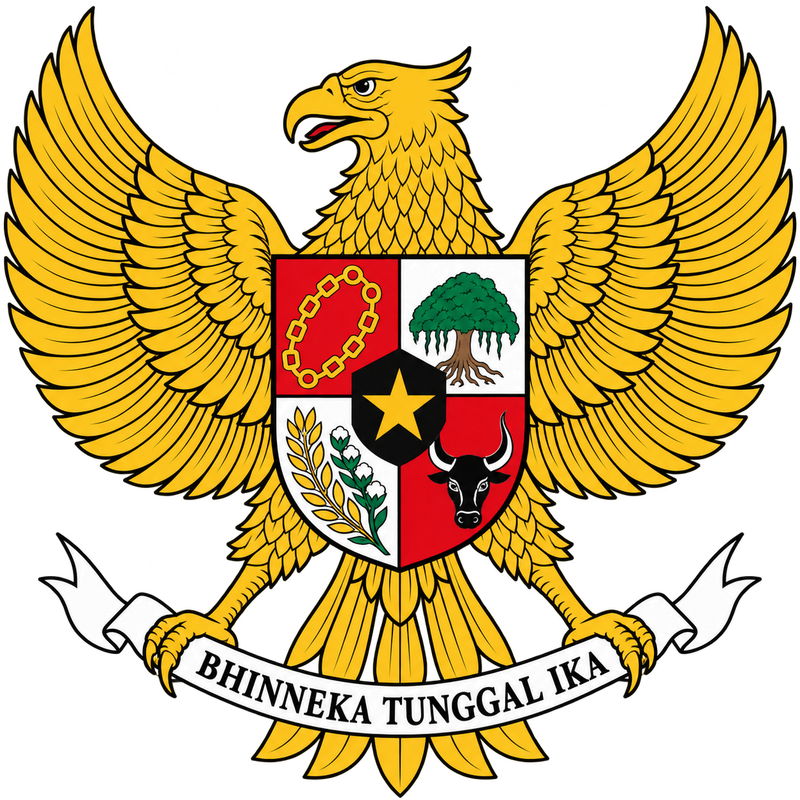
The national day is 17 August, the proclamation. The days of memory are 1 June (Pancasila Day), 28 October (the Youth Pledge), 10 November (Heroes’ Day) and 27 December (the Compact), which is a state holiday in the outer islands, with Eid, Christmas, Nyepi, Waisak and the Chinese New Year as national holidays. The flag is two horizontal bands, red over white, from the banner raised in 1945. The arms are the Garuda, bearing a shield of the five principles, with the motto Bhinneka Tunggal Ika. The Javan hawk-eagle is the national bird and the white jasmine the national flower. Schoolchildren raise the flag on 17 August in every village. The anthem is Indonesia Raya. The Monas tower in Jakarta and the Istiqlal Mosque are the republic’s symbols, and the heritage is listed in a federal register and by the League.
Foreign relations
Indonesia is non-aligned: it has no alliance and no foreign base on its soil, and is not in the Atlantic Treaty Organization, though it takes part in its exercises as a partner. It has been a member of the League of Nations since 1950, with a delegation at the Council by rotation, and keeps the non-aligned habit of Bandung. It is the largest of the strait states and the largest member of a Southeast Asian security forum that meets each year in Bandung and decides nothing.
Malaya
Relations with the Federation of Malaya are close and prickly. They are close on language and religion, with a joint cabinet meeting every year and a customs agreement, and prickly over labour, the sea border and seniority. The sea border is the argument between the line of 1957 and the line of 1824, and the plantations of Malaya are worked by Indonesian migrants. The Confrontation of 1963 to 1966 was fought against Malaya’s accession of Sarawak and Sabah, and the guarantee of 1957 was written against Indonesia. It is now a formality.
Singapore and Brunei
Relations with Singapore are correct and wary: Indonesia has never claimed the island, and restricts sand exports for environmental reasons and for leverage. The two keep the strait patrols with Malaya, and the Batam triangle. Brunei is still a British protected state; Indonesia has no claim to it.
Japan
Japan is the largest foreign investor. It apologised formally in the 1970s and again in the 1990s for the occupation, and it takes Indonesian care workers. The memory of the occupation is still raw in Java.
The Realm
The Realm is a warm trading partner, the largest buyer of Indonesian rubber, nickel and textiles, with the silence of 1965 and the Grasberg mine as the sore points, and no base or alliance. The Realm’s pressure on the Dutch in 1949 is remembered kindly. The Realm’s Prime Ministers have visited about once a decade, a joint commission meets yearly, and the Crown has no part, since Indonesia was Dutch and not British. About 600,000 Indonesians live in the Realm, many of them students and nurses, and the Moluccan Dutch who came by way of the Low Countries, with a large quarter in Los Angeles.
The Netherlands
The Dutch apologised for the war of 1945 to 1949 in 2005, there is a large Indonesian-Dutch community in the Low Countries, and relations are cordial and unsentimental. The colonial archives are held jointly. The Benelux Union article’s colonial-migrants paragraph points here.
China and the Arabian kingdom
China is a large trade partner, with one standing quarrel about Chinese fishing fleets around the Natuna islands, handled by the Navy and the League’s tribunal, and no claim on Indonesian land. The Hashemite Kingdom of Arabia is cordial: about 220,000 Indonesian pilgrims go to the Hijaz each year under a quota, and the quota’s size is a standing quarrel.
New Wessex and New Guinea
The eastern half of New Guinea is divided. New Wessex holds Papua, in the south-east, as a territory, so that the Crown’s New Wessex and Indonesia share a land frontier across the south of the island; it is the only land border that Indonesia has with a Crown realm besides the Borneo frontier with Malaya. The north-east is New Guinea, an associated state of the German Empire, which meets Indonesia’s Papua across the north.
Trade and the League
Indonesia’s largest customers are, in order, the Empire of China, Japan, the Realm, Malaya and the Raj. Its largest suppliers are China, Japan and Malaya, with the Realm’s machinery and aircraft a fifth of its capital imports. It is a member of the League’s Council by rotation and of its trade, health and maritime bodies, and it was a founder of the association of Indian Ocean states. The federation’s foreign policy is made by the Prime Minister’s cabinet and the Foreign Ministry, with the Senate’s consent required for treaties, which the producing states use to protect their own agreements on resources.
The Raj, Siam and the region
Relations with the Empire of Raj are cordial, with an Indian Ocean association of which both are founders, a maritime boundary in the Andaman Sea settled in 1974, and Borobudur and Prambanan as a shared cultural inheritance. Indonesia is friendly with Siam, correct with Vietnam, and has a quiet disagreement with the Philippines over the sea border in the Celebes Sea and the Mindanao fishermen.
The Cape and Suriname
The Dutch brought Javanese and Malay exiles to the Cape in the seventeenth century, among them the Muslim scholar Sheikh Yusuf of Makassar. His tomb at Faure is a place of pilgrimage for Indonesians, and the Cape Malay community of the Union of South Africa is the oldest Indonesian diaspora in the world. Suriname is independent, with about a fifth of its population of Javanese descent and a Javanese-language radio; an ambassador is exchanged.
Russia
Relations with the Russian Republic are correct, with arms purchases under the Revival and no alliance, and a quiet memory that the Russian Republic’s authoritarian model was the one Suharto studied.
The strait
About ninety thousand ships a year pass the Strait of Malacca. Piracy has fallen by four fifths since the three-power patrol began in the 2000s, and none of the three will place it under a joint command.
Armed forces
The Federal Army has about 400,000 soldiers, with a navy, an air force and marines, no conscription, and a budget of about 1.1 per cent of the economy. Since 2000 it has no seats in the House, and its officers may not stand for office until three years retired. Its businesses were sold in 2005, and its commands were reorganised under the Senate; it keeps a territorial command in every state. The Navy is the busiest service, with a coast guard, marines and a submarine flotilla bought from the Russian Republic and the Realm in equal numbers, and its work is the thousand-kilometre sea border and the fishing it is meant to protect. A specialised police unit handles terrorism, and the states have their own police forces beside the federal police. The death penalty was abolished in 2005.
The Navy and the sea
The Navy’s task is to watch a sea border of more than a thousand kilometres and a million square kilometres of fishing ground, with a coast guard that works with the Realm’s and New Wessex’s. The marines are the federation’s reserve and its answer to the one scenario it fears, a communal crisis in a state that the state’s own police cannot control. The Air Force flies Russian and Realm aircraft in equal numbers and has no base outside the federation. The army’s role in the states is limited to the territorial commands and to disaster relief, which is the only task for which it is trusted by everybody.
Failings
The Register states the federation’s failings plainly.
1965. The killings of 1965 and 1966, the worst crime of the federation’s history, were carried out by the army and its militias under the Compact and not against it. The Realm and Britain saw and said nothing, and sold the army spares, and the federation has apologised and prosecuted a handful.
The Cultivation System. From 1830 to 1870 the Dutch took a fifth of the land and labour of Java for the government’s crops, and the famine at Demak in 1849 is its record. It was colonial and not federal, and the federation inherited its landholding, its sugar mills and its peasantry, and has never wholly settled the quarrel over land that it left. The Register states it among the failings of the federation’s making because the federation’s first generation chose to govern what the Dutch had built and not to unmake it.
Papua. The consultation of 1969 was run by the army among about a thousand chosen elders, the League’s observer reported irregularities, and an armed independence movement has existed since 1965. The state’s people are among the poorest in a federation that has the richest mine in the world on their soil. The enhanced autonomy statute of 2021 and the promise of a second consultation in 2034 are the federation’s answer, and the question has been left open rather than settled.
May 1998. The riots in Jakarta killed about a thousand people and Chinese Indonesian women were raped, and shops and homes of Chinese Indonesians were burned across Java. The army’s part is still disputed, and no one has been convicted. Chinese Indonesians are about three per cent of the population and hold much of its commerce, and the riots are the clearest instance of the way that a minority that has been given an economic role under one government is made a scapegoat under the next.
Women and the stigma of gay and transgender Indonesians. Child marriage remains legal at sixteen in some states, polygamy is legal for Muslim men, the thirty per cent quota is not enforced, and gay and transgender Indonesians have no protection from discrimination and are raided by militias.
Assessment
The federation held when it could not govern, and what it kept in one state were peoples who had, in 1950, the means to leave it. Its constitution, a short document made by Hatta, a Sultan and a League commission, was a constitution for thirty years and not a government, and what the Revival of 1998 restored was the capacity of the Senate and the Court to say no. It is the largest Muslim country in the world and a secular one, and it is held so by two great organisations that keep out of politics. Its central question is whether unity in diversity is a fact or a motto, and the answer that the Register records is that the outer islands have paid for it in a share of their own wealth and have been compensated by the Compact.
The federation kept in one state a set of peoples who had, in 1950, the means to leave it.
Chronology
| Date | Event |
|---|---|
| About the 7th century | Srivijaya controls the strait |
| 13th century | Majapahit rises in East Java; Islam arrives by trade |
| 1511 | The Portuguese take Malacca |
| 1602 | The Dutch East India Company is founded |
| 1619 | Batavia is founded on the ruins of Jayakarta |
| 1799 | The Company is dissolved; the Dutch state takes over |
| 1811 to 1816 | The British interregnum on Java under Raffles |
| 1824 | The Anglo-Dutch Treaty; Singapore British, the Indies Dutch |
| 1825 to 1830 | The Java War under Diponegoro |
| 1830 to 1870 | The Cultivation System |
| 1873 to 1904 | The Aceh War |
| 1901 | The Ethical Policy |
| 1908 | Budi Utomo is founded |
| 1912 | The Sarekat Islam is founded |
| 1927 | Sukarno founds the Indonesian Nationalist Party |
| 28 October 1928 | The Youth Pledge |
| 1939 | France overruns the Netherlands; the government goes into exile; the Governor-General holds the Indies |
| 1940 | The London Declaration |
| January to March 1942 | Japan invades; the Dutch surrender at Kalijati |
| 1 June 1945 | Sukarno names Pancasila |
| 17 August 1945 | The Proclamation |
| 10 November 1945 | The assault on Surabaya, the Day of Heroes |
| July 1947 | The First Police Action |
| September 1948 | The Madiun Affair |
| December 1948 | The Second Police Action; the Realm’s ministry threatens the Dutch credits |
| 1 March 1949 | The Yogyakarta Offensive |
| 23 August to 2 November 1949 | The Round Table Conference |
| 27 December 1949 | Sovereignty is transferred to the United States of Indonesia |
| 23 January 1950 | The APRA coup at Bandung |
| 1950 | The Federal Compact; the bargain of the islands; the South Moluccas rising |
| 1952 | The Federal Court reads Pancasila’s first principle |
| April 1955 | The Bandung Conference; the first free elections follow in September |
| 1957 | The Padang Settlement; the Yogyakarta Judgement; martial law; the nationalisation of Dutch estates; the Djuanda Declaration |
| 1963 to 1966 | The Confrontation with Malaya |
| 1 October 1965 | The 30 September Movement; the killings follow |
| 11 March 1966 | The Supersemar; Suharto becomes Prime Minister |
| March 1967 | Sukarno is removed; Hamengkubuwono IX becomes President |
| 1969 | The Papuan consultation |
| 1971 | Golkar wins 62 per cent |
| 1976 | The Free Aceh Movement declares independence |
| 1978 | The P4 courses begin |
| 1988 | Hamengkubuwono IX dies; Abdurrahman Wahid becomes President |
| 1997 to 1998 | The Asian crisis |
| May 1998 | The riots; Suharto resigns on 21 May |
| 1998 to 2002 | The Federal Revival |
| 1999 | The first free election since 1955; Megawati becomes Prime Minister |
| 2001 | Suharto is tried |
| 2002 | The Bali bombings; the Anti-Corruption Commission |
| 26 December 2004 | The tsunami |
| 2005 | Peace in Aceh; the death penalty is abolished |
| 2008 | Suharto dies |
| 2012 | The apology for 1965 |
| 2014 | The federal health insurance begins |
| 2021 | The Papua enhanced autonomy statute |
| 2022 | The Federal Capital Act; the states refuse the new capital |
| April 2024 | The House election; Maria Sanjaya is elected President |
| The present | The sea wall is under construction; the nickel case is before the Federal Court |
Trivia
- In-Universe The proclamation of 17 August 1945 is read on the radio every year in the same two minutes, by the state broadcaster that read it in the revolution. The Federal Compact, which settled the state it proclaimed, is about thirty pages long.
- In-Universe On Nyepi, the Day of Silence, the whole island of Bali shuts down for twenty-four hours, including its airport. No lights, no traffic, no fires and no leaving the house, and the state of Bali is the only part of the federation that has a holiday on which nothing happens.
- In-Universe Rendang, the slow-cooked beef of West Sumatra, is argued over with Malaya as a matter of national honour, in a rivalry both governments find convenient. Neither side has ever proposed a settlement.
- In-Universe The Federal Court sits at Yogyakarta, the revolutionary capital, and not at Jakarta, so that the court that decides between Java and the outer islands is not in the same city as the federal government. By convention no more than four of its nine judges may come from Java.
- In-Universe Indonesia has about 17,000 islands, of which about six thousand are inhabited. Nobody has ever agreed an exact count, because the sea keeps changing it.
- In-Universe Badminton is Indonesia's national sport in everything but the official one, and the country's Olympic golds are almost all in it. The Thomas Cup is a national event.
- In-Universe Jakarta is being saved by a seven-hundred-kilometre sea wall across its bay, costing about A£40 billion and paid for by a federal levy that the outer-island states voted for as the price of keeping the capital where it is. The plan to move the capital to East Kalimantan was refused by the states.
- In-Universe For the first time in the federation's history both the President and the Prime Minister are women. The President is a Catholic law professor from the Lesser Sundas and the Prime Minister a Mandailing former governor of North Sumatra, and a woman, Megawati, was Prime Minister once before.
- In-Universe The Senate has thirty members, two from each state, and they may not belong to a party. It is the one body in the federation in which a state speaks for itself, and it does not fall with the cabinets.
- In-Universe Sultan Hamengkubuwono IX was President for twenty-one years, from 1967 to 1988. He signed what he was given, said little, and kept the federal Compact alive because he was the one person who could not be removed.
- In-Universe The Yogyakarta Judgement of 1957 held that Sukarno's National Council could advise and not decide, and the Padang Settlement of the same year gave the producing states the revenue share. Between them the Federal Court's first two great cases made the federation, and its two great failures nearly unmade it.
- In-Universe The federation was constitutional at every step on the way to Suharto's thirty-two years. He was made Prime Minister by the House, Sukarno was removed by the joint sitting, and the Court was never asked.
- In-Universe Sari Nasution, the Prime Minister, is a Mandailing from North Sumatra and the first Prime Minister from the outer islands since the 1950s. She leads the Union of Regions, a federation of state-based parties that holds the balance in the Senate.
- In-Universe Sulawesi's nickel is the raw material of the electric-vehicle batteries that the Realm and the Concert are building. The state has asked for twice the fifteen per cent royalty, and the case is before the Federal Court.
- In-Universe The Dutch government declared in 1940, from exile in London, that the Indies would be free to govern themselves in a federation of equal states. The nationalists accepted it as a promise and held the Dutch to it, and the settlement of 1949 was built on it.
- In-Universe After the second Dutch attack in 1948, the Realm's ministry told The Hague that it would stop the reconstruction credits unless it negotiated. The Dutch yielded in a month, and the Realm's schoolbooks mention it in one line.
- In-Universe The Sultan of Yogyakarta, Hamengkubuwono X, who was born in 1946, is the hereditary governor of his state and has refused every other office. The Federal Court sits in his capital.
- In-Universe Indonesia is the world's largest exporter of thermal coal, and its coal comes from Kalimantan and South Sumatra. Kalimantan wanted the federal capital, and the Kalimantan state fund invests the coal revenue for the day it runs out.
- In-Universe The peat fires of dry years in Sumatra and Kalimantan drift as haze over Malaya and Singapore almost every year. The haze is the one subject on which the two governments agree.
- In-Universe Riau, a state of Sumatra, claims to be the home of the standard Malay that became Indonesian, which Malaya disputes in good humour. The two countries keep a joint language commission that meets annually and quarrels annually about spelling.
- In-Universe The Cape Malay community of South Africa descends from Javanese and Malay exiles that the Dutch took to the Cape in the seventeenth century, and the tomb of Sheikh Yusuf of Makassar at Faure is a pilgrimage place for Indonesians. It is the oldest Indonesian diaspora in the world.
- In-Universe About 220,000 Indonesian pilgrims go to the Hijaz each year, the largest national contingent, under a quota whose size is a standing quarrel with the Arabian kingdom.
- In-Universe Pramoedya Ananta Toer wrote the Buru Quartet on Buru Island, where he was held from 1969 to 1979, and it circulated in secret until 1998. He never won the Nobel Prize, which the Register notes.
- In-Universe Civil servants wear batik on Fridays. Batik, gamelan and wayang kulit are the heritage arts, and they are taught in every state's schools.
- In-Universe The Navy burns and sinks seized foreign trawlers on camera as a matter of policy. The League's tribunal has called it disproportionate, and Jakarta calls it deterrence.
- In-Universe Indonesia has a federal health insurance that covers about nine in ten of its people and is chronically underfunded. The hospital in a Papuan village is described by its distance.
- In-Universe A voluntary two-child campaign cut Indonesia's fertility rate from 5.6 to 2.1. The population is projected to level at about 320 million around the middle of the century.
- In-Universe About five million Indonesians work abroad, in Malaya, Japan and Arabia. Remittances are about two per cent of the economy, and the abuse of domestic workers is stated as a failing.
- In-Universe The Istiqlal Mosque in Jakarta was designed by a Christian architect and stands beside a Catholic cathedral. It is one of the capital's symbols of the republic, with the Monas tower, which no federal building may exceed.
- In-Universe The Day of Heroes, on 10 November, marks the assault on Surabaya in 1945, in which the British killed about fifteen thousand Indonesians. A British brigadier was killed at the start of it, on 30 October.
- In-Universe The Free Aceh Movement became a party. The Aceh Party has governed the state since 2006, with a state gas fund, and it is a party of old fighters that most of its voters were too young to remember fighting.
- Design The federation survives here because the settlement of 1949 was entrenched under a League guarantee, a fact that gives the outer islands a veto the Indonesians of our history did not have. The same history that keeps the federation also keeps the killings of 1965: a federation changed who could say no and did not change who held the guns.
- Real-World In our history the federal United States of Indonesia of 1949 was dissolved into a unitary state in August 1950, eight months after sovereignty was transferred, and Indonesia has been a presidential republic ever since. The federation, the parliamentary government and the League guarantee are the Register's own.
- Real-World In our history Suharto was never tried and died in 2008, and Indonesia invaded East Timor in 1975. In the setting Timor was granted independence by Portugal by negotiation in the late 1950s, and Suharto was tried and convicted of corruption in 2001. The killings of 1965 and 1966 and the Asian crisis of 1997 are as in our history.
- Real-World The plan to move Indonesia's capital to East Kalimantan is real planning in our world, where it is being built. The Register's states refused it, and the sea wall is the setting's own.
- Real-World In real history East Timor was occupied by Indonesia in 1975 and became independent only in 2002.
See also
- Federation of Malaya, the neighbour of the Confrontation and the guarantee
- Singapore, across the strait and in the Batam triangle
- Benelux Union, the former colonial power
- Empire of Japan, the occupier of 1942 to 1945
- Kingdom of Portugal, whose Timor is independent
- Kingdom of Siam, where Javanese labourers died on the railway
- New Wessex, across the Torres Strait and beside Papua
- Empire of China, the other power at the Natuna
- Kingdom of Arabia, for the pilgrimage
- The League of Nations, the guarantor of the Federal Compact
- Union of South Africa, the home of the Cape Malays
- The Foreign Office, for the Realm’s and Britain’s part
Categories
Nations · Asia and the Pacific · Indonesia · Federal republics · Muslim-majority states · Archipelagic states