Baseball
Baseball is the customary national pastime of the United Kingdom of America: not a title enacted by Parliament, nor a claim that every place prefers it, but the description citizens have given the game for generations. Football commands more money and produces the largest single spectacles. Baseball keeps the deeper daily hold. From spring into autumn it offers not one national convulsion but a sequence of evenings, scores, voices and small accumulated memories. A club can be inherited before its owner, players or ballpark are known. A box score can reconnect a person to a city left decades earlier. The game is at once professional industry, organised labour, municipal institution, neighbourhood habit and an argument about who has been allowed to belong.
Its ancestry is plural. British and North American bat-and-ball traditions, including cricket and rounders, supplied different parts of a game that nineteenth-century clubs gradually standardised. Soldiers spread existing forms during the Civil War; they did not invent baseball in camp. Professional clubs, railways, newspapers, factories, colleges, Black communities, women’s teams and migration then made it continental. The National and American Leagues became the senior circuits, separately incorporated and separately scheduled, but joined through a common charter and the Autumn Classic. Around them stand minor and independent clubs, the American Women’s Baseball League, colleges, schools, treaty-nation and municipal programmes, foreign and winter leagues, unions, broadcasters, museums and an independent record office.
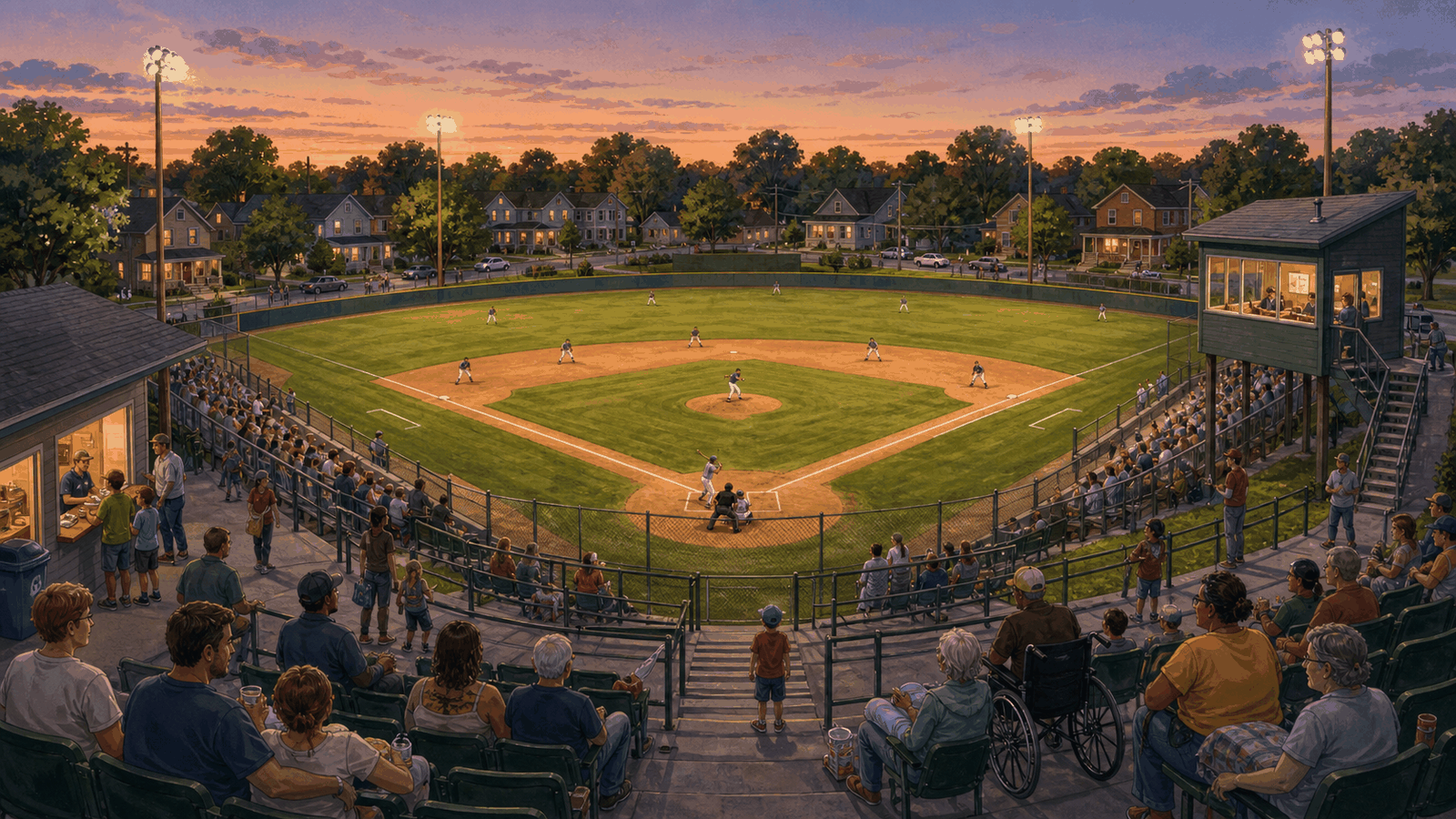
Origins and early rules
Baseball does not begin with a single inventor standing over a finished diamond. Its remote family includes games in which a struck ball, a run between safe places and the contest between fielders and runners appeared in different combinations. Cricket contributed ideas about batting, innings and organised clubs; rounders and other running games offered different arrangements of bases and outs. North American communities altered these inheritances according to available ground, local custom and the number of players who appeared. Names moved more freely than rules. “Base ball” might identify games that modern spectators would not recognise as the same sport.
The New York clubs
By the middle nineteenth century, clubs in and around New York had created one influential rules tradition. The diamond, foul ground, three outs and a more regular schedule made their game easier to reproduce between organisations that did not share a neighbourhood. That tradition is directly retained in American history, but its later dominance was not inevitable. New England forms, town ball and other local games competed for players and press attention. Standardisation followed promotion, travel and institutional power as much as technical merit. Clubs with access to newspapers and reliable opponents could present their preferences as the natural laws of the game.
The new form fitted a growing associational culture. A baseball club could be recreational, fraternal and civic at once. Members adopted constitutions, elected officers, arranged grounds and negotiated fixtures. The ideal of the respectable amateur sat uneasily beside gate receipts, payments concealed as jobs and the labour required to practise. Exclusion was present early. Club membership reflected race, class, occupation and neighbourhood; the ability to leave work for play was itself a privilege. Yet baseball also travelled outside formal clubs. Schools, workplaces, military units, churches and informal nines adapted the rules without waiting for a central authority.
The phrase itself
“National pastime” appeared first as an aspiration and a piece of promotion. It described the scale supporters wanted the game to achieve, not a legal status conferred from above. Baseball became national through repeated adoption: a shared score, recognisable field and common vocabulary that still allowed local accents. Its success lay partly in that combination. The rules were stable enough for strangers to play together, but the setting remained particular, a vacant lot, a factory field, a college green or an enclosed urban ground. The future sport was already both standard and local.
Written rules and authority
Rules also carried an argument about authority. Written codes allowed a visiting club to know what would count as an out, but the person holding the rulebook did not thereby own the game. Umpires emerged because clubs needed a neutral decision-maker; scorers emerged because newspapers and supporters wanted a durable account. Manufacturers then gained influence through the dimensions of balls and bats. Each apparently technical settlement created an institution, and each institution favoured people able to write, print, travel and purchase standard equipment.
The decisive inheritance was therefore not one ancestral game but a method of organising difference. Clubs could consent to common rules while keeping their names, grounds and customs. That pattern later supported separate senior leagues, independent foreign competitions and local broadcasting. It also explains why claims of pure invention proved so attractive: a single founding story made contested authority look natural. Modern scholarship rejects that simplicity without denying the distinct game American players eventually made.
What survives
The surviving evidence is uneven by design as well as accident. Club minutes and metropolitan newspapers record organisations able to preserve paper; oral memory and scattered notices often carry neighbourhood play. A careful history therefore distinguishes the earliest documented use from the first game actually played. It treats the New York tradition as a powerful, verified line of development without making archival visibility a patent on invention. The absence of a central archive is part of the history, not a gap to be filled by confidence.
Civil War spread
Baseball existed before the Civil War of 1861 to 1863. The conflict accelerated its movement across the Realm because it brought people from distant communities into camps, hospitals, prisons, depots and garrisons where long periods of waiting alternated with terror. Games required comparatively little equipment. A bat could be improvised, a ball repaired and a field marked on available ground. Soldiers taught one another the forms they knew, argued over rules and carried preferred versions into new regions.
Against the consoling story
The wartime game should not be turned into a consoling fable. Rank affected who had leisure and who supplied it. Segregated units and racial hierarchy limited the fellowship later memory attributed to the field. Prison games occurred inside coercion and deprivation. Civilians were displaced, families bereaved and communities destroyed. Playing together could create recognition across region without dissolving the causes or violence of the war. Baseball was one practice among many by which participants endured military life; it did not redeem the conflict.
Returning veterans nevertheless formed a powerful network of teachers, organisers and spectators. They took familiar rules to towns that had known other games, and the authority of wartime experience lent those rules weight. Newspapers could describe a match in terms readers elsewhere understood. Rail connections allowed clubs to travel, while telegraph reports detached results from the ground on which they were made. The game became part of postwar civic reconstruction, though not on equal terms. Communities celebrated shared play while preserving racial, class and regional barriers in club membership, seating and press coverage.
The war therefore belongs in baseball’s history as an engine of diffusion, not a moment of creation. It enlarged the map, accelerated standardisation and supplied later generations with a potent origin story. That story was often simplified because a game carried home by soldiers seemed to offer reunion without confronting redistribution or justice. The fuller history is more useful. Baseball spread through human mobility created by war, but its durable institutions were built afterwards by clubs, workers, entrepreneurs, schools, local governments and communities that decided the game would occupy their summers.
After the war
Within a generation the phrase “national game” had more substance. Fixtures linked cities, touring clubs demonstrated common rules and local newspapers made distant reputations legible. The same process created new boundaries. Those who controlled grounds, schedules and respectable membership could decide whose baseball counted. The game’s national expansion and its exclusions were not consecutive phases; they developed together.
Women played in wartime communities, Black soldiers and civilians carried their own club traditions, and hospital or prison games were recorded unevenly according to who controlled the archive. A military diary or illustrated newspaper can show that a game occurred without proving it was the first in a region. The article therefore treats surviving wartime images and reports as evidence of circulation rather than ownership. Communities absent from official reporting may still have been playing.
Memory and reconciliation
Postwar memory often gave the veteran a cleaner role than the organiser who followed. Yet a ball club needed ground, time, equipment, opponents and someone to settle accounts. Municipal permission, factory patronage, church or school space and informal household labour sustained the game after soldiers dispersed. Veterans were important carriers inside that larger ecology. The national pastime emerged because thousands of local institutions repeated the work, not because demobilisation automatically converted a camp recreation into a stable league.
The reconciliation claim also remained politically useful. Public ceremonies could describe former enemies meeting under common rules while avoiding the unequal settlement outside the park. Baseball sometimes did create relationships that other institutions denied, and that should not be dismissed. But a shared inning was not a shared franchise, vote, wage or hotel room. The game’s postwar civic power came from being both a genuine meeting place and an incomplete one.
The material geography
Reconstruction also changed the material geography of play. Repairing rail links, reopening schools and reorganising municipal land determined which clubs could travel and which grounds survived. Those decisions rarely appeared in a scorebook, yet they distributed opportunity. The game spread most durably where communities supplied repeated access to space, transport and time, confirming that diffusion depended on civic infrastructure after the armies had gone.
Professionalisation and the two leagues
Payment preceded respectable acknowledgement. Strong clubs found jobs for useful players, shared gate money or met travel costs while continuing to praise amateur virtue. Open professionalism made that relationship more honest without making it equal. The Cincinnati Red Stockings of 1869 are retained as the first openly salaried nine to mount their celebrated national tour, not as proof that no player had previously been paid. Their success showed that regular training, recruited skill and coordinated travel could turn a club into a commercial attraction. It also exposed the contradiction between baseball as civic association and baseball as purchased labour.
Professional organisation remained unstable. Clubs folded, schedules broke down and owners sought rules that would prevent richer rivals from taking players or abandoning inconvenient fixtures. Railways made a wider circuit possible but imposed costs and timetables. Newspapers created national reputations while favouring cities with large readerships. Enclosed grounds converted attention into revenue, and factories and urban migration supplied spectators with both local loyalties and limited leisure. Colleges defended amateur distinction even as their contests attracted money and institutional prestige.
The National League, 1876
The National League was founded in 1876 as an owner-controlled senior circuit. Its scheduled clubs, territorial expectations and enforceable membership rules promised stability after disorder. Stability served real public purposes: supporters could expect fixtures to occur and players could compare performances across a season. It also concentrated control. Owners decided membership, disciplined clubs and claimed powers over players whose labour created the product. The league’s seniority became an institution, not an inherent superiority over every competition outside it.
The American League, 1901
The American League emerged as a senior challenger in 1901. It competed for cities, players and legitimacy rather than accepting permanent subordination to the older circuit. The conflict made visible how territorial claims and contract rules could be used both to stabilise competition and to suppress alternatives. Neither league could secure a national championship while refusing to recognise the other. Their 1903 settlement regulated player movement, acknowledged two senior pennants and permitted the first Autumn Classic. The inaugural series retained its verified early format; the modern best-of-seven standard came later.
The settlement did not merge the leagues. Separate incorporation, traditions, schedules and rule differences survived. Their common affairs developed through negotiated machinery, ultimately gathered in the Joint Baseball Charter. That distinction remains essential. The term “senior leagues” describes the National and American circuits together, but there is no single private corporation sovereign over all baseball. Coordination must be justified by the shared championship, rules and integrity tasks for which it is needed, and it remains subject to labour, competition and public law.
Closed leagues
Closed leagues also became a durable American choice. Clubs do not enter or leave the senior circuits through promotion and relegation. Membership, expansion and relocation are collective decisions, constrained by solvency, competition, labour, heritage and community obligations. Bounded territories assist scheduling and club stability but do not make a city private property. A legal franchise can move while the former city’s civic memory, the new city’s living identity and the historic record remain distinct. Owners may possess a club; they cannot monopolise every meaning the club has acquired.
By the early twentieth century baseball had become a system rather than a single league table. Senior clubs sat above regional and independent professional circuits, company teams, colleges, Black clubs, women’s teams and dense amateur play. Their relationships were unequal, but each supplied audiences, labour and forms of organisation. Professionalisation did not replace community baseball. It built a profitable summit upon it.
The two-league settlement required continued bargaining. Contract lists, disputes over eligibility, common playing rules and championship arrangements had to be administered without erasing the circuits’ identities. The later Commissioner inherited these common tasks, but league presidents and club institutions remained. That divided structure helped prevent one office from simply declaring every commercial preference to be the interest of baseball, though it also created opportunities for responsibility to be passed between bodies.
Territory
Territory was similarly double-edged. A club needed assurance that another senior member would not open across the street after it had built a ground and audience. A league needed geographic coherence to publish a schedule. But territorial restraint could also block new ownership, suppress independent clubs and convert supporters into captive consumers. Modern competition review asks whether a restraint is genuinely necessary to the shared competition and whether a less restrictive arrangement is available.
Rail travel and the press created an early national market, but professional baseball never became simply a list of the largest cities. Industrial towns, regional centres and communities outside the senior circuit supported important clubs. The minor leagues were not failed aspirants awaiting promotion; they developed their own pennants and civic claims. This distinction remains important whenever senior expansion is proposed. Entry into the top circuits may create new opportunity, but it can also displace a living competition already present.
Who bore the risk
Professional status sharpened the question of who bore business risk. Owners could close a club, cancel a trip or invoke league discipline; players often absorbed unpaid wages, injuries and sudden displacement. Early stability rules protected scheduled competition while allocating insecurity downwards. That history is why modern continuity, solvency and labour provisions are not decorative additions to the sporting structure. They answer a problem present from professional baseball’s beginning.
The 1919 scandal and commissioner
In 1919 the Autumn Classic was deliberately corrupted by participants who agreed with gamblers to affect its result. The scandal belongs to UKA history, but the identity of the club, the players, the particular games and the criminal record have never been settled on the public record. The documentary trail is thin, the proceedings were partly closed, and the papers that would answer the question either were not kept or have not been found. Responsible accounts therefore describe the institutional consequences, which are amply documented, and decline to supply names the evidence does not support.
The fraud struck at the basis on which professional sport asks for attention. A supporter can tolerate error, bad judgement and defeat because the uncertainty is genuine. A contest secretly directed towards a purchased result is a different thing: spectators, honest players and opponents are made into unwitting performers. The response was severe because the leagues feared not only a lost championship but the loss of confidence in every ordinary game.
That does not make the scandal a simple tale of uniquely wicked players rescued by wise owners. Low pay, the reserve system, insecure careers, owner contempt and weak oversight created opportunities for gamblers and reasons for resentment. These conditions help explain vulnerability; they do not excuse deliberate fraud. Owners who had bound players indefinitely could not plausibly present themselves as guardians of disinterested virtue, while players could not convert exploitation into a licence to deceive colleagues and the public. Responsibility ran through individual conduct and institutional design.
The settlement
Public inquiry, legal proceedings and negotiation between the leagues produced the joint Commissioner of Baseball. The office received independent authority over integrity, common rules, umpiring administration, scheduling between the circuits and the Autumn Classic. It did not become a ministry or court, nor an unchecked personal government. The published charter defines jurisdiction; collective agreements bind the office; public law remains applicable. Criminal prosecution belongs to public authorities.
Modern integrity procedure rejects the idea that reputation alone proves corruption. An investigation must disclose the case that can lawfully be disclosed, protect evidence, give notice, permit representation, hold a reasoned hearing and provide appeal or arbitration. Lifetime exclusion is reserved for proved deliberate corruption. Confidential occurrence information, medical records and unrelated private life cannot be exposed merely to demonstrate toughness. The same principle governs modern technology: suspicious statistical patterns can begin an inquiry but cannot substitute for evidence and human adjudication.
The betting rule
Baseball participants may not bet on baseball. Senior leagues and clubs may not form bookmaker partnerships, advertise paid odds or allow gambling interests to control official data or decisions. Lawful spectator betting remains a matter for public regulation, with tightly governed exchange of integrity information. The boundary recognises that gambling exists without allowing the sport to make dependence on it part of the ordinary fan experience.
The office now
Dr Teresa Moreno has served as Commissioner since 2022. A non-partisan labour arbitrator and sports-law scholar with experience of the minor leagues, women’s baseball and public inquiry, she administers the Joint Baseball Charter for a fixed, reviewable term. She does not bargain for owners, choose national teams, alter individual umpiring calls or command the proposed Stewardship Compact. The office’s legitimacy rests on bounded authority and reasons, not the mythology of a single saviour restoring purity after 1919.
What integrity now covers
Integrity has since widened beyond bribed results. Undisclosed ownership, manipulation of medical information, harassment of witnesses, unauthorised data sale and conflicts involving agents or equipment suppliers can compromise trust without producing an obviously fixed score. The charter separates these cases from ordinary poor performance. A player is not suspect merely for making an error at a dramatic moment, and a club cannot use integrity language to punish labour organising or public criticism.
Official data creates a modern pressure point. Rapid feeds can help detect abnormal betting patterns, but they also possess commercial value. The leagues may exchange the minimum necessary information with lawful regulators while publishing the rules and auditing access. They may not turn every pitcher’s mistake into a gambling product or allow a bookmaker to demand schedule, injury or discipline information unavailable through lawful baseball channels.
The 1919 settlement is therefore remembered less as a moment when purity was restored than as the origin of an enduring institutional question: who watches the people claiming to protect the game? Independent appeal, union representation, public prosecution and reasoned decisions answer that question more credibly than personal severity. The permanent lesson is not that harshness creates trust. It is that trust needs evidence and institutions capable of examining one another.
What the record will not carry
Memory of the scandal requires equal discipline. Because the papers that would identify the club and the participants have never been found, museums, broadcasters and the Commissioner explain the institutional settlement without asserting names the sources will not carry. This restraint is not evasion. It prevents plausible reconstruction from hardening into evidence, and it leaves later research free to establish the record properly if the papers are ever found.
Cities, clubs and ballparks
A senior club is a legal franchise, a workforce and a civic inheritance that do not always point in the same direction. The modern senior leagues contain twenty-four clubs, twelve in each circuit, and this Register does not attempt a complete list of them. Club identities have changed through relocation, renaming, merger and failure across a century and a half, the leagues’ own published lineages disagree with one another at several points, and a roster stated as settled would present as fixed a matter that the game itself has never fully agreed.
Club identity is made through repetition. A home park establishes routes through a city; local radio supplies a vocabulary; families attach players to particular summers; workers maintain grounds and concessions; nearby businesses adjust their weeks to the fixture list. The club’s incorporation papers do not contain all of that value. When a franchise moves, the former city retains memories and archives, while the receiving city develops a living claim of its own. Records must show both instead of permitting an owner to erase the old place or deny the new one an authentic attachment.
Forms of ownership
The law permits private, municipal, cooperative, trust, public-authority, community and mixed ownership. Private control remains common, but no form excuses poor performance. Every owner owes disclosure, solvency, labour, accessibility, competitive-integrity, heritage and continuity duties. Beneficial interests must be known. A threatened relocation creates no automatic claim to a publicly funded park, and public ownership does not justify political interference in line-ups or bargaining.
The parks
Ballparks range from old enclosed urban grounds to municipal multi-use fields and later purpose-built parks. No architectural style is mandatory. A lawful project must address public transport, neighbourhood access, universal design, toilets, shade, water, heat and severe weather, field safety, sightlines, family and sensory needs, union workspaces, emergency use, energy demand, local businesses and year-round public value. A beautiful façade is not a substitute for a safe concourse or a bus after the last out.
Relocation
Relocation requires disclosed finances and ownership, a funded local alternative, league and competition review, worker and supporter consultation, municipal hearings, heritage and naming provisions, compensation, continuity planning and independent appeal. Public money demands an open needs case, an alternatives analysis, independent cost review, binding community returns and approval by the responsible legislature or municipality. Nostalgia alone cannot compel an insolvent enterprise to remain, but an owner’s ultimatum cannot manufacture consent.
Ticketing expresses the same tension between market and civic institution. Clubs may vary prices, but must show the complete first price, protect low-cost inventory, provide accessible and family seating, use fair lotteries for scarce postseason tickets and enforce regulated resale and anti-bot rules. The aim is not to make every seat cheap. It is to prevent the meaningful parts of a common game from becoming accessible only through wealth or insider status.
Heritage
Ballpark heritage law protects more than brick. A scoreboard, sightline, neighbourhood wall, radio booth or informal gathering place may carry cultural value even when it cannot be preserved unchanged. Review distinguishes preservation from obstruction: an unsafe or inaccessible feature can be altered, but its record should be documented and the replacement should not use “modernisation” as a pretext to remove low-cost space. Naming rights cannot extinguish a historic name in archives or public wayfinding.
Operational plans address the whole year. Grounds crews maintain turf and drainage; seasonal concession and event workers require predictable notice; municipal services plan transport and emergency cover. Some parks host schools, markets, clinics or heat refuge outside the professional schedule. These uses do not need to make every ballpark a generic civic centre, but public subsidy may legitimately require value beyond the home schedule.
The locally rooted club is powerful precisely because it combines private risk with shared meaning. Law cannot manufacture affection, and a supporter council cannot guarantee competent ownership. It can ensure that decisions disclose who gains, who pays and what would be lost. That is the minimum condition for treating a club as both a business and a public inheritance without pretending it is wholly either.
The club and the city
The distinction between a club and its city is especially important at closure or relocation. Legal continuity may carry contracts and competitive records, while murals, routes, supporter archives and memories remain rooted in place. Modern heritage terms can require copies, deposits and name protections without pretending that culture is divisible like a balance-sheet asset. A new city gains a living club; the former city does not thereby lose its past.
Labour and the reserve system
For much of professional baseball’s history, owners described the reserve system as necessary to stable competition. In practice it bound a player to one club indefinitely after the initial bargain, suppressing mobility and pay while allowing ownership to trade the contract. The system stabilised rosters by denying workers an ordinary power to leave. Its longevity should not be confused with consent. Players challenged it through short-lived fraternities, litigation, collective action and eventually a durable association of their own.
The Players Association
One independent, player-controlled Players Association now represents senior players across both leagues. It is institutionally separate from clubs, league offices and the Commissioner. The common bargaining unit reflects the fact that labour conditions cross the two circuits even though the leagues remain separate. Its scope includes minimum pay, genuine free agency after a negotiated period of club control, salary arbitration, pensions, health care, travel, scheduling, safety, discipline, licensing and grievances. Clubs may offer better terms; they may not bargain below the common floor.
Exact service thresholds are matters of collective bargaining rather than settled features of the game, and they have moved in every agreement. The controlling principles are transparent service credit, a finite period of club control, meaningful salary arbitration, genuine free agency and strong anti-collusion remedies. A club cannot manipulate an assignment merely to delay rights without review. A player cannot be held perpetually because the original contract was signed when bargaining power was weakest.
Strikes and lockouts
Ordinary labour law applies. Strikes and lockouts are lawful when conducted under the established rules. Independent mediation is available, and agreements are enforceable through arbitration and the courts. The Commissioner does not direct bargaining or declare one side’s economic demand necessary for the game. Parliament intervenes only in a genuinely exceptional public-law case, not because supporters dislike cancelled fixtures. Lost games matter; they do not erase freedom of association.
The minor leagues
The minor leagues have their own bargaining organisation. Development status never excuses poverty pay. Players are employees entitled to living wages, appropriately designed overtime, safe housing and travel, health care, pensions, injury protection, grievance rights and limits on contract control. Fixed-term development agreements between senior and minor clubs may allocate players, coaching and standards, but must preserve local ownership, names, community duties and independent business records. Affiliation changes require notice, consultation and a continuity plan.
The AWBL agreement
The AWBL has its own Players Association and agreement. Pay, medical support, maternity provision, facilities, scheduling, travel and media obligations are not charitable additions to women’s competition; they are conditions of professional work. College players likewise possess transfer freedom, academic safeguards, injury coverage, representation and lawful compensation. “Amateurism” receives no protection when it functions chiefly to deny athletes a share of revenue generated in their names.
Collective bargaining also governs changes presented as technical necessities. Pitch timers, workload rules, testing systems, data collection and schedule design affect labour as well as entertainment. Players and umpires must participate before trials become permanent. Baseball’s institutional history gives a reason for that caution: reforms described as preserving the game have often preserved the authority of those already controlling it.
Daily travel and seasonal insecurity make baseball labour distinctive without placing it outside ordinary law. Collective agreements can adapt hours, reporting and assignment rules to a travelling competition, but adaptation must not become a declaration that players or ballpark workers are not employees. The same principle applies to clubhouse staff, grounds crews, concession workers and broadcasters whose labour is less visible than the players’ but essential to every fixture.
Pensions and health
Pensions and health care address careers that may be short even for successful players. Injury can end earning power before ordinary retirement, while repeated travel and public scrutiny affect families. Benefit systems therefore include post-career treatment, education, counselling and transition support. Historical pension gaps are reviewed with attention to Black-league, minor and women’s competition rather than assuming the old senior eligibility rules were neutral.
When the game stops
Industrial action tests the public language of the pastime. Supporters may feel a genuine loss when a season stops, and small businesses or casual workers may bear costs they did not choose. Those harms justify mediation, hardship planning and honest bargaining. They do not grant owners, the Commissioner or Parliament a routine power to compel play. The game cannot claim to represent ordinary working life while treating the workers on the field as outside it.
Players also perform work outside the visible contest. Travel, rehabilitation, mandatory meetings, promotional appearances and year-round preparation affect health and family life even when they do not appear as innings. Collective bargaining makes those hidden demands legible. It prevents a club from calling necessary labour a personal hobby whenever payment, rest or injury protection would otherwise follow.
Black baseball
Black baseball did not begin as an afterthought to exclusion from white senior leagues. Black clubs grew from schools, workplaces, military units, churches, newspapers, businesses, neighbourhood associations and touring networks. They formed audiences and labour markets before durable league charters could survive. The colour line conditioned this world, but did not supply all of its purpose, talent or pleasure. Teams played to win, to earn, to represent places and institutions, and to entertain people who understood their competition on its own terms.
How the leagues were built
Owners, organisers, players and journalists built leagues through booking, shared grounds, travel, contracts and promotion. They did so under persistent disadvantages. White-controlled venues could dictate dates and rent. Undercapitalisation made a cancelled series dangerous. Schedules were sometimes incomplete, record keeping uneven and contracts contested. Gendered power limited who could own, report and govern even within institutions created against racial exclusion. Leagues collapsed and returned, not because Black competition lacked quality or audience, but because the financial environment punished independent control.
The modern collective description is “the Black leagues”. The leagues’ own historical names are used where they are documented and where the period context requires them, and the terminology of the era in which they operated is not applied to them as a present-day label. Leading Black leagues are recognised as senior professional competitions for honours and statistical history. Recognition does not require their records to be poured into a white-league table until their source disappears. The Baseball Record Office preserves league identity, publishes evidentiary limits and cross-references comparable achievements.
Gibson and Paige
Josh Gibson and Satchel Paige stand among the best documented and most celebrated players. Gibson’s power, catching and performances across Black and winter competition belong to the record; Paige’s pitching, longevity, touring and command of public attention belong there too. Their biographies are transferred on verified evidence, while legend is identified as legend. Incomplete documentation does not mean nothing occurred. It does require discipline about precise totals and cross-era rankings.
It is equally misleading to invent a definitive answer to how Gibson, Paige or their peers would have ranked in unrestricted senior competition. The white leagues’ claim to contain the best players was compromised by exclusion. That fact can be stated without turning counterfactual comparison into a new form of appropriation. Black baseball’s excellence rests on its games, testimony, archives and institutions, not on a hypothetical endorsement from the leagues that barred it.
Black women in the game
Black women participated as players, owners, organisers, writers and workers, often encountering exclusion inside both white women’s competition and male Black institutions. Their history belongs in both the Black-baseball and women’s-baseball records rather than falling between them. The same applies to Latin and Caribbean movement through Black leagues and winter ball. These circuits were never sealed national containers.
Later recognition has produced honours, pensions, restored records and archival projects. Those measures matter, especially when survivors and families receive material support and institutions gain resources to preserve their own past. They do not restore lost clubs, venues, business networks or decades of revenue. The measure of repair is not how neatly Black baseball can be fitted into another institution’s record book. It is whether its evidence, authority and community claims survive.
The Black press
Newspapers were institutions of the game, not merely sources later historians happened to find. Black reporters promoted fixtures, criticised owners, compared players and kept debates alive across cities. Their box scores and columns now supply evidence that white sporting pages ignored. Preservation therefore includes newspaper archives and the intellectual work of journalists who established standards of recognition before central bodies were willing to listen.
Renting the parks
Parks reveal material dependence. Black clubs often rented dates from white-controlled grounds and accepted unfavourable hours because access to an enclosed venue was necessary for gate revenue. A successful series could still leave little capital for a permanent home. Touring and winter competition offered opportunity but increased travel risk and made complete statistics harder to retain. The resulting gaps are products of political economy, not measures of sporting quality.
Modern honours can reproduce hierarchy if a central league alone decides which Black competition deserves senior status. The Record Office instead convenes historians, former players, families, league institutions and archival specialists under published standards. Recognition may remain contested. Dissent is recorded rather than eliminated by a press release. That approach takes history seriously enough to permit correction while refusing the fantasy that an administrative act can erase the conditions that made correction necessary.
Who decides what is preserved
Community choice controls institutional preservation. Some organisations may join broader referral, museum or competition systems; others may remain independently governed. Equal funding is not conditioned on adopting a central brand. Leadership and archives remain where communities want them, subject to access and professional preservation duties. This is how integration can connect institutions without treating absorption as progress’s only visible form.
The same principle governs biography. Josh Gibson and Satchel Paige are presented through verified clubs, documented performances, contemporary reputation and the limits of surviving evidence. Legend may be culturally important, but it is labelled as legend. Statistical uncertainty is not a reason to minimise achievement, and admiration is not permission to manufacture precision. Their records belong to the institutions in which they were made.
Integration and Ernest IV
Branch Rickey’s recruitment of Jackie Robinson, Robinson’s signing in 1945, his 1946 season with Montreal and his Brooklyn debut on 15 April 1947 are directly retained. The debut crossed the organised colour line into the previously white National League; it did not make Robinson the first Black senior professional baseball player. That distinction matters because the older formulation simultaneously exaggerates the white league’s ownership of baseball and erases the senior competition in which Black players had already excelled.
What it cost, and who paid
Robinson’s skill and endurance were indispensable. So were the Black players and organisers who demonstrated the falsity of segregation, the Black press that sustained the demand, civil-rights advocates, labour and civic pressure, changing law and public enforcement. Rickey acted from conviction and club strategy within that wider movement. Integration should not be reduced to a benevolent executive discovering one heroic individual. Nor should Robinson be denied agency by turning him only into a symbol onto which institutions projected their virtue.
Ernest IV
The change occurred during Ernest IV’s reign and was interpreted through the renewed enforcement of the American Rights Act. The King could offer ceremonial support where it was lawfully invited, but possessed no decree over contracts, clubs or league membership. He did not author baseball integration. The constitutional settlement mattered because courts, ministries and public bodies increasingly refused to subsidise or enforce racial exclusion, not because the Crown selected a player.
After the first game
Integration remained contested after the first game. Senior clubs moved at different speeds. Minor affiliates, hotels, transport, spring training, management, umpiring and front offices preserved formal and informal barriers. Players endured organised hostility and unequal discipline. Employment channels could admit exceptional talent while keeping decision-making white. The account therefore follows litigation, labour action, civil-rights enforcement and public investment beyond a single date.
The opening of white senior clubs was a civil-rights victory and an economic shock to Black-controlled baseball. Clubs recruited leading players without transferring comparable value to the institutions that had developed and promoted them. Audiences and press attention followed. Some Black clubs weakened or disappeared precisely because integration made their separate market harder to sustain. That was not an argument for preserving segregation; it was evidence that equal access without institutional repair could redistribute power upward.
Modern policy preserves archives, pensions, honours and the capacity of Black institutions where communities choose to retain them. Referral and employment systems are integrated without treating closure or absorption as the measure of equality. The Baseball Record Office records the provenance of statistics. Cooperstown and other museums share authority with Black museums, libraries, newspapers and local collections. Repatriation is available where material was wrongfully removed.
Baseball’s integration story is thus neither a simple triumph nor a counsel of despair. A closed door was forced open, careers and audiences changed, and the law’s promise gained practical force. At the same time, ownership and archival authority did not automatically follow players through that door. The game absorbed social change more readily than many of its governing institutions surrendered power.
Beyond the playing roster
Employment beyond the playing roster changed more slowly than public celebration suggested. A club could feature Black stars while retaining segregated executive networks, scouting assumptions, hotel practices and press relations. Umpiring and management offered fewer openings than player recruitment. The article follows these occupational hierarchies because integration measured only at the most visible position can conceal the institutions that still decide whose judgement counts.
Robinson’s Montreal season also demonstrates that national stories depend on cross-border institutions. Development, travel and press attention did not stop at one political frontier. The approved transfer preserves the baseball facts while translating the constitutional setting: neither Albian nor American institutions are treated as unchanged simply because the same player moved through them. The movement matters as baseball history, not as permission to import a complete external league system.
Commemoration
Commemoration creates its own duties. Annual observances, retired numbers and museum exhibits can teach, but they can also isolate racism safely in the past. Modern clubs must connect memory to hiring, contracting, discipline, facilities and archival restitution. A ceremony becomes evasive if the organisation celebrating Robinson refuses to publish present disparities or fund the institutions from which integrated baseball drew talent and audience.
Later milestones cannot be read backwards into 1947. A first roster place did not guarantee equal hotel accommodation, medical care, promotion, officiating or front-office authority. Nor did every locality change at the same pace. The article records integration as a continuing administrative process because informal control can survive after a formal colour bar falls. Enforcement, labour protection and independent complaint routes mattered alongside symbolic acceptance.
Women and the AWBL
Women have played baseball almost as long as organised baseball has existed. School teams, college clubs, factory nines, neighbourhood games and barnstorming combinations created a history repeatedly treated by promoters as novelty and by governing bodies as temporary. The Bloomer Girls demonstrated both the possibility of sustained touring competition and the constraints surrounding it: marketing often emphasised costume or gender convention even when players sought recognition for skill. Race and class determined who could travel, gain press coverage or enter a protected ground.
The wartime league
The All-American Girls Professional Baseball League operated from 1943 to 1954 and is directly retained after translation into the Second Great War setting. It offered paid elite competition and drew substantial crowds. It also enforced femininity rules, operated through tight labour control and excluded many Black players. Its decline reflected ownership decisions, changing postwar promotion, weak institutional investment and competition for facilities and attention. It is not evidence that demand for women’s baseball naturally expired.
Amateur, collegiate, workplace and independent play continued after the league closed. Repeated attempts at professional revival suffered from short financing, poor travel, inferior grounds and media neglect. The absence of a stable senior league was produced institutionally, not by an absence of players or audiences. Those histories are recorded alongside the better-known professional experiment rather than described as an empty interval.
The AWBL
The modern American Women’s Baseball League is independently governed. Its twelve independently owned clubs play a 96-game season and send four clubs to the postseason. It has its own commissioner and Players Association, regional development links and enforceable standards for pay, facilities, travel, health, maternity, media access and safeguarding. Its championship identity is distinct. It is not a development competition for the two senior men’s leagues.
The senior leagues’ rules
No sex or gender bar applies to a National or American League contract, umpiring appointment, licence or club office. A player who meets the sporting standard may sign there. The separate AWBL remains justified as a remedy for unequal opportunity and as infrastructure capable of sustaining elite women’s play rather than waiting for exceptional entry into institutions built around men. Equal labour, medical, privacy and anti-discrimination law applies in every competition.
The AWBL’s independence shapes media and facility policy. Joint promotions may widen attention, and clubs may share parks where terms are fair, but a senior men’s club cannot condition access on control of the women’s schedule or brand. Broadcast metrics are published with context, including differences in carriage and promotion. A league denied prime windows cannot then be judged as though it received equal exposure.
Maternity and health
Maternity and reproductive health rules cover leave, pay, training, travel, fertility care and return without forcing medical disclosure beyond genuine need. Parenting support includes childcare and family travel where collectively agreed. These are employment standards rather than evidence that women players require exceptional paternal supervision. The same confidentiality and independent-clinician rules used elsewhere in baseball apply.
The modern league also carries the memory of earlier institutions without claiming to be their uninterrupted legal successor. AAGPBL clubs, players and records remain in their own archive. The AWBL may honour them through exhibitions and education, but cannot convert historic labour into a marketing origin story that conceals the decades in which senior investment was withheld.
The AWBL’s independent governance prevents the senior men’s leagues from treating women’s competition as a promotional department. Cooperation on facilities, development and common rules may be valuable, but the AWBL commissioner and Players Association bargain for their own competition. Players can pursue lawful opportunities elsewhere without surrendering the institutional base built to remedy exclusion.
Minors, colleges, youth and adaptive baseball
The minor leagues form a network of regional competitions and independently owned clubs. Some enter fixed-term development agreements with senior clubs; others remain fully independent. They play for their own supporters and honours as well as developing players. No club is promoted into or relegated from the National or American League. Affiliation cannot be used to strip a local club of its name, records or community responsibilities without notice and a continuity plan.
Minor-league employment
Minor-league players are employees. Their bargaining organisation negotiates living wages, travel and housing standards, health care, pensions, injury protection and limits on contract control. Senior clubs remain accountable for duties allocated through a development agreement, while the local club keeps its own business records and obligations. A player released or injured receives transition support rather than being abandoned at the point their development value declines.
College baseball
College baseball is a major educational and regional competition, not a moral category called amateurism. Scholarships, academic progress, medical care, transfer freedom, lawful compensation and player representation protect the educational purpose. Institutions may set eligibility rules necessary to study and competition, but cannot use that purpose chiefly to deny athletes a share of commercial revenue. Independent advice is available before contracts, transfers and drafts.
Schools, municipalities, treaty nations, clubs, unions, non-profits and volunteer associations share responsibility for youth baseball. Public fields, affordable equipment, trained coaches, safeguarding, accessible transport and limits on early specialisation keep entry broad. Commercial academies cannot capture children through debt, misleading promises or exclusive long-term control. The common draft reaches only eligible domestic amateur players who register; it offers independent advice, minimum offers, education and medical protection, a short negotiating period and the freedom to decline.
Adaptive baseball
Adaptive baseball is part of the organised game rather than a charitable exhibition. Player-led rules and classification apply only where competitively necessary. Accessible fields, equipment, officials, transport, local leagues and national competition create pathways from community play to elite events. Disability inclusion also changes mainstream design: information, dugouts, workspaces and spectator routes must accommodate players, workers and supporters without forcing them into a parallel service whenever an ordinary adjustment will work.
The domestic amateur draft is bounded because entry into professional baseball is an employment decision, not a public allocation of persons. Registration is voluntary. Order and trading rules are transparent, minimum offers meaningful and medical examinations protected. A player may decline and retain the lawful alternatives stated by the agreement. Foreign professionals move through reciprocal transfer arrangements rather than a separate channel designed to reduce their rights.
Youth policy
Youth policy resists early commercial capture. Children benefit from varied positions, other sports, rest and play that is not permanently evaluated. Scouts and academies may identify talent, but cannot demand exclusive control or charge families predatory fees for access to ordinary competition. Safeguarding records follow a coach or organisation through lawful due-process systems so that changing a club does not erase substantiated misconduct.
Education bodies publish participation, injury and completion data with sex, race, disability and geography where privacy permits. The 2027 model estimates about 520,000 school and collegiate baseball participants, but translated source categories do not capture every community or treaty-nation programme. The estimate is consequently a planning measure rather than a claim that one central association administers all student baseball.
Coaches and volunteers exercise real authority over young people even when they receive no wage. Screening, two-adult safeguards, travel rules and reporting outside the coaching chain therefore apply across organisational forms. A prestigious academy or senior-club affiliation cannot lower the floor. Nor can record sharing become an informal blacklist: due process and survivor protection must operate together.
The international game
Baseball’s wider geography is a field of independent cultures. Mexico, Cuba, the Dominican Republic, Porto Rico and other Spanish-speaking Caribbean and Latin American systems have their own clubs, seasons, schools, winter competitions, archives and representative identities. They are not one undifferentiated pipeline feeding the American leagues. Players move because the game is already rooted in those places.
Reciprocal agreements
Reciprocal agreements govern contracts, releases, insurance, calendars, records and welfare. Foreign and winter leagues are recognised as competitions in their own right, and clubs that develop players may receive transparent compensation. A player retains meaningful choice. No nationality-based draft, academy or contract channel may impose weaker labour rights than those available to a comparable domestic player.
Recruiting rules require minimum ages, education and family support, licensed and fee-controlled agents, verified identity, transparent bonuses, medical privacy, union advice, immigration assistance and anti-trafficking enforcement. Players receive safe housing, language access, mental-health care, protection against document retention and support after release or injury. Cultural adaptation is not treated as a private failure by a young worker whose employer arranged the move.
Porto Rico
Porto Rico is the West Indies Federation’s Spanish-speaking baseball state. It carried a mature game into the Federation in 1958 and retains its own clubs, schools, winter competition and representative identity while cricket remains predominant federally. New Albion is a co-equal baseball country with its own leagues, youth system and national team. America cannot treat either country as a development territory or silently absorb its records.
Representative baseball
Independent men’s and women’s federations select American teams under transparent eligibility, insurance, labour and release rules. Neither the Commissioner nor the government selects players. America and New Albion compete separately; Porto Rico has its own baseball representation within the West Indies Federation; New Wessex and the wider Federation retain their separate cricket traditions. There is no combined Crown team and no baseball-cricket fixture.
A compact champions’ tournament links selected clubs from America, New Albion, Mexico, Porto Rico and other Caribbean or Latin American competitions. Its name and calendar remain unsettled. It cannot displace domestic seasons, winter leagues or the Autumn Classic. International governing agreements coordinate eligibility, playing standards, anti-corruption and discipline, but take domestic effect only through lawful adoption by the relevant national bodies.
Calendars
International movement also affects calendars. Caribbean winter competition may overlap with recovery programmes or domestic preparation, while national-team release creates insurance and workload questions. Agreements must address those conflicts openly rather than allowing a senior club to suppress another competition by invoking a contract drafted without its participation. Independent clinicians and player consent remain central.
Language and records follow the player. Contracts, discipline, medical information and immigration advice are translated; statistical records identify the competition and source language from which they came. Names and diacritics are preserved. These apparently small practices prevent a national system from treating foreign experience as raw material that becomes legitimate only after entering an American database.
The pastime beyond the Realm
The wider system also complicates the phrase “national pastime”. Baseball may hold that customary place in America while cricket carries comparable federal meaning in the West Indies Federation and other games dominate elsewhere. Equal sporting relations begin by recognising that America’s cultural attachment gives it no jurisdiction over a neighbour’s calendar, eligibility or history.
Calendar coordination makes international equality practical. Winter competition, domestic pennants, national-team release and the proposed champions’ tournament place different demands on the same players. Reciprocal agreements identify rest, insurance, injury responsibility and contract priority before a dispute occurs. Calling a foreign league a development stop would conceal both its competitive purpose and the labour owed within it.
Leagues, schedule and postseason
The National and American Leagues each contain twelve clubs arranged in two six-club divisions. Every club plays each of its eleven league opponents fourteen times, producing a 154-game schedule. The arithmetic honours the long-season tradition while fitting the modern membership. The two leagues maintain entirely separate championship schedules. They may arrange exhibitions, but an exhibition does not enter the standings and cannot become regular-season interleague play by another name.
Before the modern postseason
For most of baseball’s history, the club with the best full-season record in each league won the pennant and proceeded directly to the Autumn Classic. A tie could require a short deciding series. That system gave the six-month season unusually direct authority. The modern postseason was introduced later, but its precise first year remains unset.
The modern bracket
Today each division winner and two wild cards qualify in each league. Four clubs play best-of-five semifinals; the winners contest a best-of-seven pennant series. No qualifier receives a bye. Seeding, tiebreakers and home allocation follow published neutral Charter rules. The format is deliberately compact: it admits meaningful expansion-era competition without allowing a mediocre month of knockout games to make the 154-game season decorative.
The Autumn Classic
The pennant winners meet in the best-of-seven Autumn Classic in their home parks. It is the championship of separate league seasons, not an international fixture or ordinary interleague series. The American League uses the designated hitter; National League pitchers bat. During the Classic the home league’s rule applies in each park, making the leagues’ difference visible without preventing common safety and integrity standards.
A visible pitch timer, batter-readiness rule, limited pitcher disengagements and fixed between-innings breaks govern pace. They were adopted through bargaining and safety trials. Warnings and penalties are proportionate, with medical and accessibility exceptions. A broadcaster cannot shorten recovery, remove a safeguard or require play through unsafe conditions merely to preserve a programme slot.
The ceremonial first pitch
The Autumn Classic’s ceremonial first pitch follows separate constitutional customs. A Governor-General receives one invitation during the final scheduled baseball season of the tenure, before Game One. If unable to throw, the Governor-General may nominate a family member, former Governor-General or community player. The invitation cannot be advanced for politics or promotion. The King may accept a joint invitation any number of times, even after pitching previously, or decline. No substitute pitches for him. Neither officeholder wears club colours, endorses a sponsor or gives a policy speech.
Building the schedule
Schedule construction balances competitive repetition with travel, climate, broadcast and labour constraints. Fourteen games against each league opponent gives every club the same basic opponent count. The calendar nevertheless publishes rest, night-to-day transitions, long-distance travel and postponed-game treatment so formal equality does not hide a much harsher itinerary for particular regions or workers.
Division titles matter because they reward sustained performance against a defined group, but a title does not create a bye. Wild cards recognise strong clubs outside the two division winners without allowing half the league into the postseason. Best-of-five semifinals keep some volatility; the best-of-seven pennant series and Classic demand greater depth. The structure consciously balances the surprise of a short series against the authority of 154 games.
Home allocation is neutral and published before it can be tailored to a popular club. The ceremonial rotation for a Governor-General’s farewell operates inside that rule: it cannot move Game One or grant a competitive advantage. The Charter alternates eligible league and regional hosting over time, subject to the actual pennant winner and ordinary capacity, labour and access review.
Postponement never becomes an informal power to force unsafe play. Weather, air quality or public emergency rules state who decides, how workers are paid and how ticket holders are treated. Rescheduling seeks competitive fairness without pretending that every delay can be made costless. The national championship remains important, but it does not suspend public safety law.
Separate schedules preserve intelligible comparison. Each club faces the same eleven league opponents fourteen times, so travel and home dates can be balanced without interleague standings. Exhibitions may celebrate neighbours or international visitors, but their results do not blur the pennant. The Autumn Classic remains a meeting of champions from distinct competitive records rather than the continuation of a mixed table.
Rules, umpiring and records
A joint rules committee represents the two senior leagues, players, umpires, the AWBL, minor baseball and the public interest. It acts after trials, safety and equality review, consultation and published reasons. The Commissioner administers an adopted rule but cannot rewrite the game alone. Differences between the senior leagues, including the designated hitter, persist unless changed through this process.
The umpiring service
Umpires belong to an independent, jointly funded service. Unionised crews receive common training, transparent evaluation, protected reporting and appeal. Promotion and discipline are subject to anti-discrimination rules, and clubs cannot retaliate for an unpopular call. The Commissioner sets the administrative framework but cannot direct a decision in an individual game.
Replay
Central replay is limited to defined questions of boundary, catch, tag, force, timing and rules administration. Reviews are time-bounded and explained. Judgment calls remain with the field crew unless a separately adopted challenge rule expressly covers them. The strike zone uses a limited player challenge supported by independently audited tracking. The plate umpire calls the game and announces the result; no vendor operates a fully autonomous zone or controls the playing rule through proprietary software.
The Record Office
The Baseball Record Office preserves senior, minor, Black-league, women’s, collegiate and international records under published evidentiary standards. Corrections are versioned. Sources, uncertainty and dissent remain visible. A missing box score is not treated as a game in which every event equalled zero. Leagues supply data but cannot remove an inconvenient result or decide recognition alone.
Historical records remain continuous while era context is published for schedule length, grounds, equipment, rules, segregation, integration, medicine and performance-enhancing drugs. Annotation is preferred to erasure or false equivalence. An independent testing and adjudication system maintains a prohibited list, therapeutic-use process, chain-of-custody safeguards, representation and appeal. Deliberate cheating attracts proportionate discipline; treatment remains available.
Equipment
An independent equipment laboratory tests balls, bats, protective equipment and park systems. It publishes methods, tolerances and injury evidence, audits manufacturers and requires trials before material changes. Commercial contracts and the pursuit of a dramatic record cannot determine the playing standard. The same independence governs tracking calibration and error or bias reports.
Tracking
Tracking systems create evidence and new error. Park calibration, camera placement and model design can produce systematic differences that appear objective because they are numerical. Independent audit publishes error by park, pitch location and relevant demographic variables without exposing a player’s private data. A challenge succeeds or fails under the adopted rule; the vendor does not privately adjust the zone during a season.
Scorekeeping retains a human and scholarly character. Official scorers explain disputed classifications, and corrections follow notice rather than a quiet database change. Statistical measures developed by private analysts may enrich understanding, but the Record Office distinguishes a public record from a proprietary model. A club cannot hide the evidence required to verify an official statistic behind commercial secrecy.
Rule experiments occur in bounded leagues or exhibitions with consent, safety review and a stated end. Participants know what is being tested and how success will be assessed. Adoption requires a new reasoned decision. The existence of data from a trial does not create a permanent “sandbox” in which ordinary rights or collective-bargaining duties are suspended.
Records of discipline and officiating are treated with the same care as playing statistics. Aggregate consistency is published, while personal data and active investigations receive proportionate protection. Transparency means enough information to identify patterns and challenge a decision, not the indiscriminate release of medical details or confidential witness material.
Evaluation of umpires follows the same rule as review of calls. Tracking data may identify patterns, but promotion or discipline cannot rest on a proprietary score whose calibration cannot be challenged. Crews receive the evidence, representation and appeal; the public receives aggregate accuracy and bias reporting. Independence from clubs and Commissioner intervention in individual calls protects both accountability and authority.
Ownership, finance and competition
Baseball’s senior clubs remain economically powerful private or civic institutions, but collective coordination receives no blanket immunity from competition law. The leagues may organise a common schedule, maintain shared rules, distribute revenue and stage a championship where coordination is genuinely necessary. Territories, broadcasting restraints, labour markets, relocations and commercial agreements remain reviewable. A city is not a franchise’s exclusive private market merely because the league prefers stability.
Shared revenue
National broadcasting, streaming, licensing and central sponsorship revenue is shared substantially and equally. A negotiated portion of local revenue enters the pool, and transparent equalisation supports lower-revenue and essential regional clubs. Recipients must meet payroll, development, labour and community-use obligations. Revenue sharing is not an owner-profit guarantee.
No salary cap
The collective agreement rejects a hard salary cap. Progressive payroll equalisation, minimum club payrolls, anti-collusion enforcement and full compensation disclosure provide incentives without setting an absolute ceiling on labour income. Receipts support player benefits and competitive-balance programmes. A club cannot profit from deliberately fielding an under-resourced team while claiming equalisation as a reward for thrift.
Solvency monitoring begins before crisis. Each club maintains a funded continuity plan. If failure occurs, an independent temporary administrator protects wages, fixtures, records, supporters and local identity while seeking a lawful sale, community or public rescue, or orderly closure. League support must be disclosed and cannot quietly transfer losses to taxpayers while shareholders retain the upside.
Public money
Public ballpark finance follows need, alternatives, open books and independent cost review. Labour, accessibility, transport, environmental and community-return agreements bind recipients. A club threatening departure has no automatic entitlement to subsidy. Municipalities may decide that a park’s civic value justifies investment, but must state the cost, risk and foregone alternatives plainly.
What the game is worth
The game’s finances are estimated rather than counted. For the 2027 reference season, the most widely cited reconstruction gives about A£15 billion in combined senior-club operating revenue, about A£6.2 billion in senior player payroll and roughly A£1.1 billion in annual polity and municipal capital or operating support across professional and community facilities. These are rounded figures drawn from attendance returns, published club accounts of varying completeness and labour statistics that were not collected for this purpose. No complete national accounts series for the game exists, and the leagues have never commissioned one.
Disclosure
Ownership disclosure extends through holding companies, lenders and controlling agreements. A nominal local owner cannot conceal effective control by a broadcaster, bookmaker or investment vehicle. Changes of control require solvency, integrity, labour and continuity review. Financing terms that allow a creditor to dictate sporting decisions or seize community-held marks are disclosed and, where incompatible with the charter, prohibited.
Central commercial rights are separated from editorial and sporting authority. A sponsor may purchase exposure but not a rule, roster decision or favourable schedule. Clubs disclose significant lobbying and public-finance contacts. League procurement uses competition, beneficial-ownership checks and conflicts rules, with special scrutiny where the same company supplies data, media infrastructure and betting services.
Economic measures are published as distributions, not only totals. Revenue per club, payroll range, ticket mix, public subsidy, minor and AWBL transfers and player benefit contributions reveal who commands the game’s wealth. A growing national figure can coexist with a failing local club or poorly paid development system. Competitive balance is evaluated through opportunity and credible effort, not a guarantee that every season produces identical standings.
Beneficial-ownership disclosure matters because influence can be exercised through lenders, affiliates and media partners as well as named shareholders. League approval cannot substitute for public competition or solvency review. A community or municipal owner receives no automatic indulgence either; its labour, transparency and continuity duties are identical even when its financial return is defined differently.
Player health, safety and data
Workload protection is collectively bargained and evidence based. Pitch volume, recovery, year-round throwing, youth development, injury reporting and return to play are assessed by age, role and medical history rather than one rigid number. Clubs maintain prevention plans and share anonymised evidence with independent researchers. A win in April does not justify hiding pain that may end a career in July.
Avoidable collisions and deliberate dangerous play are prohibited. Clear lane and obstruction rules preserve ordinary competitive contact while protecting catchers and runners. Suspected concussion triggers immediate independent assessment and a graduated return. Medical decisions belong to clinicians chosen through an independently governed system funded by collective arrangements, not to a manager or club doctor under competitive pressure.
Medical records
Players control their medical records. Clubs receive only fitness information necessary for employment. Second opinions and appeals are protected, and no official may pressure a diagnosis or return-to-play decision. Confidential mental-health care, crisis support, addiction treatment, protected leave, family services and supported return distinguish illness and recovery from misconduct without allowing privacy to conceal an immediate danger.
Player data
Wearable, video and performance data is collected only when bargained and necessary. Players receive access and correction rights; purpose and retention limits are explicit; medical data remains separated; sale and unrelated surveillance are prohibited. Experimental inferences cannot support discipline, selection or contract decisions without validated evidence and appeal. Vendors are processors, not owners of the worker’s identity.
Safeguarding
Safeguarding rules apply across schools, clubs, academies, camps and travel teams. Adults are screened and trained; travel and two-adult rules reduce isolated authority; reporting exists outside the coaching chain; investigations are independent; survivors receive support; retaliation, sexual abuse, hazing and coercive recruitment are prohibited. Record sharing includes due process so that protection does not become either silence or unreviewable accusation.
Weather and heat
Heat, air quality, lightning, storm and field thresholds are locally calibrated but enforceable. Measurements are independent. Stoppage and rescheduling are paid work rules, and water, cooling, shelter and emergency plans protect spectators and workers as well as players. Broadcast schedules cannot override life safety.
Medical governance includes clinicians with expertise in pitching, concussion, disability, reproductive health, mental health and addiction, but players retain supported decision-making. A diagnosis never becomes automatic exclusion without individual assessment. Temporary restrictions must be proportionate, reviewed and separated from discipline unless deception or reckless conduct is independently proved.
Testing for prohibited substances uses accredited laboratories, split samples and a chain of custody. Therapeutic-use decisions remain medically independent. Public education distinguishes performance enhancement, substance dependence and ordinary treatment. Historical record annotation explains the evidentiary basis and era rather than applying suspicion retroactively to every exceptional performance.
Data rules cover prospects and children as well as senior players. An academy cannot build a lifelong commercial profile from a minor’s body measurements or sell predictive rankings to employers without consent and safeguards. Deletion and correction rights survive a failed tryout. Public research may use genuinely de-identified information under ethics review and fair-return conditions.
The rest of the workforce
Health standards reach the less visible workforce. Grounds crews face chemicals, machinery, heat and storms; concession and cleaning workers face repetitive work and late transport; umpires and broadcasters carry travel and fatigue burdens. A safe game is not one in which players are protected while the people preparing the park absorb the risk.
Travel and scheduling are health questions as surely as treatment is. Consecutive night games, disrupted sleep, smoke, heat and compressed make-up dates accumulate risk beyond any single injury. Bargained monitoring therefore examines roles and individual histories rather than rewarding clubs for low reported totals. Silence can indicate fear or poor detection; it is not proof of a healthy workforce.
Radio, television and streaming
Baseball became national through information before it became national through pictures. Box scores, telegraphed results, specialised reporters and illustrated papers allowed distant clubs to occupy a reader’s morning. The press also promoted myths, circulated betting information and decided which leagues deserved complete records. Its power to connect was inseparable from its power to omit.
Local radio
Every club now sustains a locally rooted broadcast service with recognisable long-serving voices. Radio remains free at the point of listening over the air. Regional and minority-language options, accessible commentary and editorial independence preserve the connection between a club and its place. Baseball has no single national voice.
The ABC
The American Broadcasting Corporation carries selected nationally significant games, the Autumn Classic and archival programmes under its public-service duties. It neither displaces club radio nor grants government or Crown figures editorial control. National rights revenue is shared substantially, while regional services survive.
Television
Television brought money, night schedules, replay and wider access while pressuring attendance, travel, competitive balance and player working conditions. Streaming now offers one portable subscription platform with local commentary choices, accessible feeds and public archival access. Live territorial restrictions must be narrow. Overlapping blackouts that leave a lawful local supporter unable to watch are prohibited.
For 2027 the usual estimate is that roughly 240 million residents watched or listened to at least one organised baseball broadcast, stream or archival programme. It measures reach rather than regular devotion, the platforms overlap in ways nobody has satisfactorily separated, and the figure should be read as an order of magnitude.
Local editorial independence allows broadcasters to criticise ownership, labour strategy or public subsidy without losing access in retaliation. Clubs may protect genuinely confidential competitive information, but credentials cannot be conditioned on favourable commentary. Minority-language services are funded as part of reaching a real audience, not treated as occasional heritage programming.
Streaming
The portable platform separates access from data extraction. It collects only what is necessary for subscription, playback and rights administration, provides correction and deletion where lawful, and does not sell identifiable viewing histories. Recommendation systems may help supporters find local or archival games but cannot manipulate access according to wealth or political profile.
The archives
Archives include complete broadcasts where rights permit, radio calls, scorecards and community recordings. Public access may follow a reasonable delay that protects current rights value. Preservation does not mean that every historic advertisement or slur is presented without context; it means the record remains available with provenance and explanation rather than edited into a permanently flattering league history.
National broadcasts change the working day. Start times, interviews, camera access and between-innings breaks are bargaining subjects. A rights fee does not purchase the ability to enter medical spaces, separate families or extend an unsafe game. Media expansion widened the pastime, but its infrastructure remains answerable to the people whose labour and attention create the programme.
Archives make the broadcast ecology durable. Local calls, minority-language broadcasts and community recordings require preservation rights that outlast a media contract. A central platform may make them searchable but cannot claim exclusive authorship. Editorial independence also means a broadcaster can criticise a club, league or public subsidy without losing access as retaliation.
Supporters and ballpark culture
Baseball’s ordinary culture is made in the intervals that other sports edit out. Supporters keep score, argue about a decision, listen to a radio in the stands, eat, leave for water and return to find the same at-bat continuing. Long stretches in which apparently little happens allow conversation and attention to alternate. The game’s slowness is not merely a defect to be corrected; it is part of how a crowd inhabits an evening.
Custom varies by club and place. Songs, food, routes to the ground, superstitions, boos and inherited seats are not centrally prescribed. “Take Me Out to the Ball Game”, written in 1908, acquired its later seventh-inning association through ballpark practice rather than a royal or singular official invention. Local musical variants remain. Anthems are reserved principally for the Autumn Classic, international matches, memorials and genuinely public occasions. Participation is voluntary, and respectful non-participation is not a sporting offence.
Supporter councils
Supporter councils are elected and possess information, consultation and reasoned-response rights on relocation, club identity, ticketing, accessibility, broadcasting and public finance. A funded route allows supporters to create trusts and seek minority ownership. Councils do not select line-ups, replace unions, exercise public planning powers or dispossess lawful owners.
Conduct and stewarding
Ballpark conduct is managed by trained civilian stewards with accessible reporting, proportionate ejection rules and independent complaints. Anti-harassment and anti-discrimination duties protect workers and spectators. Routine biometric identification, political monitoring and indefinite retention of identifiable supporter data are prohibited. Security measures must answer a specific lawful necessity rather than treating every crowd as suspect.
Food and drink
Concessions protect affordable water and staple food, regional traditions, dietary and allergy access, fair labour and space for local and minority-owned vendors. Alcohol requires age controls, non-alcoholic choices and harm-reduction rules. Merchandise licensing carries labour, environmental, authenticity, player-share and community-rights duties. Enforcement against counterfeiting cannot criminalise ordinary handmade fan culture or lawful resale.
The public imagined by these rules is not uniformly nostalgic, affluent, male, able-bodied, English-speaking or attached to a senior club. Some supporters follow an AWBL or minor club first. Some attend community or international games and rarely enter a senior ground. Baseball’s claim to be a pastime depends on making room for those practices rather than defining authenticity as one expensive version of fandom.
Opening Day
Opening Day is a widely observed but unofficial spring occasion. Schools, workplaces and municipalities may recognise local traditions, but no statute creates a mandatory holiday and no senior fixture claims to open every form of baseball. Weather and regional calendars ensure that community, college, foreign and women’s competitions begin at different times. The custom works because it is shared loosely rather than administered as one national ceremony.
Supporter humour and dissent remain part of the atmosphere. A boo is not misconduct merely because a club dislikes criticism. Political signs, labour support and respectful protest are governed by ordinary safety and conduct rules rather than viewpoint control. Harassment of a player or supporter is different from disagreement; stewards are trained to identify that boundary and provide an appeal after serious exclusion.
Inheritance
Family inheritance can welcome and exclude. Season tickets, social networks and knowledge passed between generations deepen attachment, but can make newcomers feel that authenticity requires ancestry. Clubs and supporter bodies therefore support first-time information, language access, affordable community nights and sensory accommodation without scripting how a “real” supporter behaves. Belonging is learned through participation, not certified by tenure.
Supporter councils make attachment administratively visible without governing play. They receive information early enough to matter, obtain reasons and can build trust or minority ownership, but do not choose line-ups or bargain employment. Their legitimacy comes from election and openness rather than a claim to embody every fan. Children, disabled supporters and people priced out of attendance need routes to representation too.
Public finance, access and environment
A ballpark is simultaneously a workplace, event venue, transport destination, neighbourhood neighbour and potential emergency facility. Public review therefore extends beyond the seating bowl. Plans address late-night transport, shift workers, walking and cycling where practicable, accessible pickup, freight, emergency routes, heat, water, energy and local displacement. The league certifies competition requirements; it does not override land-use law.
Access
Universal design covers booking, entrances, circulation, seating choice, sightlines, toilets, sensory needs, communication and emergency evacuation. Disabled supporters should not be confined to a small set of segregated positions or required to separate from companions. Workers receive accessible routes and equipment too. Temporary historic fabric can justify a tailored solution, not permanent denial without an alternative of equal dignity.
Climate
Climate has made shade, water, cooling and smoke or heat thresholds routine operating questions. Clubs publish locally calibrated plans and fund resilient power, drainage and field systems. Schedule pressure yields to life safety. Environmental review considers cumulative traffic, noise, light, water and energy effects rather than judging each event in isolation. A greener building cannot justify unlimited traffic growth or erase the burden carried by its neighbours.
Public investment may support fields as well as senior parks. Schools, treaty nations, municipalities and non-profits share equipment, coaching and accessible transport. In 2027, on the usual estimate, about 20 million people participated in organised or regular recreational baseball during the year, including roughly 520,000 school and collegiate players recorded through translated institutional series. The broader figure carries substantial definitional uncertainty, since nobody agrees where organised play ends and recreation begins, and no census of participation has ever been taken.
Conditions on subsidy
When a professional facility receives subsidy, binding returns may include community field time, local procurement, living-wage concessions, transit, heat refuge, emergency use and maintenance reserves. Promised benefits are audited over the life of the agreement. A headline construction figure that excludes land, finance, infrastructure and long-term maintenance is not an adequate public cost.
Environmental responsibility also reaches supply chains. Equipment, uniforms, food and merchandise carry labour, material and transport effects. Procurement favours repair, reuse, traceability and credible environmental claims. A club cannot advertise a small recycling initiative while refusing to publish the much larger water, energy or travel footprint of its operations.
The neighbourhood
Neighbourhood impact is distributed unevenly. Traffic, light and noise can fall on renters or low-income communities with little ability to capture land-value gains. Environmental-justice review maps cumulative burdens and funds mitigation, insulation or transport improvements without assuming relocation is the normal answer. Community testimony supplements technical modelling and remains part of the public reasons.
Public authorities maintain an exit plan. If a club moves, a league changes affiliation or a facility closes, contracts identify responsibility for debt, remediation, records, workers and future land use. A derelict subsidised park cannot simply become the municipality’s problem after private value has been extracted. Continuity may involve a new club, public use or redevelopment; no outcome is automatic.
Public accounts must include land, borrowing, tax treatment, utilities, policing, transport and long-term repair, not merely the cheque described as a stadium grant. Risk sharing is meaningful only when downside obligations are enforceable. If a club receives public value, community-access and continuity promises survive an ownership change rather than disappearing with the negotiating executive.
Equality, treaty nations and civic obligations
Baseball’s institutions confront discrimination through enforceable duties rather than commemorative language alone. Clubs, leagues, training bodies and contractors publish disaggregated entry, pay, promotion, discipline, medical and leadership outcomes with privacy protections. Corrective plans follow persistent barriers. Standards of sporting competence remain, but tests and pathways must be validated rather than inherited from networks that excluded most candidates.
The treaty nations
Treaty nations enter this history with pre-existing games, lands, institutions and jurisdiction. Federal and league development sometimes appropriated grounds, symbols, knowledge or markets while supplying inferior facilities and travel. Modern agreements support nation-led clubs, training, archives, data governance and environmental review. A nation is neither a municipality nor a cultural advisory group. Its name, language or symbol may be used only through an authorised, revocable agreement controlling meaning, intellectual property, revenue and review.
Names and caricature
Demeaning names, caricatures, chants and costumes are retired. Historical use does not establish consent, and consultation with individual supporters cannot substitute for nation authority. Repatriation rules extend to objects and records wrongfully removed. Community archives receive funds and technical capacity rather than being required to surrender material to a central museum to obtain recognition.
Immigrant players receive equal union protection regardless of nationality or immigration status. Labour suppliers and operating organisations share responsibility for recruitment debt, housing, documents and retaliation. Language access is available for contracts, health care, discipline, public information and emergency communication. A player may learn the language of a clubhouse without surrendering the right to understand a binding document in their own.
Uniforms at the ballpark
Military or police participation at games is limited and disclosed. Genuinely public commemorations may be supported, but there is no covert paid patriotism, child-directed recruiting, compulsory player display or operational security theatre. The ABC, clubs and leagues retain editorial independence. Baseball can host public memory without becoming a routine official rally.
The Crown at the ballpark
The same principle limits Crown participation. The Governor-General’s farewell pitch and any accepted invitation to the King represent the shared game, not patronage of a club or authority over sport. The host cannot sell political access, require a speech or receive a competitive or public-finance preference. Ceremony is legitimate precisely because its boundaries are visible.
Equal-pay and workplace duties apply beyond players. Women and minority workers historically entered cabin-like service roles, concessions or clerical work while being excluded from coaching, control rooms, scouting and management. Modern reporting follows progression and authority rather than celebrating aggregate diversity. Harassment, pregnancy penalties, disability barriers and culturally inherited tests require remedies backed by independent complaints.
Treaty-nation and local-language broadcasting can preserve knowledge that a central English service would lose: pronunciations, place names, community histories and different ways of narrating a game. Nations control the use of protected cultural material. Funding technical capacity prevents consultation from becoming a request that a small institution review complex contracts without staff or data.
Civic obligation is reciprocal. Communities provide attention, labour, land and public services; clubs provide competition, jobs and common memory. Neither contribution makes the other side subordinate. The governing question is whether institutions recognise these exchanges openly enough for people to bargain over them. Ceremony and affection cannot be used to convert a private demand into a public duty without consent.
Language
Language access illustrates the difference between welcome and shared power. Translation at a ticket window matters, but so do contract advice, elected representation, commentary and the ability to retain names and records in the language in which they were made. Equality does not require every baseball community to sound alike. It requires that linguistic difference never become a route to weaker safety, labour or spectator rights.
Ruth, the Yankees and Red Sox
Babe Ruth began his senior career as a formidable Boston pitcher and became the game’s defining power hitter. His biography, playing record and principal totals are documented in full: 714 career home runs, a .342 career batting average, 2,214 runs batted in, 2,873 hits, 2,062 walks and a pitching record that included 94 wins and a 2.28 earned-run average. These figures describe actual games while remaining subject to the Record Office’s published era context.
The sale
Boston sold Ruth’s contract to the New York Yankees after the 1919 season. The agreement was completed late that year and announced on 5 January 1920; the surviving documents, including its financing, require exact source notes rather than folklore. Ruth had already shifted towards full-time hitting. New York provided a larger stage, and his unprecedented home-run production coincided with newspapers, radio, mass spectatorship, advertising and the rise of a club able to turn celebrity into durable institutional power.
1927
Ruth hit sixty home runs in 1927. The mark no longer stands as the highest single-season total, but it remains baseball’s defining historical benchmark because it condensed a change in how the game looked and what a single player could mean to a national audience. His Yankees years produced four Autumn Classic championships among seven pennants with the club, after three championships with Boston. His earlier pitching success prevents the popular image of the slugger from containing the entire player.
Celebrity made Ruth both worker and commodity. His appetite, humour, self-invention and accessibility fed an affectionate public mythology. Clubs, promoters and advertisers profited from it. Private harm, indiscipline and unequal power belong in the biography without either sanctification or retrospective moral theatre. He did not single-handedly create the lively-ball game, radio audience or New York dynasty, but he became the figure through whom each was remembered.
The segregated record
His dominance occurred inside a segregated senior system. Ruth did not face the complete field of Black peers in league competition. That limits claims about the comprehensiveness of senior statistics without diminishing the performances actually recorded. Gibson, Paige and other Black stars are evaluated from their own evidence, not reduced to imaginary contests against Ruth. The comparison remains historically important precisely because the colour line made a complete comparison impossible.
The Yankees and Red Sox retain their American League identities and the defining national rivalry. The sale joined Ruth’s fame to New York’s later dynastic success and Boston’s long championship drought. Supporters and media named that history “the Curse”. The story was culturally real, it shaped expectation, humour and civic self-description, but was never an official or supernatural explanation for a lost game.
2004
In 2004 Boston fell three games to none behind New York in a best-of-seven pennant series, then won four consecutive games and went on to win the Autumn Classic. The result ended the drought without erasing the rivalry’s memory. A grievance repeated for generations does not vanish simply because it acquires a happy final chapter.
New York and Boston is not the only rivalry. Cross-city, regional and repeated pennant contests have their own civic histories, and several of them are older and better documented than the one the national press prefers. What distinguishes New York and Boston is not the quality of the antagonism but the volume of writing about it, and the game’s historians are steadily unpicking the assumption that the most reported rivalry is the most important.
After the playing career
Ruth died in 1948 after a career and public life that had already moved beyond ordinary sporting fame. The Record Office publishes his totals without devotional language, while Cooperstown and other archives preserve objects, papers, images and contested interpretation. The most useful measure of his place is neither that every later player failed to equal him nor that later records made him obsolete. He changed what baseball imagined a player could do, and the institutions around him changed what they could earn from a player the public would not stop watching.
Ruth’s pitching record also guards against a narrow reading of specialisation. He was not a hitter who happened to pitch briefly, and his transition was shaped by club strategy, health and the changing economics of power hitting. The retained totals therefore appear together. That integrated career helps explain why later comparisons remain difficult even before differences in schedule, equipment, parks and segregation are considered.
The financial mythology of the sale requires similar care. Surviving agreements and promissory material show a business transaction, while later supporters turned it into a moral fable about one owner’s folly and another city’s destiny. The article separates signed terms from later claims about motives or theatrical finance. A verifiable date does not make every repeated anecdote true.
What is remembered of 2004 is a short list: three games to none against New York, four consecutive victories, and the championship that followed. The surrounding detail of that season, the awards, the transactions and the opponent in the Classic itself, has been comprehensively forgotten by everyone except the people who were there. This is the ordinary fate of a famous result. The shape survives and the circumstances do not, which is why the shape is what gets retold.
Celebrity
Ruth’s cultural reach extended through cartoons, recordings, endorsements, children’s stories and personal appearances. These forms made him knowable to people who never saw a full game. They also allowed a complicated person to become a simplified emblem of abundance. The article uses that mythology as evidence about mass culture while keeping biographical claims tied to verifiable sources.
Ruth’s place in popular memory also demonstrates how media power selects the figures through whom an era is remembered. His performances were extraordinary, but their national saturation depended on New York’s market, newspaper circulation, radio growth and the institutions willing to sell a particular kind of celebrity. Players in other cities, the Black leagues and women’s competition did not receive an equal apparatus of repetition. To say this is not to diminish what Ruth did. It is to distinguish achievement from the unequal machinery that made some achievements unavoidable in public memory.
That distinction shapes the treatment of private harm and public mythology. Biography need not choose between a saint made harmless by distance and a defendant subjected to theatrical present-day judgment. It can establish conduct on evidence, explain the commercial uses of appetite and self-invention, and recognise people harmed without pretending that one moral verdict settles sporting significance. The same evidentiary discipline applied to statistics should govern character: precision where sources support it, uncertainty where they do not, and no invented scene merely because it would complete an attractive arc.
Statistics, Cooperstown and archives
Baseball invites counting because its play is divided into discrete pitches, outs, innings and games. A box score makes one afternoon portable. Accumulated across a season, it lets supporters compare a player they watched with one known only through an old newspaper. That precision is real, but it has never been universal. Some leagues received professional scorers, preserved papers and stable schedules; others left evidence scattered across local and minority presses.
Records as claims
The Baseball Record Office treats statistics as claims supported by evidence rather than sacred numbers beyond revision. It publishes methods, sources, corrections, uncertainty and dissent. Recovered Black-league, women’s, minor and international games enter through a scholarly process that preserves the league and context from which they came. A correction can change an honour or ranking; version history ensures that the earlier record and reason for change remain visible.
Cooperstown
Cooperstown’s Hall of Fame stands at the centre of the game’s commemorative life. Its first class was elected in 1936 and the museum opened in 1939, but its charter and later governance operate under UKA law. The old Doubleday invention story belongs to museum history as a disproved national myth, not as baseball’s origin. Modern selection uses independent rotating committees of players, historians, journalists, workers and public representatives with published criteria, conflicts and reasons.
Playing achievement and institutional conduct are judged distinctly. Popularity, segregation-era exclusion, gambling mythology or unproved performance-drug suspicion cannot substitute for evidence. Periodic reconsideration allows corrected representation without pretending that a plaque resolves every dispute. Records and objects are shared cultural material held across clubs, unions, libraries, museums, Black and women’s institutions, treaty nations and communities.
Memorabilia
Private ownership of memorabilia remains possible, but provenance, access, digitisation and repatriation duties survive sale or closure. No owner can erase a club archive by moving the franchise. No central hall can claim that recognition requires surrendering the original. The archival system is plural for the same reason baseball itself is plural: the game was made in more places than its most powerful leagues once admitted.
Archival gaps receive preservation resources according to need rather than existing fame. Fragile local newspapers, oral histories, private scorebooks and club business records may require digitisation, conservation or negotiated deposit. Communities set culturally appropriate access conditions, particularly for treaty-nation material. Open evidence remains the norm, but openness does not extinguish privacy, copyright or lawful cultural authority.
The work of counting
Record-making is itself labour. Scorers, statisticians, librarians, broadcasters and volunteer historians create the evidence later generations inherit. The Record Office publishes contributor credit and funding conflicts. A league sponsoring research cannot suppress an inconvenient finding, and a private database cannot become the sole source for an official honour without audit access.
Cooperstown remains prominent without becoming the only home of baseball memory. Its national collections sit inside a network of Black, women’s, local, union, nation and foreign institutions. Loans, shared exhibitions and digital links can connect them while keeping title and interpretation clear. The result is less visually simple than one temple of the game, but more faithful to how the game was actually built.
The Hall and Record Office consequently perform different tasks. The Office establishes and revises evidentiary records; the Hall interprets achievement and institutional history through independent selection. Neither may use the other’s decision as conclusive proof. A person can belong in historical interpretation without every statistic being settled, and a verified total does not itself resolve questions of conduct or honour.
The modern governing system
The National and American Leagues are separate incorporated bodies bound by the Joint Baseball Charter. The charter defines the Commissioner, common rules process, integrity system, independent umpiring, record cooperation, media coordination and Autumn Classic. It does not create a private sovereign over schools, colleges, foreign leagues or community play. Necessary coordination remains narrow and reviewable.
The Commissioner
Commissioner Dr Teresa Moreno administers those common functions. The two league institutions control their own pennant competitions within the charter, while the AWBL has its own commissioner and government. Players Associations bargain independently. The Baseball Record Office and umpiring service possess their own governance. Public prosecutors, courts, competition bodies, labour institutions, polities, treaty nations and municipalities retain their lawful spheres.
The modern rules system depends on representation and reasons. A change involving pace, equipment, injury, data or officiating passes through trials and consultation. Integrity discipline uses independent investigation and appeal. Records are not owned by the league office. International selection belongs to national federations. These separations make administration slower than personal command, but they reduce the risk that one official can convert commercial preference into the law of the game.
The size of the game
The game is large without possessing one trustworthy total. The usual 2027 estimates give approximately 57 million senior regular-season admissions, 2.3 million AWBL admissions, 31 million admissions across minor, independent and summer professional competitions, and about 110,000 direct full-time-equivalent or seasonal baseball jobs. It estimates approximately 20 million organised or regular recreational participants and about 240 million residents reached by at least one broadcast or stream. Definitions overlap at every boundary, the collecting bodies do not use common categories, and none of these figures should be treated as more than an approximation.
Baseball is broadly trusted as a game and more unevenly trusted as an industry. Supporters admire local clubs, players, umpires, grounds workers and familiar broadcasters while questioning ownership, public subsidy, data use, access, historic exclusion and the ability of wealthier clubs to turn local revenue into persistent power. The governing system’s answer is not one central ministry. It is a web of charters, agreements, unions, public laws and independent institutions capable of challenging one another.
Fragmentation
That web also creates fragmentation. A supporter seeking a remedy may confront a club, league, broadcaster, municipality or ombudsman. A minor club’s continuity may depend on both a local owner and a senior development agreement. Treaty-nation and international authority complicate uniform rules. The Stewardship Compact emerged because existing institutions could address each problem separately while struggling to decide who carried the system-wide cost.
Regional and public bodies enter governance where their powers are engaged, not through a general seat in every baseball decision. A municipality reviews land and finance; a polity enforces labour, education or planning law within federal floors; a treaty nation exercises negotiated jurisdiction; Parliament establishes national law. This functional distribution avoids both private league supremacy and a ministry attempting to operate daily sport.
Transparency
Transparency requirements include board minutes, material ownership interests, major contracts, disciplinary outcomes, collective agreements and reasons for common rules, subject to narrow privacy and competitive limits. Lobbying and gifts are disclosed. Cooling-off rules reduce the risk that officials move directly from regulating a club to benefiting from a concealed decision they made for it.
Institutional overlap still produces disputes. The Charter supplies arbitration for common baseball matters, collective agreements supply labour routes, public decisions remain reviewable by courts and competition bodies, and supporter councils receive reasoned responses rather than adjudicative command. Choosing the correct forum is part of access to justice; institutions publish referral duties so a complaint is not endlessly passed elsewhere.
The governing system’s credibility is tested most in ordinary cases: a minor affiliate changed, a mobility device damaged, a heat stoppage resisted, a record corrected, or a local broadcast threatened. Grand principles matter only if a person can identify who owes a duty, obtain evidence and secure a remedy before the season has moved on.
Published delegations make the arrangement usable. Supporters and workers should be able to identify whether a grievance belongs to a club, league, union, umpiring service, Record Office or public body without being passed indefinitely between them. Cooperation agreements can share evidence and deadlines, but final responsibility remains with the institution assigned by charter, collective agreement or law.
Institutional independence requires resources as well as formal clauses. An umpiring service dependent on discretionary club payments, a Record Office unable to preserve data or a Players Association denied access to workplaces may be independent only on paper. Common funding arrangements therefore publish contributions, protect multi-year capacity and prohibit a contributor from purchasing influence over a case. Audit examines both expenditure and whether the institution can actually discharge its remit.
The outer frame
Public law supplies the outer frame. Parliament does not select a batting order, and a court does not call a strike, but ordinary labour, equality, competition, privacy, safety and municipal law continue to apply. Sporting expertise can explain why a tailored rule is necessary; it cannot convert inconvenience into immunity. The governing system’s credibility depends on knowing which questions require baseball judgment and which concern rights that baseball shares with every other workplace and civic institution.
The National Baseball Stewardship Compact
The National Baseball Stewardship Compact is a proposed 2028 framework, not an enacted settlement. It links questions that the leagues and public bodies have often treated separately: possible senior expansion, minor-league continuity, AWBL investment, revenue sharing, streaming access, player workload, public ballpark finance, climate resilience and community rights. It contains no approved expansion city, club relocation, schedule change, appropriation, media contract, building project or binding agreement.
A temporary independent Baseball Stewardship Commission was created by Parliament after public hearings to publish options and convene the affected institutions. It includes no power to legislate by report. The responsible culture minister answers to Parliament for the commission’s establishment and public resources, but cannot impose a settlement. Commissioner Moreno cannot bind the separate leagues, and the leagues cannot bargain away statutory or treaty-nation powers.
Why the questions were joined
The immediate disputes share a distributional structure. Senior clubs seek predictable schedules and valuable media inventory. Minor clubs seek continuity when affiliations change. The AWBL seeks investment not conditional on short-term publicity. Players seek workload rules and a fair share of revenue. Municipalities seek protection against relocation threats and hidden stadium liabilities. Treaty nations seek authority over names, land, data and programmes. Supporters seek affordable access and local broadcasts. Climate adaptation imposes costs that neither an old park nor a small municipality can absorb alone.
Treating each issue separately enabled strategic bargaining. An owner could present expansion as independent of revenue sharing, or a media agreement as independent of blackouts. A senior club could reorganise development without accounting for a minor city’s lost institution. A municipality could subsidise a park while another public body paid for transport and heat resilience. The Compact process attempts to publish those connections before decisions are made.
Senior expansion and league structure
The commission may study whether twenty-four senior clubs remain the right number. It cannot name or award a city. Any option must preserve the value of the 154-game season, separate league schedules and a compact postseason unless the leagues and Players Association lawfully agree otherwise. Adding clubs would affect the fourteen-game opponent arithmetic, division balance, travel, player employment, minor relationships and broadcast inventory. No arithmetic is treated as incidental.
Expansion fees cannot be the sole measure. A candidate would need long-term ownership disclosure, a lawful park plan, transport, labour, accessibility, climate and community evidence, and a credible effect on existing minor and AWBL clubs. Treaty-nation authority applies where land, identity or markets are affected. The absence of an approved candidate is deliberate: naming a city before these rules are settled would turn analysis into a campaign promise.
Minor-league continuity
One option would convert present development agreements into a common continuity code with longer notice, funded transition, local-name and record protection, minimum geographic service and labour guarantees. Senior clubs object to terms that could freeze ineffective affiliations. Minor clubs answer that short agreements allow a distant parent to remove players and status after communities have invested in grounds and staff.
The unresolved question is how much continuity the common system owes without converting every affiliation into perpetual property. Public administration, league equalisation and independent operation are all under study. No club has been assigned rescue funding or a permanent senior partner. A plan must distinguish the value of local competition from the private value of a development contract.
AWBL investment
The AWBL seeks a multi-year development and media settlement respecting its independent governance. Proposals include shared facility standards, regional academies, better travel, free-to-air windows, maternity and medical funds, and a transparent share of central baseball licensing. The senior leagues differ over whether payments should be fixed obligations, negotiated commercial partnerships or jointly funded development grants.
The AWBL Players Association rejects a model in which investment can be withdrawn whenever ratings fluctuate. Clubs also resist governance conditions that would make the women’s league a subsidiary. The commission therefore treats facility and labour floors as possible common duties while leaving competition, selection and championship control with the AWBL. No funding figure or contract has been approved.
Revenue sharing and competitive balance
Current national revenue is shared substantially, local revenue partly pooled and payroll equalisation progressive. The Compact considers whether the local share should grow, whether minimum payroll enforcement should become stronger and whether minor and community obligations should be financed before distributions to owners. High-revenue clubs argue that excessive pooling weakens local initiative. Lower-revenue clubs point to the common schedule and championship that make local income valuable.
Players oppose any arrangement functioning as a disguised salary cap. Supporter bodies oppose equalisation that guarantees owner returns without affordable tickets or credible competition. The commission’s published options therefore retain open compensation, anti-collusion enforcement, minimum payrolls and benefit funding. None fixes a rate, threshold or transfer.
Streaming and local voice
The proposed media settlement would preserve free local radio, create one portable subscription platform and limit territorial restrictions. The difficult questions concern local rights already promised, production costs, revenue allocation, minority-language services, archives and the treatment of supporters outside a club’s immediate territory. A national platform could widen access while centralising editorial power.
Options require local commentary choices, accessible feeds, public archival access and transparent blackout rules. The ABC’s selected public-service coverage remains separate. No service provider, price, rights term or commencement date has been chosen, and the process grants no vendor control over schedules or data.
Workload, health and the calendar
The 154-game season is central to baseball’s identity and a source of cumulative strain. Players seek stronger travel, rest, pitching and schedule rules. Clubs warn that rigid national provisions may ignore roles and medical differences. Broadcasters seek predictable start times. Climate change increases heat, smoke and storm disruption, particularly where postponed games create compressed travel.
The commission is considering a collectively bargained calendar framework using medical evidence, paid postponement, regional travel analysis and independent monitoring. It cannot set a pitch limit, order a schedule or alter a collective agreement. Any trial must preserve clinician independence and prevent broadcasters from trading rest for inventory.
Ballparks, public finance and climate resilience
Municipalities want common disclosure and benefit standards to reduce the ability of clubs to play one city against another. Owners argue that land and finance conditions differ too much for a national template. Proposed floors cover open books, full project cost, accessibility, labour, transit, community use, water, heat, smoke, flood and long-term maintenance. Local legislatures would still decide whether to participate.
Climate proposals include resilience grants for public and community fields, not merely senior parks. Allocation could consider heat exposure, smoke, flood, facility condition, local capacity, treaty-nation needs and the availability of safe alternatives. No grant fund has been appropriated. No park has been approved, closed or selected for construction.
Community rights and heritage
Supporter councils seek mandatory information and response rights before relocation, naming and major ticketing or media changes. Treaty nations insist that their consent rules cannot be reduced to consultation. Black and women’s institutions seek archival and financial duties that survive absorption or closure. Minor communities seek continuity funds and control of local marks.
The emerging options distinguish consultation, consent, bargaining and public approval rather than calling all participation a veto. Supporters would not select line-ups; treaty nations would exercise authority only within their jurisdiction; unions would bargain employment; municipalities would decide land and finance. The distinction is essential to a compact that joins institutions without pretending they are interchangeable.
Governance of any settlement
One model would amend the Joint Baseball Charter. Another would combine separate league and union agreements with public statutes and polity or nation compacts. A third would establish a narrow permanent stewardship council to monitor obligations without governing competition. Each raises accountability questions. A private charter cannot bind Parliament or treaty nations; a federal statute cannot write every club schedule; a council cannot become an unreviewable commissioner above the existing commissioner.
The Stewardship Commission is required to publish competing options, evidence, conflicts and dissent. Dr Moreno may give institutional evidence but cannot announce the Compact as baseball policy. The culture minister may introduce legislation only after ordinary ministerial and parliamentary processes. Players Associations, leagues, the AWBL, polities, nations and municipalities retain the right to reject provisions requiring their agreement.
The latest 2028 position
As matters stand, hearings and institutional negotiations continue. Workforce, supporter, accessibility, treaty-nation and municipal submissions have widened the agenda rather than produced a final text. The commission has not selected an expansion map, financial model, media supplier, construction programme or binding governance form.
The unresolved status is substantive. Calling the Compact “under implementation” would allow advocates to create commitments through expectation and opponents to attack measures nobody has approved. The lawful description is narrower: Parliament has created a temporary forum, evidence and options are public, and every measure still depends on the distinct agreement or approval required for that measure.
Evidence and quantitative limits
The commission’s evidence is intentionally disaggregated. National revenue or attendance cannot answer whether a minor town has lost service, an AWBL player has safe travel or a neighbourhood bears heat and traffic costs. Submissions publish denominators, institutional boundaries and uncertainty. League figures are reconciled with union, municipal, broadcaster and community records instead of being treated as neutral merely because they are centralised.
Modelled 2027 scale figures provide planning context but confer no entitlement. Approximately 57 million senior admissions, 2.3 million AWBL admissions, 31 million lower-professional admissions, 20 million organised or regular participants and 110,000 direct jobs are working estimates. A revised source may alter them. The commission cannot convert an editorial estimate into a statutory funding formula without lawful evidence, consultation and appropriation.
Distribution matters more than a composite “health of baseball” score. A strong attendance year can coexist with inaccessible parks, low minor wages, concentrated media power or regional loss. The commission therefore rejects one national ranking that could be improved by changing weights while leaving people worse off. Any later monitoring system would need separate measures for labour, access, continuity, equality, environment and finance.
Principal political disagreements
Supporters of a broad Compact argue that piecemeal governance has allowed powerful institutions to separate benefits from costs. They want common floors and multi-year commitments before expansion or a new media cycle creates irreversible expectations. Some municipalities and minor clubs see national standards as protection against bargaining alone with a mobile senior franchise.
Sceptics answer that a national compact could protect incumbents, freeze innovation and shift local choices into an expert commission. High-revenue clubs resist transfers decided outside collective league processes. Some polities defend planning and public-finance autonomy. Treaty nations warn that a national consultation model cannot replace consent or negotiated authority. Unions reject language that might reopen settled rights in return for uncertain investment.
These positions do not form two stable camps. A club may favour national media access and oppose stronger revenue pooling. A municipality may support public-finance disclosure while seeking discretion for a particular park. Supporters may want expansion but reject a move. The commission must publish issue-by-issue positions rather than manufacture a single “baseball community” view.
Failure modes under review
One failure would be symbolic agreement: institutions endorse broad principles while every costly duty is deferred to later negotiation. Another would be premature specificity, in which a named city, vendor or project acquires political momentum before the governing rule exists. A third would be centralisation, with the temporary commission or Commissioner turning coordination into permanent command.
There is also a risk of transactional settlement. AWBL funding could be offered in return for stadium subsidy; minor continuity could be exchanged for weaker labour rules; accessibility could be presented as a benefit rather than a right. The commission’s public matrix separates existing legal obligations from negotiable improvements so no party receives credit for merely complying with law.
Delay itself has costs. Ageing fields deteriorate, media agreements expire and workers make career decisions. Interim safety, labour and accessibility duties therefore continue under existing law and agreements. The unresolved Compact is not a moratorium on enforcement. What remains forbidden is using temporary maintenance or an expiring contract to claim that a disputed permanent settlement has already begun.
The no-authority boundary
The commission may gather evidence, commission research, convene negotiations and publish options. It may not add a senior club, move a franchise, change the 154-game schedule, order revenue transfers, appropriate money, sign a media contract, amend a collective agreement, approve land, issue a building permit or bind a treaty nation. The culture minister may answer questions and later propose legislation, but cannot use ministerial support as a substitute for Parliament.
Likewise, a league discussion creates no private approval, and a municipal expression of interest creates no site. Procurement cannot begin until a lawful purchaser has authority and funds. Planning cannot be described as construction. A preferred option, if one eventually emerges, remains an option until every required public, labour, league, nation and contractual step is complete.
This boundary protects both advocates and opponents. Advocates receive a record that cannot be dismissed as mere conversation; opponents are not told that consultation itself constituted consent. The Compact process can therefore clarify what baseball owes without pretending that diagnosis and authority are the same thing.
The commission must distinguish sequencing from approval. Research on a possible media platform may identify technical requirements without selecting a supplier. A municipal inventory may show where fields need repair without promising capital. Labour modelling may reveal schedule risk without reopening a collective agreement. Publishing preparatory evidence improves later decisions only if every document states what authority it lacks and what separate step would be required.
The same caution applies to political ownership. The culture minister is accountable for creating the temporary process and for any proposal later brought to Parliament, but cannot promise a league vote, union agreement, treaty-nation consent or municipal appropriation. Dr Moreno can explain how a measure would affect the Charter without endorsing it for every baseball institution. The difference between leadership and command remains one of the Compact’s central constitutional tests.
An unresolved process can still improve public reasoning. By placing league finance beside municipal cost, schedule design beside player health and expansion beside minor continuity, the commission makes it harder for each institution to describe only its preferred consequence. That is a genuine achievement, but it is not implementation. Better evidence creates responsibility to decide lawfully; it does not decide on anyone’s behalf.
The final test is distributive. Coordination is valuable when it gives a smaller club, a worker, a treaty nation, a disabled supporter or a neighbourhood the capacity to enforce an agreed floor. It is suspect when those same participants supply testimony while owners, broadcasters and experts retain the only effective choices. The Compact will deserve support only to the extent that it changes both obligations and the command of information needed to enforce them.
The commission’s temporary character is therefore a safeguard only if it is respected. A body created to convene can acquire permanence through staff, datasets and expectations even without a formal extension. Its final report must identify which records transfer to an archive, which monitoring duties already belong to established regulators and which proposals lapse. Parliament should receive a clear closure account rather than an institutional argument for survival.
Nor should rejection of one package be described as rejection of reform. Separate agreements on pay, accessibility, municipal disclosure, archives or media portability may proceed through their existing lawful channels. Conversely, adopting one improvement cannot be marketed as approval of the whole Compact. Modular authority allows progress, but it also requires honest labelling so that a narrow settlement does not acquire broader consequences by rhetoric.
This is why the latest stage remains a conflict rather than a launch. Participants agree that the present arrangements distribute risk unevenly, but disagree over who should pay, who should decide and which matters belong together. Those are not technical details to be resolved after announcement. They are the substance of the settlement, and every affected institution retains the right to withhold the agreement that its own authority requires.
Assessment and chronology
Baseball’s unusual strength is its ability to be common without being uniform. A National League rule can differ from an American League rule; an AWBL club can anchor a city that lacks a senior men’s club; Porto Rico and New Albion can share players and opponents without surrendering representative identity. Radio can remain local while the Autumn Classic becomes a national occasion. The 154-game season turns attachment into repetition rather than requiring perpetual spectacle.
What pluralism conceals
That same pluralism can conceal unequal power. Owners historically described restraints as stability. White senior institutions treated their records as the whole game. Integration admitted players while weakening Black ownership. Women’s competition repeatedly proved demand without receiving durable investment. Municipalities funded parks without always controlling the liabilities. Professional expertise in medicine, statistics and technology can protect players, but can also close decisions to those whose bodies, money or neighbourhoods carry the result.
The modern governing system responds with independent institutions, labour rights, public law, evidence and appeal. It does not promise frictionless administration. The Commissioner is bounded, the leagues remain separate, players bargain, umpires and the Record Office have institutional independence, and treaty nations retain authority. The system works when these bodies challenge one another without destroying the common competition they share.
The proposed Compact tests whether that balance can address problems distributed across institutional boundaries. It could make hidden costs visible and give continuity, equality and climate duties firmer support. It could also create another expert forum able to coordinate demands without sharing final power. Its legitimacy will depend less on an elegant national plan than on whether each affected body receives the authority, information and resources appropriate to its role.
Measuring the hold
Baseball’s cultural position cannot be measured only through admission or revenue. Its daily schedule creates an archive of ordinary time. A child may hear hundreds of games before attending one; an older supporter may follow a local club after travel becomes difficult; a migrant player may connect several national competitions in one career. The national pastime is sustained by these repeated, imperfect connections rather than unanimous preference.
That distinction explains why football’s greater wealth and spectacular reach do not displace baseball’s customary description. A spectacle concentrates attention. A pastime disperses it across radio, municipal fields, minor towns, school fixtures, late innings and routine conversation. Football may define a handful of dates more completely; baseball supplies more dates on which nothing historic happens and the game nevertheless matters.
The game and social change
The game has often converted social movements into visible change before its governing institutions accepted the distribution of power implied by that change. Integrated rosters arrived before equal ownership or executive authority. Women’s play survived before stable senior investment. International recruitment expanded before common labour protection. Accessible seating advanced before disabled supporters and workers gained equal influence over design. Each success can therefore be celebrated and audited at the same time.
Localism is not innocent. A beloved club can police belonging, resist outsiders, conceal public costs or preserve discriminatory networks. Community memory can become a weapon against necessary change. Conversely, central standards can protect rights while flattening language, history and useful experimentation. The best modern institutions treat local attachment as a source of knowledge and obligation, not as either a complete defence or an obstacle to be overcome.
The two senior leagues embody that compromise. They remain separate enough to sustain history, rule difference and pennant identity, yet share standards needed for a common championship. Their charter is legitimate only while it remains bounded by player bargaining and public law. The AWBL, minors, colleges, nations and foreign leagues show the limit of the charter’s reach. There is a common game without one owner of the game.
Records
Records offer a final test. Baseball once presented numerical precision as proof that its history was complete. The modern Record Office reaches a more demanding conclusion: precision is meaningful only when provenance, absence and correction remain visible. A recovered box score can change a table; it cannot restore the institution whose paper disappeared. Honest uncertainty strengthens the record because it tells readers where power shaped preservation.
Ceremony
Ceremony follows the same constitutional restraint. The Governor-General’s one farewell invitation belongs to the office’s departure, while the King may accept repeated neutral invitations without acquiring a club or sporting command. These customs work when they remain voluntary, non-commercial and separate from competition. Their purpose is to enter a shared civic ritual briefly, not to claim it for the Crown.
Because the Compact is unsettled, the game faces no programme of inevitable reform. Expansion may be wise or harmful; a common media platform may widen access or centralise it; stronger equalisation may sustain competition or shelter ownership. Evidence and bargaining must decide. What is already settled is that no institution may announce the answer by acting first and calling the resulting dependency consent.
Baseball is consequently neither an untouched folk game nor a single national business. It is a federation of competitions and memories held together by rules, labour and the willingness to meet again tomorrow. Its durability has never meant institutional innocence. It means that people repeatedly found ways to keep playing while contesting who controlled the field, the record and the returns.
Chronology
- Before the mid-nineteenth century: British and North American bat-and-ball traditions circulate under varied names and rules; no single inventor produces modern baseball.
- Mid-nineteenth century: the New York club and rules tradition gains influence while competing local forms remain active.
- 1861 to 1863: soldiers, hospitals, camps, prisons and returning veterans accelerate the spread of an existing game during and after the Civil War.
- 1869: the Cincinnati Red Stockings field an openly salaried nine and undertake the retained national tour, while earlier paid play complicates any absolute “first” claim.
- 1876: the National League is founded as an owner-controlled senior circuit built around scheduled clubs and enforceable membership.
- 1901: the American League begins its senior challenge for cities, players and legitimacy.
- 1903: negotiation recognises the two circuits and enables the first Autumn Classic; early series format is preserved rather than rewritten to the modern best-of-seven rule.
- 1908: “Take Me Out to the Ball Game” is published; its customary seventh-inning use develops later.
- 1919: participants corrupt an Autumn Classic in the distinct UKA scandal; the club, players, games and legal record remain unsettled.
- Late 1919 to 5 January 1920: Boston sells Babe Ruth’s contract to New York and the transaction is publicly announced.
- 1927: Ruth hits sixty home runs, the defining historic single-season benchmark.
- 1936 to 1939: Cooperstown’s first class is elected and the Hall opens, with later charter and governance translated into UKA institutions.
- 1943 to 1954: the All-American Girls Professional Baseball League provides professional competition under wartime and gendered constraints.
- 1945 to 1947: Branch Rickey signs Jackie Robinson; Robinson plays for Montreal and debuts for Brooklyn on 15 April 1947.
- 1958: Porto Rico enters the West Indies Federation with an established baseball culture and retains its representative identity.
- Late twentieth century: a compact expansion-era postseason is added; the precise introduction year remains unsettled.
- 2004: Boston recovers from a three-games-to-none pennant-series deficit against New York and wins the Autumn Classic.
- 2022: Dr Teresa Moreno begins her fixed, reviewable term as Commissioner of Baseball.
- 2028: the twenty-four-club senior structure, twelve-club AWBL and modern common institutions operate while the National Baseball Stewardship Compact remains under negotiation without binding authority.
Baseball endured because its local clubs and daily season absorbed social change more successfully than its governing institutions did.
✎ Editor's Note · A pastime with no sovereign
The organising decision in this article is that there is no single governing corporation. The National and American Leagues are separately incorporated, separately scheduled bodies joined only by a published charter and a championship, and the Commissioner administers the functions they hold in common rather than ruling the sport.
That has consequences everywhere. There is no body that can move a club, add one, change the schedule or settle a labour question by fiat, which is why the Stewardship Compact of 2028 can produce hearings and options and no settlement at all. The player associations, the umpiring service and the Record Office are independent because nobody was ever in a position to absorb them. And a supporter with a grievance faces a web of institutions rather than an address, which the article treats as a real cost rather than a charming eccentricity.
The second decision is the ceremonial asymmetry, which is the sharpest piece of constitutional writing in the subject. A Governor-General may be invited once, before Game One of the Autumn Classic, in the final scheduled season of the tenure, and may send a substitute. The King may be invited as often as anyone cares to invite him, may decline any of them, and has no substitute at all. The logic is the same one that runs through the Realm: the vice-regal office is a term with an end, so its ceremonial moment is a farewell and can be delegated; the Crown is continuous and personal, so it cannot be represented by a proxy and does not need a farewell.
The third is the restraint about the 1919 scandal. The corruption is established; the club, the players, the games and the legal record are not, and the article declines to supply them. That is unusual in a reference work and it is the right call, because the alternative is a plausible reconstruction hardening into evidence through repetition. The Realm’s museums and broadcasters operate under the same restraint, which is stated in the text.
On the divergences: this is a game whose institutional history runs straight through 1775 and 1840, so almost nothing transfers automatically. What does transfer is named and bounded. The 1869 Cincinnati club, the National League of 1876, the American League’s 1901 challenge and the 1903 settlement; Ruth’s record and the sale; Rickey and Robinson, Montreal, and the debut of 15 April 1947; the wartime women’s league; Gibson and Paige; Cooperstown; and Boston’s recovery from three games down in 2004. The surrounding institutional map does not come with them, which is why the article names no complete club roster and no current champion.
Trivia
- In-Universe Baseball's status as the national pastime is customary rather than statutory. Parliament has never enacted it, and football commands more money and produces the Realm's largest single sporting spectacles. What baseball has is the deeper daily hold: not one national convulsion but a sequence of evenings from spring into autumn.
- In-Universe There is no single governing corporation. The National and American Leagues are separately incorporated bodies with separate schedules, joined by a published Joint Baseball Charter and by the Autumn Classic, and the Commissioner administers only what they hold in common. No institution in the game can move a club, add one or change the schedule by itself.
- In-Universe The season is 154 games and the arithmetic is exact: twelve clubs in each league, two six-club divisions, and each club plays each of its eleven league opponents fourteen times. There are no regular-season interleague games, which is what makes the two leagues' records directly comparable.
- In-Universe Eight clubs reach the postseason, four from each league, and none of them gets a bye. Two division winners and two wild cards play best-of-five semifinals, the survivors play a best-of-seven pennant series, and the two pennant winners meet in the best-of-seven Autumn Classic.
- In-Universe The American League uses a designated hitter and National League pitchers bat, and neither league has persuaded the other. In the Autumn Classic the home league's rule applies in its own parks, so the same championship is played under two different sets of rules depending on the city.
- In-Universe A Governor-General may be jointly invited to throw one ceremonial first pitch, before Game One of the Autumn Classic, in the final scheduled baseball season of the tenure. It is voluntary and non-statutory, and if the officeholder cannot throw personally the invitation may pass to a family member, a former Governor-General or a community player.
- In-Universe The King may accept as many joint invitations to throw a first pitch as are extended, regardless of how often he has done it before. He may decline any of them, and nobody substitutes for him. He wears no club colours, makes no policy speech and endorses no club or sponsor. The asymmetry with the Governor-General is deliberate: a term of office ends and can be delegated, and the Crown does neither.
- In-Universe The Autumn Classic of 1919 was deliberately corrupted, and the record does not say by whom. The identity of the club, the players, the particular games and the criminal record have never been settled on the public record, and museums, broadcasters and the Commissioner explain the institutional consequences without supplying names the evidence will not carry.
- In-Universe The senior leagues contain twenty-four clubs and this Register does not attempt to list them. Club identities have changed through relocation, renaming, merger and failure across a century and a half, and the leagues' own published lineages disagree with one another at several points.
- In-Universe Clubs do not enter or leave the senior leagues through promotion and relegation. The closed league is a durable American choice, and membership, expansion and relocation are collective decisions constrained by solvency, competition law, labour, heritage and public interest.
- In-Universe The American Women's Baseball League is independently governed, not a subsidiary of the senior men's leagues: twelve clubs, a 96-game season and a four-club postseason, with its own Players Association and its own agreement. Its independence is what prevents the senior leagues from treating it as a promotional asset.
- In-Universe No sex or gender bar applies to a National or American League contract. The AWBL exists as an independent competition rather than as an exclusion.
- In-Universe The umpiring service and the Baseball Record Office are independent of the clubs, the leagues and the Commissioner, and their functions cannot be absorbed by any of them. The Office establishes and revises records and publishes what the evidence will and will not support; the Hall at Cooperstown interprets achievement. They are deliberately different jobs.
- In-Universe The Black leagues are recognised as senior professional competitions for honours and statistical history, and their records are not poured into a white-league table until the source disappears. The Record Office preserves league identity, publishes evidentiary limits, and cross-references comparable achievements rather than merging them.
- In-Universe Integration happened during the reign of Ernest IV and the Crown neither decreed nor authored it. The change was made by Branch Rickey's recruitment, by Robinson's endurance, by Black newspapers, unions, supporters and organisers, and it remained contested long after the first game. A club could field Black stars while keeping segregated executive networks, scouting assumptions and hotel practices, and many did.
- In-Universe America and New Albion field separate baseball teams and Porto Rico keeps its own representation within the West Indies Federation. There is no combined Crown team. There is also no baseball and cricket fixture: the two games share an ancestry and have separate rules, cultures and representative systems.
- In-Universe The National Baseball Stewardship Compact has settled nothing. The temporary commission may research, hear evidence and publish options, and it may not add a club, move a franchise, change the 154-game schedule or bind anybody. Calling it "under implementation" would let advocates manufacture commitments through expectation and opponents attack measures nobody has adopted.
- In-Universe In 2004 Boston fell three games to none against New York in a pennant series, won four consecutive games, and went on to take the Autumn Classic. What survives in the retelling is that shape and almost nothing else: the awards, the transactions and even the opponent in the Classic have been forgotten by everyone except the people who were there.
- Etymology The phrase "national pastime" began as promotion rather than description. It named the scale supporters wanted the game to reach rather than a status anyone had conferred, and it stuck because the game grew into it.
- Real-World The game's institutional history runs straight through both points of divergence, so very little transfers automatically and what does is bounded. The 1869 Cincinnati club, the National League of 1876, the American League's 1901 challenge and the 1903 settlement carry over, as do Ruth's record and the sale, Rickey and Robinson with the debut of 15 April 1947, the wartime women's league of 1943 to 1954, Gibson and Paige, Cooperstown, and Boston's 2004 recovery. The largest inventions are structural: two separately incorporated leagues with no single corporate sovereign, a 154-game schedule with no interleague play, an eight-club postseason, an independent Record Office, and a 1919 scandal whose participants are genuinely unidentified rather than borrowed.
See also
- Football: wealthier, and the source of the Realm’s largest sporting spectacles
- The American Civil War: which accelerated the game’s spread without inventing it
- Ernest IV: in whose reign the senior leagues were integrated
- The Governor-General: whose one ceremonial first pitch closes a tenure
- The American Broadcasting Corporation: which carries the Autumn Classic without becoming the game’s only voice
- The West Indies Federation: where Porto Rico sustains its own baseball identity
- New Albion: which fields its own team