Ethiopia
The Empire of Ethiopia, ordinarily Ethiopia, is a parliamentary monarchy in the Horn of Africa. It holds the Ethiopian highlands and the lowlands around them, from the borders of the Sudan to the Ogaden, and reaches the Red Sea and the Gulf of Aden through the federated state of Eritrea and the autonomous region of Djibouti. It borders the Republic of Egypt and the Sudan to the west, the East African Federation to the south and Somalia to the east. Its population of about a hundred and thirty million is the fourth largest in Africa, after Nigeria, the East African Federation and Egypt, and its capital and largest city is Addis Ababa, with about five million people.
Ethiopia has never been conquered by a colonial power. Its emperors claim descent from Solomon and the Queen of Sheba, its church is among the oldest national churches in the world, and in 1896 the emperor Menelik II destroyed an Italian army at Adwa, after which Italy kept its two colonies on the coast, Eritrea and Somaliland, and never again advanced on the highlands. The empire joined the League of Nations in 1923, was neutral in the Second Great War, and took Eritrea into a federation in 1952 that has never been broken.
It was an absolute monarchy under Haile Selassie, crowned in 1930, until 1974, when a famine in Wollo that the court had concealed and university students had exposed was followed by mutinies, strikes and demonstrations. The Prime Minister, Endelkachew Makonnen, negotiated with a committee of army officers a settlement that made the empire a constitutional monarchy, in which the emperor reigns and a Prime Minister answerable to an elected Parliament governs. Haile Selassie reigned under the new constitution until his death in August 1975. His son Amha Selassie succeeded him and was never crowned, and in 1997 the throne passed to Haile Selassie’s great-grandson Yohannes V, crowned in 1998. Of the eleven Prime Ministers since 1974, the present one, Lemma Gudeta Bayisa, in office since 2023, is the first from the Oromo, the largest of the empire’s peoples.
The empire has suffered two great famines since the old court fell, in 1973 and in 1984 and 1985, and one civil war: the Tigray war of 2020 to 2022, between the federal government and the government of the province of Tigray, in which several hundred thousand people died, most of them of famine and disease under a federal siege. Its Renaissance Dam on the Blue Nile, filled from 2020 and completed in 2025, brought it close to war with Egypt, and the crisis was defused by a truce signed at Geneva in 2023 that settled nothing permanently. Ethiopia is a low-income economy of about A£160 billion that depends on coffee, cut flowers, hydroelectric power and Ethiopian Airlines, the largest airline in Africa. It has been a member of the Commonwealth since 2004, one of the two members with no imperial connection.
Name
Ethiopia comes from the Greek Aithiopia, a term Greek writers applied loosely to the peoples south of Egypt. The kings of Aksum adopted it in the fourth century, and the Kebra Nagast, the fourteenth-century Ge’ez epic of the Solomonic line, applied it to the kingdom and its people. In Amharic the country is Ityopya. The older European name, Abyssinia, derives from Habesha, a name the Amhara and Tigrayans still use of themselves, and survives in older British usage.
The formal name under the constitution of 1974 is the Empire of Ethiopia (Mengiste Ityopya). The emperor’s full style, retained in 1974, is Conquering Lion of the Tribe of Judah, Elect of God, King of Kings of Ethiopia, shortened in ordinary use to Emperor. Eritrea takes its name from Erythra Thalassa, the Greek name of the Red Sea, given it by the Italian administration in 1890. Eritreans and Djiboutians are Ethiopian citizens in law and usually describe themselves by their state or region first.
History
Aksum and the Solomonic tradition
The kingdom of Aksum, in the highlands of what are now Tigray and Eritrea, was one of the great states of the ancient world from about the first century AD. It traded ivory, gold and incense through its Red Sea port of Adulis, struck its own coins, and raised in its capital the granite stelae that still stand there. Its king Ezana adopted Christianity in the fourth century, and the church he established, whose bishops were consecrated at Alexandria, is the ancestor of the Ethiopian Orthodox Tewahedo Church. In 615 early followers of the Prophet Muhammad, persecuted in Mecca, took refuge at the Aksumite court, and Islamic tradition remembers the king’s protection of them with gratitude.
Power passed south into the highlands as Aksum declined, and the Zagwe kings cut the rock churches of Lalibela. In 1270 Yekuno Amlak took the throne claiming descent from the kings of Aksum and through them from Menelik I, the son whom the Kebra Nagast gives to Solomon and the Queen of Sheba and who is said to have brought the Ark of the Covenant to Aksum. The Solomonic dynasty founded in 1270 has held the throne since, through many collateral branches, and its descent is the basis of the crown’s legitimacy as the church teaches it. The empire survived the invasion of Ahmad ibn Ibrahim of Adal, defeated in 1543 with Portuguese help, and the northward migrations of the Oromo in the same century, which changed its peoples permanently. Fasilides founded a fixed capital at Gondar in 1636.
The Zemene Mesafint
From 1769 to 1855 the emperors at Gondar were figures in the hands of regional lords, and the period is called the Zemene Mesafint, the Era of the Princes. The lords of Tigray, Gojjam, Begemder and Shewa and the Oromo dynasty of Yejju fought for control of the throne, and the provincial identities on which the empire’s later politics turned were hardened.
Tewodros II and Yohannes IV
Tewodros II, a minor lord who rose by arms, ended the Era of the Princes and was crowned in 1855. He set out to unify and modernise the empire, quarrelled with the church over its land, and imprisoned British envoys; a British expedition stormed his fortress at Magdala in 1868 and looted it, and he shot himself rather than be taken. Yohannes IV, a lord of Tigray, was crowned in 1872. He defeated Egyptian invasions at Gundet in 1875 and Gura in 1876, checked the Italians at Dogali in 1887, and was killed in 1889 fighting the Mahdist army of the Sudan at Metemma, the last emperor from Tigray.
Menelik II and Adwa
Menelik II, King of Shewa, became emperor in 1889 and completed the conquest of the south: the Oromo, Sidama, Gurage, Wolayta, Kaffa and Somali lands that make up much of the modern empire. The conquest was violent. Northern armies burned and looted, the conquered peoples were made to support garrisons of northern soldiers, and land was granted to the soldiers, the nobility and the church while those who worked it became tenants owing labour and tribute. Slave raiding on the south-western frontier continued into the twentieth century. The order of landlord and tenant the conquest created lasted until 1976.
The Treaty of Wuchale of 1889 made Ethiopia an Italian protectorate in its Italian text and did not in its Amharic one. Italy proclaimed its colony of Eritrea in 1890, and when Menelik repudiated the treaty its forces advanced into Tigray. On 1 March 1896, at Adwa, Menelik’s army of about a hundred thousand, with the Empress Taytu commanding troops of her own, destroyed the Italian force of General Oreste Baratieri; several thousand Italian and Eritrean soldiers were killed and about three thousand taken prisoner. By the Treaty of Addis Ababa in October 1896 Italy recognised the empire’s independence and kept Eritrea and Somaliland.
No Italian government attempted to reverse it. The fascist leagues that might have made revenge for Adwa a cause were dispersed in the early 1920s, when the King of Italy refused to sanction their coup, and the Socialist Kingdom of Italy had no designs on the highlands. Adwa became the founding event of the modern empire, and was received across Africa and its diaspora as proof that an African state could defeat a European army. Menelik built St George’s Cathedral in Addis Ababa, the city he and Taytu had founded in 1886, to commemorate it, fixed the empire’s borders by treaty, and granted the concession for the railway from the French port of Djibouti, completed in 1917. He died in 1913.
The regency and the League
Menelik’s grandson Iyasu V was never crowned. His favour to the Muslims of the east and his overtures to the Ottoman Empire, then at war with Britain and Italy, alarmed the Shewan nobility and the church, which deposed him in 1916. Menelik’s daughter Zewditu became empress, the first woman of the Solomonic line to reign in her own right, with her cousin Ras Tafari Makonnen as regent and heir and the effective power in his hands.
Tafari sought above all the empire’s admission to the League of Nations, as a guarantee against any renewed European advance. Britain objected that a state in which slavery was legal could not be admitted, and Italy, wishing to settle its relations with the empire it had failed to conquer, sponsored the application. Ethiopia was admitted on 28 September 1923, one of the few African states in the League, on undertakings to suppress slavery and the arms trade. In 1924 Tafari decreed the gradual emancipation of slaves and made a long tour of the European capitals.
Haile Selassie and the constitutions
Tafari succeeded Zewditu in April 1930 under the throne name Haile Selassie, Power of the Trinity, and was crowned at St George’s Cathedral on 2 November 1930. In 1931 he gave the empire its first written constitution, a grant from the throne that created two appointed chambers, declared the emperor’s power indisputable and moved power from the provincial nobility to the crown. Through the 1930s he brought the provincial armies under the crown, founded a military academy at Holeta with Swedish instructors, built roads and schools, and appointed governors from the capital in place of the hereditary lords. No foreign army crossed the frontier then or after.
The revised constitution of 4 November 1955, proclaimed for the silver jubilee of the coronation, created an elected Chamber of Deputies, first chosen by universal adult suffrage in 1957, beside an appointed Senate. Parties were not permitted. It made English a language of the federal courts and of higher education, as it has remained, and it fixed the order of succession in articles still in force. The emperor kept the power to appoint and dismiss ministers, and the Prime Minister remained his servant rather than Parliament’s.
Neutrality in the Second Great War
Ethiopia was neutral in the Second Great War. The war in Africa was fought against the colonial forces of fascist France, none of them within reach: the empire’s neighbours were Italian Eritrea and Somaliland, the British mandate at Djibouti, the Sudan and Kenya, all on the Allied side. The empire sold the Allies coffee, hides and grain. In 1942 Haile Selassie offered troops for the Burma front, and the British government declined on the grounds of supply and of an army unequipped for jungle warfare; Ethiopian historians have argued that the colonial governments of East Africa were also unwilling to see an independent African army fight beside their own colonial regiments.
The decree of 1924 had freed few people, and the League’s commissions reported through the 1920s and 1930s that raiding and trading continued on the frontier. In 1942 a proclamation made the holding, buying or selling of any person a crime, governors were instructed to enforce it, and several were dismissed for failing to. Slavery was abolished in law in 1924 and in fact after 1942, under the pressure of the League’s reports. Ethiopian Airlines was founded as the state carrier in 1945, with American pilots and managers under contract.
Eritrea’s federation, 1952
Italy held Eritrea for sixty years, and its rule was no gentler than any other colonial power’s: land was taken for settlers, Eritreans were barred from schooling beyond the fourth grade, and the colony’s men were recruited as askari for Italy’s wars in Libya. After the Second Great War the socialist kingdom, which could not justify a colony in its own terms, decided to leave and asked the League to determine the colony’s future. A League commission found Eritrea divided in 1950, the Christian highlanders largely for union with Ethiopia and the Muslim lowlanders largely for independence, and the League resolved that December that Eritrea should be an autonomous unit federated with Ethiopia under the imperial crown, with defence, foreign affairs, currency, foreign trade and the ports reserved to the federal government. Italy withdrew without a settlement worth the name. The federation came into force on 15 September 1952.
In the late 1950s ministers at Addis Ababa pressed the Eritrean government hard over its press, its flag and the place of Amharic. The Eritrean Assembly resisted, the League’s interest in a federation it had created made the resistance costly to override, and the federal government stopped short of a break. The federation has never been broken.
The coup of 1960
On 13 December 1960, while Haile Selassie was on a state visit to Brazil, the Imperial Bodyguard under its commander, Mengistu Neway, and his brother Germame Neway seized the capital and took members of the government hostage. They held the Crown Prince, Asfa Wossen, the future Amha Selassie, who read over the radio a proclamation of a government that would end the empire’s backwardness. The army and the air force stayed loyal, and after two days of fighting the rebels shot fifteen of their hostages in the Guenete Leul palace before they fled. Germame was killed and Mengistu hanged. Whether the Crown Prince read the proclamation under duress or in some sympathy was never settled, and the question followed him to the throne.
The coup failed and its demand, a government answerable to someone other than the emperor, became the programme of the student demonstrations of the 1960s and was heard again in 1974. The emperor gave the Guenete Leul palace to the new Haile Selassie I University and lived thereafter at the Jubilee Palace, built for the jubilee of 1955.
Africa Hall and the visit to Jamaica
Haile Selassie used the empire’s standing as the one African state never colonised to make Addis Ababa a capital of the continent’s diplomacy. In 1961 he gave the League Africa Hall as the seat of its economic commission for Africa, and its stained-glass windows by Afewerk Tekle, depicting the suffering and liberation of Africa, became its emblem.
On 21 April 1966 he made a state visit to Jamaica, a state of the West Indies Federation, and was met at Kingston by a crowd of about a hundred thousand, many of them Rastafari, adherents of a movement that took its name from his own before his coronation, Ras Tafari, and regarded him as divine. He received the movement’s elders and told them that he was a man and a Christian. The visit gave the movement a standing in Jamaica it had not had, and the day is kept as Grounation Day. He had earlier made land available at Shashamane, in the Rift Valley south of Addis Ababa, for black people of the West who wished to settle in Ethiopia, as a gesture to the diaspora for which Adwa had made the empire a symbol, and the community of West Indian settlers there remains.
The Wollo famine, 1973
The rains failed in Wollo and parts of Tigray in 1972 and 1973, and by the middle of 1973 people were dying in their tens of thousands, many at the roadside on the main road north. The court and the government concealed the famine. Provincial officials reported it; the government of the Prime Minister, Aklilu Habte-Wold, did not declare it or ask for foreign relief; grain left other provinces for export while Wollo starved. The emperor was informed, and the court treated the famine as a provincial misfortune to be managed quietly, for fear of the empire’s reputation abroad.
It was exposed by students of Haile Selassie I University, who went to Wollo in the summer of 1973, photographed the camps and the dead, and showed the photographs at the university and to foreign journalists. Demonstrations followed, the government admitted the famine, and relief arrived in the autumn. Estimates of the dead range from forty thousand to two hundred thousand. A commission of inquiry reported in 1975 that the court and the government had known of the famine for months and had suppressed the reports. No one was prosecuted.
The settlement of 1974
The empire’s grievances arrived together in February 1974. Soldiers at Negele mutinied over their food and water, the Second Division at Asmara over pay; teachers and taxi drivers struck; students and workers marched in Addis Ababa. On 28 February the emperor dismissed Aklilu and appointed Endelkachew Makonnen, an Oxford-educated aristocrat and former ambassador, to restore order and prepare constitutional reform.
In June delegates elected by army, police and territorial army units formed a committee of officers. It had no single leader, it arrested ministers and officials of the old government, and it declared that it would not remove the emperor. Through the summer Endelkachew negotiated with the committee, the emperor and a constitutional commission whose draft became the basis of the settlement: the emperor would reign, and government would pass to a Prime Minister answerable to Parliament; Parliament would consist of an elected Chamber of Deputies and a Senate chosen by elected provincial councils; the officers would return to their units when the constitution came into force; and the detained ministers would be tried, if at all, in the ordinary courts. The emperor, aged eighty-two and failing, accepted. The constitution of 1974 was proclaimed on 4 November 1974, the anniversary of the constitution of 1955, and the committee dissolved itself over the following months. Most of the detained ministers were released, and a few were convicted of corruption.
The settlement’s admirers point out that the empire passed from absolute to constitutional monarchy in nine months without a massacre, a civil war or a military government. Its critics point out that it was negotiated by an aristocrat, an old emperor and a committee of soldiers, that it left the nobility its titles and the church its establishment, and that the famine’s dead were the price of a change the court could have made in 1960.
Haile Selassie’s death and Amha Selassie
Haile Selassie reigned under the constitution for less than a year, opening Parliament and signing the laws his ministers presented. He died at the Jubilee Palace on 27 August 1975, of natural causes, aged eighty-three, and was buried at Holy Trinity Cathedral after a state funeral attended by heads of state from Africa and Europe and by a delegation of Rastafari from Jamaica.
The Crown Prince, Asfa Wossen, was proclaimed emperor the same day under the name Amha Selassie. He was fifty-nine, had long been governor of Wollo in name, and had lived in his father’s shadow and, since 1960, under suspicion. He declined a coronation, telling the Prime Minister that relief for Wollo was still being distributed and that he would not spend on a ceremony what the province needed. He was never crowned.
Endelkachew’s government passed the Land Reform Act of 1976, which gave the tenants of private landlords title to the land they worked and paid the landlords in government bonds that inflation reduced to a fraction of their value. Its effect was greatest in the south, where the landlords were often the heirs of Menelik’s soldiers and the tenants Oromo, Sidama, Gurage and Wolayta peasants. The church kept its own land, by a clause its representatives obtained from a government that did not wish to quarrel with it, and the tenants of church land remained tenants.
Djibouti and the Ogaden war, 1977 and 1978
Djibouti, the port at the seaward end of the railway, had been French until the Treaty of Berlin of 1919 took France’s African colonies from it, and a British mandate afterwards. Its people were chiefly Afar, kin to the Afar of Wollo, Harar and Eritrea, and Issa, a Somali clan. When the mandate ended in 1977 it voted in a referendum for union with Ethiopia rather than independence, by about 53 per cent to 47, the Afar mostly for and the Issa mostly against. Britain and the League accepted the result, and a large part of the Issa never has. Djibouti joined the empire as an autonomous region.
Somalia, independent since 1960, claimed the Somali-inhabited lands of its neighbours, among them the Ogaden in Ethiopia’s province of Harar. Its military government under Mohamed Siad Barre had been armed for years by the Russian Republic as a client on the approaches to the Red Sea, and Djibouti’s vote ended its hope of the port. In July 1977 the Somali army invaded the Ogaden, took most of it and besieged Harar and Dire Dawa. Britain and the United Kingdom of America supplied the Ethiopian army with aircraft, artillery and ammunition, and a counter-offensive in February and March 1978 retook Jijiga and drove the Somali army out. The war was lost by Somalia, at a cost of tens of thousands of dead, and several hundred thousand Somali civilians of the Ogaden fled into Somalia. Defence treaties with Britain and the Realm were signed in 1978 and have been renewed since. Ethiopia has never joined the Atlantic Treaty Organization.
The first election, 1979
The first general election under the constitution, due in 1977, was postponed by the war. Until it was held, the Chamber elected in 1973 sat on with the appointed Senate, and Endelkachew governed with the support of the provincial notables who dominated it. The election of 1979, held with the first elections to the provincial councils, was won by the People’s Reform Party, founded in 1975 by leaders of the student movement that had exposed the famine, which formed a coalition with the southern parties. Endelkachew, who had led the conservative Unity Party, conceded. Yared Assefa Kebede, a former junior lecturer from Dessie, in Wollo, who had been among the students in the famine camps, became Prime Minister at thirty-four.
The famine of 1984 and 1985
The rains failed again across the north in 1983 and 1984. This time the government declared the famine and appealed for help in the spring of 1984, but the world’s response was slow until television pictures from the feeding camps at Korem were broadcast in Britain and the Realm in October 1984. Relief then arrived on a very large scale, from governments, air forces, churches and agencies and from the Live Aid concerts of July 1985, and no war obstructed its delivery. Estimates of the dead range from two hundred thousand to half a million.
The government’s response included the resettlement scheme of 1985, which moved about four hundred thousand people from the northern highlands to Wollega, Illubabor, Kaffa and western Gojjam. It was voluntary in law. In practice provincial officials, given targets by Addis Ababa, met them by pressure, by withholding relief and in places by force; families were divided; and the settlements were opened without water, shelter or medical care, in malarial lowlands. At least twenty thousand of those resettled died in the first two years, on land that the Oromo and Gumuz of the west regarded as theirs. Parliament suspended the scheme in 1986, the coalition broke over it, and Yared’s government fell. The party founded by the students who had exposed the famine of 1973 was responsible for the resettlement, and its leaders’ own later accounts do not dispute it.
The 1990s
Kassahun Wolde-Tsadik, of the Unity Party, governed from 1986 to 1991 and began the opening of the economy: the state’s monopoly of coffee exports and its control of foreign exchange were ended, the birr was devalued, and an investment law of 1988 admitted foreign capital. Amha Selassie suffered a stroke in 1989 that left him seldom seen; he went on signing the laws, and the Crown Council declined to establish a regency.
Somalia collapsed in January 1991, when Siad Barre fell and the country divided among factions and clans, and hundreds of thousands of refugees crossed into Harar province. In the same year Ahmed Abdulkadir Sherif of the People’s Reform Party, a lawyer from the walled city of Harar, became the empire’s first Muslim Prime Minister, over the public objection of members of the church’s synod; he governed until 1997. In 1992 a League-supported relief mission in Somalia, which the Realm joined late in the year, used Ethiopia as a staging ground, flying relief from Dire Dawa, on Ahmed’s condition that no foreign force operate on Ethiopian soil except in transit.
Yohannes V and the coronation of 1998
Amha Selassie died at the Jubilee Palace in 1997, aged eighty. He had daughters and no son, and his eldest daughter had died before him. Under the articles of 1955, which prefer sons to daughters but do not exclude descent through a woman, the crown passed to her eldest son; a party within the imperial family argued that the Solomonic succession had always passed in the male line and should go to a male-line descendant of one of Haile Selassie’s younger sons. The Crown Council, which since 1974 has consisted of the imperial family alone, met on the day of Amha Selassie’s death and confirmed the descent through the daughter. Her son, born in 1961, an agronomist in the ministry of agriculture, acceded at thirty-six as Yohannes V, taking the throne name of Yohannes IV, the last emperor from Tigray, which was read as a gesture to the north.
He was crowned by the Patriarch at St George’s Cathedral in 1998, the first coronation since 1930, in the rite of 1930 with two changes: the oath to the constitution was taken before the anointing, and the Muslim and Protestant leaders attended as guests. Parliament debated the cost, and the coronation was paid for largely by the imperial family and by public subscription. Gebremeskel Hagos Berhe, a Tigrayan of the People’s Reform Party born at Adwa, was Prime Minister from 1997 to 2001.
The 2000s
Alemayehu Desta Wolde, of the Unity Party, governed from 2001 to 2010, longer than any other Prime Minister since 1974. Ethiopia was admitted to the Commonwealth in 2004, and the economy grew quickly on coffee, flowers, construction and the airline.
In the Ogaden, an armed separatist front that had fought since the 1980s attacked a gas exploration camp in 2007 and killed dozens of workers. The army’s response in 2007 and 2008 was a campaign against the region’s civilians: villages burned, men executed without trial, women raped, herds seized, and trade blockaded until food prices rose towards famine. Relief agencies and journalists were kept out. The government denied the reports until a parliamentary inquiry of 2011 confirmed most of them, and a handful of soldiers were convicted. In 2009 Alemayehu’s government passed an anti-terrorism law whose broad definitions were used against journalists who had reported from the Ogaden and against opposition politicians.
The Renaissance Dam
In 2011 the government of Haile Ferede Abate, a Gurage of the People’s Reform Party, began the Grand Ethiopian Renaissance Dam on the Blue Nile in Gojjam province, near the border of the Sudan, designed to be the largest hydroelectric plant in Africa, with a reservoir of about seventy-four billion cubic metres. Foreign lenders would not finance a dam the downstream state opposed, and it was paid for from the federal budget and by bonds sold to Ethiopians at home and abroad, bought by schoolteachers, soldiers and the diaspora in the Realm. Egypt regarded it as a threat to its survival; Ethiopia regarded the Nile agreements that allotted the river to Egypt and the Sudan as instruments it had never signed. Negotiations over filling and drought-year releases failed, and the reservoir began to fill in July 2020 without an agreement.
The 2010s
Dawit Ersado Dangura, a Sidama of the Southern Peoples’ Alliance and the first Prime Minister from the south, led a coalition from 2014 to 2016. From 2014 the city government’s plans to extend Addis Ababa into the farmland of Shewa, where Oromo farmers would lose their land for little compensation, set off protests across the provinces where the Oromo live, which spread to the Amhara highlands and lasted four years; several hundred protesters were killed by the police and the army. Mathewos Kanko Ersumo, a Wolayta of the People’s Reform Party who had governed since 2016, resigned in 2018 when his coalition collapsed under the protests. Tesfaye Alemu Wondimu, an Amhara from Begemder and leader of the Unity Party, formed a coalition with the Oromo Federalist Union that excluded the Tigray People’s Congress, the party that governed Tigray and had sat in most federal coalitions since the 1990s.
The Tigray war, 2020 to 2022
The federal government postponed the general election due in 2020 on account of the coronavirus pandemic. The Tigray provincial council held its own election in September regardless, the federal Parliament declared it void, and Tigray’s grants were withheld. On the night of 3 November 2020 Tigray’s provincial police and militia seized the bases of the federal army’s northern command around Mekelle. Tesfaye’s government declared a state of emergency in Tigray, which the emperor signed on the advice of his ministers, and the federal army, with the militia of Begemder province, took Mekelle by the end of November.
Tigrayan forces fought on, retook Mekelle in June 2021 and advanced into Wollo towards the capital before they were driven back. From the middle of 2021 the federal government held Tigray under siege: relief convoys were stopped, electricity, telephones and banking were cut off, and fuel and medicine were withheld from a province of about six million people. Several hundred thousand people died, most of them of famine and disease under the siege, and there is no agreed count. Federal soldiers massacred civilians at Axum and elsewhere; Begemder’s militia drove tens of thousands of Tigrayans out of the Welkait district of western Begemder, which Tigrayans have claimed since the provinces were fixed; Tigrayan forces killed Amhara civilians in Wollo and Begemder. Sexual violence was committed on a very large scale by every force, above all by the federal army and its allies.
The emperor said nothing in public for a year. In December 2021 he went to Mekelle, then held by the Tigrayan forces and under siege, and called for a ceasefire and the restoration of food, medicine and power to the province. The Prime Minister’s office said it had been informed and had not objected; members of the cabinet said they learned of it from the radio. Some credit the visit with the truce that followed; others say that a year of silence had already cost the lives it might have saved. A truce signed in November 2022, under League and East African mediation, ended the fighting, and the siege was lifted in stages.
The 2023 government
A League commission of inquiry reported early in 2023 that every party had committed war crimes and that the siege had used starvation as a method of war. The Oromo Federalist Union withdrew from the coalition and Tesfaye’s government fell on a vote of confidence. Lemma Gudeta Bayisa, an economist from Arsi and the Union’s leader, formed a coalition with the People’s Reform Party and the southern parties as the first Oromo Prime Minister. His government signed the Nile truce at Geneva in 2023, loosened the anti-terrorism law without repealing it, and established a transitional justice commission whose prosecutions have been few. The Renaissance Dam was completed in 2025.
Geography
Ethiopia covers about 1,250,000 square kilometres, of which Eritrea is about a tenth and Djibouti about a fiftieth. Its core is the Ethiopian highlands, a volcanic plateau mostly above two thousand metres, split from north-east to south-west by the Great Rift Valley. The northern highlands rise in the Simien mountains to Ras Dashen, at 4,550 metres the highest point in the empire. The Blue Nile, the Abay, flows out of Lake Tana and through a great gorge westwards into the Sudan, carrying most of the water that reaches Egypt in the flood season. The Awash runs down the Rift into the Afar lowlands, the Omo flows south into Lake Turkana on the East African Federation’s side of the frontier, and the Wabe Shebelle and Genale cross the Ogaden into Somalia.
Lowlands surround the plateau. The Danakil Depression, in the Afar country of Wollo, Tigray and Eritrea, falls more than a hundred metres below sea level, and Lake Assal in Djibouti, 155 metres below, is the lowest point in Africa. The dry plateau of the Ogaden slopes east towards Somalia. Eritrea’s highlands, around Asmara at about 2,300 metres, drop steeply to the Red Sea at Massawa, and Djibouti lies on the Gulf of Tadjoura, facing Arabia across the strait of Bab el-Mandeb.
Ethiopians divide the land by altitude into the hot kolla, the temperate woina dega and the cool dega above about 2,400 metres, where most of the highland population lives and grows teff, barley and wheat. The main rains fall from June to September. When they fail, the northern highlands and the pastoral east go hungry, and every great famine in the empire’s modern history has followed such a failure. Erosion on the northern highlands, farmed for three thousand years, is among the most severe in Africa. The Ethiopian wolf, the gelada and the walia ibex are found nowhere else.
The crown
The Solomonic house
The emperor’s legitimacy rests on the Solomonic tradition: the descent, set out in the Kebra Nagast and taught by the church, of the imperial line from Menelik I, the son of Solomon and the Queen of Sheba. Historians regard the descent before 1270 as a dynastic claim rather than a genealogy. The succession articles of 1955, retained in 1974, attach the imperial dignity perpetually to the line of Haile Selassie and recite its descent from Menelik I; the rest of the constitution of 1974 rests the emperor’s powers on the constitution itself. The emperor must profess the Orthodox faith. The titles of the old nobility, ras, dejazmach and the rest, survived the settlement as courtesies without legal effect.
The emperor’s position
Under the constitution of 1974 the emperor reigns and does not govern. He appoints as Prime Minister the person able to command the Chamber of Deputies, dissolves the Chamber on the Prime Minister’s advice, assents to laws, appoints judges, governors and ambassadors on advice, and commands the armed forces in name. The constitution of 1955 declared his person sacred, his dignity inviolable and his power indisputable; the constitution of 1974 kept the first two and struck the third. He has the right to be consulted and to advise, in a weekly audience with the Prime Minister. Whether he may act in public without advice, where advice is silent, is the question his visit to Mekelle in 2021 raised and did not settle.
The Crown Council
The Crown Council was under Haile Selassie an advisory council of nobles, churchmen and members of the family. The constitution of 1974 confined it to the imperial family alone, its adult members within the line of succession, presided over by the emperor or, in a vacancy, by its eldest member. It determines questions of descent and of the order of succession, decides whether a regency is needed, and must consent to any amendment of the succession articles. Its proceedings are private. It has taken two decisions of consequence: its refusal of a regency after Amha Selassie’s stroke in 1989, and its confirmation in 1997 of Yohannes V’s descent through a daughter, in which the votes of its women members are generally believed to have been decisive.
Succession and the daughters’ debate
The succession articles of 1955, unchanged in 1974, pass the crown to the emperor’s sons in order of birth and only then to his daughters and their descendants: male-preference primogeniture within the house of Haile Selassie. The heir is the emperor’s eldest son, Crown Prince Fasil, born in 1990. His elder sister, Princess Mentewab, born in 1987, stands behind him and behind any younger brother.
Her place is the centre of the succession debate. Those who would adopt absolute primogeniture point out that the reigning emperor holds the crown by descent through a woman, that the Crown Council accepted that descent in 1997, and that the empire had a reigning empress, Zewditu, from 1916 to 1930; the People’s Reform Party, women’s organisations and many younger members of the imperial family hold this view, and the Empress is believed to share it. Those who would keep the articles point to the tradition of the house, to the church’s teaching on the anointed king, and to the danger of reopening a settled succession. Parliament cannot change the articles without the Crown Council, which has discussed the question without putting it to a vote. The emperor has said only that it belongs to the Council and to Parliament.
Coronation
The coronation is a rite of the church and is not required by the constitution; a reign begins at accession. The emperor is anointed and crowned by the Patriarch in St George’s Cathedral and receives the crown, sword, sceptre, orb, ring and robes. Three monarchs have been crowned there, Zewditu in 1917, Haile Selassie in 1930 and Yohannes V in 1998; Menelik II was crowned at Entoto in 1889, and Iyasu V and Amha Selassie were never crowned.
The emperors
| Monarch | Born | Reign | Relationship | Notes |
|---|---|---|---|---|
| Tewodros II | c. 1818 | 1855 to 1868 | A lord of Qwara | Ended the Era of the Princes. Shot himself at Magdala |
| Tekle Giyorgis II | c. 1836 | 1868 to 1871 | A lord of Lasta | Deposed by Yohannes IV |
| Yohannes IV | 1837 | 1872 to 1889 | A lord of Tigray | Defeated Egypt and checked Italy. Killed at Metemma |
| Menelik II | 1844 | 1889 to 1913 | King of Shewa | Adwa, 1896. Founded Addis Ababa. Conquered the south |
| Iyasu V | 1895 | 1913 to 1916 | Grandson of Menelik II | Never crowned. Deposed |
| Zewditu | 1876 | 1916 to 1930 | Daughter of Menelik II | The only reigning empress of the Solomonic line |
| Haile Selassie | 1892 | 1930 to 1975 | Cousin of Zewditu; regent from 1916 | Constitutions of 1931 and 1955. Reigned under the constitution of 1974 from November 1974. Died 27 August 1975 |
| Amha Selassie | 1916 | 1975 to 1997 | Son of Haile Selassie | Never crowned. Stroke in 1989 |
| Yohannes V | 1961 | 1997 to the present | Grandson of Amha Selassie through his eldest daughter | Agronomist. Crowned 1998 |
The present emperor, the Empress and the heir
Yohannes V was born in Addis Ababa in 1961, the son of Amha Selassie’s eldest daughter and a Shewan civil servant, and was baptised Dawit. He studied at the agricultural college at Alemaya and in the Realm, where he took a doctorate in soil science, and from 1986 worked in the ministry of agriculture on the terracing and reafforestation of the famine districts of Wollo and Tigray. His reign has been quieter than his predecessors’. He has visited every province, made land, water and the conservation of the highlands the subject of most of his speeches, and confined himself in public to what his governments have approved, with the exception of the visit to Mekelle. Those who have served in his household describe him as reserved and impatient with ceremony.
His wife, Empress Bontu Gemechu, is an Oromo physician from Wollega who practised at Nekemte and in Addis Ababa. They married in 1985. She was styled Empress on his accession, the first consort from outside the old nobility, and is the patron of the empire’s midwifery schools. They have four children. The eldest, Princess Mentewab, is a lawyer; the heir, Crown Prince Fasil, is an engineer who has served as an officer in the air force.
The Jubilee Palace
The emperor lives at the Jubilee Palace in Addis Ababa, built for the silver jubilee of 1955, where Haile Selassie and Amha Selassie both died. The Menelik Palace, the compound Menelik II built in the 1890s and the emperors’ seat until 1955, is a museum, with the mausoleum of Menelik and Zewditu in its grounds.
Government and politics
The constitution of 1974
The constitution of 1974, drafted by Endelkachew’s commission, agreed with the committee of officers and proclaimed on 4 November 1974, is the constitution of a parliamentary monarchy: an emperor who reigns, a Prime Minister and Council of Ministers answerable to the Chamber of Deputies, a Senate of the provinces, elected provincial councils, the entrenched federation with Eritrea, independent courts and a bill of rights. It retained the established church and the succession articles of 1955. It was amended in 1977 to admit Djibouti and has never been replaced. Amendment requires two-thirds of each chamber, and amendments touching Eritrea, Djibouti or the succession require the consent of the Eritrean Assembly, the Djibouti council or the Crown Council respectively.
Parliament
The Chamber of Deputies has 450 members elected for up to five years from single-member constituencies drawn province by province. It is the chamber of confidence and alone originates money bills, and the census on which its seats are apportioned is contested for that reason. The Senate has ninety-six members chosen by the provincial councils: six by each of the thirteen provinces, six by the Eritrean Assembly, six by the council of Djibouti and six by the City of Addis Ababa. It revises legislation, must consent to constitutional amendments and confirms the judges of the Supreme Court, but cannot bring down a government. Equal representation gives the smallest province as much weight as Shewa, with about a fifth of the population, and the Oromo Federalist Union argues that it under-represents the populous provinces where most Oromo live.
The Prime Minister
The Prime Minister is appointed by the emperor as the person best able to command the Chamber, and by convention chooses ministers from several provinces and peoples. Lemma Gudeta Bayisa, of the Oromo Federalist Union, has held the office since 2023, the eleventh holder since 1974 and the first Oromo. No party has governed alone since 1979, and governments have fallen as often to the withdrawal of a partner as to an election.
Prime Ministers since 1974
| No. | Prime Minister | Party | People and province | Term | Notes |
|---|---|---|---|---|---|
| 1 | Endelkachew Makonnen | None; afterwards the Unity Party | Amhara, Shewa | 1974 to 1979 | Negotiated the settlement. The Land Reform Act, Djibouti and the Ogaden war. Lost the first full election |
| 2 | Yared Assefa Kebede | People’s Reform Party | Amhara, Wollo | 1979 to 1986 | A leader of the students of 1973. The famine of 1984 and 1985 and the resettlement |
| 3 | Kassahun Wolde-Tsadik | Unity Party | Amhara, Gojjam | 1986 to 1991 | Opened the economy |
| 4 | Ahmed Abdulkadir Sherif | People’s Reform Party | Harari, Harar | 1991 to 1997 | The first Muslim Prime Minister. The collapse of Somalia |
| 5 | Gebremeskel Hagos Berhe | People’s Reform Party | Tigrayan, Tigray | 1997 to 2001 | The accession and coronation of Yohannes V |
| 6 | Alemayehu Desta Wolde | Unity Party | Amhara, Shewa | 2001 to 2010 | The Commonwealth. The Ogaden campaign. The anti-terrorism law |
| 7 | Haile Ferede Abate | People’s Reform Party | Gurage, Shewa | 2010 to 2014 | Began the Renaissance Dam |
| 8 | Dawit Ersado Dangura | Southern Peoples’ Alliance | Sidama, Sidamo | 2014 to 2016 | The first Prime Minister from the south |
| 9 | Mathewos Kanko Ersumo | People’s Reform Party | Wolayta, Sidamo | 2016 to 2018 | Resigned under the protests over the capital |
| 10 | Tesfaye Alemu Wondimu | Unity Party | Amhara, Begemder | 2018 to 2023 | The filling of the dam. The Tigray war. Fell over the war |
| 11 | Lemma Gudeta Bayisa | Oromo Federalist Union | Oromo, Arsi | 2023 to the present | The first Oromo Prime Minister. The Geneva truce |
Parties
Parties are mostly regional, and every government since 1979 has been a coalition. Two parties organise across the provinces. The People’s Reform Party, founded in 1975 by student leaders of the movement that exposed the famine of 1973, is a party of the centre-left, strongest in Addis Ababa and the south, and has supplied more Prime Ministers than any other. The Unity Party, founded by Endelkachew’s supporters in 1978, is conservative, centralist and close to the church, and its votes come mostly from the Amhara provinces. The Oromo Federalist Union, the largest of the regional parties, seeks provinces redrawn by language and a single Oromo province. The Tigray People’s Congress has governed Tigray for most of the period since the first provincial elections of 1979, and governed it through the war. The Southern Peoples’ Alliance speaks for the peoples of Sidamo, Gamu Gofa and Kaffa, and there are Somali, Afar, Eritrean and Djiboutian parties.
The provinces
The empire is divided into thirteen provinces, the federated state of Eritrea, the autonomous region of Djibouti and the City of Addis Ababa. The provinces are those of 1974 and have never been redrawn. Each has an elected provincial council, which chooses a chief administrator to head the provincial government, and a governor appointed by the emperor on advice, the successor of the old enderase, whose functions are formal. The provinces run schools, clinics, rural roads and the provincial police, and each chooses its official languages from among those spoken within it.
| Province | Seat | Principal peoples | Provincial languages |
|---|---|---|---|
| Tigray | Mekelle | Tigrayans; Afar, Saho and Irob | Tigrinya |
| Begemder | Gondar | Amhara; Tigrayans, Agaw and Qemant | Amharic |
| Gojjam | Debre Markos | Amhara; Agaw and Gumuz | Amharic |
| Wollo | Dessie | Amhara, Oromo and Afar | Amharic, Oromo and Afar |
| Shewa | Addis Ababa | Oromo, Amhara, Gurage, Hadiya and Kambata | Oromo, Amharic and Gurage |
| Harar | Harar | Oromo, Somali, Harari and Afar | Oromo and Somali; Harari in the city |
| Bale | Goba | Oromo and Somali | Oromo and Somali |
| Arsi | Asella | Oromo | Oromo |
| Sidamo | Awasa | Sidama, Wolayta, Gedeo and Oromo | Sidama, Wolayta and Oromo |
| Gamu Gofa | Arba Minch | Gamo, Gofa and the peoples of the lower Omo | Gamo |
| Kaffa | Jimma | Oromo and Kafficho | Oromo and Kafa |
| Illubabor | Gore | Oromo; Anuak and Nuer | Oromo |
| Wollega | Nekemte | Oromo; Berta and Gumuz | Oromo |
The arrangement satisfies those who live where their language is official and aggrieves those who do not. The Oromo are spread across nine provinces, a majority in some and a minority in others; the Afar are divided among Wollo, Tigray, Harar, Eritrea and Djibouti, the Somali among Harar, Bale and Sidamo; and the Tigrayans of Begemder’s Welkait district are governed in a language not their own. Oromo has been written in the Latin alphabet wherever it is official since the provincial councils adopted it in the 1990s. Shewa’s council sits in Addis Ababa, a city it does not govern.
Eritrea
Eritrea, with about 3.7 million people, is the empire’s one federated state, under the federation of 1952 and its own constitution of that year. Its Assembly at Asmara is elected for five years and elects a Chief Executive, who forms the Eritrean government, and the emperor is represented by a governor-general, who opens the Assembly and assents to its laws on the Chief Executive’s advice. Eritrea has its own courts, police and blue flag, and Tigrinya and Arabic are its official languages; defence, foreign affairs, currency, foreign trade and the ports of Massawa and Assab are federal. Its people are divided roughly equally between the Tigrinya-speaking Christians of the highlands and the mostly Muslim peoples of the lowlands, and the Assembly has been governed by coalitions across that line. A minority party, the Independence Bloc, seeks independence, draws its support from the western lowlands and the diaspora, argues that the League federated Eritrea without asking its people in a vote, and has never won Asmara.
Djibouti
Djibouti, with about 1.1 million people, most of them in the port city, is an autonomous region under the act of union of 1977. It is governed by a power-sharing council of six Afar and six Issa members, chosen by a regional assembly, whose chair alternates between them every two and a half years. It has its own police and port administration; Afar and Somali are its official languages, with Arabic in religion and commerce. The Afar regard the union as the guarantee of their place beside a larger Issa population, and many Issa regard it as the loss of a Somali territory. Its port carries most of the empire’s foreign trade.
Addis Ababa
The City of Addis Ababa, founded in 1886 by Menelik II and Taytu below the Entoto hills, has about five million people and is governed by an elected council and mayor outside any province. It holds Parliament, the Jubilee Palace, the Supreme Court, the patriarchate, the university and Africa Hall, the great market of the Merkato and the airport at Bole. Its growth into the farmland of Shewa caused the protests of 2014 to 2018, and the boundary between city and province remains disputed.
Law, religion and the church
The courts and the law
The Supreme Court at Addis Ababa heads a federal judiciary with a High Court in each province; Eritrea and Djibouti have their own courts, with appeals on federal and constitutional questions to the Supreme Court. Islamic courts administer personal law for Muslims, and customary courts settle much rural land and family law. The law is codified, in a penal code of 1957 and civil and commercial codes of 1960 drafted in the continental manner, but the federal courts work in English and Amharic, and the law faculty of Haile Selassie I University, founded in 1963 and staffed in its first decades largely from Britain and the Realm, trained a bar that argues from precedent in the manner of the common law. The higher courts are independent in practice; the lower are slow and in places corrupt.
The established church
The Ethiopian Orthodox Tewahedo Church, the church of about two in five Ethiopians, is the established church. It is one of the Oriental Orthodox churches, and its liturgy is celebrated in Ge’ez. For sixteen centuries its head was an Egyptian monk appointed from Alexandria; it obtained its own Patriarch in 1959. Every church holds a tabot, a tablet representing the Ark of the Covenant, and the feasts of Timket and Meskel are public holidays.
Establishment means that the emperor must be Orthodox and is crowned by the Patriarch, that the church’s land was excluded from the Land Reform Act and its land and income are untaxed, that the state maintains its historic churches and monasteries, and that its feasts and fasts set the public calendar. Disestablishment is advocated by the Oromo Federalist Union, most Muslim and Protestant organisations and part of the People’s Reform Party, and opposed by the church, the Unity Party and, by every survey, a majority of the Orthodox.
Islam and the other faiths
About a third of Ethiopians are Muslim, almost all Sunni: the Somali, the Afar and the Harari, many Oromo, especially in Arsi, Bale, Harar and Jimma, and most of the Eritrean lowlands. Harar, with its walled city and scores of mosques and shrines, is the centre of Islamic learning in the Horn. The settlement of 1974 made the two Eids and the Prophet’s birthday public holidays. About a fifth are Protestant, chiefly in the south and west, in the Lutheran Mekane Yesus church, the evangelical churches and the fast-growing Pentecostal ones, whose growth at the Orthodox church’s expense causes local friction. The rest follow traditional religions or are Catholic, and a small Jewish community, the Beta Israel, lives around Gondar.
Rights and the press
The bill of rights is enforced in the higher courts and more weakly elsewhere, and was suspended in practice by the emergencies in the Ogaden in 2007 and 2008 and in Tigray from 2020 to 2022. Private newspapers have been published since 1974 and private broadcasting since the 1990s. The anti-terrorism law of 2009 defined the encouragement of terrorism so broadly that reporting an armed group’s statements could fall within it; dozens of journalists were prosecuted, several imprisoned for years, and many more left the country. Lemma’s government loosened it in 2023, narrowing its definitions and releasing the journalists then held, and did not repeal it. Same-sex relations are a crime under the penal code of 1957, and no government has proposed to change the law.
Foreign relations
Egypt and the Nile
Relations with the Republic of Egypt and the Sudan are correct and cold. The Nile agreements of the imperial era, made between Britain, Egypt and the Sudan, divided the river’s water between the two downstream lands and allotted none to the upstream states. Egypt’s position is that its dependence on the river is absolute and that a state may defend the condition of its own existence. Ethiopia’s is that Egypt’s entitlement rests on instruments drawn up by Britain for Britain, which the empire never signed, and that the Blue Nile rises in Ethiopia and carries most of the river’s water. Both positions are correct, which is why the crisis was dangerous.
When the reservoir of the Renaissance Dam began to fill in July 2020, Egypt declared its survival at stake and moved forces towards its southern frontier, and the two states came close to war over the following three years. The crisis was defused by a schedule of filling and of guaranteed releases in drought years, agreed through the League with East African and Arabian mediation and signed at Geneva in 2023, with a joint technical committee to apply it, and it has held. It is a truce and not a settlement: it governs the dam’s filling and operation and does not determine the shares of a river that does not carry enough water for both. The two churches have done better than the two states. The Coptic and Ethiopian patriarchates, estranged since 1959 and divided over the Ethiopian monks’ rights at the Church of the Holy Sepulchre in Jerusalem, composed their quarrels during the crisis; the states have not.
Italy
Relations with the Socialist Kingdom of Italy are cordial. Italy has apologised for its colonial rule in Eritrea and paid compensation, remains a large investor, and is home to an Ethiopian and Eritrean community; older people in Asmara still speak Italian. Adwa Day, 2 March, is a national holiday kept with parades and a service at St George’s Cathedral and without rancour, and the Italian ambassador has laid a wreath at the Adwa memorial every year since the centenary in 1996.
Britain and the Realm
Britain was the empire’s colonial neighbour in the Sudan, Kenya and Djibouti, stormed Magdala in 1868 and opposed the empire’s admission to the League in 1923. The relationship became close when Britain and the United Kingdom of America armed the Ethiopian army against Somalia, and defence treaties with both have bound the three since 1978. Britain sponsored the empire’s admission to the Commonwealth. Some manuscripts and church objects taken from Magdala remain in British collections; a number have been returned. The Realm’s connection runs through the airline’s first American managers, the agricultural college at Alemaya, built with a university of the Realm, the arms of the defence treaty, the relief of 1984 and 1985, and the diaspora. Neither has bases in the empire.
The League and Africa Hall
Ethiopia has been a member of the League of Nations since 1923, one of the few African members of the old League. Africa Hall, given in 1961, is the seat of the League’s economic commission for Africa, and makes Addis Ababa one of the diplomatic capitals of the continent. The empire has held an African elected seat on the Security Council several times and has been among the largest contributors to League peacekeeping in Africa since the 1960s. A League commission shaped the federation with Eritrea in 1950, League mediation produced the Nile truce of 2023, and a League commission reported on the Tigray war the same year.
The Commonwealth
Ethiopia was admitted to the Commonwealth of Nations in 2004, one of the two members with no imperial connection and never under British rule. Its admission was argued on the ground that the association is a set of practices rather than an inheritance: its federal courts had worked in English since 1955, and its bar and its universities used English. Members who opposed it asked what a state never ruled from London was doing in an association of the empire’s former possessions, and the empire answered that it wished to be in the room where Africa’s English-speaking states met. When the Tigray war was raised at the association’s standing committee, it declined to recommend suspension because the government responsible was elected.
Somalia and the Somali question
Somalia, formed in 1960 when Italian Somaliland was given up, lost the Ogaden war of 1977 and 1978 and collapsed in 1991. It was governed by factions and transitional authorities until a weak federal republic was established in 2012, which controls much of its territory only in part. The empire supports the federal republic, trades with it in livestock and khat, and hosts several hundred thousand Somali refugees. Somali irredentism remains live, in the Ogaden, among the Issa of Djibouti, on the East African Federation’s Somali Coast and in the diaspora. The Ogaden’s separatist front, armed since the 1980s, has been weakened and has not disbanded, and no government of Somalia since 1991 has pressed the old claim or renounced it.
The East African Federation
Relations with the East African Federation are close and practical. The border, through Borana and Somali pastoral country, is open to herders and traders, and the empire sells the Federation electricity over a line opened in 2022. The Federation’s rule that it pursues no frontier changes and recognises none elsewhere suits a neighbour with a Somali question of its own. Both are upstream states on the Nile, and the Federation mediated the Geneva truce as an upstream party, as it helped broker the truce in Tigray. The principal grievance between them is the dams on the Omo, which have reduced the river’s flow into Lake Turkana and damaged the fisheries on the Federation’s side.
Arabia
The Kingdom of Arabia lies across the Red Sea, and its region of Yemen and Aden faces Eritrea and Djibouti across a strait about thirty kilometres wide. Aksum ruled parts of southern Arabia in the sixth century, and the trade in livestock, coffee and labour across the water has never stopped. Arabia mediated the Nile truce although it is Egypt’s closest ally, and the empire accepted it for that reason, holding that Cairo would accept from Damascus what it would accept from no one else. Some hundreds of thousands of Ethiopians work in Arabia, many of them women employed as domestic workers in the Gulf free cities, where their confinement, unpaid wages and abuse have been the subject of repeated complaints and of a labour agreement between the two governments.
Russia
The Russian Republic armed Somalia as a client before and during the Ogaden war. Relations were hostile for the rest of the cold war and have been correct and distant since.
The West Indies and Rastafari
Relations with the West Indies Federation are warm, and rest on the visit of 1966 and on Rastafari, for which Ethiopia is Zion. The community at Shashamane, a few hundred families descended from settlers from Jamaica and the other islands, keeps its own churches, schools and businesses; many of its members were long without Ethiopian citizenship, and an act of 2017 gave its settled residents the right to remain.
The diaspora in the Realm
About half a million people of Ethiopian and Eritrean birth or descent live in the United Kingdom of America. The largest community is in New Westminster, the capital, along one corridor of shops, restaurants, churches and remittance offices signed in the Latin and the Ethiopic scripts. They arrived in successive movements: students of the 1960s and 1970s who stayed, families who left after the famines and the resettlement, Somali refugees from the Ogaden, Eritreans of every party, the emigration that followed the opening of the economy, and Tigrayans during and after the war. Their remittances are among the empire’s largest sources of foreign currency, and they bought a large part of the bonds that built the dam.
Defence
The Imperial Ethiopian Armed Forces, an army, air force and small navy of about a hundred and fifty thousand volunteers, are among the largest in Africa. Commissions run in the emperor’s name, and command is exercised under the Minister of Defence and the Prime Minister. The army teaches its officers Adwa, the failure of the Bodyguard’s rising in 1960, and the committee of 1974, which could have taken the state and went back to barracks. It won the Ogaden war with British and the Realm’s arms and has been equipped from the same sources since. The navy is based at Massawa, under the federation’s reservation of defence, and at Djibouti. Its contingents have served in League peacekeeping missions across Africa since the 1960s.
The army’s record in the field is not that of its traditions. Its campaign against the civilians of the Ogaden in 2007 and 2008, and its massacres, sexual violence and part in the siege in Tigray from 2020 to 2022, are set out above, and few of its soldiers and fewer of its officers have been tried for them.
Economy
Ethiopia is a low-income economy with a gross domestic product of about A£160 billion, about A£1,200 a head, smaller than those of Nigeria, Egypt, South Africa and the East African Federation. It grew faster than almost any other in Africa in the 2000s and 2010s and remains poor, rural and exposed to drought. Inflation has been high for most of the period since 2008, foreign currency is chronically short, and borrowing for roads, power and the railway constrains every budget.
Agriculture and land
Agriculture employs about two-thirds of the workforce. The highland farmers grow teff, the grain of injera, with barley, wheat, maize and sorghum, and the empire’s herds are the largest in Africa. Since the Land Reform Act of 1976 most farmers have owned the land they work, which distinguishes the empire from much of the continent; the holdings are small, divided further at each inheritance, and on the northern highlands too small to feed a family in a bad year. The tenants of church land remain tenants.
Coffee
Coffee is the largest export. The plant is native to the forests of Kaffa, where tradition holds it was discovered by a goatherd whose goats danced after eating its berries, and the empire is the largest producer in Africa, selling the coffees of Sidamo, Yirgacheffe, Harar and Jimma under their own names. About half the crop is drunk at home, much of it in the coffee ceremony, in which the beans are roasted, ground and brewed before the guests and served in three rounds.
Flowers, power and industry
Cut flowers, grown in greenhouses around the Rift Valley lakes and flown to Europe overnight, have been the second export since the 2000s. Hydroelectric power from the Renaissance Dam and the dams on the Omo supplies almost all the empire’s electricity and is exported to the East African Federation, although most rural households were still unconnected when the great dam was completed. Sesame, leather, livestock, gold and khat make up most of the rest of the export trade, and textile parks have been built at Awasa and elsewhere since the 2010s.
Ethiopian Airlines
Ethiopian Airlines, the state carrier since 1945, is the largest airline in Africa and the empire’s most successful enterprise. From its hub at Bole it flies to more African cities than any other carrier and connects them with Europe, Asia, Arabia and the Realm, and it has been run as a commercial enterprise under state ownership since its American managers left in the 1970s.
The railway and the ports
The railway from Addis Ababa to Djibouti, built by a French company between 1897 and 1917, was rebuilt as an electric line and opened in 2016, and carries most of the empire’s foreign trade to the port of Djibouti. The Eritrean ports of Massawa and Assab handle Eritrea’s trade and part of the north’s.
Society
Peoples
The empire holds more than eighty peoples. The Oromo, about a third of the population, are the largest, and the Amhara, about a quarter, the second; then the Somali and the Tigrayans, each about a sixteenth, the Sidama, Gurage, Wolayta and Afar, and dozens of smaller peoples of the south and west. Eritrea adds the Tigrinya-speaking highlanders and the Tigre, Saho, Bilen, Kunama and Beja of the lowlands, and Djibouti the Issa and more Afar. The Amhara and the Tigrayans dominated the court, the church, the army and the civil service for most of the empire’s history, and Amhara held half the premierships between 1974 and 2023. The grievance of the peoples conquered in the 1880s and 1890s, above all the Oromo, is the oldest in Ethiopian politics.
Languages
Amharic, written in the Ethiopic script derived from Ge’ez, is the language of the federal government and the lingua franca of most of the empire. English is a language of the federal courts and of secondary and higher education. Oromo, the most widely spoken first language, is official in the provinces where it is spoken and written in the Latin alphabet; Tigrinya is official in Tigray and Eritrea, Arabic in Eritrea, and Somali, Afar, Sidama, Wolayta and others in their provinces and in Djibouti. Primary schooling is in the provincial languages. Ge’ez survives as the language of the liturgy.
Religion
About two in five Ethiopians are Orthodox, about a third Muslim and about a fifth Protestant; the rest follow traditional religions or are Catholic. The Orthodox predominate in the northern and central highlands, Muslims in the east and the lowlands, and Protestants in the south and west. Religious violence has been rare by the standards of the region but has occurred, in clashes in the towns of the south-west in the 2000s and in the burning of churches and mosques during the protests of 2014 to 2018.
Education
The empire had little modern schooling outside the capital before the 1950s; church schools taught reading to boys destined for the priesthood. Haile Selassie I University, founded at Addis Ababa in 1950, is the oldest university and has never been renamed. Its students exposed the famine of 1973 and founded the party that won the election of 1979, and its faculties trained most of the empire’s professions. There is now a university in every province. Literacy has risen from under a tenth of adults in 1974 to well over half, unevenly: girls in the pastoral east and the rural north are least likely to finish school, and many of the best graduates leave for the Realm and Europe.
Culture
Heritage
At Axum the stelae field holds the granite obelisks of the Aksumite kings, and the church of St Mary of Zion holds what the Orthodox church holds to be the Ark of the Covenant, brought from Jerusalem by Menelik I. This is a claim of the church. The Ark is kept in a chapel by a single guardian monk, chosen for life, who never leaves its precincts, and no one else is permitted to see it, the emperor and the Patriarch included; the church does not consider the question one that scholarship can settle.
At Lalibela eleven churches of the twelfth and thirteenth centuries were cut downwards into the living rock and remain in use, the empire’s great place of pilgrimage at Christmas. At Gondar the castles of the seventeenth- and eighteenth-century emperors stand in a walled royal enclosure. At Harar the walls of the sixteenth century still enclose the old Muslim city, where the wild hyenas are fed at night outside the gates. The monasteries of Lake Tana and the cliff churches of Tigray hold manuscripts and paintings in great numbers, and Asmara keeps the most complete modernist townscape in Africa.
Literature and art
The literature of the empire was written in Ge’ez for most of its history, in chronicles, saints’ lives, hymns and the Kebra Nagast, and in Amharic from the nineteenth century. The classic Amharic novel is Haddis Alemayehu’s Love unto the Grave of 1966. Poetry in Amharic, qene, prized for its double meanings of wax and gold, is taught in the church schools. Afewerk Tekle, whose windows fill Africa Hall, was the most celebrated painter of the twentieth century, and the church’s tradition of painting continues.
Music
The empire’s best-known modern music is Ethio-jazz, the fusion of Ethiopian modes with jazz, Latin music and soul created in the late 1960s by the vibraphonist and composer Mulatu Astatke, who had studied in London and the Realm. It grew from the nightclub scene of Addis Ababa in the 1960s and 1970s, the era of the brass bands of the army, the police and the Bodyguard and of the singers Tilahun Gessesse and Mahmoud Ahmed. That era never ended, because no curfew or government closed it: the clubs, the record labels and the bands passed from one generation to the next, Mulatu has played in the city since the 1960s, and the music of the 1970s is still heard where it was first played. The church’s chant, attributed to the sixth-century saint Yared, is sung in Ge’ez at every service.
Food
The staple of the highlands is injera, a large, soft, sour flatbread of fermented teff, on which stews, wat, of lentils, vegetables, meat or chicken are served and eaten by hand from a common tray. The Orthodox fasts, on Wednesdays and Fridays, through Lent and before the other feasts, cover more than half the year for the devout, who eat no meat, milk or eggs on fasting days, so that the empire’s cooking has a great range of dishes without animal products. The spice mixture berbere, spiced butter, honey wine and the coffee ceremony mark the rest of highland eating.
Running
The empire’s sport is distance running. Abebe Bikila, a soldier of the Imperial Bodyguard, won the marathon at the Olympic Games in Rome in 1960 running barefoot, the first Olympic champion from black Africa, and won it again at the next Games, in shoes; he was paralysed in a road accident in 1969 and died in 1973. The runners who followed him from the training grounds at Entoto and the small town of Bekoji in Arsi, among them Mamo Wolde, Derartu Tulu, Haile Gebrselassie, Kenenisa Bekele and Tirunesh Dibaba, have made the empire, with the East African Federation, the dominant power in distance running since the 1960s.
The calendar and the clock
The Ethiopian calendar, used for all civil purposes, runs about seven to eight years behind the Gregorian and divides the year into twelve months of thirty days and a thirteenth of five or six. The year begins on 11 September with the feast of Enkutatash, and the government, the airline and the banks publish both dates. The day is counted from dawn, so that seven in the morning by the international clock is one o’clock by the Ethiopian.
Symbols
Flag
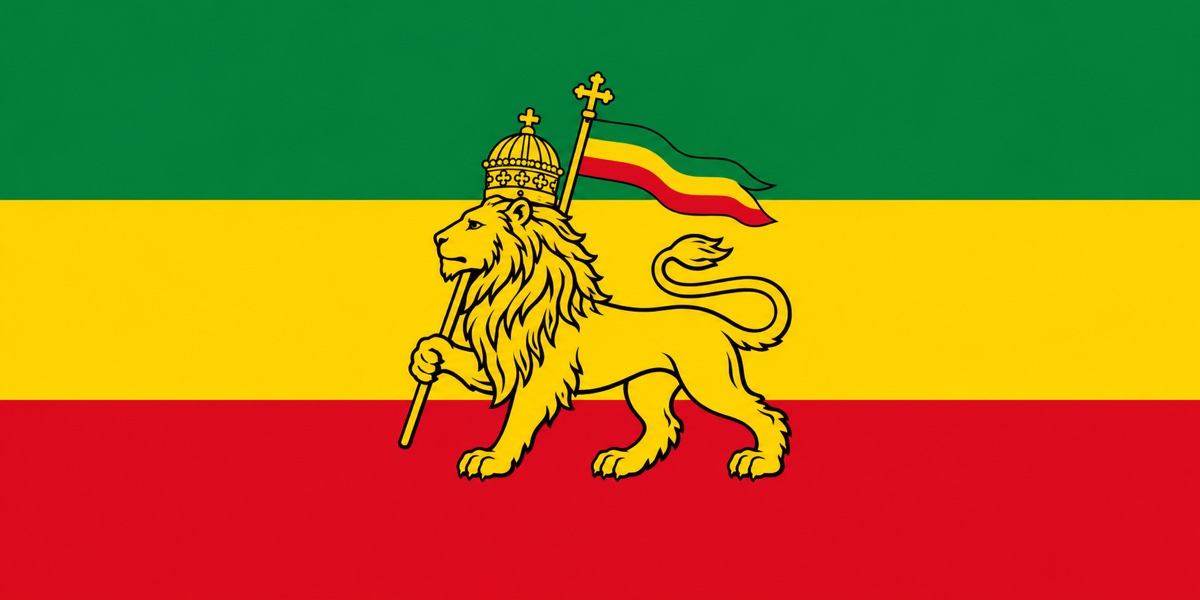
The flag is a horizontal tricolour of green, gold and red with the crowned Lion of Judah in the centre, walking and bearing a staff topped by a cross. The tricolour dates from the reign of Menelik II and has borne the lion since early in the twentieth century; the flag has never been changed. Its colours, from the one African state never colonised, were taken up by many of the states that became independent in the 1950s and 1960s and are known as the pan-African colours, and the Rastafari use them in their own emblems.
Arms
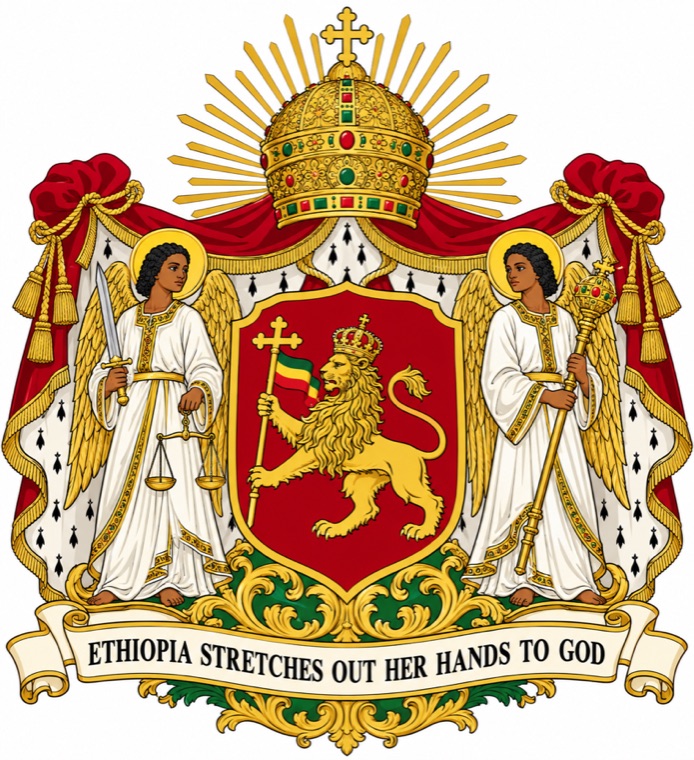
The imperial arms show the crowned Lion of Judah before the imperial throne, beneath the imperial crown, supported by two angels, one bearing a sword and the other scales, over a scroll with the motto. They appear on the coinage, government buildings and the emperor’s standard.
Anthem, motto and holidays
The anthem, Ethiopia, Be Happy, was adopted in 1930 for Haile Selassie’s coronation, with music by Kevork Nalbandian, bandmaster of the band of Armenian orphans the regent had brought from Jerusalem in 1924, and has never been replaced. The motto, from the Psalms, is Ethiopia stretches out her hands to God. The national holidays include Adwa Day on 2 March, the anniversary of the constitution on 4 November, Enkutatash, Timket, Meskel, the Orthodox Christmas and Easter, the two Eids and the Prophet’s birthday.
Failings
The concealment of the famine of 1973. Haile Selassie’s court and the government of Aklilu Habte-Wold knew that people were dying of famine in Wollo and Tigray and suppressed the reports, declined to ask for foreign relief and let grain be exported from other provinces, for fear of the empire’s reputation. Between forty thousand and two hundred thousand people died, and no one was prosecuted.
Slavery, ended late. The empire held slaves, and its governors raided the south-western frontier for them, into the twentieth century. The decree of 1924 freed few, and slavery was enforced as a crime only after 1942, under the pressure of the League’s reports rather than from within. The descendants of slaves still face discrimination in parts of the south-west and the north.
The resettlement of 1985. The government of Yared Assefa Kebede moved about four hundred thousand people from the northern highlands to the west, under a scheme voluntary in law and coerced in practice, into settlements without water, shelter or medical care. At least twenty thousand died, families were divided, and the settlers were placed on land its Oromo and Gumuz occupants had not surrendered.
The Tigray war and the siege. From 2020 to 2022 the federal government of Tesfaye Alemu Wondimu fought the provincial government of Tigray in a war in which federal soldiers and Begemder’s militia massacred civilians, sexual violence was used on a very large scale, and the province was besieged and starved, so that most of the several hundred thousand dead died of famine and disease. Tigrayan forces killed Amhara civilians in their turn. The emperor signed the emergency and said nothing for a year. Few people have been tried for any of it.
Abuses in the Somali east. In 2007 and 2008 the army answered an attack by the Ogaden front with a campaign against the region’s civilians: villages burned, men executed without trial, women raped, herds seized and the region blockaded towards famine. The government denied it until a parliamentary inquiry confirmed most of it, and a handful of soldiers were convicted.
The provinces that split peoples. The thirteen provinces of 1974 were drawn for an imperial administration, and they divide the Oromo, the Afar, the Somali and others across lines that decide whose language is official. They have never been redrawn, and the communities on the wrong side of them have been governed since 1974 in languages not their own.
Press restrictions. The anti-terrorism law of 2009 was used to prosecute and imprison journalists for their reporting and drove many more abroad. It was loosened in 2023 and has not been repealed.
The church’s land and privileges. The established church kept its land when every other landlord lost it in 1976, so that its tenants alone remain tenants; its land and income are untaxed, and its feasts set the public calendar of an empire in which most people are not Orthodox.
Open disputes
The Nile. The Geneva truce of 2023 governs the filling and drought-year operation of the Renaissance Dam. It does not settle the shares of the river, which Egypt holds to be its existence and Ethiopia its own water.
Somali irredentism. Whether the Somali of the Ogaden, of Djibouti and of the neighbouring states belong in a Somali state is pressed by the separatist front, by Somali politicians and by the diaspora, and has been renounced by no government of Somalia.
Djibouti’s place. The Afar regard the union of 1977 as their guarantee, and many Issa regard it as an annexation won by six points. The power-sharing council has held; the result has not been accepted by those who lost it.
Accountability for Tigray. Whether the crimes of the war should be tried in the empire’s courts, by a League tribunal or not at all, and whether trials should reach the ministers and commanders who ordered the siege, is argued between the federal and Tigray governments, the League and the victims’ organisations.
Daughters and the succession. Whether Princess Mentewab should stand before her brother is supported by the People’s Reform Party and opposed by the church and much of the imperial family, and cannot be decided without a Crown Council that has not put it to a vote.
Redrawing the provinces by language. The Oromo Federalist Union, now leading the government, seeks provinces drawn by language, including a single Oromo province. The Unity Party and the peoples who would become minorities in larger provinces oppose it, and the coalition has put no proposal to Parliament.
Disestablishing the church. Whether the Ethiopian Orthodox Tewahedo Church should remain established is argued between the Muslims and Protestants, together a majority, and the Orthodox, the largest single community and the church of the crown.
Assessment
Ethiopia is the only African state that kept its independence through the whole period of European empire, and Adwa remains the founding fact of its modern history and a fact of Africa’s. It passed from absolute to constitutional monarchy by negotiation rather than seizure, has transferred government between parties and peoples by election since 1979, has kept a federation with Eritrea that was never broken and taken in Djibouti by a vote, and has built the largest airline and the largest hydroelectric dam on the continent.
It is also poor, very unequal between the capital and the countryside, and repeatedly hungry. The famine of 1973 was concealed by the old court; the famine of 1984 and 1985 was declared, and the resettlement that followed killed thousands under a government formed by the students who had exposed the first. The Tigray war was fought by an elected government against an elected provincial government, and its siege killed more people than any event in the empire’s history since the conquests of the nineteenth century. The settlement of 1974 kept a military government and a war over Eritrea out of the empire’s history, and did not keep out famine, war or the army’s violence against its own people.
The crown’s part depends on the period examined. Haile Selassie’s court concealed the famine that ended his absolute power, and he died a constitutional monarch less than a year after accepting a constitution of the kind he had refused since 1960. Amha Selassie declined a coronation for the sake of the famine relief and reigned without incident. Yohannes V signed the emergency in Tigray, said nothing for a year and then went to Mekelle, and Ethiopians disagree whether that was the conduct of a constitutional monarch keeping to his place or of one who found his voice too late.
The settlement’s most lasting decision was to keep the provinces of 1974 and make languages official within them. It spared the empire a redrawing of boundaries that might have divided it further, and it left the largest of its peoples spread across nine provinces in which its standing varies, under a government that people now leads and that is committed to changing the arrangement. Ethiopian historians disagree whether the provinces have held the empire together or held its grievances in place.
Chronology
| Year | Event |
|---|---|
| c. 1st century AD | The kingdom of Aksum rises in the northern highlands |
| 4th century | Ezana of Aksum adopts Christianity |
| 615 | Early followers of the Prophet Muhammad take refuge at the Aksumite court |
| 12th to 13th century | The Zagwe kings cut the rock churches of Lalibela |
| 1270 | Yekuno Amlak founds the Solomonic dynasty |
| 1529 to 1543 | The invasion of Ahmad ibn Ibrahim of Adal, defeated with Portuguese help |
| 1636 | Fasilides founds Gondar |
| 1769 to 1855 | The Zemene Mesafint, the Era of the Princes |
| 1855 | Tewodros II is crowned |
| 1868 | A British expedition storms Magdala; Tewodros shoots himself |
| 1872 | Yohannes IV is crowned |
| 1875 and 1876 | Egyptian invasions are defeated at Gundet and Gura |
| 1886 | Menelik and Taytu found Addis Ababa |
| 1889 | Yohannes IV is killed at Metemma; Menelik II becomes emperor and signs the Treaty of Wuchale |
| 1890 | Italy proclaims its colony of Eritrea |
| 1 March 1896 | Menelik II destroys the Italian army at Adwa |
| October 1896 | The Treaty of Addis Ababa: Italy recognises the empire’s independence and keeps Eritrea and Somaliland |
| 1913 | Menelik II dies; Iyasu V succeeds and is never crowned |
| 1916 | Iyasu V is deposed; Zewditu becomes empress and Ras Tafari regent |
| 1917 | The railway from Djibouti reaches Addis Ababa |
| 1919 | The Treaty of Berlin makes French Somaliland at Djibouti a British mandate |
| 28 September 1923 | Ethiopia is admitted to the League of Nations |
| 1924 | A decree provides for the gradual emancipation of slaves |
| 2 November 1930 | Haile Selassie is crowned at St George’s Cathedral |
| 1931 | The first written constitution |
| 1939 to 1945 | Neutrality in the Second Great War |
| 1942 | Slavery is made a crime and the law enforced; the emperor’s offer of troops for Burma is declined |
| 1945 | Ethiopian Airlines is founded |
| 1950 | Haile Selassie I University is founded; the League resolves that Eritrea shall be federated with Ethiopia |
| 15 September 1952 | The federation with Eritrea comes into force |
| 4 November 1955 | The revised constitution; an elected Chamber of Deputies; English in the federal courts |
| 1960 | Somalia becomes independent. Abebe Bikila wins the Olympic marathon at Rome barefoot |
| 13 to 17 December 1960 | The Imperial Bodyguard’s coup fails |
| 1961 | Africa Hall is given to the League as the seat of its economic commission for Africa |
| 21 April 1966 | Haile Selassie visits Jamaica |
| 1973 | The Wollo famine is concealed by the court and exposed by students |
| February 1974 | Mutinies and strikes; Endelkachew Makonnen becomes Prime Minister |
| June 1974 | A committee of officers is formed and negotiates with Endelkachew |
| 4 November 1974 | The constitution of 1974 is proclaimed; the empire becomes a constitutional monarchy |
| 1975 | The People’s Reform Party is founded. The commission of inquiry reports on the famine |
| 27 August 1975 | Haile Selassie dies at the Jubilee Palace; Amha Selassie is proclaimed and declines a coronation |
| 1976 | The Land Reform Act gives tenants title; the church keeps its land |
| 1977 | Djibouti joins the empire by referendum. Somalia invades the Ogaden in July |
| March 1978 | Somalia is defeated. Defence treaties with Britain and the Realm |
| 1979 | The first full election; Yared Assefa Kebede of the People’s Reform Party becomes Prime Minister |
| 1984 and 1985 | Famine across the north; the world’s relief, Live Aid among it |
| 1985 and 1986 | The resettlement scheme; Parliament suspends it and the government falls |
| 1988 | The investment law opens the economy |
| 1989 | Amha Selassie suffers a stroke |
| 1991 | Somalia collapses. Ahmed Abdulkadir Sherif becomes the first Muslim Prime Minister |
| 1992 | The League-supported relief mission in Somalia is staged through Ethiopia |
| 1997 | Amha Selassie dies; the Crown Council confirms Yohannes V’s descent through a daughter |
| 1998 | Yohannes V is crowned at St George’s Cathedral, the first coronation since 1930 |
| 2004 | Ethiopia is admitted to the Commonwealth |
| 2007 and 2008 | The army’s campaign against the civilians of the Ogaden |
| 2009 | The anti-terrorism law |
| 2011 | Construction of the Renaissance Dam begins |
| 2014 to 2018 | Protests over the expansion of Addis Ababa into Shewa |
| 2016 | The electric railway from Addis Ababa to Djibouti opens |
| 2018 | Tesfaye Alemu Wondimu becomes Prime Minister |
| July 2020 | The Renaissance Dam begins to fill; the Nile crisis |
| November 2020 | The Tigray war begins; the emperor signs the state of emergency on advice |
| 2021 | The siege of Tigray. In December the emperor goes to Mekelle and calls for a ceasefire |
| November 2022 | A truce ends the Tigray war |
| 2023 | Tesfaye’s government falls; Lemma Gudeta Bayisa becomes the first Oromo Prime Minister. The Nile truce is signed at Geneva. The anti-terrorism law is loosened |
| 2025 | The Renaissance Dam is completed |
✎ Editor's Note · What is ruled, what is invented, and what the settlement costs
The article answers two rulings that remove the two events that shaped modern Ethiopia: there is no Italian war after Adwa, because the King of Italy refused Mussolini, and there is no Derg, because the officers of 1974 broker a constitutional settlement and go back to barracks. Without the occupation there is no exile and no British administration of Eritrea; without the Derg there is no abolition of the monarchy, no Red Terror, no thirty-year Eritrean war and no independence for Eritrea. Djibouti, a British mandate here because France lost its African colonies at Berlin in 1919, joins the empire instead of becoming a republic.
The divergence costs something. The famine of 1973 is still concealed. The famine of 1984 and 1985 still happens, without a war, and the resettlement that killed so many under the Derg is moved to an elected government formed by the students who exposed the first famine. The Tigray war still happens, between elected governments. The Ogaden campaign of 2007 and 2008 and the anti-terrorism law of 2009 are kept and attributed to the governments this history supplies. The provinces are never redrawn, which spares the empire the ethnic federalism of 1995 and leaves the Oromo divided across nine of them and without a Prime Minister until 2023. Eritrea keeps its federation and still has a party that wants out.
Ruled in the elicitation: never conquered; Adwa; no Italian war; neutrality and the Burma offer; the League since 1923 and Africa Hall; Haile Selassie crowned in 1930, reigning under the constitution of 1974, dying on 27 August 1975 at the Jubilee Palace and buried at Holy Trinity; slavery ended in 1924 and 1942; the coup of 1960; Jamaica and Shashamane; the famine concealed and exposed by students; the settlement by Endelkachew and a committee of officers; Endelkachew Prime Minister to 1979, losing to a student-founded reform party; the Land Reform Act, the bonds and the church’s land; the established church; Amha Selassie, never crowned, his stroke of 1989; Yohannes V, born 1961, a grandson through a daughter confirmed by a Crown Council of the imperial family alone, an agronomist crowned by the Patriarch at St George’s in 1998; the Oromo physician styled Empress; the Crown Prince born 1990 and his elder sister’s place; male-preference succession; the Jubilee and Menelik Palaces; eleven Prime Ministers, with Endelkachew, Tesfaye Alemu Wondimu and Lemma Gudeta Bayisa named, a Muslim from Harar in the 1990s and the 1979 winner from the student party; regional parties and coalitions; Parliament’s two chambers; the thirteen provinces, languages by province, Amharic federally and English in the courts; the calendar; Eritrea’s institutions and its minority independence party; Djibouti’s mandate, the vote of 53 to 47, the Afar and Issa council and the railway; Somalia, the Ogaden war and its suppliers, the separatist front and the abuses, the collapse of 1991 and the republic of 2012; the relief mission of 1992; the defence treaties; the two famines, Live Aid and the resettlement; the Tigray war, its dead and the emperor’s silence and visit to Mekelle; the dam and the Geneva truce; Egypt, Italy and the churches; the numbers and the economy; the religious shares; the Commonwealth in 2004; the diaspora; the culture, press law and symbols; the eight failings and seven disputes.
Invented in the writing, for veto. People: eight Prime Ministers, Yared Assefa Kebede, Kassahun Wolde-Tsadik, Ahmed Abdulkadir Sherif, Gebremeskel Hagos Berhe, Alemayehu Desta Wolde, Haile Ferede Abate, Dawit Ersado Dangura and Mathewos Kanko Ersumo, with their peoples, provinces, parties and terms, and the provinces given to Tesfaye (Begemder) and Lemma (Arsi); the emperor’s baptismal name, Dawit, his father, his doctorate and his work in Wollo and Tigray, and the reason for his throne name; the Empress’s name, Bontu Gemechu, and her home in Wollega; Princess Mentewab, born 1987, the name Fasil for the Crown Prince, and the four children. Institutions: the parties (the People’s Reform Party, the Unity Party, the Oromo Federalist Union’s programme, the Tigray People’s Congress, the Southern Peoples’ Alliance and the Eritrean Independence Bloc); the Crown Council’s composition, functions, veto over the succession articles and the women’s votes of 1997; the striking of indisputable; the Chamber of 450 and the Senate of 96; provincial chief administrators and governors, seats and language lists; Oromo in the Latin alphabet; Djibouti’s council and languages. Events and figures: the reasoning of 1997 (Amha Selassie given daughters and no son, his eldest daughter dying before him, a male-line party in the family); the date of 4 November 1974, the election postponed to 1979 and the old Chamber sitting on; the commission of 1975 and the fate of the detained ministers; the death estimates for both famines and the resettlement figures; the governments’ falls in 1986 and 2018; the investment law of 1988; the synod’s objection of 1991; the conditions on the relief mission; the coronation’s changes and cost; the parliamentary inquiry of 2011; the course of the Tigray war in this form, including the provincial election, the provincial police and militia, Begemder’s militia at Welkait, the federal soldiers at Axum, the date of the Mekelle visit and the cabinet’s dispute over it, the truce’s mediators and the League commission of 2023; Italy’s sponsorship in 1923; the reasons given for refusing the Burma offer; the pressure on Eritrea in the 1950s; the wreath at Adwa; the patriarchates’ reconciliation; the reasoning of the Arabian mediation; the Commonwealth’s refusal to suspend; the power line of 2022; the act of 2017 at Shashamane; the arms as described; the holiday of 4 November; and the currency, the birr, which was not ruled.
Kept because they happened and nothing here prevents them: the history to 1935, including Menelik’s conquest of the south; the coup of 1960 and its leaders; Aklilu Habte-Wold and the mutinies of 1974; Siad Barre; Afewerk Tekle; the anthem’s composer; Haddis Alemayehu, Mulatu Astatke, Tilahun Gessesse and Mahmoud Ahmed; Abebe Bikila and the runners. The real massacre at Axum was committed by Eritrean troops, and the real expulsions from Welkait by Amhara regional forces; both are given to the forces this history has. Amha Selassie’s real son, who is living, does not appear.
Trivia
- In-Universe Ethiopia has never been conquered. Menelik II destroyed the Italian army at Adwa on 1 March 1896, Italy kept only its coastal colonies of Eritrea and Somaliland, and no foreign army has crossed into the highlands since. Adwa Day is a national holiday, and the Italian ambassador lays a wreath.
- In-Universe The Ethiopian calendar runs about seven to eight years behind the Gregorian, has thirteen months, and begins the year on 11 September. The day is counted from dawn, so that seven in the morning by the international clock is one o'clock in Addis Ababa.
- In-Universe Ethiopian Airlines, the state carrier since 1945, is the largest airline in Africa, and Addis Ababa is the continent's principal point of transfer to the rest of the world.
- In-Universe Abebe Bikila, a soldier of the Imperial Bodyguard, won the Olympic marathon at Rome in 1960 running barefoot, the first Olympic champion from black Africa. He won it again at the next Games, in shoes.
- In-Universe The Ethiopian Orthodox Church holds that the Ark of the Covenant is kept in a chapel at Axum. A single guardian monk, chosen for life, keeps it, and no one else may see it, the emperor and the Patriarch included.
- In-Universe Ethiopia is a member of the Commonwealth that was never ruled by Britain. It was admitted in 2004, one of the two members with no imperial connection, on the strength of federal courts that had worked in English since 1955.
- Real-World Italy invaded Ethiopia in October 1935, using chemical weapons, and occupied it from 1936 to 1941, while Haile Selassie lived in exile in Bath and appealed to the League at Geneva. Here no Italian war follows Adwa, and the empire has never been occupied.
- Real-World The Derg, a committee of officers, deposed Haile Selassie in September 1974, abolished the monarchy in March 1975 and ruled until 1991, and the emperor died in its custody in August 1975. Here a committee of officers brokers a constitutional settlement and dissolves itself, and Haile Selassie dies at the Jubilee Palace as a constitutional monarch.
- Real-World Eritrea's federation with Ethiopia was dissolved in 1962, a thirty-year war followed, and Eritrea became independent in 1993. Here the federation of 1952 has never been broken, and the party that seeks independence has never won Asmara.
- Real-World Djibouti, until then French Somaliland, became an independent republic in June 1977 after a referendum almost unanimous for independence. Here it was a British mandate from 1919 and voted narrowly, by about 53 per cent to 47, to join Ethiopia.
See also
- Republic of Egypt and the Sudan, the downstream state in the Nile crisis
- East African Federation, the neighbour to the south and the other upstream party
- Federal Kingdom of Nigeria, the other African monarchy of its own in the Commonwealth
- Socialist Kingdom of Italy, defeated at Adwa and the former ruler of Eritrea
- Kingdom of Arabia, across the Red Sea, a mediator of the Nile truce
- West Indies Federation, for Jamaica, the visit of 1966 and Rastafari
- League of Nations, which Ethiopia joined in 1923 and whose economic commission for Africa sits in Africa Hall
- Commonwealth of Nations, which Ethiopia joined in 2004 without an imperial connection
- The British Empire, for the neighbouring colonies and the mandate at Djibouti
- Russian Republic, which armed Somalia in the Ogaden war
- New Westminster, home of the largest Ethiopian and Eritrean community outside the empire
Categories
- Nations of the World
- Africa and the Middle East
- Monarchies
- Federations