Tomb of the Unknown Soldier
The Tomb of the Unknown Soldier is the tomb of an unidentified American soldier of the First Great War on the crest of the Robert E. Lee National Cemetery at Arlington, in the Province of Virginia, across the Potomac from the capital. It was dedicated on 11 November 1921 and is the centre of the Realm’s national observance of Remembrance Day.
The Tomb is a plain sarcophagus of white marble carrying three lines of inscription, the third of which is the Realm’s Act of Remembrance. An unknown soldier of the Second Great War has lain under a flat slab in front of it since 1958, beside an empty slab that marked the grave of an unknown of the Indochina war until he was identified in 1998. The Tomb is Crown ground held by the forces under an Order in Council of 1921, and it has been guarded day and night since 1937 by the Tomb Company of the Regiment of Virginia, known to the rest of the Army as the Watch.
The Tomb was proposed by the American Legion in 1920 as a consolation for the Realm’s refusal to bring its dead home from the war. One body was brought home instead, chosen from four unidentified men from the Rechteveld cemeteries in Belgium, and buried with the King present.
Name
The formal name is the Tomb of the Unknown Soldier, and in ordinary speech it is the Tomb: in a sentence about Arlington, or about the Eleventh, the definite article needs no qualification. The man in it is the Unknown Soldier. To the Watch, and to the old soldiers who come to the chain, he is the American, from the inscription’s first line.
The man of 1958 is the second unknown. The stone beside him, which has held nobody since 1998, is the empty slab.
History
Before the Tomb
The Realm entered the First Great War in 1916 and lost about 120,000 men in it, in the coastal sector of Belgium it held for twenty months and in eleven days at Rechteveld, in the wood behind the coast, in the autumn of 1918. In 1919 it decided that its dead would not come home. They were buried where they fell, in war cemeteries kept to one standard under one stone, and the families were not consulted. The decision followed one the King had taken for his own son: Prince Adolphus, killed in Flanders in October 1916 serving with the Grenadier Guards, had been left where he fell on his father’s word, and when the campaign to bring the dead home was at its height the answer most often given to it was that the King’s son lay in Flanders too.
The first observances of the Armistice, in 1919 and 1920, had no grave to go to. The Crown’s wreath was laid on the steps of Parliament House, by the Governor-General, William Howard Taft, in front of a building and not a body.
The proposal for an unknown soldier came from the American Legion, in a resolution of its convention of 1920. The Legion had been chartered in 1919 to look after the men who came back and the families of the men who did not, it had campaigned for the return of the dead, and by 1920 it knew it would lose. An unknown soldier was a concession it could win: one body brought home in the name of all of them. The Legion has always declined to credit the idea to any one person. The ministry of Charles Evans Hughes accepted it within the year, partly because it was cheaper than the alternative and partly because the War Office saw in it the end of the argument about repatriation, which it did not turn out to be.
The choice, 1921
Four coffins were brought to Nieuwpoort in late October 1921, one from each of the four Rechteveld cemeteries, so that no single ground could claim the man who was chosen. Each held a soldier whom nothing could identify. At the Legion’s insistence the graves they were taken from included those of the Black regiments, in an Army that had fought the war in segregated formations, and the word on the stone was chosen afterwards to fit that fact.
The coffins were set out in the town hall at Nieuwpoort, on the mouth of the Yser, which had been rebuilt after the war and was still half restored, identical under identical flags. The choice was made by a sergeant of the Regiment of Virginia who held the Sovereign’s Cross. He walked round the coffins several times and laid a spray of white roses on one. The record gives his decoration and his regiment and not his name. Only one sergeant of the regiment held the Cross, so who he was has never been a secret, and the silence of the record is a courtesy that the Register keeps. He never spoke of it.
The other three were reburied together the same day, in one grave in the Rechteveld ground, under a stone carrying the Tomb’s second line three times: KNOWN TO GOD AND TO HIS OWN.
The voyage home
The coffin crossed in HMS Olympia, an old cruiser of the 1890s and once a flagship, on the last voyage of note she made. The crossing took eleven days and nothing happened on it. What is remembered is the end: Olympia coming up the Potomac to the capital’s navy yard with the river lined on both banks for miles.
He lay in state in Parliament House for two days, on the floor of the building on whose steps the Crown’s wreath had been laid the two years before, and the queue did not end. Four sacks of earth had come home in Olympia, one from each of the four cemeteries, and the earth went into the Tomb with him, so that he lies in the ground he came from.
Three decorations were laid on the coffin in Parliament House: the Realm’s Sovereign’s Cross, laid by the King, and the Ernest Cross and the Iron Cross, laid by Britain’s High Commissioner and Germany’s ambassador. They were the first of fourteen: over the following nine years every ally of the war but one gave him its highest award for gallantry, a thing each of them gives to no foreigner otherwise (see The decorations).
The burial, 11 November 1921
Ernest III crossed for the burial. It was one of a handful of royal visits to the Realm in a reign of fifty-eight years and the only one that anybody remembers. On the morning of the Eleventh he walked behind the caisson from Parliament House down the Charter Axis, over the river and up to the crest, about four miles at a walking pace, with the Governor-General, John J. Pershing, and the Prime Minister, Hughes, behind him and the Legion behind them.
The crowd was enormous and unplanned. It was the largest gathering in the Realm’s history to that date, nobody had organised it as a mass occasion, and it could not be counted.
The service was the Church of America’s order for burial, with the four hymns, the last of them John McCrae’s In Flanders Fields, sung immediately before the silence at eleven. It became the national order of service for the Eleventh, was fixed by the end of the 1920s, and has not been altered since.
After the silence a mother spoke. The Legion had chosen Ellen Mayhew of Chillicothe, in the Commonwealth of Ohio, a widow whose only son was missing at Rechteveld, and she read the three lines of the inscription aloud and sat down. Nobody else spoke. The rule that no office-holder speaks at the Tomb, and that the one voice heard there on the Eleventh belongs to somebody chosen by the Legion, begins with her.
The King laid the Crown’s wreath himself, the one year until 1958 that the Governor-General did not, and said nothing at all. His silence at the Tomb is the pattern his son and grandson have followed. The Last Post was sounded. The ceremony overran by two hours, because the queue to pass the Tomb did not end either.
The inscription
The words were settled by a committee of the War Office, of officers and officials, which proposed two lines: HERE LIES AN AMERICAN, and KNOWN TO GOD AND TO HIS OWN.
The first line was chosen with care. The Black press said in November 1921 that the word was American and not anything narrower because the man under it might be Black, and that the four coffins had been drawn to make that possible; the War Office never denied it.
The third line was the King’s. It reached the committee as a note of eleven words in his own hand, with no covering letter. The committee resisted it, on the ground that it drew attention to the grievance the War Office was defending, and gave way because it could not refuse. The note is in the Royal Archives at Windsor, among Ernest III’s own papers; the Realm has asked to display it and has been refused.
HERE LIES AN AMERICAN
KNOWN TO GOD AND TO HIS OWN
BROUGHT HOME FOR ALL THOSE WHO WERE NOT
The third line did draw attention to the grievance, and it has become the Act of Remembrance of the entire Realm, spoken in unison at the end of every service on the Eleventh.
Crown ground, 1921
The King’s visit was also used to settle what the Tomb was. An Order in Council of 1921, made while he was in the Realm, reserved the crest around the Tomb from the cemetery and held it for the Crown, in the keeping of the forces. The Parks System had taken the cemetery under the Act of 1916, and its writ has stopped at the chain ever since.
From 1921 to 1937 the Tomb was kept by a civilian watchman by day and by nobody at night. On an ordinary day in 1923 the German Emperor, Albrecht I, laid a wreath at it, the first foreign head of state to do so; the rule of 1921 kept foreign wreaths off the Eleventh and not off the Tomb.
The Watch, 1937
The continuous guard was the Army’s idea. The Regiment of Virginia had been used in the industrial disputes of the early 1930s, and the uniform had become a provocation in the mill towns; in 1937 the regiment offered the Tomb a guard, day and night, as a way of winning back its standing in the capital. The ministry accepted, and the War Office’s works department built the amphitheatre behind the Tomb in the same year, with the company’s quarters beneath it.
The company’s first captain, John Ambler of the Regiment of Virginia, had served at Rechteveld. He wrote the company’s creed, chose its motto and forbade photography at the change, and he is buried in the next grave in the row.
The second unknown, 1958
The second war’s dead were not brought home either, and their names went on the walls of the cemetery from 1946. The campaign for an unknown of their own was led by the Legion itself, renewed by the second war’s veterans and carried against its own older members, who had built the observance and resented being asked to share it as they had resented the 1946 Act. The government of Dwight D. Eisenhower, who had been the supreme Allied commander in Europe, chose the fortieth anniversary of the Armistice.
The second unknown was chosen as the first had been, from four coffins taken from the Realm’s cemeteries in Normandy and Brittany, where its armies had come ashore in 1944. Normandy had been the King’s own duchy since 1945. A decorated private made the choice with white roses; the record gives his regiment and not his name. The other three were buried together in one grave in the Normandy cemetery under the same stone as at Rechteveld, in conscious repetition of 1921.
He came home by sea in HMS Susquehanna, a cruiser that had fired in support of the Brittany landings, was landed at the navy yard, and lay in state in Parliament House for a day. The queue was a quarter of 1921’s. On 11 November 1958 Ernest IV crossed and laid the Crown’s wreath, as his father had, and said nothing. The second unknown lies under a flat slab in the grass in front of the sarcophagus, carrying the same three lines, so that the Tomb itself still holds one man. Ernest IV laid the Sovereign’s Cross on the coffin, and every ally of the second war gave its own highest award for gallantry, Ireland’s among them for the first time. The Watch’s silver badge was first given for the occasion.
The Indochina unknown, 1975 to 1998
The Realm began bringing its dead home during the Indochina war, from the middle of the 1960s, and named almost all of them. In late May 1975, within a month of the fall of the allied government, the ministry of Gerald Ford decided that the war should have an unknown of its own and that the burial should not wait.
There was no ceremony of choice. The forensic service was told to supply the one set of remains it could not name, and did, with a note recording its doubt, which was filed and not read. Ernest V crossed for the burial, three years into his reign; it was his first visit to the Tomb. The third unknown was buried beside the second, under a slab of the same pattern.
In 1994 a journalist found the note in the forensic service’s files. It named the place of a crash. A family whose son had been shot down near it in 1972 began a campaign, and when the family asked, the Realm agreed at once, on the principle that a man who can be named must be. In 1998 the remains were identified from blood relatives as those of Captain Paul Dettmer of the Royal American Air Force. He was disinterred, named, and buried in his family’s plot at Boonville, in the State of Missouri, as his mother asked, under a stone that says he lay at Arlington for twenty-three years. He is the only man ever taken out of the Tomb’s ground.
His slab was replaced with one reading Honouring and keeping faith with the missing. There is no body under it. The King came privately on the day it was laid, and said nothing about the disinterment then or afterwards.
Since
Napoleon VI, Emperor of the French, came in 1962, on the first French state visit to the Realm since the war. He had come ashore in Brittany with the assault wave in 1944. He carried his wreath the last twenty paces alone and stood at the Tomb longer than any visitor before him, and the Realm remembers the visit as the reconciliation. At the chain he said one sentence, in French, to the sentry, who did not answer. The words have been reported several ways, and the sentry never repeated them. He had brought the Légion d’honneur, the honour of the army the unknown had died fighting, and the Realm accepted it and welcomed it as the reconciliation, with no dissent worth recording; it is the only enemy’s honour in the case.
In 1969 a protester against the Indochina war crossed the chain and poured red paint on the Tomb’s steps. The sentry warned him twice, stepped between him and the Tomb, and did not raise the rifle. He was not charged, at the Watch’s own request: the sentry said the Tomb had been defended and nothing more was owed.
The crack across the lid was first noticed in the 1960s. In the 1980s it was decided to leave it, on the ground that a repair would be a replacement.
In 1996, the seventy-fifth anniversary, Ernest V stood at the Tomb on the Eleventh while the Governor-General, Colin Powell, laid the Crown’s wreath, and the first woman walked the mat. On May Day 2006 the guard was not withdrawn and the cemetery stayed open, and the sentry on the crest that morning is remembered and unnamed; in the same week the King laid a wreath on an ordinary day, kept apart from the Eleventh as the Realm keeps the two days apart. In the pandemic the Watch split into two halves living apart, so that one could always walk.
On 11 November 2021, the centenary, Ernest V laid the Crown’s wreath, the third King to do so, and said nothing.
The Tomb
The sarcophagus
The Tomb has no designer, deliberately. The War Office’s works department took the pattern of the standard headstone on the slope below and enlarged it into a sarcophagus: the same proportions, the same plain face, the same lettering. It is white Yule marble from Colorado, from the quarry that supplies every stone in the cemetery, and it carries no carving of any kind, only its three lines. It has been in place since the first day.
It faces west, away from the capital, toward the rest of the country the dead came from. A visitor at the chain therefore faces east, and sees the Tomb against the Charter Axis across the river.
A crack runs across the lid, the work of decades of frost in a seam of the block. It was first noticed in the 1960s, widened slowly, and was left unrepaired by a decision of the 1980s that a repair would be a replacement.
The plaza and the slabs
The Tomb stands on a small paved plaza at the top of a few steps. In the grass in front of it, on the west, lie two flat slabs side by side: the second unknown’s, carrying the three lines, and the empty slab of 1998.
Visitors come to a chain at twenty paces and cross it only to lay a wreath. Between the chain and the Tomb the sentry walks a rubber mat, replaced every few years; the old mats are cut up and given to retiring sentries. At night a single low lamp at the foot of the steps lets the sentry see the mat, and there is no other light on the crest but the amphitheatre’s behind.
Nothing is left at the chain except poppies on the Eleventh, which the Watch clears at dusk.
The amphitheatre
The amphitheatre stands behind the Tomb, on its east side. It was built in 1937 by the War Office’s works department, of white marble from the same quarry, with about a thousand seats and the Watch’s quarters beneath it, and it has no name and no architect. Nothing on the crest has an architect. On the Eleventh invited guests sit and everyone else stands on the grass, which is why the national ceremony is smaller than a visitor expects. On a summer afternoon several thousand people watch the change from its outer steps and the grass, held back by the chain and by nothing else.
The unknown soldiers
Who he might be
He cannot be identified. The four coffins of 1921 held men who were already unidentifiable, and modern technique needs something to compare against: there is no sample, no family and no record to test him by. Nobody has ever formally asked to claim him or to test him, and the question is kept away from the Tomb by an agreement nobody wrote down.
What is claimed is that he may be Black. The Black press said so in 1921, on the evidence of the four coffins and the word on the stone, and Black churches and veterans have claimed him as possibly theirs ever since. On the Eleventh, after the silence, Black congregations read a poem by Countee Cullen, written in the 1920s, on the word “American” and on who might lie under it; that is how the poem reached the schools, where it is now taught beside the third line. The Realm neither confirms nor disputes the claim, and that is the point of it.
The second unknown and the empty slab
The second unknown is the same kind of man as the first: chosen blind, from men who could not be named, and decorated by every ally of his war. The empty slab is different. It is the one place on the crest that records a mistake, and its line, Honouring and keeping faith with the missing, is the only words on the Tomb’s ground that were not written in 1921.
The decorations
Every country that fought beside the Realm in the first war gave the unknown its highest award for gallantry, except Ireland. Three came in 1921, in Parliament House; the rest came over the 1920s, as each government made up its mind, and the last in 1930.
| Country | Decoration | Given |
|---|---|---|
| United Kingdom of America | Sovereign’s Cross | 1921, by Ernest III |
| Great Britain | Ernest Cross | 1921 |
| German Empire | Iron Cross | 1921 |
| Socialist Kingdom of Italy | Gold Medal for Military Valour | 1920s |
| Kingdom of Greece | War Cross | 1920s |
| Empire of Japan | Order of the Golden Kite | 1920s |
| New Albion | New Albion Cross | 1920s |
| Union of South Africa | Cross of the Union | 1920s |
| United Provinces of the River Plate | Cross of the Plate | 1920s |
| Republic of Cuba | Order of Military Merit | 1920s |
| Kingdom of Siam | Order of Rama | 1920s |
| Empire of Brazil | Imperial Order of the Southern Cross | 1920s |
| Empire of China | Order of the Double Dragon | 1920s |
| Austria-Hungary | Gold Medal for Bravery | 1930 |
| France | Légion d’honneur | 1962, by Napoleon VI |
New Albion, South Africa and the River Plate, realms of the same King, each gave a cross of its own, founded after the war precisely so that it would not be the British one. Austria-Hungary’s came last, held up for a decade by the argument about which of the monarchy’s crowns, four of them since the Imperial Reforms of 1920, should give it.
Ireland was never asked. It had been a realm of its own since the Easter Settlement of 1919, but in 1921 the Realm counted Ireland as part of Britain’s war and took the Ernest Cross to cover it, and the separate crosses of the other realms made the omission more conspicuous. Ireland has noticed. When the second unknown was buried in 1958 Ireland was asked, having fought the second war in its own right, and gave its Military Medal for Gallantry: its first and only honour at the Tomb. The first war’s shelf still has nothing from Ireland, and the Realm has never offered to put that right.
Japan’s Order of the Golden Kite stayed in the case through the second war, after Japan’s attack on Honolulu, by a ruling that what has been given to the dead is not taken back. It was the most argued-over object on the crest for four years.
From 1921 to 1937 the decorations were kept in Columbia Cathedral, beside the Regiment of Virginia’s colours. Since 1937 they have been in a case in the amphitheatre, the one display on the crest, the first war’s on one shelf and the second unknown’s, from every ally of the second war, on another. The case is seen by appointment only, through the Watch. The Indochina unknown received no foreign honour: his burial was too fast for any government to be asked, and the allied government had fallen.
The Regiment of Virginia
The Regiment of Virginia finds the Watch. It is one of the ten red regiments of the Royal American Army, the regiments raised before the Charter that are still on the establishment, and it stands fifth in the order of precedence. It was raised at Williamsburg in 1754, its depot is there, it belongs to the 4th Division, and it has three battalions, about three thousand of all ranks with the Watch. Its motto is En Dat Virginia Quartam, behold, Virginia gives the fourth. The rest of the Army calls it the Other Half, and its soldiers call themselves Virginians, whatever polity they come from. Its Colonel-in-Chief is Prince Frederick.
The French war
The regiment was raised as a provincial regiment of the colony for the war against the French, and its first year ended in failure: at Fort Necessity in July 1754 its men surrendered to the French under a capitulation that admitted an “assassination”, and the regiment teaches the surrender and the capitulation to every recruit as the first thing it ever did and the first thing it did wrong.
From 1755 to 1758 its colonel was George Washington. It was in that command that he learned to want the rank and the regard the regular establishment would not give a colonial officer, and the regiment counts the first Governor-General as its first great colonel and, by its own boast, its last famous soldier. It carries several honours from the French war, on a colour so crowded that it was replaced in 1790. Its facings then were buff, Washington’s own colour. From the French war onwards it had a handful of free Black men as drummers and pioneers, never more than a dozen at once.
The motto is the colonial seal’s, and the regiment’s cap badge is the seal itself, the sovereign’s arms with the motto round them, under a crown. It takes the motto to mean what the seal meant, that Virginia is the Crown’s fourth dominion after England, Scotland and Ireland, and says that it still is. Nobody contradicts it.
Against the Crown, and back
From 1775 to 1779 the regiment fought against the Crown. It served in the northern campaigns of the Four-Year War and carries several honours from them, borne without the crown that surmounts every other honour, more than any other red regiment except the King’s Own Massachusetts. In the settlement it was taken onto the establishment by conversion, colours and all; its officers were commissioned afresh, and the uncrowned honours were the price of keeping the colours.
In the 1790s it dug and roaded the Virginia approaches to the new capital, and drew from the regulars the same contempt the provincials had always drawn. It went to Mexico in 1847 on Scott’s march to Mexico City, where Lee was Scott’s reconnaissance officer, and carries Cerro Gordo and Chapultepec. It is the war it talks about least.
1861
In April 1861 the regiment’s companies were in garrison across the Province: the depot at Williamsburg, and companies at Norfolk, Richmond, Lynchburg, Winchester and the western towns. Each company went the way of its town. The regiment split along the Blue Ridge, the west loyal and the east rebel, and its colonel, Hugh Fauntleroy, an old man from the Northern Neck, stayed with the colours, and about half the officers stayed with him. Richmond confiscated his estate across the lines. He died in the winter of 1862, was buried in the capital, and was moved to Arlington with the dead of the full burying grounds in 1864; he lies in the oldest section.
The colours were at the depot at Williamsburg, in the half of the Province that had rebelled. On a night in April a colour party under Colour Sergeant Thomas Oakes carried them out of the town and down the Peninsula, through rebel country, to Fort Monroe, which never fell. One of the party was a free Black drummer of the depot. Their names are on a board in the regimental museum.
The half that went over took the name the True Regiment of Virginia and fought the war under a colonel from Richmond. The two halves met in battle several times, with brothers on each side, and the regiment does not discuss it. The loyal half served wherever the Virginia front was, for the whole war, and was so short of men after the split that it enlisted boys of fifteen and sixteen from the loyal counties from 1861, as its own history says. In the last fight of the war in Virginia, in 1863, the loyal half took the True Regiment’s colours. The True Regiment was struck off the lists that year, its survivors went home under Grant’s terms, and its name is not available to any regiment again. The regiment gave its colours back to Richmond in the 1960s, and they are in a museum there.
The facings turned black in 1861, in mourning for the half that left, and they have been black since. The full-dress headdress is still the black shako the regiment was wearing when it split. The rest of the Army began calling it the Other Half as a joke about the half that left. The regiment took the name as a statement about the half that stayed, uses it proudly, and puts it on its Christmas card.
With Williamsburg in rebel country, the colours went to Columbia Cathedral in the capital, and the cathedral has been the regimental church ever since; the colours of 1754 and of 1861 hang in it. The regiment adopted “Shenandoah” as its quick march after 1861, because the song belonged to the west of the Province that stayed.
The Virginia Light Infantry
The Virginia Light Infantry was raised in 1862 under the loyal government of the Province, from Black men who had freed themselves or been freed, many of them from the rebel east. It was the regiment that dug the Capital Works, in the frost and the mud, while white regiments beside it drilled, and it refused its pay in December 1862, a labourer’s rate less the cost of its clothing, until the rate was equalised. A private of the regiment, dead of fever in the hospitals across the river, was the Black soldier of the first row at Arlington on 9 May 1864, buried in the next grave in the row; the Light Infantry’s detail had dug it.
It went on to fight in both Great Wars as a segregated regiment of a segregated Army. At Rechteveld in 1918 it was one of the few Black regiments the Army let fight, and it went into the wood while the Regiment of Virginia held the coastal line beside it, and won the honour the older regiment did not; a corporal of the Light Infantry won the Sovereign’s Cross there.
It was dissolved into the Regiment of Virginia in the Army’s integration of 1942 to 1944, the regiment that took most of its men. Its men were mixed into every company at once, the regiment’s colonel insisting on it against a cautious War Office, and its first Black officer came with them: a lieutenant commissioned from the Light Infantry’s ranks in France in 1918 and kept a lieutenant for twenty-five years. The Regiment of Virginia carries the Light Infantry’s honours on a colour of their own, and it keeps no separate day for them: its honours are kept on the regiment’s days, which is the regiment’s account of what integration means. Its Tomb Company kept the Light Infantry’s men off the walk until 1955.
1866 to 1918
In 1866 the western companies went west. When West Virginia was confirmed as a Commonwealth of its own, they left to become the West Virginia Light Infantry, taking most of the regiment’s men. The Regiment of Virginia kept the colours and the name and was rebuilt from Virginia, mostly from the east that had rebelled. The two have been brother regiments since, exchanging officers, and a party of West Virginians walks the night of the colours with them.
In the late 1860s and early 1870s the rebuilt regiment was used against the Companies in Virginia, in support of the federal marshals in the Southside and the Northern Neck, against men some of whom had served in the True Regiment. The regiment regards it as the end of its civil war. In 1870 it found the bearer party at Robert E. Lee’s funeral, at the ministry’s request, though Lee had never served in it. The regiment claims him all the same, as an honorary Virginian of its own, and his portrait hangs beside Washington’s; his son Rooney rode with the Virginia Light Horse, the Province’s other regiment, and the two regiments’ one quarrel is over which of them has the Lees.
In 1898 it went ashore on Porto Rico, in a short campaign with more fever than fighting. From 1899 to 1902 it served in Luzon, where a company burned villages under orders that the regiment’s own history calls unlawful. The history, published in the 1960s, names the villages; the Colonel wrote to the Philippine government on the centenary in 2002; and at the regiment’s own request no colour carries the Luzon honour any more.
At Rechteveld in 1918 the regiment held the coastal line while others went into the wood, and it lost fewer men than its reputation suggests. The sergeant who chose the unknown in 1921 won his Sovereign’s Cross on that line. One of the thirty soldiers the Army shot in that war was of the regiment, and the firing party was found from his own company, which is why, alone among the regiments, it supported the pardon of 2018 against the rest of the Army.
1930 to 1976
In the winter of 1930 to 1931 a company of the regiment stood with fixed bayonets at the mill gates in Danville, through a strike. Nobody was shot, and the town has never forgiven it. The uniform became a provocation in the mill towns, and the offer of the Tomb guard in 1937 was the regiment’s way of winning back its standing. The Colonel of the Regiment apologised at the mill gates in 1980, on the fiftieth anniversary, and the town accepted it without warmth. The regiment does not recruit in Danville and does not try.
On 6 June 1944 it went ashore in Brittany with the Overlord assault wave, beside the Breton formations, in its first campaign with the Light Infantry’s men in its ranks, and it went east with the drive on Paris, through the Battle for the Île-de-France, and into Paris in 1945. The second unknown came home from the ground it had landed on. Women first served in the regiment in the second war, as clerks and drivers at the depot; they served in the ranks only from the 1990s.
Two battalions served tours in Indochina in the late 1960s, quietly. No honour from that war is on the colours, because the Realm awarded none. At home the Watch walked through the protests.
In the reductions of 1975 and 1976 the Virginia Rifles, Virginia’s third regiment, raised in 1812, were disbanded, and their men came over to the Regiment of Virginia as its 3rd Battalion. That is why the old regiment has three battalions, and why the 3rd Battalion keeps the Rifles’ green facings and quick march, and carries a colour bearing the Rifles’ honours; the Rifles’ own old colours are laid up in the capitol at Richmond.
The regiment now
The three battalions are spread across the Province: the 1st at Williamsburg, the 2nd at Richmond and the 3rd at Roanoke, so that the regiment is seen in the east, the centre and the west. The 2nd Battalion’s arrival in Richmond, the capital of the half that went over, was marked by nobody, and that was the point. Williamsburg gave the regiment its freedom in 1866, and Richmond only in 1976, after the colours went home. The Province’s Assembly has never formally thanked it for anything.
It is a ceremonial regiment. The Army has tried to make it a field regiment, and the regiment has resisted. Besides the Watch it lines the crest and the path from the gate on the Eleventh, lines the Charter Axis for the opening of Parliament in alternate years with the King’s Guards, and keeps up a friendly rivalry with the Guards over drill, settled each year at a match neither will name. The Watch is what draws its recruits: most of them join hoping for the walk, and four in five of those who try fail it and serve out their time in a ceremonial regiment anyway. It recruits in Virginia first, and from anyone anywhere, and the Watch’s attachments have made it the most mixed of the red regiments. It found the bearer party for Peg Halloran’s funeral at Arlington in 2006, at the King’s request.
Prince Frederick was appointed Colonel-in-Chief on his fifteenth birthday, 2 May 2028, his first act in the Realm’s military life and the first royal colonelcy of an American regiment. The Colonel of the Regiment, who does the work and to whom the Watch’s captain answers, is a retired general of the regiment, the first woman to hold the colonelcy, appointed for ten years; she walked the Watch’s mat as a sentry in the 1990s.
The regiment carries four colours: the King’s Colour, the Regimental Colour, the Light Infantry’s colour, and the Rifles’ colour with the 3rd Battalion. Its slow march is the tune of “In Flanders Fields”, adopted after 1921 because of the Tomb. It keeps no mascot, on the ground that the Watch is mascot enough. Its journal is The Fourth Dominion. At the graveside of one of its own, “Shenandoah” is played slow after the Last Post, the one regimental addition to the form at Arlington that the cemetery allows.
It keeps two days. Its raising is kept in public, with a parade at Williamsburg. The night of the colours is kept by the regiment alone: a colour party, a party of the West Virginia Light Infantry, and anyone of the regiment who will walk with them carry the cased colours from Williamsburg to Fort Monroe, about thirty-five miles through the night. At first light a roll is called at the fort: the names of the colour party of 1861, and the youngest soldier present answers for each.
Its museum is at the Williamsburg depot. It holds Washington’s commission, the board of the 1861 colour party, the Light Infantry’s pay petition of 1862, and the first captain’s draft of the Watch’s creed.
The regiment has no famous soldiers after Washington, and says so with pride. Its famous men are the sergeant of 1921, the colour party of 1861 and the private of the Light Infantry in the first row of 1864, none of them famous. Its soldiers have won five Sovereign’s Crosses, the Light Infantry corporal’s at Rechteveld among them.
The Watch
History
The Tomb Company of the Regiment of Virginia was formed in 1937 and has kept the Tomb continuously since, day and night, in every weather; it has never once been withdrawn. The rest of the Army calls it the Watch. It is found by the Regiment of Virginia deliberately: the regiment’s loyal half kept its colours in 1861, and a Virginian regiment guarding the Realm’s dead on Robert E. Lee’s ground is the third time the ground makes the same point about loyalty, after the gate and the stone.
The company stayed white for more than a decade after the regiment integrated. The regiment took in the men of the Virginia Light Infantry between 1942 and 1944, and the company’s selection board kept every Black candidate off the walk by marking them down for “uniformity of appearance”. The bar ended in 1955. The first Black sentry, Corporal Samuel Spurlock, who had served in the Virginia Light Infantry before its dissolution, walked his first night that year, and he is buried in the next grave in the row.
The first woman walked in 1996, after the regiment opened its ceremonial companies to women. About one sentry in five is now a woman, roughly the Army’s own proportion, and nobody in the Watch treats it as worth remarking on.
Every defence review since the reductions of 1976 has proposed to shrink the company, and none has managed to.
Organisation and selection
The company is about a hundred and fifty of all ranks. A captain commands it and the first sergeant runs it, and both of them say so. The captain answers to the Colonel of the Regiment of Virginia, and not to the Superintendent of the cemetery, because the Tomb’s ground is not the Superintendent’s.
The regiment owns the company, names it, commands it, clothes it and provides its permanent cadre, but any soldier of any regiment may serve on attachment, and most of the sentries are attached: the regiment finds the captain, the first sergeant, the cadre and about a third of the sentries. While attached, sentries stand in the regiment’s red, so that soldiers of the blue regiments wear red only there.
A candidate spends six months on probation, walking only at night. Then comes the examination, on the crest, before the captain and the first sergeant: the Tomb’s history, the inscription, the creed and the orders, recited from memory. About four in five fail, and nobody who fails may try again. A tour is two years, after which the sentry goes back to his or her own regiment.
Dress and arms
The sentry wears the red coat at every hour, with a grey greatcoat over it in winter, and the dark blue spiked helmet the Army gave up in 1914, which the company alone still wears. He or she carries the current service rifle, loaded, on the shoulder away from the Tomb, so that nothing stands between the dead man and the watch; the rifle changes shoulders at each turn. It has never been fired. The three volleys at a funeral on the slope below remain the only firearms ever discharged on the ground.
The walk and the change
The walk is twenty-one paces, a turn, and twenty-one seconds facing the Tomb, the count of the highest salute, and then twenty-one paces back. It goes on in every weather, and after the gates close it goes on exactly as by day, with the same changes and nobody watching. The night walk is the point of the arrangement, and the company would rather it were not explained.
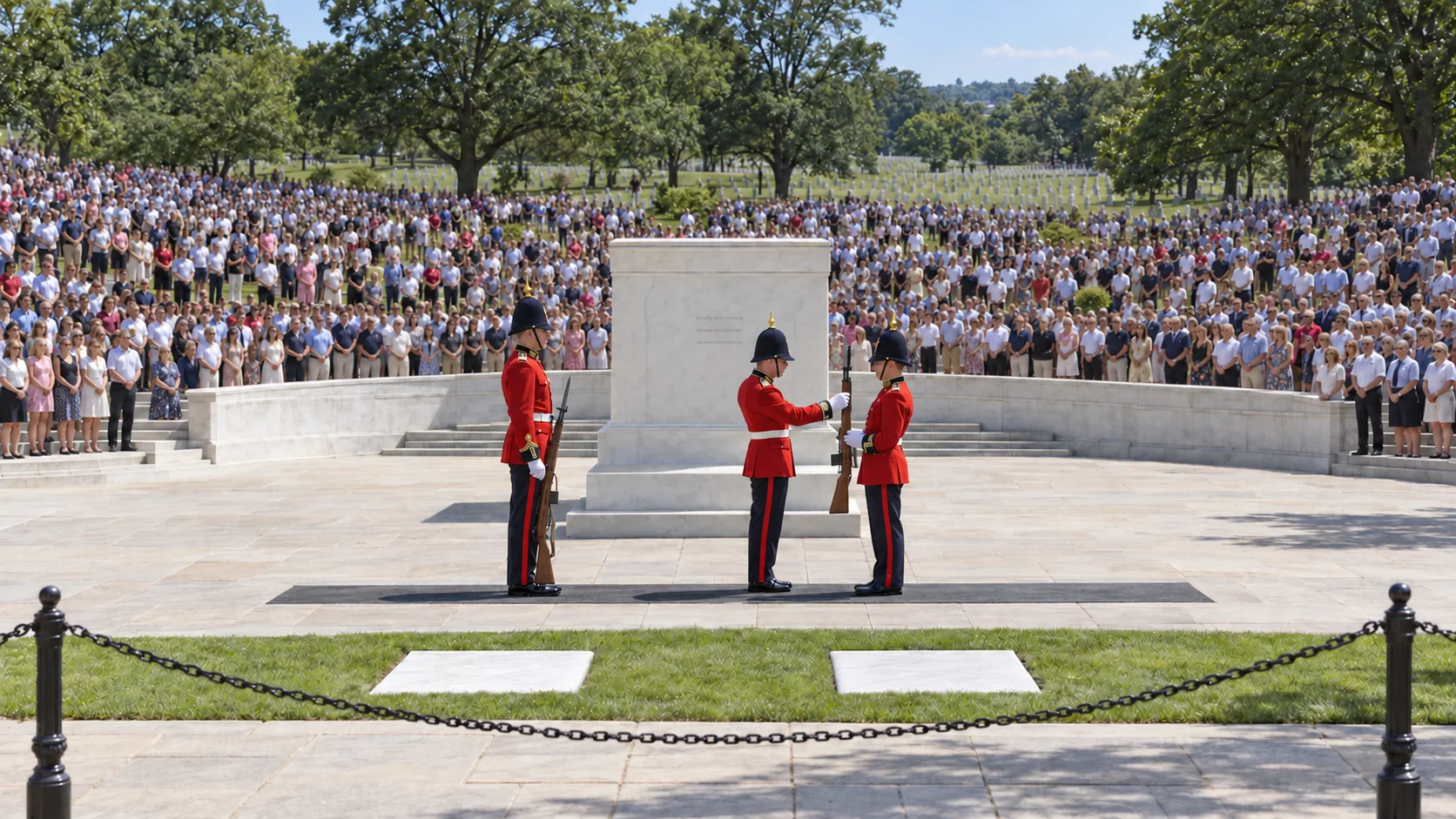
The guard is changed every half hour in summer and every hour in winter. The relief commander inspects the new sentry’s rifle in front of the crowd, and the only words of the change are the handover, “Post and orders remain as directed”, said once. They have never changed. Photography at the change is forbidden, by the first captain’s rule of 1937, which he gave on the ground that the change was for the dead and not for the album; so the most watched ceremony in the Realm outside the Eleventh is also its least photographed.
The sentry speaks only to warn. A visitor who crosses the chain hears, once and then again:
Behind the chain. Now.
It is the most remembered thing anybody hears on the crest.
On the Eleventh the sentry keeps walking through the silence, the only thing moving on the crest, because the silence is for the living and the watch is for the dead.
In every great storm the order to take shelter is given, and refused. Nobody has ever been disciplined for refusing it, and both sides treat the exchange as part of the duty. No sentry has died on the walk. Sentries have collapsed in the heat and been carried off, and the relief has always come.
The creed and the motto
The first captain wrote a creed in 1937. Every candidate learns it, and says it once, alone, at the end of the examination, and not again.
He is known to God and to his own.
He is not known to me, and I keep him.
I walk for him, not for those who watch.
I speak only to keep his ground.
The watch does not end with me.
He also chose a motto, NUMQUAM SOLUS, never alone, which is on the reverse of the badge and over the door of the quarters and is never said aloud.
The badge
Those who have served wear a small silver badge in the shape of an oak leaf, from the oak on the crest below the house. It was first given in 1958, for the second burial, to the sentries who stood at it and to every former guard then living, and it is now earned after nine months on the walk. It is one of the rarest in the Army and revocable for life for any later disgrace. There have been fewer than twenty revocations since 1958; the company keeps the list, has never published it, and no revocation is publicly known.
Former guards are buried like any serviceman, in the next grave in the row. Many ask for a grave in sight of the crest, and are refused.
The company keeps a small museum in the visitor centre: a helmet, a coat, a section of mat, and the creed on the wall.
Ceremonial
Remembrance Day
The national observance of Remembrance Day is held at the Tomb, with the Regiment of Virginia lining the crest and the path from the gate. The Last Post sounds on the evening of the tenth. On the Eleventh the Church of America’s order of service of 1921 is read, In Flanders Fields is sung last, and the silence falls at eleven. The Book, the Legion’s register of every one of the Realm’s war dead, is carried to the Tomb and laid open on the lid, at the page bearing the most recently added names. A veteran chosen by the Legion speaks, as Ellen Mayhew did, and nobody else does. At the end the whole assembly speaks the third line together.
The Governor-General lays the Crown’s wreath every year, as the resident Crown, except in the three years a King has laid it: 1921, 1958 and 2021. Then come the Prime Minister, the Leader of the Opposition and the services; then the schools’ wreath, laid since 2025 by Prince Frederick, by an arrangement made when he started at Ellicott High School, so that the children come ahead of the governments; then the polities; then the High Commissioners of the sister realms; and last the wreath of a bereaved family, chosen each year by the Legion. Prince Frederick became King as George V on 31 October 2028. The schools’ wreath was arranged for a schoolboy, and the Household has not said who lays it now; the duties of his Page of Honour, announced on the day of the accession, include attending the King at the Eleventh.
No foreign state lays a wreath on the Eleventh, by a rule of 1921 that has never been relaxed. Foreign tributes are presented at Government House on the tenth. The sister realms are not foreign states under the rule, and their High Commissioners lay theirs at the Tomb on the day.
Ordinary days
On any other day wreaths are laid by application. Regiments on their days, schools, veterans’ branches, families and foreign delegations below head of state book a time, several a day, and each wreath is carried the last twenty paces from the chain by the person laying it, alone.
A visiting head of state lays one on an ordinary day as a fixed item of nearly every state visit: a sentry carries the wreath to the chain, the visitor carries it the last twenty paces alone, and no bugle call is sounded. The cemetery keeps a stock made up.
The Crown at the Tomb
Three Kings have laid the Crown’s wreath at the Tomb, each in a different generation, and none of them has spoken there. Ernest III laid it at the burial in 1921, after walking behind the caisson. Ernest IV crossed for the second burial in 1958. Ernest V came publicly a handful of times, each remembered and dated: for the Indochina burial in 1975, the seventy-fifth anniversary in 1996, the week of May Day in 2006, and the centenary in 2021, when he laid the Crown’s wreath. His one private visit to become known was on the day the empty slab was laid in 1998. His other private visits, on the rare journeys he made to the Realm, were unannounced and not recorded.
Across the realms
Every realm of the union that fought in the first war buried an unknown of its own in the 1920s; Britain’s lies in Westminster Abbey. Their representatives lay wreaths together at each, and at Arlington they do it on the Eleventh, after the polities, because the sister realms are not foreign to one another. The Realm laid the Sovereign’s Cross on every allied unknown of the 1920s, Britain’s in Westminster Abbey among them, and those are the only graves outside the Realm that carry it.
Administration
The Tomb is Crown ground held by the forces, under the Order in Council of 1921. It lies outside the cemetery’s administration and the Superintendent’s writ, and the Watch’s captain answers to the Colonel of the Regiment of Virginia. The Tomb itself is kept by the Parks System’s masons, under the Watch’s eye, which is the one piece of Parks work done on Crown ground. The Army pays for the Watch.
The Tomb is on a Remembrance coin struck every decade since 1971, the fiftieth anniversary: commemorative, not for circulation, the profit going to the Legion. Nothing is sold on the ground.
Reception
The third line is the Tomb’s whole public life. It is said at every service on the Eleventh, in every county and every school, and a sentence a War Office committee tried to keep off the stone is the most quoted sentence in the Realm’s civic life.
The particular criticism of the Tomb is the honest fudge. The third line commemorates the dead who were not brought home, and since the 1960s the Realm has brought its dead home. The Tomb therefore stands on a policy the Realm has abandoned, and asks the living to grieve the policy rather than the dead. The position is acknowledged and deliberately unresolved: the inscription stays, the modern dead come home, and the line is read as being about the past.
The older criticism is the King’s son. The campaign for the return of the dead was answered in 1920 and 1921 with Prince Adolphus’s grave in Flanders, which was unanswerable and not honest; Ernest III is not recorded as having made the argument himself, and the third line, which was his, names the grievance it was used against.
The Watch is the Tomb’s other public life. The change is the most watched ceremony in the Realm outside the Eleventh. The night walk is what the company would rather be known for.
Failings
The Tomb was a consolation before it was a grave. The Legion proposed it because it could not win the return of the dead, the ministry accepted it because it was cheaper than repatriation, and the War Office used it for a century as the answer to the families. A policy was given a body to stand behind.
The Tomb that may hold a Black soldier was guarded by an all-white company for eighteen years. The regiment that finds the Watch took in the Virginia Light Infantry’s men and honours in the integration of the second war, mixed them into every company and claimed their colour, and its Tomb Company kept those same men off the walk until 1955 by a selection board’s phrase.
The Indochina unknown was supplied on order. The ministry of 1975 wanted the war ended with a burial, the forensic service was told to find a man who could not be named, its doubt was filed and not read, and a King was brought across the ocean for a burial that was undone in 1998. The Realm agreed at once when the family asked, which is to its credit, and only a journalist made the family able to ask.
The regiment that guards the Tomb has its own record, and states some of it. It burned villages in Luzon between 1899 and 1902 under orders its own history calls unlawful, and it states that first. It stood with fixed bayonets at the Danville mill gates through the winter of 1930 to 1931, against strikers, and apologised fifty years later. It has three battalions and has resisted every attempt to make it a field regiment, so that the rest of the Army carries the League’s deployments while it keeps the crest.
Its mourning has one subject. The black facings mourn the half of the regiment that went over in 1861. Nothing in its dress or its days marks the half of Virginia’s people who were enslaved when it split, and the Light Infantry raised from them reached its colours only in the 1940s, by an integration it then kept off its proudest duty.
Assessment
Three things are true of the Tomb, and it holds all of them.
It is a grief laundered into a policy. The Realm refused its families their dead, defended the refusal with a King’s private bereavement, and gave them one anonymous body to stand in for all the rest. The inscription admits it in its third line, and the admission was the King’s, against the officials who had to administer the refusal.
And it is a policy turned back into grief by the people who came to stand at it. A mother read the lines in 1921 and sat down. Black congregations claimed the man as possibly theirs and the Realm let the claim stand. The Legion that proposed the Tomb as a consolation fought for a second unknown in 1958. A company of soldiers who would rather not be explained has walked in front of it every night since 1937, and the line the War Office feared is the one the whole Realm says together.
And it is guarded by the Realm’s argument about loyalty, in uniform. The Watch is found by a Virginian regiment whose loyal half kept the colours in 1861, whose facings still mourn the half that went over, and which was rebuilt after 1866 from the east that had rebelled. It took in the Light Infantry of the men Virginia had enslaved and kept them off the walk for twelve years. It carried Lee to the terrace and claims him, and it walks every night in front of a man who may be Black, under a line a King wrote against his own officials. Everything the cemetery says about loyalty in stone, the regiment says on the mat.
✎ Editor's Note · The real Tomb, moved a little
The Tomb is the real Tomb at Arlington with its meaning changed by one decision: the Realm did not bring its dead home in 1919, so the unknown soldier is the only one who came back, and the inscription’s third line says so. Almost everything else is carried over, and much of it is real: the four coffins, the white roses, Olympia, the twenty-one paces and twenty-one seconds, the guard continuous from 1937, the badge first given in 1958, a second-war unknown in 1958, and a later unknown identified by his family and taken home.
What changes follows from the third line. The sarcophagus is plain because the stones below are plain. The Kings come because the Crown’s grief and the Realm’s began together in 1916, and they say nothing because the third line was the only thing the first of them said. The possibility that the unknown is Black, which the real Tomb has never been asked to carry, is the word “American” taking its own meaning seriously. And the Watch’s colour bar, its rush of 1975 and the consolation the whole thing began as are stated plainly, because a Tomb that cost the setting nothing would only be flattery.
Chronology
| Year | Event |
|---|---|
| 1754 | The Regiment of Virginia is raised at Williamsburg; Fort Necessity |
| 1755 to 1758 | George Washington is its colonel |
| 1775 to 1779 | The regiment fights against the Crown in the northern campaigns, and is taken onto the establishment by conversion afterwards, colours and all |
| 1847 | The regiment marches to Mexico City with Scott |
| April 1861 | The regiment splits along the Blue Ridge; Colour Sergeant Thomas Oakes’s party carries the colours from Williamsburg to Fort Monroe; the facings turn black |
| 1862 | The Virginia Light Infantry is raised, digs the Capital Works and refuses its pay in December |
| 1863 | The loyal half takes the True Regiment’s colours in the last fight in Virginia; the True Regiment is struck off |
| 9 May 1864 | A private of the Virginia Light Infantry is buried in the first row at Arlington |
| 1866 | The western companies become the West Virginia Light Infantry; the regiment is rebuilt from the east |
| 1870 | The regiment carries Robert E. Lee to the terrace |
| 1899 to 1902 | A company burns villages in Luzon |
| 1916 | The Realm enters the First Great War. Prince Adolphus is killed in Flanders on 21 October and left where he fell |
| 1918 | Rechteveld, in the autumn; the Armistice on 11 November |
| 1919 | The Realm decides its dead will not be brought home. The Legion is chartered. The Crown’s wreath is laid on the steps of Parliament House |
| 1920 | The Legion’s convention proposes an unknown soldier; the Hughes ministry accepts. The Crown’s wreath is laid at Parliament House again |
| October 1921 | Four coffins from the four Rechteveld cemeteries are set out in the town hall at Nieuwpoort; a sergeant of the Regiment of Virginia holding the Sovereign’s Cross chooses one with white roses; the other three are buried together under the second line |
| November 1921 | HMS Olympia brings him home; he lies in state in Parliament House for two days and is decorated with the Sovereign’s Cross, the Ernest Cross and the Iron Cross |
| 11 November 1921 | The burial. Ernest III walks behind the caisson, lays the Crown’s wreath and says nothing; Ellen Mayhew reads the inscription; the order of service is used for the first time. An Order in Council makes the crest Crown ground |
| 1922 to 1930 | The allies’ decorations follow, kept in Columbia Cathedral; Austria-Hungary’s comes last, in 1930 |
| 1923 | Albrecht I, the German Emperor, lays the first foreign wreath on an ordinary day |
| 1930 to 1931 | A company of the regiment stands at the Danville mill gates through the strike |
| 1937 | The Regiment of Virginia offers a continuous guard; the Tomb Company is formed under Captain John Ambler, with its creed, motto and rule against photography; the amphitheatre is built, and the decorations move into its case |
| 1942 to 1944 | The Regiment of Virginia takes in the Virginia Light Infantry; the Tomb Company stays white |
| 1944 to 1945 | The regiment lands in Brittany on 6 June 1944 and fights through the Battle for the Île-de-France into Paris |
| 1955 | The colour bar ends; Corporal Samuel Spurlock walks his first night |
| 1958 | The second unknown, from Normandy and Brittany, comes home in HMS Susquehanna and is buried on 11 November; Ernest IV lays the Crown’s wreath; every ally of the second war decorates him, Ireland for the first time; the silver badge is first given |
| 1960s | The crack in the lid is first noticed. The Realm begins bringing its dead home from Indochina. Two of the regiment’s battalions serve tours there. The regiment returns the True Regiment’s colours to Richmond |
| 1962 | Napoleon VI lays a wreath, the first French head of state at the Tomb, and brings the Légion d’honneur |
| 1969 | A protester pours red paint on the steps and is not charged, at the Watch’s request |
| 1971 | The first Remembrance coin carrying the Tomb, for the fiftieth anniversary |
| May 1975 | The Indochina unknown is buried, supplied by the forensic service with a note of doubt; Ernest V crosses for his first visit to the Tomb |
| 1976 | The defence reductions; the Virginia Rifles’ men become the regiment’s 3rd Battalion; the first of the reviews that fail to shrink the Watch. Richmond gives the regiment its freedom |
| 1980 | The Colonel of the Regiment apologises at the Danville mill gates |
| 1980s | The decision to leave the crack unrepaired |
| 1994 | A journalist finds the forensic service’s note of 1975 |
| 1996 | The seventy-fifth anniversary; the first woman sentry |
| 1998 | The Indochina unknown is identified as Captain Paul Dettmer, disinterred and buried at Boonville; the empty slab is laid and the King comes privately |
| 2002 | The Colonel writes to the Philippine government on the centenary of Luzon |
| 2006 | May Day: the guard stays and the cemetery stays open; the King lays a wreath on an ordinary day that week |
| 2018 | The regiment supports the Military Pardons Act against the rest of the Army |
| 2020s | In the pandemic the Watch splits into two halves so that one can always walk |
| 2021 | The centenary; Ernest V lays the Crown’s wreath |
| 2025 | Prince Frederick lays the schools’ wreath on the Eleventh for the first time |
| 2028 | Prince Frederick is appointed Colonel-in-Chief of the Regiment of Virginia on his fifteenth birthday, 2 May |
| 31 October 2028 | The Colonel-in-Chief accedes as George V |
Trivia
- In-Universe The Tomb was the American Legion's idea, proposed at its 1920 convention as a concession it could win once it knew it would lose the campaign to bring the dead home. The Legion has never credited the idea to one person.
- In-Universe In 1919 and 1920, before there was a Tomb, the Crown's wreath was laid on the steps of Parliament House, where the unknown later lay in state.
- In-Universe The four coffins of 1921 came one from each of the four Rechteveld cemeteries, so that no single ground could claim the man who was chosen.
- In-Universe At the Legion's insistence the four were drawn from graves that included the Black regiments', and the word on the stone, American, was chosen to fit that fact.
- In-Universe The choice was made in the half-restored town hall at Nieuwpoort, on the mouth of the Yser, by a sergeant of the Regiment of Virginia who laid white roses on one coffin.
- In-Universe The record gives the 1921 chooser's regiment and his Sovereign's Cross and not his name. Only one sergeant of the regiment held the Cross, so everybody knows who he was, and the record's silence is a courtesy.
- In-Universe The other three coffins of 1921 lie together at Rechteveld under a stone carrying the Tomb's second line three times: known to God and to his own.
- In-Universe HMS Olympia's eleven-day crossing in 1921 was uneventful. What people remember is the Potomac lined on both banks as she came up to the navy yard.
- In-Universe Four sacks of earth came home in Olympia, one from each Rechteveld cemetery, and went into the Tomb with him.
- In-Universe The unknown of 1921 holds fifteen decorations: the Realm's Sovereign's Cross and every ally's highest award for gallantry but Ireland's, given from 1921 to 1930, the last Austria-Hungary's, and since 1962 France's Légion d'honneur.
- In-Universe Ireland, a realm of its own since 1919, was never asked to decorate the unknown of 1921: the Realm counted it as part of Britain's war. It gave its first honour at the Tomb, the Military Medal for Gallantry, to the second unknown in 1958.
- In-Universe Japan's Order of the Golden Kite stayed in the unknown's case through the second war, by a ruling that what has been given to the dead is not taken back.
- In-Universe Napoleon VI brought the Légion d'honneur in 1962, the honour of the army the unknown died fighting. The Realm welcomed it, and it is the only enemy's honour in the case.
- In-Universe The Realm laid the Sovereign's Cross on every allied unknown of the 1920s, Britain's in Westminster Abbey among them, the only graves outside the Realm that carry it.
- In-Universe New Albion, South Africa and the River Plate each founded a gallantry cross of their own after the first war, so that what they gave the unknown would not be the British one.
- In-Universe Ernest III walked behind the caisson from Parliament House to the crest, about four miles, with the Governor-General and the Prime Minister behind him. It was one of a handful of royal visits in his reign and the only one anybody remembers.
- In-Universe At the burial a mother spoke: Ellen Mayhew of Chillicothe, a widow whose only son was missing at Rechteveld, read the three lines and sat down. The veteran who speaks on the Eleventh now is her successor.
- In-Universe Ernest III laid the Crown's wreath himself in 1921 and said nothing, the one year until 1958 that the Governor-General did not lay it.
- In-Universe The Remembrance order of service, with In Flanders Fields sung last before the silence, was first used at the burial of the unknown soldier.
- In-Universe The third line reached the War Office committee as a note of eleven words in Ernest III's own hand, with no covering letter. It is in the Royal Archives at Windsor, and the Realm's requests to display it have been refused.
- In-Universe The War Office committee resisted the third line because it drew attention to the grievance the War Office was defending. It is now the Act of Remembrance of the whole Realm.
- In-Universe The Tomb has no architect. The War Office's works department enlarged the pattern of the standard headstone into a sarcophagus, so it matches every stone on the slope below.
- In-Universe The Tomb is white Yule marble from Colorado, from the quarry that supplies every stone in the cemetery.
- In-Universe The Tomb faces west, away from the capital, toward the rest of the country the dead came from. Visitors at the chain face east and see it against the Charter Axis.
- In-Universe The crack across the lid is decades of frost in a seam of the block. A decision of the 1980s left it unrepaired, on the ground that a repair would be a replacement.
- In-Universe At night the only light on the Tomb is a single low lamp at the foot of the steps, so that the sentry can see the mat.
- In-Universe An Order in Council of 1921, made during the King's visit, reserved the crest for the Crown. The Parks System's writ stops at the chain.
- In-Universe From 1921 to 1937 the Tomb had a civilian watchman by day and nobody at night.
- In-Universe The first foreign head of state to lay a wreath at the Tomb on an ordinary day was the German Emperor, Albrecht I, in 1923.
- In-Universe The continuous guard of 1937 was the Army's idea: the Regiment of Virginia offered it to win back its standing in the capital after being used in the industrial disputes of the early 1930s.
- In-Universe The amphitheatre behind the Tomb was built in 1937 by the War Office's works department, has about a thousand seats and no name, and houses the Watch beneath it.
- In-Universe The second unknown came from the Realm's cemeteries in Normandy and Brittany in 1958, in HMS Susquehanna, a cruiser that had fired in support of the Brittany landings.
- In-Universe The 1958 unknown was chosen by a decorated private, regiment recorded and name not, exactly as in 1921, and his queue in Parliament House was a quarter of 1921's.
- In-Universe The campaign for the second unknown was led by the Legion against its own older members, who had built the observance and did not want to share it.
- In-Universe Ernest IV crossed for the second burial in 1958 and laid the Crown's wreath as his father had in 1921. Three Kings have laid it, in 1921, 1958 and 2021, and none has spoken.
- In-Universe The Indochina unknown of 1975 was supplied by the forensic service on order, with a note of doubt that was filed and not read. A journalist found it in 1994.
- In-Universe When the family asked, the Realm agreed at once that the Indochina unknown should be tested. He was identified in 1998 as Captain Paul Dettmer, shot down in 1972, and is the only man ever taken out of the Tomb's ground.
- In-Universe Paul Dettmer lies at Boonville, in the State of Missouri, under a stone that says he lay at Arlington for twenty-three years.
- In-Universe The empty slab reads Honouring and keeping faith with the missing, and there is no body under it. It is the only line on the Tomb's ground not written in 1921.
- In-Universe Ernest V's first visit to the Tomb was for the Indochina burial of 1975, and he came back privately on the day the man was taken out of it in 1998.
- In-Universe Napoleon VI, who came ashore in Brittany with the assault wave in 1944, laid a wreath in 1962 and said one sentence in French to the sentry, who did not answer. The words have been reported several ways.
- In-Universe The 1969 protester who poured red paint on the steps was not charged, at the Watch's request: the sentry said the Tomb had been defended and nothing more was owed.
- In-Universe Nobody has ever formally asked to claim or test the unknown of 1921, and the question is kept away from the Tomb by an agreement nobody wrote down.
- In-Universe Black churches and veterans have claimed the unknown as possibly theirs since 1921, and read Countee Cullen's poem on the word American after the silence. The Realm neither confirms nor disputes the claim.
- In-Universe To the Watch and the old soldiers the unknown of 1921 is the American, from the inscription's first line.
- In-Universe Prince Frederick has laid the schools' wreath on the Eleventh since 2025, after the services and before the polities, so that the children come ahead of the governments.
- In-Universe The sister realms are not foreign states under the rule of 1921, and their High Commissioners lay wreaths at the Tomb on the Eleventh. Every realm that fought buried an unknown of its own in the 1920s.
- In-Universe On ordinary days wreaths are laid by application, several a day, and each is carried the last twenty paces alone by the person laying it.
- In-Universe Nothing is left at the chain except poppies on the Eleventh, which the Watch clears at dusk.
- In-Universe The Watch's first captain, John Ambler, had served at Rechteveld. He wrote the creed, chose the motto and banned photography at the change, and is buried in the next grave in the row.
- In-Universe The Watch's motto, NUMQUAM SOLUS, never alone, is on the reverse of the badge and over the quarters' door, and is never said aloud.
- In-Universe Every candidate for the Watch says the creed once, alone, at the end of the examination, and never again.
- In-Universe The Watch's only spoken words are the creed, the handover at the change, Post and orders remain as directed, and the warning: Behind the chain. Now.
- In-Universe The Watch stayed white until 1955. Its first Black sentry, Corporal Samuel Spurlock, had served in the Virginia Light Infantry before its dissolution.
- In-Universe About one sentry in five is a woman, since the first walked in 1996, and nobody in the Watch treats it as worth remarking on.
- In-Universe The examination for the Watch is the Tomb's history, the inscription, the creed and the orders, recited from memory on the crest. About four in five fail, and nobody may try twice.
- In-Universe The sentries walk a rubber mat. When it is replaced the old one is cut up and given to the retiring sentries.
- In-Universe No sentry has ever died on the walk. Sentries have collapsed and been carried off, and the relief has always come.
- In-Universe In the pandemic the Watch split into two halves living apart, so that one could always walk.
- In-Universe No revocation of the Watch's badge is publicly known, although there have been fewer than twenty since 1958.
- In-Universe The Tomb has been on a Remembrance coin every decade since 1971. Nothing is sold on the ground.
- In-Universe The Regiment of Virginia teaches every recruit about Fort Necessity in 1754, its surrender to the French under a capitulation that admitted an assassination, as the first thing it ever did and the first thing it did wrong.
- In-Universe George Washington was the regiment's colonel from 1755 to 1758. It counts him as its first great colonel and, by its own boast, its last famous soldier; its famous men since are a sergeant, a colour party and a private, none of them famous.
- In-Universe The regiment carries several honours from 1775 to 1779 won against the Crown, borne without the crown, more than any red regiment except the King's Own Massachusetts. Keeping them was the price of keeping the colours when it came back on to the establishment.
- In-Universe In 1861 each company of the regiment went the way of its town. The colonel, Hugh Fauntleroy of the Northern Neck, stayed with the colours, and Richmond confiscated his estate.
- In-Universe Colour Sergeant Thomas Oakes's party carried the colours out of Williamsburg by night in April 1861, down the Peninsula through rebel country to Fort Monroe. One of the party was a free Black drummer of the depot.
- In-Universe The regiment's facings turned from buff to black in 1861, in mourning for the half that left, and its full-dress shako is the one it was wearing when it split.
- In-Universe The rest of the Army called the regiment the Other Half as a joke about the half that went over. The regiment took it as a statement about the half that stayed, and puts it on its Christmas card.
- In-Universe The loyal half took the True Regiment of Virginia's colours in the last fight of the war in Virginia, in 1863, and the regiment gave them back to Richmond in the 1960s.
- In-Universe Short of men after the split, the regiment enlisted boys of fifteen and sixteen from the loyal counties from 1861, and its own history says so.
- In-Universe In 1866 the regiment's western companies left to become the West Virginia Light Infantry, and the Regiment of Virginia was rebuilt mostly from the east that had rebelled. The two are brother regiments and walk the night of the colours together.
- In-Universe The Virginia Light Infantry, merged into the Regiment of Virginia in the second war, dug Lee's Capital Works, refused its pay in December 1862, and went into the wood at Rechteveld while the older regiment held the coastal line beside it.
- In-Universe The regiment carries four colours: the King's, its own, the Virginia Light Infantry's, and the Virginia Rifles' with the 3rd Battalion, which came from the Rifles when they were disbanded in 1975.
- In-Universe The regiment found the bearer parties for Robert E. Lee in 1870 and for Peg Halloran in 2006. Lee never served in it; it claims him anyway and hangs his portrait beside Washington's.
- In-Universe At its own request the regiment no longer carries its honour for Luzon, where a company burned villages between 1899 and 1902 under orders its history calls unlawful.
- In-Universe One of the thirty soldiers shot in the First Great War was of the Regiment of Virginia, and the firing party came from his own company. The regiment supported the pardon of 2018 against the rest of the Army.
- In-Universe A company of the regiment stood at the Danville mill gates through the strike of 1930 to 1931. The Colonel apologised there in 1980, the town accepted without warmth, and the regiment does not recruit in Danville.
- In-Universe The regiment's quick march is Shenandoah and its slow march the tune of In Flanders Fields. At the graveside of its own dead Shenandoah is played slow after the Last Post, the one regimental addition the cemetery allows.
- In-Universe The night of the colours is walked from Williamsburg to Fort Monroe, about thirty-five miles. At first light the names of the 1861 colour party are called, and the youngest soldier present answers for each.
- In-Universe Prince Frederick became the regiment's Colonel-in-Chief on his fifteenth birthday, 2 May 2028, the first royal colonel of an American regiment. The Colonel of the Regiment, who does the work, is a woman who once walked the Watch's mat.
- In-Universe The regiment's soldiers call themselves Virginians whatever polity they come from, which attached sentries from Ohio find strange for about a week.
- Design The Tomb is the real one with its meaning changed by one decision: because the Realm kept its dead abroad, the unknown is the only one who came home, and the third line says so.
- Design The possibility that the unknown is Black is the word American taken at its word. It costs the setting the Watch's colour bar, which is stated plainly beside it.
- Real-World The real unknown soldier was chosen on 24 October 1921 at Châlons-sur-Marne by Sergeant Edward Younger, who laid white roses on one of four caskets, and came home in USS Olympia, Dewey's flagship at Manila Bay. Younger's name is recorded.
- Real-World The real unknown was decorated with the Medal of Honor and with foreign awards that included Britain's Victoria Cross, and he lies on earth brought from France. Victoria died in 1840 in this setting, so Britain's highest award for gallantry is the Ernest Cross, founded in 1856 under Ernest II.
- Real-World The real Tomb guard has been continuous since 1937, walks 21 steps and pauses 21 seconds on a rubber mat, carries the rifle on the shoulder away from the Tomb, and wears an identification badge created in 1958. Its creed dates from 1971, and photography at the change is allowed.
- Real-World The real unknowns of the Second World War and Korea were buried on Memorial Day 1958. The Vietnam unknown, buried in 1984, was identified by DNA in 1998 as Air Force First Lieutenant Michael Blassie, shot down in 1972, and reburied near his home in St. Louis; his crypt cover now honours the missing.
- Real-World Countee Cullen was a real poet of the Harlem Renaissance. The poem on the word American is the setting's, and the article describes it without writing a line of verse in his name.
See also
- Robert E. Lee National Cemetery, on whose crest the Tomb stands
- Remembrance Day, whose national observance is held at the Tomb
- The First Great War, whose dead the Tomb stands for
- The Second Great War, whose unknown lies in front of it
- Prince Adolphus, whose grave abroad was used against the families
- Ernest III, who wrote the third line and walked behind the caisson
- Ernest IV, who laid the Crown’s wreath in 1958
- Ernest V, who laid it at the centenary
- John J. Pershing, Governor-General at the burial
- Prince Frederick, who lays the schools’ wreath
- Napoleon VI, the first French head of state at the Tomb
- The Royal American Army, whose Regiment of Virginia finds the Watch
- George Washington, the regiment’s colonel from 1755 to 1758
- Robert E. Lee, whom the regiment carried to the terrace in 1870 and claims
- The Province of Virginia, the regiment’s home
- The Commonwealth of West Virginia, whose regiment came from the regiment’s western companies
- The Royal American Navy, whose cruisers brought both unknowns home
- The Royal American Parks System, whose masons keep the Tomb
Categories
- Land and landscape
- Arlington
- Memorials
- The Great Wars
- Remembrance
- Virginia