United Baltic Duchy
The United Baltic Duchy (Vereinigtes Baltisches Herzogtum; Apvienotā Baltijas hercogiste; Ühendatud Balti hertsogiriik), ordinarily the Baltic Duchy, is a sovereign constitutional duchy on the eastern shore of the Baltic Sea. It is made of three lands, Estland, Livland and Courland, which together cover the whole of the Latvian and Estonian country between the Gulf of Finland and the frontier of Poland-Lithuania, and it borders the Russian Republic along the Narva river and the eastern edge of Latgale. Its capital is Riga. Its population is about 3.8 million.
The Duchy was proclaimed in German at Riga on 5 November 1918 by a council of the Baltic German nobility and towns under German occupation, in the last days of the First Great War. The Latvian and Estonian national councils had declared republics of their own, and the Duchy won the civil war that followed, with the help of German Freikorps, at Cēsis/Wenden in June 1919. Its first Duke was Adolf Friedrich of Mecklenburg, and by the Treaty of Mitau of 1919 the German Empire recognised it and guaranteed it against attack. It kept the privileges of its German nobility until 1945 and slowly won the acceptance of the Latvians and Estonians it had defeated, through a constitution, a franchise and the premiership of Kārlis Ulmanis.
In 1941, while the German Empire was fighting for Berlin and could not honour its guarantee, the Russian Republic occupied the Duchy, deported about 25,000 of its people and ruled it for four years under a military governor, while its Duke broadcast weekly from exile in Stockholm. Russia withdrew in 1945 under an ultimatum from Germany, Britain and the United Kingdom of America, and the Duchy calls the withdrawal its liberation. The song festival of 1946, the first held openly after the occupation, is the moment popular memory dates the Duchy’s acceptance by its own peoples from.
The Duchy is a parliamentary monarchy with a Landtag of 150 members, a Prime Minister, and a diet and government in each of its three lands. Since 2001 its Duke has been Friedrich Franz VI, who is also Grand Duke of Mecklenburg-Schwerin, a constituent state of the German Empire, and reigns over both in personal union. It is a founding member of the European Concert, holds a German guarantee but no membership of the Atlantic Treaty Organization, and uses a Baltic mark held at par with the German mark. Its largest party in Estland, the Estonian Independence Party, wants Estland to leave the Duchy, and the Ducal Court has been asked, and has not yet said, whether a land may.
Name
The state’s name in its three official languages is Vereinigtes Baltisches Herzogtum in German, Apvienotā Baltijas hercogiste in Latvian and Ühendatud Balti hertsogiriik in Estonian. The German form is the original and the only one used in the proclamation of 1918; the Latvian and Estonian forms were adopted in the constitution of 1920 and given equal standing by the amendment of 1946. In English, and in the ordinary speech of its German and Latvian citizens, it is the Duchy. Estonians more often say Riga when they mean the government, a habit that says more about the Duchy’s central political question than most of what is written about it.
The “United” in the name refers to the union of the three historic Baltic provinces of the Russian Empire, Estland, Livland and Courland, under a single crown for the first time since the Livonian Confederation of the Middle Ages. It has come, in Estonian usage, to mean something more pointed: the union of two peoples, one of which was not asked.
The Duchy’s place names are official in bilingual pairs throughout, the national language of the land first and German second: Tallinn/Reval, Tartu/Dorpat, Jelgava/Mitau, Liepāja/Libau, Cēsis/Wenden, Saaremaa/Ösel. Riga is spelled alike in German and English and is Rīga in Latvian. The Register follows the Duchy’s own practice, giving both forms where a place is first named and the national form thereafter, except where a German form is fixed in the name of an institution or a treaty, as in the Treaty of Mitau.
History
The Baltic provinces
The lands of the Duchy were conquered in the thirteenth century by German crusading orders, and their Latvian and Estonian peoples were ruled for the next six centuries by a German-speaking nobility and German-speaking towns under a succession of overlords: the Livonian Order, Poland-Lithuania, Denmark, Sweden and, from the eighteenth century, the Russian Empire. The Russian tsars ruled the three Baltic provinces of Estland, Livland and Courland through their own institutions, and left the local government of the countryside to four corporations of the German nobility, the Ritterschaften or knighthoods of Estland, Livland, Courland and the island of Ösel. The knighthoods held the land, ran the courts and the churches, and ruled the peasantry, who were serfs until the abolition of serfdom in the provinces between 1816 and 1819 and landless labourers for most of the century after.
The nineteenth century produced the Latvian and Estonian national awakenings: newspapers, schools, song festivals and a literature, the collection of the Latvian folk songs called dainas and the writing of the Estonian epic Kalevipoeg. By 1900 the Latvian and Estonian peoples were literate, organised and resentful of a German nobility that owned most of their land, and the Russian government’s attempts to make the provinces Russian had made enemies of the Germans and the national movements alike. In the revolution of 1905 Latvian and Estonian peasants burned several hundred manor houses, and the punitive expeditions that followed, led by German officers in Russian service, killed more than a thousand people. Both memories were fresh in 1918.
The proclamation of 1918
German armies occupied Courland in 1915 and the rest of the provinces in early 1918, as the Russian Empire collapsed into revolution and civil war and made a separate peace. The Baltic German nobility and the German towns proposed a state of their own under German protection, and the German government, victorious in the west and concerned to keep Russia as far from Prussia as it could, agreed.
On 5 November 1918 a United Land Council of the German nobility and towns, meeting at Riga, proclaimed the three provinces a single Duchy under a Duke to be elected and under the protection of the German Empire. The proclamation was issued in German only. That it was in German only is the fact about it that Latvians and Estonians remember.
The United Land Council of Estland, Livland, Courland and Ösel, assembled at Riga, declares that the Baltic lands, released from the dominion of the Russian Empire, are henceforth united in one Duchy, free and sovereign, under a Duke whom the Council shall elect.
The Duchy places itself under the protection of the German Empire, with whose aid it was delivered and with whose friendship it will stand.
All the inhabitants of the Duchy, of whatever language, shall enjoy the protection of its laws.
In the same weeks the Latvian People’s Council at Riga and the Estonian Provisional Government at Tallinn declared independent republics, led by Kārlis Ulmanis and Konstantin Päts. Neither recognised the Duchy.
The Council elected Adolf Friedrich of Mecklenburg as Duke in November 1918. He was a younger son of the grand-ducal house of Mecklenburg-Schwerin, an explorer of central Africa and a former governor of the German colony of Togo, with no connection to the Baltic beyond his election, and he accepted on condition that he be crowned only after the Duchy had a constitution.
The civil war
The war between the Duchy and the two republics lasted from the end of 1918 into the autumn of 1919. The Duchy’s forces were the Baltische Landeswehr, a militia of Baltic Germans, and the German Freikorps, volunteer units of soldiers who stayed in the east after the armistice in the west, paid partly in promises of land. The republics’ forces were Latvian and Estonian volunteers, better motivated and worse armed.
The Landeswehr and the Freikorps took Riga in May 1919, and in the weeks that followed several hundred prisoners and people suspected of supporting the republic were shot, many without any form of trial. On 23 June 1919 they defeated the Estonian army and its Latvian allies at Cēsis/Wenden, in northern Livland, the battle that decided the war. The Estonian government withdrew to the north and sued for terms in the autumn. A Royal Navy squadron was in the Baltic throughout the war and stayed neutral, and Estonians have not forgotten that either.
The Freikorps were the war’s most disputed element. They were raised in Germany from soldiers unwilling to go home after the armistice in the west, and the largest of them, the Iron Division, fought in Courland and at Riga. They were promised land in the Duchy for their service, which the Duchy’s government, once the war was won, declined to give; most went home, a few hundred stayed as settlers on estates the knighthoods sold them, and the killings after the taking of Riga were committed largely by their units. The Duchy’s first governments treated them as allies it had needed and did not want, and German historians have treated them as a problem the Empire exported.
The republican leaders went into exile, most of them in Finland and Sweden. They were amnestied in 1922, and several of them sat in the Duchy’s first Landtag.
The Treaty of Mitau
The Duchy’s relationship with Germany was fixed by the Treaty of Mitau, signed at Mitau/Jelgava in 1919 by Adolf Friedrich and the German Chancellor. Germany recognised the Duchy as a sovereign state and guaranteed it against attack; German forces were to enter its territory only at the Duke’s invitation. The treaty made the Duchy, in practice, a German client, and in law, which mattered more over time, a sovereign state with a guarantor.
The German Empire shall regard an armed attack upon the territory of the United Baltic Duchy as an attack upon itself, and shall come to the aid of the Duchy with all the means at its disposal.
The forces of the German Empire shall enter the territory of the Duchy only at the invitation of the Duke, and shall leave it when the Duke so requests.
The constitution of 1920
The Staatsgrundgesetz of 1920 made the Duchy a constitutional monarchy with a Landtag elected by all adult men and, from 1924, women. It also redrew the provinces. Estland received the whole of the Estonian-speaking country, including the south around Tartu/Dorpat, which had been part of Livland. Livland became the Latvian country of Vidzeme together with Latgale, the Catholic eastern region that had never been part of any Baltic province, with Riga as its seat. Courland kept Kurzeme and Zemgale. Each land received a diet of its own, and the Duchy’s supreme court was placed at Tartu/Dorpat, in Estland, as a concession to the Estonians.
The constitution preserved the knighthoods’ estates and a set of privileges: their own courts of honour, patronage over the Lutheran parishes on their lands, and reserved places on the land diets’ committees for agriculture and the church. The Latvian and Estonian parties accepted the constitution because it gave them the franchise, and the franchise was the instrument by which, over the following twenty years, they took the Duchy’s government away from the Germans who had founded it.
German, Latvian and Estonian were made official languages in 1920, German throughout and the national language in each land.
The 1920s and 1930s
The Duchy joined the League of Nations in 1920, one of the first new states admitted, and introduced the Baltic mark in 1922. Its first governments were led by Baltic Germans. In 1923 the Landtag’s Latvian majority made Kārlis Ulmanis, the defeated leader of the Latvian republic, the Duchy’s first Latvian Prime Minister, and he held the office until 1926. He is remembered as the man who made the crown bearable. Konstantin Päts, who had led the Estonian republic, also later served as Prime Minister, and his acceptance of the office is regarded by some Estonians as the moment the republic’s cause was lost and by others as the proof that it had been absorbed rather than defeated.
The interwar Duchy was more stable than most of the new states of eastern Europe, and more prosperous, trading timber, butter and flax to Britain and Germany and handling a large share of Russia’s western trade through Riga and Tallinn. It was also unequal. Its Jewish citizens were excluded from the civil service, formally until 1934 and in practice until 1941. The knighthoods kept their estates and their privileges. Latvian and Estonian peasants who had fought for the republics in 1919 found that the land they had been promised by both sides stayed with the manors.
The Russian occupation
The Second Great War began in the west, and the Duchy declared its neutrality. In 1941, with the French armies at the gates of Berlin and the German Empire unable to spare a battalion for its eastern guarantees, the Russian Republic occupied the Duchy. Russia had kept out of the war between the Allied powers and France, and it went on keeping out of it. It described the occupation at home as the recovery of former imperial provinces, and to the Allied governments, in order not to be counted a belligerent, as a protective measure on the approaches to its northern capital. The Duchy’s army of a few thousand men did not fight, on the Duke’s order.
The Duchy was governed for four years by a Russian military administration under General Pavel Rodionov. About 25,000 people were deported to the Russian interior: Jewish and other community leaders, army officers, officials, clergy and members of the German nobility. About a third of them never returned, and the places where about 8,000 of them died are still not known. Resistance took two forms: the Forest Brothers, partisans who lived in the woods of all three lands and attacked the occupation’s garrisons and officials, and the song festivals, which were held secretly in forest clearings in 1942 and 1944, with a few thousand singers each.
Daily life under the occupation was hard and, for most people, quiet. The military administration ruled through the Duchy’s own officials where they would serve, and replaced those who would not. Russian became the language of government, although German, Latvian and Estonian schools continued with Russian added. The Landtag and the land diets were dissolved, the parties banned, the newspapers censored and the knighthoods’ estates placed under Russian administration. The occupation requisitioned grain, timber and the output of the oil shale works for Russia’s wartime trade with both sides of the war in the west, and rationing in Riga was tighter in 1943 than in most of the neutral countries of Europe. The Duchy’s ports carried Russian exports throughout.
The deportations came in waves, the largest in the first months and again in 1943, after the Forest Brothers killed a Russian district commandant in Courland. Those taken were chosen from lists: officers of the Duchy’s army, officials of the ministries, members of the Landtag, leaders of the Jewish community and of the Lutheran church, members of the knighthoods, and anyone the lists described as unreliable. Families were sometimes taken with them and sometimes left behind.
Adolf Friedrich left for Stockholm before the Russian troops reached Riga, and spoke to the Duchy every week for four years on Swedish radio, by permission of the neutral Swedish government and over repeated Russian protests. The recordings survive.
I am in Stockholm, and the Duchy is in you.
I have not abdicated, and I will not. The law of the Duchy has not been repealed by the arrival of an army, and it stands. I ask no one to die for the crown. I ask you to live, and to remember what you are.
I will speak to you again next week, and every week after that, until I can speak to you at home.
Liberation
France surrendered in 1945. In June 1945 the governments of the German Empire, Great Britain and the United Kingdom of America delivered a joint note to Moscow, three sentences long.
The occupation of the United Baltic Duchy by the forces of the Russian Republic has no lawful basis.
The Allied Governments regard its continuance as incompatible with the peace that has now been restored in Europe.
They expect the withdrawal of all Russian forces from the territory of the Duchy within sixty days.
Russia withdrew within six weeks, without fighting and without acknowledgment. Its administration took the records of the deportations with it, and has never returned them. The last Russian troops crossed the Narva on 12 August 1945, which the Duchy keeps as Liberation Day, and Adolf Friedrich returned to Riga the following week. The Russian government has never apologised for the occupation, and General Rodionov, tried in absentia at Riga in 1946 and never extradited, retired to a house outside Moscow, wrote a memoir describing the occupation as “a trusteeship”, and died in 1971.
The settlement of 1945 and 1946
The first Landtag elected after the liberation passed a land reform in 1945, which ended the knighthoods’ estates. The owners were promised full compensation, and received it slowly, in instalments paid by the Duchy over thirty years, the last in 1975, financed in part by German reconstruction loans. The knighthoods became private associations the following year and have remained so, keeping their genealogies, a school and several churches.
The Liberation Amendment of 1946 revised the constitution of 1920 without replacing it. It abolished what remained of the knighthoods’ public privileges, gave German, Latvian and Estonian equal standing throughout the Duchy, added a clause guaranteeing the equality of all citizens that ended the exclusion of Jews from public office, and turned the supreme court at Tartu into the Ducal Court, with the power to review laws against the constitution. The same year the Treaty of Mitau was renewed, after Germany had been unable to honour it in 1941.
The trials of 1946 dealt with those who had served the occupation. Several hundred people were tried, some of them Russian-speaking Old Believers and Russian settlers who had worked for the military administration, and the Russian-speaking community as a whole was not punished, which the Duchy counts among its best decisions. The Forest Brothers were honoured as national heroes, and several joined the new army. A few who had killed people they suspected of collaboration, without trial, were themselves prosecuted, and whether that was just remains contested.
In the summer of 1946 the Latvian and Estonian song festivals were held openly for the first time since 1940, together, at Riga, with about a hundred thousand singers. Acceptance of the Duchy by its Latvian and Estonian citizens had been growing since the franchise of the 1920s, but it is the festival of 1946, and the sight of a German-founded Duke standing with a hundred thousand people singing in Latvian and Estonian, that popular memory fixes it to.
The cold war
The Duchy spent the cold war openly on the Western side and bound to it by no treaty but Germany’s. It was not invited into the Atlantic Treaty Organization and did not ask, on the understanding that its membership would provoke Russia more than it would protect the Duchy, and it relied on the guarantee.
The guarantee was tested once. In 1962 oil shale workers in Narva, most of them Russian-speaking, rioted over a new rule requiring foremen to speak Estonian, and two of them were killed by police. Russia massed troops on the far bank of the river, opposite the town, and demanded protection for the Russian-speaking population. The Duke invited German forces under the Treaty of Mitau, and the German Empire moved a division to Riga. After nine days the Russian troops pulled back. A few weeks later the Caribbean Missile Crisis began, and the Narva crisis was buried in the world’s memory under it, though not in the Duchy’s. A German brigade has been stationed at Ādaži, near Riga, since, and the language rule was withdrawn.
Adolf Friedrich died in 1969, having reigned for fifty-one years, and was succeeded by his grandson, Duke Friedrich Franz, who reigned until 2001. Friedrich Franz is remembered for nothing, which he regarded as the object of a constitutional monarch’s reign and said so. The Duchy ended conscription in 1994, built its army on professional soldiers, and began, from Tallinn in the 1990s, the digital administration it calls e-Duchy.
Politics in the cold war
The decades between the liberation and the end of the cold war were the Duchy’s most stable. Its governments were coalitions of the Ducal Union’s predecessors, the Social Democrats and the German Baltic Party, and changed at elections without drama. The economy grew on German investment, the transit trade and the forests, and the Duchy built housing, schools and the social insurance system on the German model. The Russian frontier was closed to most travel and watched on both sides, and the German brigade at Ādaži, after 1962, was the most visible sign of the Duchy’s position.
The union question was quiet. Estonian nationalism in these years expressed itself in culture rather than politics: in the song festivals, in literature, in the defence of the Estonian language in Estland’s schools. The Estonian Independence Party’s founders were children of this period, and several of them have written that they grew up in a Duchy that asked nothing of them but their silence about 1919, and that the silence was the grievance.
The personal union
Duke Friedrich Franz died in 2001 without children. The Duchy’s succession law named the senior line of the house of Mecklenburg-Schwerin next, and in the same year the new Grand Duke of Mecklenburg-Schwerin, Friedrich Franz VI, inherited both thrones. Since 2001 the Duchy and the German grand duchy have shared a sovereign in personal union, as Poland-Lithuania and the Kingdom of Saxony share the House of Wettin. The two states have nothing else in common: separate constitutions, governments, parliaments and laws, and separate advice to the sovereign in each.
The union was accepted in Riga without great difficulty, on conditions: that the Duke divide his year between the two states, and that his heir be educated in part in the Duchy. It was accepted in Schwerin with public pride and, in the Schwerin Landtag’s budget debates, a recurring grumble about the cost of a Grand Duke who spends much of his year abroad.
The present
The Duchy entered the twenty-first century prosperous, digital and divided. In 2018 the Baltische Handelsbank of Riga, which had laundered Russian money for twenty years, was closed after the German Empire’s financial regulator, acting under the powers the currency peg agreement gives it, withdrew its standing; the Duchy’s own regulator’s chairman resigned, and the Duchy found the episode humiliating. The same year the four knighthoods apologised for serfdom, for their privileges and for the killings of 1919. In 2019 a former ambassador, Kadri Tamm, left the diplomatic service to lead the Estonian Independence Party, which has since become the largest party in Estland. In 2025 the party’s members of the Estländischer Landtag referred to the Ducal Court the question of whether a land may leave the Duchy. In 2027 the Duchy became a founding member of the European Concert.
The Duchy’s government is a broad coalition led by the Ducal Union. The Court has heard argument on the referral and has not ruled.
Geography and the three lands
The Duchy occupies about 110,000 square kilometres of low, forested, lake-strewn country on the eastern shore of the Baltic, between the Gulf of Finland in the north and Poland-Lithuania in the south. Its coast runs for more than two thousand kilometres, including the islands, from the Narva river to the frontier near Palanga. Its highest ground, in the uplands of southern Estland and Livland, barely exceeds three hundred metres. Half the country is forest, and a tenth is bog. The Daugava carries Livland’s traffic to Riga, and Lake Peipus forms much of the frontier with Russia.
Climate and nature
The climate is maritime near the coast and more continental inland, with long, dark, cold winters, when the Gulf of Riga and the Gulf of Finland freeze in hard years, and short, light, mild summers, when the sun barely sets in Estland in June. The forests are pine, spruce and birch, and they hold elk, wolves, lynx and bears in numbers larger than in any other European country of comparable size. The bogs, some of them thousands of years old, are protected in a network of reserves that the Duchy began in the 1950s and the lands have extended since. The coasts are low, sandy in Courland and rocky in Estland, where the limestone cliff called the Glint runs along the Gulf of Finland from Tallinn to Narva.
Cities
The Duchy is not heavily urban outside its capital. Riga, with about 900,000 people, is the only large city. Tallinn/Reval, with about 450,000, is the second. Tartu/Dorpat, with about 100,000, is the university town and the seat of the Ducal Court. Daugavpils/Dünaburg, in Latgale, with about 90,000, is the largest Russian- and Polish-speaking city, a fortress town on the Daugava near the frontiers of Russia and Poland-Lithuania. Liepāja/Libau, on the Courland coast, is the Duchy’s ice-free port and was the Russian Empire’s naval base before 1918. Narva, with about 60,000, is the frontier town. Jelgava/Mitau, seat of the Courland diet, and Pärnu/Pernau, Estland’s summer resort, are the largest of the rest.
Estland
Estland is the Estonian land, the northern third of the Duchy, with about 1.5 million people. Its seat is Tallinn/Reval, a port facing Helsinki across the Gulf of Finland, with about 450,000 people, a walled medieval town, and the headquarters of the Estonian Independence Party. Its second city is Tartu/Dorpat, seat of the Duchy’s oldest university and of the Ducal Court. The islands of Saaremaa/Ösel and Hiiumaa/Dagö belong to Estland and have a small island council of their own; Ösel is the base of the Duchy’s navy. In the north-east, along the Narva, lie the oil shale country and the frontier town of Narva, about 60,000 people, mostly Russian-speaking, facing the Russian fortress of Ivangorod across the river at the most closely watched border crossing in Europe.
Livland
Livland is the Latvian land of the north and east, with about 1.7 million people. Its seat is Riga, the Duchy’s capital, with about 900,000 people, the largest city on the eastern Baltic: a German medieval old town, one of the largest collections of Art Nouveau architecture in Europe, and street signs in three languages. Livland includes the uplands of Vidzeme and, since 1920, Latgale, the Catholic and poorer eastern region with its own language, Latgalian, recognised in Livland, and Russian and Polish minorities, which has never quite forgiven being joined to a Lutheran land it had never been part of.
Courland
Courland is the Latvian land of the south-west, Kurzeme and Zemgale, with about 600,000 people. Its seat is Mitau/Jelgava, the old capital of the Duchy of Courland that existed from the sixteenth to the eighteenth century, and its ports are Liepāja/Libau and Ventspils/Windau. It is the most rural of the lands, the richest in farmland, and the one with the most synagogues, one in every town. Rundāle Palace, the Baroque palace of the old dukes of Courland, is the Duke’s summer residence.
Head of state
The Duke
The head of state is the Duke of the Baltic, a hereditary constitutional monarch. The Duke’s powers are ceremonial and reserve, like those of the other constitutional monarchs of Europe. The Duke appoints as Prime Minister the person the Landtag has voted to nominate, assents to laws, receives ambassadors, opens the Landtag, and holds the reserve powers of a constitutional monarch in a crisis of government, which no Duke has used since the constitution of 1920 took effect.
The constitution requires the Duke to swear, at accession and in each of the three official languages, to uphold the Staatsgrundgesetz and the rights of the three lands. The oath was drafted in 1920 by the Latvian and Estonian parties, and its reference to “the rights of the three lands” is the textual basis of the Estonian Independence Party’s argument that the lands, and not only the Duchy, hold rights the Duke is bound to respect.
Friedrich Franz VI
The reigning Duke is Friedrich Franz VI, who is also Grand Duke of Mecklenburg-Schwerin, and has held both thrones since 2001. He is the third Duke of the Baltic and the first to hold another throne. His style depends on where he is. In Riga he is Duke of the Baltic and Grand Duke of Mecklenburg, in that order; in Schwerin he is Grand Duke of Mecklenburg and Duke of the Baltic; and each government insists on its own order in its own documents.
He is a German speaker by birth and speaks good Latvian, learned in his twenties, and he is still learning Estonian, which he speaks carefully and with an accent that the Estonian Independence Party mocks and his Estonian audiences mostly find endearing. Since 2012 he has attended the memorial at Tartu on the anniversary of the Battle of Cēsis, 23 June, the first of the house to do so; he lays a wreath and says nothing, and the Estonian Independence Party’s torchlit march passes the memorial an hour later.
The Duke divides his year: autumn and winter in Riga, for the Landtag’s sessions, at Riga Castle; spring in Schwerin; and summer at Rundāle Palace in Courland, with a week each June at Tallinn, which the Estonian Independence Party calls “the annual visit”.
The heir and the house
The heir to both thrones is Hereditary Grand Duchess Alexandra. When the personal union began, the Landtag set a condition for accepting her as heir to the Duchy as well as to Schwerin: that she be educated in part in the Duchy. She spent two years at the University of Tartu, and speaks Estonian better than her father.
The member of the house most associated with the Duchy is not in the line of succession to it in any near sense. Duke Christian Ludwig, a cousin, was born in Hamburg, moved to Riga at the age of six, was schooled in Tartu, and lives there. He speaks Estonian better than anyone else in the family, is seen at song festivals and basketball matches, and is the house’s Baltic face. Some unionists, in moments of frustration with the personal union, wish the succession ran through him. He has said, when asked, that he does not.
The dukes
| Duke | Reign | Notes |
|---|---|---|
| Adolf Friedrich | 1918 to 1969 | Elected by the United Land Council; in exile in Stockholm 1941 to 1945 |
| Friedrich Franz | 1969 to 2001 | Grandson of Adolf Friedrich; died without children |
| Friedrich Franz VI | 2001 to present | Grand Duke of Mecklenburg-Schwerin; the personal union |
Head of government
The Prime Minister
The Prime Minister is nominated by a vote of the Landtag and appointed by the Duke, and leads a ministry responsible to the Landtag. There is no convention of alternation between the Duchy’s peoples, and there never has been, although the Latvian majority in the Landtag has meant that most Prime Ministers since 1923 have been Latvian. The first Baltic German Prime Ministers governed from 1920 to 1923, and Kārlis Ulmanis became the first Latvian head of government in 1923. Konstantin Päts was the first Estonian.
The present Prime Minister is Ilze Bērziņa, leader of the Ducal Union, a Latvian from Livland.
The coalition
Bērziņa leads a coalition of four parties with 97 of the Landtag’s 150 seats: the Ducal Union, the Baltic Social Democratic Party, the Greens and Farmers Union and the German Baltic Party. It is a coalition built around the union question. Its members disagree about taxation, about the oil shale industry and about most other things, and they agree that the Duchy should remain one state, and that the Estonian Independence Party, the largest party in Estland, should not be in government. The Social Democrats’ repeated proposals that the Duchy apologise for the killings of 1919, which the Ducal Union refuses, are the coalition’s most visible internal disagreement.
Legislature
The Landtag of the Duchy
The Landtag of the Duchy is a single chamber of 150 members, elected every four years by proportional representation, with seats allocated to each of the three lands in proportion to its population and filled from party lists within each land. It sits in Riga. It passes the Duchy’s laws, votes its budget, nominates the Prime Minister and may remove the ministry by a vote of no confidence.
| Party | Seats | Position |
|---|---|---|
| Ducal Union | 44 | Centre-right; unionist; governing |
| Baltic Social Democratic Party | 32 | Centre-left; unionist; governing |
| Estonian Independence Party | 22 | Estonian separatist; opposition |
| Greens and Farmers Union | 16 | Agrarian and environmental; governing |
| Baltic Republican League | 14 | Republican, for one republic; opposition |
| Russian Community Party | 12 | Russian-speakers, Narva and Latgale; opposition |
| German Baltic Party | 5 | German minority; governing |
| Others | 5 |
The Ducal Union is the party of the Duchy as it is: unionist, monarchist, pro-German and pro-Concert, with its strength in Livland and Courland and among the Duchy’s professional classes. The Baltic Social Democratic Party is unionist and monarchist by habit rather than conviction, and the party most willing to reckon with the Duchy’s founding. The Estonian Independence Party sits only in Estland’s seats and wants Estland to leave the Duchy. The Baltic Republican League wants the union kept and the crown abolished, and regards the Estonian Independence Party as its most dangerous opponent rather than its ally: the republicans want one Baltic republic, and the separatists want to keep nothing. The Russian Community Party, led by Dmitri Volkov, the owner of a shipping firm in Narva, represents Russian speakers in Narva and Latgale, opposes the German brigade at Ādaži, and has been accused repeatedly of taking Russian money, which has never been proved. The German Baltic Party represents the German minority and has been in most governments since 1946.
The lands
Land governments
Each of the three lands has its own Landtag and its own government, led by a Landeshauptmann, a land premier chosen by the land’s diet. The lands are responsible for schools, language, police, health and local government, and for the administration within their territory of most of the Duchy’s laws. The Duchy is responsible for defence, foreign affairs, the currency, the courts, customs and the railways.
| Land | Diet | Seat | Population |
|---|---|---|---|
| Estland | Estländischer Landtag (Eestimaa Maapäev) | Tallinn/Reval | About 1.5 million |
| Livland | Livländischer Landtag (Vidzemes Landtāgs) | Riga | About 1.7 million |
| Courland | Kurländischer Landtag (Kurzemes Landtāgs) | Jelgava/Mitau | About 600,000 |
Estland’s government
The Estonian Independence Party holds a third of the seats in the Estländischer Landtag and is the largest party in it. It is in opposition in Estland as well as in Riga, because every other party refuses to govern with it. Estland is governed by a coalition of all the other parties under a Social Democratic Landeshauptmann, so that the largest party in the land is excluded from the land’s government and from the Duchy’s, a fact the party cites in every debate as proof that the union cannot be changed from inside.
Latgale and the islands
Latgale has no diet of its own. The Latgalian language is recognised in Livland’s schools and courts, and Latgale elects a fixed number of Livland’s diet members, but its grievance at being joined in 1920 to a Lutheran land with which it shared no history has never been answered, and the Russian Community Party draws a large part of its vote there. The islands of Saaremaa/Ösel and Hiiumaa/Dagö have a small island council within Estland, which manages harbours, ferries and fishing.
Law and the Ducal Court
The constitution
The Duchy’s constitution is the Staatsgrundgesetz of 1920, as amended, most importantly by the Liberation Amendment of 1946. It establishes the Duchy, the Duke, the Landtag, the ministry, the three lands and the courts, and a catalogue of rights, including, since 1946, the equality of all citizens and of the three official languages. It may be amended by a two-thirds majority of the Landtag with the consent of at least two of the three land diets.
The constitution says nothing about whether a land may leave the Duchy. It neither permits nor forbids it. The drafters of 1920, who had just won a civil war to hold the lands together, did not think the question needed an answer, and the drafters of 1946, who had just recovered the Duchy from occupation, thought asking it would be indecent.
The Ducal Court
The Ducal Court sits at Tartu/Dorpat, in Estland. The constitution of 1920 placed the Duchy’s supreme court there as a concession to the Estonians, and the Liberation Amendment of 1946 made it a constitutional court, with the power to strike down laws of the Duchy and of the lands that conflict with the Staatsgrundgesetz. Its judges are appointed by the Duke on the nomination of the Landtag by a two-thirds majority, and must include at least one judge from each land.
The referral
In 2025 the Estonian Independence Party’s members of the Estländischer Landtag, using the right of a third of a diet’s members to refer a constitutional question, asked the Ducal Court a single question: “Whether the Staatsgrundgesetz permits a land, by the vote of its people, to withdraw from the Duchy, and if so on what terms.” The Court has heard argument from the party, from the Duchy’s government, from all three land governments and from a number of constitutional scholars. It has not ruled.
The German government has said nothing in public about the referral. It has said privately to the Duchy’s government, and the Duchy’s government has made sure the Estonian Independence Party knows, that its guarantee under the Treaty of Mitau is given to the Duchy as a whole.
Foreign relations and the guarantee
The German Empire
The Duchy’s foreign policy begins and ends with the German guarantee. The Treaty of Mitau of 1919 committed the German Empire to treat an attack on the Duchy as an attack on itself, and to send its forces only at the Duke’s invitation. The guarantee has been invoked once, in the Narva crisis of 1962, when it worked. Its failure in 1941, when Germany could not honour it, is what the Duchy remembers about it, and the renewal of the treaty in 1946 was negotiated by a Duchy that had learned that a guarantee is only as good as the guarantor’s other commitments.
The relationship is close, unequal and sovereign. German investment dominates Baltic industry. The Baltic mark is held at par with the German mark under a currency agreement that gives the German Empire’s financial regulator supervisory powers over the Duchy’s banks, which were used in 2018. A German brigade has been stationed at Ādaži since 1962. The Duchy’s army trains with the Imperial German forces, and its officers are educated in German staff colleges. Since 2001 the Duchy’s Duke has also been the sovereign of a German constituent state, a connection both governments treat as dynastic and not political, and neither entirely believes.
The European Concert
The Duchy was a founding member of the European Concert in 2027, among the smaller states of the eastern belt, not one of the founding powers. In the negotiations it pressed, with Poland-Lithuania, for the Concert to include a defence clause binding its members to one another’s aid, on the argument that the states on Russia’s frontier needed more than a common market, and lost. It also lobbied to host the Concert’s eastern agency, and lost that to Warsaw. It supports a common Concert currency, which the Estonian Independence Party opposes, though the Baltic mark’s peg to the German mark makes the argument largely academic.
Poland-Lithuania
The Duchy and Poland-Lithuania came out of the same collapse of the Russian Empire, border the same power, hold German guarantees of the same kind, and are not members of the Atlantic Treaty Organization. Their relations are correct, economically substantial and institutionally empty. There is no treaty between them, no consultative body and no common position, and there is an old rivalry over which of the two is Germany’s first partner in the east, which surfaces in every contest for German investment, German favour and, most recently, the Concert’s eastern agency.
The Russian Republic
Relations with the Russian Republic are correct, and when President Pavel Yermolov confined the Russian army to its barracks and decreed a free election on the night of 23 to 24 October 2028, Riga welcomed it within hours, behind only Helsinki. Trade across the frontier is heavy, and about a quarter of Russia’s Baltic trade passes through Riga and Tallinn, a share that has been falling since Russia built new ports near St Petersburg to avoid them. Espionage cases are brought every few years. Russia has never apologised for the occupation of 1941 to 1945, never returned the deportation records, and never extradited General Rodionov, and the Duchy has raised the records at every session of the League of Nations since 1946. Riga nonetheless agreed without conditions to the European Concert’s mandate for talks on Russian associate status, which opened at St Petersburg on 26 October 2028 under a Polish-Lithuanian envoy, and welcomed them.
The Nordic countries
Relations with Finland, across the Gulf of Finland, are close, and closest in Estland, whose language is related to Finnish. A proposal for a rail tunnel under the gulf between Tallinn and Helsinki has been under study for twenty years; the Estonian Independence Party supports it, and the Duchy’s government, which suspects the tunnel of being an argument for an Estland that faces north rather than south, has stalled it.
Relations with the Scandinavian Union, of which Finland is a member, are cool. The Duchy has never applied to join. When asked about the Baltic, the Union’s leaders have said that its members are Nordic, and Estonians hear that as a door shut on them.
Britain and the United Kingdom of America
Relations with the United Kingdom of America are warm. The Realm signed the ultimatum of 1945 and keeps an embassy in Riga, and the Duchy has twice asked, informally, whether it might be considered for membership of the Atlantic Treaty Organization, and has twice been told, politely, that it might not. The Latvian and Estonian communities in the Realm, formed mostly by exiles of 1919 and their descendants, are republican to this day and are the Estonian Independence Party’s principal funders abroad.
With Great Britain the relationship is friendly and carries one memory: a Royal Navy squadron was in the Baltic in 1919, visited Riga, and stayed neutral while the Freikorps defeated the republics, which Estonians have not forgotten.
The League of Nations
The Duchy has been a member of the League of Nations since 1920, one of the first new states admitted, and its membership has been ordinary.
Defence
The Ducal Baltic Army is a professional force of about 15,000 soldiers, trained with the Imperial German forces. The Duchy ended conscription in 1994 and maintains a voluntary reserve that draws on the tradition of the Forest Brothers and trains in the forests where they fought. The small Ducal Baltic Navy, based at Saaremaa/Ösel, operates patrol ships and minesweepers, and receives visits from the Imperial German Navy under the guarantee. There is no air force beyond a transport and helicopter squadron; the Duchy’s air defence is provided by German aircraft under the treaty.
A German brigade of about 4,000 soldiers has been stationed at Ādaži, near Riga, since the Narva crisis of 1962, at the Duke’s standing invitation. The Russian Community Party opposes it as a provocation. Every other party in the Landtag supports it.
Economy
The Duchy’s economy, with a GDP of about A£95 billion and about A£25,000 per person, is below the German Empire’s and above Poland-Lithuania’s.
Ports and transit
The Duchy’s ports, Riga, Tallinn, Liepāja and Ventspils, have been its fortune since the Middle Ages, and for most of the twentieth century they were Russia’s western trade doors, handling grain, timber, oil and manufactures in and out of Russia. The trade survived the occupation and the cold war, and it is now in slow decline as Russia moves its trade to its own new ports on the Gulf of Finland.
Timber, dairy and oil shale
Timber from the Duchy’s forests and dairy from Courland and Livland are the oldest exports and still among the largest. Oil shale, mined and burned for power in north-eastern Estland around Narva, supplies much of the Duchy’s electricity. The oil shale plants are the Duchy’s largest polluter and the largest employer of Russian speakers, and the European Concert’s climate rules threaten both at once, which makes the future of the industry the hardest economic question in Estland and one on which the Estonian Independence Party and the Russian Community Party, for once, agree.
e-Duchy
The Duchy’s digital administration, e-Duchy, was begun in the 1990s from Tallinn and extended to the whole Duchy. Every citizen carries a digital identity card, almost every public service can be used online, and the Duchy has allowed voting online in its elections since 2005. It is the Duchy’s most admired export of ideas, and a matter of some pride in Estland, where it was designed.
Banking
Riga was for many years the Baltic’s banking centre for money from Russia. In 2018 the Baltische Handelsbank, which had laundered Russian money for twenty years, was closed after the German Empire’s financial regulator, using its powers under the currency agreement, withdrew its access to the German mark, and the chairman of the Duchy’s own regulator resigned. The episode was humiliating to the Duchy, because the laundering had been known in Riga for years and it took Berlin to stop it.
Transport
The Duchy’s railways run on the Russian broad gauge laid under the empire, and connect to the German and Polish-Lithuanian standard gauge at the frontier with Poland-Lithuania, where passengers and goods change trains. A standard-gauge line from Tallinn through Riga to the Lithuanian frontier, financed by Mitteleuropa’s development bank and, since 2027, largely by the European Concert’s eastern agency, has been under construction since the 2010s and is years late. Riga has the Duchy’s principal airport, and Tallinn a smaller one. Ferries link Tallinn with Helsinki several times an hour, Riga and Liepāja with Germany and Sweden, and the mainland with the islands.
Health and welfare
The Duchy runs a social insurance system on the German model, introduced in the 1920s and extended after 1946, with health care delivered by the lands and paid for through insurance funds. Life expectancy is below the German Empire’s and above Poland-Lithuania’s. The lands differ, and Estland spends more per person on health than Livland, a difference the Estonian Independence Party cites and the Duchy’s government attributes to Estland’s lower share of the Duchy’s defence spending.
Currency
The Baltic mark was introduced in 1922 and has been held at par with the German mark since 1946. The Duchy’s central bank sets no independent monetary policy of any consequence.
Tourism
Visitors come for old Riga and old Tallinn, for the manor houses of the former knighthoods, many now hotels, for the islands, and, in large numbers from across the Baltic, for cheaper drink, which Scandinavian day-trippers carry home by the case on the Tallinn ferries.
Demographics and languages
Population
The Duchy has about 3.8 million people: about 1.5 million in Estland, 1.7 million in Livland and 600,000 in Courland. It is larger than the Latvian and Estonian populations of the early twentieth century would have suggested, because it suffered neither a great war fought across its territory nor mass settlement from Russia, and the deportations of 1941 to 1945, though they killed thousands and took many of the Duchy’s leaders, were smaller than a longer occupation would have made them. Its birth rate is low, and emigration to the German Empire and the Nordic countries has been steady since the 1990s.
Latvians make up about half the population and Estonians about a third. Russian speakers are about eight per cent, concentrated in Narva, Latgale and Riga: mostly the descendants of Old Believers, who settled along Lake Peipus and in Latgale from the seventeenth century, and of Russians who came before 1918. Germans are about six per cent, most of them urban, in Riga and Tallinn, many of them descendants of noble families who kept their town houses and lost their land in 1945. The Jewish community of about 60,000 is centred in Riga and the towns of Courland, with a Yiddish daily newspaper it shares with Vilnius and a synagogue in every Courland town. There are smaller Polish, Lithuanian and Belarusian communities in Latgale and Courland.
Languages
German, Latvian and Estonian are the official languages of the Duchy. Since 1946 all three have had equal standing in its laws, courts and Landtag, where members may speak in any of them with interpretation. In practice Latvian is the working language of the Duchy’s government, Estonian of Estland’s, and German the language of the Duchy’s relationship with Germany, of much of its commerce, and of a shrinking share of its daily life. Latgalian is recognised in Livland. Russian has no official standing, but it is the language of daily life in Narva, and the Duchy’s public broadcaster has run a Russian-language channel since 1962.
Signs are trilingual, in the order set by the land: the land’s national language first, German second, and the other national language third. A street sign in Riga reads in Latvian, German and Estonian; in Tallinn, in Estonian, German and Latvian.
Schools and universities
Each land runs its schools in its national language. German is compulsory from the age of ten throughout the Duchy, and the other national language is optional, which means that most Latvians do not learn Estonian and most Estonians do not learn Latvian, and that the Duchy’s two peoples most often speak to each other in German or English. The Estonian Independence Party wants compulsory German abolished in Estland.
The University of Tartu/Dorpat, founded in 1632 under Swedish rule, is the Duchy’s oldest university, teaching in Estonian and German. The University of Riga is its largest, and Riga Polytechnic its principal technical school.
The Baltic Germans
The Duchy’s German citizens are the descendants of the people who founded it and the people who lost most by its democratisation. Before 1918 they were about a tenth of the population of the provinces, and they owned most of the land, ran the towns and filled the professions. After the land reform of 1945 and the equality clause of 1946 they became an ordinary minority, urban and prosperous, with a party of their own, the German Baltic Party, which has sat in most of the Duchy’s governments since as a small and reliable partner. Many have emigrated to the German Empire, and those who remain are more often bilingual in Latvian or Estonian than their grandparents were.
Their relationship with the Duchy is the most complicated of any of its peoples. It was founded in their name and by their institutions, and it took their privileges away. The knighthoods’ apology of 2018 was controversial among them, and a minority regard it as an apology for the existence of their families. Most regard it as overdue.
The Russian speakers
The Duchy’s Russian speakers are unlike the Russian-speaking minorities of eastern Europe that grew from settlement under Russian rule. Most of them descend from communities that were in the provinces long before 1918: the Old Believers of Lake Peipus and Latgale, Russian merchants of Riga and Narva, and the workers who came to the Narva textile mills in the nineteenth century. The occupation of 1941 to 1945 added very few, since the Russian administration did not settle the Duchy.
They are loyal to the Duchy in every survey, most strongly in Narva, which regards the Duchy as the guarantor of its rights against an Estonian majority it distrusts. Their party, the Russian Community Party, represents their grievances, which concern language, the oil shale industry and the German brigade, and its leaders are regularly accused of Russian sympathies they deny. The Duchy’s decision in 1946 not to punish the community for the conduct of those who served the occupation, and the Russian-language channel it created after 1962, are the two policies Russian speakers most often credit, and the killings of Narva in 1962 the event they most often remember.
Religion
The Duchy has no established church. The knighthoods’ patronage of Lutheran parishes ended in 1946, and the constitution guarantees the equality of all faiths and of none.
The largest religious tradition in both Estland and Livland’s Vidzeme, and in Courland, is Lutheran, the church of the German conquest and the Swedish reformation, which became over three centuries the church of the Latvian and Estonian peasantry as well. Latgale is Catholic, like its Polish and Lithuanian neighbours. There are Orthodox congregations, Latvian and Estonian as well as Russian, and the Old Believers of Lake Peipus and Latgale keep their own churches and calendar. The Jewish community is served by synagogues in Riga and the Courland towns.
Estland is among the least religious countries in Europe. Most Estonians belong to no church, and the country’s Midsummer and its song festivals are more observed than any religious festival. Livland and Courland are more observant, though not much more.
The Old Believers occupy an unusual place in the Duchy’s history. They settled on Lake Peipus in the seventeenth century as refugees from persecution by the Russian state and church, and their villages have kept their language, their beards and their liturgy for three hundred years. The constitution of 1920 protected their communities by name. They are, by the evidence of every survey, the most loyal subjects of a German-founded crown in the Duchy, and the fact that some of them served the occupation of 1941 to 1945, and were tried for it, has never been turned against them as a community.
Culture
The song festivals
The song festivals are the Duchy’s defining national institution, older than the Duchy and more loved. The Estonian festival began in 1869 and the Latvian in 1873, both as expressions of the national awakenings, and both continued under the Duchy, which learned early not to interfere with them. Under the Russian occupation they were held in secret, in forest clearings, in 1942 and 1944. In 1946 they were held together at Riga, with about a hundred thousand singers, and the photograph of Adolf Friedrich standing among the choirs is the most reproduced image in the Duchy’s history. The festivals are now held separately again, every five years, in Tallinn and Riga, and each draws tens of thousands of singers and hundreds of thousands of listeners.
Literature
The Duchy has three literatures. The Latvian tradition rests on the dainas, the short folk songs of which more than a million have been collected, and on the national poets of the nineteenth and twentieth centuries. The Estonian rests on the epic Kalevipoeg, composed in the nineteenth century from folk tradition, and a modern literature that has always been read in Estonia as an argument for Estonian nationhood. Baltic German literature, the literature of the manor and the town, of the memoir of the vanished estates and the novel of the last generation of the nobility, is a small and distinguished tradition, read more in Germany than in the Duchy.
Architecture
Riga’s Art Nouveau quarter, built in the first years of the twentieth century when Riga was the Russian Empire’s third port, holds several hundred buildings in the style and is among the largest concentrations of it anywhere. The medieval old towns of Riga and Tallinn, the Baroque palaces of the dukes of Courland at Rundāle and Jelgava, and the manor houses of the countryside, several hundred of them surviving, many as hotels, schools or ruins, are the Duchy’s architectural inheritance.
Midsummer
Midsummer, Jāņi in Latvian and Jaanipäev in Estonian, on the night of 23 to 24 June, is the Duchy’s largest festival, kept in the countryside with bonfires, singing, wreaths and beer. In Estland it falls on the day after the anniversary of Cēsis, and the Estonian Independence Party’s torchlit march on 23 June and the bonfires of the following night have run together in the minds of a generation of Estonians.
Sport
The Duchy has sent one Olympic team since 1920, and the Estonian Independence Party wants Estland to have its own. Ice hockey is Livland’s sport and basketball Estland’s, and the two lands’ clubs meet in a Duchy league whose matches between Riga and Tallinn are the most heavily policed sporting events in the country.
Media
The public broadcaster, Baltic Radio and Television, broadcasts in German, Latvian and Estonian, and has run a separate Russian-language channel since 1962, set up after the Narva crisis on the argument that Russian speakers who heard only Moscow would believe it. There are private newspapers and broadcasters in each of the three languages and in Russian, and the Estonian-language press is overwhelmingly sympathetic to Estland’s autonomy and divided on its independence.
Food
The Duchy’s food is the food of a northern farming country: rye bread, dark and sour, eaten with everything; smoked fish from the coasts and the lakes; pork, potatoes, cabbage and peas; sour cream and curd cheese; and, in the season, berries and mushrooms gathered from the forests by almost everyone. Riga Black Balsam, a bitter herbal liqueur, is Livland’s drink, and Vana Tallinn, a sweet dark rum liqueur, Estland’s, and each land regards the other’s as undrinkable. German cooking left the Duchy its sausages, its cakes and its beer.
Symbols
The flag
The Duchy’s flag is the design adopted in 1918, and it has not been changed: a white field with a black Nordic cross, the upright set towards the hoist. Its black and white are the colours of the German crusading orders that conquered the Baltic in the Middle Ages, which the proclamation’s authors intended as a claim of continuity and which Latvians and Estonians have read, for the same reason, as a reminder of conquest. Its cross is the shape of the flags of the Nordic countries across the Baltic, which the Duchy has never claimed as a kinship and the Scandinavian Union has never acknowledged as one. The flag carries no Latvian or Estonian colour. The Latvian carmine-white-carmine and the Estonian blue-black-white, the flags of the republics of 1918, are flown unofficially on the republics’ anniversaries and at song festivals, and the Estonian Independence Party has adopted the blue-black-white as its banner.
The arms
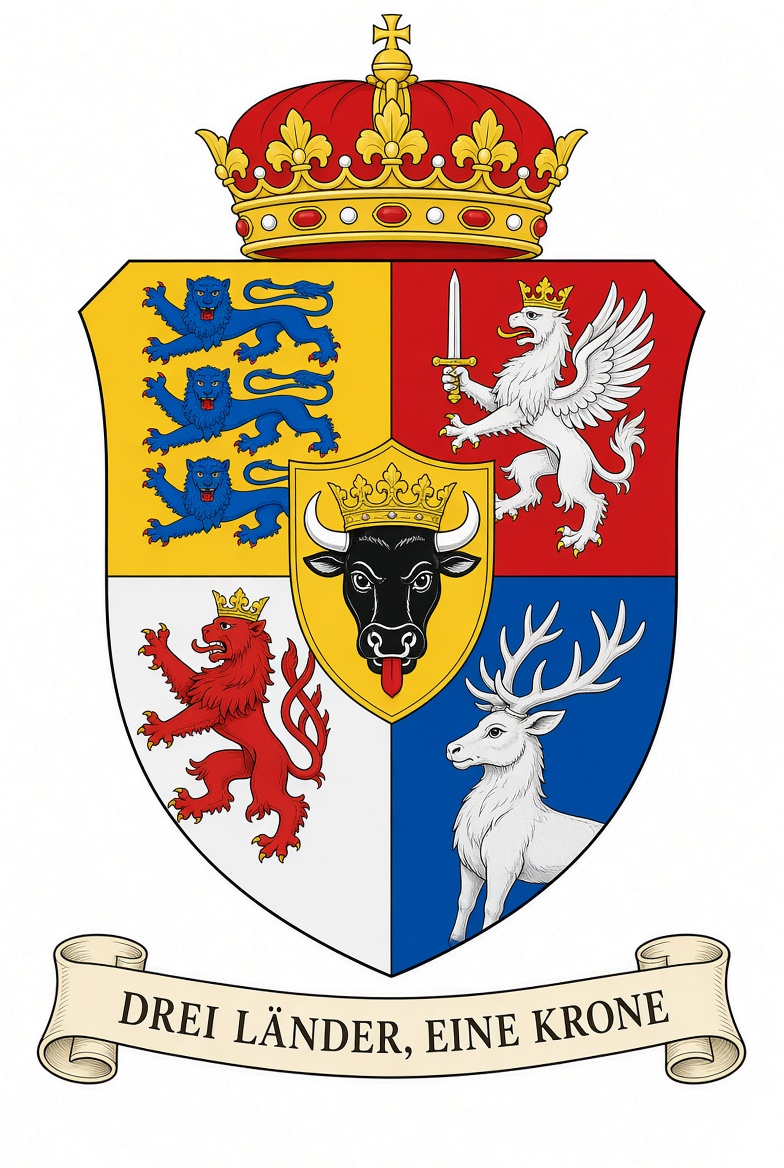
The arms of the Duchy are quartered, bearing the historic arms of the three lands and the dynasty: the three lions of Estland, the griffin of Livland, and the lion and elk of Courland, the elk being the old arms of Semigallia, so that Courland fills two quarters, with the bull’s head of Mecklenburg on a shield in the centre, beneath a ducal crown and above a scroll bearing the motto. The arms were adopted in 1920 and have not been seriously contested.
Motto, anthem and days
The Duchy’s motto is Drei Länder, eine Krone, “three lands, one crown”, in German, and it has never been officially translated. Its anthem, written in 1920, is sung in all three languages under three titles, Baltenland, Baltijas zeme and Balti maa, to the same music, and the verses differ by language: the German praises the land, the Latvian the river and the Estonian the sea, and none of them mentions the Duke.
The Duchy keeps two national days. Duchy Day, 5 November, marks the proclamation of 1918. Liberation Day, 12 August, marks the departure of the last Russian troops in 1945 and is by far the more popular. The anniversaries of the declarations of the Latvian and Estonian republics of 1918 are not official holidays, and are kept anyway, with flags and gatherings, which the Duchy’s governments have learned to leave alone.
The union question
Two peoples and one crown
The Duchy’s central political question is whether it should exist in its present form, and it is asked differently by each of its peoples. Latvians regard the union as theirs. Riga is its capital, Latvians are its largest people, and most of its Prime Ministers have been Latvian; the Duchy is, for most Latvians, simply the state, and its German founding a matter of history. Estonians regard it as something done to them. They were defeated in 1919, joined to a larger people in a state whose capital is not theirs, and governed for a century by a majority that does not speak their language. That difference is the whole union question in a sentence, and everything else in the Duchy’s politics follows from it.
The question was quiet for most of the twentieth century. The occupation of 1941 to 1945 united the Duchy’s peoples against a common enemy, and the liberation and the song festival of 1946 gave them a common memory. The cold war, and the proximity of Russia, made any argument for dividing a small state against a large one look reckless. The question returned with the end of the cold war, when the Russian threat receded, the digital administration built in Tallinn gave Estland the confidence of a land that governed itself well, and the personal union of 2001 gave the Duchy a sovereign who lived part of the year in Germany and did not speak Estonian.
The Estonian Independence Party
The Estonian Independence Party (Eesti Iseseisvuspartei) was founded in the 1990s as a small movement of Estonian nationalists and intellectuals, and became a serious party in the 2010s. Its leader since 2019 is Kadri Tamm, a former diplomat who had been the Duchy’s ambassador to the Scandinavian Union and resigned from the diplomatic service to lead it. She says that she learned in Stockholm that small states are safe when they are clear about what they are, and that Estland under the Duchy is not clear about what it is.
The party holds 22 seats in the Landtag of the Duchy and a third of the seats in the Estländischer Landtag, where it is the largest party, and it is in opposition in both because every other party refuses to govern with it. Its programme is independence for Estland by referendum, followed by negotiation of the terms of separation, an application to the European Concert and to the Scandinavian Union, and a guarantee from Germany, the Nordic countries or both. Its funders include the Estonian communities abroad, most of them in the United Kingdom of America, formed by the exiles of 1919.
It is supported most strongly in Tallinn, in Tartu and among the young, and least in Narva, where the Russian-speaking population is loyal to the Duchy in every survey.
The republicans
The Baltic Republican League is the Estonian Independence Party’s rival, not its ally. The republicans want to keep the union of the three lands and abolish the crown, and to replace the Duchy with a single Baltic republic, the state they argue the Latvian and Estonian republics of 1918 would have made together if they had won. They regard the separatists as the greater danger to that project than the Duke, since a Baltic republic without Estland would be a Latvian republic, and they are strongest in Riga and among the Duchy’s intellectuals. They hold 14 seats.
What Estland would lose
The Duchy’s government and the unionist parties have set out, in every debate, what Estland would lose by leaving. The German guarantee under the Treaty of Mitau is given to the Duchy as a whole, and the German government has said privately that it would not extend automatically to a new state. Membership of the European Concert belongs to the Duchy, and an independent Estland would have to apply. The Baltic mark is the Duchy’s currency. And Narva, whose Russian-speaking population would probably vote to stay with the Duchy, might be lost to Estland: whether as an exclave of the Duchy, cut off from the rest of it by an independent Estland, or as a fourth land, is a question nobody has answered.
The Estonian Independence Party answers that a guarantee can be negotiated, that the Concert admits new states, that a currency can be pegged, and that Narva is Estonian and will stay so. It has not said how.
The Court
The question of whether the Estonian Independence Party’s programme is lawful at all is before the Ducal Court at Tartu, on the party’s referral of 2025. The Staatsgrundgesetz is silent. The Duchy’s government argues that silence means no, since a land cannot take from the Duchy what the Duchy’s constitution does not give it. The party argues that silence means yes, since the Duke’s oath to uphold “the rights of the three lands” presupposes that the lands have rights of their own, and the right of a people to decide its own government is the first of them. The land governments of Livland and Courland have sided with the Duchy. Estland’s Social Democratic government has told the Court that the question is for the Landtag and not for judges, which is an answer both sides claim.
The unionist case
The unionist parties make a case for the Duchy that is more than an argument about what Estland would lose. It is that the Duchy has worked: that it has kept its peoples free for more than a century on a frontier where freedom has been rare, survived an occupation and recovered from it, prospered, and built a digital administration that is admired across Europe; that a small state of 3.8 million is safer than two states of 2.3 million and 1.5 million; and that the Estonian language, culture and schools are protected by the Duchy’s constitution and governed by Estland’s own diet, so that there is nothing Estonian that independence would secure and the union does not. Prime Minister Bērziņa’s formulation, repeated in every debate on the question, is that “the Duchy is how three lands became safe, and it is not finished”.
The Estonian Independence Party’s reply is that safety is not the same thing as self-government, and that a people which did not choose its state is entitled to choose it now.
Failings
1919
The Duchy’s worst failure is its founding war. The Duchy was proclaimed by a German nobility, in German, under German occupation, and it defeated the republics the Latvian and Estonian peoples had declared for themselves with the help of German Freikorps, volunteer soldiers paid in promises of Baltic land. After the taking of Riga in May 1919 and the Battle of Cēsis in June, several hundred prisoners and suspected republicans were shot, many without any form of trial, by the Landeswehr and the Freikorps, in the Duchy’s name.
The Duchy has never formally acknowledged the killings. The four knighthoods, whose members led the Landeswehr, apologised in 2018, in a statement signed by their marshals. The Duchy and its governments have not. The Social Democrats have proposed an apology in the Landtag three times. The Ducal Union has refused each time, on the ground that an apology for the killings would concede that the Duchy’s founding was illegitimate, and the Estonian Independence Party says that this is exactly the point.
The knighthoods of Estland, Livland, Courland and Ösel held the Latvian and Estonian peoples in serfdom for centuries, and in the century after its abolition held their land. They kept privileges in the United Baltic Duchy until 1945 that no free people should have been asked to bear.
In 1919 men who served in the knighthoods’ name and under the command of their members shot prisoners and people suspected of supporting the republics, at Riga and after Cēsis, without trial. We apologise for these killings, which no founding can excuse, to the families of the dead and to the Latvian and Estonian peoples.
We make this statement in our own name, and cannot make it in the name of the state.
The nobility’s privileges
The Duchy kept the privileges of its German nobility until 1945: their estates, their patronage of the churches, their reserved places in the land diets’ committees and their courts of honour, twenty-five years after a franchise had given the Latvian and Estonian majorities control of the Landtag. The peasants who had fought for the republics in 1919 on the promise of land received none until the land reform of 1945, and the knighthoods received full compensation for it. The Duchy’s historians count the delay as a failure of the Latvian and Estonian parties as much as of the Germans, since the parties had the votes to end the privileges for two decades and chose the Duke’s goodwill over their voters’ land.
The exclusion of Jews
The Duchy excluded Jews from its civil service, formally until 1934 and in practice until 1941. The exclusion was ended only by the equality clause of the Liberation Amendment of 1946. The Duchy’s record was better than that of several of its neighbours in the 1930s, and its Jewish community survived the century in a way that most of eastern Europe’s did not, but the Duchy’s own writers treat the comparison as no defence of the exclusion.
Narva, 1962
The rule of 1962 requiring the foremen of the oil shale works to speak Estonian was imposed on a Russian-speaking workforce without consultation, and two workers were killed by police in the riot that followed. The rule was withdrawn after the crisis, and the police officers were not prosecuted. The Russian Community Party marks the anniversary, and no other party does.
The bank
The Duchy tolerated the laundering of Russian money through Riga’s banks for two decades, in plain sight and against repeated warnings, and it took the German Empire’s regulator to close the Baltische Handelsbank in 2018.
Chronology
| Year | Event |
|---|---|
| 1816 to 1819 | Serfdom abolished in the Baltic provinces of the Russian Empire |
| 1905 | Revolution; manors burned; punitive expeditions |
| 1915 to 1918 | German occupation of Courland and then the whole of the provinces |
| 1918 | 5 November: the United Land Council proclaims the Duchy at Riga, in German; Adolf Friedrich elected Duke; Latvian and Estonian republics declared |
| 1919 | Riga taken in May; the Battle of Cēsis/Wenden, 23 June; killings of prisoners; Treaty of Mitau |
| 1920 | Staatsgrundgesetz; the lands redrawn; League of Nations membership |
| 1922 | Amnesty for the republican leaders; the Baltic mark |
| 1923 to 1926 | Kārlis Ulmanis, the first Latvian Prime Minister |
| 1934 | Formal exclusion of Jews from the civil service ends; practical exclusion continues |
| 1941 | Russian occupation; Adolf Friedrich broadcasts from Stockholm; deportations begin |
| 1942, 1944 | Secret song festivals in the forests |
| 1945 | Joint ultimatum in June; Russian withdrawal, 12 August; land reform |
| 1946 | Liberation Amendment; the Ducal Court; Treaty of Mitau renewed; trials; the song festival of a hundred thousand |
| 1962 | The Narva riot and crisis; German division to Riga; brigade at Ādaži; Russian-language channel |
| 1969 | Adolf Friedrich dies; Duke Friedrich Franz |
| 1975 | Final compensation payment for the land reform |
| 1994 | Conscription ends |
| 2001 | Duke Friedrich Franz dies; Friedrich Franz VI of Mecklenburg-Schwerin inherits; personal union |
| 2005 | Online voting |
| 2012 | The Duke attends the Cēsis memorial at Tartu for the first time |
| 2018 | Baltische Handelsbank closed; the knighthoods’ apology |
| 2019 | Kadri Tamm leads the Estonian Independence Party |
| 2025 | The Estonian Independence Party’s referral to the Ducal Court |
| 2027 | Founding member of the European Concert |
✎ Editor's Note · A state the Germans planned and nobody built
The United Baltic Duchy is a real plan that failed. In 1918 the Baltic German nobility, under German occupation, proclaimed a United Baltic Duchy of Estonia and Latvia under Adolf Friedrich of Mecklenburg; it collapsed with Germany’s defeat, and at Cēsis in June 1919 the Estonian army and its Latvian allies beat the Baltische Landeswehr, which is why Latvia and Estonia became republics. In a setting where Germany wins the First Great War, the plan had a patron, and this article follows it.
The divergences are chosen to keep the real countries visible inside the invented one. Cēsis is reversed and remembered as a defeat, so that the Estonian question is a question about a war. The republics of 1918 survive as unofficial national days and a party. The Soviet occupations are replaced by a Russian occupation of four years that fits a Russia which stayed out of the Second Great War and still took what was on its doorstep, and the Soviet deportations by smaller Russian ones whose records were never returned. The Estonian digital state still exists, built from Tallinn, and it has become the separatists’ best argument.
The article leaves the union question unresolved, because the Duchy’s own court has not resolved it.
Trivia
- In-Universe The Duchy was proclaimed in German only on 5 November 1918, and that is the fact about the proclamation Latvians and Estonians remember.
- In-Universe Adolf Friedrich, the first Duke, was an explorer of central Africa and a former governor of Togo, with no connection to the Baltic before his election.
- In-Universe Adolf Friedrich accepted the throne on condition that he would be crowned only after the Duchy had a constitution.
- In-Universe The Battle of Cēsis/Wenden on 23 June 1919 decided the civil war in the Duchy's favour. Estonians mark the day as a defeat every year.
- In-Universe The defeated republican leaders Kārlis Ulmanis and Konstantin Päts were amnestied in 1922 and both later became Prime Minister of the Duchy.
- In-Universe Ulmanis, who had led the Latvian republic against the Duchy, is remembered as the man who made the crown bearable.
- In-Universe The 1920 constitution put the Duchy's supreme court at Tartu, in Estland, as a concession to the Estonians. It has been the Ducal Court since 1946.
- In-Universe Latgale was never part of any Baltic province and was joined to Livland in 1920, a grievance it has never given up.
- In-Universe In 1941 Russia described its occupation of the Duchy at home as the recovery of imperial provinces and abroad as a protective measure, so as not to be counted a belligerent.
- In-Universe About 25,000 people were deported during the Russian occupation. A third never returned, and the places where about 8,000 died are still unknown.
- In-Universe Russia took the deportation records with it in 1945. The Duchy has asked for them at every League session since 1946.
- In-Universe Adolf Friedrich broadcast weekly from Stockholm for four years. His first broadcast began: 'I am in Stockholm, and the Duchy is in you.'
- In-Universe Song festivals were held secretly in forest clearings in 1942 and 1944. The open festival of 1946 had about a hundred thousand singers.
- In-Universe The 1945 ultimatum from Germany, Britain and the Realm was three sentences long and gave Russia sixty days. Russia left in six weeks.
- In-Universe General Pavel Rodionov, who governed the occupied Duchy, was tried in absentia, never extradited, and wrote a memoir calling the occupation 'a trusteeship'.
- In-Universe The Duchy counts not punishing its Russian-speaking community for the conduct of those who served the occupation among its best decisions.
- In-Universe The German guarantee in the Treaty of Mitau has been invoked once, in the Narva crisis of 1962, and failed once, in 1941.
- In-Universe The Narva crisis of 1962 lasted nine days and was buried in the world's memory a few weeks later by the Caribbean Missile Crisis.
- In-Universe A German brigade has been stationed at Ādaži, near Riga, since 1962.
- In-Universe Duke Friedrich Franz, who reigned from 1969 to 2001, is remembered for nothing, and said that was the purpose of a constitutional monarch's reign.
- In-Universe Since 2001 the Duke of the Baltic has also been Grand Duke of Mecklenburg-Schwerin. In Riga the Baltic title comes first, and in Schwerin the Mecklenburg one.
- In-Universe Friedrich Franz VI is still learning Estonian. The Estonian Independence Party mocks his accent, and most of his Estonian audiences find it endearing.
- In-Universe Hereditary Grand Duchess Alexandra spent two years at the University of Tartu, a condition the Landtag set for accepting her as heir to the Duchy.
- In-Universe Duke Christian Ludwig, a cousin in Tartu, speaks Estonian better than anyone else in the house. Asked whether he wishes the succession ran through him, he says he does not.
- In-Universe The Duke spends autumn and winter in Riga, spring in Schwerin and summer at Rundāle, plus a week in Tallinn each June that the separatists call 'the annual visit'.
- In-Universe The Estonian Independence Party is the largest party in Estland and is in opposition there and in Riga, because no other party will govern with it.
- In-Universe Kadri Tamm, the separatist leader, is a former ambassador who says she learned in Stockholm that small states are safe when they are clear about what they are.
- In-Universe The Staatsgrundgesetz says nothing about whether a land may leave. The Ducal Court has heard argument on the question and not ruled.
- In-Universe Germany has said privately that its guarantee is given to the Duchy as a whole, and the Duchy's government made sure the separatists heard it.
- In-Universe The Baltic Republican League wants one Baltic republic and regards the Estonian separatists, not the Duke, as its most dangerous opponent.
- In-Universe Narva's Russian speakers are the Duchy's most loyal voters on the union question, and might vote to stay with the Duchy if Estland left.
- In-Universe Signs are trilingual, and the land's own language comes first: Latvian, German, Estonian in Riga, and Estonian, German, Latvian in Tallinn.
- In-Universe German is compulsory in schools from the age of ten, so Latvians and Estonians in the Duchy often talk to each other in German or English.
- In-Universe The Duchy's motto, 'Drei Länder, eine Krone', has never been officially translated.
- In-Universe The anthem is sung to one tune in three languages with different verses. The German praises the land, the Latvian the river and the Estonian the sea, and none of them mentions the Duke.
- In-Universe The anniversaries of the Latvian and Estonian republics of 1918 are not official holidays, and are kept anyway.
- In-Universe The Old Believers of Lake Peipus, refugees from the Russian state and church, are by every survey the most loyal subjects of the German-founded crown.
- In-Universe The Duchy's Jewish community of about 60,000 shares a Yiddish daily newspaper with Vilnius, and every town in Courland has a synagogue.
- In-Universe The knighthoods' apology of 2018 closes by saying they 'cannot make it in the name of the state'. The state has not made it either.
- In-Universe The Social Democrats have proposed an apology for the killings of 1919 three times. The Ducal Union says it would concede that the founding was illegitimate, and the separatists say that is the point.
- In-Universe The land reform of 1945 paid the nobility full compensation, in instalments that ended in 1975.
- In-Universe The Baltische Handelsbank was closed in 2018 when the German regulator cut it off from the German mark, which the Duchy found humiliating.
- In-Universe Estonians in the Duchy often say 'Riga' when they mean the government.
- In-Universe The Duchy has had online voting since 2005, through e-Duchy, which was designed in Tallinn.
- In-Universe The Duchy sends one Olympic team. Ice hockey is Livland's sport and basketball Estland's, and matches between Riga and Tallinn are the most heavily policed games in the country.
- In-Universe Riga Black Balsam is Livland's drink and Vana Tallinn Estland's, and each land considers the other's undrinkable.
- Design Cēsis is reversed rather than erased, so that the Estonian question in the Duchy is a question about a lost war that people still mark, not an abstraction.
- Real-World The United Baltic Duchy was a real German plan of 1918, proclaimed by the Baltic German nobility with Adolf Friedrich of Mecklenburg as its intended Duke. It collapsed with Germany's defeat that November.
- Real-World At the real Battle of Cēsis in June 1919 the Estonian army and its Latvian allies defeated the Baltische Landeswehr. Estonia marks 23 June as Victory Day.
- Real-World The real Latvia and Estonia became independent republics in 1918, were occupied by the Soviet Union in 1940 and 1944 with mass deportations, and regained independence in 1991. Estonia really did build one of the world's most advanced digital governments.