Empire of Brazil
The Empire of Brazil (Império do Brasil), ordinarily Brazil, is a federal parliamentary constitutional monarchy occupying almost half of South America. It has about 215 million people, twenty-six states, and its capital and court at Rio de Janeiro. Its monarch is Pedro VI, who is also King of Portugal, and who exercises none of the imperial authority in person: the Viceroy, elected by the General Assembly and confirmed by the Emperor, represents him, and the Prime Minister governs with the confidence of the Chamber of Deputies.
Brazil is the only large state of the Americas that has never been a republic. It separated from Portugal in 1822 under a son of the Portuguese king, kept the Constitution of 1824 through every change since, abolished slavery in 1888 without losing its throne, and emerged from the twentieth century with no military government, no revolution and no default. The one break in the record is the Estado Novo of 1937 to 1945, when a prime minister governed with the Assembly suspended and an emperor countersigned the decrees, and it ended when the newly acceded Empress Isabel II dismissed him.
Since the Convention of Rio of 1986, on the death of Isabel II without children, the Brazilian and Portuguese crowns have been held by the same person. The Convention shares nothing but the person. Brazil is governed entirely from Rio, the Emperor may not be advised on Brazilian affairs by Portuguese ministers, and he visits twice a year.
The country is rich and unequal in that order. Its output per head is about A£30,000, the highest of any large country in South America, and the distance between its richest and poorest states is a factor of three. It is the world’s largest exporter of soy, beef, coffee and sugar, holds the greater part of the Amazon rain forest, and carries, as its own historians insist on saying, the consequences of having been the largest slave society in the Americas and the last of them to abolish slavery.
Name
The state’s formal name is the Empire of Brazil, Império do Brasil, and has been since 1822. In ordinary speech the country is Brazil, and the word empire is used mainly of the nineteenth century: Brazilians say o Império and mean the age of Pedro II. The adjective and demonym are Brazilian, brasileiro.
The name of the country comes from brazilwood, pau-brasil, the dyewood that was the first export of the Portuguese coast and whose name comes in turn from brasa, an ember, for the red dye it yields. The Portuguese first called the territory the Land of the Holy Cross, Terra de Santa Cruz, and the commercial name displaced the devotional one within a generation, a substitution Brazilian writers have been making jokes about since the seventeenth century.
The state’s title was chosen deliberately in 1822 and is not an affectation of grandeur. A kingdom would have been a Portuguese form, and the men around Pedro wanted a title that did not imply a branch of something else. Empire also carried, in the constitutional vocabulary of the 1820s, the sense of a large composite state, and Brazil at independence was exactly that: a coastal chain of captaincies with an interior nobody in Rio had seen. The style of the sovereign, fixed by the Constitution of 1824 and unchanged, is Emperor and Perpetual Defender of Brazil, Imperador e Defensor Perpétuo do Brasil.
The Empire is a name and not a description of a relationship. Brazil holds no overseas territory and never has. When the Register describes the empire’s failings, they are the failings of a state that governed its own people badly, and not of a colonial power, which is a distinction Brazilian historians make firmly and which their Portuguese colleagues sometimes find pointed.
History
The colony and the court in Rio
Portugal claimed the coast in 1500 and governed it for three centuries as a plantation colony: sugar in the north-east on the labour of enslaved Africans, gold and diamonds in Minas Gerais from the 1690s, cattle in the interior, and Jesuit missions in the Amazon. Brazil received about 4.8 million enslaved Africans, more than any other territory in the Americas, nearly ten times the number landed in the colonies that became the United Kingdom of America. The traffic and the plantation are the foundation of everything that follows, and the article states it here rather than in a later section.
In 1808 the Portuguese court fled Napoleon’s invasion and moved to Rio de Janeiro, which became the capital of the Portuguese monarchy, the only case in history of a European court governing its empire from a colony. The consequences for Brazil were permanent: the ports were opened, a bank, a press, a library, a military academy and a royal court arrived at once, and in 1815 Brazil was raised to a kingdom equal with Portugal. When John VI returned to Lisbon in 1821, leaving his son Pedro as regent, the Portuguese Cortes attempted to reduce Brazil to a colony again, and found that there was now a government at Rio with every reason to refuse.
Independence, 1822
On 7 September 1822, on the bank of the Ipiranga, Pedro declared Brazil’s independence, and he was acclaimed Emperor Pedro I in December. The separation was a son parting from his father, not a colony from an empire. There was fighting in Bahia, Maranhão and Pará against garrisons that refused the new order, and it was over within a year, and no Portuguese army was ever sent. Portugal recognised the Empire in 1825.
The manner of the separation is the reason the two crowns could be joined again in 1986 without embarrassment. There was no war of independence to commemorate, no massacre to hold against Lisbon, and no republic in between. Brazilian schoolchildren are taught that their country became independent by a decision of the Portuguese heir, and the standard national joke about the Cry of Ipiranga is that it was the most convenient revolution in the history of the world.
The Constitution of 1824
Pedro I dissolved the constituent assembly and granted a constitution of his own in 1824. It has been amended out of all recognition and never replaced, which makes it the oldest working constitution in the Americas after the Charter of Union. It created a Chamber of Deputies and a Senate, a Council of State, an established Catholic Church and a property franchise, and it gave the Emperor a fourth branch of government, the Moderating Power (Poder Moderador), with which he could appoint and dismiss ministries, dissolve the Chamber and suspend magistrates.
The Moderating Power is the hinge of Brazilian constitutional history. It made the Emperor the working centre of the state for sixty years, it made the parliamentary system a gift rather than a right, and its abolition in 1946 is the moment Brazil dates its own democracy from.
Abdication and the Regency
Pedro I’s reign ended badly. He lost a war to the United Provinces of the River Plate over the Banda Oriental, which became independent Uruguay in 1828; he was suspected, correctly, of caring about the Portuguese succession as much as the Brazilian one; and in 1831 he abdicated in favour of his five-year-old son and sailed for Europe.
The Regency of the 1830s is the period in which Brazil came nearest to breaking apart. Four provinces rose: the Cabanagem in Pará, in which perhaps a fifth of the population died; the Sabinada in Bahia; the Balaiada in Maranhão; and the Farroupilha in Rio Grande do Sul, which lasted ten years and proclaimed a republic. The revolts were suppressed with great violence, and their suppression created the first Brazilian standing army with a politics of its own. The regents, unable to govern a country that would not obey a committee, declared the boy of age at fourteen in 1840.
Pedro II and the conciliation
Pedro II reigned from 1831 to 1891, sixty years, fifty of them as an adult. He was a studious and unglamorous sovereign who read constantly, corresponded with scientists, disliked ceremony and took the business of government seriously to the point of exhaustion. Under him Brazil acquired railways, telegraphs, a civil code, a professional diplomatic service and a reputation abroad for stability that the Spanish American republics did not enjoy.
Politics ran through two parties, Liberals and Conservatives, which the Emperor alternated in office at his own discretion under the Moderating Power. Contemporaries called the arrangement the conciliation and it produced ministries that fell without violence and elections whose results followed the change of ministry rather than causing it. Critics at the time and historians since have called it a rotation of one class: both parties were drawn from the same planters, lawyers and merchants, and the property franchise excluded almost everybody.
Slavery and abolition
Brazil banned the Atlantic slave trade by treaty with Britain in 1826 and by statute in 1831, and the traffic continued illegally on a great scale for twenty years, landing hundreds of thousands of people while the law stood unenforced. It was ended in the 1850s, when the Royal Navy entered Brazilian waters, seized and burned slave ships and blockaded the ports where they were fitted out. The action worked and it was an invasion of Brazilian sovereignty, and Brazilian historiography records it as both, which is why the treaty of 1826 remains the sourest memory in an otherwise friendly relationship with Britain.
Slavery itself lasted another generation. It was dismantled by stages: the Law of the Free Womb in 1871, freeing children born to enslaved mothers; the Sexagenarian Law of 1885, freeing the elderly, whom the plantations no longer wanted; and finally the Golden Law of 13 May 1888, signed by the Princess Imperial Isabel as regent in her father’s absence, which abolished slavery outright.
Abolition was accompanied by compensation, and the compensation was paid to the owners. A loan raised on the London market indemnified the planters for the value of the people they had held, and it was not finally repaid until the 1930s. The freed received nothing: no land, no payment, no schooling and no protection, and most of them stayed where they were on wages that were worse than subsistence. The modern argument for reparations is made in exactly those terms, that the state has already accepted the principle of paying for slavery and has so far paid only one side of it.
Compensation is also the reason the throne survived. A planter class that had lost its property without payment would have had every reason to withdraw its loyalty from the monarchy, and to say nothing when the army moved the following year. The planters were paid, and they had nothing to gain from a republic.
The Paraguayan War
The Paraguayan War of 1864 to 1870 was Brazil’s war above all. Paraguay under Francisco Solano López invaded Mato Grosso and then crossed the territory of the River Plate to attack Corrientes, and Brazil fought it in alliance with the colonial government of the United Provinces of the River Plate and with Uruguay until Paraguay was destroyed. Paraguay lost more than half its population to battle, famine and disease, and Brazil, which supplied most of the troops and nearly all of the money, has never found a comfortable way to teach the war.
Its domestic consequence was the making of the Brazilian army. Officers came home from five years in the field with a corporate identity, a list of grievances about pay and promotion, and the conviction that they had saved a country governed by lawyers. Enslaved men who had been sent to the war as substitutes for their owners’ sons came home free, and their presence made the abolitionist argument unanswerable. Both of those consequences arrived in the same decade, and how the monarchy handled them decided whether it survived.
The army reform, and the crisis that did not happen
The military question was handled by a royal commission in 1882, which took evidence from veterans in every garrison town and reported that the army was underpaid, promoted by patronage, commanded without a staff and politically resentful for reasons the state had given it. The army law of 1884 did what the commission recommended: pay rises and a proper pension, promotion by examination rather than patronage, a general staff, and the right of retired officers to stand for the Chamber, which took the officers’ politics out of the barracks and put it where it could be answered.
The reform is the single act to which Brazilian historians attribute the survival of the monarchy. When abolition came four years later and the planters were compensated, there was no aggrieved landed class to lend a grievance to the army, and when a group of officers and republican civilians canvassed a rising in 1889, the garrisons were uninterested. Pedro II reigned until his death in 1891.
Republicanism did not disappear; it took seats instead. The Republican Party, strong among the coffee planters of São Paulo and among young officers and positivist intellectuals, elected deputies from the 1880s and has sat in every Chamber since. That is why Brazilian republicanism is an old, respectable parliamentary movement rather than a revolutionary one, and why the country has argued about the monarchy for a hundred and forty years without ever fighting about it.
Isabel I
Isabel I, who had signed the Golden Law as regent, succeeded her father in 1891 and reigned until 1921. Her reign made the constitution parliamentary in fact.
She inherited the Moderating Power and stopped using it. Ministries were made and unmade by the Chamber from the mid-1890s; the Emperor’s choice of prime minister became the choice the Chamber had already made; and the dissolution of the Chamber was granted on the advice of the ministry rather than imposed on it. She did this deliberately and said so in public, on the argument that a Crown that chose governments would eventually choose wrongly and be blamed for it.
The rest of her reign was a long argument about the Church, whose closeness to her was used against her by liberals and positivists throughout, and which she left established. It was also the period of the rubber boom, which built an opera house at Manaus and a fortune that collapsed after 1912 when Asian plantations took the market, and of the acquisition of Acre from the Peru-Bolivian Confederation by the Treaty of Petrópolis in 1903, a purchase the Confederation still regards as having been made at a low price.
Isabel I is the most admired sovereign in Brazilian history, and the reparations argument is conducted in her name by both sides: by those who point out that she signed abolition, and by those who point out what she signed it with.
Pedro III, the war, and the 1920s
Pedro III reigned from 1921 to 1944. Brazil had entered the First Great War in 1917, after French submarines sank Brazilian merchant ships in the Atlantic, on the side of the Central Powers with Britain, the German Empire and the United Kingdom of America. Its contribution was a naval division in the South Atlantic, medical units in Europe and a great deal of food, and it sent no infantry.
The 1920s were the decade in which the old political settlement came apart. The coffee interest of São Paulo and the cattle interest of Minas Gerais had governed between them for a generation; the cities had grown a working class, a commercial middle class and a press that despised both parties; and young officers, the tenentes, mounted two barracks risings that were put down in days and whose survivors became a movement. The collapse of the coffee price in 1929 destroyed the governing party’s finances and its argument at once.
Vargas and the Estado Novo
Getúlio Vargas, a lawyer and state governor from Rio Grande do Sul, won the election of 1930 at the head of an alliance of the defeated states, the tenentes and the urban middle class, and Pedro III appointed him Prime Minister. He held the office for fifteen years.
The first phase was reforming and popular. He gave Brazil the eight-hour day, the minimum wage, paid holidays, the union statute and a labour court system, which together remain the foundation of Brazilian labour law; he created the first state industries in steel and oil; he extended the vote to women in 1932; and in 1934 he carried the constitutional revision that disestablished the Catholic Church, which went on supporting him for years afterwards.
The second phase was authoritarian. In 1937, on the pretext of a communist plot whose documents his own police had written, he invoked the state-of-siege article of the constitution, suspended the General Assembly, and governed by decree. The suspension was renewed by decree every six months for eight years, and Pedro III countersigned every renewal. The Supreme Tribunal held the arrangement lawful at the time and said forty years later that it had been wrong.
The Estado Novo censored the press, created a political police, imprisoned hundreds of communists, anarchists and liberals and tortured some of them, and interned Japanese, German and Italian Brazilians during the war. It also built the steelworks at Volta Redonda, the oil company and the national development bank, and it is remembered by many Brazilians for the labour code rather than for the prisons, which is a division in the national memory that the article states rather than resolves.
Pedro III’s part is judged harshly. His private papers, opened in the 1970s, show that he thought the suspension wrong from the beginning and told Vargas so in audience after audience. He signed anyway, for eight years, and Brazilians generally regard the papers as making his conduct worse rather than better.
The Second Great War
Brazil entered the Second Great War on the Allied side in 1942, after submarine attacks on its shipping, and its war was a real one. It sent an expeditionary division of about 25,000 men to Italy from 1944, with an air group, and lost about 450 killed; it provided the South Atlantic air bases on which the ferry route to Africa depended; and it supplied rubber, iron and food.
The contradiction was noticed at the time and was fatal to the government that had created it. A country whose parliament had been suspended for five years was fighting a war for constitutional government abroad, and its soldiers came home and said so. The veterans’ association demanded elections within weeks of the German surrender.
The dismissal, 1945
Pedro III died in 1944 and was succeeded by his daughter Isabel II, then forty-nine, who had spent the Estado Novo in public silence and private fury.
In October 1945, with the veterans’ association, the Supreme Tribunal and most of the press behind her, she dismissed Vargas under the Moderating Power, appointed a caretaker ministry and ordered elections. She acted on nobody’s advice, which was lawful and had not been done for half a century. It is the single most popular act by any Brazilian sovereign, and it is the last time the Moderating Power was used.
The Assembly of Brazil has not met for eight years. It was suspended for six months, and the six months have been renewed sixteen times, by decree, with my father’s signature and now with mine.
I will not sign the seventeenth. The ministry is dismissed and the Assembly is summoned. Whatever the country decides at the election, it will decide it in the Assembly and not in this palace.
Vargas went home to Rio Grande do Sul, was elected to the Senate in 1950 and died in 1954. He was never tried, which remains a standing complaint of the Brazilian left and right alike, for different reasons.
The settlement of 1946
The parliament elected in 1945 rewrote the constitution’s central provisions, and the Crown asked it to.
The Moderating Power was abolished in 1946, at the Crown’s own request, a year after it had saved the constitution. Isabel II’s argument, made in a message to the Assembly, was that a power which had been used well once had been used badly for eight years, and that no monarchy should keep an instrument whose value depended on the character of its holder.
The same settlement introduced universal suffrage including the illiterate, created the universal public health service, established a constitutional court separate from the Supreme Tribunal, recognised the land titles of the quilombo communities founded by escaped enslaved people, and provided that a state of siege lapses after sixty days unless the Assembly renews it sitting in person.
The developmental decades
From 1946 to the 1970s Brazil grew fast and continuously under a sequence of developmental ministries of both parties. The national development bank financed steel, hydroelectricity, cars, chemicals, aircraft and oil; foreign firms were admitted on terms that required manufacture in the country; and the state companies in oil and electricity were built in this period. Embraer, founded in the 1960s, became the country’s proudest industrial fact and the third civil aircraft manufacturer in the world.
Proposals to move the capital inland, which had been in every constitution since 1824, were made repeatedly in these decades and never carried. The court, the Assembly, the ministries, the banks and the newspapers were all in Rio, and a monarchy had no reason to refound itself in the cerrado. The architect Oscar Niemeyer, who would have built the new capital, built instead the ministries quarter of Rio, the cultural centre at Belo Horizonte and a great deal of São Paulo, and Brazilian modernism is a coastal style.
1964
In March 1964 a group of generals demanded that the Empress dismiss a Labour ministry that was pressing land reform and the taxation of great estates, and let them appoint a government of national order.
Isabel II refused. She received the officers, told them that the ministry held the confidence of the Chamber and that the Chamber would decide, and then went on the radio the same evening and said it to the country. The Rio garrison would not march on the Catete against the Empress’s stated refusal, the movement collapsed within three days, and the officers responsible were retired quietly over the following year. Brazil had no military government, and this is the central fact of its modern political history.
It did not escape unmarked. A state of emergency was declared after the crisis and lasted about eighteen months, under a civilian ministry, with press censorship and about 4,000 detentions, of whom two died in custody. The Empress refused to renew it at the end of 1965 and it lapsed. A truth commission in the 1990s named those responsible, three police officers were convicted, and the detainees were compensated.
I have been asked this afternoon to dismiss a ministry that holds the confidence of the Chamber of Deputies, and to appoint in its place a government of order chosen by officers.
I have declined. The ministry was made by the Chamber and will be unmade by the Chamber, at an election or on a vote, and by nothing else and nobody else. I am told that this is a dangerous answer. It is the only one my oath allows, and I will not be giving another.
The land reform passed in a weakened form in 1967: taxation of unproductive estates, public purchase and resettlement, and a right of occupation that the courts have been adjudicating ever since. The landless movement still occupies estates, and the cases are still heard.
The recession, and the succession
Brazil’s long boom ended in the early 1980s in a hard recession, high interest rates and a debt the government rescheduled rather than repudiated. It did not default, and there was no hyperinflation, which is the difference between Brazilian economic history and that of its neighbours, and the reason the mil-réis has never been replaced.
The other question of the decade was dynastic. Isabel II had married late and had no children, and the absence of an heir had been obvious for twenty years. Both Brazil and Portugal, whose crowns would fall to the same person if nothing were done, reformed their succession laws to absolute primogeniture in parallel in the 1980s, and the Brazilian Assembly debated the alternatives in public: a republic, or a cadet candidate from a Brazilian branch, which it rejected on the ground that inventing a dynasty was a worse answer than inheriting one.
The Convention of Rio, 1986
Isabel II died in 1986, aged 91, and the crowns of Brazil and Portugal came to the same person. The terms were settled beforehand by the Convention of Rio, negotiated for Brazil by the Prime Minister and the President of the Supreme Tribunal together, an unusual pairing insisted on so that the result would read as law rather than as politics, and signed in Rio because Brazil refused to sign it anywhere else.
The Crowns of Brazil and of Portugal are held by the same person and are in every other respect separate.
The Emperor is advised in the affairs of Brazil by the ministers of Brazil and by no others. Neither Crown may be separated from the other except by Act of both Parliaments.
The Convention shares nothing but the person: no citizenship, no defence, no customs, no common institutions. It provides that the Viceroy is elected by the General Assembly and confirmed by the Emperor, and that the Emperor takes the Portuguese ordinal, so that the sovereign who is Pedro VI in Lisbon is Pedro VI in Rio although Brazil has had a Pedro I, a Pedro II and a Pedro III of its own.
Brazil took the arrangement as an opportunity and got more out of it than Portugal did. It kept its own government entirely, acquired a European connection it uses commercially, and treats its absent sovereign as an export. The ordinal was the price, it was resented by a substantial minority from the first day, and it is still resented.
Since the union
Manuel II of Portugal reigned as Emperor from 1986 to 2027. He was respected in Brazil and distant from it, never learned to be Brazilian in public, and in the last fifteen years of his reign came twice. The republican vote rose steadily through the 2000s and the republican party became the third force in the Chamber.
Pedro VI, who succeeded in 2027, is half Brazilian. His mother is a Brazilian whom his father married in 1993, he spent long childhood periods in Rio, he has family there, and he moves between European and Brazilian Portuguese without effort, which Brazilians noticed in his first sentence. The ordinal argument has been noticeably quieter since he acceded, and his heir, Infanta Isabel, named for Isabel II and more visible than her brother, does a great deal of the Brazilian work.
Geography
Extent
Brazil covers about 8,510,000 square kilometres, nearly half of South America, and borders eight states: the United Provinces of the River Plate, Uruguay, Paraguay, the Peru-Bolivian Confederation, New Granada, Guyana, Suriname and French Guiana, the frontier with the Confederation reaching its Amazonian departments at a single point in the far west. Its Atlantic coast runs about 7,500 kilometres. It is crossed by the equator in the north and the Tropic of Capricorn in the south, and almost all of it is tropical or subtropical.
The Amazon
The Amazon basin occupies about three fifths of the country. The river carries a fifth of all the fresh water that reaches the sea, is navigable by ocean ships as far as Manaus a thousand miles inland, and drains a forest that holds a tenth of the known species on earth. The forest is the subject of Brazilian politics rather than a backdrop to it: the argument about who may cut it, who may mine under it, who may live in it and who abroad may have an opinion about it runs through every ministry.
Deforestation has fallen from its worst years and has not stopped. The federal environment agency has police powers, satellite monitoring shared with the League, and an army that resents being asked to enforce against ranchers, loggers and illegal gold miners in territory the size of Europe.
The other country
Brazil outside the Amazon is four more countries.
The cerrado, the savannah of the centre-west, was regarded as useless until soil science and the development banks of the 1970s turned it into the largest new farm belt created anywhere in the twentieth century. It now grows most of the soy.
The sertão, the dry interior of the north-east, is a country of drought, migration and a long literature of both. Its people have been leaving for São Paulo for a century, and the cash transfer and the water programmes of recent decades have reduced but not ended the leaving.
The Atlantic forest of the coast, which once ran the whole length of the country, is mostly gone: cut for sugar, coffee and cities, and reduced to fragments that are now more strictly protected than the Amazon and far more nearly lost.
The Pantanal, on the Paraguayan and Confederate frontier, is the largest tropical wetland in the world, flooded half the year, and the country’s great wildlife reserve. The southern highlands, temperate and settled by Germans, Italians and Poles, grow wheat, grapes and cattle and feel like nowhere else in Brazil.
Regions and climate
The five official regions, North, North-East, Centre-West, South-East and South, are the units in which Brazilians discuss their own inequality. The South-East holds the money, the industry and about two fifths of the people; the North-East holds a quarter of the people and the deepest poverty; the North is enormous and nearly empty; the Centre-West grows the food; the South is the richest per head.
| Region | Character | Principal states |
|---|---|---|
| North | The Amazon basin; vast, forested, thinly settled | Amazonas, Pará, Rondônia, Acre, Roraima, Amapá, Tocantins |
| North-East | Sugar coast and dry sertão; the oldest Brazil and the poorest | Bahia, Pernambuco, Ceará, Maranhão, Paraíba, Alagoas, Sergipe, Piauí, Rio Grande do Norte |
| Centre-West | The cerrado farm belt and the Pantanal | Goiás, Mato Grosso, Mato Grosso do Sul |
| South-East | Industry, coffee, the capital and the largest city | São Paulo, Rio de Janeiro, Minas Gerais, Espírito Santo |
| South | Temperate, European-settled, prosperous | Rio Grande do Sul, Paraná, Santa Catarina |
The climate runs from equatorial in the Amazon, hot and wet all year, through the tropical wet and dry of the centre, the semi-arid sertão with its recurring droughts, to the subtropical south, which has frosts and occasionally snow in the highlands. The country has no deserts, no mountain range worth the name, and almost no earthquakes, and its natural disasters are floods, landslides on the coastal escarpment and drought in the north-east.
Government and politics
The Crown
Brazil is a monarchy whose monarch lives abroad. Pedro VI is Emperor of Brazil in his own right and separately from his Portuguese crown, under the Constitution of 1824 as amended and the Convention of Rio of 1986. He is advised in Brazilian affairs by Brazilian ministers alone. No Portuguese minister may advise him on Brazil, and an act performed in the wrong capacity is a nullity in both states, a rule administered by a joint chancery office in Lisbon and a corresponding office of the Imperial Household in Rio, which must countersign anything he signs in Brazil. The two offices correspond daily and publish their disagreements once a year.
What the Emperor does in Brazil is small and exact. He confirms the Viceroy whom the General Assembly elects, by instrument rather than in person; he signs what the Viceroy’s office sends him; he opens the Assembly on one of his two annual visits; and he does nothing else that the constitution requires. A single confirmation has been delayed: nine days in 1998, by Manuel II, for reasons the palace never explained, after which the Assembly passed a resolution recording that the confirmation was a formality and that it expected it to be treated as one.
The civil list is voted annually by the Assembly, is published, and pays for the visits, the palaces and the household office and for nothing else. Brazil contributes nothing to the Portuguese court, and Brazilian ministers say so in public with some regularity.
The Emperor’s Brazilian visits are two a year: September, for Independence Day and the opening of the Assembly, and February, which is officially a tour of a different region each year and unofficially the carnival visit. The Viceroy meets him at the aircraft and hands back the state in a formula of about forty words, resuming it when he leaves. It is theatre, it has been performed since 1986, and the crowds have never fallen.
The Viceroy
The Viceroy of Brazil (Vice-Rei do Brasil), addressed as Excellency, is the head of state in practice. The office is filled by election in the General Assembly, by an absolute majority of both houses sitting together, for a term of five years, renewable once, and confirmed by the Emperor. It is deliberately above party: a Viceroy may not have sat in the Chamber within the previous two years, and the convention is to elect judges, diplomats and retired public servants rather than politicians.
The Viceroy appoints the Prime Minister, gives assent to legislation, receives ambassadors, confers the imperial orders on ministerial advice, commands the armed forces formally, and opens the carnival in Rio by handing the keys of the city to the crowd. The office has no reserve powers of the kind the Moderating Power conferred; when a government falls, the Viceroy sends for whoever can command the Chamber, and the choice has never been contested since 1986.
Seven people have held the office. Two served the full ten years, two have been women and two Black Brazilians. The present Viceroy, Otávio Barreto Lins, a retired judge of the Supreme Tribunal, was elected in 2026.
| Viceroy | Term |
|---|---|
| Joaquim Prado Valente | 1986 to 1991 |
| Iracema Dantas | 1991 to 2001 |
| Sérgio Matos Aguiar | 2001 to 2006 |
| Benedita Rosário Lima | 2006 to 2016 |
| Fernando Teles Barbosa | 2016 to 2021 |
| Marcos Aurélio Ventura | 2021 to 2026 |
| Otávio Barreto Lins | since 2026 |
The General Assembly
The General Assembly (Assembleia Geral), which has borne the name since 1824, has two elected houses.
The Chamber of Deputies has 513 members elected for four years by proportional representation in each state, with a floor and a ceiling on each state’s representation that over-represents the small northern states and is the oldest grievance of São Paulo. The Senate has 81 members, three for each state, elected for eight years with a third and two thirds renewed alternately every four. The ministry is responsible to the Chamber; the Senate revises, confirms judicial and diplomatic appointments, and must approve treaties.
Voting is compulsory between eighteen and seventy, and the ballot is electronic and counted within hours, a system Brazil exports and is proud of.
Government and parties
The Prime Minister chairs the Council of Ministers and governs with the confidence of the Chamber. Helena Vasconcelos of the Labour Party has held the office since 2025 at the head of a coalition with the smaller regional parties.
The party system is fragmented and has three main forces. The Conservative-Liberal bloc descends from the old Conservative party by way of the developmental ministries and is strongest in agriculture, business and the south. Labour descends from the unions the Estado Novo created and the movements it suppressed, and is strongest in the industrial south-east and the north-east. The Republican Party, founded in the 1870s, is the third force and the only mass republican movement in any of the Crown’s realms. Beyond them sit evangelical, regional, green and libertarian parties, and no party has governed alone since the 1960s.
An authoritarian populist right exists, polls about a fifth, and is strongest in the evangelical churches and among agribusiness. It is capped by a fact of constitutional design rather than by virtue: the head of state is not an office anybody can win, so a movement built on a leader cannot capture the state by winning a single election.
States and federalism
Brazil is a federation of twenty-six states, each with an elected governor and legislative assembly, its own courts and its own police. There is no federal district: Rio de Janeiro is the capital and lies within the state of Rio de Janeiro, an arrangement the Assembly has examined three times and left alone.
| State | Capital | Region |
|---|---|---|
| Acre | Rio Branco | North |
| Alagoas | Maceió | North-East |
| Amapá | Macapá | North |
| Amazonas | Manaus | North |
| Bahia | Salvador | North-East |
| Ceará | Fortaleza | North-East |
| Espírito Santo | Vitória | South-East |
| Goiás | Goiânia | Centre-West |
| Maranhão | São Luís | North-East |
| Mato Grosso | Cuiabá | Centre-West |
| Mato Grosso do Sul | Campo Grande | Centre-West |
| Minas Gerais | Belo Horizonte | South-East |
| Pará | Belém | North |
| Paraíba | João Pessoa | North-East |
| Paraná | Curitiba | South |
| Pernambuco | Recife | North-East |
| Piauí | Teresina | North-East |
| Rio de Janeiro | Rio de Janeiro | South-East |
| Rio Grande do Norte | Natal | North-East |
| Rio Grande do Sul | Porto Alegre | South |
| Rondônia | Porto Velho | North |
| Roraima | Boa Vista | North |
| Santa Catarina | Florianópolis | South |
| São Paulo | São Paulo | South-East |
| Sergipe | Aracaju | North-East |
| Tocantins | Palmas | North |
States levy their own sales taxes and compete for factories by remitting them, a competition economists deplore and governors defend. A federal transfer fund moves money from the South-East to the North and North-East on a formula that is renegotiated, with great bitterness, about once a decade.
Law and the courts
The legal system is civil law, codified, with a Supreme Tribunal of eleven judges appointed by the Viceroy on the Prime Minister’s advice and confirmed by the Senate, and a separate Constitutional Court created in 1946 to review legislation. The courts are slow, heavily used and constitutionally powerful: the Constitutional Court extended civil marriage to same-sex couples in 2013, and the Supreme Tribunal has ordered states to build prisons, hospitals and schools.
Brazil retains no death penalty for civil crimes. Its prisons are overcrowded and in many states effectively run by the gangs inside them, and the League’s human rights bodies have found against Brazil on prison conditions repeatedly.
The republic question
Brazil is the only realm of the Crown in which republicanism is a mass movement. The Republican Party is the third force in the Chamber, and the argument it makes is double, which is also its weakness: one half says that a head of state who lives in Lisbon and visits twice a year is an absentee, and the other says that the empire was built on slavery and cannot be redeemed by good behaviour. The two arguments appeal to different voters, and the party has never reconciled them.
A referendum was held in 1993, with two questions. The first asked whether Brazil should become a republic, and the monarchy won with about 60 per cent. The second asked whether the Viceroy should be elected directly by the people rather than by the Assembly, and it lost much more narrowly. Direct election remains the reform most likely to happen: it unites republicans with monarchists who would like the office to be stronger, and the only institution firmly against it is the Assembly, which would lose the power to choose.
Polling puts support for keeping the monarchy at about 55 per cent against about 30 for a republic, with the rest indifferent. It is strongest in the North-East and weakest in São Paulo.
Foreign relations and defence
Position
Brazil is non-aligned and self-consciously so. It belongs to no military alliance, holds no foreign bases and hosts none, and its standing demand in international politics is a permanent seat on the League Security Council, which it has pressed since 1945. Nobody in particular blocks it and nobody decisive supports it. The election of Mateo Ferreira, a former Brazilian foreign minister, as Secretary-General of the League in 2024 is treated at home as a consolation prize, and is said so in print.
Portugal
The relationship with Portugal is the union and very little else. The Convention shares nothing but the person, and both governments repeat the sentence constantly. There is no shared citizenship: Brazilians have no right of entry to Portugal, only a standing visa arrangement and a residence route, and the same in reverse. Degrees are mutually recognised, an agreement made alongside the Convention, and more Brazilians study at Coimbra than at any other foreign university. About a million Brazilians live in Portugal, the largest single community abroad, and it is the diaspora that matters politically because it is the one the union is blamed for.
The Americas
The great rivalry is with the United Provinces of the River Plate, over the Banda Oriental in the 1820s, over the leadership of the continent since, and over football always. It is now conducted economically and inside Mercosur, which Brazil founded with the Plate, Uruguay and Paraguay in 1991, which Chile joined as a full member in 1996, and which is the instrument by which it leads the continent without saying so. That the two largest monarchies in South America share a continent and no monarch is a source of amusement in both, and their state visits are the only ones for which protocol has to be written from scratch.
Uruguay is the result of the old war and is close. Paraguay is close and careful: Brazil is its largest partner and its co-owner of the Itaipu dam, and the memory of 1870 sets the limit on how close it can get. The Peru-Bolivian Confederation buys and sells across an Amazonian frontier neither country polices seriously, sells Brazil its gas, and has not forgotten the price it was paid for Acre. With the United Kingdom of America relations are correct, commercial and a little wary: the two largest economies of the Americas are competitors in agriculture and in aircraft, and Brazilian governments of every colour treat American approval as something to be avoided rather than sought.
Beyond
The Empire of China is the largest trading partner, buying the soy and the iron, and the dependence is debated in exactly the terms it is debated everywhere. Britain is old and commercial: British capital built the railways and financed the coffee, and the treaty of 1826 that bound Brazil to end the slave trade, and the Royal Navy’s enforcement of it in Brazilian waters, remain the sourest memory in the relationship. The Lusophone countries of Africa, independent since the 1950s, are partners in construction, oil and education, and Brazil is the senior member of the Lusophone Community by size while Portugal chairs it by courtesy, an arrangement everybody involved describes as a fiction and keeps.
Defence
The armed forces are the largest in South America: an army of about 220,000 on a mixed conscript and volunteer basis, an air force, and a navy with a carrier, an amphibious brigade and a long-running nuclear submarine programme which has produced reactors and not yet a boat. Brazil has no nuclear weapons, is party to the regional treaty that prohibits them, and enriches uranium for fuel under inspection.
The army’s tasks are the Amazonian frontier, disaster relief and, increasingly and unwillingly, environmental enforcement. It has been out of politics since 1964, a discipline the officer corps is proud of and repeats at every opportunity, and the civilian Ministry of Defence has been led by a civilian without interruption since 1946.
Economy
Overview
Brazil has the largest economy in South America and output per head of about A£30,000, which makes it a high-income country by a modest margin and the richest large country on the continent. It is also among the most unequal countries in the world. Both statements are true and the article leads with them in that order, because the average is real and so is the distribution: the South and South-East have incomes comparable with southern Europe, the poorest states of the North-East have about a third of that, and the difference inside São Paulo between its financial district and its eastern periphery is wider than the difference between its regions.
The country escaped the fate of its neighbours in the 1980s. There was a hard recession and a rescheduled debt, and there was no default and no hyperinflation, which is why the mil-réis has run unbroken since the empire’s founding and why Brazilian finance has an unglamorous reputation for continuity. The central bank has been statutorily independent since the 1980s and targets inflation, and the currency has been managed rather than defended.
The explanation Brazilian economists give for the country being richer here than its resources alone would predict has four parts: no military government and so no rewriting of the rules every decade; industrialisation from 1946 under ministries that admitted foreign firms on terms rather than walling them out; the absence of a debt catastrophe; and an export basket broad enough that no single price collapse has ever taken the whole economy with it.
Agriculture
Brazil is the largest exporter in the world of soy, beef, coffee, sugar, orange juice and chicken, and the second of maize. Most of it is grown in the cerrado on holdings of industrial scale, with soil science, tropical crop breeding and the machinery industry behind it, and most of the rest along the old coffee and cattle frontiers of the South-East and South. Family agriculture, which is a separate legal category with its own ministry and credit lines, grows most of what Brazilians actually eat.
The agribusiness bench in the Chamber is the most disciplined caucus in Brazilian politics. It crosses party lines, has never lost a vote on land taxation that mattered, and is the reason environmental enforcement in the cerrado is weaker than in the Amazon.
Mining and energy
Iron ore from Minas Gerais and Pará is the largest mineral export, with bauxite, manganese, gold and almost all the world’s niobium. Mining’s reputation in Brazil is governed by two tailings dam collapses in the 2010s, which killed hundreds of people, buried a river system and produced the strictest dam law in the world and a corporate prosecution that is still running.
Electricity is overwhelmingly hydroelectric, including Itaipu on the Paraná, built jointly with Paraguay and for thirty years the largest power station on earth, with wind in the north-east, solar, two nuclear reactors on the coast, and ethanol from sugar cane in the fuel supply since the 1970s. Oil comes from the deep pre-salt fields off the south-east coast, worked by the state company with foreign partners under a production-sharing rule whose revenue is committed by statute to education.
Industry and services
Manufacturing is concentrated in São Paulo, the Paraíba valley, Minas Gerais and the south: cars since the 1950s, aircraft, steel, chemicals, machinery, food processing and a substantial arms industry. Embraer is the country’s proudest industrial fact, builds the regional jets that much of the world’s short-haul flying is done on, and is the reason relations with the Realm’s aircraft industry are a permanent irritation.
Services are four fifths of output. São Paulo is the financial centre of the southern hemisphere, Rio holds the oil companies, the court and the government, and the telenovela industry is the largest cultural export after aircraft and soy.
Poverty, work and the state
About a third of the workforce is informal, a proportion that has fallen slowly. The labour code created under Vargas still governs formal employment, and the unions it created are still the strongest in the Americas.
A national conditional cash transfer, in place since the 1990s and paid to mothers on condition of school attendance and vaccination, has halved extreme poverty and is now beyond party argument: the right proposed abolishing it once, in 1999, and has not repeated the experiment. Pensions are generous, expensive, politically untouchable, have been reformed twice with enormous difficulty, and are the largest single item of public spending. The tax system is famously complicated, and simplifying it is the reform every government promises.
Transport
Brazil moves by road, and famously so: the railways were built for coffee and ore and never became a passenger network, and the long-promised high-speed line between São Paulo and Rio has been announced by six governments and built by none. Freight rail to the ports survives and is being extended into the cerrado. River transport carries the Amazon, where there are no roads to speak of and a boat is the bus. Air travel is heavy, domestic and cheap by the standards of a continent-sized country, and the busiest air corridor in the southern hemisphere is São Paulo to Rio.
Society
Population
Brazil has about 215 million people, the sixth largest population in the world, and is no longer growing quickly: fertility fell below replacement in the 2010s and the population will begin to decline within a generation. About 87 per cent live in cities, mostly on or near the coast, and the interior north remains almost empty.
The largest city is São Paulo, with about 12 million in the city and 22 million in its metropolitan area, followed by Rio de Janeiro with about 13 million in its own, then Belo Horizonte, Salvador, Recife, Fortaleza, Porto Alegre, Curitiba and Manaus, which is a city of two million in the middle of the rain forest.
São Paulo’s resentment of Rio is the oldest continuous argument in Brazilian politics. The money is in São Paulo, the court, the ministries, the ambassadors and the oil companies are in Rio, and São Paulo has been proposing that the capital be moved, to the interior or to itself, for well over a century.
Peoples
The census asks Brazilians to place themselves in one of five colour categories and most of the country is mixed. Roughly 43 per cent describe themselves as pardo, about 45 per cent as white, about 10 per cent as Black, and small percentages as Asian or Indigenous. Colour tracks income and geography closely: the south is whiter and richer, the north-east is browner and Blacker and poorer, and within every city the correlation holds street by street.
Immigration built the south and the south-east: Portuguese throughout, Italians in their millions from the 1870s, Germans and Poles in the south, Spaniards, Lebanese and Syrians in the cities, and Japanese from 1908, whose descendants number about two million, mostly in São Paulo, and constitute the largest Japanese community outside Japan. Their internment during the Second Great War is acknowledged by the state, with a memorial in São Paulo and a formal apology in the 1990s. Migration now is mostly regional, with Venezuelans, Haitians and Bolivians of the Confederation, together with Portuguese and Angolans under Lusophone arrangements.
About three million Brazilians live abroad, the largest communities in Portugal, the Realm and Japan.
Slavery, race and the reckoning
Brazil received about 4.8 million enslaved Africans, more than any other country, and abolished slavery last, in 1888, with compensation paid to the owners and nothing to the freed. Everything in the previous section about colour and income follows from those two facts, and the modern Brazilian state says so.
The reckoning has been slow and is real. The myth of racial democracy, the twentieth-century national doctrine that Brazil had no colour line because it had no segregation law, was abandoned officially in the 1990s after research the government itself commissioned. Quilombo communities, founded by people who escaped slavery, have had their land titles recognised since 1946 and have been receiving them slowly ever since. Capoeira, prosecuted as a crime into the twentieth century, is now protected heritage and the prosecution is taught in schools. Candomblé and Umbanda, whose temples were raided within living memory, are protected in law and increasingly in practice.
The reparations programme enacted in the present century provides quota places in the universities and the federal service, an accelerated land-titling programme for the quilombos, and a schools programme. It does not provide cash payments to descendants, which is the demand of the movements that argue, with the abolition loan in hand, that the state has already paid for slavery once and paid the wrong people.
The Crown’s apology came in two parts. Manuel II made a short and careful statement on the centenary of abolition in 1988, which Brazil judged inadequate and which is still quoted against him. Pedro VI made the full apology in the General Assembly early in the present reign, on behalf of a dynasty that reigned over slavery for sixty-six years and profited from it, and it was received as the better of the two because it said what the first had avoided.
Indigenous peoples
About 1.7 million people in some 300 peoples speaking about 270 languages are recognised as Indigenous. Demarcated indigenous lands cover about an eighth of the national territory, mostly in the Amazon, and several groups in the far west remain uncontacted by policy as well as by choice.
Demarcation is a right and enforcement is the problem: illegal gold mining, land invasion, cattle and the diseases that come with them. There are no reserved seats in the Assembly, indigenous deputies are elected in the ordinary way and there have been few of them, and consultation is statutory and conducted through a standing committee whose findings governments are required to consider and are not required to follow.
Religion
There has been no established church since 1934. About half the population is Catholic, a share that has fallen steadily; about a third is evangelical Protestant, concentrated in the urban peripheries and growing; and the Afro-Brazilian religions, Candomblé and Umbanda, are practised openly and protected in law. There are substantial Spiritist, Jewish, Muslim and Buddhist communities, and about a tenth of the country states no religion.
Religion is politically consequential. The evangelical bench in the Chamber is large, disciplined and socially conservative, and it is the reason abortion remains criminal except in narrow cases and the most divisive question in Brazilian politics, twelve years after the courts settled same-sex marriage.
Health and education
The public health service, created in 1946 and universal, provides care free at the point of use, is chronically underfunded, and is the institution Brazilians rank highest and complain about most. Its proudest possession is the public vaccine institute and one of the best immunisation records in the world.
Education is inverted: the public universities are free, excellent and hard to enter, and the state schools beneath them are weak, so that the children of the middle class pass through private schools into free universities while the children of the poor pass through free schools into private ones. The quota places of the reparations programme were created to break that circuit and have measurably widened who reaches the public universities. Literacy is about 94 per cent, and adult illiteracy is concentrated among the old and in the rural north-east.
Crime and policing
Brazil has a homicide rate among the highest in the world for a country not at war, concentrated overwhelmingly among young Black men in the peripheries of the large cities. Police operations in the favelas are lethal, prisons are run from inside by gangs that also run the drug trade, and possession of drugs has been decriminalised in practice while trafficking is prosecuted hard.
The record is better than it was and is not good. Homicides have fallen by about a third from their peak, several states have reformed their police and shown that it works, and the federal government has no power to compel the others to copy them. The article states this plainly because the state does: the national human rights commission publishes the figures by colour and by state every year.
Favelas
About a fifth of the urban population lives in favelas, self-built neighbourhoods on the hillsides and peripheries. A long programme of titling and services has brought water, electricity, sewerage, post and schools to the older ones and made many of them ordinary working-class districts; the newer ones, further out, have none of it. The favela is also a cultural centre of gravity, the origin of samba, of funk carioca and of much of what the rest of the world recognises as Brazilian.
Culture
Language
Portuguese is the only official language and is spoken by practically everybody, alongside the 270 Indigenous languages and the German and Italian dialects that survive in the south. Brazilian Portuguese and European Portuguese are separate standards, each official in its own country, and the joint orthographic agreement that governs spelling across the Lusophone world is disliked by writers in both.
Literature
Machado de Assis, the grandson of freed slaves who became the first president of the Brazilian Academy of Letters, is the country’s greatest writer and the one its critics measure the rest against. The nineteenth century also produced Alencar’s indigenist romances and the abolitionist poetry of Castro Alves. The twentieth produced Guimarães Rosa, whose novel of the sertão remade the language; Clarice Lispector; Jorge Amado, whose Bahia is the Brazil most foreign readers have met; Carlos Drummond de Andrade; and the modernists of 1922, whose manifesto proposed that Brazilian culture should cannibalise what it borrowed.
Music
Samba came out of the Black neighbourhoods of Rio in the early twentieth century and became the national music; bossa nova made it quieter and conquered the world in the 1960s through João Gilberto and Tom Jobim; Tropicália made it strange in the same decade through Caetano Veloso and Gilberto Gil; forró is the music of the north-east and funk carioca of the favelas now. Villa-Lobos wrote the concert music and Elis Regina sang the songs, and the country produces popular music in a quantity out of all proportion to its size.
Carnival
Carnival is five days before Lent and is several different festivals. In Rio and São Paulo it is the parade of the samba schools, neighbourhood institutions with thousands of members, judged in a stadium on a theme chosen a year in advance; the themes are frequently political and the Crown has been one twice. In Salvador it is trucks with sound systems and two million people in the street; in Recife and Olinda it is frevo and giant puppets; in the small towns of Minas it is brass bands. The Viceroy opens the Rio carnival by handing over the keys of the city.
Sport
Football is the national sport and the national argument. Brazil has won the World Cup five times, in 1958, 1962, 1970, 1994 and 2002; lost the final of 1950 at home to Uruguay in front of 200,000 people at the Maracanã, which is still the national wound; and lost 7 to 1 at home in 2014, which is the national joke. Pelé, Garrincha, Zico, Romário, Ronaldo, Ronaldinho and Marta are household names in countries that have never heard of a Brazilian prime minister.
Beyond it there are volleyball, in which Brazil is among the best in the world; motor racing, with Senna and Fittipaldi; jiu-jitsu, which is a Brazilian invention by adoption; and the Rio Olympics of 2016.
The fixture against Portugal is played every few years and is the only football match on earth at which both sides share a head of state. A quarter of a billion people watch it, and the Emperor is obliged to look at neither end.
Food and everyday life
Feijoada, black beans with pork, is the national dish; rice and beans is the national meal; churrasco is the south’s; the African-descended cooking of Bahia with its palm oil and peppers is the country’s most distinctive; and açaí, cassava and river fish are the north’s. Coffee is drunk constantly and in small cups. The beach is a public institution in Rio, and so is the habit of arriving late, about which Brazilians make the same joke the Portuguese make and mean something slightly different by it.
Symbols
Flag
The national flag is the imperial flag: a green field with a large gold lozenge, and within it the blue circle of the imperial arms beneath the imperial crown, within a wreath of coffee and tobacco. Green is the house of Braganza, gold the house of Habsburg for Pedro I’s empress, and the republican flag of the starry globe with the motto Ordem e Progresso was designed by positivists in the 1880s for a republic that never came and has no official standing. It is occasionally flown at republican demonstrations, which is the only place most Brazilians have seen it.
Arms
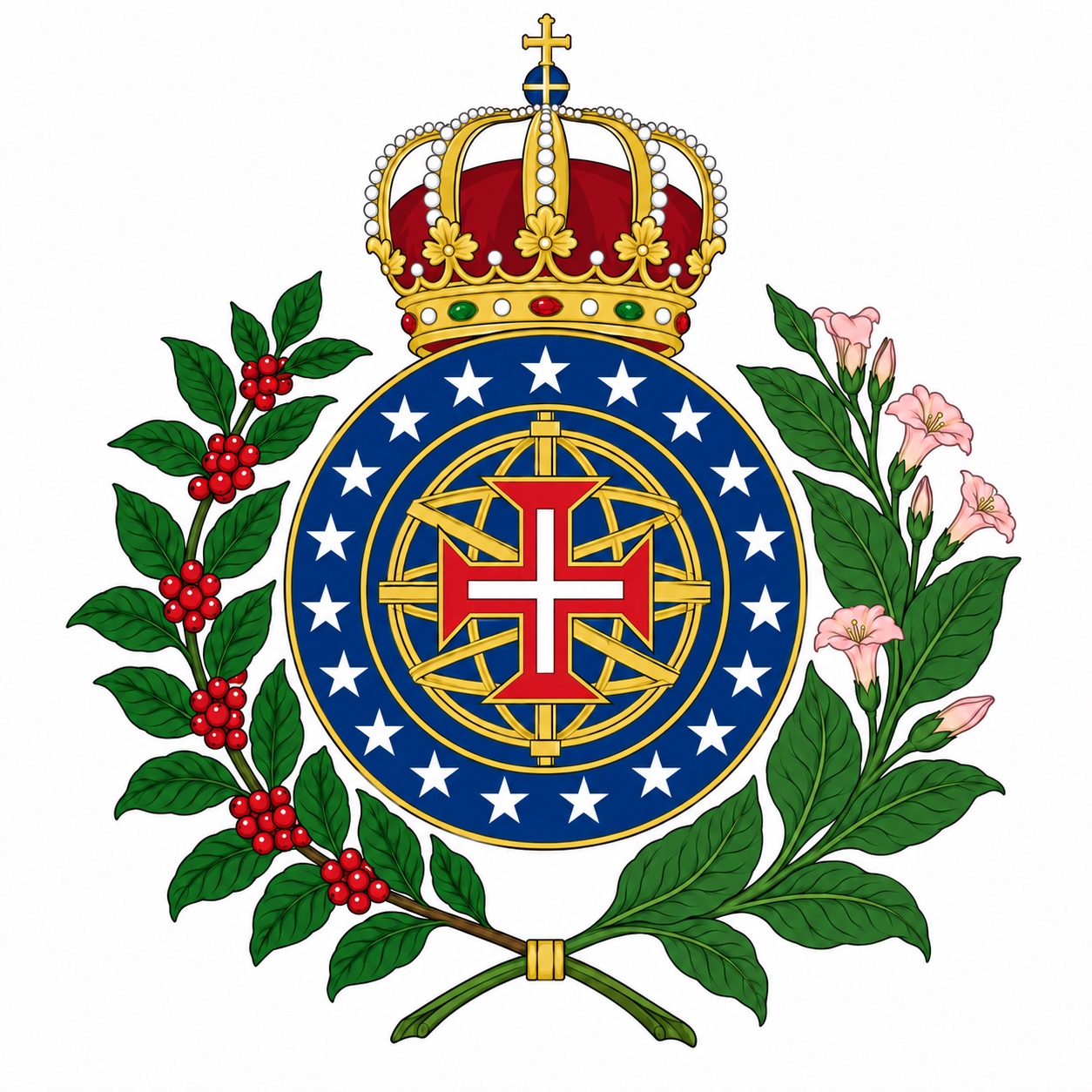
The arms are the armillary sphere of Portuguese navigation and the Cross of the Order of Christ on a blue field, ringed by nineteen stars for the provinces of the founding, within a wreath of coffee and tobacco branches, beneath the imperial crown. They have not been altered since the states outgrew the stars, on the reasoning that the stars record the founding rather than the present.
Crown, anthem and motto
Pedro II’s crown, made for his acclamation in 1841, is kept at Petrópolis and is not worn. A Brazilian sovereign is proclaimed and takes an oath before the General Assembly, and there is no coronation, a practice that matches the Portuguese one by coincidence rather than by arrangement.
The Hino Nacional Brasileiro is the anthem, with the melody Francisco Manuel da Silva wrote in 1831 and imperial words rather than the republican verses of 1909. The motto is Independência ou Morte, the words attributed to Pedro I at the Ipiranga, which appears on the arms of the army and on a great many public buildings.
Palaces
The Paço de São Cristóvão in Rio is the Emperor’s palace, is open to the public between visits, and stands empty the rest of the year, which republicans point at and monarchists say is the point. The Palácio do Catete is the Viceroy’s residence and the working seat of the head of state. Petrópolis, in the hills above Rio, is the summer residence of the court, was the town the nineteenth-century court built around itself, and is where the Treaty of Petrópolis was signed in 1903.
National day
7 September, Independence Day, is the national day, and the Emperor attends when his September visit allows. 13 May, the anniversary of abolition, is a public holiday and is increasingly the more serious of the two occasions.
Assessment
Brazil is the great continuity of the Americas: one state, one dynasty, one constitution, no republic, no revolution, no military government and no default in two hundred years. Every other large country in the hemisphere has broken and remade itself at least once. Brazil has amended.
Some of what the continuity bought is plain. There was no ruinous decade of the kind its neighbours suffered, no rewriting of the rules every generation, no disappearances and no junta, and the institutions that exist are old enough to be trusted and have been tested twice in living memory: in 1945, when the Crown dismissed a government that had suspended parliament, and in 1964, when it refused the generals and they went home. A country in which the head of state is not an office anybody can win has a ceiling on what a demagogue can achieve by winning one election, and Brazil has had cause to be grateful for the ceiling.
What it cost is equally plain and the article states it without softening. The monarchy survived 1888 because the planters were paid for the people they had held; the loan that paid them ran until the 1930s and the freed got nothing; and the distribution of land, income and colour in Brazil today is legible as the direct descendant of that transaction. Continuity preserved the parliamentary order and it preserved the landed order in the same motion, and the country that never had a revolution is also the country that never had a land reform worth the name until 1967, and then a weak one.
Whether those two facts are connected is the central argument of Brazilian historiography and the article does not settle it. One school holds that the Crown was the landed order’s instrument and that the absence of a rupture is the absence of the only thing that would have broken it. The other holds that the republics of the continent broke and remade themselves repeatedly without redistributing anything, and that Brazil’s inequality is the ordinary inequality of a plantation economy rather than the price of a throne. Both schools have the evidence they need, and neither has persuaded the other in a century.
The live questions are narrower. The Amazon is falling more slowly and still falling. The reparations argument has reached the stage of asking why the state paid the owners and not the freed, and no government has answered it. The Viceroy will probably be directly elected within a generation, which will make a stronger office of a post designed to be weak. And the monarchy itself, having spent forty years being represented by a Portuguese king who came twice a year, is now represented by a half-Brazilian one who is easier to like, which has quietened the argument without answering it.
Chronology
| Date | Event |
|---|---|
| 1500 | Portuguese landfall; the coast claimed |
| 16th to 19th centuries | The plantation economy; about 4.8 million enslaved Africans landed, more than in any other country |
| 1808 | The Portuguese court moves to Rio de Janeiro; the ports are opened |
| 1815 | Brazil raised to a kingdom equal with Portugal |
| 7 September 1822 | Independence declared by Pedro, the Portuguese heir; acclaimed Emperor in December |
| 1824 | The Constitution granted, with the Moderating Power |
| 1825 to 1828 | War with the River Plate over the Banda Oriental; Uruguay becomes independent |
| 1826 | Treaty with Britain binding Brazil to end the slave trade |
| 1831 | Pedro I abdicates; the Regency begins |
| 1835 to 1845 | The Cabanagem, Sabinada, Balaiada and Farroupilha revolts |
| 1840 | Pedro II declared of age at fourteen |
| 1850s | The Royal Navy ends the illegal slave trade in Brazilian waters |
| 1864 to 1870 | The Paraguayan War; Paraguay destroyed; the Brazilian army made |
| 1871 | The Law of the Free Womb |
| 1882 to 1884 | The royal commission on the army and the army law: pay, pensions, promotion by examination, a general staff |
| 13 May 1888 | The Golden Law abolishes slavery, with compensation to the owners |
| 1889 | A republican and military movement fails to find a garrison |
| 1891 | Death of Pedro II; Isabel I succeeds |
| 1890s to 1900s | The Moderating Power falls into disuse; the Chamber makes ministries |
| 1903 | Acre acquired from the Peru-Bolivian Confederation by the Treaty of Petrópolis |
| 1912 | The rubber boom collapses |
| 1917 | Brazil enters the First Great War on the Central Powers side after its ships are sunk |
| 1921 | Pedro III succeeds |
| 1922 to 1927 | The tenente risings |
| 1929 to 1930 | The coffee collapse; Vargas wins the election and is appointed Prime Minister |
| 1932 | Women’s suffrage |
| 1934 | The Church disestablished |
| 1937 | The Estado Novo: the Assembly suspended under the state-of-siege article, renewed by decree for eight years |
| 1942 | Brazil enters the Second Great War on the Allied side; Japanese, German and Italian Brazilians interned |
| 1944 | Pedro III dies; Isabel II succeeds; the expeditionary division lands in Italy |
| October 1945 | Isabel II dismisses Vargas and summons the Assembly: the last use of the Moderating Power |
| 1946 | The Moderating Power abolished at the Crown’s request; universal suffrage; the health service; the constitutional court; quilombo titles |
| 1946 to 1970s | The developmental decades: steel, cars, hydroelectricity, aircraft, oil |
| 1950 | The World Cup final lost to Uruguay at the Maracanã |
| 1964 | The generals demand a dismissal and the Empress refuses; the movement collapses in three days |
| 1964 to 1965 | A state of emergency: about 4,000 detentions, two deaths in custody, ended by the Empress’s refusal to renew |
| 1967 | Land reform, in a weakened form |
| 1970s | Itaipu begun with Paraguay; the ethanol programme; Embraer |
| Early 1980s | Recession and rescheduling, without default or hyperinflation |
| 1980s | Both crowns reform to absolute primogeniture in parallel |
| 1986 | Isabel II dies childless; the Convention of Rio; the crowns of Brazil and Portugal united in one person; Manuel II Emperor |
| 1988 | Manuel II’s centenary statement on abolition, judged inadequate |
| 1991 | Mercosur founded |
| 1993 | Referendum: the monarchy carries about 60 per cent; direct election of the Viceroy is defeated narrowly |
| 1990s | The cash transfer programme; the truth commission on 1964 to 1965 |
| 2010s | The tailings dam collapses; the kickback investigation |
| 2013 | Civil marriage extended to same-sex couples by the Constitutional Court |
| 2016 | The Rio Olympics |
| 2024 | Mateo Ferreira, a former Brazilian foreign minister, becomes Secretary-General of the League |
| 2026 | Otávio Barreto Lins elected Viceroy |
| 2027 | Manuel II dies; Pedro VI succeeds, the first half-Brazilian sovereign since 1889 |
| Present | The full apology for slavery made in the Assembly; the ordinal argument quieter; direct election of the Viceroy the likeliest reform |
✎ Editor's Note · The army law of 1884
The divergence is one reform and everything else follows from it. In the history the Register’s readers know, the Brazilian monarchy fell in November 1889 because two constituencies had turned against it in the same decade: an officer corps that came home from Paraguay underpaid and unpromoted and full of positivism, and a planter class that had just lost its property without compensation. Here the officers were dealt with in 1884 by a commission that took their evidence, and the planters were paid in 1888. Neither had a reason to move, and a monarchy that nobody needs to overthrow does not fall.
The point of the article is what that buys and what it costs. It buys the thing every Brazilian history wishes for, an unbroken constitutional line: no republic, no juntas, no disappeared, no currency reform, and two occasions on which a sovereign stopped something that should have been stopped. It costs the thing every Brazilian history is about, which is that the compensation that saved the throne was paid to slaveholders, out of a loan the country serviced for forty years, while the people who had been enslaved received nothing at all. The inequality in the modern article’s economy section is the same transaction, read a hundred and forty years later.
The Register therefore refuses the obvious shape, in which the surviving monarchy is the gentler timeline. It is not a gentler timeline. It is the same country with the same foundation and one fewer rupture, and the article’s assessment leaves open the question of whether the missing rupture is what preserved the foundation, because Brazilian historians have not settled it either.
Trivia
- In-Universe Brazil is the only large country in the Americas that has never been a republic.
- In-Universe Its independence was declared in 1822 by the heir to the Portuguese throne, which is why there is no war of independence to commemorate and why the crowns could be joined again in 1986 without embarrassment.
- In-Universe The Constitution of 1824 is still in force, amended, and is the oldest working constitution in the Americas after the Charter of Union.
- In-Universe The monarchy survived 1889 because of an army law passed in 1884: pay, pensions, promotion by examination and a general staff, recommended by a commission that took evidence from Paraguayan War veterans in every garrison town.
- In-Universe Abolition in 1888 was paid for. The owners were compensated by a loan that ran until the 1930s, and the people freed received nothing, which is the foundation of the modern reparations argument.
- In-Universe Brazil received about 4.8 million enslaved Africans, more than any other country in the world, and abolished slavery last.
- In-Universe The Royal Navy ended the illegal Brazilian slave trade in the 1850s by entering Brazilian waters and burning ships, which Brazilian historiography records as both a liberation and a violation of sovereignty.
- In-Universe The Golden Law was signed by a princess acting as regent, who later reigned for thirty years as Isabel I and is the most admired sovereign in Brazilian history.
- In-Universe Isabel I stopped using the Moderating Power on purpose, on the argument that a Crown that chooses governments will eventually choose wrongly and be blamed for it.
- In-Universe Brazil fought the First Great War on the side of the Central Powers, alongside Britain, Germany and the Realm, after French submarines sank its merchant ships.
- In-Universe The Estado Novo was lawful. Vargas suspended the General Assembly in 1937 under the constitution's state-of-siege article and renewed the suspension by decree every six months for eight years.
- In-Universe Pedro III countersigned all sixteen renewals. His private papers show he thought the suspension wrong throughout, which Brazilians consider an aggravation rather than a defence.
- In-Universe Brazil fought the Second Great War for constitutional government abroad while its own parliament was suspended, and the expeditionary division's veterans came home and said so.
- In-Universe Empress Isabel II dismissed Vargas in October 1945 on nobody's advice. It is the most popular act any Brazilian sovereign has performed and the last use of the Moderating Power.
- In-Universe The Moderating Power was abolished in 1946 at the Crown's own request, a year after it had saved the constitution.
- In-Universe Vargas was never tried. He was elected to the Senate in 1950 and died in 1954.
- In-Universe In 1964 the generals asked the Empress to dismiss a ministry and she went on the radio and refused. The Rio garrison would not march on her, and Brazil is the South American country that had no military government.
- In-Universe The emergency that followed 1964 lasted eighteen months, detained about 4,000 people and killed two in custody. A truth commission named those responsible in the 1990s and three police officers were convicted.
- In-Universe Brazil has never defaulted on its debt and has never had a hyperinflation, which is why the mil-réis has run unbroken since the empire's founding.
- In-Universe No new capital was ever built. Every constitution since 1824 provided for one, and the court, the Assembly, the banks and the newspapers were all in Rio.
- In-Universe Oscar Niemeyer built the ministries quarter of Rio instead of a new capital, and Brazilian modernism is a coastal style.
- In-Universe There is no federal district. Rio de Janeiro is the capital and sits inside the state of Rio de Janeiro.
- In-Universe São Paulo has been proposing that the capital be moved for more than a century, and it is the oldest continuous argument in Brazilian politics.
- In-Universe Since 1986 Brazil and Portugal have shared a sovereign and nothing else. There is no shared citizenship: a Brazilian needs a visa for Lisbon.
- In-Universe The Convention of Rio was signed in Rio because Brazil refused to sign it anywhere else, and negotiated by the Prime Minister and the President of the Supreme Tribunal together so that it would read as law rather than politics.
- In-Universe The Emperor takes the Portuguese ordinal in Brazil. A Paulista republican has introduced a bill to renumber him Pedro IV of Brazil in every parliament since 1987, and the Chamber votes it down by about two to one.
- In-Universe The Viceroy is elected by the General Assembly for five years, renewable once, and may not have sat in the Chamber in the previous two years.
- In-Universe When the Emperor lands in Brazil, the Viceroy meets him at the aircraft and hands back the state in a formula of about forty words, and takes it up again when he leaves.
- In-Universe One confirmation of a Viceroy has ever been delayed: nine days, in 1998, after which the Assembly passed a resolution recording that the confirmation is a formality.
- In-Universe An imperial act performed in the wrong capacity is a nullity in both Brazil and Portugal, and two chancery offices, in Lisbon and Rio, exist to prevent it. They publish their disagreements annually.
- In-Universe Brazil is the only realm of any crown in which republicanism is a mass party, and the Republican Party has sat in parliament since the 1870s.
- In-Universe The 1993 referendum asked two questions. The monarchy carried the first with about 60 per cent; direct election of the Viceroy lost the second much more narrowly, and is the reform most likely to happen.
- In-Universe The Viceroy opens the Rio carnival by handing over the keys of the city, and the samba schools have made the Crown their parade theme twice.
- In-Universe Brazil against Portugal is the only football match in the world at which both sides share a head of state.
- In-Universe Pedro II's crown is kept at Petrópolis and is not worn. Brazilian sovereigns are proclaimed and swear an oath before the General Assembly, with no coronation.
- In-Universe The republican flag with the starry globe and the motto Ordem e Progresso was designed in the 1880s for a republic that never happened and has no official standing. The national motto is Independência ou Morte.
- In-Universe The imperial arms still carry nineteen stars for the provinces of the founding, although there are now twenty-six states, on the reasoning that the stars record the founding.
- In-Universe The Emperor's palace in Rio stands empty between his two annual visits and is open to the public, which republicans point at and monarchists say is the point.
- In-Universe Brazil is the largest exporter of soy, beef, coffee, sugar, orange juice and chicken in the world.
- In-Universe Almost all the world's niobium comes from Brazil.
- In-Universe Itaipu, on the Paraná, was built jointly with Paraguay and was for thirty years the largest power station on earth.
- In-Universe About two million Brazilians are of Japanese descent, the largest Japanese community outside Japan. Their internment during the Second Great War has been formally apologised for.
- In-Universe Demarcated indigenous lands cover about an eighth of Brazil, and about 270 indigenous languages are spoken.
- In-Universe Capoeira was prosecuted as a crime into the twentieth century and is now protected national heritage. The prosecution is taught in schools.
- In-Universe The Crown apologised for slavery twice: a short statement on the 1988 centenary that Brazil judged inadequate, and a full apology in the General Assembly early in the present reign.
- In-Universe Brazil's standing demand in international politics is a permanent seat on the League Security Council. The Brazilian secretary-generalship of 2024 is treated at home as a consolation prize.
- Real-World Brazil's monarchy really was overthrown on 15 November 1889, by a military coup eighteen months after abolition, and Pedro II went into exile in France, where he died in 1891. The Register's divergence is an army reform in 1884 and compensation in 1888.
- Real-World Abolition in 1888 really was carried without compensation to slaveholders, and the resulting anger of the planters is the standard explanation for how little support the monarchy had the following year.
- Real-World Princess Isabel, who signed the Golden Law as regent, never reigned. She died in exile in France in 1921, the year the Register has her reign ending.
- Real-World Getúlio Vargas governed Brazil from 1930 to 1945 and again from 1951, and the real Estado Novo of 1937 to 1945 was a dictatorship with a secret police. He shot himself in the Catete palace in August 1954.
- Real-World Brazil really did send an expeditionary force of about 25,000 men to Italy in 1944, the only independent South American country to fight in Europe, and really did intern Japanese, German and Italian Brazilians.
- Real-World The Brazilian military dictatorship of 1964 to 1985 killed several hundred people and tortured thousands. The Register replaces it with a three-day crisis and an eighteen-month emergency.
- Real-World Brasília was built between 1956 and 1960 to Lúcio Costa's plan with Oscar Niemeyer's buildings, and the capital moved there in April 1960.
- Real-World Brazil defaulted in 1987 and passed through five currencies between 1986 and 1994 before the real ended the hyperinflation. The mil-réis was in fact replaced by the cruzeiro in 1942.
- Real-World The 1993 referendum happened, and it asked Brazilians to choose between monarchy and republic and between parliamentary and presidential government. The republic won with about 66 per cent and presidentialism with about 55.
- Real-World Brazil's imperial flag, with the crowned arms on the gold lozenge, was replaced four days after the 1889 coup by the starry globe and the positivist motto Ordem e Progresso.
See also
- Kingdom of Portugal, with which Brazil shares its sovereign
- Pedro VI, King of Portugal and Emperor of Brazil
- United Provinces of the River Plate, the old rival
- Peru-Bolivian Confederation, the Amazonian and Acre neighbour
- League of Nations, whose Secretary-General is Brazilian
- The Second Great War, in which Brazil fought in Italy
- James G. Blaine, who negotiated the commercial convention of the 1880s
Categories
- Nations of the world
- The Americas
- Constitutional monarchies
- Great powers