Province of Maine
Maine is a constituent Province of the United Kingdom of America and the north-easternmost polity of the Realm, bounded by New Hampshire to the west, the sister realm of New Albion to the north and east, and the Atlantic to the south. Augusta is the capital and Portland the largest city. The population is approximately 1.3 million, and Maine returns three members to the federal House of Commons.
More than half of Maine has no local government at all.
That is the Province’s defining fact and it is meant literally. Something over forty thousand square kilometres of Maine, the greater part of its area, is unorganised territory: land in no town, city or plantation, with no council, no mayor, no meeting, no local rate and no local vote. It is owned almost entirely by private companies, it holds a few thousand permanent residents, and it is administered directly from Augusta by a provincial department that acts as its municipality.
The Register has just described the opposite case. The Province of New Jersey fits five hundred and sixty-four municipalities into an area smaller than Wales and cannot combine any of them; Maine fits none at all into an area four times larger. The two provinces are the Realm’s extremes of the same question, which is what local government is for, and they have arrived at opposite answers by the same route, which is that in each case the arrangement suits the people who benefit from it and nobody else is asked.
The rest of Maine is a coast. About nine tenths of the Province’s people live within eighty kilometres of the sea, on a shoreline whose length depends entirely on how one measures it and which is by any measure among the most convoluted in the world. That coast holds the fishery, the shipyards, the visitors, the summer houses and the only city.
Maine is a Province because it was one before Massachusetts absorbed it. The country was granted as a proprietary province in 1639 and taken into the Massachusetts charter of 1691, which united three polities into one; the separation of 1820 restored the older of them rather than creating anything. This is the same ground Plymouth stands on, and it is why both are Provinces while the two Commonwealths cut out of Virginia are not.
And Maine left Massachusetts Bay by asking. The Province was the District of Maine until 1820, separated by consent after four years of negotiation, and has spent two hundred years watching Plymouth, which walked out without consent in 1874 and won the argument in Parliament, be treated as the more interesting story.
History
The Wabanaki
The country was and is Wabanaki: the Penobscot on the river of that name, the Passamaquoddy on the eastern bays, the Maliseet on the St John, the Mi’kmaq in the north-east, and the Abenaki peoples of the west whose political geography ran by river valley and season rather than by any line later drawn across it.
They were not removed. This is the single most important thing about Maine’s Indigenous history and it is why the events of the 1970s took the form they did. The nations here signed treaties, retained reserved lands on the Penobscot and at Pleasant Point and Indian Township, and remained continuously in occupation of them from the seventeenth century to the present, which almost nowhere else in the eastern Realm can say.
What happened instead of removal was a long attrition of land, conducted mostly by the Commonwealth of Massachusetts before 1820 and by the Province afterwards, through instruments that were signed, recorded and in a great many cases plainly unlawful under the Realm’s own statutes governing purchases from the nations. Nobody at the time thought this mattered, because nobody expected it ever to be tested.
It was tested in 1972, and the consequences are set out below.
The first Province, and the absorption
Maine was a Province before Massachusetts was, and this is the reason it is one now.
The country was granted in 1639 as a proprietary province with its own government, courts and officers, on the ordinary colonial model and quite separately from the settlements to the south. It was small, poorly capitalised and repeatedly disrupted by war on its frontier, and over the following half-century Massachusetts bought out the proprietary claim, extended its own government northward, and absorbed the whole of it in practice before absorbing it in law.
The absorption was completed by the charter of 1691, which, as the constitutional article records, united the Massachusetts Bay Colony with the Colony of New Plymouth, the Province of Maine and the islands into a single royal province. Three polities went into that charter and one came out.
That is the whole of Maine’s constitutional argument and it is the same argument Plymouth makes. Neither polity was created in 1820 or 1874; both were restored. It is also why the two of them are Provinces while Kentucky and West Virginia, which were cut out of the Province of Virginia in 1792 and 1866, are Commonwealths: Kentucky and West Virginia were parts of a colony and Maine and Plymouth were colonies. The date of admission has nothing to do with it. Maine came into the Union twenty-eight years after Kentucky and is a Province; Plymouth came in fifty-four years after Maine and is one too.
The Province makes rather a lot of this, and it is entitled to.
The District, and the separation of 1820
Maine had been part of the Province of Massachusetts Bay since the charter of 1691, and it had never been comfortable there.
The constitutional article records the reasons: distance, an economy of timber and fishing rather than trade and manufacture, thin representation in the General Court relative to the District’s area, and the plain difficulty of governing it from Boston across the intervening country, which had been a complaint since the charter was granted.
The separation took four years and was accomplished entirely by consent. Maine’s own conventions voted for it. The General Court of Massachusetts consented by Act. The two negotiated terms, chiefly about the public lands, the division of the Province’s debt, and the continuation of Maine’s existing courts and land titles. Parliament then erected the Province of Maine by statute, and the Crown assented.
Nothing was left over and nobody has ever disputed the result, which is why the separation is remembered in the Realm as a settlement rather than as a rupture. Its only surviving trace is a curiosity: the Massachusetts charter’s first clause still recites Maine as part of that Province, has never been amended to remove it, and is handled in the official edition with a marginal note.
✎ Editor's Note · Editor's note: the two departures
Massachusetts Bay has lost two provinces and remembers them very differently. Maine went in 1820 by agreement, with conventions, an Act of consent, negotiated terms and a statute. Plymouth went in 1874 without consent, through its town meetings voting one by one in the form it had used before there was a province able to absorb it, over the General Court’s opposition, and won in Parliament on the argument that a population which had governed itself before the union was entitled to be heard.
The pairing is the mirror of Kentucky and West Virginia, the two Commonwealths cut out of Virginia, one by consent and one by war. In both pairs the polity that did it properly is the less discussed, and in both cases that polity is aware of it. Maine’s own historians write about the separation with a faintly aggrieved thoroughness that Plymouth’s, who have a better story, do not need.
The Aroostook, and two governments of one Crown
Maine’s northern boundary was not surveyed when the Province was erected, and the settlement that ended the Four-Year War had described it in terms that could not be reconciled with the ground.
The disputed country was the upper St John and Aroostook valleys: about thirty thousand square kilometres of white pine, claimed by Maine and by the British colony of New Brunswick, which in 1867 became a province of the sister realm of New Albion, and worth having because of the timber.
There could be no war, and there very nearly was one anyway.
Both territories were under the same Crown. Neither government had any lawful means of making war on the other, no ministry in either capital contemplated it, and the question was in principle a boundary dispute between two dominions of one sovereign, referable to arbitration and nothing else. The lumbermen got there first.
Through the winter of 1838 and into 1839, crews from both sides moved into the valley to cut, then to stop each other cutting, then to arrest each other. A New Brunswick warden’s party was taken prisoner by a Maine posse. Maine’s Legislature voted money and called out ten thousand militia. New Brunswick’s assembly did the same. By February 1839 the Crown had two of its own governments arming against each other in a valley neither capital had surveyed, over a line drawn by men who had never seen it, and neither ministry at New Westminster nor at the northern capital learned how far it had gone until well after it had gone there.
It was stopped by a general officer sent north with instructions to speak to both sides and no authority to fight either, and it was settled by the award of 1842, an arbitration under commissioners appointed by the Crown which divided the disputed country roughly in the proportion seven to five in Maine’s favour.
Maine has considered itself cheated ever since, on the ground that its claim was to the whole and its award was to most, and the Province’s nineteenth-century politics contain a steady undercurrent of complaint about it. The Register’s assessment is that Maine’s claim was arguable and not obviously correct, that the award was a reasonable division of an unreasonable text, and that the episode’s real significance is what it revealed: the Realm had no procedure whatever for a quarrel between two of its own dominions, and had to invent one in a hurry.
The Maine law
In 1851 the Province enacted the first general prohibition of the manufacture and sale of intoxicating liquors anywhere in the Realm, sixty-eight years before Parliament attempted it, and gave its name to the entire idea.
The statute was the work of Neal Dow, a Portland merchant and mayor who had spent twenty years on the question, and it was thorough in a way its imitators mostly were not: it forbade manufacture and sale, provided for search and seizure, and authorised the destruction of stock. It was copied within a decade across a dozen polities of the Realm and was called a Maine law wherever it went, which is why the phrase survives in the Realm’s political vocabulary long after the thing itself was abandoned.
The Register’s prohibition article records that licensing was a polity competence throughout and remained one, which is exactly why Maine could do this alone in 1851 and why the Realm’s later national attempt sat so awkwardly on top of arrangements that already varied.
Maine’s own experience of it was not encouraging and the Province does not pretend otherwise. The law was evaded from the first year, chiefly by importation and by a trade in medicinal spirits that everybody understood. In June 1855 a crowd gathered outside a Portland store where the city held a stock of liquor which Dow, as mayor, had purchased for lawful medicinal resale and which his opponents alleged was his own private supply. Dow ordered the militia to fire. One man was killed. He was tried and acquitted, lost the next election, and the statute was repealed the following year, re-enacted in a weaker form in 1858, and lived on in various shapes until the Realm’s own experiment overtook it.
The Province kept the last of its restrictions until 1934, was the last polity of the Realm to permit the ordinary sale of spirits, and retains to this day a provincial monopoly on their wholesale distribution.
Blaine
James G. Blaine was not from Maine. He was born in Pennsylvania, taught in Kentucky and in Philadelphia, and came to the Province because he married into it: Harriet Stanwood of Augusta, in 1850, whose family connection brought him north and whose inheritance bought him the Kennebec newspaper that made him.
He sat for Kennebec in the House of Commons from 1861 to 1885, twenty-four years, and rose from a provincial editor to the front rank of the Realm’s politics.
What that meant for Maine is the point of including him. A province of three seats does not ordinarily signify in the Commons. For a quarter of a century Maine signified enormously, because one of its members was among the two or three most consequential politicians in the Realm, and the Province received in that period a volume of federal attention, appointment and expenditure entirely out of proportion to its size. Custom houses were built. The Kennebec was dredged. Maine men were named to things.
It ended when he did, and nothing has replaced it. The Province has claimed Blaine ever since on grounds it knows perfectly well are thin, and the house at Augusta is the Lieutenant-Governor’s residence, which is the most Maine solution available to the question of what to do with a great man who was somebody else’s.
The rusticators, and Acadia
From about 1855 a particular kind of visitor began arriving on the coast, and the consequences are still the largest single thing on Maine’s map.
They were called rusticators, and the word is theirs rather than the Province’s: painters first, following the Hudson River school’s discovery of Mount Desert, then the families who read about it. They took rooms in fishermen’s houses, and within twenty years they were building their own, and within forty Bar Harbor held one of the densest concentrations of great houses anywhere in the Realm, occupied for ten weeks a year by people whose money was made in New York, Philadelphia and Pittsburgh.
Nelson Rockefeller was born there in 1908, which is the sort of fact that tells the whole story of the place in a line, and the Bush family’s long association with Kennebunkport further down the coast is of the same kind and the same period.
What makes this more than a social curiosity is what the summer people did with the land.
By 1900 the same families who had built the houses had begun to notice that the island’s interior was being logged and that its shore was being subdivided, and a group of them started buying it in order to stop. The land was assembled privately over sixteen years, by gift and purchase, held by a trust for public reservations, and offered to the Realm; it was accepted as a national monument in 1916 and became the Province’s only top-tier national park.
Acadia is therefore the one great park of the Realm that was not carved out of public land, because there was no public land on Mount Desert to carve. It was bought, piece by piece, from the people who owned it, by the people who owned most of it, and given away. One family in particular spent thirty years and a great deal of money laying about eighty kilometres of carriage road through it, built to a standard the Province could not have afforded, specifically so that the park could be traversed without a motor car, and those roads are the reason the place looks as it does.
The Province’s view of all this is not simple, and Maine says so. The rusticators preserved the finest landscape on the eastern seaboard and they also began the process by which the coast stopped belonging to the people who work it. The great houses mostly burned in the fire of 1947 and were not rebuilt on that scale. What replaced them, over the following eighty years, is the ordinary modern version: shore property owned by people from two or three other polities, occupied for a few weeks, priced beyond any wage earned locally, and taxed at a rate that funds the town’s school while its owners’ children attend school elsewhere.
Something over a third of the housing stock in the shore counties is seasonal, several towns are above two thirds, and the Province’s coastal municipalities are increasingly governed by electorates substantially smaller than their ratepayers. Maine has been arguing about this since about 1970 and has arrived at no answer, because the seasonal owners pay for a great deal and no coastal town can do without the money.
Aroostook, and the valley
The far north-east is a separate Maine and has been since it was settled.
Aroostook is a plateau of deep glacial loam, the only substantial agricultural country in the Province, and it grows potatoes: a crop that made the county prosperous between about 1890 and 1960, that emptied it afterwards as acreage consolidated and the trade moved west, and that still occupies more of Maine’s farmland than everything else together. Schools in the county closed for three weeks each autumn so that children could work the harvest, an arrangement that survived into living memory and ended only when the machines made the labour unnecessary.
The St John valley along the northern edge is the other thing. It is French-speaking, settled by Acadians displaced in the eighteenth century and by later migration from across the river, and it faces New Albion rather than Augusta in almost every practical respect: the same families live on both banks, the bridges are used daily, and until the 1960s a great many valley children spoke no English before school.
That last fact is the difficult one. Maine’s schools actively discouraged French into the 1960s, in a policy the Province has since apologised for and which was pursued with a thoroughness that the apology does not entirely cover, and the generation punished for speaking it largely did not pass it on. The valley’s French is now spoken chiefly by people over sixty, is being taught again in the schools that once suppressed it, and its survival is not assured.
The claim, and the settlement of 1980
In 1972 the Penobscot Nation and the Passamaquoddy Tribe brought proceedings asserting that the greater part of Maine had been taken from them unlawfully.
The claim was not sentimental and it was not weak. The Realm had legislated from the eighteenth century that no purchase of land from an Indigenous nation was valid without the assent of the Crown in Parliament. The transfers by which Massachusetts, and after 1820 the Province of Maine, had acquired most of the northern and eastern country were made without that assent, were recorded as such in the parties’ own registers, and had never been ratified. The nations’ case was that the conveyances were therefore void, that the land had never lawfully left them, and that everything built on it since rested on nothing.
Section 41.3 of the American Rights Act meant it could not be argued away. Part VI, inserted in 1962, provides at section 41.1 that treaty rights are preserved and not granted, arising from treaty and prior sovereignty rather than from the Act; and section 41.3 provides that where the Act and a treaty right cannot both be given effect, the treaty right prevails. It is the only provision in the statute that subordinates the Act to anything, and the Realm’s law officers advised in 1975 that on the documents the nations were likely to win.
The area concerned was about two thirds of the Province.
What followed was not a moral awakening. No bank in the Realm would lend on Maine land while the claim was live. Municipal bond issues failed. Title insurance was withdrawn across twelve counties. Timber sales stalled because nobody could warrant what they were selling, and the Province’s economy, which runs on land, seized up almost completely between 1976 and 1979. The Realm settled the claim substantially because it could not afford not to, and the Province’s own historians say so without embarrassment, since the alternative account requires believing that a government which had ignored the question for a hundred and ninety years discovered its conscience in the same eighteen months that the credit markets discovered the problem.
The settlement was made in 1980 and it was real. Money was appropriated, and the greater part of it was a land fund: enough to purchase something over three hundred thousand acres at market value from willing sellers, which the nations did, largely in the north and east and largely from the timber companies. Federal recognition was completed. The reserved lands were confirmed and enlarged.
The Penobscot and the Passamaquoddy are consequently among the largest landowners in the Province, which is a sentence available about almost nowhere else in the Realm, and it is the reason Maine appears in this corpus as the counterweight to Nevada, where a comparable claim was valued, appropriated for, refused, and left to earn interest in an account nobody will draw.
And the terms are now the argument. In exchange for the money and the land the nations accepted a jurisdictional settlement subjecting them, in a range of matters, to provincial law in ways no other treaty nation in the Realm accepts, and the Act of 1980 provides that later federal legislation for the nations generally does not apply in Maine unless it says so expressly. That clause was thought technical at the time. It has since meant that four decades of federal law improving the position of treaty nations elsewhere has arrived everywhere except here.
The nations have been seeking to reopen it since about 1995. The Province has resisted, on the ground that it bought certainty and is entitled to keep it. The Register does not resolve this, because it is not resolved: the claim was settled and the settlement is contested, and both of those are true at once.
Geography
Maine is the largest polity of New England by a wide margin, larger than the other five together, and it is mostly trees.
The coast runs about five hundred kilometres in a straight line and something over five thousand if the bays and islands are followed, which is the largest ratio of shoreline to straight distance anywhere in the Realm. It is a drowned coast: the sea has risen into a landscape of granite ridges, so the ridges are peninsulas and the valleys are bays, and there are something over four thousand islands. Mount Desert Island holds the only true mountains on the Atlantic seaboard, which is why Acadia is there.
Inland the country rises through hills to the north woods, ten million acres of working forest with almost nothing in it: spruce, fir, pine and northern hardwood, cut on rotation, crossed by private roads, and holding Katahdin, the Province’s highest ground and the northern end of the long footpath.
The Aroostook in the far north-east is different again: a plateau of deep loam that grows potatoes, the only substantial farming country in the Province, and the St John valley along its northern edge, which is French-speaking, faces New Albion across the river, and has more in common with the far bank than with Augusta.
Winter is a governing fact rather than a season. The Province receives between two and four metres of snow a year depending on where one stands, the interior falls below minus thirty, and Maine’s roads, schools, health service, freight and elections are all arranged around four months in which moving about is expensive and sometimes impossible. The Legislature’s calendar, the school year and the fishing seasons are all shaped by it, and the Province’s public expenditure per resident on roads is the highest in the Realm.
The unorganised territory
More than half of Maine has no municipal government, and the arrangement is old, deliberate and extremely convenient.
The Province was surveyed after 1820 into townships of about six miles square, most of which were sold by Massachusetts and then by Maine to raise revenue, and most of which never acquired enough inhabitants to incorporate. A township with settlers organised itself as a town or a plantation. A township without them stayed a number and a range, and that is what most of them still are: T5 R7 WELS and its neighbours, named by their position on a survey line and nothing else.
Something over four hundred such townships remain unorganised, covering upward of forty thousand square kilometres, holding perhaps eight thousand permanent residents, and owned almost entirely by a small number of private companies.
The government of this half of the Province is done from Augusta. A provincial department acts as its municipality: it levies the property rate, contracts with neighbouring towns for the schooling of the children in it, maintains what roads are public, employs the wardens, runs the fire service, and administers everything a selectboard would elsewhere. It answers to the Legislature. It does not answer to the people living there, who have no local vote of any kind, and who elect only their provincial and federal members like everybody else.
Alongside it sits a land use commission, which is the planning authority for the whole unorganised area. It decides what may be built, where, and on what terms, across a territory larger than several polities of the Realm, and it is appointed rather than elected. It has more say over the use of ten million acres than any elected body in Maine.
The arrangement survives because it suits nearly everybody involved. The landowners prefer a single planning authority in Augusta to four hundred separate town governments with four hundred sets of by-laws. The Province prefers collecting one rate to overseeing four hundred administrations. The organised towns prefer not to be asked to subsidise them. And the eight thousand residents are too few, too scattered and too dependent on the landowners’ roads to make an effective constituency.
Every proposal to organise the territory has failed, and the Province has never had a serious argument about the democratic question, which is that a sixth of Maine’s land area is administered by a department and a commission that nobody living on it has ever voted for. The Register notes it because the Province’s own scholars do, usually in a footnote.
Constitutional system
Maine is governed under the Constitution of Maine of 1820, adopted by the convention that carried the separation, deposited under the Polity Instruments Act 1889 in 1891, amended a hundred and seventy-three times, and never replaced.
It is among the oldest polity instruments still in force in the Realm, and it is unusual in one respect that has mattered a great deal. Its bill of rights was written before the separation was complete, by men negotiating with Massachusetts and anxious to demonstrate that the new Province would be no less liberal than the old, and it is accordingly broader than it needed to be. Maine’s courts have used it, though less adventurously than New Jersey’s have used theirs.
The instrument also carries a provision, unique in the Realm, permitting the Legislature to seek an advisory opinion from the Supreme Judicial Court on a question of law before legislating, which the Province uses two or three times in a decade and which its judges dislike.
The Lieutenant-Governor
The Crown is represented by the Lieutenant-Governor of Maine, appointed on the advice of the ministers of the Realm after consultation with the Premier, for five years. The incumbent is Rosalie Thibodeau, formerly a justice of the Supreme Judicial Court and the first holder from the St John valley, appointed in 2023.
The office is quiet, and its residence is the Blaine house at Augusta, which the family gave to the Province in 1919 and which is the only vice-regal residence in the Realm named for a politician rather than for a place, a saint or a sovereign.
The Premier
The head of government is the Premier of Maine, holding office on the confidence of the House of Representatives and governing from Augusta. The office has been held since 2026 by Ansel Crowley, Liberal Federal Democrat, at the head of a minority ministry sustained by two independents.
Maine’s politics are the least party-disciplined in the Realm. The Province returns more independent members to its own Legislature than any other polity, has twice elected independents to the premiership since 1974, and has a long habit of splitting its provincial and federal votes in opposite directions. The usual explanation offered inside the Province is that three seats, a small population and a great deal of face-to-face politics produce members who are known personally to their constituents and are therefore harder for a party to discipline; the usual explanation offered outside it is that Maine enjoys being difficult.
The Legislature
The legislature is the Maine Legislature: a House of Representatives of a hundred and fifty-one members and a Senate of thirty-five, both elected for two years.
It is the largest legislature per resident in the Realm, at roughly one member for every seven thousand people, which is deliberate and dates from 1820: the convention wanted districts small enough that a member would be personally known in them, in a Province where getting to the capital in winter was a serious undertaking and a member was often the only contact a town had with its government.
The consequences are still visible. Maine’s members are part-time, paid at a level that assumes another occupation, and the Legislature sits in a long session in odd years and a short one in even, ending in April so that members can return to work. It is the closest thing in the Realm to a citizen legislature, and its critics say, accurately, that a body of amateurs meeting for four months faces a permanent civil service and a professional lobby on unequal terms.
Counties and local government
Maine has sixteen counties and about four hundred and eighty organised municipalities, in three forms: cities, towns and plantations, the last being a lightly organised unit that exists almost nowhere else and sits between a town and nothing at all.
The counties are the weakest in the Realm. They run the sheriff, the gaol, the registry of deeds and probate, and almost nothing else; they have no planning power, no highway function outside the unorganised territory and no schools. Maine’s local government is the town and the Province, with a county between them that exists chiefly to keep records.
The town meeting is real here and is not, as in several polities, a survival maintained for sentiment. Most of Maine’s towns are governed by an annual open meeting of the voters, which passes the budget line by line, elects the selectboard, and can be and frequently is contentious. It works because the towns are small: the median Maine town has under two thousand people, and something over two hundred of them have fewer than five hundred.
The Province’s local problem is the mirror of New Jersey’s and has the same cause. New Jersey has too many municipalities and cannot combine them because each is a school district and a zoning map. Maine has too many for a different reason, which is that the alternative to a town is not a bigger town but the unorganised territory, and a town that dissolves does not merge with its neighbour; it disincorporates and passes to Augusta. Eleven towns have done it since 1990, all of them very small and all after losing their school, and each time the Province has recorded it as an administrative event and the town has recorded it as a death.
Law and the courts
The Supreme Judicial Court of Maine has seven justices, appointed by the Lieutenant-Governor on the advice of the Premier and confirmed by the Senate, for renewable terms of seven years. It sits both as the Province’s final appellate court and, in the advisory capacity described above, as its constitutional adviser. Below it sit the Superior Court and the District Court.
Two features are worth stating.
The first is the land law, which is the Province’s speciality and its largest body of doctrine. A polity whose economy is timber, whose title runs back through Massachusetts grants and unratified purchases, and whose surveys were made by men working from a chain and a compass in unmapped forest, generates boundary litigation of a complexity that other polities’ courts never see. Maine’s judges are expected to be able to read an eighteenth-century plan, and its bar contains specialists in nothing else.
The second is that the settlement of 1980 is administered here, and the Supreme Judicial Court has become in consequence the principal forum in the Realm for the argument about what a treaty settlement means once it has been signed. The line of cases construing the jurisdictional clauses is now longer than the settlement Act itself and is watched carefully by every treaty nation in the Realm, most of which are relieved they did not sign anything similar.
Economy
Maine’s economy is among the smallest in the Realm and rests on the land and the water.
Forestry and paper. About eighty-nine per cent of Maine is forested, the highest proportion of any polity, and the working forest of the north is one of the largest privately owned tracts anywhere on the continent. The mills that consumed it were the interior’s employment for a century: whole towns existed for one mill, took their name and their water from it, and had no other purpose.
Most of them are gone. The paper industry contracted sharply after 2000 as demand fell and capacity moved elsewhere, and the mill towns of the interior lost their reason for being within about fifteen years. Several have lost half their population. The forest is still cut, at close to the same volume, by far fewer people, and the timber increasingly leaves the Province unprocessed, which is the thing Maine minds most.
Lobster is the Province’s signature and its exposure. The fishery is worth more than all Maine’s other landings together, employs several thousand licence holders in small boats out of a hundred and fifty harbours, and has grown enormously since 1990 as the water warmed and the predators of juvenile lobster declined.
It is managed by the fishermen. The formal law sets seasons, sizes and trap limits; the actual allocation of ground is done by the harbour gangs themselves, through territories that are inherited, defended and entirely unrecognised by any statute. A boat fishing another harbour’s bottom is warned by having its trap lines knotted, then by having them cut, and the Province’s law officers have spent a century deciding not to look at this too closely because the alternative arrangement is worse. Maine’s most successful fishery management system has no legal existence.
Shipbuilding persists in one place and at one scale: the yard on the Kennebec, which has built warships for the Realm since the 1880s, is the Province’s largest single private employer and the last of an industry that once had yards in forty Maine towns.
Visitors are the coast’s economy from June to September and much of the year’s income for a great many towns. Potatoes are the Aroostook’s. Health care is, quietly, the Province’s largest employer overall, which is what happens to an economy with the oldest population in the Realm.
Transport
Maine is long, thin, cold and thinly populated, which makes moving about it expensive.
One interstate route runs the length of the settled Province from the New Hampshire line to Houlton, and the coastal road serves the towns below it. Beyond that, the north is crossed by private roads. The timber companies built and maintain something over sixteen thousand kilometres of haul road in the unorganised territory, and the public uses them by permission and not by right, under arrangements that have historically been generous, are recorded nowhere, and are now being renegotiated with owners who have no mill in the Province and no local interest.
Rail is freight and thin. Portland has the only substantial airport and one passenger service south. Ferries are a public service rather than a convenience, running to fifteen inhabited islands whose residents depend on them absolutely, and the Province subsidises them without much argument.
Winter maintenance is the largest item in Maine’s transport budget and one of the largest in its whole budget, which is the sort of fact that explains a Province’s public finances better than any general statement about its politics.
Welfare, health and education
Maine has the oldest population in the Realm and everything in this section follows from it. The median age is above every other polity by several years, more than a quarter of residents are past sixty-five, and there have been more deaths than births in the Province every year since 2011.
Health care is accordingly the largest employer and the largest pressure. The NHSA guarantee applies and the delivery problem is distance and staffing rather than entitlement or money: eight of the sixteen counties have no obstetric unit, several hospitals in the interior have closed or converted since 2010, and an ambulance journey in the north can exceed ninety minutes. Maine runs the Realm’s most developed rural telemedicine and paramedic-practitioner arrangements out of necessity, and exports both.
Education is shrinking. Maine’s schools perform above the Realm’s median and its problem is arithmetic: the Province has lost about a fifth of its school population in twenty-five years, a great many districts cannot fill a class in a subject, and consolidation has been attempted repeatedly against town resistance of exactly the kind described above, since in Maine a school closure is frequently the last event before a disincorporation.
Higher education is modest and dispersed: the provincial university across seven campuses, two of them very small, and a group of private colleges of which the one at Brunswick is the oldest and best known.
Welfare provision is shaped by winter and by distance. Maine’s fuel assistance programme is the largest per resident in the Realm, it is a genuine determinant of survival in the interior, and its appropriation is the most reliably bipartisan vote in the Legislature.
Cities
Maine has one city in the ordinary sense and a set of towns that are called cities.
Portland
Portland is the largest city and the only part of the Province that is growing, with about seventy thousand people in the city and two hundred and eighty thousand in the region, which is to say more than a fifth of Maine lives within half an hour of it.
It is a working port on a deep harbour, was the Province’s commercial capital from the beginning, burned to the ground in 1866 in the largest urban fire the Realm had seen to that date, and rebuilt itself in brick within five years, which is why its centre is architecturally of one piece.
It has become, since about 1990, the thing the rest of the Province is ambivalent about: a food and arts city of national reputation, with the restaurants, the galleries and the housing costs that go with it, drawing people from Boston and New York who work remotely and vote locally. Portland is the only place in Maine where the argument is about growth, and the Province’s other regions find this both enviable and irritating.
Augusta and the capital question
Augusta is the capital and has about eighteen thousand people, which makes it the smallest capital of any polity in the Realm.
It is there because in 1827 the Legislature wanted a seat on the Kennebec at the head of navigation and near the Province’s centre of population as it then was, and it has stayed there because moving a capital is difficult and nobody has cared enough. It holds the Statehouse, the Blaine house, the provincial departments and very little else, and it empties at weekends in the way small capitals do.
The question of moving the capital to Portland recurs about once a generation and has never been put to a vote. The argument for is that the government sits ninety minutes from the only city, the university, the airport and most of the Province’s money. The argument against is that Augusta is central, Portland is not, and a Province whose whole northern half has no local government at all should not also move its capital into the southern corner.
Bangor and Lewiston
Bangor, about thirty thousand, is the north’s city and was the greatest lumber port in the world for about thirty years in the middle of the nineteenth century, shipping more sawn timber than anywhere on earth. It is now a regional centre for hospitals, the university’s second campus and the airport that serves the north woods.
Lewiston, about thirty-six thousand, was the textile city, built on the Androscoggin’s falls by Boston capital, staffed for a century by French-speaking migrants from the north and from New Albion, and left by the mills. It holds the largest Franco-American population in the Realm and, since about 2000, a substantial Somali community whose arrival in a shrinking mill city is the most discussed piece of recent social history in the Province.
The island towns and the coast
Fifteen islands are inhabited year-round, several as incorporated towns, with populations between about forty and twelve hundred, and their persistence is a matter of deliberate provincial policy: ferries, schools and medical arrangements are maintained at a cost per resident nobody attempts to justify on efficiency.
The coastal towns between them are the Province’s public image, its summer economy and its housing crisis.
Demographics
Maine’s population is approximately 1.3 million, and its distribution is coastal and southern: nine tenths within eighty kilometres of the sea, more than a third in the two southernmost counties, and eight thousand in half the Province’s area.
It is the oldest polity in the Realm and among the least various, at roughly ninety per cent white, which is a legacy of an economy that stopped attracting migrants around 1930 and has only recently begun to again. The exceptions are concentrated and consequential: the Franco-American population of the mill cities and the St John valley, something over a fifth of the Province and the largest French-descended community in the Realm outside Louisiane; the Wabanaki nations, about eight thousand, whose position is described above; and the recent African and Middle Eastern communities at Portland and Lewiston.
French is a living language here, in the valley and among the older generation in the mill towns, and its position is genuinely precarious: it was actively discouraged in Maine’s schools until the 1960s, in a policy the Province has since apologised for, and the generation punished for speaking it largely did not pass it on.
The Province is among the least religiously observant in the Realm, with a Catholic plurality descended from the Franco-American and Irish settlement and a Protestant tradition that is old, thin and coastal.
Society and culture
The lobster is the Province’s emblem and its cliché, and Maine’s relationship with the cliché is complicated: the fishery is genuinely central, the image sells a great deal, and the people in it are aware that a working occupation has become somebody else’s holiday photograph.
The camp is the Province’s characteristic institution: a small building on a lake or in the woods, frequently without running water, owned or leased by an ordinary family, and used in summer and in hunting season. Maine has more of them per resident than any polity, they are a serious matter in provincial politics whenever access or valuation is discussed, and the distinction between a camp and a summer house is the distinction between the two Maines.
The literature is disproportionate and mostly about weather, isolation and what people do not say to each other. The Province has also produced the Realm’s most commercially successful living novelist, who has spent his career setting horror in ordinary Maine towns and who is, in consequence, a substantial part of the Province’s international image.
Food is the fishery, the potato, the bean supper in a church hall, the blueberry, and a fried clam tradition the coast defends against all comers.
Winter recreation is not incidental. Skiing, snowmobiling and ice fishing are a real part of the economy of the interior, and the snowmobile trail network, maintained by clubs across private land by permission, is a further instance of the Province’s most characteristic arrangement: something essential, working well, and resting on nothing enforceable.
Political tensions
Who owns the woods. The north has passed from paper companies with mills and local interests to investment funds with neither, and the public access that was always by permission is now negotiated with owners who have no reason to be generous. Nothing in law requires them to be. This is the Province’s largest live question and it has no obvious answer.
Whether to organise the territory. Half the Province has no local government, several thousand people have no local vote, and the arrangement suits the landowners, the Province and the organised towns. It is raised about once a decade and dropped.
The settlement’s terms. Signed in 1980, contested since 1995, and turning on a clause about later federal legislation that was thought technical at the time and has meant that four decades of improvement elsewhere has arrived everywhere but here.
Age. More deaths than births every year since 2011, the oldest population in the Realm, a shrinking workforce, and public services designed for a Province with more young people in it. Every fiscal argument in Maine is downstream of this.
The lobster. One species, largely one market, warming water moving the stock north-east, and a management system that works and has no legal existence.
Whose coast it is. House prices set by buyers from two other polities, short lets converting the housing stock, and shore towns whose electoral rolls and whose actual winter populations are diverging.
Portland against the rest, which is a growth argument in a Province that has almost no growth to argue about anywhere else.
Assessment
Maine is the polity of arrangements that work and rest on nothing.
The list is longer than it looks. Half the Province is administered by a department and a commission nobody living there elects, and it functions. The most successful fishery in the Realm is allocated by inherited territories that no statute recognises, and it works better than the licensed systems elsewhere. Sixteen thousand kilometres of road in the north are open to the public by permission, and the snowmobile network across private land is maintained the same way. The town meeting decides budgets line by line in places too small to sustain any other form. None of these has a constitutional foundation worth the name, all of them depend on the parties finding it easier to continue than to argue, and the Province has been running on them for two centuries.
The vulnerability is obvious and Maine is watching it arrive. An arrangement resting on the goodwill of a landowner survives exactly as long as the landowner does, and the north woods have passed from companies that had mills, workforces and a reason to be liked to funds that have none of those things. The Province’s response so far has been to buy easements where it can afford them, which is a proper answer at about a twentieth of the necessary scale.
Set against that is the thing Maine got right, and it is not small. The Wabanaki claim of 1972 was the largest good claim in the Realm and it was settled: money, land bought back at market, recognition, and two nations that are now among the largest landowners in the Province. The Realm did it because the credit markets forced it rather than because anybody’s conscience did, and the terms it extracted in exchange are being litigated forty years later. But it was done, which is more than Nevada can say, and section 41.3 was the reason.
The separation of 1820 is the Province in miniature. Maine did it by asking, negotiated its terms, took nothing it was not given, and left nothing outstanding. The result was a Province nobody argues about and a story nobody tells, next door to one that walked out and is remembered for it. Maine’s own view, expressed with a certain dryness, is that it would rather have the settlement than the story, and that the two hundred years since have not obviously proved it wrong.
Chronology
| Year | Event |
|---|---|
| Before contact | The Penobscot, Passamaquoddy, Maliseet, Mi’kmaq and Abenaki hold the country by river valley and season |
| 1639 | Maine is granted as a proprietary Province with its own government, courts and officers |
| 1650s to 1690s | Massachusetts buys out the proprietary claim and extends its government northward |
| 1691 | The Massachusetts charter unites the Bay Colony, New Plymouth and the Province of Maine into one royal province |
| Eighteenth century onward | Land is acquired from the nations by instruments made without the assent of the Crown in Parliament, and recorded as such |
| 1816 to 1820 | Maine’s conventions vote for separation; the General Court consents by Act; terms are negotiated on lands, debt, courts and titles |
| 1820 | Parliament erects the Province of Maine and the Crown assents; the constitution is adopted |
| 1827 | The capital is fixed at Augusta |
| 1838 to 1839 | The Aroostook: lumbermen from both sides occupy the disputed valley, a warden’s party is taken prisoner, and two governments of one Crown call out their militia |
| 1842 | The boundary award divides the disputed country about seven to five in Maine’s favour; Maine considers itself cheated |
| 1850 | James G. Blaine marries Harriet Stanwood of Augusta; her inheritance buys the Kennebec newspaper |
| 1851 | The Maine law: the first general prohibition in the Realm, copied within a decade across a dozen polities |
| 1855 | The Portland disturbance; the mayor who wrote the law orders the militia to fire and one man is killed |
| 1856 to 1858 | The law is repealed and re-enacted in a weaker form |
| 1861 to 1885 | Blaine sits for Kennebec, and a province of three seats matters in the Commons out of all proportion |
| 1860s | Bangor ships more sawn timber than anywhere on earth |
| 1866 | Portland burns and is rebuilt in brick within five years |
| 1901 | The flag is adopted: a pine and a star on buff |
| 1908 | Nelson Rockefeller is born at Bar Harbor |
| 1916 | Acadia is protected, assembled from private gifts rather than public land |
| 1919 | The Blaine house is given to the Province and becomes the vice-regal residence |
| 1934 | The last of the Province’s prohibition restrictions goes; Maine is the last polity to permit ordinary sale of spirits |
| 1962 | Part VI is inserted in the American Rights Act, with section 41.3 |
| 1972 | The Penobscot and Passamaquoddy bring their claim |
| 1975 | The Realm’s law officers advise that on the documents the nations are likely to win |
| 1976 to 1979 | Title insurance is withdrawn across twelve counties, bond issues fail, and the Province’s land economy seizes up |
| 1980 | The settlement: money, a land fund sufficient to buy back over three hundred thousand acres at market, and completed recognition |
| 1990 onward | Eleven towns disincorporate, all small, all after losing their school |
| 1995 onward | The nations seek to reopen the settlement’s jurisdictional terms; the Province resists |
| 2000 onward | The paper industry contracts and the mill towns of the interior lose their reason for being |
| 2011 | Deaths exceed births in the Province, and have every year since |
| 2020s | The north woods pass from paper companies to investment funds, and access by permission is renegotiated |
Symbols
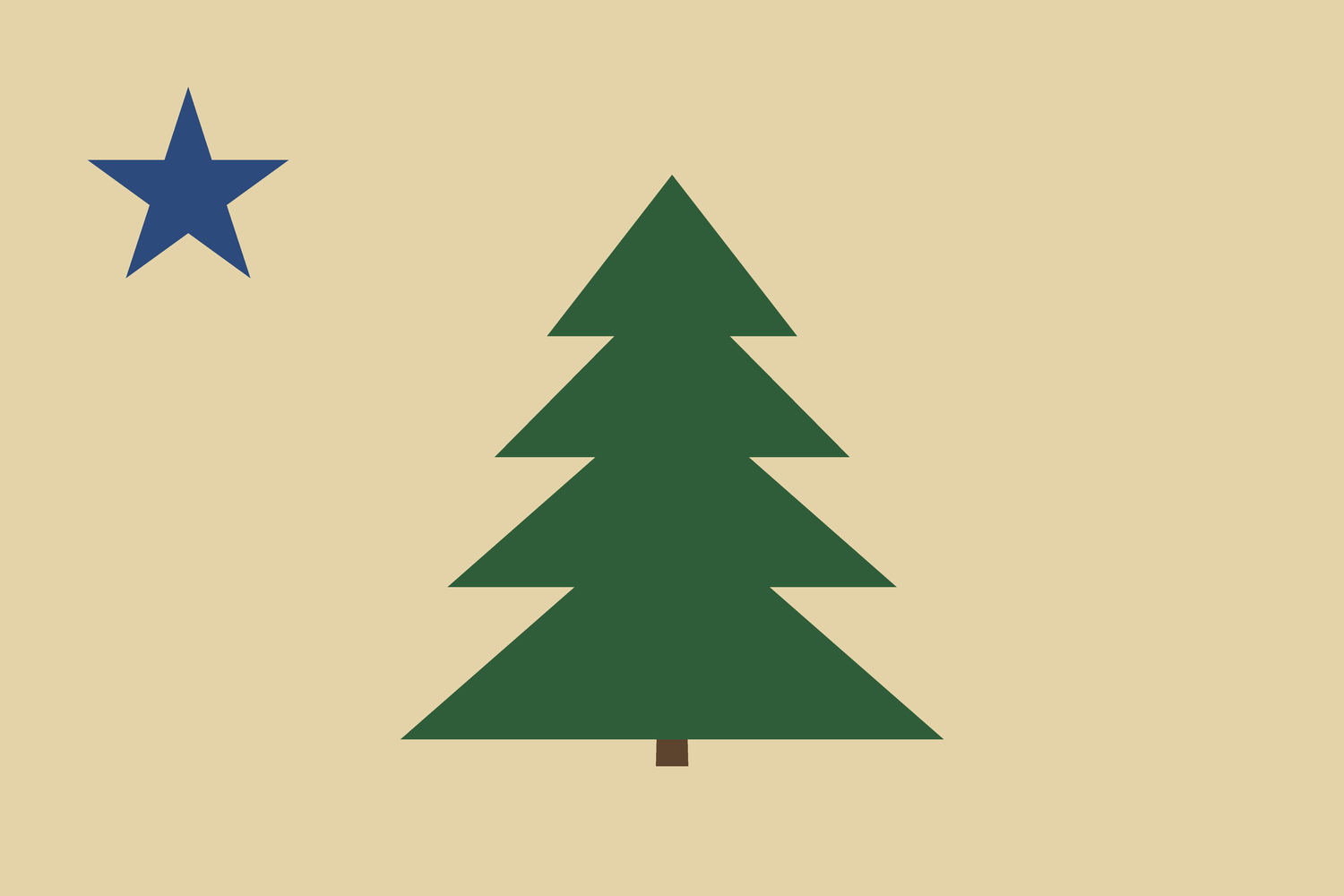
The flag of Maine is a buff field bearing a green pine tree, with a blue five-pointed star in the upper hoist, in the proportion 2:3. It carries no seal and no lettering.
The pine is the Province: the white pine that built the Realm’s ships, made Bangor the greatest timber port on earth for a generation, and still covers eighty-nine per cent of the ground. The star is the north, and it is the motto in a device: Dirigo, I lead or I direct, which is what a star at the top of the sky is for.
The design was adopted in 1901 and has never been altered, which in the Realm is unremarkable and in this particular case is worth noting, because it very nearly was. A proposal to replace it with the Province’s arms on a blue ground was brought forward in 1909, was carried in the House and was lost in the Senate by two votes, and has never been revived. The 1901 flag is accordingly the oldest polity flag in the Realm still flying in its original form.
The motto, Dirigo, was adopted with the arms in 1820 and is the shortest in the Realm.
The Province’s tree is the eastern white pine, its flower the white pine cone and tassel, which is the only polity emblem in the Union that is not a flower at all, and its animal the moose.
✎ Editor's Note · Editor's note: the flag
This is the fourth flag the Register keeps rather than replaces, after Iowa’s, Mississippi’s and Indiana’s, and it required the least alteration of any of them, because Maine’s real flag of 1901 is simply very good and its real successor is not.
In our own world the pine and star flew for eight years and was replaced in 1909 by the state arms on a blue field, which is the commonest and worst form of American state flag; the 1901 design has had a campaign behind it for decades and has never quite come back. The Register’s only change is that the replacement failed. The two-vote defeat in the Senate is the invention, and it is the whole of the divergence.
Trivia
- In-Universe Maine is a Province because it was one before Massachusetts absorbed it. It was granted as a proprietary province in 1639, and the charter of 1691 united the Bay Colony, New Plymouth and the Province of Maine into a single royal province. Three polities went into that charter and one came out.
- In-Universe The date a polity joined the Union has nothing to do with whether it is a Province. Maine came in twenty-eight years after Kentucky and is a Province; Plymouth came in fifty-four years after Maine and is one too. Kentucky and West Virginia were parts of a colony, and Maine and Plymouth were colonies.
- In-Universe More than half of Maine has no local government at all: over forty thousand square kilometres in no town, city or plantation, with no council, no local rate and no local vote, owned almost entirely by private companies and administered from Augusta by a provincial department that acts as its municipality.
- In-Universe Something over four hundred townships in the unorganised territory are still known by their position on a survey line rather than by a name, in the form T5 R7 WELS, because they never acquired enough inhabitants to incorporate.
- In-Universe A land use commission is the planning authority for the whole unorganised territory. It is appointed rather than elected, and it has more say over the use of ten million acres than any elected body in Maine.
- In-Universe New Jersey has five hundred and sixty-four municipalities in an area smaller than Wales and Maine has none at all across more than half of an area four times larger. The two Provinces are the Realm's extremes of the same question, and in each case the arrangement suits the people who benefit from it and nobody else is asked.
- In-Universe Maine separated from Massachusetts Bay in 1820 by consent: its own conventions voted, the General Court consented by Act, terms were negotiated on lands, debt, courts and titles, and Parliament erected the Province by statute. Nothing was left over except that the Massachusetts charter's first clause still recites Maine as part of that Province and is handled in the official edition with a marginal note.
- In-Universe In the winter of 1838 the Crown had two of its own governments arming against each other in a valley neither capital had surveyed. Lumbermen from Maine and New Brunswick occupied the disputed Aroostook country, a warden's party was taken prisoner, both legislatures voted money and called out militia, and neither ministry learned how far it had gone until afterwards.
- In-Universe The Realm had no procedure whatever for a quarrel between two of its own dominions and had to invent one in a hurry. The boundary award of 1842 divided the disputed country about seven to five in Maine's favour, and Maine has considered itself cheated ever since.
- In-Universe Maine enacted the first general prohibition in the Realm in 1851, sixty-eight years before Parliament tried it, and the statute was copied across a dozen polities and called a Maine law wherever it went. In 1855 the mayor who had written it ordered the militia to fire on a crowd outside a store holding the city's liquor stock, and one man was killed.
- In-Universe The Penobscot and Passamaquoddy claim of 1972 covered about two thirds of the Province, and it was good: the purchases had been made without the assent of the Crown in Parliament required by the Realm's own statutes, and were recorded as such. Section 41.3 of the Rights Act meant it could not be argued away.
- In-Universe The Realm settled because no bank would lend on Maine land while the claim was live. Title insurance was withdrawn across twelve counties, bond issues failed and the Province's land economy seized up between 1976 and 1979. Maine's own historians say the alternative account requires believing that a government which had ignored the question for a hundred and ninety years found its conscience in the same eighteen months the credit markets found the problem.
- In-Universe The settlement of 1980 bought back over three hundred thousand acres at market value, which the nations then purchased, making the Penobscot and Passamaquoddy among the largest landowners in the Province. It is the one large treaty claim in the Realm that was actually resolved.
- In-Universe The price was a clause. The Act of 1980 provides that later federal legislation for the treaty nations generally does not apply in Maine unless it says so expressly, which was thought technical at the time and has meant that four decades of improvement elsewhere has arrived everywhere but here. The nations have been trying to reopen it since 1995.
- In-Universe Maine's most successful fishery management system has no legal existence. The statute sets seasons, sizes and trap limits; the actual allocation of bottom is done by the harbour gangs through inherited territories, enforced by knotting and then cutting an intruder's trap lines, and the Province's law officers have spent a century declining to look at it closely because the alternative is worse.
- In-Universe Sixteen thousand kilometres of road in the north woods are open to the public by permission and not by right, as is the snowmobile trail network across private land. Both arrangements work, neither is enforceable, and the north has lately passed from paper companies with mills and local interests to investment funds with neither.
- In-Universe Augusta has about eighteen thousand people, the smallest capital of any polity in the Realm. The vice-regal residence is the Blaine house, the only one in the Realm named for a politician rather than a place, a saint or a sovereign.
- In-Universe James G. Blaine was not from Maine. He married into it in 1850, his wife's inheritance bought him the Augusta newspaper, and he then sat for Kennebec for twenty-four years and made a province of three seats matter in the Commons out of all proportion to its size. The Province has claimed him ever since on grounds it knows are thin.
- In-Universe The Maine Legislature has one member for roughly every seven thousand people, the largest per resident in the Realm, because the convention of 1820 wanted districts small enough that a member would be personally known in a Province where reaching the capital in winter was a serious undertaking.
- In-Universe Eleven Maine towns have disincorporated since 1990, all of them very small and all after losing their school. A town that dissolves here does not merge with its neighbour; it passes to Augusta and becomes unorganised territory.
- In-Universe There have been more deaths than births in Maine every year since 2011, and it has the oldest population in the Realm. Health care is quietly its largest employer.
- In-Universe Acadia is the one great park of the Realm that was not carved out of public land, because there was no public land on Mount Desert to carve. It was assembled privately over sixteen years by gift and purchase, largely by the summer families who had built the great houses there, and given to the Realm in 1916.
- In-Universe One family spent thirty years laying about eighty kilometres of carriage road through Acadia, built to a standard the Province could not have afforded, specifically so the park could be crossed without a motor car. Those roads are the reason it looks as it does.
- In-Universe The rusticators preserved the finest landscape on the eastern seaboard and began the process by which the coast stopped belonging to the people who work it. Something over a third of the housing in Maine's shore counties is seasonal, several towns are above two thirds, and coastal municipalities are increasingly governed by electorates substantially smaller than their ratepayers.
- In-Universe Maine's schools actively discouraged French into the 1960s, in a policy the Province has since apologised for. The generation punished for speaking it largely did not pass it on, and the St John valley's French is now spoken chiefly by people over sixty and taught again in the schools that once suppressed it.
- In-Universe Schools in Aroostook closed for three weeks each autumn so that children could bring in the potato harvest, an arrangement that survived into living memory and ended only when the machines made the labour unnecessary.
- Design The flag is the pine and the star: the white pine that built the Realm's ships and still covers eighty-nine per cent of the ground, and the north star, which is the motto Dirigo rendered as a device.
- Real-World Maine's 1901 pine and star flag is real and so is its replacement in 1909 by the state arms on blue, which has had a restoration campaign behind it for decades. The Register's only change is that the 1909 replacement failed in the Senate by two votes, which makes this the oldest polity flag in the Realm still flying in its original form. The separation of 1820, the Aroostook confrontation, the Maine law and the Portland riot, and the Penobscot and Passamaquoddy claim and its 1980 settlement including the clause about later federal legislation are all real.