American Airlines
American Airlines is the largest airline in the United Kingdom of America and the largest in the world by passengers carried. It is a private company, has never been anything else, and is headquartered at Fort Worth in the Republic of Texas, one of the Realm’s three non-Crown republics. It holds no warrant, performs no ceremonial function, and has never carried a head of state.
It was not founded so much as assembled. In 1930 a holding company bought up roughly eighty small mail and passenger operators and welded them into a single airline, and the result had no founding vision, no first flight worth commemorating and no author. Four years later a scandal over the award of mail contracts forced the aviation holding companies apart, and the airline was reconstituted under new ownership, a new board and the name it still carries.
What it did with the following century was build the thing Pan American World Airways never had, which was the interior. While the flag carrier was constructing bases on Pacific atolls and negotiating landing rights with foreign ministries, this company was accumulating the unglamorous domestic network that connects the Realm to itself, and when the Realm opened its air market in the late 1970s that fifty-year accumulation decided the contest before it began. The flag carrier had to find its passengers at the gate. This one could fill an aircraft to London from forty cities.
It is used constantly and loved not at all. Most people in the Realm fly it several times a year and hold no feeling about it beyond irritation at the fare structure. It is the airline that made flying affordable for people who had never flown, and it did so by breaking a wage structure, hollowing out service to smaller places, and outlasting companies that had their workforces inside them. Its record includes a reservation system that quietly cheated, a recorded telephone call proposing to fix prices, and a maintenance shortcut it devised itself that killed two hundred and seventy-three people. It also has the largest fleet in the world, employs more people than any other company in its home republic, and behaved better after May Day than the airline everyone likes.
Foundation
Eighty airlines in a holding company
By the late 1920s the Realm’s domestic aviation consisted of several dozen small operators flying mail under federal contract, most of them undercapitalised and many of them barely airlines at all. The financial interest in them was considerable, because a mail contract was a guaranteed revenue stream and the aircraft were incidental to it.
In 1930 a holding company assembled with that logic in mind acquired roughly eighty of these operators and consolidated their routes, aircraft and contracts into a single airline. The consolidation was a financial exercise. Nobody involved was an aviator, the company had no coherent route map for its first two years, and its constituent parts continued in several cases to operate as though nothing had happened.
The contrast with the flag carrier is total and is the beginning of everything else about this company. Pan American was one man in Havana with an idea. This was a spreadsheet with an aviation division.
The mail scandal
The making of the company was a political disaster that had nothing to do with it.
In the early 1930s allegations emerged that the federal air mail contracts had been carved up between the large holding companies at a series of meetings from which smaller operators had been excluded, with the knowledge and participation of the responsible minister. The contracts were cancelled. The Royal American Air Corps was ordered to fly the mail in their place, and did so through a winter it was not equipped for, with aircraft that had no instruments for the weather and pilots who had not been trained for it. Men were killed. The mail did not get through reliably and in some weeks did not get through at all.
The government reversed itself, restored commercial contracts, and legislated. The new statute forbade the holding companies from owning airlines, required the carriers to separate from their manufacturing and financial parents, and barred from any reconstituted company the executives who had attended the meetings. Airlines that wished to bid for mail were obliged to reorganise and, in practice, to rename.
This company was one of the pieces. It emerged from the breakup with its route network intact, its ownership severed, a new board and the name American Airlines. It also emerged, in 1934, with a new president.
The name
The name was chosen for the reason most things about this company were chosen, which is that it was available and it worked, and it produced within a decade a dispute that has never been settled.
The flag carrier had been Pan American since 1927 and held the national adjective in its charter. This company held it by registration and by use. Each maintained that the other’s use was liable to confuse the public, each was correct, and neither would give way. The matter went to law three times between the 1940s and the 1970s without producing a judgment either could rely on.
It was eventually resolved not by a court but by a coexistence agreement, negotiated over two years and signed in the 1970s, which divides the permitted uses between them with a precision that repays reading. It governs typography, colour, the circumstances in which either may use the adjective without a qualifier, and the conduct of both companies in markets where they compete directly. It has held. Passengers, who were never consulted, resolved the question independently by calling one Pan Am and the other simply American, and both companies long ago stopped correcting anyone.
C. R. Smith
C. R. Smith became president in 1934 and ran the airline until 1968, and the company that exists is recognisably his.
He was a Texan, trained as an accountant, and he was in almost every particular the opposite of Juan Trippe. He did not negotiate with foreign ministries. He was not photographed with heads of state. He owned no yacht, cultivated no ambassadors, and had no interest whatever in aviation as a spectacle. What he had was an unusual capacity for detail and an entirely unsentimental grasp of the fact that an airline is a business for moving people at a cost per seat-mile, which will succeed if that number is right and fail if it is not.
He knew a remarkable proportion of his staff by name and answered his own correspondence. He disliked ceremony to a degree his executives found inconvenient. He was also implacable: against competitors, against the unions in the early years, and against anyone inside the company who could not produce the figures to support what they were proposing.
He served in a Cabinet after leaving the airline, which the company mentions in its official history and which he appears never to have mentioned at all.
The DC-3
The telephone call
In 1935 Smith wanted an aircraft that did not exist, and he obtained it in the most characteristic way available to him, which was to telephone the manufacturer and refuse to hang up.
The airline was flying a twin-engined airliner that worked and did not quite pay. Smith’s proposition was that a wider version, with sleeping berths for the transcontinental service, would carry enough people to earn a living from passengers alone, without a mail contract underneath it. The manufacturer had just finished designing the aircraft Smith wanted modified, had no wish to redesign it, and said so.
Smith kept him on the line for something close to two hours. The call is said to have cost more than three hundred dollars, a sum the company’s accounts department queried and which Smith is supposed to have described as the cheapest thing the airline ever bought. The manufacturer agreed on the condition that the airline order twenty of them, which Smith did without financing in place.
What it changed
The aircraft entered service in the mid 1930s and it changed the industry more completely than anything before the jet.
It was the first airliner anywhere that could be operated profitably carrying passengers alone. Every airline until that point had flown people as a supplement to a government mail contract, and the contract was the business. This aircraft ended that. Within five years it carried the overwhelming majority of the Realm’s air passengers, it was flown by nearly every carrier in the world that could obtain one, and the industry’s basic proposition had changed from moving mail to moving people.
The mirror of the 747
The two great commissioning decisions in the Realm’s aviation history were made thirty years apart by its two largest airlines, and they are exact opposites in outcome.
Pan American ordered a wide-bodied aircraft before it had been designed, in a quantity that obliged its manufacturer to build a factory, and the resulting fleet arrived into a market not yet large enough for it and very nearly finished the company. American ordered an aircraft that did not exist from a manufacturer that did not want to build it, and it made the airline and the industry at once.
The difference is not vision, because both decisions took nerve, and it is not luck alone. It is that Smith had done the arithmetic on a market he could see, and Trippe had done it on a market he expected to arrive. The company’s own account of the episode leans on this rather heavily. It has been citing a 1935 telephone call in its annual report for ninety years.
The Second Great War
Requisition and contract flying
About half the fleet was requisitioned after the Realm entered the war in 1941, and the airline flew the rest under military direction on contract routes at home and, increasingly, abroad.
The work was unglamorous and enormous. Pan American built the ferry route across the South Atlantic to Africa; this company flew the traffic across the width of the Realm that made the ferry route usable, moving personnel, freight and priority cargo between the industrial interior, the ports and the training establishments, on a scale and at a tempo no civil operation had approached. It also flew military routes over the North Atlantic and across the Pacific, which gave it international operating experience it had no peacetime use for and did not forget.
Smith goes to the Air Corps
Smith took leave from the airline and served as deputy commander of the Air Transport Command of the Royal American Air Corps, the organisation responsible for moving everything the Realm’s forces needed to wherever they were fighting. He held general officer rank and was decorated for it.
The appointment made sense in a way that says a good deal about both the man and the period. The military’s problem was the scheduling and logistics of a global transport network under conditions of extreme demand, which was the commercial problem he had spent a decade solving, and the Realm’s response was to put the airline president in uniform and let him solve it again at scale.
It is one of two occasions in the company’s history when it behaved better than its reputation, and the company has never made very much of it. Smith declined to discuss the command afterwards on the ground that a great many people had done more.
What the war taught it
The airline emerged with a body of long-distance operating experience, a large cadre of people who had run enormous logistics under pressure, and a settled understanding that its business was the movement of the Realm’s own interior. Pan American emerged from the same war with a global route structure and a relationship with government. Both companies got what they went in wanting.
The regulated decades
A domestic airline in a regulated market
For thirty years after the war the Realm’s air transport was regulated in the ordinary way of the period: routes were awarded rather than contested, fares were approved rather than set, and a carrier that wished to fly between two cities applied for permission and frequently did not get it.
The system suited this company well enough. It held the strongest domestic route portfolio in the Realm, its costs were the industry’s lowest, and a regulated market rewarded the operator who could squeeze the most out of a fixed licence. It also meant that the thing which would later decide everything, the possession of a dense interior network, was accumulating quietly while nobody regarded it as an advantage.
The board that awarded the routes
The instrument of the regulated era was a federal board that decided which carrier flew where, at what fare, and how often, and its proceedings are worth describing because they explain a great deal about what both large airlines became.
An application to open a route was a legal contest. Carriers filed evidence, engaged counsel, produced traffic forecasts and public-interest arguments, and waited, sometimes for years. The board weighed the applicants’ financial fitness, the adequacy of existing service and a general obligation to maintain a healthy industry, which in practice meant it distributed routes so that no carrier failed and none grew large enough to threaten the others.
The system rewarded a particular set of skills, and they were not commercial ones. A carrier prospered by being good at hearings, by cultivating the board’s staff, and by structuring its network so that every application looked like a public benefit. Pan American was superb at this and had been doing a version of it with foreign ministries since 1927. This company was competent at it and regarded the whole apparatus with a contempt it was careful not to express in filings.
The cross-subsidy nobody described
The regulated fare structure contained a transfer that was never written down and that everyone in the industry understood.
Fares on dense trunk routes were set above what competition would have produced, and the surplus paid for service to smaller cities that could not have supported it. A passenger flying between two large cities was, without being told, subsidising the connection of a town in the interior to the rest of the Realm. The board did not describe the arrangement in those terms and no statute established it, but it was the structural fact of the system, and it is the reason so many small places had scheduled air service in 1975 and do not have it now.
This matters to the argument at the end of this article. The reform that made flying cheap did not merely lower fares. It dismantled a transfer, and the people who lost by it were not the people who noticed.
The jet age
Jet services began at the end of the 1950s and the company was among the first into them, using them on the transcontinental routes where the time saving was largest and the premium traffic densest.
The jet did to the domestic market what the DC-3 had done twenty years earlier, which was to enlarge it beyond what anyone had forecast. Fares fell in real terms, the traffic multiplied, and the airline discovered that it was in a mass-market business. The next twenty years were spent adjusting to that, mostly by getting larger.
Smith’s long ending
Smith left in 1968, having run the company for thirty-four years, and the general view is that the last five of them were too many.
The airline he handed over was the largest domestic carrier in the Realm, financially sound, operationally excellent and institutionally rigid. It had been shaped for a regulated market by a man who had mastered that market completely, and it had very little idea what to do about anything else. The decade after his departure was the worst in its history until the one that followed.
SABRE
Built out of air defence
The company’s most consequential creation is not an aircraft. It is a database.
By the late 1950s the airline’s booking system was a room of people, a wall of card files and a telephone, and it could not keep up. The company approached a computing manufacturer with the problem, and the system that resulted was built on the architecture of a military air defence network, which had been designed to track aircraft across a continent in real time and turned out to be very well suited to tracking seats.
SABRE became operational in the mid 1960s. It held every seat on every flight the airline operated, updated instantly from terminals anywhere on the network, and it worked. Within a decade the airline had placed terminals in travel agencies across the Realm, and within two the great majority of air tickets sold in the country were sold through it or through the systems built to imitate it.
The screen
The agent selling a ticket did not see a neutral list. They saw a screen, the screen showed a limited number of options, and the order in which those options appeared was determined by software written by an airline.
The company’s flights appeared first. Not always, not crudely, and not by a rule anyone could point to in a single line of code, but by a weighting of the display algorithm that consistently advantaged its own services over identical or better ones offered by competitors. Agents worked from the top of the screen, because agents are busy and the top of the screen is what a screen is for. The effect on bookings was very large and was measured internally with satisfaction.
What the screen did
This is the company’s central institutional failing and it is a peculiarly modern one, because nothing about it looked like wrongdoing while it was happening.
There was no conspiracy, no meeting, no instruction to defraud. There was a commercial company that had built a piece of infrastructure the whole industry depended on, and which wrote the rules of that infrastructure to suit itself, in a medium so new that the people being disadvantaged took years to work out what was happening to them. Competitors who complained were told, accurately, that the system was the airline’s property and had cost it a fortune to build. Some of them paid to be listed better.
Investigated, regulated, never quite punished
The matter was investigated at length. Rules were eventually made requiring neutral display, prohibiting the weighting of a system operator’s own services, and obliging disclosure of the ranking criteria. They were made some years after the advantage had already been taken, which is the ordinary rhythm of regulation and was in this case worth a great deal of money.
No one was prosecuted. The company accepted the rules, complied with them, and has never conceded that what preceded them was improper. Its position is that it built the system, that no competitor was prevented from building one, and that several tried and failed. This is true, and it is not a defence of writing the ranking.
The spinoff
The system was separated from the airline under a combination of regulatory pressure and shareholder impatience, floated as an independent company, and promptly valued above the airline that had created it.
This is the first of two occasions on which the most valuable thing this company ever built turned out not to be an aeroplane. It is not a fact anyone inside the airline enjoys having pointed out, and it is pointed out constantly.
Liberalisation
The structural advantage
The Realm liberalised its domestic air market in the late 1970s under Jimmy Carter’s government, and the outcome of the resulting contest was decided by fifty years of accumulated geography before a single fare was cut.
An airline in an open market wins by feeding its own aircraft. A carrier with a hundred domestic points can assemble a full aircraft for any destination out of small numbers of passengers from everywhere, and a carrier without them must find people who happen to want to fly from where it flies. This company had the hundred points. Pan American had almost none, and its structural weakness, invisible and harmless for half a century, became close to fatal within four years.
The move to Texas
The company’s response to liberalisation was the clearest statement any Realm business has made about what it thought the future was. It moved.
It abandoned its eastern headquarters, relocated the entire corporate operation to the new purpose-built airport on the prairie between Dallas and Fort Worth, and rebuilt its network around connecting traffic through it. The airport was larger in area than the island of Manhattan, had been built on empty land because the two cities could not agree which of them should have it, and had no history, no constraint and unlimited room. Kennedy had a listed roof and a boundary. This had grass.
The relocation was regarded at the time as eccentric. It was correct, and the consequences for the Republic of Texas were larger than the consequences for the airline.
Hub and spoke
The system the company built is the one the industry still uses. Passengers are gathered from a large number of small places, flown to a hub, sorted, and flown out again, which allows an airline to offer service between thousands of city pairs while flying only a few hundred routes.
It is enormously efficient and it is the reason air travel became cheap. It also requires banks of aircraft to arrive and depart together, which is why a hub airport is quiet for hours and then briefly frantic, and it makes the whole network vulnerable to weather at a single point.
What it did to the rest of the Realm
The system rewired the country, and not evenly.
Cities that became hubs acquired service to everywhere and the economic weight that follows it. Cities that became spokes lost their direct flights and now reach the world by changing aircraft in Texas or Chicago. Dozens of smaller places, particularly in the Plains and the interior west, lost scheduled service altogether, because a route that had been cross-subsidised under regulation was not viable without it and nobody was obliged to fly it any more.
The Realm gained cheap air travel on a scale nobody had imagined and a great many communities lost their connection to it. Both halves of that sentence are the direct result of the same reform, and this company is the principal author of the mechanism.
The call
February 1982
In February 1982 the company’s president telephoned the president of a rival Texan carrier, and proposed that they both raise their fares by twenty per cent.
The two airlines were engaged in a fare war on routes out of Dallas that neither was winning and both were bleeding on. The proposal was that each should stop. The exact words were recorded, because the man receiving the call had begun taping his calls and did not mention it, and the transcript is short, unambiguous and entirely devoid of the euphemism such conversations normally carry. Asked to be more specific about what he was proposing, the caller declined on the ground that it would be illegal, and then continued.
The prosecution
The recording was handed to the authorities. The government brought proceedings for attempted monopolisation, and the matter was settled without admission on terms that restricted the executive’s contacts with competitors for a period of years.
No fine of consequence was paid and no one went to prison. The executive remained with the company and was appointed chief executive three years later.
Braniff
The airline on the other end of the call was Braniff, and it did not survive the year.
Braniff was the other Texan airline, and it was everything this one was not. It had spent the previous decade turning itself into the most visually extravagant carrier in the world: a fleet painted in flat single colours, a different colour for each aircraft, terminals and interiors designed as a single scheme, and cabin crew in couture uniforms by a European fashion house. It advertised itself on the proposition that flying should be a pleasure, and for a while a great many people agreed.
It expanded aggressively into the routes liberalisation opened, at exactly the moment fuel prices rose and interest rates went to levels no airline could carry debt at, and it ran out of money in May 1982. The collapse was sudden. Aircraft were stopped where they stood, crews were stranded in cities they had flown to that morning, and passengers holding tickets discovered at the counter that there was no airline.
The recorded call did not cause this and the company is entitled to say so. Braniff was already in serious difficulty and the proposal was in part an acknowledgment of it. But the two facts sit next to each other in the record and always will: the glamorous Texan airline died, the unglamorous Texan airline down the road survived, and a few months before the end the survivor’s president rang the other one to suggest they both put their prices up.
Crandall
The successor
The executive who made the call became chief executive in 1985 and ran the company for thirteen years, and he is the second of the two portraits this article requires.
He was abrasive to the point of notoriety, worked continuously, smoked continuously, and was cleverer about the economics of air transport than almost anyone in the industry. He understood before his competitors did that liberalisation had turned aviation into a commodity business, that a commodity business is won on cost and on distribution, and that sentiment about the golden age of flying was a luxury for companies that were going to die.
He was right about nearly all of it. The industry he described is the industry that exists.
The olive
The story everyone tells about him is that he had a single olive removed from each first-class salad, on the calculation that nobody would notice and that the saving would be some forty thousand dollars a year. It is true. It is also the least interesting thing about him and is repeated because it is small enough to hold.
The same instinct produced the reservation system’s commercial exploitation, the loyalty programme, the two-tier wage scale and the hub network. It is one temperament, applied at every scale from a salad to a continent, and the article is obliged to note that it worked.
The commodity insight
His central perception, which the industry took twenty years to accept and now treats as obvious, was that a seat on an aeroplane is a commodity.
Passengers say they value service, punctuality, comfort and the reputation of the carrier, and when shown two fares they choose the lower one at rates that barely move. If that is true, then an airline’s product is not really the flight. It is the price at which the flight can be offered, which is a function of cost, and the availability of the flight at the moment of purchase, which is a function of distribution. Everything else is decoration that must be paid for out of a margin that does not exist.
From that single reading follows the whole of what the company became: the exploitation of the reservation system, the loyalty programme, the two-tier scale, the hub network, the unbundled fare, and the removal of anything nobody was counting. It is a coherent theory of the business, it was correct, and the industry that resulted is the one every traveller in the Realm now uses.
What he broke
He also broke things that had not needed breaking, and the company is still paying for one of them.
The wage structure he split has never been made whole. The relationship with the unions he negotiated it from has never recovered. And the culture he left behind, in which every question is a cost question and every proposal must survive a spreadsheet, is efficient and is a poor instrument for noticing anything that the spreadsheet does not measure. The company’s worst day, four years before he took over, was caused by exactly that kind of blindness, and nothing in the following decade made the institution better at seeing it.
The two-tier scale
The bargain of the 1980s
In the early 1980s the company proposed, and its unions accepted, an arrangement that has shaped the industry ever since: existing employees would keep their pay, and everyone hired thereafter would be permanently on a substantially lower scale for identical work.
The bargain offered in exchange was growth and security. The company undertook to expand rather than contract, to keep the existing workforce whole, and to create a large number of new jobs that would not otherwise exist. The unions, negotiating in the wreckage of an industry where several carriers had just failed and taken their members’ employment with them, took it.
The line by hire date
It did what it was designed to do. The company grew rapidly, the existing staff kept their terms, and tens of thousands of people were employed who would not have been.
It also divided the workforce permanently along a line nobody could see and everybody knew, which is the date they were hired. Two people in the same cabin, doing the same job to the same standard, on materially different money, with no prospect that the later one would ever catch up. The resentment outlasted every person who negotiated it. It made the union hall unmanageable for a generation, because the members’ interests genuinely diverged, and it poisoned every subsequent negotiation because the later hires had learnt what the earlier ones had traded.
The partial merger
The scales were eventually brought together after decades of disputes, at very large cost, and without restoring what the later hires had lost in the intervening years.
The company’s position is that the arrangement preserved the jobs that exist and that the alternative was the fate of the carriers that refused it. The unions’ position is that it bought labour peace with the wages of people who were not in the room and could not be. Both propositions are true. Neither side has stopped saying so.
The regionals
The logic escaped the agreement, as such logic does.
Thin routes are flown by small aircraft painted in the company’s colours, sold under its name, with its code on the ticket, crewed by employees of separate companies on considerably lower pay. Passengers cannot tell and are not intended to. The wage split the unions fought through the 1980s did not survive as a line in the contract; it survived by moving to a place the contract did not reach.
AAdvantage
Identifying the best customers
The reservation system told the airline something no carrier had previously been able to know, which was who its passengers actually were. In 1981 the company used it to launch a programme rewarding repeat travel, initially for the straightforward purpose of identifying and holding the small proportion of customers who generated a large proportion of the revenue.
It was the first of its kind. Every competitor had one within eighteen months, and it is now impossible to buy an airline ticket anywhere in the world without being offered membership of something descended from it.
The currency
What it became is not a marketing scheme. It is money.
The company sells points, in enormous quantities and at substantial margin, principally to banks, who attach them to payment cards and use them to persuade customers to spend. The airline issues a currency, controls its supply, sets the rate at which it may be redeemed against seats, and books the proceeds of selling it long before anyone flies anywhere.
Worth more than the aeroplanes
Analysts valuing the company routinely conclude that the loyalty programme is worth more than the airline attached to it, and in several assessments worth more than the airline, its fleet and its slots combined.
That is the second time in this company’s history that its most valuable creation has turned out not to be an aeroplane. The first was a database. A firm that spent ninety years learning to fly better than anyone has twice discovered that the money was somewhere else, and it has never quite decided whether this is a triumph of adaptability or an indictment of the business it is nominally in.
Flight 191
25 May 1979
On the afternoon of 25 May 1979 a wide-bodied aircraft of the company took off from Chicago carrying two hundred and seventy-one people. During the takeoff rotation the left engine and the pylon attaching it to the wing separated from the aircraft and went over the top of the wing, severing hydraulic lines and damaging the leading edge as they went.
The crew, who could not see the wing from the flight deck and whose instruments for the affected systems had lost power with the engine, flew the aircraft according to the procedure they had been trained to follow for an engine failure at that point in the takeoff. That procedure was correct for an ordinary engine failure and was wrong for this one, because the damage to the wing meant the aircraft would stall at a higher speed on the left than on the right. It rolled, and it struck the ground about a mile beyond the end of the runway. Everybody aboard was killed, and two people on the ground.
It remains the deadliest aviation accident in the Realm’s history.
The procedure
The pylon had cracked before the aircraft ever left the gate, and it had cracked because of the way the company maintained it.
The manufacturer specified that the engine and its pylon be removed separately, the engine first. The company had determined that removing both together as a single assembly saved a substantial number of labour hours per aircraft, and had devised a method for doing it using a forklift to take the weight. The method required the load to be positioned with a precision the equipment was not really capable of, and if the forklift moved or settled at the wrong moment the pylon took a stress it had not been designed for. On the aircraft that crashed at Chicago, it had.
The procedure had not been approved by the manufacturer. It had not been submitted for approval. It had been developed internally, adopted, and used.
The finding
The investigation established the sequence within weeks and the cause within months, and the finding was as direct as such findings are permitted to be: the airline’s own unapproved maintenance procedure had damaged the aircraft, and the damage had caused the accident.
Two other operators were found to have adopted similar shortcuts. The regulator grounded the type across the Realm for a period, which was contentious at the time and is now generally regarded as having been right, and the affair produced permanent changes to how carriers may vary a manufacturer’s maintenance instructions and to what must be reported when they do.
How the company carries it
The company did not contest the finding, has never attempted to distribute the responsibility, and pays for the memorial.
It is, nevertheless, the fact that sits underneath everything else in this article. A firm whose distinguishing quality is that it measures things with more care than its competitors killed two hundred and seventy-three people by finding a cheaper way to do a job and not asking whether it was safe. The saving was labour hours. The failure was not one of arithmetic but of the thing arithmetic cannot do, which is to notice what has not been counted.
Pan American’s great catastrophe was Tenerife, and Pan American did not cause it. This company caused its own.
Safety since 191
What the company did
The accident produced a reorganisation of the maintenance function that the company describes, accurately, as the most thorough it has ever undertaken.
Engineering was separated from the operational chain of command so that a decision about whether an aircraft was fit to fly could not be taken by anyone with a schedule to protect. Any variation from a manufacturer’s published procedure was made a matter for formal submission and external approval, with no internal authority to adopt one. A reporting scheme was established under which an engineer or a crew member could raise a concern without attribution and without it passing through a line manager, and the company committed to publishing the number of reports received, which it still does.
Whether it took
The record since is good, and the company is careful about how it says so.
There has been one further fatal accident in the intervening half century, arising from a structural failure in circumstances the industry as a whole had misunderstood, and the company’s conduct in the investigation was open. The reporting scheme generates several thousand submissions a year and the maintenance separation has held through four changes of chief executive and a great deal of cost pressure.
What is harder to establish is whether the institution changed or only the procedures did. The company is still a place where questions are settled by measurement, and the failure at Chicago was not a failure of measurement but of imagination about what had not been measured. Its own safety directorate has said in terms that a culture of this kind requires permanent external challenge because it cannot reliably generate the challenge itself, which is an unusually candid thing for a corporate function to publish and is the strongest evidence available that something did in fact change.
The network
The shape of it
The network is a hub system of five points, carrying more passengers than any airline in the world over a route map that is overwhelmingly domestic and increasingly not.
Dallas/Fort Worth
The principal hub and the corporate home, and the largest airport in the Realm by area. It was built on empty prairie between two rival cities because neither would accept the other’s, it has more room than any comparable facility in the world, and its whole design assumes connecting traffic rather than local demand.
Its advantage over Kennedy is not size but freedom. Kennedy is bounded, listed in part, and cannot add a runway without a decade of argument. This airport has added capacity four times without anybody outside the Republic noticing, and the airline’s ability to grow its network has never once been limited by its principal hub. In an industry where the scarcest asset is a place to put an aeroplane, that is worth more than most of the fleet.
Chicago
The northern hub, the older of the two great interior interchanges, and the one place where the company operates under genuine constraint. It is shared with a competitor of comparable size, the airport is congested, and the weather closes it several times each winter with consequences that propagate across the whole network within hours.
It is also where Flight 191 happened, and the company’s Chicago operation has never been an ordinary part of the business to the people who work in it.
Miami
The gateway to Latin America and the one place where the company competes with the flag carrier on ground the flag carrier held first. Pan American built hemispheric aviation from Miami in the 1930s and was, for two decades, effectively the whole of it. This company arrived properly only after liberalisation and is now the larger of the two on most of the routes.
The Miami operation is culturally distinct from the rest of the airline, works substantially in Spanish, and recruits from a city that has been the hinge between the Realm and the hemisphere for a century.
Phoenix and Charlotte
The western and southeastern points, both acquired through mergers and both retained because the arithmetic supported it. Each arrived with a workforce, a seniority list and an institutional memory of having been a proud independent carrier, and each took the better part of a decade to integrate.
Phoenix in particular sits in the March of Arizona and gives the company a substantial presence in the fastest-growing part of the Realm’s interior, which was the reason for the merger and has justified it. The carrier it was acquired from was UKAirways, headquartered at Tempe, with hubs at Phoenix and Charlotte, and the company kept its maintenance base at the Tempe airport and the three thousand jobs that went with it.
International
After liberalisation the company used its domestic feed to build a long-haul network, and this is the war with Pan American rather than a sideshow to it.
The flag carrier had no answer. A transatlantic service is filled from the cities behind it, and this company could fill an aircraft to London from forty of them while Pan American could fill it from one. Pan American’s international dominance, which had been unassailable for fifty years, was reduced within two decades to a strong position rather than a monopoly, and the balance now is that the private company is much the larger domestically and the flag carrier remains the larger internationally, by a margin that narrows.
The alliance
The company assembled a broad multi-carrier global alliance rather than a single deep partnership, on the reasoning that reach matters more than intimacy and that a loose grouping is easier to leave.
It is the largest such grouping in the world by destinations and the least integrated of the three, and it exists in substantial part as an answer to the joint business that British Airways and Pan American operate across the Atlantic. Against a deep two-carrier partnership it offers breadth, and it is an open question inside the industry whether breadth is the right answer. The company has never obtained anything like the same coordination its rivals achieve on the corridor that matters most.
The rivalry
Two companies and one word
The relationship with Pan American is a century old, is conducted with elaborate public courtesy, and is the defining external fact about both companies.
They have competed on the same routes since the 1940s, argued over the same word since the 1930s, appeared on opposite sides of every significant aviation question the Realm has considered, and are obliged to cooperate constantly on the ordinary business of an industry that cannot function without shared standards. Their chief executives sit on the same trade bodies. Their safety departments exchange information without reservation, which is a professional norm neither would breach for any commercial advantage. Their government affairs departments spend the rest of the year trying to injure each other.
Domestic and international
The balance is now stable and unsatisfactory to both.
Domestically this company is much the larger, and the flag carrier’s domestic network exists principally to feed its long-haul services rather than to compete for its own sake. Internationally the flag carrier remains the larger, though by a margin that has narrowed in every decade since liberalisation, and it holds routes and rights accumulated over a century that this company cannot simply buy.
Each is therefore permanently strong where the other is permanently weak, and neither can finish the argument. Both boards understand this perfectly well and neither is able to say so publicly, because the entire case each makes to government depends on the contest being winnable.
The lobbying
The company has argued for forty years that a state-owned competitor distorts a market the Realm chose to open, and it has never once persuaded a government to sell.
It has funded the research, briefed the committees, supplied the arguments to sympathetic members of the Conservative and Crown Union, and made the case in every review of the flag carrier’s status since corporatisation. Its frustration is entirely genuine and its case is not stupid: a competitor that cannot go out of business does not face the discipline every other operator faces, and no amount of commercial-principles drafting changes that.
It loses because the argument the Realm actually has is not about markets. It is about whether a country this large, holding Alaska, the Pacific islands and Loreto, can leave its external and marginal air links to whoever finds them profitable in a given decade, and the answer the Realm keeps giving is no. The company’s reply, which it makes every few years, is that it would happily bid for the obligated routes under contract. Nobody has taken it up.
What it will not fly
The company has no route obligations and flies nothing it does not wish to. It says so plainly, which is more than can be said for most of its positions.
It does not serve the far polities. The thin services to Alaska, the Pacific islands and Loreto are Pan American’s, and this company’s view is that a public corporation constituted to fly them should fly them. Its critics call this free riding on a network the public pays for. It calls it not being a government department. Both descriptions fit and neither party finds the other’s interesting.
Growth by acquisition
A network that is partly a graveyard
The company has grown by buying, repeatedly, across four decades, and a substantial part of its present route map arrived through the failure of somebody else.
It has acquired routes, aircraft, slots, gates and occasionally whole companies from carriers in difficulty, usually cheaply and usually at the moment when the seller had no alternative. In several cases the seller’s difficulty had been aggravated by this company’s own competitive conduct, which is legal, is what an open market is for, and reads differently depending on whether the reader is a shareholder or a former employee of the acquired firm.
The company’s position is that the alternative to a route being bought is a route disappearing, and that the communities served by the carriers it absorbed kept their service because it absorbed them. This is true in most instances and is not true in all of them.
What each merger costs
The financial price of an acquisition is the smallest part of it. The real cost is integration, and it takes about a decade.
Two fleets must become one, which means either a common type or a permanent complication. Two operating certificates must be combined, which is a regulatory undertaking of considerable size. Two reservation systems must be merged, an exercise that has gone publicly and expensively wrong for this company twice. Two workforces must be placed on one seniority list, which is the part that produces litigation lasting longer than the aircraft do.
The company is now more experienced at this than any airline in the world, which is a competence acquired the hard way and one its own executives describe without enthusiasm.
Cargo
Freight in the hold
The company carries a great deal of freight and does so almost entirely in the holds of passenger aircraft rather than in dedicated freighters, which is a deliberate structural choice and a consequential one.
Belly capacity is close to free: the aircraft is flying regardless, the marginal cost of filling the space beneath the cabin is small, and the revenue drops almost entirely to the bottom line. What it cannot do is go where the passengers do not. A dedicated freight operator flies where the goods are, at night, into airports passengers never see. This company flies where the passengers are, in daylight, and sells whatever space is left.
What it will not do
It has twice examined building a dedicated freight division and has twice declined, on the ground that the specialist operators are better at it and that competing with them would require an entirely separate airline inside the company.
The decision is characteristic and is probably right. It also means that the fastest-growing part of air transport over the last thirty years, the movement of parcels for goods bought without leaving the house, has been a business this company participates in as a subcontractor rather than a principal, and its share of the value is correspondingly small.
The carrier from below
A different structure
The most serious commercial threat the company faces is not the flag carrier and is not the other two trunk operators. It is a low-fare airline with a structure so different that the two companies are barely in the same business.
It flies one type of aircraft, which collapses training, maintenance, spares and crew scheduling into a single problem instead of six. It does not operate hubs, flying point to point between city pairs that can support a service, so it carries almost nobody who is connecting and loses almost nothing when weather closes an airport. It turns an aircraft around in a fraction of the time the trunk carriers take, which means each airframe flies more hours a day and earns more before it is paid for. It sells directly and has never depended on the distribution systems this company spent thirty years controlling.
Why the hub is a liability against it
Against that model, everything this company built as an advantage becomes a cost.
A hub requires banks of aircraft to arrive and depart together, which means aircraft and crews sit idle between banks. It requires a large ground operation to sort passengers and baggage. It concentrates the network’s vulnerability at a handful of points. All of that is worth paying for when it lets an airline serve thousands of city pairs it could not otherwise fill, and it is worth nothing at all on a route dense enough to be flown directly.
The low-fare carrier flies the dense routes and leaves the rest. This company must fly both, because its network is the reason its network works, and it is competing on the profitable half against an operator with structurally lower costs while carrying the unprofitable half on its own.
What it has done about it
Very little that has worked. It has matched fares where it must, established its own lower-cost operations more than once, and quietly withdrawn from a number of routes it cannot defend.
The candid view inside the industry is that the hub model is a superb answer to the question of 1979 and a mediocre answer to the question of 2028, and that this company is very large, very good at the thing it does, and doing a thing that matters less each year.
The Republic
A company from a republic
The largest company in the Realm’s aviation is headquartered in a polity that kept its president when it joined, and the arrangement produces a texture nothing else in the Realm quite matches.
American Airlines observes every constitutional formality and volunteers nothing beyond it. It holds no warrant and has never sought one. It performs no ceremonial function. It carries no member of the royal family in any official capacity and has never been asked to. It is, by some distance, the least monarchical large institution in the United Kingdom of America, and there is a detectable satisfaction about this in Fort Worth that nobody there would put in writing.
The airport and modern Texas
The airport made the Republic’s modern economy, and the airline made the airport.
Two mid-sized rival cities became one of the great metropolitan regions of the Realm within fifty years, on the back of a facility built between them because neither would concede, and a corporate migration southward that followed the connectivity rather than the tax rates, whatever the Republic’s own account of the matter says. A company deciding where to place a headquarters asks how many places it can reach in a morning, and after 1979 the answer in north Texas was better than the answer almost anywhere.
The Republic’s prosperity in the modern era is substantially an aviation story. The airline knows it, and it trades on it in every dealing it has with the Texan government, on questions of taxation, of airport charges, of noise and of the labour law that applies within the Republic’s borders.
What the Republic gets and what it gives
The relationship is close and is not equal in the way either party publicly suggests.
The Republic has an airline that employs more people within it than any other private company, an airport that is among the largest employers in the hemisphere, and a claim to be the aviation centre of the Realm that no other polity can seriously contest. It has also handed the company a great deal: infrastructure financed publicly, expansion approved with a speed that would be impossible in the Province of New York, and a legislature that has never once seriously threatened the airline’s interests.
Critics in the Republic’s own assembly have described the arrangement as a polity organised around a single company, which is an exaggeration and is closer to the truth than the airline finds comfortable. The company’s reply is that it could move, which is true, and that it will not, which is also true and is the reason the threat works.
Correct and distant
Toward the Crown the company is scrupulously correct and volunteers nothing whatever.
There is no warrant and none has been sought. There is no ceremonial function. No member of the royal family has been carried in an official capacity, and when the question was raised in the 1990s the company observed that the Royal American Air Force existed for that purpose and let the matter drop. Its executives attend what they are invited to and say what is required.
Nothing in this is disloyal and nobody has ever suggested otherwise. It is simply that the largest institution in the Realm’s aviation is a private company from a republic, run by people who measure things and venerate nothing, and it has never seen a reason to pretend to a warmth it does not have. There is a satisfaction about this in Fort Worth which is entirely real and which nobody there would put in writing.
Labour
A workforce divided by date
Relations are unresolved and permanently sore, and the reason is the arrangement described above rather than anything happening now.
The scales have been partly merged, the regional subsidiaries remain, and the union hall remembers the early 1980s with more precision than most people remember last year. Every negotiation begins from a position of accumulated grievance on one side and accumulated cost on the other, and both are real. The company genuinely cannot pay regulated-era terms in a liberalised market. The unions genuinely were asked to sell something that belonged to people who had not yet been hired.
The strikes
There have been four national stoppages since liberalisation, the longest of them nineteen days, and they follow a pattern.
The company approaches a negotiation with a comparison to its competitors’ costs, which is accurate. The union approaches it with a comparison to the company’s profits and its executive pay, which is also accurate. Neither comparison answers the other. The dispute escalates, a large number of flights are cancelled, the travelling public is inconvenienced in a way that generates a great deal of press hostile to both sides, and a settlement is reached that neither regards as just.
Unlike the flag carrier’s disputes, these are not political events. A strike against a company the Realm owns reaches Parliament within a day. A strike against this one reaches the business pages, and the government’s position is that it is a matter for the parties.
What the seniority system does
Seniority governs almost everything for flying staff: the aircraft flown, the routes, the base, the shifts, the leave and the retirement. It is transparent, it is defended fiercely by everyone inside it, and it makes each of the company’s frequent acquisitions into a fight.
When two airlines merge, two seniority lists must become one, and there is no method of doing it that does not disadvantage somebody by several years of career. The company has absorbed a considerable number of carriers, and the integration disputes from some of them were still in arbitration long after the aircraft had been repainted. It is the least visible and most persistent cost of growth by acquisition, and the company’s negotiators are now better at it than anyone in the industry, which is not a distinction they sought.
The cabin
Unbundled
The company competes on fare and is entirely honest about it. It unbundled the product decades ago, charging separately for baggage, for seat selection, for the ability to change a booking and for a place in the queue, and it defends all of it on the ground that a passenger who does not want those things should not pay for them.
The seats are closer together than they were. There was one famous attempt to go the other way, removing seats to give everyone more room and advertising it heavily, and it was abandoned after a few years because the market would not pay for it. That failure is instructive and the company mentions it rarely.
What it competes on
The unbundling is disliked and it is also an accurate reading of the market. When a passenger is shown two fares and one is lower, the lower one is chosen at rates that do not vary much with income, education or how strongly the person says they value service. The company established this to its own satisfaction decades ago and has organised itself around it since.
The criticism that survives is not that the fares are misleading, since the charges are disclosed, but that a market in which every competitor must advertise an incomplete price is one no individual competitor can leave. The company agrees with this analysis and observes that it is a matter for the regulator.
The fleet
Mixed for leverage
The fleet is one of the largest in the world and is deliberately mixed. The company maintains competing types specifically so that no manufacturer can ever be confident of the next order, and accepts the additional training and maintenance cost as the price of bargaining power. It has extracted terms from both major manufacturers that neither will discuss.
The bare metal
For most of its history the fleet was unpainted, and the polished aluminium finish became the most recognisable thing about the company.
Everyone assumed it was a design decision. It was an accounting one: paint on a large aircraft weighs a meaningful amount, weight costs fuel, and across a fleet of that size the saving was substantial. The company had done the arithmetic, arrived at bare metal, and never bothered to correct anyone’s assumption that it was a matter of style.
Modern airframes are largely composite and cannot be left bare, so the company was obliged to paint. It handled the change poorly, presenting a new scheme with a good deal of language about heritage and renewal, and the response from the public was that the airline had thrown away the one thing anyone recognised it by. The company’s honest answer, which it did not give, was that the aircraft had stopped being made of the metal.
May Day
The company had a modest operation at Kennedy on 1 May 2006 and lost a small number of its people there.
What it did afterwards is the second occasion on which it behaved better than its reputation. It identified everyone working under its name that morning, including the staff employed by its contractors and by its regional partners, treated them without distinction, dealt with the families directly and quickly, and did not require anyone to establish who had employed them before it would help. This was neither announced nor publicised, and it became generally known some years later, principally through the transport unions, at the point when the same unions were forcing the flag carrier to recut a memorial it had left names off for eleven years.
The company has never worked out how to mark the day. Its dead were few and the event belongs, in the Realm’s mind and correctly, to the airline that lost forty-one people at its own gate. It attends, says nothing, and has three times declined invitations to speak.
Climate
The company measures and does not moralise. It publishes what it is required to publish, invests where the arithmetic supports it, buys efficient aircraft because efficient aircraft are cheaper to operate, and declines to present any of this as a virtue.
Its position on the wider question is that a country of the Realm’s size cannot be run without a domestic air network, that rail is a genuine alternative on perhaps a dozen corridors and not on the rest, and that it will fly whatever the law permits as efficiently as it can. It is unbothered by the criticism the flag carrier absorbs in Parliament, because nobody can compel it to attend.
It had no interest whatever in the supersonic successor programme for as long as that programme was the only supersonic question on the table. Asked, it observed that a supersonic transport is an expensive way to move a hundred people and that it would look again when somebody showed it the arithmetic.
In 2027 somebody did, and the arithmetic came from a direction nobody had been watching.
The Pacific test
The arithmetic that changed
Every argument about supersonic flight in the Realm for fifty years has been an argument about land. The overland prohibitions are what confined Concorde to the oceans, they are why Pan American could never use the aircraft to fix its network, and lifting them by low-boom design is the entire promise of the successor programme.
The observation that changed this company’s position is that the Pacific has no land in it.
A route from the Realm’s west coast to Japan crosses nothing but water for its whole length. It requires no low-boom shaping, no rewriting of the prohibitions, no new aircraft and no programme. It could have been flown at any point in the last fifty years by anybody who had a supersonic aeroplane and the passengers to fill it, and the reason nobody has is that no operator has ever had both at once. British Airways has the aircraft and its network runs east through the Gulf, not across the Pacific. Pan American has five airworthy frames and a resolution of the House of Commons tying them to London. This company has the largest domestic feed in the Realm pouring into San Francisco every morning and has never owned a supersonic aircraft in its life.
That is the arithmetic somebody finally put in front of the board, and it is the kind this company cannot ignore, because it is not about glamour. It is about an asset lying unused and a feed lying unmatched.
San Francisco to Kyoto
The route under study runs from San Francisco to the Kansai region of the Empire of Japan, and is referred to throughout the industry as the Kyoto route.
The destination is deliberate and is not Tokyo. Japan’s capital is the largest metropolitan region on earth and its airports sit among a very great many people who did not ask to live under an approach path. The Kansai field is built on an artificial island in Osaka Bay, offshore and surrounded by water on every side, which was done in the first place so that it could operate around the clock without a noise complaint. For an aircraft whose entire regulatory history is a history of noise, an airport whose noise falls into the sea is not a convenience. It is the reason the route is possible at all.
It also happens to serve Kyoto and Osaka, which between them hold a considerable share of the traffic that would pay for the thing.
Range makes it two sectors rather than one. The aircraft cannot reach Japan from California in a single leg, so the service stages through Honolulu in the Kingdom of Hawaii, which is a polity of the Realm, which makes the first sector domestic, and which the company regards as an advantage rather than a compromise.
Buying the aeroplane
The company bought a Concorde. It bought exactly one, second hand, from British Airways, and it paid very little for it.
That last point is the whole of the decision and it is easy to miss. A fifty-year-old supersonic airliner of a type that has been out of production since the 1980s, which no other operator in the world is certificated to fly, has almost no resale market. British Airways had frames surplus to a fleet it has been consolidating for years, and a surplus Concorde is not an asset so much as a storage problem. The price was a fraction of what a season’s lease would have cost, and at the end of it the company owned an aeroplane rather than a receipt.
Buying a depreciated asset nobody else wants, at the bottom, from a seller who needs it gone, is what this company has done with aircraft for ninety years. That it happened to be the most glamorous machine in the sky was incidental, and the board minute recording the purchase is said to be four lines long.
The aircraft went onto the Realm’s register, into American paint, and to a maintenance arrangement negotiated with the manufacturer and with British Airways, whose engineers are the only people alive who know the type. Crews were trained in Britain and requalified at home.
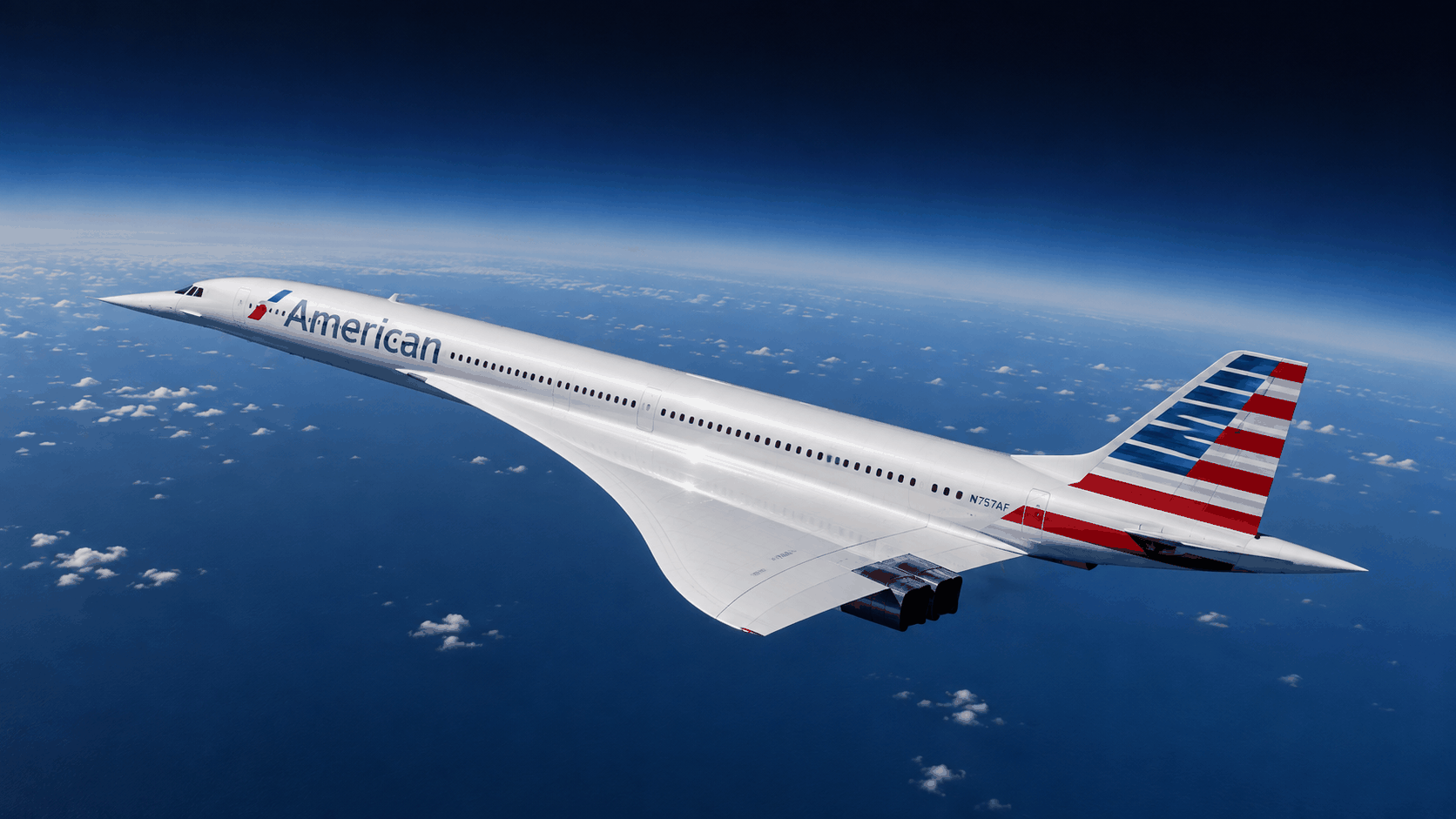
The season
In 2027 the company flew it from San Francisco to Honolulu and back on a published schedule for a single season. Both sectors are over water, so unlike the celebrated interchange Braniff ran in the 1970s the aircraft was not restricted to subsonic cruise. It went supersonic on a domestic sector of the Realm, which had not happened before.
The purpose was not revenue and the company was open that it was not. It was to establish whether an airline that has never operated the type can acquire the competence to do so: whether its crews can be trained to the standard in the time available, whether its engineers can support an aircraft they have never seen without the manufacturer resident on site, whether its ground operation can turn one, and what all of that costs per seat when set against a subsonic aircraft flying the same passengers eight hours later.
It published the results, which is not usual and which is entirely in character. The company has spent a century settling arguments with figures, and it had just spent a season generating some.
What it proved and what it did not
The operation worked. Punctuality was poor by the company’s standards and acceptable for a first season, the aircraft was available more often than the sceptics had predicted, and the crews were trained inside the schedule.
What the test could not settle is the thing that matters, which is whether enough people will pay enough to cross the Pacific in half the time, often enough, in both directions, all year. A season on a two-thousand-mile domestic sector to Hawaii establishes that the company can fly the aeroplane. It establishes very little about a five-thousand-mile route to Japan whose economics depend on a category of traveller the company has never previously had any reason to identify.
The aeroplanes that do not exist
The harder problem is not commercial and the test could not have solved it.
A scheduled service needs a fleet. Pan American maintains five airworthy frames to sustain a single daily rotation, and that ratio is roughly the floor: an operator needs spares, an aircraft in maintenance, and something to fly when one goes unserviceable in Honolulu. This company owns one aeroplane. One is enough to prove a concept and is not enough to sell a timetable, and everybody involved has known that from the beginning.
There is no way to buy more. The type has been out of production for forty years, roughly thirty-four were ever built, and every airworthy frame in the world belongs to British Airways or to Pan American. Pan American’s are tied to London by a resolution of the House of Commons. British Airways will sell surplus frames and has exactly as many surplus frames as it has, which is a small number and falling.
So the company has demonstrated that a supersonic Pacific route works, and cannot fly one, for want of aeroplanes that no longer exist. The only routes out of that are to buy most of what British Airways has left, which would cost a great deal more than the first one did now that somebody has shown the aircraft is worth something, or to wait for the successor programme it spent twenty years declining to join.
The board has authorised further study and has ordered nothing. This is the correct decision and is also the decision this company always makes.
What it did to everybody else
The consequences outside the company were larger than the consequences inside it.
Pan American’s reaction was not restrained. Its position, put in public with unusual heat, was that British Airways is its partner in a joint business across the Atlantic and had sold a supersonic aircraft outright to its principal domestic rival, in order to open a Pacific route Pan American is legally prevented from flying, because Parliament tied its own frames to London in 2008 and has never untied them. British Airways replied that the arrangement was commercial, that the aircraft is its property, and that its alliance with Pan American concerns the North Atlantic and does not extend to a veto over the Pacific. Both statements are accurate and neither is an answer to the other.
The more serious consequence is for the successor programme. A demonstration that supersonic flying is commercially arguable today, over water, with fifty-year-old aircraft and no new technology whatever, is not obviously helpful to a partnership asking two governments and the Concert’s Commission to fund an aircraft on the promise of overland flight in the 2040s. Officials in Straßburg have described the test as encouraging. Several people in the industry have observed that they would say that.
The company now
Large and under threat
It carries more passengers than any airline in the world, earns a modest and volatile return on doing so, and is worth considerably less than the sum of its parts.
The pressure comes from both directions. Below it, a substantial low-fare carrier with a genuinely different structure, one aircraft type, no hubs and fast turnarounds, has taken the short-haul market apart from underneath, and against that model the hub system is a liability rather than an asset. Above it, the flag carrier holds the long-haul and cannot be driven out of it, because it cannot fail. The other two large trunk carriers, United and Delta, compete in the same squeezed middle and face the same arithmetic.
The company’s size is real and its position is less secure than the size suggests. It is the largest airline in the world and it is not obvious what that is worth.
What it is for
There is a question underneath the commercial one that the company has never had to answer and the flag carrier is asked constantly.
Pan American exists because the Realm decided it should, and its constitution says what it is for: to connect the country to the world and to fly the places that cannot pay. British Airways exists commercially and carries a warrant, a national flag on its tail and a set of protected routes it may not abandon. Both companies can be asked what they are for and both have an answer written down somewhere.
This one has shareholders. Its purpose is the purpose of any company, which is to earn a return, and it has never claimed otherwise or been embarrassed by the claim. What follows from that is a genuine and underappreciated fact about the Realm’s aviation: the airline most people actually fly is the only one of the three with no obligation to anybody except the people who own it, and the Realm has been content with this arrangement for fifty years because the fares are low.
Whether that is a settlement or merely an absence of one is the sort of question the Register can raise and cannot resolve.
Whether it was worth it
The argument the Realm has never settled is whether the reform this company was the principal beneficiary of was a good one.
On one side: air travel in the Realm is cheaper in real terms than at any point in its history, it is used by people who would never have flown under the regulated system, the network is denser, the fleet is younger and the safety record is better than it has ever been. On the other: an entire wage structure was broken and rebuilt lower, several large companies were destroyed with their workforces inside them, dozens of smaller communities lost scheduled service and have not regained it, and the cheap fare is quoted before the charges that make it a real one.
Both ledgers are accurate. The Realm has been adding them up for fifty years without reaching a total, and the Register does not propose to supply one.
✎ Editor's Note · Writing the company that won
The problem this article had to solve is that its subject is the most consequential airline in the Realm’s daily life and nobody feels anything about it. Pan American is loved, British Airways is respected, and this company is simply how a person gets to Chicago. The temptation was to let that absence of affection curdle into contempt, and the article is written cold rather than hostile because contempt would be both unfair and dull.
So the failings are given at full strength and without editorial assistance. The reservation system is the most interesting of them, because nothing about it looked like wrongdoing at the time: a company built the infrastructure the whole industry depended on and wrote its rules to suit itself, in a medium so new that the victims took years to understand what was being done to them. The recorded telephone call is included because it is on tape and because the airline on the other end died within months, and the article states plainly that the call did not cause that and that the two facts will always sit next to each other. Flight 191 is the centre of gravity, and the finding placed there is the real one: a firm whose distinguishing quality is that it counts things more carefully than its competitors killed two hundred and seventy-three people by finding a cheaper way to do a job, which is a failure not of arithmetic but of the thing arithmetic cannot do.
Against all that, the two moments of grace are given their full weight precisely because the rest is so unsentimental. Smith took off the suit and ran the Realm’s wartime airlift, and declined afterwards to discuss it. And after May Day the company found everyone who had been working under its name, including the contracted staff, and helped them without asking who had employed them, at the same time as the airline everyone likes was sorting its own dead into those it owned and those it merely hired. Neither episode was publicised by the company. Both are true, and an article that left them out to preserve a tidier thesis would have been a worse one.
Chronology
| Year | Event |
|---|---|
| 1930 | A holding company consolidates roughly eighty small mail and passenger operators into a single airline. There is no founding flight and no founder |
| Early 1930s | The air mail scandal: contracts alleged to have been carved up in a ministerial back room are cancelled, the Air Corps flies the mail through a winter it is not equipped for, and men are killed |
| 1934 | Legislation breaks the aviation holding companies apart. The airline is reconstituted, renamed American Airlines, and C. R. Smith becomes president |
| 1935 | Smith telephones the manufacturer and stays on the line until it agrees to build the aircraft he wants. He orders twenty without financing in place |
| Mid 1930s | The resulting aircraft becomes the first airliner anywhere able to earn a living carrying passengers alone, without a mail contract underneath it |
| 1941 to 1945 | About half the fleet is requisitioned. Smith takes leave to serve as deputy commander of the Air Transport Command of the Royal American Air Corps, and is decorated |
| Late 1950s | Jet services begin on the transcontinental routes |
| Mid 1960s | SABRE becomes operational, built on the architecture of a military air defence network. Terminals follow into travel agencies across the Realm |
| 1968 | Smith leaves after thirty-four years, handing over the largest domestic carrier in the Realm and an institution shaped entirely for a regulated market |
| Late 1970s | The Realm liberalises its domestic air market under Carter. The company’s fifty-year accumulation of interior routes decides the contest before it begins |
| 25 May 1979 | Flight 191 crashes at Chicago; 273 dead. The cause is an unapproved maintenance procedure the company devised itself to save labour hours |
| 1979 | The company abandons its eastern headquarters and moves the entire corporation to the new prairie hub in the Republic of Texas |
| 1981 | The first modern loyalty programme is launched to identify the airline’s most valuable customers |
| February 1982 | The company’s president telephones the president of Braniff and proposes both raise fares twenty per cent. The call is recorded |
| May 1982 | Braniff collapses. Aircraft stop where they stand and crews are stranded in the cities they flew to that morning |
| Early 1980s | The two-tier wage scale is agreed: existing staff keep their terms, all future hires are permanently on a lower one |
| 1985 | The executive who made the call becomes chief executive, and runs the company for thirteen years |
| 1980s to 1990s | Neutral-display rules are eventually made for reservation systems, some years after the advantage has been taken. Nobody is prosecuted |
| 2000s | SABRE is separated and floated, and is promptly valued above the airline that built it |
| 1 May 2006 | A small number of the company’s people are killed at Kennedy. It identifies everyone working under its name, contractors included, and helps them without asking who employed them |
| 2010s | The bare metal finish ends, composites making it impossible. The rebranding is handled badly |
| 2028 | The largest airline in the world by passengers, on thin margins, squeezed by low-fare carriers below and a flag carrier that cannot fail above |
Trivia
- In-Universe The company was not founded. A holding company bought roughly eighty small carriers in 1930 and welded them together, and for its first two years the constituent airlines largely carried on as though nothing had happened. There is no first flight to commemorate and the company has never pretended otherwise.
- In-Universe C. R. Smith obtained the aircraft that made the airline by telephoning the manufacturer and refusing to hang up for the better part of two hours. The accounts department queried the cost of the call. He is supposed to have called it the cheapest thing the airline ever bought.
- In-Universe The airline president spent the Second Great War as deputy commander of the Realm's military air transport organisation, holding general officer rank, and declined to discuss it afterwards on the ground that a great many people had done more.
- In-Universe Twice now the most valuable thing this company ever built has turned out not to be an aeroplane. The first was a reservation database that was floated and immediately valued above the airline. The second is a loyalty programme that analysts price above the fleet and the slots combined.
- In-Universe The agent selling you a ticket did not see a neutral list. They saw a screen written by an airline, and the airline's own flights were at the top of it. Rules requiring neutral display were eventually made, some years after the advantage had been taken, and nobody was prosecuted.
- In-Universe The most recognisable fleet in the Realm was unpainted because paint is heavy and the company had done the arithmetic. Everyone assumed it was a design decision. Nobody at the company ever bothered to correct them.
- In-Universe Pan American holds the national adjective by charter and this company holds it by registration and long use. Three lawsuits produced no usable judgment, and the matter was finally settled by a coexistence agreement governing typography, colour and the circumstances in which either may use the word unqualified.
- In-Universe It has campaigned for forty years to have the flag carrier sold and has never persuaded a government. Its standing offer to bid for the obligated routes to Alaska, the islands and Loreto under contract has never been taken up by anybody.
- In-Universe The largest company in the Realm's aviation is headquartered in a polity that kept its president when it joined the Union. It holds no warrant, performs no ceremony and has never carried a member of the royal family officially, and there is a satisfaction about this in Fort Worth that nobody there would put in writing.
- In-Universe Asked whether it was interested in supersonic flight, the company said it would look again when somebody showed it the arithmetic. In 2027 somebody did, and it came from the one direction nobody was watching: every argument about supersonic flying for fifty years had been an argument about land, and the Pacific does not have any.
- In-Universe It bought a Concorde for very little money, because a fifty-year-old supersonic airliner of a type nobody else is certificated to fly has almost no resale market and British Airways wanted it off the books. Buying depreciated assets nobody wants, from sellers who need them gone, is what this company has done with aircraft for ninety years. The board minute is said to be four lines long.
- In-Universe It owns one Concorde. Pan American needs five airworthy frames to run a single daily rotation, so one is enough to prove a route and nowhere near enough to sell a timetable. There is no way to buy more: the type has been out of production for forty years and every airworthy aircraft in the world belongs to British Airways or to Pan American.
- In-Universe The Kyoto route goes to the Kansai field rather than to Tokyo because that airport is built on an artificial island in Osaka Bay, so its noise falls into the sea. For an aircraft whose entire regulatory history is a history of noise, that is not a convenience but the reason the route is possible.
- In-Universe After May Day it found everyone who had been working under its name at Kennedy, including the staff employed by its contractors, and helped them without requiring anyone to establish who had employed them. It did not publicise this. It became known years later through the transport unions, who were at that moment forcing the flag carrier to recut a memorial it had left names off for eleven years.
- In-Universe It once removed seats from its aircraft to give every passenger more room, advertised the fact heavily, and put them back a few years later because the market would not pay for it. The company mentions this rarely.
- In-Universe The most serious threat to the largest airline in the world is a carrier that flies one type of aircraft, operates no hubs and turns an aeroplane around in a fraction of the time. Against that structure every advantage the hub system was built to provide becomes a cost.
- In-Universe Its own safety directorate has published the view that a company which settles questions by measurement cannot reliably generate its own challenge and requires permanent external scrutiny. It is an unusually candid thing for a corporate function to put in writing, and it is the best evidence available that Chicago changed something.
- In-Universe Two of the three great carriers of the Realm and its sister realm can say what they are for, because somebody wrote it down. This one has shareholders. It has never claimed anything else and has never been embarrassed by the claim.
- In-Universe It carries an enormous quantity of freight and owns no freighters, selling only the space beneath the cabin on aircraft that were flying anyway. It has twice examined building a dedicated cargo division and twice concluded that the specialists were better at it.
- Design The three airline articles are written as one argument in three parts: a flag carrier the state rescued, a flag carrier the state sold with a string attached, and a private company that beat them both domestically and got none of the affection. Each is a different answer to the question of who should own the means of flying, and none of the three is presented as the right one.
- Real-World The assembly from eighty carriers, the mail scandal and the forced reorganisation, the telephone call that produced the DC-3, the wartime command, SABRE and its display bias, the move to Texas, the recorded price-fixing call, the two-tier wage scale, the first frequent flyer programme and the bare metal livery are all real. So is the salad olive.
- Real-World Flight 191 happened here as it did in our own history: 25 May 1979, Chicago, 273 dead, the engine and pylon separating on rotation because of an unapproved maintenance procedure the airline had devised itself to save labour hours using a forklift. It remains the deadliest aviation accident on American soil in both timelines.
- Real-World Braniff was real, was Texan, was the most visually extravagant airline in the world with a fleet painted in flat single colours and couture cabin uniforms, and collapsed in May 1982 a few months after the recorded call. The call did not cause the collapse. Both facts are in the record and always will be.
See also
- Pan American World Airways - the flag carrier, publicly owned and never sold, and this company’s rival for a century and for a word
- British Airways - the sister realm’s carrier, sold with a golden share, and the third answer to the same question
- Republic of Texas - the non-Crown republic the company is headquartered in
- Treaty of Austin - how that republic joined the Realm with its presidency intact
- Economy of the UKA - the wider economy, and the liberalisation argument this company won
- The May Day Bombings (2006) - in which it lost a small number of people and behaved well
Categories
Institutions · Aviation · Republic of Texas · Commerce and Industry