Southwest Airlines
Southwest Airlines is the largest carrier of domestic passengers in the United Kingdom of America, a private company throughout its history, and the only one of the Realm’s four great airlines that had to win a lawsuit before it was permitted to fly at all.
It exists because of a gap. The Republic of Texas is a non-Crown republic that joined the Realm by treaty with its presidency intact, and an airline flying only within its borders fell outside the federal board that awarded routes and approved fares. Three established carriers understood immediately what that meant and went to law to prevent the company being certificated at all. The litigation ran four years. The company won, in the Republic’s highest court, and began flying in 1971 between three Texan cities with four aircraft.
Everything that made it formidable afterwards was a refusal. One manufacturer. No hubs and no connections sold. No assigned seats. No charge for changing a booking, and two bags carried without charge when every competitor billed for one. No listing in the reservation systems American Airlines built and controlled, because it would not pay a competitor a fee on every ticket it sold. Each refusal was individually defensible on operating grounds and together they produced the lowest costs in the industry and an airline people were genuinely fond of, which is a combination nobody else in the Realm has managed.
Most of those refusals have now been reversed. An investment fund took a large position, argued with figures that fifty years of declining to charge for things was money lying on the floor, and prevailed. Assigned seating has arrived, a premium cabin has been added, the free bags are gone, and connecting banks are being built at airports the company spent five decades insisting were not hubs. It remains enormous and profitable. Whether what made it worth having has survived the process is a question nobody can yet answer, and this article does not attempt to.
Foundation
A triangle on a napkin
The company began as a sketch. A lawyer and a client, discussing what to do about the cost and inconvenience of moving between the Republic’s three largest cities, drew a triangle connecting them and worked out that a carrier flying only those three legs would be a viable business and would not require anybody’s permission.
The napkin is probably embellished. The triangle is not: the first route map was those three cities and nothing else, and the company has never discouraged anyone from believing the rest of the story.
The jurisdictional gap
The insight underneath the triangle was legal rather than commercial, and it is the reason the company exists at all.
The Realm’s air transport in the 1960s was economically regulated by a federal board which decided who flew where and at what fare, and an application to open a route was a contested legal proceeding that could take years. The board’s jurisdiction ran to carriers operating between polities. A carrier that never crossed a polity boundary was outside it.
Texas is very large and holds several major cities, so a purely internal airline was a serious proposition there in a way it would not have been almost anywhere else. It was also a republic that had joined the Realm by the Treaty of Austin with its own presidency, its own constitution and a settled tradition of regulating its own commerce, and its aviation authority was a real body rather than a formality.
So the company applied to the Republic, not to the Realm. It proposed to charge what it liked, fly as often as it wished, and answer to Austin. Nothing about this was a loophole in the pejorative sense; it was the plain effect of a federal structure. It was nonetheless an advantage no interstate carrier could obtain, and the incumbents recognised the danger at once.
Four years in court
Three established carriers, Braniff among them, went to law to stop the company being certificated.
The proceedings ran from the late 1960s into 1971 and were fought at every level available. The arguments made against the new airline were that the Republic’s three cities were adequately served, that additional capacity would damage carriers already operating and thereby harm the public, and that a purely intrastate operation was a device to evade regulation the Realm had imposed for good reason. The third point was entirely correct and the court held that it did not matter, because the regulation in question did not apply.
The company won at the Republic’s highest court and flew its first service in June 1971, four years after incorporation, having spent a substantial part of its initial capital on lawyers before carrying a single passenger.
The detail worth holding on to is that Braniff, the most glamorous airline in the Realm and the pride of Texan aviation, tried to prevent this company existing, failed, collapsed in 1982, and was outlived by its intended victim by more than fifty years.
Barely surviving
The litigation was the easier part. What followed nearly finished the company twice.
The incumbents matched every fare it published and undercut several, on routes where they could afford the losses and it could not. It ran out of money within eighteen months. The decision taken at that point is the founding act of the operation that exists today: rather than reduce the schedule, the company sold one of its four aircraft and undertook to fly the same timetable with three.
That is arithmetically impossible unless the aircraft spend almost no time on the ground. So they did not. The company established a ten-minute turnaround, in which an aircraft arrived, was unloaded, cleaned, refuelled, reloaded and departed inside ten minutes, with everyone aboard doing whatever was required including the cabin crew tidying the cabin and the captain helping with bags. It worked, and it kept the airline alive.
An emergency measure taken to avoid bankruptcy in 1972 became the operating philosophy of the next fifty years. Nearly everything the company later did well descends from the discovery that an aeroplane earns money only in the air, and that the ground is where airlines lose.
The box
Confined by statute
Having failed to prevent the company existing and failed to price it out of the market, the incumbents did the remaining thing available to them, which was to have the legislature draw a box around it.
The prairie hub between Dallas and Fort Worth had opened, and the arrangement under which it was built required the region’s airlines to move there. This company declined, on the ground that it had signed nothing and that its whole proposition depended on operating from a field seven miles from the centre of Dallas rather than one twenty-five miles from anywhere. The resulting fight produced federal legislation restricting service from the old field to destinations within the Republic and a ring of immediately adjacent polities.
The restriction stood for roughly thirty-five years. For that entire period the company was forbidden by statute to fly from its own home airport to most of the Realm.
What the box did
It made them, and the company has been graceful enough to say so.
An airline confined to short sectors within a limited region cannot grow by adding glamour, distance or connections. It can only grow by taking traffic from the ground, from the roads and the buses and the people who were not travelling at all, which requires fares low enough to compete with driving. And it can only sustain those fares by being better at the cost of a short sector than anyone has ever been.
So the company spent three and a half decades doing nothing except perfecting the economics of the short flight, in a market it was not allowed to leave, while its competitors spent the same period on route networks, alliances, premium cabins and reservation systems. When the restriction was finally repealed, an operator emerged that could fly a two-hundred-mile sector for less than any airline in the world, into a national market that had no answer to it.
The incumbents built a cage and their prisoner used it as a gymnasium.
The repeal
The restriction was lifted in stages over several years in the 2000s, after a negotiated settlement between the company, the incumbent, the two cities and the Republic, in which everybody obtained something and the company obtained the thing that mattered.
The politics of the repeal are worth a sentence, because they inverted. The legislation had been passed at the urging of an incumbent protecting a new airport and a city protecting its investment. By the time it was repealed, the incumbent’s objection had softened, because the company was by then flying to most of the Realm from other cities anyway and the box was restricting little except the convenience of Dallas passengers. What had been a strategic weapon had decayed into an inconvenience for the electorate of the polity that had lobbied for it.
The restriction therefore ended not because anyone conceded it had been wrong but because it had stopped working, which is how most such things end.
What was released
What emerged from the box in the late 2000s was not a regional carrier that had been held back. It was the most efficient short-haul operator in the world, with thirty-five years of accumulated practice, a workforce that had never known a layoff, a fortress position at a city-centre airport, and no debt to speak of.
It expanded across the Realm within a decade and there was very little the trunk carriers could do about it, because the thing that had been perfected in the box was precisely the thing they had never had to learn. American had spent those same thirty-five years building a hub machine, an alliance and a loyalty currency. It had not spent them learning how to turn an aeroplane in twenty minutes, and it could not acquire that knowledge by deciding to.
The home field
The company never left Love Field and never intended to, and the refusal is the physical expression of the whole difference between it and American Airlines.
American abandoned its eastern headquarters, moved to the prairie and built a machine for sorting connecting passengers on a site larger than the island of Manhattan. This company stayed at the old close-in city airport the new one had been built to replace, because its passengers lived in Dallas and the point of the exercise was to be near them.
Two Texan airlines, twenty-five miles apart, arrived at opposite answers to the same question about what an airport is for. Both answers were right for the business each was in, and the fact that they are visibly, geographically opposed has been useful to journalists for fifty years.
The founder
A litigator who ran an airline
The lawyer who defended the company through four years of litigation then ran it for three decades, and he is the third portrait these articles require.
Juan Trippe built an empire and treated an airline as an instrument of it. C. R. Smith was an accountant who treated an airline as a cost per seat-mile to be minimised. This one was a trial lawyer who treated an airline as several thousand people who would look after the passengers if the company looked after them, and who took the view, stated repeatedly and apparently sincerely, that the employees came before the shareholders because that was the order in which the value was actually created.
He chain-smoked, kept bourbon in his office, knew a genuinely implausible number of employees by name, and appeared at company events in costume with a regularity his board found difficult. He is the only founder in the Realm’s aviation of whom anybody was fond.
The arm-wrestle
In 1992 the company found itself in a trademark dispute with a small aviation firm over an advertising slogan both were using. The legal costs of resolving it properly would have exceeded anything either stood to gain.
So the two chief executives arm-wrestled for it, in front of a paying crowd, with the proceeds going to charity. The founder, who was then in his sixties and had prepared by being photographed apparently training with a bottle of bourbon, lost. The winner then granted the company permission to keep using the slogan anyway, on the ground that it had been a good afternoon.
It is entirely true. It is also the single most efficient illustration available of how this company differed from its competitors, none of which could have done it, and several of which would have regarded the suggestion as a resignation matter.
Employees before shareholders
The founder’s stated order of priority was employees, then passengers, then shareholders, and he was asked about it constantly by people who assumed he could not mean it.
His answer, given in some form for thirty years, was that the order was not a moral claim but a description of how the value was actually produced: an airline is delivered by the people the customer meets, so a company that treats them badly is buying a worse product than its competitors and paying the same for it. The shareholders came third not because they mattered least but because they were downstream.
Whether he believed the moral version as well is not really answerable and probably does not matter. What is on the record is that the company behaved as though the order were true through five recessions, and that the shareholders did better out of it than the shareholders of any competitor.
Succession
The people who followed were able operators. They kept the machine running, grew it substantially, and none of them was able to hold the culture together by force of personality in the way he had.
The article resists saying the company declined after him, because commercially it did not; it became several times larger and remained profitable throughout. What is fair to say is that the thing everybody valued was partly one man, and that a quality held in place by a particular person is always going to be temporary. The company spent twenty years trying to systematise something that had not been a system.
The model
One manufacturer
The company has bought from a single manufacturer for its entire history and flies Boeing aircraft exclusively.
The advantage of a common fleet is not obvious until it is enumerated. One type means one set of manuals, one training programme, one pool of pilots every one of whom can fly every aircraft the company owns, one spares inventory, one set of tooling, one maintenance qualification for every engineer, and an operations department that can substitute any airframe for any other at any time without checking anything. Six problems collapse into one. The saving is not a line in the accounts; it is distributed through every function of the company, and it is the largest single reason the costs are lower than everybody else’s.
The 717 exception
The discipline is very nearly absolute and is not quite. Alongside the 737 fleet the company operates a sub-fleet of Boeing 717s, and they arrived by accident.
They came with an acquired carrier, and doctrine said dispose of them. The company examined the arithmetic and kept them, because at around a hundred seats the smaller aircraft opens routes and cities the 737 is simply too large to fill, and a company whose entire proposition is serving markets the trunk carriers cannot serve profitably found that argument difficult to dismiss. The exception bought reach.
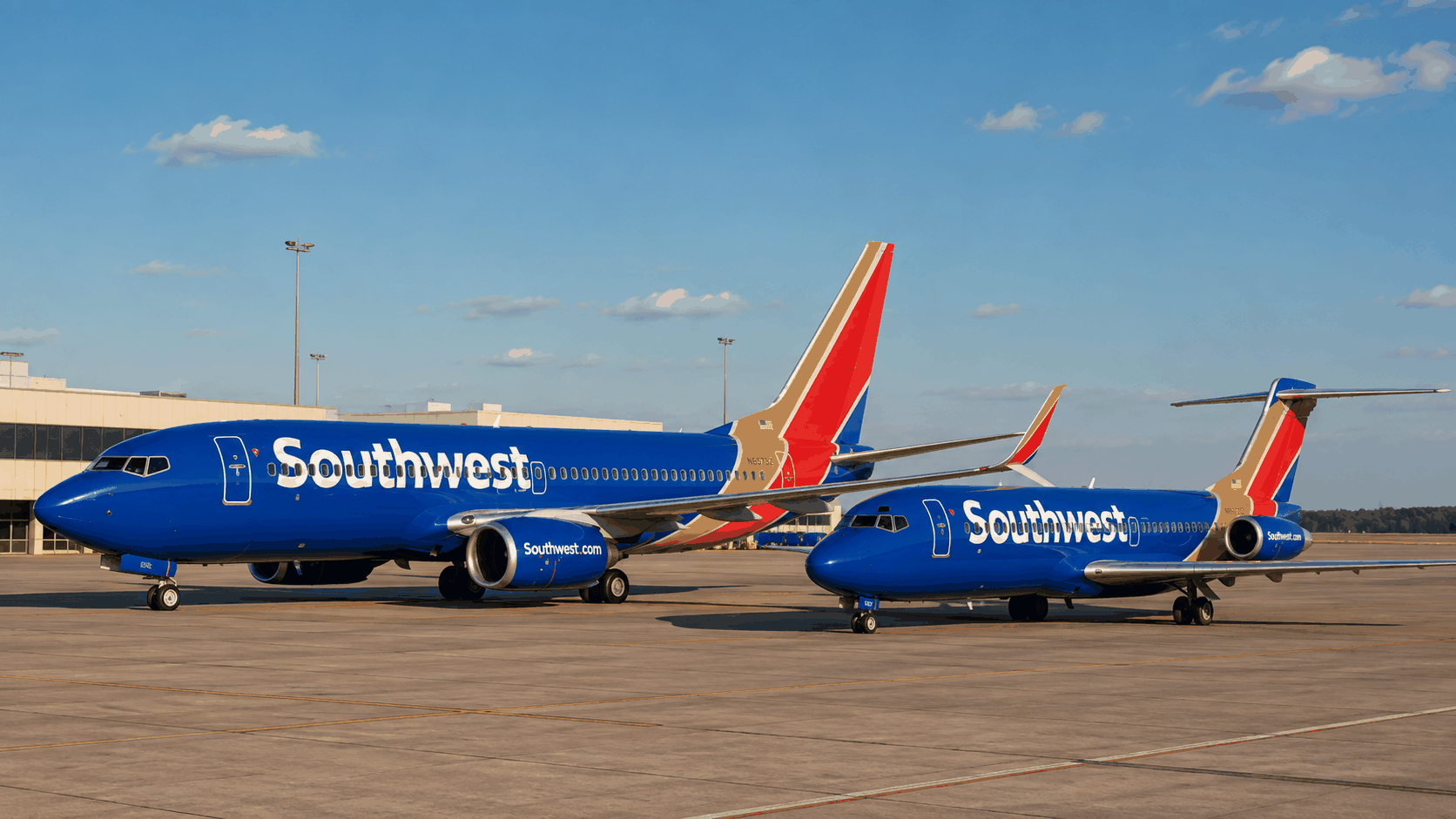
It is worth being precise about what the exception is. The company’s rule was never strictly one type; it was one manufacturer, and both aircraft are Boeing, so the commercial relationship, the support arrangements and the negotiating position are undisturbed. What is disturbed is everything downstream: two type ratings, two maintenance qualifications, two spares inventories, two rosters that cannot be freely interchanged.
The internal argument about whether to keep them has never entirely stopped, and it resurfaces at every fleet review. The purists hold that the exception costs more than it earns and that the discipline is the company. The operators hold that a hundred-seat aircraft reaches sixty cities that would otherwise be unserved and that a doctrine which cannot accommodate that is a superstition. Neither side has won, which is why the 717s are still flying.
The ten-minute turn
The turnaround is the heart of the operation and everything else is arranged around it.
An airline earns nothing from an aircraft on the ground and pays for it continuously. If a competitor turns an aeroplane in fifty minutes and this company turns it in twenty-five, then over a day of six sectors this company obtains an extra flight from the same airframe, the same crew and the same capital, and it can therefore charge less for every seat and still earn more. That is the entire arithmetic of the business, and everything distinctive about the product was chosen to serve it.
The original ten minutes belongs to the era of small aircraft, few passengers, no security screening and hand-loaded bags, and is no longer achievable. What survives is the priority, which is that the operation is designed backwards from the turnaround, and any proposal that slows it must justify itself against the revenue of the flight it costs.
Boarding without seats
The clearest instance is the boarding process, which passengers regarded as a quirk and which was an operational decision.
Passengers were assigned a position in the queue rather than a seat, and chose where to sit on stepping aboard. This boards an aircraft measurably faster than assigned seating, because nobody is walking past their row to reach a seat behind somebody who is still stowing a bag, and because the aircraft fills from wherever people are rather than in an order the system has imposed. Boarding speed is turnaround time and turnaround time is the business.
People found it either liberating or barbaric according to temperament, and both parties argued about it for fifty years. It has now been abolished, which is a useful measure of what the reversals actually cost: the company gave up a documented operational advantage in exchange for a fee it can charge for a better seat.
Selling direct
The company would not list in the industry reservation systems, and the decision made it independent.
Those systems were built and controlled by competitors, principally by American, and every ticket sold through one carried a fee paid to the operator of it. This company declined to pay a rival on each sale and sold direct instead: first by telephone and its own counters, then by building, early and without much fuss, the first airline website in the Realm that mattered.
The consequence was that it was the only large carrier in the Realm which owed the incumbents nothing for access to its own customers. The display bias that quietly disadvantaged everybody else selling through those screens could not touch a company that was not on them. It is the least discussed of its refusals and possibly the most valuable.
Point to point
The company flew city pairs directly, sold no connections, and regarded a passenger changing aircraft as somebody else’s business model.
A hub gathers passengers from many small places, sorts them, and sends them out again, which allows an airline to serve thousands of city pairs it could not otherwise fill. It also requires aircraft and crews to arrive and wait for one another in banks, a large ground operation to move bags between them, and it concentrates the whole network’s vulnerability at a handful of points. Point-to-point flying gives up the connections and keeps the aeroplanes moving.
This too is being reversed. Connecting banks are being built, because connections are how a carrier fills seats on long thin routes, and the company is now constructing the thing whose absence was the reason it beat American.
Labour
Unionised, and not adversarial
The company is among the most heavily unionised airlines in the Realm, which surprises people who assume that a low-cost operator must be a low-wage one, and it is not true that it is.
Its people are generally paid at or above the industry, and the cost advantage comes from productivity rather than from rates: an aircraft flown more hours a day, turned faster, crewed by people who are not standing about waiting for it. That is a bargain both sides could defend, and for most of the company’s history both sides did.
The contrast with American’s two-tier settlement is exact and is the strongest evidence that this company was genuinely different rather than merely cheaper. One firm reduced its costs by paying later employees less for the same work. The other reduced them by getting more flying out of the same day.
Why the bargain held
The reason relations were not adversarial for fifty years is that both sides could see the same arithmetic and neither had to pretend.
A company competing on cost must reduce the cost of a seat, and there are only two ways to do it. It can pay people less for the same work, which American did, or it can get more work out of the same paid hour, which requires the people doing the work to cooperate rather than merely comply. The second is unavailable to a firm whose staff have reason to resent it, because a ten-minute turnaround depends entirely on people doing things nobody can compel them to do: a captain carrying bags, a purser cleaning a row, a gate agent starting the boarding announcement thirty seconds early because the inbound was late.
The company understood that the productivity it needed could not be extracted, only offered, and it priced the offer accordingly. That is a harder thing to sustain than a two-tier scale and it produced a better company.
The strikes that did not happen
The company has never had a strike, which is remarkable in an industry where the two largest carriers in these articles have had four apiece, and it is not because the unions are weak. They are strong, they are well organised, and they have gone to the edge more than once.
What has prevented it is a bargaining relationship in which the company’s figures are shown rather than asserted, disputes are settled before they become positions, and the union leadership has generally been able to tell its members that the arrangement on offer is the best available without being disbelieved. That last item is the whole of it, and it is a form of capital that takes decades to build and can be spent in a single bad year.
The record that was broken
For fifty years the company never put a worker out of a job involuntarily. Not through the fuel shocks, not through the recessions, not through liberalisation, when most of its competitors shed employees in tens of thousands and several ceased to exist.
The record has now ended. The particulars are disputed and the number is not enormous by industry standards, and none of that is the point. The no-layoff record was not a statistic; it was the company’s central claim about what kind of institution it was, made continuously for half a century and believed by its own workforce. Ending it cost something no accountant scored.
If a single fact is wanted for what has happened to this company in the last decade, it is that one.
The culture
The doctrine
The company holds, and has held explicitly since the founder’s time, that its employees come before its shareholders, and it means this as a causal claim rather than a sentimental one.
The argument is that an airline’s product is delivered almost entirely by people the customer meets: the person at the counter, the crew in the cabin, the handler who finds the bag. A company that treats those people well gets a product it cannot otherwise buy, passengers who return because of how they were dealt with, and therefore shareholders who do better than they would have under an arrangement that put them first. Stated aloud it sounds like the kind of thing companies put in annual reports and do not act on. This one acted on it for fifty years, which is the difference.
It is visible in the figures
The claim would be unfalsifiable if it were only a claim, and it is not, because it shows up in the operating data.
Staff turnover has run at a fraction of the industry’s for decades, which means the average employee has years more experience than a competitor’s and the company spends far less on training people who leave. Turnaround times, which depend entirely on whether people do things that are not strictly their job, have been the industry’s best throughout. Sickness absence is low. Grievance volumes are low. And the company has never had a strike, in an industry where the two largest carriers in these articles have each had four or more, which is not because its unions are weak.
None of that is culture in the decorative sense. Each of those numbers is money, and together they are a substantial part of the cost advantage that the fleet discipline does not explain.
The jokes
The visible expression is the humour, which is genuine, is more disciplined than it looks, and is the thing passengers remember.
Cabin crew deliver the safety briefing in verse, or set to music, or as stand-up, and have done since the 1970s. The company permits it, does not script it, and requires only that every mandated point be made. The result is the one safety briefing in the Realm that passengers actually watch, which the regulator has noted with approval more than once and which no competitor has been able to copy, because the competitors’ crews correctly understand that their employers would not defend them if a joke landed badly.
That is the whole of the difference in a sentence. The permission is worth more than the jokes.
What is happening to it
The culture is real and is measurably thinning, and the company’s own people say so.
It was built for an airline of a few thousand employees where the founder knew a large fraction of them by name, and it is now being asked to hold together an organisation of enormous size in the middle of dismantling the features that expressed it. It is difficult to tell staff that the passenger comes first while removing the free baggage allowance, and difficult to say the employees come before the shareholders in the same decade the no-layoff record ended and an investment fund set the agenda.
Nobody inside the company argues the culture has gone. A good many argue about how much of it is left, which is a different conversation from the one they were having ten years ago.
Fares
Simple on purpose
The company’s pricing was for most of its history the simplest in the industry, and the simplicity was a deliberate commercial weapon rather than an absence of sophistication.
Where competitors operated dozens of fare classes with restrictions, minimum stays, advance purchase rules and change penalties, this company offered a small number of fares with almost no conditions attached. A passenger could see what a seat cost, buy it, and change their mind later without being punished for it. The industry regarded this as leaving money on the table, which it was, and as commercially naive, which it was not: a fare structure a passenger can understand is a fare structure a passenger will buy without shopping around, and the company’s direct-sale model depended on people coming to it rather than to a comparison screen.
No change fees
The change fee deserves separate mention because it was, for the rest of the industry, one of the most profitable lines on the balance sheet, and this company simply did not charge one.
A passenger whose plans altered rebooked and paid the difference in fare if there was one, and nothing else. Competitors charged substantial fixed penalties, in many cases approaching the value of the original ticket, and defended them as necessary to protect the yield of a system that sells the same seat at fifteen prices. This company’s position was that a passenger who cannot change a booking without being fined is a passenger who books later, books less, and resents you, and that the fees were being counted as revenue when a portion of them were really a charge against future custom.
Nobody was persuaded by this until the industry was eventually forced to abandon change fees anyway, at which point a great many carriers discovered the company had been right about the demand effect for thirty years.
The bags
The two free bags were the last of the refusals to go and the most famous, because it was the one the advertising had been built on.
Charging for checked baggage was industry standard for two decades, generating very large sums, and this company declined throughout, on the argument that it was the single most visible way to be different and that the traffic it attracted was worth more than the fees. It advertised the fact relentlessly and with a certain amount of glee.
The allowance ended under the reversals, and of everything that has been taken away it is the change passengers noticed first and resented most, precisely because the company had spent twenty years telling them it never would.
The network
Where it flies
The network is a dense web of short and medium sectors across the Realm, concentrated in the interior, the south and the west, with a substantial short international operation into the Caribbean and Mexico, and domestic services to the Territory of Loreto since its accession, all flown with the same aircraft as everything else.
It serves a great many places the trunk carriers reach only through a hub, and a number they do not reach at all. In the smaller cities of the interior it is frequently the only jet service, and its arrival has repeatedly halved local fares within a year, an effect economists studying the Realm’s air market gave a name to and have measured across several decades.
Secondary airports
Where a city has more than one airport the company generally uses the smaller and older one, which is cheaper in charges, less congested, closer to the centre and quicker to get an aircraft in and out of.
This began as an economy and became a strategy. A secondary field will negotiate, because it needs the traffic; a primary hub will not, because it does not. The company has repeatedly been the making of an underused airport, and has on several occasions withdrawn from one when the charges rose, with a bluntness the affected polities have found instructive.
What the model cannot do
The honest boundary of the operation is that it cannot cross an ocean.
A company built on turning one type of aeroplane round quickly on short sectors has no aircraft capable of long-haul flying, has never ordered one, and would have to break the fleet discipline entirely to acquire one. It has therefore never competed for the traffic that made Pan American, and its executives have been consistent for fifty years that they have no intention of trying. It is a genuine limit and the company has never pretended otherwise, which is more than can be said for several carriers that did try.
The product
A list of refusals
For most of its life the product was defined by what the company would not do.
One cabin, with no first class. No assigned seats. No charge for changing a booking, at a time when every competitor’s change fee was among its most profitable lines. Two bags carried free when the industry had discovered that baggage could be billed separately. No connections sold and no interline agreements to speak of. No listing in the reservation systems.
Not one of these was sentimentality. Each was defensible on operating grounds and most of them made the turnaround faster or the distribution cheaper. But their cumulative effect was something the operations department had not designed, which is that passengers understood the company to be on their side, and behaved accordingly. It was worth more than any advertising the industry has ever bought.
The heart
The company’s emblem is a heart and its exchange ticker is a pun on the name of the airport it never left.
This should be unbearable and is not, because it was meant. A firm that declines to charge you for changing your booking has purchased the right to a certain amount of sentimentality, and for fifty years the branding was a reasonably accurate description of the experience rather than a claim about it.
The early years, and the lawsuit it lost
The affection has to be set against how the company sold itself at the beginning, which was on sex, and against a case it fought and lost.
The early advertising branded the airline around love, put cabin crew in hot pants and boots, and traded explicitly on the appearance of the women who worked in the cabin. The company hired only women for those posts. When that was challenged, it did not settle. It argued in court that being an attractive young woman was a genuine occupational requirement for the job, because its commercial proposition depended on it and the airline had built its market position on exactly that.
The court rejected the argument in terms. An airline’s business is transporting passengers safely, the judgment held, and any appeal to the sex of the person handing out the drinks is a marketing preference and not a requirement of the work, and a company may not select its employees on that basis however profitable doing so may be.
The company complied, changed the policy, and has said very little about the episode since. It is the necessary counterweight to everything likeable in this article, and it pairs precisely with Pan American’s marriage bar and weight checks: two airlines, two versions of the same wrong. The difference is that Pan American maintained its conditions through practice and never wrote them down, and this company went to court and argued for its version on the record.
The collapse
The system that could not cope
The company’s central institutional failure came in the middle of a winter storm, and it was a failure of software.
Severe weather closed several airports for a period, which happens every year and which every airline plans for. Recovery from that kind of disruption is a scheduling problem: crews end their duty periods in the wrong cities, and the airline must work out where everybody is, who is legally able to fly, and how to reassemble aircraft and crews into a working timetable. Every carrier does this with software, because the problem is far too large to solve by hand.
This company’s software could not do it. The system had been built for a smaller and simpler airline, it had been extended repeatedly rather than replaced, and when the number of displaced crews passed a threshold it stopped producing usable assignments. What followed is the part that distinguishes the episode from an ordinary bad week: the company lost track of where its own people were, and had to establish it by telephoning them.
Ten days
The operation did not recover for over a week. Something in the order of two million passengers were stranded, in many cases repeatedly, having been rebooked onto flights that were then also cancelled. Baggage accumulated in halls in quantities that had to be sorted by hand for weeks afterwards. Crews sat on hold for hours trying to reach a scheduling department that could not answer, and in several cases reported for duty in cities the company did not know they were in.
Every competitor operating in the same weather recovered inside two days.
The warnings
The company had been told. Its own pilots’ and cabin crew unions had been raising the state of the scheduling system formally for the better part of a decade, in writing, with specificity, and had described in advance more or less exactly the failure that occurred. The investment required was substantial and unglamorous and produced no revenue, and it was deferred repeatedly in favour of expenditure that did.
That is the failure, and its shape matters. This is a company built on refusals, on doing without, on the discipline of not spending money that does not earn. Applied to salads, seat assignments and reservation fees, that discipline produced the best short-haul airline in the world. Applied to the software that tells an airline where its crews are, it produced a system with no margin at all, which worked perfectly until the day it was asked to do something difficult.
Cost discipline hardened into brittleness. It is the precise failure mode a company of this kind would have, and there is no version of the story in which the company was unlucky rather than warned.
Afterwards
It paid. The regulator imposed the largest penalty in its history for the treatment of passengers, the compensation and refunds ran to a very large sum, and the company replaced the system, which took years and cost several times what doing it in advance would have.
The chief executive’s account of the matter was direct and did not attempt to blame the weather, which was to his credit and did not much help. The episode is the single largest reason the investment fund was able to make its case two years later, because a company that had just demonstrated it was not being run tightly enough had lost the argument that it should be left alone.
What it cost beyond money
The financial cost was recoverable and the company recovered it within two years. The other cost has not been recovered.
For fifty years this company’s standing rested on a proposition that it was competently and decently run in a way its competitors were not, and that proposition had survived every comparison because it was largely true. Ten days in which two million people were stranded, in which crews could not reach their own scheduling department, and in which every rival flying the same weather was operating normally within forty-eight hours, was a public demonstration to the contrary that no advertising could answer.
It also broke something internally. The staff who spent that week apologising to passengers on behalf of a system they had been warning about for a decade were the same staff whose loyalty was the company’s actual asset, and a number of them have said publicly since that it was the moment the place stopped feeling different.
The grounding
The single-manufacturer discipline is also a concentration risk, and it has bitten once, badly.
Following two fatal accidents to other operators, the company’s principal type was grounded worldwide by regulators for an extended period. A carrier with a mixed fleet loses part of its capacity in that situation. This company lost most of it at once, had no second type of any scale to fall back on, and watched competitors fly around the gap it could not fill.
It had spent fifty years arguing that the concentration was worth it. The argument was correct on the arithmetic across those fifty years and it was never a free position, and this is what the other side of it costs. The 717 sub-fleet, which the purists had wanted disposed of, was one of very few things the company still had flying, an irony that was noted internally at considerable length.
The fleet
Size and shape
The company operates one of the largest fleets in the world and very nearly the least varied. The great majority is a single narrow-body type in several generations, supported by the smaller inherited sub-fleet, and there is nothing else.
Every aircraft is configured identically within its type, which sounds trivial and is not. An operations department that can substitute any airframe for any other without checking the seating, the galley fit or the crew qualification has a flexibility on a disrupted day that a mixed fleet simply cannot buy, and disrupted days are where airlines lose money.
Bought at the bottom
The company has a long practice of ordering aircraft when nobody else wants them.
Its largest orders have generally been placed in the trough of a downturn, when the manufacturer’s order book is thin and its terms are correspondingly generous, and taken delivery of into the recovery. Competitors ordering at the top of a cycle have paid materially more for identical aeroplanes. This is not clever in any complicated sense; it requires only that a company have money in a recession, which requires that it did not overextend in the boom, which is the discipline described above.
The relationship with Boeing
The arrangement with the manufacturer is hard-nosed on both sides and sentimental on neither.
The company is the largest single-type customer any manufacturer has, which gets it terms nobody else sees and gives the manufacturer a guaranteed base load against which to plan a production line. In exchange the company accepts a dependence it periodically threatens to end and never has, and the manufacturer accepts a customer that negotiates every order as though it were the first.
Neither party pretends this is a partnership. When the type was grounded, the manufacturer’s problem became the company’s problem in full, and the company said so publicly and in detail, which a sentimental relationship would have prevented.
Safety
The safety record is exceptionally good and the reason is not mysterious.
A fleet with essentially one type, flown by crews who have flown nothing else, maintained by engineers who work on nothing else, produces a depth of familiarity that most airlines cannot approach. Crews encounter the aircraft’s rarer behaviours more often relative to their experience, procedures are exercised constantly rather than annually, and there is no risk of a crew applying one type’s habits to another.
There has been one passenger death in more than fifty years of operation. An engine failed uncontained, debris broke a cabin window, and a passenger was fatally injured by the decompression. The captain flew the damaged aircraft to a landing without further loss. The company’s conduct in the investigation was straightforward, it accepted the findings, and the resulting inspection regime for that engine type was adopted across the industry.
The record deserves stating and does not deserve overselling, and the company has generally observed that distinction better than its competitors would have.
The reversal
Why now
The reversals did not arrive because the model stopped working. They arrived because the company’s defences against being told what to do fell away at the same time.
For four decades the answer to any proposal to change this company was the profit record, which was unanswerable and which every board and every fund understood. Within a few years the streak ended, an operational collapse stranded two million people and demonstrated the company was not being run as tightly as it said, and the culture that had made outside criticism seem impertinent was visibly thinning. A firm that had spent fifty years being able to say look at the record could no longer say it.
The fund
An investment fund took a large position and argued that the company was leaving enormous sums unclaimed.
The case was not stupid and the article should be plain about that. Every competitor charged for baggage, for seat selection, for early boarding, for changing a booking, and for a better cabin. This company charged for almost none of it while carrying more domestic passengers than anybody in the Realm. The sums involved were very large, they were calculable, and the fund calculated them.
The counter-argument is that the refusals were not costs but the product: that passengers chose this airline because of them, that the loyalty they generated was worth more than the fees foregone, and that a version of the company charging for everything is simply a smaller airline with older aeroplanes and no reason to be preferred. That argument is true or false depending on how passengers actually behave once the refusals are gone, which is not knowable in advance and cannot be put in a spreadsheet.
One of those cases had figures attached and the other had a proposition about people. The one with figures won, as it generally does.
What has gone
Assigned seating. A premium cabin. The free baggage allowance. The point-to-point network, which is being rebuilt around connecting banks. The board agreed to all of it within a few years, and the pace was set by people who bought shares in the company because it was consistently profitable and then required it to stop doing the things that had made it so.
What is left
The single manufacturer. The turnaround discipline, though slower than it was. The industrial relations, though strained. The direct selling. And a workforce a good deal of which has been there for decades and which is watching.
The company remains enormous and remains profitable. Whether it remains the thing it was is the argument, and it is genuinely open. The reversals are too recent for the evidence to exist, the company’s own executives disagree about it in public in a way that would have been unthinkable twenty years ago, and this article declines to guess.
The streak
Four decades of profit
The company was profitable in every year for more than four consecutive decades, through fuel shocks, recessions, wars, a liberalisation that destroyed most of its competitors, and the collapse of two of the three carriers that had once sued to stop it existing.
That record has no equal in the Realm’s aviation and very few in any industry. Commercial aviation has collectively lost money across the whole of its existence: the cumulative profit of every airline that has ever operated, added together, is generally reckoned to be negative. Against that background, a single carrier turning a profit every year for forty-odd years is not a good run. It is a different kind of company.
How
There is no single explanation and the company has never claimed one, but the components are known.
The cost base was structurally lower and stayed lower. The fleet discipline removed complexity that competitors paid for continuously. The fuel exposure was hedged further forward and more aggressively than anybody else’s, which in the years when fuel moved violently was worth more than everything else combined and which the company mentions less often than it might. The legislative box, resented at the time, kept it out of the markets where the trunk carriers were destroying each other. And it never once bought growth it could not fund, which is the discipline most airlines abandon first and the one that kills them.
And how it ended
The streak ended, as everything in aviation eventually does, and it ended in circumstances outside the company’s control rather than through any failure of its own.
It matters chiefly for what it did to the argument. A company that has been profitable every year for forty years is very difficult to instruct, because every proposal to change it can be answered by pointing at the record. A company whose streak has ended, and which has since suffered a public operational collapse, has lost that answer. The investment fund arrived at a moment when the two things the company had always been able to say in its own defence were no longer available, and it is not a coincidence.
The company now
Its position
It carries more domestic passengers within the Realm than any other airline. It flies a short-haul network of great density, has a substantial short international operation into the Caribbean and Mexico, and domestic services to the Territory of Loreto since its accession, all flown with the same aircraft as everything else, and has never attempted long-haul because it possesses nothing that could fly it.
That limit is the honest boundary of the model. A company built on turning one type of aeroplane round quickly on short sectors cannot cross an ocean, and this one has never pretended it could.
The imitators
The model has been public, documented and analysed for fifty years, is taught in every business school in the Realm, and almost nobody has executed it.
The reason is that imitators copy the visible parts. They buy one type of aircraft, publish low fares, and put the crews in casual uniforms, and they do not copy the turnaround discipline, which is unglamorous and requires everybody to do jobs that are not theirs, or the industrial relations, which require paying people properly and treating them as the source of the advantage rather than a cost to be reduced. Several large carriers established imitations inside themselves and closed them within a few years, having discovered that the parts they had copied were the parts that did not matter.
The flag carrier
Its relationship with Pan American is an uneasy interline arrangement that both find useful and neither enjoys.
They overlap awkwardly. Pan American was permitted to buy a domestic trunk network in 1985 precisely so that it would have passengers to fill its long-haul services, and a good deal of the short-haul traffic that network was bought to capture now travels on this company at fares the flag carrier cannot match. Against that, the two are worth a great deal to each other at the margin, because a passenger this company carries to a coastal city may want to cross an ocean afterwards and it has nothing to offer them.
So they interline, sell each other’s onward sectors, and are both faintly embarrassed by the arrangement: the state-owned flag carrier because it is feeding the company undercutting its domestic business, and this one because its entire identity is built on not needing anybody.
The Crown
Toward the Crown the company is cheerfully unbothered.
It holds no warrant and has never sought one. It performs no ceremonial function. Where American’s distance from the monarchy is a position, held deliberately and with a faint satisfaction, this company’s is simply an absence of one. It has no view. Asked, its executives say something pleasant and return to the subject of aircraft utilisation.
It is the only large institution in the Realm that treats the monarchy roughly the way an ordinary person does, which is with general goodwill and almost no attention, and in a country whose public life is organised around the Crown that is a genuinely unusual thing to be.
Where it belongs
For a company so completely a product of one republic’s law, it presents itself as belonging nowhere in particular.
It works hard to seem like the local airline in every city it serves, sponsors things in all of them, and takes noticeable care not to be understood as a Texan company operating elsewhere. American trades on its Republic constantly. This one, which owes the Republic its entire existence, mentions it rarely, and the difference is deliberate: an airline serving four hundred city pairs cannot afford to be from somewhere.
Climate
Its exposure is better than it looks, and it says so at every opportunity.
The obvious charge against it is that short-haul flying is the most carbon-intensive per passenger and the most substitutable by rail, and that a company whose network is largely journeys a train could make is the one operator in these articles whose core business public policy could simply replace. The company’s answer is arithmetic, which is its answer to most things: a young single-type fleet flown at very high utilisation with full aircraft is the most efficient large operation in the Realm per passenger carried, and the relevant comparison is not with a railway that does not exist on most of these corridors but with the competitors actually flying them.
Both propositions are true, which is why the argument does not move.
Three airlines from one republic
The cluster
Three of the four great carriers in the Realm’s aviation came out of the same republic, within thirty miles of each other, and the concentration is not a coincidence.
American Airlines is the giant: reconstituted by a mail scandal, run for thirty-four years by a Texan accountant, moved bodily to the prairie in 1979 and built into the largest airline in the world on the mathematics of the connecting passenger. Braniff was the glamorous one: a painted fleet, couture uniforms, an airline sold on the proposition that flying should be a pleasure, expanded too fast into the opening market and gone by 1982. And this company is the insurgent, which both of the others tried to strangle, one in court and one by statute, and which outlived one of them and took the short-haul market from the other.
Why Texas
The Republic supplied three things none of the Crown polities could.
It supplied distance, because Texas is very large and its cities are far apart and badly connected by land, so air travel there was a necessity rather than a luxury a generation before it was elsewhere. It supplied a constitutional gap, because a republic that joined the Realm with its own presidency and its own commercial regulation could license an airline the federal board could not touch. And it supplied a business culture, not always attractively, in which a company was expected to fight for what it wanted and no particular deference was owed to an incumbent because it had been there first.
Braniff sued this company to prevent it existing. American had the legislature confine it. This company took the short-haul market from American and outlived Braniff by fifty years. All three behaved exactly as the Republic’s commercial temperament would predict, and the resulting aviation cluster is the densest in the Realm and produced, between them, most of what flying in the United Kingdom of America is now like.
What they made between them
The modern experience of flying in the Realm was designed in north Texas by three companies that despised one another.
The hub system, the loyalty currency, the reservation screen and the unbundled fare came from one of them. The point-to-point network, the rapid turnaround, the single fleet type and the fare a passenger can understand came from another. The third contributed a demonstration, expensive and conclusive, that glamour is not a business model.
Every ticket bought in the Realm carries the fingerprints of that quarrel.
✎ Editor's Note · The insurgent, and the trap in writing one
The difficulty with this article is that its subject is the likeable one, and an article that simply likes its subject is a worse article. The insurgent story is the most seductive shape in business writing: the small company that beat the giants by being cleverer and kinder, ruined at the end by financiers who understood the price of everything. It is also very close to true here, which makes it more dangerous rather than less.
So the affection is made to earn itself. The early marketing sold sex, the company hired only women for the cabin and defended that in court as a business necessity, and it lost, and that sits in the article at full length beside Pan American’s marriage bar rather than in a footnote. The scheduling collapse is the centre of gravity, and the finding placed there is that the company was warned in writing by its own unions for a decade and deferred the spending, because the same discipline that produced the best short-haul operation in the world produced a system with no margin at all. Cost discipline hardening into brittleness is the exact failure mode a company built on refusals would have, and there is no reading in which it was unlucky. The broken no-layoff record is given as the single fact that best measures the last decade, because it was never a statistic but the company’s central claim about itself.
The reversals are left unjudged, deliberately. The fund’s case had figures and the company’s older case had a proposition about how people behave, and the article says plainly that the one with figures won as it generally does, and then refuses to say who was right, because the evidence does not exist yet. Four airlines now sit in these articles as four answers to the same question, and this is the only one whose answer is currently being taken away from it.
Chronology
| Year | Event |
|---|---|
| 1967 | Incorporated to fly between three Texan cities, on the insight that a carrier never crossing a polity boundary falls outside federal economic regulation |
| 1967 to 1971 | Three established carriers, Braniff among them, litigate to prevent the company being certificated at all. The company wins at the Republic’s highest court |
| June 1971 | First service, four years after incorporation, with four aircraft and a great deal of the initial capital spent on lawyers |
| 1972 | Out of money as the incumbents match every fare. The company sells an aircraft and flies the same schedule with three, which requires and produces the ten-minute turnaround |
| 1970s | The Love marketing: hot pants, boots, and an airline sold on the appearance of the women in the cabin |
| Late 1970s | Federal legislation confines service from the home field to the Republic and adjacent polities. The restriction stands about thirty-five years |
| 1981 | The company argues in court that being an attractive young woman is a genuine occupational requirement for cabin crew. The court rejects the argument in terms |
| 1982 | Braniff collapses, ten years after trying to prevent this company from existing |
| 1992 | A trademark dispute is settled by a public arm-wrestling match. The founder loses and is granted the slogan anyway |
| 1990s | The company refuses to list in the industry reservation systems and sells direct, later building the first airline website in the Realm that matters |
| 2000s | The founder steps back. His successors are able operators and none can hold the culture in place by personality |
| 2000s | The legislative box is repealed. An operator that has spent thirty-five years perfecting the short sector is released into a national market with no answer to it |
| 2010s | A merger brings a Boeing 717 sub-fleet. Doctrine says dispose of it; the arithmetic says a hundred-seat aircraft reaches cities the 737 cannot fill, and it is kept |
| 2010s | The principal type is grounded worldwide after two fatal accidents elsewhere, taking most of the fleet out at once with no second type of scale to fall back on |
| 2018 | An uncontained engine failure kills a passenger, the only such death in the company’s history. The captain lands the aircraft |
| 2022 | The scheduling system fails in a winter storm. Roughly two million passengers are stranded over ten days; the company loses track of where its own crews are. Its unions had warned in writing for a decade |
| 2020s | The consecutive-profitability streak ends. The no involuntary layoff record, held for fifty years, is broken |
| 2020s | An investment fund takes a large position. Assigned seating, a premium cabin, baggage charges and connecting banks follow |
| 2028 | Enormous, profitable, and in the middle of being converted into the airlines it beat |
Trivia
- In-Universe Three established airlines went to law to stop this company being certificated at all, and one of them was Braniff. The litigation ran four years. Braniff collapsed in 1982, and the company it had tried to prevent from existing outlived it by more than fifty years.
- In-Universe The ten-minute turnaround was not a strategy. The company ran out of money in 1972, sold one of its four aircraft, and undertook to fly the same schedule with three, which is impossible unless the aeroplanes barely stop. An emergency measure became the operating philosophy of the next half century.
- In-Universe Having failed to stop the company in court and failed to price it out of the market, the incumbents had the legislature draw a box around it: no service from its home field beyond the Republic and its neighbours. It spent thirty-five years inside that box perfecting the short sector, and emerged able to fly one for less than anybody in the world.
- In-Universe A trademark dispute in 1992 was settled by the two chief executives arm-wrestling in front of a paying crowd, with the takings going to charity. The founder, then in his sixties, lost. The winner let the company keep the slogan anyway on the ground that it had been a good afternoon.
- In-Universe Unassigned seating looked like a quirk and was an operational decision: an aircraft with no seat assignments boards measurably faster, boarding speed is turnaround time, and turnaround time is the entire business. It has now been abolished in exchange for a fee.
- In-Universe It was the only large carrier in the Realm that owed the incumbents nothing for reaching its own customers, because it refused to list in reservation systems its competitors owned and took a fee on. The screen bias that quietly disadvantaged everyone else could not touch a company that was not on the screen.
- In-Universe American reduced its costs by paying later employees less for identical work. This company reduced its costs by getting more flying out of the same day. Both are Texan, both were trying to survive the same decade, and the difference is the strongest evidence that this one was genuinely different rather than merely cheaper.
- In-Universe For fifty years it never put a worker out of a job involuntarily, through fuel shocks, recessions and a liberalisation that destroyed most of its competitors. That record has now ended. It was never a statistic; it was the company's central claim about what it was.
- In-Universe The rule was never one aircraft type. It was one manufacturer. The 717s inherited in a merger stayed because a hundred-seat aeroplane reaches sixty cities a 737 cannot fill, and when the main type was grounded worldwide they were among the few things the company still had flying, which the purists who wanted them sold have never been allowed to forget.
- In-Universe Its emblem is a heart and its exchange ticker is a joke about the airport it never left. This ought to be unbearable and is not, because a company that declines to charge you for changing your booking has bought the right to a certain amount of sentimentality.
- In-Universe Its own pilots and cabin crew had been warning in writing about the scheduling software for a decade, with specificity, describing in advance more or less exactly the failure that occurred. The spending produced no revenue and was deferred each year in favour of spending that did.
- In-Universe The model has been public and analysed for fifty years and is taught in every business school in the Realm, and almost nobody has executed it. Imitators copy the single fleet type and the low fares, and not the turnaround discipline or the industrial relations, which are the parts that generate the advantage.
- In-Universe It is the only large institution in the Realm that treats the monarchy the way an ordinary person does, with general goodwill and no attention whatever. Where American's distance from the Crown is a position, this company simply has no view.
- Design Four airlines now form one argument: a flag carrier the state rescued, a flag carrier the state sold with a string attached, the giant that won on structure and got no affection for it, and the insurgent that won by refusing and is having the refusals taken away. Three of the four are Texan.
- Real-World The napkin triangle, the four-year lawsuit, the intrastate origin, the sold aircraft that produced the ten-minute turn, the legislative confinement to the home field, the arm-wrestling match, the refusal to list in the reservation systems, the unassigned seating, the profitability streak and the no-layoff record are all real.
- Real-World The early marketing really did sell the airline on hot pants and the appearance of its cabin crew, the company really did hire only women for those posts, and it really did argue in court that female sex appeal was a genuine occupational qualification. It lost, and the judgment is why that argument is not available to anybody now.
- Real-World The scheduling collapse happened here as it did in our own history: a winter storm, software that could not reassign displaced crews, an airline reduced to telephoning its own people to find out where they were, roughly two million passengers stranded over ten days, and every competitor in the same weather recovered in two.
See also
- American Airlines - the Texan giant it took the short-haul market from, and the company that had the box drawn around it
- Pan American World Airways - the flag carrier, its uneasy interline partner, and the domestic feed it is quietly eating
- British Airways - the fourth of the set, and the furthest from this one in every respect
- Republic of Texas - the polity whose constitutional status the company was built on
- Treaty of Austin - how that republic joined the Realm with its presidency, and its own commercial regulation, intact
- Economy of the UKA - the liberalised market this company did most to define
Categories
Institutions · Aviation · Republic of Texas · Commerce and Industry