Kingdom of the American States
The Kingdom of the American States is the name by which history knows the rebel state constituted at Charles Town, in the Province of South Carolina, on 20 May 1861, by five slaveholding polities that had gone into rebellion against the Lincoln ministry: South Carolina, North Carolina, Georgia, Alabama and the greater part of Virginia. It was not its name. The state never agreed on one, and the name it is known by was coined in the British press in the summer of 1861 as a joke. It lasted two years and five months and ended, without a treaty or a word of political settlement, when its army surrendered at Bennett Place, in North Carolina, on 9 October 1863.
Its claim was that it was not a rebellion at all. Its founders said that they were the King’s loyal subjects in America, governed by a ministry that had broken faith with the Charter, and that they had constituted a government of their own only until the King should recognise them and send them a Viceroy. Every institution they built was designed to make that claim, and every one of them exposed the thing the claim was there to hide. They chose for their head the title of Lord Protector, which Oliver Cromwell had held after cutting off a king’s head. They provided in their constitution for a Viceroy to be appointed by the King, and set his chair on a dais in their chamber, where it stood empty for two years. They could not make a seal, because a seal needs a name round its rim. Their banknotes carried the King’s portrait and their stamps carried the Lord Protector’s. And they petitioned Ernest II twice, and both petitions came back unopened.
The war that destroyed it is told in The American Civil War. This article is the record of the state itself: how it was made, how it was governed, what it paid with and wrote on and flew, how it tried to be recognised, and how it ended. Its leaders were tried for treason in the Realm’s ordinary courts after the war, and its Lord Protector, its Chancellor, three of its ministers, its general-in-chief and the leaders of all five of its polities were hanged.
Name
A state with no name
The convention that constituted the state could not agree on a name for it, referred the question to a committee, and the committee never reported.
Every name proposed conceded something the rebellion could not afford to concede. A republic conceded that its members had left a monarchy. A confederation of sovereign states conceded that they had left a Union and were founding a new thing, which was the very claim their constitutional argument denied. Anything containing the word American invited the question of what the existing American realm was. The instrument of government therefore described its own jurisdiction only as these States, and the state’s officers signed as officers of no named country for the whole of its existence.
The committee on the name
The committee had five members and was chaired by Robert Barnwell Rhett of Charles Town, the most uncompromising of the men who had made the rebellion, and it considered four names.
They were the American Realm, which claimed the existing realm and was too obviously false; the Loyal Provinces, which Alabama would not accept because it was a State and not a Province; the Southern Dominion, which was Rhett’s own and which conceded a separate country under the King, exactly what the Charter did not allow; and the Confederate States, which conceded everything. Rhett would agree to nothing but his own. The committee met eleven times. Its minutes survive in the Rebel Archives at New Westminster, and their first item is a protest by Alabama’s delegates, entered at the committee’s first sitting and repeated at every sitting of the Congress for two years, that Alabama was a State.
The name the world used
The name the world used was first printed in the British press in the summer of 1861, on the reasoning that a state which insisted it was a monarchy and had no monarch might as well be called a kingdom.
It passed into general use because the alternative was a circumlocution. Rebel officials protested against it and used it in their own private letters, which is how historians know they had given up looking for anything better. The Realm’s schools teach it as the rebel state, commonly called the Kingdom of the American States, and teachers use the mocking name because children remember it.
The enacting formula
Every Act of the Congress began with the words “Be it enacted by the Loyal Provinces in Congress assembled”. The Union’s newspapers printed it with the word Loyal in quotation marks, and Alabama’s delegates entered their protest against the word Provinces.
Origins
From rebellion to state
South Carolina’s forces fired on Fort Sumter, in Charles Town harbour, on 12 April 1861, and the five polities that went into rebellion met in convention at Charles Town in May.
The winter of 1860 to 1861 had shown that the slaveholding polities could not agree on what they wanted, and only five went. Their assemblies had debated what they called the constitutional position at Charles Town, Raleigh, Savannah, Montgomery and Richmond, and the five that carried their votes for rebellion sent delegates to a convention at Charles Town, which met in the old Exchange on the waterfront. Howell Cobb of Georgia presided. On 20 May 1861 the convention adopted the instrument of government and the state existed.
Charles Town
Charles Town was chosen over Richmond and Montgomery as a matter of precedence: South Carolina had fired first, and its capital would not be governed from anywhere else.
Charles Town was then the capital of the Province, as it had been since the colony was founded, and the choice placed the seat of the new state on a coast that the Royal American Navy and the Royal Navy could blockade, in the harbour in which the war had begun. It was a serious error within a year. The Province’s capital was moved to Port Royal after the war, so that the seat of the rebellion should not remain the seat of the Province.
The instrument of government
What it provided
The instrument was careful and in places able, and its ablest passages are the ones designed to avoid admitting what it did.
It provided for a Congress of two houses; an executive under a Lord Protector; a supreme court; and a vice-regal office, the Viceroy, to be filled by the King. It protected slavery explicitly and permanently, in terms far more direct than anything in the Charter of Union, and it forbade any future amendment on the subject. It did not say what the state was called.
Preamble. We, the delegates of the Provinces of South Carolina, North Carolina, Georgia and Virginia and of the State of Alabama, being His Majesty’s loyal subjects in America, and finding that His Majesty’s ministers in Parliament have broken the faith on which the Charter of Union was made, do, until His Majesty shall be pleased to provide otherwise, ordain this instrument for the government of these States.
Article I. Of the Viceroy. There shall be a Viceroy of these States, who shall be appointed by His Majesty and shall hold office during His Majesty’s pleasure. The Viceroy shall give or withhold assent to the Acts of the Congress, shall commission the judges and officers of these States, and shall summon and dissolve the Congress. Until a Viceroy is appointed, his office shall be kept, and his chair shall stand in the chamber of the Congress.
Article IV. Of the Lord Protector. For the present exigency, and until a Viceroy shall be appointed, the executive power shall be exercised in His Majesty’s name by a Lord Protector, chosen by the Congress, who shall govern for His Majesty and in His absence and shall resign his office into the hands of the Viceroy upon his arrival.
Article IX. Of property in persons. No law shall be made, by the Congress or by any Province or State, denying or impairing the right of property in negro slaves; and this article shall not be amended.
The two houses
The Congress had two houses, both of which sat for the whole of the state’s existence.
The lower house, the House of Delegates, was made up of about ninety delegates sent by the five polity assemblies, as the colonial assemblies had sent delegates to the Continental Congress in 1774, and on great questions it voted by polity. Its Speaker was Thomas Bocock of Virginia. The upper house, the Senate, had ten members, two from each polity, chosen by the polity governments, and sat as a council of revision; its President was R. M. T. Hunter of Virginia.
Why a Congress
The name Congress was the state’s best legal argument.
The Charter of 1783 had been made by three parties, the Crown, Parliament and the Continental Congress, and the third of them no longer existed. The rebels’ lawyers argued that when one party broke faith, another might be reconvened to hold it to the bargain, and that a Congress of the American provinces was that party. The Union’s answer was that the Continental Congress had not lapsed but had walked into the first Parliament, whose Commons had seated its delegates without election, so that Parliament was its successor in fact as well as in law. The argument was never tested in any court, because no court of the Realm would hear the rebels, and the state’s own supreme court never sat.
The court that never sat
The supreme court the instrument provided for was never constituted, because its judges were to be commissioned by the Viceroy, and there was no Viceroy. The polity courts carried on as they had before, under the same judges and the same law.
The Lord Protector
The title
The title was proposed by Alexander Stephens, who had found it in the protectorships of the medieval royal minorities, and nobody in the convention mentioned Cromwell until the Union did, the next morning.
The office was designed to fill the space between a Crown the rebels would not repudiate and a republic they would not become. A Lord Protector governed in the King’s name and in his absence, as the protectors of the young Henry VI had, until the King could govern for himself. The theory was coherent and the title was a catastrophe. The Union did not need to write propaganda about it; it printed the letterhead. The most famous of the cartoons, “Cromwell’s Ghost”, showed Cromwell seated in the empty chair and the Lord Protector bowing to him, and it has been reprinted in every textbook since.
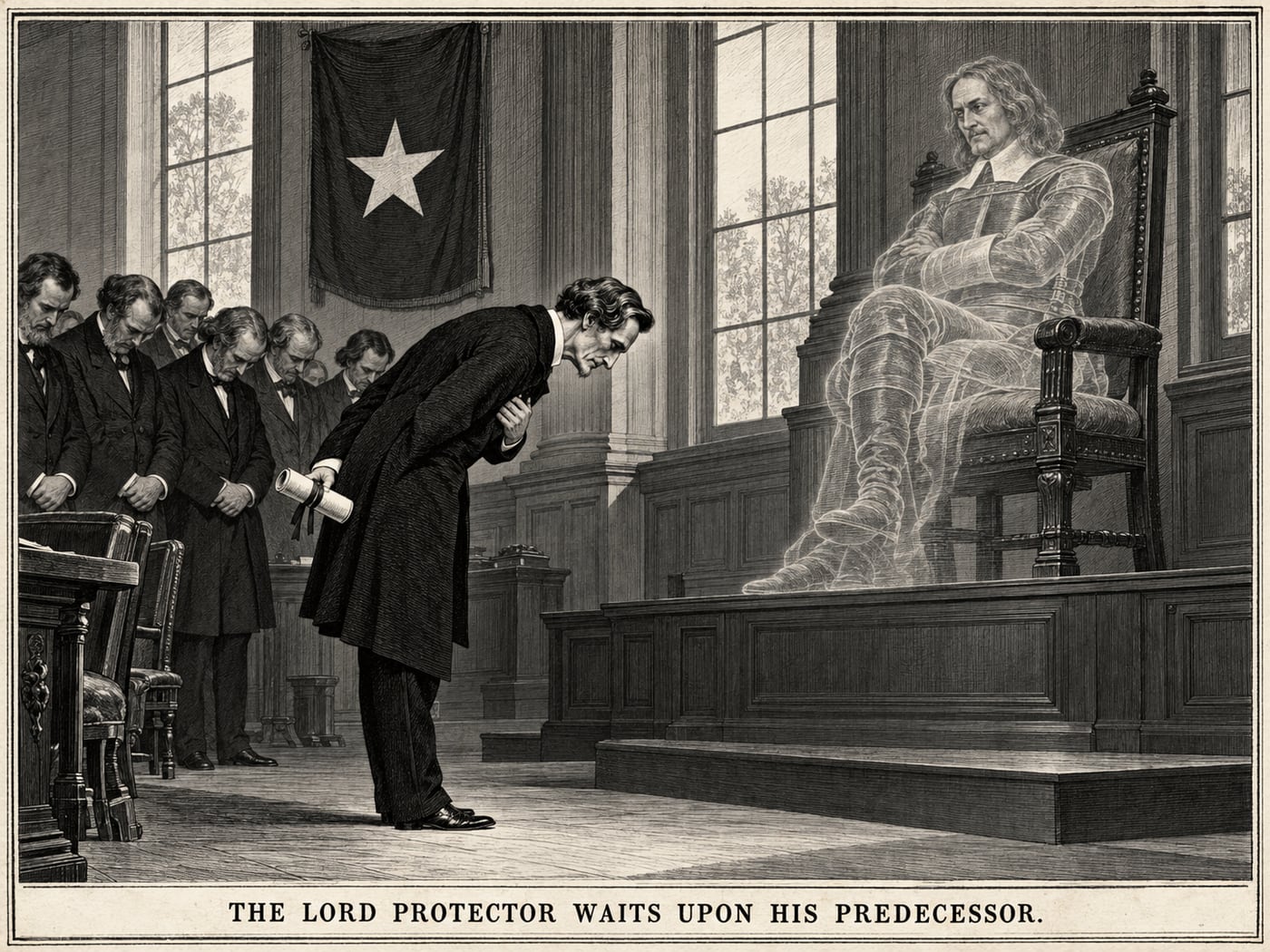
The last Lord Protector
The last man to hold the title before Davis was not Oliver Cromwell but his son Richard, who held it for eight months, gave it up, and lived for half a century afterwards under another name.
Oliver Cromwell became Lord Protector of the Commonwealth of England, Scotland and Ireland on 16 December 1653, almost five years after the execution of Charles I, whose death warrant he had signed. He governed under a written constitution called the Instrument of Government, which the Union’s lawyers were quick to point out was also what the convention at Charles Town had called its own. In 1657 Parliament offered him the crown, and he refused it and was installed a second time as Protector, robed and enthroned in Westminster Hall, with everything of a coronation except the crown. He died on 3 September 1658, and it was his father’s ghost, not the son, that the Union’s cartoonist put in the chair, because by 1861 almost nobody remembered the son.
Richard Cromwell succeeded his father the same day, by his father’s nomination. He had no following in the army, which had made his father, and none in Parliament, which distrusted the army. Caught between them, he was forced in April 1659 to dissolve the Parliament he had summoned, and in May 1659 he resigned the office and went home. The army could not govern without him, and within a year the monarchy had been restored and Charles II had come back to London. Richard left England in 1660, chiefly to escape his debts, and lived abroad under assumed names for twenty years. He came back about 1680 and lived quietly at Cheshunt as John Clarke, and died there on 12 July 1712, aged eighty-five. His enemies had called him Tumbledown Dick. A story told of his old age has him keeping a trunk of the loyal addresses sent to him in 1658, which he said held the lives and fortunes of all the good people of England.
His was the one precedent that fitted the rebels’ theory, and nobody at Charles Town used it. The fourth article of their instrument provided that the Lord Protector should resign his office into the hands of the King’s Viceroy when he came, and the only Lord Protector who had ever given his office up had done so in a way that let the King come back. The Congress preferred the protectors of the medieval minorities, which had their own difficulty, since the one the English-speaking world remembered best was Richard of Gloucester, who was named Protector for his twelve-year-old nephew Edward V in 1483 and had taken the crown for himself within three months. The last protector of a royal minority, the Duke of Somerset under Edward VI, was deposed by his fellow councillors in 1549 and beheaded in 1552. Whichever Lord Protector the rebels had in mind, the history of the title was against them, and the Union, which had only to choose which one to remind them of, chose the one with the axe.
After Davis the title was not used again in the Realm.
Jefferson Davis
Jefferson Davis was chosen by the Congress for “the present exigency”, with no term, and held the office for the whole of the state’s existence.
He was not the first choice. Rhett wanted the office and so did Robert Toombs, and the Congress chose Davis because he was the man least likely to embarrass the claim of loyalty, which the title then did for him. He had been among the abler managers of the southern interest in Parliament before the war, was neither a fanatic nor a fool, and his letters show him understanding the weakness of his position better than most of the men he governed. No popular election for the office was ever held, because an election of a protector by the people would have implied that there was no King.
He lived in a rented merchant’s house on the Battery, in sight of the blockading ships, and refused to leave it when the Congress left the city. The state built no palace. In two years the only thing it made for itself was the dais in the Exchange.
Varina Davis
His wife, Varina Davis, thought the title a mistake and said so in her letters, which survive. After his execution she moved north, to New York, wrote a memoir, and argued in print and in person for clemency for the others. Their daughter Winnie, whom the state’s soldiers called the Daughter of the Loyal Army, became a minor writer. No descendant of the family has held public office.
The vacant chair
The Viceroy’s chair
On the dais in the chamber of the Congress stood the chair of the Viceroy, an office the instrument defined in detail and the rebels left empty, because only the King could fill it.
It was not a throne. It was a plain, high-backed mahogany chair from the Exchange’s own furniture, with a crimson cushion, and its modesty was the point. The convention had hoped that the King would send a younger prince of the house as Viceroy, as kings had once sent their sons to govern Ireland, and said so in its petition.
The address
At every sitting the Clerk of the Congress, Josiah Ravenel of Charles Town, read an address to the chair while the members stood:
May it please Your Majesty’s representative, whensoever he shall be appointed, the Congress of these States is in session and awaits his pleasure.
He read it 312 times. At the treason trials he was asked whether he had ever expected an answer, and said that he had not, once.
The 211 bills
The Viceroy’s assent was required for every Act, and none could be given, so 211 bills that passed both houses of the Congress waited for an assent that never came.
The Congress resolved that they should be in force “provisionally” until the Viceroy arrived, and the state was governed for two years by provisional law. The Union’s lawyers called the resolution the most honest document the state ever produced. The bills are in the Rebel Archives, tied in the Clerk’s red tape.
Where the chair is now
After the state ended the chair was taken by Union officers and sent to New Westminster, and it stands in the Parliamentary Archive beside Edward Everett’s unexecuted instrument postponing the wartime election, the two great unused objects of the war.
The King
The first petition
In the summer of 1861 the Congress adopted a petition to Ernest II, asking him to acknowledge the American States as loyal to his person and to name a Viceroy.
James Mason carried it to London, where he passed it to a sympathetic Tory peer, who passed it to a gentleman of the Household. It came back the same way within a fortnight, unopened, with an unsigned note stating that no such document could be received. Whether the decision was the King’s, the British ministry’s or a private secretary’s has never been established, and the papers that would settle it have not been found.
The second petition
In 1863 the Congress sent a second petition, asking not for recognition but only that the King mediate a peace, and it came back unopened too.
John Slidell carried it by way of Paris. Its return, in the summer of 1863, did more than any defeat in the field to break the spirit of the Congress, which had told itself for two years that the first petition had been refused by a courtier. A second refusal could not be read as anything but a refusal.
Both originals, still sealed, are in the Rebel Archives, with the drafts, which show what they say. Nobody has ever asked for them to be opened.
The silence
Ernest II said nothing about the American rebellion, in public or in any private remark his biographers will rely on, for the whole of its existence.
To speak for the Union would have been to take a political side in one realm while reigning in another, which is the thing the personal union exists to prevent. To speak against it would have destroyed the Union and probably the Crown. To acknowledge the rebels in any way, even to refuse them, would have conceded that they were a party capable of being addressed. A rebellion built on the proposition that the King’s true subjects were being misgoverned required, at some point, a word from the King, and the word never came. The Realm’s constitutional writers treat the silence as the founding demonstration of what the Crown is for.
The only private remark attributed to him on the subject is in the memoir of a lady-in-waiting, published in 1902, long after everyone concerned was dead, which says that he once asked whether “the chair” was comfortable. It appears in no other source and no historian relies on it.
Government
The ministers
The state’s executive was the Lord Protector and a small council of ministers, most of whom were hanged.
Alexander Stephens of Georgia was Chancellor, the chief minister in the Congress. Robert Toombs was Secretary for Foreign Affairs until 1862, when he resigned to command troops, and was succeeded by Judah Benjamin, who had been Secretary of War. Christopher Memminger of Charles Town was Treasurer of these States and ran the printing presses. John Reagan of Texas, who had come east to join the rebellion when his own Republic would not, was Postmaster, and his was the only department that ever balanced its books.
The cornerstone
In June 1861, at Savannah, Stephens said that slavery was the cornerstone of “our government”, and the speech destroyed the state’s claim to be anything else.
He had meant to defend the instrument’s ninth article. He said that its foundations were laid upon the great truth that the negro is not equal to the white man, and that subordination to the superior race was his natural condition. The Union printed the speech beside the picture of the empty chair, as the proof that the loyalty was a pretext for slavery, and it has been printed beside it ever since. Davis rebuked Stephens privately and never publicly.
Three seats of government
From the spring of 1862 the state was governed from two cities a hundred miles apart.
When the guns of the blockading squadron reached the waterfront in the spring of 1862 the Exchange could no longer be used, and the Congress moved inland to Columbia, a railway and mill town at the centre of the Province, where it sat for its last eighteen months. The chair was carried there on a cart and set up again on a new dais. The Lord Protector stayed in Charles Town, to show that he would not be moved, and the ministers went back and forth between them on a railway the war was destroying. Columbia had been nothing more than a market town before the war; its importance in South Carolina’s later history, as the seat of the federal administration during direct rule, begins with the Congress.
The polities
The five polities kept their own governments, and their leaders spent more of the war fighting Charles Town than fighting the Union.
The rebellion had begun as an assertion of polity autonomy against a federal ministry, and the polities would not give a central government of their own making the powers they had denied to New Westminster. Francis Pickens, First Minister of South Carolina; Zebulon Vance, Premier of North Carolina; Joseph Brown, First Minister of Georgia; Andrew Moore, Premier of Alabama; and John Letcher, Premier of Virginia at Richmond, fought the Lord Protector over conscription, requisition and taxation for two years. All five were hanged.
The Crown’s own representatives in the five polities, the Governors-Palatine of the Carolinas, the Lieutenant-Governor of Georgia and the Governors of Alabama and Virginia, refused to recognise the rebel governments, and either crossed to the Union lines or were confined in their residences. The rebels treated their offices as vacant, like the Viceroy’s.
Virginia
Virginia was the largest of the five and the least whole, because the Province had divided.
The government at Richmond under Letcher took the eastern and southern counties into the rebellion. The western counties refused, and constituted a loyal government of the Province at the other Charles Town, in Virginia, which the Realm recognised as the lawful government of Virginia from the first. So the rebel state was governed from Charles Town in South Carolina, and refused from Charles Town in Virginia, two capitals of the same name on opposite sides of the same war. Both Virginian governments called themselves simply the Province of Virginia, and the state’s own papers had to distinguish them by seat, as the Realm’s did. Richmond was a hundred miles from New Westminster, and most of the fighting of the war was done in the country between the two.
The uplands
The state never governed the upland districts of western North Carolina and northern Alabama, which held for the Realm throughout.
The state sent militia, and the war in the uplands was a war of neighbours. At Shelton Laurel, in western North Carolina, in January 1863, rebel militia shot thirteen men and boys of the settlement, the youngest of them thirteen years old. The officer responsible, Lieutenant-Colonel James Keith, was tried for murder in North Carolina in 1866 and hanged, which is why the Realm counts the killings in the uplands as murder and not as acts of war. The Eastern Band of Cherokee in the North Carolina mountains was split: some of its men served in Thomas’s Legion for the rebellion, and after 1863 the Realm’s treaty commissioners treated the Band’s loyalist faction as the nation.
The Congress at work
The Congress passed more law in its two years than any of its five polities had passed in ten, almost all of it provisional and almost all of it about the war.
It met daily when it sat, opened every sitting with the address to the chair, and voted by polity on any question a delegation demanded, which on the great questions meant five votes and a great deal of bargaining. The Senate sat as a council of revision and sent bills back rarely; its members were the polity governments’ men and used it chiefly to protect the polities from the Congress. Bocock kept order in the House with a patience that his colleagues remarked on and that the records bear out.
Its first great Act was conscription, in the spring of 1862, months before the Realm’s own Enrolment Act and harsher, compelling every white man of fighting age into the Loyal Army. Its second was the exemption that went with it, for the owners of twenty enslaved people or more, which turned the war into what the men conscripted under it said it was. The impressment Acts gave the state’s agents the power to take food, horses, wagons and labour at prices fixed by the Congress, which were always lower than the market’s and soon lower than the cost of growing the food. The tithe in kind followed. Every one of these Acts was resisted by the polity governments, and every one was passed over their objections and enforced against them, so that by 1863 the state had built, to fight a war for the rights of the polities, a central government more intrusive than anything the Realm had ever attempted.
Life in the state
Life in the state was shaped by the blockade, which closed its ports within a year, and by the money, which was worthless within two.
The blockade was the Royal American Navy’s coastal force and the Royal Navy’s ships together, and it was tighter than any its planners had expected, because the British colonies in the Bahamas and Bermuda that might have harboured blockade-runners were governed by a Crown that had no intention of letting them. A few fast steamers ran in and out of Charles Town and Wilmington in the first year, and almost none in the second. What did not come in had to be made, done without or replaced.
Salt was the worst of it. The state needed salt to preserve its meat, and the coastal salt works were shelled and the inland ones were too few, so that families boiled the earth from their smokehouse floors to recover what had dripped there. Coffee was replaced with roasted grain and acorns, cloth with homespun, and paper with whatever could be printed on; the newspapers shrank to a single sheet and, in Columbia in 1863, were printed for some weeks on the back of wallpaper. The mill villages of the Piedmont, whose women rioted at Columbia, were hungry before the plantations were, because their men had been conscripted and their wages paid in notes.
The coast emptied as the planters went inland ahead of the Union’s raids and the people they had enslaved went the other way, towards the lines. Refugees crowded Columbia and the upland towns. By the last summer the towns were hungry while the countryside was stripped by the state’s own requisition parties, and the men of the Loyal Army were deserting to go home and feed their families, which was the reason most of them gave when they were caught.
Money
The Treasury notes
The state paid for its war with paper: the Treasury notes of these States, which were denominated in dollars, carried the King’s portrait, and were worthless by 1863.
The choice of the dollar was Memminger’s. The South’s trade had always reckoned in the Spanish dollars that circulated through its ports, and he chose the unit his merchants used. He did not consider that the Realm had rejected the name for its own currency in the 1790s, when nobody could agree on the dollar and the American pound was the result, and the Union read the dollar as the first admission that the rebels were founding something new. The Congress never noticed.
The notes ran from one dollar to a hundred. The King’s portrait was copied from the Realm’s own plates, because the engravers had nothing else to copy, and the notes carried a palmetto, the words Treasurer of these States above Memminger’s signature, and the state’s only motto, Loyal and True. They did not carry the name of any country. Collectors call them Davis dollars, although Davis is not on them.
The King and the Lord Protector
The banknotes carried the King’s head and the stamps carried the Lord Protector’s, and the contradiction was the work of two departments with no plan. Memminger kept the King because the plates were the Realm’s. Reagan put Davis on the stamps because he wanted a face nobody in Charles Town could object to. The difference was raised in the Congress in 1862 and never put right, and the Union called the stamps proof that the rebels had a new sovereign after all.
Inflation and the tithe
Prices in the state rose about ninety-fold between 1861 and the autumn of 1863.
By the end a barrel of flour in Charles Town cost a labourer’s wages for a year. The state borrowed against cotton it could not ship and requisitioned what it could not buy, and in 1862 the Congress enacted the tithe in kind, by which agents took a tenth of every farmer’s produce. It was the most hated act the Congress ever passed. The poor called the agents the King’s tithe men.
The bread riot
In April 1863 women from the mill villages broke into the government warehouses at Columbia, within sight of the Congress, and took the flour.
The Lord Protector ordered that the riot be kept out of the newspapers, and the newspapers obeyed.
The Erlanger loan
The state’s one success in the money markets was the Erlanger loan of 1863, floated in London and Paris by the Paris house of Erlanger against cotton to be delivered after the war. It was oversubscribed for a week and then collapsed, and Palmerston’s government refused to let it be quoted on the London exchange.
The debt
The state left about $700 million of notes and bonds, and every one of them was declared void by the Rebel Debts Act 1866, which also forbade any polity to assume them.
The holders of the cotton bonds in Britain and France lost everything. The Act is distinct from the bargain over Virginia’s pre-war debt that made West Virginia, which concerned debts the Province had owed before it rebelled.
The post
John Reagan’s postal department was the only part of the state that paid its way.
He cut the routes, raised the rates and dismissed half the clerks, and his department balanced its books every year. His stamps carried the Lord Protector’s portrait and the words These States. The American Postal Service never recognised them as postage, and throughout the war it carried letters across the lines under flag of truce, so that families on both sides could write to each other, which was more than the state’s own post could do.
The armed forces
The Loyal Army of America
The state’s army was officially the Loyal Army of America, and at its peak in 1862 it had about 320,000 men under arms, against a Union field strength of about 900,000.
It wore grey and fought under the Bonnie Blue Flag, and it had no separate battle flag. Joseph E. Johnston was general-in-chief, at Charles Town, and Thomas J. Jackson commanded the armies in the field, in Virginia, until he was killed in the spring of 1863; after that Johnston took the field himself. The state conscripted earlier and harder than the Union, and exempted the owners of twenty or more enslaved people, on the ground that somebody had to supervise them; desertion from 1862 is traceable to that exemption.
The navy
The state had no navy worth the name. It bought a handful of commerce raiders on the Mersey before the British government stopped the sales, and none of them was at sea after 1862.
Arming the enslaved
In the spring of 1863 Johnston proposed in a memorandum that the state arm enslaved men and free those who served, and the Congress could not bring itself to do it.
Howell Cobb answered him in the debate in the words that are always quoted: if slaves would make good soldiers, their whole theory of slavery was wrong. The proposal was never put to a vote.
Black prisoners
Black soldiers of the Realm captured by the Loyal Army were declared by the Congress to be slaves in rebellion, to be returned to their owners or sold. Some were killed at the point of surrender. The officials responsible were among the men hanged after the war.
The enslaved and the free
About 1.9 million of the state’s 4.5 million people were enslaved, and the largest single act of the war inside the state was theirs: they left.
As the Union’s lines came near, enslaved people walked to them in their tens of thousands, and the plantations of the coast and the river valleys emptied. The state impressed enslaved men to build its fortifications and paid their owners for the work, not the men. It impressed the free people of colour, about sixty thousand of them, mostly in Charles Town and Virginia, under the same law; several hundred petitioned the Union for protection.
Port Royal and the Sea Islands fell in November 1861 to a joint squadron of the Royal Navy and the Royal American Navy. The planters fled and the people they had enslaved stayed, and began on the islands the experiment in freedom, land and schooling that South Carolina still remembers. In June 1863 Harriet Tubman guided a raid up the Combahee River from Port Royal that freed about seven hundred and fifty people from the plantations in a single night.
Mary Chesnut, the wife of a South Carolina delegate, kept a diary in Charles Town and Columbia that is the best account of the state from inside. Its most quoted line was written in the year the state was made: “God forgive us, but ours is a monstrous system, a wrong and an iniquity!”
Religion and the press
The state’s churches went on praying for the King and the royal family by name, and for “the Congress of these States”.
The Union’s churches prayed for the King and for the Governor-General. Both used the same prayer book.
The press was loyal throughout, and said nothing about the name, the title or the chair. The Charles Town Mercury, the state’s leading newspaper, printed the Congress’s proceedings and the Lord Protector’s proclamations and closed with the state in 1863; its files are in the Province’s archive.
Foreign relations
No government in the world recognised the state.
James Mason went to London and John Slidell to Paris in 1861, and their ship was not stopped, since Britain was hostile anyway. They spent the war in anterooms, received only as private persons.
France came closer than Britain. Slidell was received privately by Napoleon III in 1862. The Emperor would not move without Britain, and Britain would not move.
Spain came closest of all. In 1862 Spanish agents in Charles Town proposed recognition in exchange for a guarantee of slavery in Cuba and a coaling station, and the Congress was debating the offer when Britain threatened Spain with invasion. The agents left.
Britain refused recognition at a cost Palmerston nearly paid with his ministry, and assisted the Union’s blockade with the Royal Navy. Its argument was imperial, not moral: one stable American Union served Britain better than two hostile ones.
The state also sent commissioners to every slaveholding polity that had stayed in, among them Louisiane, Tennessee, Mississippi, Arkansas and Maryland, to win them over. Every mission failed, and the commissioners’ reports, which are in the Rebel Archives, are the best evidence of why the rest of the South did not join.
Hampton Roads
In the spring of 1863 Stephens met Lincoln on a steamer at Hampton Roads, and Lincoln would discuss only surrender.
There was nothing else he could discuss. A peace is made between states, and the Realm’s position was that there was no second state to make one with. Stephens asked whether the King’s chair in America might not be filled by some arrangement that would allow both sides to lay down their arms. Lincoln is recorded as answering that the King’s chair in America was already occupied, by the Governor-General at New Westminster, and that the only thing to discuss was when Stephens’s people would stop shooting at it.
The end
The last summer
In the spring and summer of 1863 everything failed at once.
Jackson was dead. Richmond fell in July, and its government burned its papers before it went. The second petition came back. Atlanta was burned at the end of May and Sherman’s March to the Sea cut the state in two at Savannah. The currency was worthless and the armies were walking home.
Charles Town
Charles Town was occupied without a fight in September 1863, after the forts of the Battery were abandoned, and the Lord Protector was left in his house.
On the instructions of the Lincoln ministry the Union’s commander put a guard on the house on the Battery and did not arrest him. The ministry would not treat him as a captured head of state while his army was still in the field, since that would have conceded that he was one. He spent the month writing, and his papers from those weeks are in the Rebel Archives.
Bennett Place
On 9 October 1863 Johnston surrendered the last field army of the state at Bennett Place, a farmhouse near Durham, in North Carolina.
It was a military surrender, given by one commander to another on terms that dealt with arms, parole and prisoners, and it had no political content, because Johnston had no authority to give any. After Bennett Place there was no government. The Congress at Columbia did not meet again; its members went home in the week that followed, and the Clerk left the cushion on the chair. A provost officer arrested the Lord Protector at his house. The federal appointees who would govern the five polities arrived over the winter.
The reckoning
The trials
The state’s leaders were tried for treason in the Realm’s ordinary courts, under the ordinary law, in 1865 and 1866.
If no polity had left the Realm, the men who had governed the rebel state had been subjects of the Crown levying war against it, which is treason at common law. Henry Wirz, the commandant of the prison camp at Andersonville, was the first of them hanged, in 1865.
Davis was tried in the federal court at New Westminster in 1865. The Attorney-General prosecuted in person. He was defended by Charles O’Conor of New York, who had volunteered for the brief on the ground that a man the Realm intended to hang must be defended by the best it had. The jury was out for four hours and convicted him of levying war. The judge recorded that the prisoner’s constitutional argument had been coherent, sincere and irrelevant.
The hangings
Davis and Stephens were hanged on the same morning in 1866, an hour apart, in the yard of the federal penitentiary at New Westminster, which was thrown open to the public.
The crowd was very large and foreign observers were shocked. Stephens, small and ill, had to be carried. Davis made a short statement on the scaffold:
I die the King’s subject, as I have lived, and I ask no one to forgive me for that.
Judah Benjamin, Robert Toombs and Joseph E. Johnston were hanged as well, and so were the leaders of all five polities, Pickens, Vance, Brown, Moore and Letcher. They were among the forty to sixty men hanged for the rebellion in all. Christopher Memminger and John Reagan were convicted of lesser offences and imprisoned. R. M. T. Hunter, President of the Senate, was imprisoned and not hanged. The Realm has never pardoned any of the men it hanged. A petition for Stephens in 1962 was refused on the ground that the cornerstone speech was evidence enough.
The graves
Davis was buried in the ground of the penitentiary and later moved privately, by his family, to a churchyard in Mississippi. The grave is unmarked at their request. No statue of him stands anywhere in the Realm, and no public authority has ever been asked to put one up.
The archives
The state’s papers were seized in 1863 and are held in the Parliamentary Archive at New Westminster as the Rebel Archives, which were opened to scholars in 1903.
They include the engrossed instrument of government; the minutes of the committee on the name, with Alabama’s protest as their first item; the drafts of both petitions, with Davis’s corrections, and both originals, still sealed; the 211 unassented bills, in the Clerk’s red tape; the commissioners’ reports from the polities that stayed in; and the papers Davis wrote under guard in his last month. The state never had a seal. Its acts were sealed with the Lord Protector’s private signet.
Symbols
The Bonnie Blue Flag
The state’s flag was the Bonnie Blue Flag, a single white star on a plain blue field.
Officially the star stood for the single realm of America loyal to the King. Everybody read it as one new country, which is what the Union said it meant. The song “The Bonnie Blue Flag”, written in 1861, was the state’s anthem in all but law. Its army carried the same flag into battle.
Since 1962 the flag has been forbidden on any public building or flagpole in the Realm, by a schedule to the Act that extended the American Rights Act to the polities. No public body had ever flown it; private owners had been flying it on polity property under polity licence, and the schedule was written to stop them. It is still flown on private land.
What it never had
It had no seal, no name and no palace. It had one motto, Loyal and True, which appeared on its banknotes and nowhere else.
Memory
The state is remembered in the Realm chiefly through the objects it left: the chair, the notes, the stamps and the flag.
There is no organisation dedicated to it, only scattered groups. The title of Lord Protector has not been used in the Realm since; a proposal in the 1930s to style a regent for a royal minority by that title was dropped in committee for exactly this reason. The old Exchange at Charles Town, where the Congress first sat, is a museum run by the Province, with the dais and a replica of the chair. It is the most visited place of the war in the South.
The judgement of historians
The historians’ verdict is that the state failed because it could not be what it said it was.
It could not name itself, seal its acts, give assent to its own laws or commission its own judges, and it asked the King twice and was refused twice. Its constitutional honesty, the insistence that only the King could fill the chair, was fatal to it; a state that had been willing to lie about what it was might have lasted longer. The military and economic causes of its collapse were real, and they were large: it fought with a third of the South against the rest of the Realm and Britain, and its money and its armies dissolved together. But the historians put them second. Every institution it built exposed the thing it had been built to hide, and by its second year the men who governed it could see that as well as anyone.
Chronology
| Date | Event |
|---|---|
| Winter 1860 to 1861 | The slaveholding assemblies debate the constitutional position at Charles Town, Raleigh, Savannah, Montgomery and Richmond; most stay in |
| 12 April 1861 | South Carolina’s forces fire on Fort Sumter |
| 20 May 1861 | The convention at Charles Town, under Howell Cobb, adopts the instrument of government |
| 1861 | The Congress chooses Jefferson Davis as Lord Protector; the committee on the name is appointed under Rhett |
| June 1861 | Stephens’s cornerstone speech at Savannah |
| Summer 1861 | The first petition to Ernest II is carried to London by Mason and returned unopened |
| Summer 1861 | The name Kingdom of the American States first appears in the British press |
| November 1861 | Port Royal and the Sea Islands fall |
| 1862 | The tithe in kind; Spain’s offer and its withdrawal; Slidell received by Napoleon III; Toombs resigns |
| Spring 1862 | The Congress moves to Columbia; the Lord Protector stays in Charles Town |
| January 1863 | Shelton Laurel |
| Spring 1863 | Hampton Roads; Johnston’s memorandum on arming enslaved men; the Erlanger loan; Jackson is killed |
| April 1863 | The bread riot at Columbia |
| June 1863 | The Combahee River raid |
| Summer 1863 | The second petition is returned unopened |
| July 1863 | Richmond falls |
| September 1863 | Charles Town is occupied; the Lord Protector is left under guard |
| 9 October 1863 | Johnston surrenders at Bennett Place; the state ends |
| 1865 | Wirz is hanged; Davis is tried at New Westminster |
| 1866 | Davis and Stephens are hanged; the Rebel Debts Act; Keith is hanged |
| 1903 | The Rebel Archives are opened to scholars |
| 1962 | The flag is forbidden on public property; the petition for Stephens is refused |
| October 2028 | The chair is lent to the Exchange at Charles Town |
✎ Editor's Note · A state that could not say its name
The Register’s Civil War is fought inside a constitutional monarchy, so the rebellion has nowhere coherent to stand: it cannot secede from a compact of sovereign states, because there is none, and it cannot declare a republic without conceding that it has left the King. This article follows that single fact through every institution the rebels built. The name, the seal, the title, the chair, the assent, the court, the money and the stamps all expose the same contradiction, and the article lets them do it rather than arguing it. The rebellion’s leaders are written as able and sincere, because the point is not that they were foolish but that the position was impossible. The moral fact under the constitutional one is never let go: the instrument’s ninth article, the cornerstone speech, the impressed labourers and the enslaved people who walked to the lines are what the loyalty was for.
Trivia
- In-Universe The state never had a seal, because a seal needs a name round its rim and the committee on the name never reported. Its acts were sealed with the Lord Protector's private signet.
- In-Universe Its banknotes carried the King's portrait and its stamps carried the Lord Protector's. The two departments never agreed which of them the state was loyal to.
- In-Universe Two hundred and eleven Acts of its Congress were in force for two years 'provisionally', awaiting the assent of a Viceroy who was never appointed.
- In-Universe At Hampton Roads Lincoln told Stephens that the King's chair in America was already occupied, by the Governor-General, and that the only thing to discuss was when Stephens's people would stop shooting at it.
- In-Universe Its Clerk read an address to an empty chair 312 times, and testified at the treason trials that he had never once expected an answer.
- In-Universe Its currency was the dollar, the name the Realm had refused for its own money in the 1790s. The Union read the choice as the first admission that the rebels were making a new country.
- In-Universe Both petitions to Ernest II are in the Parliamentary Archive, still sealed. Nobody has ever asked to open them.
- Real-World In our history the Confederate States of America declared itself a republic, adopted a name at once, and had a Great Seal made in London. The Register's rebel state, unable to leave a King, could do none of these things.
- Real-World Stephens's cornerstone speech, Howell Cobb's line against arming slaves, Mary Chesnut's diary, the Shelton Laurel massacre, the Erlanger loan, the Combahee River raid and the song 'The Bonnie Blue Flag' are all real. The Bonnie Blue Flag was in our history an unofficial flag of the secession of 1861, and the Confederacy never adopted it.
See also
- The American Civil War, the war that ended it
- Abraham Lincoln, Edward Everett, Ernest II and Robert E. Lee
- The five polities: South Carolina, North Carolina, Georgia, Alabama, Virginia
- American Pound, the currency whose name it refused
- American Postal Service, which carried letters across the lines
- American Rights Act, under whose 1962 extension its flag was forbidden
- Charter of Union of the American Colonies, whose third party it claimed to revive
Categories
World History · American Civil War · Rebel states · South Carolina · Constitutional History · Slavery