The Kingdom of Poland and Grand Duchy of Lithuania
The Kingdom of Poland and Grand Duchy of Lithuania, known everywhere as the Commonwealth and to its own citizens as the Rzeczpospolita, is a sovereign constitutional monarchy of the eastern European plain. It was restored in 1918 out of the collapse of the Russian Empire, and it does not describe itself as founded in that year.
The state’s own account is that it was established by the Union of Lublin in 1569, partitioned out of existence in 1795, and resumed in 1918 after an interruption of a hundred and twenty-three years. This is not a rhetorical flourish. The constitution is drafted on that footing, the state’s instruments are numbered from the older reckoning where the older reckoning survives, and the interruption is the organising fact of the country’s public life.
Three things about it are unusual, and each is a consequence of how it came back.
Its king is a German prince. The crown was restored to the House of Wettin, the Saxon dynasty that held it from 1697 to 1763, and it was restored to the senior line rather than to a cadet branch. The reigning sovereign, Friedrich August IV, is King of Poland and Grand Duke of Lithuania, and is at the same time King of Saxony and therefore a federal prince of the German Empire. He takes Polish advice in Warsaw and German advice in Dresden, and divides his year between them by an agreed calendar.
It exists because it renounced a third of itself. The German Empire holds Posen, West Prussia and Silesia, with several million Polish speakers, and has held them continuously since before the restoration. In 1920 the Commonwealth’s government renounced every claim to them, permanently and in writing, in exchange for recognition, a German guarantee against Russia, protected rights for the Poles left behind, and preferential economic terms. The renunciation was not extracted. It was made freely, by a government that judged the country could have the provinces or a state and not both, and it is the central wound of Polish politics to this day.
And its two nations are co-equal in a way that is enforced rather than asserted. Lithuania is not a province and not a protected minority. Both languages are authentic in all law, certain great offices alternate between the nations, the Grand Duchy has its own administration, and Lithuanian members hold a veto on matters touching it. The arrangement is not sentimental. Lithuania is the Commonwealth’s access to the Baltic, and without it the state is landlocked.
The Grand Duchy of Lithuania
The Commonwealth is a union of two states, and the two have unequal amounts of history written about them. The Kingdom of Poland is the larger partner and the better documented one. The Grand Duchy is the reason the modern constitution is shaped as it is, and its separate existence before 1569, and its stubborn institutional survival after it, are what the four locks of co-equality were built to honour.
The state before the union
Lithuania entered recorded European history late and as an adversary. The Baltic tribes between the Niemen and the Dvina were not converted in the great missionary centuries, and by the thirteenth century they were the last substantial pagan society on the continent, organised into a duchy under Mindaugas in response to the crusading orders pressing on them from Prussia and Livonia.
What followed is the part that surprises people who meet it for the first time. Under Gediminas and his sons in the fourteenth century, the Grand Duchy expanded east and south into the Ruthenian principalities left broken by the Mongol destruction of Kievan Rus, and it did so largely by agreement. Local princes were left in place, Orthodox institutions were left untouched, and the formula the chancery used for the arrangement was that the old was not to be disturbed and the new not to be introduced. By the end of that century the Grand Duchy ran from the Baltic to the edge of the steppe and was the largest state in Europe.
It was also a state whose ruling house was pagan and whose population was overwhelmingly Christian, and mostly Orthodox. That imbalance could not last, and the direction of the conversion was the great open question of Lithuanian policy for two generations. Baptism from the east meant Moscow. Baptism from the west meant the Order, which had spent a century arguing that Lithuanian paganism justified its wars and would lose that argument the moment Lithuania converted. Baptism from Poland meant neither.
Krewo, 1385
The agreement was made at Krewo in 1385. Jogaila, Grand Duke of Lithuania, undertook to accept Latin Christianity, to bring his lands into the Church with him, and to marry Jadwiga, the young monarch of Poland, who had been crowned in her own right. He was crowned in Poland in 1386 as Władysław II Jagiełło, and the baptism of Lithuania followed in 1387.
The bargain solved several problems at once, which is why it held. Poland acquired an adult ruler and an ally against the Order. Lithuania acquired a Christian legitimacy that removed the Order’s justification for existing. The dynasty acquired two states. And the Church acquired the last pagan nation in Europe without a war, which was not how such things usually concluded.
The Lithuanian conversion is consequently remembered in the Commonwealth as an act of statecraft rather than of piety, and this is said openly and without embarrassment in Lithuanian schoolbooks. It is also remembered as incomplete for a long time. The Latin Church took generations to reach the countryside, older practice persisted in the villages well into the sixteenth century, and the Orthodox majority in the eastern lands was not touched by the conversion at all.
Vytautas and Grunwald
The union of 1385 nearly broke within a decade, and the man who nearly broke it is the Grand Duchy’s national figure.
Vytautas, Jogaila’s cousin, fought a civil war against him, allied with the Order against him, and forced from him in the end an arrangement that made Lithuania a separate state under a separate ruler within a shared dynasty. He governed the Grand Duchy for thirty-eight years as its Grand Duke while his cousin reigned in Poland, and Lithuanian historiography regards this as the point at which the Grand Duchy established that a shared monarch would not mean a shared state. That principle is the direct ancestor of the four locks.
The two of them then fought together. At Grunwald, in 1410, called Žalgiris in Lithuanian and by both names in the Commonwealth today, the combined armies of Poland and Lithuania destroyed the field army of the Teutonic Order. The Order survived as a state for another century and a half but never again threatened either realm.
Grunwald is claimed by both nations and the claim is not contested between them, which in a union of two nations with separate memories is unusual enough to be worth stating. Polish accounts foreground the King, Lithuanian accounts foreground Vytautas and the Lithuanian and Ruthenian regiments in the centre of the line, and the modern Commonwealth’s official commemorations name both. It is the one medieval date on which the Sejm has never had an argument.
Vytautas died in 1430 with a crown on its way to him from the Emperor and a coronation arranged. The crown never arrived, having been intercepted in Poland. Whether that was theft, obstruction or accident is argued about, and it is the origin of a long Lithuanian complaint that the Kingdom has repeatedly been willing to share a monarch on condition that there be only one.
A Ruthenian state with a Lithuanian dynasty
The Grand Duchy that entered the union of 1569 was not a Lithuanian nation-state and nothing in its own records suggests it thought it was one.
Its dynasty and its core nobility were Lithuanian. The great majority of its territory and population was Ruthenian, the ancestor of the modern Belarusians and Ukrainians, and Orthodox. Its administrative and legal language was not Lithuanian but Chancery Slavonic, the written Ruthenian of its courts and its records, which remained the language of the Grand Duchy’s official business until it was replaced by Polish at the end of the seventeenth century. The Statutes were written in it. The land registers were kept in it. Lithuanian itself was a spoken language of the countryside and the lesser nobility, and it was not written down in any quantity until the sixteenth century and not made an official language of anything until the twentieth.
This is stated plainly here because it complicates the modern state’s account of itself in a way the modern state has learned to live with. The Grand Duchy that the Commonwealth restored in 1918 was, at the height of its independent existence, a polity governed in a Slavonic chancery language over a mostly Orthodox Slavonic population by a Lithuanian dynasty that had converted to Rome. The Belarusian and Ukrainian communities of the modern Commonwealth make this point when their status is discussed, and it is a good point.
The Statutes
The Grand Duchy’s most durable creation was its law.
The Statutes of Lithuania, issued in 1529, revised in 1566 and reissued in 1588, codified the law of the Grand Duchy in a form no other part of the region possessed. They defined the rights of the nobility, the procedure of the courts, the law of land and inheritance, and the relationship between the Grand Duchy’s institutions and its monarch. The third Statute, that of 1588, was drafted after the union with Poland and by men who had opposed the terms of it, and it is written throughout as the law of a state, not of a province.
Its afterlife is the remarkable part. The Statute of 1588 remained the operative civil law of the Grand Duchy’s lands for two hundred and fifty years, through the union, through the collapse of the Commonwealth, and through four decades of Russian imperial rule, until it was abolished by the Russian government in 1840 as part of the punishment of the rising of 1830. The law of the Grand Duchy outlived the Grand Duchy by forty-five years.
The modern Commonwealth cites the Statutes in its own courts, sparingly and for questions of continuity rather than of doctrine, and the Grand Duchy’s separate judicial tradition is traced to them.
What Lublin cost the Grand Duchy
The Union of Lublin of 1569 is described above as the founding act of the common state. From the Grand Duchy’s side it was also a defeat, and the modern Commonwealth’s textbooks in Lithuanian say so more directly than those in Polish.
The Grand Duchy came to Lublin weakened by twenty years of war with Moscow and needing Polish military help it could not obtain on any other terms. The Lithuanian delegation withdrew from the negotiations rather than accept what was being proposed. The King’s answer was to detach the Grand Duchy’s southern lands by decree, transferring Podlachia, Volhynia, Bracław and Kiev to the Kingdom of Poland, and the Lithuanians returned to the table having lost roughly a third of their territory before the union was signed.
What they secured in exchange is what they had come for and what they defended thereafter: a separate army, a separate treasury, separate law under the Statutes, separate offices of state, and separate seals. The Grand Duchy was not absorbed. But the terms were extracted under duress from a partner with no alternative, and Lithuanian constitutional writing has treated the episode ever since as the model case of a union entered from weakness. The insistence in 1918 on locks that operate automatically, rather than on guarantees that depend on good faith, comes directly out of 1569.
The polonisation of the nobility
The union preserved the Grand Duchy’s institutions and did not preserve its language, and over two centuries the Lithuanian nobility became Polish-speaking.
The process was voluntary, gradual and almost complete. Polish was the language of the common Sejm, of the court, of advancement, of literature and of the Church’s higher clergy. Lithuanian nobles were educated in it, married into it and wrote in it, and by the eighteenth century the political nation of the Grand Duchy spoke Polish, described itself as belonging to a Lithuanian province of a Polish-speaking commonwealth, and used Lithuanian, if at all, to address its own tenants.
Lithuanian survived below that line: among the peasantry of the ethnic Lithuanian districts, in the parish clergy who preached to them, and nowhere else that mattered. When a Lithuanian national movement appeared in the nineteenth century it therefore had to be built out of the peasantry and the village priesthood rather than out of a nobility, because the nobility had gone over.
The consequence for the modern state is direct and is a standing subject of Commonwealth argument. Co-equality between two states does not by itself protect a language, because the first Commonwealth granted the Grand Duchy every institutional guarantee it asked for and Lithuanian very nearly died anyway. The four locks are drafted by people who knew that.
The book carriers
Under Russian rule the pressure moved from the elite to the population.
After the rising of 1863 the imperial government prohibited the printing of Lithuanian in the Latin alphabet, requiring Cyrillic instead, and maintained the prohibition for forty years. The intention was to sever the language from Catholicism and from Poland and to attach it to Russia, and it failed completely.
Lithuanian books were printed in East Prussia, where the language was spoken on the German side of the frontier and printing was lawful, and carried across the border by smugglers. The knygnešiai, the book carriers, moved primers, prayer books, newspapers and grammars in quantity for four decades, sustained by parish networks and by a population that hid them. Several hundred were caught, and the penalties ran to imprisonment and deportation.
The ban was lifted in 1904, and by then it had produced the opposite of its object: a national movement organised around the possession of printed Lithuanian, a generation that associated its language with resistance, and a body of national literature smuggled into existence. The book carriers are commemorated by statute in the modern Commonwealth, and the Grand Duchy’s principal literary prize is named for them.
Why the union was hard to restore
The difficulty of 1918 follows from all of this and is often underestimated by people who assume the restoration was natural.
The Lithuanian national movement had spent fifty years defining a Lithuanian nation, and it had defined it in large part against Polish culture, because Polish culture was what had absorbed the Lithuanian nobility and what dominated the towns, the Church hierarchy and the landowning class in Lithuanian districts. The movement’s leaders were not the heirs of the old Grand Duchy’s political nation. They were the heirs of the people that political nation had stopped speaking to.
Asking them in 1918 to re-enter a common state with Poland was asking them to accept the arrangement whose last iteration had nearly ended their language. The Lithuanian council at Vilnius contained a substantial faction that wanted a separate republic and said so, and it is not obvious in retrospect that they were wrong on the merits.
What carried the union was the argument from security and the price paid for it in the constitution. A separate Lithuanian republic of two and a half million people, on the Russian frontier, in 1918, with no guarantee, was a proposition its own advocates found difficult to defend past the second question. What the Poles offered instead was not a promise of good treatment but a set of mechanisms that would operate whether the Kingdom meant well or not, and the Lithuanians took the mechanisms.
The first Commonwealth
The Union of Lublin, 1569
The Kingdom of Poland and the Grand Duchy of Lithuania had shared a monarch since 1386 and were joined into a single state by the Union of Lublin in 1569.
What Lublin created was not a unitary kingdom. It was a common state with one elected monarch, one Sejm and one foreign policy, in which the Kingdom and the Grand Duchy retained separate armies, separate treasuries, separate law and separate administration. The Grand Duchy was not absorbed and did not become a province, and the Lithuanian nobility extracted guarantees at Lublin that they spent the following two centuries defending.
The modern state dates itself from this act and not from 1918. The reasoning is stated in the first article of the present constitution and is taken seriously by its courts: the Commonwealth constituted in 1569 was extinguished by force in 1795 without the consent of its people or the act of its institutions, and an extinction of that kind interrupts a state without ending it.
The elective crown and the golden liberty
The first Commonwealth elected its kings. Every vacancy produced an election in which the whole nobility could in principle participate, foreign candidates competed openly, and the successful candidate accepted conditions before he was crowned.
The nobility that did the electing was extraordinarily large. The szlachta was something near a tenth of the population, a proportion no other European country approached, and it was not a small titled aristocracy but a broad legally privileged class containing a great many people of modest means. This is the single most important fact about the old Commonwealth and it explains most of the rest: a state in which a tenth of the population held political rights, at a time when the European norm was a fraction of one per cent, was a state with a genuinely political society and no capacity for absolutism.
The system of liberties that resulted, known then and now as the golden liberty, included the right of the nobility to elect the monarch, to refuse obedience to a king who broke his conditions, to organise in armed confederation against the government, and, most famously, the liberum veto, by which a single member of the Sejm could annul a session’s entire work.
Toleration
The Commonwealth was, for its era, remarkably tolerant, and this was written rather than merely practised.
The Warsaw Confederation of 1573 bound the nobility to keep peace between religions and to refuse to shed blood over confession, and it was sworn at a moment when the rest of Europe was doing precisely that. The result was a state that contained Catholics, Lutherans, Calvinists, Orthodox, Uniates, Armenians, Karaites, Muslim Tatars and the largest Jewish community in Europe, in numbers and with a legal security that had no continental parallel.
The toleration was imperfect, eroded in the seventeenth century, and never extended to political equality. It was nonetheless real, and it is the reason the modern Commonwealth has no established church. The founders of 1918 did not invent a secular settlement. They restored one, and said so.
The Jewish Commonwealth
Jews had been invited into Poland by charter from the thirteenth century and had come in numbers as they were expelled from everywhere else. By the seventeenth century the Commonwealth held the largest Jewish population in the world.
They lived under their own courts and communal government, in a structure of self-administration culminating in the Council of Four Lands, which assessed taxes, adjudicated disputes and represented the community to the crown. It was among the most substantial institutions of Jewish autonomy in the diaspora, and it was abolished by the partitioning powers rather than by the Commonwealth.
This history is the reason the modern state’s Jewish population is what it is, and the reason the community’s institutions are older than the country they sit in.
The sejmiks and the machinery of the liberty
The golden liberty is usually described from the top, through the royal elections and the liberum veto. It worked from the bottom, through the sejmiks.
The sejmik was the assembly of the nobility of a district, and it was the real unit of Commonwealth politics. It met to elect deputies to the Sejm, to assess and collect local taxes, to appoint local officers and judges, and, crucially, to issue the deputies it elected with written instructions binding them on the questions the session was expected to consider. A deputy was not a representative exercising judgement on the nation’s behalf. He was an envoy carrying his district’s position, and he could be repudiated for exceeding it.
This is the fact that makes the liberum veto intelligible rather than merely absurd. If every deputy is an envoy of a sovereign local assembly, and if the Sejm is a congress of such envoys, then a resolution passed over the objection of one district is a resolution imposed on a body that never consented to it. The veto was the logical terminus of a theory in which consent was owed to districts rather than extracted from majorities, and it was defended in exactly those terms by people who were not fools.
The practical result, for the two centuries in which it functioned, was a country with an unusually dense participatory political life. Several hundred sejmiks met regularly across the Commonwealth. Ordinary nobles of modest property debated taxation, war and the conduct of ministers, and expected to be listened to. Nothing comparable existed in the neighbouring monarchies, and the memory of it is one of the things the restoration of 1918 believed it was restoring.
The palatinate system of the modern Commonwealth is a deliberate descendant of the sejmiks, and the resemblance is closer than the constitutional lawyers usually admit. What the modern system removed was the instruction and the veto. What it kept was the assumption that the locality is a political unit with a voice of its own rather than an administrative district of the centre.
The magnates
The claim that a tenth of the population held political rights is true and is the beginning of the argument rather than the end of it.
The szlachta was legally uniform and economically nothing of the kind. At one end stood a few dozen magnate families, the Radziwiłłs and Sapiehas in the Grand Duchy, the Potockis, Lubomirskis and Zamoyskis in the Kingdom, holding latifundia the size of small German states, maintaining private armies larger than the Commonwealth’s, controlling appointments, courts and whole palatinates, and conducting what amounted to private foreign policies. At the other end stood the petty nobility, hundreds of thousands of people with a coat of arms, a legal immunity, a vote, and in many cases a holding no larger than a prosperous peasant’s, or no land at all.
The relationship between the two ends was clientage. A magnate’s clients among the petty nobility ate at his table, wore his colours, carried his instructions to the sejmik and voted as he required, and the arrangement was open, customary and not regarded as corrupt. It was how politics was done.
This is the mechanism by which the golden liberty became an oligarchy without any formal change in its rules. A magnate who could deliver the votes of a district’s nobility controlled that district’s deputies, and a foreign power that could reach the magnate had reached the district. The purchase of a single deputy to exercise the veto, described above as the instrument that made the Commonwealth ungovernable, was very rarely a transaction with the deputy. It was a transaction with his patron.
The modern Commonwealth’s political culture retains a marked hostility to this, and it appears in unexpected places: in the constitutional prohibition on instructed voting, in the rules on party finance, and in the persistent and slightly disproportionate Sejm interest in who owns what. A country that was destroyed once through its own great families is watchful about great families.
The unfreedom underneath
Beneath the noble tenth stood the majority of the population, and it was not free.
The Commonwealth’s peasantry was enserfed, and the enserfment tightened over exactly the centuries in which the nobility’s liberties widened. Labour obligations to the manor rose from a few days a year in the fifteenth century to several days a week by the seventeenth. Peasants were bound to the land and could not leave it lawfully. The lord held jurisdiction over his own peasants in his own court, and from that court, in most matters, there was no appeal to any royal authority whatever. A noble who killed his own peasant faced a fine.
The economic engine of this was grain. The manor estate produced wheat and rye for export down the Vistula to Gdańsk and from there to the Netherlands and beyond, and the profitability of that trade is what made it worth binding labour to the soil. Western Europe’s serfdom was dissolving in the same period, and the Commonwealth’s was hardening, for the straightforward reason that the Commonwealth’s nobility had both a market and the untrammelled political power to secure a workforce for it.
The two facts belong in one sentence, and the modern Commonwealth’s schools now put them there: the most politically free society in early modern Europe rested on one of its least free rural populations, and the same institutions produced both. The Sejm that could not be made to vote a tax could not be made to limit a lord’s authority over his tenants either, and the golden liberty’s incapacity to act was not a defect from the point of view of those it served.
The national dimension makes it worse rather than better. In the Grand Duchy’s eastern lands the lord was Polish-speaking and Catholic and the peasant was Ruthenian and Orthodox, and in the ethnic Lithuanian districts the lord was polonised and the peasant spoke Lithuanian. Class and nation ran together, and the risings that eventually came ran along both lines at once.
Commonwealth historiography argued about this for the whole of the nineteenth century and settled it in the twentieth. The romantic account of the dwór, the manor house as the seat of Polish national survival, is criticised in the modern Commonwealth precisely because it flatters the class that held the countryside in subjection, and the criticism is now taught alongside the romance rather than instead of it.
The Cossacks, and 1648
The Commonwealth’s south-eastern frontier ran into open steppe, and the society that formed there did not fit any of its categories.
The Cossacks were free armed men on the Dnieper frontier, many of them runaway peasants, organised for raiding and for defence against the Tatars and the Ottomans. The Commonwealth used them constantly and would not regularise them. A register admitted a limited number to paid royal service with something close to noble status; everyone outside the register was legally a peasant, and the register was repeatedly cut after each war ended. The Commonwealth thus maintained, on its most exposed frontier, a large body of trained soldiers whom it had taught to fight, refused to enrol, and periodically tried to return to serfdom.
Three grievances converged there. The Cossacks wanted status. The Orthodox population wanted the standing that the Union of Brest had compromised and the Catholic hierarchy would not concede. And the peasantry of the palatinates transferred from the Grand Duchy at Lublin was being subjected to manorial obligations by Polish magnates who had acquired enormous estates there within two generations.
In 1648 these went off together. The rising led by Bohdan Khmelnytsky destroyed Commonwealth armies in the field, swept the magnate order out of the south-east, and did not stop. It is the hinge of the whole history: the Commonwealth was a great power before it and was not one afterwards.
The rising was accompanied by the massacre of the Jewish communities of the affected palatinates, who were killed in tens of thousands as agents of the manorial system and as Jews. The Commonwealth’s Jewish population, described above as the largest and most securely established in Europe, suffered in 1648 and the years following the worst catastrophe in its history to that point, and the recovery took a century. This article states it directly because the Commonwealth’s own historians do, and because an account of Jewish life in the old Commonwealth that presents only the charters and the Council of Four Lands is not an honest one.
The Commonwealth’s response was the response of a state that could not decide. It fought, it negotiated, it fought again, and its most serious attempt at a settlement, the Union of Hadiach of 1658, proposed to reconstitute the Commonwealth as a union of three, adding a Grand Duchy of Ruthenia alongside the Kingdom and the Grand Duchy of Lithuania, with its own offices, its own army and legal standing for the Orthodox Church.
It was ratified in a weakened form, arrived years too late, and was overtaken by the war it was meant to end. The eastern lands went to Muscovy instead, by the agreement the Cossack leadership had already made at Pereyaslav in 1654 and by the partition of the Ukraine that followed in 1667.
Hadiach is studied closely in the modern Commonwealth, and the reason is obvious to anyone who reads the 1918 constitution beside it. The proposal to make a third nation a constituent state with automatic guarantees, rather than a subject population with promises, is precisely the solution the modern Commonwealth adopted for Lithuania. It was available in 1658 and the Commonwealth reached it only when the alternative had already been chosen for it. Whether the Belarusian and Ukrainian communities of the present state have been offered the Hadiach solution or merely the promises is an argument in the Sejm now.
The Deluge
The Cossack war brought in everything else.
Muscovy invaded in 1654 and took Smolensk, Vilnius and most of the Grand Duchy. Sweden invaded in 1655 and took nearly everything else, in a campaign so rapid that it is remembered as an inundation and gives the period its name, the Deluge. Brandenburg changed sides twice. Transylvania joined in. The Grand Duchy’s own senior magnate concluded a separate union with the Swedish king and took part of the Lithuanian army with him, which is the episode that ended any Commonwealth illusion that the magnates were reliable.
The material destruction was on a scale the region did not see again until the twentieth century. Estimates of population loss over the period run to a third of the Commonwealth’s people, higher in the Grand Duchy, and the towns suffered worse than the countryside. Vilnius was burned and its population killed or scattered. The commercial life of dozens of towns, much of it Jewish and German, did not restart.
The mythology that came out of it is the defence of the monastery at Częstochowa, which held against a Swedish siege and became the symbol of a national and Catholic recovery. That story did real work: it gave the Commonwealth a narrative of deliverance and fused Polish identity with Catholicism more tightly than the tolerant sixteenth century would have recognised. The narrowing of the Warsaw Confederation’s toleration, noted above, dates substantially from this period, and the Commonwealth turned confessional at the moment it stopped being strong.
The state survived the Deluge and never recovered its resources. Everything described in the following section, the empty treasury, the small army and the purchasable Sejm, is the condition of a country that lost a third of its population and most of its towns in fifteen years and then continued for another century and a half under the same constitution.
Vienna, 1683
The last act of the Commonwealth as a great power was performed on someone else’s behalf.
Jan III Sobieski, elected king in 1674 and a soldier of genuine distinction, marched to the relief of Vienna in 1683 under a treaty with the Emperor and commanded the allied army that broke the Ottoman siege. The charge of the Commonwealth’s heavy cavalry, the winged hussars, at the end of that day is the most famous single image in Polish military history and is reproduced on approximately everything.
The victory was real, decisive for central Europe, and worth almost nothing to the state that won it. The Commonwealth gained no territory it could hold, exhausted a treasury it could not replenish, and returned to a Sejm that would spend the next decade unable to pass a budget. Sobieski died in 1696 having failed to make the crown hereditary in his family, and the election that followed brought in the first of the Saxon kings.
The historical irony is not lost on anyone in the Commonwealth and is mentioned in Sejm speeches to this day. The Habsburg monarchy that the Commonwealth saved at Vienna went on to take a share of the Commonwealth’s own partition a century later, and its successor state holds Kraków and Galicia still, which is why Commonwealth kings are crowned at Warsaw. That the modern relationship with Austria-Hungary is nonetheless the warmest the Commonwealth has with any great power is a fact Commonwealth diplomats find easier to explain than Commonwealth historians do.
The decline, and the Saxon kings
The Commonwealth failed as a state before it was destroyed as a country, and the mechanism is not in dispute.
An elective crown produced foreign interference at every vacancy. The liberum veto made legislation impossible whenever any interested power could purchase a single deputy, and interested powers did. The army was small because the Sejm could not vote for one, the treasury was empty because the Sejm could not tax, and the state’s neighbours grew more centralised in exactly the century the Commonwealth grew less so.
The Wettin period falls in the middle of this. Augustus II was elected in 1697, converting from Lutheranism to Catholicism in order to be eligible, and he and his son Augustus III reigned, with one interruption, until 1763. The period is remembered in Polish historiography as one of paralysis and foreign management, and the phrase used for it is not complimentary.
That matters to the modern state, because the dynasty restored in 1918 is that dynasty. The objection was made at the time and has never been fully answered: the house brought back to the throne is the house that presided over the Commonwealth’s worst century. The answer given in 1918, and repeated since, is that legitimacy is not the same as record, that the Wettins were the last dynasty to hold the crown by the Commonwealth’s own law, and that a restoration needs continuity more than it needs merit.
The reform that came too late
The Commonwealth understood its problem and tried to solve it.
The Constitution of 3 May 1791 abolished the liberum veto, made the crown hereditary, strengthened the executive and extended rights to the towns. It was the second written national constitution in the world and it lasted rather more than a year.
Its enactment provoked the intervention it was designed to prevent. Russia invaded, the reform was annulled, and the second and third partitions followed. The Commonwealth was extinguished in 1795, and the lesson drawn from the episode by every subsequent generation of Poles is not that reform was wrong but that it was attempted from weakness and too late.
The partitions
One hundred and twenty-three years
Between 1795 and 1918 there was no Polish state, and the Polish and Lithuanian lands were divided between three empires that governed them in three different ways. The differences are the reason Polish politics still has three distinct traditions.
The Russian partition was the largest and the harshest. It contained Warsaw and Vilnius. Two great risings, in 1830 and 1863, were defeated and answered with confiscation, deportation, the suppression of the Polish administration and a policy of russification that reached into the schools, the churches and the language of the courts. Lithuanian suffered worse than Polish: printing in the Latin alphabet was prohibited outright for four decades, and books were carried in from East Prussia by smugglers who are now national figures.
The Prussian and later German partition contained Posen, West Prussia and Silesia. It was governed with more competence and less violence, and with a settlement policy of a directness the Russians never attempted: a state commission bought Polish land for German settlers, the Kulturkampf fell hardest on Polish Catholics, and instruction in Polish was progressively removed from the schools. It produced the most economically developed and most organised Polish society of the three, and the most durable Polish civic institutions, because the resistance it provoked was legal and associational rather than insurrectionary.
The Austrian partition, Galicia, was the poorest and by a wide margin the freest. After 1867 it received genuine autonomy: a Polish provincial diet, Polish administration, Polish as the language of the courts and universities, and Poles serving in the imperial government at Vienna. Kraków and Lwów became the intellectual capitals of a nation that had no state, and Galicia is the reason the modern Commonwealth’s relations with Austria-Hungary are warm and its relations with Germany are not.
The three memories
Polish public argument still runs along these lines a century later.
The Russian partition produced the insurrectionary tradition, the memory of risings and their cost, and the deepest fear of the eastern neighbour. The German partition produced the organisational tradition, the belief that Polish society survives by building institutions rather than by rising, and a grievance about land and language that the renunciation of 1920 could not settle. The Austrian partition produced the parliamentary tradition and the conviction, still audible, that Poles govern themselves best when somebody else is providing the security.
The modern state was assembled by people from all three, and its constitution is the compromise between them.
The Poles of the German Empire
Several million Poles live under German sovereignty and have done so without interruption since the eighteenth century. They are the largest national minority in the German Empire, they hold rights secured by a treaty the Commonwealth signed, and they are the subject on which Commonwealth politics is least able to be honest with itself.
What was renounced
The lands given up permanently at Dresden in 1920 were Posen, West Prussia and Upper Silesia, together with the smaller Polish-populated districts adjoining them. They were not marginal. Posen is the province in which the Polish state began, containing Gniezno, the seat of the primacy, and Poznań itself. Silesia was the most heavily industrialised ground in the region. West Prussia carried the lower Vistula and Danzig, through which the Commonwealth’s grain had left for the sea for four hundred years.
The population of those provinces was not consulted about the renunciation, and no mechanism existed by which it could have been. The Treaty of Dresden was negotiated between a German government and a Commonwealth government over the heads of people who were subjects of the first and, in their own understanding, members of the nation of the second.
The Prussian partition, 1795 to 1918
The section on the partitions above describes the Prussian and German partition as the best governed and the most systematically assimilating of the three. Both halves of that judgement need setting out, because the modern relationship rests on them.
Prussian administration in the Polish provinces was efficient, honest and comparatively unbloody. It built roads, drained land, established schools, enforced law predictably and industrialised Upper Silesia into one of the great coal and steel regions of Europe. The peasantry of the Prussian partition was emancipated decades before that of the Russian, and emancipated with land. By the end of the nineteenth century the Poles of the German provinces were the most literate, the most prosperous and the most densely organised Polish population anywhere.
They were also the object of a sustained state programme to make them German, pursued through law and money rather than through violence, and pursued hardest in precisely the decades in which the rest of the empire was becoming more liberal.
The Kulturkampf
Bismarck’s campaign against the political power of the Catholic Church in the 1870s was directed at German Catholicism and fell hardest on Poles, because in the Polish provinces the Church was the only national institution the state had not already taken.
Priests were imprisoned or expelled, seminaries closed, ecclesiastical appointments taken into state hands, and the Archbishop of Gniezno and Poznań, the Primate, was arrested and removed. Religious instruction in Polish was progressively replaced by instruction in German.
The intended effect was to break a clerical political machine. The actual effect was to weld Polish nationality to Catholic practice in the German provinces more tightly than anywhere else in the partitions, to give the parish clergy the standing of a national leadership, and to teach a generation that its language and its faith stood or fell together. The Church’s position in the modern Commonwealth, strong without being established, owes a great deal to a Prussian chancellor.
The Settlement Commission
In 1886 the Prussian state established a Settlement Commission with public funds and a single object: to buy land in the Polish provinces and place German farmers on it, shifting the ethnic balance by purchase.
It was a serious programme, funded on a scale that grew steadily for thirty years, and it very largely failed. The Polish response was not insurrection but counter-organisation. Polish land banks, parcelling societies and agricultural circles bought land in competition with the Commission and sold it in small lots to Polish farmers. Polish cooperative credit unions financed them. Polish landowners who sold to Germans were boycotted socially and commercially. Over the life of the Commission the total area of land in Polish hands in the province of Posen rose rather than fell.
The episode that carried furthest was small and legal. A farmer named Michał Drzymała, refused permission to build a house on land he had lawfully bought because building permits in the province were being withheld from Poles, bought a circus wagon and lived in it, moving it a short distance each day so that it remained in law a vehicle rather than a dwelling. He was litigated against for years. The wagon became an international symbol of the whole policy, and Drzymała is one of the few figures of the German partition known to every schoolchild in the Commonwealth.
Września, and the school strikes
In 1901, at Września in Posen, children who refused to answer religious instruction in German were beaten, and their parents were prosecuted for encouraging them.
The case became a scandal well beyond the empire. It also became a template. Between 1906 and 1907 school strikes spread across the Polish provinces on the same issue, involving something on the order of a hundred thousand children at their height, sustained for months by parishes, families and the Polish press.
The strikes did not obtain the restoration of Polish religious instruction. They demonstrated something else, which mattered more in the long run: that a population with dense associational institutions could conduct sustained collective action within the law against a state far stronger than itself, and impose reputational costs on it.
Organic work
The tradition that came out of all this has a name, organic work, and it is the German partition’s contribution to Polish political thought.
Its premise was that risings had been tried three times and had cost the nation its elites, its land and its institutions on each occasion, and that a nation without a state survives by building what a state would otherwise provide: banks, cooperatives, schools, newspapers, libraries, choral societies, gymnastic associations, savings clubs, agricultural institutes. Its practitioners were priests, doctors, teachers, editors and estate managers rather than conspirators, and its politics were legal, parliamentary and unromantic. Polish deputies sat in the Prussian Landtag and in the Reichstag throughout, and used them.
The modern Commonwealth’s civic culture descends from this tradition far more than from the insurrectionary one, a fact that sits awkwardly with a national mythology built around risings. The cooperative movement, the credit unions, the density of Commonwealth associational life and the constitutional preference for mechanisms over declarations all trace back to Posen rather than to Warsaw.
What the treaty gave them
The Treaty of Dresden did not simply abandon the Poles of the German provinces, and the Commonwealth’s defenders have always insisted on the distinction while conceding it is not a complete answer.
In exchange for the renunciation, the German Empire accepted binding obligations toward its Polish population: instruction in Polish in state schools in districts where Poles are numerous, the use of Polish in worship and in dealings with local administration, the lawful existence of Polish associations, press and cooperatives, and guaranteed representation in the provincial diets and the Reichstag. The obligations run to the Commonwealth as a party, which means the Commonwealth has standing to raise breaches as a matter of treaty rather than as an interference in German internal affairs.
That standing has been used. Commonwealth governments have raised school provision, appointments, and the conduct of provincial administrations, sometimes successfully. Since 1992 the matter has also been raised at the League and in the talks that produced the European Concert, and since 2027 in the Concert’s institutions, which the Commonwealth regards as a considerable improvement on raising it in Berlin.
What the treaty did not give them was any voice in their own transfer, any route to Commonwealth citizenship, or any prospect of the question being reopened. The renunciation was drafted to be permanent and was drafted that way deliberately.
A hundred years inside Germany
The Poles of the German provinces are now a population that has lived four generations under a state the Commonwealth is allied to, and they are not the same people as the Poles of the Commonwealth.
They are German subjects and say so. They are prosperous, concentrated in industry and in the professions, and thoroughly integrated into German economic life. Most are bilingual and a substantial number are more comfortable in German than in Polish. A large internal migration in the industrial decades took hundreds of thousands of them west into the Ruhr, where their descendants are Polish in surname and German in everything else, and where the Polish institutions the treaty protects have little purchase.
Assimilation is the fact nobody in Commonwealth politics wants to state and every serious study of the question states. Each generation, some proportion of the protected population ceases to use the protections, and the community that the treaty defends is smaller in practice than the treaty’s demographic definition of it. The rights are real, are honoured tolerably well by the standards of minority guarantees anywhere, and are being taken up by a declining share of those entitled to them.
Whether this is a national tragedy, an ordinary consequence of a century of peace and prosperity, or the vindication of a settlement that traded territory for security is the argument, and it is not one the Commonwealth is capable of settling, because the people whose answer would matter most are not its citizens and have never been asked.
The politics of it
Every Commonwealth party has a position on the German Poles and no Commonwealth government has a policy, which is the whole difficulty in one sentence.
National Restitution and its successors have made the renunciation their founding grievance for a century, and continue to. Their demand has moved over that century from revision of the frontier, which nobody now proposes seriously, to a set of positions about citizenship, cultural funding, right of return and the standing of the treaty, which are proposed seriously and are not negligible.
The parties of the founding settlement answer that the renunciation bought the state, that a state which reopens it has no guarantee and no economy, and that the guarantee has been tested twice and held. This is the governing position and has been under every administration since 1920, including administrations that campaigned against it.
The Commonwealth’s own official conduct is careful to the point of stiffness. It funds Polish cultural institutions in the German provinces where German law permits, maintains consular arrangements of unusual density there, admits students from those provinces to Commonwealth universities on Commonwealth terms, and does not describe any of this as irredentism, because it is not, and because describing it carelessly would jeopardise all of it.
The anniversary of the Treaty of Dresden is not a Commonwealth holiday and is not commemorated by the state. It is marked every year by National Restitution with a procession, and by nobody else, which is a reasonably exact summary of the country’s relationship with its own founding bargain.
The restoration
The collapse
The Russian Empire broke in 1917 and did not put itself back together. What followed in the western provinces was not a transfer of power but the absence of one: garrisons without orders, a civil administration that stopped being paid, and a civil war beginning somewhere to the east whose outcome nobody could predict for five years.
Into that vacuum came organisations that had been preparing for it in some cases for decades. The Polish national committees, the Lithuanian council at Vilnius, the municipal governments, the Church, the landowners’ associations and the Jewish communal boards all had structures that survived the imperial collapse, and the state was assembled out of them in the eighteen months that followed.
The war of restoration
Independence was declared in 1918 and had to be fought for.
The war of restoration, fought through 1919 and into 1920 against the Russian forces contesting the western lands, is the founding myth of the modern Commonwealth and the one part of its history on which Poles and Lithuanians agree without qualification. It was a real war with a real prospect of defeat, fought by an improvised army over the same ground the risings of 1830 and 1863 had been crushed on, and it was won.
It was won with German help, and the article states this plainly because the country does. German arms, German credit, German staff officers and, at two points, German formations were decisive. The war is remembered as a Polish and Lithuanian victory, and the assistance is remembered too, and the relationship between those two memories is the whole of the German question in Polish politics.
Piłsudski
Józef Piłsudski, a socialist and conspirator from the Russian partition who had spent his adult life preparing for exactly this contingency, commanded the armies of the restoration and is the founder figure of the modern state.
He is also its most awkward one, because the settlement he carried was not the settlement he wanted. Piłsudski’s tradition was republican, insurrectionary and suspicious of every great power without distinction, and what he agreed to in 1920 was a hereditary monarchy under a German dynasty, guaranteed by the German Empire, purchased with the renunciation of the Polish provinces of that empire.
He carried it because he judged the alternative was no state at all, and he said so in almost those words. The judgement was probably correct and it split his own movement permanently. The men who had followed him into the war of restoration divided over the terms of the peace, and the faction that would not accept them became the rejectionist tradition that runs through the next hundred years of Polish politics and briefly governs in the 1930s.
Piłsudski himself took no crown office, refused the offer of a regency, served as the first commander of the Commonwealth’s armies and left public life earlier than his supporters wished. Polish opinion of him is warm and complicated. He is the man who won the war and signed the terms.
The crown question
The Commonwealth had to decide in 1919 what it was, and the argument was fierce.
The republican case was the obvious one. The state was being restored by a movement led by republicans, in an age of republics, out of the wreckage of an empire, and the last monarchy the Polish lands had known was the one that failed. Nothing about 1918 pointed toward a king.
The monarchical case was made on three grounds and all three were practical. A crown gave the restored state a continuity in law with the state extinguished in 1795, which mattered enormously to a country whose entire legal theory rested on interruption rather than novelty. A crown gave Lithuania something to be co-equal in, since two republics federating is a harder problem than two nations sharing a monarch, which is what they had actually done from 1386. And a crown was what the German Empire preferred, which nobody said aloud and everybody understood.
The Sejm resolved for a monarchy and offered the crown to the House of Wettin as the last dynasty to have held it lawfully. Whether that decision was Polish or German in origin is still argued about a century later, and the honest answer is that it was both: the Sejm chose freely from a list on which Berlin had already indicated its preference, and no member of that Sejm was in any doubt about which name Berlin preferred.
The Treaty of Dresden, 1920
The instrument that settled the Commonwealth’s existence was signed at Dresden in 1920, in the capital of the dynasty it was about to crown, by negotiators who had travelled there.
What the Commonwealth gave. A permanent and unconditional renunciation of every claim to Posen, West Prussia, Silesia and any other territory of the German Empire, on behalf of itself and its successors, with no reservation, no time limit and no provision for reopening.
What the Commonwealth received. Recognition as a sovereign state. A German guarantee against Russian attack, in terms stronger than any Germany had given anybody. Protected legal rights for the Polish population remaining inside the German Empire, including schooling, language, worship and representation. And an economic settlement giving the Commonwealth preferential access to German markets, credit and ports on terms no other state enjoyed.
The renunciation was freely made. This is the point on which Polish historiography is most insistent and most uncomfortable, because it removes the consolation of coercion. There was no ultimatum, no threat of force and no deadline. The government of the day examined the position and concluded that a state which claimed the German provinces would have neither the provinces nor a guarantee, and that a state which renounced them would have a country.
They were right, and it has never stopped being a wound. The argument made against them at the time, that a nation which sells a third of itself for security has purchased a state and lost a nation, is made in the Sejm still.
The coronation
Friedrich August III of Saxony was crowned King of Poland and Grand Duke of Lithuania in 1921.
The ceremony was held at Warsaw rather than at Kraków, which is in Austrian Galicia and was therefore unavailable, and the substitution was felt. The Wawel is where Polish kings are crowned and buried; a coronation anywhere else is a coronation in the wrong place, and the Commonwealth has held every subsequent one at Warsaw while continuing to regard the arrangement as temporary. It has been temporary for a hundred and seven years.
The rite was Catholic, in a state with no established church, and this was settled by the simple expedient of the Church acting as a church rather than as an organ of state. The oath, discussed below, is sworn to the nation and not to any confession.
The King did not cease to be King of Saxony. The two crowns have been held together ever since.
The constitution
What the founders built
The Constitution of the Commonwealth was adopted in 1921 and is the instrument still in force.
Its drafters were conscious that they were the successors of the men who wrote the Constitution of 3 May 1791, and they were conscious that the first Commonwealth had died of its own liberties. They were expected to build a modern executive state on the German or French pattern. They did not.
What they produced instead was a deliberate act of continuity with the golden liberty, modernised where the drafters thought modernisation was safe and preserved where they thought it was sacred. Polish constitutional writing calls this either the founders’ greatest achievement or their central error, and the argument has not been settled in a century.
Three inheritances were carried forward on purpose.
A weak executive. The head of government is hemmed in by design: no power of decree, no emergency authority that does not lapse, no control of the parliamentary timetable, and a cabinet that requires the Sejm’s confidence for every minister individually rather than collectively. The framers had watched the executive power of three empires govern their grandparents and were not minded to build another one.
Strong provincial and municipal autonomy. The palatinates and the cities hold competences the centre cannot reach: schooling, policing below the national level, land use, local taxation and the administration of the courts of first instance. This is the old Commonwealth’s local self-government carried into the twentieth century, and it is why the Grand Duchy’s separate administration did not require an exception to be invented for it.
And an oath by the king to the nation, enforceable.
The oath
The sovereign swears twice. The oath is taken at Warsaw in Polish and at Vilnius in Lithuanian, in two ceremonies some weeks apart, and both texts are authentic and identical in force.
The last clause
Should I fail to keep this oath, my subjects are free from obedience.
That sentence is a direct descendant of the old Commonwealth’s de non praestanda oboedientia, the nobility’s right to withdraw obedience from a king who broke his conditions, and the founders of 1921 restored it knowingly. It is the most discussed clause in the constitution and the least used.
Its effect is subtle, and it is not a power. The king has no powers. He appoints on advice, promulgates on advice, and possesses no veto, no dismissal, no emergency authority and no capacity whatever to govern. What the clause gives him is not a right to act but a duty he cannot delegate, and duties of that kind constrain other people.
A government requires the king’s signature to promulgate. A king whose oath forbids him to suffer the violation of the constitution cannot sign an instrument that violates it, and a king who signs one has, by the terms of his own oath, released his subjects from their obedience to him. He is not permitted to choose. This is why Polish constitutional lawyers describe the office as having no powers and one immovable obligation, and why the distinction has mattered exactly once.
The Sejm and the Senate
The Sejm is the confidence chamber, elected by proportional representation on constituencies drawn within the two nations separately. The Senate is the upper house, elected on a longer cycle from the palatinates and the great cities, and it revises, delays and returns; it cannot defeat a government.
The Sejm’s power over ministers is unusual. Confidence is voted in each minister individually and may be withdrawn from one without dissolving the government, which produces ministries that shed and replace members continuously and rarely fall entire. Foreign observers regard this as instability. Poles regard it as the alternative to instability, on the ground that a chamber able to remove one minister is a chamber that need not remove a government.
The four locks of co-equality
Lithuanian co-equality is enforced by four separate mechanisms, and the redundancy is the point: the founders did not intend any one of them to be the whole guarantee.
Reserved representation and a veto. Lithuanian members hold a fixed bloc of seats in both chambers, independent of population, and matters touching the Grand Duchy’s law, administration, language or territory require their concurrence. The veto is real and has been used.
Alternating offices. Certain great offices must alternate between the nations across their terms: the Marshal of the Sejm, the presidency of the Supreme Court, the Chancellor of the Treasury and the command of the armies. The Chancellorship of the Crown is not among them, because it follows the Sejm’s confidence, but a convention almost as old requires a Chancellor of one nation to take a deputy of the other, and it has never been broken.
Both languages authentic in all law. Every statute, every decree and every judgment of the higher courts exists in Polish and Lithuanian, and neither text prevails. Where they diverge the courts apply the reading more favourable to the subject, a rule borrowed consciously from the practice of other bilingual jurisdictions and, in the Commonwealth’s case, invoked about once a decade.
A separate Lithuanian administration. The Grand Duchy administers itself: its own civil service, its own courts below the highest level, its own schools inspectorate and its own police. Vilnius is not a provincial capital and the officials there do not report to Warsaw.
Why the locks hold
The mechanisms are respected because the underlying bargain is real, and the article states it plainly because the Commonwealth does.
Lithuania has something Poland cannot do without, which is the Baltic coast. The German Empire holds West Prussia, so the Commonwealth has no other access to the sea and no prospect of acquiring one, having renounced the claim permanently in 1920. Every ton of Polish trade that does not pass through German ports on German terms passes through Lithuania.
And Poland has something Lithuania cannot do without, which is a population and an army large enough to make the German guarantee worth giving. A Lithuania alone on the Russian frontier is a country Berlin would not have guaranteed and Petrograd would not have respected.
The union is therefore not an act of generosity by the larger partner or of submission by the smaller. It is an exchange, both halves of which are still true, and Lithuanians point this out whenever a Polish politician describes co-equality as a concession.
The nobility
The szlachta was never abolished, and this surprises visitors.
Titles carry no legal privilege, no reserved representation, no exemption and no standing in law, and the constitution says so in terms. What survives is social, and it survives on a scale no other European country approaches, because the szlachta was a tenth of the old population rather than a fraction of a per cent. A very large number of ordinary Commonwealth families have noble descent, know it, and mention it.
The consequence is that nobility here means something closer to a widespread inherited civic identity than to an aristocracy. It carries associations of obligation, of local office and of the old liberties rather than of grandeur, and it cuts across class in a way that makes foreign observers assume the Commonwealth is more egalitarian than it is. It is not more egalitarian. It is differently unequal, and the inequality does not run along the line the titles suggest.
The crisis of the 1930s
The rejectionist tradition
The men who broke with Piłsudski over the terms of 1920 did not disappear. They became a permanent current in Commonwealth politics, organised from the middle 1920s as the National Restitution movement, and their case was simple enough to fit on a poster: the Commonwealth had bought its existence by selling its own people, and a nation that accepts such a bargain has agreed to be smaller for ever.
Its intellectual leader was Roman Dmowski, who had opposed the settlement from the first and whose politics were nationalist in a comprehensive sense. The movement’s founding grievance was territorial. Its inherited intellectual apparatus was not only territorial, and the distinction, which its defenders drew then and draw now, did not survive contact with office.
The collapse
The economic crisis of the early 1930s hit the Commonwealth harder than it hit Germany.
The country was agricultural in its majority, industrially concentrated in a few places, dependent on German credit and on preferential access to German markets that contracted when German markets contracted. Unemployment in the cities reached figures the state had no machinery to relieve. Land prices collapsed. The złoty’s peg to the mark, which had bought a decade of stability, transmitted the German contraction directly into Polish wages.
The government of the day was a coalition of the settlement parties and it had no answer, because the answer available to a sovereign state with its own currency was not available to this one.
National Restitution in office
The movement won a plurality in the elections of 1933 and formed a government.
Its programme was the renegotiation of the Treaty of Dresden. It demanded that Germany reopen the territorial clauses; Germany declined, in terms that were courteous, immediate and final. It demanded a revision of the economic settlement; Germany offered talks and conceded nothing of substance. Within eighteen months the government had obtained none of the three things it had been elected to obtain, and it was governing a country whose economy was still contracting.
What it did then is the part of the century the Commonwealth is least comfortable with.
It turned on its own minorities. Numerical limits were imposed on Jewish admission to the universities and the professions. Public contracts were directed away from Jewish firms by administrative instruction rather than by statute, which kept the measures out of the courts. Municipal authorities in several cities were permitted to act against Jewish market traders, and the violence that followed in 1935 and 1936 was not organised by the state and was not prevented by it either.
And it moved against the constitution. The Sejm would not pass the enabling measures the government wanted, the Senate returned what the Sejm passed, and in 1936 the government resorted to emergency decrees suspending the constitutional guarantees of assembly, of the press and of the courts of first instance.
The refusal
The decrees required promulgation, and promulgation required the King.
Friedrich August III refused. He had sworn, at Warsaw in Polish and at Vilnius in Lithuanian, that he would neither violate the constitution himself nor suffer its violation by others, and that if he failed in this his subjects were free from their obedience to him. He took the position that the oath left him no discretion: an instrument suspending the constitution’s guarantees was an instrument he was forbidden to sign, and the forbidding was not his own judgement but the terms on which he held the crown.
The government’s response was that the king had no powers, which was true, and that a refusal to exercise a power he did not have was a usurpation, which was not. The deadlock held for eleven weeks. The decrees were not promulgated and therefore had no force; the government could not remove the king; the king could not remove the government.
Contemporary opinion outside the Commonwealth expected a coup, and the German ambassador reported one as likely. It did not come, and the reason it did not come is that the army’s oath ran to the constitution and the officer corps had been recruited disproportionately from families for whom that particular sentence in the royal oath was the point of the whole arrangement.
How it ended
It ended through the Sejm, by the mechanism the founders had built for exactly this and had never expected to use.
The Sejm cannot easily bring down a Commonwealth government entire. It can withdraw its confidence from ministers individually, and between March and June 1937 it did so eleven times, removing the Minister of the Interior, then the Minister of Justice, then the ministers responsible for the universities, the police and the treasury, until the government that remained could not administer the decrees it had failed to promulgate. Dmowski’s successor as head of the ministry resigned in June and the movement lost the elections that followed by a margin that ended it as a governing force.
The measures against the Jewish population were repealed within a year, the university limits were abolished outright, and the state paid compensation for the destruction of 1935 and 1936 in a settlement that Jewish organisations at the time described as adequate and insufficient in the same sentence.
What the Commonwealth learned from it
The episode is taught in every Commonwealth school and the teaching is not celebratory.
What the country takes from it, and states in its own constitutional writing, is a set of propositions it regards as proven. That a government which cannot deliver what it promised will find something else to deliver. That the something else is generally a minority. That the constitutional machinery held, but held slowly, and that eleven weeks of deadlock and four months of individual votes is a poor speed at which to save a constitution. And that the guarantee which mattered in the end was a sentence in an oath that the founders had put in for reasons of historical piety and that nobody had expected to be operative.
The uncomfortable corollary is also taught. The crisis was survived because one man declined to sign, and he was under an obligation rather than exercising a judgement, but the country has no answer to what would have happened had he read his obligation differently. The Commonwealth’s defence against the collapse of its constitution was a German prince’s understanding of a Polish sentence.
The Second Great War
The war comes east
The Commonwealth entered the Second Great War on the Allied side, alongside the German Empire, against fascist France.
It entered on its own decision and not under the Treaty of Dresden, which guaranteed the Commonwealth against Russia and said nothing about a war in the west. The Sejm voted for war in a session that lasted a single afternoon, and the vote was carried by a margin that included most of what remained of the National Restitution benches, whose leaders had spent the previous decade arguing that the German connection was a chain and now voted to honour it. That vote is the beginning of the reconciliation of Commonwealth politics and is treated as such.
The country was not, at first, a theatre. It was a rear area: the depth behind the German front, the place where German industry dispersed when the Ruhr was overrun, the source of grain and coal and men when the western half of the alliance’s greatest land power was in enemy hands.
The frontier that stayed quiet
The Commonwealth fought the Second Great War with its back to the enemy it had built its entire state around.
Every assumption of Commonwealth defence policy since 1920 had concerned Russia. The guarantee was against Russia, the army was deployed against Russia, the fortifications faced east, and the war plans assumed that any general European conflict would open with a Russian advance across the Niemen and the Bug. When the war came it came from the west, against an enemy the Commonwealth had no frontier with, and the eastern plans were left in their files.
The Russian Republic was fractured and weak throughout the war and opened no second front. Why it did not is a question Commonwealth staff colleges have examined ever since without arriving at a settled answer, and the honest summary is that Russia was in no condition to and knew it. At the time nobody in Warsaw or Vilnius believed that would last.
The consequence was that a substantial part of the Commonwealth’s army spent the war facing an enemy that never came. Formations that the western front badly wanted were held in the east through 1940 and 1941 because no Commonwealth government could take the risk of moving them, and the decision to release the reserve that marched to Berlin was taken in the knowledge that it stripped the eastern deployment to a screen. It is remembered as the largest gamble any Commonwealth government has taken, and it was taken by a cabinet that expected to be destroyed politically if it was wrong.
The eastern frontier’s silence also shaped the peace. The Commonwealth emerged from the war having fought hard and having lost nothing of its own territory, which is not the experience of any of its neighbours, and it emerged convinced that the quiet had been luck rather than policy. That conviction is the origin of the cold war posture described below and of a defence establishment that has never in a century been willing to treat the eastern frontier as a solved problem.
The rear area
Before the Commonwealth was a front it was the alliance’s eastern workshop, and the war transformed its economy permanently.
When the Ruhr was overrun, German industry moved what it could eastward, and a great deal of it moved into Commonwealth territory: machine tools, aircraft components, chemicals, ordnance, whole workforces with their engineers. Commonwealth coal from the eastern basins, Commonwealth grain and Commonwealth rail capacity carried a war that was being fought a thousand kilometres away. The palatinates administered a mobilisation of labour on a scale the country had never attempted, and the central government acquired powers over the economy that it had never held and did not entirely relinquish afterwards.
The Commonwealth’s industrialisation, treated in the economy section as a postwar achievement built on German capital, in fact begins here. Plant sited in the Commonwealth during the war for reasons of safety stayed after it for reasons of cost, and several of the country’s largest industrial towns are what they are because of decisions taken in 1940 by German planners looking for somewhere the bombers could not reach.
The social consequences were equally durable. Wartime labour drew hundreds of thousands of people out of the countryside into industrial employment and did not send them back. The agricultural consolidation that the postwar palatinates administered was possible because the war had already emptied the villages.
The winter of 1941
Then the war came to it, because it came to Berlin.
The fascist armies threw a second and deeper thrust eastward across the north German plain and reached the imperial capital in the winter of 1941. Berlin was besieged for two weeks, French forces entered its western districts, a third of the city was destroyed, Albrecht I remained in it throughout, and the Prussian Landtag withdrew to Königsberg. The city was not taken, and the relief came.
Commonwealth formations were among the armies that relieved it. This is the single most important sentence in the modern history of the country and it is taught to every Commonwealth schoolchild in approximately those words.
What it meant was not military. The relief of Berlin was a coalition operation and the Commonwealth’s share of it, honestly stated by its own historians, was substantial but not decisive on its own. What it meant was that the ledger had been reversed. A state that had been given its existence by German arms in 1919, and had paid for that existence with a third of its nation in 1920, had marched west in the worst winter of the war to save the capital of the power it was indebted to.
The war that made the relationship equal
Everything the Commonwealth has in its relationship with Germany dates from that winter.
The formal changes came later and were slow: the economic settlement was renegotiated in stages from the late 1940s, the guarantee was rewritten on more equal terms, and the last provisions of the 1920 treaty that treated the Commonwealth as a lesser party were removed by agreement in 1992. But the thing that made all of it possible is that after 1941 no German government could speak to Warsaw in the register of 1920, and no Polish government had to listen in it.
Commonwealth losses in the war were heavy, on a scale proportionate to those of the German states, and the country’s war memorials carry the same weight in public life as Germany’s do. What the Commonwealth does not have, and is quietly aware of not having, is a war of national survival on its own soil. The fighting on Commonwealth territory was real but was not the desperate defence that Prussia and the Rhineland experienced. The Commonwealth’s war was fought largely in other people’s countries, in the service of an alliance, and the memory is correspondingly less traumatic and less unifying than the German one.
The community that was not destroyed
The Commonwealth entered the war three years after a government had excluded Jews from its universities and failed to prevent violence against them, and it entered the war with the largest Jewish population in Europe inside its frontiers.
That population went to war as citizens. Jewish conscripts served in the Commonwealth’s armies in numbers proportionate to the community, in the same units as everyone else, under a conscription law that the constitutional crisis of 1936 and 1937 had left untouched and that the repeals of 1937 and 1938 had restored to full effect. Jewish organisations raised loans, staffed hospitals and ran a substantial part of the relief administration in the rear areas. The community’s institutions, the communal boards, the schools and the Yiddish press, operated throughout the war under their ordinary law.
At the end of it the community was intact. It had taken casualties in proportion to its share of the population and it had lost none of its institutions, its cities or its continuity.
This is the fact from which the modern Commonwealth’s demographic and cultural life follows, and it is worth stating without ornament. The two and a half million Jewish citizens of the present Commonwealth are the community of 1939 continued forward, and the eight hundred years of institutional history described in the section on the Jewish Commonwealth was never interrupted. The country that came out of the war contained the same synagogues, the same communal boards, the same publishing houses and the same neighbourhoods it had gone into the war with.
Commonwealth Jewish opinion about the state’s conduct in this period is not sentimental and is the more valuable for it. The community’s own historians point out that the state protected them because it was at war with somebody else, that the protection was a by-product of the alliance rather than the fruit of any conversion, and that the same electorate which produced the government of 1933 was still there in 1945. What they also say, and say without qualification, is that the Commonwealth was where the community was standing when the century did what it did to Europe, and that it is standing there still.
The cost
Commonwealth losses in the war were heavy in absolute terms and are commemorated as such: something over six hundred thousand dead, the great majority of them soldiers, in a country of some thirty millions.
The pattern of loss is unusual and explains a good deal about the country’s postwar politics. The Commonwealth lost soldiers rather than civilians, on other people’s territory rather than its own, in offensives rather than in defence. Its cities were not destroyed. Its population was not deported. It has no razed capital, no obliterated community and no year of occupation.
This is the source of the quiet unease noted above. The Commonwealth’s war memorials are numerous and its war dead are honoured on the scale of any belligerent, and yet the country knows that it did not undergo what Prussia underwent in 1941, and it knows that its neighbours know. The result is a national memory that is proud, unusually free of grievance, and faintly defensive, and a strand of Commonwealth writing that has spent eighty years asking whether a nation that was spared the worst is entitled to the standing that the sacrifice of others purchased.
The one Commonwealth territory that was fought over at length is the western march of the Kingdom, where the front rested for four months in 1941 and where the towns were shelled and changed hands. It is the site of the national war cemetery and of the annual commemoration, and it is regarded, correctly, as the part of the country that had the experience the rest of it was spared.
The cold war
The republic to the east
The war ended in 1945 at Versailles, and the danger the Commonwealth had been guaranteed against arrived a few years later.
The Russian Republic had been fractured and weak throughout the Second Great War and had opened no second front. It reconsolidated across the postwar decade into something nobody had planned for, and by the late 1940s it was a great power with the largest land army in the world and, shortly, with nuclear weapons. The frontier between it and the Commonwealth is the longest land border either state has with a hostile power, and it runs through open country with no natural line of defence anywhere along it.
The Atlantic Treaty Organization was founded in 1949 against precisely this danger, and the Commonwealth is not a member of it and never has been. Membership rests on Atlantic geography and willingness, and the Commonwealth is not Atlantic. There is no category, no partnership and no associate standing available to it at any level, and the rule that excludes it is the same rule the alliance uses to decline Russia politely.
What the Commonwealth has instead is the German guarantee: bilateral, older than the alliance by twenty-nine years, and given by one country rather than seventeen.
The border war
The guarantee was tested once, in 1953, and it held.
Russian forces crossed the frontier in the north-east in strength that was substantial but limited, on a pretext concerning the treatment of a Russian-speaking population that the Commonwealth disputed then and disputes now. The operation was almost certainly a probe rather than an invasion: an attempt to establish whether a guarantee given by Germany to a non-Atlantic state, in the fourth year of an alliance that did not include it, was a document or a commitment.
Germany invoked the guarantee within thirty-six hours and moved. German formations crossed into the Commonwealth, German aircraft operated from Commonwealth fields, and the German government stated publicly and in the plainest available language that an attack on the Commonwealth would be met as an attack on the Empire. The Russian forces withdrew inside three weeks. The fighting was real, the Commonwealth’s dead numbered in the low thousands, and the frontier ended where it had begun.
This is the only occasion on which the guarantee has been formally invoked, and it settled the relationship for a generation. A promise that has been kept once is a different instrument from a promise that has never been tested, and every subsequent Commonwealth government has known that, and so has every Russian one.
1968
The Commonwealth’s other formative cold war experience was one in which nothing happened to it at all.
In the autumn of 1968, during an internal crisis in the Russian Republic that the west did not understand for some years, Russian formations concentrated on the Finnish frontier in strength and without warning. They also moved, in smaller strength and with less notice taken at the time, on the Commonwealth’s eastern frontier.
The difference in what followed is the whole of the Commonwealth’s position in the world.
Finland is covered by the ATO through the Scandinavian Union’s collective accession. Had Finland been attacked, sixteen states would have been at war with Russia automatically, immediately, by operation of a treaty, with no decision to be taken in any capital and no mechanism by which any government could have paused, qualified or declined. The Atlantic Council sat continuously and had nothing to decide.
Had the Commonwealth been attacked, one country would have had to choose. Germany would almost certainly have chosen as it chose in 1953, and every Commonwealth planner believed it would. But it would have been a choice, taken by a government, in a capital, at a time, and it could in principle have gone the other way.
Warsaw understood this in 1968 in a way it had not before. The Commonwealth’s security had been indistinguishable in practice from an ally’s for two decades; in those seventy hours the distinction between a guarantee and a mechanism became visible, and it has not become invisible again.
What the Commonwealth concluded
It did not conclude that it should join the alliance, because it cannot.
What it concluded, and acted on, was that a guaranteed state should be worth guaranteeing. Commonwealth defence spending rose through the 1970s to a level it has broadly maintained, the army was rebuilt around the proposition that it must hold the frontier for the days it would take a German decision to be taken and executed, and the doctrine adopted then is still the doctrine: hold long enough that the choice is easy.
Commonwealth officers describe this without embarrassment as the strategy of a country that is not in the alliance and has read the alliance’s treaty carefully.
The modern Commonwealth
1992
The date the Commonwealth gives for the end of its subordinate relationship with Germany is 1992, and what happened in that year was a form of words.
The German government issued a formal acknowledgement concerning the Treaty of Dresden. It did not apologise, because there was nothing to apologise for in the terms the Commonwealth itself insists upon: the renunciation of 1920 was freely made, without ultimatum or deadline, by a Polish government that had examined its position. What the acknowledgement said was narrower and harder. It recorded that the terms had been settled between parties of such unequal standing that the word freely, while accurate, did not describe the whole of the transaction, and that the German Empire had understood this at the time and had drafted accordingly.
That is the entire substance of it. There was no territorial provision, no compensation and no reopening of anything.
Polish opinion divided immediately and has stayed divided. One reading is that the acknowledgement was worth more than any material concession, because it settled the historical question that the material questions were proxies for. The other is that a great power which has held a third of your nation for a century and then concedes an adjective has given you nothing and been thanked for it.
The last clauses of the 1920 treaty that had treated the Commonwealth as the lesser party were removed by agreement in the same year, which is why the date is used. Everyone involved understood that the real change had happened decades earlier, in a winter outside Berlin.
The thaw, and the anxiety
Russia is in flux, the cold war has cooled, and the Commonwealth is more uneasy than it has been in thirty years. When President Pavel Yermolov confined the Russian army to its barracks and decreed a free election on the night of 23 to 24 October 2028, Warsaw was among the first capitals to welcome it, and the unease described below acquired, for the first time in a generation, a rival in hope. By the end of the next day the Russian Republic was the Russian Empire, under a constitutional crown still without a constitution. On 26 October a former Foreign Minister of the Commonwealth, Tomasz Wierzbicki, opened the European Concert’s talks with Russia at St. Petersburg as the union’s special envoy, on a mandate Warsaw had agreed without conditions.
This is counterintuitive and Commonwealth officials explain it readily. A hostile Russia with known intentions is a state that can be planned against. A Russia whose direction is undetermined, whose internal arrangements are being rebuilt, and whose army is large, present and unreformed, is a state that cannot be. The frontier has not moved and the forces on the other side of it have not gone home.
The Commonwealth’s particular anxiety is that a thaw erodes guarantees faster than it erodes armies. A German public that no longer believes in the Russian danger is a public less willing to fight for Warsaw; the guarantee is a promise and promises are political. Nothing in the alliance’s automatic mechanism applies here. The Commonwealth’s security has always depended on a German decision, and the thaw makes that decision harder to predict rather than less necessary.
Politics at present
The German question is settled, and this is the largest change in Commonwealth politics in a century.
The parties divide on ordinary lines: economic management, taxation, health and pensions, the cities against the countryside, the professional classes against the industrial ones. The rejectionist tradition is extinct as a governing force and survives as a historical position held by a small number of people. No significant party proposes reopening the renunciation, and no significant party proposes leaving the German relationship.
The government is led by Rasa Vaitkienė, Chancellor of the Crown since 2026, a Lithuanian and the third of her nation to hold the office. Her ministry is a coalition of the centre and the moderate left, and its principal business is fiscal: the defence estimates, the pension settlement and the perennial argument about the palatinates’ spending powers.
Conscription was abandoned during the thaw and its restoration is not a live proposal. The argument about defence is about money rather than manpower, and the position taken by every serious party is that the Commonwealth’s doctrine requires equipment and readiness rather than numbers.
The Commonwealth holds no nuclear weapons and shelters under the German deterrent. It does not like discussing this and rarely does. The question of whether a state whose entire security rests on another country’s decision should possess a weapon of its own has been asked by a small number of Commonwealth writers and has never been taken up by a party.
What it has not done
The Commonwealth is the largest of the states that came out of the Russian collapse and it does not lead them.
The United Baltic Duchy, to the north, came out of the same collapse, fronts the same power, and holds a German guarantee of the same kind under the Treaty of Mitau without membership of the alliance. Finland went a different way and is inside the Scandinavian Union and therefore inside the alliance. The Commonwealth’s relations with the Duchy are correct, economically substantial, and organised through nothing: there is no eastern grouping, no consultative body, no common position and no institution, and there is an old rivalry over which of the two is Germany’s first partner in the east.
This is criticised at home with some force. The argument made against every Commonwealth government for forty years is that a country with the Commonwealth’s history, size and interests should be the organising power of the eastern states rather than a client of the western one, and that its failure to build anything is a failure of ambition rather than of capacity. The answer given by every Commonwealth government is that an eastern grouping without a guarantee behind it is a debating society, that the Commonwealth cannot offer the guarantee because it does not have one to give, and that the Duchy, which has a German guarantee of its own, has never wanted Polish leadership and has said so.
Both positions are respectable and the argument continues.
The country
Land and cities
The Commonwealth occupies the plain between the Oder and the eastern forests, and it is a country without natural defences in almost every direction, which is the fact its history turns on.
Warsaw is the capital and much the largest city, rebuilt and expanded through the century into an administrative and financial centre of the first rank. Vilnius, the capital of the Grand Duchy, is the second city of the state and the first of Lithuania, and is a university town of great age with a baroque core and an administration of its own. Łódź is the industrial capital, textile and then everything else. Kaunas is Lithuania’s industrial and commercial centre. Białystok and Lublin are the eastern cities, both of them multilingual in a way the western ones are not. Klaipėda on the Baltic is the Commonwealth’s port and the reason the union is not a sentiment.
The country’s great historic cities are outside it. Kraków and Lwów are Austrian, Danzig and Breslau and Posen are German, and this poverty of ancient capitals is the most persistent physical consequence of the partitions. The Commonwealth is a state whose national imagination is furnished with buildings in other countries, and it deals with this by travelling: Commonwealth citizens visit Kraków in enormous numbers and the Austrians have never made it difficult.
The two Polands
The frontier with Germany is open, and has been since the economic provisions of the 1920 treaty were extended in the postwar decades.
Poles move freely between the Commonwealth and the German provinces, work on both sides of it, marry across it and are educated across it. The Polish-speaking population of Posen, Silesia and West Prussia is still distinct, still organised, still has its own party in the Reichstag and still has protected schooling, worship and language rights under the guarantees of 1920. The two Polish societies are, in ordinary practice, one society with a border through it.
This is the real answer to the renunciation, and both governments know it. The clause that could not be renegotiated in a century has been made substantially irrelevant by the free movement of the people it concerned. Commonwealth schoolchildren are taught both sides of the argument of 1920 and are then, in most cases, taken on a school trip to Poznań.
Nobody describes this as a solution, because it is not one. It is a set of arrangements that has made an insoluble question tolerable, and it depends on the goodwill of a much larger neighbour, which is what the Commonwealth’s entire external position depends on.
The Jewish Commonwealth
Something near a tenth of the population is Jewish, which is the largest proportion of any state in Europe and one of the largest anywhere.
The community is overwhelmingly urban and concentrated in Warsaw, Vilnius, Łódź and Białystok. Vilnius is its intellectual centre and has been for four centuries, and the city’s older Jewish designation as the Jerusalem of Lithuania is still in ordinary use. Yiddish is a protected language of the Commonwealth with its own schools, press, theatre and publishing, and it is a living literary language rather than a heritage one.
There is no reserved representation and there are no Jewish seats. Jewish citizens participate in Commonwealth politics as ordinary members of ordinary parties, hold every office including the great ones, and are represented in the Sejm in numbers roughly proportionate to their share of the population. The interwar arrangement of separate confessional parties did not survive the 1930s or the war, and its disappearance is generally regarded as a good outcome reached by a bad route.
The state’s record toward the community is better than that of its neighbours and its century. This is true and it is not a high standard: the neighbours are an empire that ran an eastern marches policy against its own Polish subjects and committed a genocide in South West Africa, and a Russian state with a pogrom history. The Commonwealth’s own record contains the university quotas, the administrative exclusions and the unprevented violence of the middle 1930s, and contains the fact that these were the acts of an elected Commonwealth government and not of an occupier. The country repealed them, compensated for them, and teaches them.
Learning
The Commonwealth’s oldest university is at Vilnius, founded in 1579 and therefore older than the state’s own restoration by three and a half centuries, and its existence is one of the reasons Lithuanian claims to co-equality were never merely political.
Warsaw is the largest university and the centre of the sciences. The loss of Kraków and Lwów to Austria removed two of the four great historic Polish universities from the Commonwealth’s territory, and the arrangement that has grown up in response is unusual: Commonwealth students attend Kraków in large numbers under a long-standing agreement with Vienna, Commonwealth degrees and Austrian ones are mutually recognised, and a substantial part of the Polish academic profession has been educated in a country the Commonwealth does not govern.
The old culture
What survives of the first Commonwealth is more than antiquarian, because the szlachta was too large a class for its habits to disappear.
The manor, the dwór, remains the central image of Commonwealth self-description, in the way that the cottage or the farmhouse is elsewhere: a modest country house with a colonnade, a family with a name and no money, and an assumption of local obligation. The literature returns to it continuously. So does the politics: Commonwealth political language is full of the vocabulary of the old liberties, and a government accused of overreach will be accused in terms drawn directly from the seventeenth century.
Sarmatism, the old nobility’s belief in its own descent from a steppe warrior people and its corresponding taste for eastern dress, horses and rhetoric, survives as costume, as historical enthusiasm and as a persistent strain of national self-regard that Commonwealth writers criticise in every generation and none has removed.
The United Kingdom of America
The Commonwealth’s relationship with the United Kingdom of America is warm, distant and almost entirely demographic.
Emigration to America ran heavily from all three partitions before the restoration and continued afterwards, and the American Polish and Lithuanian communities are among the largest in the Realm. The Commonwealth’s consular network in America is disproportionate to its size, its diaspora policy is active, and American remittance and investment were significant to the country’s postwar recovery.
Politically there is very little. The Commonwealth is not in the alliance, has no bilateral treaty with the Realm, and is not a subject of American strategic attention except as part of the German relationship. Commonwealth opinion of America is affectionate, uncomplicated and slightly wistful, in the manner of countries with large diasporas and small consequences.
Economy
The shape of it
The Commonwealth is a prosperous middle-sized economy, industrialised late and unevenly, and integrated with Germany to a degree that has no parallel between two sovereign states elsewhere in Europe.
Its own strengths are real. Agriculture remains substantial and is efficient rather than peasant, the product of a century of consolidation that the palatinates administered and the centre paid for. Coal, and the heavy industry that grew around it, sustained the country through the middle of the century and has been declining since, with the political consequences that decline always carries. Textiles at Łódź, chemicals along the Vistula, electrical engineering at Warsaw and Kaunas, and a software and services sector that has grown very fast since the 1990s and is now the largest single source of the country’s export earnings after machinery.
Klaipėda is the port. Everything that leaves the Commonwealth without crossing German territory leaves through it, and the port’s capacity, its rail connections and its winter working are permanent items of national policy in a way that would seem disproportionate in a country with a longer coastline.
The German integration
The relationship is not a trading partnership. It is closer to a shared economy with two treasuries.
The złoty is pegged to the German mark and has been since the 1920s, with two devaluations in a century. German banks hold a large share of Commonwealth credit. German firms own outright or in part a substantial part of Commonwealth manufacturing, and Commonwealth firms are embedded in German supply chains at a depth that makes the two industrial systems difficult to describe separately. Something over half of Commonwealth exports go to Germany, and a large further share goes through Germany.
The advantages have been enormous and the Commonwealth does not pretend otherwise. The country industrialised on German capital, recovered from the war on German credit, and has grown for three decades on access to German markets that no other state outside the German customs area enjoys.
The cost is that the Commonwealth does not control its own monetary policy and has not since the 1920s. The peg transmits German conditions directly: when the German economy contracts, the Commonwealth contracts with it, and it did exactly this in the crisis of the 1930s with consequences described above. Every Commonwealth government since has been asked why the peg is maintained, and every one has given the same answer, which is that the peg is the price of the credit and the market access, and that a country which broke it would find out very quickly what its own currency was worth.
The argument for breaking it is made seriously by serious economists, in every decade, and has never been made by a governing party.
The palatinates and the money
The Commonwealth’s provinces, the palatinates, hold taxing powers and spending competences that a centralised state would find alarming, and the perennial fiscal argument of Commonwealth politics is between them and Warsaw.
The palatinates raise property and local income taxes, administer schooling and the lower courts, and control land use. The centre raises the customs, the excise and the greater part of income tax, and funds defence, the higher courts, the universities and the equalisation payments that move money from the western palatinates to the eastern ones. The Grand Duchy of Lithuania sits within this system as a unit rather than as a set of palatinates, which gives Vilnius a stronger fiscal position than any Polish province and is a standing Polish complaint.
Defence
The doctrine
Commonwealth defence policy has one object: to hold the frontier long enough that the German decision is easy.
This is stated in exactly those terms in the country’s own doctrinal publications, which is unusual. Most states describe their defence policy in terms of deterrence or of victory. The Commonwealth describes its in terms of the political convenience of an ally, and does so because the analysis is correct and because a doctrine that pretended otherwise would produce the wrong army.
An army designed to defeat Russia alone would be an army the Commonwealth cannot afford and could not man. An army designed to be overrun quickly is an invitation. What the doctrine requires is a force capable of holding a prepared frontier against a substantial attack for a period measured in days rather than hours, with enough depth that a breakthrough does not become a collapse, and with enough visible competence that a German government asked to honour the guarantee is being asked to reinforce a fight rather than to start one.
Every element of Commonwealth force structure follows from this. The army is armoured and mechanised out of proportion to the country’s wealth, its artillery is heavy, its engineering is exceptional, and its air force is configured for the defence of its own airspace and the support of its own ground forces rather than for anything further afield. The Commonwealth has no expeditionary capability worth the name and has never wanted one.
Manpower
Conscription was abandoned during the thaw and has not been restored.
The debate at the time divided the country and the alignment was not the expected one. The army’s own general staff argued for abolition, on the ground that a conscript army of the size the Commonwealth had maintained was consuming the budget that the doctrine actually required, and that a smaller professional force with modern equipment would hold the frontier longer than a large one without it. The opposition came from the political parties of both the centre-right and the left, for different reasons: the right regarded conscription as a national institution, and the left regarded a professional army as a class institution.
The general staff won. The army is now professional, considerably smaller, and by the assessment of every foreign observer including the Russian one, substantially more capable. Whether it is capable enough is a question the Commonwealth cannot answer.
Restoration is not a live proposal. The defence argument is entirely about money, and specifically about whether the equipment programme can be sustained at the level the doctrine assumes on the budget the treasury will bear.
German forces in the Commonwealth
German formations have been stationed on Commonwealth soil since 1953, when they arrived during the border war and did not leave.
There are two garrisons in the north-east and a substantial air presence, and their function is not primarily military. Twelve thousand German soldiers cannot hold a frontier of that length and are not meant to. What they are is the guarantee made physical: an attack on the Commonwealth would kill German soldiers on the first morning, which converts a German decision from a choice into a formality, and every party to the arrangement understands that this is the point of it.
The presence is resented in proportion to its usefulness. The movement to remove the garrisons is perennial, articulate, and small, and it has never been supported by a major party. Its argument is that a sovereign state does not station another country’s army on its territory to make that country’s promises credible, and that a Commonwealth which needed hostages to be defended is not being defended but managed. The answer given is that the Commonwealth agrees with all of this and would still prefer the soldiers to remain.
The weapon it does not have
The Commonwealth has no nuclear weapons and is covered, by the same guarantee and the same understandings, by the German deterrent.
The subject is not discussed with any enthusiasm. Germany built its own arsenal because it could not rely on the release of American weapons for German defence; the Commonwealth relies on the release of German weapons for Commonwealth defence, and the parallel is exact and unwelcome. A small number of Commonwealth strategic writers have observed that the logic which produced a German deterrent applies with more force to a country that is not even in the alliance.
No party has taken it up. The reasons given privately are that the programme would be unaffordable, that it would end the German relationship on which everything else rests, and that a Commonwealth deterrent would give Russia a reason to strike the Commonwealth first that it does not currently have. The reason given publicly is that the question does not arise.
The shared crown
One man, three dignities
Friedrich August IV is King of Poland, Grand Duke of Lithuania and King of Saxony. He succeeded his father in 2011 and holds all three by the same inheritance.
The arrangement is not a personal union of the ordinary kind, because the two states are not comparable in status. In Saxony he is a constituent sovereign of the German Empire: his kingdom is one of the federal states, his government is bound by imperial law, his kingdom’s delegation to the Bundesrat is instructed by his ministry, and he holds his position under an imperial constitution he cannot alter. In the Commonwealth he is the sovereign of an independent state answerable to nobody.
The same man is therefore constitutionally subordinate in one capacity and fully sovereign in another, and Commonwealth constitutional writing regards this as the central oddity of the country’s arrangements. It has produced no practical difficulty in a century, which the Commonwealth attributes to good management and its critics attribute to the German relationship never having been tested at the point where it would matter.
The calendar
The King’s year is divided between Dresden and Warsaw by an agreed calendar, negotiated between the two households and revised about once a decade.
He spends rather more of the year in Saxony than in the Commonwealth, which is noticed in Warsaw and is a small permanent irritation. The Commonwealth’s share includes the parliamentary session’s opening, the great state occasions, the Vilnius weeks that the Grand Duchy’s own arrangements require, and the summer, which is spent at a residence in the Lithuanian lakes that successive kings have preferred to anywhere else they own.
The division is administrative rather than symbolic and both households treat it that way. The Commonwealth’s constitutional business does not require the King’s physical presence except for a small number of ceremonial acts, and instruments requiring the sign manual are transmitted to wherever he is.
Two streams of advice
He takes Saxon advice from his Saxon ministry on Saxon matters and Commonwealth advice from the Chancellor of the Crown on Commonwealth matters, and the two streams are kept separate as a matter of strict practice.
Neither ministry has any standing to advise on the other’s business, neither is informed of the other’s advice as a matter of course, and the households maintain separate secretariats, separate archives and separate private secretaries. A Commonwealth minister who attempted to raise a Saxon question with the King would be committing a serious impropriety, and the reverse is equally true and more carefully policed, because the asymmetry of power runs the other way.
The two streams have never formally collided. This is the claim both states make and it is probably accurate. What has prevented it is not the constitution, which provides no rule for a collision and contains no mechanism for resolving one, but the officials: a standing understanding between the two private secretaries, maintained continuously since the 1920s, whose entire function is to identify a question that might reach the King from both directions and to ensure that it does not.
Commonwealth constitutional writers describe this arrangement as robust in practice and indefensible in theory. A country whose sovereign might in principle receive contradictory instructions from a foreign government and its own, and which relies on two civil servants to prevent it, has not solved the problem so much as arranged for it not to arise.
Could the crowns separate?
Nothing prevents it and no mechanism exists to accomplish it.
The Commonwealth’s constitution vests the crown in the House of Wettin by hereditary succession and does not mention Saxony. Saxony’s arrangements vest its crown in the same house by the same succession and do not mention the Commonwealth. The two run in parallel because the same person satisfies both, and they would diverge automatically the moment the two lines of succession produced different answers, which they have not and which nothing in either instrument is designed to prevent.
The Commonwealth could end the union at any time by altering its own succession, which would require a constitutional amendment and a Sejm majority. No party proposes it. The reasons given are that the Wettin crown is the state’s continuity with 1795, that a separate Polish dynasty would have to be found or invented and neither is attractive, and that the arrangement works.
The unstated reason, which Commonwealth commentators state readily, is that a shared monarch is a strand of the German relationship that costs nothing and is worth something. A country whose security rests on a German decision does not casually remove the one institution that gives a German house a personal interest in Polish survival.
The Catholic question
The Wettins have been Catholic since 1697, when Augustus the Strong converted in order to be eligible for the Polish crown.
In Saxony this has been an anomaly for three centuries: a Catholic dynasty reigning over a state with an established Evangelical-Lutheran church, an arrangement canon describes as the oldest continuous confessional oddity in the German Empire. In the Commonwealth it is the opposite of an anomaly. A Catholic king in a country that is overwhelmingly Catholic is unremarkable, and it is one of the few things about the Wettin restoration that required no explanation to anybody in 1918.
The conversion that made the house awkward in Dresden is the conversion that made it eligible in Warsaw, and Commonwealth historians point this out with some relish. The dynasty paid for the Polish crown in 1697, lost it in 1763, kept the price, and was given the crown back a hundred and fifty-five years later on the strength of having paid.
What the two countries think of him
Commonwealth opinion of the monarchy is settled and mild. The institution is popular in the way that uncontroversial institutions are popular, its cost is modest and published, and the republican tradition that lost the argument in 1919 has no organised successor. Polling on the monarchy has not moved appreciably in forty years.
What Commonwealth opinion is less settled about is the sharing. A recurring complaint, aired in the press and never taken up by a party, is that the Commonwealth has a part-time king who spends more of his year in a foreign country as the sovereign of a province of another empire. The answer usually given is that a full-time Polish king would have to come from somewhere, and that everywhere he might come from is worse.
Saxon opinion is the mirror image and rather more relaxed, because the Saxon crown is the older attachment and the Polish one is understood in Dresden as an ancestral dignity recovered. Saxony makes rather more of the Polish connection than the Commonwealth makes of the Saxon one, and there is a permanent exhibition about it in the Dresden royal collections that Commonwealth visitors find slightly trying.
Government and administration
The Chancellor of the Crown
The head of government is the Chancellor of the Crown, an office whose title was revived from the first Commonwealth in 1921 by founders who preferred an old name to an accurate one.
The revival has one persistent inconvenience, which is that the German head of government is also a Chancellor. Commonwealth officials have spent a century saying “our Chancellor” and “the Imperial Chancellor” in conversations where the distinction matters, and the press of both countries has settled on Warsaw and Berlin as shorthand. The Commonwealth has considered renaming the office twice and has declined both times, on the ground that the name is older than the German Empire.
The Chancellor is nominated by the Sejm, appointed by the King, and holds office while retaining the confidence of individual ministers as described above. The office is weak by design: no decree power, no control of the parliamentary timetable, no power to dismiss a minister the Sejm has confirmed, and no emergency authority that survives thirty days without a vote.
What the Chancellor has instead is the treasury and the appointment of the permanent heads of departments, and Commonwealth political practice is accordingly a practice of budgets and personnel rather than of decrees. A strong Chancellor here is one who can carry estimates.
The Sejm
The Sejm has four hundred and sixty members, elected by proportional representation for four years, in constituencies drawn separately within the Kingdom and the Grand Duchy.
Its most distinctive feature is the individual confidence of ministers. A minister requires an affirmative vote of the Sejm on appointment and may be removed by a simple majority at any time, without the government falling. The practical effect is that Commonwealth ministries are continuously reshuffled by the chamber rather than by the Chancellor, that ministers cultivate the Sejm directly rather than through their leader, and that a Chancellor’s authority over colleagues is a matter of persuasion.
Foreign observers describe this as chronic instability and produce the figures: the average Commonwealth minister serves under two years, and no ministry since 1921 has ended a four-year term with the cabinet it began with. Commonwealth political scientists reply that the same figures show something else, which is that governments in the Commonwealth are rarely brought down entire, that the country has had eleven changes of governing party in a century and no extra-constitutional change of government since 1937, and that a chamber which can remove a minister has less occasion to remove a government.
The Senate
The Senate has a hundred and forty members elected from the palatinates and the Grand Duchy on an eight-year cycle, half renewed every four years.
It revises, delays for up to a year, and returns legislation with reasons. It cannot reject supply and cannot vote confidence. Its real function is the one the founders intended, which is to be slower than the Sejm and to be composed of people whose careers do not depend on the next election, and it performs it. Its committee reports are read.
The palatinates
The Commonwealth is divided into palatinates, the historic provinces, whose competences are constitutionally entrenched rather than delegated. The centre cannot legislate on schooling, land use, local policing or the courts of first instance without palatinate consent.
This is the old Commonwealth’s local self-government carried forward, and it makes the country harder to govern and much harder to govern badly. The 1930s crisis is the standing illustration: a government that had captured the centre found that it had captured rather less than it expected, because the schools it wished to impose quotas on were administered by palatinates that in several cases simply did not implement them.
The Grand Duchy of Lithuania is not a palatinate and is not divided into them. It administers itself as a unit through its own institutions at Vilnius, and its relationship with Warsaw is governed by the union articles rather than by the ordinary law of provincial administration.
Law and the courts
Commonwealth law is codified, in the civil tradition, and the codes were written in the 1920s by commissions drawing on Austrian, German and French models and on the surviving Commonwealth law of before 1795.
The court system runs from the palatinate courts through appellate courts to a Supreme Court whose presidency alternates between the nations. Every judgment of the appellate courts and above exists in both languages, and where the texts diverge the courts apply the reading more favourable to the subject.
Judicial review of legislation exists and is narrow. The Supreme Court may find a statute incompatible with the constitution and must then refer it back to the Sejm with reasons; it cannot strike it down. The Sejm may re-enact by an absolute majority, in which case the statute stands. This has happened four times, and on three of those occasions the Sejm amended rather than re-enacting.
Religion
A country with no established church
The Commonwealth has no established church and its constitution forbids the state to confer that status on any body.
This is unusual in a country whose population is overwhelmingly Catholic, and it is the direct inheritance of the Warsaw Confederation of 1573. The founders of 1921 treated religious establishment as a thing the first Commonwealth had done without, and the argument that carried was that a state which had contained Catholics, Protestants, Orthodox, Uniates, Muslims and the largest Jewish community in Europe without an establishment could hardly acquire one at the moment of its restoration.
The Catholic Church did not oppose this and in the decisive debates supported it. Its reasoning was its own and it has been consistent about it since: a church established by a state is a church the state may regulate, and the Polish Church had spent a century under three governments which had regulated it energetically. Independence from Warsaw was worth more than precedence in it.
The Church in practice
The Church is the largest institution in the country that is not the state, and its influence is social rather than constitutional.
It maintains schools, universities, hospitals, charities and a press, none of which the state funds and none of which the state controls. Its clergy do not sit in the Sejm and are barred by the constitution from doing so. Its position on legislation is stated publicly, listened to, and frequently disregarded, and Commonwealth politics contains a substantial Catholic centre party that the hierarchy does not direct and has occasionally opposed.
The Church’s standing was greatly increased by the 1930s, when it opposed the National Restitution government’s measures against the Jewish population from an early stage and in terms that were unambiguous. This is the single most consequential thing the Polish Church did in the twentieth century and it is remembered by everybody, including by Commonwealth Jews, who make the point in public and add, as they generally do, that opposition is not the same as prevention.
The other confessions
Lithuania is Catholic in its majority and contains a significant Lutheran minority in the west, a legacy of the old Prussian border. The Grand Duchy administers its own church arrangements and its relationship with the hierarchy is separate from the Kingdom’s.
The eastern palatinates contain Orthodox and Greek Catholic populations of long standing, whose position was among the more delicate questions of the founding and whose churches hold the same legal position as every other body, which is to say none. The Commonwealth’s Orthodox are ecclesiastically independent of Moscow, a separation effected in the 1920s under circumstances that were political on both sides and that the Russian Church has never accepted.
Muslim Tatars, settled in the Grand Duchy since the fourteenth century, are the oldest Muslim community in Europe outside the Balkans and Iberia. They number a few tens of thousands, maintain mosques of great age in the Lithuanian countryside, and served in the Commonwealth’s cavalry for six centuries, a fact the army has never stopped mentioning.
Karaites, a distinct community likewise settled in the Grand Duchy in the medieval period, survive in small numbers and hold a recognised communal status of their own.
Peoples and languages
The two nations and the others
The Commonwealth is not a nation-state and has never described itself as one. Its constitution refers throughout to the nations of the Commonwealth in the plural, and the plural is not decorative.
Poles are the large majority. Lithuanians are the other constituent nation, concentrated in the Grand Duchy and holding co-equal standing by the four locks described above. Jews are something near a tenth of the whole and are distributed through the cities of both nations. Beyond these there are Belarusians and Ukrainians in the eastern palatinates, Germans in the west and in the commercial cities, Russians in numbers that increased during the imperial period and have declined since, and the small ancient communities of the Grand Duchy.
Language
Polish and Lithuanian are the languages of state, co-equal, both authentic in all law.
The practical position is uneven in the way such arrangements always are. Polish is the larger language and the language of most national institutions by weight of numbers; Lithuanian is guaranteed and enforced and genuinely used, and its position is far stronger than that of a comparable minority language anywhere in Europe, because it is not a minority language but the language of a constituent nation. Lithuanian is compulsory in schools throughout the Grand Duchy and optional but common in the Kingdom; Polish is compulsory throughout.
Yiddish is a protected language with a legal status short of the two national ones: schools, press, publishing and theatre, funded on the same basis as any other communal institution, which is to say by its own community with the state neither assisting nor obstructing. Its literary production is substantial and continuous.
Belarusian, Ukrainian, German and Russian hold recognised status in districts where their speakers are numerous, which entitles their communities to schooling and to dealings with the local administration in their own language.
The eastern minorities
The Commonwealth contains substantial Belarusian and Ukrainian populations in its eastern palatinates, and their constitutional position is the country’s oldest unfinished argument.
They are not small. Together they are considerably more numerous than the Jewish community and approach a tenth of the Commonwealth’s population, concentrated in a belt of eastern districts where in places they are the local majority. They are mostly Orthodox or Uniate in a state whose two constituent nations are Catholic. Their languages hold recognised status, which secures schooling, local administration and courts in districts where their speakers are numerous, and which is a genuine and well-funded provision rather than a formality.
What they do not have is what the Lithuanians have. The four locks of co-equality protect a nation by making its consent structurally necessary: they operate automatically, they cannot be suspended, and they do not depend on the goodwill of a majority. The eastern minorities are protected instead by rights, which are enforceable, real, and revocable by the same legislature that granted them.
The argument that follows from this is conducted in the language of the seventeenth century, and both sides know exactly what they are quoting. The Union of Hadiach of 1658 proposed to make the Ruthenian lands a third constituent state of the Commonwealth with its own offices, its own army and standing for the Orthodox Church, and it came too late to be tried. Belarusian and Ukrainian deputies have been asking since the 1920s why the solution the first Commonwealth reached for in extremity, and the solution the second Commonwealth adopted for the Lithuanians in 1918, has never been offered to them.
The answers given are three, and they are made in good faith and are not sufficient. The first is arithmetical: a third constituent state would require a wholesale reconstruction of a constitution whose locks are built for two, and nobody has produced a version of the four locks that works for three. The second is geographical: the Belarusian and Ukrainian populations are not organised around a historic state with institutions to restore, as the Grand Duchy was, and there is no agreed unit to constitute. The third is unspoken in the Sejm and said everywhere else, which is that the two constituent nations are not willing.
The practical position is that the eastern palatinates are among the poorest in the Commonwealth, that their linguistic rights are honoured, that their deputies sit in every parliament and occasionally in cabinets, and that no government of the last hundred years has put a third nation on the agenda. Commonwealth opinion regards the arrangement as generous, which it is by regional standards, and the communities regard it as conditional, which it also is.
The complication that keeps the question alive is external. Belarusian and Ukrainian populations also live across the frontier under the Russian Republic, in conditions the Commonwealth’s own diplomats describe as considerably worse, and the Commonwealth has made public use of that comparison for eighty years. The obvious retort has been made in the Sejm many times: that a state which cites its neighbour’s treatment of a people as evidence of its own virtue has chosen a standard rather than met one.
What this costs and what it buys
The arrangement is expensive, slow and administratively awkward, and the Commonwealth regards the expense as the point.
Every statute in two languages, every higher judgment in two languages, alternating offices, reserved seats, a separate administration for the Grand Duchy, and recognised status for four further languages in districts, is a machinery that a unitary state would find absurd. What it buys is a country in which the second nation has never seriously considered leaving, the minorities have never organised for separation, and the only serious attempt to govern against a minority ended in the destruction of the government that tried it.
Commonwealth writers point out, when the machinery is criticised as cumbersome, that the first Commonwealth was destroyed and the second has not been, and that the difference is not obviously unrelated to the fact that the second one troubled to include people.
Geography
The plain
The Commonwealth occupies the northern European plain between the Oder basin and the eastern forests, and the defining fact of its geography is that there is nothing in it to stop an army.
The land rises gently from the Baltic through the lake districts of the north, flattens into the central plain that carries most of the population and nearly all of the agriculture, and rises again only in the far south where the country approaches the Carpathians without reaching them, the mountains themselves being Austrian. There is no defensible line anywhere on the eastern frontier and no river that runs the right way. Commonwealth military engineering is exceptional because it has had to be: the frontier defences are made rather than found.
Water
The Vistula is the country’s spine, rising outside its territory in Austrian Galicia and running north through Warsaw to the sea at Danzig, which is German. The Commonwealth’s principal river therefore begins in one foreign country and ends in another, which is a fair summary of the country’s whole position and is regularly used as one.
The Nemunas, the great river of the Grand Duchy, runs to the Baltic at Klaipėda and is entirely Commonwealth for the length that matters. It carries the traffic the Vistula cannot, and the canal works joining the two river systems, begun in the 1930s and completed in the 1960s, are the largest public undertaking in the country’s history and the reason Klaipėda is a serious port rather than a fishing town.
The northern lakes of Masuria and the Lithuanian lake country are the Commonwealth’s principal landscape of recreation and its most photographed one.
Forest
The eastern forests are the last great lowland forest in Europe and cross the frontier into Russia, where the same trees are managed differently and everyone concerned is aware of it.
They are protected, they are worked, and they are the subject of the Commonwealth’s most sustained environmental argument, between a forestry service with an industrial mandate and a conservation movement that has been growing since the 1970s. Białowieża, on the eastern edge, is the oldest protected forest in the country and holds the European bison, which is the Commonwealth’s national animal and appears on a great deal of its coinage.
Daily life
The rhythm of the country
The Commonwealth is a country of small cities and large villages, and the balance between them is unusual in modern Europe: it urbanised late, urbanised without emptying the countryside, and the proportion of the population living in places of fewer than twenty thousand people is higher than in any comparable state.
The consequence is that the country feels older than it is. Market towns still hold markets, the parish is still an administrative as well as a religious unit in much of the country, and the extended family remains the principal welfare institution in a state whose formal welfare provision is adequate rather than generous.
The dwór
The image the Commonwealth uses for itself is the dwór, the manor: a low white house with a colonnaded porch, a lime avenue, a family with a long name and a short income, and an assumption that the people who live there hold local office because somebody must.
Very few Commonwealth citizens live in one. Almost all of them recognise it. It appears on book covers, in advertising, in the opening shots of films and in the design of public buildings that have no business resembling a country house, and its persistence is the clearest evidence of what the szlachta’s size did to the national imagination. A country in which a tenth of the population was gentry produced a national self-image that is gentry, and it survives the disappearance of the class it describes.
Critics of this have been writing since the nineteenth century, in an unbroken tradition, and the criticism is itself now part of the culture: that the dwór myth flatters a class that failed the country, that it makes Commonwealth politics sentimental about obligation and vague about money, and that the peasantry who worked the land around those white houses have no comparable image and never acquired one.
Food and the table
The Commonwealth’s cooking is eastern European in its foundations, with a set of distinctions that outsiders miss and locals do not.
The Polish and Lithuanian traditions are close and not identical: the Grand Duchy’s cooking is heavier in dairy and in the cold soups of the summer, the Kingdom’s in sour rye and in the preparations of pork that the country’s agriculture has always favoured. Both are seasonal to an extent that surprises visitors from richer countries, because the preserving traditions survived the arrival of refrigeration and are now practised by choice.
The Jewish culinary tradition is not a separate cuisine here in the way it is elsewhere, because it has been in the same kitchens for six hundred years. A great deal of what the Commonwealth regards as national cooking is Jewish in origin, a great deal of Commonwealth Jewish cooking is Polish and Lithuanian in origin, and the untangling is a minor academic industry with no prospect of resolution.
The table itself is the country’s principal social institution. Commonwealth hospitality is elaborate, obligatory and exhausting, and its rules are followed by people who describe them as absurd while following them.
The year
The Commonwealth’s public year is Catholic in its shape, with the additional observances of a state that has several other calendars running inside it.
Christmas Eve, not Christmas Day, is the great family occasion in both nations, with its twelve dishes, its empty place and its vigil. Easter is the greater religious festival and the one that fills the churches. All Souls in November fills the cemeteries instead, at a scale that visitors find extraordinary: the whole country goes to the graves on the same night and the burial grounds are lit end to end with candles.
To these the state adds Restoration Day in November, marking the declaration of 1918, and Union Day in July, marking Lublin in 1569, which is the older and, in the Grand Duchy, the more important of the two.
Sport
Football is the mass game, played and watched, with a league divided into Kingdom and Grand Duchy sections that combine for a national championship, an arrangement dictated by the union’s institutional habits rather than by geography.
The Commonwealth’s competitive strength, however, is in the individual sports of the eastern tradition: athletics, weightlifting, the combat sports, and above all volleyball, which is a national obsession of the kind that outsiders find inexplicable and which the country has been very good at for sixty years. Basketball occupies the same place in the Grand Duchy, where it is not a sport but a second confession, and the Lithuanian national side’s results are followed in the Kingdom with a mixture of pride and slight resentment.
The Jewish Commonwealth
The largest community in Europe
Something near two and a half million citizens of the Commonwealth are Jewish, and no other European state has a comparable proportion. The community is the direct continuation of the one that lived in these lands before the partitions, in the same cities, frequently in the same institutions, and its documented history here runs to eight hundred years.
This continuity is the largest single fact about the Commonwealth’s society, and the article states it plainly because everything else about the country’s cities, culture and intellectual life follows from it.
Where and how
The community is urban and always has been. Warsaw holds the largest population, Vilnius the most prestigious, and Łódź and Białystok the most industrial. In the eastern palatinates there are small towns whose Jewish population is a plurality and whose municipal business is conducted in three languages as a matter of routine.
Vilnius is the intellectual centre and has been since the eighteenth century. The city’s Jewish designation, the Jerusalem of Lithuania, is in ordinary secular use in both nations and appears in tourist literature, and the seminaries, libraries and publishing houses that earned it are still operating. The Strashun library, the yeshivas, the Yiddish scientific institute founded in the 1920s and never interrupted, and the printing trade that made the city the capital of Hebrew and Yiddish publishing for two centuries are all continuous institutions rather than reconstructions.
Yiddish
Yiddish is a living language here with about two million speakers, a school system, a daily press, a substantial publishing industry, a theatre with permanent companies in four cities, and a continuous literary tradition that has never been broken.
It holds a protected status under Commonwealth law: recognised, entitled to schooling and to dealings with local administration where its speakers are numerous, and neither funded nor obstructed by the state. Its institutions are communal and self-supporting, which is the arrangement the community has preferred in every discussion of the question and which reflects a long and reasonable preference for institutions the state cannot withdraw.
The literary consequence is the part that visitors find hardest to absorb. Yiddish here is a language with living novelists, a contemporary poetry, literary quarrels, prizes, and a readership under forty. It is not a heritage tongue and is not treated as one.
Hebrew is a language of religion and of scholarship, and increasingly of a Zionist minority that has grown since the middle of the century without ever becoming a majority current. Commonwealth Jewish emigration to the Middle East has been steady and modest, and the community’s dominant position has always been that it is at home.
In the life of the country
Jewish citizens are ordinary participants in Commonwealth public life at every level.
There are no reserved seats and no Jewish parties. The confessional parties of the interwar Sejm did not survive the 1930s and the war, and their disappearance is generally regarded as a good outcome reached by a bad route: a community that had organised separately for its own protection stopped needing to, in circumstances that were not what anybody would have chosen. Jewish members sit in both chambers in numbers roughly proportionate to the population, distributed across the parties in much the same pattern as everybody else, with a leftward tilt in the industrial cities that is a matter of class rather than confession.
Jewish Commonwealth citizens have held every great office including the Chancellorship, which was first held by a Jewish politician in the 1960s without producing any constitutional difficulty and with a quantity of public comment that seems, to a modern reader, both excessive and revealing.
The record
The Commonwealth’s record toward this community is better than that of any of the states that partitioned it and better than most of its century. That is true, and it is a low bar, and the article says so.
The comparison is with a German Empire that ran a settlement policy against its own Polish subjects and committed a genocide in South West Africa, and with a Russian state whose pogrom history is not in dispute. Being better than these is not an achievement that entitles anybody to much.
Against its own standards the Commonwealth’s record contains one substantial failure and it is the one described above: the university quotas, the administrative exclusion from public contracts, and the violence of 1935 and 1936 which the state did not organise and did not prevent. These were the acts of an elected Commonwealth government, in the Commonwealth’s own institutions, against the Commonwealth’s own citizens. They were repealed within a year of that government’s fall, compensation was paid, the university limits were abolished outright, and the episode is taught in schools.
The community’s own assessment, offered whenever it is asked for, is that the Commonwealth is the best country in Europe for a Jew to have lived in for the last five hundred years, that this says a great deal about Europe and less about the Commonwealth than Poles would like, and that the state’s record is genuinely good and has one very bad decade in it. All three propositions are treated in Commonwealth public discourse as true simultaneously.
Symbols
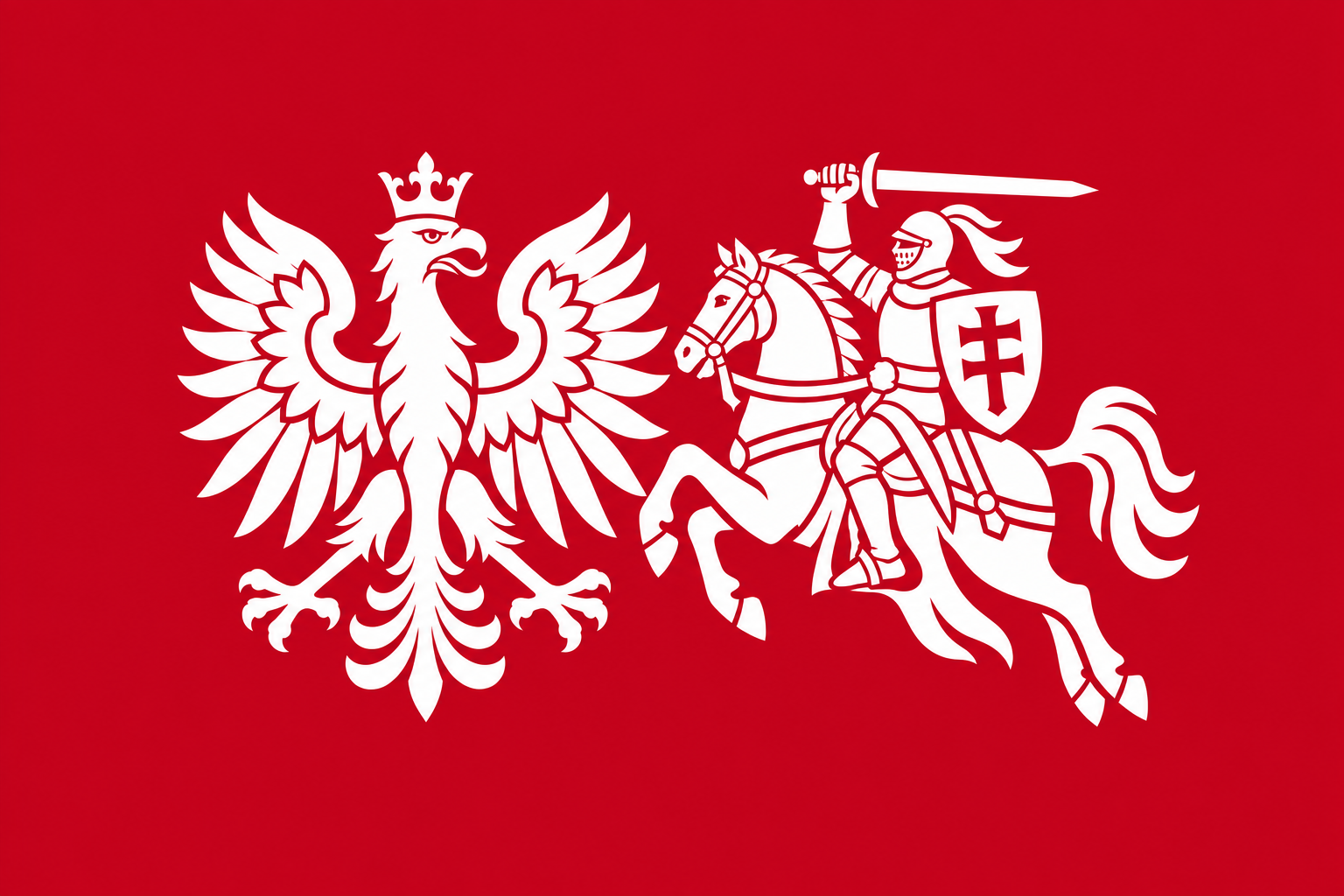
The flag
The flag is the White Eagle of Poland and the Vytis of Lithuania, both white, on a red field, turned inward so that they face each other.
The colour was the easy part and the Commonwealth says so. Both nations had borne white on red for six centuries before the union, which meant that the restored state could adopt a single scheme without either partner surrendering its own, and the founders were candid that this was luck rather than statesmanship. It is the only element of the flag that required no argument.
Everything else required a great deal.
The problem of the first quarter
The banner of the first Commonwealth was quartered, with Poland in the first and fourth quarters and Lithuania in the second and third. That is the ordinary heraldic treatment of a union and it carries an ordinary heraldic meaning, which is that one partner is senior. For two hundred years nobody thought this needed defending.
It could not survive the restoration. A state whose whole constitutional apparatus is the four locks of co-equality, whose statutes exist in two texts of which neither prevails, could not fly a flag that answered in the first quarter the question its constitution refuses to answer anywhere else. The Lithuanian members said so in 1919 and they were right, and the Polish members conceded the point faster than anybody expected, on the reasoning that a union which had just renounced a third of its territory to exist at all could afford to renounce a quartering.
What replaced it removes the first position rather than assigning it. The two charges stand side by side at the same height, neither larger, neither raised, and each turned to face the other. There is no first quarter because there are no quarters.
What it cost each of them
Both charges had historically faced the same way, as nearly all heraldic beasts do, and two beasts facing the same way are a procession rather than a meeting. To confront them, at least one had to be turned from the posture it had held since the fourteenth century.
The settlement’s answer was that a new centre was drawn and both were turned to it, so that neither nation could be named as the one that moved. This is the official account, it is in the 1919 instrument, and it is what the Commonwealth has said ever since.
Heralds have pointed out from the beginning that only one of them actually moved. A charge at the fly facing the hoist is in its traditional posture; a charge at the hoist facing the fly is reversed. Since the Eagle stands at the hoist, the Eagle is the one that turned, and the Vytis rides as it always rode. The objection is unanswerable and the Commonwealth has never answered it. The official position remains that both were turned, and the state’s response to the heraldic point, on the rare occasions it is put formally, is that the instrument says what it says.
Lithuanians tend to enjoy this more than Poles do. It is also the only matter in the Commonwealth’s constitutional life on which the smaller nation got the better of the arrangement and the larger one has to pretend otherwise, which is why it comes up.
The two charges
The Eagle is crowned and there is no crown above it. The distinction matters here more than it would elsewhere. The Eagle’s crown is the Eagle’s, worn since long before the Wettins and belonging to the charge rather than to the man; a crown set over both charges would be the sovereign’s, and the sovereign is a Saxon prince who is also a federal prince of the German Empire. The flag is the nations’ and not the dynasty’s, and on a flag otherwise so carefully balanced the absence is conspicuous and is meant to be.
The knight’s shield keeps its double cross. This has been raised periodically, on the ground that a Christian device sits oddly on the flag of a state with no established church, a protected Jewish population and four national languages. It has never been changed, and the argument that has held is that the cross is on the flag as a piece of fourteenth-century Lithuanian identity rather than as a statement of belief, which satisfies most people and not everybody.
The two almost touch. The Eagle’s leading wingtip and the horse’s head are separated at the centre by a gap narrow enough that the pair reads as one device at any distance, which was deliberate and was the last thing settled. An earlier draft set them further apart, and was rejected on the ground that two charges with clear air between them look like two states that have agreed to share a flag.
What is not on it
There is no date. The Commonwealth dates itself from 1569 and treats 1795 to 1918 as an interruption rather than an ending, and it declines to put either year on the flag, for opposite reasons in each case: 1569 because a state that never stopped existing does not need to assert a founding, and 1918 because writing the restoration on the flag would concede that there was something to restore.
There is no motto, no lettering and no third colour.
Culture
Literature
Commonwealth literature is written in four languages and the country counts all four as its own.
The Polish tradition is the largest and carries the national canon: the romantic poets of the partitions, whose work was written mostly in exile and smuggled home, and whose position in the culture is closer to scripture than to literature; the realist novelists of the nineteenth century; and a twentieth-century literature that has spent a hundred years arguing about the settlement of 1920 without often saying so directly.
The Lithuanian tradition is smaller, younger as a written literature, and disproportionately important to the national self-understanding of the Grand Duchy, whose language was suppressed in print for four decades under the Russians and whose literary revival is therefore a political fact as much as an artistic one.
The Yiddish tradition is the third and by international reputation the most influential, having produced writers whose work is translated everywhere and read in the original by two million people at home.
The Hebrew tradition is scholarly and religious in the main, with a modern secular strand of recent growth.
The country’s characteristic literary subject, across all four, is the same: the relationship between a small nation and a large neighbour, and what a country owes to a bargain that saved it.
Music
The Commonwealth’s musical reputation rests on the nineteenth century and it has never quite escaped it.
The piano tradition is the national one, and the romantic repertoire written in exile during the partitions is the country’s most exported cultural product by a considerable margin. Contemporary Commonwealth composition is respected and follows the central European mainstream. Folk music is alive rather than preserved, particularly in the Grand Duchy, whose polyphonic singing tradition is unlike anything else in Europe and holds international protection.
Klezmer is not a revival here. It is a continuous popular tradition that has been playing at Commonwealth weddings without interruption for three hundred years, and its practitioners find the international revival elsewhere slightly puzzling.
Theatre and film
Theatre is the prestige art form and is subsidised by the palatinates rather than by the state, which produces an unusual geography: the best companies are in provincial cities with wealthy palatinate treasuries rather than in the capital.
Commonwealth cinema is small, critically esteemed abroad and chronically underfunded at home, and its recurring subjects are the 1930s, the war, and the countryside.
The press
The Commonwealth’s newspaper culture is dense, partisan and multilingual, with national dailies in Polish, Lithuanian and Yiddish and a substantial regional press in all three plus German and Belarusian.
Its distinguishing feature is the constitutional protection of the press, which is drafted in absolute terms and was written by people who had lived under three censorships. The provision survived the 1930s only because the decrees suspending it were never promulgated, which is the single most cited consequence of the King’s refusal and is taught alongside it.
Foreign relations
Germany
Everything else is a footnote to this.
The relationship is a security guarantee, a currency peg, a customs and market arrangement, an open frontier, a shared dynasty and a population of several million Poles living under German sovereignty with protected rights secured by a Commonwealth treaty. No two sovereign states in Europe are entangled to this degree, and the Commonwealth’s entire foreign policy is in practice the management of one relationship and the arrangement of the others around it.
Commonwealth opinion of Germany is not affectionate and is not hostile. The word used most often by Commonwealth diplomats is unavoidable, and the word used most often by Commonwealth voters, in surveys that ask the question every few years, is necessary. Neither is a compliment and neither is a complaint.
What has changed since 1941, and more since 1992, is that the relationship is conducted between governments rather than between a patron and a client. Commonwealth ministers disagree with German ones publicly, block things in the European Concert, litigate trade questions and win some of them. None of this was available in 1930.
Austria-Hungary
The warmest of the Commonwealth’s relationships and the least consequential.
Galicia was the freest of the three partitions, Vienna gave the Poles autonomy, Polish, their own diet and their own universities, and Polish politicians served in the imperial government. That memory is a century old and still operative: Commonwealth opinion of Austria-Hungary is positive to a degree that Austrians find gratifying and slightly excessive.
The practical content is cultural and educational. Kraków and Lwów are Austrian, the Commonwealth’s students attend them under a standing agreement, degrees are mutually recognised, and a substantial part of the Polish academic profession has been trained abroad in what it regards as a Polish city. The two states cooperate on the Vistula, which rises in Galicia, and on the movement of people, which is unrestricted.
There is no security relationship. Austria-Hungary has never offered a guarantee and the Commonwealth has never asked for one.
Russia
The frontier is the longest either state has with a hostile power, and the relationship is correct, cold and continuous.
Diplomatic relations have never been broken, not during the border war of 1953 and not during the crises. Trade exists and is substantial in raw materials. The two states have standing arrangements on the frontier, on the forests that cross it, on river management and on the movement of the small populations that live on both sides, and these have operated through periods when the political relationship was very bad indeed.
Commonwealth policy toward Russia has been the same for eighty years and is unlikely to change: no provocation, no concession, no illusion. Commonwealth diplomats are regarded across Europe as the best-informed on Russian affairs of any nationality outside Russia, for the obvious reason.
The thaw has not altered the policy. It has made Commonwealth officials more anxious rather than less, as described above, and the anxiety is expressed institutionally as an increase in analytical capacity rather than in forces.
The United Baltic Duchy
The United Baltic Duchy is the Commonwealth’s closest neighbour in situation and its least developed relationship in substance.
Both states came out of the same collapse of the Russian Empire, front the same power, hold German guarantees, and lack the alliance’s. The Duchy’s guarantee, under the Treaty of Mitau of 1919, failed in 1941, when Russia occupied the Duchy while Germany fought for Berlin, and the Commonwealth, whose own guarantee under the Treaty of Dresden was never tested in the same way, watched the occupation and did nothing, which the Duchy has not forgotten.
Relations are correct, economically substantial and institutionally empty. There is no treaty, no consultative body and no common position, and the two states have competed for a century for the position of Germany’s first partner in the east, most recently for the seat of the European Concert’s eastern agency, which Warsaw won in 2027. The Duchy’s Estonian separatist movement is watched in Warsaw and Vilnius with an attention both governments deny.
The Scandinavian Union
Cordial, commercially important and slightly awkward.
The Union is the Commonwealth’s principal Baltic trading partner and the two are natural counterparts. It is also a full member of the alliance and therefore covered by an automatic guarantee that the Commonwealth cannot obtain, which is a difference neither party raises and both are conscious of. Finland in particular occupies a position the Commonwealth might have occupied had the collapse of 1917 produced different alignments, and Commonwealth writers say so periodically.
The United Kingdom of America
Warm, demographic and thin, as described above. Large diaspora, small consequence.
The European Concert
The Commonwealth is a founding-generation member of the European Concert and takes it seriously.
The Concert is the one international forum in which the Commonwealth is Germany’s formal equal, holding one seat as Germany holds one seat, and the Commonwealth’s diplomats have used it accordingly. The Concert has no defence arm, which the Commonwealth regrets and has argued about, and its position on the question is the one that its whole situation dictates: a European defence capability would be a capability the Commonwealth could join, which is not true of the Atlantic alliance, and Warsaw is therefore among the most consistent supporters of a Concert defence competence and among the least successful.
The League of Nations
Membership is ordinary and the Commonwealth’s participation is conscientious. It contributes to League missions, sits on the technical bodies, and has never held a permanent seat or expected one.
Education, health and infrastructure
Schools
Schooling is administered by the palatinates and by the Grand Duchy, funded from local and central money together, and is compulsory to sixteen.
The system is multilingual by construction rather than by concession. A child in the Grand Duchy is taught in Lithuanian and learns Polish; a child in the Kingdom is taught in Polish and, in many palatinates, learns Lithuanian; a child in a Yiddish-speaking community may be taught in Yiddish in a communal school recognised by the state; and in districts with German, Belarusian, Ukrainian or Russian populations the corresponding provision exists. Commonwealth teacher training is correspondingly complicated and the country produces a great many linguists.
Standards are good and unevenly distributed, with the western palatinates and the great cities well ahead of the eastern countryside, a gap the equalisation payments have narrowed over fifty years without closing.
Universities
Vilnius, founded 1579, is the oldest and by tradition the most prestigious. Warsaw is the largest and the centre of the sciences. There are substantial universities at Łódź, Kaunas, Lublin and Białystok, technical universities in the industrial cities, and the ancient arrangement by which Commonwealth students attend Kraków and Lwów in Austria.
Commonwealth higher education is free at the point of use, competitive on entry, and chronically short of research money by comparison with Germany, which recruits Commonwealth academics continuously and successfully. The resulting drain is a standing political complaint with no evident solution, since the Commonwealth cannot pay German salaries and the frontier is open.
Health
The Commonwealth maintains a public health service funded from social insurance rather than from general taxation, administered by the palatinates and the Grand Duchy, and universal in coverage.
It is adequate rather than excellent, its rural provision is thin, and its hospitals are old. Its outcomes are broadly comparable with the European middle. Commonwealth citizens with money and proximity cross into Germany for specialist treatment, an arrangement that is legal, common and politically awkward.
Railways and roads
The Commonwealth’s railway network is dense, old and oriented in the wrong direction, having been built by three empires for three purposes none of which was the movement of goods between Warsaw and Vilnius.
The correction of this has been a hundred-year public works programme and is not finished. The great achievements are the north-south trunk lines linking the industrial south to Klaipėda, the canal system joining the Vistula and Nemunas basins, and the rebuilding of the eastern network on a military logic after 1953. The gauge question remains: Russian broad gauge meets Commonwealth standard gauge at the eastern frontier, which is inconvenient for trade and, as every Commonwealth planner has observed since 1919, extremely convenient for defence.
Road building came late and fast. The motorway network was largely built after 1990 with German and Mitteleuropa money, and since 2027 with the Concert’s, and is now good.
The cities
Warsaw
Warsaw is the capital, the seat of the Sejm and the Senate, the residence of the King when he is in the country, and much the largest city in the Commonwealth with something over two million people in the city proper.
It is not an old capital in the way Kraków is an old capital, and it knows it. Warsaw became the seat of the first Commonwealth’s government only in the late sixteenth century, was the capital of the Russian partition’s Polish administration through the nineteenth, and became a national capital again in 1918 by default rather than by right: Kraków, which every Pole regarded as the proper capital, was in Austria and unavailable.
The city that resulted is administrative, financial, modern and a little bit provisional. Its great buildings are nineteenth-century Russian, twentieth-century Commonwealth and a considerable amount of postwar reconstruction, since Warsaw was fought over in 1944 during the western counteroffensive and lost a substantial part of its centre. The old town was rebuilt from paintings and plans in the 1950s, an undertaking that the Commonwealth regards as a national achievement and that architectural historians outside the country regard with more reserve.
Its Jewish quarter is not a memorial district. It is a working part of a working city, the largest Jewish urban concentration in Europe, with its own commercial streets, press, schools, theatres and synagogues, and its residents’ principal complaint is the same as everybody else’s, which is the rent.
Vilnius
Vilnius is the capital of the Grand Duchy, the second city of the Commonwealth, and by a wide margin the more beautiful.
It is a baroque city on hills at the confluence of two rivers, with a university older than the modern state by three and a half centuries, a cathedral, a castle hill, and a street plan that has never been rationalised. It is also the most multilingual place in the Commonwealth: Lithuanian as the language of the Grand Duchy’s administration, Polish as the language of a large historic population, Yiddish as the language of the community that made the city’s intellectual reputation, and Belarusian and Russian in the surrounding country.
The city’s contested past between Poles and Lithuanians is the union’s oldest internal question and the union is the reason it stopped being dangerous. Both nations claim it, both nations have it, and nobody is required to choose. Commonwealth writers point to Vilnius as the single strongest argument for the whole arrangement, on the ground that in any other constitutional settlement this city would have been a war.
Łódź
Łódź is the industrial capital: a nineteenth-century textile city that grew from a village to a metropolis in fifty years, built by Polish, German and Jewish capital together, and the most purely commercial place in the country.
It has no castle, no cathedral of note and no history before the machines, and it has made a civic virtue of this. Its architecture is the architecture of factories and factory owners’ palaces, its museums are museums of manufacture and of cinema, and its politics have been left-wing without interruption for a hundred and thirty years.
Kaunas
Kaunas is Lithuania’s second city and its industrial and commercial centre, a compact place of interwar architecture and considerable civic pride, which has spent a century as the practical capital of the Grand Duchy’s economy while Vilnius held the offices and the prestige.
Klaipėda
Klaipėda is the port, and the Commonwealth’s entire access to the sea.
It is a small city doing a very large job. Its docks, its rail head, its icebreaking capacity and its winter working are matters of national policy, its expansion has been funded by the central treasury for eighty years, and the canal system connecting it to the Vistula basin is the largest public work the country has undertaken. Its population is Lithuanian, with a German minority of long standing that predates the Commonwealth entirely.
The eastern cities
Białystok and Lublin are the cities of the eastern palatinates, both of them multilingual in daily practice, both of them poorer than the west, and both of them the centres of the Commonwealth’s most persistent regional development problem.
The reigns
Friedrich August III, 1921 to 1949
The restoration king. He was crowned at Warsaw in 1921 in a ceremony everybody understood to be in the wrong city, held both crowns through the whole of the interwar period, refused the emergency decrees in 1936, and reigned through the Second Great War and the beginning of the cold one.
His refusal in 1936 is the act that defines the Commonwealth monarchy. It is worth restating that he did not think of it as an exercise of discretion: his consistent position, stated at the time and never varied, was that his oath removed the question from him, and Commonwealth constitutional writing has taken him at his word ever since.
He was not, by contemporary accounts, a remarkable man in any other respect, and this is generally regarded as having been an advantage.
Friedrich Christian, 1949 to 1968
The postwar reign. The border war of 1953 fell in it, and the King’s part was the constitutionally invisible one of receiving advice and doing what he was told, which was the correct part and was noticed as such.
He is remembered in the Commonwealth chiefly for the practice, which he began, of spending the summer in the Lithuanian lake country, and for a series of public appearances in the Grand Duchy that did a great deal for the union’s standing at a time when Lithuanian opinion of it was at its lowest.
Maria Emanuel, 1968 to 2011
The long reign. Forty-three years, spanning the crisis of 1968, the peace movement, the economic difficulties of the 1980s, the thaw, and the settlement of 1992.
He was the first of the Wettin kings to be genuinely popular in both his countries rather than merely accepted, and the reason usually given is that he was the first who had grown up expecting to hold both crowns and had been educated accordingly, in both languages, with tutors from both countries. His Polish was excellent, his Lithuanian was serviceable, and the difference between those two facts was itself a subject of comment in Vilnius.
The 1992 settlement was concluded in his reign and he had rather more to do with it than the constitution required, which was noticed at the time and has been discussed since without anybody being able to establish exactly what he did.
Friedrich August IV, 2011 to the present
The present King. He succeeded in 2011 at the age of forty-nine, and his reign has so far been uneventful in the constitutional sense and busy in every other.
He is the first Wettin king to have spent a substantial part of his working life outside the two countries, having trained and worked as an engineer, and Commonwealth commentary makes rather more of this than the man himself appears to. He divides his year by the calendar, keeps the streams of advice separate, and has not tested any of the arrangements he inherited.
Politics since the war
The settlement decades
Commonwealth politics from 1945 to the middle 1970s were dominated by the parties of the founding settlement, in coalitions of the centre, with the National Restitution tradition reduced to a fringe and the socialist left excluded from office by the same anti-Russian consensus that governed everything else.
The period’s achievements are the ones every western European country claims for the same decades: reconstruction, industrialisation, the health service, the expansion of the universities, and a doubling of real incomes. The Commonwealth’s version was slower than Germany’s and faster than anybody’s expectations in 1945.
The left in office
The socialist and agrarian coalition that took office in 1974 was the first government since the founding that was not drawn from the settlement parties, and it governed for nine years.
Its record is contested and its significance is not. It built the modern welfare system, nationalised the coal industry at the worst possible moment in the history of coal, and demonstrated that a government of the left could hold the eastern frontier and honour the German relationship, which a great many people had doubted and which settled the question permanently. Every Commonwealth government since has been able to be of any complexion, and this is the period that made it so.
The 1980s
Economic difficulty, the peace movement, and the argument about the garrisons.
The Commonwealth’s peace movement was smaller than Germany’s and differently composed, drawing on the Church, the universities and the agrarian left rather than on the urban young, and its object was the removal of the German garrisons rather than nuclear disarmament, the Commonwealth having no nuclear weapons to disarm. It failed, as described above, and its failure was decisive: the garrison question has never since been raised by a party with any prospect of office.
The thaw and after
The politics of the last three decades have been the politics of a settled country with an unsettled neighbour: fiscal argument at home, continuity abroad, and a low-level permanent anxiety that expresses itself in defence estimates rather than in rhetoric.
The German question is closed. The Russian question is open and unanswerable. The internal question, which is the balance between the palatinates and the centre and between the Kingdom and the Grand Duchy, is the one that actually decides Commonwealth elections, and it is the question the country’s founders would have expected, because it is the question their constitution was designed to keep alive.
Rights and liberties
The declaration
The Constitution’s second title is a declaration of rights, and it is longer and more specific than the equivalent in most European instruments of its date, for the reason that its drafters had lived under three foreign administrations and knew precisely which rights they wanted named.
It guarantees the ordinary liberties of person, conscience, expression, assembly and property. It also guarantees, in terms drawn directly from the experience of the partitions, the right to be taught in one’s own language, the right to worship in it, the right of communities to maintain their own schools at their own expense without licence from the state, the right to deal with the local administration in a recognised language, and the right of any inhabitant to petition the Sejm directly and receive an answer.
The provision on the press is absolute in its drafting. It permits no licensing, no prior restraint and no suspension, and its survival through the 1930s is owed entirely to the fact that the decrees suspending it were never promulgated.
Enforcement
Rights are enforced by the ordinary courts and, since a reform of the 1950s, by a direct constitutional complaint that any inhabitant may bring to the Supreme Court after exhausting the ordinary remedies.
The remedy is real and is used, at a volume that keeps the Court permanently behind its own list. The Court’s power over statutes is the limited one described above: it may declare an incompatibility and refer the statute back, and the Sejm may re-enact. Over individual administrative acts its power is complete.
The gap
The Commonwealth’s rights settlement has one acknowledged weakness, which the 1930s exposed and which has never been closed.
The declaration binds the state. It does not bind private conduct, and the exclusions of the 1930s were effected in substantial part through administrative practice, contract preference and municipal licensing rather than through statute, precisely because these were the instruments the courts could not easily reach. The state repealed the measures it had enacted; the informal apparatus took longer to dismantle and was dismantled politically rather than judicially.
Successive proposals to extend the declaration’s reach into private conduct have foundered on the objection that a right enforceable against a neighbour is a different kind of instrument from a right enforceable against a government, and that the Commonwealth’s whole constitutional tradition is about the second. The objection is respectable and the gap remains.
The army
What it is
The Commonwealth’s army is professional, mechanised, and larger relative to the country’s population than any comparable European force outside the frontier states.
Its organising problem is stated in its own doctrine and repeated above: hold the frontier long enough that the German decision is easy. It is built for one campaign, in one place, against one enemy, and it makes no pretence of being built for anything else. It has no strategic lift, no carrier aviation, no expeditionary structure and no ambition to acquire any.
Its traditions
The Commonwealth’s military traditions are older than the Commonwealth and are consciously maintained.
The cavalry regiments carry lineages to the first Commonwealth and in several cases to the sixteenth century, the Tatar squadrons among them. The engineers, who are the army’s most respected arm, trace themselves to the fortification of the eastern frontier under the last kings before the partitions. The oath is sworn to the constitution and the nation, in the soldier’s own language, and it is the same oath in Polish and Lithuanian.
The officer corps is drawn disproportionately from the szlachta families of the countryside, in a pattern that has proved impervious to a century of deliberate broadening, and this is one reason the royal oath’s last clause carried the weight it did in 1936. The men who would have had to enforce a coup were the men whose families had been reciting that clause for three hundred years.
Conscription and its end
The army was a conscript force from 1921 until the thaw, and its abolition is described above.
The social consequence is larger than the military one and is still working itself out. Universal service was the Commonwealth’s principal institution for mixing its population: Poles and Lithuanians, city and country, Catholic and Jewish, western palatinate and eastern, all passed through the same barracks. Its ending removed the one experience most Commonwealth men had in common, and the country has not replaced it. Every discussion of restoring conscription in the last twenty years has been in substance a discussion about this rather than about defence, and the general staff’s opposition has been correspondingly irritated.
Emigration and the diaspora
The going
Emigration from these lands has been continuous since the middle of the nineteenth century and has never entirely stopped.
The first waves left the partitions for economic reasons and went overwhelmingly to the United Kingdom of America, where the Polish and Lithuanian communities are among the largest immigrant populations in the Realm. Jewish emigration from the Russian partition was heavy in the same decades and for harder reasons, and the American Jewish community of Polish and Lithuanian origin is very large.
The restoration slowed but did not stop it. The economic crisis of the 1930s produced another wave, and the postwar decades produced a steady professional emigration to Germany that continues, at a level the Commonwealth finds politically uncomfortable and economically convenient.
America
The largest destination was the United Kingdom of America, and the movement was on a scale that changed both countries.
Emigration from the Polish and Lithuanian lands to the Realm ran from the 1870s to the First Great War at a rate that emptied whole districts of the Russian partition, and it went overwhelmingly to industry. Polish labour built out the steel towns and coal fields of the American interior, and the Polish parishes founded in those decades, with their schools, their societies and their newspapers, are the institutional core of what is now one of the Realm’s largest ancestral communities. Lithuanian emigration was proportionately even heavier, and the Lithuanian community in America was for a period at the turn of the century a more significant centre of Lithuanian publishing and national organisation than anywhere in the homeland, for the straightforward reason that printing Lithuanian was lawful in America and prohibited at home.
Jewish emigration from the same lands in the same decades was very large and left for harder reasons, and the American Jewish community of Polish and Lithuanian descent is correspondingly substantial. That this emigration continued after the restoration, and rose sharply during the National Restitution years, is a fact the Commonwealth does not dispute.
The relationship this produced is warm, asymmetric and slightly awkward on the Commonwealth side. The Realm’s Polish and Lithuanian populations are numerous, prosperous, politically organised and several generations removed from the Commonwealth, and their attachment is to an idea of the country that its citizens sometimes find unrecognisable. Commonwealth ministers visiting American cities are received by communities whose Polish is a century old, whose parishes preserve devotions the Commonwealth has largely abandoned, and whose politics on the German question are considerably firmer than those of any Commonwealth government.
There is a further complication that Commonwealth diplomacy handles carefully. The Realm is an Atlantic power and the leading state of the ATO, an organisation the Commonwealth cannot join; the Commonwealth’s security rests instead on Germany. The diaspora is therefore a channel of sympathy to a state that is not, and cannot be, a guarantor, and Commonwealth governments have been careful for eighty years not to let that sympathy be mistaken by anybody, in Warsaw or in New Westminster or in Berlin, for a second guarantee.
The modern going
Emigration did not stop with prosperity, and its present form is the one the Commonwealth finds hardest to discuss.
The open frontier with Germany, the currency peg, the mutual recognition of qualifications and the density of German firms in the Commonwealth economy together mean that a Commonwealth graduate can take employment in Germany with no more friction than in moving between palatinates. Several hundred thousand have. The flow is heaviest in medicine, engineering and the sciences, it is concentrated among exactly the people the Commonwealth has spent the most on educating, and it is a straightforward transfer of trained labour from the poorer economy to the richer one.
The Commonwealth’s official position is that this is the price of the integration and that the integration is worth it. The position is defensible and is not popular. Every party of the last three decades has promised to address it, the measures adopted have been salary supplements, return grants and bonded training in the medical faculties, and the flow has continued at much the same rate throughout.
The Grand Duchy feels this more sharply than the Kingdom, because the same movement that takes a Lithuanian doctor to Hamburg takes a Lithuanian graduate to Warsaw first, and the Grand Duchy’s institutions have watched two centuries of experience repeat itself in economic form. The arguments made in Vilnius about internal migration are the arguments made in Warsaw about emigration to Germany, at one remove, and both cities are aware of the symmetry.
The diaspora policy
The Commonwealth maintains an active diaspora policy, a disproportionate consular network and a citizenship law that is generous to descent.
The policy’s practical objects are investment, remittance and political sympathy in America, and it has been reasonably successful at all three. Its emotional object is harder to state and is stated anyway in every ministerial speech on the subject: that a nation which spent a century without a state learned to count the people who left as part of it, and has not stopped.
Environment and science
The forests and the argument
The Commonwealth holds the largest surviving lowland forest in Europe and has spent fifty years arguing about what to do with it.
The forestry service is old, professional and industrial in its mandate. The conservation movement is younger, has grown steadily since the 1970s, and has won a series of protective designations culminating in the full protection of the oldest stands. The argument between them is the Commonwealth’s principal environmental question and is complicated by the frontier, since the same forest continues into Russia under a management regime the Commonwealth regards as destructive and can do nothing about.
The European bison, extinct in the wild elsewhere, survives here and is the country’s national animal.
Water and coal
The Commonwealth’s two other environmental problems are the ones its economy produced: the pollution of the river basins by a century of unregulated industry, largely corrected since the 1980s at very great expense, and the coal question, which is not corrected.
Coal is the country’s own fuel, the industry employs a declining but politically concentrated workforce in the southern palatinates, and every Commonwealth government since 1990 has promised a transition and delivered part of one. The Concert’s environmental commitments have made this harder to defer and no easier to accomplish.
Science
Commonwealth science is strong in mathematics, which is a tradition of great age and international standing, in the physical sciences, and in the branches of engineering the army has paid for.
Its structural problem is money and proximity: German institutions pay better, recruit continuously, and are three hours away by train. The Commonwealth trains excellent scientists and exports a great many of them, and its universities have made a policy of maintaining the connections rather than resenting them, on the reasonable ground that a Commonwealth physicist in Munich is more use to the Commonwealth than a resentful one in Warsaw.
Assessment
The union of the two nations
The union works, and the article says so without qualification because the evidence does not admit of much.
Lithuania has never seriously attempted to leave. No Lithuanian party of any size has proposed it in a century. Lithuanian is a national language rather than a protected one, the Grand Duchy administers itself, the co-equality provisions are used and respected, and Vilnius, which in almost any other constitutional arrangement in twentieth-century Europe would have been fought over, was not.
The cost is real and should be named, because Lithuanians name it. Co-equality in law is not equality in weight: the Kingdom is four times the Grand Duchy’s size, national politics is conducted in Polish more often than the constitution implies, and a Lithuanian who wishes to reach the top of a Commonwealth national institution needs Polish while the reverse is not true. The four locks prevent the Grand Duchy from being outvoted. They do not prevent it from being outnumbered, and no constitutional mechanism could.
What the union bought, both nations agree, is the thing neither had alone: Lithuania got a guarantee worth having, and Poland got the sea.
The German bargain
The bargain of 1920 worked, on the only test that matters, which is that the Commonwealth exists.
A state that claimed Posen, West Prussia and Silesia in 1920 would have received no recognition, no guarantee and no credit, would have faced Russia alone in 1953, and would in all probability have not survived the century in any form its founders would recognise. The government that renounced them judged this correctly. The country has the borders it has, the population it has, and a century of continuous constitutional government, and it purchased all of that with a signature at Dresden.
The price was a third of the nation, and the article does not soften that. Several million Poles have lived their whole lives under a foreign sovereign because a Polish government signed them away, and no arrangement since, including the open frontier that has made the question tolerable, has altered the fact. The Commonwealth teaches its schoolchildren both sides of this argument and has not resolved it, which is the correct treatment of a question that has no answer.
The worst failure
The Commonwealth’s worst episode is the 1930s and is described above. Its worst failure, in the sense of a thing it could admit and has not, is a different matter and is continuing.
The Commonwealth will not admit that Lithuanian is losing.
The four locks of co-equality are real, and they work as institutions. Both languages are authentic in all law, the great offices alternate, the Grand Duchy keeps its own institutions, and no Commonwealth government has ever tried to reduce any of it. The locks protect the Grand Duchy. They do not protect the language, and the founders knew they would not, having read how Lithuanian very nearly died under the first Commonwealth with every institutional guarantee intact.
Each generation, a larger share of the Grand Duchy’s families send their children to Polish-language schools, because Polish is the language of the Commonwealth’s capital, its universities, its army and its money. Vilnius speaks more Polish in its offices than it did fifty years ago. The share of the Grand Duchy’s citizens who use Lithuanian at home has fallen in every census since the 1960s, and the census reports present the figures without comment.
Every Commonwealth government answers that co-equality is honoured, which is true, and that the choice of a school is a family’s, which is also true. Neither is an answer to a question no government has been willing to ask aloud: whether a union of two co-equal nations in which one language slowly replaces the other is still the union the constitution describes. The most common judgement among Lithuanian writers, and the one this article shares, is that the Commonwealth has built the most careful institutional protection of a smaller nation in Europe, and has allowed itself to believe that the institutions are the nation.
What kind of country it is
The Commonwealth is a small power with a large history, which is a difficult combination and produces a characteristic set of habits.
It is legalistic, because law is what a country without natural frontiers has instead of them. It is proceduralist to a degree that exasperates its neighbours, because its constitution was built by people who had watched executives govern their grandparents. It is multilingual by construction rather than by tolerance, and its machinery of co-equality is expensive, cumbersome and the reason it is still whole. It is more conscious of its dependence than it admits and less resentful of it than outsiders expect.
And it is a state that has been continuously constitutional for a hundred and seven years, having been extinguished for a hundred and twenty-three, in a part of Europe where that is not the ordinary outcome. Its founders would regard this as the whole of what they were trying to achieve, and would be surprised by very little else.
Chronology
| Date | Event |
|---|---|
| 1385 | The agreement at Krewo. Jogaila accepts Latin Christianity and the Polish marriage. |
| 1386 | The Polish and Lithuanian crowns are joined in one person. |
| 1387 | The baptism of Lithuania, the last pagan state in Europe. |
| 1410 | Grunwald, called Žalgiris. The field army of the Teutonic Order is destroyed. |
| 1529, 1566, 1588 | The Statutes of Lithuania. The Grand Duchy codifies its own law. |
| 1569 | The Union of Lublin creates the Commonwealth. The modern state dates itself from this act. |
| 1573 | The Warsaw Confederation binds the nobility to religious peace. |
| 1648 | The rising of Bohdan Khmelnytsky in the south-east. Commonwealth armies are destroyed; the Jewish communities of the affected palatinates are massacred. The Commonwealth ceases to be a great power. |
| 1655 to 1660 | The Deluge. Sweden and Muscovy invade together; something near a third of the population is lost. |
| 1658 | The Union of Hadiach proposes a third constituent state, a Grand Duchy of Ruthenia. It comes too late. |
| 1667 | The eastern lands are partitioned with Muscovy. |
| 1683 | Jan III Sobieski relieves Vienna. The last act of the Commonwealth as a great power. |
| 1697 | Augustus the Strong, Elector of Saxony, converts to Catholicism to be eligible for the Polish crown. The Wettins reign in Poland. |
| 1763 | The Saxon union ends. |
| 3 May 1791 | The reform constitution abolishes the liberum veto. It lasts a little over a year. |
| 1795 | The third partition. The Commonwealth is extinguished. |
| 1830, 1863 | Risings in the Russian partition; both defeated. |
| 1840 | Russia abolishes the Statute of Lithuania, forty-five years after the state it governed. |
| 1864 to 1904 | Printing Lithuanian in the Latin alphabet is prohibited. The book carriers smuggle it from East Prussia. |
| 1867 | Galicia receives autonomy from Vienna. |
| 1886 | The Prussian Settlement Commission begins buying Polish land for German settlers. It largely fails. |
| 1901 | Września. Children are beaten for refusing religious instruction in German. |
| 1906 to 1907 | The school strikes across the Polish provinces of the German Empire. |
| 1917 | The Russian Empire collapses. |
| 1918 | Independence declared. The war of restoration begins. |
| 1919 to 1920 | The war is won, with German assistance. |
| 1920 | The Treaty of Dresden. The Commonwealth renounces all claim to Posen, West Prussia and Silesia in exchange for recognition, a German guarantee, protected rights for Poles remaining in Germany, and economic terms. |
| 1921 | The Constitution is adopted. Friedrich August III is crowned at Warsaw, the Wawel being in Austria. |
| 1933 | National Restitution takes office on the economic crisis. |
| 1935 to 1936 | University quotas, administrative exclusions and unprevented violence against the Jewish population. |
| 1936 | The government issues emergency decrees suspending constitutional guarantees. The King refuses to promulgate them, citing his oath. Eleven weeks of deadlock. |
| 1937 | The Sejm removes eleven ministers individually. The government falls. The measures are repealed within a year. |
| 1939 to 1945 | The Second Great War. The Commonwealth fights on the Allied side alongside Germany. |
| Winter 1941 | Berlin is besieged by fascist French forces. Commonwealth formations are among the armies that relieve it. |
| 1945 | Versailles. The Commonwealth’s standing with Germany is permanently altered. |
| 1949 | The Atlantic Treaty Organization is founded. The Commonwealth is not Atlantic and cannot join. |
| 1953 | Russian forces cross the frontier. Germany invokes the guarantee within thirty-six hours. The Russians withdraw in three weeks. |
| 1968 | Russian formations move on the Finnish and Commonwealth frontiers together. Finland is covered automatically by sixteen states; the Commonwealth is covered by one country’s decision. |
| 1974 to 1983 | The socialist and agrarian coalition governs, and settles the question of whether the left may hold office. |
| 1980s | The peace movement; the argument over the German garrisons; the garrisons remain. |
| 1990s | The thaw. Conscription is abandoned. |
| 1992 | Germany formally acknowledges the inequality of the 1920 terms. The last subordinate clauses of the Treaty of Dresden are removed. |
| 2011 | Friedrich August IV succeeds, as King of Poland, Grand Duke of Lithuania and King of Saxony. |
| 2026 | Rasa Vaitkienė becomes Chancellor of the Crown, the third Lithuanian to hold the office. |
| 2028 | A Russia in flux; a settled German question; an open frontier; and an eastern policy that has still built nothing. |
✎ Editor's Note · A country that bought itself
The Commonwealth exists because canon had already decided three things and they turned out to fit together. Russia was “shorn of the western fringe” in 1917 and the western lands were “gathered into the German-ordered Europe.” Germany still holds Posen, West Prussia and Silesia, with millions of Polish speakers and a Polish party in the Reichstag. And Saxony’s Catholic Wettins carry “a dynastic memory of having been kings” of Poland.
Put those together and the country writes itself: a state restored from the Russian partition alone, existing inside a German security order, with its own provinces still German, under the dynasty that converted in 1697 to be eligible for exactly this crown. The renunciation of 1920 is the price that makes the arrangement coherent, and making it freely given rather than extracted is what makes it painful, because a nation can forgive a gun and cannot forgive a judgement.
Almost everything else is a consequence. The four locks of co-equality exist because Lithuania is the only coastline. The doctrine of holding the frontier long enough that the German decision is easy exists because the ATO’s guarantee is automatic and this country cannot have it. The 1930s crisis turns on an oath the founders restored out of historical piety and nobody expected to be operative. And the 1968 crisis, which was written for the alliance article three sections before this one existed, does double duty: the same seventy hours that showed sixteen states what an automatic guarantee feels like showed this one what a promise feels like instead.
The Jewish community is the largest divergence in the setting and the hardest to write, because survival on that scale is a happy fact and the surrounding century was not. The article’s approach is to state the good record, state that the comparison flattering it is a low bar, and then set out the quotas, the exclusions and the violence of the 1930s as the acts of an elected Commonwealth government against its own citizens. The community’s own three-part verdict, that this was the best country in Europe for a Jew for five hundred years, that this says more about Europe than about Poland, and that the record has one very bad decade in it, is offered as all three being true at once.
Trivia
- In-Universe The flag carries the White Eagle and the Vytis side by side, turned inward to face each other, because the quartered banner of the first Commonwealth put Poland in the first quarter and a state whose statutes exist in two texts of which neither prevails could not answer on its flag the question its constitution refuses to answer anywhere else. There is no first quarter because there are no quarters.
- In-Universe The colour was the only part that required no argument. Both nations had borne white on red for six centuries before the union, so the restored state could take a single scheme without either partner giving up its own, and the founders said openly that this was luck and not statesmanship.
- In-Universe The official account is that a new centre was drawn and both charges were turned to it, so that neither nation could be named as the one that moved. Heralds have pointed out from the beginning that a charge at the fly facing the hoist is in its traditional posture, so only the Eagle actually turned. The objection is unanswerable, the Commonwealth has never answered it, and the state's response when the point is put formally is that the instrument says what it says.
- In-Universe It is the one matter in the Commonwealth's constitutional life where the smaller nation got the better of the arrangement and the larger one has to pretend otherwise, which is why Lithuanians raise it and Poles do not.
- In-Universe The Eagle is crowned and there is no crown above the two charges. The Eagle's crown belongs to the charge and predates the Wettins by centuries; a crown set over both would belong to the sovereign, who is a Saxon prince and a federal prince of the German Empire. The flag is the nations' and not the dynasty's.
- In-Universe An earlier draft set the two charges further apart and was rejected, on the ground that two charges with clear air between them look like two states that have agreed to share a flag. They now almost touch, and read as one device at a distance.
- In-Universe There is no date on the flag, and the two candidate years are refused for opposite reasons: 1569 because a state that never stopped existing does not need to assert a founding, and 1918 because writing the restoration on the flag would concede there had been something to restore.
- Design The flag was built from the article rather than the other way round. The four locks of co-equality are enforced and redundant by design, so the flag had to remove the position of honour rather than assign it, and the heraldic objection that only one charge moved was kept instead of being tidied away, because a settlement that works in law and leaks in heraldry is the most characteristic thing this country does.
- Real-World The banner of the historical Polish-Lithuanian Commonwealth was quartered with the Polish Eagle in the first and fourth quarters and the Lithuanian Vytis in the second and third, and nobody at the time thought the seniority it expressed needed defending. Our Lithuania left that arrangement and took a tricolour of its own; this one stayed, and made the flag answer for it.
- In-Universe The Statute of Lithuania of 1588 remained the operative civil law of the Grand Duchy for two hundred and fifty years and was abolished by Russia in 1840, forty-five years after the state that made it had ceased to exist. The law of the Grand Duchy outlived the Grand Duchy.
- In-Universe The official language of the Grand Duchy of Lithuania was neither Lithuanian nor Polish. It was Chancery Slavonic, the written Ruthenian of its courts, and it remained so until the end of the seventeenth century. The Statutes were written in it.
- In-Universe The golden liberty gave political rights to a tenth of the population and rested on the serfdom of most of the rest. The obligations of the peasantry to the manor rose over the same centuries in which the liberties of the nobility widened, and the same institutions produced both.
- In-Universe The Union of Hadiach of 1658 proposed to add a third constituent state to the Commonwealth, a Grand Duchy of Ruthenia with its own army and standing for the Orthodox Church. It arrived too late to be tried. Belarusian and Ukrainian deputies have been citing it in the Sejm since the 1920s.
- In-Universe A farmer named Michał Drzymała, refused a building permit because permits were being withheld from Poles, bought a circus wagon and moved it a short distance each day so that it remained in law a vehicle rather than a dwelling. He was litigated against for years and became an international symbol of Prussian settlement policy.
- In-Universe The Commonwealth spent the Second Great War with most of its army facing east, against a Russian attack that never came. The decision to release the eastern reserve was what allowed Commonwealth formations to march to the relief of Berlin, and it stripped the eastern frontier to a screen.
- In-Universe The Commonwealth entered the Second Great War with the largest Jewish population in Europe and ended it with that population intact, three years after a government of its own had excluded Jews from its universities.
- In-Universe The Commonwealth dates itself from the Union of Lublin in 1569 and treats 1795 to 1918 as an interruption rather than an ending. The constitution is drafted on that footing and its courts take it seriously: a state extinguished by force without the consent of its people or the act of its institutions is interrupted rather than ended.
- In-Universe The King of Poland and Grand Duke of Lithuania is also King of Saxony and therefore a federal prince of the German Empire. The same man is constitutionally subordinate in one capacity and fully sovereign in another, and the two streams of advice have never formally collided because two private secretaries have spent a century ensuring that they do not.
- In-Universe The royal oath ends: should I fail to keep this oath, my subjects are free from obedience. It is a deliberate restoration of the old Commonwealth right to withdraw obedience from a king who broke his conditions, and it is not a power. The king has no powers. It is a duty he cannot delegate, which is why it constrained a government in 1936.
- In-Universe In 1936 the National Restitution government issued decrees suspending the constitution. Friedrich August III refused to promulgate them, on the ground that his oath left him no discretion. The deadlock held eleven weeks, and the Sejm then removed the government minister by minister, eleven times between March and June 1937, until what remained could not administer decrees it had never promulgated.
- In-Universe The Commonwealth renounced its claim to Posen, West Prussia and Silesia in 1920 freely, with no ultimatum and no deadline, because its government judged the country could have the provinces or a state and not both. Polish historiography is most insistent and most uncomfortable on this point, because it removes the consolation of coercion.
- In-Universe Lithuania is the Commonwealth's only access to the sea. Germany holds West Prussia and the claim to it was permanently renounced, so every ton of trade that does not pass through German ports on German terms passes through Klaipėda. The four mechanisms enforcing Lithuanian co-equality are not generosity; they are the price of a coastline.
- In-Universe In the winter of 1941, Commonwealth formations were among the armies that relieved the siege of Berlin. A state given its existence by German arms in 1919, which had paid for it with a third of its nation in 1920, marched west to save the capital of the power it was indebted to, and the relationship has never been the same since.
- In-Universe In 1968 Russian forces moved on the Finnish and Commonwealth frontiers in the same week. An attack on Finland would have put sixteen states at war automatically with no decision to be taken anywhere. An attack on the Commonwealth would have required one country to choose. Warsaw has organised its defence policy around that distinction ever since: hold long enough that the choice is easy.
- In-Universe Something near a tenth of the Commonwealth is Jewish and Yiddish is a living literary language with about two million speakers, a daily press, permanent theatres in four cities and novelists under forty. Vilnius is still called the Jerusalem of Lithuania in ordinary secular use, and its yeshivas, libraries and publishing houses are continuous institutions rather than reconstructions.
- In-Universe The Commonwealth has no established church, in a country overwhelmingly Catholic, because the Warsaw Confederation of 1573 bound the nobility to religious peace and the founders of 1921 restored the settlement rather than inventing one. The Church supported this: a church established by a state is a church the state may regulate, and the Polish Church had spent a century being regulated.
- In-Universe The Commonwealth's great historic cities are all outside it. Kraków and Lwów are Austrian, Danzig, Breslau and Posen are German. It is a state whose national imagination is furnished with buildings in other countries, and its coronations have been held at Warsaw instead of the Wawel, on a temporary basis, for a hundred and seven years.
- In-Universe The szlachta was about a tenth of the old Commonwealth's population rather than a fraction of a per cent, so a very large number of ordinary families have noble descent and mention it. Nobility here means an inherited civic identity rather than an aristocracy, which makes the country look more egalitarian than it is: it is differently unequal, and the inequality does not run along the line the titles suggest.
- Design Nearly the whole country follows from three things canon had already fixed: Russia lost its western fringe in 1917, Germany still holds Posen, West Prussia and Silesia, and Saxony's Catholic Wettins carry a dynastic memory of the Polish crown. A restored Commonwealth inside the German order, under the dynasty that converted in 1697 to be eligible for it, is what those three facts produce when put together.
- Design The 1968 crisis was written for the Atlantic Treaty Organization article before this country existed, and it does double duty. The same seventy hours that showed sixteen allied states what an automatic guarantee feels like showed the Commonwealth what a bilateral promise feels like instead, which is the difference the whole article turns on.
- Real-World In the real world Poland was partitioned, restored in 1918 as a republic, invaded in 1939, and lost nearly the whole of the largest Jewish community in Europe. Here the restoration is a monarchy under a Saxon king, the German provinces are never recovered, there is no invasion, and the community survives at about a tenth of the population with Yiddish as a living literary language.
- Etymology Rzeczpospolita, the Commonwealth's own name for itself, is a calque of the Latin res publica and means the common thing or the public matter. It has been used continuously since the sixteenth century and survived the restoration of a monarchy without anybody finding the combination odd, because it never meant republic in the modern sense.
- Real-World In our history the great majority of Poland's Jewish community was murdered in the Holocaust, and Yiddish ceased to be a living language of Polish public life.
See also
- The German Empire
- The Kingdom of Saxony
- The Russian Republic
- The Atlantic Treaty Organization
- The European Concert
- Austria-Hungary
- The Second Great War
Categories
Nations of the World · Monarchies · Eastern Europe · The Cold War · Personal Unions · Restored States