United Kingdom of America
The United Kingdom of America is a constitutional monarchy born from a negotiated settlement rather than a final break. When the crisis of the late eighteenth century reached its resolution in 1783, the result was not a presidential republic. It was an American federation: parliamentary in government, asymmetrical in federal structure, rights-bound by law, and unmistakably American in culture and daily life.
The UKA is not the United States with a crown glued onto the eagle. It is not Britain stretched across North America. It is a distinct American constitutional civilisation, loud, local, legalistic, commercial, patriotic, rights-conscious, suspicious of arbitrary power, comfortable with public argument, and bound together by a Crown that survived because it became useful.
✎ Editor's Note · Why the United Kingdom of America, and not the United States
The name is the first thing a reader has to accept, and it is not decoration. Each of its three parts is doing constitutional work that the familiar name could not do.
“States” was the word the settlement declined. In 1783 a state was a sovereign polity, and to call the parts states was to claim precisely what the negotiations at Philadelphia were convened to avoid: thirteen independent sovereignties, separately capable of treaty and war. The parts of this Union entered it as Provinces, Colonies and Plantations, and the Charter says so throughout. Naming the country for its parts would have named the thing it refused to be.
“Kingdom” is singular, and that is the point. United States names the components and leaves the whole unnamed. United Kingdom names the whole and leaves the components to be whatever they turn out to be, which in this Realm is a great many different things: provinces, commonwealths, republics, a march, four grand duchies, actual kingdoms in Alaska and Hawaiʻi, and a territory bought from Mexico in 2027. The word makes room for the asymmetry rather than flattening it. It also settles the grammar at the moment of founding. This Realm is is rather than are from 1783.
The precedent was on the table. The negotiators did not coin the form from nothing. The Treaty of Union of 1707 had made England and Scotland one Kingdom of Great Britain out of a union of parliaments under one Crown, by treaty rather than by conquest, which is exactly the instrument they were drafting, and its articles had called the result a united kingdom. Britain did not take the words into its own name until the union with Ireland in 1801, eighteen years after the Americans had. Reaching for that grammar was an argument as much as a name: it asserted that what was happening in Philadelphia was a union between equals of the same kind, not a colony being permitted to stay.
“Of America” is geography, not possession. It is the same construction as of Great Britain. Nobody owns the place; the Crown is in right of it.
The word states survives all the same, and survives in the right position. Article VIII admits new States into the Union, so that states exist inside the kingdom rather than constituting it, which is the whole trick of the name in a single clause.
History
The imperial crisis and the Four-Year War (1775 to 1779)
Everything before 1775 happened as it happened. The Seven Years’ War left Britain victorious and indebted, the ministries that followed tried to make the American colonies pay a share of the cost, and the colonies answered that a Parliament in which they were not represented could not tax them. The quarrel ran through the Stamp Act, the Townshend duties, the occupation of Boston and the Coercive Acts to open fighting at Lexington and Concord in April 1775 and to Bunker Hill in June. The Second Continental Congress raised an army under George Washington and, in the same weeks, sent the Olive Branch Petition to George III.
The turning point is a piece of paper. On the advice of his Colonial Secretary, Lord Dartmouth, the King accepted the petition rather than rejecting it, declined to proclaim the colonies in rebellion, and left the constitutional door open. What that removed was the war’s cause, not the war. George III remained the hawk of his own government, his ministers believed force would still settle the terms, and the fighting ground on for four more years over the question of what the colonies were to be inside the empire rather than whether they would leave it.
The Four-Year War ran through four phases: the siege of Boston in 1775 and 1776, the widening of the war in 1776, the continental struggle of 1777, and the exhaustion of 1778 and 1779. Saratoga in 1777 was the pivot, bringing France into the war in 1778 and Spain after her. Congress had refused the alliance France offered on condition of independence, and France fought without a treaty. The American war ended in 1779, before the British campaign in the south reached Virginia or the Carolina backcountry. Spain took Florida in Bernardo de Galvez’s Gulf campaign and failed before Gibraltar, in a war with Britain that went on until a separate European peace in 1783. Because the fighting stopped in 1779, Benedict Arnold is remembered as the hero of Saratoga; and because no side had been defeated, the Loyalist flight was a movement rather than an exodus, seeding the loyal north of New Albion without emptying the seaboard.
The Declaration of American Grievances (1776)
On 4 July 1776 the Continental Congress adopted the Declaration of American Grievances, drafted by Thomas Jefferson for a committee that included Benjamin Franklin, John Adams and John Dickinson, and signed first by John Hancock. Its preamble held that all men are created equal and that the truth of it was self-evident. Its body was a bill of twenty-three charges laid against George III by name, including the charge that he waged war even while professing to hear the petitions of his subjects. Its closing pledged lives, fortunes and sacred honour.
What it did not do was declare. Richard Henry Lee moved for independence and was defeated; the Fourth of July voted independence down. Dickinson redirected the final movement, and the document that emerged proclaimed the colonies free and self-governing peoples, under the Crown and no otherwise dependent, and appealed for redress rather than separation. It became the negotiating text of the settlement that followed, and the Charter of 1783 answered it charge by charge.
Two silences in it outlasted the crisis. Jefferson’s clause condemning the slave trade was struck by Congress to hold the southern colonies, which is the founding’s first honest silence and the direct ancestor of the Charter’s deferral seven years later. And the document indicted a king and then kept him: the Crown the Realm shares to this day descends from the monarch its founding creed arraigned in twenty-three particulars. Both sides claimed the Grievances during the Civil War, and its equality clause became the abolitionists’ weapon and Abraham Lincoln’s. The Realm does not commemorate it. A document whose demands were met is a stage in an argument rather than a birthday, and its anniversary belongs to the Charter instead.
The Peace of Boston and the Philadelphia Negotiations (1779 to 1783)
The fighting ended on 19 October 1779 in the Old State House at Boston, where it had begun, with an armistice and framework signed by George Washington and Sir Henry Clinton. There was no victor and no surrender. The Peace of Boston set out six principles: an American Parliament under the Crown; the renunciation by Westminster of the claim to tax; full free trade; the opening of the trans-Appalachian west; a general amnesty with no treason trials and no reprisals; and the retention of the Crown with reserved powers only, together with the deferral of the hard questions, slavery above all.
Washington resigned his military commission the same day and went home to Mount Vernon, intervening thereafter only at decisive moments. Congress demobilised the Continental Army quickly and kept a small caretaker force under Nathanael Greene. The arrears crisis that followed was serious and politically dangerous, and produced no attempted coup and no general mutiny. Most British forces left in 1780, leaving symbolic port garrisons.
The Peace constituted the Philadelphia Negotiations, which ran from late 1779 to 1783 with every formal session held in Philadelphia, principally at the Pennsylvania State House. Three co-equal parties consented: the Crown, Parliament and the Continental Congress. Franklin chaired the American commission with Adams and John Jay as equal commissioners, James Madison as principal constitutional drafter and Alexander Hamilton in a subordinate committee role; Richard Oswald and David Hartley led the royal commission and Edmund Burke the Commons members. The four phases were the opening settlement of 1779, institutional design in 1780, rights and federalism in 1781, and the final bargains and ratification of 1782 and 1783. A complete draft went to the colonies in 1782, ratification required all thirteen, North Carolina came in during May 1783 and Rhode Island last in June, and the final plenary adopted the text on 21 June 1783.
The Charter of Union of the American Colonies and the first ministries (1783 to 1804)
The Charter of Union of the American Colonies was proclaimed publicly on 4 July 1783 in the Old State House at Boston, deliberately on the anniversary of the Grievances, and commenced at once. There was no convention at Philadelphia in 1787 and no document of that year; the settlement is the one negotiated between 1779 and 1783, and Madison is its architect. Its eighteen articles constitute the Crown in right of America, the Parliament of the United Kingdom of America with its Commons and its House of Lords American, the ministry, the polities, the courts, supply, defence, commerce, treaties, emergency powers, amendment and supremacy. The name United Kingdom of America was coined in the negotiating rooms and enters law here.
Article IX is the rights article, and it is the reason the Charter is remembered as more than a treaty of union. It states liberties rather than enforcing them, which was the compromise available in 1783 and the weakness the next century exposed. On slavery the Charter says nothing at all. That silence was not an oversight but a price, paid to secure unanimous ratification, and it is the founding’s central failure: a constitutional instrument speaking the language of liberty over a Realm in which roughly one person in five was owned.
Washington was commissioned first Governor-General at the signing and served until 1797, and was created Duke of Mount Vernon in November 1783. Franklin became the first Prime Minister in 1785. The Charter had created ministers but contained no confidence clause, no codified premiership and no cabinet system, so Franklin’s ministry invented responsible government entirely through practice: a first minister who held office because the Commons would carry his supply, and who left when it would not. John Adams followed in 1788, Jefferson in 1796, and the transfers were made without soldiers, which was not obvious at the time and became the Realm’s proudest early habit.
Expansion, dispossession and the Hanoverian succession (1804 to 1844)
The ministries of Madison, Monroe, John Quincy Adams, Andrew Jackson and Henry Clay carried the Union across the continent. Population doubled and doubled again, the trans-Appalachian west opened at the Peace filled with settlers, canals and then railways bound the interior to the ports, and new polities entered the Union under a variety of constitutional forms rather than a single template. The federal structure grew asymmetrical because admission was always a negotiation and never an application of doctrine.
The cost was borne by the Indigenous nations, and the Realm’s record is not defensible. Treaties were made and broken by the same government within living memory of their signing. Land guaranteed in perpetuity was taken by later statute and by purchase under duress. Whole nations were removed from their homelands, under Jackson’s ministry above all, to make room for polities that now sit in the Union’s table, and the Crown’s own guarantees went unenforced against settlers because Parliament would not pay for enforcement. The Navajo Republic and the several hundred other treaty nations hold what they hold today on a land base reduced first and returned in part.
The second of the Realm’s two great accidents came in June 1840, when Queen Victoria was assassinated four months into her first pregnancy. The child died with her. The crown of Great Britain and of America passed to her uncle Ernest Augustus, Duke of Cumberland and King of Hanover, who reigned as Ernest I. The House of Hanover therefore continued where in another accounting it would have ended, and the personal union with Hanover, which Victoria’s accession had broken in 1837, was restored. In America the succession registered as a constitutional event rather than a dynastic one. The Charter had been drafted to make the identity of the sovereign a matter of comparatively little consequence to the working of government, and the accession of an unfamiliar and unpopular king tested that design in its first serious trial and did not break it.
Florida, Texas and admission by negotiation (1845 to 1846)
Florida had been Spanish since Galvez took it in the Four-Year War, and it came into the Union in 1845 as a presidential republic, keeping an elected head of state inside a monarchy and entering some months ahead of Texas. It is the first of the constitutional oddities that make the federation asymmetrical in fact rather than in theory, and the precedent that made the Texas settlement arguable.
Texas was harder, and the sequence matters because the Realm still litigates it. The Treaty of Austin was signed at the Texas Capitol on 2 March 1845 by a Texan delegation under Sam Houston as special plenipotentiary, with Jose Antonio Navarro and Thomas J. Rusk, and a UKA delegation led by Prime Minister Daniel Webster. It promised union and did not create it. Two reciprocal Acts of Union followed, in Texan law on 2 March 1846 and in American law on 6 April, and the Proclamation of Union of 21 April 1846 commenced the Union. Governor-General Henry Clay was a constitutional witness and did not negotiate; Ernest I and President Anson Jones ratified on legislative authority rather than personal prerogative.
Texas entered as a constituent republic in perpetual union, keeping its name, its presidency, its bicameral Congress, its supreme court and its republican form, with no Texan Crown and no personal allegiance sworn by its officers. What the convention did not do is the part the Realm remembers less comfortably. It did not put slavery on its agenda, offering neither protection nor prohibition. It excluded the Indigenous nations of Texas entirely, and they did not consent. Its land commission preserved many Spanish and Mexican grants and did not prevent major Tejano land loss, and the courts later narrowed its citizenship clause to exclude the enslaved. Treaty Day, 21 April, is a Texan observance and not a federal one.
The Mexican-American War and the territorial crisis (1846 to 1861)
The Mexican-American War followed within four days of Union. Mexico had accepted neither Texan independence nor the Rio Grande boundary; the Thornton Affair of 25 April 1846 occurred between the Nueces and the Rio Grande on ground both governments claimed; and Parliament declared that war existed by the act of Mexico. The Register classifies the war as an expansionist conquest by the United Kingdom of America. That classification does not deny Mexican violence or the insecurity felt in Texas, and it places both inside the Webster ministry’s decisions to annex a disputed claim, occupy the Rio Grande line, refuse withdrawal, and expand a frontier defence into the conquest of New Mexico, California, Veracruz and Mexico City.
It was a squalid war fought competently. Disease killed far more American soldiers than combat did, by a factor of six or more. American troops committed looting, sexual violence, killings, coercive requisitions and collective punishment, and Mexican regular and irregular forces killed prisoners, civilians and suspected collaborators. Mexican civilian losses were never counted and are probably many thousands. The Treaty of Guadalupe Hidalgo of 2 February 1848, whose English and Spanish originals are equally authoritative, recognised the Rio Grande and ceded Alta California and New Mexico, with permanent dual nationality for the residents unless renounced and protection for Catholic worship and Spanish-language legal access. Its land clauses were weak in practice, it did not recognise Indigenous sovereignty, and it did not settle slavery. Baja California remained Mexican.
The cession then broke the Realm’s politics. California entered as a free Commonwealth under the settlement of 1850, which did nothing to prevent coerced Indigenous labour or the California genocide; other western territories were opened on popular sovereignty subject to federal judicial review; and Parliament strengthened enforcement against people escaping slavery. The ministries of Houston and William Seward ran on the question and could not answer it. Lincoln took office in 1858. The Parliamentary Reform Act of 1859 redistributed the Commons, extended the franchise to nobody, and dropped “American” from the name of the House of Lords, and it is the last major measure the Union passed before the shooting started.
The Civil War (1861 to 1863)
The American Civil War began in 1861 as armed rebellion in the slaveholding polities of the Deep South. It was not a secession, because no lawful mechanism of secession existed and none was attempted with any prospect of success. What the rebel polities did was refuse to obey Parliament, the federal courts and the ministry, and raise armies to make the refusal good. The distinction is not pedantry. It determined that the rebellion was a criminal enterprise rather than a war between states, that no foreign power could recognise a belligerent without insulting the Crown directly, and that the settlement afterwards would be made by statute rather than by treaty.
The Crown’s institutional weight is the reason the rebellion had no allies. A shared monarch made recognition an act against the sovereign’s own person as well as against a foreign government, and the European powers that might otherwise have weighed cotton against principle found the price of intervention raised beyond what they would pay. Texas remained formally loyal, its rebellion local and proslavery, with no lawful secession and no membership of any confederation.
The war lasted two and a half years and killed on a scale the Realm had not imagined. Lincoln’s ministry, which had come to office on the territorial question, fought it as a war for the Union and finished it as a war against slavery, and the shift was neither sudden nor cynical. Wartime liberation measures operated from 1863 and freed people in disturbed regions as the armies reached them, which meant that emancipation arrived in practice long before it arrived in law and arrived unevenly, by geography and by luck. The rebellion collapsed in 1863.
Emancipation and the American Rights Act (1863 to 1866)
The Emancipation Measure of 1 January 1865 completed what the war had begun. It was an Act of the Parliament of the United Kingdom of America, abolishing slavery and human bondage in every polity of the Realm, including the loyal ones, and it did so without conditions of apprenticeship. Compensation was paid, and only to owners in the polities that had stayed loyal. Rebel owners received nothing, on the ground that a subject in rebellion could not be compensated for the consequences of his own treason. Nothing was paid to the freed. The valuation is the reason abolition waited two years after the fighting stopped, and the American Civil War article treats the matter at length. That it took a statute rather than a proclamation is characteristic of the Realm: the wartime measures had been executive and provisional, and only Parliament could reach into the internal law of a loyal polity.
Governor-General Edward Everett died in office on 15 January 1865, two weeks after the Measure, and Salmon P. Chase succeeded him in February. Lincoln, who had entered the premiership in 1858, remained until 1869, and the eleven years make him the longest ministry of the nineteenth century. He was not assassinated. He was created 1st Duke of Springfield in 1870, lived another eleven years in retirement, and died at Springfield in 1881. His article is at Abraham Lincoln.
The second and larger instrument came in 1866. The American Rights Act took the liberties Article IX of the Charter had stated and made them enforceable law. As enacted it bound the Crown, the ministries and every federal authority, and it bound the polities not at all: the clause that would have reached them was struck out in the Lords, and the limitation sat in the definition of public authority at s.4.2 until 1962. Its central doctrine, that power must show its warrant, requires an official interfering with a right to identify the specific legal authority for the act, and it created a non-derogable core that no emergency may enter. The Realm calls it the Second Founding, and the name is accurate. The Charter built a union; the Rights Act supplied the thing the Charter had been unable to agree on in 1783, which is a remedy.
Reconstruction and its abandonment (1865 to 1889)
Reconstruction was the attempt to rebuild the southern polities on free labour, Black citizenship and the enforcement of the new Act. For a decade it partly worked. Black men voted and held office in polities where they had been property, schools opened, the federal courts heard cases that would have been unthinkable a decade earlier, and Black communities demanded enforcement and often got it. Ulysses S. Grant’s ministry, from 1869 to 1877, prosecuted terror organisations with more vigour than it is usually credited for.
It was then abandoned, and Parliament abandoned it. The federal appetite for garrisoning polities against their own governing classes ran out well before the work was done; the constabulary and judicial capacity required to enforce federal guarantees across a continental federation was never funded at the scale the settlement implied; and the political coalition that had passed the Measure and the Act broke up over currency, tariffs and corruption. Former slaveholders reconstructed dependency without the name of slavery, through sharecropping, vagrancy statutes, debt peonage and labour contracts backed by coercive enforcement, and the federal government declined to stop them. Blaine’s ministry from 1877 marks the beginning of the retreat, and Reconstruction ended in 1889 by quiet withdrawal, with no statute or proclamation to mark it.
The period’s central irony is a matter of record. Frederick Douglass became Governor-General on 15 February 1873, holding the sovereign’s own office in America, and was created 1st Earl of Cedar Hill in 1874, in the second year of his term. Lincoln had been made a duke four years earlier for the same work on the same question, and both men were alive throughout. For seven years the Governor-General of the Realm sat in precedence below a former Prime Minister living in retirement. Neither man is recorded as having said anything about it in public, and the modern Realm does not defend the difference, because no defence has been offered that did not embarrass the person offering it.
The Gilded Age (1877 to 1900)
The decades after Reconstruction made the Realm rich, urban, industrial and unequal in roughly that order. Steel, coal, oil, railways, shipping and finance built fortunes on a scale the Charter’s drafters had no vocabulary for. Immigration from Ireland, Germany, Scandinavia and then southern and eastern Europe remade the cities and produced the nativist reaction that has recurred in every American generation since. Labour conflict became national politics, party machines governed the great cities better than their reputations allow and more corruptly than their defenders admit, and the ministries of Tilden, Cleveland and McKinley spent themselves on tariffs, currency and the trusts.
Two failures ran underneath the prosperity. In the southern polities, segregation was constructed piece by piece through polity law and private violence, and nothing in the Rights Act reached either, because the Act did not bind the polities and would not until 1962. The Act made it legally impossible for the federal government to impose segregation itself, and that mattered. What it could not do was prevent a county from doing it, and nothing had to be defied for the apparatus to be built. The responsibility is Parliament’s, for the clause it removed in 1866 and did not restore for ninety-six years.
In the west, the same period produced the allotment schemes designed to dissolve collective Indigenous title, and the boarding schools, where children were taken from their families, forbidden their languages and punished for speaking them. That programme ran for generations and was apologised for within the lifetimes of the people it was done to. It was federal policy, made by ministers and voted by Parliament, and it ran concurrently with the vice-regal terms of Frances Willard and of Booker T. Washington, the second Governor-General born into slavery, who reached the office from Tuskegee rather than from Parliament.
The progressive ministries and the overseas territories (1895 to 1914)
McKinley’s ministry took the Realm into the Spanish-American War of 1898 and out of it with an empire it had not planned and never resolved what to do with. Porto Rico came under American administration and later joined the West Indies Federation; the Philippines became a Territory of the Realm, governed from New Westminster and represented in nothing, until 1946, when it was raised out of that condition and into the personal union as a sovereign kingdom. A Union whose founding document was a demand for representation acquired subjects who had none, and the contradiction was noticed at the time and set aside.
Theodore Roosevelt reached the premiership on McKinley’s resignation in 1903 and held it to 1911, leading the Liberal Federal Democrats and declining every peerage offered him. The Square Deal used parliamentary majorities rather than executive orders to discipline the trusts, regulate the railways, inspect food and drugs, protect labour and conserve land, and Roosevelt co-founded the Royal American Parks System with Ernest III. Abroad he built the Panama Canal and sent the Great White Fleet round the world, and both were exactly what they appear to be.
Water was the era’s other great subject and remains the Realm’s. The arid west could not be settled without reclamation at a scale only the federal government could finance. The Newlands Reclamation Act of 1902 and the completion of Roosevelt Dam in 1911 established the pattern of basin-wide planning, irrigation districts and chartered public trusts that governs American water still, and the Salt River Project is its working example. Woodrow Wilson, the scholar-premier and Roosevelt’s intellectual successor, took office in 1911 and inherited a Realm that had finished closing its frontier and was about to discover that Europe had not finished with its own.
The First Great War and the Treaty of Berlin (1914 to 1919)
The assassination of the Duke of Saxe-Coburg and Gotha by a French national opened the crisis of 1914. The alignments are the ones the Realm’s history books treat as natural and which are not natural at all: Germany, Britain and the United Kingdom of America on one side, France, Russia and the Ottoman Empire on the other. The dynastic and constitutional ties among the Crown realms and the German Empire did most of the work, and the trade and finance did the rest.
The Realm stayed out for two years and entered in 1916 after parliamentary authorisation and formal proclamation. What it brought was manpower, money and industrial production at a volume that decided a war of attrition already three years old, under the field command of John J. Pershing. What it took home was four hundred thousand casualties, a permanent federal income tax, a vastly enlarged state, and a generation of Black veterans who returned from a war fought in the name of liberty to polities that would not let them vote. The First Great War is where the modern civil rights movement acquires its organisation and its impatience.
The Treaty of Berlin of 1919 restrained France, dismembered the Ottoman Empire, reorganised eastern Europe and carried Wilson’s doctrine of self-determination into the settlement as its governing principle. Americans celebrated the Arab Kingdom as that doctrine’s vindication. Wilson was broken by a stroke in 1919 and died in 1924.
Boom, crash and the Roosevelt settlement (1919 to 1939)
Charles Evans Hughes took office in 1919 as the centre-right return after two Liberal Federal Democrat ministries and governed like the judge he had been, treating legal internationalism as a method rather than a monument. Calvin Coolidge succeeded him in 1925 and presided over the boom with deliberate minimalism, enforcing Prohibition without zeal and declining every honour offered him. The decade brought automobiles, radio, cinema, consumer credit, jazz, mass sport and modern celebrity, and it brought the speculative structure that collapsed in 1929. History has largely blamed Coolidge, and he has few defenders.
Franklin D. Roosevelt took office in 1929 at the head of a Labour and Liberal Federal Democrat coalition and held it for sixteen years, the longest ministry in the Realm’s history and three general elections won. The New Deal built the modern social settlement out of relief, recovery and reform: public works, a conservation corps, bank reform, labour protection and the first federal machinery of social insurance. It did so without amending the Charter, which is the fact the Realm cites when it is asked what the Charter is for.
The Crown made its own answer to the Depression. On Roosevelt’s advice the King appointed Earl Browder Governor-General in 1929, a communist who never renounced the class analysis and who opened Parliament, granted assent and represented the Crown for eight years. The appointment was deliberately incendiary and was intended as proof that the monarchy belonged to every class; capital was appalled and his own comrades split. It is coherent only because the Realm’s coming cold war was between crowns and republics rather than between capital and labour. Admiral Kolchak’s victory in the Russian civil war of 1922 had produced the authoritarian Russian Republic, and in France the Nationaux built a fascist state out of defeat, depression and revanchism and began to rearm.
The Second Great War (1939 to 1945)
The Second Great War began with French aggression in 1939, and the Realm stayed out of it for more than two years. It supplied the alliance as the arsenal, argued with itself over neutrality, and entered only when Japan attacked Honolulu in December 1941. Strategy was France-first from the beginning, over considerable domestic objection, and the alliance that fought it was the First Great War alliance re-formed: Britain, Germany, the Realm, with Italian and Byzantine forces under the same supreme command from late 1943.
Within ten weeks of entry the Realm committed the gravest domestic wrong of its modern history. Americans of Japanese heritage on the Pacific coast, most of them subjects of the Crown by birth, were removed from their homes and held in camps for the duration on no individual evidence and no charge. It was done by the Roosevelt ministry, ratified by Parliament and upheld by courts that declined to apply the American Rights Act to the people it most obviously covered. The Act’s non-derogable core existed in 1942 and was not enforced, and the Realm’s own constitutional literature calls the internment the Rights Act’s wartime failure without qualification. Refugees from the nationalist persecutions in Europe were also turned away, and that decision was the ministry’s too.
The war ran to Overlord, whose principal landings came in Brittany on 6 June 1944 with Operation Rollo opening a secondary front in the Cotentin, and to the collapse of the French nationalist state in 1945. A continuity crisis in 1943, when Roosevelt collapsed while the Speaker was also incapacitated, produced Governor-General George C. Marshall’s reserve action, the first of only two uses of the vice-regal reserve power in the Realm’s history. Roosevelt died at Charter House on 12 April 1945 and Harry S. Truman was commissioned in his place.
The postwar settlement (1945 to 1960)
Truman completed the settlement his predecessor had left unfinished and authorised the atomic attacks on Hiroshima and Nagasaki, having considered demonstration, blockade, altered terms and invasion, with a separate civilian review and authorisation for the second attack. He then placed atomic energy under statutory civilian control, and he publicly regretted and apologised for the attacks. The apology entered his reputation without settling anything, and the argument about the decision continues in the Realm as it continues everywhere.
The Versailles Conference of 1945 reconstituted France as a constitutional parliamentary empire under Bonapartist legitimacy on Truman’s doctrine of punishing Paris and preserving France, and created Normandy as a constituent Crown duchy. The League of Nations had already been rebuilt at San Francisco earlier that year, deliberately before Versailles sat, so that the reconstructed League could supervise the peace rather than be created by it, and the Realm took a permanent seat on its Security Council and kept Russia on the Security Council on purpose. The Atlantic Treaty Organization followed in 1949, founded on Atlantic geography and willingness rather than on any test of constitutional form.
At home the Fair Deal made the emergency reform state permanent: a statutory full-employment duty, near-universal social insurance, mass housing, education grants, veterans’ benefits, and the National Health Service of America, a mixed network of hospitals, clinics and independent practitioners administered by the polities and financed federally. Truman used procurement and administrative rules against housing discrimination and unequal treatment in the forces. Dwight D. Eisenhower defeated him in 1952 and governed for eight years on the middle way, preserving the whole postwar settlement and building the Interstate System. On civil rights he accepted federal enforcement and used marshals and lawfully federalised troops when negotiation failed, and he moved too cautiously and spoke without adequate moral clarity, which is the judgement of the Realm and not only of his critics. His ministry recognised and worked with Batista in Cuba after the 1952 coup, and the Cuban Revolution of 1959 exposed that as the failure it was.
Rights, growth and the long sixties (1960 to 1974)
A two-wing revolt removed Eisenhower from his party’s leadership in 1960, and Governor-General Earl Warren commissioned John F. Kennedy in the King’s name that November after a Liberal Federal Democrat and Conservative coalition demonstrated confidence. The years that followed were the Realm’s most prosperous and its most contentious. Growth was general, suburbs and highways and universities expanded together, and the rights movement moved from the courts into the streets and back into Parliament with the American Rights Act as its instrument.
The Act’s great advantage was that it already existed. The movement did not have to win a new constitutional principle; it had to force the enforcement of one that had been law since 1866, which changed the arguments, the litigation and the timetable without making the work easy. Polity resistance, economic inequality and the plain limits of federal enforcement capacity slowed it at every stage. What it achieved was the dismantling of legal segregation, the enforcement of the franchise and a set of judgments that made the Act’s central doctrine operative in ordinary life rather than in constitutional theory.
Kennedy was assassinated on 22 May 1966. Barry Goldwater held office as an unnumbered caretaker for three months, a fact his own libertarian tradition finds useful and his opponents find inconvenient, and Lyndon Johnson formed a ministry in August and governed to 1972. Shirley Chisholm became Governor-General in 1971. Richard Nixon took office in 1972 and resigned in 1974, the only Prime Minister to do so, and the Realm’s constitutional machinery absorbed the crisis without any recourse to the Crown, which the constitutional literature notes with more relief than it likes to admit.
The same years were those of the Indochina war, the longest war in the Realm’s history and the only one it has lost. Kennedy’s advisers became Johnson’s army of about 450,000, conscription returned by ballot from 1967 to 1973, and the war divided the Realm more deeply than anything since the Civil War and grew a counterculture beside it. Nixon withdrew the Realm’s forces to a ceasefire in 1973; on 18 March 1975 the Commons refused supply for the allied government’s forces, and Saigon fell six weeks later. About 51,000 of the Realm’s servicemen and women died in it, and the War Powers Act of 1976 was written against the way it had been fought.
From Ford to the end of the cold war (1974 to 2001)
Ford and Carter governed through a decade of inflation, energy shock and diminished confidence, and Carter’s ministry made recognition and consent enforceable for the treaty nations in the Treaty Relations Act 1978, one of a sequence of partial steps that ran from the Treaty Renewal Act 1923, through the Compacts Act 1949, Part VI of the Rights Act in 1962 and the Self-Determination Act 1973, to the Fourteenth Amendment of 1989 and the Acts of 1990. Ronald Reagan took office in 1981 and held it for eight years, cutting taxes, deregulating, rebuilding the deterrent and pressing the Russian Republic harder than any predecessor, with Sandra Day O’Connor and then Colin Powell in Government House. The domestic settlement he attacked he did not dismantle, because the Rights Act made the health and housing duties justiciable entitlements rather than budget lines, and that is the structural reason the American right argues about the scope of the Act rather than about its existence.
The cold war ended without a treaty and without a victory parade. The Russian Republic did not collapse; it liberalised unevenly, retreated from its near abroad, and remains the Realm’s principal strategic rival on terms nobody has satisfactorily defined. What replaced containment was never agreed, and the ministries of George H. W. Bush and Bill Clinton spent the 1990s improvising in the space where a doctrine should have been, in the Balkans, in the Gulf, and in the trade settlements that reorganised American manufacturing at considerable cost to the polities that had held it.
The decade’s domestic work was quieter and more consequential. The Repatriation Act of 1990 bound the federal museums to repatriation, though not the polities’ or private ones, the Native Languages Act of the same year reversed the boarding schools’ policy on language, and in 1998 Clinton’s ministry apologised in the Commons for the boarding school programme itself. Mario Cuomo served as Governor-General from 1997, and Al Gore formed a ministry in 2001 into what everyone concerned expected to be an ordinary decade.
May Day and the security settlement (2006 to 2012)
The May Day Bombings of 1 May 2006 killed 2,158 people in coordinated attacks in New York, the first device detonating at 10:37 in the morning. Governor-General Condoleezza Rice issued the proclamation that constitutes the second and last use of the vice-regal reserve power in the Realm’s history. John McCain formed the emergency government and remained Prime Minister until 2012.
What McCain built is the settlement the Realm still lives under, and it does not look like a security state. There are no checkpoints in the concourses, no queues at the door of a museum, no rule about what may be carried onto an aeroplane in a passenger’s own hands. Ordinary life after May Day was deliberately kept as it had been, and the apparatus was placed underneath it: standing data-matching across federal and polity records, watch lists compiled from intelligence that no court examines, and screening applied to employment, travel documents, financial accounts and immigration status without the subject being told it has happened. The security settlement is invisible by design, and that was the design’s selling point.
It is also where the harm is. A person wrongly listed does not encounter a barrier; they encounter a series of unexplained refusals over a period of years, with no notice that a listing exists and no proceeding in which to contest it. The Rights Act’s doctrine that power must show its warrant is difficult to invoke against a power that never states it is acting. The American Rights Consolidation Act of 2008 folded the expanded security powers inside the Rights Act framework and preserved the non-derogable core untouched, which its defenders call the constitutional achievement of the century’s first decade and its critics call the moment the Realm wrote the invisibility into law. Both are describing the same statute.
The Realm at present
Barack Obama governed from 2012 to 2018 and Markham from 2018 to 2025, through a decade in which the security settlement was argued about rather than repealed, the cold war continued to fade without ending, and the Realm’s politics fragmented from three serious parties into six. Sonia Sotomayor left Government House in 2022 and Michelle Lujan Grisham succeeded her. Ana Valdez became the thirty-seventh Prime Minister in October 2025, on Markham’s death in office, and from that November governed in coalition with the Liberal Federal Democrats and the Greens. She was the first woman to hold the office and the first of Latin American heritage.
The Realm’s most recent territorial change came in 2027, when Mexico sold the Baja peninsula to it under the Treaty of La Paz and the peninsula entered as the Territory of Loreto, the Union’s newest accession and the first of its kind, giving the Realm the entire lower Colorado to the delta and a set of water arguments that will outlast everyone now conducting them. The accession was also the occasion for the 2028 redesign of the national flag, which removed the thirteen stripes of the founding colonies on the argument that a flag numbering thirteen commemorates a founding rather than describing a country of forty-nine polities, a District and a Territory. Whether that was maturity or erasure is not settled, and the eastern polities the stripes counted have views the rest of the Realm has been slow to take seriously.
Loreto also ended the Valdez ministry. On 26 July 2028 Valdez lost a confidence division over the Territory’s status by 229 votes to 230, the five interim members for Loreto voting against her, and asked for a dissolution rather than resigning. The general election of 7 September 2028 punished all three parties of her coalition and gave nobody a majority: the Conservative and Crown Union finished first with 168 seats, Labour fell to 124, and Alternative for the Realm and the Left and Solidarity Bloc gained most. No party would serve under another party’s leader. On 10 September five parties holding 397 seats signed Heads of Agreement for a ministry limited to a federal enumeration of Loreto, a Bill to settle the Territory’s constitutional form, and supply, and on 11 September the Governor-General commissioned its chairman, Caleb Whitlock, Lord Whitlock, a crossbench hereditary peer of twenty-six who belongs to no party, as the thirty-eighth Prime Minister and the youngest by seventeen years. He chairs the ministry and does not lead it, is bound to resign when its business is done or on 30 June 2031, whichever comes first, and has Valdez as his Home Secretary. Alternative for the Realm, the only party outside the ministry, is the Official Opposition.
On 25 September 2028 the Royal Air Force aircraft carrying the King from London to Ottawa on a private visit was lost east of Newfoundland. Great Britain delegated his British functions to Queen Christina within hours. In the Realm the Governor-General stated that her commission continued, and Parliament, recalled the next day, heard Lord Whitlock at the bar of the House of Commons, the first Prime Minister to answer there, and referred to the law officers the question whether Article II.8 of the Charter was engaged. On 29 September the King was found alive in a life raft by a Newfoundland crab boat and flown to New Westminster, where he was taken to New Westminster General with a head injury. On 30 September he was declared incapable under the Realm’s Regency Act 1811, and Queen Christina was sworn as Regent in the Realm. On 2 October Great Britain declared him incapable by an Act of its own Parliament and made her Regent there too. The King woke on 20 October and did not recover, and on 25 October he asked what an abdication would require. On 30 October he told the peoples of his realms that he had decided to give up the Crown, and the thirteen governments of the Interrealm Succession Compact adopted common terms. The Realm was the last to give effect to them, on 31 October, and at two that afternoon, six in the evening in London, his son succeeded as George V, aged fifteen, with Queen Christina as Regent until his sixteenth birthday on 2 May 2029. He is the first sovereign to live in the Realm. His father is the Duke of Cumberland. See Kittyhawk.
The United Kingdom of America is two hundred and forty-five years old as a constitutional entity and rather older as a society, the largest economy in the world by nominal value and not the most comfortable place in it to live, a great power with a shrinking sense of what its power is for. It has kept the same supreme law since 1783 and the same rights instrument since 1866, amended, consolidated and fought over continuously. Its unresolved arguments are the ones it started with: how far the Rights Act’s guarantee of a decent minimum actually reaches, what is owed to the treaty nations, whether an invisible security apparatus can be made accountable, and what a Crown is for in a country that indicted a king and then kept him.
Geography and the land
The United Kingdom of America occupies approximately 9,980,000 square kilometres of North America and the Pacific, and holds approximately 350 million people. The figure includes the continental body of the Realm from the Atlantic to the Pacific, the northern territory of the Kingdom of Alaska, the volcanic archipelago of the Kingdom of Hawaii, the Caribbean seat of the Free City of Philipsburg, the Crown territories of Guam in the western Pacific and the American Virgin Islands in the Caribbean, held outside the polities since 1898 and 1917, and, since 2027, the Baja California peninsula held as the Territory of Loreto. It does not include the northern half of the continent, which is the separate Crown realm of New Albion, nor Mexico, with which the Realm shares a land frontier of some three thousand kilometres.
The land is the oldest fact about the Realm and the one its politics has never finished absorbing. Almost every durable argument in American public life, over water, over parks, over treaty nations, over who pays for a coastline that is moving, is at bottom an argument about a continent too large to govern by a single rule and too interconnected to govern by forty-nine.
The shape of the Realm
The continental body of the Realm runs roughly 4,500 kilometres from the Atlantic beaches of the eastern provinces to the Pacific surf of the Commonwealth of Cascadia and the Commonwealth of California, and roughly 2,500 kilometres from the northern lakes to the Gulf and the Rio Grande. Four time zones cross it and the Alaskan and Hawaiian polities add two more, so that Parliament sits in New Westminster while the Kingdom of Hawaii is five hours from its own morning. A ministry cannot supervise a continent directly, and the asymmetrical federation is in part an accommodation to distance.
The physical structure is simple in outline and unforgiving in detail. A coastal plain on the Atlantic and Gulf gives way to an old, worn mountain system in the east, then to the interior lowland drained by a single river system, then to high dry plains, then to the young and violent mountain country of the west, then to a narrow and crowded Pacific margin. The pattern runs north and south, which is why the Realm’s rivers run mostly north and south and its railways, roads and grievances mostly run east and west.
The consequence for a single federation is that no natural region coincides with a polity. The Mississippi basin is shared by more than twenty of them; the Colorado is claimed by seven jurisdictions and a foreign state. Federal power in the UKA has therefore grown fastest wherever geography refused to respect a boundary, which means water, navigation, flood, fire, quarantine and the movement of freight.
The Atlantic seaboard and the Appalachian east
The eastern edge of the Realm is a coastal plain, narrow in the north and broadening southward until in Georgia and Florida it is the whole polity. Its estuaries made the founding: the harbours of Massachusetts Bay and Plymouth, the Hudson at New York, the Delaware at Philadelphia, the Chesapeake reaching deep into Maryland and the Province of Virginia, and the Potomac, on which the capital stands. Every one of the thirteen founding polities is coastal or near-coastal, and the Realm’s oldest cities sit at the head of tidewater navigation because that is where cargo had to change from ship to wagon.
Behind the plain rises the fall line, a step where rivers break over harder rock, and behind it the Appalachians: an ancient, folded, thoroughly eroded system running some 2,400 kilometres from the northern woods to Alabama, nowhere higher than about 2,000 metres and almost everywhere a barrier out of proportion to its height. The mountains held the colonies against the interior for a century and a half, and the trans-Appalachian west was opened as the fourth principle of the settlement of 1779, which is a way of saying that the founding bargain was partly about a mountain range.
The eastern uplands remain the Realm’s most thoroughly forested large region and among its poorest. Coal built the mountain counties of the central Appalachians and then left them, and the pattern of a resource extracted for the benefit of distant cities is a mountain grievance long before it is a western one. To the north the Green Mountains of the Republic of Vermont and the White Mountains of the Province of New Hampshire carry a different economy built on forest, water and, latterly, on people who come to look at them. South and west of the mountains the land falls away into the Ohio valley and the interior low plateaus, the first country the Realm’s settlers reached that was neither coast nor mountain.
The Mississippi and its basin
The Mississippi is the organising fact of the interior. With the Missouri it forms one of the world’s longest river systems, and its basin drains approximately 3.2 million square kilometres, close to two-fifths of the continental Realm, gathering the Ohio and the Tennessee from the east, the Missouri and the Platte from the high plains and the Arkansas and the Red from the south-west, and delivering all of it to the Gulf through the Grand Duchy of Louisiane.
The system made the interior economically possible before railways existed and has never stopped mattering. Grain, coal, chemicals and containers still move on it, and the inland waterway is maintained as a federal navigation as a matter of course, because no polity could maintain a river that touches twenty of them. The Great Lakes, shared with New Albion, form a second inland system linked to the Atlantic and to the Mississippi headwaters by canal, and the two together are why Chicago exists.
The river has also been the Realm’s most persistent adversary. Two centuries of levee building raised the channel above its own floodplain, drained the wetlands that used to absorb high water, and produced a river more dangerous in flood than the one the engineers began with. The great flood of 1927 broke the levee doctrine, drove hundreds of thousands from their homes, fell hardest on Black tenant communities in the lower valley, and produced the federal flood works that govern the river now. Those works include the control structure at the Atchafalaya, which exists because the Mississippi has been trying to change its course for decades and the Realm has decided that it may not.
The bill for all of it is presented at the delta. Louisiane loses coastal wetland every year to subsidence, to the sediment that levees now carry past the marshes and out to the continental shelf, and to a rising sea, while the Gulf receives the fertiliser runoff of the entire basin and returns a seasonal zone of oxygen-depleted water off the Louisiane coast: a problem produced by the farming practice of a dozen upstream polities and paid for by the fisheries of one.
The Great Plains and the hundredth meridian
West of the Missouri the land rises, the trees thin and stop, and the Realm enters the Great Plains: a belt some 800 kilometres wide of short-grass and mixed-grass country climbing to the foot of the Rockies, running from the State of the Dakotas and Montana south through Nebraska and the State of Kansas to the Texan panhandle. Much of it is losing population in the same decade that the Realm as a whole is gaining it.
Somewhere near the hundredth meridian the average annual rainfall falls below about 500 millimetres, and that line is the single most consequential fact of American geography. East of it, ordinary farming works and land law drawn for a wet country makes sense; west of it, it does not. The Realm nevertheless surveyed and distributed the west on eastern terms, in rectangular parcels sized for a wet-country homestead, and the arid-lands surveys of the 1870s that warned it not to were read, praised and ignored.
The consequences arrived on schedule. Dry cycles in the 1890s and again in the 1930s emptied whole counties, and the plough that broke the plains removed a grass cover that had taken millennia to establish. The drought years of the 1930s lifted the soil into the air, an event the Realm answered with shelterbelts, soil districts and the Conservation Corps of the Roosevelt ministry rather than with any reconsideration of how the land had been given away.
Beneath the southern plains lies the Ogallala aquifer, a body of fossil groundwater that made irrigated farming possible across western Kansas, the Oklahoma-Sequoyah panhandle and the Texan high plains from the middle of the twentieth century. It is being drawn down faster than it recharges, in places by more than a metre a year, and in the driest districts the depletion is measured not in rates but in remaining decades. The plains also hold the Pahá Sápa, the Black Hills of the Dakotas, whose taking is treated below.
The Rockies, the Great Basin and the desert south-west
The Rocky Mountains are the Realm’s spine and its water tower, running south from the New Albion ranges through Montana, Wyoming, Colorado and into the March of Arizona, with more than fifty summits above 4,200 metres in Colorado alone. The continental divide runs their length and decides, ridge by ridge, whether a snowflake will end in the Gulf of Mexico or the Gulf of California. Almost all of the west’s usable water begins as snow on these mountains, which is why the Realm monitors the snowpack the way other countries monitor a harvest.
West of the Rockies the land collapses into the Great Basin, a province of block-faulted ranges and closed valleys where no water reaches the sea. It is the heart of the State of Deseret and of Nevada, and the emptiest quarter of the continental Realm. Its salt flats and interior lakes are the remnant of far larger Pleistocene bodies, and the largest survivor is itself now shrinking as the streams feeding it are diverted upstream.
South of the Basin the Colorado Plateau carries the deepest canyon country on the continent, cut through horizontal rock that records some two billion years. The plateau is shared between the March of Arizona, Deseret, Colorado and the Navajo Republic, and its status as the most photographed landscape in the Realm has never resolved the question of who it belongs to.
Lower and hotter still are the Sonoran, Mohave and Chihuahuan deserts, which cover most of the March of Arizona and reach into Loreto and Mexico. This is the one region where the climate itself is a constitutional category: the March’s marcher powers exist because water, heat, border and corridor could not be governed on ordinary provincial terms, and the Lord Marcher’s certification of a water or heat emergency has no equivalent elsewhere in the Union.
The Pacific slope
The Pacific margin is narrow, seismic, densely populated and unlike anything east of it. Two mountain systems run parallel to the coast: an outer coast range, low and wet, and an inner wall formed by the Cascades in Cascadia and the Sierra Nevada in California, the latter rising to about 4,420 metres and dropping, within 140 kilometres, to the lowest land in the Realm at some 86 metres below sea level in the Californian desert.
The Cascades are volcanic and active, a segment of the Pacific ring of fire that has produced eruptions within living memory, and the whole coast lies on or beside plate boundaries. The San Andreas system runs through the settled heart of California, and the Cascadia subduction zone offshore is capable of a magnitude nine earthquake and an ocean-wide tsunami, both certainties on a geological timescale and unknowns on a human one.
The inner wall makes the region’s climate. Pacific weather rises over the Cascades and the Sierra, drops its rain and snow on the western flank, and arrives on the eastern flank as dry air, which is why Cascadia contains both the wettest temperate forest in the Realm and, ninety kilometres away, sagebrush country that needs irrigation to grow anything. The Columbia cuts through the barrier and drains an interior basin the size of a large European state; its dams supply a great part of the region’s electricity and have cost the salmon runs on which the treaty nations of the river depend, an injury litigated continuously and not settled. California’s own arrangement is the most artificial in the Realm, its Central Valley receiving most of its water from somewhere else, moved south by aqueduct from the northern rivers and east from the Colorado.
The extremes: Alaska, Hawaii and the peninsula
Three polities sit outside the continental pattern altogether. The Kingdom of Alaska is by far the largest of the forty-nine, about a sixth of the Realm’s entire area, holding the highest summit in North America at about 6,190 metres, more coastline than the rest of the Realm combined, and a population smaller than a middling city. It is Native-majority, and its geography is why: ground transport is seasonal or absent, most communities are reached by air or water, and the subsistence harvest is not a cultural survival but a working food system.
The Kingdom of Hawaii lies some 3,800 kilometres from the Californian coast, an archipelago built by a hot spot in the middle of the Pacific plate and still building, with active volcanism on the largest island and summits above 4,100 metres that carry snow in a tropical latitude. Its isolation produced one of the highest rates of endemic species anywhere and, with the arrival of shipping, one of the highest rates of extinction. Hawaii is also the Realm’s forward position in the Pacific, which is the reason a nineteenth-century monarchy in the middle of an ocean ended as a constituent kingdom under an American Crown; the manner of that ending remains an open argument in the islands.
The Territory of Loreto is the newest addition. The Baja California peninsula, some 143,000 square kilometres of desert mountain and coast reaching 1,250 kilometres south from the frontier, was bought from Mexico under the Treaty of La Paz and admitted in 2027. Its acquisition was a purchase and not a conquest, which the Realm is careful to say and which does not settle how the transfer is regarded in Mexico or by the peninsula’s own inhabitants.
Loreto’s arrival changed the Realm’s water map. The March of Arizona had held a foothold on the Gulf of California at Rocky Point since the border settlement of 1899; with the peninsula, the Realm now holds the western shore of the Gulf and the entire lower Colorado to its delta. It has therefore acquired, at the moment of the river’s greatest shortage, the last stretch of it, including the ruined estuary that decades of upstream diversion left dry.
Climate
The Realm spans arctic, temperate, subtropical and tropical conditions, and the range is wider than that of any comparable state. Northern Alaska is polar; the Gulf coast, southern Florida and Hawaii are subtropical or tropical; between them the continental interior swings through extremes that maritime countries find implausible, with more than 60 degrees Celsius separating the recorded extremes at a single plains station.
The dominant control is that the mountains run north and south. There is no east-west barrier between the Arctic and the Gulf, so cold continental air descends freely into the interior in winter and warm humid Gulf air runs north in summer, and the two meet over the middle of the country. The result is the most violent weather regime on earth: the plains and the lower Mississippi valley receive the great majority of the world’s tornadoes, the Gulf and Atlantic coasts take tropical cyclones from June to November, and the interior takes ice storms, blizzards and hail in quantities that shape insurance markets nationally.
Regionally, the east is humid and reliably watered, the south hot and humid, the Pacific north-west mild and wet in winter and dry in summer, coastal California properly Mediterranean, the Great Basin and the south-west arid to hyper-arid, and the northern plains and interior Alaska severely continental. The summer monsoon that reaches the March of Arizona and Loreto from the south is the one regional climate feature with its own body of law, since it delivers a large fraction of the annual rainfall in a few weeks and in a form that arrives as flood rather than supply. Fire, likewise, is a climate feature rather than an accident across the western half of the Realm: forests that evolved under frequent low-intensity burning met a century of suppression policy, and the fuel it accumulated is what the present climate is now removing.
The western water problem
The over-allocation of the Colorado is the most politically consequential fact of American geography, and the Realm did it to itself with its eyes open. The basin compact of 1922 divided the river between an upper and a lower division on flow measurements taken during what later tree-ring work established was one of the wettest stretches in eight centuries. It apportioned more water than the river carries in an average year, before any allowance for Mexico, before any allowance for evaporation from the reservoirs built to store it, and before the treaty nations’ rights were counted at all.
Every subsequent arrangement has been built on that arithmetic. The great federal dams, the aqueducts carrying the river to California and to the March of Arizona, the irrigation districts of the Imperial Valley, and the growth of Phoenix, Las Vegas, Los Angeles and San Diego all rest on a division of a river that assumed water which does not exist. Since the 1960s the river has usually failed to reach the sea, and the delta in what is now Loreto is the visible consequence.
The nations of the basin were left out and then, partly, let back in. Treaty nations hold reserved water rights whose seniority is often superior to that of the polities and cities using the water, and which for most of the twentieth century were unquantified and therefore unusable. Quantifying them, settlement by settlement, is among the most consequential legal work now proceeding in the Realm, and each settlement means that water presently being used by somebody else has an owner.
The law governing all of this is not federal in origin. Western water runs on prior appropriation, first in time first in right, a doctrine invented by miners and confirmed by polity courts, and it is a rule for allocating scarcity with no mechanism for reducing use when the resource shrinks. Shortage is therefore declared rather than negotiated, and each declaration cuts the most junior users first, which in practice means agriculture in the March of Arizona subsidising the cities of California. Nobody defends this as a design. It is what accumulated.
Land, water and minerals in public trust
A large part of the Realm’s land, and a larger part of its water and minerals, is not owned by anybody in the ordinary sense. It is held in public trust and administered by chartered bodies which are audited, locally governed and answerable in the courts, and which are neither nationalised industries nor government departments. The arrangement descends from the frontier statutes of the nineteenth century, when polities and marches discovered that a resource nobody could own privately still had to be run by somebody.
The worked example is the Salt River Project, the chartered public trust supplying water and electricity to the Phoenix metropolitan area. Its founding runs through the reclamation legislation of 1902 and the completion of the Roosevelt Dam in 1911, named for the Prime Minister whose ministry made basin-wide reclamation national policy, and its dam chain on the Salt and the Verde is what turned a desert valley into a metropolitan region. It is a Crown corporation in right of the March, its shareholders are landowners with water entitlements rather than investors, and its certification that it can or cannot serve a proposed development is one of the few instruments in the Realm that can stop a subdivision outright.
Its generating fleet states the Realm’s energy position more plainly than any national figure. The Palo Verde Nuclear Generating Station, west of Phoenix and jointly owned with the Salt River Project among its owners, is the single largest power source in the United Kingdom of America and the only large nuclear station in the world with no body of water to cool it. It runs instead on treated municipal wastewater piped out from the cities of the Valley, because in that country there was no river to spare and the effluent was the only reliable supply. The rest of the fleet is Valley gas and high-plateau coal, including the Coronado station and a share of the Navajo Generating Station near Page.
The coal stations are the part of the record that does not flatter the arrangement. They drew their coal, their water and their consent from the treaty nations and left behind respiratory illness, contaminated groundwater and, at the Navajo Generating Station, closure. The formula the Register uses for it is extraction without generational benefit, and it is not softened here.
The parks and the public land
The Royal American Parks System is the Realm’s largest single landholder and, by a wide margin, its most popular institution. Founded in the ministry of Theodore Roosevelt in concert with Ernest III, its dual authorship is the reason its lands are held in the Crown’s name rather than a department’s: a park created by statute can be abolished by statute, and a park held by the Crown in trust for the Realm requires an argument no ministry has yet wished to have in public.
The system holds the canyon country of the Colorado Plateau, the Sierra valleys, the geothermal basin of the northern Rockies, the volcanic peaks of the Cascades, the swamp of southern Florida, the volcanoes of Hawaii and an Alaskan estate larger than most European countries. Beyond the parks proper, federal and Crown lands cover close to a third of the continental Realm and a far higher share of the west, so that in Nevada, Deseret and the March of Arizona the public estate is the ordinary condition of the landscape and private title the exception. That concentration is the origin of the west’s longest-running political quarrel: grazing permits, mineral leasing, timber sales, motorised access, wilderness designation and the management of fire are all decided by an authority answering to a Parliament in which the arid polities hold a small fraction of the seats.
The parks were also not empty when they were made. Several of the most celebrated were created by removing the people who lived in them, and managing a landscape as wilderness by first removing its inhabitants was policy rather than accident. Some of the resulting arrangements have since been revisited through co-management agreements with the affected nations, and most have not.
The land taken
The Realm’s territory was assembled by purchase, by treaty, by war and by dispossession, and the last of these accounts for most of the ground. Every polity in the Union stands on land held by Indigenous nations at the founding, and the mechanisms by which it ceased to be theirs are a matter of record rather than interpretation: treaties made and broken by the same government within a generation, land guaranteed in perpetuity taken by later statute, purchases made under duress, allotment schemes designed to dissolve collective title into saleable parcels, and the failure of the Crown to enforce its own guarantees against settlers.
The taking followed the geography. The eastern nations were removed first and furthest, to make room for the cotton economy of the south and the farm economy of the Ohio valley. The plains nations were reduced as the railways arrived and the bison were destroyed, a destruction understood at the time to be a means of ending a food supply as well as a commercial slaughter. The western nations were confined to the land nobody else wanted, which is why so many reservations sit on the driest ground in the west, and why the discovery of minerals or water beneath them so often preceded a further reduction.
A land base reduced until self-support was impossible produces dependence on federal grant funding, and that dependence is then read as a natural condition of the nations rather than as the residue of the policy that created it. It is the residue of the policy.
The Pahá Sápa case is the one the Realm cannot argue its way around: the guarantee was explicit, the taking followed the discovery of gold, and the nation concerned has declined compensation on the ground that accepting payment would confirm a sale it never made. The Navajo Republic, meanwhile, holds a territory larger than several polities and exercises an autonomy no comparable arrangement approaches, on a land base that was taken first and returned in part. What is still owed is argued in the Realm’s courts and Parliament every year and is not settled.
Extraction and its cost
Two centuries of extraction have left marks on the Realm’s land that are visible from orbit and, in several cases, permanent on any human timescale. The record is not disputed by anybody; what is disputed is what is owed for it.
The eastern forests were cut over almost entirely between the founding and the First Great War, and the second-growth woods now covering the Appalachians and New England are a recovery rather than a survival. The coal seams of the central Appalachians were worked by methods that culminated in the removal of entire ridgelines and the filling of the valleys below them with the spoil, burying headwater streams that no restoration returns. Hydraulic mining in the Sierra washed whole hillsides into the rivers of California and raised their beds so far that the flood works built to contain them are still in service.
The plains lost the bison herds, the passenger pigeon, and the tallgrass prairie of which a fraction of one per cent survives ungrazed and unploughed. The interior wetlands were drained on a continental scale for agriculture, which is why the Mississippi floods as it does and why the Gulf receives what it receives. Hardrock mining across the intermountain west left tailings, acid drainage and, on and around the treaty nations of the Colorado Plateau, abandoned uranium workings whose cleanup is incomplete after seven decades and whose health consequences fell on the people who mined them.
The Realm built its wealth on this and has been slow, and in places unwilling, to price it. Federal conservation law from the Roosevelt ministry onward arrested the worst of the continuing damage and has done relatively little about the accumulated stock of it, and the places where the extraction happened are for the most part still waiting for the party that profited to be identified.
The productive land
The Realm is among the world’s largest agricultural producers and does it on a smaller share of its workforce than almost anywhere else. The maize and soya belt of the interior, running through the Ohio and upper Mississippi valleys, sits on some of the deepest soils on earth, laid down as glacial loess and prairie sod, and produces a surplus that has been an instrument of American foreign policy since the First Great War. The wheat belts run north and south through the plains, hard red winter wheat in Kansas and Oklahoma-Sequoyah, spring wheat in the Dakotas and Montana.
Irrigated agriculture is a western phenomenon and a disproportionate one: it uses the great majority of the water consumed west of the hundredth meridian to produce a minority of the region’s economic output, which is the arithmetic behind every proposal to reallocate a western river and behind the resistance to every one of them. California’s Central Valley grows a third of the Realm’s vegetables and most of its nuts, fruit and wine grapes, on water moved hundreds of kilometres and on groundwater that in the driest years has been pumped fast enough to lower the ground surface by several metres.
The south grows cotton, rice, poultry and timber on land whose ownership history is inseparable from slavery and from the tenancy system that followed it, and the concentration of that land in fewer hands over the twentieth century displaced Black farming communities on a scale the Realm has documented and not remedied. The Gulf, Atlantic, Pacific and Alaskan fisheries are federally managed and are where the Realm’s conservation law has worked best, having rebuilt stocks that were commercially extinct within living memory.
Agriculture is also the Realm’s largest consumer of water, its largest source of the nutrient runoff that reaches the Gulf, and, through drainage and cultivation, the principal reason the interior looks as it does. That is not a marginal cost. It is the price of the productive land.
The urban Realm
The Realm is overwhelmingly urban and has been since the interwar years, with something over four-fifths of its 350 million people in metropolitan regions and a large majority of those in suburbs rather than central cities. The distribution reflects the geography exactly: a near-continuous belt along the north-eastern seaboard from Massachusetts Bay through New York and Philadelphia to the Columbia District, a manufacturing and lake-port belt around the Great Lakes, a southern and Gulf crescent from Florida through Texas, and a Pacific concentration in California and Cascadia.
New Westminster, on the Potomac in the Columbia District, is the working Crown city and deliberately not the largest, wealthiest or oldest. New York is the financial capital and principal port of entry, Chicago the interior’s transport and commodity centre, Los Angeles and the Californian conurbations the largest single metropolitan mass, Houston and Dallas the fastest-growing of the southern cities, New Orleans the Gulf’s oldest port and its most exposed, and Honolulu and Anchorage the centres of the oceanic and northern kingdoms.
Phoenix, the capital of the March of Arizona, is the case that most clearly states what the modern Realm has done with its land. A metropolitan region of millions in the Sonoran desert exists because a chartered trust dammed two rivers, because federal reclamation brought a third from the Colorado, and because a nuclear station cooled by the cities’ own wastewater keeps the air conditioning running through a lengthening summer. Every element of that arrangement is engineered and contingent on decisions taken elsewhere, and the city is still growing.
The Realm’s urban form was substantially set by the Interstate System begun under the Eisenhower ministry, which made the postwar suburb possible, moved freight off the railways and drove limited-access highways through the centres of cities along routes that, with a consistency the Realm has since acknowledged, ran through Black and poor neighbourhoods rather than around them. Undoing some of those routes is now a programme of several polities, each paying for its own, since the federal fund that built them cannot pay to remove one, and the debt is not discharged.
The climate now arriving
The changes now reaching the Realm are not uniform, and the west is taking them first and hardest. The Colorado basin has been in drought for most of the past three decades, long enough and dry enough that the hydrological record is being rewritten around it, and the great reservoirs have spent years at fractions of capacity. Snowpack in the Sierra, the Cascades and the Rockies is arriving later, melting earlier and falling increasingly as rain, which reduces the natural storage every western water system was designed to depend on.
Fire seasons in California, Cascadia and the interior mountain west now run months longer than a generation ago and burn at intensities that kill forests rather than thinning them, and the smoke has become a routine summer public health problem for cities a thousand kilometres downwind. Heat is the March of Arizona’s version of the same fact: Phoenix now records extended runs of days above 43 degrees, the Lord Marcher’s heat emergency certification has moved from a contingency to an annual instrument, and heat deaths in the Valley are counted in the hundreds each summer, falling on the unhoused, the outdoor workforce and households that cannot pay to cool a dwelling.
The coasts are taking a different form of the same change. Southern Florida faces tidal flooding on a limestone aquifer that cannot be sealed against salt water, the Louisiane delta is losing land to subsidence and sea level together, and tropical cyclone intensity in the Gulf and the Atlantic is rising even where frequency is not. In the Kingdom of Alaska the change is structural: permafrost thaw is destroying roads, pipelines and foundations, sea ice loss has removed the winter barrier that protected the coast from storms, and several Native villages are being relocated at costs no polity budget anticipated. Hawaii is losing coral, and Loreto arrived in the Union as a water-scarce peninsula at the end of an over-allocated river.
The Realm’s politics has not settled what to do about any of it. The parties differ on the pace and the instruments rather than on the fact, the polities most exposed are not those with the most seats, and the argument over who pays to move a city, retire a water right or abandon a coastline runs through the same institutions and in much the same terms as the water arguments of a century ago.
Constitutional structure
The Crown
The Crown in right of America is the formal source of executive authority, continuity, royal assent, honours, appointments, proclamations, state ceremony, and national legitimacy. The Crown acts through law and ministerial advice. The monarch is not a president. The monarch is not a personal ruler. The monarch is the living office through which the state continues.
The Crown in right of America is constitutionally distinct from the Crown in right of Britain. The same monarch holds both, but as separate legal personalities. The Crown in right of America is bound by the Charter and the American Rights Act. It cannot act outside the law, and an emergency may press hard upon liberty but may not enter the non-derogable core of the Rights Act.
Parliament
Parliament of the United Kingdom of America is the central political institution of the Union. It consists of:
- The Crown in right of America
- The House of Commons
- The House of Lords
The House of Commons controls confidence and supply. Government rises and falls through Parliament, not through a separate presidential mandate. The House of Lords (originally the House of Lords American under the 1783 Charter; renamed by the Parliamentary Reform Act, 1859) is a serious upper chamber rooted in hereditary continuity but reformed by law, it preserves revision, scrutiny, constitutional warning, and institutional memory. Neither chamber is allowed to swallow the whole system.
The House of Commons
The Commons holds 460 seats, elected at a single realm-wide general election under a federal mixed-member system: 364 single-member constituencies topped up by 96 best-loser members corrected within each polity, with no party list anywhere in the count. It holds confidence and supply, and a ministry lives or dies by it alone.
Constituencies are drawn within polities rather than across them, so the boundary of a province or a grand duchy is never crossed by a seat. The consequence is that the Commons is federal in its composition without being federal in its powers: it represents polities as districts of population, not as members of a union.
The House of Lords
The Lords holds 302 members and is the chamber where the federation itself has a voice. It revises, delays, scrutinises and takes the great mass of committee work, and it cannot override the Commons on confidence or on supply. Its composition is deliberately mixed:
- 150 life peers, appointed by the Crown on the Prime Minister’s advice through an independent commission
- 96 polity members, two from each polity, returned by its own legislature or elected directly, as that polity decides, save the Free City of Philipsburg, which under its Charter sends none
- 44 hereditary peers, of whom 40 are elected by the whole hereditary peerage from among themselves and 4 sit automatically as the holders of the Four Great Peerages of the Realm, whose seats are not subject to election and do not count against the forty
- 12 Lords Spiritual of the Church of America
The polity element is what makes the chamber American rather than a transplanted Westminster. A federation of forty-nine asymmetric polities cannot be represented by a Commons elected on population alone, and the ninety-six are the answer: two from each polity, whatever its size, so that the Republic of Vermont and the Commonwealth of California send the same number. The one exception is the Free City of Philipsburg, whose Charter trades representation for autonomy and which sends nothing to either house. How a polity chooses its two is a matter for the polity, and the practice is not uniform. Most return them through their own legislature, which keeps them representatives of governments rather than a second set of politicians competing with the Commons for a popular mandate. About a dozen put the seats to their electorates at a general election instead, having amended their own constitutions to do it, and the federation has no view on the matter: under Article XVII.9 the form of a polity’s government is beyond federal reach, and the method of return falls squarely inside it.
The dozen did not arrive together or for the same reason, and no single argument accounts for them.
Cascadia was first, in 1908, and the practice is still called the Cascadian return by people who like naming things. It followed naturally from a polity that had already given itself citizen initiative and the only recall of a head of government anywhere in the Realm, and four western polities copied it within a generation: the March of Arizona, the Free State of Colorado, the State of the Dakotas and the State of Deseret. The argument in all four was the same and was about distance rather than democracy: a legislature sitting in one city returning the polity’s only voice in the federal upper House was thought too small a room for so large a decision.
The three constituent republics followed between the wars, and their reasoning was constitutional housekeeping rather than reform. Vermont, Texas and Florida already had constitutions that made no provision for the Crown and no Crown representative to return anyone in the vice-regal manner, and an indirect return had begun to look like the last untidied corner of an otherwise republican arrangement.
The three small eastern polities came much later, in the 1960s and 1970s, and their reason was neither. New Hampshire, Rhode Island and Providence Plantations and the Lower Counties on the Delaware are jealous of a separateness they have had to defend since 1783, and in each the case that carried was that a member returned by the polity’s own government was a creature of a government the electorate already considered too close to it.
The twelfth is the Grand Duchy of Michigan, which amended its constitution in the 1990s for reasons that made sense in Michigan and have never persuaded anybody outside it. It is the useful case, because it demonstrates that the practice has no doctrine behind it and never did.
Oklahoma-Sequoyah has been asked repeatedly and has declined every time, and its refusal is the best argument against direct election anyone in the Realm has made. Its legislature is tricameral, and the House of Nations gives the Five Nations a guaranteed voice in the return that a popular ballot across the whole state would submerge. The polity with the strongest democratic reason to want the reform is the one that has most consistently refused it.
The remarkable thing is that it makes no difference. A directly elected polity member sits, votes and is treated exactly as a returned one, and the Lords has never developed a distinction between them. The reason is structural rather than courteous. The chamber cannot override the Commons on confidence or on supply, so a popular mandate buys a member nothing in the business the chamber actually does; and on the one question where the Lords is absolute, a Charter amendment, the proposal goes to the whole electorate at a referendum in any case, so no member of the upper House has occasion to claim he speaks for the people. They are all in the same position, which is that of a reviser. The Columbia District and the Territory of Loreto, being neither of them among the forty-nine, send no polity members either, which leaves the capital of the Realm without a voice in the chamber that exists to speak for its parts.
The hereditary element is the smallest and the most argued over. The southern hereditary peerages created in the antebellum period rested on enslaved labour, a fact the peerage’s own institutional history states plainly, and the reduction of the hereditary bloc to forty elected seats is the settlement that followed a century of pressure to abolish it outright.
The Four Great Peerages
Four hereditary peerages sit automatically, outside the election of the forty and not counted against it, and their holders take their seats by right of the dignity alone. They are the Four Great Peerages of the Realm:
| Peerage | House | Seat |
|---|---|---|
| Duke of Mount Vernon | House of Washington | Mount Vernon, Province of Virginia |
| Marquess of Monticello | House of Jefferson | Monticello, Province of Virginia |
| Duke of Springfield | House of Lincoln | Springfield, Commonwealth of Illinois |
| Earl of Cedar Hill | House of Douglass | Cedar Hill, Columbia District |
The four are not the oldest peerages, nor the richest, nor the highest by rank throughout. What they hold in common is that each was created for a person without whom the Realm as constituted would not exist: the commander who accepted a settlement instead of a crown, the draftsman of the Grievances, the sovereign’s first minister of the war that ended slavery, and the man who spent a life arguing that the Charter’s liberties were owed to people the Charter had not counted.
Their ranks are unequal, and three of the four inequalities are explicable. Mount Vernon is the founding dukedom, conferred on Washington in November 1783 and the reference point of every argument about whether the peerage should exist at all. Monticello is a marquessate, the American border rank, and the choice was deliberate on both sides: Jefferson’s own objections to a hereditary order are the origin of the peerage’s longest-running internal argument, and a rank below Washington’s was the compromise that let a man who disliked the institution accept a place in it. Springfield is the only other dukedom among the four, which is the Realm stating in the plainest available language that it ranks the Union’s preservation with its founding.
The fourth is not explicable, and the Realm has stopped trying.
Springfield and Cedar Hill were created four years apart, and both men were alive.
Abraham Lincoln left the premiership in 1869, after an eleven-year ministry that carried the Union through civil war and destroyed slavery, and was created 1st Duke of Springfield in 1870. He was not assassinated. He lived another eleven years and died at Springfield in 1881. Frederick Douglass became Governor-General of the United Kingdom of America on 15 February 1873 and was created 1st Earl of Cedar Hill in 1874, in the second year of his term, serving until 15 February 1881.
Two ranks separate them, and nothing available explains it. It cannot be chronology: four years is the same decade, the same Parliament and the same generation of ministers. It cannot be the scale of the service: the two services were the same service, one ending slavery by statute and the other spending a life arguing that the Charter’s liberties were owed to people the Charter had not counted. And it cannot be the office, which is the part that will not go away. Douglass was already Governor-General when the earldom was granted. He was exercising the Crown’s own authority in America, in the highest appointment the Realm has, and the Realm looked at a man in that office and made him an earl.
What it was is a judgement made at the time by people who understood exactly what they were doing. The modern Realm does not defend it, and the reason is that no defence has ever been offered that did not embarrass the person offering it.
The arrangement then stood, in plain view, for seven years. From 1874 until the end of his term in 1881 the Governor-General of the Realm sat in the order of precedence below a former Prime Minister living in retirement as a duke, and below the marquess and the duke of the founding generation. Both men were alive for the whole of it. Lincoln died at Springfield in 1881, in the same year Douglass left office, and neither is recorded as having said anything about the difference in public.
Douglass accepted the earldom. Whether that was pragmatism, a refusal to let the rank become the argument, or something he simply never explained is not on the record, and the Register does not fill it in.
The case for the four sitting outside the election is antiquity and continuity rather than principle, and the Realm’s republicans say so every time the question is opened. The case against abolishing them is that they are four seats in a chamber of three hundred and two, and that a country which keeps its founders’ houses in the room has a cheap and visible way of remembering what the room is for.
The Ministry
The Prime Minister and Cabinet govern in the name of the Crown and are responsible to Parliament. The Prime Minister is powerful because they command the government and usually the Commons majority or coalition. They are not a separately elected head of state. The Ministry falls when it loses the confidence of the House of Commons.
The courts
The courts enforce the Charter, the American Rights Act, federal law, polity law, and due process. They speak in plain modern American English. Their job is to say what the law permits, what it forbids, and when power has exceeded its warrant. The Royal American Supreme Court is the final court of appeal on Charter and Rights Act questions.
Rights
Rights in the UKA are not favours from the state. They are limits upon the state. Under the American Rights Act, a limit on a right is not reasonable merely because it is popular, administratively convenient, or has been imposed before. Every public official must identify the specific legal authority for any act that interferes with a right. The non-derogable core, the rights that cannot be suspended even in a declared emergency, cannot be entered by any Parliament, any ministry, or any Crown instrument.
The federal structure
The UKA is not a normal symmetrical federation. It is asymmetrical by design. Its constituent units do not all share the same origin, title, office, culture, or constitutional form. The Union is held together not by pretending every place is the same, but by giving each place a lawful place in the whole.
| Polity Type | Character |
|---|---|
| Province | Older constituent unit with historical depth and provincial institutions |
| State | Federal-era admission to the UKA, constitutionally equal in federal representation |
| Commonwealth | Civic, reformist, rights-conscious polity with strong public process |
| Grand Duchy | Compact-based cultural or legal polity with grand-ducal identity |
| Kingdom | Constituent monarchy with local royal identity and local Crown institutions |
| March | Strategic polity with special powers tied to water, border, defence, emergency, or corridor governance |
| Republic | Local republican polity inside the Union |
| Free City | Chartered city-polity, often port-based, commercial, dense, and autonomous |
| District | Federal or special administrative area |
The treaty nations are not polities and stand in none of the table’s rows; their place in the order is described in their own section below.
This asymmetry is not a flaw. It is the system. It lets the UKA absorb difference without forcing every community into one legal costume.
The federal capital is New Westminster, on the Potomac, in the Columbia District: the working Crown city of the United Kingdom of America, where power may act but must be seen acting.
The treaty nations
Main article: Treaty Nations of the United Kingdom of America
Standing outside the forty-nine, and outside the polity count entirely, are the treaty nations: the Indigenous nations whose lands are held under treaty with the Crown in right of America rather than granted by any polity, and whose governments the Realm recognises as governments rather than as administrative bodies. In the strict sense, a treaty nation holds its own government, its own territory and its own treaty relationship with the Crown. It stands outside the polities in law and inside them on the map: its land lies within a polity’s borders, but none of that polity’s law reaches it except by compact. The nations are not polities of the Union and are not counted among the forty-nine, and the treaty rather than the Charter is the instrument that describes what each of them is.
The Crown recognises 574 nations, entered on a single Schedule. They range from the Navajo Republic, the largest by territory, which elects a President who is both head of state and head of government and functions as a polity in everything but the count, down to nations of a few hundred people holding a few square kilometres.
Four arrangements, and no principle behind them
The nations on the Schedule do not all stand in the same relation to the polities. There are four arrangements, they are constitutionally incompatible, and which one a nation ended up in was decided by history, geography and negotiating position rather than by any doctrine the Realm can point to.
One nation stands outside the polities as a republic. The Navajo Republic’s land lies inside the borders of the March of Arizona, which administers there only by compact, and the Republic is counted in no polity’s total. Only one nation has grown into a republic on the scale of a polity, and nothing else in the order approaches it.
Most nations hold treaty and compact authority inside a polity. The Mashantucket Pequot and the Mohegan in the Province of Connecticut are the worked example: recognised nation governments exercising differentiated authority within a province’s territory, where the province’s own supreme court has no inherent jurisdiction over nation matters and changes to protected land require the nation’s consent. Three hundred and fourteen nations on the Schedule stand this way.
Some nations sit in a polity’s legislature. The State of Oklahoma-Sequoyah is the Realm’s treaty-state experiment. The Five Nations founded it in 1907 and are constituent parts of the state rather than enclaves within it, and thirteen nations now sit in the House of Nations of a tricameral legislature, beside a House of the People and a Senate. The nations of the Grand Duchy of Minnesota sit in its Senate, and those of the Kingdom of Alaska, whose standing rests on the accession settlement of 1884 rather than on treaties, in its legislature; 253 nations stand this way.
And one confederacy is inside and outside a polity at once. The six nations of the Haudenosaunee are inside the Province of New York for everything ordinary, by compact, and outside its constitutional order for land, treaty, status and their own government. They deal with the Crown through New York’s Lieutenant-Governor, who acts for the American Crown under a standing federal commission held since the settlement of 1783, and not with Albany.
No account reconciles the four. A nation of comparable size and history might, depending on where its land lay and what it could extract at the moment of settlement, hold a republic, a compact inside a province, a chamber in a polity’s legislature, or a place inside and outside a polity at once. The Realm has never articulated a principle that would explain the difference, and the honest reading is that there was not one.
Semi-sovereignty
The treaty nations are semi-sovereign, and the term is a description rather than a euphemism. A treaty nation makes its own law and is not a subordinate legislature of any polity. It runs its own courts and its own police, and it sets its own membership, which is the nation’s to define and nobody else’s. In every case but one the Crown in right of America holds the underlying title to a nation’s land in trust, and the nation holds the land and cannot be moved from it; the exception is the Meskwaki, who bought their land in 1857 and own it outright. A nation ordinarily deals with the Crown through the Governor-General and with the government through the Minister for Treaty Relations, not through the polity whose borders surround it, and the Prime Minister meets a nation’s leaders, government to government, when the nation asks.
What it does not hold is the outward half of sovereignty: no foreign policy, no defence, no currency, no treaties with foreign states and no capacity to leave. Its people are subjects of the Crown and citizens of the Realm alongside their own nationality. Federal law reaches into nation territory, and the extent of that reach is the single most litigated question in the whole arrangement.
The authority is also differentiated rather than uniform. What a given nation holds depends on its own treaty, its own compacts and the statutes that have accreted around them, so no general statement about what a treaty nation may do is true of all of them. Changing a nation’s treaty status, recognised jurisdiction or protected land requires its consent. That requirement is statutory, in the Treaty Relations Act 1978, and was never entrenched: on the orthodox view Parliament could repeal it by an ordinary Act, which the nations dispute, and that possibility is their standing fear.
The record
The Realm’s record on the treaty nations will not bear examination, and the Register states it rather than managing it.
Treaties were made and broken by the same government within living memory of their signing. Land guaranteed in perpetuity was taken by later statute, by purchase under duress, by allotment schemes designed to dissolve collective title, and by simple failure to enforce the Crown’s own guarantees against settlers. Nations were removed from their homelands to make room for polities that now appear in the table above. Children were taken from their families into boarding schools, forbidden their languages and punished for speaking them, in a programme the Realm ran for generations; Clinton’s ministry apologised for it in the Commons in 1998, within the lifetime of people it was done to. The dependence of many nations on federal grant funding is not a natural condition but the residue of a land base that was reduced until self-support became impossible, and a great many peoples hold nothing at all, having been dispossessed under the system that advanced with the western frontier and left them without land to hold anything with.
The comparison the Realm least likes to have drawn is the one its own history invites. In 1919 the United Kingdom of America went to the peace table at Berlin as a champion of self-determination, and its public celebrated the Arab Kingdom as the vindication of everything the Union told itself it had fought for. The American press of that year was capable of running an article on self-determination in Arabia and an article on the western allotments in the same edition without noticing. Allotment ended with the Treaty Renewal Act 1923, four years later; that the doctrine was true of Arabia and not of the Realm’s own treaty nations went unremarked for two generations.
What exists now is better than what preceded it and is not a settlement. Recognition is real, the consent requirement is enforceable though not entrenched, and the Navajo Republic in particular exercises a very wide autonomy. It rests on a land base that was taken first and returned in part, and the argument about what is still owed is live, unresolved, and conducted in the Realm’s courts and its Parliament every year.
What the one republic demonstrates
On one reading, the Navajo Republic’s existence is the proof that the fuller alternative was available. A nation could hold territory, a government and treaty standing on the scale of a polity without the Union collapsing, because one does, and has, and the Realm has accommodated it for as long as it has existed.
That it happened once is therefore not evidence that it was difficult. It is evidence that it was possible and was not repeated. The other reading is that the Navajo case was singular, a land base, a people and a distance from settlement that no other nation had, so that a republic was refused to no one. Neither has prevailed, and the argument about why several hundred nations hold treaty standing while exactly one holds a republic is a live one in the Realm’s politics rather than a settled question in its history.
Law, rights and the courts
The United Kingdom of America is a legalistic country. Its founding instrument is a written charter rather than an accumulation of practice, its liberties are carried in a statute any person may sue upon, and its public argument reaches a courtroom faster and more often than in any comparable realm. Americans describe this to themselves as a virtue and to each other as a nuisance, and both descriptions are accurate.
The architecture has three levels. The Charter of Union of the American Colonies of 1783 is the supreme constitutional document and the source of every other authority in the Realm. The American Rights Act of 1866, consolidated in 2008, carries the Charter’s liberties into enforceable law and is treated as constitutional in the same rank. Beneath both sits the ordinary law: federal statute, polity statute, the common law inherited from England and remade here, and the treaty law governing the Realm’s relations with the Indigenous nations.
The Charter as working law
The Charter’s eighteen articles are not a museum text. They are the operating instructions of a functioning state, cited in argument, pleaded in litigation, and quoted by ministers who are losing. The articles constitute the Crown, Parliament, the Commons, the Lords American, the Ministers, the Provinces, the Rights, the Courts, Supply, Defence, Commerce, Treaties, Foreign Relations, Emergency Powers, Amendment and Supremacy, along with the technical provisions that make the rest work. Every admission of a polity since 1783 has been made under the Charter’s authority.
Article IX carries the liberties. It is the shortest of the substantive articles and by a wide margin the most litigated, and its brevity is the reason for both. Written in 1783 by drafters who could not agree on detail and settled for principle, it states what power may not do to a subject in terms general enough to have survived two and a half centuries of argument about what the terms mean.
Article XVIII is the supremacy provision and the hinge of the whole system. A statute repugnant to the Charter is of no effect, and the courts are the bodies that say so. That sentence is easy to write and has taken the Realm two centuries to work out, because the same Charter also created a Parliament that Americans expected to be sovereign in the manner of the Parliament they had just spent four years arguing with. The reconciliation is not complete.
What keeps the Charter alive is that it is short enough to be read and old enough to be assumed. A schoolchild learns its articles by number, and a premier resisting a federal minister will cite Article VI before the end of the first sentence.
Amending the Charter
Amendment runs under Article XVII and is deliberately difficult without being impossible. An amendment must pass the Commons and the Lords and is then put to the people on a day appointed for no other business. It is carried only by a double majority, a majority of the people voting and a majority of those voting in a majority of the parts of the Union, and is then presented for Assent. A further class requires more: no amendment may alter the form of government of any part of the Union without that part’s consent. The Constituent Republic of Texas and the Kingdom of Alaska hold their forms by that rule. The treaty nations hold no such lock: the consent they must give to a change in their standing is required by the Treaty Relations Act 1978 rather than by the Charter, and they have no count in a Charter referendum.
The Charter has been amended fourteen times in two hundred and forty-five years, a small number for a document governing a continental federation, and the explanation is not reverence. It is that the Realm learned early to do its constitutional work by statute instead.
The Emancipation Measure of 1865 abolished slavery by Act of Parliament rather than by amendment. The Parliamentary Reform Act 1859 redistributed the Commons and renamed the upper house without touching the Charter’s text. The American Rights Act of 1866 gave the Realm an enforceable bill of rights by ordinary legislative process. Each is constitutional in weight and none is an amendment, and the practice has produced a body of supreme statutes standing alongside the Charter and understood to be repealable only in form.
Whether that practice is a strength or a defect is argued in every generation. Its defenders hold that a federation obliged to assemble two-thirds of forty-nine legislatures for every reform would never have abolished slavery or built a rights instrument. Its critics hold that the Realm has amended its constitution without the consent the Charter requires, writing the polities out of a process the Charter had written them into. Nobody has proposed a fix the other side will accept.
The American Rights Act
The Rights Act of 1866 is the Realm’s second founding, and it exists because the first one failed. Article IX had stated liberties and provided no reliable way to enforce them, and the courts spent eighty years reading it as a direction to government rather than a right of the subject. The Act converted the direction into a claim. It today binds the Crown, every minister, every constabulary, every polity and every public authority in the Realm, and gives any person whose rights it touches a cause of action in the ordinary courts. It did not bind the polities until the American Rights (Extension) Act 1962, and everything the Realm now understands the Act to mean dates from then.
Its governing doctrine sits at section 2.2 and is quoted in the Realm the way other countries quote scripture: power must show its warrant. An official who interferes with a protected right must identify the specific legal authority for the act, and the burden is on the official rather than the subject. A limit is not lawful because it is popular, administratively convenient, or has been imposed before. Every American schoolchild can recite the phrase, and every American constable has had it recited at them.
The Act also carries a non-derogable core: the rights that cannot be suspended by any Parliament, any ministry, any Crown instrument or any declared emergency. Freedom from torture, from arbitrary killing, from slavery and forced labour, and from punishment without law sit inside it, along with the guarantee that a person detained by the state must be told and must be able to test the detention before a judge. The core cannot be entered. It has been approached, and those occasions are the darkest passages in the Act’s history.
The 2008 consolidation rewrote the Act into a single modern statute after the May Day Bombings, folding the expanded security powers of the emergency inside the rights framework rather than allowing them to sit outside it. That was the settlement’s central design choice and its central compromise.
The social minimum in a courtroom
The feature that distinguishes American rights law from every comparable system is that the Rights Act carries a social minimum as an enforceable right. Health, housing, schooling, water and the other listed subsistence entitlements are justiciable. A person can go to court and say that the Realm is not providing what the Act guarantees, and the court will hear it.
What the court will not do is write a budget. The obligation is one of reasonable progressive fulfilment, and the phrase does two jobs: it concedes that a subsistence right cannot be delivered on the day of judgment, and it insists that the concession is not a permission to do nothing. The hearing has a shape. The claimant establishes the entitlement and the shortfall. The authority produces its programme: what it is doing, what it has budgeted, what it has achieved, and on what timetable it expects to reach the standard. The court asks whether that programme is reasonable and whether it is moving, not whether it would have chosen the same one.
The remedies are correspondingly indirect and, to foreign observers, strange. A court may declare a programme unreasonable, which is a finding of unlawfulness and not a recommendation. It may order an authority to produce a plan by a date and return to court with it. It may retain supervision of a case for years, which the housing and schools litigation regularly produces. What it may not do is order a specific sum appropriated, because Supply belongs to the Commons and no court has claimed otherwise.
The effect on American life is easy to underestimate. Waiting lists, school funding formulas, hospital provision in thinly populated polities and water allocation in the arid West have all been reshaped by judgments rather than by legislation. The floor in the United Kingdom of America arrives by judgment and charter rather than by ministry and union congress, which is the distinctively American route to a destination Europe reached by other means.
The scope of the Act
How far reasonable progressive fulfilment reaches is the permanent argument of American public life, and it is not settled.
The minimal reading holds that the Act is a shield. Its purpose, stated in its own preamble and demonstrated by its history, is to stop power from doing things to people: to make the constable show the warrant and the minister show the statute. On this reading the subsistence provisions guarantee that the state will not obstruct a person’s access to the necessities of life and will maintain a genuine floor beneath destitution, and nothing more. To read them as an open claim on the public revenue is to convert a limit on government into a mandate for it, transferring to seven judges a power over the purse the Charter placed in an elected chamber. This is the tradition that produced the Barry Goldwater caretaker ministry of 1966 and keeps the Province of New Hampshire’s loyal libertarianism a coherent constitutional position rather than a local eccentricity. Its adherents are not opponents of the Rights Act; most regard themselves as its only consistent defenders.
The expansive reading holds that the text says what it says. Parliament in 1866 wrote health, housing and schooling into a rights instrument, knowing what a rights instrument was for, and Parliament in 2008 re-enacted them after a century and a half of judicial construction. On this reading the word “progressive” is a promise of movement and the word “reasonable” is a standard, not a loophole, and a Realm with the largest economy on earth cannot plead that a housing waiting list of eleven years is the best it can manage.
Both readings are argued by serious lawyers from the same sections of the same statute, and the Royal American Supreme Court has held the line between them without ever drawing it in a place that survives the next case. The Realm has organised itself around the expectation that the argument will continue.
The Royal American Supreme Court
The Royal American Supreme Court was established by the Charter of 1783 and sits in New Westminster. It has seven Justices, one of whom is Chief Justice, and unlike the appellate courts beneath it the whole court hears every case it takes. There are no panels and no divisions. Four votes decide the Realm.
It is not the judicial arm of the House of Lords, and that was a decision rather than an oversight. The drafters at Philadelphia knew how the British constitution handled final appeals, with the law lords of the upper chamber sitting as the last court, and declined to reproduce it. The Charter created the court as a separate institution answerable to no chamber, on the reasoning that a body given the power to void an Act of Parliament could not also be a committee of Parliament. The Realm has therefore never had to disentangle its highest court from its legislature, which is one of the few points on which American constitutional writers permit themselves open satisfaction.
Justices are appointed by the Crown on the Prime Minister’s advice, through a commission that produces a shortlist the Prime Minister may reject but may not add to. They hold office during good behaviour to a retirement age of seventy-five and may be removed only on an address of both Houses, which has been attempted twice and achieved never. Judgments issue as a single opinion of the court where one can be assembled, with dissents published in full, and the dissents are read.
The bench has been porous with political office, which the modern Realm finds uncomfortable. William Howard Taft was Chief Justice and then Governor-General. Charles Evans Hughes resigned as a Justice to enter politics and became Prime Minister. Earl Warren was Chief Justice from 1953 to 1955 and left the court for Government House, where he served as Governor-General until 1963. Each of those moves was lawful and none would now be made without a public argument about it.
Judicial review and its limits
The Realm is not a pure parliamentary supremacy system and it is not a system of judicial supremacy either, and the space between the two is where American constitutional law actually lives.
The courts may hold an Act of Parliament void for repugnancy to the Charter, and have done so, though rarely and never lightly. Under the Rights Act the more common remedy is a declaration of incompatibility, which does not strike the statute down but obliges the responsible minister to come to Parliament and answer for it. In practice the declaration is close to fatal: no ministry since 1971 has left one standing for a full session. Administrative acts are quashed constantly. A minister acting outside statute, a constabulary acting without warrant, a polity authority acting beyond its competence, all of these are ordinary work for the federal courts and none of it raises a constitutional question.
The limits are real. The courts will not question proceedings in Parliament, review the internal discipline of either House, or enquire into advice tendered to the Crown. They will not order Parliament to legislate or appropriate money, and they will not review the Charter itself, which is the instrument they derive from. On the deployment of the armed forces and the conduct of foreign relations they have been reluctant to the point of near-refusal, a reluctance the Rights Act’s security litigation has begun to erode without dislodging.
Standing is where the Realm diverges most sharply from other systems, and the source is the Parliamentary Reform Act 1859. In reforming the Realm in reverse order, redistributing seats before extending the franchise, the Act granted the right to object to “any Person”, in terms not confined to members, polities or public bodies. What was drafted as a safeguard against corrupt returns was read by the courts within a generation as a general rule of public law, and it has never been narrowed. A citizen of the Free City of Philipsburg may challenge a water order in the March of Arizona if the order is unlawful. The Realm’s lawyers regard this as the most consequential sentence in nineteenth-century American legislation, and ministries of every party have complained about it.
The polity courts
Each of the forty-nine polities maintains its own judiciary, and the variety is what the Realm’s asymmetry would predict. A polity’s courts apply that polity’s law, which in most places is common law with local statute on top, in Louisiane is a civil code, and in the Constituent Republic of Texas runs through institutions the Republic brought with it in 1846 and rebuilt in its Constitution of 1910. Most polities have a supreme court of their own, final on the interpretation of their own law and final on nothing else.
The federal system runs beside rather than above it. Federal district courts sit in every polity, federal courts of appeal sit by circuit, and the Royal American Supreme Court sits above both structures on the questions that are properly federal: the Charter, the Rights Act, federal statute, treaties, and disputes between polities or between a polity and the Union. An appeal from a polity supreme court reaches the RASC only by raising one of those questions, so the great majority of American litigation never comes near New Westminster and is finally decided in a building with a polity’s arms over the door.
Judicial selection is the sharpest visible difference between the two systems. Federal judges are appointed. A great many polity judges are elected, some on party labels, some on retention ballots, some by the polity legislature, and the practice is old, popular and constantly criticised. Its defenders say a judiciary applying local law to local people ought to answer to them, and that appointment merely hides the politics. Its critics say a judge who must raise money to keep a seat is not independent in the sense the Rights Act requires, and they have brought that argument to the RASC three times without winning it. The court has held that the Act constrains how an elected judiciary may behave without requiring that it be abolished, which satisfies nobody and has lasted forty years.
Treaty-nation jurisdiction
The legal machinery of the treaty nations follows one rule that outsiders find counter-intuitive and that American lawyers regard as the only workable one: jurisdiction follows the source of law, not the map.
A treaty nation makes its own law and is not a subordinate legislature of any polity. It runs its own courts, with jurisdiction over its territory and its members, and it polices its own land. The surrounding polity’s supreme court has no inherent authority over nation matters, and the word inherent is doing the work: the polity court is not a court of general jurisdiction that happens to be restrained, it has no original claim there at all. An appeal from a nation court does not lie to a polity court. It lies where that nation’s own law and treaty say it lies, which in some nations is an internal appellate court, in others a federal court on a defined class of question, and in the Navajo Republic is a supreme court of the Republic, final in its own field.
Because authority is differentiated rather than uniform, no general statement about what a treaty nation may do is true of all of them. What a nation holds depends on its own treaty, its own compacts and the statutes accreted around them, which makes treaty-nation law the most fact-specific field in American practice. The extent to which federal law reaches into nation territory is the most litigated question in the whole arrangement. The King v Redhawk (2006) held that ordinary federal criminal statutes reach nation land as they reach everywhere else; later cases confined it to the criminal law, and how far regulatory statutes reach is still argued.
Two rules hold across the field. Changing treaty status, recognised jurisdiction or protected land requires the consent of the affected nation, a requirement made by the Treaty Relations Act 1978 and never entrenched, so that on the orthodox view Parliament could repeal it. And in the March of Arizona, compact disputes that negotiation cannot settle may go to the March’s own Council of Nations and Compacts, which sits at Phoenix, holds one of its two sessions a year at Santa Fe, and gives advice that must be received but need not be followed. For decades its sessions were formalities, and the present Lord Marcher is the first in that time to convene it on a dispute.
None of this machinery was built to a plan. It is the sediment of several hundred separate negotiations conducted over two centuries by a government that broke as many as it kept, and the Realm’s record on that is stated in the treaty nations section of this article rather than softened.
The common law inheritance
American law is common law, received from England before 1783 and never repudiated. The Charter preserved the existing law of the colonies except where it altered it, so the Realm woke up in 1783 with Coke, Blackstone, the writs and the whole apparatus of English private law already in force. Most of it is still recognisable: contract, tort and property in a Massachusetts court would be intelligible to an English lawyer, and the reverse is true.
The divergences are old and deep. The most important is that America kept the civil jury and England did not. Damages for personal injury, defamation and commercial wrongs are assessed by juries in most polities as a matter of course, entrenched by Article IX and by polity constitutions in terms no ministry has been able to touch. The second is that America distrusted the prerogative far earlier and far harder, so that Crown immunity in tort was abolished by statute in stages across the nineteenth century and had gone entirely by 1902, when the mother country still held it. The third is the protection against detention without judicial review. Habeas corpus was never suspended during the Civil War. Section 12.2 of the Rights Act permits suspension of the writ only by an Act of Parliament for an expressly stated period, while section 9.4 preserves periodic review of detention and access to a court even in an emergency.
American law is also markedly more statutory than the tradition it came from. Polities codify, and the frontier legislatures in particular produced statute where an English court would have produced doctrine. Some of the results are odd enough to have their own literature: the water statutes of the arid West, the range and fencing law of the plains, the salvage provisions of the Gulf ports, and the Realm’s flag code, under which polity flags fly level with one another and the Royal Standard never half-masts. The notable and unusual laws are collected separately, and they are not curiosities. They are the record of a common law system that kept meeting conditions England had never had to legislate for.
Crime, policing and punishment
Prosecution runs in the name of the Crown and is conducted overwhelmingly by officers the Crown does not choose. Most polities elect their district attorneys, who prosecute in the sovereign’s name, on their own judgment, answerable to a local electorate. Federal prosecution runs through the Attorney-General of the Realm and the Crown prosecutors, who are appointed and are formally required to act independently of ministerial direction in individual cases, a requirement tested publicly four times since 1945.
Policing is local to a degree foreign observers consistently underestimate. There are several thousand municipal and county constabularies, each polity maintains a constabulary of its own, and the Royal American Constabulary at Constabulary House in New Westminster is the federal force, with jurisdiction over federal offences, inter-polity crime and the security of the Realm. Nobody commands the whole of it, and the Realm regards this as a feature.
What binds the fragments together is the Rights Act. Power must show its warrant is not a slogan in a police station; it is the standard against which a search, a stop, a detention or an interview is tested, and evidence obtained in breach of it is excluded on a rule stricter than any comparable realm’s. American constables record their encounters, disclose their material and justify their entries, and the constabulary complaint is that the Act makes ordinary policing slow. The courts have answered for a century and a half that it was intended to.
Capital punishment was abolished throughout the Realm by statute in 1967, after the Royal American Supreme Court held that its administration, which fell on Black defendants and the poor in proportions the Crown’s own figures could not explain, could not be reconciled with the Rights Act. Several polities have sought restoration since and none has obtained it, the non-derogable core having been held to bar its return, and the argument that the court decided a question belonging to Parliament has never gone away.
Imprisonment remains the Realm’s principal punishment and its principal embarrassment. The rate is high by the standards of Europe, it falls unevenly on Black and Indigenous Americans, and the litigation over prison conditions under the Act’s subsistence provisions has been continuous since the 1970s without resolving it.
The legal profession and the litigious Realm
The Realm has one legal profession with two names. Every lawyer is admitted by the polity in which they practise, entitled to advise and to appear, and admitted separately to the federal courts; the one who argues cases in court is called a barrister and the one who does everything else an attorney, titles kept from the colonial courts by the profession’s habit rather than by any law, and many lawyers style themselves both. There are no solicitors. The Crown overlay survives in a single rank, King’s Counsel, conferred on senior advocates by letters patent on the recommendation of an independent committee, worn in court and coveted well out of proportion to what it confers.
There are approximately 1.4 million admitted lawyers in the Realm, barristers and attorneys together, one for every two hundred and fifty people, the highest figure in the world by a distance. Its law schools are large and politically consequential, its bar associations are powerful in polity politics, and its senior advocates are public figures in a way that its judges deliberately are not.
American litigiousness is real and its causes are structural rather than cultural. Contingency fees are lawful and normal, which puts litigation within reach of people who could not otherwise fund it. Costs do not follow the event in most polities, so a losing claimant is not ruined by the defendant’s bills. Civil juries assess damages and assess them generously, punitive damages are available, and class actions are heavily used. Public records requests are a right rather than a favour, and they feed litigation. The Rights Act itself generates an enormous docket, because a statute letting any person sue over the reasonableness of a housing programme is going to be sued upon.
Whether the volume is a defect is the scope argument in another costume. The Realm’s businesses regard litigation as a tax on enterprise and have said so in every decade since 1880. Its rights lawyers regard it as the mechanism by which the Charter’s promises became things people actually receive, and can point to the housing, schooling and water provision of forty-nine polities in support. The Realm has never chosen between them.
Emergency powers and the settlement after 2006
Article XVI of the Charter provides for emergency. Under XVI.7 a declaration creates no power to make law: a ministry may issue orders only under authority already provided by statute, subject to the limits of that statute and to the continuing confidence of the Commons. New legislative authority requires an Act of Parliament. The non-derogable core of the Rights Act cannot be entered under any declaration.
The Realm has declared emergency rarely, and the record of what it did under those declarations is not good. Parliament never suspended habeas corpus during the Civil War, but there were arrests that later inquiries found unlawful and military detention in the border counties that no statute authorised. The First Great War brought press control and the internment of enemy aliens. The Second Great War brought the internment of Japanese-heritage Americans in 1942, carried out under emergency order by a ministry that had built the modern rights settlement and upheld by the courts that were supposed to be its guarantee. It is the American Rights Act’s plainest failure. The Act had been law for seventy-six years, and it did not protect the people it was written for, because the institutions charged with applying it decided not to.
The May Day Bombings of 1 May 2006 produced the modern settlement. The emergency government formed under Prime Minister John McCain built the security state the Realm now has: the Security of the Realm Act, which created a standing framework of investigatory and listing powers no longer dependent on a declaration, and the Signals Directorate, which collects and analyses at a scale the 1866 Parliament could not have imagined. The 2008 consolidation folded these powers inside the Rights Act rather than exempting them from it, preserving the non-derogable core intact, and that was the settlement’s genuine achievement.
It is also where the settlement failed, and the failure is not the one visitors expect. Ordinary American life after May Day looks very much as it did before it: no checkpoints, no queues, no ritual of removal at the airport door. The Realm decided that security would be invisible, and it delivered exactly that. The harm is invisible too. A person may be listed on the basis of material they will never see, by a process they are not told has occurred, and discover only that applications fail, that clearances do not come, that a border crossing takes four hours for reasons nobody will state. The powers McCain built to defend the Realm’s liberties have narrowed them, in a form that is very difficult to litigate because the person harmed does not know they have been harmed. Successive judgments have forced disclosure, notification and independent review into the scheme. None has reached the bottom of it, and the Realm has not decided whether it wants to.
The great rights cases
The Realm teaches its constitutional history through a short list of judgments, and the list is unusually honest about the ones it lost.
Rutledge v Ordway (1853) is the worst. The Royal American Supreme Court held that Article IX secured the liberties of subjects and that the enslaved, being property in law, were not among them, making the Charter’s central promise conditional on a status the Charter had declined to define. The same era’s courts narrowed the Treaty of Austin’s guarantee to “all inhabitants” of Texas so that it excluded the enslaved, a reading the treaty’s text did not require. American courts upheld slavery, and they did it by construing a liberties clause against the people who most needed it.
Halloway v the Grand Duchy of Louisiane (1897) held that separate provision could be equal provision, and segregation stood on that sentence for fifty-eight years. American courts upheld segregation. The Rights Act had been in force for thirty-one years when Halloway was decided, and it was the Act that the court construed to permit it.
Nakamura v the Crown (1943) upheld the internment. The court accepted the ministry’s assertion of military necessity without examining the evidence for it, which the record now shows was thin at the time and known to be thin. The judgment was overruled by Ishida v the Realm in 1967 and the Realm paid redress in 1988, and American legal education treats neither as having settled the matter.
Against those stand the judgments the Realm points to. Cleaves v the Board of Schools of Talbot (1955), decided in Earl Warren’s final term as Chief Justice, overruled Halloway outright and held that separation was inequality on its face. Ivey v the Minister of Housing (1974) established the structural remedy, holding that a court which could declare a programme unreasonable could also require a lawful one and retain the case until it arrived. Redbird v the March of Arizona (1991) applied the source-of-law rule to a polity’s attempt to regulate on nation land, on facts that made the rule expensive for the Realm rather than cheap. And Ferreira v the Signals Directorate (2014) held that a person listed by the Realm has a right to be told, in some form, that the Realm has done it: the first crack in the invisible harm, and on any candid reading a small one.
Government and politics
Politics in the UKA is parliamentary, federal, local, and theatrical in the way only a serious democracy can be theatrical. Government depends on confidence. The Opposition is loyal to the realm by opposing the ministry. Coalitions matter. Backbenchers matter. The Lords matter. Courts matter. Local governments matter. Polities matter.
The political culture is full of arguments over: Crown and Parliament; rights and emergency powers; federalism and local autonomy; state equality and provincial privilege; housing and zoning; healthcare and taxation; labour and industry; religion and conscience; Indigenous treaties; immigration and citizenship; military spending; public records; water, climate, and infrastructure.
The UKA is stable because its conflicts have institutions to move through. It is unstable whenever those institutions are ignored.
The six parties
| Party | Position | Commons seats, 7 September 2028 | Place |
|---|---|---|---|
| Conservative and Crown Union (CCU) | Centre-right constitutional monarchist | 168 | In the Whitlock ministry; the largest party |
| Labour and Social Democratic Party (LSDP) | Centre-left parliamentary reformist | 124 | In the Whitlock ministry |
| Alternative for the Realm (AfR) | Right-populist | 62 | The Official Opposition |
| Left and Solidarity Bloc (the Bloc) | Left, cooperative and municipal | 48 | In the Whitlock ministry, in government for the first time |
| Liberal Federal Democrats (LFD) | Liberal federalist, rights-focused | 32 | In the Whitlock ministry |
| Alliance 90 / Green Realm (A90/GR) | Ecological, centre-left | 25 | In the Whitlock ministry |
The six hold 459 of the 460 seats, the Speaker holding the other, and the five interim members for the Territory of Loreto sit on top of the 460. A majority is therefore 233, and the largest party finished sixty-five short of it.
Defence and the deterrent
The armed forces
The Realm maintains the Royal American Armed Forces under the Crown, with the Royal American Navy the largest single naval force in the Crown realm system, Atlantic and Pacific carrier groups, and the Royal American Air Force. The service is professional. Federal defence is an imperial competence of the Union rather than of the polities, which retain guards and reserves of their own.
The Realm is a founding member of the Atlantic Treaty Organization, established in 1949 under Truman, and a permanent member of the League of Nations Security Council. It is not a member of the European Concert.
Nuclear weapons
The United Kingdom of America built the first atomic weapons and is the only power to have used them. The project was proved on the ranges of the March of Arizona, and the attacks on Hiroshima and Nagasaki in 1945 ended the Pacific war. Those facts sit at the centre of the Realm’s account of the Second Great War and are treated in the article on that war rather than softened here.
The modern posture is narrower than the origin suggests. The Realm’s deterrent is carried at sea, in the Navy’s ballistic-missile submarines, and the land-based and air-delivered legs that existed at the height of the cold war have been retired. Warhead numbers have fallen substantially from their peak under the verification arrangements the League administers, and no American weapons are stationed in the other Crown realms, several of which are nuclear-free by their own decision and would not accept them.
The retirement of the other two legs is recent enough to be argued about. Its supporters hold that a sea-based deterrent is the least provocative and least accident-prone arrangement available, that it cannot be overrun and does not need to be dispersed across other people’s territory, and that a Realm which invented these weapons has a particular obligation to hold as few of them as deterrence requires. Its critics hold that a single-leg deterrent concentrates risk in one platform and one technology, and that the reduction was taken as the cold war with the Russian Republic appeared to be fading rather than after it had. Neither argument has prevailed, and the fading is not complete.
Release, and the two authorities
The use of a nuclear weapon requires the concurrence of two authorities: the Prime Minister, who is answerable to the Commons, and the Governor-General, acting in the King’s name. Neither can act alone, and there is no procedure by which either may be bypassed.
The arrangement is the most consequential surviving function of the vice-regal office, and it was designed to be. A Realm that had used the weapon once, on the decision of a ministry, concluded afterwards that the decision should never again rest with a single officer holding a parliamentary majority. Placing half the authority in an office that is deliberately non-partisan, that no party controls and that no election can deliver, was the answer it reached. Critics have called it a constitutional fiction that would collapse in the four minutes such a decision would actually allow. Its defenders answer that a fiction nobody has tested is still a rule that shapes what ministers plan for, and that the alternative was a single hand.
Economy
The United Kingdom of America is the largest economy in the world by nominal value and is not the best place in the world to live. Both halves of that sentence are load-bearing, and the Realm’s own statisticians print them together. They also print the qualification: measured by total output rather than by exchange rates, the largest economy in the world is China, whose people produce more between them and are individually far poorer. Which figure is the real one depends on the question being asked, and the Realm quotes whichever suits the argument in front of it. The economy is commercial in temperament, privately owned in the main, litigious in its habits, and bounded by a social minimum that arrives as an enforceable right rather than as a bargain between employers, unions and ministries. The system has a name in the Realm’s own literature: the chartered market economy. The detailed treatment is at Economy of the UKA.
What follows is the national picture: the totals, the constitutional form the market operates inside, the sectors, the labour settlement, the regional and racial inequalities the totals conceal, and the permanent argument about how far the floor reaches. That argument is not settled here because it is not settled in the Realm.
Shape and scale
The Realm holds a population of approximately 350 million and produces a gross domestic product of approximately A£28 trillion nominal, which is A£80,000 a head. The American pound is the currency of account for the whole of the Register’s comparative model, so the Realm’s purchasing-power multiplier is 1.00 by definition and its nominal and PPP totals are identical. The Realm cannot be cheap or dear against itself, and every other economy in the world is measured against the American figure, which stands at the index of 100.
The consequence of that arithmetic is a country whose sheer weight is difficult to state without sounding like advocacy. The Realm’s output is larger than that of any European state by a wide margin, and a comparison with the Concert’s combined membership is one the Concert itself declines to make by publishing no combined total. Its domestic market is large enough that a great many American firms of considerable size have no foreign operations at all and feel no lack. Its central bank’s decisions are transmitted to every trading nation within hours whether or not those nations are consulted, which is the most persistent complaint made against the Realm by its own allies.
Scale is not the same as comfort. The Realm’s Human Development Index stands at 0.946, which places it below the German Empire at 0.950 and below Brunswick at 0.952, and level with Prussia and with Ireland. An American at the median lives a longer and richer life than most people alive and a shorter and more precarious one than a German or a Brunswicker at the same point in their own distribution. The gap is small in the index and legible in the particulars: infant mortality, occupational injury, the survival rate of the uninsured interval between one job and the next, and the number of people who reach sixty having never had a settled address. The Realm is the biggest economy and is not the richest place to live, and its own statistical office says so in those words.
The chartered form
The chartered market economy is not a mixed economy in the European sense and is not a laissez-faire one. Its organising instrument is the charter: a grant of corporate existence and defined privilege, issued by the Crown in right of America or by a polity, carrying conditions that are enforceable in court by anybody with standing to sue.
Every corporation in the Realm exists by charter. That is the ordinary law of incorporation and would be unremarkable except that in the UKA the charter never became a mere registration formality. American charters carry purposes, and a chartered body acting outside its purposes acts without warrant, which is the same doctrine the American Rights Act applies to public officials, imported wholesale into company law. A bank chartered to take deposits and lend against them may be restrained from proprietary speculation not because a regulator forbids it but because the charter does not authorise it, and the action may be brought by a shareholder, a depositor, a polity attorney-general, or in some polities any subject of the Crown who can show an interest.
What a charter obliges varies by the kind of body. A trading company owes its shareholders, its creditors and the terms of its instrument. A chartered public body, of which there are thousands, owes a defined public duty and is audited against it. A body holding a monopoly or a natural franchise, a water district, a port, a rail corridor, a transmission network, owes service on published terms to everyone within its area, which is the origin of the Realm’s peculiar and litigious utility law. The distinction American lawyers draw is between the market, which is presumptively free, and the franchise, which is presumptively obliged, and a great deal of the Realm’s commercial litigation is an argument about which side of that line a given business sits on.
The system’s admirers hold that it disciplines private power without a ministry of industry, because the discipline is judicial and continuous rather than political and episodic. Its critics hold that it converts economic regulation into a lawyers’ contest that the better-resourced party usually wins, and that a charter enforced by litigation is enforced only against defendants somebody can afford to sue. Both descriptions are accurate.
The Rights Act floor
The American Rights Act of 1866, consolidated in 2008, carries the Charter’s Article IX liberties into enforceable statutory law. Its economic significance is that health, housing, schooling and water are justiciable entitlements under it. They are not policy commitments, not manifesto pledges and not the subject of a European-style tripartite settlement between labour, capital and the state. They are rights, and a person denied them may sue.
The operative qualification is reasonable progressive fulfilment. The Act does not require the Realm to deliver a defined standard of housing to every subject tomorrow; it requires public authorities to move toward fulfilment at a rate a court will accept as reasonable given resources, and to justify any retrogression. A claimant who shows that a polity has stalled, or has gone backwards, or has allocated in a manner that leaves an identifiable class outside the floor entirely, can obtain a declaration, and increasingly a supervised order with reporting obligations attached. The Royal American Supreme Court is the final arbiter, and its Rights Act docket is the single most consequential economic jurisdiction in the country.
The practical machinery is unglamorous. Most of the floor arrives through polity administration under federal finance: the National Health Service of America is a mixed network of hospitals, clinics and independent practitioners run by the polities with federal money equalising the resources between them, doctors retaining clinical independence, and the whole arrangement subject to being sued when it fails. Housing works similarly and worse. Schooling is the polities’ own and the most unequal of the three. The federal government’s leverage is money and judgments rather than direct provision.
This is the distinctively American route to the same destination Europe reached by other means. It produces a floor that is legally secure and administratively ragged, defended by judges rather than by unions, and vulnerable in a way the European settlements are not: it depends on people knowing they have a claim and being able to bring it. The Act’s own enforcement bodies report that take-up of the entitlements is lowest exactly where deprivation is highest.
Public trusts
Land, water and minerals are substantially held in public trust and administered through chartered bodies. This is the feature that most surprises foreign observers, who arrive expecting the Realm’s celebrated attachment to private property and find that the continent’s water, a great part of its subsurface mineral estate and enormous tracts of its land are not owned by anybody in the ordinary sense.
The trusts are not nationalised industries and the distinction matters. A nationalised industry is owned by the state and directed by a ministry. A trust holds an asset for defined beneficiaries, is governed by a board answerable to those beneficiaries, is audited, chartered and locally governed, and can be sued by the people it exists to serve. Trust boards are frequently elected, sometimes on franchises inherited from the frontier that nobody would design now, including several where the vote runs with acreage rather than with persons. Trust revenues fund schools, universities, reclamation works and in some polities a substantial share of ordinary government.
The legal ancestry is the frontier statutes, several of which are treated at Notable and unusual laws. Nineteenth-century legislatures confronting arid land, absentee speculation and the mining rush reached for the trust because it let them grant use without granting ownership, and because a trust could outlive the legislature that made it. What began as expedient became structural, and by the twentieth century the Realm had built its water law, its grazing law, its forestry and its offshore regime on the same foundation.
The trusts are also the Realm’s most effective instrument against the concentration of resource wealth, and the reason the American oil and mining fortunes never reached the scale their counterparts reached elsewhere. Extraction on trust land is licensed rather than owned, royalties return to the beneficiary body, and the licence is revocable. That the Realm applied this discipline rigorously to private speculators and inconsistently to itself is the subject of the next section.
Water, energy and the Salt River Project
The worked example of the chartered trust is the Salt River Project, the Crown corporation in right of the March of Arizona that supplies water and electricity to the Valley around Phoenix. It descends from the Newlands Reclamation Act of 1902 and Roosevelt Dam of 1911, it runs the dam chain on the Salt and the Verde, its members vote as landholders under a franchise that predates the modern city several times over, and it is simultaneously a utility, a water court, a land trust and a unit of government.
Its generating fleet states the Realm’s energy position in miniature. The flagship is the Palo Verde Nuclear Generating Station west of Phoenix, of which the Project is one of several owners, the single largest power source in the Realm, and the only large nuclear station in the world cooled by treated municipal wastewater, because in that basin there is no river to spare and the cities’ effluent was the only water available at the scale required. Around it sit a Valley fleet of natural-gas plants and, on the high plateau, the coal stations, including Coronado and a share of the Navajo Generating Station near Page.
The coal stations are the failing, and the Realm’s record on them will not bear examination. They drew their coal, their water and their consent from the treaty nations, on terms negotiated between a nation with almost no alternative revenue and a utility with the law and the finance on its side. They generated power for cities hundreds of miles away and left behind respiratory disease, contaminated groundwater and a landscape worked out. The Navajo Generating Station’s closure amid the retreat from coal removed the employment and the royalties and left the damage in place. The phrase the record uses is extraction without generational benefit, and it is the correct phrase.
Water remains the binding constraint on the Realm’s western half and the subject of its most durable interstate quarrels. Since 2027 the Realm holds the entire lower Colorado to the delta through the Territory of Loreto, which resolved a century-old international allocation and created a domestic one in its place. The compacts governing the river allocate more water than the river carries in an average year and have done since they were signed, a fact known to the drafters at the time.
Agriculture and the food economy
American agriculture is enormously productive, heavily capitalised, chemically intensive and dependent on water it does not pay the replacement cost of. It employs a small fraction of the workforce and feeds a great part of the world. The grain belt through the Dakotas, Kansas, Iowa and Illinois is the largest contiguous surplus-producing region on earth; the Commonwealth of California grows the specialty crops; Texas and the interior run the cattle economy; the South grows cotton, rice, poultry and timber.
The sector’s political weight exceeds its economic share by a wide margin, which is a feature of the electoral arithmetic rather than of the accounts. Every polity returns two members to the Lords whatever its population, so the agricultural polities hold a permanent bloc in the upper chamber, and the Commons top-up seats are calculated per polity. Farm support, water allocation and rail freight rates have been national political questions continuously since the 1870s and remain so.
Agricultural labour is the sector where the Rights Act floor is thinnest. Seasonal harvest work is done in large part by workers on temporary admission whose entitlements are formally identical to everyone else’s and practically inaccessible: a person who will leave the polity in eleven weeks does not bring a housing claim that takes two years to litigate. Successive inquiries have documented labour camps that would not be lawful for any settled population, and successive ministries have accepted the findings and not changed the outcome. This is the clearest single case of an entitlement that exists in law and does not exist in fact, and it is not an oversight in the design; it is the design’s characteristic failure.
Manufacturing, aerospace and technology
The Realm remains a manufacturing power of the first rank, which distinguishes it from several comparable economies that let the sector go. The Great Lakes industrial belt makes vehicles, machinery, chemicals and steel; the Gulf coast refines and makes petrochemicals; Cascadia, southern California and the March build aircraft, spacecraft and their engines; the Carolinas and Tennessee took the newer plants, including a great deal of foreign-owned assembly.
Aerospace is the sector most shaped by the Crown. The Royal American Navy and the Royal American Air Force are the largest customers, procurement is a parliamentary supply question fought over annually in the Commons, and the industry’s geography follows the political settlements of the two Great Wars and the cold war rather than any commercial logic. Civil aviation and the space launch business grew out of the same firms and the same public money, and the Realm’s principal launch complexes remain chartered public bodies leasing to private operators. The economic dependence runs in both directions and is a standing subject of complaint from every ministry that has tried to reduce a programme and discovered how many constituencies it touched.
Technology is the Realm’s most valuable and least chartered sector, concentrated in California, Cascadia and a scatter of university towns, and it is where the chartered form has been least successful. The great data and platform companies were incorporated under general company law with purposes drawn broadly enough to authorise nearly anything, and the courts have been slow to apply franchise doctrine to businesses that look like markets and behave like utilities. Whether a network carrying a substantial share of the Realm’s commerce and public conversation is a franchise obliged to serve on published terms, or a private business free to contract as it wishes, is the largest unresolved question in modern American commercial law, and both the Commons and the Supreme Court have declined several opportunities to answer it.
Finance and the American pound
The American Pound (A£) is issued by the Royal American Reserve, the Realm’s central bank, which is a chartered body rather than a department of state and holds its independence by statute rather than by convention. Its governing board is appointed by the Crown on the advice of the Prime Minister, its accounts are laid before Parliament, and its mandate covers price stability and employment together, which is the compromise the Fair Deal settlement reached and which no ministry since has reopened.
The pound is the world’s principal reserve currency and the currency in which most international commodity trade is invoiced. This gives the Realm an advantage its economists describe with some embarrassment: it borrows cheaply in its own money, it can run external deficits that would discipline any other country, and its monetary policy is exported to nations that have no vote in it. The Concert’s members have raised the point at the League repeatedly. The Realm’s answer has been that the position was not sought and cannot be renounced unilaterally, which is true and is also convenient.
Financial services centre on New York, with Chicago in derivatives and commodities, and the Free City of Philipsburg occupying a distinctive position as a chartered offshore centre inside the Union: a polity with its own commercial code, its own courts and a permanent argument with New Westminster about how much of the Realm’s tax base transits through it. Banking law is where charter doctrine bites hardest, because a bank’s charter is both its licence and its constraint, and the Realm’s periodic financial crises have each been followed by a narrowing of chartered purposes rather than by the creation of a new regulator. Whether that method works better than the European one is disputed. The 1929 collapse and the reforms that followed it are the reference case for both sides.
Entertainment, media and the export of American life
The Realm’s entertainment industry is a major export sector and a larger cultural fact than its receipts suggest. Cinema, television, recorded music, publishing, sport and now interactive entertainment are concentrated in southern California, New York, Nashville and Atlanta, and their products reach nearly every country that permits them, including several that formally do not.
The Crown layer sits lightly on the industry and shows mostly in the licensing and broadcast architecture. The American Broadcasting Corporation is Crown-chartered and independent of the Crown’s government, funded outside the ordinary estimates precisely so that a ministry cannot discipline it through supply, and it competes with an unusually large commercial sector rather than dominating a small one. Sport is organised in private leagues under ordinary company law, which is why the Realm’s competition arrangements look nothing like Europe’s and why the leagues’ antitrust exposure is litigated in every decade.
The sector is also the Realm’s principal instrument of soft power and is understood as such by its rivals. The Russian Republic restricts American cultural imports as a matter of standing policy and has done throughout the cold war. The Concert’s Commission argued for cultural exceptions from the first trade round it opened with the Realm, and the member states had argued for them in every negotiation before it, obtaining some. The Realm’s own view, expressed with more candour than tact by successive trade ministries, is that a country whose films people want to watch does not need to argue about it.
Labour, unions and the litigious workplace
Trade unions in the Realm are real, legally secured and structurally weaker than their European counterparts, and the reason is the Rights Act. Where the European settlements delivered the social minimum through collective bargaining and a union movement strong enough to enforce it, the American floor arrives by judgment and charter, which means that an American worker’s most important protections do not depend on belonging to anything.
Collective bargaining is settled law and has been since the Fair Deal. Union density is high in the industrial belt, in the ports, in transport, in the public services and in entertainment, and low across the South, the retail economy and most of the technology sector. The Left and Solidarity Bloc sits federally as the union movement’s own party to the LSDP’s left, and the Labour and Social Democratic Party remains the movement’s main parliamentary vehicle. Strikes are lawful and reasonably common; the Realm has no general tradition of national stoppages, because the disputes that would produce them tend to be resolved in court instead.
The workplace itself is litigious to a degree foreign observers find pathological. Dismissal, discrimination, injury, wage theft and unsafe conditions all generate private claims, and American employment lawyers are among the most numerous professional class in the country. The system delivers substantial remedies to people who bring claims and nothing at all to people who do not, and the people who do not are disproportionately the newly arrived, the undocumented, the rural and the young. The Realm’s own labour inspectorate has said for thirty years that a rights-based floor enforced by private action systematically under-protects exactly the workers least able to act, and the finding has been accepted by every ministry that received it and acted on by none.
Inequality and the regions left behind
The Realm’s Gini coefficient is 0.32. That places it just below England and Great Britain at 0.34, which are the liberal-market cases, and well above the social-market bloc: Germany at 0.28, Benelux at 0.28, Brunswick at 0.26, Scandinavia at 0.25. The Realm is richer and rougher than Europe. It is also markedly fairer than a continental economy of its size and openness would ordinarily produce, and the distribution sits inside the band its European allies occupy rather than outside it. Both facts are the Rights Act’s doing. The floor shows in the number; the ceiling is not touched at all.
The national average conceals regional differences wide enough to be different countries. The coastal metropolitan economies, the Bay area, the New York region, greater Boston and Seattle, produce per-capita output far above the Realm’s mean. The interior industrial towns that lost their plants between 1975 and 2000 sit far below it and have not recovered, because the Realm’s answer to deindustrialisation was individual entitlement and labour mobility rather than regional policy, and entitlement does not rebuild a town.
The South carries the deepest and oldest of these deficits, and its causes are known. Two and a half centuries of slavery, a war fought to preserve it, an abandoned Reconstruction, and a century of sharecropping, vagrancy law and coercive labour contracts produced a region entering the twentieth century with its capital stock, its schooling and its wealth distribution deformed. Federal investment since 1945 has narrowed the gap and has not closed it, and the Black southern population bears the largest share of what remains. The Realm’s wealth gap by race is wider than its income gap by a large multiple, and no ministry has proposed a measure adequate to it.
The treaty nations stand at the bottom of every distribution the Realm publishes: income, life expectancy, housing, water access, educational attainment. The grant dependence of many nations is not a natural condition but the residue of a land base reduced by treaty violation, allotment and purchase under duress until self-support was impossible, and the resource extraction described above took what remained without leaving a lasting benefit behind. The Realm has apologised for parts of this within the lifetime of the people it was done to, and the argument about what is owed is live in its courts and its Parliament every year.
Taxation and the fiscal relationship
Federal revenue rests principally on a progressive income tax, corporation tax, payroll contributions funding social insurance and the health service, and the Realm’s share of trust and mineral royalties. Tariffs are low and have been since the Charter settlement made full free trade one of its six principles; the Realm’s protectionist episodes are exceptions its own historians treat as departures from the founding bargain. There is no realm-wide consumption tax. Proposals for one appear in nearly every decade, are costed, are found to be regressive against a floor the Rights Act makes justiciable, and are dropped.
Supply is the Commons’ alone. A ministry that cannot carry its estimates falls, which makes the annual budget the most reliable point at which a governing coalition is tested. The Lords may scrutinise supply and may not override it, and the four Great Peerages notwithstanding, no chamber but the Commons has touched a money bill since 1859.
The fiscal relationship between the Realm and its polities is where the constitutional and the economic meet. Polities levy their own income, property and sales taxes, at rates varying so widely that the New Hampshire and California codes are barely recognisable as instruments of the same federation. Federal transfers are of two kinds: block grants that equalise capacity between rich and poor polities, and conditional finance attached to the Rights Act entitlements. The second kind is the flashpoint. When the Supreme Court finds that a polity has failed the standard of reasonable progressive fulfilment in housing or in schooling, the order falls on the polity’s budget, and the polity’s answer is that the Realm has legislated an obligation and left somebody else to pay for it. Every polity has made this complaint and the poorest make it loudest, because a judgment that a rich commonwealth absorbs can dominate a poor province’s estimates for a decade.
The permanent argument
The Realm’s central economic dispute is not between capitalism and socialism, which it settled long ago and in capital’s favour. It is about the scope of the Act: how far reasonable progressive fulfilment reaches, what it obliges, and who decides.
One side holds that the Act’s language is not decorative. If health, housing, schooling and water are rights, then a right unfulfilled is a right denied, and the standard of reasonableness must rise as the Realm’s wealth rises; a country producing A£28 trillion cannot plead resource constraints against a claimant sleeping in a car. On this reading the Act is the constitutional warrant for something close to a comprehensive welfare state, delivered by court order rather than by statute because the Realm’s political institutions were never going to deliver it any other way.
The other side holds that a floor is a floor and not a ceiling, that the Act secures a minimum against destitution and was never a licence for judges to set the level of public provision, and that an expansive reading transfers the most consequential spending decisions in the country from a Commons that can be voted out to a court that cannot. This is the tradition Barry Goldwater spoke for, and it is why the Province of New Hampshire is a serious constitutional position rather than an eccentricity: a polity can be genuinely libertarian in the UKA precisely because the floor is defined narrowly and secured elsewhere, so that everything above it is genuinely open.
Neither reading has prevailed. The Supreme Court has expanded the standard in some decades and narrowed it in others, ministries of both blocs have legislated around judgments they disliked, and the Realm has arrived at 2028 with a floor that is real, contested at every edge, and differently located in every polity. What the Act does not reach is the honest measure of it: it does not reach wealth, it does not reach the racial gap, it does not reach the agricultural labour camps, it does not reach the treaty nations’ land base, and it does not reach anyone who does not know to sue. The argument about whether it should is the Realm’s economic politics, and there is no sign of its ending.
The Realm and the world economy
The Realm trades with everyone and belongs to very little. It holds a permanent seat on the Security Council of the League of Nations, whose economic and financial machinery it largely designed in the postwar settlement, and its pound underwrites the settlement system that machinery administers. It is the principal power of the Atlantic Treaty Organization, whose economic consequence is a defence industrial base integrated across its membership and a procurement relationship the smaller members regard as unequal.
It is not a member of the European Concert and has never sought membership. The Concert is a customs and regulatory union of European states, the Realm is a continental economy of its own with a currency the Concert’s members hold in reserve, and the relationship is that of an external friend and patron rather than a participant. In practice this means negotiated access rather than common rules: the Realm and the Concert conduct their trade through agreements negotiated by the Commission, of which the first round opened in 2027, they argue about agriculture, cultural goods, data and standards as the member states argued about them before, and each accuses the other of exporting its regulation. American firms comply with Concert product rules to sell into Europe and complain about it; Concert firms comply with American financial rules for the same reason and complain about that.
The Realm’s other relationships follow the same shape. It is the largest trading partner of New Albion, of Mexico and of most of the Caribbean and Pacific realms. Its exchange with the Empire of China is enormous, growing and politically fraught. Its trade with Russia is small and has been for eighty years, which is the clearest economic residue of the cold war and the thing most likely to change as the cold war fades. What replaces containment as the organising principle of the Realm’s external economic policy is genuinely undecided. The Valdez ministry never said, and the Whitlock ministry, whose agreed business is Loreto and supply, has no remit to.
Society and culture
Population
The United Kingdom of America holds a population of approximately 350 million, distributed across forty-nine polities, the Columbia District, the Territory of Loreto, the Crown territories of Guam and the American Virgin Islands, and the several hundred treaty nations that stand outside the polity count. It is the third most populous state in the world and by a wide margin the most populous of the Crown realms. Roughly four Americans in five live in urban or suburban settlement, and the great majority of those live in metropolitan regions that cross polity lines and are governed by nobody in particular.
The distribution is uneven to a degree that shapes the whole federation. The Commonwealth of California alone returns fifty-two members to the Commons and holds more people than the fifteen smallest polities together; the Free City of Philipsburg holds fewer people than a modest suburb of Chicago. Population has been moving south and west for eighty years, out of the older industrial provinces and into the March of Arizona, Texas, Florida and Cascadia, and the redistribution of Commons seats that follows each census is one of the reliable quarrels of federal politics.
The federal census records ancestry, religion and language on a voluntary basis, and the categories it uses have been fought over in Parliament, in the courts and in the press since the 1960s. Broadly, and with all the caution such figures deserve, something over half the population reports European descent, roughly one American in six reports Latin American or Hispanic ancestry, rather more than one in eight is of African descent, about one in fifteen is of Asian descent, and rather over two per cent claim Indigenous nationality or descent. Multiple answers have been permitted since 1980 and are now given by nearly a fifth of respondents, which has made the older categories less useful every decade and has not made them any less argued about.
Growth is slow, ageing is real, and immigration supplies most of what growth there is. The Realm’s demographic position is easier than Europe’s and harder than its own twentieth century assumed, and the argument about how much easier is a permanent feature of its politics.
Immigration across two centuries
The Union was built by people arriving. The Charter settlement of 1783 left the trans-Appalachian west open and left immigration to the polities, and for most of the following century the Realm had no federal immigration law worth the name. Irish and German arrivals in the 1840s and 1850s remade the eastern cities and founded the German settlement of Wisconsin; Scandinavian farmers took the upper Midwest; Chinese labourers built the western railways and were then met with the exclusion statutes that are the first great federal restriction and the first great federal disgrace in the field. Southern and eastern European arrival between 1880 and 1920 was larger than anything before it, and the nativist reaction to it produced the quota regime of the 1920s, which Parliament passed, defended for four decades and repealed in 1965 without ever quite apologising for.
What the arrivals made is not a single American type. It is a country of layered particularities that agree on procedure: a Realm where a man may be Sicilian in his kitchen, Wisconsindeutsch at his grandmother’s table, thoroughly American at the ballot box and entirely uninterested in reconciling the three. The Crown had almost nothing to do with any of it. Naturalisation is a statutory process administered by the ministry, the oath is sworn to the Charter and to the King in that order, and the ceremony is held in a courthouse rather than a church.
The modern pattern is Latin American, Asian and African. Spanish-speaking arrival from Mexico and the Caribbean has been the largest single stream since the 1970s, and the accession of the Territory of Loreto in 2027 added a Spanish-speaking population to the Union by treaty rather than by migration, which the Realm found it had no settled language for. Immigration politics runs hot, Alternative for the Realm campaigns for strict enforcement, and the ministries of both major parties have found the subject easier to campaign on than to legislate.
The descendants of slavery
Slavery was legal in the Realm for eighty-two years after the Charter, was practised under the Crown’s law and in the Crown’s courts, and was ended by parliamentary statute on 1 January 1865 after a civil war that killed several hundred thousand people. Parliament wrote the deferral into the founding settlement deliberately, the drafting committee of the Declaration of American Grievances struck Jefferson’s anti-slavery clause to hold the southern colonies in 1776, and the peerage created hereditary dignities in the antebellum South whose wealth rested on enslaved labour and which sit in the House of Lords to this day. None of that is contested. What is contested is what follows from it.
What followed immediately was Reconstruction, which was real, was enforced for a decade and was then abandoned. The mechanisms that replaced slavery were sharecropping, vagrancy statutes, labour contracts backed by criminal enforcement, and the private violence that polity constabularies declined to prosecute. Segregation in the southern polities was constructed by polity legislatures, upheld by polity courts, tolerated for two generations by the Royal American Supreme Court, and financed by federal programmes that wrote racial exclusion into mortgage insurance and housing subsidy well into the 1950s. The American Rights Act of 1866 was on the statute book for the whole of it.
The civil rights movement of the postwar decades used that Act as its instrument, case by case and statute by statute, and its gains are not in doubt: legal segregation is gone, the franchise is enforced, and Black Americans have held the premiership, the Governor-Generalship, the Chief Justiceship and one of the Four Great Peerages. The gap in household wealth is nonetheless roughly six to one, incarceration falls unevenly by any measure the Realm collects, and school segregation by residence is more complete in several northern metropolitan regions than it was in the South in 1970. The Realm’s own historians disagree about how much of this is residue and how much is ongoing, and the Register does not settle it.
Indigenous nations in the social order
The constitutional position of the treaty nations is set out above, and the social position is a different subject. The 574 nations on the Schedule hold recognised government. Their combined citizenry, about three million, is a little under one in a hundred of the Realm’s people, and their land, about 400,000 square kilometres, is what the frontier left them after it had taken the rest. The Navajo Republic is the exception at the top, with its own president, courts, schools and broadcasting; the median nation is small, rural, poor, and dealing with the Office of Treaty Relations at Denver.
The boarding schools are the part of the record that the Realm has been slowest to look at. For roughly a century the federal government took Indigenous children from their families into residential schools, forbade them their languages, punished them for speaking them, and ran the programme through agencies that reported to ministers who answered to Parliament. Clinton’s ministry apologised for it in the Commons in 1998, in the lifetime of people it was done to, which is a measure of how recently it stopped rather than a measure of contrition. The language loss it produced is the reason a majority of Indigenous languages in the Realm now have fewer than a thousand fluent speakers, and the immersion schools that treaty nations have built since the 1970s are recovering ground that a public programme took.
Nation citizenship is defined by the nations themselves and is not the federal census category, which is why the two numbers never agree and why arguments about who counts as Indigenous are conducted in nation courts rather than federal ones. Urban Indigenous communities, the product of the relocation policies of the mid twentieth century, now hold nearly half the nations’ citizens, who remain citizens of their nations with portable entitlements but have no nation government where they live. Casino compacts, energy leases on the high plateau and the closure of the Navajo Generating Station have each become national arguments in the past two decades, and the phrase the nations use for the coal years, extraction without generational benefit, has entered the general political vocabulary.
The internment of 1942
In 1942, after the attack on Honolulu brought the Realm into the Second Great War, the Roosevelt ministry ordered the removal of Americans of Japanese heritage from the western polities and their confinement in camps administered by a federal civil authority. Roughly 120,000 people were held, the majority of them subjects of the Crown by birth. Parliament voted the money. The Royal American Supreme Court declined to strike the orders down while the war lasted, on a reading of the American Rights Act that the same court has since described as the worst judgment in its history.
The internment is the Rights Act’s plainest wartime failure and is taught as such. It was not a polity measure, not a wartime irregularity by field commanders, and not the work of an institution that lacked the tools to prevent it: the Act of 1866 was in force, its doctrine that power must show its warrant was a century old, and the warrant that was shown was ancestry. Property was sold at a fraction of value under compulsion, businesses were not returned, and the communities of the Pacific coast were not reconstituted after 1945.
Redress came in 1988, by statute, with an apology from the ministry and payments to surviving internees. The Realm treats the episode as settled in law and unsettled in meaning, and it is cited in every parliamentary debate on emergency powers since, including the debates that produced the American Rights Consolidation Act of 2008. That the citation is now automatic is not the same as saying it is decisive.
The security settlement and the harm of invisibility
The May Day Bombings of 1 May 2006 killed 2,158 people in New York and are the great modern rupture in the Realm’s public life. What followed is easy to describe wrongly, because the settlement the Realm reached does not look like a security regime from the outside. Ports and airports were not rebuilt around queues, the ordinary movement of people was not made slower, and the concert halls, ballparks, courthouses and railway stations of the Realm operate very much as they did on 30 April 2006. That was a deliberate decision, argued in Parliament and defended on the ground that a Realm which visibly surrendered its ordinary life would have conceded the point.
The screening instead went underneath. Watch lists, data matching across federal and polity holdings, financial reporting, communications retention and the sharing of records between agencies that had previously had no reason to speak all expanded enormously between 2006 and 2008 and were then folded inside the Rights Act framework by the Consolidation Act, which preserved the non-derogable core and licensed a great deal beneath it. The screening is continuous, automated and almost entirely unfelt by the people it clears.
The harm is what happens to the people it does not clear. A person wrongly listed is not arrested and is not told. Employment vetting comes back adverse without a reason, a security clearance is refused without a stated ground, a licence application stalls, a bank closes an account under reporting rules it may not explain, and the affected person is left to infer the cause from a pattern of doors that will not open. The proportion of listings that are erroneous is not published. Challenge requires knowing there is something to challenge, and the Realm has built, in the name of keeping ordinary life ordinary, an apparatus whose characteristic injury is that its subjects cannot see it. That is the criticism the Consolidation Act has never answered, and it is made every year in the Commons and in the courts.
The peerage in a country that does not defer
The Realm has a hereditary peerage, treated at length in the article on the American peerage, and it occupies less social space than any comparable institution in Europe. Forty-four hereditary peers sit in a House of Lords of 302, and forty of those are elected by the hereditary peerage from among themselves. Peers pay ordinary tax, sue and are sued in ordinary courts, and appear on juries. There is no peerage court, no entail protected against creditors, and no legal privilege attaching to a title beyond the seat itself and the order of precedence at a state dinner.
The reason is a founding one. The Realm’s first Prime Minister took no title, its greatest ministries have repeatedly refused elevation, and the citizen-premier tradition running from Theodore Roosevelt through Coolidge, Franklin Roosevelt and Truman established that a Prime Minister who accepts a peerage is making a statement about himself. A newspaper editor will call a duke by his title in print and by his surname in an editorial attacking him, and neither is considered discourteous. The social forms that surround the peerage in Britain never took here, and visitors from the other Crown realms consistently report that Americans are polite to titles and not impressed by them.
What the peerage does hold is memory. The Four Great Peerages sit automatically because their houses are the founding, the Union and the argument about who the Union was for, and a country that keeps Washington, Jefferson, Lincoln and Douglass in the room has a visible way of remembering what the room is for. The counterargument, made every session by republicans and by a good part of the Labour benches, is that hereditary membership of a legislature is indefensible in principle and that the southern creations of the antebellum period settle the matter. Neither side has won, and the peerage’s own institutional history states the slavery point plainly rather than leaving it to its critics.
Class, money and the social minimum
Money is the Realm’s real hierarchy, and it is franker about that than most societies with a monarchy. The Realm’s per capita income of roughly A£80,000 is the world’s benchmark figure, its Gini coefficient of 0.32 places it above the German and Scandinavian social markets in inequality and well below its own historical peak, and its Human Development Index of 0.946 sits below Germany and Brunswick. It is, as the article on the economy puts it, richer and rougher than Europe.
The social minimum arrives by a route no European country would recognise. The American Rights Act makes health, housing, schooling and water justiciable entitlements subject to reasonable progressive fulfilment, and the floor is therefore delivered by judgment and charter rather than by ministry and union congress. The National Health Service of America, created under the Fair Deal, is a mixed network of hospitals, clinics and independent practitioners administered by the polities with federal money equalising resources. A person denied care does not write to a minister. They file.
How far the Act’s guarantee reaches is the central economic argument of the Realm and is not settled. The Labour benches read reasonable progressive fulfilment expansively; the loyal-libertarian tradition of New Hampshire and the Goldwater current within the Conservative and Crown Union read it narrowly and hold that a right enforced by a court that must also fund it is a right that will eventually eat the legislature. Both positions are respectable, both have governed, and the courts have obliged neither.
Class markers are regional, educational and commercial rather than aristocratic. Where a person went to university, what they do, what their street is worth and how they speak carry the freight that a title carries elsewhere, and the resulting hierarchy is neither gentler nor more legible for having a Crown above it.
Religion and the established Church
The Church of America is established by law. The sovereign is its Supreme Governor, twelve of its bishops sit as Lords Spiritual, its bells toll at 10:37 in the morning on every 1 May, and its liturgy carries the coronation, the state funeral and the opening of Parliament. It is also the church of rather less than a tenth of the population, and it has been a minority church for longer than it has been a majority one.
The Realm is religiously plural to an extent that makes the establishment look stranger from outside than it feels from within. Catholics are the largest single body by a wide margin, the product of Irish, German, Italian, Polish and Latin American arrival and of the Louisianais and Mexican populations who were Catholic before the Realm reached them. Baptist and Methodist churches dominate the South, the historically Black denominations are among the most consequential civic institutions in the country, the State of Deseret is Latter-day Saint by overwhelming majority, and Jewish, Muslim, Hindu, Buddhist and Sikh communities are large, old in the case of the first and growing in the case of the rest. The fastest-moving figure is the quarter of the population that reports no religion at all.
Establishment survives because it was disarmed early. No polity has an established church, none may impose a religious test, and the Rights Act’s guarantee of conscience is inside the non-derogable core. What the Church of America holds is ceremonial precedence, a bench in the Lords, and the obligation that comes with both: it is expected to speak for the religious life of a country most of which does not belong to it, and its bishops are criticised in the press when they speak and when they do not. The Realm’s religious argument is not establishment against disestablishment. It is conscience against anti-discrimination law, and it is conducted in courtrooms.
Language
The official and everyday language of the Realm is American English, and the article’s thesis is that this is an American language carrying a Crown layer rather than a British language spoken by Americans. The vowels, the vocabulary of ordinary life and the rhythm are those of North America. What the Crown supplied is a register: assent, warrant, ministry, prorogation, the Right Honourable, the Crown in right of America, a vocabulary of office and procedure that a schoolchild learns alongside the mechanics of a confidence vote.
Spelling shows the same split and shows it messily. Statutes, court judgments, royal instruments and the quality press keep the older forms, so the Realm defends its honour, licences its practitioners and organises its labour in print. Everyday and commercial usage trends American, so the same person writes colour on a warrant in the morning and color on a shopfront in the afternoon without noticing the difference. Style guides have attempted to rationalise this since the 1880s and have uniformly failed.
Two regional vernaculars have standing of their own. Wisconsindeutsch, the German of Wisconsin, survived into the present because nobody in authority thought it worth suppressing, a piece of luck rather than a policy. Louisianais, the native French of Louisiane, is endangered for precisely the opposite reason: it was valuable enough to be made official, which drew it into schools and administration and towards a standard it never agreed on. Kouri-Vini stands apart from both and is a subject of its own. Spanish is spoken by tens of millions and is the majority language of the Territory of Loreto; its legal protection in the 1848 cession was real on paper and weak in practice, and the accession of Loreto has reopened the question of what an official language obligation means at scale. The Realm has never legislated an official language federally, which is why the argument about doing so recurs.
Education
Schooling is a polity competence, and the Realm has roughly fourteen thousand school districts, the great majority of them run by elected boards with power over curriculum, hiring and the property tax rate that funds them. The consequences are exactly what that arrangement predicts: enormous variation in resource between adjacent districts, a school board meeting that is the most consequential and worst attended election in most people’s lives, and a national argument about a subject over which no national authority exists. Federal money arrives with conditions attached, and the conditions are litigated.
Civics is the one thing taught everywhere and taught in the same shape. A schoolchild learns the Charter’s eighteen articles, the American Rights Act, the difference between the national anthem and the royal anthem, what royal assent is and why it is never refused, how a ministry falls, and why the King cannot lower anyone’s rent. The teaching is deliberately unsentimental about the Crown and is one of the reasons the institution survives: a country that explains its monarchy in procedural terms is less likely to be disappointed by it.
Higher education is large, expensive, decentralised and internationally dominant. The Realm holds the old colonial foundations, the land-grant universities created by federal statute in the nineteenth century, and vast polity systems of which California’s is the largest in the world. King’s College in New York, which the Realm still also calls Columbia, kept its royal name, and the retention is a standing joke about how little the name meant. Tuition, debt and admissions preference are perennial political subjects, and the Rights Act’s schooling guarantee has been read to reach compulsory education and has not been read to reach a degree.
The press and broadcasting
The Realm’s press is loud, local, adversarial and legally very hard to sue. Public records law is broad, court files are open by default, and the doctrine that power must show its warrant has an obvious journalistic corollary that reporters cite constantly and lawyers cite more precisely. Every polity capital has a press gallery, every county courthouse has someone in it who reads the docket, and the assumption that a public body will answer a written request within a fixed period is one of the least remarked and most consequential features of American public life.
The American Broadcasting Corporation is the Realm’s chartered public broadcaster, created by royal charter in 1927 and independent of the Crown’s government in the way that matters, which is that ministers cannot direct its editorial line and have periodically tried. Its creed, to inform, educate and gather, states the third obligation that a continental federation asks of a broadcaster and that no commercial network has ever accepted. It is funded by a founding endowment and an annual parliamentary grant rather than by any licence fee or charge on the viewer, which removes one grievance and creates another, since the grant is voted every year by the Parliament the corporation exists to hold to account. Its charter review is one of the reliable set pieces of the parliamentary calendar.
Commercial broadcasting is bigger, richer and older in habit than the ABC, and the wire cooperative that supplies most of the Realm’s newspapers with their national and foreign coverage is privately owned by its member papers and editorially independent of all of them. Local news has been contracting for twenty years as advertising moved, and the counties that have lost their paper are measurably worse governed, a finding the Realm’s own commissions have published and its Parliament has not acted on.
Sport
Sport in the Realm is commercial, professional, enormous and organised on the American pattern of closed leagues, franchises and drafts rather than the European pattern of promotion and relegation. Baseball is the oldest of the national games and holds a ceremonial place the others do not; gridiron football is the largest by money and audience; basketball and ice hockey are national, the latter played in a league of the Realm’s own and another of New Albion’s, whose champions meet each spring in a series both realms call the real championship. Association football is growing, is played by everybody under the age of twelve, and is watched by rather fewer of them afterwards.
College sport is the feature that foreign visitors find hardest to believe. Universities field teams before crowds of a hundred thousand, in stadiums that are the largest structures in their polity, under conferences whose realignments are covered as regional news. The money involved is immense, the athletes’ share of it has been fought over in the courts for a generation, and the resulting settlement satisfies nobody.
The Crown’s contact with sport is deliberately light and mostly ceremonial. Trophies are presented, a royal box exists at the largest fixtures, and the sovereign is patron of a number of governing bodies without any power over them. The anthem question is the one point of genuine protocol. Games open with the Battle Hymn of the Kingdom, the national anthem, sung by the crowd; God Save the King is the royal anthem and is played only when the sovereign is present, and playing it otherwise is a mistake that broadcasters have made and been mocked for. Athletes who have declined to stand for the national anthem have found, correctly, that the Rights Act protects them, and have found equally that it does not protect them from their employers’ opinion.
Food and drink
The Realm eats regionally and eats a great deal. Barbecue divides into four or five mutually contemptuous schools between Texas, the Carolinas, Kansas City and Memphis; New England keeps its chowder and its cod; the Creole and Cajun cooking of Louisiane is the Realm’s most complete regional cuisine and its most successfully exported; the German settlement of Wisconsin gave the country its sausage, its beer culture and its Friday fish fry; Mexican and Tex-Mex cooking is the food of the whole southwest and, since 2027, of a Territory. The diner, the roadside stand and the food truck are institutions with case law attached.
Alcohol is regulated by the polities, which is why the Realm has fifty different licensing regimes and a number of counties that are still dry. Prohibition was enacted federally in 1920, enforced without much conviction by the Coolidge ministry, and repealed in 1933, leaving behind the patchwork rather than a settlement. The frontier statutes discussed in the article on notable and unusual laws include several that govern water rights and liquor licences in the same breath, which tells the reader something about the priorities of the legislatures that passed them.
Tea has no ceremonial standing whatever. Coffee is the national drink, taken in quantity and without much reverence outside the Pacific coast, and the absence of an afternoon tea culture in a realm under a Crown is the single most cited example of how little the constitutional settlement touched the kitchen.
Music, film and the arts
The Realm’s popular music is the world’s, and its lineage is African American: the spirituals, the blues, jazz, gospel, rhythm and blues, rock, soul and hip hop, each of them made by the descendants of enslaved people and each of them commercialised, at first, by companies that paid them badly. Country music runs from the same century and different mountains, and the two traditions have been borrowing from one another and denying it since the 1920s. The Realm exports music the way it exports film, which is to say overwhelmingly and without much strategy.
Hollywood exists, in the place and roughly the industry the reader expects, and the Crown overlay sits lightly on top of it: royal charters for the older studios, a knighthood or a peerage occasionally offered and more often declined, and a national epic that no other country would have made. Boston is that epic, the film of the founding settlement and the peace that ended the Four-Year War, and it occupies the place in the Realm’s self-image that a war of independence occupies elsewhere. The arts and cinema article treats the industry, the epic and the Crown’s relationship to both.
The subsidised arts are smaller than Europe’s and more dependent on private endowment, which is the American pattern with a chartered wrapper. Orchestras, museums and theatres are typically chartered non-profit corporations with boards of local money, the federal arts endowment is modest and periodically threatened in supply debates, and the polities fund unevenly. The Realm’s museums hold Indigenous ancestral remains and objects whose return is being negotiated nation by nation, slowly, under statute, and the negotiation is not finished.
The civic calendar
The Realm keeps two national observances of opposite character. Charter Day, on 4 July, marks the sealing of the Charter of Union of the American Colonies in 1783 and is the celebratory one: parades, fireworks, town speeches, and the public reading of the Declaration of American Grievances before the Charter is toasted, the Grievances having been adopted on the same date seven years earlier. Boston Day, on 19 October, marks the Peace of Boston of 1779 and belongs to the war dead. It is solemn, it involves wreaths and a silence rather than fireworks, and the Realm is careful not to let the two run together.
There is no Independence Day, and the absence is the sharpest single expression of a founding by settlement rather than separation. The Fourth is kept, on the same date and with much the same noise, for the opposite reason.
The rest of the calendar is recognisably American with additions. Thanksgiving is the largest family observance and is not a state occasion at all. Memorial and veterans’ observances, Labour Day, the King’s official birthday, Emancipation Day on 1 January in the polities that keep it, and the Indigenous nations’ own days fill the year, and the polities each add their own founding or accession dates. Texas keeps Treaty Day on 21 April, the day the Proclamation of Union commenced in 1846, with a thoroughness that visitors mistake for separatism and Texans regard as the opposite.
Since 2006 the calendar has carried one more. On every 1 May the bells of the Church of America toll at 10:37 in the morning, Constabulary House observes a full minute of silence, and the Realm stops for the length of it. The observance was not legislated. It began in New York in 2007 and spread because people kept doing it.
How different the Realm is from itself
A federation of forty-nine asymmetric polities across nearly ten million square kilometres does not have one culture, and the Realm’s own account of itself concedes this more readily than most countries manage. New England is dense, old, litigious and municipal, governed at the town meeting and proud of it. The South is the most religious region, the most musical, the most burdened by its history and the least willing to be lectured about it. The Midwest carries the German and Scandinavian settlement, its churches, its cooperatives and its vernaculars. The Pacific coast is the Realm’s engine of technology, film and immigration, and the March of Arizona is a water polity where the governing question is always the river.
The oddities are constitutional as much as cultural. Texas is a constituent republic with its own president and its own congress, and its civic identity is built on having negotiated rather than been conquered. The State of Deseret is a religious commonwealth in fact if not in law. The Kingdom of Alaska is a Native-majority constituent monarchy. The Free City of Philipsburg is a Caribbean port that sends two members to the Lords and none to the Commons. The State of Oklahoma-Sequoyah has a legislature with three chambers because the nations there became the polity instead of standing outside it. Loreto is Spanish-speaking, Mexican in memory, and eleven months into being American.
What holds this together is not a shared way of life. It is a shared procedure: the Charter, the Rights Act, a courthouse in every county seat, and a general expectation that a disagreement will be conducted in public, at length, and in writing. Americans of every region are readier to sue one another than any comparable people and readier to attend a meeting about it first.
Daily life
Most Americans live in a metropolitan region, own or rent a detached or semi-detached house, drive to work on a road system built by federal statute in the 1950s, and hold health cover through a polity-administered network whose bills they still receive. The working week is long by European standards, holiday entitlement is short, and both facts are argued about in terms of the Rights Act rather than in terms of a labour settlement. Two incomes are normal, childcare is expensive, and the distance between what the Act guarantees and what a family can arrange is where most domestic politics actually lives.
Public life is local to a degree that surprises visitors. School boards, zoning boards, water districts, library boards, county commissions and the chartered public trusts that run the water and the power in the arid West are all elected or locally governed, meet in the evening, publish their agendas, and are attended by the handful of people whose lives they are about to change. A property dispute, a licence refusal or a records request is handled by filing, and the small claims court is a genuinely popular institution.
The Crown is present in daily life mostly as a letterhead. It is on the courthouse, the warrant, the constable’s badge, the currency and the postage; it is in the oath a witness swears and the name of the prosecution; and it is not in the conversation. Americans discuss the ministry constantly and the monarchy rarely, take a mild proprietary interest in the King without deferring to him, and would regard a sovereign who tried to intervene in their zoning appeal as having made a category error. Families argue politics over dinner, the neighbours put signs on their lawns, and the Realm goes on being loud, local, legalistic, commercial, patriotic and permanently unfinished.
Symbols
The national flag
The flag of the Realm is a vertical triband of gold, navy and gold, the navy centre panel about twice the width of either gold band and divided from them by narrow crimson fillets. On the navy stands the gold eagle displayed, crowned with the arched royal crown, holding a rolled charter in one talon and a sheaf of arrows in the other, beneath an arc of white stars.
The eagle is the Realm’s device and is uncrowned nowhere: the crown above its head is the whole constitutional argument in one image, an American bird under a European diadem, and neither element was ever going to be given up. The charter and the arrows are the two things the Union was founded to secure, a written liberty and the means to defend it, and the eagle carries both rather than choosing.
The stripes, and their removal
The flag flown until 2028, declared by the Flag Act 1850, was a different design. It kept the navy field, the crowned eagle and the arc of stars, and it carried across its lower third the thirteen red and white stripes of the founding colonies beneath a gold fillet.
The stripes came off in the 2028 redesign, and the reasoning given was arithmetical. Thirteen stripes number the founding colonies. The Realm they were flown over holds forty-nine polities, the Columbia District, and a Territory admitted in 2027, along with treaty nations that stand outside the count altogether, and a flag that numbers only the original thirteen commemorates a founding rather than describing a country. The accession of the Territory of Loreto was the immediate occasion; the argument had been made, and lost, at intervals for a century before it.
What replaced the stripes was the triband and the eagle’s two charges, so that the flag now carries the Charter rather than a number.
The stripes were not abolished, only moved. The Great Seal and the arms of the Realm keep them, unchanged, which means the founding remains recorded in the instruments that carry the Realm’s legal identity and has come off the cloth it flies daily. That distinction was the redesign’s central defence and its critics’ central complaint, and it has not settled either way. The thirteen eastern polities that the stripes counted have views about it that the rest of the Realm has been slow to take seriously, and the argument is live.
The Royal Standard
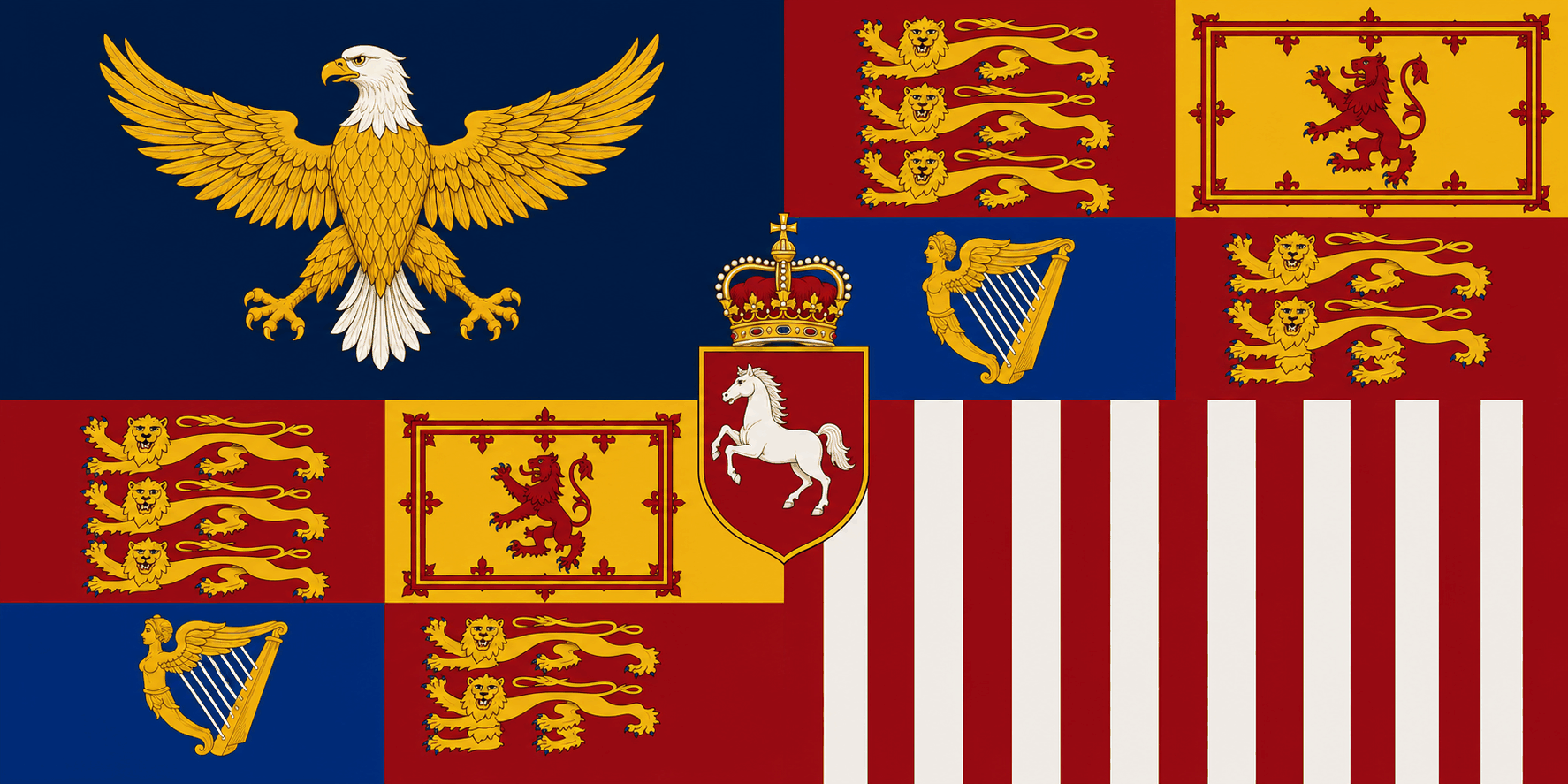
The Royal Standard is a separate banner and a much older one, adopted in 1841 under Ernest I and never replaced. It flies only where the sovereign is personally present, is raised on his arrival and lowered on his departure, and is never flown in his absence. The Governor-General does not fly it, because it marks a person rather than an office.
Its proportions are a standing constitutional irritant, treated at length in the article on the Crown in right of America, and they are the reason the Realm has two national emblems whose politics point in opposite directions: a modern flag that dropped its thirteen stripes for being too small a number, and an 1841 standard on which America holds one quarter of four.
The Great Seal

The Great Seal of the United Kingdom of America. The thirteen stripes on the eagle’s shield are the ones the national flag gave up in 2028.
The Great Seal of the United Kingdom of America, also styled the Great Seal of America, is the Realm’s principal instrument of authentication. It is applied to letters patent, including those creating peerages, to commissions and instruments of appointment, and to the formal written acts of the Crown in right of America. The seal does not confer the authority it records: an instrument is valid because the power behind it was properly exercised, and the seal is the evidence that it was exercised in the proper form.
The design is crowded, and the crowding is deliberate. A crowned eagle stands at the centre with wings displayed, bearing on its breast a shield of thirteen stripes, an arc of stars above the crown, an olive branch in one talon and a sheaf of arrows in the other. At the left stands a column wound with a ribbon lettered LEX, a bound volume lettered CONSTITUTIO at its foot. At the right stands a figure of Justice, blindfolded, with a balance in one hand and a sword in the other. Beneath the whole runs a field of stripes and a banner carrying the motto, Ex Pluribus Corona · Ex Libertate Unio. The device is worked in gold relief on a navy field within a laurel border between beaded rings.
The thirteen stripes are the continuity described above. When they came off the national flag in the 2028 redesign they were kept here unchanged, which is why the Realm’s founding number survives on the instrument that carries its legal identity rather than on the cloth it flies daily.
The seal’s density is the feature against which the Royal American Supreme Court designed its own. The Court’s seal carries a crown, a balance and the year of the Charter and nothing else: no eagle, no shield, no column, no book, and neither a sword nor a figure holding the scales. The two devices belong to the same eighteenth-century engraving tradition and make opposite arguments within it, the Great Seal assembling every emblem of the Realm’s authority and the Court’s withholding most of them.
Anthem, motto and Charter Day
The national anthem is the Battle Hymn of the Kingdom; the royal anthem is God Save the King. The motto is Ex Pluribus Corona, Ex Libertate Unio, from many a crown and from freedom union, which is a deliberate double: the first half answers the question of what holds the polities together and the second answers what the holding is for.
The Realm keeps two observances and they are of opposite character. Charter Day, on 4 July, is the celebratory founding: the day the Charter of Union of the American Colonies was sealed. Boston Day, on 19 October, is solemn and belongs to the war dead, marking the Peace of Boston that ended the fighting in 1779.
There is no Independence Day. The Fourth belongs to the Charter and not to a declaration. The Declaration of American Grievances was adopted on the same date in 1776, and the Realm does not commemorate it, because it asked for redress under the Crown and got it: a document whose demands were met is a stage in an argument rather than a birthday. That the Realm keeps the day on which its colonies asked the Crown for redress, rather than one on which anybody declared anything, is as compact a statement of the settlement as the calendar produces.
The modern era
By 1945 the UKA is a global great power. By now, it is one of the central states of the world: wealthy, diverse, urbanised, militarily powerful, institutionally old, culturally modern, politically noisy, and permanently arguing with itself.
The May Day Bombings of 1 May 2006, 2,158 killed in coordinated bombings across the realm, become the great modern trauma, reshaping emergency law, public memory, security culture, and national ceremony. Prime Minister Al Gore declares a state of emergency. The post-May Day consolidation (2006 to 2008) produces the American Rights Consolidation Act of 2008, folding expanded security powers inside the Rights Act framework and preserving the non-derogable core.
Ana Valdez becomes the 37th Prime Minister in 2025, the first Prime Minister of Latin American heritage and the first woman to hold the office.
Caleb Whitlock, Lord Whitlock, a crossbench peer of twenty-six, becomes the 38th Prime Minister on 11 September 2028, chairing a ministry of five parties on written terms after Valdez lost a confidence division over the Territory of Loreto and the general election that followed returned no majority.
What the UKA is not
The UKA fails as a concept if it becomes too simple. It is not:
- A republic with royal titles added
- A copy of Great Britain with American geography
- A British Empire fantasy
- A feudal America
- A pure parliamentary supremacy system
- A presidential republic in disguise
- A unitary kingdom
- A ceremonial monarchy with no constitutional weight
- A monarchy where the King personally governs ordinary policy
The monarch matters. But the monarch does not personally rule. Parliament matters. But Parliament is limited by supreme constitutional law. The provinces and states matter. But the federation is not symmetrical. The courts matter. But they do not become the whole government.
The United Kingdom of America is a realm of contradiction made durable by law. It is old and modern. Royal and democratic. Federal and national. Local and imperial-scale. Rights-bound and ceremonial. Deeply American and constitutionally unfamiliar. The Realm is strongest when all five forces, Crown, Charter, Parliament, Polities, and People, pull at once.
Trivia
- In-Universe There is no Independence Day. The Fourth of July is Charter Day, marking the sealing of the Charter of Union of the American Colonies, and the Declaration of American Grievances shares the date without being commemorated. A document whose demands were met is a stage in an argument rather than a birthday. The solemn observance is Boston Day on 19 October, for the war dead.
- In-Universe The Realm ranks the Union's preservation with its founding, and says so in the peerage. Mount Vernon and Springfield are the only two dukedoms among the Four Great Peerages, so Washington and Lincoln sit at the same rank, while Jefferson holds a marquessate because a man with objections to a hereditary order needed a rank below Washington's to accept a place in one.
- In-Universe Springfield and Cedar Hill were created four years apart, in 1870 and 1874, and both men were alive. One was made a duke and the other an earl, two ranks lower, by the same institution within four years, for the same work on the same question. It cannot be chronology and it cannot be the scale of the service, and the modern Realm does not defend it.
- In-Universe Frederick Douglass was already Governor-General when his earldom was granted, exercising the Crown's own authority in America, and the Realm looked at a man in that office and made him an earl. The arrangement stood in plain view for seven years, and neither he nor Lincoln is recorded as having said anything about it in public.
- In-Universe The Crown's office widened long before the elected one did. The appointed Governor-Generalship had Frederick Douglass from 1873 and Frances Willard, the first woman to hold it, from 1889. The elected premiership produced no woman until Ana Valdez in 2025, more than a century later.
- In-Universe The thirty-eighth Prime Minister sits in the House of Lords and answers to the Commons at the bar of the House. Caleb Whitlock, Lord Whitlock, commissioned in September 2028 at twenty-six, is the youngest holder of the office by seventeen years and the first to sit in the upper House since Thomas Jefferson governed the last months of his premiership from it in 1804.
- In-Universe Polities do not all choose their two Lords members the same way. Most return them through their own legislature; about a dozen elect them at a general election, having amended their own constitutions to do it. The federation has no view, because under Article XVII.9 the form of a polity's government is beyond federal reach. It makes no practical difference: the chamber cannot override the Commons on confidence or supply, so a popular mandate buys a member nothing, and a Charter amendment goes to the whole electorate at a referendum in any case.
- In-Universe The Free City of Philipsburg sends nothing to either house of Parliament. Its Charter is a merchant's bargain, more autonomy and no seats, so that New Westminster is fenced out of the harbour's ordinary business in exchange for a permanent absence from the legislature that governs the Realm. It is the only polity that bought its independence by giving up its voice.
- In-Universe Releasing a nuclear weapon requires two authorities: the Prime Minister, answerable to the Commons, and the Governor-General acting in the King's name. Neither can act alone. A Realm that had used the weapon once on a ministry's decision concluded it should never again rest with a single officer holding a parliamentary majority.
- In-Universe No American nuclear weapons are stationed in any other Crown realm. That single restriction is why the deliberately nuclear-free Scandinavian Union can belong to the same alliance, and why a Crown realm can declare itself nuclear-free without any argument with New Westminster about what sits on its soil.
- In-Universe The Realm accommodated Indigenous nations in four constitutionally incompatible ways and has never articulated a principle that explains the difference. One nation stands outside the polity count as a republic, most hold compact authority inside a polity, some sit in a polity's legislature, as the nations of Oklahoma-Sequoyah do in its tricameral one, and the Haudenosaunee are inside and outside the Province of New York at once.
- In-Universe The stripes were moved rather than abolished. The 2028 flag dropped the thirteen red and white stripes because thirteen numbers the founding colonies and the Realm holds forty-nine polities and a Territory admitted in 2027, but the Great Seal and the arms keep them. Whether that was maturity or erasure is not settled, and the thirteen eastern polities have views.
- In-Universe The Realm is the largest economy on earth by nominal value, is second to China by total output, and is not the richest place to live. Its Human Development Index of 0.946 sits below the German Empire and Brunswick and level with Prussia and Ireland, which is a deliberate consequence of a system that delivers a social minimum as an enforceable right rather than as a European-style settlement.
- In-Universe The central economic argument of the Realm is a phrase. How far the American Rights Act's obligation of reasonable progressive fulfilment actually reaches has never been settled, and it is the argument that makes Barry Goldwater's premiership and New Hampshire's loyal-libertarian tradition coherent rather than eccentric.
- Real-World There is no United States and no Declaration of Independence. George III accepted the Olive Branch Petition in 1775, the Four-Year War ended in negotiation rather than separation, and the Charter of Union of the American Colonies of 1783 is the founding document. The Realm has a Prime Minister and a Governor-General and has never had a President.
- Real-World Abraham Lincoln is not assassinated here. He is Prime Minister from 1858 to 1869, is created 1st Duke of Springfield in 1870, and dies at Springfield in 1881, twelve years after leaving office. The rebellion he suppressed was armed refusal rather than formal secession, and the Crown's institutional weight is what kept foreign powers from recognising it.
- Real-World Polities joined the Union at about the same dates their real-world counterparts achieved statehood, unless something in the setting moved them. Texas is the great exception, entering by negotiation in three stages ending with the Proclamation of 21 April 1846, and the Territory of Loreto has no counterpart at all, being the Baja peninsula bought from Mexico and admitted in 2027.
- Etymology The motto Ex Pluribus Corona, Ex Libertate Unio means from many a crown, and from freedom union. It is a deliberate double: the first half answers what holds the polities together and the second answers what the holding is for. It plays against the real-world E pluribus unum, which answers only the first.
- Real-World King's College in New York, now Columbia University, dropped its royal name in 1784 after the American Revolution.
- Real-World The UKA is not meant to read as the real United States with royal titles added, nor as the real United Kingdom with American geography.
- Real-World No comparable arrangement for indigenous nations in our own world approaches the autonomy of the Navajo Republic.
- Real-World Benedict Arnold is remembered in the Realm as the hero of Saratoga alone. In the real world his treason of September 1780 ended that reputation, but here the fighting stopped in 1779 and the occasion for it never arose.
See also
- The Crown in right of America, the doctrine by which a shared monarch is a specifically American institution
- The Governor-General, the Crown’s resident office and the line of thirty who have held it
- The Prime Minister, the head of government and the thirty-eight who have held the office
- The Royal American Supreme Court, the apex court of seven Justices
- Treaty Nations of the United Kingdom of America, the 574 nations on the Schedule and the four arrangements under which they stand
- The American Rights Act, whose enforceable social minimum is the Realm’s central argument
- Polities and the Federation, the forty-nine constituent polities and their asymmetric types
- The American peerage, including the Four Great Peerages
- Nations of the World, the other states of the world and the sister realms
Categories
Nations of the World · United Kingdom of America · Constitutional History · Monarchies · Federations · The Crown