Principality of Wales
The Principality of Wales, formally also Tywysogaeth Cymru and commonly known as Wales or Cymru, is a constituent principality of the United Kingdom of Great Britain. It occupies the western peninsula of Great Britain and includes the island of Anglesey, the southern industrial coast, the central uplands, and the border counties, including Monmouthshire. Cardiff is the governing capital, Caernarfon is the ceremonial capital, and Machynlleth is an additional parliamentary seat. Wales shares the British Crown, currency, nationality, armed forces, foreign policy, and ordinary court system with the rest of the UKGB while possessing an entrenched domestic constitution, legislature, government, body of law, and system of local administration.
Wales is governed under the Welsh Constitution 2025, which entered into force on 1 March 2026 after approval in a Welsh referendum. The Constitution defines Wales as a principality within the British realm and assigns it general authority over domestic matters unless a subject is reserved to the UKGB. Senedd Cymru, or the Welsh Parliament, has 96 members elected by closed-list proportional representation. It elects the First Minister, scrutinises the Welsh Government, approves Welsh taxation and expenditure, and enacts bilingual laws. The Supreme Court of the United Kingdom of Great Britain is the final constitutional and appellate court.
The King is sovereign in his capacity as King of Great Britain. Wales has no separate monarch, Governor, or Viceroy, and the principality is not an additional Crown capacity. The King’s assent to Welsh laws and appointment of the First Minister are undertaken on Welsh advice within the single British Crown. Prince Frederick held the ceremonial dignity Prince of Wales until his accession as George V on 31 October 2028, and it has at present no holder. Under the 2025 settlement, the heir’s dignity is gender neutral and passes as Prince or Princess of Wales. It gives its holder no executive or legislative authority.
Welsh and English are equal official languages. Welsh law must be enacted in equally authoritative versions, and residents may use either language before Welsh public authorities. Education aims at functional bilingualism while retaining both Welsh-medium and English-medium schools. British Sign Language has protected status in education, courts, public media, and service delivery but is not a co-official language.
The modern Welsh economy developed from agriculture, mining, metal production, ports, and public services. Coal and heavy industry no longer dominate employment, but their physical and political effects remain visible in the south Wales valleys, Swansea Bay, the north-east, and the former slate districts. Public policy follows a democratic market-socialist model that places particular weight on care, food, housing, utilities, local procurement, transport, tourism, and small enterprise. Steel, renewable energy, nuclear power, universities, manufacturing, cultural production, and environmental restoration are also important.
The official state flag is the black and gold Cross of Saint David. The Red Dragon, Y Ddraig Goch, remains a protected cultural and sporting flag. The national anthem is Hen Wlad Fy Nhadau, while God Save the King is used separately when the sovereign is present in an official capacity. St David’s Day on 1 March is the primary national holiday and also commemorates the commencement of the Welsh Constitution.
Wales’s constitutional development has been shaped by conquest, incorporation into England, industrialisation, language revival, labour politics, and gradual devolution. The 2025 settlement gives Wales powers formally comparable to those of England and Scotland, but its smaller tax base and higher service costs leave it dependent on transfers from the UKGB. This condition is often described in Welsh politics as “praise without power”: British institutions recognise Welsh identity and public service obligations while disputes over finance limit what Welsh institutions can deliver.
At present Wales is governed by a Labour-Plaid coalition led by First Minister Anwen Rhys-Davies. Its immediate dispute with the UKGB concerns the first needs-based equalisation assessment. Welsh ministers argue that the assessment underfunds universal adult social care, bilingual rural provision, and the Welsh share of integrated health obligations. The UKGB Treasury argues that some costs arose from commitments made without guaranteed funding. The Welsh Fiscal Council has found substance in both positions. Services continue through the use of Welsh reserves while negotiations proceed through the Council of the Nations.
Etymology
The English name Wales derives from an Old English term for Brittonic or foreign peoples. Its historical use therefore arose from an external description, although it has long since become the ordinary English name used by Welsh institutions and residents. The Welsh name Cymru derives from a Brittonic word associated with compatriots or fellow countrymen. Cymru is not a ceremonial alternative. It is the ordinary national name in Welsh and appears throughout legislation, education, transport, broadcasting, and public administration.
The formal constitutional names Principality of Wales and Tywysogaeth Cymru refer to Wales’s place within the UKGB. The term principality does not mean that the Prince of Wales governs the territory or holds its public property. It records a historical and dynastic form that has been adapted to parliamentary government. Welsh constitutional practice distinguishes the principality as a public polity from the heir’s personal dignity. The same word appears in both contexts, but the legal subjects are different.
Use of “the Principality” by itself is less common in ordinary speech than Wales or Cymru. Government publications generally use the formal names for constitutional instruments, treaties involving devolved participation, royal instruments, and ceremonial occasions. Acts of the Senedd usually refer simply to Wales. The Welsh and English names have equal status, and neither is treated as a translation subordinate to the other.
The adjectives Welsh and Cymreig refer broadly to the country, people, and culture. Cymraeg refers more specifically to the Welsh language and can describe Welsh-language activity. Public bodies avoid treating language, ancestry, citizenship, and national identity as interchangeable. A person may identify as Welsh without speaking Welsh, speak Welsh without exclusive Welsh identity, or combine Welsh identity with British, English, Caribbean, South Asian, European, or other affiliations.
History
Early Wales
The territory now called Wales formed part of Roman Britain before political authority fragmented during the early medieval period. Brittonic-speaking kingdoms developed across western Britain as Roman administration receded. Gwynedd, Powys, Deheubarth, and smaller kingdoms or lordships varied in extent and stability. Their rulers fought, married, and negotiated with one another and with English, Irish, Scandinavian, and Norman neighbours. No continuous central Welsh state governed the whole modern territory throughout this period.
Legal and political memory nevertheless acquired recognisably Welsh forms. The law associated with Hywel Dda was compiled, copied, and adapted across several kingdoms. It regulated status, kinship, land, compensation, royal authority, and legal procedure. Later constitutional discussion often treated it as proof of an indigenous legal order distinct from English common law. Modern scholarship and public education avoid presenting the surviving texts as a single timeless national code, since manuscripts differ and the law changed over centuries.
Christian institutions linked Wales to wider Latin Christendom while retaining local traditions associated with saints, monasteries, holy places, and learned communities. Saint David became the principal national patron. The dioceses and religious houses later underwent Norman, English, and papal reforms, but local saints and Welsh-language devotion remained part of religious life. The modern national day draws from this history without making adherence to Christianity a condition of Welsh identity.
Political consolidation was intermittent. Rhodri Mawr and later rulers established broad dynastic authority but could not make it permanent. Gruffudd ap Llywelyn briefly ruled most of Wales in the eleventh century before his defeat and death. Norman expansion then created marcher lordships along the border and in the south. Marcher rulers exercised extensive legal and military powers and built castles, towns, lordships, and ecclesiastical institutions. Native rule survived most strongly in the west and north.
The princes and the conquest
The rulers of Gwynedd expanded their authority during the twelfth and thirteenth centuries. Llywelyn ab Iorwerth, commonly known as Llywelyn the Great, combined warfare, marriage, diplomacy, and internal administration to become the most powerful Welsh ruler of his time. His successors faced both dynastic division and increasing pressure from the English Crown. The title Prince of Wales came to express a claim to precedence over other Welsh rulers and territories rather than an uncontested modern national office.
Llywelyn ap Gruffudd secured recognition as Prince of Wales in the Treaty of Montgomery in 1267. His relationship with Edward I later deteriorated over homage, territory, marcher conflict, and the practical limits of English supremacy. War resumed in 1277 and again in 1282. Llywelyn was killed in December 1282, and his brother Dafydd was captured and executed the following year. Edwardian forces occupied the remaining centres of native princely power.
The conquest imposed a new political order rather than erasing all local practice at once. The Statute of Rhuddlan in 1284 organised much of the conquered territory under royal administration, shires, and English criminal law while permitting parts of Welsh civil custom to continue. Marcher lordships retained exceptional jurisdictions. Edward I’s castle and borough programme supported garrisons, settlement, taxation, and control. Caernarfon, Conwy, Harlech, and other fortified sites were instruments of conquest before they became heritage and ceremonial sites.
The English heir received the title Prince of Wales, which became attached to the senior heir of the English and later British Crown. The title did not create continuous autonomous Welsh government. Its later ceremonial adaptation remains controversial because the dignity originated in the settlement that followed military defeat. The 2025 Constitution acknowledges this origin and separates the heir’s title from the public authority of the principality.
Social and legal relations after conquest differed by district. Welsh landholders could retain influence, while discriminatory rules restricted many Welsh residents in boroughs or public office. The March remained legally fragmented. Rebellion, local accommodation, service to the Crown, and movement across the border all occurred. A simple division between a permanently unified Welsh population and an equally unified English state obscures these variations, but the overall balance of authority had shifted decisively to the English Crown.
Owain Glyndŵr
Owain Glyndŵr’s revolt began in 1400 amid a dispute over land, the political disruption surrounding the deposition of Richard II, and wider Welsh grievances. Glyndŵr drew support from different regions and social groups, defeated royal forces, took towns and castles, and established diplomatic relations with England’s enemies. He assumed the title Prince of Wales and sought to create a Welsh political and ecclesiastical order.
In 1404 Glyndŵr held a parliament at Machynlleth. The surviving evidence does not supply a complete modern account of its membership or procedure, and the present Parliament House is later than the meeting it commemorates. The event nonetheless became the principal historical basis for a Welsh claim to representative government before incorporation. Glyndŵr also held assemblies elsewhere and proposed Welsh universities and an independent church structure in his diplomacy.
The revolt ultimately failed. English forces recovered territory, castles fell, and many supporters accepted pardons or lost property. Glyndŵr disappeared from the record without a confirmed capture or burial. Penal legislation and political suspicion followed. The uprising did not create an uninterrupted Welsh state or legislature, and the modern Senedd does not claim legal succession from the 1404 assembly.
Modern constitutional memory treats Glyndŵr as a founder because he connected national rule with representative assembly, law, education, diplomacy, and public consent. This interpretation differs from using him only as a military hero. The annual Senedd sitting at Machynlleth commemorates the political claim without presenting the revolt as an uncomplicated national liberation. The war included destruction, coercion, divided loyalties, and foreign intervention, all of which remain part of historical teaching.
Glyndŵr’s arms and banners are distinct from the state symbols chosen in 2025. His public reputation appears in memorials, literature, education, political speech, and cultural organisations. Republican, nationalist, labour, liberal, and constitutional-monarchist traditions have all claimed parts of his legacy. The Constitution does not prescribe a single interpretation.
Tudor incorporation and constitutional union
Welsh gentry increasingly entered royal service during the fifteenth century. The accession of the Tudor dynasty in 1485 gave a family of Welsh origin the English Crown, but it did not restore a separate Welsh principality. Tudor rule strengthened the central state and prepared the conditions for statutory incorporation. Local administration still combined marcher jurisdictions, royal counties, borough privileges, and Welsh customary practice.
The Laws in Wales legislation of the sixteenth century extended the English administrative, parliamentary, and legal system throughout Wales. It abolished or absorbed marcher jurisdictions, created or regularised counties, provided Welsh representation at Westminster, and applied English law and official language requirements. Welsh residents gained a more uniform route into public office and parliamentary representation while the independent standing of Welsh law and institutions was reduced.
The modern Welsh settlement describes these Acts as an unequal constitutional union. The term recognises that they built a durable shared state and removed some arbitrary marcher powers. It also recognises that the settlement was enacted by the English Crown and Parliament without a Welsh national legislature and that English became the language of administration and law. Describing the process only as annexation overlooks the common institutions it created; describing it only as union conceals the imbalance under which it occurred.
The language provision had long consequences. Welsh continued as the language of most people in many regions, in worship, poetry, family life, commerce, and local society, but it lacked equal standing in formal administration. Welsh-speaking litigants and officials often worked through translation or English-language forms. The exclusion was institutional rather than evidence that Welsh ceased to function as a public language.
The county map that developed from this order later supplied the basis for the thirteen historic counties restored as the upper tier of local government in 2026. Their boundaries and names carry Tudor and later administrative histories as well as older regional identities. Restoration does not recreate sixteenth-century government or marcher privilege. It uses familiar territories for democratic administration under the Welsh Constitution.
Reformation, Bible, and religious change
The Reformation altered Welsh religious and cultural life. The Crown’s break with Rome, dissolution of monasteries, and creation of an established church were imposed through the same state structures that governed England. Religious houses lost land and institutional functions. Changes in worship and doctrine generated compliance, local adaptation, resistance, and later denominational division.
Translation of scripture and worship into Welsh helped standardise literary Welsh and supported the language over the following centuries. The Welsh Bible and prayer book gave communities access to Protestant worship in their own language even though English dominated civil administration. This combination of legal subordination and religious use shaped the later association between Welsh-language culture, literacy, chapel life, and political dissent.
The established church in Wales remained part of the Church of England until the twentieth century. Its parishes, dioceses, buildings, and schools were central institutions, but Nonconformist denominations acquired a large following from the eighteenth century. Methodists, Baptists, Congregationalists, and other communities built chapels and voluntary organisations across rural and industrial Wales. Their influence extended beyond theology into education, temperance, music, mutual aid, and liberal politics.
Modern public ceremonies recognise this nonconformist inheritance while remaining secular and inclusive. The history is not presented as a story of one national faith replacing another. Anglican, Catholic, Nonconformist, Jewish, Muslim, Hindu, Sikh, humanist, and other communities form part of contemporary Wales, and the Constitution protects belief, conversion, criticism, and nonbelief.
Wales and the British unions
When England and Scotland formed Great Britain in 1707, Wales did not enter as a separately represented party. It was already incorporated within the English legal and parliamentary order. Welsh MPs voted as members of the English Parliament, and the resulting British institutions applied to Wales, but no Welsh national legislature negotiated terms comparable to the Scottish settlement.
This absence became a central subject of later Welsh constitutional criticism. Scotland retained separate law, church, and educational institutions through the union. Wales entered the new kingdom through the institutions created by sixteenth-century incorporation. The difference affected later debates about whether Wales was a nation, a principality, a region of England, or a cultural part of a unitary Britain.
The 2025 settlement does not attempt to invent Welsh participation in 1707. Its preamble records that Wales was present through incorporation and absent as a distinct constitutional voice. This admission supports the modern claim that Welsh consent must be expressed directly when the powers of the principality are altered. It does not invalidate the laws enacted during the previous British order.
Participation in the British state also created shared institutions and identities. Welsh people served in Parliament, armed forces, administration, churches, trade, empire, science, industry, and migration networks. Welsh political life was never limited to resistance against London. Unionism, liberalism, labour politics, imperial participation, pacifism, republicanism, and cultural nationalism all developed within the same society.
Atlantic connections and the Olive Branch settlement
Britain’s acceptance of the Olive Branch Petition in 1775 prevented the North American crisis from becoming a successful republican war of independence. The resulting constitutional transformation created the United Kingdom of America as a sister realm under the shared monarch. Wales acquired no new constitutional status within Great Britain, but its Atlantic economy and migration patterns changed.
Welsh ports participated in trade with the UKA. Manufactured goods, metal, coal, slate, food, and shipping services moved across the Atlantic, while American agricultural products and capital entered British markets. Welsh merchants and industrialists operated within networks centred on Bristol, Liverpool, London, and American ports. The benefits were uneven and included connections to commerce shaped by slavery and colonial extraction.
Religious links were especially important. Welsh Baptists, Methodists, Congregationalists, and other dissenters maintained correspondence, preaching, publishing, and migration networks with American communities. Welsh-language congregations developed in parts of the UKA. Some migrants formed concentrated settlements; others entered mixed industrial or farming districts and gradually shifted toward English.
The shared Crown made movement between Great Britain and the UKA politically easier than movement between unrelated states, but migrants still faced cost, distance, labour insecurity, and cultural loss. The Atlantic connection did not empty Wales or produce a single loyalist identity. It enlarged the places in which Welsh language, religion, labour organisation, and family networks operated.
Later Welsh accounts sometimes treated the UKA as proof that constitutional transformation could preserve monarchy while redistributing power. Others saw it as a wealthy realm whose scale made Welsh claims appear small. The comparison entered devolution debates, but Wales did not become an American dependency, Crown realm, or overseas polity.
Industrialisation
Industrialisation changed Wales more rapidly than any constitutional act since the Tudor settlement. South Wales contained large deposits of coal and iron ore, accessible valleys, and ports connected to Atlantic markets. Ironworks expanded around Merthyr Tydfil and other centres. Copper smelting made Swansea a major industrial town. Coal production grew across the valleys, while Cardiff, Barry, Newport, and other ports handled exports. Steel later became central to the southern economy.
North Wales developed different industrial concentrations. Slate quarrying transformed communities in Gwynedd, and metal mining, shipbuilding, brick, engineering, and coal employed workers in the north-east and coastal districts. Rural industries and domestic production did not disappear immediately. Agriculture remained important, and industrial workers often retained family connections to farms, villages, and Welsh-speaking districts.
Population moved from rural Wales, England, Ireland, and farther abroad into expanding towns. The new communities were not culturally uniform. Welsh remained strong in many industrial districts, particularly where migration came from the Welsh countryside, while English became dominant in ports and mixed settlements. Chapels, unions, friendly societies, libraries, choirs, newspapers, and political clubs provided institutions in places where municipal services developed slowly.
Industrial wealth was concentrated among owners, investors, landlords, and commercial firms. Workers faced dangerous pits, quarries, furnaces, docks, and transport systems. Injury, lung disease, explosions, flooding, insecure wages, child labour, poor housing, and polluted land and water formed part of the same economy that supplied British industrial power. Public history treats production and suffering together.
The Merthyr rising of 1831, the Rebecca disturbances, Chartism, strikes, and later trade unionism reflected different grievances and political languages. They cannot all be reduced to modern Welsh nationalism. Some demands concerned wages, tolls, representation, food, debt, land, or working conditions. Together they established a durable association between Welsh public life and organised challenges to concentrated power.
Industrial development increased Wales’s importance to the British state without granting it matching political control. Decisions about tariffs, railways, labour law, policing, land, and public investment remained largely at Westminster or with private capital. This mismatch became an early form of the later complaint about praise without power: Welsh coal and steel were described as national assets while communities had limited authority over the terms of extraction.
Language, education, and the Blue Books
Nineteenth-century Wales experienced both pressure on the Welsh language and a major expansion of Welsh print culture. Newspapers, religious publications, poetry, political writing, and popular education reached a wide readership. Eisteddfodau and cultural societies adapted older practices to industrial and urban society. Literacy did not require the abandonment of Welsh, although advancement in law, administration, higher education, and many professions often required English.
The 1847 reports on education, later known as the Blue Books, criticised Welsh schools and associated the Welsh language and Nonconformist society with ignorance and immorality. Their evidence and conclusions were contested at the time and became a lasting national grievance. The reports influenced policy and social attitudes even where they did not directly prescribe every later practice.
The Welsh Not, a device used in some schools to identify and punish children for speaking Welsh, varied in form and extent. It was not a single uniform programme imposed identically across Wales. Its memory nonetheless records how educational discipline could make a child’s home language a source of shame. Public teaching avoids both denying the practice and converting every Welsh school into the same story.
English expanded through compulsory education, migration, administration, and economic opportunity. Welsh survived through family transmission, religion, publishing, local commerce, cultural organisation, and later public policy. Language change therefore reflected coercion and practical incentives together. Families often adopted English because they believed it would improve their children’s prospects, even when the choice contributed to long-term language loss.
The University of Wales and its constituent colleges broadened access to higher education and gave Welsh national institutions a durable form. Libraries, museums, schools, and cultural bodies followed. These institutions did not possess legislative authority, but they created a national public sphere before political devolution.
Nonconformity, liberalism, and land
Nonconformity became closely associated with Welsh liberal politics during the nineteenth century. Chapel networks supported public speaking, literacy, voluntary organisation, and campaigns against Anglican privilege. Welsh Liberalism combined religious equality, tenant interests, education, temperance, disestablishment, and in some cases greater national recognition. It also contained class divisions and did not represent every Welsh voter.
Land ownership became a recurring political issue. Large estates shaped rural tenancies, mineral rights, urban expansion, and access to common resources. Agricultural workers and tenant farmers depended on landlords whose political and religious identities could differ from their own. The land question linked economic security to language and community continuity, especially in western and northern districts.
The tithe conflicts and campaigns for disestablishment illustrated how religious and economic grievances overlapped. Nonconformists objected to compulsory support for an established church they did not attend. The eventual Welsh Church Act separated the Church in Wales from the state, although implementation was delayed by the First Great War and took effect in 1920.
Disestablishment did not abolish Anglican life or transfer the Crown into a Welsh religious office. The Church in Wales became a self-governing Anglican province. It retained buildings and internal law under its constitution while losing established status. The settlement remains a central precedent for separating national history from state religious privilege.
Labour and national politics before 1914
The growth of organised labour altered Welsh politics around the turn of the twentieth century. Miners’ unions, railway workers, steelworkers, dockers, quarrymen, and other groups built local and national organisations. Industrial disputes over wages, safety, hours, recognition, and management authority produced both negotiation and violence. State policing of strikes remained a source of grievance.
The Labour movement challenged Liberal dominance but inherited parts of the radical and nonconformist tradition. Its strongest districts lay in the industrial south and north-east, though socialism and unionism took different forms across occupations. Cooperative societies, working men’s institutes, women’s organisations, and educational movements contributed to political organisation beyond the workplace.
Welsh national politics before 1914 did not centre on a single demand for home rule. Cultural autonomy, disestablishment, land reform, labour rights, education, and administrative recognition competed for attention. Some advocates linked Welsh self-government with Irish and Scottish home rule. Others believed reform through Westminster was sufficient.
The creation of national administrative bodies and the office of Secretary of State for Wales came later than many campaigners sought. Before those institutions existed, Welsh interests were represented through MPs, local authorities, voluntary bodies, unions, churches, and informal cabinet responsibility. The absence of a national executive made coordination difficult and reinforced dependence on departments organised for England and Wales together.
First Great War
Wales entered the First Great War as part of Great Britain. The British government fought beside Germany and the United Kingdom of America against France and Russia. Welsh participation followed the political decisions of the British state rather than a separate Welsh declaration or command. Ernest III was sovereign, and recruitment, taxation, munitions, shipping, and strategy remained British responsibilities.
Welsh regiments recruited heavily, and Welsh personnel served throughout the British armed forces. Voluntary enlistment drew on patriotism, local pressure, employment conditions, religious conviction, ideas of duty, and loyalty to comrades. Opposition also existed. Pacifists, some Nonconformists, socialists, and labour activists challenged conscription or particular war policies. The diversity of response is obscured when service is described either as unanimous enthusiasm or as simple coercion.
Coal, steel, ports, railways, hospitals, and merchant shipping made Wales important to the war economy. South Wales coal supplied ships, industry, and transport. Steel and engineering plants produced military and logistical material. Cardiff, Newport, Swansea, Barry, and smaller ports handled cargo and personnel. Women entered industrial, transport, agricultural, clerical, medical, and voluntary work in larger numbers, although employment and pay remained unequal.
Industrial discipline generated disputes over wages, prices, dilution of skilled labour, safety, and state control. The government treated uninterrupted coal production as a strategic necessity. Union leaders negotiated within wartime restrictions while local activists sometimes rejected settlements. The tension between national service and workers’ control strengthened labour politics after the war.
Casualties affected towns, villages, congregations, workplaces, and families across Wales. Memorials were built in civic centres, chapels, churches, schools, clubs, and industrial communities. They usually named the dead without resolving political arguments about the war. Welsh-language and English-language remembrance developed together. The experience deepened public expectations that wartime sacrifice should be followed by housing, work, political representation, and social reform.
Victory did not give Wales a separate constitutional settlement. It did accelerate disestablishment, electoral change, labour representation, and national administrative discussion. The Church in Wales became disestablished in 1920. Returning servicemen and wartime workers faced unemployment, disability, grief, and unstable industry. The gap between public commemoration and material provision became part of interwar political criticism.
Interwar Wales
The interwar economy was marked by sharp regional inequality. Coal, steel, shipping, and heavy industry faced reduced demand, industrial conflict, and long periods of unemployment. Communities built around a single pit, works, quarry, or port were especially vulnerable. Poor relief, migration, hunger marches, union organisation, and local mutual aid became features of daily life.
The General Strike and mining disputes carried particular force in Wales. Miners defended wages, hours, union recognition, and community survival against owners and a state concerned with production and fiscal stability. Defeat weakened organised labour in the short term but did not remove its place in Welsh public life. Labour increasingly replaced the Liberals across the industrial south.
Economic migration flowed to English industrial districts, London, the UKA, and other destinations. Some migrants maintained Welsh language and associational life; others assimilated into broader labour and urban cultures. Depopulation affected rural as well as industrial areas. The belief that young people had to leave to build a secure life became a lasting political concern.
Plaid Cymru was founded in 1925 from movements concerned with language, culture, economic development, and national self-government. Its early support was limited and geographically uneven. The party contained conservative cultural nationalists, pacifists, social reformers, and advocates of stronger political autonomy. It did not immediately displace Labour or Liberal traditions.
Public institutions expanded despite economic hardship. Broadcasting, universities, the National Eisteddfod, museums, libraries, local education, and Welsh-language organisations helped sustain a national public sphere. Radio brought Welsh speech, music, worship, sport, and news into homes while also increasing exposure to British English media. Arguments over broadcast time and editorial control anticipated later disputes about public media.
The Crown remained a British institution rather than a Welsh government. Royal visits to industrial and rural communities attracted interest but also criticism when ceremony appeared disconnected from unemployment and housing. Ernest III’s death in 1936 and Ernest IV’s accession occurred amid economic and international uncertainty. The office of Prince of Wales remained dynastic and ceremonial.
Second Great War
Great Britain entered the Second Great War against fascist France and its co-belligerents. Wales again participated through the British state. Ernest IV was sovereign. Welsh political parties largely supported the war, although debates continued over conscription, civil defence, industrial control, and the balance between military necessity and civil liberty.
Wales contributed coal, steel, aircraft and vehicle components, ports, maintenance, food, military training, and personnel. Milford Haven and the Bristol Channel were important to maritime supply. Cardiff, Swansea, Newport, Barry, Port Talbot, Holyhead, and other transport centres supported Atlantic defence and movement across the British Isles. Rural land was used for training, food production, storage, and relocated activity.
Fascist French air attacks struck Welsh ports, industrial sites, railways, and urban districts. Cardiff and Swansea suffered major civilian damage, and attacks affected other coastal and industrial communities. Bombing disrupted homes, schools, worship, employment, and municipal services. Civil defence depended on wardens, firefighters, medical staff, volunteers, transport workers, and households as well as the armed forces.
Evacuation brought children and families into rural communities, sometimes across linguistic and class boundaries. War industries again expanded women’s paid work. Black and colonial personnel, merchant seamen, refugees, and workers from other parts of Britain added to the population of ports and industrial districts. Their presence forms part of Welsh wartime history even where later public remembrance focused mainly on local military service.
Coal production remained essential but dangerous. The state pressed for output while miners and unions raised safety, food, pay, and working-condition concerns. Industrial accidents did not cease because the country was at war. The relationship between state direction and organised labour helped shape postwar support for nationalisation and welfare provision.
Welsh regiments retained names and traditions within the British Army, but Wales did not field an independent national force. Welsh personnel also served in the Royal Navy, air services, merchant marine, medical corps, intelligence, logistics, and civil administration. Casualties occurred in Europe, the Atlantic, the Mediterranean approaches, Asia, and the Pacific according to British deployment.
The war ended with Britain among the victorious powers. Commemoration joined military service with the civilian experience of bombing and industrial mobilisation. The postwar public expected housing, healthcare, education, employment, and security in return for shared sacrifice. These demands strengthened Labour and made the welfare state a central British and Welsh institution.
Postwar welfare and national administration
The postwar settlement nationalised coal and major infrastructure, expanded social insurance, created a shared British health service, and increased public housing and education. Wales benefited substantially because industrial illness, inadequate housing, rural poverty, and uneven medical access had been severe. The system was British in finance and staffing but increasingly adapted to Welsh geography and administration.
Nationalisation changed ownership without giving mining communities full control of investment or closure. The National Coal Board improved some equipment, safety, and welfare provision, but decisions remained concentrated. Mines continued to close as energy demand and industrial policy changed. The public character of the industry made closure a government act rather than a purely private one, which intensified political responsibility.
Welsh administrative institutions developed gradually. A Minister for Welsh Affairs and later the Welsh Office coordinated functions that had previously been divided among England-and-Wales departments. The Secretary of State for Wales gained a Cabinet position and administrative powers. These reforms made Wales more visible within central government but did not create an elected Welsh executive.
The contrast between cultural recognition and political authority persisted. Government supported selected national institutions and acknowledged Welsh distinctiveness, yet large decisions about water, industry, transport, broadcasting, and local government remained at Westminster or Whitehall. Supporters of devolution argued that administrative offices could speak for Wales only through ministers responsible to a British parliamentary majority.
Tryweryn
The Liverpool Corporation obtained authority from Westminster to flood the Tryweryn valley and create the Llyn Celyn reservoir. Capel Celyn, farms, a school, chapel, cemetery, and surrounding land were displaced or submerged. Welsh MPs opposed the measure, but their opposition could not prevent legislation serving an English city’s water needs.
The reservoir opened in 1965. The event became a defining example of external authority overriding a Welsh community. Its political force came from the physical loss and from the procedure: a public body outside Wales obtained parliamentary authority without Welsh consent and used it to remove a Welsh-speaking settlement.
Public memory does not treat every reservoir or water transfer as equivalent to Tryweryn. Wales contains reservoirs that serve Welsh communities and support flood control, energy, and public supply. The grievance concerns ownership, consent, compensation, ecological cost, and whose interests govern the decision. The 2025 Constitution’s public-trust rules and Cardiff-London water compact were written partly to prevent repetition.
Memorial sites, archives, art, graffiti, political campaigns, and education preserve the history of Capel Celyn. The phrase associated with remembering the valley became part of language and devolution politics. The constitutional settlement does not claim that later powers can restore the lost community. It uses the event as evidence for requiring consent and published public reasons in future cross-border water decisions.
Aberfan
On 21 October 1966 a colliery spoil tip above Aberfan collapsed after heavy rain and engulfed Pantglas Junior School and nearby houses. The disaster killed 116 children and 28 adults. It was not an unforeseeable natural event. The placement and management of the tips, prior warnings, institutional failures, and the treatment of local knowledge made it a disaster of public negligence.
Rescue work involved residents, miners, emergency workers, medical staff, soldiers, and volunteers. The scale of the loss and the fact that children were killed in their school gave Aberfan a particular place in Welsh and British memory. Public attention also exposed the physical risks imposed on communities by extractive industry after production had ceased at a particular site.
The tribunal found responsibility within the National Coal Board. Later controversy concerned compensation, accountability, the removal of remaining tips, and the use of money from the disaster fund. Official expressions of sympathy could not substitute for direct responsibility or repair. This distinction strongly influenced Welsh scepticism toward ceremonial recognition unaccompanied by institutional power.
The Constitution’s environmental, health, and social rights draw on a wider history than Aberfan alone, but the disaster is central to their public explanation. Mine and quarry tips are subject to inspection, transparent risk classification, funded remediation, and community access to information. Memorial observance remains led by families and the local community rather than appropriated as a general national festival.
Language movement and public media
Welsh-language activism grew during the postwar decades. Campaigners used petitions, electoral politics, direct action, nonviolent civil disobedience, broadcasting protests, and community organisation to demand official recognition, Welsh-language education, road signs, public services, and media. The movement included people with different views on independence, socialism, religion, and constitutional reform.
Legislation gradually recognised the use of Welsh in courts and administration. Welsh-medium schools expanded, and local authorities adopted bilingual practices. The creation of a Welsh-language television service followed sustained political pressure. Public broadcasting became one of the clearest examples of a cultural demand producing an institution with national reach.
These reforms did not reverse language decline automatically. Housing markets, migration, employment, family transmission, and the dominance of English-language media continued to affect daily use. Activists disagreed over whether policy should concentrate on speaker numbers, territorial communities, universal education, workplace use, or individual rights.
The 2025 Constitution rejects a numerical national target as the principal measure of success. It establishes enforceable individual access and a universal educational expectation. This approach treats Welsh as a common public language while protecting English-medium institutions and avoiding the classification of citizens by linguistic identity.
Deindustrialisation and the miners’ strike
Heavy industrial employment declined during the later twentieth century. Mine closures accelerated, steel and manufacturing employment contracted, and docks changed with containerisation and shifts in global trade. The effects were concentrated in places whose housing, transport, retail, social organisations, and local finance had developed around large employers.
The miners’ strike of 1984 to 1985 was a major conflict over closures, union power, energy policy, and the future of coal communities. Welsh miners joined the strike despite differences in initial balloting and local strategy. Women’s support groups organised food, finance, travel, public meetings, and political activity. Policing, hardship, internal disagreement, and the eventual defeat affected families and communities long after work resumed.
Closure removed more than wages. Collieries supported institutes, sports, welfare, training, union organisation, and a shared occupational identity. Some institutions survived independently; others disappeared. Public programmes reclaimed land and improved housing, but replacement employment was often lower paid, less secure, or located beyond easy public transport.
The later Welsh economy became more varied, with public services, universities, tourism, distribution, advanced manufacturing, culture, and smaller firms. Diversification did not eliminate regional inequality. Former industrial districts continued to experience poorer health, lower wealth, and infrastructure deficits. The foundational-economy strategy of 2026 is partly an answer to the limits of relying on a single new export industry to replace coal.
Devolution referendums
The 1979 referendum on a Welsh Assembly was defeated by a large margin. The proposal had limited powers and faced opposition from Conservatives, some Labour figures, unionists, and voters who regarded another tier of government as unnecessary. Supporters also struggled to present the institution as capable of changing economic conditions during a period of industrial crisis.
Devolution returned to the political agenda during the 1980s and 1990s. The experience of central government policies opposed by large Welsh majorities, language reform, European regional policy, local-government change, and the development of national civil society strengthened the argument for an elected institution. Support remained uneven by region and party.
The 1997 referendum approved an Assembly by a narrow majority. The closeness of the vote shaped the institution’s early caution. The National Assembly for Wales began work in 1999 with executive and secondary legislative responsibilities. It was initially a single corporate body rather than a fully separated legislature and government.
Subsequent reforms separated the executive, expanded primary law-making, moved toward a reserved-powers model, changed the institution’s name to Senedd Cymru / Welsh Parliament, and developed Welsh taxation. A later referendum approved broader legislative authority. Devolution became an ordinary part of government even as arguments continued over its scope, performance, and cost.
The electoral system also changed. The 2026 Senedd election was organised for 96 members in sixteen six-member constituencies using closed party lists. The change increased capacity and proportionality but drew criticism over voter choice within lists and the relationship between members and local areas. The Welsh Constitution retained this model while permitting later reform through entrenched electoral procedures.
Constitutional convention of 2025
Pressure for a new British settlement grew from several directions. Scotland demanded firmer protection for its law and Parliament. England required domestic institutions distinct from Westminster’s realm-wide functions. Kernow sought recognition as a national component. Wales argued that the consent convention, fiscal arrangements, and limits of devolved authority remained too dependent on central political practice.
The realm-wide constitutional convention of 2025 brought together governments, legislators, local authorities, civic bodies, unions, public institutions, and citizen participants. It did not dissolve the UKGB or convert its national components into sovereign Crown realms. Its purpose was to place domestic self-government and shared British functions within a written constitutional relationship.
Welsh negotiations concentrated on general legislative competence, constitutional protection against unilateral repeal, finance, language equality, natural resources, local government, social rights, and direct access to the Crown within the British capacity. Disputes concerned the extent of taxation, intervention powers, courts, and the relation between the Senedd and Westminster.
The final Welsh Constitution was approved by roughly three-fifths of voters. Support was broad but not unanimous. Some unionists regarded the settlement as excessive and fiscally risky. Some nationalists argued that it entrenched dependence and withheld sovereignty. Supporters presented it as enforceable self-government within a continuing Britain.
The Constitution received royal assent in 2025 and commenced on St David’s Day 2026. Transitional provisions preserved every existing law, office, contract, public body, judgment, tax obligation, and legal proceeding unless the Constitution or later legislation altered it. This continuity prevented commencement from becoming an administrative break.
Geography
Location and boundaries
Wales occupies the western part of Great Britain between the Irish Sea, the Bristol Channel, and the English border. The boundary with England runs from the Dee estuary in the north to the Severn estuary in the south. It crosses settled lowlands, uplands, river valleys, and communities whose economic and family connections do not follow the constitutional line. Road, rail, water, health, policing, and labour-market agreements therefore make cross-border administration a permanent part of Welsh government.
The territory follows the modern national boundary. Monmouthshire is within Wales. The English counties historically associated with the Marches remain in England. This rule prevents medieval lordships or cultural borderlands from becoming a basis for contemporary territorial claims. It does not deny the mixed history of the border, where Welsh and English languages, law, religion, trade, and kinship have long overlapped.
Anglesey, or Ynys Môn, is the largest island and is connected to the mainland across the Menai Strait. Smaller inhabited islands and coastal communities fall within the ordinary local-government structure. Offshore waters and seabed interests are administered as Welsh public resources subject to the UKGB’s reserved authority over international boundaries, navigation, defence, and defined strategic infrastructure.
Physical regions
Much of Wales is upland. Eryri in the north-west contains the country’s highest mountains and deep glacial valleys. The Cambrian Mountains form a broad central watershed with sparse settlement, reservoirs, peatland, forestry, and extensive grazing. Bannau Brycheiniog occupies the south-central uplands. Lower country in the Vale of Glamorgan, the Usk and Wye valleys, north-east Wales, Pembrokeshire, Carmarthenshire, and the coastal belts supports larger settlements or more intensive farming.
The south Wales coalfield produced a distinctive pattern of narrow, densely settled valleys running between upland ridges. Towns grew along rivers, railways, tramroads, and pit sites rather than around older county centres. The industrial coast from Newport through Cardiff and Swansea to Llanelli developed ports, steelworks, copper works, engineering, and urban services. North-east Wales has close economic links with Merseyside and Cheshire, while the north-west and west contain Welsh-speaking rural districts, tourism centres, former slate communities, universities, ports, and energy sites.
The principal rivers include the Severn, Wye, Dee, Usk, Taff, Teifi, Tywi, Conwy, Clwyd, and Glaslyn. Several cross the border or supply communities outside their immediate catchments. Reservoir construction, flood management, ecological restoration, water quality, and transfers to England therefore involve both Welsh public-trust law and formal intergovernmental agreements.
Coast and sea
Wales has a long and varied coast relative to its land area. The north and west coasts face the Irish Sea, the south-west projects into the Atlantic approaches, and the south coast faces the Bristol Channel. Major ports developed at Milford Haven, Swansea, Port Talbot, Cardiff, Newport, Holyhead, and other sites. Fishing, ferries, energy, naval history, tourism, conservation, and coastal settlement all depend on access to the sea.
The coast includes high cliffs, dune systems, estuaries, salt marshes, broad beaches, industrial waterfronts, and low settlements exposed to flooding. Welsh planning law protects public coastal access and requires long-term adaptation plans. Existing communities are defended where engineering, maintenance, and ecological conditions make defence reasonable. Authorities may restore dunes, wetlands, and floodplains where natural systems offer more durable protection. Relocation must be voluntary and accompanied by compensation, housing, and measures to preserve community links.
Offshore wind and tidal proposals create recurring disputes between decarbonisation, local landscape, fishing, port employment, seabed ecology, and public ownership. Welsh law treats the seabed and strategic natural resources as held in public trust, but the Crown Estate remains a UKGB institution. A guaranteed Welsh revenue share and consultation rights prevent offshore income from being treated as wholly external to the communities affected by development.
Climate
Wales has a temperate maritime climate. Prevailing Atlantic weather produces mild winters, cool summers, and high rainfall in western and upland areas. Eastern and coastal districts are generally drier, though local conditions vary sharply over short distances. Snow is most persistent in the mountains. Storms, river floods, coastal surges, drought, wildfire risk, and slope instability are all material planning concerns.
Climate change has increased the frequency of extreme rainfall, summer heat, coastal erosion, and periods of water stress. These effects are uneven. A village threatened by coastal loss faces a different problem from a valley town exposed to river flooding or an upland farm affected by drought and soil loss. Welsh adaptation policy therefore combines national standards with catchment and community plans rather than relying on a single national engineering programme.
The Constitution’s environmental rights require public authorities to consider ecological integrity, climate stability, and the interests of future generations. Courts may review whether authorities have adopted lawful plans and funded reasonable measures, but they do not determine the exact location of every sea wall, reservoir, or renewable installation. Budgeting remains a political responsibility subject to the enforceable minimum duties.
Settlement
Cardiff is the largest centre of government, finance, higher education, media, and cultural administration. Swansea is the principal city of the western part of the south coast and retains industrial, university, maritime, and service functions. Newport connects south-east Wales with the Severn corridor and English markets. Wrexham is the largest northern urban centre and has strong cross-border manufacturing and service links.
The valleys contain a network of towns rather than a single metropolitan centre. Their built form records the rapid industrial growth of the nineteenth and early twentieth centuries, followed by mine closures, population movement, and public-sector expansion. Some communities have diversified into advanced manufacturing, distribution, tourism, culture, remote work, and public services. Others retain high rates of ill health, insecure employment, poor transport, and vacant or deteriorating property.
Rural Wales includes market towns, farming districts, coastal settlements, former quarry communities, and dispersed villages. Distance raises the cost of schools, health services, buses, care, emergency response, and bilingual administration. Tourism supports employment but can also raise housing costs and convert year-round homes into seasonal accommodation. Welsh equalisation policy recognises remoteness and language obligations as public-service costs rather than optional cultural expenditure.
Three constitutional centres
Cardiff is the governing capital and houses the permanent Senedd chamber, Welsh Government, civil service headquarters, national public bodies, and principal political media. It developed this role mainly during the twentieth and early twenty-first centuries. Its status reflects population, transport, institutional concentration, and its place in the industrial south rather than a claim to represent every region without qualification.
Caernarfon is the ceremonial capital. Royal investitures, selected Crown observances, constitutional anniversaries, and acts of national remembrance are held there. The castle’s origin in Edward I’s conquest makes its ceremonial use contested, but modern practice does not conceal that history. Investiture programmes include Welsh institutions, language, and public participation, and the ceremony confers no governing authority on the heir.
Machynlleth is an additional parliamentary seat because of its association with Owain Glyndŵr’s 1404 parliament. Each Senedd session includes a formal sitting there. Committees, civic hearings, and educational programmes are also held in the town. Machynlleth does not maintain a second permanent bureaucracy or compete with Cardiff as an administrative capital. Its function connects the modern legislature with a Welsh claim to representative government that predates incorporation into England.
The three-centre arrangement distributes constitutional meaning without dividing executive responsibility. Cardiff conducts government, Caernarfon carries Crown ceremony, and Machynlleth carries parliamentary memory. Other national institutions are deliberately distributed among towns and regions, but no further place has the same formal constitutional designation.
Border and cross-border services
The border with England is politically clear but socially permeable. Residents cross it for work, school, healthcare, shopping, family life, agriculture, and transport. Several towns belong to labour markets and service areas that extend into both countries. The 2025 settlement protects internal British movement and does not create routine border controls.
Public administration must still determine which authority and law apply. Residence usually governs local taxation, voting, social services, and school entitlement. The location of land, a workplace, regulated activity, or service may govern other questions. Welsh and English institutions publish joint guidance where residents would otherwise face conflicting rules.
Healthcare arrangements allow patients to use the nearest or most appropriate facility across the border. Finance follows agreed British and Welsh formulas rather than requiring patients to settle disputes between authorities. Emergency ambulances and specialist networks operate through reciprocal protocols.
School attendance across the border is possible under local agreements, but it does not remove Welsh bilingual-education duties for schools in Wales. Transport and admissions rules take account of rural communities whose nearest school is in the other country. Families are informed of the curriculum and language consequences of their choice.
Police forces cooperate on investigations and immediate response. A constable’s powers, evidence, warrants, and prosecution route follow shared British law and the territorial law relevant to the incident. Cross-border operation does not place Welsh policing under an English minister.
Planning, flooding, rivers, roads, railways, electricity, and waste can affect both sides. Joint authorities or agreements may administer a functional area, but they do not alter the constitutional border. A shared project must identify accountability, finance, language duties, public access, and dispute resolution.
The border is therefore neither a foreign frontier nor an administrative fiction. Welsh law differs from English law, and democratic responsibility lies with different governments. Daily life nonetheless depends on cooperation that makes those differences manageable.
The Crown and the principality
The King of Great Britain
George V reigns in Wales as King of Great Britain. The principality does not produce a separate royal style, seal of sovereignty, ministry of the Crown, or legal personality comparable to the King’s sovereign realms. Acts concerning Wales are acts within the British Crown even when Welsh ministers supply the relevant constitutional advice.
The distinction matters because Ernest holds several separate Crown capacities. Advice from Welsh ministers cannot affect the UKA, South Africa, Raj, Brunswick, Hanover, or any other capacity. Advice from those governments cannot affect Wales. British ministers also cannot replace Welsh advice on a function that the Welsh Constitution assigns to the Welsh Government, except through a lawful intervention process.
Ordinary royal functions in Wales are limited. The King appoints the First Minister chosen by the Senedd, grants assent to Welsh bills, receives formal reports, participates in constitutional and commemorative occasions, and may refer a competence question to the UKGB Supreme Court before assent. He does not select policy, dismiss a government that retains Senedd confidence, or refuse legislation because he disagrees with it.
Royal visits are organised through Welsh and UKGB institutions according to subject. A visit concerning devolved education, language, health, or culture is arranged principally with Welsh ministers. Defence or foreign-policy activity remains under UKGB advice. The administrative distinction is recorded publicly to prevent ceremony from obscuring constitutional responsibility.
Royal assent and referral
After the Senedd passes a bill, the Llywydd certifies the text and its bilingual enactment. Welsh ministers advise the King to grant assent. If a substantial competence or entrenched-rights question exists, the King may refer the bill to the Supreme Court before assent on the basis of published legal reasons. The referral suspends completion but does not create a policy veto.
The Court determines whether the bill falls within Welsh competence and complies with the Constitution. If it is valid, assent follows. If only part is invalid and severable, the bill returns to the Senedd for reconsideration. The Crown cannot use referral to delay a lawful bill indefinitely, and courts may review whether the published referral requirements were met.
Welsh advice in this process belongs to the single British Crown. It is analogous to domestic advice within a devolved constitutional order, not advice to a separate King of Wales. Royal instruments identify Ernest’s British capacity and the Welsh constitutional basis for the act.
Prince or Princess of Wales
The dignity Prince or Princess of Wales belongs automatically to the heir apparent under UKGB law. It is gender neutral and does not depend on a separate discretionary creation after each succession. Prince Frederick held it from his birth until he acceded as George V on 31 October 2028, when it merged in the Crown. It has at present no holder, because the heir presumptive, Queen Caroline, is not an heir apparent. His other heir’s dignities, Prince of Columbia, Good Hope, the Antilles, and Wolfenbüttel, arose under different constitutional orders and did not affect Wales.
The Welsh title carries ceremonial, charitable, educational, and representational duties agreed with Welsh institutions. Its holder may support language learning, youth programmes, heritage, environmental restoration, and public service. The office has no budgetary, executive, legislative, judicial, military, or appointment authority. Statements by the holder do not bind the Welsh Government.
Public debate about the title remains lawful. Some Welsh republicans and nationalists regard it as a symbol of conquest. Other residents accept it as part of the shared monarchy or value its public role. The Constitution does not require personal allegiance to the title and protects peaceful campaigns to alter or abolish it through UKGB constitutional procedures.
Investiture at Caernarfon
The heir is formally invested at Caernarfon in a traditional royal ceremony. The ceremony uses Welsh and English, includes the principality’s state flag and cultural symbols, and involves representatives of the Senedd, local government, public services, faiths, nonreligious communities, culture, labour, and youth. It does not include an oath of political obedience by the Welsh people.
The site is interpreted directly as a castle built during Edward I’s conquest. Official material explains the origin of the English heir’s title and the later reinvention of investiture. The ceremony does not claim uninterrupted consent from the thirteenth century. Its present legitimacy rests on constitutional law and contemporary acceptance rather than conquest.
Investiture regalia may retain historic forms, but their use is ceremonial. The heir promises service to the people and Constitution of the UKGB, with specific recognition of Welsh law and language. No transfer of land, revenue, governmental authority, or ownership of Welsh public assets occurs.
Crown property and honours
Palaces, castles, estates, and historic sites in Wales have varied ownership. Some belong to public heritage bodies, some to the UKGB Crown Estate, some to local or Welsh institutions, and some to private owners. The title Prince of Wales creates no general proprietary claim. Caernarfon Castle is managed as a historic site and ceremonial venue under public law.
The Crown Estate remains a UKGB-wide institution. Welsh law guarantees Wales a revenue share from activities connected to Welsh land, coast, and seabed. Strategic decisions require consultation and published reasons. The settlement stops short of creating a separate Welsh Crown Estate.
British honours continue in Wales and are awarded within the single British system. Recommendations concerning devolved public service are prepared with Welsh participation. The honours recognise civic, cultural, scientific, labour, educational, environmental, humanitarian, and public work. Wales has no separate national order, and the Prince of Wales cannot create honours independently.
Constitution and relationship with the UKGB
Constitutional status
Wales is one of the four national components of Great Britain, with England, Scotland, and Kernow. Its formal domestic competence is equal to that of England and Scotland under the realm-wide settlement of 2025. The constituent polities do not possess international sovereignty, and none can advise the King in a capacity outside the British Crown. The UKGB Parliament remains responsible for the reserved order and for realm-wide legislation enacted within its constitutional limits.
The principality is not a federation member in the international sense and does not possess a right of unilateral secession. The Constitution protects Welsh democratic government, however, and Westminster cannot abolish or reduce the settlement through an ordinary majority acting alone. Changes to the Welsh Constitution require Welsh procedures. Changes to the division of authority between Wales and the UKGB require the participation of both legislatures and, where the Welsh Constitution itself is amended, a Welsh referendum.
The post-2025 term “constituent principality” differentiates Wales from an administrative region and from a sovereign Crown realm. Its institutions derive their authority from the British constitutional order and the Welsh referendum together. Welsh statutes are primary law within competence. Their validity does not depend on ministerial permission from London, although the Supreme Court may review whether they enter a reserved field or violate entrenched rights.
Welsh Constitution 2025
The Welsh Constitution 2025 is the principal domestic constitutional instrument. It was enacted following the realm-wide convention, approved in a Welsh referendum, and granted royal assent within the UKGB order. It binds the Senedd, Welsh Government, local authorities, public bodies, and all persons exercising devolved public power.
The Constitution combines institutional rules with a justiciable bill of rights. It defines the principality, official languages, legislature, executive, finance, local government, public resources, and relationship with the UKGB. It also protects democratic participation, labour, culture, health, housing, social provision, and the environment. Ordinary Welsh legislation cannot override it by implication.
Legal continuity was a central feature of commencement. The Constitution did not require every Act, regulation, council, school, hospital, police force, contract, or court case to be recreated. Existing law continues unless it is inconsistent with the Constitution or amended by a competent legislature. Public officials remained in office subject to new duties and accountability rules.
The Constitution is both Welsh law and part of the wider British constitutional order. Westminster recognises its entrenched status. The UKGB Supreme Court may disapply either Welsh or realm-wide action that violates the agreed division of powers. The document therefore does more than express a political convention, but it does not establish Welsh sovereignty outside Britain.
Reserved-powers settlement
The Senedd may legislate on any subject not reserved to the UKGB. Reserved fields include defence, foreign affairs, currency, nationality, immigration, most international trade powers, the central institutions of the British Crown, and other matters defined by the realm constitution. The list is interpreted according to purpose and effect rather than by searching for incidental contact with a reserved subject.
Welsh competence includes health policy, adult social care, housing, education, language, culture, local government, land use, agriculture, environmental regulation, most transport within Wales, economic development, devolved taxation, natural resources, and public services. Some functions are shared. Rail operates through British Rail, healthcare uses an integrated British system, and energy policy interacts with the common grid and reserved safety standards.
The UKGB may establish common minimums in fields assigned to it by the realm constitution. Wales may exceed a British social, labour, environmental, or equality floor where the subject is devolved. It cannot use devolved law to obstruct British defence, immigration, currency, or international obligations lawfully adopted within reserved competence.
Competence disputes should first enter intergovernmental discussion. If no agreement is reached, the Welsh or UKGB law officers may refer the question to the Supreme Court. Individuals and organisations may also raise competence in a case where a disputed law affects them directly. The Court’s judgment binds both governments.
Constitutional amendment
Amendment of the Welsh Constitution requires approval by two-thirds of the full Senedd, endorsement in a Welsh referendum, and royal assent. The referendum question and proposed text must be available in Welsh and English, accompanied by an independent explanation of legal effect. A simple majority of valid votes decides the referendum; there is no turnout threshold.
An amendment affecting the powers reserved to the UKGB, the representation of Wales at Westminster, or a shared institution also requires legislation from the UKGB Parliament. Westminster participation does not replace the Welsh referendum. Conversely, a Welsh amendment cannot alter the rights or functions of England, Scotland, or Kernow without their constitutionally required participation.
Ordinary statutes may reorganise departments, programmes, and procedures within the constitutional framework. They cannot evade entrenchment by describing a constitutional change as administrative. The Supreme Court may examine substance rather than form.
Legislative consent
Westminster must obtain Senedd consent before legislating in a devolved field. The requirement is legal rather than merely conventional. Consent is given through a public Senedd resolution after committee scrutiny. Conditions or time limits may be attached where the Westminster bill permits differentiated territorial application.
The only exception is a narrow national emergency that cannot be addressed effectively through Welsh legislation or agreement. The UKGB government must state the emergency, explain why Welsh action is insufficient, limit the measure in subject and duration, and submit it to judicial review. The exception cannot become a general convenience power.
If Westminster legislates without valid consent or emergency justification, the Supreme Court may prevent the provisions from applying in Wales. This remedy preserves realm-wide legislation elsewhere while enforcing the territorial settlement. Political disagreement alone does not constitute an emergency.
UKGB intervention
The central government may intervene in devolved administration only after a grave and stated constitutional failure. Examples include persistent refusal to comply with a final court order, collapse of lawful government, or inability to maintain a constitutionally required minimum service where no less intrusive remedy exists. Policy disagreement, fiscal criticism, or electoral unpopularity is insufficient.
An intervention proposal requires approval by the UKGB Parliament, notice to the Senedd, and immediate access to the Supreme Court. The instrument must identify affected functions, duration, funding, review dates, and a restoration plan. Welsh institutions continue to exercise every function not expressly transferred.
Court supervision applies throughout. The Court may narrow, suspend, or terminate an intervention that is unnecessary, disproportionate, procedurally defective, or no longer justified. The UKGB government must report publicly on restoration. No intervention is in force.
Council of the Nations
The Council of the Nations consists of the UKGB Prime Minister and the First Ministers of England, Scotland, Wales, and Kernow. Ministers responsible for finance, health, infrastructure, emergencies, or other subjects may attend when relevant. The Council coordinates shared services, fiscal settlements, competence questions, emergency planning, and cross-border programmes.
The Council is not a legislature, cabinet, or upper chamber. It cannot enact law, tax residents, direct courts, or alter a constitution. Its agreements take effect through the lawful powers of participating governments and legislatures. Minutes, agreements, dissents, financial models, and implementation reports are published, subject to narrow protections for security and active negotiations.
The requirement to publish disagreement is important for Wales. Earlier intergovernmental arrangements often allowed responsibility to become unclear. A Welsh minister could blame London, a British minister could blame Cardiff, and the public might lack the information needed to assess either claim. Published positions make the distribution of authority and money more visible.
The Council is the forum for the 2028 equalisation dispute. Its process does not prevent later judicial proceedings, but no case has been filed. The disagreement remains one of finance and interpretation rather than a claimed breach already submitted to the Court.
Representation at Westminster
Welsh residents elect members to the UKGB House of Commons through the British electoral system. Representation is population based but protected by a constitutional minimum so that demographic change cannot reduce Wales below meaningful participation in realm-wide government. Welsh MPs vote on reserved matters, common finance, shared services, and the formation of the UKGB government.
The division between Westminster and the Senedd is functional rather than a rule that Welsh MPs may vote only on Welsh matters. Westminster remains the legislature of the whole realm within its competence. The separate English legislature handles English domestic law. This arrangement reduces the earlier tendency for English policy to be treated as British policy by default.
The House of Lords contains Welsh members through the ordinary British arrangements for appointment, service, and historic membership. Wales has no fixed delegation or national quota. Proposals for territorial representation recur in constitutional debate, but the 2025 settlement did not adopt one.
Senedd Cymru and Welsh government
Composition and elections
Senedd Cymru has 96 members. Wales is divided into sixteen constituencies, each returning six members through closed-list proportional representation. Parties submit ordered lists, and seats are allocated according to their share of the constituency vote. Independent lists may qualify under the same electoral and disclosure rules.
Members serve four-year terms. Electoral law provides for an independent boundary process, campaign-finance limits, disclosure of donations, accessible voting, bilingual ballot material, and administration by an independent commission. The Constitution protects the proportional character of the system, although its detailed allocation formula may be amended through the entrenched electoral procedure.
The closed-list system broadened proportional representation and increased the size of the legislature from its earlier form. Critics argue that it gives party organisations too much control over candidate ranking. Supporters argue that six-member districts produce fairer representation and allow committees to scrutinise a much larger government. The Constitution leaves internal party democracy to legislation and party rules subject to equality and disclosure law.
Every annual parliamentary session includes a formal sitting at Machynlleth. The permanent chamber, committee offices, library, and administration remain in Cardiff. A Machynlleth sitting may consider legislation, receive reports, or hold a national debate, and its proceedings carry the same legal status as proceedings in Cardiff.
Llywydd and parliamentary procedure
The Senedd elects the Llywydd and deputy presiding officer. The Llywydd chairs plenary business, protects minority rights, certifies bills and bilingual texts, applies standing orders, and represents the institution. Owain Llewelyn holds the office. The role is expected to be politically impartial during service.
Standing orders allocate committee places and speaking time broadly in proportion to party strength. Opposition and backbench members may chair committees. Ministers must answer questions, provide documents subject to lawful exceptions, and appear before committees. A refusal can produce a formal finding and court enforcement where a statutory duty applies.
Both Welsh and English may be used in every proceeding. Simultaneous interpretation, transcripts, documents, and bill texts are provided as ordinary parliamentary infrastructure. Language choice does not affect speaking time, legal force, or access to committee work.
The Senedd’s privileges protect debate and legislative work but do not create a general immunity from criminal or civil law. Standards, financial interests, employment, gifts, outside income, and campaign funding are regulated publicly. Recall may follow defined findings of serious misconduct, although ordinary political disagreement is settled at elections.
First Minister and Cabinet
The Senedd elects the First Minister, who must be one of its members. The King formally appoints the person elected. The First Minister directs the Welsh Government, allocates portfolios, represents Wales in the Council of the Nations, advises the Crown on devolved functions, and remains accountable to the Senedd.
The Senedd may remove the First Minister only through a constructive vote that elects a successor. This rule prevents an opposition majority from dismissing a government without agreeing on an alternative. A defeated ministry continues in a limited caretaker capacity until the successor is appointed.
Cabinet ministers are normally members of the Senedd. Up to two people who are not members may serve if the Senedd confirms each appointment individually. They may speak and answer questions but cannot vote. The exception allows technical or public-service experience to enter government without converting the executive into an appointed ministry.
Anwen Rhys-Davies, leader of Welsh Labour, is First Minister. Her government is a Labour-Plaid coalition. Coalition agreements are published and do not alter the legal responsibility of ministers. Plaid participates in government while retaining a long-term commitment to national self-government beyond the current settlement.
Confidence, terms and caretaker government
Government confidence belongs to the Senedd. Budgets, supply, and explicit confidence motions test whether the ministry can govern. A failed ordinary bill is not automatically a loss of confidence unless the government clearly made it one before the vote. This prevents routine legislative disagreement in a proportional chamber from producing constant changes of ministry.
Elections ordinarily occur every four years. Early dissolution is exceptional and follows the constitutional procedures for failure to form a government, prolonged inability to pass supply, or a lawful supermajority decision by the Senedd. The Crown does not dissolve the chamber on personal initiative.
During an election or government-formation period, ministers remain in office as caretakers. They maintain services and respond to emergencies but avoid major appointments, irreversible contracts, and substantial new policy unless delay would cause public harm. The civil service publishes caretaker guidance.
Civil service and public administration
Wales has a separate bilingual civil service. Recruitment is merit based, and language requirements must correspond to the duties of each post. Some positions require advanced Welsh and English; others permit appointment with funded language training. The system aims to provide services in both languages without making ancestry or home language a condition of public employment.
Civil servants owe professional duties to the Welsh Government and Constitution rather than to a political party. A statutory civil-service commission regulates appointment, discipline, ethics, whistleblowing, and political impartiality. Senior appointments are published and scrutinised by the Senedd.
Welsh public bodies must identify the legal source of their authority, publish service standards, and give reasons for decisions affecting rights. Administrative review, ombudsman investigation, tribunal appeals, and judicial review provide different routes for challenge. The language of a complaint does not affect the remedy available.
The government maintains offices outside Cardiff and distributes national bodies across Wales. Digital services supplement rather than replace local and telephone access. This rule responds to uneven broadband, disability, age, language choice, and the distances faced by rural residents.
Political parties
Welsh Labour combines social democracy, trade-union links, support for the British welfare state, and acceptance of entrenched Welsh government. Its internal divisions concern the balance between realm-wide solidarity and stronger Welsh fiscal autonomy. Labour has historically drawn support from the valleys, cities, public-sector workers, and parts of rural Wales, although no district is politically uniform.
Plaid Cymru combines Welsh national self-government, language policy, decentralisation, environmental politics, and social democracy. It participates in the current coalition but presses for a firmer challenge to the UKGB Treasury. Its support is broadest in Welsh-speaking and western districts but extends into urban and postindustrial areas.
The principal unionist and conservative opposition is led by Bethan Pritchard. It supports the UKGB, market enterprise, fiscal restraint, and local autonomy while accepting the 2025 Constitution. Other liberal, green, socialist, and local lists compete under proportional representation. Peaceful advocacy of independence, republicanism, restoration of more central rule, or constitutional amendment is lawful.
Participation and petitions
Residents may petition the Senedd in Welsh or English. Petitions meeting published thresholds receive a formal response and may be considered by committee. The process is distinct from the citizen initiative, which requires a much larger signature threshold and can enact an ordinary statute after judicial pre-clearance.
Consultation duties apply when public authorities propose major service closures, land acquisitions, language standards, transport changes, or environmental decisions. Consultation does not promise that the most numerous response will prevail. Authorities must provide usable information, allow adequate time, consider affected groups, and publish reasons.
Children and young people have structured routes into policy through schools, youth organisations, local bodies, and Senedd hearings. Their participation does not substitute for elected representation. It recognises that education, transport, climate, housing, and care decisions affect people who cannot yet vote.
Public meetings and digital participation supplement formal elections. Authorities must retain non-digital methods so that consultation is not confined to residents with reliable internet, literacy, time, and confidence in official platforms.
Law and courts
Welsh law
Welsh law consists of Acts of the Senedd, subordinate legislation, applicable UKGB statutes, common law, retained earlier legislation, and constitutional judgments. It is a distinct body of law because devolved statutes and institutions produce rules that differ from those in England. It is not administered by a fully separate hierarchy of ordinary courts.
Legislation is enacted in Welsh and English. Both texts are original law. Courts begin with the ordinary meaning of each and seek an interpretation that gives coherent effect to both. If wording differs, judges consider common meaning, purpose, legislative history, constitutional rights, and the principle that neither language is subordinate.
Legal education, professional qualification, court forms, and digital databases support practice in both languages. A party may conduct proceedings in Welsh or English, use both, and receive interpretation where necessary. Delay or additional public cost cannot be charged to a person merely because Welsh is used.
Shared courts
Wales and England share the same ordinary court institutions. Magistrates’ courts, county courts, the Crown Court, tribunals, and appellate courts sit across both territories and apply the law relevant to the case. There is no separate Welsh court division with an independent chain of command.
This arrangement preserves professional scale, consistency, and access to specialist judges while accepting that Welsh law requires distinct expertise. Court administration must allocate Welsh-law cases to judges with suitable knowledge and maintain bilingual capacity. The location of a court does not determine which law applies.
The Supreme Court of the UKGB is the final appellate court and constitutional court. It hears disputes about Welsh competence, constitutional rights, legislative validity, public intervention, and bilingual interpretation. Its judgments bind Welsh and UKGB institutions.
Judicial appointments
A Welsh Judicial Appointments Commission selects most judges whose regular service is based in Wales. It uses published criteria, open competition, professional and lay participation, language planning, and equality duties. The Commission does not require every judge to be fluent in Welsh, but the system as a whole must provide sufficient bilingual capacity.
Senior appointments to shared courts involve both Welsh and UKGB institutions. The Welsh Commission participates in the joint process, while formal appointment remains within the British Crown. Supreme Court appointments follow the realm-wide constitutional method with Welsh representation where the vacancy or required expertise makes it relevant.
Judicial independence protects judges from dismissal or financial pressure for their decisions. Complaints about conduct are handled separately from appeals against judgments. The Senedd cannot reverse a particular judgment by directing the outcome of a case, though it may amend ordinary law prospectively within constitutional limits.
Prosecution, prisons and probation
The Crown Prosecution Service is shared with England and operates through Welsh offices subject to Welsh language and constitutional duties. It decides prosecutions independently from Welsh ministers and police. The Attorney or law officer responsible for Welsh constitutional litigation cannot direct an individual prosecution for political reasons.
Prisons are administered through a shared British service. Sentencing law may contain Welsh provisions within competence, and prisons in or serving Wales must provide Welsh-language access, education, healthcare, family contact, and rehabilitation. The Welsh Government participates in capacity and placement planning but does not maintain a separate prison system.
Wales controls probation, community sentences, youth diversion within devolved competence, and community rehabilitation. This division allows local health, housing, addiction, employment, and family services to work with people leaving custody. Cross-border arrangements apply where a person lives in one jurisdiction and is detained or supervised in another.
Constitutional review
Courts exercise strong constitutional review. If an Act of the Senedd violates the Welsh Constitution, exceeds competence, or conflicts with entrenched rights, the Supreme Court may invalidate it. Lower courts may grant interim relief and refer substantial constitutional questions through established procedures.
The Court should use remedies proportionate to the defect. It may sever an invalid provision, suspend invalidity briefly to permit correction, preserve completed lawful acts, or issue a declaration requiring funded action. Suspension cannot leave a person exposed to unlawful detention or an immediate serious rights violation.
UKGB action affecting Wales is subject to the same constitutional order. The Court may prevent Westminster legislation from applying in Wales where it violates entrenched consent or competence rules. This authority does not make the Court a substitute legislature. It determines legality while elected institutions choose among lawful policies.
Rights
Civil and political rights
Residents possess the civil and political rights protected throughout the UKGB, including expression, association, assembly, conscience, privacy, fair trial, democratic participation, and equality before the law. Welsh constitutional rights add specific protection for language access, culture, local democracy, labour, social provision, housing, health, and the environment.
Speech may be regulated under narrow laws against direct threats, targeted harassment, defamation, or serious incitement to violence. Advocacy of independence, unionism, republicanism, monarchy, language reform, tax resistance through lawful means, or changes to territorial government is protected. Public institutions cannot treat criticism of Wales or Britain as disloyalty.
The Constitution incorporates the UKGB equality floor, including full LGBT equality. Wales does not maintain a separate constitutional family code or quota system. Welsh legislation may improve practical access to services and enforce anti-discrimination duties without weakening common British rights.
Social and environmental rights
The right to health requires access to an integrated public health system and protection of an enforceable minimum standard. The right to adult social care requires assessment and need-based provision without fees in Wales. Housing rights protect against homelessness and require reasonable funded progress toward adequate, affordable, and accessible homes.
Labour rights protect union membership, collective bargaining, lawful strikes, safe work, fair pay, and consultation during industrial restructuring. These guarantees permit regulation of notice, essential emergency cover, and democratic union procedure, but they prevent ordinary legislation from eliminating effective collective action.
Environmental rights cover clean air and water, ecological protection, access to environmental information, participation in decisions, and reasonable climate planning. Courts can require a lawful plan and genuine implementation. They cannot order unlimited spending without regard to available resources, competing rights, and the competence of elected institutions.
Social rights combine a judicially enforceable minimum with a duty of reasonable, funded, and progressive improvement. A government cannot answer a failure of basic provision by citing policy discretion alone. It may defend the pace or design of broader improvement with evidence about resources, effectiveness, and distribution.
Citizen initiatives
Citizens may propose an ordinary Welsh statute by collecting signatures from 5 per cent of registered Welsh electors within six months. The proposed text is submitted to the Supreme Court for pre-clearance before signatures are finalised or a referendum is held. The Court considers competence, form, protected subjects, and constitutional rights.
Initiatives cannot determine a budget or tax, exercise reserved powers, decide an individual case, alter a court judgment, or reduce entrenched rights. They also cannot amend the Constitution through the ordinary initiative route. A proposal failing these rules may be revised and resubmitted.
A cleared initiative that reaches the threshold proceeds to a Welsh referendum. A simple majority of valid votes enacts it, without a turnout quorum. The Electoral Commission publishes neutral information and regulates campaign finance. The Senedd may place a clearly identified alternative on the same ballot under rules preventing contradictory enactments.
The initiative power supplements rather than replaces the Senedd. Most Welsh law continues to arise through elected government and parliamentary scrutiny. The pre-clearance process prevents a campaign from collecting signatures for a measure that could never take legal effect.
Finance and equalisation
Welsh taxation
Wales sets Welsh rates or shares of personal income tax and controls land, property, tourism, environmental, and local taxes. The UKGB retains the principal corporation and consumption taxes, customs, currency, and other realm-wide revenue. Shared tax administration reduces duplication while published accounts identify Welsh receipts and assignments.
The Senedd authorises every Welsh tax and expenditure programme. Ministers cannot raise revenue by administrative instruction. Local authorities levy taxes assigned to them under Welsh law and receive equalisation through national formulas. Borrowing does not count as ordinary revenue and is reported separately.
The tax settlement aims to connect Welsh policy with responsibility for raising money without pretending that a smaller and less wealthy tax base can finance every national service alone. Welsh ministers can vary priorities and rates within competence. The UKGB remains responsible for equalisation and shared systems whose purpose is to provide comparable citizenship across the realm.
Needs-based equalisation
The 2025 settlement replaces the Barnett formula with a statutory needs-based system. The assessment considers population, poverty, age, ill health, rurality, language duties, infrastructure condition, and the cost of delivering common services. It also considers Welsh revenue capacity and the division between devolved and shared functions.
An independent technical process produces the baseline, but political institutions approve the resulting transfer. Data, assumptions, methods, and sensitivity ranges are published. Wales may challenge errors or interpretations through the Council of the Nations and ultimately the Supreme Court where a legal duty is disputed.
Equalisation does not reimburse every policy choice. A Welsh Government that establishes a service beyond the common British floor must normally finance the additional cost from Welsh revenue unless the formula recognises the service as part of assessed need. The boundary between a legitimate cost of equal citizenship and a discretionary Welsh enhancement is often contested.
Language obligations form part of assessed need because bilingual administration costs more in some fields and because the Constitution requires it. Rurality also raises costs where small schools, transport, care visits, emergency response, and clinics must serve dispersed communities. These are not treated as inefficiencies that Wales can remove simply by centralising every service in the south-east.
Welsh Fiscal Council
The Welsh Fiscal Council is an independent institution responsible for revenue forecasts, spending analysis, debt sustainability, equalisation assessment, and long-term fiscal risks. It publishes methods, assumptions, alternative scenarios, and evaluations of major commitments. It does not set taxes or determine policy.
Idris Bowen chairs the Council. The appointment is made through a public process with Senedd supermajority approval and protected tenure. Staff have access to government data subject to privacy and security law. Ministers must respond publicly when they reject a material finding.
The Council’s independence does not imply that its forecasts are certain. Reports identify ranges and revisions. Political parties may disagree about distribution, taxation, or acceptable debt while using the same published evidence.
Borrowing and debt
Wales may borrow for capital investment, short-term cash management, and defined emergencies. Fiscal rules require transparent debt reporting, prudent servicing, and separation of recurrent spending from long-lived investment. The Constitution does not impose a permanently balanced budget.
The Welsh Fiscal Council assesses compliance and sustainability. The Senedd approves borrowing limits and major guarantees. Public enterprises disclose liabilities, and public-private arrangements cannot be used to hide debt or long-term service payments.
The UKGB does not automatically guarantee every Welsh obligation. Emergency support requires agreement and conditions consistent with Welsh self-government. A fiscal dispute cannot by itself justify central intervention unless it produces the grave constitutional failure defined by the intervention clause.
Crown estate and public resources
Water, minerals, Welsh seabed interests, and other strategic natural resources are held in public trust under Welsh law. Licences must address environmental cost, labour, community benefit, restoration, and transparent public return. Private property and lawful contracts remain protected.
The Crown Estate continues as a UKGB-wide body. Wales receives a guaranteed share of revenue connected with Welsh land and waters. Major projects require consultation with Welsh institutions and affected communities. Reserved British responsibilities for navigation, defence, and international boundaries remain intact.
Public-trust status prevents a government from treating natural assets as ordinary property available for disposal without continuing duties. It does not ban private operation, farming, quarrying, renewable development, or infrastructure. Courts review legality, while the Senedd and ministers decide among lawful uses.
Audit and public integrity
Welsh public expenditure is audited by an independent national audit institution responsible to the Senedd. It examines legality, financial accuracy, value, procurement, grants, public enterprises, and local government. Audit findings are public unless a narrow legal restriction applies.
The Auditor may refer suspected crime to the shared prosecution authorities and administrative failures to the ombudsman or relevant regulator. Audit itself does not determine criminal guilt or remove an elected government. Committees use its reports to question ministers and officials.
Political finance, lobbying, ministerial interests, procurement contacts, and significant meetings are disclosed under statute. Former ministers and senior officials face time-limited restrictions on work connected to decisions they made in office. Registers are bilingual and searchable.
Freedom-of-information law applies to the Welsh Government, Senedd administration, local authorities, public enterprises, and contracted bodies performing public functions. Exemptions protect personal privacy, active investigations, genuine commercial confidentiality, and security. Public-interest tests and independent appeals prevent routine secrecy.
Local government and administration
Historic counties
The thirteen historic counties form the upper tier of local government: Anglesey, Brecknockshire, Caernarfonshire, Cardiganshire, Carmarthenshire, Denbighshire, Flintshire, Glamorgan, Merionethshire, Monmouthshire, Montgomeryshire, Pembrokeshire, and Radnorshire. Welsh forms may be used with equal official standing under local language rules.
Restoration in 2026 replaced the twenty-two principal-area structure for upper-tier purposes. The counties coordinate strategic planning, social care administration, education support, waste, emergency planning, county transport, and services requiring scale. Boundaries follow the approved historic framework with technical adjustments for modern administration recorded in law.
The counties are democratic authorities, not revivals of landed or ceremonial rule. Their councils are elected, budgets are public, and decisions are reviewable under the Constitution. Historic identity explains the map but does not exempt a county from national rights or service standards.
Districts, boroughs and cities
District, borough, and city councils form the lower principal tier. They manage housing, local planning, neighbourhood services, public space, licensing, local roads, waste collection, recreation, and functions allocated by Welsh law. Boundaries reflect settlement patterns and may be reviewed through an independent process.
Cardiff, Swansea, Newport, and Wrexham are district-level city authorities within their historic counties. They are not separate upper-tier principal areas. Their city status and scale give them extensive operational capacity, but county coordination still applies in specified fields.
Local charters may establish a parliamentary council, directly elected mayor, or committee system. A change requires public consultation and local approval under Welsh law. All forms retain an elected council, scrutiny, published finance, and access to judicial and audit review.
Town and community councils
Town and community councils are constitutionally protected as the neighbourhood tier. They have elected members, consultation rights, modest revenue authority, and responsibility for defined local facilities and services. Welsh law prevents their abolition or merger without local participation and reasons.
These councils vary greatly in capacity. Some maintain halls, parks, paths, allotments, markets, cultural programmes, or local transport support. Others mainly represent small communities in planning and service consultations. Equalisation and shared staffing help smaller councils meet legal duties.
Community government is especially important in rural and Welsh-speaking districts where a distant county or district office may not reflect local conditions. Protection does not give a council power to exclude newcomers, restrict language rights, or obstruct national housing duties.
Cardiff capital region
The Cardiff Capital Region has a directly elected authority responsible for metropolitan transit, strategic housing, major planning, and economic development across the south-east. It coordinates rather than replaces constituent councils. Its boundaries follow the functional urban and commuting region defined by statute.
Direct election gives the authority a public mandate for decisions that no single city or district can make effectively. The regional budget and borrowing are subject to Welsh fiscal law. Housing plans must distribute growth and affordable provision rather than concentrate displacement in lower-income districts.
The authority’s relationship with Glamorgan and Monmouthshire requires clear allocation of functions. Where powers overlap, Welsh law identifies the lead body and creates joint scrutiny. The region does not possess legislative authority.
Development councils
Non-legislative development councils serve north Wales, mid Wales, west Wales, the valleys, and the south-east. They include local authorities, unions, employers, universities, colleges, community organisations, and Welsh public bodies. Their work concerns investment, skills, transport, land, and industrial transition.
The councils advise on public investment and may administer programmes delegated by Welsh law. They cannot enact regulations, tax residents, or override elected councils. Their recommendations and funding decisions are published.
Regional councils prevent national policy from assuming that Cardiff’s economy represents the whole country. They also prevent every development issue from requiring a new legislative tier. Boundaries may overlap for specific transport or environmental projects where functional regions differ.
Policing
County constabularies provide ordinary policing under common Welsh standards. Local democratic boards scrutinise priorities, complaints, use of force, equality, language access, and community relations. Operational decisions in individual investigations remain independent.
Welsh standards govern training, community policing, data, public-order practice, cooperation, and the relationship with health and social services. Serious organised crime, national security, and cross-border operations involve shared British bodies under reserved law. Welsh forces participate through formal agreements.
The Constitution protects peaceful protest, including strikes, language campaigns, climate action, unionist rallies, and independence demonstrations. Police may regulate safety and prevent violence but cannot treat political inconvenience as a public-order threat. Historical experience during strikes and language protests informs training and oversight.
Emergency services and civil protection
Fire and rescue, ambulance response, local emergency planning, flood response, mountain rescue coordination, and public-health support operate under Welsh policy within shared British systems. Counties and city authorities maintain plans for storms, industrial accidents, wildfire, infrastructure failure, disease, and major transport incidents.
The Welsh Government sets common standards and coordinates events affecting more than one county. Local command remains important because terrain, road access, language, industry, and volunteer capacity differ. Plans identify when British military or specialist assistance may be requested without transferring civilian authority.
Volunteer mountain-rescue, lifeboat, community first-response, and search organisations form part of practical resilience. Public grants, insurance, training, communications, and safeguarding support them. Volunteers do not replace the statutory duty to maintain professional emergency services.
Bilingual warning systems are required. BSL, accessible formats, and community-language communication are added according to need and the nature of the emergency. Authorities cannot postpone an urgent warning while producing perfect parallel material, but they must plan capacity in advance and correct gaps quickly.
Public inquiries follow disasters or serious institutional failures where ordinary investigation cannot establish adequate accountability. Their terms, evidence, family participation, reporting, and government response are governed by statute. The history of Aberfan gives particular force to the requirement that technical institutions listen to local evidence and disclose known hazards.
Emergency powers remain temporary. A crisis may justify rapid procurement, movement restrictions, evacuation, or temporary use of property, but every measure requires legal authority, reasons, records, compensation where applicable, and later review. An emergency cannot be used to suspend the Senedd or ordinary constitutional criticism.
Civil protection is funded as infrastructure rather than treated solely as a response to rare events. Flood maps, safe tips, firebreaks, resilient communications, backup power, shelters, public training, and maintained equipment reduce harm before an emergency occurs. The Welsh Fiscal Council includes major resilience liabilities in its long-term assessment.
Mutual-aid agreements allow personnel and equipment to move among Welsh counties and across the English border. The authority requesting assistance retains civilian coordination unless the scale of the event requires a lawfully declared national structure. Costs are reconciled after immediate danger has passed, so uncertainty over reimbursement does not delay rescue.
After an emergency, authorities publish operational reviews and track recommendations. Families and affected communities receive information before a report is used for general political presentation. Recovery programmes address temporary housing, schools, work, mental health, damaged businesses, public records, and the restoration or relocation of infrastructure. These duties reflect the fact that a formally concluded rescue operation may leave a community disrupted for years.
External relations
Cultural and economic offices
The Welsh Government may maintain offices abroad for trade promotion, education, language, climate cooperation, tourism, universities, culture, and diaspora relations. These offices operate under UKGB foreign policy and do not function as embassies. They cannot issue visas, recognise governments, or conclude sovereign treaties.
Welsh ministers may sign administrative arrangements within devolved competence where UKGB law permits. Such instruments concern cooperation rather than international sovereignty. The British government remains responsible for treaty ratification and diplomatic recognition.
Relations with the UKA include universities, cultural organisations, investment, labour history, family links, and Welsh communities. Relations with Patagonia concern education, language, heritage, and community exchange under the UKGB’s relationship with the relevant sovereign state.
European Concert
The UKGB is a member of the European Concert and represents Wales through British institutions. Wales has no separate seat, observer status, veto, or automatic ministerial place in a delegation. European law within Concert competence applies through the UKGB constitutional order.
Welsh ministers advise the British government where a Concert proposal affects devolved functions. They may attend technical meetings as members of the British delegation when invited, but the Constitution does not guarantee such attendance. The Council of the Nations coordinates the British position where several constituent governments are affected.
Wales may participate directly in cultural, educational, scientific, regional, and local networks that accept non-sovereign members. These relationships cannot become an alternative Welsh foreign policy.
International position
Wales is represented internationally as part of the UKGB. It does not hold separate membership in the League of Nations, European Concert, military alliances, or international financial institutions. References to Welsh positions in those bodies describe contributions to the British position, not a separate vote.
This limitation is a recurring subject of political debate. Supporters of the settlement argue that Britain supplies diplomatic and defence scale while Wales controls domestic affairs. Critics argue that decisions affecting climate, trade, agriculture, migration, and culture cannot be divided neatly from foreign policy. The Constitution addresses the problem through consultation rather than separate sovereignty.
Defence
Defence is fully reserved. Wales has no separate army, navy, air force, national guard, or military command. Welsh residents serve voluntarily under the same British law and command as other UKGB citizens. Bases, training areas, ports, and defence industries in Wales remain subject to British strategy and Welsh land, environmental, and local rules where those do not obstruct reserved functions.
Welsh regimental names, colours, memorials, music, recruiting histories, and associations survive within the British armed forces. They are ceremonial and organisational identities rather than forces accountable to the Senedd. Overseas deployment is decided by UKGB institutions.
Civil resilience requires cooperation among British defence authorities, Welsh emergency services, local government, health bodies, and infrastructure operators. Military assistance during floods, fires, storms, or major accidents remains under civilian law and does not transfer government to defence authorities.
Economy
Economic model
Wales follows democratic market socialism. Private ownership and enterprise continue alongside public infrastructure, strong labour rights, social services, cooperative organisation, public investment, and strategic planning. The government does not attempt comprehensive state ownership or central allocation of ordinary consumer activity.
The model responds to Wales’s history of externally owned extraction and later dependence on mobile investment. Public policy seeks to retain more value in communities through wages, procurement, local ownership, public equity, training, and long-term contracts. It also accepts that firms need access to British and international markets.
Economic policy is constrained by the common UKGB currency, corporation-tax system, international trade policy, and competition rules. Welsh powers over land, skills, procurement, infrastructure, local taxation, and development still provide substantial scope. The Council of the Nations coordinates programmes affecting the British internal market.
Wales earns markedly less per head than Great Britain while consuming public services at close to the British standard, and the distance between those two facts is the equalisation dispute. Output of approximately A£190 billion across 3.2 million people gives an income per person of approximately A£59,000, about three quarters of the British figure of approximately A£78,000 and of the American. Human development of 0.925 and a Gini coefficient of 0.27 stand near British levels, sustained by realm-wide insurance, pensions and transfer rather than by Welsh output. Welsh governments read the gap as proof that the funding formula must be assessed on need; British ministers reply that the transfer is already the remedy.
Foundational economy
The principal development strategy centres on the foundational economy. This includes care, food, housing, water, energy distribution, local transport, waste, maintenance, retail, tourism, and other services used regularly by residents. These sectors employ more people than a small number of celebrated advanced industries.
Public procurement rewards fair pay, training, environmental performance, local supply capacity, and service continuity where compatible with British market law. Long contracts may support investment, but authorities must avoid closed patronage networks and publish awards, ownership, and performance.
The strategy treats care workers, drivers, builders, food producers, technicians, cleaners, and maintenance staff as part of economic development. Wage and training policy aims to improve productivity and stability rather than assume that low pay is necessary for essential services.
Small firms benefit from shared procurement platforms, public advice, affordable premises, and access to finance through UKGB public institutions. The government does not describe every local business as a cooperative or social enterprise. Ordinary private firms remain a normal part of the economy.
Public investment
The principal development bank is the UKGB public investment bank. Wales does not maintain a separate national bank duplicating its functions. Welsh ministers negotiate dedicated windows for industrial conversion, housing, energy, rural enterprise, and infrastructure, with published territorial accounts.
The bank provides long-term loans, guarantees, and equity where commercial finance is too short term or risk averse. Projects must meet labour, environmental, governance, and repayment standards. Public support does not guarantee that every historic employer will survive unchanged.
Welsh institutions may hold equity directly in strategic projects. Returns are reported and reinvested. Losses and contingent liabilities remain visible in public accounts rather than being hidden through special vehicles.
Labour relations
Sectoral bargaining establishes wage, training, pension, safety, and transition standards across major industries. Unions and employer organisations negotiate within statutory frameworks. Works councils provide employees with information and consultation on investment, technology, working time, restructuring, and closure.
Workers may strike lawfully after democratic procedure and notice. Emergency-service rules require limited life-preserving cover but cannot eliminate effective industrial action. Secondary solidarity and public protest are regulated narrowly under UKGB labour rights.
Employment law addresses insecure scheduling, false self-employment, agency work, discrimination, and workplace surveillance. Public contracts require compliance. Enforcement combines inspectors, unions, tribunals, and representative claims rather than relying on individuals to challenge every violation alone.
Cooperatives receive the same legal recognition and access to finance as private companies. They do not receive an automatic preference in procurement solely because of legal form. Performance, worker benefit, community value, and price remain relevant.
Steel and manufacturing
Steel remains strategically important around Port Talbot and the south coast. The conversion programme replaces carbon-intensive production with electric furnaces, hydrogen where technically and economically suitable, recycling, grid investment, and upgraded port and rail links. The objective is continued primary industrial capacity rather than preservation of every process unchanged.
Public support includes equity, loan guarantees, training, energy agreements, and worker protections. Firms receiving assistance must disclose investment, maintain agreed employment, involve works councils, and repay or surrender public value if commitments are broken. Conversion plans include suppliers and communities rather than only direct employees.
Welsh manufacturing also includes aerospace components, automotive and rail supply, electronics, food processing, medical products, engineering, and specialist materials. Policy links firms with universities, colleges, apprenticeships, and British procurement. It avoids claiming that one new technology has replaced the whole industrial economy.
Coal and industrial land
Coal is held as a strategic public reserve. Wales does not pursue routine commercial expansion or reopen pits as a general employment policy. Limited extraction may occur for safety, remediation, research, or an authorised strategic need under environmental and labour law.
Former collieries, tips, coking sites, and industrial land require long-term monitoring and restoration. Redevelopment must address contamination, drainage, subsidence, heritage, access, and community use. The public bears some costs because historic operators no longer exist or lacked adequate restoration obligations.
Mining heritage is preserved through museums, archives, memorials, former buildings, machinery, oral history, and landscape interpretation. Preservation does not require romantic treatment of dangerous work or opposition to cleaner industry.
Energy
Welsh energy policy combines offshore wind, tidal projects, hydroelectricity, solar generation, storage, efficiency, and a renewed nuclear station at Wylfa. Energy grids remain predominantly public within the integrated British system. Welsh authorities control planning and community-benefit rules subject to reserved safety and network standards.
Renewable projects must consider landscape, habitats, fishing, farming, archaeology, language, and local ownership. Consultation does not provide every community with an absolute veto, but decisions require evidence, reasons, compensation where appropriate, and continuing benefit.
Wylfa supplies firm low-carbon electricity and skilled employment in the north-west. Nuclear safety, waste, security, and licensing remain British responsibilities. Welsh authorities participate in emergency planning, land use, skills, transport, and community arrangements.
Municipal and community generation may sell power through the common grid. Storage and local microgrids improve resilience in rural areas. Fossil fuel capacity declines but remains available for limited backup during transition.
Agriculture and rural economy
Agriculture combines family farms, tenants, cooperatives, estates, common land, and specialised producers. Livestock remains important in upland and grassland areas, while dairy, horticulture, cereals, forestry, fisheries, and food processing vary by region. Policy does not prescribe one national crop or farm model.
Public support rewards food production, soil and water protection, biodiversity, carbon storage, animal welfare, language continuity, and rural employment. Payments are tied to verified outcomes and farm viability. Small farms receive administrative support so that compliance does not favour only large landholders.
Tenant protection and community pre-emption reduce displacement. Succession and inheritance law remain subject to private rights and tax rules, but public finance can help new entrants and cooperatives acquire land. Compulsory purchase requires public purpose, due process, and compensation.
Local procurement connects schools, hospitals, care services, and public kitchens with Welsh producers where quality, season, and price permit. Regional food reserves and processing capacity improve resilience without aiming at complete self-sufficiency.
Land and community ownership
Communities and public bodies have rights of notice and pre-emption when significant land or buildings come to market in defined circumstances. Public funds may support purchase for housing, farming, renewable energy, woodland, cultural use, or local enterprise. The right provides an opportunity to buy, not confiscation.
Private ownership remains protected. Expropriation requires law, a public purpose, fair procedure, and just compensation that may consider non-market losses and public investment as well as market value. Courts review necessity and proportionality.
Large estates and institutional owners must disclose beneficial ownership and land use. Transparency supports taxation, planning, environmental enforcement, and community negotiation. It does not make private address details generally public where safety and privacy require protection.
Tourism
Tourism is important to the north-west, west coast, Pembrokeshire, the national parks, market towns, heritage sites, Cardiff, and several former industrial districts. Visitors support accommodation, food, retail, transport, culture, outdoor recreation, and seasonal work. The sector also depends on public paths, beaches, rescue services, roads, water, waste systems, and cultural institutions.
Welsh policy does not treat visitor numbers as the sole measure of success. Local procurement, year-round employment, wages, housing, environmental capacity, and access to public places form part of licensing and development decisions. Large projects must show how benefits remain in the host region.
Public access to beaches, paths, town centres, and cultural sites cannot be removed merely to create exclusive visitor facilities. Charges may support maintenance, but planning law protects ordinary local use. National-park and coastal authorities manage crowding through transport, booking at vulnerable sites, seasonal staffing, and distribution of visitors.
The second-home and short-term-rental rules are intended to keep tourism compatible with settlement. They do not prohibit holiday accommodation. Local authorities may vary controls according to evidence, since housing pressure in a small coastal community differs from that in a large city or a district with vacant stock.
Industrial and labour heritage has become part of the visitor economy. Former mines, quarries, railways, docks, steel communities, and workers’ institutes are interpreted as places of production and conflict rather than decorative remnants. Revenue contributes to conservation and local employment where possible.
Research and innovation
Welsh universities and technical institutes conduct research in medicine, materials, energy, agriculture, language technology, climate adaptation, marine science, manufacturing, and social policy. The government supports applied research connected to public needs while protecting basic scholarship without an immediate commercial product.
Innovation policy is tied to production and services. A successful research grant does not by itself create a regional industry. Public support therefore connects laboratories with apprenticeships, suppliers, procurement, patient services, farms, ports, steel conversion, and local firms.
Welsh-language technology includes speech recognition, translation support, educational tools, publishing, and public-service systems. Such tools assist rather than replace qualified speakers and translators where legal precision or personal care is required. Public procurement requires data protection, audit, and correction of systematic language errors.
The UKGB public investment bank and British research institutions provide scale beyond the Welsh budget. Welsh bodies participate in common programmes while setting additional priorities. Intellectual property created with public support may carry access, manufacturing, or return conditions rather than passing entirely into private ownership.
Economic geography
Economic conditions differ sharply within Wales. Cardiff and its region contain government, finance, media, universities, professional services, and growing technology firms. Newport connects manufacturing and logistics to the Severn corridor. Swansea Bay combines services, universities, port activity, energy, manufacturing, and the continuing importance of steel farther east.
The valleys have varied economies but share the legacy of settlement built around extractive industry. Public employment, care, distribution, construction, light manufacturing, commuting, and small firms have replaced part of the lost industrial base. Transport and health inequalities limit access to new work.
North-east Wales is integrated with cross-border manufacturing and labour markets. The north-west combines language institutions, tourism, energy, agriculture, universities, ports, and former slate districts. Mid Wales depends on public services, farming, small manufacturing, tourism, and long-distance connections. West Wales includes ports, energy, food, tourism, public services, and rural enterprise.
Regional policy does not seek identical industries everywhere. It aims to give each region access to housing, education, transport, digital infrastructure, finance, and public institutions from which varied economies can develop. Development councils test national proposals against local conditions.
Transport
Railways
Passenger and freight rail in Wales form part of unified public British Rail. The infrastructure and operating system are planned across the UKGB, while Welsh authorities determine Welsh service priorities and contribute funding through the shared settlement. Wales does not maintain a separate national rail corporation.
The network reflects nineteenth-century industrial routes more than a single national plan. Lines often run east toward English markets, ports, or main lines, while direct travel between north and south Wales can require long journeys or travel through England. The 2028 strategy improves connections without relying on one prestige project to solve every regional problem.
Investment includes electrification, station access, passing capacity, frequency, freight terminals, valley services, coastal resilience, and coordination with buses. North Wales connections with Merseyside and the English main line remain economically important. South Wales services link the valleys, cities, ports, and Severn corridor. Mid and west Wales require lower-volume routes whose public value cannot be measured only by fare revenue.
British Rail publishes territorial investment and service data. This allows Welsh institutions to compare expenditure and outcomes without assuming that every project must be funded within Wales alone. Cross-border lines are treated as shared infrastructure rather than foreign connections.
Buses and local mobility
Welsh law establishes a minimum-frequency public-transport right. Rural and urban communities receive scheduled buses, demand-responsive services, or an equivalent connection to essential centres. The exact service varies by geography, but complete absence of public transport is not accepted as normal.
Integrated fares allow transfer among buses and trains. Concessionary travel, accessible vehicles, bilingual information, and real-time service data apply nationally. Local authorities may operate services directly or contract regulated providers under labour and reliability standards.
The right is especially important for young people, older residents, disabled people, low-income households, and communities where car ownership is necessary only because public transport is weak. Service planning considers schools, hospitals, care work, shift patterns, shops, and social participation rather than peak commuting alone.
Roads remain essential in rural areas and for freight. Maintenance, safety, active travel, and reliable connections take priority over general expansion. Major road proposals must be tested against climate, land, community, and public-transport alternatives.
Ports and aviation
Milford Haven, Holyhead, Port Talbot, Swansea, Cardiff, Newport, and smaller ports support energy, ferries, freight, industry, fishing, maintenance, and marine services. Port ownership and governance vary, but strategic facilities are subject to Welsh planning, labour, environmental, and public-access rules alongside reserved British navigation and security law.
Industrial conversion links ports with offshore wind, steel, hydrogen, grid equipment, and decommissioning. Ferry routes across the Irish Sea support passengers, freight, and constitutional links with Ireland. Port communities also face pollution, housing pressure, and dependence on a limited number of employers.
Cardiff Airport and smaller aviation facilities operate within British aviation regulation. Welsh policy supports essential connectivity but does not subsidise unlimited short-distance flying where rail is practical. Aviation planning includes noise, emissions, surface transport, and the economic effect on the wider region.
Water
Water as a public trust
Water is held in public trust. Welsh authorities regulate catchments, reservoirs, abstraction, drinking-water delivery, wastewater, ecological standards, flood management, and public access within competence. The system is predominantly public and cannot be sold as an ordinary commercial asset without constitutional change.
The public-trust rule responds to the physical importance of Welsh water and the political history of reservoirs built for English cities. It does not create exclusive Welsh ownership of every river crossing the border. Catchments and supply networks require cooperation, and residents outside Wales may depend on infrastructure located within it.
Charges fund maintenance, treatment, investment, conservation, and social tariffs. Governance includes workers, consumers, local authorities, environmental expertise, and public appointments. Dividends cannot be extracted for unrelated private owners.
Cardiff-London water compact
Transfers of Welsh water to England operate under a binding compact between Welsh and UKGB institutions. New or substantially expanded transfers require Welsh consent, ecological limits, community benefit, transparent pricing, and periodic review. Existing lawful supply continues under transitional provisions and later review.
Consent must be more than consultation. The Senedd approves the framework for major transfers, and affected communities participate in local assessment. The UKGB may not use ordinary reserved powers to reproduce the procedure that flooded Capel Celyn. A genuine national emergency permits temporary action under the constitutional emergency clauses, with compensation and review.
Ecological limits address minimum river flows, reservoir levels, drought, habitats, water quality, and future climate conditions. Pricing reflects infrastructure and environmental cost rather than treating raw water as a windfall commodity. Community benefits may include investment, local service support, access, restoration, or revenue sharing.
Periodic review matters because a transfer considered sustainable under one rainfall pattern may become harmful as the climate changes. The compact allows adjustment without requiring either side to deny the interdependence of the network.
Environment
Climate policy
Welsh climate policy combines emissions reduction, adaptation, and industrial planning. Electricity decarbonisation, building efficiency, transport, steel conversion, farming, peatland, woodland, and waste fall partly or mainly within Welsh authority. The UKGB controls common carbon commitments, international negotiation, and several energy and market rules.
The Constitution requires a lawful long-term plan, interim budgets, public reporting, and funded measures. Courts may review whether the government has ignored its duties or relied on unsupported claims. They do not select the precise technology mix where several lawful paths exist.
Adaptation plans are organised by coast, catchment, settlement, infrastructure, and ecosystem. Authorities must identify who bears risk and cost. Low-income households cannot be left in unsafe or uninsurable homes because a national strategy describes eventual adaptation without near-term support.
National parks and access
National parks remain principally public conservation and planning institutions. They protect landscape, habitats, cultural history, farming, settlement, and public enjoyment. Park authorities are democratically accountable through local and national appointments and must provide services in Welsh and English.
A broad responsible right to roam applies to suitable countryside, coast, and open land. Users must respect crops, livestock, homes, conservation restrictions, fire rules, and temporary closures. Landowners must not block lawful access, while public authorities fund paths, information, rescue coordination, and habitat protection.
Parks are living areas rather than empty scenery. Residents need housing, transport, schools, farms, work, and digital infrastructure. Planning balances these needs with conservation. Tourism policy distributes visitors and supports year-round local economies instead of concentrating pressure at a few sites.
Woodland, peat and biodiversity
Welsh woodland policy expands native and mixed forests, restores damaged uplands, manages commercial timber, and reduces fire and disease risk. Planting decisions consider farms, views, archaeology, water, and community access. Large uniform plantations are not treated as equivalent to resilient woodland.
Peatlands and wetlands store carbon, regulate water, and support wildlife. Restoration includes blocking drains, changing grazing, removing unsuitable trees, and compensating lawful land users. River restoration addresses barriers, pollution, sewage, industrial legacy, and damaged floodplains.
Biodiversity duties apply to public bodies and major private developments. Offsetting is a last resort and cannot justify destruction of irreplaceable habitat through payment alone. Local ecological knowledge and scientific monitoring inform decisions.
Industrial and mining legacies
Mine tips, contaminated land, subsidence, abandoned workings, polluted rivers, and derelict industrial structures remain public responsibilities long after closure. A national register records ownership, risk, inspection, and remediation. Communities have access to the relevant safety information.
The Aberfan history makes secrecy or fragmented responsibility especially unacceptable. Regulators can require owners to act and may undertake emergency work directly. Public funds cover orphaned sites, with later recovery from responsible parties where possible.
Restoration can preserve selected structures and landscapes as evidence while making land safe for housing, parks, energy, business, or nature. The choice is made site by site. Leaving every ruin untouched is no more historically honest than erasing every trace of industry.
Demographics and society
Population distribution
Most residents live in the south-east, the south Wales valleys, Swansea Bay, the north-east, and coastal or market-town corridors. Central Wales and parts of the west are sparsely populated. The distribution creates different demands for transport, healthcare, schools, housing, and representation.
The population is ageing, particularly in some rural and coastal districts. Younger adults often move for education, housing, or work, while retirees and remote workers move into other communities. Welsh policy seeks to make remaining or returning a practical choice without restricting internal British movement.
Cardiff and other cities have grown through migration from elsewhere in Wales, England, the UKA, former British imperial territories, Europe, and the wider world. Rural and industrial communities also contain long histories of movement. Contemporary Wales is not divided into an ethnically mixed capital and an otherwise unchanged countryside.
Migration and nationality
Immigration and nationality are reserved to the UKGB. Welsh institutions have no power to issue visas, create Welsh citizenship, or exclude British residents from movement. They do control integration services, education, housing, local voting rules within the British framework, and access to devolved programmes according to residence.
New residents may learn Welsh and English through public programmes. Language learning is encouraged as participation, not imposed as an ancestry test. Employers receiving public support provide appropriate training where language forms part of service delivery.
Asylum policy is British, but Welsh local authorities and services receive and support people under common arrangements. Housing, health, education, legal access, and protection from exploitation are Welsh administrative responsibilities where devolved.
Class and regional inequality
Class remains a strong division in Wales. Property ownership, inherited wealth, education, occupation, disability, transport, and region affect life chances. The industrial working class has changed as mines and many works closed, but wage labour, insecure work, and union organisation remain central to the economy.
Former industrial districts carry higher rates of illness and lower household wealth than many prosperous suburbs and tourist areas. Rural poverty can be less visible because it is dispersed. High housing prices in attractive regions may coexist with low local wages.
Public policy measures distribution by place and household rather than using national averages alone. Equalisation within Wales supports counties and districts with lower revenue or higher need. Economic development is assessed by wages, health, housing, service access, and retained local value as well as output.
Gender and family life
UKGB equality law provides full legal equality in employment, education, services, family status, and political participation. Wales adds practical duties in public procurement, care, housing, violence prevention, and service access. It does not maintain constitutional gender quotas for the Senedd or public boards.
Women remain more likely to perform unpaid care and to work in lower-paid care, retail, education, and service roles. Universal adult social care and childcare reduce but do not remove these inequalities. Sectoral bargaining seeks to improve pay in occupations historically undervalued because of gender.
Families take varied forms. Marriage equality and LGBT rights follow the UKGB floor. Public services recognise married and unmarried partners, single parents, adoptive families, extended households, and carers according to law. Religious bodies retain freedom over worship within the narrow limits of equality law.
Disability
Disability rights apply across transport, housing, work, education, healthcare, elections, digital services, and culture. Public bodies must plan accessibility from the start rather than rely only on individual adjustments after exclusion occurs. Older industrial buildings and difficult terrain make implementation uneven.
Social care, personal assistance, accessible housing, BSL, community rehabilitation, and employment support are connected rather than administered as isolated programmes. Disabled people and representative organisations participate in standards and review.
The constitutional minimum prevents a fiscal crisis from eliminating essential support. Broader improvements remain subject to reasonable funding and prioritisation, with courts able to require evidence and lawful planning.
Health and social care
Shared British health service
Wales participates in a shared British National Health Service. The system pools principal finance, workforce planning, medicines, specialist capacity, data standards, and major infrastructure across the UKGB. Welsh authorities control health policy, local organisation, prevention, primary care priorities, and delivery within Wales.
The arrangement is neither a wholly separate Welsh NHS nor direct administration from London. British integration allows patients to use specialist services across internal borders and supports national staffing and purchasing. Welsh democratic control permits policies suited to rural access, bilingual care, industrial illness, public health, and the geography of the valleys.
Welsh ministers prepare health plans and are accountable to the Senedd. Health boards or successor public bodies administer hospitals, community services, and primary-care networks under national standards. Private and charitable providers may supply contracted services but cannot displace universal public entitlement.
Patients may receive care in Welsh or English where communication affects consent, diagnosis, treatment, dignity, or continuing support. Interpretation and bilingual workforce planning are clinical requirements, not simply cultural amenities. BSL and community-language access follow need and equality duties.
Public health
Public health policy addresses industrial disease, respiratory illness, mental health, addiction, disability, rural access, healthy housing, and health inequalities. Former mining and industrial communities carry long-term burdens that are not explained solely by current behaviour. Prevention therefore includes environmental and occupational repair.
Health protection coordinates with British institutions on infectious disease, medicines, laboratories, and emergencies. Welsh authorities may adopt additional measures within competence. Emergency restrictions require legal authority, evidence, time limits, Senedd scrutiny, and judicial review.
Mental-health policy aims to integrate crisis care, community services, schools, housing, work, and addiction support. Coercive treatment remains subject to rights, review, and independent advocacy. The Welsh-language capacity of mental-health services receives particular attention because communication can affect assessment and trust.
Adult social care
Adult social care is a universal Welsh public service provided free according to assessed need. It covers personal care, support for independent living, home adaptation, respite, disability services, and residential or nursing support where necessary. Means do not determine access to the assessed care package.
Counties administer much of the system under national rights and funding rules. Public, cooperative, charitable, and regulated private providers may deliver services, but the Welsh Government remains responsible for universal access. Workforce pay, training, travel time, language skills, and continuity of carers are national planning concerns.
Integration with the British health service prevents disputes over whether a person’s needs are medical or social from interrupting care. Joint assessments and pooled budgets operate under Welsh policy. Families retain choice and support but are not presumed to supply unlimited unpaid care.
Universal provision is one source of the 2028 fiscal dispute. Wales adopted a broader care entitlement than the common British minimum. Welsh ministers argue that population need, rural delivery, and integration with shared health obligations require equalisation support. The UKGB Treasury treats part of the cost as a Welsh policy choice.
Social security
The main pension, unemployment, disability, and income-support systems remain British and are financed across the UKGB. Wales administers devolved supplements, emergency assistance, housing support, and services connected to employment, care, and local welfare.
Welsh supplements cannot reduce British entitlement. They may respond to particular housing, disability, child, transport, or heating costs. Administration aims to minimise repeated assessments and contradictory decisions across systems.
Public bodies must inform residents of entitlement and provide accessible applications. Automation may assist but cannot make an adverse decision without explainable legal grounds and a route to human review. Language choice and digital exclusion cannot reduce access.
Housing
Housing rights
The Constitution protects an enforceable minimum against homelessness. A person without safe accommodation is entitled to assessment and timely shelter or housing assistance. Local authorities cannot limit the duty to groups considered especially deserving, although the form of assistance may reflect need and risk.
Beyond the minimum, the government must pursue a reasonable and funded programme for adequate, affordable, accessible, and energy-efficient housing. Courts may examine plans, budgets, waiting times, discrimination, and implementation. They do not allocate individual permanent homes outside the statutory system unless necessary to remedy a specific unlawful failure.
Public, municipal, cooperative, and community-land-trust construction is central to supply. Secure private renting remains part of the market under standards for condition, eviction, deposits, rent information, and access. Owner-occupation is protected but not treated as the only legitimate tenure.
Housing policy links new development to transport, schools, care, work, language planning, and climate risk. Large isolated estates without services are avoided. Empty buildings and previously developed land are used where suitable, while rural plans permit homes needed for year-round communities.
Second homes and tourism pressure
Local authorities may cap the conversion of housing into short-term accommodation and impose high taxes on second homes or persistent vacancy. Measures must be based on evidence about housing supply, prices, local services, and community impact. Owners retain access to appeal and property rights.
The policy is strongest in coastal and Welsh-speaking areas where tourism demand can remove a large share of homes from year-round use. Revenue supports affordable housing, local services, and enforcement. The purpose is to preserve functioning communities rather than to exclude visitors or people moving permanently to Wales.
Tourism remains an important employer and source of income. Regulation therefore distinguishes professionally managed visitor accommodation, occasional home sharing, hotels, caravan sites, and housing removed from residential use. Local procurement and workforce housing reduce conflict between the visitor economy and residents.
Languages
Official languages
Welsh and English are the official languages of the principality. They have equal legal status before Welsh institutions, and each person may use either in dealings with public authorities. The duty applies to oral communication, forms, websites, hearings, correspondence, signs, records, and access to services according to published standards.
Equality does not require every employee to perform every task in both languages. Public bodies must organise staffing, interpretation, translation, procurement, and training so that the institution can provide an equal service. A resident should not face delay, inferior information, or additional cost because of language choice.
Welsh law is drafted and enacted in two original texts. Neither is described as the translation. Courts interpret both and seek an outcome consistent with their common meaning and constitutional purpose. Legislative drafters maintain shared terminology and record deliberate differences where a concept cannot be expressed identically.
Private businesses are subject to language duties where they perform public contracts, provide regulated essential services, or meet statutory size and public-access conditions. Small businesses and voluntary groups receive support before enforcement. Ordinary private conversation, publication, worship, and commerce remain free.
Welsh Language Board
The Welsh Language Board is a collective independent body. It replaces the former single-commissioner model. Members include people with Welsh-language, English-language, legal, educational, service-delivery, disability, and wider community experience. Appointment rules prevent government or one linguistic organisation from controlling it.
The Board sets binding standards within authority granted by statute, investigates complaints, orders practical remedies, publishes compliance reports, and may bring litigation. It can require a body to correct procedures, supply a delayed service, train staff, or revise an unlawful standard. Financial penalties are available for serious or repeated noncompliance but are not the usual first response.
The Board must also protect equal access for people who primarily use English. Welsh promotion cannot be implemented by withholding a necessary service from an English-speaking resident. This does not prevent Welsh-language requirements for posts where they are objectively connected to the work.
The Board reports to the Senedd rather than a minister. Its standards and enforcement decisions are reviewable by courts. It publishes evidence on daily language use, service capacity, education, workplaces, and community conditions without adopting a single speaker target as the constitutional measure of success.
British Sign Language and community languages
British Sign Language has protected status in education, courts, healthcare, public media, elections, and government services. Deaf residents may obtain interpretation and accessible information, and public institutions must plan capacity rather than rely on emergency arrangements. BSL is not a third co-official language for all legislation and administration.
Other community languages are supported through equality, education, health, and access duties. Local authorities must provide interpretation where population, need, or the seriousness of a decision makes it reasonable. The policy recognises long-established and newer communities without creating a fixed constitutional list that could exclude future residents.
Language policy distinguishes national bilingualism from multilingual service access. Welsh and English structure the general public order. BSL and community-language protections ensure that this order does not deny effective participation to residents who use neither in a particular context.
Education
Schools
Education is a Welsh responsibility under national standards and local delivery. Publicly funded schools fall into Welsh-medium, English-medium, or bilingual models, but every school teaches both official languages. The constitutional objective is functional bilingual proficiency by the end of compulsory education rather than a specified national number of Welsh speakers.
Functional proficiency does not mean identical attainment for every pupil. Schools must provide appropriate support for disability, late arrival, interrupted education, and pupils learning both languages. Assessment measures communication and access as well as formal grammar. Parents can choose between available language models, subject to fair admissions and local capacity planning.
Welsh-medium education uses Welsh as the principal teaching language while maintaining high English proficiency. English-medium schools provide sustained Welsh teaching and increasing opportunities to use the language beyond a single lesson. Bilingual schools may vary language by subject or year under published plans.
Local authorities plan school places with the Welsh Language Board and communities. They may expand Welsh-medium provision where demand and public objectives justify it, but closure or conversion requires consultation and attention to travel, community use, and rural sustainability. Transport duties prevent language choice from being available only to families able to drive long distances.
Curriculum and national history
The curriculum includes Welsh history within British, European, Atlantic, imperial, and global contexts. Pupils study the native kingdoms, conquest, Glyndŵr, Tudor incorporation, the 1707 omission, language change, industrialisation, empire, migration, both Great Wars, labour, Tryweryn, Aberfan, deindustrialisation, and devolution.
The curriculum does not prescribe one moral or constitutional conclusion. It distinguishes historical evidence from national legend and gives attention to divided loyalties, class, gender, race, religion, and regional difference. Welsh participation in empire and industry is taught with both agency and coercion rather than presenting Wales only as victim or beneficiary.
Local history is part of national history. A school near a slate quarry, steelworks, port, farm, castle, chapel, migration district, or former pit may use archives and sites connected to that community. National standards ensure that pupils also encounter histories beyond their locality.
Teaching materials are available in Welsh and English to the same academic standard. Universities, museums, archives, libraries, cultural bodies, and community groups contribute resources, but elected authorities remain accountable for the curriculum.
Further and higher education
Public universities charge no tuition to Welsh residents. Residency rules are objective and prevent brief nominal residence solely to avoid fees while allowing people who move to Wales genuinely to qualify after a reasonable period. Living costs are supported through grants, public loans, housing, and targeted assistance.
Universities are autonomous in teaching, research, admissions, and internal governance. Public funding carries duties concerning academic freedom, Welsh-language provision, access, regional service, research integrity, and transparent finance. Ministers cannot direct the result of research or exclude lawful viewpoints.
Welsh-medium higher education is delivered through dedicated programmes and cooperation among institutions. Students may submit work and receive supervision in either official language where the course has appropriate capacity. Specialist fields may use English or other international languages extensively without losing Welsh public duties.
Further education, apprenticeships, adult learning, and technical colleges are central to the industrial and care economy. Credits and qualifications allow progression into university without forcing every learner through one academic route. Paid retraining supports workers affected by industrial conversion.
Religion
Wales has no established church. The Church in Wales has been disestablished since 1920 and governs its own worship, clergy, property, and internal law subject to civil rights. The King holds no Welsh office equivalent to Supreme Governor of the Church of England.
Religious communities have equal civil standing. Christian denominations, Jewish, Muslim, Hindu, Sikh, Buddhist, and other communities may organise, worship, educate, own property, and seek public-law recognition under neutral rules. Humanist and nonreligious organisations receive comparable access to civic consultation and ceremonies.
National events are multifaith and nonreligious. They may include prayer, music, silence, readings, and reflection without requiring participation in worship. Nonconformist history receives particular attention because chapels shaped Welsh language, education, labour, music, and politics, not because the state endorses their doctrine.
Religious freedom includes conversion, criticism, refusal, and nonbelief. Religious bodies may maintain doctrinal rules for worship and ministry within narrow exemptions, but publicly funded services and employment remain subject to equality law. Family and civil status are governed by public law.
National identity
Welsh identity is civic and cultural rather than a separate legal citizenship. Residents hold common UKGB nationality. The Constitution protects self-identification and does not require a language test, ancestry, birthplace, religion, or oath to Wales for ordinary rights.
Identity varies by region and family. Some people identify as Welsh only, others as Welsh and British, and others combine Welsh identity with English, Caribbean, African, South Asian, European, Jewish, Muslim, or other backgrounds. Some long-term residents do not identify as Welsh. Public services cannot discriminate among these positions.
The absence of Welsh citizenship does not make Welsh national life purely symbolic. The Senedd electorate, residence rules, local democracy, language rights, and public institutions define a territorial political community. The distinction is that nationality and immigration remain British rather than Welsh legal fields.
Census categories are voluntary and allow multiple identities. Statistics support equality, language planning, and service provision but do not create permanent communal status. Public policy avoids treating Welsh speakers, people born in Wales, and people identifying as Welsh as the same group.
Diaspora
Welsh migration created communities throughout the UKA and other Crown realms. Churches, cultural societies, choirs, newspapers, labour networks, and family associations preserved elements of Welsh life abroad. English-language assimilation was common, but surnames, music, sport, religion, and renewed language study maintained connections.
Y Wladfa in Patagonia holds a distinct place in Welsh memory because settlers established Welsh-language communities in South America. Its history includes endurance, adaptation, relations with Indigenous peoples, life under the British Crown in the colony of the River Plate and then in the sovereign United Provinces of the River Plate, economic hardship, and cultural exchange. About 60,000 people in Chubut speak Welsh, the largest Welsh-speaking community outside Wales. Modern Welsh institutions support educational and cultural links without treating the settlement as Welsh territory.
Diaspora policy is cultural and educational. Wales may maintain offices, grants, exchanges, and language programmes but cannot determine nationality or conclude sovereign agreements. UKGB foreign and immigration law governs formal status.
Return migration and family movement connect Wales with the UKA, Patagonia, Europe, and former industrial destinations in England. Diaspora identity is not treated as more authentic than the experience of people living in contemporary Wales.
Culture
Cultural institutions
Welsh cultural institutions include museums, libraries, archives, galleries, theatres, music organisations, heritage bodies, and local collections. They are publicly funded through charters that protect professional and editorial independence. Welsh and English provision is expected across the national network.
Collections address native kingdoms, conquest, religion, rural life, industry, empire, migration, labour, sport, art, and contemporary society. Institutions do not present Welsh culture as a single continuous folk tradition. Industrial machinery, domestic objects, oral history, minority archives, film, popular music, and digital records are part of national heritage.
Distribution matters. Major institutions in Cardiff work with regional museums, archives, libraries, schools, and community collections. Public funding supports conservation and access outside the capital. Digital access supplements visits but does not replace local institutions.
National and local archives operate under public-access law. Government records are transferred on published schedules, with temporary restrictions for privacy, security, legal privilege, or active administration. Decisions to close records are reviewable, and permanent secrecy requires a specific statutory basis rather than general institutional embarrassment.
Welsh-language records receive cataloguing and conservation equal to English-language material. Oral histories record people whose lives appear incompletely in official files, including industrial workers, migrants, women, disabled residents, language activists, service personnel, and communities displaced by public projects. Consent and privacy rules apply to living participants.
The record of the 2025 convention and referendum is preserved as constitutional history. Drafts, submissions, minutes, campaign material, and local testimony allow later researchers to distinguish public agreement from the claims made by governments. The archive does not assign one authorised interpretation of the settlement.
Archives relating to Tryweryn, Aberfan, industrial safety, policing, and central government decisions receive particular public attention. Access is part of accountability but does not remove the privacy of families and survivors. Memorial organisations participate in decisions about sensitive collections without obtaining a general veto over historical research.
Eisteddfod
The National Eisteddfod is an independent chartered institution. It organises competitive and public activity in poetry, prose, music, performance, visual art, discussion, learning, and Welsh-language culture. It receives public support but is not a department of government.
The Eisteddfod moves among locations and depends on volunteers, local organisation, professional staff, participants, and visitors. Its Welsh-language character remains central. Access programmes, interpretation, and outreach allow learners and non-Welsh speakers to participate without converting the event into a bilingual government fair.
Local and youth Eisteddfodau support education and community activity. The bardic ceremonies remain cultural practices rather than state offices. Awards do not confer constitutional status.
Debate concerns cost, accessibility, language confidence, regional balance, artistic experimentation, and the relationship between tradition and new work. Independence permits the institution to argue with government as well as receive public funds.
Literature, music and performance
Welsh literature exists in both official languages and in translation between them. Medieval poetry, religious writing, industrial literature, modern novels, drama, journalism, and experimental work belong to overlapping traditions. Public support for Welsh-language publishing addresses a smaller market without requiring one political viewpoint.
Choral singing retains associations with chapel, mining, rugby, schools, and community music, but it is not the whole musical culture. Classical, folk, rock, electronic, hip-hop, brass-band, popular, and immigrant traditions are also present. Music policy supports venues, training, broadcasting, archives, and fair work rather than selecting an official national style.
Theatre and performance operate through national and local companies, festivals, touring, schools, and independent venues. Bilingual and Welsh-language work often requires public support because the audience market is smaller. Artistic independence protects criticism of Wales, Britain, monarchy, nationalism, and government.
Media
The BBC remains the single British public broadcaster. Its charter includes enforceable Welsh obligations covering news, production, language, regional representation, archives, education, and public service. Welsh governance bodies participate in appointments and accountability without creating a separate Welsh state broadcaster.
Welsh-language television and radio continue within the public system and through independent producers. English-language services must cover Wales as a polity rather than only as a region in British stories. Network production outside London is measured by substantive work and employment, not the nominal location of a commission.
An arm’s-length Welsh public media fund supports local journalism, investigations, community media, digital projects, minority reporting, and services in both official languages. Awards follow published criteria and cannot be directed by ministers according to editorial loyalty.
Private newspapers, broadcasters, publishers, podcasts, and online media operate under British law. Concentration of ownership and the decline of local reporting remain concerns. Public records and freedom-of-information law support scrutiny by smaller organisations.
Food and ordinary life
Welsh food reflects farming, ports, industry, migration, class, and regional practice. Lamb, beef, dairy products, seafood, laverbread, cawl, breads, cheeses, cakes, vegetables, and preserved foods remain recognisable, but ordinary diets are neither uniform nor confined to traditional dishes. South Asian, Caribbean, Mediterranean, East Asian, American, and other influences are part of urban and national life.
Pubs, cafes, clubs, chapels converted to other uses, community halls, sports grounds, libraries, markets, parks, and seafronts provide social spaces. Access varies with income, transport, and the loss of local facilities. Foundational-economy policy treats a shop, bus, care service, and community venue as part of settlement viability.
Daily language use changes by place and setting. A person may work in English, speak Welsh at home, use both at school or sport, and encounter several community languages in the same town. Public policy supports this complexity without claiming that bilingual law has removed social differences.
Memory and monuments
Castles, industrial sites, chapels, war memorials, statues, place names, museums, and landscapes carry conflicting histories. Welsh policy generally retains monuments with direct interpretation rather than assuming preservation equals celebration. Removal remains possible through lawful local processes where context cannot address harm or where an object lacks a suitable public purpose.
Edwardian castles are preserved as major historical sites while their role in conquest is stated plainly. Mining heritage records skill, solidarity, illness, ownership, disaster, and environmental cost. Imperial collections address Welsh participation in conquest, trade, mission, administration, and opposition.
Tryweryn and Aberfan are not treated as interchangeable symbols. One concerns imposed displacement for water; the other concerns lethal industrial negligence. Each has its own community, evidence, memorial practice, and claims on public institutions.
Sport
Rugby union
Rugby union is the principal national game. The national side, clubs, schools, and community organisations provide a common public language across regions and classes, although participation and support vary. International matches use the Red Dragon flag and Hen Wlad Fy Nhadau.
The sport’s association with industrial communities, chapels, schools, and male working-class identity remains influential. Modern governance addresses concussion, safeguarding, women’s rugby, finance, facilities, player welfare, and the gap between professional and community levels.
Rugby does not exercise official constitutional authority. Its national prominence can exclude people who do not follow it, and public funding must be justified under ordinary sport and health policy. The national team represents Wales in sport while defence and foreign affairs remain British.
Football and other sports
Association football is the broad weekly mass sport, with strong club support, grassroots participation, and a Welsh national team. Some clubs compete within cross-border league structures because of historical development. This does not alter the principality’s constitutional boundary.
Athletics, cycling, boxing, swimming, cricket, field hockey, netball, basketball, disability sport, mountain sport, and water sport have national organisations and local traditions. Public policy supports facilities and participation rather than declaring each a national emblem.
Sporting bodies are independent but subject to equality, safeguarding, financial, and anti-corruption law. Welsh and British teams coexist according to the rules of each sport. Athletes may represent Wales in one competition and Great Britain in another.
National symbols
State flag
The state flag is the Cross of Saint David. It has a black field charged with a centred upright gold cross and uses a proportion of 3:5. The design contains no Crown, shield, cinquefoils, lettering, border, dragon, or constituent emblem. Welsh institutions use it on government buildings, at the Senedd, on official vessels and vehicles, and during constitutional observances. Its adoption as the state flag accompanied the 2025 constitutional settlement.
The cross draws on the long association of black and gold cross designs with Saint David and Welsh ecclesiastical and civic use. Before 2025 it had no general official status equivalent to the Red Dragon. Its constitutional adoption was therefore a deliberate modern choice rather than the discovery of a forgotten state flag. Supporters favoured a simple design capable of distinguishing the institutions of the principality from cultural and royal symbolism. Critics objected that it displaced the better known dragon from formal use.
The flag’s official geometry fixes the cross at the visual centre, with arms of equal width extending to each edge. Black is rendered as #000000 and gold as #FFD700 in standard digital use. Physical flags may use durable textile equivalents rather than a single mandated dye specification. The aspect ratio remains 3:5 in both ceremonial and ordinary government display.
Red Dragon
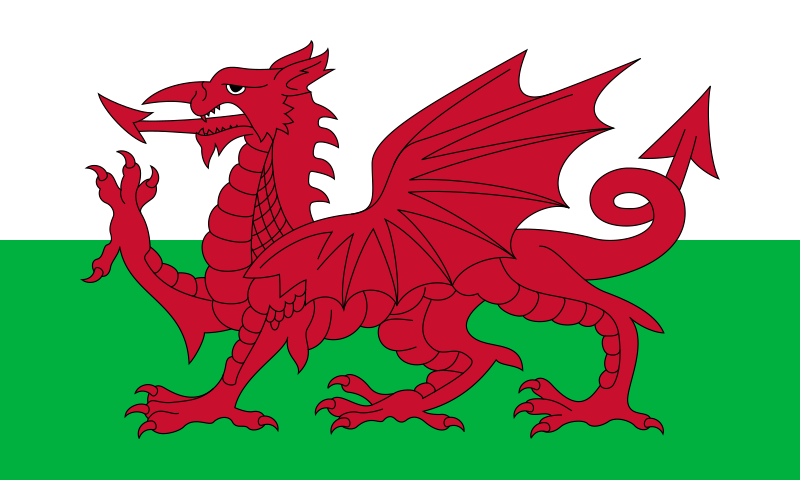

Y Ddraig Goch, the Red Dragon, is the protected cultural and sporting flag of Wales. Its familiar red dragon on a green and white field continues to appear at rugby and football matches, Eisteddfodau, festivals, schools, community events, diaspora gatherings, and private homes. It is not legally subordinate as a cultural emblem, but it is not the state flag used to identify Welsh public authority.
The distinction permits the dragon to remain associated with popular Welsh identity rather than becoming an exclusive government mark. Public bodies may display both flags where the context combines constitutional and cultural representation. Sporting organisations ordinarily use the dragon alone. The law protects both designs against deceptive official use and commercial registration that would prevent customary public display.
The change did not remove older dragon emblems from historic buildings, uniforms, regimental material, public art, or archives. Nor did it alter the dragon’s place in Welsh mythology and political culture. Debate over the two flags remains ordinary and sometimes partisan. Some nationalists prefer the dragon because it predates the modern settlement in public recognition, while some constitutionalists prefer the cross because it gives the principality’s institutions a distinct and reproducible mark.
Arms and motto
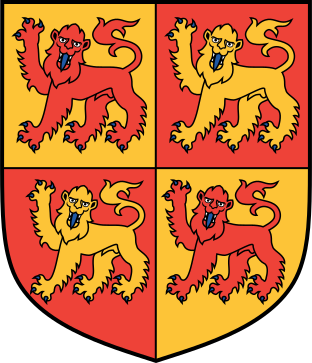

The public arms of Wales are quarterly gold and red with four lions passant guardant counterchanged. They derive from the arms attributed to the medieval rulers of Gwynedd and associated with Llywelyn ap Gruffudd. In constitutional use they represent Wales rather than the Prince of Wales personally. The shield appears on seals, warrants, court documents, certain ceremonial buildings, and formal publications.
The arms are normally displayed without the elaborate wreath, Crown, plants, and ribbons found in later royal badges. This treatment separates the public achievement of Wales from the heraldry of the British royal family. A ceremonial version may place the shield within a restrained Welsh setting, but the quarterly field and four counterchanged lions remain the legal core.
The motto is Cymru am byth, commonly rendered in English as “Wales for ever”. It appears in ceremonial, military-historical, and sporting contexts but is not required on every state use of the arms. The Constitution treats the motto as a national expression, not a political test or an assertion of sovereign independence.
Anthems and national day
Hen Wlad Fy Nhadau is the national anthem. It is used for civic ceremonies, international sport, school observances, and events at which Wales appears as a national component of Great Britain. The article must not reproduce its lyrics. Welsh and instrumental performances are normal, and public law does not prescribe a single authorised arrangement for ordinary use.
God Save the King is the royal anthem. It is used when the King is present in an official capacity and during specified Crown observances. It is not routinely appended to every Welsh national ceremony. Where both anthems are used, the programme distinguishes the national and royal functions rather than treating one as a translation or substitute for the other.
St David’s Day, 1 March, is the primary national public holiday. It combines religious, cultural, educational, and civic observance. Parades, school events, concerts, local food, public lectures, and Eisteddfod activity vary by place. Since 2026 the date has also served as Constitution Day because the Welsh Constitution commenced on 1 March. Official observance includes publication of constitutional reports and a sitting or address of the Senedd, but it does not turn the holiday into a military or state-directed festival.
Politics at present
Labour-Plaid coalition
The government formed after the 2028 constitutional transition is a coalition of Welsh Labour and Plaid Cymru. First Minister Anwen Rhys-Davies leads it. The coalition supports universal adult social care, bilingual public services, industrial conversion, public transport, housing, and the needs-based fiscal settlement.
The partners differ over tactics toward the UKGB. Labour places greater weight on negotiation, common British services, and an emergency transfer that preserves the new settlement. Plaid favours a more confrontational defence of Welsh fiscal autonomy and argues that accepting underfunding would make constitutional equality nominal.
The opposition led by Bethan Pritchard accepts the Constitution but criticises the government for adopting commitments before finance was secure. It supports equalisation for objective need while demanding spending restraint and clearer division between common British obligations and Welsh policy additions.
Owain Llewelyn, as Llywydd, manages Senedd proceedings without joining the fiscal argument as a party leader. The office protects committee scrutiny, debate, and the rights of the coalition and opposition.
First equalisation assessment
The first statutory equalisation assessment recognises Welsh poverty, age, ill health, rurality, infrastructure costs, and bilingual obligations. It nevertheless excludes much of the projected cost of universal adult social care. It also disputes elements of the Welsh calculation for integrated health responsibilities and bilingual delivery in small rural services.
The UKGB Treasury, represented in negotiations by Edward Markham, argues that equalisation must finance comparable need rather than every devolved policy choice. It maintains that Wales expanded the care entitlement without securing a stable Welsh revenue source or prior common agreement.
The Welsh Government argues that separating care from health misstates an integrated British service and shifts costs among budgets. It also argues that bilingual and rural provision are constitutional requirements, not discretionary enhancements. Without additional support, ministers say that Wales must either reduce the new care guarantee or cut unrelated services.
The calculation is technically complex but politically direct. Formal equality of legislative power does not provide the revenue needed to exercise that power. The dispute therefore tests whether the new settlement can distinguish Welsh responsibility from structural limits on the Welsh tax base.
Welsh Fiscal Council report
The Welsh Fiscal Council examined both governments’ models. Under Idris Bowen, it concluded that the assessment leaves a genuine shortfall after reasonable efficiency assumptions. Rural staffing, bilingual provision, social-care demand, and shared health obligations cost more than the transfer recognises.
The Council also concluded that Welsh ministers adopted the universal care timetable without a fully guaranteed funding base. Some costs exceed the common British service level and therefore cannot automatically be assigned to equalisation. The report rejected the strongest public claims made by both sides.
The Council did not prescribe a political settlement. Its scenarios identify the effects of a UKGB grant, slower implementation, Welsh tax changes, borrowing limits, and spending reductions. None has automatic legal force.
Use of reserves
The Welsh Government has refused immediate service cuts. It is using finite reserves and cash-management authority to maintain care, health coordination, rural services, and existing programmes while negotiations continue. The Senedd receives regular statements on the rate at which reserves are being used.
Reserves cannot sustain the commitments indefinitely and cannot lawfully replace recurrent revenue as a permanent arrangement. Their use buys time for negotiation. It also increases pressure because delay reduces the options available in a later budget.
The government has not announced a final tax increase, care restriction, or cuts package. Local authorities and health bodies continue planning under temporary funding directions. Providers and workers face uncertainty but remain bound by existing service and employment law.
Council of the Nations negotiations
The Welsh Government filed a formal objection with the Council of the Nations. The realm government’s part in the talks was chaired by Prime Minister Caroline Pembroke until her party replaced her with Alistair Rennie, under whom it continues. The process includes finance officials, published technical submissions, and political meetings among the affected governments.
Wales seeks recognition of a larger share of care, health, rural, and language costs. The UKGB seeks limits preventing constituent governments from creating new entitlements and transferring the full expense to the common budget. Other constituent governments are interested because the interpretation will influence later assessments.
A one-off emergency UKGB grant is under discussion. It could prevent immediate reductions while the methodology is reviewed. No grant has been authorised, and the parties have not agreed whether accepting one would prejudice the permanent formula.
Coalition strain and public debate
Plaid members argue that reserves should support a short final period of negotiation followed by a firm demand for full recognition. Labour ministers fear that escalating too quickly could destabilise shared health finance and weaken public support for the new Constitution. The disagreement is serious but remains within the coalition agreement.
The opposition uses the Fiscal Council’s criticism of Welsh commitments to demand a revised care timetable. Unions and service organisations support protection of provision while pressing both governments for certainty. Local authorities warn that delayed decisions can themselves increase cost through temporary contracts and staff loss.
Public discussion is conducted through Senedd debate, committee evidence, council meetings, unions, professional bodies, Welsh and British media, and civic organisations. There is no mass emergency, violent mobilisation, or breakdown of administration. The political pressure comes from budgets and approaching service deadlines.
Status at publication
At publication, adult social care and other affected services continue under existing Welsh law. The Welsh Government is financing the shortfall temporarily from reserves. The Council of the Nations is still considering the formal objection and has not issued an agreement.
The equalisation formula has not been recalculated. The UKGB has not authorised an emergency grant. The Welsh Government has not enacted a final package of tax changes, service reductions, or delayed entitlements. No party has filed proceedings in the Supreme Court.
The Labour-Plaid coalition remains in office. Its members continue to disagree over the acceptable terms and timing of a compromise, but no confidence motion or coalition withdrawal has occurred. The 2028 settlement therefore remains under negotiation while services continue and reserves decline.
✎ Editor's Note · On the state flag, the Red Dragon, and 'praise without power'
In our world the Red Dragon, Y Ddraig Goch, is the recognised flag of Wales, and the black and gold Cross of Saint David never held general official status. This timeline reverses that standing. The 2025 settlement adopts the Cross of Saint David as the official state flag of the principality and gives the Red Dragon protected status as a cultural and sporting flag. Both remain in daily use, but only the Cross of Saint David is the constitutional flag. The public arms shown here are based on the historic arms of the House of Aberffraw, quarterly gold and red with four lions, and are distinct from the personal royal heraldry of the Prince of Wales. The recurring Welsh phrase “praise without power” is the article’s organising idea rather than a slogan of any party. British institutions recognise Welsh identity and public-service obligations, and the 2025 settlement grants powers formally comparable to those of England and Scotland, yet a smaller tax base and higher service costs leave Wales dependent on transfers. The unresolved 2026 dispute over needs-based equalisation is where that condition is currently being tested.
Trivia
- In-Universe The official state flag is the black and gold Cross of Saint David. The Red Dragon, Y Ddraig Goch, is not the state flag; it is a separately protected cultural and sporting flag, and both were fixed in their present roles by the 2025 settlement.
- In-Universe Wales keeps three constitutional centres rather than one capital. Cardiff is the governing capital, Caernarfon is the ceremonial capital where the heir is invested, and Machynlleth, the seat of Owain Glyndŵr's parliament of 1404, is an additional parliamentary seat.
- In-Universe The heir's dignity is gender neutral under the 2025 settlement and passes as Prince or Princess of Wales. It is purely ceremonial and carries no executive or legislative authority. Prince Frederick held it until his accession as George V on 31 October 2028, and it has at present no holder.
- In-Universe The King is sovereign only in his single capacity as King of Great Britain. Wales is not an additional Crown, kingdom, or capacity, and his assent to Welsh laws is given on Welsh advice within the one British Crown.
- In-Universe St David's Day on 1 March is both the national holiday and the day the Welsh Constitution came into force in 2026, so the national day and the constitutional commencement now share a date.
- In-Universe Welsh politics describes the settlement as "praise without power": recognition of Welsh identity and service obligations coexists with a dependence on British transfers that limits what Welsh institutions can deliver.
- Real-World In our world the Red Dragon is the flag of Wales and the Cross of Saint David has no general official status. This timeline makes the Cross of Saint David the official state flag and reduces the Red Dragon to a protected cultural flag.
- Real-World Tryweryn and Aberfan are real events and are retained here. The Welsh Constitution 2025, the 96-member Senedd elected by closed-list proportional representation, and the needs-based equalisation dispute are alternate-history inventions of this setting.
See also
- United Kingdom of Great Britain, the sovereign state of which Wales is a constituent principality
- Kingdom of England, with which Wales shares the border and the ordinary courts
- Kingdom of Scotland, the comparable constituent nation of the UKGB
- Duchy of Kernow, the constituent national duchy whose 2025 settlement most closely parallels Wales’s
- George V, King of Great Britain and sovereign of the principality since 31 October 2028, and Prince of Wales until then, a ceremonial dignity
- Ernest V, King of Great Britain and sovereign of the principality until his abdication
- Styles and Titles of the Crown, for the sovereign’s eleven kingdoms, two duchies, and one empire
- European Concert, which the UKGB belongs to and in which Wales holds no separate seat
- United Kingdom of America, the sister realm whose 1775 Olive Branch settlement reshaped the Atlantic world Welsh emigrants crossed into
- The First Great War and The Second Great War, in which Welsh coal, steel, and manpower were central to the British effort
Wales · Cymru · Constituent Principality · Great Britain · Foreign Nations