Pan American World Airways
Pan American World Airways is the flag carrier of the United Kingdom of America, a public corporation wholly owned by the Crown in right of America, and the oldest continuously operating airline in the Realm. It was founded in 1927, flew the first scheduled service of its life from Key West to Havana in October of that year, and has carried the Realm’s name across the Atlantic, the Pacific and the Americas for a century. Its aircraft are all called Clippers. Its livery has not substantially changed in seventy years: a white fuselage, a blue cheatline and the blue globe on the tail.
It is not a royal institution and does not pretend to be. It holds no warrant, carries no Crown in its name and does not fly the King, the Governor-General or the Prime Minister, all of whom travel by the Royal American Air Force. What it holds instead is a public shareholder. The airline was corporatised in 1985 under Ronald Reagan’s government, given a board, a balance sheet and the outward form of an ordinary company, and not sold. Every share remains with the Crown in right of America, and the arrangement is now more than forty years old.
That fact explains its survival, which is otherwise difficult to explain. Pan American was built as an international carrier and had no domestic network to feed it, a structural weakness that ought to have killed it when the Realm liberalised its air market in the late 1970s. It nearly did. The airline was rescued by a state that decided a flag carrier was worth keeping, permitted to buy the domestic trunk network it had never possessed, and then reorganised rather than wound up. Its competitors received no such treatment, and several of them are gone.
The airline is profitable and reasonably well regarded, and the Realm’s affection for it is real but not uncritical. It is also the institution that lost forty-one of its own people at its own gate on the morning of 1 May 2006, and no account of it can be written around that.
History
The airline’s century divides into four unequal parts: a founding era of personal empire-building under Juan Trippe, a wartime and jet-age expansion that made it the Realm’s face abroad, a near-death in the liberalised market of the late 1970s, and the state settlement of 1985 under which it still operates.
Founding and the Trippe era
Pan American was founded in 1927 by Juan Trippe, and the airline that exists today is recognisably his creation. He was twenty-eight, connected, and in possession of an idea most of his contemporaries thought premature: that scheduled international air transport was a business rather than an exhibition.
The first service left Key West for Havana in October 1927 carrying mail. Passenger services followed within months, and the Caribbean and Latin American network expanded rapidly through the late 1920s and the 1930s, built on mail contracts, landing rights negotiated directly with foreign governments, and a willingness to construct airfields, weather stations and radio installations where none existed.
Trippe’s reputation is genuinely divided and the division is not a matter of taste. He built an aviation network of a scale and technical seriousness that nobody else attempted, insisted on navigational and meteorological standards that became industry practice, and commissioned aircraft that manufacturers had not intended to build. He was also a monopolist of unusual determination. He used political access to secure exclusive route awards, worked to deny competitors the landing rights he had obtained for himself, and treated the mail contracts as an instrument for excluding rivals from markets he intended to hold alone. The Realm’s later decision to take the airline into public ownership was made easier by two generations of parliamentary irritation at how the private company had behaved when it was private.
The founding route did not survive the century. Havana was Pan American’s first destination and remained a central one for three decades, and the Cuban revolution ended it. The airline has not flown to Cuba since, and the Republic of Cuba remains outside its network, a small permanent reminder that the first line it ever drew on a map is the one line it can no longer fly.
The Latin American empire
For its first fifteen years Pan American was not a global airline. It was a Latin American one, and the scale of what it built in the hemisphere is easy to lose behind the later glamour of the ocean crossings.
By the middle of the 1930s the company reached every country in the Americas, over a network assembled from mail contracts, exclusive concessions negotiated directly with governments, and a large and deliberately inconspicuous structure of subsidiaries and shareholdings in carriers that appeared to passengers to be local. In several countries the national airline was a Pan American company and was not advertised as one. In several more the only aviation infrastructure that existed had been surveyed, financed and built by the airline, which then held the concession to use it.
This was a genuine achievement and it was the foundation of everything the company later became. It also meant that for two decades Pan American was not a participant in hemispheric civil aviation so much as the thing itself, and it behaved accordingly.
An instrument of policy
The airline’s conduct in Latin America before and during the Second Great War is the oldest item on its record, and the company’s own account of it has changed twice.
Through the late 1930s the Realm’s government became concerned about French-owned and French-influenced airlines operating in South America, at a time when France was moving toward the position it would occupy in the war. Pan American was asked to do something about it, and did. The company acquired control of nominally national carriers through holdings it did not disclose, replaced their managements, and dismissed flight and ground staff on the basis of nationality, in several cases men who had flown those routes since the 1920s and who were given no reason and no notice. It also built, under a government programme conducted in secret, a chain of airfields across the Caribbean, Brazil and West Africa that were presented at the time as commercial expansion and were in fact the ferry route the Realm would use to move aircraft to the war.
The airfields were a substantial contribution to a war the Realm was right to fight, and the company has never been shy about saying so. The rest is harder. A commercial airline concealed its ownership of foreign national carriers from the governments that had licensed them, dismissed employees for their passports, and described a state programme as its own commercial initiative, and it did all of it before the Realm was a belligerent and while it was still telling those governments it was an ordinary commercial partner.
Pan American’s position for forty years was that these were matters of national security about which it could not comment. Its position from the 1970s was that it had acted under government direction in a period of emergency, which is true. Its position since the corporatisation is that the conduct was wrong, that the direction does not excuse the concealment, and that a company which was at the time entirely private cannot place the whole of the responsibility on ministers it had spent a decade cultivating. That third answer is the best of the three and it took the airline fifty years to arrive at it.
The Clippers
Pan American names every aircraft it operates a Clipper, a practice begun with the flying boats of the 1930s and never abandoned. The name was chosen deliberately for its maritime associations, at a period when the airline’s long-range aircraft landed on water, carried a purser and a navigator, and were staffed and provisioned more like ships than like buses.
The flying boats gave the airline its founding public image, and the aircraft themselves were ordered to specifications no manufacturer had previously been asked to meet, because no one had previously wanted to fly those distances.
The Pacific
The trans-Pacific service, opened in the mid 1930s, is the most purely audacious thing the company has ever done, and it was undertaken for a reason that had nothing to do with aviation: there was no route to Asia and the airline decided to build one.
The difficulty was not the aircraft. It was that the Pacific is mostly empty. A flying boat crossing it needed places to stop, refuel, be repaired and shelter from weather, and between the western coast of the Realm and the Asian mainland there were a handful of islands with no harbours, no fuel, no accommodation, no fresh water in useful quantity and in some cases no permanent population. So the airline built the stops. It chartered ships, loaded them with construction plant, generators, radio masts, fuel tanks, prefabricated buildings, water condensers, food and men, sailed them to specks of coral and put a station on each one.
Each was a small settlement maintained for the sake of a service that called perhaps twice a week. The crossing that resulted took the better part of a week, cost more than most people earned in a year, and was flown by an airline that had constructed the geography it depended on. Nothing in the company’s history is more characteristic and nothing has been harder for its successors to live up to.
The Atlantic
The Atlantic came later. Scheduled transatlantic passenger service opened in 1939, and the first destination was Great Britain. That the Realm’s first regular air link to another country was a link to the senior sister realm was noticed at the time and has been remarked on ever since. The route remains the airline’s busiest international corridor, and within the company it is still referred to as the family run.
The Second Great War
The airline’s fleet and its people were taken into war service after the Realm entered the conflict in 1941. Long-range Clippers were requisitioned for transport, the airline flew the South Atlantic ferry route carrying aircraft, personnel and materiel toward Africa, and its construction and survey arms built or improved airfields, radio stations and weather posts across routes the Realm’s forces would need.
Prime Minister Franklin D. Roosevelt was carried to a wartime conference by flying boat, the first head of government of the Realm to travel to a conference by air. The flight is well remembered inside the airline and is one of the reasons the modern arrangement, under which the airline carries no head of state or government at all, sometimes surprises people who know the history.
The war work was substantial, dangerous and profitable, and it left Pan American with a route structure, a body of long-distance operating experience and a relationship with government that no private competitor could match. It also established the expectation, never subsequently dislodged, that the Realm’s flag carrier was an instrument of national policy as well as a business.
The jet age
The two decades after the war were the period in which the airline became the thing the Realm pictures when it pictures an airline, and the period in which it acquired most of the habits that later nearly killed it.
The first jet services opened in 1958 and changed the business more completely than any development before or since. A crossing that had been an overnight endurance became an afternoon. Fares fell in real terms, the traffic multiplied, and an aircraft that had carried a few dozen people in considerable discomfort was replaced by one carrying a hundred and fifty in relative ease. Pan American was among the first carriers anywhere to operate the type and used the advantage without much restraint.
Flight 1 and Flight 2
Its most famous services belong to this period. Flight 1 and Flight 2 circled the world in opposite directions, westward and eastward, departing New York and returning to it by way of Europe, the Middle East, southern Asia and the Pacific over several days and a dozen intermediate stops. They were slow, expensive, operationally awkward and enormously useful to the airline’s image, and they ran for decades because the company understood exactly what they were worth. A traveller could board an aircraft in New York and, without ever changing airline, arrive back where they began having gone the wrong way round the planet.
The Worldport
The Worldport opened at the New York airport in 1960, before the airport carried Kennedy’s name. Its distinguishing feature was a vast elliptical roof cantilevered far out beyond the building, so that aircraft parked beneath it and passengers boarded in the dry. It was widely imitated and never quite equalled, it has twice been substantially rebuilt, and it remains the terminal the airline works from.
The Pan American Building
The company built its headquarters over the approach to Grand Central Station in 1963, a slab of a building with its name on the roof in letters visible across midtown. It sold the tower long ago and the name came down, which older employees mention more often than the sale of any aircraft.
Boeing and the 747
The order before the design
The largest thing Pan American ever did was not fly somewhere. It was place an order.
In the mid 1960s the airline concluded that the jet had solved speed and had not solved cost, and that the next advance would have to come from size. It went to Boeing and asked for an aircraft roughly two and a half times the capacity of anything then flying. Boeing did not have such an aircraft, had not designed one, and had no facility capable of assembling it. Pan American ordered twenty-five of them anyway, for a sum larger than the company was worth, on the calculation that the traffic would arrive to fill the seats.
The order obliged the manufacturer to build a factory for it, on a site cleared from forest north of Seattle in the Commonwealth of Cascadia, and the building that resulted enclosed a greater volume than any structure on earth. Two companies had bet themselves on the same aeroplane at the same time, and neither had a position to retreat to.
What it did to the manufacturer
Boeing came close to not surviving it. The development ran over cost and over time, the engines were not ready when the airframe was, the company borrowed to the limit of what it could borrow, and the market softened at exactly the wrong moment. Employment at the works fell by more than half within three years of the aircraft entering service.
It is now the most successful commercial aircraft programme ever undertaken and the foundation of the manufacturer’s position for half a century. Boeing has never forgotten which customer made it happen, and the commercial relationship between the two companies has a warmth that neither’s negotiators are able to entirely conceal and that both sides’ finance departments regard as a liability.
What it did to the airline
The traffic arrived, but not on the schedule the calculation assumed, and the intervening years were expensive. Pan American took delivery of a fleet of very large aircraft into a market that was not yet large enough for them, and it did so at the precise moment fuel prices rose and the Realm began the argument that ended in liberalisation. The aircraft that was supposed to secure the company’s position instead loaded it with capacity it could not fill and debt it could not service, and it is a substantial part of the reason the airline nearly died in the decade that followed.
That is the part usually left out. The order is remembered as visionary, and it was, and it very nearly finished the airline that placed it. Both statements are true and the industry has never entirely reconciled them.
The relationship since
The airline has bought predominantly from the same manufacturer ever since, which is defended on standardisation grounds and is not entirely explained by them. A public corporation buying a domestic manufacturer’s aircraft is a politically comfortable act in a way it would not be in a country without an aircraft industry, and both the airline and Boeing have on occasion allowed a commercial decision to be understood as a patriotic one.
The retirement of the last of the type in the 2010s was treated in the Realm as a minor public event, which is discussed below with the rest of the fleet.
Liberalisation and the near failure
The Realm liberalised its domestic air market in the late 1970s, under Jimmy Carter’s government, on the ordinary argument that competition would lower fares. It did lower fares. It also came close to destroying Pan American, for a reason that had been visible in the airline’s structure for fifty years and had never mattered before.
Pan American was an international carrier. It had been built to fly between the Realm and the world, and it possessed almost no domestic network of its own. Its competitors, which had grown up flying between American cities, could feed their long-haul services with passengers assembled from a hundred domestic points. Pan American had to find its passengers at the gate. In a regulated market where international routes were awarded rather than contested, that had been a tolerable weakness. In an open one it was close to fatal.
The argument in Parliament
The airline lost money heavily through the early 1980s. The argument that followed was conducted in Parliament rather than in a boardroom, and it was not principally about aviation. It was about whether the Realm required a flag carrier at all, and if it did, what it was for. The case for letting the airline fail was made seriously: that a state-owned competitor distorted a market the Realm had just decided to open, and that sentiment was not a reason to subsidise an aircraft.
The case that prevailed was that the Realm is very large, that a great deal of it is not commercially attractive, and that a country holding Alaska, Hawaiʻi and an Atlantic and Pacific network could not sensibly leave its external air links entirely to whoever found them profitable in a given decade.
Corporatisation
The settlement was reached under Reagan’s government and took effect in 1985. Pan American was reconstituted as a public corporation with a commercial board, statutory accounts, a duty to operate on ordinary commercial principles and an obligation to serve specified routes whether or not they paid. It was permitted to acquire a domestic trunk network, which it did, and which gave it for the first time the feed that its structure had always lacked.
Owned, not sold
It was not sold. Every share was retained by the Crown in right of America and every share is retained still. The arrangement is generally described as a privatisation and generally is not one, and the confusion is not accidental: the reform was presented to a Conservative and Crown Union parliamentary party as a step toward the market and to a Labour opposition as the preservation of a public asset, and both descriptions were accurate enough to pass.
The result is a company that behaves commercially, competes for passengers, publishes accounts, and cannot go out of business. Its critics have never stopped saying that the last clause makes the first three decorative.
Governance after Trippe
Juan Trippe left the airline in 1968 and died in 1981, and the company spent the following fifteen years discovering how much of its method had been him. The chief executives who followed inherited a route network assembled by personal negotiation, a culture that treated the government as an instrument, and no obvious way of running either once the founder’s political access had gone with him.
The board
The corporatisation of 1985 replaced that arrangement with a formal one. The airline is governed by a board appointed by the Crown on the advice of ministers, with a majority of non-executive members, a chair who may not be a serving politician, and a statutory duty to operate on ordinary commercial principles subject to the route obligations. Its accounts are laid before Parliament. Its chief executive is a commercial appointment and has, since corporatisation, generally been recruited from outside the company.
The problem that cannot be solved
The arrangement produces a recurring institutional problem that has never been solved and is probably not soluble. The board is accountable to ministers for a commercial performance that ministers also constrain, through route obligations they impose and fare policies they take an interest in, and it is accountable to Parliament for public conduct while competing against private carriers accountable to nobody but shareholders. Chairs have resigned over it twice. The standing joke inside the company is that it has all the freedom of a private business and all the scrutiny of a department, which is the wrong way round.
The Crown
No warrant
Pan American holds no royal warrant, carries no Crown in its name, flies no royal standard and displays no royal cypher. For a company every share of which belongs to the King in right of America, this is a conspicuous amount of nothing.
It is deliberate, and the reasoning is constitutional rather than aesthetic. The Crown in right of America owns the airline in the same impersonal sense in which it owns a naval dockyard or a stretch of federal highway, which is to say that the ownership is a legal description of the public interest and not a relationship with a person. Decorating the aircraft with royal insignia would suggest the opposite, and would put the sovereign’s name on a commercial undertaking that competes for passengers, loses baggage and is sued in the ordinary courts.
The contrast with British Airways is exact and is regularly remarked on in both realms. The company Britain sold carries a Royal Warrant. The company the Realm kept carries nothing at all. Each arrangement looks eccentric from the other side of the ocean and each is a faithful expression of how its country understands the Crown.
State flying
The King, the Governor-General and the Prime Minister are flown by the Royal American Air Force, and none of them travels on the airline in an official capacity.
This surprises people who know the history, because it was not always so. Prime Minister Franklin D. Roosevelt crossed to a wartime conference in a Pan American flying boat with a Pan American crew, and for two decades after the war senior ministers travelled commercially as a matter of course. The separation hardened through the 1950s and 1960s on security and continuity-of-control grounds, and was made formal at the corporatisation.
The airline is not entirely absent from state travel even now. It carries officials, delegations and the working parties that precede a state visit, and it moves a great deal of government freight. What it does not carry is the person of the sovereign or the head of government, and the company has never asked to.
Why the separation is defended
The arrangement has been reviewed twice and retained both times, on an argument that has nothing to do with aviation.
A flag carrier that flew the King would be, in the public mind, an arm of the state. The Realm’s whole settlement with this company depends on it not being that: it is owned publicly and run commercially, and every safeguard in the 1985 statute exists to keep those two facts from collapsing into each other. The moment the sovereign’s aircraft is also the aircraft the public buys a ticket on, the airline stops being a business the state happens to own and becomes something closer to a department with a livery.
Whether that distinction survives contact with the airline’s actual behaviour is a fair question and is asked in the section on the airline now.
Network
The hubs
John F. Kennedy International Airport is the principal hub and the airline’s operational and emotional centre. The Worldport terminal there, built at the height of the jet age with a roof cantilevered out over the aircraft stands, remains in service after two major reconstructions and is the building most people picture when they picture the airline.
Phoenix is not a hub and holds the airline’s most unusual single route: a daily widebody service to Tokyo, the only long-haul departure from the March of Arizona. The commercial case was marginal every time it was examined, the March pressed for it for the better part of fifty years, and the airline flew it because a flag carrier that already serves Alaska and the Pacific islands at a loss is poorly placed to refuse a polity of that size a connection to Asia. It has since outperformed its forecasts.
Miami is the oldest hub and holds the Caribbean and Latin American network that the airline began with. San Francisco carries the Pacific. Chicago is the continental interchange that the domestic acquisition of the 1980s brought with it. New Westminster exists chiefly because the federal capital generates a great deal of official traffic, and it is the smallest of the five and the least commercially justified.
Kennedy
The hub is also the constraint. Kennedy is congested, its slots are allocated rather than bought, and the airline holds a large share of them by inheritance from the period when the airport was built around it. It has argued for expansion for thirty years while holding an asset that expansion would devalue, and it is aware that this is the same position British Airways occupies at Heathrow and that the two companies have never compared notes on it in public.
The Worldport is a listed structure, which means the airline cannot demolish it and has twice had to rebuild inside a roof it is not permitted to alter. Passengers are fond of it. The operations department is not.
Competition
Competition is real. Three large private trunk carriers and a shifting population of low-fare operators contest the domestic market, and the airline holds a minority of it. Its dominance is in the long-haul and the international, where the route obligations and the accumulated rights of a century still count for something.
The fleet
The naming committee
Every aircraft the airline operates carries a name as well as a registration, and the name is always a Clipper. The individual names are drawn from winds, stars, navigational terms, historic sailing vessels and, since the 1970s, from places in the Realm that have asked for one. A polity that wishes to see its name on the side of an aircraft applies to the company, and the applications are dealt with by a committee that meets twice a year and takes the matter more seriously than an outsider would expect.
The modern fleet
The modern fleet divides in the ordinary way between twin-aisle aircraft for the long-haul and international network and single-aisle aircraft for the domestic and short-haul flying acquired in the 1980s. The company has generally bought from a small number of manufacturers and has tended to standardise, on the reasoning that a public corporation answerable for its costs cannot afford the maintenance and training overheads of a varied fleet. It maintains its principal engineering base near the New York hub and a second at Miami.
The last of the wide-bodies
The retirement of the last of the great four-engined wide-bodies, the type the airline had commissioned into existence in 1970, was treated in the Realm as a minor public event. The final service was flown with a full aircraft, the crew were photographed, and the ABC carried it. The company disposed of the airframe unsentimentally and put out a statement about fuel burn per seat, which was correct and satisfied nobody.
The far-polity sub-fleet
Aircraft serving the far polities are a partial exception to the standardisation. The Alaskan and Pacific island routes require types that can work short and rough strips in poor weather, and the airline operates a small sub-fleet for them at a cost per seat it does not publish separately and is periodically asked to.
Concorde and the supersonic years
The Realm attempted a supersonic transport of its own and abandoned it. The national programme of the 1960s ran past its budget, could not solve the sonic boom, and was cancelled in the early 1970s after a parliamentary fight that turned on cost and on the objections of communities living under the proposed test corridors. The Realm therefore reached the supersonic era, when it reached it at all, in an aircraft built by somebody else.
Concorde was an Anglo-French aircraft, designed and manufactured jointly by Great Britain and France under a treaty neither government could withdraw from without penalty, and its existence in a Realm whose recent history included a war against France was politically awkward from the beginning. Pan American had held options on the type since the 1960s and exercised them, and the reason it exercised them is the reason it does most things: it was owned by a government, and the government wanted the Realm’s flag carrier flying the fastest aircraft in the world.
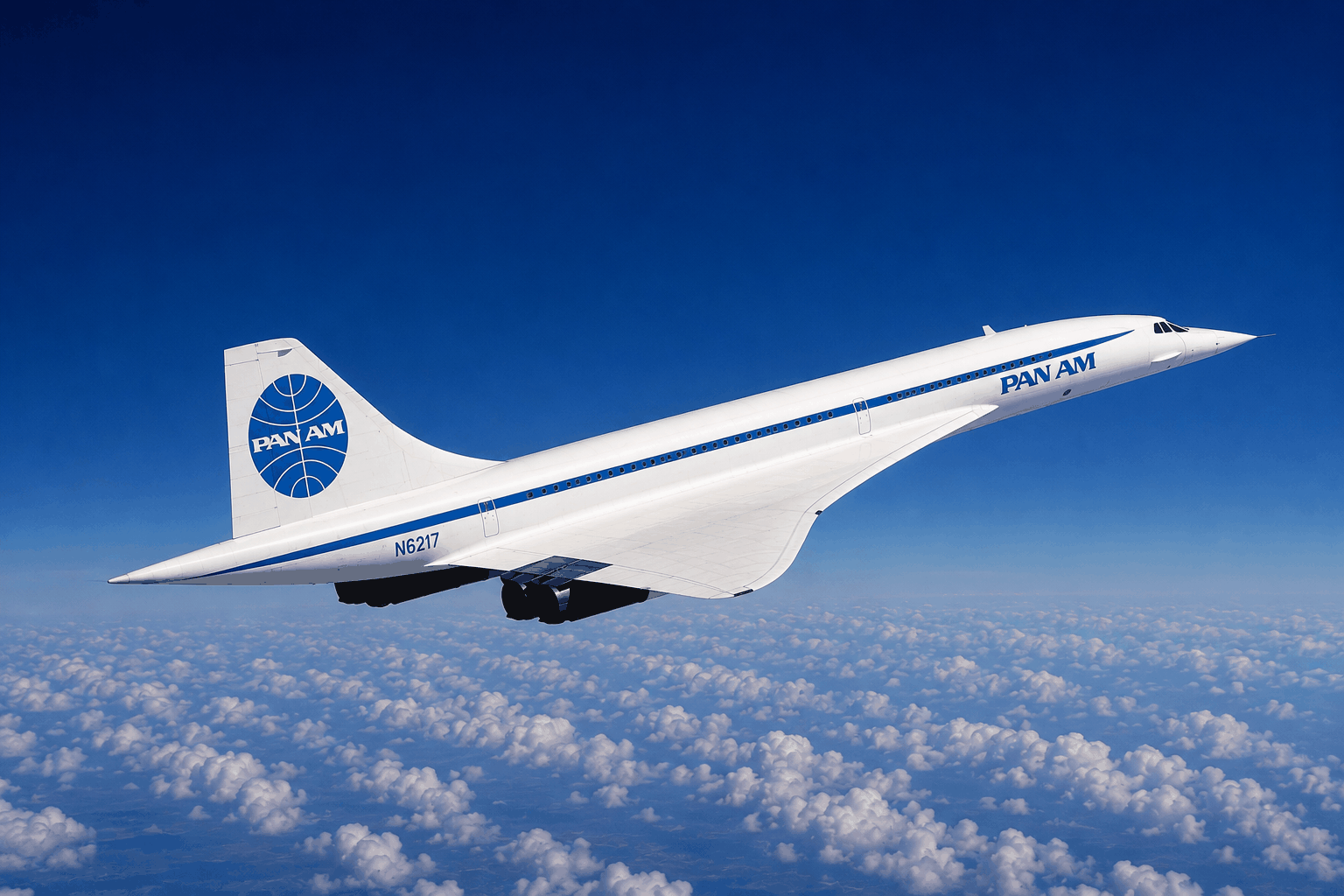
Services began in 1976, and the route was the family run. New York to London, three and a half hours, twice daily at the peak, in a cabin holding about a hundred people in seats that were narrower than the ones behind them on an ordinary aircraft. A crossing that had taken a night, and then an afternoon, now took less time than a working morning. The airline advertised it barely at all, on the correct assumption that everyone who could afford it already knew.
The sonic boom decided everything else about the aeroplane. Supersonic flight over land was prohibited in the Realm, as it was nearly everywhere, which meant the type could never serve the domestic network and could never be anything but an ocean aircraft. Pan American, whose structural problem was precisely that it had no domestic network, thus acquired the most glamorous fleet in the world and could not use a single frame of it on the routes that would have fixed the company.
The economics were argued about for thirty years and were never settled, in part because the airline’s own accounts could be read either way. Loaded, and at the fares it charged, a crossing made money. Counted against the acquisition cost, the fuel, the maintenance of a small orphan fleet, and the engineering staff who worked on nothing else, it did not. Its defenders inside the company argued that it carried the people who booked everything else, and that the airline’s standing in the eyes of the world was worth more than the line in the accounts. Its critics observed that this was an argument no private carrier had ever been able to make to a shareholder, and that a state-owned airline making it was really asking the public to buy a small number of people a fast flight to London.
The reprieve of 2008
The end came after May Day, and then did not come.
The security settlement cost the type nothing, because the Realm chose to screen in the background rather than at the barrier, and a Concorde passenger in 2007 reached the aircraft as quickly as one in 1997. What the type lost was its passengers. The habitual transatlantic population did not return at its former volume, and a service that needed about ninety of them a day could not survive losing twenty. In March 2008 the board concluded that the commercial case was finished and announced withdrawal within eighteen months.
Parliament refused to accept it. The Commons debate that followed was one of the few occasions on which a scheduled airline service has been the subject of a division, and the motion instructing the airline to maintain supersonic operations passed with support from every party and opposition from members of most of them. The ministry, which had not asked for the debate and did not especially want the outcome, undertook to meet the cost of the type separately from the airline’s accounts. The board, which had made an honest commercial judgement and been overruled, complied. One member of it resigned.
The reprieve was possible because the aircraft had never been quite as orphaned here as it was elsewhere. Pan American’s decision to exercise its options in the 1960s had held the export order book together at the moment it would otherwise have broken, and a second production batch ran into the early 1980s, so that roughly thirty-four airframes were built rather than twenty and the youngest of them were half a decade newer than anything the type ever had. The aircraft also flew remarkably little: two sectors a day on one route for thirty years leaves an airframe with fewer hours on it than a widebody accumulates in a decade. And the manufacturers were two governments bound by a treaty neither could leave, which meant that continued type support was never really a commercial question. When the airline asked whether the aircraft could be kept airworthy, it was asking three states, and three states answered yes for reasons that had nothing to do with engineering.
What the reprieve bought was twenty more years of an aeroplane that nobody any longer pretends is a business. The subsidy is published. It appears in the estimates as a line under the transport vote, it is debated most years, and the sum is not enormous by the standards of what the Realm spends on other things it likes. At present the airline holds five airworthy frames and flies one rotation a day to London, down from two, in a cabin that is fuller than the economics would suggest because a proportion of the seats are now bought by people making the crossing once in their lives rather than by people making it monthly. The service is booked out for months. It has become, without anyone deciding that it should, a national possession rather than a means of transport.
The comparison that is always made, and that the airline dislikes, is with the British operation. British Airways flies the type on several routes without subsidy and at a profit, and the difference is not management. A supersonic aircraft may only exceed the speed of sound over water or empty ground, and the imperial network the British carrier inherited runs across oceans and desert nearly everywhere, so it has several viable supersonic routes. Pan American was permitted exactly one. The company’s structural weakness had always been the absence of a domestic network, and the aircraft that might have transformed a domestic network was the one aircraft it was forbidden to fly over one.
The Pacific, and the aircraft it cannot send there
The instruction of 2008 has a consequence nobody debating it foresaw.
Parliament required the airline to maintain supersonic operations, and in practice that has meant the London rotation, because five airworthy frames will support one route and will not support two. The airline is therefore committed, by a resolution it did not seek, to flying the one supersonic service it can least justify commercially, with no capacity left over for any other.
In 2027 American Airlines bought a surplus Concorde outright from British Airways, put it on the Realm’s register in its own paint, and flew a season of supersonic services from San Francisco to Honolulu as a test for a projected route to Japan. The Pacific is all water, so such a route needs no new technology and could have been flown at any point in the last fifty years by an operator with both an aircraft and a feed.
Pan American has flown the Pacific since the 1930s and built, island by island, the bases the crossing depends on. What it does not have is a frame it is permitted to release from London, and it watched a private competitor rent one from its own Atlantic partner and fly the ocean this company invented.
Its objection was public and unusually heated, and the heat came from the word outright. An aircraft lent for a season goes back. An aircraft sold does not, and there are no more being made. British Airways replied that the aircraft was its property and that the alliance covers the North Atlantic and nothing else, which is correct. The airline has since asked ministers twice whether the 2008 instruction might be read as satisfied by supersonic operations generally rather than by that route in particular. It has not had an answer.
The carbon argument
The argument against it is now made on carbon rather than on cost, and it is a much harder argument to answer. The type burns something over three times as much fuel a passenger as the aircraft it flies alongside, and the airline that is required to explain its emissions to Parliament every year is also the airline flying the least defensible aeroplane in the sky. Its answer, that the fleet operates on sustainable fuel under a dispensation and accounts for a rounding error in the company’s total emissions, is arithmetically correct and persuades nobody who was not already persuaded. Most people in the industry expect the type to be retired within a decade, and expect the decision, when it comes, to be taken on the grounds that eventually take every such decision, which is that the parts ran out.
Whether it was ever anything more than a public subsidy for the fastest few thousand travellers in the world, or whether a Realm is entitled to own something magnificent and count the cost afterwards, is a question the Register does not propose to settle. It is worth recording only that the Realm has now been asked it four times and has answered the same way each time.
The second Concorde
In November 2027 the Realm’s government, the government of the French Empire and the Commission of the European Concert signed a memorandum of understanding on the joint definition of a supersonic transport aircraft. The industrial partners are Boeing, at Seattle in the Commonwealth of Cascadia; Aérospatiale, at Toulouse; and Airbus, the consortium of the Concert’s members’ aircraft builders. Nothing has been ordered, no money beyond the study has been voted, and the partners have conspicuously declined to give the aircraft a name, on the correct understanding that naming a thing is the last step before committing to it. The press calls it the second Concorde. The obvious name, given the Concert’s motto and the first aircraft’s, has occurred to everybody and has been used by nobody official.
The technical proposition is the one that defeated the Realm sixty years ago. The national supersonic programme of the 1960s was cancelled because it could not solve the sonic boom, and the boom is what has confined every supersonic transport since to the oceans. The study is built around low-boom shaping, the discipline of designing an airframe so that its shock waves reach the ground spread out and softened rather than as a crack, and its object is not speed but permission: an aircraft quiet enough that the overland prohibitions could be rewritten around it. If that works, and it has not yet been demonstrated at size, the consequence for this airline in particular is considerable. Pan American spent a century with a structural weakness that was the absence of a domestic network, and then spent fifty years owning the fastest aircraft in the world and being forbidden to fly it on the one part of its system that would have been transformed by it. A supersonic aircraft permitted over land is the first one the company could actually use.
The politics are more complicated than the engineering. Great Britain co-invented the original and enters this one through a consortium rather than as a principal, which is felt in London and is not much discussed in Toulouse. The partnership is also the first substantial industrial act of the Concert era and the first large one between the Realm and France since the war, which is why the memorandum was signed at Straßburg in the Concert’s first year and why the photographs of the signing were composed as carefully as they were. And the climate objection arrives before the aircraft does: Alliance 90 / Green Realm opposes the study on the ground that a supersonic aircraft is by definition a less efficient way to move a person and that no amount of shaping changes it, while others who are not Green argue more narrowly that the study money would buy a great deal of railway.
The Register notes the programme and declines to predict it. Supersonic transport has been about to return for most of a century.
The Atlantic alliance
The joint venture
Pan American and British Airways operate the North Atlantic as a joint business, coordinating schedules, selling each other’s seats, aligning fares and sharing the revenue of the combined operation under a formula neither has published.
The arrangement was assembled in stages from the late 2000s over the corridor each carrier regards as its most important. It is highly profitable for both. It has also removed most of the competition from that corridor, which is the same sentence read from the other end, and it is the single largest commercial fact about the airline that does not appear in its public description of itself.
A public corporation and a private company
The oddity is sharper from this side than from London’s.
Pan American is a public corporation wholly owned by a Crown, in permanent commercial partnership with a listed foreign company answerable to shareholders. The Realm is therefore, through an instrument it owns outright, a participant in the pricing of a market in which it is also the regulator, and it has arranged matters so that the profits of reduced competition on the Atlantic accrue in part to the public purse.
Nobody planned it that way and no minister has ever defended it in those terms. The airline’s answer is that it is required to operate on ordinary commercial principles, that the alliance is an ordinary commercial arrangement, and that it would be criticised more sharply for declining a profitable one. This is correct and is not the whole of the matter.
The regulators
Competition authorities on both sides of the Atlantic have examined the alliance repeatedly across twenty years and resolved nothing.
Each has extracted undertakings on slots, frequencies and the treatment of connecting carriers. None has made the finding that would break it up. The reason is straightforward: dissolving it would be a substantial commercial injury to a British listed company and a substantial political injury to an American public corporation, at a moment when neither government wants the aviation relationship between the realms disturbed, and no regulator has been willing to be the one who does it.
The question of whether a state-owned carrier should be in joint venture with a private foreign company at all has therefore never been answered. It is raised, examined at length, and set down again.
The personal union
Underneath the commercial arrangement sits a constitutional one. Britain and the Realm share a sovereign, and the aviation relationship reflects it: an open skies arrangement older and more permissive than either realm has with anyone else, mutual recognition of certificates and licences, and eased entry for subjects of either. It is not a common travel area and neither government calls it one.
It is also the reason the family run is called the family run, and the reason a commercial alliance that would be contentious between any other two countries has been allowed to become normal between these.
Cargo
Freight and the mail
Freight is a larger part of the business than most passengers realise, and at Kennedy it is a larger part of the airport. The New York hub is among the biggest freight facilities in the Realm, and Pan American Cargo is the reason a substantial share of that tonnage moves.
What travels is what has always travelled by air: goods whose value or perishability justifies the cost. Pharmaceuticals and medical materials, precision components, live animals, seafood from the Pacific and the Gulf, cut flowers from Latin America, financial and legal documents in the years before they became electronic, and a steady flow of parts for aircraft other than its own. The Realm’s position as a trade gateway means the airline carries a great deal that neither begins nor ends in the country.
Two elements of the freight business are constitutional rather than commercial. The first is mail, which the airline still carries under contract and which is the reason it exists at all: the Key West service of 1927 was a mail flight, and the company has never been out of the mail business for a day since. The second is that the route obligations apply to freight as well as passengers. The Alaskan and island services carry goods that no commercial operator would move at a price the communities could pay, including medical supplies, mechanical parts and, in winter, food. The airline does not describe this as a public service in its accounts. It is one.
The routes that do not pay
The obligation
A schedule of specified services is attached to the airline’s constitution, and it is the practical form the public ownership takes. These are routes the airline is required to operate at a stated minimum frequency regardless of their commercial performance: the Alaskan services, the Hawaiian services, the thinner Pacific island connections, a number of internal routes to polities that would otherwise be reachable only by a long drive, and, since the accession of the Territory of Loreto in 2027, the Baja peninsula services that a new territory of the Realm is entitled to expect.
None of them pays. The Alaskan routes lose money in a straightforward way and the Loreto routes are expected to lose money for a decade. The commercial side of the airline regards the schedule as a tax, argues at each review for its reduction, and has never once won the argument outright. The constitutional answer is that a Realm which admits a territory takes on the obligation to connect it, and that a flag carrier owned by the Crown is the instrument through which the obligation is met.
The sister realms
Services to the realms sharing the King form a distinct network within the airline, with its own history, its own staffing traditions and a certain amount of ceremony that the rest of the operation finds faintly embarrassing. Great Britain, New Albion, New Wessex, the West Indies Federation and the Union of South Africa are all served, and the routes are older than most of the airline’s commercial network.
South Africa
The South African services are the airline’s longest and most damaging political controversy, and the first thing its critics raise.
Pan American flew to South Africa throughout the apartheid period. It did so lawfully, under a bilateral agreement between two realms of the same Crown, and it did so while the Realm’s own public opinion turned steadily against the South African government. The airline was picketed at Kennedy and at Miami for the better part of two decades. Its crews were lobbied, and a number refused the roster and accepted the consequences of refusing it. Parliamentary questions were asked continuously, and the answer given was always the same: that route policy followed the Realm’s foreign policy, that the Realm had not severed relations, and that a carrier owned by the state could not conduct a boycott the state had declined to impose.
The answer that was correct and insufficient
That answer was constitutionally sound. A public corporation that selects its destinations according to the political opinions of its board, against the declared policy of the government that owns it, is a different and more troubling kind of institution than the one the 1985 statute created, and the people who made this argument at the time were not making it in bad faith.
It is also not now regarded as sufficient, for two reasons the company has come to accept. The first is that the airline did more than fly the route. It marketed it, promoted South African tourism in the Realm’s own newspapers, and ran the service as an ordinary commercial destination at a time when what was happening there was not in dispute and was documented in the Realm’s own press. Nothing in the bilateral agreement required enthusiasm. The second is that the airline’s crews, who had no constitutional argument available to them, worked out a position on the question a good deal faster than the board did.
What the company says now
The airline’s official history treats the period as a failure of moral imagination rather than of law, which is closer to honest than most corporate histories manage and stops just short of the point.
Evidence from the company was given to the South African Truth and Reconciliation Commission, and the airline retained the roster records of the crews who refused. Those refusals were not reinstated as service or compensated, and several of the people concerned are still living. A proposal to mark them has been raised at three successive annual general meetings and has not been adopted, on grounds that have never been stated in public.
The 1977 collision
The worst accident in the history of aviation involved a Pan American aircraft. It happened on 27 March 1977, at Los Rodeos on Tenerife in the Canary Islands, and it began somewhere else entirely.
A separatist bomb at the airport on neighbouring Gran Canaria closed it that morning, and traffic bound for Las Palmas was diverted to Los Rodeos, a small field with a single runway and no capacity for the aircraft that arrived. Among them were two Boeing 747s: Pan American Flight 1736, the Clipper Victor, carrying 396 people, and KLM Flight 4805, carrying 248. The apron filled. Aircraft were parked along the taxiway, which meant departing traffic had to back-taxi down the runway itself and turn at an exit before the far end. Then the fog came in off the hills and reduced visibility to a few hundred metres, so that neither the tower nor either crew could see the others.
The Pan American aircraft was back-taxiing on the runway and had missed the exit it was looking for. The KLM aircraft, at the far end and turned for departure, began its take-off run without clearance. Its captain was his airline’s chief flight instructor, the man who had trained a great many of its pilots, and when his flight engineer questioned whether the runway was clear he was overruled. The aircraft struck the Clipper Victor amidships at rotation speed.
583 people died. Everyone aboard the KLM aircraft was killed. Of the 396 aboard the Pan American aircraft, 335 died and 61 survived, and every survivor of the accident came off that machine. It remains the deadliest accident in the history of aviation.
The investigation established that the immediate cause lay with the KLM aircraft, which began its take-off run without clearance. It also established a set of contributing failures that the industry as a whole had been tolerating for years. The radio phraseology was ambiguous: the departing crew reported that they were “now at take-off”, which the tower took as a statement of position and the crew meant as a statement of action. Two transmissions overlapped at the critical moment and produced a squeal that blocked the one message that would have stopped it. The airfield was working beyond its capacity in weather that made visual confirmation impossible. And a flight-deck culture in which a junior officer would not press a point against the most senior pilot in his company had removed the last defence available.
Pan American’s conduct in the first weeks was defensive. It emphasised the other carrier’s responsibility, which was real, more loudly than it examined its own operating practice, and it took public criticism for doing so. The reform that followed was nonetheless substantial and the airline was among the first to implement it: standardised phraseology, an explicit duty on any crew member to challenge an unsafe act regardless of rank, and the training regime in flight-deck authority and communication that is now universal. The accident is taught in the airline’s own training as a failure of speech.
May Day
At 10:37 on the morning of 1 May 2006 the first bomb detonated at Grand Central Station. Seventy minutes later the second struck John F. Kennedy International Airport, in the terminal that is the airline’s home.
Forty-one Pan American staff were killed. They were check-in and gate agents, ground handlers, engineers, and cabin crew waiting on standby for an afternoon rotation. It is the largest single loss of the airline’s own employees in its history, larger than any accident it has suffered, and it happened on the ground, at its own gate, to people who were not flying anywhere.
The Realm’s airspace closed within the hour. The airline grounded its fleet, diverted its inbound transatlantic services to New Albion and the other sister realms, and put several thousand passengers into hotels in cities they had not intended to visit. Over the following fortnight it flew the families of the dead to New York without charge, carried the dead home to the polities and countries they came from, and repatriated stranded travellers on aircraft that were frequently close to empty. That work is well remembered and was well done.
The airline observes the anniversary system-wide. At 10:37 on 1 May its aircraft on the ground hold where they stand, its counters stop, and its crews and passengers keep the silence that the Church of America bells mark across the Realm. The forty-one names are carved in the terminal at Kennedy, in the concourse, where people walk past them with luggage.
The contracted dead
Who was not counted
The memorial in the concourse was wrong for eleven years, and the airline knew it.
The cleaners, baggage handlers, caterers and security staff who died at Kennedy that morning were, in many cases, not employed by Pan American. They were employed by contractors, on contracts the airline had written, doing work the airline required, in a building the airline operated. They died in the same explosion as the forty-one. They were not counted among the airline’s dead, their names were not carved in the concourse, and their families dealt not with the airline but with a succession of insurers, contracting companies and, in two cases, contracting companies that had ceased to exist.
The distinction was legally impeccable. It was also, as the airline’s own later review conceded, a distinction that nobody in the terminal that morning would have recognised, since the dead had been working alongside one another in the same concourse on the same task of getting an airport through a morning.
The memorial was recut in 2017 to include them, after a campaign run by the families and by the transport unions rather than by the company. The compensation question was settled separately, later, and less generously. The airline has apologised. It has not fully explained why a public corporation, owned by the Crown in right of America, spent eleven years defending a definition of its own workforce that its own workforce did not accept.
Security after 2006
The choice the Realm made
The Security of the Realm Act 2006 and the settlement built around it changed the airline’s operations profoundly and changed the experience of flying with it hardly at all, and the gap between those two statements is the whole of the matter.
The Realm made a deliberate choice after May Day, and the airline was one of the places it was most visible. It did not rebuild its airports around queues, confiscation and public ritual. A passenger at Kennedy arrives, checks a bag, walks to a gate and boards an aircraft in a manner a traveller from 2005 would find substantially familiar, and the terminal is not organised to remind anyone that an atrocity happened in it. The reasoning, argued through the Integrated Transport Security Framework and stated openly at the time, was that visible security is largely a performance for the reassured rather than an obstacle to the determined, and that a Realm which turned its termini into checkpoints would have handed the people who bombed Kennedy a permanent alteration of national life for nothing.
What changed instead sits behind the wall. Passenger data, watch lists, intelligence fusion between the Constabulary and the polities, liaison officers who are not in uniform, staff trained and expected to report what looks wrong, and the records the airline holds and shares under lawful instruction. The screening is real, continuous and serious, and it is done in the background, on information rather than on the ordinary travelling public. The airline is a substantial instrument of it: a carrier that knows who is booked on every seat is the most useful single source the arrangement has.
The airline’s position is consistently uncomfortable and consistently quiet. Its formal stance is that it complies with lawful instruction and does not comment on security matters, which is true and is not an answer. And the civil-liberties problem this settlement creates is a harder one than queue length, because invisibility cuts both ways. A passenger delayed by a search knows they have been searched. A passenger declined a booking, moved down a standby list or quietly flagged does not necessarily know that anything has happened at all, and cannot easily challenge what he has not been told about. The watch-list disparities that appear elsewhere in the post-May Day record appear here in exactly that form. Whether a settlement that spared the Realm the indignity of the checkpoint bought that relief with a loss of visibility that the courts cannot reach is the question the American Rights Act litigation of the last two decades has been circling.
Labour
A dispute with the Realm
Pan American is heavily unionised across every grade, and its industrial relations are political in a way that a private carrier’s are not. A strike by its pilots, cabin crew or ground staff is a dispute with a company that the Realm owns, which means it reaches Parliament within a day and the front pages within an hour.
The standing argument
The company has had three national stoppages since corporatisation, the longest of them eleven days. The unions’ standing argument is that a public corporation should not use commercial-principle language to justify terms its private competitors set, and the company’s standing answer is that it competes with those private competitors for the same passengers. Neither side has conceded and neither expects to. The relationship is generally described inside the industry as adversarial, functional and permanent.
The transport unions’ role in forcing the recutting of the May Day memorial is remembered on both sides, and has not made the ordinary bargaining any easier.
Crew and the cabin
The academy
The airline trains its own flight and cabin crew at an academy near Miami, which is the oldest such institution in the Realm and takes candidates from every polity. Selection is competitive, the training is longer than the regulatory minimum, and the company treats the academy as a recruiting advantage rather than a cost, which is one of the few arguments its board and its unions have never had.
The purser
Cabin service retains an inheritance from the flying boats, most visibly in the survival of the purser as a rank with real authority rather than a courtesy title. The purser runs the cabin, holds the paperwork, deals with the authorities on arrival and is the person a captain speaks to about anything happening behind the flight-deck door. On the sister-realm and long-haul services the tradition is stronger still, and the older pursers are among the most formidable employees in the company.
Language
Language is a practical requirement rather than a decoration. Crews on the Latin American network are expected to work in Spanish, on the Louisiane and Atlantic services frequently in French, and the airline recruits deliberately in the polities whose languages it needs. It has carried an interpreting obligation on the far-polity routes since the 1970s, and it employs Indigenous-language speakers on the Alaskan services.
What was done to the stewardesses
The airline’s cabin crew were, for three decades, employed on terms it would now be unlawful to write down, and the company applied them rigorously.
Until the 1970s a stewardess was required to be unmarried and was dismissed on marrying. She was required to retire at thirty-two. She was weighed, at intervals and without notice, against a figure fixed for her height, grounded without pay if she exceeded it and dismissed if she did not correct it. There were rules about her hair, her skin, her spectacles and the shade of her stockings. None of these conditions applied to the men working in the same cabin, who could marry, could age, were not weighed, and whose careers were expected to last.
The company’s justification at the time was that it was selling an experience of which the crew were part, which is a description of what it was doing rather than a defence of it. The conditions ended through a combination of litigation under the American Rights Act, sustained union pressure, and the eventual realisation that dismissing experienced staff on their thirty-second birthdays was an expensive way to run an airline.
The women concerned were not compensated. A number of them organised, and continue to organise, and their association has outlasted several of the executives who declined to meet it. The airline acknowledged the practice in its centenary history in a passage of four sentences. The association’s published reply to those four sentences is longer than the passage.
The uniform
The uniform has changed six times since the war and is currently a navy of a shade the company will not describe as anything but navy. The blue globe appears on it, and the crews wear it in airports where the Realm itself is not otherwise represented, which is the closest the airline comes to admitting that it functions as a national symbol.
Climate and the next fleet
The most exposed operator
Aviation is the hardest part of the Realm’s climate settlement to solve, and a state-owned airline is the most exposed operator in it. Pan American is answerable to Parliament for emissions in a way its private competitors are not, and it is the carrier that ministers are asked about.
Its published position is that fleet renewal is the largest available reduction, that sustainable fuels remain limited by supply rather than by willingness, and that the Realm’s rail alternatives are good on some corridors and absent on most. The company has committed to fuel and emissions targets, has been criticised for the pace of them by Alliance 90 / Green Realm, and has been criticised for the cost of them by parts of the Conservative and Crown Union.
The route obligations sharpen the problem in a way that has no clean answer. The airline is required by its constitution to fly thin services to Alaska, the Pacific islands and Loreto, on aircraft that burn more per passenger than anything else it operates, to communities that in several cases have no other practical connection to the Realm and are also among the places most exposed to a changing climate. The company cannot cease those flights. It cannot make them efficient. It has not found a way to describe the position that satisfies either its critics or itself.
Concorde is the same problem stripped of every mitigating circumstance. The obligated routes are at least a public service to people who need them, whereas the supersonic service is a fast crossing for a hundred people a day who could make it slowly, and it is flown by the least efficient passenger aircraft in commercial use anywhere. The airline’s defence, that the fleet runs on sustainable fuel under dispensation and is a rounding error against a network of its size, is true and is also the kind of answer that concedes the argument by needing to be made. Ministers have declined to reopen the 2008 instruction. They have also declined to say what they would do if asked to renew it.
The airline now
Pan American is profitable, carries more passengers than at any point in its history, and operates a fleet of a size that would have been unimaginable to the men who flew the mail to Havana. It is generally liked. Its punctuality is unremarkable, its fares are not the lowest available, its long-haul cabins are well regarded and its domestic service is regarded as adequate, which for a national carrier is close to a compliment.
The Realm’s attachment to it is not really commercial. It is the airline whose name is on the aircraft that carry Americans home, whose globe is recognised in airports that have never heard of the polity a traveller comes from, and whose forty-one dead are cut into the wall at Kennedy. Proposals to sell it surface every few years and are not seriously pursued, because no government has yet wanted the argument.
The criticism that survives every defence is structural and simple. Pan American did not out-compete the carriers that died in the decades after liberalisation. It outlived them because the Realm would not let it fail, and it has never had to discover what it would do if that were not true. Its board operates a company that cannot lose. Whether that has made it a public good or merely a protected incumbent is not a question the accounts can answer, and the argument is now old enough to have been had by three generations of the same two parties.
✎ Editor's Note · The airline that did not die
The load-bearing choice here is that Pan American survives, because in our own history it did not: it was killed by deregulation, by the loss of the domestic feed it never had, and by a bombing, and it collapsed in 1991. The article’s whole job is to earn the survival rather than assert it, so the fatal weakness is kept exactly as it really was, an international carrier with no domestic network meeting an open market, and the thing that changes is the owner. A state that has decided a flag carrier is worth keeping lets it buy the feed and reorganises it instead of burying it. That produces the honest criticism the article ends on: the airline is alive because it was owned, not because it was better, and a company that cannot fail has never had to find out what it is. The Crown is kept deliberately at arm’s length, no warrant and no royal flying, so that the public ownership reads as an ordinary constitutional fact rather than as pageantry. May Day is the centre of gravity, and the failing placed there is the real one that institutions commit after atrocities: not cowardice on the day, which is rare, but the slow legalistic sorting of the dead into those the organisation owned and those it merely contracted.
The surviving Concorde works the same way and is deliberately not a triumph. In our own history the type died in 2003 because the manufacturer withdrew its support, not because the airframes were finished, and that was a commercial decision by a company. Here the manufacturers are governments bound by a treaty and the operator is owned by a third one, so the same question is asked of politics instead of accountancy and gets the answer politics gives. What that buys is not a vindication of the aeroplane but an aeroplane nobody defends on its merits any more: a published subsidy, one rotation a day, and a carbon argument its operator cannot win. The successor programme is left as a study rather than a launch for the same reason. The Realm is at its most characteristic when it keeps a beautiful thing going for reasons it cannot quite justify, and least like itself when it is allowed to feel good about it.
Chronology
| Date | Event |
|---|---|
| 1927 | Founded by Juan Trippe. The first scheduled service, carrying mail, leaves Key West for Havana in October |
| Late 1920s to 1930s | The Caribbean and Latin American network is built on mail contracts, directly negotiated landing rights, and airfields, radio stations and weather posts constructed by the company itself |
| Mid 1930s | Trans-Pacific services open island by island, using flying boats built to a specification no manufacturer had previously been asked to meet |
| 1939 | Scheduled transatlantic passenger service opens; the first destination is Great Britain |
| 1941 to 1945 | Fleet and crews taken into war service: the South Atlantic ferry route, airfield construction, and Franklin D. Roosevelt carried to a wartime conference by flying boat |
| 1958 | First jet services. A crossing that had been an overnight endurance becomes an afternoon |
| 1960 | The Worldport opens at the New York airport, before the airport carries Kennedy’s name |
| 1963 | The Manhattan headquarters is completed above the approach to Grand Central Station |
| 1960s | The New York airport is renamed for John F. Kennedy as a memorial, following his assassination in Manhattan in 1966 |
| 1931 to 1942 | The Latin American work: control of nominally national carriers acquired through undisclosed holdings, staff dismissed by nationality, and a secret government airfield programme presented as commercial expansion |
| 1948 to 1990 | Services to South Africa are flown throughout apartheid, lawfully and under sustained protest; crews who refuse the roster are neither reinstated nor compensated |
| Until the 1970s | Cabin crew are dismissed on marriage, retired at thirty-two and weighed without notice. The conditions end through Rights Act litigation and union pressure; no compensation follows |
| 1968 | Juan Trippe leaves the airline; he dies in 1981 |
| 1970 | The great four-engined wide-body enters service, built because the airline ordered it before it had been designed |
| 27 March 1977 | Diverted to Los Rodeos on Tenerife after a bomb closes Gran Canaria, the Clipper Victor is struck on a fogbound runway by a KLM 747 taking off without clearance. 583 die; the 61 survivors all come off the Pan American aircraft. It remains the deadliest accident in aviation history |
| 1976 | Concorde services begin on the New York to London route, the airline having exercised options it had held since the 1960s. The type can never serve the domestic network, because supersonic flight over land is prohibited |
| Late 1970s | The Realm liberalises its domestic air market. The airline, built with no domestic network to feed it, begins to lose money heavily |
| Early 1980s | Parliament debates whether the Realm requires a flag carrier at all. The case for letting it fail is made seriously and does not prevail |
| 1985 | Corporatised as a public corporation with a commercial board and statutory route obligations, and permitted to acquire a domestic trunk network. Every share is retained by the Crown in right of America |
| 1 May 2006 | The second of the four May Day bombs strikes John F. Kennedy International Airport. Forty-one Pan American staff are killed, the largest single loss of the airline’s own employees in its history |
| 2008 | The board announces the withdrawal of Concorde on commercial grounds. The Commons divides and instructs the airline to maintain supersonic operations; the ministry undertakes to meet the cost separately. One director resigns |
| 2027 | The Realm, the French Empire and the European Concert sign a memorandum at Straßburg on the joint definition of a supersonic transport, with Boeing, Aérospatiale and Airbus as industrial partners. Nothing is ordered |
| 2006 | The Security of the Realm Act rebuilds aviation security behind the counter rather than in front of it, and makes the airline an instrument of screening it did not seek to become |
| 2017 | The May Day memorial in the concourse at Kennedy is recut to include the contracted staff left off it for eleven years, after a campaign by the families and the transport unions |
| 2027 | Services to the Territory of Loreto are added to the schedule of specified routes on the accession of the Baja peninsula |
| 2028 | Profitable, carrying more passengers than at any point in its history, and unable to go out of business |
Trivia
- In-Universe Every Pan American aircraft is a Clipper. The practice began with the flying boats of the 1930s, which carried a purser and a navigator and were provisioned more like ships than like buses, and it has never been abandoned.
- In-Universe The airline's first scheduled service, in October 1927, ran from Key West to Havana. It is the one route it can no longer fly: Cuba has been outside the network since the revolution, and the first line the company ever drew on a map is now the only one closed to it.
- In-Universe Pan American was corporatised in 1985 and never sold. Every share remains with the Crown in right of America, which is why the reform is usually called a privatisation and usually was not one.
- In-Universe The airline does not carry the King, the Governor-General or the Prime Minister. State flying belongs to the Royal American Air Force, and the company holds no royal warrant and no Crown in its name.
- In-Universe A schedule of specified services is attached to the airline's constitution: Alaska, Hawaii, the thin Pacific connections and, since 2027, Loreto. None of them pays. The commercial side argues for their reduction at every review and has never won the argument outright.
- In-Universe The airline built the Pacific before it flew it. There was nowhere to stop between the Realm and Asia, so it chartered ships, loaded them with generators, radio masts, fuel tanks, prefabricated buildings and water condensers, sailed them to specks of coral and put a station on each one, for the sake of a service that called about twice a week.
- In-Universe Pan American ordered the great wide-body before it had been designed, in a quantity that obliged Boeing to build a factory for it, for a sum larger than the airline was worth. It is remembered as the most visionary order ever placed by a carrier, and it very nearly finished the company that placed it. Both things are true.
- In-Universe For its first fifteen years the company was not a global airline but a Latin American one, and in several countries the national carrier was a Pan American company that was not advertised as one.
- In-Universe Cabin crew were dismissed on marriage, retired at thirty-two and weighed without notice against a figure fixed for their height. None of it applied to the men in the same cabin. The airline gave the practice four sentences in its centenary history, and the association of the women concerned published a reply that is longer than the passage.
- In-Universe Crews who refused the South African roster during apartheid were neither reinstated nor compensated, and the airline kept the records of who they were. A proposal to mark them has been raised at three successive annual general meetings and has not been adopted, for reasons never stated in public.
- In-Universe Every share belongs to the King in right of America and no aircraft carries a cypher, a warrant or a royal standard. The company Britain sold flies a Royal Warrant; the company the Realm kept flies nothing at all. Each looks eccentric from the other side of the ocean.
- Design The two flag carriers of the personal union are written as a matched pair and are meant to be read against each other: one made by a man and taken over by a state, the other made by a state and released to the market, arriving at similar places from opposite directions.
- In-Universe Forty-one Pan American staff were killed at John F. Kennedy International Airport on 1 May 2006. It remains the largest single loss of the airline's own employees in its history, larger than any accident it has suffered, and it happened on the ground to people who were not flying anywhere.
- In-Universe The May Day memorial in the concourse at Kennedy was recut in 2017 to add the contracted cleaners, handlers and caterers who died in the same explosion and had been left off it for eleven years. The campaign was run by the families and the transport unions, not by the company.
- In-Universe Flight 1 and Flight 2 circled the world in opposite directions, westward and eastward, leaving New York and returning to it the wrong way round the planet over several days and a dozen stops. They were slow, expensive and operationally awkward, and the company understood exactly what they were worth.
- In-Universe A polity that wants its name on the side of an aircraft applies to the company, and the applications are handled by a committee that meets twice a year and takes the matter more seriously than an outsider would expect. Every aircraft is still a Clipper.
- In-Universe The airline has not been out of the mail business for a day since 1927. Its first service was a mail flight, and mail is still carried under contract, which makes the oldest part of the company also the most continuous.
- In-Universe The route obligations apply to freight as well as passengers, so the Alaskan and island services carry medical supplies, mechanical parts and, in winter, food at prices no commercial operator would offer. The airline does not call this a public service in its accounts. It is one.
- Real-World The great four-engined wide-body of 1970 existed because Pan American ordered it before it had been designed, in a quantity that obliged the manufacturer to build a factory for it. That is true in both histories, and the order is still regarded in the industry as the most consequential ever placed by an airline.
- Real-World In our own history Pan American World Airways collapsed on 4 December 1991, killed by deregulation, the absence of a domestic feeder network and the Lockerbie bombing. Here it survives because it was publicly owned: the same fatal weakness appears, and a state that wanted a flag carrier lets it buy the domestic network instead of letting it die.
- Real-World The Tenerife collision of 27 March 1977 happens here exactly as it happened in our own history: the bomb at Gran Canaria, the diversion to Los Rodeos, the fog, the KLM 747 beginning its run without clearance, the Clipper Victor on the runway, 583 dead and 61 survivors all from the Pan American aircraft. It remains the deadliest accident in aviation in both timelines, and produced the same reforms in both.
- In-Universe Photographs of Concorde in cruise are nearly all military in origin. At its operating height and speed no ordinary camera aircraft could hold station beside one, so the known air-to-air pictures were taken from fighters, and the best of the Pan American images was made over the Atlantic from an aircraft of the Royal Air Force.
- In-Universe Pan American has flown Concorde on the New York to London run since 1976 and has never been able to fly it anywhere else. Supersonic flight over land is prohibited, so the airline whose structural weakness is the absence of a domestic network owns the most glamorous fleet in the world and cannot use one frame of it to fix the company.
- In-Universe The airline tried to retire Concorde in 2008 and was stopped by the House of Commons, which divided on the question and instructed it to keep flying. It is one of very few occasions on which Parliament has ordered a company to continue operating a service it had decided to end. A director resigned over it.
- In-Universe The successor aircraft under study by Boeing, Aérospatiale and Airbus has deliberately not been given a name. Officials explain that naming it would imply a decision that has not been taken. Given the motto of the European Concert and the name of the first aircraft, everyone can see what it would be called.
- Real-World Pan American held options on Concorde in our own history and gave them up in 1973. Here it exercised them, for the reason it does most things: it was owned by a government, and the government wanted the Realm's flag carrier flying the fastest aircraft in the world.
- In-Universe The aircraft destroyed at Tenerife was the Clipper Victor. The airline has never reused the name, and the Clipper naming committee has declined every application for it.
- Real-World Juan Trippe founded the airline in 1927 in both histories, and is divided in both. He built global aviation to a technical standard nobody else attempted, and he used political access to deny competitors the landing rights he secured for himself.
- In-Universe A traveller who flew from Kennedy in 2004 and again would find the airport substantially unchanged, which was the intention. The Realm's response to the bombing of its largest air terminal was to leave the terminal alone and rebuild what happens before the passenger reaches it.
- Real-World The Realm's aviation security settlement after May Day went the opposite way to the one our own history chose after September 2001. There is no removal of shoes, no restriction on liquids, no separate queue at the entrance to the concourse. The screening exists and is heavier than ours, but it is done on data and intelligence rather than on the person standing at the barrier, and the argument made for it at the time was that a checkpoint inconveniences the innocent and delays the determined by about four minutes.
- Real-World In the history of our world Pan American gave up its Concorde options in 1973, and the other airlines followed it.
See also
- British Airways, the sister realm’s flag carrier, its Atlantic joint-venture partner, and the airline this one is best understood against
- Economy of the UKA, the wider economy in which the airline sits
- American Broadcasting Corporation, the Realm’s other great chartered public corporation
- The May Day Bombings (2006), in which forty-one of the airline’s staff were killed at Kennedy
- Province of New York, which holds Kennedy and the airline’s principal hub
- Union of South Africa, the sister realm whose apartheid-era services remain the airline’s longest controversy
- Territory of Loreto, the newest polity and the newest obligation on the schedule
- Republic of Cuba, the destination of the airline’s first service and the one it can no longer fly
Categories
Institutions · Public Corporations · Transport · Aviation · May Day · Economy · New York