Kamerun
Kamerun is a self-governing state on the Gulf of Guinea in west-central Africa and the oldest of the associated states of the German Empire. It lies between the Federal Kingdom of Nigeria to the west and Lake Chad to the north, and borders Chad to the north-east, Ubangi to the east, and the Congo, Gabon and Equatorial Guinea to the south. Its population of about thirty million belongs to more than two hundred and fifty peoples. Its capital is Jaunde, on the forest plateau of the interior, and its largest city and port is Duala, on the estuary of the Wuri.
Kamerun was a German protectorate from 1884. It became an associated state on 22 June 1955, two years before Togo and before any other territory, by a treaty of association with the Empire and a constitution that came into force that day, which is its national day. It governs itself in all domestic matters, conducts most of its own external relations, has been a member of the League of Nations in its own right since 1955, and may end the association alone, on notice and without cause. Its defence is discharged by the Empire, and its currency, the Kamerun mark, is pegged one to one to the German mark.
It is the only associated state whose head of state is the German Emperor. The constitution of 1955 created the office of Kaiser von Kamerun, a capacity separate from the imperial one, held by whoever is German Emperor and represented at Jaunde by a governor-general appointed on the advice of Kamerun’s Prime Minister, in which the Imperial Chancellor has no part. Every governor-general since 1972 has been Kamerunian; the present one, Albertine Ngo Bayiha, a former president of the Supreme Court, has held the office since 2021. The treaty of 1955 is also the only treaty of association that makes the associated state’s citizens German nationals. Government is conducted by a Prime Minister answerable to an elected Landtag of 180 members. Theresia Mvondo Essomba of the Kamerun Union, an economist, has been Prime Minister since 2024, the twelfth since 1955. Since the death of Heinrich I on 12 February 2028 the Kaiser von Kamerun has been the minor Alexander I, whose powers are exercised under the German regency law, since 11 October 2028 by his elder sister, Princess Charlotte.
The protectorate’s record in Kamerun includes the seizure of the Duala people’s land at Duala and the hanging in 1914 of Rudolf Duala Manga Bell, king of the Bell Duala, who had resisted it; the plantations on Mount Kamerun, built on forced labour; and the deaths of the carriers conscripted for the conquest of French Equatorial Africa between 1914 and 1916. The Reichstag rehabilitated Duala Manga Bell in 2016, and part of the land was returned in 2018. Kamerun’s income of about A£3,200 a head is nearly twice Nigeria’s and rests on the German market, the port of Duala, offshore oil and the development fund of the association, and whether that income is worth what the association costs is the question its parties argue over most. Since 2014 its gendarmerie and German troops have fought raids by Boko Haram in the far north, the first German combat in Africa since 1945.
Name
Kamerun derives from the Portuguese Rio dos Camarões, the river of prawns, the name Portuguese navigators gave the estuary of the Wuri in the 1470s for the shrimp they found swarming in it. The name passed into Spanish as Camarones and into English as Cameroons, and was applied first to the estuary, then to the Duala towns on its banks, which German usage called Kamerunstadt until they were renamed Duala in 1901, and to the mountain that stands over the coast to the west. The protectorate proclaimed in 1884 took the name in its German form, and the constitution of 1955 kept it.
The constitution names the state Kamerun alone, without a style such as kingdom or republic. The head of state is styled Kaiser von Kamerun, a territorial form that the German imperial title deliberately avoids, and the constitution’s drafters chose it to make plain that the office belonged to Kamerun and not to the German federation. A citizen is a Kamerunian, in German Kameruner, and the adjective is kamerunisch. Place names are written in the German forms fixed by the protectorate’s survey and kept by the constitution: Jaunde for the capital, whose Ewondo name is Ongola; Duala for both the city and its people; Buea, Garua, Marua, Ngaundere and Fumban.
History
The coast before 1884
The coast between the Rio del Rey and the Campo river was settled by Bantu-speaking peoples long before Europeans reached it. The Duala, on the Wuri estuary, became from the seventeenth century the intermediaries between the European ships and the peoples of the interior, first in the trade in slaves and from the early nineteenth century in palm oil, palm kernels and ivory. Their towns were governed by rival lineages, of which the Bell and the Akwa were the strongest, each under a king whose authority rested on control of the trade routes inland and of the credit advanced by the ships. The Bakweri farmed the slopes of Mount Kamerun, and the Bassa and Bakoko held the forest behind the coast.
The interior was organised differently. The Beti peoples of the southern plateau, among them the Ewondo, the Bulu and the Eton, lived in lineage villages without kings. The Bamileke and the peoples of the Grassfields around Bamenda lived in chiefdoms under hereditary rulers, the fons, some of them large, and the kingdom of Bamum at Fumban was a centralised state whose ruler took the title of sultan. In the north the Fulbe jihad of Modibo Adama, begun in 1809 as part of the movement of Usman dan Fodio, founded the emirate of Adamawa, whose lamido sat at Yola, and a ring of subordinate lamidates at Garua, Ngaundere, Marua, Rei Buba and Tibati that raided the non-Muslim peoples of the plains and the Mandara mountains for slaves. Around Lake Chad the Kotoko towns and the sultanate of Mandara lay within the orbit of Bornu.
British traders dominated the estuary for most of the nineteenth century, and English Baptist missionaries settled there from 1845. The Duala kings asked several times for British protection and received no answer. By the 1880s the Hamburg houses of Woermann and Jantzen und Thormählen had trading stations on the river, and Woermann ships ran between Hamburg and the coast.
The protectorate
On 12 July 1884 the kings of the Bell and Akwa Duala signed a treaty with the agents of the two Hamburg houses placing their country under German sovereignty, and two days later the imperial commissioner Gustav Nachtigal raised the German flag at Duala. A British consul arrived some days afterwards to find the treaty signed. The treaty reserved to the Duala the land they cultivated and the land on which their towns stood, a clause their kings understood as the condition of the whole agreement and which their descendants have cited ever since.
The protectorate grew inland by expedition and by war. A station was founded at Jaunde among the Ewondo in 1889. German forces fought the Bakweri from 1891 to 1894, the Bulu from 1899 to 1901, and the Grassfields chiefdoms of Bafut and Mankon, and between 1899 and 1902 they took the Fulbe lamidates of the north, whose rulers were kept in office as subordinates. The governor’s seat moved in 1901 from Duala to Buea, on the cooler slopes of Mount Kamerun. Under Governor Jesko von Puttkamer, from 1895 to 1907, two concession companies were granted large tracts of the south and north-west, and the rubber collected in the south-east was gathered by forced labour and the taking of hostages. Puttkamer was recalled in 1907 after the conduct of his administration had been aired in the Reichstag.
Some rulers governed in alliance with the protectorate. The Bamum sultan Ibrahim Njoya, who devised a script for his language in the 1890s, received the Germans at Fumban, used their support against his rivals, and in 1908 sent his father’s throne to Berlin as a gift to the Emperor, where it is still held.
The Duala land seizures
The protectorate’s most consequential act on the coast was the removal of the Duala from their own town. From 1910 the government planned to clear the Duala from the plateau above the river, the Joss plateau, where the Bell lineage had its town, and from the riverfront, and to build there a European quarter separated from the African population by an open belt. The plan was justified on grounds of hygiene and the control of malaria. The Duala were to be moved inland to a new settlement, with compensation fixed far below the value of the land, and the expropriation ordinance was issued in 1913.
Rudolf Duala Manga Bell, king of the Bell Duala since 1908, opposed it. He had been educated in Germany, at Aalen and Ulm, spoke German fluently and conducted the resistance by German means: petitions to the Reichstag in 1912 and 1913, the engagement of a lawyer in Berlin, and appeals to the treaty of 1884, whose land clause the ordinance broke. The question was debated in the Reichstag’s budget committee, where Social Democratic and some Zentrum members took the Duala side. The government withdrew its recognition of him as king in 1913, and in 1914 his emissary to Berlin, Adolf Ngoso Din, was arrested on his return.
Duala Manga Bell was arrested in May 1914 and charged with high treason, on the allegation that he had sought the support of other rulers and of foreign powers against German rule. He was tried at Duala on 7 August 1914, days after the war with France had begun, convicted, and hanged with Ngoso Din the next morning. The governor, Karl Ebermaier, declined to commute the sentences. On the same day at Ebolowa, Martin-Paul Samba, a Bulu who had been educated in Germany and had served as an officer in the protectorate’s forces, was shot on a charge of conspiracy. The removal of the Duala from the plateau was completed during the war, and the plateau was laid out as the European town and the seat of the coastal administration.
The plantations
The volcanic soils of Mount Kamerun drew plantation companies from the 1890s. After the Bakweri war the government declared the mountain’s land crown land and granted it to companies, most of them financed from Hamburg, and moved the Bakweri into reserves on poorer ground below the estates. The plantations grew cocoa, then bananas, rubber and palm oil, and they needed far more labour than the mountain could supply.
The government supplied it by force. Chiefs in the Jaunde district and the Grassfields were assigned quotas of men, who were marched to the coast under escort for contracts they had not agreed to. The administration’s own medical reports recorded annual death rates among the labourers of up to one in ten in the worst years before 1914, from dysentery, pneumonia and malnutrition. Recruitment by quota was ended after the First Great War, and the estates remained in private German hands, worked by wage labour under contractors, until 1962.
The First Great War and French Equatorial Africa
In 1914 Britain and Germany were allies and France was the enemy, and the war reached West Africa within weeks. Kamerun’s protectorate force, African soldiers under German officers, with the police and with tens of thousands of conscripted carriers, invaded French Equatorial Africa. Columns moved up the Sangha and Ubangi rivers and north towards Lake Chad. Libreville fell to a landing from the sea in the first months of the war, Brazzaville in 1915, and the last French posts in Chad surrendered in 1916. To the west, Nigerian and British forces took Dahomey and Niger at the same time, alongside German troops from Togo.
The campaign was won at heavy cost to the carriers. Men were seized in the villages of the south and the Grassfields to carry ammunition and food through forest and swamp, and died of dysentery, exhaustion and hunger in numbers nobody recorded. The joint commission on the colonial period later estimated that more than ten thousand died, described the figure as a minimum, and treated the absence of a count as a finding in itself.
1919 and the mandates next door
The Treaty of Berlin of 1919 gave Germany the four territories of French Equatorial Africa, Gabon, the Middle Congo, Ubangi-Shari and Chad, as League mandates. They were administered separately from Kamerun, under the mandate’s obligation to report to the League, and Kamerun’s own borders were not changed. Kamerunian clerks, teachers and soldiers served in the mandates in large numbers between the wars. All four became independent republics in 1960, as Gabon, the Congo, Ubangi and Chad.
Between the wars
The protectorate between the wars was governed from the Colonial Office at Berlin through a governor, who moved his seat from Buea to Jaunde in 1921. The central railway from Duala, begun in 1908, reached Jaunde in 1927. Cocoa spread among the Beti and Bulu farmers of the south, who grew it on their own land and sold it to German firms, and it became the territory’s first African cash-crop economy independent of the plantations. Roads were built by compulsory labour, which every adult man owed for a number of days each year and which chiefs could commute into payment or extend at will.
Mission schools spread faster than government ones. A school ordinance of 1910 had required German in every school that received a subsidy, and by the 1930s a German-educated class of teachers, clerks, catechists and pastors had formed in the south and on the coast. The first Kamerunians graduated from German universities in the 1920s, most of them at Hamburg. In 1928 students at the mission school at Foulassi, in the Bulu country, wrote the song that became the national anthem. From 1927 the governor was advised by a council on which four nominated Kamerunian members sat. The Duala petitioned the Reichstag for the return of the plateau in 1919 and again in 1926; both petitions were referred to the Colonial Office and went no further.
The Second Great War
Kamerun was not attacked in the Second Great War. French colonial forces held North Africa for the fascist regime, and Kamerunian soldiers served with German formations in the North African campaign, where the regime’s forces were documented killing colonial soldiers who tried to surrender. Duala served as a convoy port on the route around Africa while the Mediterranean was closed. At home the war brought new labour levies for rubber, timber and the port, which were abolished with the rest of compulsory labour in 1946.
The People’s Union and the road to association
The Kamerun People’s Union (Kamerunische Volksunion) was founded at Duala in 1948 by trade unionists and teachers, with Ruben Um Nyobe, a Bassa court clerk and union organiser, as its secretary-general. It demanded independence, the return of land taken under the protectorate and an end to contract recruitment on the plantations, and built a following among the Bassa, the Duala and the Bamileke and in the port and on the estates. The protectorate government answered with prosecution. The Union’s newspaper was banned in 1951. In 1952, after a strike at the port in which police fired on a crowd and killed more than a dozen people, the Union itself was banned and Um Nyobe and other leaders were imprisoned.
The ban did not end the Union’s support, and the imperial government concluded during 1953 that the protectorate could not be governed in its existing form. It offered association, the arrangement then being drawn up for all the remaining territories, and negotiated it not with the People’s Union but with the moderate Kamerunian members of the governor’s council and with the chiefs. They formed the Kamerun Union in 1953 under Gustav Ebongue Kotto, a Duala lawyer trained at Hamburg. The offer took from the People’s Union the demand for self-government that had been its strength and left its demand for independence outside the settlement. The People’s Union called association colonial rule under another name and boycotted the negotiations.
The treaty and the constitution of 1955
The treaty of association was negotiated at Berlin during 1954 and signed in the spring of 1955. Its common terms were those that every later treaty shared: domestic self-government, defence discharged by the Empire, free movement, preferential access to the German market, a development fund fixed by treaty, and the right of the associated state alone to end the association on notice. Kamerun’s delegation obtained two terms that no other territory sought. The constitution would keep the German Emperor as head of state, in a separate capacity as Kaiser von Kamerun; and the treaty would make Kamerunians German nationals. The delegation argued, and the imperial government accepted, that the second followed from the first, since the subjects of one sovereign could not be foreigners in the country of his other capacity. The coastal and chiefly members of the delegation wanted the connection placed in the Crown, with whose representatives their predecessors had treated in 1884, and not in the ministries at Berlin. The People’s Union called the arrangement colonialism with a crown on it.
A constituent council at Jaunde, composed of the Kamerunian members of the governor’s council, the senior chiefs and members elected in the provinces, drafted the constitution. Albrecht I travelled to Kamerun and signed it at Jaunde, and it came into force on 22 June 1955, together with the treaty. Its transitional articles lifted the ban on the People’s Union by amnesty, and Um Nyobe was released.
The first governments
The first election to the Landtag, in 1955, gave the Kamerun Union a majority, and Ebongue Kotto became the first Prime Minister. His government took over the protectorate’s administration, replaced German officials in the senior posts with Kamerunians over the following decade, obtained membership of the League of Nations and planned a university. The first governor-general was Ludwig Hartmann-Voss, the last governor of the protectorate.
The People’s Union boycotted the election of 1955 and stood in the next. In 1961 the Social Democrats under Martin Fotsing Kuete, a Bamileke teacher from Dschang, formed a government with the People’s Union’s support, and in 1962 Um Nyobe entered it as Minister of Labour.
Labour, land and the university, 1962 to 1968
Um Nyobe held the ministry until 1968 and wrote the plantation labour code, which fixed wages, hours, housing and medical care on the estates, recognised the plantation unions and ended the contract recruitment that had outlived compulsory labour. In 1962 the Mount Kamerun plantations were nationalised into a state company, the Kamerun Plantation Corporation, with compensation to their German owners paid over twenty years and partly from the development fund, which critics in Kamerun described as buying back the country’s own land with German money. The University of Jaunde was founded the same year, teaching largely in German and paired with the University of Hamburg. Wilhelm II visited Kamerun in 1965, for the tenth anniversary of the constitution. Um Nyobe left office when the coalition fell in 1968, and died in 1991.
The first Kamerunian governor-general, 1972
Three Germans held the office of governor-general from 1955 to 1972. The third, Johannes Stemmler, a former diplomat, retired in 1972, and on the advice of Prime Minister Ernst Mballa Nkodo the Kaiser appointed Daniel Bikoi Nlend, a Bassa teacher and former President of the Landtag, the first Kamerunian to hold the office. Every governor-general since has been Kamerunian. The constitution has never required it.
Oil, 1977
Oil was found offshore in the Rio del Rey basin, near the Nigerian border, in the early 1970s, and production began in 1977 under the Social Democratic government of Paul Nyemb Makon. The fields are worked by a state company, the Kamerun Oil Company (Kamerunische Erdölgesellschaft), with German partners holding minority shares. Oil became one of the largest exports within a few years, and its revenue, and the falls in its price in 1986 and 2014, have shaped every budget since.
The northern Prime Minister, 1983 to 1988
In 1983 the Kamerun Union chose as its leader, and the Landtag as Prime Minister, Hamadu Sali Bakari, a Fulbe from Garua and the party’s finance spokesman, the only Prime Minister from the Muslim north. His government began a programme of roads, schools and irrigation in the three northern provinces, the first sustained claim the north had made on the budget. The fall in the prices of oil and cocoa from 1986 left the state short of revenue, and since the peg to the mark ruled out devaluation, the adjustment fell on spending. The northern programme was cut first, by his own cabinet, under pressure from the party’s southern members. In August 1986 a cloud of carbon dioxide released from Lake Nyos, a crater lake in the Grassfields, suffocated about seventeen hundred people in the villages below it. The Social Democrats under Gottlieb Epee Ekwalla took office in 1988.
The joint commission and the rehabilitation of 2016
The joint commission on the colonial period, which meets alternately at Berlin and in the associated capitals, obtained full access to the imperial archives and the right to publish without German editorial control in the 1990s, after two decades of refusal. Its Kamerunian members have been among its most active, and its reports on the Kamerun record, the land seizures, the plantations, the carriers of 1914 to 1916 and the repression of the People’s Union, are required teaching in Germany under the critical-history framework and in Kamerun’s own schools. In its report on the Duala case, published in 2012, the commission found that the treason charge had rested on evidence the court did not test and that the trial had been hurried to its end under cover of the war, and it called the execution of Duala Manga Bell a judicial murder.
In 2016 the Reichstag rehabilitated Duala Manga Bell by resolution, annulling the sentence and acknowledging that the expropriation had broken the treaty of 1884. Heinrich I travelled to Duala as Kaiser von Kamerun, on the advice of the Kamerun government, and was present when the resolution was read on the site of the execution, with the king of the Bell Duala, and laid a wreath there.
The return of 2018
The rehabilitation did not return the land. In 2018, after two years of negotiation between the two governments and the Bell family, part of the Duala plateau was returned: the parcels still held by the German state, and a block of former protectorate land held by the Kamerun state, were transferred to a trust of the Bell Duala. The rest of the plateau is occupied by the Kamerun state’s own ministries and courts, by the city and by private owners who bought from the protectorate or its successors, so that the Bell family’s claim to it is now pressed against Jaunde as much as against Berlin. Duala Manga Bell’s great-grandson, the present king of the Bell Duala, sits in the House of Chiefs and presses the claim there.
Boko Haram and the far north, from 2014
In 2014 the insurgent movement Boko Haram, then holding territory in Borno across the border in Nigeria, began raiding across the border into Kamerun’s Far North, attacking villages, markets and gendarmerie posts. Kamerun’s government asked for German combat support under the treaty, and the Reichstag approved the deployment narrowly, the first German combat in Africa since 1945. In 2015 eleven German soldiers were killed in an ambush near the shore of Lake Chad, the heaviest German loss in a single action since 1945. The campaign is described below under Defence and the north.
The government of 2024
The election of 2024 returned the Kamerun Union as the largest party after eight years of Social Democratic government, and Theresia Mvondo Essomba, a Beti economist who had taught at the University of Jaunde and served as finance minister, formed a government with the support of a northern party. Her government has opened a review of the costs and returns of the association, and she has said that Kamerun’s interest lies inside it on better terms.
The regency of 2028
Heinrich I died on 12 February 2028, and his fourteen-year-old son succeeded him at once as Kaiser von Kamerun, as he did in his other capacities. Under the German regency law, which the constitution of 1955 applies to the Kaiser von Kamerun without further act, the Kaiser’s powers passed to the Regency Council and, when the Council was abolished, to Princess Charlotte as sole Regent from 11 October 2028. No separate oath was taken for Kamerun. The Landtag noted the regency by resolution. Members from several parties objected in the debate that Jaunde had not been asked: a German law amended by German institutions had decided who exercised the powers of Kamerun’s head of state. The government answered that Kamerun’s own constitution had settled the question in 1955 and that Kamerun could change it. It has not proposed to.
Geography
Kamerun covers about 530,000 square kilometres, from the Gulf of Guinea to Lake Chad, a distance of about twelve hundred kilometres. It borders Nigeria to the west along the line fixed between London and Berlin in 1913, Chad to the north-east, Ubangi to the east, and the Congo, Gabon and Equatorial Guinea to the south. Its coast runs about four hundred kilometres along the Bight of Biafra, from the Bakassi peninsula, Kamerun’s under the agreement of 1913, to the Campo river.
Mount Kamerun, an active volcano of about four thousand metres, rises directly from the sea west of Duala and is the highest mountain in West and Central Africa; it erupted in 1922, 1959, 1982, 1999 and 2000. Its seaward slope at Debundscha is among the wettest places in the world. The mountain is the largest of a line of volcanoes that runs north-east into the Grassfields around Bamenda, where crater lakes such as Nyos lie among high grassland. Behind the coastal plain and the mangroves of the Wuri estuary, the land rises to the southern plateau, covered by equatorial forest and holding Jaunde at about seven hundred and fifty metres. The Adamaua plateau crosses the middle of the country, and north of it the land falls to the basin of the Benue around Garua and then to the savanna and Sahel of the Far North, the Mandara mountains along the Nigerian border, and the marshes of the Logone and Lake Chad, which has shrunk by most of its area since the 1960s.
The climate runs from equatorial in the south, with two rainy seasons, to tropical in the centre and semi-arid in the far north, where the dry season lasts most of the year. The principal rivers are the Sanaga, the longest and the source of most of the country’s hydroelectric power, the Wuri, the Nyong and the Benue.
The Kaiser von Kamerun
A separate capacity
The Kaiser von Kamerun is an office created by the constitution of 1955 and held by whoever is German Emperor. It is legally distinct from the imperial Crown and from the Prussian Crown held by the same person. Acts done in it are done on Kamerun’s advice, under Kamerun’s constitution, and bind no German institution. The Kaiser’s papers in this capacity are handled by a Kamerun secretary in the imperial household, a Kamerunian official, and advice reaches the Kaiser from the Prime Minister through Kamerun’s High Representative in Berlin rather than through any German ministry. The Imperial Chancellor has no part in any act of the Kaiser von Kamerun. German constitutional lawyers apply to the capacity the same separation they observe between the imperial and Prussian capacities, and the household keeps its papers in a third stream.
Kamerun is the only associated state that kept the Kaiser. Togo, converted two years later, and the states that followed it chose heads of state of their own.
The governor-general and advice
The Kaiser is represented at Jaunde by a governor-general, appointed on the advice of the Prime Minister of Kamerun for no fixed term. The governor-general appoints as Prime Minister the person able to command the Landtag, opens and dissolves the Landtag on the Prime Minister’s advice, assents to laws, and appoints judges, provincial governors and ambassadors on advice. The constitution reserves to the Kaiser in person only the appointment and removal of the governor-general, on Kamerun’s advice. No governor-general has refused advice. The governor-general lives at the Governor’s House at Jaunde and uses the old governor’s residence at Buea, built in 1902, in the dry season.
The present governor-general, Albertine Ngo Bayiha, is a Bassa jurist who was president of the Supreme Court before her appointment in 2021, on the advice of a Social Democratic Prime Minister. She has served under governments of both large parties, and through the regency.
The regency
Because the Kaiser von Kamerun is whoever is German Emperor, a German minority is also a Kamerunian one, and the constitution of 1955 applies the German regency law to it without a separate Kamerunian act. When Alexander I succeeded at fourteen in February 2028, the Kaiser’s powers passed first to the nine-member Regency Council and then, from 11 October 2028, to Princess Charlotte as sole Regent, who will exercise them until he reaches sixteen in January 2030. No separate oath was taken at Jaunde or for Kamerun. In practice the Regent’s part is small, since almost every function of the head of state is performed in Kamerun by the governor-general; the only act reserved to the Kaiser in person, the appointment of a governor-general, has not arisen. Whether the regency should have been Jaunde’s to accept is one of the open disputes described below.
Imperial visits
The Kaiser has visited Kamerun in that capacity three times. Albrecht I came in June 1955 to sign the constitution at Jaunde. Wilhelm II came in 1965, for the tenth anniversary of the constitution. Heinrich I came in 2016 for the rehabilitation of Duala Manga Bell and laid a wreath on the site of the execution at Duala. Friedrich V did not visit.
The Kaisers von Kamerun
| Kaiser | Reign as Kaiser von Kamerun | Notes |
|---|---|---|
| Albrecht I | 1955 to 1957 | Signed the constitution at Jaunde in June 1955 |
| Wilhelm II | 1957 to 1989 | Visited Kamerun in 1965 |
| Friedrich V | 1989 to 2005 | Abdicated in all his capacities |
| Heinrich I | 2005 to 2028 | Visited Duala in 2016 for the rehabilitation of Duala Manga Bell. Died 12 February 2028 |
| Alexander I | 2028 to the present | A minor; powers exercised by the Regency Council, then from 11 October 2028 by Princess Charlotte as Regent |
The governors-general
| No. | Governor-General | Origin | Term | Notes |
|---|---|---|---|---|
| 1 | Ludwig Hartmann-Voss | German | 1955 to 1961 | The last governor of the protectorate |
| 2 | Konrad Ellwanger | German | 1961 to 1966 | A Württemberg jurist, formerly a judge of the Imperial Court of Justice |
| 3 | Johannes Stemmler | German | 1966 to 1972 | A former diplomat; handed over to the first Kamerunian |
| 4 | Daniel Bikoi Nlend | Bassa, the Coast | 1972 to 1980 | The first Kamerunian. A teacher and former President of the Landtag |
| 5 | Ibrahim Hamman Sanda | Fulbe, Adamawa | 1980 to 1989 | A former ambassador to the League |
| 6 | Elisabeth Ngah Essono | Ewondo, the Centre | 1989 to 1997 | A physician. The first woman |
| 7 | Bernhard Kengne Tsafack | Bamileke, the West | 1997 to 2005 | A former rector of the University of Jaunde |
| 8 | Ernst Ekambi Ebele | Duala, the Coast | 2005 to 2013 | A former president of the Evangelical Church of Kamerun |
| 9 | Peter Tamfu Nsom | Kom, the North-West | 2013 to 2021 | A former leader of the plantation workers’ union |
| 10 | Albertine Ngo Bayiha | Bassa, the Coast | 2021 to the present | A former president of the Supreme Court |
Government and politics
The constitution of 1955
The constitution of 1955 is that of a parliamentary state with the Kaiser as head of state: a Prime Minister and cabinet answerable to the Landtag, an advisory House of Chiefs, independent courts, a bill of rights, ten provinces with elected councils, and articles that incorporate the treaty of association. It has been revised twice, in 1974 and in 1998, chiefly to widen the use of the national languages and to give the provinces more of their own revenue. Amendment requires two-thirds of the Landtag. Articles touching the treaty of association cannot be changed without the treaty’s own procedure, and the articles on the head of state require two-thirds in two successive Landtags with an election between, a rule designed to make the Kaiser hard to remove that the departure party regards as the constitution’s principal defect.
The Landtag
The Landtag at Jaunde has 180 members, elected for five years by proportional representation from party lists in the ten provinces, with seats apportioned by population. It is the chamber of confidence and of the budget, and no other body can amend or delay its bills except the House of Chiefs on matters of land and custom, and then only for a limited time. Its proceedings are conducted in German, and since 1955 members have had the right to speak in any of the three national languages, with interpretation.
The Kamerun Union has been the largest party in most Landtags and has led most governments, usually with the support of a northern party; the Social Democrats have governed for about two-fifths of the period since 1955, usually with smaller partners. No party has won an absolute majority since 1968.
The Prime Minister
The Prime Minister is appointed by the governor-general as the person best able to command the Landtag, and by convention forms a cabinet drawn from several provinces and peoples, with at least one northern minister in a senior portfolio. The Prime Minister advises the Kaiser on the appointment of the governor-general, which is the only appointment in which Kamerun’s government speaks directly to the Kaiser. Theresia Mvondo Essomba, of the Kamerun Union, has been Prime Minister since 2024, the twelfth since 1955.
Prime Ministers since 1955
| No. | Prime Minister | Party | People and province | Term | Notes |
|---|---|---|---|---|---|
| 1 | Gustav Ebongue Kotto | Kamerun Union | Duala, the Coast | 1955 to 1961 | A Duala lawyer trained at Hamburg. The treaty and constitution; the League |
| 2 | Martin Fotsing Kuete | Social Democrats | Bamileke, the West | 1961 to 1968 | Governed with the People’s Union. The plantation nationalisation, the labour code and the University |
| 3 | Ernst Mballa Nkodo | Kamerun Union | Eton, the Centre | 1968 to 1975 | Advised the appointment of the first Kamerunian governor-general. The first revision of the constitution |
| 4 | Paul Nyemb Makon | Social Democrats | Bassa, the Coast | 1975 to 1979 | Oil production and the state oil company |
| 5 | Johannes Ondoa Nnanga | Kamerun Union | Bulu, the South | 1979 to 1983 | The oil revenue law and the first oil surpluses |
| 6 | Hamadu Sali Bakari | Kamerun Union | Fulbe, the North | 1983 to 1988 | From Garua. The only northern Muslim Prime Minister. The northern programme and its cutting; Lake Nyos |
| 7 | Gottlieb Epee Ekwalla | Social Democrats | Duala, the Coast | 1988 to 1994 | The austerity of the oil and cocoa slump |
| 8 | Christoph Wandji Nana | Kamerun Union | Bamileke, the West | 1994 to 2001 | The second revision of the constitution and the new universities |
| 9 | Margarethe Ngono Ekani | Social Democrats | Ewondo, the Centre | 2001 to 2007 | The first woman Prime Minister |
| 10 | Julius Ngum Nfor | Kamerun Union | Nso, the North-West | 2007 to 2016 | Asked for German combat support against Boko Haram in 2014. The ambush of 2015 |
| 11 | Samuel Ikome Molua | Social Democrats | Bakweri, the South-West | 2016 to 2024 | The rehabilitation of Duala Manga Bell and the return of 2018 |
| 12 | Theresia Mvondo Essomba | Kamerun Union | Beti, the Centre | 2024 to the present | An economist. The review of the association |
Parties
The Kamerun Union (Kamerun-Union), founded in 1953 by the moderates who negotiated association, is a Christian-democratic party of the centre-right, strongest among the Beti of the Centre and South, in the West and among the chiefs, and closely tied to the Catholic Church and the cocoa farmers’ cooperatives. It has led most governments and has always supported the association, arguing within it for better terms.
The Social Democrats (Sozialdemokratische Partei Kameruns) are the party of the port, the plantation unions, the public service and the University, strongest on the coast and in the Grassfields. They absorbed most of the People’s Union in the 1970s, claim Um Nyobe as their own, and have also governed within the association, though their left wing is its sharpest internal critic.
The northern parties represent the Fulbe and the other peoples of Adamawa, the North and the Far North; the largest, the Northern Alliance, is based at Garua and Ngaundere and has supported governments of both large parties in exchange for northern ministries and budget commitments. The Independence League (Unabhängigkeitsbund), the departure party, seeks to end the association under the treaty’s own clause. It is an ordinary parliamentary party of a few per cent, holds a handful of seats, draws on students and on the Duala and Bassa districts that supported the People’s Union, and claims the People’s Union’s demand for independence while the People’s Union’s leader served in an associated government. There is no party organised on the question of language, and no Anglophone question, since Kamerun was never divided.
The provinces
Kamerun is divided into ten provinces, each with an elected provincial council and a governor appointed by the governor-general on advice. The provinces run primary schools, clinics, rural roads and the provincial police, and since the revision of 1998 they may choose which of the national languages is used in their first school years. They are named officially in German; the English names below are those in general use abroad.
| Province | German form | Seat | Principal peoples |
|---|---|---|---|
| The Coast | Küstenprovinz | Duala | Duala, Bassa, Bakoko |
| The South-West | Südwestprovinz | Buea | Bakweri and the peoples of the mountain and the forest |
| The North-West | Nordwestprovinz | Bamenda | The Grassfields peoples, among them the Nso, Kom, Bafut and Bali |
| The West | Westprovinz | Bafussam | Bamileke and Bamum |
| The Centre | Zentralprovinz | Jaunde | Ewondo, Eton and other Beti; Bassa |
| The South | Südprovinz | Ebolowa | Bulu and Fang |
| The East | Ostprovinz | Bertua | Baya, Maka and the forest peoples |
| Adamawa | Adamaua | Ngaundere | Fulbe, Mbum, Baya |
| The North | Nordprovinz | Garua | Fulbe, Fali and the peoples of the Benue |
| The Far North | Provinz Äußerster Norden | Marua | Fulbe, Mafa, Tupuri, Massa, Mundang, Kotoko and Shuwa Arabs |
The House of Chiefs
The House of Chiefs (Haus der Häuptlinge) is an advisory chamber of about sixty traditional rulers: the Sultan of Bamum, who is its senior member, the lamidos of Garua, Ngaundere, Marua and Rei Buba, the kings of the Bell, Akwa and Deido Duala, the fons of the Grassfields and the Bamileke, and the paramount chiefs of the Beti and the forest peoples. It must be consulted on every bill touching land tenure, customary law or chieftaincy, may return such a bill to the Landtag with its objections, and can delay it for six months but not defeat it. It has no part in confidence or the budget.
Its proceedings are the forum for the land claims of the protectorate period. The king of the Bell Duala, Duala Manga Bell’s great-grandson, has pressed the claim to the rest of the Duala plateau there in successive sessions, and the Bakweri chiefs have pressed theirs to the plantation land of Mount Kamerun, now held by the state corporation.
The courts and the joint tribunal
The courts apply a civil and criminal law derived from the German codes as adapted by the Landtag since 1955, alongside customary courts for marriage, inheritance and land under custom, and courts of Islamic law for the personal status of Muslims in the three northern provinces who choose them. The Supreme Court at Jaunde is the final court of appeal in every matter of Kamerun law and rules on the constitution.
Questions arising under the treaty of association go instead to the Joint Tribunal of the association (Gemeinsames Schiedsgericht), which has five judges: two appointed by Kamerun, two by the Empire and a president agreed by both governments. It sits alternately at Berlin and at Jaunde. It has ruled against Berlin more than once. In 1983 it held that the development fund’s formula required the transfers to be adjusted for inflation, which the imperial finance ministry had declined to do for three years; and in 1996 it held that Kamerunians resident in Germany could not be excluded from benefits that some constituent states tied to state citizenship, since the treaty made them German nationals without it. Both judgments were complied with.
The association
The treaty
The treaty of association of 1955 is the oldest of the treaties and the model for the rest. It gives Kamerun full domestic self-government without imperial supervision, its own external relations except where it chooses to have them conducted for it, defence discharged by the Empire, free movement of persons, preferential access to the German market, a development fund on a formula fixed by treaty and not voted annually, and the right to end the association alone, unilaterally, on notice and without cause. The Empire has no reciprocal right and no power to expel. Two clauses are peculiar to Kamerun: those that make the German Emperor its head of state and its citizens German nationals.
Kamerun holds a seat as an observer on the Reichstag’s committee on the associated states, which German usage still calls the colonial affairs committee, and its High Representative in Berlin has the standing of an ambassador.
The Kamerun mark
The Kamerun mark (Kamerun-Mark) is issued by the Kamerun Central Bank at Jaunde and has been pegged one to one to the German mark since 1955. The German central bank maintains a support facility for the peg under the treaty. The peg gives Kamerun a stable currency, low inflation and borrowing on German terms. It also imports a monetary policy made in Berlin for an economy many times richer, keeps the currency too strong for most exports other than oil and cocoa, and removed devaluation as a means of adjustment in the slumps of 1986 and 2014, when the burden fell instead on public spending. No Kamerun government has proposed to end it.
The development fund
The development fund carries capital transfers to Kamerun on the treaty’s formula, at about A£2 billion a year, a little over two per cent of national income and about a tenth of public spending. The transfers are not conditional on political alignment and have paid for a large part of the schools, hospitals, roads and water supplies built since 1955. Successive Kamerun governments have opposed every proposal to convert them into an annual appropriation, since the treaty’s formula is what makes them secure against a bad session of the Reichstag.
Free movement and German nationality
Kamerunians may live and work anywhere in the Empire, and Germans in Kamerun. Under the treaty Kamerunians are German nationals, the only associated people who are, and they hold German nationality directly by treaty and not through citizenship of a constituent state, the one exception to the rule by which German nationality is acquired. They carry German passports, vote in Reichstag elections when resident in Germany and serve in the German civil service. The clause is tied in the treaty to the Kaiser’s position as head of state, so that a Kamerun that removed the Kaiser would face the question of whether its people remained German.
The question of departure
Kamerun may leave the association at any time on notice. East Africa’s departure in the 1970s is cited in Kamerun by both sides: by the departure party as proof that it can be done, and by the large parties as proof of what it costs, since a departing state would lose at once the German defence guarantee, the support for its currency, its preferential market access, the development fund and, under the nationality clause, perhaps its people’s German nationality. The Independence League argues that a choice made under such costs is not a free one. No government has asked the Landtag to consider departure.
Defence and the north
Kamerun maintains a gendarmerie of about twelve thousand, which polices the countryside and the frontiers, and a small army of about six thousand for internal security. Its defence is otherwise discharged by the Empire, from the German naval station at Duala, the West African station of the German navy, and a garrison at Jaunde. The German ships at Duala have exercised with the Nigerian navy since 1999.
From 2014 Boko Haram raided across the border from Nigeria into the Far North, attacking villages, markets, schools and gendarmerie posts around Marua, Kusseri and the Mandara mountains and abducting villagers. Kamerun’s gendarmerie could not hold the frontier alone, and the government of Julius Ngum Nfor asked for German combat support under the treaty. German deployments abroad require a prior resolution of the Reichstag, and the Reichstag approved the deployment narrowly. The left wing of the German SPD and the USPD opposed it as a colonial war fought in a former colony, and several members of the governing parties abstained. It was the first German combat in Africa since 1945.
In 2015 eleven German soldiers were killed in an ambush near the shore of Lake Chad, the heaviest German loss in a single action since 1945. Their deaths made the deployment a long argument in Germany, where its renewal has been contested in the Reichstag at every vote, and in Kamerun, where the departure party and part of the Social Democrats regard German troops in the north as the clearest evidence of what the association is. The government and the Kamerun Union answer that the north was defended by the forces the treaty provides and would not otherwise have been defended. The raids have diminished but not ended, and German troops remain in the Far North with Kamerun’s gendarmerie.
The campaign was not conducted cleanly. In December 2014, twenty-five men arrested in sweeps of two villages in the Far North died in a single night in a gendarmerie cell at Marua, and the Landtag inquiry that followed found that detainees held under the emergency powers had been denied access to lawyers and families for months. The inquiry recommended the prosecution of the officers responsible, and none has been brought to trial.
Foreign relations
Germany
Relations with the German Empire are those of the association and are closer than with any other state. Kamerun conducts most of its own foreign policy and has been a member of the League in its own right since 1955, but trade, money, defence and a large part of its education run through Germany, and about four hundred thousand Kamerunians live there. The two governments disagree regularly, about the fund, the deployment in the north and the colonial record, and settle their disagreements under the treaty, before the Joint Tribunal where necessary. Kamerun’s governments have cooperated closely with the joint commission on the colonial period, and the commission’s Kamerunian members have pressed for its findings to name the bodies responsible.
Nigeria
Relations with the Federal Kingdom of Nigeria are friendly and close. The border was fixed between London and Berlin in 1913 and has never been disputed, and no Nigerian government has claimed the Bakassi peninsula. The old emirate of Adamawa straddles the line, with its lamido at Yola on the Nigerian side, and the Fulbe of both countries share families, markets and herding routes. The two governments have coordinated against Boko Haram since 2014, and Nigerian and Kamerunian forces operate on their own sides of the frontier under a joint arrangement. Nigerian traders are numerous in Duala, and Kamerunian workers in the Nigerian oil industry.
Togo
Togo, converted in 1957, is the only other West African associated state, and the two consult together on the fund, the terms of trade and the association’s committees. Togo did not keep the Kaiser, and its citizens are not German nationals, which makes Kamerun the more integrated of the two and the one whose position is cited most often in the arguments about the association.
The League of Nations
Kamerun has been a member of the League of Nations since 1955 and has voted with Germany less often than Berlin expected. It voted with the African states on decolonisation from the 1950s, pressed the League on South West Africa, whose cession by Germany in 1919 it regards as part of the same colonial record as its own, and supports a permanent African seat on the Security Council held by rotation. It has supplied gendarmes to League missions in Africa since the 1960s.
The neighbours
Kamerun’s relations with the four republics that were German mandates between the wars, Gabon, the Congo, Ubangi and Chad, are ordinary and are conducted largely through trade, since Duala handles much of the trade of Chad and Ubangi, which have no coast. Gabon has itself been an associated state of the Empire since 1968; the other three stayed fully independent. Many families on both sides of the eastern border are connected by the movement of clerks and soldiers between the wars. Relations with Equatorial Guinea to the south are correct and concern mostly fishing and the offshore boundary.
Economy
Kamerun’s economy of about A£95 billion gives an income of about A£3,200 a head, nearly twice Nigeria’s. It rests on the German market, to which most of its exports go on preferential terms; the port of Duala; offshore oil; cocoa, coffee, timber and bananas; and the development fund. Its weaknesses are those of an economy tied to a much richer partner: a currency too strong for manufacturing, dependence on the prices of oil and cocoa, a large public sector paid for in part by German transfers, and a gap between the coast and the south and the three northern provinces that every government has acknowledged and none has closed. The argument over what the association costs and what it returns is the principal subject of Kamerun’s politics, and both large parties conduct it inside the association.
Duala and the port
Duala, with about four million people in its metropolitan area, is the commercial capital and the largest port of west-central Africa, handling Kamerun’s trade and much of the trade of Chad and Ubangi. It has been served by the Woermann line of Hamburg since the 1880s, and the German naval station lies beside the commercial harbour. The port, the oil terminal, the breweries, the cement works and the banks make the Coast the richest province, and its growth since 1955 has outrun its drainage, its roads and its housing.
Oil
Oil has been produced offshore since 1977, from fields in the Rio del Rey basin and later off Kribi, by the state Kamerun Oil Company with German partners. It has been one of the largest exports for most of the period since, and its revenue has been the most volatile item in the budget. Production has declined from its peak in the 1980s, and the government’s review of the association includes the question of how the fund’s formula should treat oil revenue.
Agriculture and timber
Cocoa is grown by smallholders among the Beti and Bulu of the Centre and South and is the largest agricultural export; coffee comes from the Bamileke country and the Grassfields; bananas, palm oil and rubber from the plantations of the Kamerun Plantation Corporation on Mount Kamerun; and timber from the forests of the South and East, where logging concessions have been criticised by the forest peoples and by German conservation groups alike. Cotton and groundnuts are grown in the North, and cattle are raised by the Fulbe of Adamawa.
Society
Peoples
Kamerun’s population of about thirty million belongs to more than two hundred and fifty peoples. The largest groups are the Beti of the Centre and South, among them the Ewondo, Bulu and Eton; the Bamileke of the West, who are prominent in commerce in every city; the peoples of the Grassfields around Bamenda; the Duala, Bassa and other coastal peoples; the Fulbe of the north; and the non-Muslim peoples of the northern plains and the Mandara mountains, among them the Mafa, Tupuri, Massa and Mundang. About half the population lives in towns, and Duala and Jaunde together hold about seven million people.
Languages
German is the language of administration, the higher courts, secondary schooling and the University, inherited from the protectorate’s school ordinance of 1910 and kept by the constitution of 1955. Duala, Ewondo and Fulfulde are the national languages, recognised in 1955 for use in the Landtag and local administration and widened by the revisions of 1974 and 1998 into the lower courts, provincial administration and the first years of primary school. Duala is the language of the coast and of makossa, Ewondo of the Beti south, and Fulfulde the common language of the north, but most Kamerunians speak none of them as a first language and learn their own at home, a national language in the market and German at school. The place of German, defended as a language of opportunity and criticised as the protectorate’s language kept by its successors, is one of the country’s open disputes.
Religion
About two-thirds of Kamerunians are Christian, divided roughly equally between Catholics and Protestants, from the missions of the protectorate: the Basel Mission, whose successor is the Evangelical Church of Kamerun, on the coast and in the Grassfields; the Presbyterians among the Bulu of the South; the German Baptists; and the Pallottine Fathers and the other Catholic orders, whose church has archdioceses at Jaunde, Duala, Garua and Bamenda. About a quarter are Muslim, mostly Fulbe and the peoples of the north, and the rest follow traditional religion, which many Christians also observe. There is no established church.
Education
Schooling is free and compulsory to the age of fifteen, and the provinces run the primary schools with money from the development fund and the state. Secondary and higher education are conducted largely in German. The University of Jaunde, founded in 1962 and paired with the University of Hamburg, was the only university until the 1990s, when state universities were founded at Duala, Buea, Dschang and Ngaundere. The gap in enrolment between the south and the Far North is the largest of any measure of the north’s position.
Kamerunians in Germany
About four hundred thousand Kamerunians live in Germany, the largest communities in Hamburg and the cities of the Ruhr, with students in every university town. As German nationals they arrive with full rights, and most arrive speaking German. They report discrimination in housing, employment and policing of the kind the Empire has been slow to act against, and their organisations have been among the most effective participants in the joint commission and in the enlargement of the colonial content of the critical-history framework. Hamburg’s inquiry into the colonial origins of its merchant fortunes, published in the 2020s, gave the Kamerun trade a large part of its findings.
Culture
Makossa and Manu Dibango
Makossa, the popular music of Duala, grew in the 1950s and 1960s out of the city’s dance bands, its church choirs and the guitar music of the coast, sung in Duala over a driving bass. Its best-known figure abroad was Manu Dibango, born at Duala in 1933, who was sent to school in Germany, learned the saxophone, and made his career through Hamburg, in the clubs of the Reeperbahn and the city’s recording studios in the 1950s and 1960s. His Soul Makossa of 1972 carried the music to Europe and the Realm. He returned often to Duala and died in 2020.
Football
Football is the national game, and the national team, the Indomitable Lions, has been African champion several times. Kamerunian players have played in the German leagues since the 1960s. Roger Milla, born in 1952, played his club football in Germany and became the best-known Kamerunian sportsman when, at the World Cup of 1990, aged thirty-eight, he scored four goals and celebrated each with a dance at the corner flag, as the Indomitable Lions became the first African team to reach the quarter-finals. He scored again at the next World Cup, aged forty-two.
Mission choirs and the anthem
Choral singing came with the missions and became Kamerunian. Every church has its choir, the Basel and Presbyterian hymnals were translated into Duala and Bulu in the protectorate period, and choir competitions between parishes and schools draw large audiences. The national anthem came out of that tradition: it was written in 1928 by students at the mission school at Foulassi, in the Bulu country, sung first in Bulu and then in German, and adopted by the constitution of 1955.
Symbols
Flag
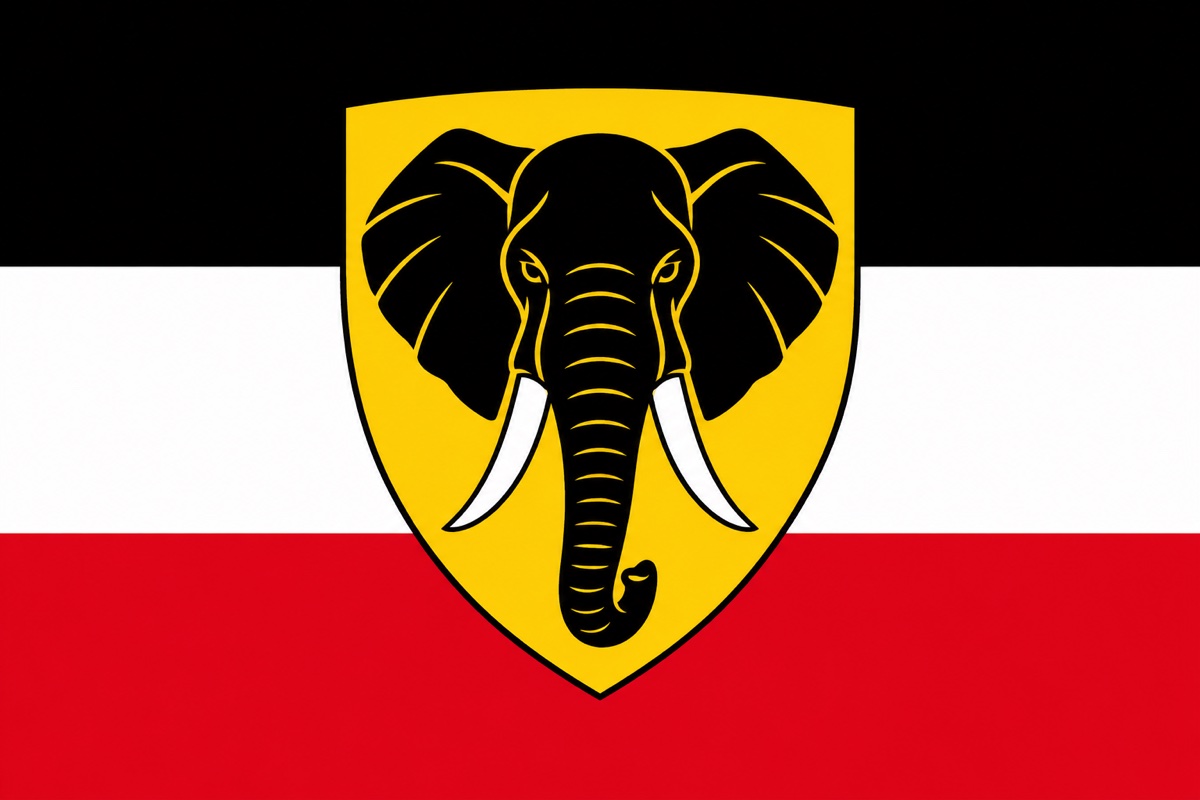
The flag is the imperial black, white and red horizontal tricolour with a shield bearing an elephant’s head in the centre. The design was drawn up in 1914 among the proposed flags for the German protectorates, and was not adopted before the war. The constitution of 1955 adopted it unchanged, so that a flag designed for the protectorate became the flag of the associated state. It is criticised by the Independence League and by some Social Democrats as the protectorate’s flag, and defended by the large parties as the flag under which the association was made.
Arms
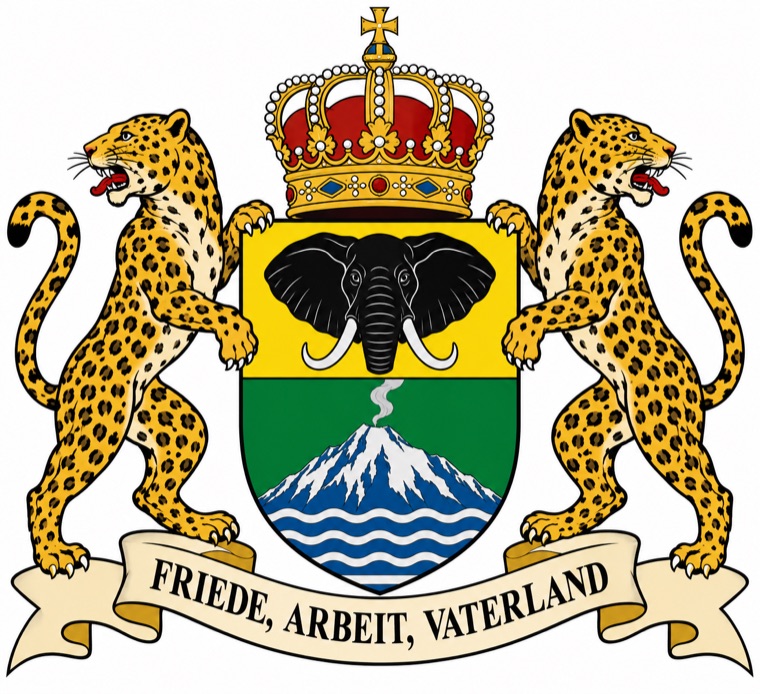
The arms are a shield bearing the elephant’s head and Mount Kamerun, supported by two leopards, beneath the imperial crown. They appear on the coinage of the Kamerun mark, on government buildings and on the governor-general’s standard.
Anthem, motto and national day
The anthem is O Kamerun, Cradle of our Fathers (O Kamerun, Wiege unserer Väter), written at Foulassi in 1928 and sung in Bulu and German. The motto is Friede, Arbeit, Vaterland, Peace, Work, Fatherland. The national day is 22 June, the anniversary of the coming into force of the constitution in 1955. The public holidays also include the Christian feasts and the two Eids.
Failings
The Duala land seizures. From 1910 the protectorate government planned, and from 1913 carried out, the removal of the Duala from the Joss plateau and the riverfront of their own town, in breach of the treaty of 1884 that reserved their land to them, in order to build a European quarter. Compensation was fixed far below the land’s value. The imperial government and the protectorate administration were responsible, and the land was not returned for more than a century, and then only in part.
The hanging of Duala Manga Bell. King Rudolf Duala Manga Bell, who had resisted the seizures by petition and law, was tried for high treason at Duala in a single day in August 1914 and hanged with Adolf Ngoso Din the next morning, on evidence the court did not test; the governor declined to commute the sentences. The joint commission called it a judicial murder. The Reichstag rehabilitated him in 2016, a hundred and two years later.
Forced labour on the plantations. The Mount Kamerun plantations were built on land taken from the Bakweri and worked before 1914 by men conscripted through quotas imposed on chiefs and marched to the coast under escort, among whom the administration’s own reports recorded death rates of up to one in ten a year. The protectorate government organised the recruitment and the plantation companies profited from it.
The carriers of 1914 to 1916. The conquest of French Equatorial Africa was carried on the backs of tens of thousands of conscripted carriers, of whom more than ten thousand died of disease, exhaustion and hunger. Nobody counted them at the time, and the protectorate force that conscripted them kept no rolls of the dead.
The repression of the People’s Union. Between 1951 and 1955 the protectorate government banned the People’s Union’s newspaper and then the party, imprisoned its leaders, among them Ruben Um Nyobe, and its police killed more than a dozen people at the port strike of 1952. The repression ended with the amnesty of 1955 and was followed by a settlement negotiated with the People’s Union’s opponents.
The north’s neglect. The three northern provinces have had the lowest school enrolment, the fewest doctors and the highest child mortality in Kamerun under every government since 1955. The one sustained programme to change that, begun by the only northern Prime Minister, was cut first by his own cabinet in the slump of 1986, and Boko Haram recruited in a region that the state had left poor. This failing belongs to Kamerun’s own governments.
Dependence on the fund and the mark. Kamerun’s public finances depend on transfers from the development fund, and its monetary policy is made in Berlin through the peg. In the slumps of 1986 and 2014 the peg left public spending as the only means of adjustment, and the dependence that makes the association hard to leave has been deepened by governments of both large parties.
Open disputes
What the association costs. Whether the German market, the hard currency, the fund and the defence guarantee are worth the loss of monetary policy, a currency too strong for most of the economy and a German force in the north is argued between the large parties, within each of them, and by the Independence League, and the government’s review has not settled it.
The Bell family’s land claim. The king of the Bell Duala claims the rest of the Duala plateau, now held largely by the Kamerun state, the city of Duala and private owners. The Kamerun government holds that the return of 2018 settled what the state could return without dispossessing others; the Bell family holds that the treaty of 1884 was broken for the whole plateau, and presses the claim in the House of Chiefs.
Keeping the Kaiser as head of state. Whether a German Emperor, represented by a governor-general, should remain Kamerun’s head of state is pressed by the Independence League and part of the Social Democrats, who regard it as the protectorate kept in form, and defended by the Kamerun Union and the chiefs, who regard it as the guarantee of German nationality and of an equal standing with Germany. The entrenchment of the head of state’s articles means the question would take two Landtags to decide.
The place of German. Whether German should remain the language of the higher courts, secondary schooling and the University, or give way further to the national languages, is argued between those who regard it as Kamerun’s access to the German economy and those who regard it as the protectorate’s language kept by its successors and a barrier to the majority who do not speak it at home.
German troops in the north. Whether German forces should remain in the Far North is contested in the Reichstag at every renewal and in Kamerun between those who regard them as the defence the treaty promised and those who regard them as a German army back in Africa.
Whether the regency should have been Jaunde’s to accept. The German regency of 2028 reached Kamerun automatically under its own constitution of 1955. Members of the Landtag from several parties hold that Kamerun should have been asked, or should have been given its own procedure; the government holds that the constitution settled the question and that Kamerun may change it.
Assessment
Kamerun is the associated state in which the arrangement has gone furthest. It kept the German Emperor as head of state when no other territory did, made its people German nationals, has held its currency at par with the German mark since 1955, and has governed itself since 1955 through regular changes of government between two large parties, without a coup, a civil war or a suspension of its constitution. Its income is nearly twice Nigeria’s, and its schools, hospitals and university were built in large part with transfers that the treaty secured against German politics.
The same arrangement is what its critics describe. The defence of the state, the value of its money, the terms of its trade and a large part of its public capital are decided in or by Germany; the German army fights in its north; and the regency of 2028 showed that German law decides who exercises the powers of its head of state. The right to leave is genuine, and the costs of using it are those that East Africa paid. Whether the association is a partnership freely renewed or a dependency made comfortable is a question on which Kamerunians divide, and both large parties have chosen to argue it inside the association.
Its colonial record has been confronted more fully than most. The joint commission named the land seizures, the forced labour and the deaths of the carriers; the Reichstag rehabilitated Duala Manga Bell; part of the Duala plateau has been returned. The rest has not, and the claim to it is now pressed against Kamerun’s own state. The repression of the People’s Union was followed by the release of its leader into a settlement negotiated with his opponents, and then by his service as a minister in an associated government, which his admirers read as vindication and the departure party as his absorption.
The failing most clearly Kamerun’s own is the north. Every government since 1955 has spent less there than it promised, and the only northern Prime Minister’s programme was the first thing cut when money ran short in 1986. The insurgency that brought German troops into combat after 2014 recruited in the provinces the state had left poorest.
Chronology
| Year | Event |
|---|---|
| 1470s | Portuguese navigators name the Wuri estuary Rio dos Camarões |
| 1809 | Modibo Adama begins the Fulbe jihad that founds the emirate of Adamawa |
| 1845 | English Baptist missionaries settle on the Wuri estuary |
| 12 July 1884 | The kings of the Bell and Akwa Duala sign a treaty of protection reserving their land |
| 14 July 1884 | Gustav Nachtigal raises the German flag at Duala |
| 1889 | A German station is founded at Jaunde |
| 1891 to 1894 | War with the Bakweri; their land on Mount Kamerun is taken for plantations |
| 1895 to 1907 | Jesko von Puttkamer is governor; the concession companies; forced rubber collection |
| 1899 to 1902 | The Fulbe lamidates of the north are taken |
| 1901 | The governor’s seat moves to Buea; Kamerunstadt is renamed Duala |
| 1908 | Rudolf Duala Manga Bell becomes king of the Bell Duala. Sultan Njoya sends the Bamum throne to Berlin |
| 1910 | The school ordinance requires German in subsidised schools; the plan to remove the Duala from the plateau |
| 1913 | The expropriation ordinance. The Anglo-German boundary with Nigeria is fixed |
| 7 August 1914 | Duala Manga Bell is tried for high treason at Duala |
| 8 August 1914 | Duala Manga Bell and Adolf Ngoso Din are hanged; Martin-Paul Samba is shot at Ebolowa |
| 1914 to 1916 | Kamerun’s forces take French Equatorial Africa; heavy loss of carriers |
| 1919 | The Treaty of Berlin; French Equatorial Africa becomes four German League mandates |
| 1921 | The governor’s seat moves to Jaunde |
| 1927 | The central railway reaches Jaunde. Kamerunian members join the governor’s council |
| 1928 | Students at Foulassi write the song that becomes the anthem |
| 1939 to 1945 | The Second Great War; Kamerunian soldiers serve in North Africa |
| 1946 | Compulsory labour is abolished |
| 1948 | The Kamerun People’s Union is founded at Duala, with Ruben Um Nyobe as secretary-general |
| 1952 | The port strike; police kill more than a dozen people; the People’s Union is banned and its leaders imprisoned |
| 1953 | The Kamerun Union is founded under Gustav Ebongue Kotto; Berlin decides to offer association |
| Spring 1955 | The treaty of association is signed at Berlin |
| 22 June 1955 | The constitution, signed by Albrecht I at Jaunde, comes into force; Kamerun becomes the first associated state. Amnesty for the People’s Union |
| Later in 1955 | Ebongue Kotto becomes the first Prime Minister. Kamerun joins the League of Nations |
| 1957 | Togo becomes an associated state. Wilhelm II succeeds Albrecht I |
| 1960 | Gabon, the Congo, Ubangi and Chad become independent republics |
| 1961 | Martin Fotsing Kuete forms a Social Democratic government |
| 1962 | Um Nyobe becomes Minister of Labour. The plantations are nationalised. The University of Jaunde is founded |
| 1965 | Wilhelm II visits Kamerun |
| 1968 | The coalition falls; Um Nyobe leaves office |
| 1972 | Daniel Bikoi Nlend becomes the first Kamerunian governor-general |
| 1974 | The first revision of the constitution |
| 1977 | Offshore oil production begins |
| 1983 | Hamadu Sali Bakari of Garua becomes the only northern Prime Minister |
| 1986 | Oil and cocoa prices fall; the northern programme is cut. The Lake Nyos disaster |
| 1989 | Friedrich V succeeds Wilhelm II |
| 1990 | Roger Milla’s goals take the Indomitable Lions to the World Cup quarter-finals |
| 1990s | The joint commission obtains full archive access and the right to publish freely |
| 1991 | Ruben Um Nyobe dies |
| 1996 | The Joint Tribunal rules for Kamerunians resident in Germany |
| 1998 | The second revision of the constitution |
| 2001 | Margarethe Ngono Ekani becomes the first woman Prime Minister |
| 2005 | Friedrich V abdicates; Heinrich I succeeds |
| 2012 | The joint commission calls the hanging of Duala Manga Bell a judicial murder |
| 2014 | Boko Haram raids the Far North; the Reichstag narrowly approves German combat support |
| 2015 | Eleven German soldiers are killed in an ambush near Lake Chad |
| 2016 | The Reichstag rehabilitates Duala Manga Bell; Heinrich I attends at Duala. Samuel Ikome Molua becomes Prime Minister |
| 2018 | Part of the Duala plateau is returned to a trust of the Bell Duala |
| 2021 | Albertine Ngo Bayiha becomes governor-general |
| 2024 | Theresia Mvondo Essomba becomes Prime Minister |
| 12 February 2028 | Heinrich I dies; Alexander I becomes Kaiser von Kamerun; the Regency Council exercises his powers |
| 11 October 2028 | Princess Charlotte becomes sole Regent; the Landtag notes the regency by resolution |
✎ Editor's Note · What is ruled, what is invented, and what the association costs
The article answers one ruling with a consequence: Germany won both Great Wars, so there was no Versailles to take Kamerun away, no Anglo-French partition and no French Cameroun. Kamerun therefore stays whole, stays German-speaking and becomes the first of the associated states that the German Empire article already described. The distinctive choice is that it alone kept the Kaiser, which ties two things together: German nationality, which comes through the treaty because it cannot come through a constituent state, and the regency of 2028, which reaches Jaunde automatically because the head of state is whoever is German Emperor.
The divergence costs something. The Duala land seizures, the hanging of Duala Manga Bell, the Bakweri land and the plantation labour all happened and all happen here, and with no Allied conquest in 1914 the Duala removal is completed rather than abandoned. The carriers die in a German conquest of French Equatorial Africa instead of in an Allied conquest of Kamerun. The People’s Union is repressed and then outflanked rather than crushed in a war, which saves Um Nyobe’s life and puts him in an associated government, where his admirers and his successors in the departure party read the same career differently. The north is neglected by Kamerunian governments, and Boko Haram brings German soldiers back to combat in Africa.
Ruled in the elicitation: the title, nav and length; the German spellings; the association from 1955, before Togo in 1957; the Kaiser von Kamerun as a separate capacity, the governor-general on the Prime Minister’s advice, the Chancellor’s exclusion; Albrecht I at Jaunde, Wilhelm II in 1965, Heinrich I in 2016; the regency arriving automatically, no separate oath and the Landtag’s resolution with objections; three German governors-general to 1972, the last a diplomat, and Kamerunians since; Albertine Ngo Bayiha, a former president of the Supreme Court, since 2021; German nationality by the treaty alone; the Landtag of 180 by proportional representation; the Kamerun Union, the Social Democrats, northern parties and a fringe departure party; no Anglophone question; twelve Prime Ministers with Gustav Ebongue Kotto first, a Fulbe from Garua in the 1980s and Theresia Mvondo Essomba since 2024; ten provinces in English with German forms; the House of Chiefs and the Sultan of Bamum; the Supreme Court and the Joint Tribunal of five; the League since 1955; the Duala seizures, the hanging, the joint commission’s judicial murder, the rehabilitation of 2016, the return of 2018 and the great-grandson in the House of Chiefs; the forced labour and the nationalisation of 1962; the conquest of French Equatorial Africa and the mandates’ independence in 1960; the People’s Union and Um Nyobe, Minister of Labour 1962 to 1968, author of the labour code, died 1991; the gendarmerie, small army, Duala station and Jaunde garrison; Boko Haram from 2014, the Reichstag’s narrow vote, the left’s opposition and the eleven dead of 2015; the population, the economy and its figures, the mark, oil from 1977, Duala and the Woermann line, the languages, the religious shares, the University of 1962 paired with Hamburg, the 400,000 in Germany; the flag, arms, anthem, motto and national day; makossa, Manu Dibango, Roger Milla and the Indomitable Lions; the seven failings and six disputes.
Invented in the writing, for veto. People: ten Prime Ministers, Martin Fotsing Kuete, Ernst Mballa Nkodo, Paul Nyemb Makon, Johannes Ondoa Nnanga, Hamadu Sali Bakari, Gottlieb Epee Ekwalla, Christoph Wandji Nana, Margarethe Ngono Ekani, Julius Ngum Nfor and Samuel Ikome Molua, with their peoples, provinces, parties and terms; the governors-general Ludwig Hartmann-Voss, Konrad Ellwanger, Johannes Stemmler, Daniel Bikoi Nlend, Ibrahim Hamman Sanda, Elisabeth Ngah Essono, Bernhard Kengne Tsafack, Ernst Ekambi Ebele and Peter Tamfu Nsom; Ngo Bayiha’s Bassa origin and the Prime Minister who advised her appointment; Mvondo Essomba’s teaching and ministry. The names were chosen from the peoples the article assigns: German Christian names for southern Christians, as mission baptism in a German protectorate would give, and Fulbe names for the north, avoiding the names of living politicians. Institutions: the party names in German, the Northern Alliance and the Independence League; the People’s Union’s ban in 1952, the port shooting and its merger with the Social Democrats; the Kamerun Union’s founding in 1953; the constituent council; the entrenchment of the head-of-state articles; the revisions of 1974 and 1998; the Landtag’s term and lists; the House of Chiefs’ size, composition and six-month delay; the courts’ law and Islamic personal-status courts; the Joint Tribunal’s name and its judgments of 1983 and 1996; the High Representative, the household’s Kamerun secretary and the Governor’s House; the Kamerun Central Bank, the Kamerun Oil Company and the Kamerun Plantation Corporation, with the compensation from the fund; the fund’s size; the force sizes; the provinces’ German names, seats and powers. Events: the seat moving to Jaunde in 1921; the governor’s council of 1927; the Duala petitions of 1919 and 1926; the completed removal of the Duala; the sequence of the conquest of 1914 to 1916 and the carriers’ minimum; Kamerunian service in the mandates and in North Africa; the labour levies to 1946; the delegation’s reasoning for keeping the Kaiser; the date of the commission’s Duala report; the wreath of 2016; the parties to the return of 2018; the northern programme and its cutting; the government’s review of the association; the Marua deaths in custody and the Landtag inquiry, which carry over the deaths of December 2014 and are added beyond the seven ruled failings.
Kept because they happened and nothing here prevents them: the precolonial history, Modibo Adama and the lamidates; the treaty of 12 July 1884, Nachtigal and the late British consul; Puttkamer and the concessions; Njoya, his script and the throne sent to Berlin in 1908; the Joss plateau plan of 1910 and the ordinance of 1913; Duala Manga Bell’s schooling, petitions and trial, the dates of 7 and 8 August 1914, Adolf Ngoso Din, Governor Karl Ebermaier and Martin-Paul Samba; the Bakweri reserves and the plantation death rates; the school ordinance of 1910; the Foulassi anthem; Lake Nyos in 1986; the eruptions of Mount Kamerun; the universities of the 1990s; Soul Makossa and Manu Dibango’s death in 2020, his career moved from Paris to Hamburg; Roger Milla’s goals of 1990 and 1994, his club career moved from France to Germany.
Trivia
- In-Universe Kamerun is the only associated state that kept the German Emperor as its head of state. He reigns there as Kaiser von Kamerun, a capacity separate from the imperial one, through a governor-general appointed on the advice of Kamerun's own Prime Minister, and the Imperial Chancellor has no say in the appointment.
- In-Universe The flag of Kamerun, the imperial black, white and red with a shield bearing an elephant's head, was designed in 1914 among the proposed flags for the German protectorates. It was not adopted before the war and first flew over Kamerun when the constitution came into force on 22 June 1955.
- In-Universe Kamerunians alone among the associated peoples are German nationals. Their nationality comes directly from the treaty of association of 1955, the one exception to the rule that a German is first a citizen of a constituent state.
- In-Universe Kamerun was the first associated state of all, converted in 1955. Togo followed in 1957.
- In-Universe The border between Kamerun and Nigeria, fixed between London and Berlin in 1913, has never been disputed, and the Bakassi peninsula at its southern end has been Kamerun's throughout.
- Real-World Kamerun was conquered by British and French forces in the First Great War and divided between France and Britain from 1916, an arrangement confirmed by League mandates. French Cameroun became independent in 1960, and the southern British Cameroons joined it in 1961. Here there was no conquest and no partition, and Kamerun stayed German and whole.
- Real-World Rudolf Duala Manga Bell was hanged at Duala by the German colonial authorities on 8 August 1914, as he is here, and is honoured in Cameroon as a national hero. Here the Reichstag rehabilitated him in 2016 and part of the Duala plateau was returned in 2018.
- Real-World Ruben Um Nyobe, leader of the Union of the Peoples of Cameroon, was killed by French troops in the Sanaga-Maritime forest on 13 September 1958, during the insurgency that followed the banning of his party. Here he survived, served as Minister of Labour from 1962 to 1968, and died in 1991.
- Real-World The flags proposed in 1914 for the German colonies, Kamerun's among them with its elephant's head, were never adopted, because the war broke out and the colonies were lost. Here Kamerun's design was adopted in 1955 and still flies.
See also
- German Empire, of which Kamerun is an associated state, for the association and the colonial record
- Federal Kingdom of Nigeria, the neighbour to the west, across a border never disputed
- East African Federation, whose German half left the association in the 1970s
- Ethiopia, an African monarchy whose emperor is represented in Eritrea by a governor-general
- Free and Hanseatic City of Hamburg, home of the Woermann line and of the largest Kamerunian community in Germany
- France, which lost French Equatorial Africa to German mandates in 1919
- The First Great War, for the African campaigns and the carriers
- Prussian constitutional crisis of 2028, which produced the regency that reached Kamerun
- League of Nations, of which Kamerun has been a member since 1955
- Alexander I, German Emperor and Kaiser von Kamerun
- Princess Charlotte, Regent for her brother in all his capacities
- Heinrich I, who attended the rehabilitation of Duala Manga Bell in 2016
Categories
- Nations of the World
- Africa and the Middle East
- Monarchies
- German associated states