Kingdom of Prussia
The Kingdom of Prussia (Königreich Preußen), ordinarily called Prussia, is the largest constituent kingdom of the German Empire. It extends from the Rhineland and Westphalia in the west through Brandenburg, Silesia and Pomerania to the historically Polish and Baltic provinces in the east. Its population of approximately sixty million makes it larger than many sovereign states, but Prussia is not sovereign in foreign affairs and is not another name for Germany.
Prussia retains its own Crown, Constitution, Landtag, ministry, courts, police administration, provinces, established church and military contingent. The Empire governs the fields assigned to it by the amended German Constitution of 1871, including foreign relations, federal defence, the common market and the other competences exercised at imperial level. Prussia governs the extensive domestic fields that remain. Imperial law prevails where the two orders lawfully overlap.
The King of Prussia is also German Emperor. The two Crowns are constitutionally inseparable, but they remain separate offices. An instrument issued as King of Prussia is a Prussian act, made through Prussian institutions and recorded under the Prussian seal. An instrument issued as German Emperor belongs to the Empire. This distinction has become central because the same nine-member Regency Council is acting for the minor Alexander I in both capacities while maintaining separate proceedings, records, votes and advice.
Prussia is in a constitutional crisis. In April 2028 the Regency Council dismissed Dr Johanna Falk, the Social Democratic Minister-President supported by a comfortable Landtag majority, after her ministry issued an Advice-Binding Declaration limiting royal executive discretion, and Konrad von Arnim, an elder of the Free Conservative tradition, administered a restricted caretaker government while Falk challenged the dismissal. On 3 October 2028 the Zentrum left her coalition, and her majority was gone. On 9 October the Prussian Constitutional Court held the dismissal void and restored her ministry, to a House she could no longer command. On 10 October the Landtag, with the Reichstag and the Bundesrat for the Empire, abolished the Regency Council and made Princess Charlotte sole Regent, and on 11 October, sworn, she dissolved the Abgeordnetenhaus on Falk’s advice. Falk leads a caretaker ministry into an election on 3 December 2028, and who can command the new House is unresolved.
Etymology
The kingdom takes its name from a territory that lies at its eastern edge rather than its centre. Prussia, Preußen, was originally the land of the Old Prussians, a Baltic people conquered and largely absorbed during the medieval crusades in the region, and the name attached first to the ducal territory around Königsberg. Brandenburg, the older and more central Hohenzollern possession, never gave the state its name.
That accident of naming had a constitutional consequence. Ducal Prussia lay outside the Holy Roman Empire, while Brandenburg lay within it, and only a territory outside the imperial structure could carry a royal title without offence to the Emperor. The coronation at Königsberg in 1701 therefore styled its subject King in Prussia rather than King of Brandenburg, and the eastern name spread over the whole of the Hohenzollern lands as those lands grew westward. The form King of Prussia followed later, once the imperial objection had ceased to matter.
The distinction survives in ordinary usage. Preußen names the kingdom, the historic East Prussian province and, loosely, the administrative temper the state is credited with, and Prussian writers have complained for two centuries that the third sense has swallowed the first two.
History
The Teutonic and Brandenburg inheritance
The land that gave the kingdom its name was not German. Prussia was the territory of the Old Prussians, a Baltic people whose language was related to Lithuanian and Latvian, settled between the lower Vistula and the Memel. In 1226 Duke Konrad of Masovia invited the Teutonic Order, a crusading order then losing its position in the Levant, to act against them, and the Emperor Frederick II granted the Order title to whatever it took. The conquest ran from 1230 to 1283, was interrupted by two general risings, and was completed by fortification, famine and the settlement of German and Flemish colonists on cleared land. The Old Prussian language survived in the countryside into the early eighteenth century and then died. Prussian teaching describes this as a conquest and a colonisation, because that is what it was.
Defeat at Tannenberg in 1410 began the Order’s decline; the Second Peace of Thorn in 1466 surrendered the western half of the territory, later called West Prussia, and left the remainder a fief of the Polish crown. In 1525 the Grand Master, Albrecht of Brandenburg-Ansbach, a Hohenzollern, dissolved the Order’s rule in his lands, adopted the Lutheran confession and took the title Duke in Prussia, holding the duchy from the Polish king. The first Protestant princely state in Europe was created by the secularisation of a crusading order, and its capital was Königsberg.
Brandenburg came to the Hohenzollerns by a different route. The family were burgraves of Nuremberg, useful to the Emperor Sigismund and willing to lend him money; Sigismund pledged the Mark of Brandenburg to Frederick VI in 1415 and confirmed him in it in 1417. The acquisition mattered less for the land, which was sandy, thinly populated and poor, than for the dignity attached to it, since Brandenburg was one of the seven electorates and carried a vote in the election of emperors. The Treaty of Xanten of 1614 then brought Cleves, Mark and Ravensberg on the lower Rhine, and in 1618 the ducal Prussian line failed and the Elector inherited the duchy. From that year one dynasty held territory inside the Empire, territory outside it under Polish overlordship, and detached enclaves in the far west, with no common law, no common institutions, no common estates and no contiguity of any kind. The Thirty Years War then passed over all of them.
The Great Elector and the making of a state
Frederick William, Elector from 1640 to 1688, inherited devastated and garrisoned lands and an army of a few thousand men whose loyalty was uncertain. His central decision was to keep a standing army in peacetime and to fund it from the territories jointly rather than to raise forces from each as its estates permitted, and most of the reign follows from that requirement. Victory over the Swedes at Fehrbellin in 1675 gave the state a military reputation it had not previously possessed, while the Treaty of Wehlau in 1657 and the Peace of Oliva in 1660, obtained by changing sides during the Northern War, extinguished Polish overlordship and left the duchy of Prussia in his full sovereignty.
Sovereignty abroad was paid for by the destruction of consent at home. The estates of Ducal Prussia refused taxation they had not voted; Hieronymus Roth, the Königsberg alderman who led the resistance, was arrested in 1662 and held until his death sixteen years later, having refused a pardon that required an admission of guilt, and Christian Ludwig von Kalckstein, who took the case to Warsaw, was seized there in 1670 by the Elector’s agents and executed in 1672. The General War Commissariat, created to supply the army, absorbed one field of civil business after another and became the state’s administration; an excise on the towns replaced the taxes the estates had granted; and the nobility accepted the arrangement in exchange for exemption from taxation and confirmation of their authority over the peasants on their estates. Prussia’s parliamentary institutions descend from the constitutional grants of the nineteenth century, not from the bodies the Great Elector removed.
The same reign issued the Edict of Potsdam of 1685, which admitted Huguenot refugees on generous terms and brought some twenty thousand people, many of them skilled, into a depopulated country. It also chartered the Brandenburg African Company in 1682 and built the fort of Groß Friedrichsburg on the Gold Coast in 1683, from which the state trafficked enslaved Africans to the Caribbean for a generation, taking revenue recorded in its own accounts, until the holdings were sold in 1717. The traffic was small beside that of the maritime powers and it was not incidental: it was a deliberate state venture undertaken for money, and it is taught in Prussian schools as part of the state’s record.
The royal title of 1701
By the end of the seventeenth century the Elector Frederick III governed more people than several kings and ranked below all of them. Precedence in that period determined seating, the order of signature and the seriousness with which a state’s envoys were received. The obstacle was the Holy Roman Empire, which admitted only one king within its bounds, and the solution lay in the eastern duchy, which had never belonged to the Empire and had been fully sovereign since 1660.
The Emperor Leopold I sold his consent by the Crown Treaty of 16 November 1700 in exchange for troops for the coming War of the Spanish Succession. The coronation followed at Königsberg on 18 January 1701. Frederick placed the crown on his own head and then crowned his wife, an act of deliberate meaning, and only afterwards received an anointing from two bishops he had created for the purpose. The style adopted was King in Prussia, both because the Emperor’s consent extended only to the territory outside his Empire and because the Polish crown, which had ceded overlordship but not memory, protested the title for decades.
The ceremony was extravagantly expensive, and the cost was the principal charge against it at the time. Its lasting consequence was geographical. Prussian kingship acquired its rite in a Baltic city some six hundred kilometres from the seat of government, and it kept it, so that the distributed capital of the modern kingdom preserves an arrangement that began as a constitutional evasion. The imperial title of 1871 was proclaimed on the anniversary of the Königsberg coronation, and 18 January remains Kingdom Day.
The soldier state and the invasion of Silesia
Frederick William I, who reigned from 1713 to 1740, supplied the instruments that made the next reign possible. He tripled the army, created the General Directory in 1723 as a single ministry over the whole monarchy, imposed a rigid economy on the court, ordered the establishment of village schools in 1717, and introduced the canton system in 1733, which assigned each regiment a recruiting district and bound the peasantry of that district to service. The canton regulation also fixed the social compact of the old kingdom: the nobility received a monopoly of the officer corps and confirmation of their manorial jurisdiction, and the crown received the obedience of their tenants in the ranks. That compact governed the Prussian countryside for two centuries and was not dismantled until after the Second Great War.
Frederick II succeeded in May 1740 and invaded the Austrian province of Silesia in December of the same year, without declaration, without provocation and on a dynastic pretext his own ministers regarded as thin. Silesia was populous, industrially advanced and worth more in revenue than several older provinces together. Two wars, from 1740 to 1742 and from 1744 to 1745, secured it. The Seven Years War, which Frederick opened in 1756 by invading Saxony, was the consequence: France, Austria and Russia combined against him, Berlin was occupied twice, the army was destroyed and rebuilt repeatedly, and the state survived the war rather than winning it. Silesia remained Prussian and remains a Prussian province.
The population of the monarchy fell by a substantial fraction during the Seven Years War, districts of Pomerania and the New Mark were emptied, and the finances were preserved only by British subsidy and by debasing the coinage. What the wars produced beyond the province was a reputation: Prussia was thereafter treated as a great power, and treated itself as a state whose security rested on being feared. The modern Kingdom Day observance teaches the Silesian wars as wars of conquest.
The Frederician state and the partitions
Frederick II’s domestic record is not reducible to the wars. He abolished judicial torture in the first year of his reign, ordered the codification that produced the General State Laws of 1794 after his death, tolerated confessions the state did not favour, settled some three hundred thousand colonists on drained and reclaimed land, and intervened personally in the Miller Arnold case of 1779 to punish judges he believed had favoured a nobleman against a commoner, an intervention that was itself an abuse of the judicial independence he claimed to defend. Administration became genuinely professional, recruited by examination in its lower and middle ranks.
The society beneath it was not reformed. Peasants east of the Elbe remained in hereditary subjection, owing labour services and unable to leave the estate, marry or take a trade without permission. Frederick protected peasant holdings against absorption by the estates, because peasants were the source of soldiers and taxes, but he did not free them, and he strengthened the noble monopoly of both the officer corps and the estate lands. The kingdom of 1786 was administratively modern and socially fixed, and the tension between those two facts is the subject of the following century.
Prussia took part in all three partitions of the Polish state, acquiring West Prussia and the Netze district in 1772, Danzig, Thorn and the province called South Prussia in 1793, and New East Prussia in 1795. The partitions ended an old European state by agreement among its neighbours and brought a very large Polish-speaking population under Prussian administration for the first time. The 1772 acquisition also joined Brandenburg to the eastern duchy across the corridor that had separated them since 1466, which was the strategic purpose. The kingdom’s Polish question, and everything the Prussian state later did about it, begins here.
The collapse of 1806 and the peace of Tilsit
Prussia stayed out of the wars of the French Revolution after 1795 and spent ten years attempting to profit from neutrality. When it went to war in 1806 it did so late, alone and with an army whose organisation had not changed materially since 1763. The double defeat at Jena and Auerstedt on 14 October 1806 destroyed the field army in a single day, and what followed was worse than the battle: fortress after fortress surrendered without serious resistance, Berlin was occupied within a fortnight, and the court fled east to Königsberg and then to Memel, the third time in a century that the eastern city had served as the refuge of the monarchy.
The Treaties of Tilsit in July 1807 took roughly half the kingdom. Everything west of the Elbe was lost, the Polish acquisitions of 1793 and 1795 were detached, an indemnity was imposed that the state could not pay, French garrisons remained until it was paid, and the army was capped at forty-two thousand men. The kingdom that had entered the war as a great power left it a French dependency of the second rank, and the settlement was understood at the time as a judgment on the Frederician structure rather than as a military accident.
That judgment produced the reform ministry. Its members argued that a state which could not command the willing exertion of its own population had no reserve of strength to draw on, and that the subjection of the peasantry, the closure of the officer corps, the exclusion of the towns from their own government and the absence of any national representation were therefore military problems as much as moral ones. The argument was made to a king, Frederick William III, who was cautious, unenthusiastic and frequently persuaded by the reformers’ opponents, and it succeeded only in part.
The Reform Era
The October Edict of 1807, secured by Karl vom Stein, abolished hereditary subjection, permitted the free sale of land and opened all trades to all classes. The Municipal Ordinance of 1808 gave the towns elected councils and self-administration in their own affairs, and it is the direct ancestor of Prussian municipal government as it still operates. Dismissed at French insistence in November 1808, Stein was succeeded by Karl August von Hardenberg, who abolished the guild monopolies, introduced a general trade tax and carried the Regulation Edict of 1811.
The Regulation Edict is where the reform’s limits are clearest. Peasants could acquire full ownership of the land they worked, but only by surrendering a third of it, or a half where their tenure had been less secure, to the landlord, or by paying an equivalent rent charge. The estates east of the Elbe consequently grew, the smallest holdings disappeared, and the eastern countryside acquired the large landless labouring population that shaped its politics until the land reform of the twentieth century. Emancipation of the person was real; the transfer of property ran the other way. The Edict of 1812 admitting Jews to citizenship was similarly narrowed once the emergency passed: it was never extended to the territories recovered in 1815, its promise of access to public employment was not honoured, and exclusion from the officer corps, the higher administration and much of the professoriate persisted informally into the twentieth century and was not fully removed until the postwar settlement.
Military reform under Gerhard von Scharnhorst and August von Gneisenau abolished the most degrading corporal punishments, required examination for officers’ commissions and opened them in principle to men who were not noble, established the war academy and the institution that became the general staff, and evaded the French cap on numbers by passing recruits through the ranks into a trained reserve. Wilhelm von Humboldt founded the University of Berlin in 1810 on the principle that teaching and research belong in the same institution, reorganised the Gymnasium, made the Abitur the qualification for entry and created the seminar as a method. The university reform outlived every other part of the programme and was copied across Europe and America.
The reformers also promised a constitution. Frederick William III repeated the promise in 1810 and again in 1815, when it was made a condition of war loans raised from his own subjects, and did not keep it. Provincial diets, established in 1823 and organised by estate, were the substitute, and the unredeemed promise of 1815 is why the constitutional question dominated Prussian politics for the following generation.
The settlement of 1815 and the western provinces
The Congress of Vienna returned Prussia to the first rank and changed its character. It received the Rhineland and Westphalia, the northern half of Saxony and Swedish Pomerania, while surrendering most of the Polish territory taken in 1793 and 1795 and retaining the remainder as the Grand Duchy of Posen, with a formal guarantee of Polish nationality that the administration observed for about a decade and then abandoned. The state was now discontinuous, split into eastern and western halves separated by other German territory, and it had acquired several million Catholic subjects in the west who had spent twenty years under French administration and French civil law, which they kept.
The Cologne church dispute of 1837, in which the Prussian government arrested Archbishop Clemens August von Droste-Vischering over the treatment of mixed marriages, showed that a Protestant state church and a Catholic western population were an unresolved problem, and it organised Rhenish Catholicism politically a generation before the Kulturkampf gave it a party.
Economically the settlement was transformative in a way nobody in 1815 intended. The coal of the Ruhr and of Upper Silesia now lay in the same customs area as the state’s markets, and the Customs Union of 1834, built outward from the Prussian tariff, extended that area over most of Germany. Railway construction from 1838 knitted the two halves of the kingdom together and made the eastern grain trade and the western coal trade parts of one economy. Prussia became the industrial power of Germany before it became its political head, and the Rhineland and Westphalia have been the kingdom’s economic engine ever since.
Industrialisation arrived without corresponding legal or political change. The rising of the Silesian weavers in 1844 was suppressed by troops, with deaths; factory legislation was minimal; combinations of workers were criminal; and the provincial diets represented estates rather than people. By the middle of the 1840s the kingdom had a modern economy, a professional administration, an unreformed franchise, no national representation and a king, Frederick William IV, who regarded a written constitution as an interposition between the Crown and its subjects.
The revolution of 1848
News of the revolution in Paris reached Berlin in early March 1848 and met an existing crisis over the United Diet, which the King had convened in 1847 to obtain a loan and dissolved when it demanded regular sessions in return. Barricades went up in Berlin on 18 March, and the fighting that night killed several hundred people, overwhelmingly artisans, journeymen and labourers. The King ordered the troops out of the city, saluted the bodies of the dead as they were carried past the palace, promised a constitution and rode through Berlin under the black, red and gold colours. A Prussian National Assembly was elected to agree a constitution with the Crown.
The counter-revolution took eight months. The army was reconciled to the Crown, the moderate liberals separated themselves from the democratic clubs, and in November the ministry was replaced, the Assembly was moved out of Berlin and then dissolved, and troops reoccupied the capital without resistance. On 5 December 1848 the King issued a constitution on his own authority rather than agreeing one, dissolving the body elected to write it and granting instead a text of his own. An ordinance of May 1849 imposed the three-class franchise on the elected chamber. Risings in the Rhineland and in Baden were put down by Prussian troops that summer.
Prussia refused the German question in the same period. The Frankfurt Parliament offered Frederick William IV the imperial crown of a united Germany in April 1849; he declined it on the ground that it came from an assembly rather than from the princes, and the Prussian attempt to build a union of princes instead collapsed under Austrian and Russian pressure at Olmütz in November 1850. The failure was formative for the officials who ran the state afterwards, and it is why unification, when it came, was accomplished by the army and the Crown rather than by a parliament.
The Constitution of 1850
The revised text was sworn on 31 January 1850 and is, as amended, the instrument under which the kingdom is governed today. What it conceded was substantial and was not withdrawn: a written constitution the Crown could not simply revoke, a bicameral Landtag with an elected lower chamber, a requirement that taxation and the budget rest on statute, guarantees of personal liberty, property, conscience, association and the press subject to law, judicial independence with irremovable judges, ministerial countersignature for most royal acts, and confirmation of municipal self-government. Prussia after 1850 was a state of laws with an administrative jurisdiction, and Prussian officials could be sued.
What the settlement reserved was equally deliberate. Royal assent to ordinary legislation was an absolute veto requiring no countersignature. Ministers were appointed and dismissed by the King, again without countersignature, and were responsible to him in fact whatever the text said about responsibility. Command of the army lay outside the ordinary constitutional machinery, and the army swore its oath to the King personally rather than to the constitution. Article 63 permitted government by ordinance when the chambers were not sitting. The upper chamber was reconstituted in 1854 as the Herrenhaus, composed of hereditary members and royal appointees, and it could block anything the lower chamber passed.
The three-class franchise was the settlement’s central distortion. Every male taxpayer voted, but voters were divided into three classes by the amount of tax paid, and each class chose the same number of electors, so that in most constituencies a few percent of voters, sometimes a single man in a rural district, appointed a third of the electors. Voting was oral and public, which exposed tenants, employees and officials to pressure. The system produced a chamber that misrepresented the electorate for seventy years, and it was defended on the express ground that it should.
The 1850 text has never been replaced. Its structure and above all its treatment of assent and of the appointment and dismissal of ministers survive in the amended constitution now in force, so that the modern royal powers requiring no countersignature are the direct descendants of clauses drafted in the aftermath of a suppressed revolution. That ancestry is one of the arguments in the constitutional case now before the Prussian Constitutional Court, and both sides make use of it.
The constitutional conflict and Bismarck
The army bill introduced in 1860 by the War Minister, Albrecht von Roon, proposed to enlarge the standing army, extend service to three years and reduce the militia to a reserve. The lower chamber voted the money provisionally and then refused it, on constitutional rather than military ground: the budget was the one instrument through which an elected body could reach an institution otherwise beyond its control. Wilhelm I, regent from 1858 and king from 1861, regarded the bill as a matter of royal command and prepared to abdicate rather than concede.
Otto von Bismarck was appointed Minister-President in September 1862 to avoid that outcome. His constitutional argument, the so-called gap theory, was that the constitution provided no procedure for the case in which Crown and chambers failed to agree a budget, that in the resulting gap the government must continue to govern, and that the Crown’s duty to maintain the state therefore prevailed. On that basis the Prussian government collected taxes and spent money without lawful authority from 1862 to 1866, disciplined officials who criticised it, and issued a press ordinance in 1863 that the chamber declared illegal. After the victory over Austria, an Indemnity Act in September 1866 retrospectively legalised four years of unlawful expenditure, and the chamber passed it because the policy had succeeded.
Prussian liberalism split over that vote and has never entirely reassembled: those who accepted the indemnity formed the National Liberal party, those who refused it remained with the progressives, and both descendants sit in the present Abgeordnetenhaus under names inherited from the division. The episode is also why the modern constitution treats supply as it does. Continuing appropriations sufficient to maintain ordinary services, followed by mediation and eventually by an election, exist precisely so that a failure to agree a budget can never again be resolved by a government simply proceeding without one.
The wars of unification and the Empire of 1871
Three wars in seven years settled the German question on Prussian terms. The war of 1864 against Denmark, fought jointly with Austria, brought Schleswig and Holstein under joint administration and then supplied the quarrel that produced the war of 1866. The campaign against Austria and its German allies was decided in seven weeks and effectively ended at Königgrätz on 3 July. Austria was excluded from Germany, and the Holy Roman Empire, restored at Vienna fifty-one years earlier and worn by the Habsburgs at every election since, was dissolved a second time. The dignity Prussia had conceded in 1815 as a harmless antique was abolished by Prussian arms within a single lifetime of the concession, and the abolition was the point of the war rather than a consequence of it.
The peace settlement was less sweeping than the victory permitted, and the difference was made by diplomacy rather than by Prussian restraint. Prussia annexed Hesse-Kassel, Nassau, the free city of Frankfurt and the Elbe duchies, which became the provinces of Hesse-Nassau and Schleswig-Holstein. It did not annex the Kingdom of Hanover. Great Britain and the United Kingdom of America pressed hard against the extinction of the Welf kingdom, a position the dynastic connection between the British Crown and the house of Hanover after 1840 made certain, and Berlin accepted a negotiated German settlement in which Hanover survived as a state, reduced in weight and bound into the northern order. The Welf duchy of Brunswick likewise continued. Prussia thereby organised northern Germany without absorbing it, and the modern federation contains two states that exist because Prussian appetite was checked from outside.
The North German Confederation of 1867 gave the arrangement a constitution, an elected Reichstag chosen by universal manhood suffrage, and a federal council of instructed state delegates. That Prussian subjects voted for the federal parliament on an equal franchise while voting for their own chamber under the three-class system was pointed out from the first session and remained an unanswerable argument for fifty years.
War with France in 1870 brought the southern states in, and the imperial title was proclaimed in January 1871 on the anniversary of the coronation of 1701. The King of Prussia became German Emperor, the Prussian Minister-President became imperial Chancellor in practice, and the imperial constitution of 1871 made the Chancellor answerable to the Emperor alone, the Reichstag’s control over the executive being a later achievement won by amendment. The territory ceded by France was constituted separately and never became Prussian; it is today the Grand Duchy of Alsace-Lorraine, with its capital at Straßburg. Bavaria entered on terms of its own. Prussia was not dissolved into the German Empire and did not intend to be: it supplied the federation with its army, its administrative method and most of its personnel, and it kept its own Crown, constitution, Landtag, ministry, courts and church.
The Kulturkampf
Between 1871 and the later 1870s the Prussian state conducted a sustained campaign against the institutions of the Catholic Church. The pretext was the doctrine of papal infallibility declared in 1870 and the claim that Catholic loyalty was directed outside the state. The purpose was to bring the Church’s schools, seminaries, appointments and discipline under state control, and the campaign was pursued through the criminal law.
The measures accumulated quickly. The clerical paragraph of 1871 made political preaching a criminal offence. The school inspection law of 1872 transferred supervision of all schools to the state, and the Jesuit order was expelled from the Empire by imperial law in the same year. The May Laws of 1873, enacted by the Prussian Landtag, required candidates for the priesthood to complete state examinations and university study, subjected ecclesiastical appointments to a state veto and created a royal court for church affairs. Civil marriage was made compulsory in 1874, and in 1875 all state payments to the Catholic Church in Prussia were suspended and most religious orders were dissolved.
The costs are not disputed. By 1876 every Catholic bishop in Prussia had been imprisoned, deposed or driven into exile. More than a thousand parishes were left without a priest. Clergy were fined, jailed and expelled; orders running schools, hospitals and nursing houses were closed, and their work fell on institutions that could not immediately replace it; and Catholic families in the Rhineland, Westphalia, Silesia and Posen were governed for a decade by a state that treated their religion as a security problem. In Posen the confessional campaign and the national campaign were the same campaign: the archbishop of Gnesen and Posen, Mieczysław Ledóchowski, was fined, imprisoned for two years from 1874 and then deposed, principally over the use of Polish in religious instruction.
The campaign failed. Catholic voters organised, and the Zentrum grew from a small caucus into the second party of the Reichstag and the largest party of the Prussian west, a position its Prussian organisation still occupies and which placed it in the governing coalition dismissed in 2028. Most of the May Laws were repealed or suspended between 1880 and 1887, though state school inspection and civil marriage remained. Prussia concluded no concordat then and has concluded none since, which is why Catholic equality in the kingdom rests on general religious law applying to all recognised communities rather than on a negotiated instrument. Successive Prussian governments declined to make a formal acknowledgment of the Kulturkampf until the reign of Wilhelm II.
The Polish policy of the imperial period
From the 1870s the Prussian state pursued a deliberate policy of reducing the Polish character of its eastern provinces, using law, money and administration against a population that were its own subjects. The policy was avowed, its instruments were public, debated in the Landtag and voted by majorities, and the modern kingdom describes it in its schools as a programme of national coercion carried out by a constitutional state against people entitled to its protection.
Language came first. Decrees from 1873 removed Polish as a language of instruction in the elementary schools of Posen, West Prussia and Upper Silesia, first in most subjects and then, by 1887 and 1900, in religious instruction as well, so that children were catechised in a language many did not understand. Polish was excluded from the courts, from railway and postal service and from public business, and the imperial association law of 1908 permitted public meetings in Polish only where Polish speakers exceeded three fifths of the population, a provision known at the time as the muzzle paragraph.
Land came second. The Settlement Commission, created in 1886 with an initial fund of one hundred million marks that was repeatedly enlarged, was charged with buying estates in Posen and West Prussia and settling German farmers on them. Polish landowners, cooperatives and credit banks bought competitively against it, and over three decades the Commission failed to shift the balance of ownership it existed to shift. The Eastern Marches Association, founded in 1894, agitated for more, and Prussian officials serving in the east received a salary supplement for doing so. The expropriation law of 1908 authorised the compulsory purchase of Polish-owned land for settlement, a power taken against subjects on the ground of their nationality; it was used in four cases in 1912, and its existence did more than its use. Building ordinances of the same period produced the case of Michał Drzymała, refused permission to build a house on his own land and living for years in a circus wagon, which became the most widely known image of the policy.
The policy failed on its own terms. The Polish-speaking population of the eastern provinces grew rather than shrank, Polish cooperative banking and associational life became stronger and better organised than that of their German neighbours, and the Polish deputies in the Landtag and Reichstag formed a disciplined caucus, the Polnische Fraktion, which still exists as a cross-party grouping in the Abgeordnetenhaus. Liberal and Catholic deputies argued at the time that a state which suspended the ordinary security of property for one class of subjects had abandoned the principle on which it asked all its subjects to rely.
Every part of the modern minority settlement is an answer to a specific measure of this period. The twenty percent threshold for co-official languages answers the language decrees; the national autonomy of Posen answers the Settlement Commission; the guarantee of equal treatment in land, building and credit answers the expropriation law of 1908. The kingdom’s language and minority law is not a general liberal inheritance. It is a repair, drafted with the record of the imperial period in front of the drafters.
The First Great War
The First Great War began with the assassination of the Duke of Saxe-Coburg and Gotha by a French assailant, and it placed the German Empire in the field alongside Great Britain and the United Kingdom of America. Prussia supplied the greater part of the German army, the general staff that directed it and the industrial capacity of the Rhineland, Westphalia and Silesia that armed it. The kingdom fought against France in the west and Russia in the east, and it was in Prussia that the war’s only large invasion of German soil occurred.
Russian armies crossed into East Prussia in the opening weeks, occupying the eastern districts and forcing the flight of a substantial civilian population. They were destroyed in the battles of the late summer and cleared from the province by the following spring, but the rebuilding of the eastern towns continued through the war and afterwards, financed by public subscription across Germany, and it left East Prussia with an unusually complete stock of early twentieth-century public architecture. No comparable invasion reached the western provinces.
The war fell heavily on the kingdom’s social arrangements. The three-class franchise became indefensible in a state conscripting the men it disfranchised, and by the middle of the war the demand for equal suffrage was being made in the Landtag by parties that had previously defended the system; the Crown promised reform in general terms and without a date. The Polish policy was quietly suspended for the duration, since the state could not simultaneously expropriate a population and call it to the colours.
Victory came after the collapse of the Russian war effort and the exhaustion of France. Germany retained Alsace-Lorraine, Posen, Silesia and East and West Prussia, and the eastern frontier was left facing a Russia that fell into civil war and emerged in 1922 as the Russian Republic under Admiral Kolchak. Friedrich IV, who had reigned since 1888 and had spent the war attached to field headquarters, died in 1919 a few months after the peace, and was succeeded by his son Albrecht I.
The interwar reforms under Albrecht I
Because Germany won, Prussia had no revolution. There was no collapse of the monarchy, no proclaimed republic, no council movement and no counter-revolutionary reaction, and the reform of the Prussian constitution was therefore carried out by amendment, by a Crown and a Landtag both still in place and both under pressure. The pressure was real: demobilised soldiers, an organised labour movement, a strengthened Social Democratic party and a Zentrum with a coherent programme made the pre-war franchise politically impossible to defend.
The three-class franchise was abolished in the reforms of 1919 and 1920 and replaced by equal, secret and direct suffrage for the Abgeordnetenhaus. The Social Democrats entered a Prussian ministry for the first time and, with the Zentrum and the progressive liberals, supplied most of the kingdom’s governments for the following decade. Ministries began in practice to depend on a majority in the lower chamber as well as on royal confidence, and the doctrine of dual confidence, which the constitution nowhere stated in those words, developed out of that practice. The expropriation law of 1908 was repealed, the Settlement Commission was wound up, and Polish-language instruction returned to the elementary schools of Posen and West Prussia, though not yet to administration or the courts.
The reforms stopped short in three places. Women did not receive the vote in Prussian state elections, which were not made fully universal until after the Second Great War; the Kingdom of Bavaria, which enacted universal adult suffrage in its own settlement between 1919 and 1923, was ahead of Prussia by a generation on this point and was cited against Prussian ministers for thirty years. The Herrenhaus was left essentially unreformed, so that a hereditary and royally appointed chamber retained a veto over legislation passed by an equally elected one. And the eastern estates were untouched, retaining the land, the local administrative offices and the officer tradition that had been theirs since the eighteenth century.
Albrecht I’s own position was that a Crown which conceded in time would not be asked to concede everything, and his defenders regard the interwar decades as a vindication of it. His critics answer that reform granted from above rested on the good will of the grantor, that it stopped precisely where the Crown’s own interests began, and that the settlement of the 1940s had to complete what the settlement of 1919 declined to do. That argument has never been settled in Prussian politics, and it is audible in the present constitutional dispute.
The Second Great War
The Second Great War began with the attack by the Nationaux government of France, and it was fought on German soil. In the winter of 1941 the French advance reached the capital itself: Berlin was besieged for a fortnight, French forces entered its western half, and the city was not taken. Roughly a third of it was destroyed, one western district almost entirely. The relief came and the French were driven back. The regime that had sent them took four more years to fall. The western provinces bore the first and heaviest of that fighting. The Rhineland and Westphalia were the frontier, their industrial districts were fought over and bombed, and the civil population of the border districts was moved eastward in numbers for which the state had made no adequate preparation. Prussian formations made up the greater part of the German armies engaged, and Prussian industry armed them.
Albrecht I did not leave the capital for the duration of the war. Berlin was under repeated air attack and, at the end, under siege, the government dispersed its departments as any government would, and ministers pressed the King to remove himself to a safer seat. He refused, appeared in the bombed districts and signed his instruments in the city throughout. The decision was not militarily necessary, and its consequence was that the monarchy was afterwards associated with civil endurance rather than with evacuation. The standing the Crown acquired in those years is a substantial part of why the postwar settlement was negotiated with the Crown rather than against it.
The later phase of the war moved south and south west, where the fighting reached the Alpine approaches and the Bavarian formations carried the mountain war, while allied forces from Great Britain and the United Kingdom of America came into the line and the German armies pushed west. The war ended in 1945 with the defeat of fascist France and the fall of the Nationaux.
Prussia’s losses were the heaviest of any German state, in soldiers, in civilians and in built fabric. Quarters of Berlin, of the Ruhr cities and of the western towns were destroyed from the air, the eastern provinces absorbed very large numbers of people displaced from the west, and the kingdom emerged victorious and materially damaged on a scale no earlier victory had cost it. It also emerged with two facts that the victory did not conceal. The eastern estate districts, on which the billeting of the displaced, the food administration and much of the civil emergency work fell, had proved incapable of carrying duties that the municipalities of the west carried without particular difficulty. And the men who had fought had been promised, by every party including the Crown’s own ministers, that they would not return to the country they had left.
The postwar settlement
The settlement was made between 1945 and the early 1950s by a compact of the Social Democrats, the Zentrum and the Crown, and it was carried through the amendment procedure of the 1850 constitution rather than by a new instrument. That choice was deliberate and is why Prussia is still governed under a text imposed in the aftermath of 1848: the parties took the view that a constitution which had survived the war ought to be repaired rather than replaced, and that a monarchy which had stayed in Berlin had earned the right to be reformed with its own consent.
Land reform was the largest single measure. Holdings above a statutory ceiling were compulsorily purchased with compensation and redistributed to tenants, farm labourers, returning soldiers and displaced families, chiefly in Pomerania, East and West Prussia, Brandenburg and the Province of Saxony. The estate as an administrative unit was abolished, the manorial districts were merged into ordinary municipalities, and the family farms and cooperatives that now dominate the eastern countryside date from this reform. The landowning families were not expelled or dispossessed of their houses, forests and collections, and they remain influential in agricultural organisations, the officer tradition, heritage institutions and conservative politics. What ended was their standing as a class holding public authority by virtue of owning land.
The civil service was reconstructed on merit recruitment, with entry and promotion by examination and professional qualification, an end to the practice by which local notables held the district offices, and the addition of representational and language duties intended to prevent a statewide service from becoming the instrument of one region, class or linguistic community. Universal and equal suffrage, including the vote for women, was enacted for the Abgeordnetenhaus and the municipalities. The Herrenhaus was reformed into its present tripartite composition of provincial, life and hereditary members in equal thirds, which removed the hereditary peerage’s control of the chamber without abolishing it. The professional and associational exclusions applying to Jewish Prussians, some surviving unrepealed and some surviving in practice alone, were removed by statute in the same period.
Military reform proceeded more slowly. The principle of a professional volunteer contingent without peacetime conscription was agreed in the settlement, on the argument that a state which had twice mobilised its whole male population should not hold the power to do so as a matter of routine, and it was completed by statute in the following two decades. The Prussian contingent kept its own administrative formations, recruiting institutions and War Ministry, subordinate in federal defence matters to the imperial Defence Ministry, and the army’s oath was rewritten to run to the constitution as well as to the King.
The reign of Wilhelm II
Wilhelm II reigned from 1957 to 1989 and is called the Reconciliation King. The epithet refers to a specific programme, carried out over three decades, of settling the quarrels the Prussian state had itself begun. It was possible because the postwar compact had removed the interests that would have resisted it, and it was chosen because the King and his ministers judged that a state with a record like Prussia’s could not ask its minorities for loyalty while declining to describe what it had done to them.
The Catholic settlement came first. The surviving remnants of the Kulturkampf legislation were repealed, and Wilhelm II made a formal acknowledgment, in his own name and in the name of the Prussian state, that the campaign had been an injustice done to subjects on account of their religion. He did not offer a concordat, and none has been concluded: the Prussian position, maintained since, is that a settlement negotiated with one church would reproduce the inequality it was meant to end.
The minority settlements followed. The national autonomy of Posen, organised around Polish and German equality rather than around a majority and a tolerated minority, was enacted in his reign, together with bilingual administration in West Prussia, district-level co-officiality in East Prussia and Silesia, and the twenty percent statutory threshold that governs the whole system. Schleswig-Holstein received its province-wide German and Danish binational settlement. Silesia was kept as a single province with protected linguistic districts rather than partitioned on language lines, a decision contested at the time and still contested. The common critical-history framework taught in Prussian schools, which requires the Kulturkampf, the Polish policy, the partitions and the state’s part in the slave trade to be taught rather than omitted, dates from the same period.
The institutional reforms of the reign are less visible and no less important. The Prussian Constitutional Court at Potsdam was given its modern form, with fifteen-year non-renewable terms and selection divided between the Crown and the two chambers, which made constitutional review a professional jurisdiction rather than an occasional political adjudication. Provincial governors became directly elected. The Crown accepted Social Democratic ministries as ordinary rather than exceptional, and sectoral codetermination entered Prussian industry with royal assent and without a constitutional crisis. Throughout, the eastern frontier faced the Russian Republic, and the kingdom carried the largest share of German defence without a return to conscription.
The criticism of the reign is that its reconciliations were granted rather than won, arriving after the injured parties had ceased to be able to compel them, and that a Crown which chooses when to repair its own state’s wrongs retains the power to choose otherwise. Wilhelm II’s defenders reply that the reforms were carried through the legislature by ordinary majorities and are not revocable by the Crown that assented to them. The disagreement is old and remains a live argument in Prussian politics.
The abdication of Friedrich V
Friedrich V succeeded in 1989 and reigned for sixteen years. His reign is chiefly associated with the negotiated industrial transition of the Ruhr and of Upper Silesia, in which mine and works closures were carried out through agreements among unions, firms, provinces, municipalities and the state development bank rather than by a single closure programme, and with the statutory reordering of the Crown estate, which placed the palaces, forests, collections and revenue-bearing property under statute and public audit and separated them definitively from the private property of the Hohenzollern family.
In 2005 he abdicated. The decision was his own, was announced in advance, and was made on the ground that the office required capacities he no longer believed he could give it at the standard it required, and that a reign ought to be capable of ending by an act of judgment rather than only by death. Because the Prussian and imperial Crowns are inseparable in succession but remain separate offices, the abdication required parallel instruments, an imperial act and a Prussian act, executed through separate procedures and recorded under separate seals. It was the first occasion on which the doubled machinery was used for anything other than a death, and the procedural precedent is now cited routinely in the handling of the two capacities.
The constitutional precedent is more contested. On one reading, the abdication confirmed that the Crown is an office rather than a possession, that its holder serves it and may honourably decline to continue, and that the hereditary principle is compatible with an act of personal judgment. On another, it introduced the possibility that a monarch may be pressed to go, by ministers, by family or by opinion, and made the Crown’s independence conditional in a way the constitution never intended. The instruments drafted in 2005 answer the second reading only in part, by requiring the sovereign’s own personal act, and the argument about what the precedent means has not been resolved.
Friedrich V lived nineteen years after his abdication, taking no part in politics and holding no advisory office towards his successor. He died in 2024 in an accident during public service undertaken after leaving the throne, and the funeral was, at his own instruction, that of a private subject rather than of a former king.
The reign of Heinrich I
Heinrich I succeeded in 2005. He married Caroline of Hanover, sister of Ernest V, a marriage that renewed the connection between the Prussian house and the Welf dynasty whose kingdom Prussia had declined to annex in 1866. Their daughter Princess Charlotte was born shortly before the accession and their son Alexander Friedrich Wilhelm Heinrich at Hanover on 18 January 2014, so that the elder child was born to a prince and the younger to a king.
The reign’s characteristic practice was a more socially engaged form of public duty than the Crown had previously undertaken: sustained attention to housing, hospitals, social provision and the industrial districts in transition, largely without ceremony, and a habit of visiting institutions repeatedly over years rather than once for a photograph. The practice was popular and drew criticism from constitutionalists who held that a Crown associating itself with particular social conditions is closer to policy than the office permits. Heinrich I’s answer, given publicly more than once, was that the constitutional powers of the Crown were exercised on ministerial advice and that its public attention was a different thing.
Two measures of the reign bear directly on the present. The succession reform of 2015 enacted absolute primogeniture, but prospectively only, and therefore did not disturb the order already established by Alexander’s birth in 2014, so that Princess Charlotte is the King’s elder sister and not his heir. The 2027 Prussian general election returned a comfortable majority for the Social Democrats, the Fortschrittliche Volkspartei and the Zentrum, and Heinrich I nominated Dr Johanna Falk as Minister-President in the ordinary way, on the ordinary understanding that a Crown nominates the person able to command the elected chamber.
Heinrich I died on 12 February 2028 of an aortic aneurysm, and the cause was announced promptly. His son succeeded automatically as Alexander I, King of Prussia and German Emperor, at the age of fourteen, the first minor sovereign of the modern constitutional era in either capacity. The accession brought into operation a regency architecture that had been designed with care, provided for in both constitutions and never once tested under conditions of political conflict.
Geography
Prussia covers approximately 348,000 square kilometres and stretches across the whole northern breadth of the German Empire, from the Rhineland and Westphalia in the west, through Brandenburg, Pomerania and Silesia, to the Polish and Baltic provinces in the east. It is not a compact territory, and the distance between Aachen and Memel is greater than the length of many sovereign states.
Most of the kingdom lies on the North German Plain, low, glaciated and agriculturally productive, rising only in the south and west: the Silesian uplands and the edge of the Sudetes, the Harz on the border with Brunswick, and the hills of the Rhineland and Westphalia. The Baltic coast runs from Schleswig-Holstein to the Curonian Lagoon and carries the ports of Stettin, Danzig and Königsberg. The great rivers run north: the Rhine through the western industrial belt, and the Elbe, Oder and Vistula across the plain to the Baltic, all of them navigable and all of them worked. The Masurian lakes in East Prussia and the Spree and Havel wetlands around Berlin are the two largest inland water systems.
The climate is temperate and continental, and it becomes drier and more sharply seasonal from west to east. Winters in East Prussia are materially longer and colder than winters in the Rhineland, a difference that shaped settlement, agriculture and the eastern estate economy, and one the modern kingdom still spends money on in heating, transport and rural provision.
Crown, succession, and dynasty
The Crown and the imperial link
The Prussian Crown belongs to the House of Hohenzollern. Since 1871 its holder has also held the German imperial Crown, and the federal Constitution controls the common succession. Prussian law cannot place a different person on the Prussian throne from the person entitled to the imperial throne. The Crown is hereditary under absolute primogeniture, subject to the prospective terms of the succession reform enacted in 2015.
Succession and the 2015 reform
That reform did not reorder persons already born. Princess Charlotte, born before her brother, remained behind Alexander Friedrich Wilhelm Heinrich, born in Hanover on 18 January 2014 under the prior rule. The change equalised the rights of later-born descendants and future generations without retroactively displacing Alexander. Charlotte is therefore the King’s elder sister but not his heir under the protected transitional settlement. Alexander privately believes that Charlotte should have succeeded, but has not made that belief a public claim or sought to reopen the succession.
Alexander succeeded as Alexander I, King of Prussia and German Emperor, on 12 February 2028 after his father, Heinrich I, died suddenly from an aortic aneurysm. The cause was promptly announced. Alexander was fourteen. The accession was automatic; the regency governs the exercise of powers, not possession of the Crown. An imperial proclamation in Berlin was followed by a legally separate Prussian enrolment. He will assume the personal legal exercise of the royal office at sixteen. From sixteen until eighteen the Regency Council continues as a supervisory body with advisory authority only.
The alternate Hohenzollern line
The modern Hohenzollern line differs from the dynasty familiar to another history. Queen Victoria was assassinated in 1840 while four months pregnant. The Princess Royal was never born, and the historical Wilhelm II therefore never existed. Crown Prince Frederick of Prussia married Feodora of Hohenlohe-Langenburg in 1858. Feodora died in 1872, but the marriage established the line that inherited the Prussian and imperial Crowns.
| Reign | Monarch | Constitutional significance |
|---|---|---|
| 1888 to 1919 | Friedrich IV | Reforming soldier-monarch; died shortly after victory in the First Great War |
| 1919 to 1957 | Albrecht I | Presided over democratic reform and remained in Berlin during the Battle for Berlin |
| 1957 to 1989 | Wilhelm II | The Reconciliation King; an alternate Hohenzollern monarch, not the historical Wilhelm II |
| 1989 to 2005 | Friedrich V | Abdicated voluntarily; died in a public-service accident in 2024 |
| 2005 to 2028 | Heinrich I | Known for the socially engaged practice of the Crown; died suddenly on 12 February 2028 |
| 2028 to present | Alexander I | Acceded aged fourteen; royal powers presently exercised through the Regency Council |
Alexander was crowned German Emperor at Berlin Cathedral on 1 March 2028, but that imperial rite did not serve as a Prussian coronation. The separate Prussian coronation and traditional Prussian oath remain deferred until he assumes personal rule at sixteen. They will take place at Königsberg, whose ceremonial place in the monarchy survives the transfer of ordinary government to Berlin. The Crown estate is a mixed body of historic palaces, forests, collections and revenue-bearing property held under statute and public audit. It is legally separate from the private property of the Hohenzollern family.
Constitution and royal powers
Prussia is governed under the Constitution of 1850, repeatedly amended rather than replaced. Its modern form joins a strong Crown to democratic parliamentary government. The King is an executive co-ruler, but ministers administer the state and the Minister-President must retain both royal confidence and the confidence of the elected Abgeordnetenhaus.
Nomination and dismissal
The King nominates the Minister-President, whose appointment requires confirmation by the Abgeordnetenhaus. Once confirmed, the Minister-President appoints and directs the ministry through the constitutional forms of the Crown. The Abgeordnetenhaus may withdraw confidence by an ordinary no-confidence vote; it is not required to elect a successor in the same motion. The King may personally dismiss the Minister-President, and that power is the principal question now before the Constitutional Court.
The King’s personal constitutional powers include:
- nominating and dismissing the Minister-President;
- granting or withholding assent to ordinary Prussian legislation;
- issuing the instruments required for lawful appointments and promulgation;
- acting as constitutional commander of the Prussian contingent within the German Army;
- refusing a requested dissolution when ministerial advice is abusive or plainly directed towards evading constitutional responsibility;
- and exercising other powers expressly reserved by the amended Constitution.
Assent and countersignature
Royal assent is an absolute veto over ordinary Prussian legislation. Neither assent nor dismissal of the Minister-President requires ministerial countersignature. Other royal acts ordinarily require countersignature and therefore carry ministerial responsibility. The distinction makes the reserved powers legally real without turning every expression of royal preference into state action.
The Minister-President may advise dissolution of the Abgeordnetenhaus. The Crown ordinarily follows that advice but may refuse a dissolution used to obstruct accountability, repeat elections without a governing purpose or defeat an imminent lawful confidence judgment. Supply disputes begin under continuing appropriations sufficient to maintain ordinary services. Mediation follows, and a persistent deadlock ultimately produces an election rather than an administrative shutdown.
Incorporated rights
The Prussian Constitution incorporates the rights guaranteed by the German imperial Constitution instead of reproducing a separate catalogue. Prussian authorities are therefore bound by imperial guarantees of equality, due process, conscience, association, political participation and the other protected rights. Equality is substantive: a formally identical rule may still be unlawful where it entrenches a material exclusion that the state has a duty to remedy.
Regency and the royal minority
The Regency Council was abolished on 11 October 2028. Amendments to the Prussian and imperial Constitutions passed on 10 October made Princess Charlotte sole Regent in each capacity, separately, until Alexander is sixteen, with the Council’s advisory and supervisory role to eighteen; she was sworn the next day. The account below describes the Council as it acted from February to October 2028.
The Regency Council had nine members:
- Princess Charlotte, the King’s adult elder sister;
- Queen Mother Caroline, sister of Ernest V of Great Britain;
- two presiding officers drawn from the Reichstag;
- two presiding officers drawn from the Bundesrat;
- the President of the Prussian Abgeordnetenhaus;
- a retired judge of the German Imperial Constitutional Court;
- a retired judge of the Prussian Constitutional Court.
Princess Charlotte chaired the Council as the senior dynastic member by blood. Before the accession she was principally known for provincial civic patronage rather than national political work. Queen Mother Caroline represented the other dynastic seat and exercised the formal royal governorship of the Evangelical Church of the Prussian Union during her son’s minority.
Two capacities, never merged
The Council acted for both Alexander’s imperial and Prussian offices, but never through a merged capacity. An imperial meeting and a Prussian meeting had different agendas, advice papers, minutes, votes, seals and legal consequences. A member could vote differently in the two capacities. Imperial ministers cannot advise a Prussian act, and Prussian ministers cannot convert a state instrument into an imperial one.
Exercise of a personal Prussian royal power required a two-thirds Council vote. Ordinary formal acts were completed through the usual ministerial and countersignature procedures. The Council could not alter the succession, extend the minority or treat itself as a collective sovereign. At sixteen Alexander will begin exercising the office personally; until eighteen the Regent, who inherited this part of the Council’s role in October 2028, remains available to advise and supervise but loses her power to decide for him.
Alexander attended, received the papers necessary to understand the business, questioned members and could state a view, but he had no vote. Princess Charlotte conducted the Council with public neutrality and procedural strictness while protecting his opportunity to be heard. His position in the minutes is evidence about the Council’s protective purpose and legitimacy, not a direction binding upon it.
Contested legitimacy
The Council’s political legitimacy was contested because six members voted to dismiss Falk despite the opposition of both dynastic members and the President of the Abgeordnetenhaus. The result was:
| Position | Members |
|---|---|
| Against dismissal | Princess Charlotte · Queen Mother Caroline · President of the Abgeordnetenhaus |
| For dismissal | The remaining six legislative and judicial members |
Alexander privately opposed the dismissal and asked that his dissent be minuted. A later leak disclosed his view, creating the unusual position in which a regency claimed to protect the Crown’s constitutional discretion by using a power against the preference of the minor sovereign for whom it acted. The disclosure prompted a youth-led campaign for coordinated German and Prussian constitutional amendments permitting early personal rule. Alexander thanked supporters but refused to endorse changing either Constitution for his own benefit.
Minister-President and government
The Minister-President leads the Prussian State Ministry and coordinates departments responsible for domestic administration, policing, education, infrastructure, provincial relations, state enterprises and other Prussian competences. The office is neither a federal chancellorship nor a subordinate provincial premiership. It governs a constituent kingdom whose decisions affect most of Germany’s population and much of its economy.
The end of the personal union
For the Empire’s first half-century the Minister-President of Prussia and the Imperial Chancellor were, with brief exceptions, the same man. The arrangement was not a convenience but a necessity of the original settlement. The Chancellor instructed Prussia’s delegation in the Bundesrat; Prussia’s weight in that chamber was uncapped and in practice decisive; and a Chancellor who did not also command the Prussian government could be destroyed by it in the federal chamber without a vote being taken in the Reichstag at all. Every attempt to separate the offices before 1919 failed within a few years, and the men who tried it left office saying the same thing about why.
The settlement of 1919 ended the union, and ended it for reasons that were structural rather than symbolic. Once dual confidence was established at both levels, a single officeholder would have had to retain the confidence of the Kaiser, the Reichstag, the King and the Abgeordnetenhaus simultaneously, and since the two parliaments are elected on different cycles by proportional systems that reliably produce different coalitions, the requirement was not merely burdensome but frequently impossible to satisfy. The separation was also the price the smaller states set for accepting a federal government with real authority, and they set it alongside two other conditions: the cap on Prussian voting weight in the Bundesrat, which removed the mechanism that had made the union necessary, and the transfer of the Great General Staff from Prussia to the Empire.
The three reforms are best understood as one act. Together they converted Prussia from the state through which the Empire was governed into the largest of the states the Empire governs, and Prussian conservatives have never entirely accepted any of them. The Chancellor has since been a federal officer answerable to the Reichstag, the Minister-President a Prussian officer answerable to the Abgeordnetenhaus, and the two governments have been free to diverge.
They diverge now. Dr Matthias Brenner of the FVP heads an imperial coalition of the FVP, the Zentrum and the SPD; the Prussian majority dismissed in 2028 rested on the SPD, the FVP and the Zentrum under Dr Johanna Falk. The same three party families, in a different order, under different leaders, in two governments that need not agree and at present do not. It is also the reason the crisis of 2028 has remained a Prussian crisis: an imperial government sympathetic to Falk has been able to stay out of the litigation entirely, which a Chancellor who was also Minister-President could not have done, and the Empire has not been turned into an instrument against the Prussian Council.
Dual confidence
The constitutional rule of dual confidence requires the Minister-President to retain the confidence of both the King and the Abgeordnetenhaus. In ordinary practice the Crown nominates a figure capable of forming a parliamentary government, and dismissal follows loss of parliamentary confidence, resignation or a clear breakdown in lawful administration. Whether the Crown may dismiss a ministry that retains a stable majority for disagreement over the scope of royal power has never been authoritatively determined.
The Falk ministry
Dr Johanna Falk is a Berlin constitutional and labour lawyer and a member of the Prussian organisation of the Sozialdemokratische Partei Deutschlands. The 2027 election produced a comfortable governing majority of the SPD, the Fortschrittliche Volkspartei and the Deutsche Zentrumspartei. Their programme combined democratic modernisation, expanded social provision, administrative reform, stronger provincial equality and clearer limits around the personal powers of the Crown.
The ministry’s Advice-Binding Declaration stated that royal executive discretion was, by settled constitutional convention, ordinarily bound by ministerial advice even where the written text preserved a formal choice. The Council regarded that claim as an attempt to amend the Constitution by declaration and remove discretion expressly entrusted to the Crown. Falk’s government regarded it as a statement of responsible government under a Constitution whose operation had changed through democratic practice.
After the dismissal, the Council appointed Konrad von Arnim, a former Prussian deputy and elder of the Freikonservative Partei / Deutsche Reichspartei, to temporary stewardship. His authority was confined to essential administration. He could maintain services, meet existing legal obligations and respond to immediate emergencies, but he could not initiate a full legislative programme, make irreversible appointments or redirect Prussian policy while the Court considered the validity of his appointment. His appointment lapsed when the Court restored Falk on 9 October 2028.
The Landtag in detail
The two chambers in session
The Prussian Landtag sits in Berlin, in two nineteenth-century buildings whose gardens back onto one another, the Abgeordnetenhaus in the larger and the Herrenhaus in the older. The arrangement is a survival of the 1850 settlement, which placed the two houses within walking distance of each other and of the State Ministry, and it has outlasted several proposals to move the legislature to a single modern chamber. The Landtag is the legislature of a kingdom whose population exceeds that of most European states, and its committee work occupies a substantial quarter of central Berlin.
A Landtag runs for four years in annual sessions, opened by a speech setting out the ministry’s legislative programme and closed by prorogation. The two chambers sit separately and deliberate independently. They meet jointly only for defined ceremonial acts, principally the opening of a Landtag and the reception of the sovereign, and a joint sitting has no legislative capacity: nothing can be enacted by the houses acting as one body.
Dissolution reaches only the Abgeordnetenhaus. The Herrenhaus is a continuing chamber and is never dissolved, because none of its three orders derives its mandate from a general election. This asymmetry has a practical consequence for the emergency power. A proclamation must be ratified by both chambers within fourteen days, and a dissolution therefore does not extinguish the lower house for that purpose: the previous membership may be summoned to ratify or refuse a proclamation issued during the interval before a new House assembles. The provision has never been used. It exists because the alternative, an emergency lawfully proclaimed and incapable of ratification, would have placed the Crown and the ministry beyond the reach of the only body entitled to check them.
Election of the Abgeordnetenhaus
The Abgeordnetenhaus has 480 members elected for four years by mixed-member proportional representation. Each voter casts two votes: the first for a candidate in one of 240 single-member constituencies, the second for a provincial party list. Constituency members are returned by simple plurality. The list vote determines each party’s overall entitlement, and the remaining 240 seats are distributed so that the total membership of each party approaches its share of the list vote as closely as the constituency results allow. Constituencies are drawn by an independent commission on a fixed statutory tolerance for population variation and are revised after each decennial enumeration.
The total is fixed at 480 and cannot be enlarged by overhang, which distinguishes the Prussian system from several others using the same family of methods. A party that wins more constituencies in a province than its proportional entitlement in that province keeps the members it has elected, and the excess is absorbed by reducing its list allocation in provinces where it is under-represented. Only where the excess cannot be absorbed anywhere does a residual disproportionality remain, and the Constitution accepts that small distortion rather than allow the chamber to grow. Two Landtage in the past thirty years have been returned with a party holding one seat more than strict proportionality would give it.
Lists are provincial rather than statewide, so a party’s internal balance between its western industrial organisation and its eastern rural organisation is settled by its own provincial conferences before the election rather than by a central office afterwards. Candidates may stand both in a constituency and on a list, and a defeated constituency candidate may be returned from a list, a practice periodically criticised in the Abgeordnetenhaus itself and repeatedly retained.
The consequences of no threshold
There is no statewide electoral threshold. The framers of the modern electoral law removed the question of representation for small formations from the discretion of the large parties deliberately, having observed that thresholds are ordinarily written by those they will not exclude. In a chamber of 480 the natural threshold created by arithmetic alone is roughly one fifth of one percent of the list vote, so a party with a compact regional following can enter the chamber without negotiating an exemption.
The practical effect is smaller than the design suggests. The constituency tier concentrates support, and the parties that benefit from the absence of a threshold are those with a real geographical base rather than those with a diffuse national sympathy. The Unabhängige Sozialdemokratische Partei Deutschlands, Preußischer Landesverband, has sat continuously in the Abgeordnetenhaus on vote shares that would have excluded it in most comparable systems, and candidates organised through the Polnische Fraktion have been returned from Posen, West Prussia and the Polish-speaking districts of Silesia and East Prussia in every modern Landtag. Small confessional, agrarian and municipal lists appear and disappear, occupying between two and eight seats in a typical House.
Fragmentation has nonetheless been moderate, and Prussian coalitions have generally been formed from three parties or fewer. The argument against the present arrangement is not that it has produced ungovernable chambers but that it protects formations whose only function is to deny a majority to others. The argument for it is that a chamber legislating for sixty million people across twelve provinces with two large linguistic minorities should not be closed to a community that can elect a member. Neither argument has displaced the other, and no threshold bill has reached a second reading since the 1970s.
Membership, officers and the presidency
Members are elected at eighteen and may stand at eighteen. The mandate is free: a member is not bound by instructions from a party, a constituency or a provincial organisation, and the Constitutional Court has held that a party may expel a member but cannot vacate the seat. Members enjoy immunity from prosecution for words spoken in the chamber and from arrest during a session except in flagrant cases or with the leave of the House. Salaries, staffing allowances and the register of members’ outside interests are set by statute rather than by resolution, so that the chamber cannot quietly enlarge its own emoluments.
The Abgeordnetenhaus elects a President and three Vice-Presidents at the beginning of each Landtag. The President is customarily drawn from the largest party in the House, and by a convention observed since the 1960s at least one Vice-Presidency goes to the largest party not in government. The President regulates debate, rules on order and admissibility, represents the chamber in dealings with the Crown, the Herrenhaus and the provinces, and controls the chamber’s estate and staff. Rulings from the chair are recorded and published, and the accumulated body of them is the working procedural law of the House.
The President of the Abgeordnetenhaus also sits ex officio on the Regency Council, a duty that reaches the office only when a sovereign is a minor and that had not been exercised since the office was created. Its consequences in 2028 have been severe. The President voted against the dismissal of Dr Johanna Falk and was outvoted, and now presides over a chamber whose majority regards the act as void, while remaining a member of the body that performed it. No procedure exists for separating the two functions, and none was thought necessary.
The Herrenhaus and its three orders
The Herrenhaus has 180 members divided exactly in three. Sixty are provincial members, five from each of the twelve provinces. Sixty are life members appointed by the King. Sixty are hereditary representatives elected by the recognised Prussian peer houses from among their own qualified members. No order may be enlarged without amending the Constitution, and no order can command the chamber alone, since 91 votes are required to carry a division and no order holds more than 60.
Provincial members are elected by the provincial assemblies rather than nominated by the provincial governors, and are elected proportionally, so a delegation of five ordinarily contains members of two or three parties and a province governed by one party does not send five of its own. They hold office for the life of the assembly that elected them. Berlin, which exercises province-like powers under its capital charter, sends no delegation, a point its assembly has raised at every constitutional review since the charter was granted.
Life members are appointed for life and cannot be removed except by the process that removes a judge. The convention governing appointment is that the order should carry into the chamber what an election does not reliably produce: senior judges, physicians, engineers, trade union officers, university teachers, retired officers, church and communal officials, and people whose public service has been provincial or municipal rather than parliamentary. The convention is not a rule, and the order has at various periods been used to reward political service. Appointments are made on the advice of the Minister-President, and whether the choice of a life member is one of the personal powers requiring a two-thirds vote of the Regency Council has not been decided. The point has become practical: the Constitutional Court’s interim order forbids the caretaker to make irreversible appointments, so the vacancies that have arisen since February 2028 stand unfilled.
The hereditary order is the most altered of the three. Before the postwar settlement the heads of qualified houses sat by personal right and the chamber’s hereditary element ran into the hundreds. It now consists of 60 representatives elected by the whole body of recognised houses, each house casting a single vote irrespective of rank, title or property, in regional colleges renewed every eight years. The register of recognised houses is maintained by statute and closed to new creations, since the Crown no longer creates hereditary peerages. The order therefore preserves the historic peerage as an organised constitutional interest while withholding from any individual peer the right to sit, and its numbers fall slowly as houses become extinct. A statutory review is required when the register falls below a set number of houses, a threshold not yet reached.
Legislation and mediation
Bills may originate in either chamber or be introduced by the State Ministry, and the two chambers are co-equal: no bill becomes law until both have passed it in identical terms, and neither can override the other. Government bills are ordinarily introduced first in the Abgeordnetenhaus, but bills concerning provincial administration, the courts, the codification of private law and the peerage are conventionally introduced in the Herrenhaus, whose committees carry more legal and administrative experience and less electoral pressure.
A bill receives three readings in each chamber. The first is formal, the second is the substantive debate and the point at which the bill goes to committee, and the third is confined to the text as reported. Amendments in committee are unrestricted except that a member may not move an increase in expenditure without identifying its source, a rule of order rather than of law. Public evidence is taken in committee on any bill at the request of one quarter of the committee’s members, which places the power to compel hearings in the hands of the opposition.
Where the chambers pass different texts, either may request a mediation committee. It has sixteen members, eight from each chamber, chosen to reflect the composition of each, and it meets in private. It may propose a compromise text but cannot amend the bill itself: its report is put to both chambers without amendment and is accepted or rejected as a whole. Three attempts at mediation are permitted on a single bill; after the third, the bill falls and cannot be reintroduced in the same session. The great majority of contested bills are settled at the first mediation, and the committee’s private character is generally credited with that record and periodically attacked for the same reason.
Assent, amendment and the veto
A bill passed by both chambers goes to the Crown. Royal assent is an absolute veto over ordinary Prussian legislation and requires no ministerial countersignature, which means that a refusal is a personal act of the King for which no minister is answerable to the Landtag. There is no procedure by which the chambers may override a refusal, no time limit within which assent must be given or withheld, and no requirement that reasons be published, although reasons have been published on each of the modern occasions. Assent has not been withheld from a bill passed by both chambers since the reign of Albrecht I.
The instruments of promulgation are a separate matter and are countersigned in the ordinary way. The distinction is the practical core of the Prussian arrangement: the reserved powers are legally real and are exercised by the sovereign alone, while the great mass of royal acts carries ministerial responsibility and can be examined in the chamber. Critics of the settlement argue that an unreviewable veto is incompatible with a chamber elected on universal suffrage. Its defenders argue that a power used twice in a century is a safeguard rather than a government, and that the absence of use is evidence of the convention rather than of the power’s emptiness. The Falk ministry’s Advice-Binding Declaration addressed exactly this question and was answered by the dismissal.
Amendment of the Constitution requires a two-thirds majority in each chamber. Provincial competences, which are set out in an organic statute rather than in the constitutional text, may be altered by three-fifths of each chamber, and this lower threshold is the reason the boundary between the two instruments is itself politically contested. Whether the royal assent power extends to a constitutional amendment carried by two-thirds of both chambers has never been tested. The text confines the veto to ordinary law, and the settled opinion among Prussian constitutionalists is that an amendment is promulgated without a power to refuse. That opinion has been disputed since February 2028 and no authority binds it.
Supply
The budget is prepared by the State Ministry, introduced in the Abgeordnetenhaus and must pass both chambers. The Herrenhaus may reject or delay a supply bill and may amend it downward, but by statute it may not move an increase in expenditure or the imposition of a tax. The lower house therefore holds the initiative in finance without holding a monopoly of it, and Prussian ministries negotiate with the provincial order of the Herrenhaus over equalisation payments as a matter of routine.
Failure to enact a budget before the start of the financial year does not stop the state. Continuing supply applies automatically: expenditure proceeds at the level of the previous year’s authorised appropriations, restricted to services legally required or already established, with no new programmes, no new establishments and no new borrowing beyond the service of existing debt. Salaries, pensions, school and hospital funding, provincial transfers and the maintenance of the railway and grid continue. The Prussian state has never closed an office or suspended a payment for want of an appropriation, and the framers of the modern provision regarded an administrative shutdown as a method of coercion that no chamber should possess.
Continuing supply is followed by compulsory mediation. The mediation committee sits with the Presidents of both chambers and the Minister of Finance and must report within thirty days; a second reference is permitted. If mediation fails, the ministry may advise dissolution, and the Crown’s power to refuse dissolution is narrowed in this case, since a supply deadlock is by definition a governing purpose. The sequence ends in an election rather than in a settlement imposed by either chamber or by the Crown. It has run to its conclusion twice, in 1968 and in 1994.
Confidence, nomination and dissolution
The Abgeordnetenhaus alone determines confidence. The Herrenhaus may censure a minister and occasionally does, but a censure carries no legal consequence, and no ministry has resigned upon one. A motion of no confidence in the Abgeordnetenhaus must be signed by one tenth of the membership, cannot be voted upon until forty-eight hours after it is moved, and is carried by an absolute majority of the whole House, 241 votes. The motion is ordinary and not constructive: it does not name a successor, and the House is under no obligation to elect one in the same division. The framers considered the constructive form and rejected it, on the ground that a chamber capable of agreeing only that a ministry must go should not be obliged to manufacture a majority it does not have.
A ministry defeated on confidence must resign. The King then nominates a Minister-President, who must be confirmed by an absolute majority of the Abgeordnetenhaus before taking office. Confirmation is a vote on the person, and repeated nominations are permitted. If no nomination is confirmed within sixty days the Crown may dissolve the House, and if the Crown does not, the House stands dissolved by operation of law at ninety days. Throughout that interval the outgoing ministry continues in a caretaker capacity restricted to essential administration, and this restriction is the source of the limits now binding Konrad von Arnim, whose appointment did not follow a defeat on confidence at all.
The Minister-President may also put a question of confidence and may advise dissolution. The Crown ordinarily follows advice to dissolve but may refuse where the advice is directed to evading an imminent confidence vote, to repeating an election without a governing purpose or to defeating an inquiry the House has voted to hold. The refusal power is narrow, has been exercised once, and is separate from the dismissal power. Dual confidence means that the Minister-President must hold the confidence of the King and of the Abgeordnetenhaus at the same time and that either may withdraw it. Whether the Crown may withdraw it from a ministry that plainly retains the confidence of the chamber, over a dispute about the extent of royal power rather than a breakdown in lawful government, was the question before the Constitutional Court, which answered it on 9 October 2028: it may not.
Committees and scrutiny
Standing committees correspond to the departments of the State Ministry and are chaired in proportion to party strength, with the chairs of the finance and audit committees going by convention to the opposition. The Main Committee handles the budget and any bill not assigned elsewhere. Committee membership is proportional, sittings are public unless the committee resolves otherwise, and ministers appear on summons rather than by invitation.
The power of inquiry belongs to a minority. One quarter of the members of the Abgeordnetenhaus, 120, may compel the establishment of a committee of inquiry and settle its terms of reference, which cannot be amended by the majority. Such committees take evidence on oath, may require the production of documents from Prussian authorities and may apply to the ordinary courts to enforce their orders. Ministerial claims of confidentiality are determined by the courts and not by the minister asserting them, a rule extended by analogy in the Court’s rejection of a general claim of Crown confidentiality over the Regency Council’s Prussian record.
The Herrenhaus concentrates on legal scrutiny, the drafting of codes, provincial administration and the audit of state enterprises, and its committee reports are used by the lower house as working material rather than treated as an obstacle. Both chambers appoint members to the joint standing committee on provincial competences, where the equalisation formula is negotiated. Each chamber selects three judges of the Constitutional Court by a two-thirds majority of its own membership, a requirement that has always compelled agreement across party lines and has twice left a seat vacant for more than a year. A petitions committee in each chamber receives complaints from citizens and may require an authority to answer in writing, and the Prussian civil service is bound to reply within a statutory period.
The parties
Prussian parties bear the names of their federal German organisations, each operating in the kingdom through its Preußischer Landesverband. The Deutschkonservative Partei (DKP) rests on agrarian conservatism, the Protestant state culture, loyalty to the Crown and the traditional military interest, and its strength is concentrated in the rural districts of the eastern and central provinces. The Freikonservative Partei / Deutsche Reichspartei (FKP/DRP) is small, administratively minded and habitually governmental, drawing on the aristocratic and official classes; it has supplied ministers to coalitions of several complexions, and Konrad von Arnim is one of its elders. The Nationalliberale Partei (NLP) speaks for industry, the professions and a strong constitutional state, and is strongest in the western cities and the Silesian industrial districts.
The Deutsche Zentrumspartei (Zentrum) organises Catholic political life and is dominant in parts of the Rhineland and Westphalia and strong in Upper Silesia and the Catholic districts of the east, with a settled commitment to federalism, confessional equality and the social institutions of the Church. The Fortschrittliche Volkspartei (FVP) is the party of progressive liberalism, parliamentary reform, civil rights and administrative transparency, and does best in Berlin, the university towns and the professional districts of the larger cities. The Sozialdemokratische Partei Deutschlands (SPD) is the largest party in the kingdom, based on organised labour in the Rhineland-Ruhr, Berlin, Stettin, the Silesian coalfield and the ports. The Unabhängige Sozialdemokratische Partei Deutschlands (USPD) sits to its left, presses for more complete democratisation and criticises the SPD’s accommodation with the institutions of the old state.
No German green party exists. Environmental politics runs inside the SPD, where it competes with the industrial unions, and through the churches, which hold real moral standing and no seat at the cabinet table. In Prussia the argument is sharpened by the coalfields and the grid, both of which the state owns.
The Polnische Fraktion is a cross-party caucus and not a party. Its members are returned under various labels, retain their own partisan affiliations and vote together on language, education, provincial autonomy and equal administration. It negotiates with governments of any composition, has supported ministries of the left and the right, and has taken no position on the dismissal.
The chambers since the dismissal
From April to October 2028 neither chamber was dissolved. The Abgeordnetenhaus elected in 2027 sat on with the SPD, FVP and Zentrum majority that had confirmed Dr Falk, and it passed a resolution affirming its confidence in her ministry, which had no operative effect. The coalition refused to nominate replacement ministers, and von Arnim did not seek confirmation, which he could not have obtained; he administered under a royal appointment that the lower house never confirmed.
The Herrenhaus has taken no collective position and its three orders have divided differently from the parties. Its provincial members have pressed for the equalisation and provincial-language bills already in committee to proceed regardless of the dispute, arguing that provincial administration should not be suspended while the Court considers who may direct the State Ministry. The bills cannot be enacted, since a caretaker restricted to essential administration cannot carry a legislative programme, and they remain on the order paper.
Committee work has continued and has become the principal parliamentary activity of the crisis. The Abgeordnetenhaus has opened an inquiry into the alleged coordination between members of the Regency Council and the conservative parties before the dismissal, established on the demand of the governing majority and contested at every sitting by the DKP. The finance committee has begun preparatory work on the 2029 estimates without a ministry able to introduce them.
Supply is the approaching test. The budget for 2028 was enacted before the dismissal, so the continuing-supply machinery has not been engaged. The estimates for 2029 must be introduced in the ordinary course, and the interim order prevents the caretaker from introducing them. Whether continuing supply can carry a kingdom of sixty million through a full financial year is a question the Landtag began to ask and no institution has yet answered.
The collapse, the regency and the dissolution
Main article: Prussian constitutional crisis of 2028
The majority ended before the litigation did. On 3 October 2028 the Zentrum’s Prussian organisation left the coalition, saying it would accept whatever the Court decided but would not resume a contest with the Crown during the regency and would support no ministry whose first business was that contest; the SPD and the FVP together fall short of the 241 votes of an absolute majority. On 9 October the Court held the dismissal void and restored Falk, to a House in which no combination of parties could now confirm a Minister-President. On 10 October that House, the Herrenhaus, the Reichstag and the Bundesrat abolished the Regency Council by constitutional amendment and made Princess Charlotte sole Regent, and on 11 October, sworn, she dissolved the Abgeordnetenhaus on Falk’s advice; an election is called for 3 December 2028. The Herrenhaus, which is never dissolved, continues to sit. The 2029 estimates remain unintroduced, and unless the new House confirms a ministry and passes a budget before the year ends, the kingdom will enter 2029 under continuing supply.
Courts, rights, and administration
The Prussian Constitutional Court sits at Potsdam. It has nine judges serving single non-renewable terms of fifteen years. The King, Abgeordnetenhaus and Herrenhaus each select three judges. This distribution requires the Court to possess legitimacy from the Crown, the democratic chamber and the mixed historic-territorial chamber without allowing any one of them to appoint a majority.
Judges may be removed only through a judicial tribunal followed by a two-thirds vote in each chamber of the Landtag. Removal cannot be used to reverse a judgment or punish an interpretive position. The Court hears constitutional complaints, institutional disputes, provincial-competence cases and challenges to the legality of Prussian statutes and royal acts.
Ordinary courts and administration
Ordinary Prussian justice is organised in layers culminating in the Prussian High Court. Administrative disputes are heard by specialised divisions within the ordinary courts rather than by a wholly separate administrative judiciary. The German Imperial Constitutional Court exercises limited review over federal questions, including the boundary between imperial and Prussian competence and the meaning of incorporated imperial rights.
The civil service
The civil service is recruited primarily by merit examination and professional qualification. Recruitment and promotion also carry representational and language duties so that a statewide service does not become an instrument of one region, class or linguistic community. Senior appointments pass through an independent commission before ministers make the final choice. Political direction belongs to ministers; professional standards and lawful access cannot be set aside for patronage.
Emergency powers
An emergency begins by Crown proclamation on ministerial advice. Both chambers must ratify the proclamation within fourteen days. Courts remain open, constitutional review continues and emergency measures remain subject to legality, necessity and proportionality. An emergency cannot suspend the succession, prolong a Landtag term without legal authority or convert the caretaker ministry into a permanent government.
Prussian citizenship is acquired before German nationality. A person naturalised by Prussia after five years becomes a German national through the federal constitutional link. The rule preserves state membership as the legal gateway while preventing separate classes of Prussian and German civic belonging.
The twelve provinces
The provincial system
The provinces are older than provincial self-government. The reorganisation of 1815 divided the kingdom into administrative districts under an appointed Oberpräsident who governed as the Crown’s agent, with no elected body to answer to and no independent revenue. Elected provincial diets and a defined sphere of self-administration arrived with the Provincial Ordinance of 1875, which gave the provinces roads, poor relief institutions, asylums, drainage boards and a levy of their own. The postwar settlement converted these administrative bodies into governments, and the modern arrangement is the third settlement rather than an inheritance from the first.
Provincial competences now cover spatial planning, provincial roads and regional rail concessions, water management and flood defence, conservation and monuments, provincial hospitals and social institutions, culture and broadcasting participation, regional development and the administration of schooling above the municipal level. These powers approach home rule in practice, but they are delegated by the Prussian Constitution rather than reserved against it. What protects them is procedural: a change to provincial competences requires three fifths of both chambers of the Landtag, which no ordinary governing majority has commanded since the rule was adopted, and which the caretaker ministry of 2028 cannot attempt at all.
Each province elects a governor directly for a single six-year term that cannot be renewed, and each elects a provincial assembly on the same proportional method used for the Abgeordnetenhaus. The two are elected separately and frequently disagree, and a governor from outside the assembly’s majority is unremarkable. The single term is defended as a guarantee against provincial machines and criticised on the ground that a governor who can never face the voters again is disciplined by nothing but the courts and the press. Proposals to permit one renewal are introduced in most parliaments and have never passed.
The Oberpräsident is what remains of the office that once ran the province outright. Appointed by the King on the advice of the Prussian ministry, the holder supervises the legality of provincial acts, may refer a measure to the administrative divisions of the ordinary courts, certifies certain instruments and represents the state at provincial ceremonies. The office cannot substitute its own decision for the governor’s, cannot direct policy and cannot remove an official. The reduction of the Oberpräsident from ruler to legal supervisor, and the transfer of everything else to an elected governor, was the central bargain of the postwar provincial reform.
Provinces raise no income tax of their own. They receive a fixed share of Prussian tax revenue, a needs-weighted equalisation payment and access to borrowing through the state development bank, which prices provincial debt on the kingdom’s credit rather than the province’s. Rhineland, Westphalia, Hesse-Nassau and Brandenburg pay more into the equalisation pool than they draw; Pomerania, East Prussia, West Prussia and Posen draw more than they pay; Silesia and the Province of Saxony have moved between the two columns within living memory. The formula is renegotiated every seven years and is the most reliably bad-tempered debate in Prussian politics.
Three arrangements cut across the map. Police are a single Prussian service, but each province maintains a board that must approve the provincial commander and the annual policing plan, which gives twelve elected bodies a veto over appointments without producing twelve forces. The Ruhr is governed by an elected cross-provincial authority seated at Essen, spanning the industrial districts of both Rhineland and Westphalia. Berlin exercises powers approaching a province’s under its capital charter while remaining legally inside Brandenburg, and sends no delegation of its own to the Herrenhaus. Every province, whatever its size, sends five members to that chamber, which means Hohenzollern and the Rhineland are equally represented in it.
East Prussia
East Prussia occupies the kingdom’s Baltic north east, a country of moraine ridges, pine and mixed forest, sandy soils and standing water. The Masurian lakes cover the south, the Curonian and Vistula lagoons lie behind long sand spits on the coast, and the Rominten and Elk forests in the east hold the largest wild elk population in the Empire. It is the coldest and most sharply continental of the provinces, with a winter materially longer than the Rhineland’s, and the additional cost of heating, road maintenance and rural transport is written into the equalisation formula. Because the eastern provinces were never separated from the rest of the kingdom, East Prussia is not an exclave: the land route runs continuously through West Prussia and Pomerania, and the Berlin to Königsberg line is one of the busiest passenger corridors in the north.
Königsberg, with rather more than half a million people, is the provincial seat and the ceremonial capital of the kingdom, and the coronation and the royal oath belong to it rather than to Berlin. It is also a working Baltic port, a naval base, a centre of food processing and shipbuilding, and the seat of the Albertina, the university at which Kant taught and where his grave stands against the cathedral wall. Memel at the northern edge, Tilsit on the Niemen and Insterburg and Allenstein inland are the other significant towns. The province holds Prussia’s easternmost land frontier and its garrisons, surveillance installations and hardened logistics are maintained at a level the western provinces do not see, a consequence of the Russian Republic’s proximity that successive Prussian ministries have described as unwelcome but not optional.
The economy remains more agricultural than the Prussian average. Grain, oilseed, dairy and horse breeding dominate, the Trakehnen stud continues under provincial ownership, and the amber works on the Samland coast still produce most of the world’s supply. Land reform after the Second Great War fell heavily here, where the great estates were largest, and the province is now a landscape of medium family farms and machinery cooperatives with a few surviving manorial households that farm at ordinary scale and retain disproportionate social standing. Wind generation, Baltic tourism and the lakes have added income without replacing what left when the estates broke up, and population has drifted west for three generations.
The province is confessionally Protestant with two long-standing exceptions: the Ermland, the Catholic district around Braunsberg and Frauenburg that was never converted at the Reformation, and the Catholic parishes among the Polish-speaking population of the south east. Language settlement here is by district rather than province-wide. Polish is co-official in the Masurian districts where speakers pass the twenty percent threshold, and Lithuanian in the north eastern districts around Memel. Neither community was granted this. Prussian school regulations from 1873 removed both languages from instruction, confined them to religious teaching and then restricted that, and the state pursued the policy for two generations before a single one of these districts was bilingual on paper.
Politically East Prussia is the most conservative of the provinces, with the DKP and the FKP/DRP consistently strong outside Königsberg, a solid SPD vote in the city and the ports, and a Polnische Fraktion presence in the southern districts. Its distinguishing argument is not language but distance: every provincial government of the past thirty years has campaigned on the proposition that Berlin governs the east through documents rather than visits.
West Prussia
West Prussia is the province of the lower Vistula, a corridor of country running from the Culm and Thorn districts north to the delta and the sea. Its landscape divides sharply. The Werder, the reclaimed delta behind Danzig, carries the richest arable soil in northern Prussia behind a system of dykes and pumps maintained by boards older than the province; the Kashubian lakeland to the west is broken, wooded and poor; the Tuchola Heath is one of the largest continuous pine forests in the Empire. The Vistula itself is the working spine, dredged, embanked and busy, carrying bulk freight from Silesia and Posen to the sea.
Danzig is the provincial seat and the largest city, a Hanseatic port of some six hundred thousand with shipyards, a container terminal, oil and grain handling and a technical university. It is the Empire’s principal Baltic outlet after Stettin and the natural port for the whole Vistula basin. Elbing builds rolling stock and turbines, Thorn is a university town and the birthplace of Copernicus, Graudenz and Marienwerder are administrative and agricultural centres, and Marienburg holds the great brick castle of the Teutonic Order, which the province maintains as a monument and which its own guide literature describes as the beginning of the conquest that gave the region its German population.
The economy combines the port, shipbuilding and marine engineering with intensive delta agriculture, sugar processing, timber and a growing logistics sector along the Vistula and the rail corridor. Kashubian tourism and the Baltic coast supply summer income to districts that have little else. The province sits near the middle of the equalisation table, richer than Posen and poorer than Pomerania’s coastal districts, and its politics turn heavily on port investment and river works.
West Prussia is the bilingual mixed province, and the description is administrative rather than sentimental. There is no national settlement of the kind Posen has and no binational parliament. Instead, Polish and German are both languages of administration in every district that meets the threshold, which in practice means most of the south and centre and none of the coast, and officials in those districts are required to work in either language on request. The Kashubians, whose speech is distinct from Polish and who are mainly Catholic, are recognised separately and hold co-official status in the districts west of Danzig, an arrangement they fought for against the objection of both German and Polish provincial parties. Confessionally the province is close to evenly divided, Catholic in the Polish and Kashubian districts and Lutheran in the German ones, with Danzig historically Lutheran and now mixed.
The imperial-era policy of Germanisation applied here as it did in Posen. The Settlement Commission bought Polish land in the Vistula districts, the language decrees removed Polish from schools, and the building permit rules of 1904 were used against Polish smallholders in West Prussia as well. The province’s modern politics are shaped by the fact that the same measures produced a different result here: because neither community formed a decisive majority, the outcome was neither national autonomy nor assimilation but a permanent competition for the same voters, conducted through district councils, school boards and the composition of the provincial administration. Both national parties describe the present balance as provisional, and neither has proposed anything that the other would accept.
Posen
Posen lies in the middle Warthe basin, a fertile and largely level province of arable farming, lakes and small towns, without mountains, coast or heavy industry. It is the most agricultural of the twelve by share of employment and among the most productive by yield: wheat, sugar beet, rapeseed, potatoes, dairy and one of the largest concentrations of food processing in the Empire. The provincial capital, Posen, is a city of some six hundred thousand with a university, a trade fair that dates from the 1920s and is the largest east of Leipzig, and the seat of the provincial parliament. Bromberg on the Brahe is the second city, a canal and rail junction with engineering and chemical works; Gnesen holds the primatial archbishopric and is the oldest ecclesiastical centre of Polish Christianity; Lissa, Ostrowo and Schneidemühl are the significant lesser towns.
Posen is the Polish-German national autonomous province, and the autonomy is the most extensive arrangement of its kind in the Empire. Polish and German are co-official throughout, without any threshold test. The provincial parliament is elected on a common roll but its committees on education, culture and language operate on a double-majority rule requiring the assent of both national groups. Polish-medium schooling runs from primary through to a full faculty structure at the university, teacher training is separately organised, and posts in the provincial administration are allocated by a proportionality rule that both communities monitor closely. Roughly two thirds of the province’s 2.7 million people give Polish as their first language, which means the German population of Posen is itself a protected minority under the same statute, holding guaranteed German-medium schools and a guaranteed share of provincial appointments.
None of this was granted. From 1886 the Prussian state operated a Royal Settlement Commission with public funds, running eventually to some hundreds of millions of marks, whose declared purpose was to purchase Polish-owned land and settle German farmers on it in order to change the ethnic composition of the province. From 1894 the German Eastern Marches Association, tolerated and in places assisted by provincial officials, campaigned for the same end. School regulations removed Polish from instruction and then from religious teaching, which produced the school strike at Wreschen in 1901, where children were beaten for refusing to answer catechism questions in German, and a far larger strike across the province in 1906 and 1907. A settlement law of 1904 required building permits in terms designed to prevent Polish smallholders from building on land they owned. An expropriation act of 1908 authorised the compulsory purchase of Polish estates outright, and was used. Cardinal Ledóchowski, the Archbishop of Gnesen and Posen, was imprisoned by the Prussian state during the Kulturkampf.
The province’s modern institutions descend directly from the Polish response, which was economic rather than insurrectionary: cooperative credit banks, land-purchase societies that outbid the Settlement Commission for estates coming to market, agricultural circles and reading rooms. Those cooperatives still hold much of the province’s food processing and rural credit, and the largest of them is older than the autonomy statute it now operates under. Posen is overwhelmingly Catholic, with a substantial German Lutheran minority and a Jewish community whose continuous presence in the province long precedes the kingdom.
Politically the province returns the Polnische Fraktion’s largest bloc, alongside a strong Zentrum vote and a smaller SPD presence in Posen and Bromberg. The Fraktion’s institutional neutrality in the 2028 dismissal has been criticised inside the province by those who regard a dispute over royal power as exactly the kind of question a national minority should not sit out. What is argued about is not whether the imperial policy happened, which the kingdom’s common critical-history framework requires schools to teach, but whether the present settlement adequately answers it, and the two communities do not agree.
Pomerania
Pomerania is the Baltic province between the Oder and the Vistula districts, a long strip of glacial moraine, sandy heath, pine forest and coastal lagoon, with the island of Rügen at its western end and Usedom in the Oder estuary. Its soils are thin, its lakes are numerous and its coast is the most heavily used stretch of German seaside outside Schleswig-Holstein. Winters are milder than East Prussia’s but the province shares the same long distances and low population density, and at about 2.4 million people it is the least populous of the eleven substantial provinces.
Stettin at the mouth of the Oder is the provincial seat and by far the largest city, a port of about four hundred thousand that functions as Berlin’s sea outlet and handles more tonnage than any other Prussian harbour. It has shipbuilding, chemicals, grain terminals and an increasing volume of offshore-wind assembly. Stralsund and Greifswald in the west are smaller, older and academic, Greifswald holding a university founded in 1456 and a substantial marine and plasma research establishment. Kolberg, Köslin and Stolp serve the central and eastern coast, and Swinemünde on Usedom is the province’s main passenger link to Scandinavia.
The economy rests on the port, agriculture, forestry, fisheries, tourism and, in the past three decades, energy. Grain, oilseed and cattle dominate inland farming; the fisheries have contracted under quota; and the coastal districts have built the largest concentration of wind generation in Prussia, feeding grids the kingdom itself owns. The province receives more from equalisation than it contributes and has done so continuously since the formula was adopted, a position its governments resent and its economists accept.
Pomerania was the heartland of the Junker estate economy and the province where postwar land reform bit deepest. Holdings above a threshold were broken and redistributed to smallholders, cooperatives and resettled families, and the province today is farmed by family enterprises and machinery rings. The old families were reduced but not removed. They remain visible in agricultural associations, the officer corps, hunting and forestry bodies and the DKP’s provincial organisation, and the argument over whether the reform went far enough or too far is still capable of filling a hall in the eastern districts.
Confessionally Pomerania is the most solidly Protestant province in Prussia, with the Evangelical Church of the Prussian Union holding a near-monopoly of historic parishes and a Catholic population concentrated in Stettin and among internal migrants. There is no province-wide language settlement, since German is the first language of almost the entire population. The one exception lies at the eastern edge, where Kashubian-speaking parishes in the Lauenburg and Bütow districts extend across the boundary from West Prussia and hold co-official status where the threshold is met. Low German remains widely spoken in rural districts and is supported through schools and provincial broadcasting rather than through co-officiality, since it carries no claim to separate administration.
The province’s distinguishing politics are those of depopulation. Every recent provincial government has fought the same argument in Berlin over rural rail lines, hospital consolidation, school closure thresholds and the maintenance of coastal defences, and Pomeranian governors of otherwise opposed parties have made common cause on all four. The province’s conservatism is agrarian and Protestant rather than aristocratic, and its most reliable political emotion is the suspicion that the kingdom counts it as a distance to be crossed on the way to Königsberg.
Brandenburg
Brandenburg is the historic core of the Hohenzollern state and the province that contains the seat of government. Its landscape is glacial and unspectacular: sandy soil that earned the region a reputation for poverty long before it earned one for administration, extensive pine plantations, the lake and channel systems of the Havel and the Spree, the wet woodland of the Spreewald in the south and the drained Oderbruch in the east. The Elbe crosses its western edge and the Oder its eastern, and the canal network linking them through Berlin carries a substantial share of Prussian inland freight.
Berlin lies within the province and dominates it. The capital’s population exceeds that of the rest of Brandenburg combined, and its capital charter gives it powers approaching a province’s while leaving it legally inside one. The relationship generates continuous friction over planning, water abstraction, transport pricing, waste and housing, all of which cross a boundary that neither side treats as real. Proposals to merge the two into a single unit, or to detach Berlin as a thirteenth province, are introduced regularly. Both would require three fifths of each chamber and neither has come close, in part because the smaller provinces are unwilling to create a thirteenth Herrenhaus delegation for the capital.
Outside Berlin the province is a ring of medium towns. Potsdam is the provincial seat as well as the judicial and royal capital of the kingdom, an arrangement that puts the Constitutional Court, the royal household and the Brandenburg provincial administration within a few streets of each other and produces a periodic proposal to move the provincial government to Frankfurt an der Oder or Cottbus. Frankfurt an der Oder is a single undivided city on both banks of the river, with a revived university and a semiconductor plant. Cottbus governs Lower Lusatia and its lignite country, Brandenburg an der Havel retains steel and rolling stock works, and Babelsberg outside Potsdam holds the largest film studios in the Empire.
The provincial economy is a commuter and logistics economy in the inner ring, agricultural in the north and west, and industrial in the Lusatian south east, where opencast brown coal and the power stations built on it are being closed under a negotiated transition programme that has so far cost more and delivered fewer replacement jobs than the province was promised. Research parks, aviation and rail engineering, food processing and a large state-financed housing programme account for most recent growth. Brandenburg contributes to equalisation on the strength of Berlin and would be a substantial recipient without it.
Confessionally the province is Protestant in historic structure and heavily unaffiliated in practice, with the lowest rate of church membership in Prussia outside the industrial west. Berlin holds the largest Jewish community in the Empire, continuous since the seventeenth century, with the principal rabbinical seminary and communal institutions. The one language settlement in the province concerns the Sorbs of Lower Lusatia, a Slavic population around Cottbus whose language is co-official in the districts that meet the threshold and taught throughout a wider zone. Sorbian is the most endangered of Prussia’s protected languages, and the province’s own reports acknowledge that the opencast mines destroyed dozens of Sorbian villages outright, with their inhabitants resettled and their parishes dissolved, in the decades when the coal was thought inexhaustible.
Politically Brandenburg is the province where Prussian and imperial government are most visible and least popular. Its rural districts are conservative, its Lusatian districts industrial and increasingly volatile, and its inner ring social democratic, and its governors have generally been elected on the promise of representing the province against the capital inside it.
Silesia
Silesia is the largest and most populous of the eastern provinces, running some four hundred kilometres along the upper and middle Oder from the Moravian gate to the Lusatian border. Its southern rim is mountainous, taking in the Riesengebirge, the Glatz basin and the eastern Sudetes; its centre is the fertile Oder valley; its north west shades into the sandy country around Görlitz and its south east into the Upper Silesian coalfield, one of the largest continuous industrial districts in Europe. The province holds roughly seven million people.
Breslau is the provincial seat and the third largest city in Prussia, a university city of about eight hundred thousand on the Oder islands, with a medical and technical research base, a large concentration of electronics and vehicle supply, and the Jewish theological seminary founded in 1854 that remains among the principal centres of rabbinical scholarship in the Empire. Kattowitz, Gleiwitz, Beuthen and Königshütte form the industrial conurbation of the south east, with coal, coking, zinc, steel and, more recently, automotive and chemical plant. Oppeln governs the centre, Waldenburg the exhausted hard-coal district of the south west, Liegnitz and Glatz the mountain approaches, and Görlitz the western edge.
The provincial economy remains the second heaviest in Prussia after the Ruhr. Coal output has fallen by more than half since its peak and the transition programme here is less generously funded and less politically visible than the Rhenish one, a difference Silesian governments of every party have complained of. Lignite and its power stations dominate the north west, chemicals and metallurgy the south east, textiles and precision work the mountain valleys, and agriculture the Oder plain. Tourism in the Riesengebirge and the spa towns provides the mountain districts with the income the mills used to.
Silesia is unified, and the unity is contested. The province was administered as two, Upper and Lower, for much of the imperial period, and the postwar decision to constitute a single Silesian province with protected linguistic districts rather than a partition along the language line was taken over the objection of Upper Silesian organisations that wanted their own province and have not stopped asking. Polish is co-official in the districts of the south east that meet the threshold, together with a wider zone of school provision. Whether the Silesian speech of the industrial districts is a dialect of Polish or a language in its own right entitled to its own threshold is a live legal question, argued in the provincial parliament, the Landtag and the courts, and the province’s own statistical office publishes both counts because it cannot resolve which is correct.
Confessionally the province is divided along a line older than the industry. Lower Silesia is Protestant, the legacy of the Prussian conquest of 1740 and the settlement that followed; Upper Silesia and the Glatz basin are strongly Catholic. The Kulturkampf of the 1870s fell on Upper Silesia harder than on almost anywhere else in the kingdom, with priests fined and imprisoned, seminaries closed and Polish removed from religious instruction, and the effect was to bind the Catholic and Polish-speaking population to the Zentrum for a century afterwards. That alignment is still legible in provincial results.
Politically Silesia is the least predictable of the large provinces. Zentrum and the Polnische Fraktion hold the Catholic and Polish-speaking south east, the SPD holds the industrial towns, the DKP and the NLP divide the Protestant north and west, and the provincial governorship has changed party at every election but one since the single-term rule was introduced.
Province of Saxony
The Province of Saxony is not the Kingdom of Saxony, and the distinction is a standing nuisance in Prussian administration. The province is the central Prussian territory assembled in 1815 from the northern half of the old Saxon kingdom, the former archbishopric of Magdeburg and Thuringian and Halberstadt fragments, and it wraps around the Kingdom of Saxony’s northern and western sides without touching Dresden. It holds about 3.7 million people on some of the best farmland in the Empire.
Its geography runs from the Harz mountains in the west, whose upper forests are a national park and whose old mining towns live on tourism and light manufacture, through the Magdeburg Börde, a loess plain that produces the highest cereal and sugar-beet yields in Prussia, to the Elbe and Saale valleys and the lignite fields around Halle and Bitterfeld. The Unstrut and Saale slopes carry the northernmost commercial vineyards in the Empire.
Magdeburg on the Elbe is the provincial seat, a river port and engineering city of about a quarter of a million with heavy machinery, cranes and water technology. Halle is larger and more academic, sharing a university with Wittenberg and anchoring the chemical belt that runs south through Merseburg, Leuna, Schkopau and Bitterfeld, the densest concentration of chemical plant in Prussia and the source of its most persistent contamination problems. Erfurt governs the Thuringian south, Nordhausen and Halberstadt the Harz foreland, and Dessau lies on the province’s eastern margin with its design school and Elbe floodplain reserve.
The provincial economy is chemicals, agriculture, food processing, machinery and energy. The lignite fields are in managed decline under a transition compact that has converted several exhausted opencast pits into a lake district, an outcome the province advertises and the displaced villages remember differently, since the same pits were dug through occupied settlements within living memory. Potash mining around Staßfurt continues, as does the disposal problem its brine creates for the Elbe. The province has moved between contributing to and receiving from equalisation twice in thirty years and is currently a small net recipient.
Confessionally this is the Lutheran heartland in the most literal sense. Wittenberg, where the Reformation began, Eisleben, where Luther was born and died, and Halle, where Pietism was organised, are all within the province, and the Evangelical Church of the Prussian Union maintains its principal historic institutions here. The Eichsfeld in the south west is the significant exception, a compact Catholic district that belonged to Mainz until 1802 and remained Catholic through every subsequent transfer, and Erfurt has a Catholic bishopric and a Jewish community whose medieval synagogue is the oldest standing in Europe.
There is no language settlement in the province: German is the first language throughout, and the only protected regional form is Low German in the northern districts, supported through schools rather than co-officiality.
Politically the province is the oldest continuous stronghold of Prussian social democracy outside the Ruhr, built on the chemical works, the rail shops and the sugar factories, with a conservative agrarian vote in the Börde and the Harz foreland and a Zentrum presence confined almost entirely to the Eichsfeld. Its distinguishing argument in Berlin is chemical liability: who pays for a century of ground contamination on sites that were state-owned for part of that century, a question the province has litigated against its own kingdom twice.
Schleswig-Holstein
Schleswig-Holstein occupies the base of the Jutland peninsula between the North Sea and the Baltic, and its geography runs in three north-south bands: the marsh, low and diked, along the western coast; the sandy geest through the centre; and the hill country of the east, with fjords, beech woods and the province’s best land. The North Frisian islands and the Halligen lie off the west coast, Fehmarn off the east, and Heligoland is administered with the province. The North Sea to Baltic canal crosses it from Brunsbüttel to Holtenau and is internationalised by treaty, open to all flags in peace.
Kiel is the provincial seat, the principal naval base of the German fleet, a university city and a ferry port for Scandinavia. Flensburg on the northern fjord is the second city and the centre of the Danish-speaking community. Neumünster and Rendsburg are inland industrial towns, Husum and Tönning serve the marsh, and Altona and Wandsbek, immediately outside the boundary of the Free and Hanseatic City of Hamburg, are Prussian towns of this province, which is why Hamburg’s standing grievance about a workforce that uses the city daily and pays its taxes to Prussia is in the first instance a Schleswig-Holstein matter. No settlement has been reached and the partial arrangements are renegotiated every few years.
The economy is shipbuilding and marine engineering at Kiel and Rendsburg, naval procurement, ferry and canal traffic, dairy and arable agriculture, fisheries, food processing, offshore and onshore wind on a scale second only to Pomerania’s, and a tourist industry concentrated on Sylt and the eastern fjords. Coastal protection is the province’s largest single capital commitment and is expected to grow, since a large share of the western marsh sits below storm-tide level behind works that the province maintains and the kingdom part-finances.
Schleswig-Holstein carries the only province-wide binational settlement in Prussia. German and Danish are both languages of administration throughout the province, not merely in the northern districts where Danish speakers are concentrated, and the Danish community maintains its own school system, church congregations, libraries and press with public funding, alongside guaranteed representation in the provincial parliament and an exemption from ordinary electoral arithmetic. The German minority in Denmark holds mirrored rights, and the two arrangements rest on a pair of declarations exchanged between the German Empire and the Scandinavian Union, which makes the external guarantee imperial while the administration remains Prussian. North Frisian is separately protected on the islands and the adjoining mainland, and Low German is taught throughout.
The settlement was won against the Prussian state. Prussia and Austria took the duchies from Denmark by war in 1864, and Prussia annexed them in 1867. Article V of the Peace of Prague of 1866 obliged Prussia to hold a plebiscite in the northern districts; no plebiscite was held, and in 1878 Prussia obtained Austria’s agreement to cancel the obligation. From 1898 the provincial administration under Oberpräsident von Köller expelled Danish nationals, left the children of those who had opted for Danish citizenship in 1864 effectively stateless, dismissed Danish-minded teachers, and prohibited Danish flags and songs. The Optanten question was only partly settled by convention in 1907. Because no territorial transfer ever followed, the Danish-speaking population remained inside Prussia in far greater numbers than the modern minority statutes of other provinces contemplate, which is why the settlement here had to be province-wide.
Politically the province combines a strong SPD vote in Kiel and the Hamburg suburbs, a substantial agrarian conservative vote in the east and the marsh, and a permanent Danish parliamentary presence that is not aligned with any statewide party and negotiates issue by issue.
Westphalia
Westphalia lies between the Rhineland and the Weser, and it is two provinces in economic fact. The northern and central Münsterland is a level, hedged, intensively farmed plain of scattered farmsteads and small market towns. The south is upland: the Sauerland with its forests, reservoirs and steep valleys, and the Siegerland beyond it, an old iron and smelting country. Between them, along the Hellweg and the Emscher, runs the eastern half of the Ruhr conurbation, which contains the majority of the province’s roughly nine million people.
Münster is the provincial seat, a Catholic university city of three hundred thousand where half the Peace of Westphalia was negotiated in 1648, with an archiepiscopal see, a large student population and the province’s administrative apparatus. Dortmund is the largest city, formerly coal and steel and now logistics, software, brewing and research; Bochum, Gelsenkirchen, Herne, Recklinghausen and Hamm complete the industrial belt. Bielefeld and Minden govern the Protestant east, Paderborn the Catholic south east with its own archbishopric and university, Hagen and Iserlohn the northern Sauerland, and Siegen the far south.
The economy is more diverse than its reputation. The Ruhr districts have moved from coal and steel to logistics, energy services, medical technology, higher education and public administration, with the residual heavy plant concentrated at fewer and larger sites; the Sauerland and the Märkisches district hold one of the densest concentrations of small and medium metalworking firms in Europe, producing wire, fasteners, tools, lighting and castings; the Münsterland is intensively agricultural, with pig and poultry production at a scale that has loaded groundwater in several districts with nitrate above the permitted level. The province and the Prussian environment ministry have been in open conflict over the resulting abstraction restrictions for a decade, and the farming organisations, the water utilities and the province’s own agencies do not agree on the remedy.
Westphalia is confessionally divided along the old ecclesiastical boundaries. The Münsterland, the Paderborn country and much of the Sauerland are strongly Catholic; Minden-Ravensberg in the east and the Siegerland in the south are Protestant, and both are pietist in tradition, with the Bethel institutions near Bielefeld among the largest charitable care establishments in the Empire. The Ruhr districts are mixed, secularised and shaped by generations of internal migration, including a Polish-descended population that arrived from the eastern provinces in the nineteenth century and left a permanent mark on the surnames, the parishes and the football clubs of the coalfield. That community assimilated and holds no language rights, its arrival having predated the threshold statutes by a century.
There is no minority settlement in Westphalia. German is the sole official language, with Low German protected as a regional form in the north.
Politically the province is the clearest three-way division in Prussia: SPD in the Ruhr, Zentrum in the Catholic countryside, and a conservative and national-liberal vote in the Protestant east. Its distinguishing institution is the Ruhr authority, which it shares with the Rhineland and which takes from the province some of the planning, transport and land powers that provincial governments would otherwise hold. Westphalian ministers have supported the authority consistently and complained about it just as consistently, on the ground that a body elected across two provinces answers to neither.
Rhineland
The Rhineland runs along the Rhine from the Dutch border to the Saar country, and it is the most populous, most urban and most productive of the twelve provinces, with about twelve million people. Its shape follows the river. The Lower Rhine is flat, wet and heavily built; the Cologne basin holds the province’s largest cities and, beneath them, the Rhenish lignite field; the Rhine gorge between Bonn and Koblenz is a terraced wine country and a monument landscape; the Eifel and the Hunsrück are thinly populated volcanic and slate uplands; the Moselle, the Ahr and the Saar valleys carry vineyards and, on the Saar, the remains of a coal and steel district.
Cologne is the largest city in Prussia after Berlin, an archiepiscopal see, a media and insurance centre and a river port. Düsseldorf is the financial and administrative counterweight with the province’s largest concentration of company headquarters, Duisburg holds the largest inland port in the world at the Ruhr mouth, and Essen, Oberhausen, Mülheim and Krefeld complete the Rhenish half of the Ruhr conurbation. Aachen on the western frontier has the Empire’s leading technical university and Charlemagne’s chapel; Bonn is a university town of moderate size, having never been called on to be anything else; Koblenz remains the formal seat of the provincial administration although a large part of the working government has migrated downstream to Düsseldorf, an unresolved arrangement that the provincial parliament revisits every few years. Trier in the south west is the oldest city in Germany.
The provincial economy is the industrial engine of the kingdom: chemicals along the river at Leverkusen, Dormagen, Cologne and Krefeld, vehicles and vehicle supply, machinery, aluminium, insurance and banking at Cologne and Düsseldorf, cutlery and tools in the Bergisches Land at Solingen and Remscheid, and wine and tourism in the Moselle and Ahr valleys. The Rhenish lignite field remains the largest single source of carbon emissions in the Empire and is being closed under a negotiated transition with the unions, the operator and the municipalities. The closure does not dispose of the record: the province and the state-owned operator used compulsory powers over four decades to demolish entire villages and resettle their populations for opencast extraction, with legal authority and against sustained local opposition, and several of the last relocations were completed after the decision to end the mining had already been taken.
The Rhineland is overwhelmingly Catholic in structure, with Cologne, Trier, Aachen and Münster’s Rhenish parishes forming the heaviest concentration of Catholic institutional life in Prussia, and Protestant enclaves in the Bergisches Land, where Wuppertal and Elberfeld are historically pietist. The Kulturkampf was fought here as bitterly as in Posen, with the Archbishop of Cologne imprisoned and deposed and dioceses left vacant for years, and it created the Zentrum as a mass party. Jewish communities along the Rhine at Cologne and Bonn are among the oldest north of the Alps and remain among the largest in the Empire, and the medieval Rhenish foundations of Speyer, Worms and Mainz, from which much of that tradition descends, lie beyond the provincial frontier in Bavaria and Hesse.
Politically the province combines Zentrum strength in the Catholic countryside and the smaller cities, a dominant SPD vote in the Ruhr and the industrial Rhine, and a liberal commercial tradition in Cologne and Düsseldorf. Its distinguishing sentiment is that it was annexed rather than joined: the Rhineland became Prussian in 1815 without being asked, and a Rhenish or Rhenish-Westphalian state within the Empire has been proposed in every generation since, most seriously in the early 1920s. No such proposal has ever obtained the three fifths it would require, and the cross-provincial Ruhr authority is generally described in Berlin as the concession that made the question manageable.
Hesse-Nassau
Hesse-Nassau is administratively one province and historically two countries, and the arrangement is written into its government rather than merely remembered. The northern country is Hesse, the former Electorate of Hesse-Kassel, a land of wooded hills, the Vogelsberg, the Rhön and the Fulda and Werra valleys. The southern country is Nassau, comprising the former duchy, the Taunus and Westerwald uplands, the Lahn valley, the Rheingau slopes and the city of Frankfurt am Main. The two are separated by uplands, face different rivers and were joined only because Prussia annexed both in the same year.
The province maintains two seats. Kassel governs the Hessian country and Wiesbaden the Nassau country, each with its own administrative apparatus, cultural institutions and provincial funds, while a single elected governor and a single provincial parliament sit alternately in the two cities. The duplication is expensive and has survived every attempt at consolidation, because any statute merging the two administrations would need three fifths of both Landtag chambers and neither internal country will supply its share.
Frankfurt is the largest city, a commercial and exchange centre with the Empire’s principal trade fairs, its busiest airport and its densest rail junction. It is not the banking capital of Germany: the imperial central bank, the great houses and the ministries are in Berlin, and Frankfurt’s exchange, book fair and commodity trades operate at one remove from them, a division of function that Frankfurt periodically contests and has never overturned. Wiesbaden is an administrative and spa city, Kassel an engineering centre building rail vehicles and turbines, Hanau works precious metals, Marburg and Gießen are university towns, Fulda holds the Catholic bishopric at which the German bishops’ conference meets, and Höchst anchors the chemical industry on the Main.
Prussia acquired both countries in 1866 by annexation after the war with Austria, deposing the Elector of Hesse and the Duke of Nassau. It also annexed the Free City of Frankfurt, which had been neutral, and imposed a war contribution so large that the city could not meet it; the mayor, Karl Fellner, killed himself during the occupation. The levy was subsequently reduced. Frankfurt’s civic institutions were absorbed into a Prussian province and its status as a free city was never restored, which is why the Empire has three free cities and not four, and the episode is taught in the province’s schools under the kingdom’s common critical-history framework.
Confessionally the province is Protestant in Hesse and northern Nassau, Catholic in the Fulda country, the Rheingau and parts of the Westerwald, and mixed in Frankfurt. The Jewish community of Frankfurt is among the largest and oldest in the Empire, with a continuous communal history that includes the ghetto in which the city confined its Jewish residents until the nineteenth century and the legal disabilities that were not fully lifted until after emancipation. There is no linguistic minority settlement in the province and German is the sole language of administration.
Politically Hesse-Nassau splits along the same internal line as everything else. The Hessian north is social democratic in its towns and conservative in its countryside; the Nassau south is more liberal and more commercial, with a Zentrum vote in the Catholic districts. Its distinguishing constitutional feature is that it is the only province whose internal division has legal effect, and its provincial politics consist largely of managing an equality between two countries that neither of them believes is being observed.
Hohenzollern
Hohenzollern is the smallest of the twelve provinces by a very large margin: about eleven hundred square kilometres, roughly a third of one per cent of the kingdom, and some hundred and twenty thousand inhabitants. It lies in the Swabian Jura between Württemberg and Baden, more than three hundred kilometres from the nearest other Prussian territory, and it consists of the two former principalities of Hohenzollern-Hechingen and Hohenzollern-Sigmaringen, whose princes ceded them to the Prussian Crown in 1849 in the aftermath of the revolutions. The province is therefore Prussian by dynastic transfer rather than by conquest, purchase or congress.
Its landscape is limestone plateau cut by deep valleys, with beech and spruce forest over much of the surface, karst caves and sinkholes, and the upper Danube running through a gorge in the south. Sigmaringen, on the Danube beneath the Hohenzollern castle that the senior Catholic line rebuilt in the nineteenth century, is the provincial seat and the largest town at some seventeen thousand people. Hechingen lies beneath Burg Hohenzollern, the ancestral castle of the dynasty, which is held privately by the family and opened to the public, and is legally distinct from the statutory Crown estate. Haigerloch, Gammertingen and Veringenstadt are the other towns of consequence.
The economy is forestry, dairy and stock farming on the plateau, precision metalworking, textiles and machine tools in the valleys, and tourism drawn by the two castles, the Danube gorge and the caves. Incomes are close to the Prussian average, which is unusual for a rural province and is generally credited to the same pattern of technical training and small-firm manufacturing found across neighbouring Württemberg.
Almost the entire population is Catholic, which makes Hohenzollern the only province of a kingdom with an established Protestant church in which that church has no significant congregation. The dynasty’s Swabian branches remained Catholic at the Reformation while the Brandenburg line did not, and the province is the one part of Prussia where the Hohenzollern name attaches to a Catholic religious culture. There is no language settlement; the population speaks Swabian German.
Administratively the province is an exercise in improvisation. It is too small to run its own hospitals, higher courts, universities or technical services, and it maintains treaties with Württemberg and Baden for hospital provision, appellate court capacity, university places and specialised services, with Prussian statute applying and the neighbouring institutions delivering. Policing, however, follows the general Prussian rule: the officers in Sigmaringen belong to the central Prussian service and answer, through the provincial board, to a chain of command whose nearest other posting is several hundred kilometres away, an arrangement the Prussian interior ministry defends on principle and its own inspectors describe as expensive.
Politically the province is stable, Catholic and conservative, returning a Zentrum or DKP governor in almost every cycle and a single constituency member to the Abgeordnetenhaus. It is also the standing exhibit in every argument about the Herrenhaus, since it sends five members to that chamber on the same terms as the Rhineland, giving its hundred and twenty thousand inhabitants roughly a hundred times the representation per head. Proposals to transfer the province to Württemberg, merge it with a neighbour or reduce its Herrenhaus delegation are raised in most parliaments. They are opposed by the province itself, which has voted on the question twice and both times preferred to remain a Prussian province, and by the smaller provinces generally, which understand what a precedent would mean.
The three capitals
The Prussian capital is distributed among three cities, and the distribution is functional rather than ceremonial. Berlin governs and legislates. Potsdam judges and houses the royal family. Königsberg crowns and conducts high ceremony. The three seats are not of equal weight in ordinary life, because the daily business of a state of sixty million people belongs almost entirely to Berlin, but the division is legal and not a courtesy. A short list of acts is valid only in the place the Constitution assigns to it, and a much longer list of habits, offices and expectations has grown around that list.
The arrangement was customary long before it was written. Königsberg was the seat of the royal title from 1701, Berlin the seat of government from the electoral period onward, and Potsdam the residence the Hohenzollerns preferred whenever they could avoid the capital. The three-seat capital took its present legal form in the constitutional amendment of 1953, ordinarily called the seats amendment, which named the cities, fixed the functions attached to each and provided for displaced sittings in emergency. The amendment settled a practice; it did not invent one.
Berlin
Berlin is the working capital. The Prussian State Ministry, the departments, the Prussian Landtag and the central administration of the police, the railways, the state development bank and the education and provincial ministries are all seated there. So is the government of the German Empire, and the doubling is the single most important fact about the city. The Reichstag and the Bundesrat meet within walking distance of the Abgeordnetenhaus and the Herrenhaus in the Leipziger Strasse. The Imperial Chancellery and the Prussian State Ministry stand on the same street. A Berlin voter casts ballots for a municipal assembly, a Prussian chamber and an imperial one, and the Berlin political press has spent a century explaining which government is meant by which building. The confusion has become acute, when an imperial ministry under Chancellor Brenner has had to conduct federal business while a Prussian ministry seated two hundred metres away is claimed by two people at once.
Physically the city is low, wide and river-flat, built on sand and gravel between the Spree and the Havel, with the lakes and pine forest of the March pressing into its western and southern districts. It was never divided, never walled and never lost a capital function. It was very nearly taken. In the winter of 1941 fascist French forces drove deep into Germany and reached the capital, besieged it for two weeks and entered its western half, and the city was not taken. Albrecht I remained in it throughout rather than withdraw to safety, which is why the Battle for Berlin is the founding modern story of the place and why it turned the Crown into a symbol of civil and military endurance rather than evacuation. Roughly a third of the city was destroyed, one western district almost entirely. Relief came, the French were driven back and the regime that had sent them took four more years to fall. Reconstruction was continuous with what had stood before, and the ceremonial spine from the Brandenburg Gate along Unter den Linden to the Imperial Palace, the cathedral, the museum island and the university survives as a nineteenth-century composition rather than a recovered fragment, though the districts around it are visibly of the decade that rebuilt them. Around that spine lies a very large nineteenth and twentieth-century industrial city: the tenement districts of the north and east, the villa suburbs of the south west, the electrical and machine-building works of Siemensstadt and Moabit, and the ring of railway yards, canals and allotment gardens that gives the city its particular unglamorous texture.
Approximately 5.4 million people live within the charter boundary and about seven million in the wider Berlin region, which makes it the largest city of the Empire and of Prussia by a wide margin. Its economy is administrative before it is anything else, since government at three levels is the largest single employer, but it also holds electrical engineering, machine building, chemicals and pharmaceuticals, the largest concentration of universities, hospitals and research institutes in Europe, and a very large service and software sector. It is not the country’s press capital. The serious national press and the principal broadcasters are Hamburg institutions, and what Berlin publishes is a lobby press of political weeklies, trade papers and departmental bulletins written for people who already work in the buildings. Berliners tend to regard this as evidence of seriousness and Hamburg regards it as evidence of provincialism.
Berlin’s constitutional position is anomalous by design. It lies within the province of Brandenburg and is not a thirteenth province. A capital charter transfers to the city the functions a province would otherwise exercise, so its elected Oberbürgermeister and city assembly deal directly with the State Ministry, the Brandenburg governor has no authority inside the boundary, and Berliners do not vote in the Brandenburg gubernatorial election. What the charter does not transfer is representation in the Herrenhaus. The five provincial seats belong to Brandenburg and are chosen by a provincial body that Berliners do not elect, with the result that 5.4 million people are represented in the upper chamber only by whichever life members and hereditary representatives happen to live among them. Proposals for a thirteenth province or for a separate Berlin delegation are introduced regularly, most recently by the FVP in 2026, and are defeated by a combination of DKP resistance to enlarging an urban Social Democratic bloc and the reluctance of the smaller provinces to dilute their own share.
Potsdam
Potsdam judges. The Prussian Constitutional Court sits there, and so does the Prussian High Court at the head of the ordinary judicial system, both moved out of Berlin in the postwar reorganisation that professionalised constitutional review. The Constitutional Court’s nine judges serve single non-renewable terms of fifteen years, three chosen by the King, three by the Abgeordnetenhaus and three by the Herrenhaus, and they sit in a deliberately plain low building of brick and glass put up in the 1960s within sight of the Havel, at a calculated distance from the palaces around it. The judicial academy, the state law reports, the Court’s archive and a small, expensive and highly specialised constitutional bar have all settled in the same town. Since February 2028 the Regency Council has also held its Prussian meetings at Potsdam and its imperial meetings at Berlin, an administrative practice adopted to keep the two records physically as well as legally apart.
Potsdam also houses the royal family. The sovereign’s official residence in his imperial capacity is the Imperial Palace in Berlin, but the Prussian household, the Crown estate administration, the royal archives and the family’s ordinary home are at Potsdam, and the distinction between where a monarch is lodged and where a family lives is one the Hohenzollerns have maintained since Frederick II. Alexander I returns there when he is not required in Berlin, and the small observatory at which he pursues astronomy is a Potsdam institution. Prussian royal baptisms, weddings and burials take place in the town’s churches and mausolea rather than at Berlin Cathedral, which is imperial, or at Königsberg, which makes kings but does not keep them.
The town is small for the weight it carries, with roughly 260,000 inhabitants, and its character is that of a court and garrison town that acquired a judiciary. Sanssouci, the Neues Palais, the Neuer Garten, the Dutch quarter and the lakes make it the most visited place in Brandenburg. Its working economy is the judiciary, the Crown estate, the scientific institutes on the Telegrafenberg in geodesy, astrophysics and climate research, the film studios at Babelsberg, the state archives and a great deal of tourism. Housing is the most expensive in the province and a large share of the population commutes to Berlin, twenty-five kilometres away and half an hour on the suburban railway, which is the fact that most complicates Potsdam’s claim to be a separate capital at all.
Königsberg
Königsberg crowns. The royal title was taken there on 18 January 1701, in the church of the castle, and every Prussian coronation since has been held in the same building. The rite includes the Prussian royal oath, the investiture of the orders and the proclamation of the reign in the Prussian capacity, all of which are distinct in law from the imperial proclamation and coronation at Berlin. Alexander I was crowned German Emperor at Berlin Cathedral on 1 March 2028, and that rite was not a Prussian coronation. His Prussian coronation stands deferred until he assumes personal rule at sixteen. The ceremonial establishment at Königsberg has been preparing since 2028 on the assumption that the rite will follow his sixteenth birthday on 18 January 2030, which is also Kingdom Day, but no date has been proclaimed and the constitutional crisis has made the timing a political question as well as a dynastic one.
The city stands on the Pregel a little inland from the Baltic, joined to the sea by the ship canal to Pillau and to its own history by the seven bridges whose arrangement gave eighteenth-century mathematics one of its more famous problems. The castle stands, the cathedral on the Kneiphof stands with Kant’s tomb against its outer wall, and the Albertina, founded in 1544, is the second oldest university in the kingdom. The centre is a dense brick and stone city of the German Baltic, more Hanseatic in feeling than Berlin and much colder in winter, with an ice-bound river in hard years and icebreakers on the canal. Approximately 620,000 people live there, which makes it the largest city of the eastern provinces after Breslau.
The state has taken deliberate steps to give Königsberg year-round institutional work rather than a rite once a generation. The Chancery of the Prussian Orders, the office of arms and the eastern division of the state archives are seated there, and in 1971 the Prussian Court of Audit was moved from Potsdam to Königsberg as part of an eastern development policy, over the objection of most of its staff. The Court of Audit is now the largest state employer in the city after the university. Beyond the public payroll the economy is the port, the amber works of the Samland, shipbuilding and repair, rail engineering, food processing and the Baltic ferries to the Scandinavian Union. It is also a garrison and naval town, because the eastern approaches are a real defence problem and the frontier is closer than the Rhine by a considerable margin.
None of this has solved the underlying difficulty. Königsberg is poorer than the western cities, more dependent on equalisation, and losing its young people to Berlin and the Rhineland at a rate that thirty years of policy has slowed rather than reversed. The city’s own argument, made by East Prussian members of every party, is that the ceremonial capital is given ceremonies when what it needs is institutions, and that the coronation rite is easier for the state to fund than a laboratory.
The distribution in practice
Very few acts are actually location-bound, but those few are load-bearing. Statutes are introduced, debated and passed at Berlin; a text that has not been through the two chambers in the Leipziger Strasse is not a Prussian statute, and the assented original is enrolled in the state record and promulgated in the Prussian Law Gazette in the same city. Judgments of the Constitutional Court are deliberated and pronounced at Potsdam, including the interim order of 2028 limiting the caretaker ministry. The coronation and the royal oath occur at Königsberg. Everything else is administrative and may be done wherever the responsible official happens to be.
The Constitution provides expressly for displacement, and the provision exists because the case arose. The Landtag may resolve to sit elsewhere when Berlin is unavailable, and it has done so once, for two sessions in the winter of 1941, when the fighting reached the capital and it removed to Königsberg while Albrecht I remained in the besieged city. The Constitutional Court sat away from Potsdam twice in the same weeks. The 1953 amendment wrote the emergency into the text rather than leaving it to improvisation, and the episode is the strongest argument the distribution has ever been given: a state whose legislature, judiciary and Crown were already accustomed to sitting in different cities was able to lose the use of one of them for a fortnight without losing the capacity to legislate or to judge.
The practical machinery is unremarkable and constant. Sealed instruments move between the three seats by the Prussian State Courier service, an office that survives because seals and enrolled originals have to travel physically whatever else is transmitted electronically. The State Ministry maintains a permanent secretariat at Potsdam of about 180 officials, chiefly for dealings with the courts, the household and the Crown estate, and a smaller office at Königsberg of about sixty. The Constitutional Court maintains a registry at Berlin so that litigants and counsel need not travel to file. The household maintains staff at all three seats, as do the protocol service and the police protection command.
Travel, duplication and cost
The Berlin to Potsdam leg is not a journey in any meaningful sense. Ministers, judges, counsel and officials move between the two cities several times a week on a suburban railway, and for most purposes the governmental and judicial capitals occupy one metropolitan area. This is the strongest practical argument against treating Potsdam as a distinct seat and the strongest practical argument for keeping it, depending on which side is speaking.
Königsberg is a genuine distance. The city lies about 590 kilometres from Berlin, three and a half hours by express since the eastern high-speed line opened in 1997 and rather over six hours before it, or an hour and ten minutes by air. Officials describe a Königsberg appointment as a whole day, and the ceremonial establishment there works for events that occur roughly once in a generation: there have been five Prussian coronations since 1888. The staff, buildings, vestments, regalia conservation, rehearsal and security capacity are maintained continuously for a rite that is used rarely, and the Court of Audit, which is itself seated in the city, reports on the cost every year.
That published figure is a little under one tenth of one percent of Prussian expenditure. Defenders of the arrangement quote it as proof that the distribution is cheap. Critics reply that the figure counts buildings and salaries but not officials’ time, not the duplicated protocol and security establishments, and not the delay imposed on business that has to wait for people to be in the right city, and that no honest number for those exists.
Arguments about the arrangement
The consolidation argument is made most often by the FVP and by parts of the SPD, and it holds that a modern administration should sit in one place, that the ceremonial capital is an expensive courtesy, and that the money would serve East Prussia better as investment than as regalia. The USPD makes a sharper version of the same case, treating the coronation establishment as monarchical expenditure of no public value at all. Against this, East Prussian members of every party, joined on this question by the Polnische Fraktion, defend the distribution as the only structural guarantee that the state’s attention reaches the east at all, and argue that a Berlin which held every organ would forget the frontier provinces within a generation.
The constitutional argument has become more prominent since February 2028. Its supporters observe that the distribution separates the government from the judiciary and both from the Crown, so that no single city holds every organ of the state, and that the Falk case is being heard by judges who do not live among the ministers whose acts they are judging. The counter-observation is that Potsdam is twenty-five kilometres from Berlin, that the Regency Council took the disputed decision in the same town in which the Court now sits, and that the social world of the senior judiciary, the higher civil service and the household is substantially one world regardless of postal address. The Court has not treated the point as raising any difficulty. Neither side has persuaded the other.
Berlin’s own complaint runs alongside both. Berliners pay for three capitals, hold two of the three governments within their boundary, and have no delegation of their own in the Herrenhaus. Königsberg’s complaint is the mirror image: it holds the rite and not the institutions. Any change to the seat provisions requires the ordinary constitutional amendment procedure, which means majorities in both chambers that the eastern and smaller provinces have never had reason to supply, and no consolidation proposal has come close to passing. It is worth recording that nobody proposes moving the Landtag out of Berlin, and that the arguments are therefore about what the other two cities are for.
Language, nationality and the minority settlements
German is the sole official language of the Prussian state, and no proposal to alter that has come close to passing either chamber of the Landtag. Prussia is nevertheless a kingdom in which approximately six million people, about one inhabitant in ten, declare a nationality or a home language other than German. The largest such population by a wide margin is Polish, concentrated in Posen, West Prussia, the industrial and rural districts of Upper Silesia and the southern districts of East Prussia. The second is Danish, in northern Schleswig-Holstein. Smaller populations speak Sorbian, Kashubian, Masurian, North Frisian and Prussian Lithuanian, and a very much larger number speak Low German while claiming no nationality but the German one.
These populations are governed within a distinction the Prussian state now insists upon and once denied. State citizenship precedes German nationality: a person is a Prussian, and is therefore a German. Nationality in the modern Prussian sense is not a second citizenship and confers no separate membership of the state. It is a declared cultural belonging carrying defined consequences in language, schooling and provincial administration, and by statute it may not be examined, contested or verified by any authority. A person is of the nationality he says he is, and the declaration may not be recorded against his name in any register kept for another purpose.
Because the Prussian Constitution incorporates the imperial rights rather than reproducing them, and because equality under those rights is substantive rather than formal, the settlements are not treated in law as exceptions to equality but as instruments of it. A formally identical rule administered in one language in a district where a third of the population does not use that language is capable of being unlawful precisely because it is identical. Five provinces carry a named settlement and no two are alike: national autonomy in Posen, province-wide bilingual administration in West Prussia, district co-officiality in East Prussia, protected linguistic districts inside an undivided Silesia, and a province-wide German-Danish binational settlement in Schleswig-Holstein. The differences are not a scale of generosity. They record different distributions, different inherited institutions and, above all, different histories of negotiation, in which the terms obtained were the terms the minority concerned was in a position to obtain.
The eastern marches policy, 1871 to 1918
For roughly forty years after the founding of the Empire, the Prussian state pursued a declared policy of reducing the Polish-speaking population of its eastern provinces in its property, its language, its schooling and its capacity to organise. The policy is called the eastern marches policy, Ostmarkenpolitik, and Prussian ministries described its aims in those terms in public documents at the time. It was not an accumulation of local abuses. It was legislated, funded by the Landtag, administered by the civil service and defended from the government bench.
It began with language. The school ordinances of 1872 and 1873, issued during the Kulturkampf against the Catholic Church and falling hardest on a population that was both Polish and Catholic, made German the language of instruction in the elementary schools of Posen and West Prussia, leaving Polish only for religious teaching in the lowest classes. Archbishop Mieczysław Ledóchowski of Gnesen-Posen was fined, imprisoned and deposed for refusing to comply. The Business Language Act of 28 August 1876 made German the sole language of the courts, the administration and every public authority in the kingdom, ending the use of Polish in litigation, in the land registry and in all dealings with officials. In 1885 and 1886 the government expelled some thirty thousand Polish and Jewish residents of the eastern provinces who held the nationality of other states, many of them long settled, in an operation carried out by the police and defended in the Landtag as a matter of frontier security.
It proceeded to land. The Royal Prussian Settlement Commission for West Prussia and Posen was established by statute in 1886 with an endowment of one hundred million marks, repeatedly increased until the total voted approached a thousand million. Its purpose was to buy Polish-owned estates and settle German farming families on them, and it was the largest programme of state-directed internal colonisation attempted in nineteenth-century Europe. It settled roughly twenty thousand German families on something over four hundred thousand hectares, and it failed on its own terms, because Polish cooperative banks and parcelling societies outbid it for the same land and Polish landholding in Posen was greater when it stopped buying than when it began. The Settlement Act of 1904 responded by requiring official permission to erect a dwelling on newly acquired land, a provision aimed at Polish smallholders, and produced the case of Michał Drzymała, who bought land, was refused permission to build, and lived on it for years in a travelling wagon while the courts considered whether a wagon was a house.
It proceeded to children. The extension of German-language religious instruction to the upper classes in 1900, and to all classes in 1906, struck at the one subject in which Polish had survived. At Wreschen, Września, in 1901, children who refused to answer their catechism in German were caned, and the parents who supported them were prosecuted, more than twenty receiving sentences of up to two and a half years. The school strike of 1906 and 1907 spread across Posen and West Prussia, at its height involving some seventy-five thousand children in several hundred schools, sustained by parents who were fined, dismissed from employment and in some cases imprisoned. The Expropriation Act of 1908 completed the sequence by authorising compulsory purchase of Polish-owned land for German settlement. It passed the Herrenhaus narrowly against a body of conservative landowners whose objection was that the state should not acquire a power to expropriate estates, not that it should not use nationality as a criterion. The power was exercised once, in 1912, against four Polish estates of about sixteen hundred hectares.
Around the legislation stood a private apparatus with semi-official standing: the German Eastern Marches Association, founded in 1894 and known from the initials of its founders as the Hakatists, which campaigned for further measures and monitored officials thought insufficiently vigorous. Polish place and street names were replaced, Polish given names were refused registration, civil servants posted to the east received an eastern marches supplement to their salaries, and Poles were in practice excluded from the senior administration and from most of the judiciary in their own provinces. Modern Prussian historiography treats all of this as the policy of the state rather than of a faction within it, and the critical-history framework requires it to be taught by name. The assessment of Friedrich IV remains contested: he assented to the 1908 Act, and conservative accounts presenting the reforming soldier-monarch as a reluctant or peripheral figure are disputed by historians who observe that the Crown was neither obliged to assent nor silent about the aims.
Abandonment and reversal
The policy was not abandoned because it was recognised as wrong. It was abandoned because it ceased to be sustainable, and the recognition followed unevenly and over decades. Three pressures did the work: the war, the franchise and the eastern frontier.
Victory in the First Great War was won by an army in which the eastern provinces served in proportion to their population and were killed in proportion to their service, and the Polish-speaking dead of Posen and West Prussia were commemorated on the same village monuments as their German neighbours, in German. The discrepancy between what had been asked of those men and what the state had spent thirty years doing to their families became a fixed feature of Prussian argument from 1918 onward. The settlement commission had suspended its purchases in 1917 for reasons of wartime finance and never resumed them.
The franchise mattered more. The eastern marches policy had been legislated by an Abgeordnetenhaus elected on the three-class franchise, which weighted votes by tax paid and so gave the German landowners and officials of the east a decisive voice over a Polish population that was overwhelmingly poor. When the three-class franchise was abolished in the reform of 1919, the arithmetic of the eastern provinces reversed within a single election, and a policy directed against a majority of the electorate in two provinces could no longer command a majority in the chamber. Equal suffrage was not completed in Prussia until after the Second Great War, but the 1919 reform was enough to make the old policy unlegislatable.
It was also resisted, and the resistance was not peaceful. The winter of 1919 and 1920 produced a general strike across Posen, refusal of taxes and requisitions in numerous districts, and armed action in the countryside around Posen, Gnesen and Schrimm. The army was used and several hundred people were killed, the official inquiry of 1921 and the Polish organisations of the province having published counts that were never reconciled. The crisis established that the eastern provinces could be held by force or governed by consent, and that the cost of the first was now visible.
The eastern frontier supplied the argument that finally carried the conservative parties. Prussia faced, and after 1922 faced in a more organised form, a hostile Russian state along the whole of its eastern approach. The security case for Germanisation had always been that a Polish population was a standing liability in a frontier province. The case against it, which the general staff came to accept during the 1920s, was that several million disaffected people astride the army’s own lines of communication were a far larger liability, and that no settlement programme could change the composition of the eastern districts faster than the frontier could become dangerous. That reasoning, rather than any change of sentiment, moved the Free Conservatives and much of the German Conservative party.
Reversal followed in grudging stages. The Expropriation Act was repealed in 1920 and the commission wound up in 1921, though the villages it had planted remained, as they remain now, with their populations and their names. Polish was restored to the courts in 1921 and to administrative dealings in Posen and West Prussia in 1923. The Posen Compromise of 1925, the Posener Ausgleich, negotiated on the Polish side chiefly by the Posen advocate Wojciech Trąmpczyński, created an elected provincial diet with competences in schooling, culture and provincial administration and required its instruments to be published in both languages. Critics on the Polish side observed that the name had been borrowed from a compromise between two crowns and applied to a concession from one, and that the province had received administration in Polish without receiving standing as a nation.
The Second Great War produced both the worst modern act of the Prussian state toward its Polish citizens and the conditions for the settlement that followed. Fascist French propaganda directed at the eastern provinces offered a Polish state to any population that would break with Germany, and it very largely failed. In 1940 the Prussian ministry of the interior nevertheless interned approximately twelve hundred Polish national figures, teachers, editors, priests and provincial politicians, as a precaution and on the advice of an internal security service that produced no evidence against most of them. They were released in 1942 after a challenge in the ordinary courts, and the state apologised formally and paid compensation in 1968. Whether the loyalty of the eastern provinces in that war showed that the interwar settlement had worked, or showed that the population was loyal to its neighbours and to terms already won and was rewarded accordingly, is asserted with confidence by opposite parties and has never been resolved.
The modern architecture is the work of the reign of Wilhelm II, from whose conduct in this field the epithet Reconciliation King derives. The Language Act of 1962 established the twenty percent threshold across the kingdom; the Posen Act of 1965 converted the 1925 compromise into a national autonomous province; the West Prussian Administration Act of 1966 made that province bilingual in its entirety; and the Silesian Districts Act of 1968 settled the linguistic districts of the unified province. In 1986, on the centenary of the settlement commission, the King said at Posen that the Prussian state had attempted for a generation to extinguish a nationality among its own citizens, that it had used law, money and the police to do it, and that it had failed and deserved to fail. The speech is quoted constantly, and the Polish organisations of the province note as often that it was made a hundred years after the statute and twenty-one years after the settlement it is now used to celebrate.
The twenty percent threshold
Under the Language Act of 1962, as consolidated in the Nationalities and Languages Act of 1994, a regional language becomes co-official alongside German in an administrative unit in which at least twenty percent of the resident population declares it. The figure is taken from the language and nationality declaration collected with the imperial census every ten years, most recently in 2021 and next in 2031. The declaration is voluntary, free, unverifiable and legally unchallengeable, may name more than one language, and is aggregated statistically without being retained against the individual. Those protections are not incidental. They exist because the registers of the imperial period, of optants, of school-strike families, of members of Polish associations, were compiled by the same state and used against the people listed in them.
The unit of measurement varies with the consequence, which is what produces the different provincial shapes. Municipal business, signage and by-laws follow the municipality. Courts, district administration, police establishment and provincial services follow the district, the Kreis. Province-wide arrangements, where they exist, rest on separate statutes and not on the threshold at all.
Where the threshold is met, co-officiality carries a defined set of entitlements rather than a general status. A resident may address any authority in the language and receive a reply in it within the same period as a German-language reply. Forms, notices, published decisions and by-laws appear in both languages, both texts authentic, and signage and the registration of personal names use the language’s own orthography and diacritics. Proceedings in the ordinary courts may be conducted in the language at a party’s election, without cost to that party and without an interpreter being treated as a concession. A fixed proportion of the district’s civil-service establishment must be filled by officers certified in the language, which is where the merit-plus-representation duties of the Prussian service bite hardest and where recruitment is most persistently short. Mother-tongue-medium schooling becomes an entitlement rather than a discretion.
The threshold has a ratchet. Co-officiality once established is not lost because a single census falls below twenty percent; it lapses only after two consecutive censuses below fifteen percent, and even then the Landtag may preserve it by resolution of both chambers. The Constitutional Court held in the signage case of 2011 that because equality under the incorporated rights is substantive, withdrawal of an established co-officiality requires justification beyond the arithmetic. No district has lost the status since the Act came into force.
The margins produce effects nobody intended and nobody has removed. The most common complaint is the cliff: a municipality at twenty and a half percent receives the entire apparatus and its neighbour at nineteen and a half receives nothing, so children cross a boundary to school and pensioners cross it to file a form. Declaration becomes strategic near the line, and census years bring campaigns urging people to declare, which the Polish and Danish organisations run and simultaneously distrust, because a right that must be mobilised for can be lost by demobilisation and because the declaration was designed to be private. Merging a qualifying district with a non-qualifying one would extinguish the status arithmetically, so boundary changes affecting a co-official district now require the consent of the district assembly and a resolution of the Landtag, which has made the administrative map of the east unusually rigid.
The sharpest effect is demographic. A district keeps its co-officiality most reliably when it neither grows nor attracts incomers, because prosperity in the eastern provinces means German-speaking arrivals from elsewhere in the kingdom. Several Upper Silesian districts have watched their percentages fall not because anyone stopped speaking Polish but because the industrial transition brought new residents, and the resulting position, in which economic success is experienced by a minority community as a threat to its language rights, is raised regularly in the Abgeordnetenhaus and has never been answered. Municipalities below the line often provide bilingual services voluntarily; the Polnische Fraktion welcomes this and objects to it in the same breath, since voluntary provision can be withdrawn without appeal and weakens the case for lowering the statutory figure.
Posen and national autonomy
Posen is the only Prussian province whose settlement is national rather than linguistic. Its population of approximately three and a half million declares Polish nationality at a little over three-fifths and German at a little under, and the province is bilingual throughout by force of the Posen Act rather than by any threshold. The Act’s governing principle is that Posen is a binational province and not a Polish province containing Germans: every entitlement it creates runs to both nationalities in identical terms, and the German associations of the province use them as freely as the Polish ones.
The province is governed by a directly elected governor and a provincial diet with defined competences in schooling, cultural institutions, provincial administration, land use and the provincial share of economic development. Its statutes are enacted in German and Polish, both texts authentic, with divergences referred to the Constitutional Court at Potsdam, which has decided eleven such references since 1965, mostly on drafting rather than substance. A parity convention, which is a convention and not a rule, holds that the governor and the president of the provincial executive should not be of the same declared nationality. It was broken lawfully in 2016, when both offices were held by Polish-declared politicians, and the resulting proposal to give it statutory force was declined by the Polish parties themselves, on the ground that a rule requiring nationality to be counted for office is a rule requiring nationality to be registered.
Parents enrol children in a Polish-medium, German-medium or bilingual network, funding follows the child at equal rates, and no authority may inspect or question the choice. The University of Posen teaches in both languages with faculties designated accordingly, and its Polish-language faculty of law had to be built from nothing in the 1960s because Prussian law had never been taught in Polish. The Provincial Language Office certifies translators and maintains administrative terminology, a task that exists because ninety years of exclusion from the courts and ministries left Polish without a working Prussian legal vocabulary; the terminology invented in the 1960s is a standing subject of humour and diverges noticeably from the administrative Polish used by Polish speakers under other sovereigns. The province funds a Polish theatre, a provincial library and archive, and Polish-language channels within the municipal broadcasting consortium.
What the autonomy does not include is the more contested list. There is no separate Posen citizenship, and could not be, since Prussian citizenship is the only state citizenship and precedes German nationality for every inhabitant equally. There is no Posen police force: policing is a Prussian service, and what Posen has is the ordinary provincial board with its power to approve commanders and plans, used there more assertively than anywhere else in the kingdom, together with a language-certification quota in the establishment. There are no Posen courts, only Prussian courts in which a party elects the language. The province has no treaty power, no representation abroad and no part in foreign relations, none of which belongs even to Prussia. It has no veto over Prussian or imperial legislation, no right of secession and no entrenchment: its competences may be altered by three-fifths of both chambers of the Landtag, exactly as any other province’s may. That single fact is the one the Polish movement resents most and the one Prussian ministers of every party have been least willing to modify. Posen is a net recipient under provincial equalisation, which the Deutschkonservative Partei mentions frequently, and it is subject to the common critical-history framework on identical terms to Brandenburg.
West Prussia, East Prussia and Silesia
West Prussia is bilingual in its administration and is not autonomous, and the difference records a fact about its population rather than a judgement about its deserts. There is no national majority in the province and no clean line to draw. Polish, Kashubian and German villages interleave along the Vistula, the province contains in Danzig a large and overwhelmingly German city with a substantial Polish minority, and the Kashubian organisations have consistently refused to be counted as Polish. A Posen-style settlement would have required a national community with an ascertainable majority, and there was none. The 1966 Act therefore made every provincial authority bilingual, attached the entitlements to the individual speaker rather than to a national community, and created no diet, no parity convention and no designated national institutions. West Prussian Polish politics has complained ever since that the province received the paperwork while Posen received the standing, and the standing bill to extend national autonomy to West Prussia has been introduced in five successive parliaments without reaching a second reading.
East Prussia operates co-officiality at district level only, because its non-German population is both smaller and concentrated. Polish speech survives in the Catholic districts of Ermland around Allenstein and in Protestant Masuria to the south, while Königsberg and the northern and eastern districts are German almost without exception, and no proposal has been made to impose provincial bilingualism on them. The complication is Masurian. The 1962 Act had to decide whether Masurian, a Polish variety spoken by a population which has identified with the Prussian state and the Prussian church for three centuries, counted toward the Polish figure, and it decided that the declarant would choose. Most Masurians declared and still declare German nationality with Masurian as a home language, so that two southern districts qualify for Polish co-officiality and four do not, although a considerably larger number of people in those four districts speak a Polish variety at home. The Masurian associations are divided between those who regard the decision as the recognition of a distinct people and those who regard it as the device by which the state kept four districts monolingual. In the far north-east, the Prussian Lithuanian population of the Memel district holds a single district arrangement maintained under the no-loss clause, its numbers having fallen well below the threshold within living memory.
Silesia is one province and was very nearly two. The industrial and rural districts of the upper province are Polish-speaking in large majority, Breslau and the lower province are German, and in the reform decade of the 1960s a serious and well-supported proposal would have divided the province, restoring a separate Upper Silesian province with a Polish majority and a settlement approaching Posen’s. It was defeated by a coalition that had little else in common. The mining and steel unions opposed it because the coalfield straddles the linguistic line and division would have split a bilingual labour movement into two weaker ones. The ministry opposed it because the coal, steel, rail and water systems of the industrial district could not be administered from two capitals. The Crown and the Free Conservatives opposed it because they did not want a second Posen. And a substantial part of the Upper Silesian population opposed it because it did not wish to be classified as either Polish or German by an administrative boundary. The 1968 Act therefore kept the province whole and drew linguistic districts inside it, with co-officiality in the qualifying industrial and Oppeln districts, no change in the lower province, and a separate Sorbian provision in the north-western corner where Lusatia extends across the boundary from Brandenburg.
The Silesian language question remains open and has become the most difficult of the current arguments. A substantial movement holds that Silesian speech is a language and not a Polish dialect, and seeks its scheduling as a distinct regional language. The Prussian government has taken no position. The Polnische Fraktion is divided along an unusually raw line, because separate scheduling would divide the count in Upper Silesia and could carry several districts below twenty percent for Polish, and everyone in the argument knows what happened when Kashubian was scheduled separately in 1994. The Silesian movement replies that a nationality cannot be asked to remain uncounted in order to protect somebody else’s arithmetic. Neither the linguists, the Landtag nor the Court has settled it, and no draft has been laid.
The Danish settlement in Schleswig-Holstein
The Prussian frontier with Denmark has stood on the Kongeaa since 1864, and the Danish-speaking districts of northern Schleswig have been Prussian ever since, because a Germany that lost no war was never obliged to hold the plebiscite it had promised. Article V of the Treaty of Prague of 1866 undertook that the northern districts would be ceded to Denmark if their inhabitants voted for it. The vote was never held, and in 1878 Prussia procured the abrogation of the article by agreement with Austria, extinguishing the undertaking without consulting the population it concerned. The Danish national movement in the province demanded a plebiscite for the next seventy years and never obtained one.
Prussian policy toward the Danish minority in the imperial period followed the eastern pattern with local variations. The school ordinance of 1888 made German the sole language of instruction except in religious teaching. The optant question left several thousand people, and after them their children, in a statelessness constructed by the state’s own registration rules. Between 1898 and 1901, under the provincial governor von Köller, the administration dissolved Danish associations, dismissed officials suspected of Danish sympathies and expelled Danish nationals resident in the province, in some cases separating families in which one parent held Danish and the other Prussian nationality. The Köller policy was abandoned as counterproductive rather than repudiated, and the phrase remains in ordinary political use in the province.
The Danish settlement was reached before the Polish one and shaped everything that followed, and the reason is that Denmark existed. Denmark and Germany ended the Second Great War on the same side against fascist France, which made the Schleswig question simultaneously more awkward and more soluble, and in 1955 the two governments issued the Copenhagen and Kiel Declarations. They are deliberately not a treaty. Each state declared, in parallel and in identical substance, that national belonging is a free choice, that it may not be examined, contested or officially recorded, and that neither advantage nor disadvantage may attach to it. Framing them as unilateral declarations meant that neither state could be said to have accepted foreign supervision over its own citizens, a point on which the Prussian ministry was immovable and which the Danish government accepted because the alternative was nothing.
The Nationalities Act of 1958 made Schleswig-Holstein binational across the whole province rather than by threshold, for three reasons. A count was exactly what the Danish side would not accept after the optant registers. The Danish institutions, the school association, the newspaper, the library service and the congregations, serve a membership scattered well south of the districts where Danes are numerous. And a threshold would have destroyed the reciprocity at a stroke, since the German minority north of the Kongeaa is far too small to reach twenty percent anywhere. Approximately four hundred thousand people in the province declare Danish nationality, forming a majority in the four northernmost districts and a visible presence as far south as Flensburg and Rendsburg. The Danish school association is funded per pupil at parity with municipal schools, and the Danish congregations hold public-law status of their own and are served by clergy of the Danish national church under an arrangement the Evangelical Church of the Prussian Union resisted for two decades before conceding it. Because Prussia has no statewide electoral threshold, the Danish electoral association sits in the Abgeordnetenhaus without needing the exemption minority parties elsewhere must negotiate, and by convention one of the province’s five Herrenhaus seats has been held by a Danish member since 1962.
Reciprocity in form is not symmetry in fact, and both sides say so. The German minority in Denmark numbers some tens of thousands, chiefly in the Kolding and Ribe districts and in Copenhagen, against several hundred thousand Danes in Prussia. The Danish position that the disproportion reflects what Prussia took in 1864 is met by the Prussian right’s position that Prussia gives a great deal more than it receives. Since 1949 the Scandinavian Union has assumed the Danish side of the standing relationship, and a joint commission meets alternately at Flensburg and Kolding, comprising the Prussian ministry, the Danish government, the Union secretariat and the minority organisations of both states. It can decide nothing, which both sides give as the reason it works. Its constitutional position is awkward, since Prussia is not a foreign-policy actor: the declarations are imperial instruments in form and the German chair is an imperial official, while nearly every item on the agenda is a Prussian competence answered by Prussian officials sitting behind him. Several of the Danish organisations in the province object to dealing with the Union at all, preferring Copenhagen, and say so at every session.
Schooling and the critical-history framework
Prussian schools are municipal, funded under statewide equalisation guarantees setting a floor no municipality may fall below, and bound by a common framework covering the leaving certificate, the core curriculum and the teaching of history. Within that frame, parents in the minority provinces enrol children in one of three networks: German-medium, minority-medium or bilingual immersion. Enrolment follows a parental declaration no authority may inspect or dispute, funding follows the pupil at equal per-capita rates, and a small-school supplement covers the higher unit cost of a Polish-medium or Danish-medium school in a district where its pupils are few. That supplement is the most persistent object of ratepayer complaint in the eastern provinces and the item most often proposed for reduction when provincial budgets are tight.
The load-bearing compromise is that German language and literature are compulsory in every network at a level sufficient for the common statewide leaving certificate, so that no child is streamed out of the Prussian labour market by the language of his schooling. The state insisted on this and the minority school associations insisted on it at least as hard, having spent the interwar period arguing that separate provision must not become inferior provision. The certificate is the same everywhere and is sat in the language of instruction with a common German paper.
The critical-history framework is a statewide minimum, drafted by an independent commission of historians and teachers, ratified by both chambers of the Landtag, revised on a ten-year cycle, and operating by requiring that certain matters be taught rather than by prescribing what is to be concluded about them. The required content includes the partitions of Poland and Prussia’s share in them; the eastern marches policy by name, including the settlement commission, the school strikes and the Expropriation Act of 1908; the war of 1864, Article V and its abrogation; the Köller policy; the internments of 1940; the exclusion of Jewish Prussians from professions, commercial bodies and associations under the Empire, some of which was not formally ended until after the Second Great War; the conduct of Prussian forces in both Great Wars; and the German colonial record.
What the framework is for is disputed in terms that have not changed materially in thirty years. The Deutschkonservative Partei and part of the Free Conservatives hold that it has become an instrument of national self-abasement, that a kingdom which won both Great Wars is being taught to apologise for its existence, and that the required content should be cut to a short core with the rest returned to municipal and teacher discretion. The Polnische Fraktion, the Social Democrats and the minority school associations hold the opposite complaint, that the framework is bloodless: it requires the facts to be stated and stops short of requiring that responsibility be attributed, so a child may leave school knowing that the settlement commission existed without having been told in terms that the Prussian state set out to dispossess several million of its own citizens on the ground of their nationality. Teachers’ organisations say the required content cannot be taught properly in the hours allowed and that the argument between the other two parties is conducted as though time were unlimited.
The flashpoint of the current cycle is the examination. The 2024 draft would have made the eastern marches policy a required question in the statewide leaving examination rather than merely required teaching, on the reasoning that what is examined is what is taught. The commission carried it, the Abgeordnetenhaus carried it, the Herrenhaus rejected it, and the requirement lapsed. It was expected to return in the 2028 session and has not, because a caretaker ministry limited to essential administration cannot introduce it. Separately, the Danish organisations complain that the framework devotes several pages to the Polish material and a few lines to 1864 and the Köller policy, which they attribute to the Polish caucus having been represented on the drafting commission from the beginning while the Danish minority was not admitted to it until 1998.
Sorbian, Kashubian, Masurian and the smaller varieties
The Sorbs of Lusatia are the only minority in Prussia whose settlement depends on another German state. Upper Sorbian is spoken around Bautzen in the Kingdom of Saxony and Lower Sorbian around Cottbus in Brandenburg, so a single small people is divided between two kingdoms with different language statutes, and its schools, publishing house and cultural institute are financed through a joint foundation of Prussia, Saxony and the Empire whose budget is renegotiated on a cycle that satisfies nobody. Lower Sorbian is the weaker of the two and is now taught to more children than speak it at home. The Sorbian bodies fought the lignite mining of the Lausitz for two generations and largely lost: villages were bought out and demolished under Prussian mining law with the ministry’s approval, and the loss of settlement did more damage to the language than any school policy. The mines are now closing under the negotiated industrial transition, which the Sorbian institutions have noted publicly and without satisfaction.
Kashubian is spoken in the lakeland districts of West Prussia and eastern Pomerania and was recognised as a distinct language in the consolidation act of 1994, after a campaign of some thirty years. The Kashubian organisations sought recognition and several Polish organisations opposed it, correctly anticipating the consequence: counted separately, Kashubian speakers ceased to swell the Polish figure, and two West Prussian districts fell below twenty percent for Polish at the next census. Both were preserved by the no-loss clause and later by special provision, and the episode is cited in every subsequent argument about scheduling a language, most recently and most bitterly in Upper Silesia.
Masurian occupies the most uncomfortable position of any variety in the kingdom. It is a Polish speech carried by a Protestant population which has identified with Prussia and with the Prussian church since the Reformation, and which the eastern marches policy therefore never seriously attacked. It is declining faster than any other minority language in the kingdom, chiefly among speakers over sixty, and optional Masurian instruction in the southern East Prussian schools has attracted only modest take-up. Masuria is consequently the one place where the assimilation of a Polish-speaking population into German nationality was substantially completed, and it was completed without coercion, by church, army, school and preference. Whether that is a fact the modern state should regard as a success, a loss, or something it has no standing to characterise at all is argued in the province and avoided in Berlin.
North Frisian, spoken on the western coast and islands of Schleswig-Holstein by perhaps ten thousand people, sits outside the binational settlement because that settlement is bilateral. Frisians are neither German-national nor Danish-national in their own account, and the German-Danish framework has no category for them. They are covered instead by a separate provincial act of 1990 providing for schooling, signage and a cultural institute, which the Frisian associations accept as adequate provision and reject as a classification, on the ground that a people should not have to be legislated for as an afterthought to somebody else’s reciprocity.
Low German is by a great margin the largest non-standard speech in the kingdom and is not a minority language in the statutory sense, because its speakers claim no nationality but the German one. The twenty percent threshold was built for nationalities and cannot process a language whose speakers would carry every district in six provinces past the line without anyone intending co-officiality. It is handled instead under a separate regional-language provision covering school instruction, broadcasting hours and a small number of university chairs, with no co-officiality whatever. The northern language associations point out regularly that the Free and Hanseatic City of Hamburg, spending its own civic money on the same speech, does considerably more per head than Prussia does, and that Prussia treats Low German as heritage where Hamburg treats it as an institution.
Yiddish has never been scheduled. The Jewish communities of Prussia, which hold status as equal public-law religious bodies and have been continuous and substantially German-speaking since the nineteenth century, did not seek scheduling, and in the imperial period were among the strongest advocates of German-language schooling at a time when the same state was expelling Jewish residents of the eastern provinces who held foreign nationality and excluding Jewish Prussians from professional and associational bodies. A more recent eastern-migration population in Berlin, Breslau and Posen does speak Yiddish, and a proposal to schedule it under the regional-language provision is before the Landtag. The communities are divided on it and have not asked for a decision.
The Polnische Fraktion and the continuing arguments
The Polnische Fraktion is a cross-party caucus and not a party. It is recognised in the standing orders of the Abgeordnetenhaus as a Fraktion for a scheduled list of subjects comprising language, minority schooling, provincial autonomy, nationality registration, cultural institutions and the minority aspects of equalisation, and for nothing else. Its members are elected on the ordinary lists of the Social Democrats, the Zentrum, the Progressives and, in smaller numbers, the National Liberals and the German Conservatives, and they keep their party whip on confidence, supply and all general business. Roughly forty-five of the four hundred and eighty members of the 2027 Abgeordnetenhaus are enrolled. Enrolment is voluntary, some Polish-declared members do not enrol, and a handful of German-declared members from Posen and Upper Silesia do; the caucus admits anyone who accepts its standing rules, which it presents as proof of its binational character and its critics describe as dilution.
The form is itself the residue of an argument. Until the 1960s the Polish deputies sat as a separate parliamentary party, which gave them an independent voice and left them permanently in opposition and permanently outside every ministry. The move to a cross-party caucus put Polish members inside the governing parties and delivered results: junior ministries, the school inspectorates, seats on the drafting commissions, and the Posen Act itself. It also ended the possibility of a Polish vote that could be cast against the government of the day as a bloc. Whether that was the price of the settlement or the mechanism by which the settlement was obtained is disputed within the caucus as much as outside it, and the division between those who regard the arrangement as mature politics and those who regard it as capture runs through every leadership contest.
The caucus has a standing legislative demand, unmet for twenty years: to lower the threshold to fifteen percent, or in the alternative to create a second tier at ten percent carrying signage, forms and the right to a reply only. It has been introduced and defeated repeatedly, most recently in 2026, and was expected to form part of the Falk ministry’s programme. It is now frozen, because a caretaker restricted to essential administration cannot carry it and the Constitutional Court’s interim order forbids a new legislative programme. The caucus is institutionally neutral on the dismissal and has said repeatedly that it will not spend its position on a quarrel between the Crown and the Social Democrats, while objecting in the strongest terms to the delay that quarrel has imposed on language and equalisation business. The German Conservatives argue in the opposite direction, that the threshold should be raised or the apparatus returned to municipal discretion, on the ground that the state should not fund the indefinite reproduction of a nationality that is not its own.
That argument is answered on the ground that it confuses nationality with citizenship: state citizenship precedes German nationality, a Polish-declared Posener is a Prussian and therefore a German, and no lawful consequence attaches to the declaration beyond the ones the settlements create. The answer is accepted in Prussian law and settles nothing politically, since the complaint is directed not at the legal position but at the existence of a Polish-speaking public sphere inside a German kingdom.
Beneath these runs the older question of whether the settlements are generous or merely sufficient. The state’s account is that Prussia concedes more than imperial law or any international instrument requires, that its threshold is lower and its Posen arrangement more extensive than the arrangements of most European states, and that the structure has been maintained through eight decades and many changes of government. The Polish account is that every instrument was conceded at the last possible moment under pressure and drafted to concede the minimum that would end it, and that the twenty percent figure of 1962 was chosen because it qualified the districts already bilingual in practice and no others, which the drafting papers released in 2012 are said to bear out and which the ministry disputes.
The oldest question is whether autonomy inside Prussia foreclosed something else. One position holds that the leaders of 1925 and 1965 traded a national future for a provincial present, accepted delegated powers alterable by three-fifths of a chamber they can never control, and taught three generations to seek administration in Polish instead of anything larger. A second holds that there was nothing to trade for, that the alternative on offer at every point was continued coercion, and that a nationality which came through the settlement commission with its language, its church, its banks and its schools intact did not do so by declining what was available. A third, more common among younger members of the caucus, holds that the argument is antiquarian and that the live questions are whether the settlements can survive a shifting population, whether national autonomy should be extended to West Prussia and Upper Silesia, and whether a threshold designed in 1962 can describe a kingdom in which most Polish speakers now live in cities rather than in the districts the Act was written around. None of the three has ever commanded the caucus, and none of the arguments in this section has been closed by statute, by judgment or by agreement.
The Prussian contingent
Constitutional position
Prussia does not maintain an army of its own. It maintains a contingent within the common German Army, and the distinction is the whole of the modern arrangement. The contingent is raised, recruited, administered, garrisoned and paid for as a Prussian body; it is commanded, equipped, trained to doctrine and employed as part of a single imperial force. Its regiments carry Prussian names, numbers, battle honours and traditions, and its soldiers wear the imperial uniform. The same structure governs the other constituent states, including the Royal Bavarian Army, and the Empire’s land forces are the sum of those contingents rather than a separate creation standing above them.
The contingent system reaches land forces only. The navy has been an imperial service since 1871 and the air force from its creation, both raised, administered and commanded wholly by the Empire, and no constituent state has a naval or air contingent. Prussia’s coastline, its Baltic ports and the shipyards at Stettin and Danzig therefore sit under imperial naval administration on Prussian soil, an overlap managed by standing agreements over land, harbours, rail access and civil employment.
The King of Prussia is constitutional commander of the Prussian contingent in his Prussian capacity, and German Emperor in the imperial command structure. Because one person holds both offices, the separation is maintained through instruments, advice and record rather than through persons. A commission, a colonelcy-in-chief or a regimental appointment issued in the Prussian capacity is a Prussian act under the Prussian seal, on Prussian ministerial advice. During the minority the Regency Council must vote separately in each capacity, and a military instrument prepared for the imperial side cannot be completed by a Prussian vote or the reverse.
The War Ministry and the corps districts
The Prussian War Ministry sits in Berlin and is headed by the Prussian War Minister, a member of the State Ministry answerable to the Landtag for Prussian military administration. In federal defence matters the War Minister is subordinate to the Imperial Defence Minister. The subordination is stated in the imperial Constitution and is not a courtesy: on operations, deployment, force structure, doctrine, procurement and the readiness commitments arising from the Empire’s alliances, the imperial minister directs and the Prussian minister executes. What remains to the Prussian ministry is the machinery by which a contingent is produced and sustained.
That machinery is substantial. The ministry administers recruiting, personnel records, the military estate of barracks, ranges, depots and training areas, married quarters and garrison welfare, veterans’ pensions supplementary to the imperial scheme, the military archives and the historical office. It negotiates with provincial governments over land, water, noise, conservation and the economic effect of garrisons, and it appears before the Landtag’s committees to answer for all of it. Its own budget is voted by the Landtag, which gives the Abgeordnetenhaus a limited but genuine handle on an institution whose operational direction lies outside its reach.
Administration is organised in corps districts following provincial boundaries, each with a recruiting inspectorate, a district administration and a standing relationship with the provincial government and the police. The districts do not command formations in the field; they raise, house and support them. The Great General Staff, Prussian in origin and imperial since the middle of the last century, no longer belongs to the kingdom at all, a transfer that smaller states regarded as the most important single reform of the imperial military settlement and that Prussian conservatives have never entirely accepted.
Recruitment and the volunteer establishment
Service is professional and voluntary. There is no peacetime conscription in Prussia or anywhere in the Empire, and none has existed since the volunteer establishment was completed in stages after the Second Great War. Other ranks enlist for an initial engagement of four years, with re-engagement to a career of twelve or twenty years and pension, and a substantial minority serve a single engagement and leave with a recognised civilian qualification, which the recruiting service advertises openly as a reason to enlist.
Entry is by open competition on physical, educational and aptitude standards published in advance. Statute forbids the exclusion or preferment of a candidate by confession, first language, national origin, party membership or the standing of a family, and the recruiting inspectorates are audited against those provisions by the same commission that audits the civil service. Serving soldiers retain the vote, may belong to a party and may join the representative association, but may not stand for the Landtag or the Reichstag without resigning, and may not appear in uniform at a political meeting.
Recruitment is nevertheless uneven, and the ministry’s own published figures show it. Enlistment runs well above the statewide average in Pomerania, East Prussia and the rural districts of Brandenburg and the Province of Saxony, and well below it in Berlin and in the wealthier western suburbs. Polish-speaking recruitment from Posen and West Prussia recovered slowly and only after the language provisions were extended to instruction and to the disciplinary process, which is to say only after the army stopped requiring a soldier to be examined in a language he did not command.
The reserve consists of former regulars under recall obligation for a period after discharge, together with a voluntary territorial reserve trained principally for civil emergency. Wartime expansion would proceed by statute and by recall rather than by a standing conscript base, and the shortness of that base is the standing criticism of the volunteer establishment made by the DKP and by parts of the officer corps.
Officers
Officers enter by two routes: direct entry after secondary education, followed by the imperial officer academies and a degree at one of the two federal service universities, and commissioning from the ranks, which supplies about a third of the corps and rather more of its technical branches. The old Prussian cadet houses, which took boys of the landed families at ten and produced officers who had known no civilian institution, were closed in stages between 1919 and the 1950s; the surviving buildings are ordinary state schools or archives.
Promotion above regimental command is imperial, decided by boards under the Imperial Defence Ministry, and includes civilian members drawn from the ministries and the judiciary. Selection files are disclosable to the officer concerned, and an adverse finding may be challenged before the ordinary administrative divisions. These arrangements exist because the older ones did not work: the imperial-era officer corps was in practice closed to Jews, effectively closed to declared Social Democrats and to a lesser extent to Catholics outside particular regiments, and the exclusions were operated through the regimental election of officers and through unwritten standards of acceptability that left no document to appeal.
The aristocratic character of the corps has diminished without disappearing. Noble names remain more common in the armoured regiments descended from the old cavalry and in certain guards formations than in the artillery, engineers or signals, and the proportion of officers whose fathers were officers remains high by comparison with the civil service. The ministry publishes these figures annually, a practice introduced in the 1970s over the objection of the general staff of the day, and the argument about what they show is conducted in the Landtag each year when the estimates are debated.
Oath, discipline and military justice
Prussian soldiers take the common imperial oath, to the Constitution and to the Emperor and King, and there is no separate Prussian formula. The absence of a double oath distinguishes Prussia from Bavaria, whose soldiers swear both to their own King and to the imperial Constitution under the Munich Protocol of 1951; the Prussian case requires no second oath because the two offices belong to one person. The oath is sworn to the Crown as an office and not to the person of the sovereign, which is why the accession of a fourteen-year-old in February 2028 required no soldier to swear again, a point the War Ministry found it necessary to state publicly in the first week of the reign.
Separate Prussian military justice was abolished after the Second Great War. Criminal offences committed by soldiers, including offences under the military code, are tried in the ordinary Prussian courts before specialised divisions with judges trained in military law, on ordinary rules of evidence and with ordinary rights of appeal. Commanders retain disciplinary powers over minor matters, limited by statute in kind and severity, and every disciplinary award is appealable to a court outside the chain of command. Corporal punishment, which the Prussian army retained long after most of its neighbours abandoned it and which was applied with particular severity to recruits from the eastern provinces, was abolished in the nineteenth century in form and in practice only in the twentieth.
A soldier may petition the imperial parliamentary commissioner for the armed forces directly, without passing through his superiors and without disclosing the petition to them, and the commissioner reports annually to the Reichstag. Prussia maintains no equivalent state office; the Prussian complaint machinery covers administration, accommodation, pay and welfare, not command. The division is deliberate. Complaints about the exercise of command belong to the Empire because command belongs to the Empire.
Scale, funding and the two percentages
Prussian formations supply approximately fifty-five percent of German active forces. Prussia holds thirty percent of the votes in the Bundesrat, the constitutional ceiling on the kingdom’s federal representation. The two figures are deliberately different and their difference is the most quoted fact about the federal settlement. Prussia contributes more than half the Empire’s soldiers and cannot convert that contribution into more than three tenths of the Empire’s federal voice, and the ceiling was insisted upon by the smaller states as a condition of the arrangement that gives Prussia the soldiers.
The Empire pays for defence from imperial revenue, and the contingents are not maintained at the expense of their states. What Prussia funds from its own budget is the administrative apparatus: the War Ministry, the estate, recruiting, supplementary welfare, the archives and the historical office. The distinction matters constitutionally, because a state that paid for its own soldiers would have a claim to direct them, and it matters politically, because the Landtag’s grip on the Prussian military budget is a grip on buildings and pensions rather than on battalions.
Prussia’s share of the army is not a specialisation in the sense that Bavaria’s mountain formations are. The Prussian contingent supplies the bulk of the ordinary order of battle: armour, mechanised infantry, artillery, engineers, signals and logistics, together with the greater part of the Empire’s eastern garrison. The last is the fact that governs Prussian military geography. The Empire’s frontier with the Russian sphere runs through Prussian territory, and East Prussia, Posen and Silesia carry a density of garrisons, depots and training areas that no other part of Germany approaches. Prussian ministers therefore have an interest in imperial defence policy which they cannot pursue through command, and pursue instead through the Bundesrat, where they hold thirty percent.
The old army and its record
The Prussian army’s prestige rests on a record that includes conquest and coercion, and the modern state teaches it that way. The eighteenth-century canton system tied recruits to the estates on which they were born and made the estate owner their officer, so that the same man held the land, the local administration and the commission, and a peasant’s military obligation was an extension of his obligation to his landlord. The army that resulted was disciplined by flogging and desertion rates that its own returns record. It took Silesia by invasion, and it garrisoned and administered the Polish territories acquired in the partitions.
In the nineteenth century the army was used repeatedly against Prussian civilians. Troops were employed to break strikes and disperse demonstrations, garrison commanders in more than one town displaced the civil authority in disputes with the local population, and the Landtag of the period lacked the power to obtain redress: military appropriations were voted for multiple years at a time, military justice was closed to civilian courts, and the War Minister answered in practice to the King rather than to the chamber. In the eastern provinces the army formed part of the Germanisation policy, taking Polish-speaking recruits, commanding and disciplining them in a language many did not speak, and promoting them rarely.
Victory in the First Great War compounded the problem instead of resolving it. Because Germany won, the Supreme Command’s wartime encroachment on civil government was never discredited by collapse, and the institution emerged from 1919 with its prestige intact and its claims unrefuted. Prussia and the Empire had to build civilian control against a victorious army rather than upon a defeated one, which is why the work took two generations and a second war to finish.
The Second Great War did not supply the discrediting that the first had withheld. It was fought partly on Prussian soil, and in the winter of 1941 fascist French forces drove deep into Germany and reached Berlin. In the Battle for Berlin the city was besieged for two weeks and the French entered its western half. The city was not taken. Albrecht I remained in it throughout rather than withdraw to safety, and that decision made the Crown a symbol of civil and military endurance rather than of evacuation. Roughly a third of the city was destroyed. Relief came, the French were driven back, and the regime that had sent them took four more years to fall.
The siege therefore strengthened the difficulty identified after 1919 instead of dissolving it. An army that had held the capital with the sovereign inside it emerged from the war with a claim on the nation that no defeat had discredited, and the reformers of the following decade had to argue for civilian control, merit recruitment and the abolition of separate military justice against an institution the country had just watched hold Berlin. This is why the postwar reforms took the form of answers to particular failures rather than of a judgement on the army as a whole: no general judgement of that kind was politically available, and the reformers did not pretend otherwise. The contingent’s conduct in that war is commemorated, and the fact that Polish-speaking soldiers from Posen and West Prussia served in large numbers while their families’ language rights at home remained restricted is part of the same record and became one of the arguments that carried the reforms.
The reforms of 1919 and after
The reforms were answers to identified problems rather than a general modernisation. Annual votes on the military budget and the Landtag’s power to summon the War Minister answered a chamber that had been unable to hold military administration to account. The transfer of the General Staff to the Empire answered a Prussian body directing a federal army. The closure of the cadet houses and the opening of commissions to competition answered a corps recruited from a caste. The statutory bar on exclusion by confession, language, origin or party answered exclusions that had been real, unwritten and effective. The abolition of separate Prussian military justice answered a jurisdiction that had shielded its own. The parliamentary commissioner answered a soldier’s inability to complain outside the chain of command. The volunteer establishment answered a conscript system whose social function had been the formation of politically reliable subjects as much as the raising of soldiers.
None of these was uncontested and several were carried against the institution’s own advice. The abolition of military justice was resisted by the general staff of the day on the ground that ordinary judges could not understand operational necessity, and the argument is still made when a court acquits or convicts against expectation. The volunteer establishment is criticised from the right for its thin mobilisation base and from the left for producing a professional force socially distinct from the population it serves. The reforms are defended in Prussia on the narrow ground that each was addressed to something that had actually gone wrong, and their defenders do not claim that they transformed the institution’s character.
Aid to the civil power and civil emergency
The Prussian contingent has no ordinary internal role. Policing is a Prussian civil service under provincial boards, and soldiers are not used for public order. Troops may be employed in aid of the civil power only under an emergency proclamation issued by the Crown on ministerial advice and ratified by both chambers of the Landtag within fourteen days, and the courts remain open throughout, so that the legality, necessity and proportionality of any measure can be tested while it is in force. No such proclamation has been issued in Prussia in the modern constitutional era.
Civil emergency is different and requires no proclamation. Formations assist provincial and municipal authorities in flood, storm, fire and industrial accident on request, under civilian direction and without police powers. Prussian units worked the Oder and Vistula floods, and in the North Sea flood of 1962 they worked in the Prussian districts around Hamburg and, at the free city’s request, inside its boundary. This work is the principal source of the contingent’s standing with populations that have no other contact with it, and the ministry is candid that it is also the principal source of its recruiting.
Social position
The social position of the Prussian officer is unusually high, higher than the constitutional authority of the institution would suggest, and Prussians of every party say so. Garrison towns organise around their regiments, regimental associations remain socially significant in the eastern provinces, and a commission still carries a weight in civilian life which the equivalent qualification carries nowhere else in the Empire. The reserve commission, once a formal social credential that opened careers and closed them to those denied it, no longer functions in that way, but the memory of what it meant is recent enough to be raised in argument.
The state’s own commemorative practice is deliberately double. Kingdom Day on 18 January includes the military memorial services at Potsdam, and the same observance is bound by the common critical-history framework taught in Prussian schools: service and sacrifice are remembered, and conquest, coercion and the structures of the old state are taught rather than romanticised. The War Ministry’s historical office publishes work critical of the army’s predecessors, including its record in the eastern provinces and against Prussian strikers, and has done so since the 1960s under statutory protection from ministerial direction. Whether an institution can hold prestige of this kind and remain constitutionally ordinary is a question Prussians argue about continuously and have not settled.
The contingent at present
The dismissal of Dr Johanna Falk has not touched the operational chain of command, which is imperial and has functioned throughout without interruption or comment. That is precisely what the postwar settlement was designed to produce, and it is the strongest argument its defenders have made during the crisis: a constituent kingdom can lose its government to a disputed royal act without any question arising about who commands the soldiers on its territory.
Prussian military administration is another matter. The Prussian War Minister was a member of the Falk ministry and left office with it, and the department is being run by its permanent head under the caretaker, who has taken no political direction beyond essential administration. The Constitutional Court’s interim order forbids irreversible appointments, so the ministry’s recommendations to the imperial promotion boards have been held, along with decisions on the closure of two training areas and the disposal of estate in the Rhineland. The estimates for the ministry’s own budget cannot be prepared by a caretaker for a Landtag that has not confirmed him.
The Regency Council has continued to complete Prussian military instruments by separate vote in the Prussian capacity, and no member has suggested that the contingent has any part in the constitutional dispute. Neither Falk nor von Arnim has invoked it, no officer has spoken publicly on the case, and the representative association has stated that its members’ obligations are unaffected. The restraint is consistent with the settlement and is being noted, in a kingdom whose army was for two centuries an argument in its politics, as an outcome that would not have been available a century ago.
Economy
Prussia holds the largest economy in the German Empire and one of the largest in Europe. It is a coordinated social market: wages and conditions are set chiefly by sectoral agreement rather than by firm or statute, workers hold statutory rights of representation inside the enterprise, and a dense layer of public-law chambers, cooperatives, savings institutions and state undertakings sits between the ministry and the market. Most cash welfare and social insurance are imperial. Prussia holds education, training, housing, planning, mining law, policing, public infrastructure, regional development and the state undertakings, and legislates in the wide concurrent fields the Empire has not occupied.
The defining feature of the Prussian economy is institutional continuity. Its coalfields, steel works, chemical plants, electrical factories, banks, chambers and trade unions have operated in unbroken legal succession since the nineteenth century. There was no partition of the kingdom, no dismantling of plant by a victorious enemy, no occupation regime rewriting company law, no destruction of the currency and no externally financed reconstruction. The Second Great War nonetheless did real and heavy damage. The Rhenish and Westphalian industrial districts were bombed for three years, the Silesian works were attacked from the air late in the war, and in the winter of 1941 fascist French forces drove deep into Germany and reached the capital. The Battle for Berlin besieged the city for a fortnight and carried French troops into its western half. The city was not taken. Albrecht I remained in it throughout, roughly a third of its fabric was destroyed and one western district was lost almost entirely, and relief came, the French were driven back and the regime that had sent them took four more years to fall.
That damage was repaired inside firms that survived it, under boards and families that continued in place, using credit from the same banks, because nothing came between the destruction and the repair: no dismantling commission, no reorganisation of company ownership by a foreign authority, no currency reform and no reconstruction programme financed and directed from outside. Prussian industrial history is therefore a record of accumulation and adaptation rather than of collapse and rebuilding, and the consequences of that, favourable and unfavourable, run through every part of the account below.
Structure and scale
Prussian output is approximately 4.9 trillion marks at nominal values and 5.1 trillion marks at purchasing power parity, slightly more than half the German total. Income per person of about 82,400 marks stands a little above the American figure and a little below the German average, because Hamburg, Bavaria and several of the smaller southern and central states are richer per head than the kingdom that contains most of the Empire’s heavy industry. Human development is 0.946, level with the United Kingdom of America and below the imperial average of 0.950, and the Gini coefficient of disposable income is 0.29. About twenty-nine million people are in paid employment.
Manufacturing, mining and energy together account for roughly a quarter of Prussian value added, a share higher than in any comparable European economy and one that has fallen slowly rather than sharply. Construction contributes about six per cent, agriculture about one and a half, and services the remainder. Within services, transport, wholesale trade, insurance, banking, public administration, education and health are all large; consumer and cultural services are proportionately smaller than in Hamburg or Munich, a difference Prussian economists attribute to the number of medium-sized industrial towns in the kingdom’s settlement pattern.
Activity is unevenly distributed. The Rhine and Ruhr conurbation, Berlin and its Brandenburg ring, the Frankfurt district of Hesse-Nassau, the Upper Silesian industrial belt and the Baltic port cities produce the great majority of output. Against these stand the poorest districts in the Empire: the Masurian lake country, eastern Pomerania, the Posen borderlands, the Eifel uplands, and the mining towns of Lusatia and Upper Silesia where employment has been contracting for thirty years. Statewide unemployment stands at about 4.6 per cent, but it is under four per cent across most of the Rhineland and above eleven in the Lusatian lignite district and thirteen in parts of Upper Silesia.
Public finance runs through shared taxes. Receipts from income tax, corporation tax and turnover tax are divided between the Empire, the states and the municipalities under statutes requiring Bundesrat consent, and a horizontal equalisation transfers revenue between states. Prussia is a net contributor to the interstate scheme while containing the districts that most need it, which is why Prussian ministers argue for stronger equalisation in provincial forums and for restraint in federal ones. An internal Prussian scheme redistributes among the twelve provinces and among municipalities; the Rhineland, Berlin and Hesse-Nassau pay into it, and East Prussia, Posen, Pomerania and the coalfield districts draw from it.
Prussia carries the Empire’s largest export interest and possesses no trade policy. Commercial treaties, tariffs, the common market and external representation belong to the imperial level, so Prussian industry lobbies imperial ministries in Berlin rather than negotiating abroad, and the Prussian State Ministry conducts what amounts to a permanent internal trade campaign through the Bundesrat delegation. The kingdom also collects the income tax of a large workforce that uses services it does not pay for, most visibly around Hamburg, whose tight boundary leaves its entire suburban population Prussian. Partial arrangements exist. No settlement does.
The coordinated model
Wages, hours, holiday entitlement, grading and much of working practice are set by sectoral collective agreements negotiated between industrial trade unions and employers’ associations across bargaining regions that do not follow provincial lines. In the metal and electrical trades the pattern is a pilot settlement reached in one region, commonly Rhineland-Westphalia or Berlin-Brandenburg, which the remaining regions then adopt with local variation. Mining, chemicals, energy, rail, construction, printing, banking, insurance and the public services each bargain separately. Where coverage is wide enough, the Prussian labour ministry may extend an agreement by order to all employers in the trade, a power used most often in construction, cleaning and the meat trades.
The parties are known collectively as the social partners and hold a standing consultative position in Prussian administration. They sit on the boards of the training system, on the labour courts as lay judges, on the boards of the imperial insurance funds and on the transition bodies in the coalfields. This gives them influence far beyond the bargaining table and gives Prussian government a reliable means of implementing policy through organisations that are not part of the state. It also means that groups without a place in either organisation have no place in the machinery at all.
Coverage has fallen. Roughly fifty-two per cent of Prussian employees now work under a sectoral agreement, against about eighty-six per cent in 1975. The largest single cause was a device introduced by the employers’ associations themselves in the 1990s: a class of membership carrying the association’s services and lobbying without the obligation to apply its collective agreement. The associations created the exemption to retain members who were leaving, and it worked, at the cost of the coverage the associations existed to deliver. Union density is about thirty-one per cent overall, above sixty in mining, steel, rail and the public services, and below ten in private consumer services.
Representation inside the enterprise rests on the Works Councils Act of 1920, amended repeatedly and never repealed. Councils may be constituted in any establishment with more than five employees; they exist in about forty-one per cent of qualifying establishments and cover about sixty-two per cent of employees, the gap reflecting the concentration of councils in larger workplaces. Their rights are strongest over working time, shift arrangements, holiday scheduling, piece rates, monitoring and the social consequences of restructuring, and they must be consulted before dismissals. They are bound by a peace obligation and may not call a strike.
Codetermination on supervisory boards is sectoral rather than uniform, which is the most distinctive feature of the Prussian arrangement and also its most awkward. Coal, iron, steel and the state railway operate under full parity, with equal numbers of shareholder and employee representatives and a neutral member agreed between them. Chemicals, electrical engineering, vehicles and heavy engineering operate under formal parity in which the chair is drawn from the shareholder side and holds a casting vote. Most service sectors provide one third. The strongest form of codetermination in the Empire therefore sits in the industry that is closing, and the mining and chemical union has argued since the Coalfields Agreement that the parity model will disappear with the last pit unless it is transferred by statute to the successor industries. No such statute has been passed.
Vocational training is delivered through the dual system, in which apprentices divide their week between an employer and a public vocational school under a curriculum agreed by the social partners and examined by the chambers. About forty-six per cent of a Prussian school cohort enters an apprenticeship. Membership of the crafts chambers and the chambers of industry and commerce is compulsory and their status is public-law; they administer the examinations, keep the registers and supervise the training firms, and they have done so under statutes dating from the 1890s. Entry to most skilled trades on one’s own account still requires the master craftsman’s certificate introduced in 1908, which has never been deregulated. Its defenders point to standards, liability and the training obligation that comes with it. Its critics point out that it restricts entry, raises prices in trades where competition is already thin, and falls hardest on career changers, on the self-taught and on migrants whose foreign qualifications the chambers recognise slowly and incompletely.
The Ruhr
The Ruhr is the coalfield and industrial district straddling the boundary between the provinces of Rhineland and Westphalia, running from Duisburg on the Rhine eastward to Hamm. About 6.4 million people live within the area of the Ruhr Authority; the wider Rhine and Ruhr urban region, which includes Cologne and Düsseldorf, approaches twelve million and is the largest continuous urban and industrial area in Europe. Deep mining began in the 1830s as shafts were sunk through the marl cover to the north of the exposed seams, and the coke, iron, steel, engineering and chemical complex assembled around it over the following sixty years remains the industrial engine of the Empire.
Governing it has never fitted the provincial map. Coal seams, river catchments, rail junctions and labour markets all cross the Rhineland and Westphalia boundary; sewers, water supply and flood defence cannot be planned on either side alone. A planning association was created in 1920 to allocate industrial and housing land across the district, and its powers grew steadily until it was reconstituted in 1979 as a directly elected body. The Ruhr Authority now has an assembly of 145 members elected across fifty-three municipalities on the same four-year cycle as provincial elections. It plans and licenses industrial land, runs regional transport and the district’s waterworks and wastewater system, holds the regional housing powers, and administers the Prussian share of the coalfield transition fund.
The Authority is unpopular with almost everyone who deals with it and is not seriously proposed for abolition. Both provinces regard it as a subtraction from their competence; the municipalities regard it as a body that overrides local plans while depending on their precept; turnout at its elections is about thirty-four per cent, the lowest of any directly elected Prussian institution. Its defenders answer that a watershed does not respect a provincial border, that the district’s transport network was rationalised only after a single authority could plan it, and that the transition fund would otherwise be administered twice.
The district’s population is not ethnically homogeneous and has not been since the 1870s, when the mines recruited heavily in Posen, West Prussia and Upper Silesia. By 1913 something over seven hundred thousand Polish-speaking Prussians lived in the Ruhr, with their own parishes, savings clubs, choral societies, newspapers and, from 1902, a Polish mineworkers’ union. Polish surnames remain common across Westphalia and in the district’s football clubs. The Prussian state’s treatment of that population before the First Great War was not neutral: the police maintained registers of Polish-language associations, meetings conducted in Polish were subject to restriction under the associations law, and the Ruhr mining companies cooperated with both. The modern province teaches this; the Polnische Fraktion cites it when transition administration is discussed.
Coal now employs a small fraction of the district’s workforce. Three integrated steel works remain, together with rolling and specialty steel plants, the chemical works at Marl and along the Rhine, energy and turbine engineering, and a very large logistics sector anchored on Duisburg, whose inland port handles around 155 million tonnes a year and is the largest in the world. Nine universities and technical colleges founded between 1962 and 1980 supply the district’s research capacity, and the teaching hospitals are among the Empire’s largest employers.
The environmental record is severe and is stated as such in Prussian official publications. Because mining subsidence made gravity sewers impossible, the Prussian state and the mining companies agreed in 1906 to convert the Emscher and its tributaries into an open wastewater channel, and a river ran through a district of millions of people as an uncovered sewer for the better part of a century. Its enclosure and restoration were completed only in the present decade. Ground level across large parts of the district has fallen by up to twenty-four metres, so that the Emscher lowland now lies below the water table and is kept dry by pumping stations that must operate permanently. The perpetual obligations of pumping mine water, treating it and maintaining the polder stations are met from a statutory fund capitalised at about thirty-four billion marks, behind which the Prussian state stands. The obligation has no end date, and no serious estimate treats the fund as sufficient without further state contribution.
Silesia and the eastern industrial districts
Upper Silesia is the kingdom’s second industrial region and its largest producer of hard coal, at roughly thirty-eight million tonnes a year against the Ruhr’s twenty-one. The district around Kattowitz, Königshütte, Gleiwitz and Beuthen combines deep coal mines, coking plants, steel works, rail vehicle manufacture and the surviving remnant of a zinc and lead industry that was among the largest in Europe from the 1820s to the 1970s. Mining and the industries dependent on it still account for about a fifth of provincial employment.
Ownership developed differently from the west, and the difference persists. Where the Ruhr was built largely by bourgeois family firms, Upper Silesia was developed by a small number of aristocratic houses working their own mineral rights, and by the Prussian state, which operated fiscal mines and smelting works on its own account from the eighteenth century. Several of the magnate fortunes were among the largest private fortunes in Europe before the First Great War. Their successors converted into companies during the 1920s and remain, in reduced form, among the controlling shareholders of the Silesian coal and steel groups, which places the Silesian question alongside the Junker question rather than alongside the Ruhr’s.
Lower Silesia is a different economy. Breslau, with about 1.1 million inhabitants, is the fourth city of the kingdom and a centre of machine building, rail vehicles, electronics and pharmaceuticals, with a university of the first rank and the largest concentration of research employment east of Berlin. The Waldenburg hard-coal basin closed in 1994 after a decade of contraction; the towns around it have never recovered their population. The province’s western edge runs into the Lusatian lignite field, which it shares with Brandenburg.
The mining districts of Upper Silesia are the principal Polish and Silesian-speaking area of the kingdom outside Posen and West Prussia, and several of them meet the twenty per cent threshold for co-official status. This gives the transition an additional dimension absent in the Ruhr, because the communities most exposed to pit closures are also those whose language rights are administered under the same provincial government. The Polnische Fraktion has concentrated its economic work on ensuring that retraining, apprenticeship and public employment in the transition programmes are available in both languages, and has repeatedly reported that they are not.
Silesia’s standing grievance concerns the machinery rather than the money. The Ruhr has a directly elected cross-provincial authority, a named fund, a permanent secretariat and a national audience. Upper Silesia has a departmental programme run from Breslau under supervision from Berlin, with an advisory council that has no budget of its own. Provincial calculations put transition spending per displaced mineworker in Upper Silesia at rather less than four fifths of the Ruhr figure; the State Ministry disputes the basis of the comparison and has not published one of its own. The dispute is unsettled and has become sharper since the caretaker government lost the authority to legislate.
The industrial legacy is at least as bad as the Ruhr’s and less well remedied. Zinc and lead smelting around Beuthen and Piekary left soils heavily contaminated with lead, cadmium and arsenic across an area of several hundred square kilometres. Elevated blood lead in children in those districts was documented by Prussian public health authorities in the 1970s, and the remediation programme did not begin in earnest until the 1990s. Winter air quality in the Upper Silesian towns remains among the worst in the Empire, driven less by industry than by domestic coal burning in old housing stock that the province has been slow to insulate or convert.
The eastern provinces hold further industry of consequence: the shipyards and marine engineering of Stettin and Danzig, the food processing, timber and machinery works of Königsberg, the potash and rock salt of the Staßfurt district in the Province of Saxony, and the chemical complex around Halle and Merseburg built on Central German lignite, which is the third of the kingdom’s three lignite fields and the smallest.
Berlin
Berlin is the largest city in the Empire, with about 5.8 million inhabitants and roughly 7.4 million in the wider region, and its economy is unlike that of the industrial provinces because it is simultaneously the biggest manufacturing city, the financial centre, the seat of two governments and the largest concentration of research employment in Germany.
Manufacturing in Berlin is a continuous inheritance from the 1840s, and the important point is that it runs through the siege of 1941 rather than beginning again after it. A third of the city was destroyed in the Battle for Berlin and one western district was lost almost entirely, but the works that survived were rebuilt by the companies that had owned them, on the sites they had occupied, financed by the banks that had always financed them and directed by the same boards and families. No external authority stood between the ruin and the repair to reorganise, break up or reallocate what remained. The locomotive and machine works of the Moabit and Wedding districts, the electrical industry that grew out of the telegraph workshops of the 1840s and 1880s and built entire company quarters in Spandau and Treptow, the precision instrument and optical trades, machine tools, and the pharmaceutical and fine chemical works of the northern districts are therefore all still in production under corporate names that predate the war by generations. The electrical and instrument sectors are the largest, and Berlin’s works are the principal customers of the Prussian technical universities. Printing, official publishing, the party and trade press and the imperial and Prussian government printing offices form a further block of employment, although the Empire’s serious general newspapers are edited in Hamburg.
Government is the city’s other pillar. The imperial ministries, the Reichstag, the Bundesrat, the Prussian State Ministry and the Prussian Landtag are all in Berlin, together with the imperial and Prussian civil services, the diplomatic corps accredited to the Empire, and the headquarters of the imperial armed forces administration. Roughly one Berlin worker in six is employed by a public authority or a public-law body. The Constitutional Court and much of the Crown’s administration sit at Potsdam, a distinction the city notices whenever a constitutional question arises.
Research is concentrated to a degree found nowhere else in the Empire. Berlin holds three universities, the largest teaching hospital complex in Europe, the seat and several institutes of the Kaiser Friedrich Society for the Advancement of the Sciences, founded in 1911, and the imperial standards, materials and physical-technical institutes. Public and private research spending in the Berlin region is above four per cent of regional product.
Housing is the city’s principal economic and political problem. Owner occupation is about seventeen per cent, the lowest rate of any large German city; municipal companies and housing cooperatives together own around a third of the stock, a legacy of the building programmes of the 1920s and the 1950s; and rents in the inner districts are the second highest in the Empire after Munich and rising faster. Berlin’s capital charter gives it powers approaching a province’s, but it lies within Brandenburg, and the same commuter and tax argument that Hamburg conducts with Prussia, Berlin conducts with the province that surrounds it. The inner ring of Brandenburg has grown rich on the city; the outer districts of the same province are among the poorest in the kingdom.
Agriculture and the eastern provinces
Agriculture accounts for about one and a half per cent of Prussian value added and rather more than two and a half per cent of employment, while occupying roughly half the kingdom’s land. The eastern provinces, East and West Prussia, Posen, Pomerania and the eastern parts of Brandenburg and Silesia, remain the principal arable region: rye, wheat, oilseed rape, sugar beet, potatoes and maize, with pig and dairy production concentrated in Westphalia and Schleswig-Holstein respectively.
The order that preceded the modern countryside should be described without softening. Until 1927 much of the east was administered through estate districts in which the owner of the estate held the local police and administrative authority, so that a private landowner was also the public officer over the people who worked for him. Agricultural labourers were governed by servants’ ordinances that gave employers disciplinary powers, and the seasonal labour system that supplied the eastern estates from the 1890s required foreign Polish workers to leave Prussian territory each winter and return in spring, a rule designed to prevent settlement. From 1886 the Prussian state operated a Settlement Commission that bought Polish-owned land in Posen and West Prussia in order to plant German farmers on it, a deliberate programme of national land engineering carried out with public money by the government of the kingdom.
Land reform came after the Second Great War, enacted by the Social Democratic, Centre and Crown compact that shaped the whole postwar settlement. Holdings were capped at 250 hectares of arable land, with a higher ceiling on poor soils, and the surplus was compulsorily purchased with compensation and distributed to sitting tenants, agricultural labourers, returning soldiers and settlement cooperatives. Woodland was treated separately, under a higher ceiling and an option to convert into an audited public trust. The reform destroyed the estate as an economic unit across most of the east within a decade.
It did not destroy the families. Compensation was paid rather than withheld, and a substantial part of it was converted into urban property, company shares and bank deposits, so that a class whose wealth had been in land emerged from the reform with wealth in capital. Forests, which were treated more gently, remained a durable source of income. A number of families that lost ownership returned as tenants and now farm a smaller area on lease from the settlers who received it. Their names remain prominent on the elected boards of the agricultural chambers, in the forestry and hunting associations, in the officer corps, in the endowed schools and student corporations, and on the candidate lists of the DKP and the FKP/DRP; a scattering of church patronage rights over village parishes survives as a legal curiosity. Whether this constitutes ordinary private association or the persistence of an administrative caste under new forms is disputed in Prussian public argument, and the two accounts do not reconcile.
What replaced the estates is a countryside of family farms and cooperatives. Eastern arable holdings typically run between 180 and 420 hectares, large by the standards of the Rhineland and Westphalia, where fifty hectares is common, and small by the standards of what preceded them. Cooperative organisation is dense: dairy and grain marketing cooperatives, machinery rings, purchasing societies and the cooperative banks descended from the rural credit unions of the 1860s. The Prussian state stud at Trakehnen, founded in 1732, continues as a state institution and remains the reference herd for the East Prussian warmblood.
The eastern provinces also carry the kingdom’s demographic problem. Masuria, eastern Pomerania and the Posen borderlands have lost population steadily to Berlin, the Rhineland and the Baltic cities; village schools have closed, bus services have been reduced to statutory minimums, and the equalisation formula that funds those services is calculated per inhabitant, so that decline compounds. Tourism on the Masurian lakes and the Baltic coast, wind development in Schleswig-Holstein and Pomerania, and Baltic fishing, whose quotas are now negotiated through the European Concert and were cut repeatedly under the Baltic conventions before it, are the partial answers on offer.
Public ownership: railways, grids and the state bank
Prussia owns the railway. Progressive nationalisation of the private companies from 1879 created the Prussian State Railways, which operate about 33,000 route kilometres, carry roughly 1.9 billion passengers and around 340 million tonnes of freight a year and employ a workforce that remains among the most heavily unionised in the kingdom. The Empire owns a separate network assembled from the smaller states and from the Bavarian system, sold to the imperial level in mid-century in exchange for money and guarantees for Bavarian rural lines. The two networks interoperate under imperial framework law governing gauge, signalling, access charges, safety and through freight tariffs. Proposals to merge them recur roughly once a decade and fail for opposite reasons: Prussia will not surrender the last large enterprise it wholly controls, and the smaller states will not join a merged railway in which Prussian traffic and Prussian management would be dominant.
The railway’s fiscal position has reversed within living memory. Before the First Great War the state railways were the largest single source of Prussian revenue and financed a substantial part of the kingdom’s budget without recourse to taxation. They now require an operating and investment subsidy of some eighteen billion marks a year, chiefly for regional and rural services which the Landtag has repeatedly declined to abandon. Prussian conservatives argue the subsidy is a transfer from taxpayers to a unionised workforce; the SPD and Zentrum argue that a network the state guarantees to rural districts cannot be assessed on the accounts of its profitable lines alone.
Prussia also owns the principal electricity transmission grids, together with an increasing share of the gas and district heating networks. Generation is mixed, in private, municipal and cooperative hands, and distribution is largely municipal through the town works. State ownership of transmission has an effect its designers did not intend. Because the grid company’s investment plan determines which regions can connect new generation and which cannot, that plan has become the operative instrument of Prussian energy policy, and it is settled between a state-owned company and a ministry rather than by statute in the Landtag. The same ministry is the counterparty of the regulator. Proposals to place grid planning on a statutory footing have been drafted three times and passed none.
The single Prussian development bank is the Preußische Staatsbank, which traces its corporate existence to the Seehandlung established in 1772 and has financed Prussian public purposes without interruption since. Its balance sheet is about 620 billion marks. It lends for regional equalisation, social housing, industrial conversion, municipal infrastructure, cooperative enterprise and the training system, ordinarily on-lending through the municipal savings banks and the cooperative banks rather than dealing with borrowers directly, and its liabilities carry a state guarantee.
All three holdings are contested, on different grounds. The railway is attacked as a subsidy and defended as a service. The grid is attacked as policy made outside parliament and defended as the only way to plan a network across twelve provinces. The Staatsbank attracts three separate objections: that its guarantee amounts to state aid, an argument that has begun to be pressed through the European Concert’s competition machinery only since the Treaty of Straßburg came into force in 2027; that the guarantee never appears as public debt, so the Landtag scrutinises the bank far less closely than it scrutinises a department of similar size; and that a government without legislative authority can nonetheless direct very large sums through it. That last objection has become concrete, since it is unsettled whether the caretaker ministry may give direction to the bank’s lending committee at all, and whether such direction falls within the Constitutional Court’s interim prohibition on irreversible acts. The Court has not ruled.
Public broadcasting is not a state undertaking. It is operated by a consortium of Prussian municipalities, which own it collectively and appoint its supervisory bodies, an arrangement adopted so that a service expected to scrutinise the Crown, the ministry and the provinces is owned by none of them.
Energy and the coal settlement
Prussia holds essentially all of the Empire’s coal: hard coal in the Ruhr and Upper Silesia, and lignite in three open-cast fields, the Rhenish west of Cologne, the Lusatian on the Brandenburg and Silesian border, and the Central German around Halle and Merseburg. It also holds the potash and rock salt of the Staßfurt district. It has no oil of consequence and imports its gas. Total coal output was around 170 million tonnes of all grades, against a peak more than three times that figure, and direct employment in mining stood at about 78,000 against some 640,000 in 1960. Mining is regulated under Prussian law descending from the General Mining Act of 1865, a statute older than the Empire itself.
Electricity generation is roughly thirty-one per cent coal, twenty-six per cent wind, sixteen per cent nuclear, twelve per cent gas, eight per cent solar and the remainder hydro, biomass and waste. Nuclear stations were built from the 1960s and continue to operate; there is no separate German environmental party, so the case for phasing them out has been argued inside the SPD and through the Evangelical and Catholic churches, and it has not carried. The question of a permanent repository remains open, with candidate salt formations identified in the Province of Saxony and in the neighbouring Kingdom of Hanover, whose government has refused to consider the proposal.
Gas supply is a security question as much as an economic one. No pipeline connects the Empire to the Russian Republic, and none is contemplated. Prussian industry burns pipeline gas from the Scandinavian Union and seaborne cargoes landed at Hamburg, Bremen and the Prussian Baltic terminals. Atlantic Treaty Organization planning treats the Baltic wind farms, the interconnectors and the seabed cables as exposed infrastructure, and the cost of their protection is carried partly by the Prussian grid company and partly by imperial defence.
The withdrawal from coal is governed by the Coalfields Agreement of 2021, negotiated between the Prussian State Ministry, the imperial government, the mining and chemical union, the coal and power companies, the Ruhr Authority and the provinces of Rhineland, Westphalia, Silesia, Brandenburg and the Province of Saxony. Hard coal production ends in 2038 and lignite in 2040, subject to a review in 2032. The Agreement commits about ninety billion marks over twenty years to bridging pensions, retraining, land remediation, site conversion, grid and rail investment and replacement revenue for mining municipalities, and it guarantees continued employment or a bridge to pension for any worker above a service threshold at the date of signature.
Its failings are recognised on all sides. Because entitlement follows length of service with the mining companies, the guarantees reach the long-serving core and reach contractors, agency workers and recent entrants either weakly or not at all, and subcontracted maintenance and haulage employ a large share of the workforce at every pit. Municipalities lose the mining levy faster than replacement revenue arrives, so the towns least able to absorb the loss absorb it first. The Ruhr, with an elected authority and a national profile, is better represented in the administration of the fund than Upper Silesia or Lusatia. Above all, the boundary between Prussian and imperial competence limits what Prussia can do: it can build, train, remediate and invest, but unemployment insurance, pensions and income support are imperial, so the kingdom that is closing the mines cannot alter the income floor that the closures expose.
Two centuries of coal have left obligations without end dates. Forty-four villages in the lignite fields have been demolished and their populations resettled since 1950. Three further relocations in the Rhenish field remain outstanding, and since the 2040 phase-out date arguably removes the need for the coal beneath them, they are the subject of an unresolved dispute before the Prussian courts between the operator, the province and the affected households, with the awkward feature that the households already moved cannot be unmoved. Groundwater across the Rhenish and Lusatian fields has been drawn down over areas of thousands of square kilometres and will take decades to recover; the pit lakes intended to replace the workings will take longer still to fill and several are acidifying as they do. Prussia is the largest single source of greenhouse gas emissions in the Empire by a wide margin. The transition is being negotiated by the same firms, unions, chambers and ministries that built the industry, which is why it is orderly, and also why it is slow.
Banking, insurance and concentration
Prussian banking has three pillars of very different ages and purposes. The private universal banks, founded between 1856 and 1872 and seated in Berlin, take deposits, lend, underwrite and hold equity in their industrial clients. The municipal savings banks descend from institutions established from 1818 onward, are public-law bodies guaranteed by their municipalities, and operate under a regional principle that confines their lending to their own area. The cooperative banks descend from the urban credit associations of the 1850s and the rural credit unions of the 1860s and remain member-owned.
The relationship between the great banks and industry is the defining feature of Prussian corporate finance. A large firm ordinarily has a principal bank of long standing, frequently for a century or more; that bank sits on its supervisory board, lends to it through cycles in which a capital-market lender would have withdrawn, and votes at its general meeting both its own shares and the shares of customers held in its custody. Cross-shareholdings between banks, insurers and industrial companies remain extensive. The consequences are consistent: firms are financed by banks and retained earnings rather than by equity issues; the Berlin bourse is large in government and corporate bonds and modest in listed equity for an economy of this size; hostile takeovers are rare to the point of novelty; and capital moves out of declining activities slowly, because the institutions holding the assets are the institutions that would have to write them down.
Berlin holds the Reichsbank, which has issued the German mark from the capital without interruption since 1876, the principal bond and money markets, the head offices of the great banks and the largest German insurers, which have been seated in the city since the composite insurance company of 1890. Hamburg retains marine insurance and trade credit. Frankfurt am Main, in the Prussian province of Hesse-Nassau, is a substantial second banking centre with its own exchange. The German mark itself has run without redenomination since 1873, which is unusual in Europe, and Prussian savings institutions administer endowments, mortgages and rent charges of great age as ordinary business.
The kingdom’s cartel history is not an episode but a legal tradition, and it should be stated plainly. In 1897 the imperial court held that cartel agreements were enforceable contracts, so that combinations to fix prices and allocate output could be, and were, enforced by suing the members who broke them. The Rhenish-Westphalian Coal Syndicate, formed in 1893, allocated quotas and set prices for around nine tenths of Ruhr output; a steel works association followed in 1904; the Prussian state was itself a seller into markets that its own fiscal mines helped to organise. In 1910 the imperial legislature went further and made membership of the potash syndicate compulsory by statute, turning a private cartel into a legal duty. The great combinations of the 1920s in steel, chemicals and electrical manufacture grew directly out of these arrangements.
Competition law arrived late and by domestic route. The imperial Act against Restraints of Competition of 1962 was carried by the FVP, SPD and Zentrum against the opposition of the conservative parties and of organised industry. It prohibited price agreements as a general rule, but exempted rationalisation cartels, structural crisis cartels and export cartels, and expressly preserved the coal and steel syndicates, which remained lawful until 1994. Prussian competition policy therefore begins two generations later and from a weaker position than in comparable economies, and the results are visible in the present structure: in steel, in bulk chemicals, in electrical equipment, in composite insurance and in the great banks, the three largest firms hold shares that would attract intervention in most other jurisdictions. Merger control exists at imperial level, but the Act preserves a ministerial override on grounds of overriding public interest, which has been used eleven times since 1962, nine of them in coal, steel or energy.
The European Concert has begun to change the argument only very recently, since its foundation by the Treaty of Straßburg in 2027 brought to bear a competition and state-aid regime that Prussian institutions cannot influence through the Bundesrat. Prussian industry, the chambers, the DKP and the FKP/DRP object to it as an external constraint on a domestic settlement; the SPD, the FVP and much of the Zentrum support it as a means of achieving what Prussian and imperial law failed to achieve for sixty years. The first cases have not been decided, the alignment cuts directly across the ordinary division between the parties, and the question is unresolved.
Labour, wages and the limits of the model
Median full-time earnings in Prussia are comfortably above the European average, and the distribution of disposable income is compressed by imperial transfers to a Gini of 0.29. Wealth is a different matter. The distribution of net assets is among the most concentrated in Europe, at a coefficient near 0.78, and the reasons are structural rather than accidental: the largest family firms are not floated and their value never enters a market; the land reform of the postwar settlement paid compensation rather than confiscating, so agrarian wealth was converted rather than destroyed; there has been no currency reform to extinguish old fortunes; and owner occupation of housing stands at only about forty-three per cent, so the principal asset of ordinary households in most comparable countries is, in Prussia, an asset of landlords.
The coordinated model divides the workforce into those it reaches and those it does not. Inside are long-tenure employees of large industrial firms, the public services, the railway, the utilities and the banks, with sectoral agreements, works councils, training pathways and, in some sectors, board representation. Outside are agency workers, subcontracted labour in logistics, cleaning, construction and meat processing, care and domestic workers, the self-employed in delivery and platform work, and most employees of small service firms. The Prussian labour ministry’s own estimates put around a quarter of the workforce in the second group. Its members bargain individually, rarely have a works council, and are the first affected by any downturn, which is one reason the headline statistics of a coordinated economy look stable while the experience of a substantial minority does not.
The model was built around a continuous full-time career and rewards it. Part-time employment is overwhelmingly female and concentrated in retail, care and education support; interruptions for child-rearing reduce both current earnings and, because imperial pensions are earnings-related, income in old age. Childcare provision is a Prussian competence and varies widely by province, being extensive in Berlin, the Rhineland and the Province of Saxony and thin across rural East Prussia, Pomerania and Posen. The resulting gap in lifetime income is documented in every Prussian statistical yearbook and has narrowed slowly.
Access to the training system is not equal. Apprenticeship places are allocated by employers, who select on school record and on interview, and the chambers’ own reporting shows that applicants from Polish-speaking districts, from the Danish minority areas and from recently arrived families receive offers at materially lower rates than others with comparable qualifications. The recognition of foreign qualifications by the crafts chambers is slow. Recruitment from the Concert states and from further afield has been concentrated precisely in the sectors that sectoral bargaining does not cover, so the newest part of the workforce is also the least protected part of it, and the trade unions have made only partial progress in organising it.
Industrial conflict is low by international standards. The peace obligation binds during the currency of an agreement, sympathy action is tightly restricted, and disputes are ordinarily settled through arbitration procedures written into the agreements themselves. Prussia loses a small number of working days per thousand employees in an average year, with the exceptions falling in bargaining rounds in the metal trades and on the railway.
The constitutional crisis has had a measurable economic effect. The caretaker ministry may maintain services and meet existing obligations but may not pursue a legislative programme, so the measures pending when the Falk government was dismissed remain suspended: a bill to widen the extension of sectoral agreements, a revision of the Staatsbank’s mandate, the preparatory work for the 2032 coal review, and a redrafting of the internal provincial equalisation formula on which the eastern provinces and the coalfield districts both depend. The employers’ associations and the trade union confederation, which agree on very little else, have each stated that prolonged suspension is more damaging than either version of the disputed legislation. Neither the Court nor the Landtag has yet determined how long the suspension will last.
Society, religion and learning
Prussian society is not a single society. The kingdom extends from Aachen to Memel, holds the heaviest industry in Europe and some of its emptiest countryside, and contains the largest Protestant church, one of the largest Catholic populations and one of the largest Jewish populations on the continent. What its inhabitants share is a state, a legal culture and an administration, which is a good deal less than a nation and a good deal more than nothing.
Population and urbanisation
Approximately sixty million people live in Prussia, about four-fifths of them in urban areas. The distribution is uneven to a degree that governs most domestic politics. Something close to a third of the population lives in the Rhineland and Westphalia, chiefly in the Ruhr conurbation and the Rhine cities, which together form a polycentric agglomeration of roughly seven million with no dominant centre. The Berlin region holds about seven million more. Silesia, centred on Breslau and the Upper Silesian industrial district, is the third great concentration. Against these stand Pomerania, East Prussia, West Prussia and much of Posen, which are thinly settled, agricultural and steadily losing people, and the emptiest districts of East Prussia and eastern Pomerania have fewer inhabitants now than they had a century ago.
The birth rate has been below replacement since the 1970s. Population has been held roughly stable by migration of two kinds. The older and larger movement is internal and now more than a century old: the migration of Masurian and Polish-speaking Prussians from the eastern provinces to the Ruhr coalfield from the 1870s onward, which left the western industrial towns with a substantial population of eastern descent and gave the Ruhr football clubs the surnames they are still known by. The newer movement is foreign, chiefly from eastern and south eastern Europe, and is concentrated in Berlin, the Rhine cities and the Ruhr. Life expectancy stands at about eighty-two years, households are small, and the eastern provinces are ageing fastest, which is why equalisation transfers and rural provision consume a disproportionate share of Prussian spending.
The confessional map
The confessional geography of Prussia was made by conquest, partition and settlement rather than by choice, and it has barely moved in two centuries. The Protestant heartland is the north and east: Brandenburg, Pomerania, the Province of Saxony, most of East Prussia and the Protestant districts of Hesse-Nassau. The Catholic heartland is the Rhineland and Westphalia in the west, Upper Silesia and Posen in the east, and the Ermland enclave in East Prussia. Schleswig-Holstein is Lutheran and partly Danish-speaking. The great cities are mixed everywhere.
Membership figures no longer track the map closely. Roughly a third of the population is enrolled in the Evangelical Church of the Prussian Union and rather under a third in the Catholic Church, with membership in both falling steadily since the 1960s. Jewish communities account for a little under two percent. Smaller recognised bodies include the Old Lutheran churches that separated in the nineteenth century, Reformed congregations outside the Union, Old Catholics, Mennonites in the Vistula delta, the free churches and, more recently, Muslim communities formed by migration. The largest single category in Berlin and in most of the industrial cities is now no confession at all.
Enrolment matters because the state collects a church tax on behalf of every recognised public-law religious community, including the Jewish communities, and remits it for a fee. The arrangement funds the confessional welfare institutions that a great deal of Prussian social provision still runs through. It also requires the tax authorities to hold a record of every taxpayer’s religious affiliation, which the FVP and the USPD have attacked for thirty years as a state register of belief, and which the churches, the Jewish communities and the finance ministry defend on the ground that no cheaper method of funding the institutions has been proposed. The dispute is unresolved.
The established church and its limits
The Evangelical Church of the Prussian Union was created in 1817, when Friedrich Wilhelm III united the Lutheran and Reformed congregations of his territories by royal act and imposed a common order of service. Congregations that refused were not left alone. Dissenting Old Lutheran ministers were suspended, fined and imprisoned through the 1830s, services were broken up by police, and several thousand of the dissenters emigrated, some of them to the German-speaking districts of North America whose descendants figure in the later history of Wisconsindeutsch. Toleration came in 1845, and the Old Lutheran churches remain in existence as separate bodies. The Union was a state act of religious coercion, and the Church’s own historical commission has said so in those terms since 1978.
The King is the formal governor of the Church, and Queen Mother Caroline exercises the function during Alexander I’s minority. The office is narrow. It carries no teaching, sacramental or disciplinary authority; the Church governs itself through elected presbyteries, provincial synods and a general synod which elects its own presiding bishop. The governor confirms that election, summons the general synod and holds the Church’s seal. Because the office is treated as an office of the Crown exercised over a public-law body rather than a spiritual office within it, the question whether the governor must belong to the Church has never had to be answered.
Establishment confers public-law status, the church tax, chaplaincies in the hospitals, prisons and the Prussian contingent, a claim on state funds for historic buildings, and seats on a small number of public boards. It confers nothing in civil law. There is no religious test for any Prussian office, the incorporated imperial guarantees of equality and conscience bind every Prussian authority, and Catholic, Jewish and other recognised communities hold the same public-law standing without an establishment. Whether establishment should survive at all is a live argument in which the DKP defends it, the FVP and USPD would end it, the SPD is divided, and the Church itself is ambivalent, since establishment brings money and supervision in the same instrument. The Empire contains both models, Bavaria having disestablished its Catholic Church by concordat in the settlement of 1919 to 1923, and each side cites the Bavarian example against the other.
Catholic Prussia
Roughly twenty million Prussians are Catholic, which makes the Catholic population of this Protestant-established kingdom one of the largest confessional blocs in Europe. It became Prussian without being consulted. The Rhineland and Westphalia were transferred to Berlin in 1815, Posen was taken in the partitions, and Upper Silesia was conquered in the 1740s, so the western and eastern Catholic populations alike entered the state as subjects of a dynasty of another confession, which is the origin of a western Catholic conviction, still audible, that the Rhineland is governed by strangers.
The state gave that conviction repeated confirmation. In the Cologne troubles of 1837 the Prussian government arrested and imprisoned the Archbishop of Cologne over the treatment of mixed marriages. In the Kulturkampf from 1871 the state expelled the Jesuits, made the criticism of state policy from the pulpit a criminal offence, placed seminaries, clerical education and clerical appointments under state supervision by the May Laws of 1873, withheld the salaries of non-complying clergy, and imprisoned or exiled bishops until most Prussian sees stood vacant and hundreds of parishes were left without a priest. These were acts of the Prussian state against its own subjects, and the state has never been able to argue that they were anything else. They also failed. Catholic electoral participation rose sharply under persecution, the Zentrum’s vote roughly doubled, and the party emerged as the permanent political expression of Catholic Prussia, which it remains.
In the east the same policy was inseparable from Germanisation. Religious instruction in Polish was withdrawn, producing the school strike at Wreschen in 1901 and the far larger strikes of 1906 and 1907, in which children were beaten for refusing to pray in German. The Settlement Commission of 1886 was funded to buy Polish land for German settlers, and the expropriation law of 1908 authorised compulsory purchase for the same purpose. Confessional regulation and national policy were the same instrument, Catholic and Polish grievance fused permanently, and the modern national autonomy of Posen, the language thresholds and the existence of the Polnische Fraktion are all consequences of it.
Modern Catholic equality rests on general religious law. There is no Prussian concordat, and the Catholic Church holds precisely the standing that any recognised public-law community holds. Some Catholic voices, particularly in the Rhineland, have argued for a concordat on the Bavarian model to secure school, hospital and chaplaincy arrangements by treaty. The Zentrum has declined to seek one, on the ground that a treaty would make Catholic rights the product of a bargain rather than of equality, and that a bargain can be renegotiated. Others within the Church regard that position as a preference for principle over protection. The argument recurs whenever a school or hospital funding dispute reaches the Landtag and has never been settled.
The Jewish communities
Prussia’s Jewish communities were never destroyed, and they are today among the largest and most institutionally developed in Europe. Something approaching one million Jews live in the kingdom, of whom about a quarter are in Berlin, with major communities at Breslau, Frankfurt, Königsberg, Posen, Cologne, Danzig, Stettin and throughout the Ruhr. The New Synagogue in the Oranienburger Strasse in Berlin has been in continuous congregational use since 1866, as have the great synagogues of Breslau and Königsberg. The communities are public-law corporations with elected boards, the church tax, their own schools, hospitals, welfare institutions, archives and cemeteries. The rabbinical seminaries founded in the nineteenth century all remain where they were founded: the Jewish Theological Seminary at Breslau from 1854, the Orthodox rabbinical seminary at Berlin from 1873, and the college for the scientific study of Judaism at Berlin from 1872. The liberal, positive-historical and neo-Orthodox traditions of modern Judaism therefore remain seated in the cities in which they were formulated, and the scholarly tradition of the Wissenschaft des Judentums has an unbroken institutional line from the 1820s to the present.
None of that describes a frictionless history, and the Register does not present it as one. Formal emancipation preceded actual admission by the better part of a century. The edict of 1812 conferred citizenship in the older provinces while excluding Jews from state office, and it was not extended to Posen, where a separate and more restrictive regulation applied. Full legal equality arrived in 1869 and passed into imperial law in 1871. Practice did not follow. From the mid-1880s until after the First Great War the Prussian army effectively refused reserve commissions to unconverted Jews, and since a reserve commission was in practice a condition of entry to the higher civil service and the senior judiciary, a bar erected inside the army operated as a bar on the whole senior public service without any rule saying so. Ordinary university chairs generally required baptism, and Jewish scholars were held for whole careers in unsalaried or extraordinary positions. The professions were formally open and socially restricted. Student corporations excluded Jewish members outright, which is why Jewish students formed their own association in 1896.
The state also acted directly. Between 1885 and 1887 Prussia expelled some thirty thousand Russian and Austrian nationals from its eastern provinces, the majority of them Poles and roughly a third of them Jews, and the expulsion of eastern Jewish migrants remained an instrument of provincial administration for decades afterwards. The antisemitic petition of 1880 and 1881, which demanded the exclusion of Jews from teaching and the judiciary and an end to Jewish immigration, gathered a quarter of a million signatures and was presented to the Chancellor; the Berlin antisemitism dispute of the same years established a respectable academic vocabulary for the same demands; and antisemitic parties held Reichstag seats through the 1890s. In October 1916 the Prussian War Ministry ordered a census of Jewish soldiers in the field army, on the premise that Jewish Prussians were evading service. It never published the result. The order is still cited, and the Ministry’s own postwar historians have described it as the most damaging single act the Prussian army committed against its own soldiers.
The barriers came down unevenly and late. The reserve commission bar ended with the democratic settlement after the First Great War. Practice in the universities and the senior administration persisted informally for decades and was addressed only by the postwar equality legislation and the litigation that followed it. The last student corporations maintaining confessional exclusion lost their public recognition and their university premises in the 1950s and 1960s. Because Germany won both wars, no defeat forced a reckoning; the change came from inside, through legislation, litigation and generational replacement, and it was slow. Antisemitic incidents continue to be recorded, the state pays for standing protection at communal buildings, and the communities themselves are divided over whether that protection is a service or a permanent admission that the problem was never finished with.
Schools and the critical-history framework
Municipalities run the schools. Prussia sets curriculum frameworks, teacher qualification, class-size floors and funding, and equalisation payments are calculated to guarantee comparable provision in a poor East Prussian district and a rich Rhenish suburb. Below that guarantee the system is genuinely local, and the tracked secondary structure of Gymnasium, Realschule and Hauptschule survives alongside comprehensive schools in municipalities that have chosen them, with the SPD pressing for comprehensive reform and the DKP and NLP defending selection. Language provision follows the twenty percent threshold: Posen has fully bilingual schooling under its autonomy statute, Schleswig-Holstein has Danish-medium schools under the binational settlement, districts of West Prussia, East Prussia and Silesia teach in Polish, and Sorbian instruction is provided in Lower Lusatia. Religious instruction is denominational, with an ethics alternative and a right of withdrawal, and Jewish instruction is provided where numbers allow.
The one part of the curriculum that no municipality may vary is the common critical-history framework, a statutory syllabus for the history of the Prussian state binding on every school regardless of who administers it. It requires the teaching of the conquest and settlement of the east, the partitions of Poland, the Germanisation policy and the school strikes, the Kulturkampf, the coercion that produced the Union church, the anti-socialist laws, the three-class franchise, the exclusions practised against Jewish Prussians, the Empire’s colonial record, and the conduct of the Prussian army in both Great Wars, including its conduct as a victorious army. The framework’s governing rule is that these are taught as acts of the state, with the responsible institution named, rather than as misfortunes that befell the country.
The framework is not uncontroversial. The DKP argues that it produces a penitential history in which nothing survives to be admired, and has twice attempted to add a compensating requirement. The Polnische Fraktion argues that it is still written from Berlin and that the eastern provinces appear in it as objects rather than participants. Teachers’ organisations complain that the statutory content now exceeds the hours available. The framework has been amended four times, most recently in 2021, and each amendment has been contested in the Abgeordnetenhaus rather than left to the ministry.
Universities and scientific institutions
Prussia funds and appoints to a dozen universities. The Friedrich-Wilhelms-Universität at Berlin, founded in 1810, remains the model on which the research university was built and the largest in the Empire; the technical university at Charlottenburg sits beside it. The Albertina at Königsberg, founded in 1544, is the oldest and carries the Kant tradition as a working philosophical school rather than a memorial. Breslau, founded in 1811 with Catholic and Protestant theological faculties side by side, is the principal university of the east. Bonn, Cologne, Münster, Aachen, Kiel, Marburg, Frankfurt, Halle, Greifswald and the bilingual university at Posen make up the rest. Göttingen, which would otherwise be among them, lies in Hanover, and the habit of Prussian and Welf scientific collaboration across that border is old enough that most working scientists forget the frontier is there.
The scientific establishment is unusually concentrated and unusually continuous. The Prussian Academy of Sciences dates from 1700; the imperial research society founded in 1911 has the majority of its institutes in Prussia and chiefly at Dahlem, funded jointly by the Empire and the kingdom; the imperial physical and technical institute is at Charlottenburg; the observatories, the geodetic institute and the climate research establishment are on the Telegrafenberg at Potsdam; the Charité, the Prussian State Library and the Prussian state archives are at Berlin. What distinguishes these institutions from their counterparts in most European countries is that their staffs were never dispersed. There was no emigration wave in the 1930s, no purge of faculties, no relocation of scientific capacity across the Atlantic, and no postwar division of the collections. Personnel lines, holdings and archives run unbroken from the nineteenth century, and the result is a concentration of scientific capacity in and around Berlin that no other European city approaches. It is also the standing argument against the Prussian model: Bavaria built its technical strength by placing institutes in small towns tied to local firms, and Bavarian ministers observe that Prussia built the same strength by putting almost everything in one city and then paying to keep the east from emptying.
Two liabilities attach to the inheritance. The first is the record of exclusion described above, which the universities have documented in their own institutional histories since the 1960s. The second is the origin of the collections. The Berlin museums were assembled through expeditions and colonial administrations, claims for the return of objects are before the Empire rather than the kingdom, and the Prussian institutions holding the material have taken no common position. Both matters are open.
The civil service as a social class
The Prussian civil service is a career, a legal status and a social formation. Entry is by examination and professional qualification, with the higher grades requiring a university degree, two state examinations and a period of practical training. Officials hold lifetime tenure, a state pension and a disciplinary code, and they may not strike, a prohibition the unions have challenged repeatedly and never overturned. Recruitment and promotion also carry statutory representation and language duties: each grade is reported on annually by province, language, confession, class origin and sex, recruitment plans must address under-representation, and officials serving in bilingual districts must certify competence in the second language. Senior appointments pass through an independent commission which produces a qualified list from which ministers choose, so that political direction survives while patronage is constrained.
The service’s social history is less orderly than its present rules. It was the route by which the educated middle class entered the state and the route by which the nobility kept its hold on the state after it had lost its hold on the land. Junker families remained heavily represented in the presidencies and the higher administration for two generations after the postwar land reform, and the pre-1919 practice of expecting a reserve commission and corporation membership of higher civil service candidates operated as a religious and political filter that excluded Jews and Social Democrats without any rule to that effect. Social Democrats were formally excluded from public employment under the anti-socialist laws between 1878 and 1890 and informally for long afterwards. A cold war loyalty screening introduced in the 1960s was narrowed by the Constitutional Court in the 1980s but never repealed, and the USPD continues to allege that its members are refused teaching posts in certain provinces.
The present service is large, graduate, and about half female overall, with women still under-represented in the highest grade and Polish-speaking Prussians still under-represented in the senior grades after four decades of representation duties, both of which the annual report states plainly. Its culture prizes procedure, discipline and hierarchy. The file is the unit of administrative reality, nearly every senior official is a lawyer, and the standing criticism is that a service trained wholly in law administers cautiously and litigates well. The caretaker period of 2028 has tested this directly, since the service has been required to execute the instructions of a ministry whose lawfulness is before the Court. Its response has been to record everything and undertake nothing irreversible, which has been praised as constitutional propriety and attacked as a refusal to take responsibility, sometimes by the same deputies in the same debate.
Social character and the militarism question
The Prussian virtues, punctuality, thrift, order, obedience, plainness and duty, are a nineteenth-century advertisement that the state wrote for itself, and Prussians dispute both their accuracy and their value. Very little is actually shared by sixty million people spread from Aachen to Memel. A Rhinelander and a Masurian have a state, a currency and an administration in common and not much else, regional identity is generally stronger than Prussian identity, and Prussian identity is generally weaker than German identity in the west and stronger in the east. What is broadly shared is associational: very high union density, dense club and society membership, allotment gardens on the edge of every industrial city, choral and shooting societies, quiet Sundays enforced by statute, and a football culture in the Ruhr whose oldest surnames record the migration from the east.
The militarism question cannot be handled by pointing at the modern volunteer force. The state was made by an army and administered by men formed in it. The officer corps was a closed caste with its own courts and its own honour code; duelling among officers was tolerated by the state long after it was a crime for everyone else; the Zabern incident of 1913 became the standing example of military authority overriding civil authority because the army’s conduct was upheld and the civil complaint was not. Prussia elected its own legislature on the three-class franchise, weighted by tax assessment, until 1918, so that the kingdom’s parliament was chosen on a plutocratic basis for sixty-eight years while the Empire’s was chosen by universal male suffrage. The Prussian police broke assemblies and the anti-socialist laws criminalised a party that a fifth of the electorate voted for.
The uncomfortable fact about the correction is that no defeat compelled it. Prussia and Germany won both Great Wars, and a victorious army is considerably harder to reform than a beaten one. What change there has been came from inside and slowly: the democratic franchise after 1919, the SPD, Zentrum and Crown compact after the Second Great War, land reform, the professionalisation of constitutional review, the critical-history framework, the abolition of conscription and the conversion of the contingent into a volunteer force under civil and ministerial control. Uniforms are uncommon in Prussian civil life, the officer corps recruits across society, and the Kingdom Day military observance at Potsdam is a memorial service rather than a parade.
Whether that amounts to the end of the thing or only to its retirement is genuinely disputed. Prussian historians of the left hold that the administrative temper which made the old army possible survives intact in the ministries and the officer families that still supply a disproportionate share of the senior command. Conservative historians reply that a state which abolished conscription, subordinated its War Ministry and teaches its own record against itself has done more than any defeated power was ever asked to do. The 2028 crisis has given both readings fresh material, since it turned on whether an unelected body could remove an elected ministry, and each side has found in it the confirmation it expected.
Symbols and national observances
Prussia uses two official flags. The civil flag is a plain black-over-white bicolour in a 2:3 ratio. The state flag is a distinct design in a 3:5 ratio: a horizontal black-white-black triband with narrow black stripes at the top and bottom, bearing on the broad white field the crowned black Prussian eagle, which holds an eagle-topped sceptre in one talon and a blue orb bound with gold in the other and carries the intertwined royal cipher FR, for Fridericus Rex, on its breast.

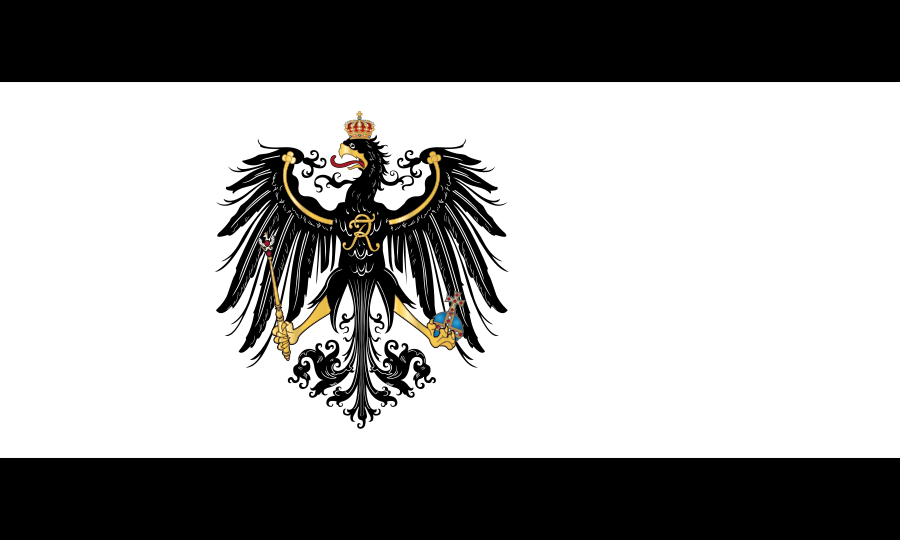
The full arms display the crowned black eagle bearing sceptre, orb and the cipher FR. Simpler forms of the eagle are used by ministries, courts and public corporations according to statute. The motto is Gott mit uns. The anthem is the Preußenlied.
Kingdom Day
Kingdom Day is observed on 18 January, the anniversary of the royal coronation at Königsberg in 1701. The commemoration combines constitutional ceremonies, provincial observances, military remembrance and public access to Crown properties. Modern observance treats military history critically: service and sacrifice remain part of public memory, while conquest, coercion and the unequal structures of the old state are taught rather than romanticised.
Berlin, Potsdam and Königsberg each host a different part of the observance. Berlin holds the parliamentary and governmental ceremonies, Potsdam the Crown and military memorial services, and Königsberg the rites associated with kingship and succession. The distribution prevents any one capital from claiming the whole meaning of the state.
The constitutional crisis of 2028
The present crisis began after the 2027 election returned a comfortable SPD-FVP-Zentrum majority to the Abgeordnetenhaus. Falk’s ministry treated the result as authority for a programme of democratic and social modernisation. The Advice-Binding Declaration became the first direct test because it addressed not policy but the source of executive authority itself.
The dismissal
The Regency Council concluded by six votes to three that the Declaration attempted to remove constitutional discretion reserved to the King without using the amendment process. It dismissed Falk and installed von Arnim as caretaker. Princess Charlotte, Queen Mother Caroline and the President of the Abgeordnetenhaus dissented. The parliamentary coalition refused to nominate replacement ministers or recognise the dismissal as creating a government entitled to pursue new policy.
Before the Court
Falk’s application asks the Prussian Constitutional Court to declare the dismissal void and restore her ministry. It argues that dual confidence does not permit the Crown to defeat an existing parliamentary majority over a dispute about constitutional convention; that a regency must exercise personal powers impartially and for protective rather than partisan purposes; and that covert coordination with the FKP/DRP and DKP compromised the Council’s decision.
The Council and caretaker answer that dismissal is expressly personal, exempt from countersignature and textually available whenever royal confidence is withdrawn. They argue that the Advice-Binding Declaration attempted to accomplish by executive statement what could lawfully be done only by constitutional amendment.
The Court has accepted jurisdiction and required full disclosure. It has rejected a general claim of Crown confidentiality over the Council’s Prussian deliberations. Its interim order allows essential administration to continue but prevents irreversible appointments, a new legislative programme, changed Bundesrat instructions and other acts that would allow the caretaker to determine the merits through accomplished facts.
Political alignment
Until October 2028 the political alignments were stable. The SPD, FVP and Zentrum demanded Falk’s restoration. The NLP supported reinstatement on constitutional grounds. The USPD gave critical support while pressing for more complete democratisation. The FKP/DRP accepted temporary stewardship and said the Court’s eventual ruling must control. The DKP defended the Council’s power despite the leaked evidence of Alexander’s opposition. The Polnische Fraktion remained neutral on the dismissal while opposing delay to provincial and language administration. The Zentrum’s withdrawal on 3 October broke the alignment.
Public demonstrations have been large and peaceful. Berlin and much of the industrial west favour the dismissed coalition; conservative rural districts and parts of the eastern provinces are more supportive of the Council, with substantial variation inside every province. The Reichstag has debated the effect of the Prussian dispute on imperial government, and the Bundesrat is constrained because Prussia’s delegates may follow only their existing instructions.
Alexander accepted disclosure of the Council record and regarded the Constitutional Court as the lawful institution capable of protecting both democratic government and the Crown. He stated no view on the merits. Privately he favoured a narrow result restoring Falk while preserving dismissal for a demonstrable constitutional emergency, never an ordinary policy dispute, which is close to the judgment the Court gave. His early-rule campaign remains unresolved.
The judgment
On 9 October 2028 the Court gave judgment. It held the dismissal void: the Crown’s power to withdraw confidence from a Minister-President who retains the confidence of the House is a safeguard against the breakdown of lawful government, and a dispute about the extent of the Crown’s discretion is not such a breakdown. It also held the Advice-Binding Declaration of no legal force: a convention may bind in practice but cannot be made binding in law by a ministry’s declaration, and the Crown’s discretion is what the written Constitution says until the Constitution is amended. Both sides claimed the judgment. Falk was restored and von Arnim’s appointment lapsed, his acts in the interval standing, but the Zentrum had left the coalition six days earlier. The next day the Landtag and the imperial parliament abolished the Regency Council and made Princess Charlotte sole Regent, and she dissolved the House on Falk’s advice. The crisis continues under the main article.
Trivia
- In-Universe Berlin remains legally within Brandenburg despite exercising province-like powers under its capital charter. It is not a thirteenth province and does not receive a separate five-member delegation in the Herrenhaus.
- In-Universe Princess Charlotte is older than Alexander I but is not first in the succession. The 2015 absolute-primogeniture reform was prospective and preserved the order already established by Alexander's birth in 2014.
- In-Universe Prussia supplies about fifty-five percent of German active forces but holds only thirty percent of Bundesrat votes. Military scale and federal voting weight are deliberately not identical.
- Real-World The historical Wilhelm II does not exist in this timeline because Queen Victoria was assassinated before the birth of the Princess Royal. The Wilhelm II who reigned from 1957 to 1989 is a different member of the alternate Hohenzollern line.
See also
- Alexander I, German Emperor, the minor sovereign whose recorded opposition to Falk’s dismissal reshaped the crisis
- German Empire, the federal state of which Prussia is the largest constituent kingdom
- Kingdom of Hanover, the Welf kingdom preserved from Prussian annexation in 1866
- Duchy of Brunswick, the separate Welf duchy within the same federal order
- The First Great War, after which Prussia adopted democratic franchise and developed dual confidence
- The Second Great War, including the fascist French advance and Battle for Berlin
- European Concert, the supranational European order in which Germany represents its constituent states
Prussia · German Empire · Hohenzollern · Constitutional Monarchy · Federalism · Regency · Foreign Nations